



Abstract
Despite evidence on the increasing centrality of moral approaches to leadership for extant employees, management research provides little guidance on whether and how prospective employees come to draw conclusions about such leadership in their employer choice. Therefore, this paper integrates authentic leadership into signaling theory to identify CEO sociopolitical activism—a public and costly expression of personal political values by a company's highest and most visible leader—as an effective signal that is interpreted by job seekers to evaluate the CEOs’ degree of authentic leadership. Three experiments, including a parallel design for causal mediation inferences, and a field survey support that authentic leadership attributions mediate the positive impact of CEOs’ activism on job seekers’ employer attractiveness evaluations and employer choice. This mediation is attenuated when the activist CEO's espoused political values are incongruent with those of the job seeker and when the CEO engages in activism due to customer pressure rather than personal convictions. These findings primarily contribute to signaling theory and the literature on authentic leadership. For practitioners, the paper identifies a unique leadership signal that can contribute to an employer brand while cautioning about the costs this signal might impose on companies’ diversity.
With an increased demand for meaningfulness through work, moral approaches to leadership have flourished (Aguinis & Glavas, 2019; Palanski et al., 2021; Podolny, Khurana, & Hill-Popper, 2004) and play a pivotal role in explaining employees’ evaluations of their work environments (Lemoine, Hartnell, & Leroy, 2019). In their employer choice, job seekers regularly anticipate these work environments (Breaugh, 2013; Chapman, Uggerslev, Carroll, Piasentin, & Jones, 2005; Uggerslev, Fassina, & Kraichy, 2012) and have likewise been found to increasingly strive to join employers whose leaders they perceive to be guided by values beyond profit (Edelman, 2021, 2022). Because of their limited access to and quality of information, job seekers need to rely on signals—that is, observable and costly pieces of communication by the employer that bridge this information asymmetry—to derive insights into such latent but relevant employer qualities (Bangerter, Roulin, & König, 2012; Connelly, Certo, Ireland, & Reutzel, 2011). Thus, effectively signaling that their leadership is guided by moral and not just economic values could likely help employers succeed in their “war for talent”—particularly as a pandemic leaves many companies struggling to fill vacancies (Waldmeir, 2021). Yet, despite the necessity to signal attractive work environments to job seekers (Breaugh, 2013; Rynes & Barber, 1990; Rynes, Bretz, & Gerhart, 1991) and decades of research documenting the fundamental impact of moral approaches to leadership on extant employees’ evaluations of these work environments (Avolio, Walumbwa, & Weber, 2009; Lemoine et al., 2019; Palanski et al., 2021), research has thus far neglected whether and how prospective employees might assess such leadership qualities in their employer choice.
In this paper, we integrate the literature on authentic leadership (AL; Gardner, Cogliser, Davis, & Dickens, 2011) into signaling theory (Spence, 1973, 1978) to illuminate the role of leadership signals and attributions in job seekers’ employer evaluations. Signaling theory informs us that, to effectively convey a latent quality such as leadership, a signal must be salient to the receiver (allowing observability) and costly to the sender (lending credibility to the signal) (Bangerter et al., 2012; Connelly et al., 2011; Rynes & Barber, 1990). We argue that a distinct moral approach to leadership that uniquely accommodates these signaling requirements lies in AL, defined as leaders’ awareness and unbiased processing of their thoughts and values and the transparent expression thereof in behaviors and social interactions even in the face of opposing external pressures and concomitant costs (Gardner et al., 2011; Walumbwa, Avolio, Gardner, Wernsing, & Peterson, 2008). AL thus uniquely emphasizes observable expressions of leaders’ personal values despite costs associated with these expressions (Lemoine et al., 2019; Weischer, Weibler, & Petersen, 2013). In this research, we hence specifically ask how employers can effectively signal AL to job seekers and how this affects job seekers’ employer attractiveness evaluations.
We propose CEO sociopolitical activism (CSA)—that is, a CEO's “personal and public expression of a stance on some matter of current social or political debate, with the primary aims of visibly weighing in on the issue and influencing opinions in the espoused direction” (Hambrick & Wowak, 2021: 34)—as such a signal. Despite foreseeable financial and personal disincentives, these activist CEOs make public value statements on controversial sociopolitical issues such as abortion or gun legislation and are frequently covered in the media (Bedendo & Siming, 2021; Bhagwat, Warren, Beck, & Watson, 2020; Hambrick & Wowak, 2021). We argue that CSA thus constitutes a salient and costly signal for CEOs’ willingness to transparently communicate their personal values even against opposing pressures. Job seekers will interpret this as redolent of AL increasing their intentions to seek work at the CEO's company, which they envision to offer a meaningful work environment characterized by consistent standards of morality and predictability in leaders’ decisions (Gardner et al., 2011; Gill & Caza, 2018). We theorize on two contingencies to this mediation. First, while job seekers will generally consider CSA as a signal of AL, they will do so to a lesser extent if their own political values are incongruent with the ones espoused in CSA. This occurs because, from the perspective of politically incongruent job seekers, the CEO's (albeit authentic) behavior is inconsistent with an orientation toward common goals and values expected from leaders (Sidani & Rowe, 2018; Steffens et al., 2021; van Knippenberg, 2011) jeopardizing the interpretation of CSA as reliably reflecting authentic leadership. Second, the reliability of CSA as a signal of AL diminishes if CEOs justify their activist stance on the basis of stakeholder demands rather than their own moral convictions because doing so is inconsistent with the robustness of external coercion required both from authentic leaders (Gardner et al., 2011) and credible signals (Connelly et al., 2011).
We test and find support for this moderated mediation framework in three between-subjects experiments, using an online labor platform as a field setting for job-seeking behavior (e.g., Burbano, 2016; Horton, Rand, & Zeckhauser, 2011; Radoynovska & Ruttan, 2021), and a field survey of current job seekers. In light of frequent methodological criticism of insufficient attention to causality in management research (e.g., Antonakis, Bendahan, Jacquart, & Lalive, 2010; Stone-Romero & Rosopa, 2008), in our first experiment, we simultaneously measure and manipulate the mediating process in a parallel design and thus allow for causal inferences between the independent, mediator, and dependent variables (Imai, Tingley, & Yamamoto, 2013; Pirlott & MacKinnon, 2016). In the three additional studies, we demonstrate the generalizability of our framework to real companies and employer evaluations (Study 2), different sociopolitical issues (Study 2, 3A, and 3B), liberal and conservative CEO stances (Study 3A), and alternative operationalizations of our key variables, including actual employer choice (Study 3B).
We thus particularly contribute to signaling theory and the recruitment literature by integrating insights from AL and showing that job seekers rely on salient and costly leadership signals such as CSA in their employer choice. In doing so, we contribute a distinct CEO behavior suited to signal AL to signaling theory and to the scarce literature on the behavioral antecedents of AL (Steffens, Mols, Haslam, & Okimoto, 2016; Weischer et al., 2013). We also complement current theory (Hambrick & Wowak, 2021) and empirical investigations (e.g., Burbano, 2021) of the microlevel impacts of CSA by providing evidence that, beyond concerns of political alignment, the nature in which these political values are expressed informs and influences stakeholders. For practitioners, this paper reveals that CSA can elicit favorable attributions of AL among job seekers but does so at a substantial cost to the company's inclusiveness and diversity.
Theory and Hypotheses
Research on moral approaches to leadership has burgeoned over the last decades, resulting in substantial evidence that such leadership is “not only necessary for the good of society but also essential for sustainable organizational success” (Avolio et al., 2009; Lemoine et al., 2019: 148; Palanski et al., 2021). Respective research describes both the impact of moral leadership in extant employees’ work environments (Avolio et al., 2009; Banks, McCauley, Gardner, & Guler, 2016; Lemoine et al., 2019) and how these employees arrive at respective leadership perceptions, as they, for example, compare their experiences with a focal leader to their implicit leadership theories or prototypes for leaders of a certain nature (e.g., successful, moral, authentic) (Junker & van Dick, 2014; Lord, Epitropaki, Foti, & Hansbrough, 2020). Matching the centrality of moral approaches to leadership in extant employees’ work environments, surveys indicate that, in their anticipation and evaluation of the qualities of a potential future work environment and subsequent employer choice (Breaugh, 2008, 2013; Chapman et al., 2005), prospective employees increasingly pay attention to the extent to which an employer appears to be led by moral values (Edelman, 2021, 2022). Yet, in sharp contrast to the accumulating knowledge on moral approaches to leadership in the context of extant employments (Avolio et al., 2009; Lemoine et al., 2019; Palanski et al., 2021), systematic theory or evidence on how prospective employees might arrive at respective attributions and how this process affects their ultimate employer choice remain absent. Because attracting talent and hence understanding their employer evaluations is of primary importance to business performance and survival (Breaugh, 2008, 2013; Ehrhart & Ziegert, 2005), we aim to resolve this mismatch between the likely relevance and our current understanding of how attributions of moral approaches to leadership—specifically of AL—arise in and affect the job-seeking process.
Signaling Theory and the Job-Seeking Process
We draw from signaling theory (Spence, 1973, 1978), which has become a prominent lens to understand how job seekers arrive at evaluations of latent employer qualities despite the inherent information asymmetry between employers and job seekers (Bangerter et al., 2012; Connelly et al., 2011; Rynes & Barber, 1990). Specifically, signaling theory posits that job seekers rely on salient (i.e., observable) and costly (i.e., credible by incurring a cost that only a sender truly endowed with the positive quality of interest is willing to bear) signals “that they receive from whatever information they do have to make inferences about working conditions and other organizational characteristics” (Bangerter et al., 2012; Celani & Singh, 2011; Jones, Willness, & Madey, 2014: 385). Extant research documents how, particularly in the early stages of their job search, job seekers interpret such signals, draw inferences on employers’ latent qualities, and select an employer based on their evaluations of these qualities (for reviews, see Breaugh, 2013; Celani & Singh, 2011; Lievens & Slaughter, 2016; Uggerslev et al., 2012). Examples of qualities included in this research are an employer's reputation, prosocial orientation toward employees, the prestige from an employment, and job advancement prospects that job seekers assess based on signals such as an employer's corporate social responsibility, executive demographics, recruiting materials, or awards (Alniacik, Alniacik, & Erdogmus, 2012; Jones et al., 2014; Moser, Tumasjan, & Welpe, 2017; Turban & Greening, 1997; Walker, Feild, Bernerth, & Becton, 2012; Wang, 2013). To some extent, the signals and qualities job seekers primarily attend to vary over time as certain qualities become more (or less) meaningful to them (Aguinis & Glavas, 2019; Jones, Willness, & Heller, 2016; Twenge, 2010) and corresponding signals—like gender-inclusive job ad wording (Gaucher, Friesen, & Kay, 2011) or a company's social media activities (Carpentier, van Hoye, & Weijters, 2019)—become available. Yet, despite decades of evidence for an increasing centrality of moral approaches to leadership in employees’ work environments (Avolio et al., 2009; Lemoine et al., 2019; Palanski et al., 2021; Podolny et al., 2004), respective job market signals remain devoid of theoretical or empirical attention.
Integrating Authentic Leadership Attributions and Signaling Theory
We explicitly draw from the signaling requirements of costliness and salience to create an understanding of how respective leadership signals and subsequent attributions impact job seekers’ employer evaluations and choice. 1 Specifically, while these requirements might appear somewhat opposed to the idea of personal and mutually beneficial leader-follower interactions integral to many moral approaches to leadership (Avolio et al., 2009; Brown, Treviño, & Harrison, 2005; Lemoine et al., 2019), they match one moral approach to leadership in particular: AL. AL draws from Kernis’s (2003: 1) original characterization of authenticity as “the unobstructed operation of one's true, or core, self in one's daily enterprise” and incorporates that, ultimately, “it is followers’ understanding (including their perceptions of leaders as more or less authentic) and their subsequent actions that account for leaders’ impact in the world at large” (Steffens et al., 2016: 728), such that leaders are authentic to the degree that they are perceived as such by followers (Gardner et al., 2011; Sidani & Rowe, 2018). Thus, AL uniquely emphasizes the open expression of leaders’ self despite concomitant costs as well as followers’ perceptions thereof (Gardner et al., 2011; Lemoine et al., 2019), matching the observability and costliness required from effective signals. Specifically, individuals evaluate the degree of AL along four dimensions (Gardner et al., 2011; Walumbwa et al., 2008): (1) self-awareness (i.e., understanding one's positive and negative attributes and their impact on others), (2) relational transparency (i.e., presenting one's undistorted self by openly sharing information and one's true thoughts and feelings), (3) balanced processing (i.e., objectively analyzing relevant information before making decisions and the solicitation of challenges to one's own positions), and (4) internalized moral perspective (i.e., being guided by personal and internalized moral standards and values even when these incur costs due to external pressures). These four dimensions are mutually reinforcing and have repeatedly been found to explain most variance when operationalized with AL as an overarching second-order factor (Avolio, Wernsing, & Gardner, 2018; Steffens et al., 2016; Walumbwa et al., 2008).
Although a substantial body of research documents the impact of AL on a wide variety of follower-, leader-, and performance-related outcomes (for recent reviews, see Cha et al., 2019; Gill & Caza, 2018; Lehman, O’Connor, Kovács, & Newman, 2019; Lemoine et al., 2019), antecedents of AL are comparably under-researched: In their initial review, Gardner et al. (2011) identified only one significant antecedent of AL—namely, leaders’ psychological capital. Since then, leaders’ explicit and implicit self-esteem (Randolph-Seng & Gardner, 2013), self-knowledge and self-consistency (Peus, Wesche, Streicher, Braun, & Frey, 2012), emotional intelligence (Miao, Humphrey, & Qian, 2018), and gender (Monzani, Hernandez Bark, van Dick, & Peiró, 2015) have been identified as leader dispositions anteceding AL. In contrast, even when taking into account more distal streams of literature (Alilyyani, Wong, & Cummings, 2018; Zhang et al., 2021), 2 distinct leader behaviors that ultimately give rise to AL attributions among observers remain poorly understood, and calls for more attention to these antecedents are frequent (Cha et al., 2019; Lehman et al., 2019; Leroy, Anseel, Gardner, & Sels, 2015). Indeed, we could only identify two papers addressing behavioral antecedents of AL attributions, specifically, personal value enactments through storytelling (Weischer et al., 2013) and the championing of followers’ interests (Steffens et al., 2016)—both of which can, however, be incorporated into various distinct behaviors.
CEO Sociopolitical Activism as a Signal of Authentic Leadership
Building on AL and signaling theory, we hence propose CSA as an effective signal for AL. Activist CEOs take “a stance on some matter of current social or political debate, with the primary aims of visibly weighing in on the issue and influencing opinions in the espoused direction” (Hambrick & Wowak, 2021: 34). Generally, CEOs are increasingly covered in the news and other media (Park & Berger, 2004) such that their behavior is often considered a readily available signal for external stakeholders such as investors or the media (Bergh, Ketchen, Orlandi, Heugens, & Boyd, 2019; Connelly et al., 2011). However, CSA stands out in particular as the addressed sociopolitical issues such as abortion or immigration policy lack moral consensus, involve biased information processing, and feature evolving viewpoints and issue salience (Nalick, Josefy, Zardkoohi, & Bierman, 2016). Because of the involved controversy, CSA is frequently covered in the media and comes at the cost of antagonizing stakeholders, including investors (Bedendo & Siming, 2021; Bhagwat et al., 2020; Hambrick & Wowak, 2021), making it an easily observable, costly, and thus effective signal (Connelly et al., 2011).
Moreover, while the microlevel impacts of CSA have mostly been investigated along identification processes triggered by stakeholders’ political (mis)alignment with the CEO's espoused views (Burbano, 2021; Hambrick & Wowak, 2021; Wowak, Busenbark, & Hambrick, 2022), CSA not only signals CEOs’ distinct political values but also their understanding of how to incorporate these values into their role as a company's highest leader. Specifically, we argue that CSA qualifies as behavior that effectively signals elevated degrees of AL along its four dimensions: First, given their managerial expertise and knowledge about stakeholder relations, it can safely be assumed that, prior to their activist stance, CEOs are aware that their political values are their own and might not be unanimously supported by stakeholders, some of who will subsequently ascribe negative attributes to them (Hambrick & Wowak, 2021; Nalick et al., 2016). Such behavior is reflective of self-awareness. Second, activist CEOs enact relational transparency by openly presenting their political convictions to their stakeholders rather than distorting their public self and resorting to more disclosed means such as lobbying (Hambrick & Wowak, 2021). Third, CSA typically involves official letters or statements in which CEOs carefully deliberate on their position and make an informed argument that evokes discourse among the public (Bhagwat et al., 2020; Chatterji & Toffel, 2018; Nalick et al., 2016). Activist CEOs thus invite (and often realize) challenges to their positions, reflecting elevated levels of balanced processing. Finally, the issues addressed in CSA are typically unrelated to the company's operations (Nalick et al., 2016; Wettstein & Baur, 2016), and CEOs engage in CSA despite financial disincentives (Bedendo & Siming, 2021; Bhagwat et al., 2020). Many activist CEOs argued that they “knew there would be backlash” (Dantes, 2018) and some even challenged shareholders to sell their shares if they disagreed with a respective position (Shankleman, 2014). Hambrick and Wowak (2021: 42) therefore conclude that CSA “is so personal and so risky that a CEO must have at least a glimmer of inner conviction before taking such a stand, especially a vivid stand,” such that these CEOs are likely perceived as driven by an internalized moral perspective. In sum, activist CEOs saliently champion a sociopolitical cause for personal convictions and despite concomitant costs, allowing job seekers to utilize this behavior as a salient and costly signal for the relevant but latent employer quality that is the CEO's degree of AL. Therefore: Hypothesis 1 (H1): CSA is positively associated with job seekers’ AL attributions to the CEO.
In turn, we expect that attributions of AL will increase job seekers’ desire to pursue work at the focal company. As companies’ highest upper echelons and “quintessential boundary-spanning agent[s]” (Hambrick & Wowak, 2021: 47), CEOs’ leadership is influential in shaping organizational life both in practice (Berson, Oreg, & Dvir, 2008; Finkelstein, Hambrick, & Cannella, 2009; Hood, 2003) and in outsiders' expectations (Bligh, Kohles, & Pillai, 2011; Meindl, 1995). Indeed, upper echelons’ approach to leadership has repeatedly been found to trickle down to and affect employees across organizational levels and departments (e.g., Greenbaum, Babalola, Quade, Guo, & Kim, 2021; Mayer, Kuenzi, Greenbaum, Bardes, & Salvador, 2009; Schaubroeck et al., 2012) such that it should be informative for job seekers from various career levels and functional backgrounds who seek to anticipate their future work environments. Moreover, strong strategic leadership (Alniacik et al., 2012; Biswas & Suar, 2016) and, in the context of hybrid organizations, organizational authenticity (Radoynovska & Ruttan, 2021) have been found to positively contribute to job seekers’ employer evaluations. Finally, since AL, in particular, is associated with a multitude of follower benefits, ranging from job satisfaction to personal health (Banks et al., 2016; Gardner et al., 2011; Gill & Caza, 2018), we expect that CSA increases company's employer attractiveness to the degree that it is perceived as an expression of CEOs’ AL. This yields the following mediation: Hypothesis 2 (H2): CSA is positively associated with job seekers’ employer attractiveness evaluations via AL attributions to the CEO.
The Moderating Role of Political (In)Congruence
As noted by Connelly et al. (2011: 54), “signaling effectiveness is determined in part by the characteristics of the receiver” as these affect the interpretation of a given signal (e.g., DeGrassi, 2019; Highhouse, Thornbury, & Little, 2007; Jones et al., 2016). In the focal context, job seekers’ political values likely influence the degree to which CSA is interpreted as a reliable signal of AL along our framework. This is because, whereas authenticity is not judged against the moral content of the self-expressions as “‘to thine own self be true’ is resolute in its indifference to moral postures” (Kernis, 2003; Sparrowe, 2005: 424), some degree of value congruence is regularly required for followers to attribute AL to their leaders (e.g., Banks et al., 2016; Steffens et al., 2016; Weischer et al., 2013)—a finding which has been critically discussed due to its discrepancy with Kernis’s (2003) morally resolute conceptualization of authenticity (Algera & Lips-Wiersma, 2012; Alvesson & Einola, 2019; Gardner, Karam, Alvesson, & Einola, 2021).
However, AL involves not just authenticity but also leadership, which adds the requirement that (prospective) followers perceive a leader to promote common values and lead a group toward a shared goal (Sidani & Rowe, 2018; Steffens et al., 2021; van Knippenberg, 2011). This is likewise reflected in the conceptualization of AL in that “an authentic relationship” rests on “shared and complementary goals” derived from “deeply held and overlapping values” (Avolio & Gardner, 2005: 327; Gardner et al., 2011) such that “an authentic person's behavior cannot be labeled as ‘leadership’ unless it is embraced by a follower who grants moral legitimacy to the leader” (Sidani & Rowe, 2018: 630). Given the controversial nature of the subjects addressed in CSA, we contend that, as their political incongruence rises, job seekers will interpret CSA as a signal of authenticity but no longer one reliably indicating authentic leadership as, for these job seekers, the CEO is not oriented toward joint goals and values—much the opposite. We hence expect that such job seekers attribute lower levels of AL to an activist CEO but not to an extent that would display the CEO as an inauthentic person, such that political incongruence attenuates the positive impact of CSA on AL attributions but does not reverse it: Hypothesis 3 (H3): Political incongruence will attenuate the impact of CSA on AL attributions and, thus, its mediated effect on job seekers’ employer attractiveness evaluations.
The Moderating Role of Stakeholder Pressure
Sets of signals can convey inconsistent information to receivers which decreases the signals’ reliability and hence effectiveness (e.g., Connelly et al., 2011; Drover, Wood, & Corbett, 2018; Pernkopf, Latzke, & Mayrhofer, 2021). We adopt these insights and acknowledge that even the same signal can incorporate inconsistencies, making the focal signal less reliable in the eyes of the receiver. Specifically, the hypothesized signaling mechanism rests on the premise that CEOs are perceived to engage in CSA for their own convictions. While most CEOs indeed claim credible personal motives in their activist statements (Hambrick & Wowak, 2021; Nalick et al., 2016), some use less personal justifications (Branicki, Brammer, Pullen, & Rhodes, 2021). For example, Marc Benioff, CEO of Salesforce, repeatedly claimed that his activism does not reflect his own beliefs but those of his employees (Steinmetz, 2016), and Whataburger's CEO Preston Atkinson (2015) pointed toward customer demands in his opposition to open gun carry. Therefore, Nalick et al. (2016) conclude that, while most activist CEOs likely act upon their personal political beliefs, a second-best explanation for CSA is pressure from stakeholders, particularly as stakeholders increasingly expect CEOs to engage in CSA (Edelman, 2021, 2022).
However, such “de-personalized” activism (Branicki et al., 2021: 278) breaks with the central premise of AL (and corresponding signals) that leaders ought to be true to themselves and unaffected by external coercion. That is, while authentic leaders are open to input from their stakeholders and particularly their followers, they exclusively champion these values or interests if they correspond to their own (Gardner et al., 2011; Walumbwa et al., 2008). As such, compared to personally motivated CSA, CSA referring to stakeholder demands should reduce the reliability of CSA as reflective of AL and thus jeopardize the positive indirect effect of CSA on job seekers’ employer evaluations via AL attributions. Therefore: Hypothesis 4 (H4): Compared to CSA based on personal convictions, referring to stakeholder demands will attenuate the impact of CSA on AL attributions and, thus, its mediated effect on job seekers’ employer attractiveness evaluations.
Empirical Approach
Overview of Studies
To test our hypotheses, we combine three field experiments and one field survey. 3 This triangulation of methods allows us to address unique sets of questions in each study while compensating the weaknesses of one particular approach with the strengths of another. At the highest level, our experiments address issues of causality while the field survey speaks to issues of generalizability (Antonakis et al., 2010; Podsakoff & Podsakoff, 2019). In our primary experiment, participants react to a CEO supporting women's abortion rights. This first study serves the primary purpose to establish the accurate causal order of the proposed independent, mediating, and dependent variables. We do so by conducting a parallel design (Imai et al., 2013; Pirlott & MacKinnon, 2016) in which the mediator is randomly measured (and thus endogenous) or manipulated (and thus exogenous). Study 2 employs a field survey in which we leverage a sample of current job seekers’ extant beliefs about an employer of their choice. Thus, this study ensures that the hypothesized associations not only play out when experimentally stimulated but also in job seekers’ real-world evaluations. In Study 3A, we experimentally confirm the generalizability of the proposed framework for liberal- and conservative-leaning CSA on a different sociopolitical issue: open gun carry. We further manipulate whether a company's employees urged the CEO to take the respective stand. In Study 3B, participants actively choose (or reject) their employer in an experiment rather than stating their employer preferences to address concerns related to the meaningfulness of scale-based measures of employer attractiveness. Moreover, we manipulate whether the company's customers pressured the CEO to become activist respectively to remain neutral on another sociopolitical issue: bathroom bills.
In each study, we performed principal component analyses for the multi-item measures to ensure that the average variance extracted of each construct is greater than the highest squared correlation between the constructs, meeting the guideline of the Fornell-Larcker criterion for discriminant validity (Fornell & Larcker, 1981), and obtained indirect effects using Preacher and Hayes’s (2008) bootstrapping approach in Hayes’s (2018) PROCESS macro with 5000 bootstrap resamples and 95% confidence intervals. An overview of the studies and their findings is provided in Figure 1. In the web appendix, we provide additional information on the addressed sociopolitical issues (W1), the applied scales and their reliability (W2), and the additional analyses mentioned below (W4–W7).
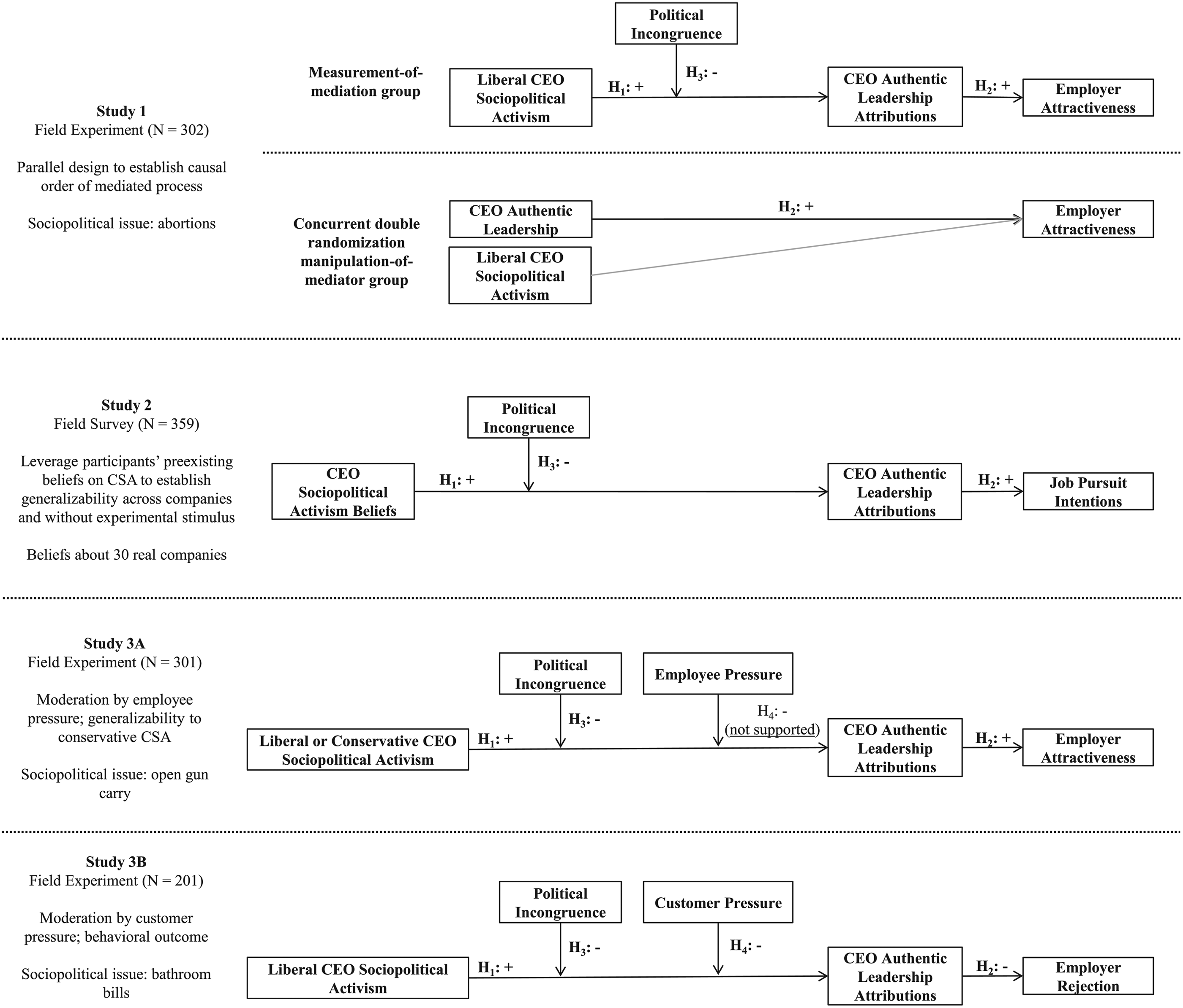
Overview of Hypotheses and Studies
Rationale of the Experiments
In Studies 1, 3A, and 3B, we employ experiments to reflect signaling theory's emphasis on the causal primacy of the focal signal (cf. Colquitt, 2008). Experiments have long been described as the “gold standard” and “failsafe way to generate causal evidence,” (Antonakis et al., 2010: 1086) with some authors arguing that they are the exclusive method to definitively rule out the most common sources of endogeneity (Hill, Johnson, Greco, O’Boyle, & Walter, 2021; Podsakoff & Podsakoff, 2019). This is particularly crucial for our framework, which involves mediation and thus requires establishing causality not only between independent and dependent variables but also along the mediating paths (Spencer, Zanna, & Fong, 2005; Wood, Goodman, Beckmann, & Cook, 2008). We conduct our experiments on the online labor platform Prolific Academic. The use of these platforms has flourished for management research in general (Aguinis & Lawal, 2012; Aguinis, Villamor, & Ramani, 2021; Bolinger, Josefy, Stevenson, & Hitt, 2022) and as field settings for job-seeking behavior in particular, as platforms' users are observed in a natural setting in which they actively search for employment creating “natural labor-market contexts in which to study worker-hirer interactions” (Burbano, 2016: 1113; Horton et al., 2011) without compromising internal validity or ethical principles (e.g., if job seekers were led to apply for a nonexistent job) (e.g., Antonetti, Crisafulli, & Tuncdogan, 2021; Burbano, 2016; Radoynovska & Ruttan, 2021). Among the various online-labor platforms, Prolific has been recommended in particular as participants are comparably more naive and attentive than, for example, those on Amazon Mechanical Turk (Peer, Brandimarte, Samat, & Acquisti, 2017).
In our experiments, we created situations in which participants knew that they could work for different employers (as is the case in reality) and then assessed one specific employer from that population. To do so, a job was advertised on Prolific in which participants were informed that they would be randomly allocated to one of multiple possible employers that would pay them for a market research task—a typical task on Prolific, which preserves mundane realism by leveraging the natural abundance of market research tasks on Prolific rather than placing participants in an artificial context. Upon starting the job, participants initially reported their age and gender “to form well-balanced samples for each company.” All participants were then allocated to the same company, which “produces and sells a range of consumer products such as toothbrushes and other personal hygiene products.” Afterward, participants were randomly assigned to one of the treatment conditions of the experiment (see Web Appendix W3 for each experiment's treatment materials).
Study 1
Procedure and Sampling
In our primary experiment, we apply a parallel design (Imai et al., 2013) that combines a measurement-of-mediation design (MMD) with a concurrent double randomization manipulation-of-mediator design (CDMD). Participants are randomly assigned to one of two separate studies that assess the same mediation model. In the MMD group, only the treatment variable (CSA) is manipulated while the mediator (AL attributions) and outcome variable (employer attractiveness) are measured. While this common approach allows for the computation of indirect effects, “a statistically significant indirect effect does not, on its own, imply causation,” because the causal direction of the path from the mediator to the dependent variable can merely be assumed (Podsakoff & Podsakoff, 2019: 22; Spencer et al., 2005; Wood et al., 2008). To accommodate this critical threat to causality, in the CDMD group, both the treatment and the mediator are manipulated (and hence exogenous), while the outcome variable is measured. 4
Our parallel design is thus equivalent to a 2 × 3 between-subjects experiment in which CSA (activist vs. neutral) and the CEO's AL (low vs. high vs. no manipulation-of-mediator) are manipulated. In the MMD group, we manipulate whether a CEO spoke out against recent legislation banning abortion in his company's home state or, instead, remained silent on the issue. Participants of this group do not receive additional information about the CEO's AL. In the CDMD group, we additionally manipulate the mediator, that is, the CEO's degree of AL (low vs. high): After receiving the information on whether the CEO became activist on the abortion ban, participants in this group are presented with additional information on the focal CEO's degree of AL using the vignettes developed by Cianci, Hannah, Roberts, and Tsakumis (2014). Specifically, participants are informed of a recent external assessment of the CEO's leadership. In this assessment, the focal CEO is described as having characteristics typical of a leader high (e.g., “the CEO emphasizes the need for everyone on his team to speak their mind and frequently displays his own true emotions”) or low (e.g., “the CEO does not emphasize the need for everyone on his team to speak their mind and his true emotions are difficult to read”) in AL.
After receiving the treatments, all participants fill out a survey reporting the employer attractiveness of their allocated company, the degree of AL of the CEO, their political views, and their demographics. Our sample consists of 302 U.S. citizens of whom 51.8% reported being female, 44.2% male, and 4.0% non-binary. Our average participant was 31 years old (range: 18–73 years), held a bachelor's degree, and was slightly more liberal than conservative (M = 2.75 on a 7-point liberal-conservative differential).
Measures
We assess participants’ evaluations of their allocated employer's attractiveness along two measures. First, we asked participants whether they were satisfied with their allocated employer using three items (α = 0.95; e.g., “I am satisfied with working for this company”). We further added an item asking whether the allocation occurred within less than 5 seconds to increase realism. Second, we measured their job pursuit intentions along an established five-item scale (α = 0.96; Highhouse, Lievens, & Sinar, 2003). We measured AL attributions using the 14-item Authentic Leadership Inventory 5 (ALI; Neider & Schriesheim, 2011) and, in line with extensive scale analyses (Avolio et al., 2018; Neider & Schriesheim, 2011; Steffens et al., 2016), computed its higher-order solution (α = .96) for our analyses. We also measured CEO authenticity attributions by adopting eight items of Kernis and Goldman’s (2006) authenticity inventory (KGAI; α = .93). For each dimension of authenticity, we selected the two items with the highest factor loadings as reported by Bond, Strauss, and Wickham (2018). Next, we asked respondents to self-identify on a liberal-conservative semantic differential as the “single most useful and parsimonious way to classify political attitudes for more than 200 years” (Jost, 2006: 654). In our main analyses, we use their conservatism as a proxy for their political incongruence with the CEO's liberal stance but also asked for participants’ agreement with the CEO's position in a single item (thus capturing value congruence).
Pretest for Manipulation Success
In a pretest with 51 Prolific respondents, we ensured that our treatments work as intended. ANOVAs reveal that participants who received the CSA treatment correctly reported that the CEO “openly opposed the abortion ban” (MCSA = 6.56, Mcontrol = 1.15; F(1, 49) = 662.643, p = .000) rather than preferring “to remain neutral on the issue of abortion” (MCSA = 1.44, Mcontrol = 6.77; F(1, 49) = 576.322, p = .000). The AL treatments (Cianci et al., 2014) did not affect these items but correctly predicted participants’ mean score across the ALI items (MLow = 2.40, MHigh = 5.71; F(2, 48) = 40.690, p = .000). We hence conclude that the treatments worked as intended.
Hypothesis Testing
Descriptive and correlational information on our variables is provided in Table 1. We perform a series of regressions, which we report in Table 2. H1 predicts that CSA will generally increase AL attributions among participants, which we confirm in the MMD group (β = 2.42, p = .000). H2 predicts that this association mediates the impact of CSA on employer attractiveness. Therefore, we first ensure that, in the CDMD group, the AL treatments indeed cause the change in employer attractiveness. A significantly positive effect of the high AL treatment on employer attractiveness (β = 2.49, p = .000) lends support for a causal relationship. Moreover, the nonsignificant interaction of the CSA treatment and the treatment for high AL supports the appropriateness of a mediation over a moderation model—a relevant threat given the simultaneous manipulations in parallel designs (Imai et al., 2013; Pirlott & MacKinnon, 2016). Therefore, we use PROCESS model 4 to test the mediation in the MMD group. A positive indirect effect (β = 2.46 [1.79; 3.13]) supports H2. 6
Means, Standard Deviations, and Correlations of Study 1
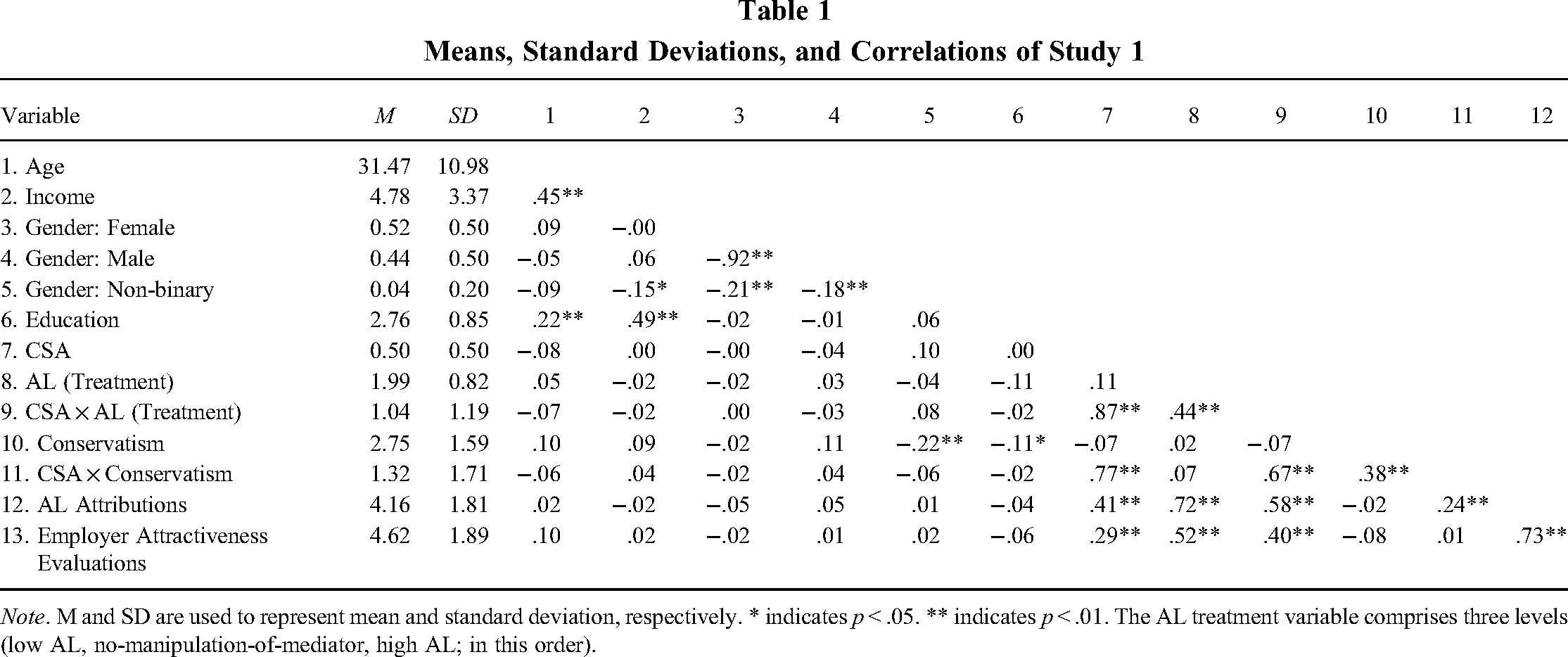
Note. M and SD are used to represent mean and standard deviation, respectively. * indicates p < .05. ** indicates p < .01. The AL treatment variable comprises three levels (low AL, no-manipulation-of-mediator, high AL; in this order).
Regression Results of Study 1
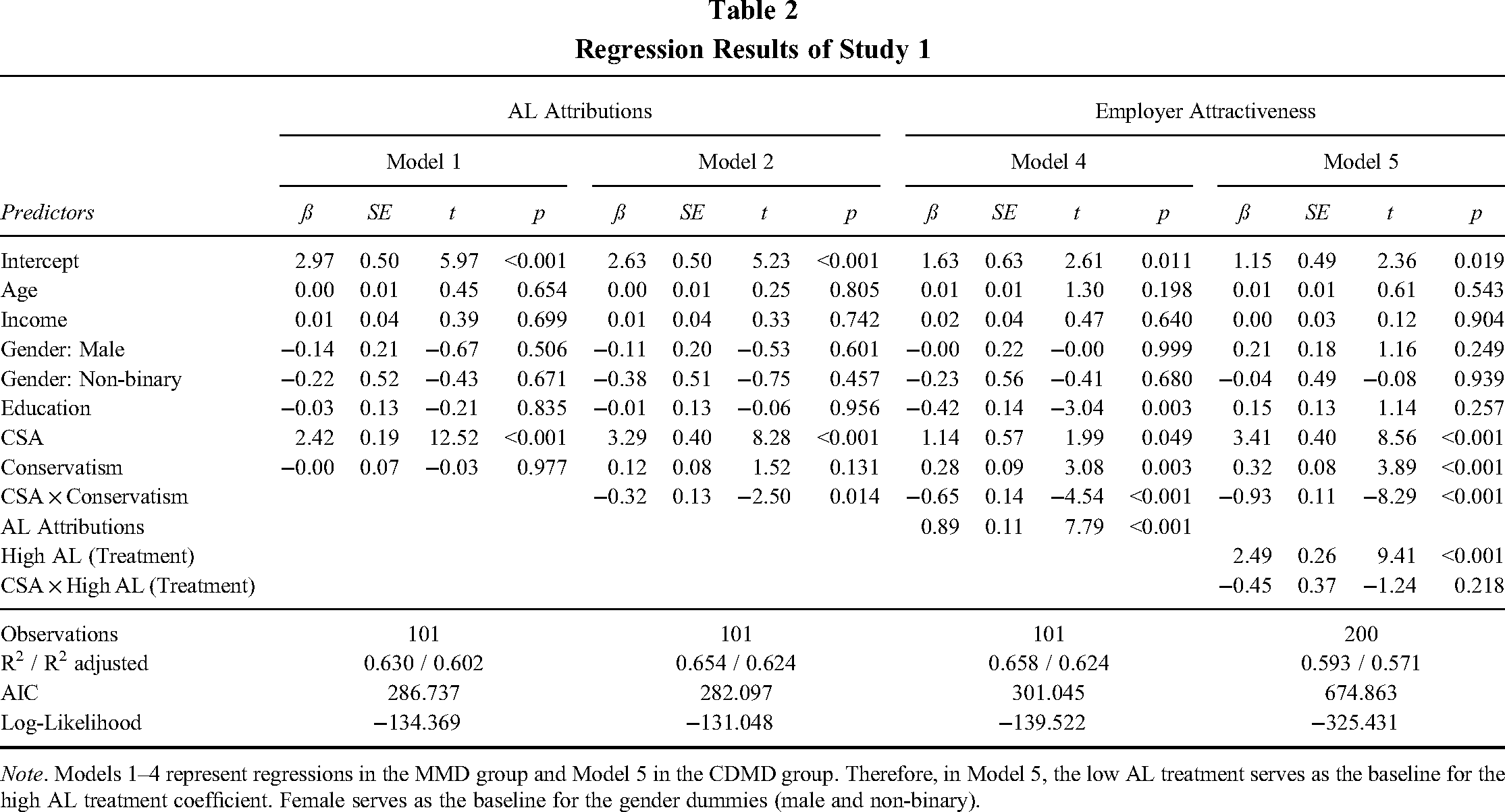
Note. Models 1–4 represent regressions in the MMD group and Model 5 in the CDMD group. Therefore, in Model 5, the low AL treatment serves as the baseline for the high AL treatment coefficient. Female serves as the baseline for the gender dummies (male and non-binary).
H3 predicts that the positive impact of CSA on AL attributions is attenuated by participants’ political incongruence, which is supported by a negative interaction of the CSA treatment and participants’ conservatism (β = −.32, p = .014). In line with our argumentation, plotting the marginal effects reveals that higher political incongruence decreases the impact of CSA on AL attributions but that the effect does not drop below zero (see Figure 2). We hence apply PROCESS model 8 to test a moderated mediation in the MMD group. In this model, participants’ conservatism moderates both CSA's impact on AL attributions and on employer attractiveness to statistically incorporate that the direct effect of CSA on employer attractiveness is likely reversed for those job seekers who agree respectively disagree with the position—all results are robust to the exclusion of this interaction term. Supporting H3, the indirect effects are likewise significant and positive but diminishing as indicated by a significantly negative index of moderated mediation (β = −.28 [ − .52; − .05]).
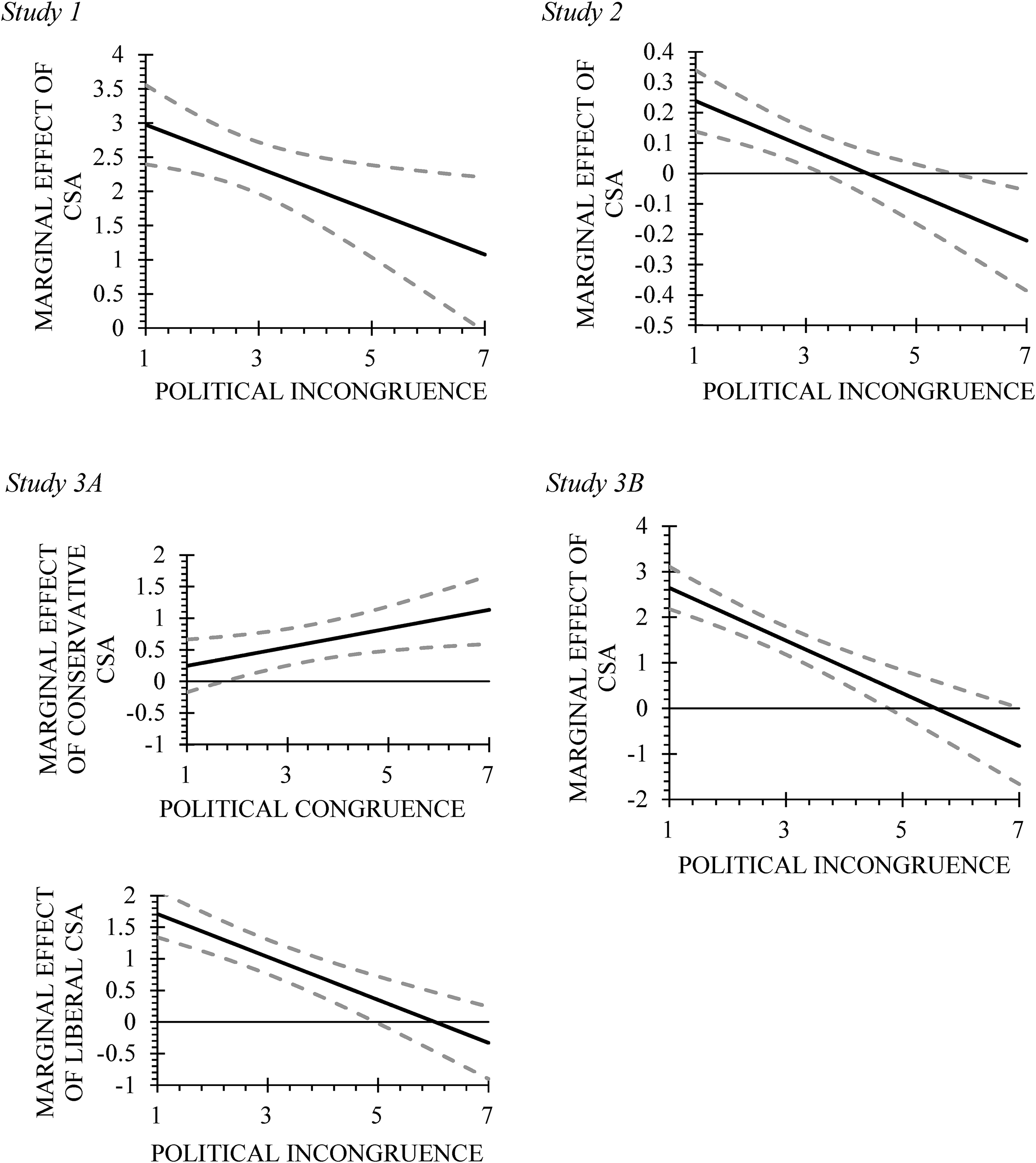
Marginal Effects of CSA on AL Attributions Contingent on Political (In)congruence
Additional Analyses
To ensure the robustness of the above findings, we use several alternative specifications of our variables and analytical procedures that we report in Web Appendix W4. Specifically, our results remain consistent when we run the regressions in the full dataset (i.e., integrating the MMD and CDMD groups), use an established measure for job pursuit intentions (Highhouse et al., 2003) instead of our context-specific scale for employer attractiveness evaluations, or use participants’ agreement with the CEO's position on abortion to capture value congruence. Finally, we applied the shortened form of the KGAI (Bond et al., 2018; Kernis & Goldman, 2006) as a measure for CEO authenticity. Our data reveals that, while political incongruence moderates the effect of CSA on AL attributions measured along the ALI, it does not moderate the effect of CSA on authenticity attributions measured by the KGAI. The basic mediation (H1 and H2) is supported in both operationalizations. This corroborates the reasoning behind H3—that is, that political incongruence between the CEO and a job seeker attenuates the attribution of authentic leadership but not authenticity per se.
Discussion of Study 1
In our primary study, we find that participants attribute AL to activist CEOs and that this causally explains a substantial portion of any positive impact of CSA on employer attractiveness. However, experiments are frequently criticized for preserving internal validity at the cost of external validity (Lonati, Quiroga, Zehnder, & Antonakis, 2018). Specifically, the controlled environment of experiments allows for the generalization of the inferences only if the treatments accurately manipulate the variable of interest (ensured in pretests) and the treatments are representative of the class of manipulations they aim to represent (Highhouse, 2009). Therefore, we accommodate that there might be nuances that remain uncaptured by our experimental treatments and, in Study 2, rely on job seekers’ preexisting beliefs about employers rather than inducing specific experiences via treatments. We also shed light on some of these nuances by varying the sociopolitical issues and ideological leaning of the stance as well as explicitly manipulating stakeholder pressure as a contingency of the proposed effects (Studies 3A and 3B).
Study 2
Procedure and Sampling
In this second study, we emulate the empirical setups of Jones et al. (2014) and Wang (2013) by surveying job seekers about a prospective employer, which participants initially select from a list of companies to mirror that job seekers must be generally interested in a specific employer before engaging in conscious assessments of that employer's qualities. Following Jones et al. (2014), participants are randomly asked to select their top employer choice or one toward the bottom of their realistic employer choices to ensure variance in the job pursuit variable. To also increase variance in our independent variable, we initially selected 15 companies whose CEOs were prominently featured in current publications on CSA (Branicki et al., 2021; Chatterji & Toffel, 2018; Hambrick & Wowak, 2021; Nalick et al., 2016). For each of these companies, we selected one industry competitor that appeared not to have engaged in as prominent CSA, yielding a list of 30 employers (see Web Appendix W5a for additional information on the company selection, its audit, and an overview of the included companies).
We prescreened Prolific user profiles and recruited 465 users who had stated in their profiles that they are currently actively looking for new permanent employment. To ensure that this status was still active at the point of participation, we asked participants for their job-seeking status as part of the survey and subsequently dropped observations of 106 participants who indicated that they are no longer looking for a new employer. Thus, our final sample consists of 359 active job seekers from the United States, representing a mix in gender (59.6% female, 37.6% male, 2.8% non-binary), age (range: 18–78 years), and political ideology (M = 3.27 on a 7-point liberal-conservative differential).
Measures
We apply the higher-order solution of the ALI (α = .92; Neider & Schriesheim, 2011) and Highhouse et al.’s (2003) measure of job pursuit intentions (α = .93). To capture job seekers’ CSA beliefs concerning the selected company's CEO, we used a continuous 3-item scale (α = .95; e.g., “I believe that the CEO of [the company] frequently speaks out on controversial political issues”) in our main analyses. Additionally, we asked participants whether they remember a distinct instance of CSA by the focal company's CEO. Those who answered “yes” further reported whether they remembered the topic addressed in the specific instance of CSA and, if so, what it was about as well as their agreement with the espoused position. 7 Our inferences are robust to using this dichotomous operationalization as the independent variable (Web Appendix W5d). To capture political incongruence, we asked participants for their stance on the liberal-conservative continuum (Jost, 2006) and computed a measure of conservatism by asking them about their support for respectively opposition to 11 political issues and groups such as Black Lives Matter (α = .92; cf. Kidwell, Farmer, & Hardesty, 2013; Nail, McGregor, Drinkwater, Steele, & Thompson, 2009). We reversed these measures for the 20 participants who chose Chick-fil-A as their employer. We did so because, reflecting the predominance of liberal-leaning CSA (Bhagwat et al., 2020; Hambrick & Wowak, 2021), it is the only company on our list with a track record of conservative-leaning CSA, such that the reversed conservatism measure (reflecting liberalism) captures political incongruence for this case. 8 In our main analyses, we use the latter issue-based measure of conservatism, but results remain virtually unchanged when using the single-item operationalization (Web Appendix W5e). We also included a series of control variables that we positioned as filler scales creating proximal and topical separation between our variables of interest, reducing the risk of common method bias (Johnson, Rosen, & Djurdjevic, 2011; Podsakoff, MacKenzie, Lee, & Podsakoff, 2003). Specifically, participants report whether they had worked at the chosen company before, their familiarity with the company's CEO, and their demographics, as well as their expectations concerning instrumental employment characteristics along three multi-item scales (α > .90; Lievens, 2007; Lievens & Highhouse, 2003). 9
Hypothesis Testing
We report descriptive and correlational information on the measures in Table 3 and the regression results in Table 4. In support of H1, participants’ CSA beliefs are positively associated with AL attributions to the CEO (β = .08, p = .012) that, in turn, positively predict participants’ job pursuit intentions (β = .16, p = .014). We hence use PROCESS model 4 to test H2, finding a positive indirect effect (β = .02 [.001; .04]) linking CSA beliefs and job pursuit intentions via AL attributions. Finally, in line with H3, the positive association of CSA and AL attributions is offset as participants’ degree of conservatism rises (β = −0.08, p = .000; see Figure 2), which likewise attenuates the indirect association of CSA and job pursuit intentions, indicated by a negative index of moderated mediation (β = −0.01 [ − .03; − .002] calculated in PROCESS model 8.
Means, Standard Deviations, and Correlations of Study 2
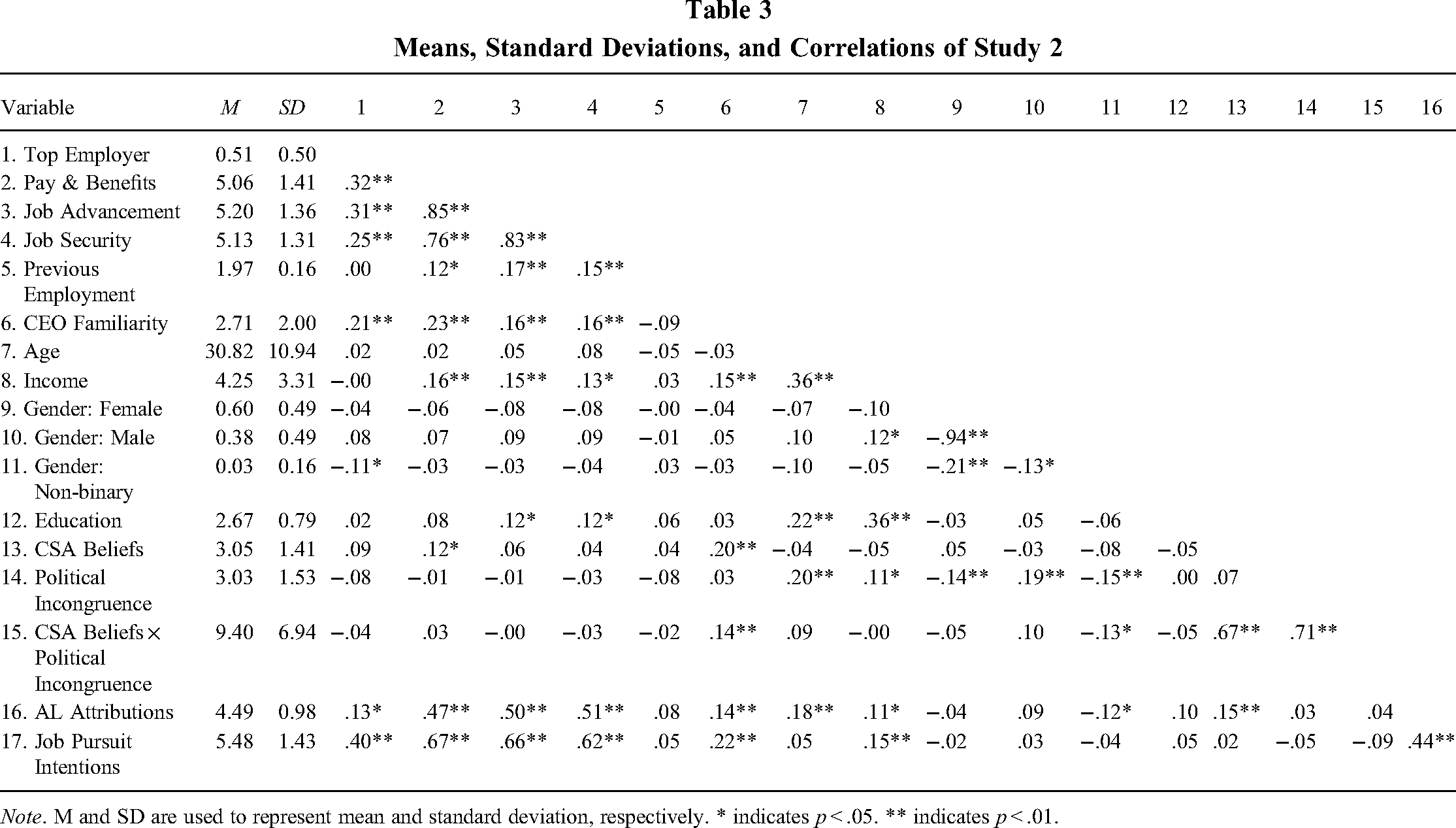
Note. M and SD are used to represent mean and standard deviation, respectively. * indicates p < .05. ** indicates p < .01.
Regression Results of Study 2
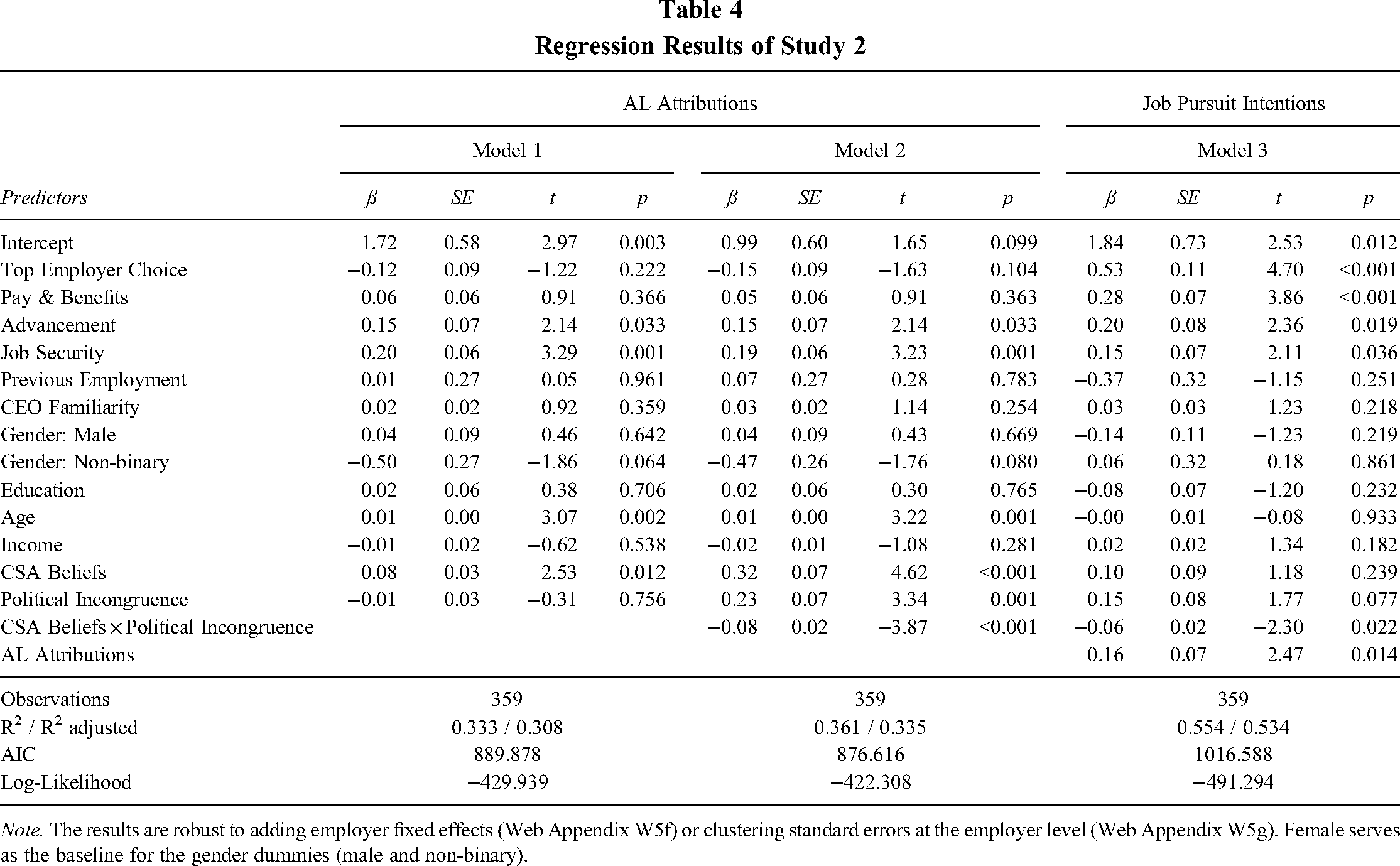
Note. The results are robust to adding employer fixed effects (Web Appendix W5f) or clustering standard errors at the employer level (Web Appendix W5g). Female serves as the baseline for the gender dummies (male and non-binary).
Discussion of Study 2
This second study serves the primary purpose to establish external validity and thus to complement the experimental evidence. Indeed, we find that, despite the fundamental complexity and multidimensionality of real employer evaluations, the belief that an employer's CEO engages in CSA positively relates to respective AL attributions and, thus, job pursuit intentions.
Study 3A
Having established the causal relationship of CSA, AL attributions, and employer attractiveness evaluations (Study 1) as well as the external validity of these associations (Study 2), Study 3A serves the primary purpose to, first, test H4 by manipulating whether the company's employees pressured the CEO into taking or abstaining from a stance. Second, to allow for further generalization of the model, we evaluate reactions to liberal- and conservative-leaning CSA on an alternative sociopolitical issue: open gun carry. Third, due to the parallel design of Study 1, only a limited number of participants was allocated to the MMD group. Therefore, in Study 3A, a larger sample is used to assess indirect effects.
Procedure and Sampling
The setup follows the MMD of Study 1. We manipulate whether the allocated employer's CEO recently took a supporting (conservative), opposing (liberal), or neutral stand on recent legislation that “would allow employees of sensitive places such as schools and government buildings to openly carry firearms.” Further, in his justification, the CEO either referred to his own political values (personal condition) or to employees who came forth asking him to take the respective position (pressure condition). As such, the experiment employs a 3 (conservative vs. liberal vs. neutral) × 2 (personal vs. pressure) between-subjects design. Our sample consists of 301 U.S. citizens who were recruited via Prolific and represent a mix of genders (49.7% female, 49.0% male, and 1.3% non-binary). The average participant was 36 years old (range: 18–74 years), held a bachelor's degree, and had a slightly more negative attitude toward open gun carry (M = 3.18 on a 7-point negative-positive semantic differential).
Measures
We use the same measures as in Study 1 for employer allocation satisfaction (α = .91), job pursuit intentions (α = .95; Highhouse et al., 2003), and AL attributions (α = .86; Neider & Schriesheim, 2011). We use our self-constructed employer attractiveness scale as the main dependent variable, but results are robust to using the measure by Highhouse et al. (2003) (Web Appendix W6a). We directly ask for participants’ attitude toward the focal issue of open gun carry (very negative–very positive) in a single item as a measure of political (in)congruence.
Pretest for Manipulation Success
In a pretest, 77 Prolific workers correctly observed that the CEO “supported open gun carry” in the conservative-condition (Mconservative = 6.26, Mliberal = 2.33, Mneutral = 2.73; F(2, 74) = 39.741, p = .000), “opposed open gun carry” in the liberal-condition (Mconservative = 1.70, Mliberal = 5.71, Mneutral = 2.73; F(2, 74) = 37.398, p = .000), and remained neutral in the neutral-condition (Mconservative = 1.59, Mliberal = 2.38, Mneutral = 6.46; F(2, 74) = 76.445, p = .000). These items were unaffected by the pressure treatments that exclusively explained whether participants reported that, in his stance, the “CEO responded to the wishes of his employees” (Mpersonal = 2.00, Mpressure = 5.20; F(1, 75) = 76.267, p = .000).
Hypothesis Testing
Descriptive and correlational information on the measures can be found in Table 5. In the regressions reported in Table 6, the neutral condition is used as the baseline to which the impacts of the liberal and conservative CSA treatments are compared. Supporting H1, both the liberal (β = 1.16, p = .000) and the conservative CSA treatment (β = .85, p = .000) increase AL attributions on average. We test H2 and H4 by applying model 8 of the PROCESS macro and entering the employee pressure condition as the moderator. In the personal condition, indirect effects are positive and significant for both liberal (β = 1.06 [.62; 1.55]) and conservative (β = .77 [.37; 1.22]) CSA. The employee-pressure condition does not moderate the impact of CSA on AL attributions in the liberal condition but, to a marginal extent, in the conservative CSA condition (β = −.53, p = .084). The indirect effects of liberal (β = .86 [.51; 1.25]) and conservative (n.s. [ −.09; .70]) CSA decrease in this condition, directionally supporting H4, but the index of moderated mediation suggests that this change is not significant. We also run a PROCESS model 4 while controlling for the employee pressure condition. This reveals a positive net indirect effect for liberal (β = .92 [.64; 1.25]) and conservative (β = .53 [.26; .84]) CSA on employer attractiveness perceptions. Overall, these results support H2 but only lend directional support for H4.
Means, Standard Deviations, and Correlations of Study 3A
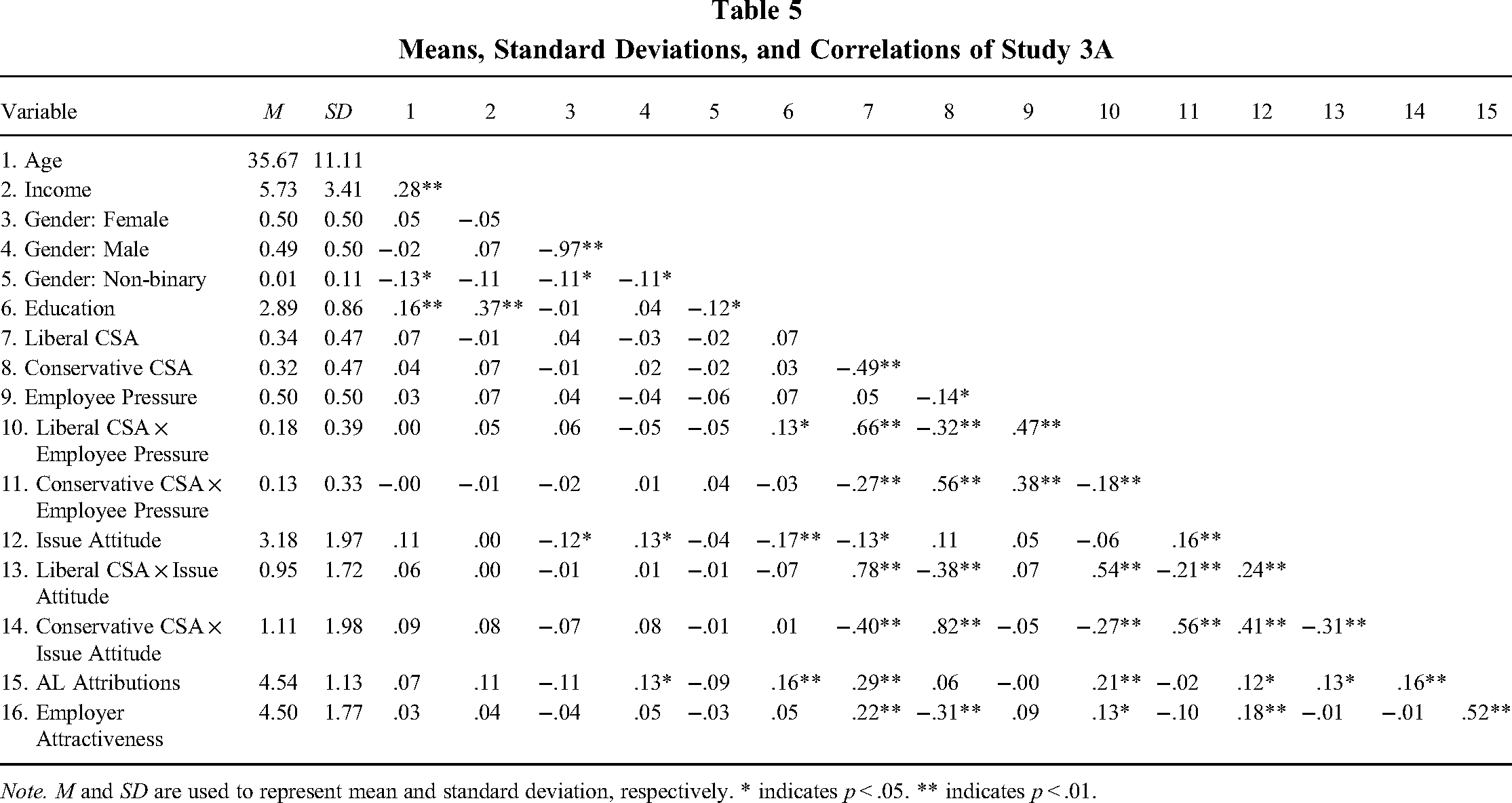
Note. M and SD are used to represent mean and standard deviation, respectively. * indicates p < .05. ** indicates p < .01.
Regression Results of Study 3A
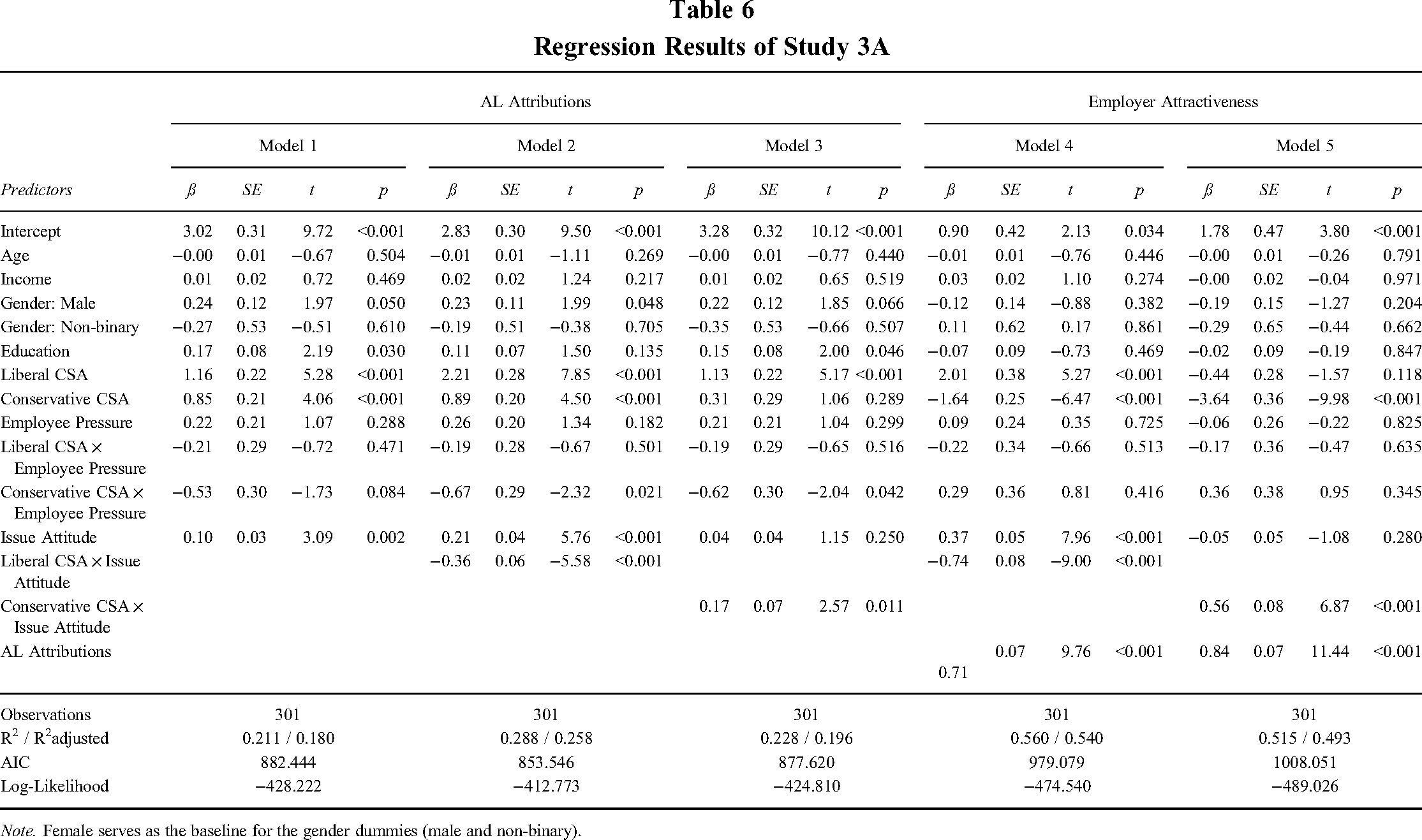
Note. Female serves as the baseline for the gender dummies (male and non-binary).
We test H3 individually for each CSA treatment. The interaction of participants’ attitudes toward open gun carry and the CSA treatment positively predicts AL attributions in the conservative condition (β = .17, p = .011) and negatively in the liberal condition (β = −.36, p = .000) (see Figure 2 for marginal effects). We test the indirect effects using model 8 of the PROCESS macro in which we add each CSA treatment as the independent variable while controlling for the other CSA and the employee-pressure condition. Indirect effects for the liberal treatment decrease as the attitude toward open gun carry grows more positive, indicated by a significantly negative index of moderated mediation (β = −.24 [ − .35; − .14]). That is, previously positive indirect effects turn insignificant (but not negative) as participants’ attitudes toward open gun carry grows more positive. For conservative CSA, the index of moderated mediation is positive (β = .12 [.02; .23]) such that the mediation is insignificant for those with a very negative attitude toward open gun carry but grows significantly positive as that attitude rises. In sum, we find support for H3.
Discussion of Study 3A
In Study 3A, H1 through H3 are supported for a novel sociopolitical issue, open gun carry, and regardless of whether the CEO took a liberal or conservative stand on respective legislation. However, we did not find convincing support for H4, which suggested that job seekers should attribute more AL to CEOs claiming personal values to guide their CSA rather than stakeholder demands, specifically those of employees. One potential explanation is that, while the essence of AL is the honest expression of the leader's own moral convictions (Sparrowe, 2005; Weischer et al., 2013)—the insight guiding our theorizing—AL involves a degree of responsiveness to followers (Gardner et al., 2011) and, sometimes, the championing of their interests (Steffens et al., 2016). Thus, the perception that a CEO did not stand up for his or her own convictions might reduce AL attributions while the perception that the CEO champions followers’ interests might have increased them, yielding the insignificant net effect. However, the proposed association of H4 might be more evident if the stakeholders from which the pressure originates are external.
Study 3B
Study 3B serves three purposes: First, we investigate whether H4 is supported when the stakeholder pressure for CSA originates from customers (rather than employees), filling the gap created by Study 3A. Second, we leverage the study design to measure employer choice rather than stated preferences to alleviate potential concerns surrounding scale-based assessments of employer preferences (Lonati et al., 2018). Finally, we use yet a different sociopolitical issue, transgender rights, to further increase our framework's generalizability.
Procedure and Sampling
The general setup follows that of Study 3A. We manipulate whether the CEO recently opposed or remained neutral on the introduction of a bathroom bill. Bathroom bills are described to restrict the use of public bathrooms to people of the corresponding biological sex such that transgender people could no longer use the bathroom of their choice. Participants are then randomly assigned to one of four treatment groups representing a 2 (activist vs. neutral) × 2 (personal vs. pressure) between-subjects design. In the scenarios, we manipulate whether the CEO claimed to be guided by his own moral convictions or responded to customer pressure in his decision to (not) engage in the issue. Subsequently, participants have the option to select a different employer to support with their work. As in a real employer search situation, this incurs the cost of having to read through another employer's description. Participants subsequently provide feedback on their decision by reporting their AL attributions to the first company's CEO. Those who wished to be reallocated are then introduced to an alternative company as their employer. As their work task, they report their political views and demographics. We recruited 201 participants aged between 18 and 70 years (M = 32) who represent a mix of genders (52.7% female, 46.3% male, and 1.0% non-binary). A total of 65.7% of our participants held a high school degree or higher qualification, and they were, on average, slightly more liberal than conservative (M = 2.90 on a 7-point liberal-conservative differential).
Measures
Participants’ choice not to work for the activist CEO's company but to select a different employer is captured in a binary variable that we call employer rejection (equal to 1 if a participant chooses a different employer; hence, regressions are logistic). We operationalize AL attributions as the higher-order solution of the ALI (α = .87; Neider & Schriesheim, 2011). Participants also report their political conservatism on a 7-point liberal-conservative scale and their positive attitude toward “transgender people using the bathroom of their choice.” In our primary analysis, we use participants’ political conservatism to capture political incongruence, but our results are robust to using the attitude-based measure (Web Appendix W7a).
Pretest for Manipulation Success
We ensure that our treatments worked as intended in a pretest with 40 Prolific workers. ANOVAs reveal that participants correctly extrapolated whether “the CEO openly opposed the bathroom bill” (MCSA = 6.35; Mneutral = 2.40; F(1, 38) = 78.685, p = .000) and whether, “with his position, the CEO responded to customer pressure” (Mpersonal = 2.05, Mpressure = 6.00; F(1, 38) = 83.454, p = .000). The treatments only affected the targeted items and thus worked as intended.
Hypothesis Testing
Descriptive and correlational information is provided in Table 7 and regression results in Table 8. The CSA treatment increases AL attributions to the CEO (β = 1.99, p = .000), supporting H1. To test H2 and H4, we apply model 8 of the PROCESS macro and enter the customer pressure condition as the moderator. Reflecting an attenuating impact of the pressure condition on AL attributions (β = −.87, p = .010), the CSA treatment has a significant and negative indirect effect on participants’ employer rejection in the personal (β = −2.26 [ −4.06; −1.31]) and, to a lower extent, the pressure (β = −1.28 [ −2.41; −.64]) condition. The index of moderated mediation is positive and significant (β = .98 [.22; 2.28]), supporting both H2 and H4.
Means, Standard Deviations, and Correlations of Study 3B
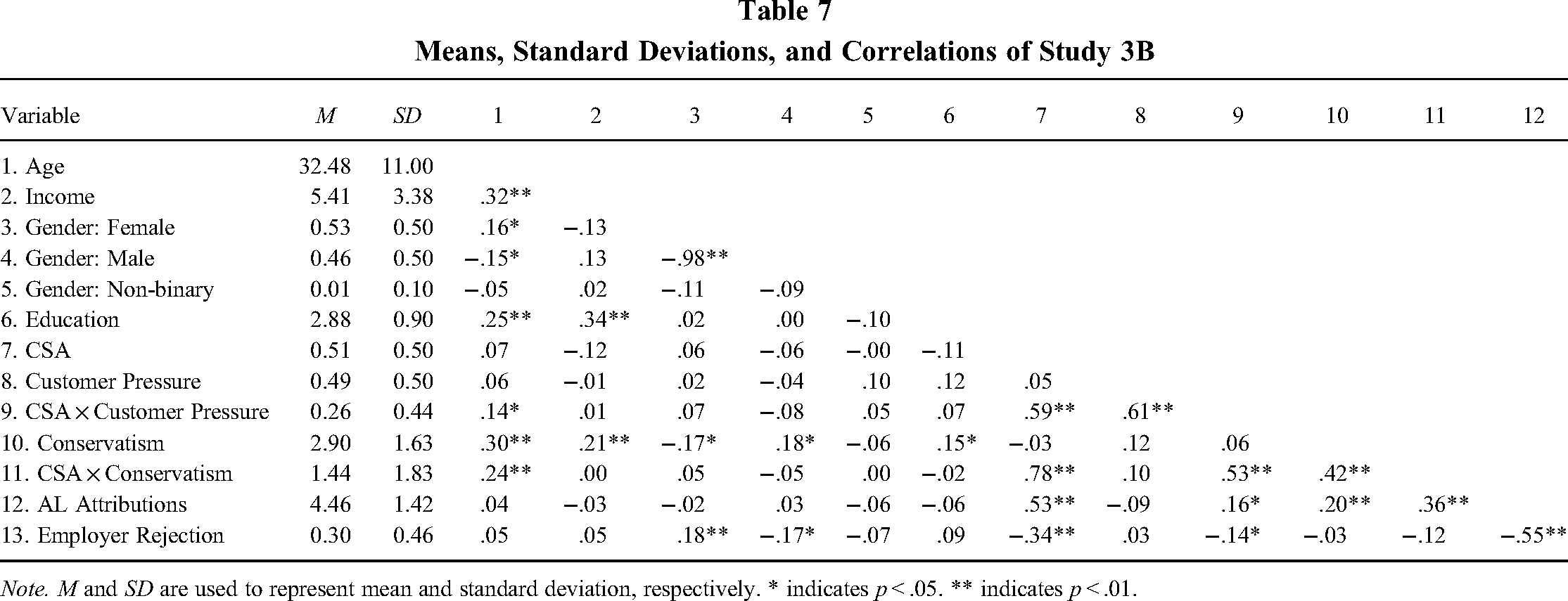
Note. M and SD are used to represent mean and standard deviation, respectively. * indicates p < .05. ** indicates p < .01.
Regression Results of Study 3B
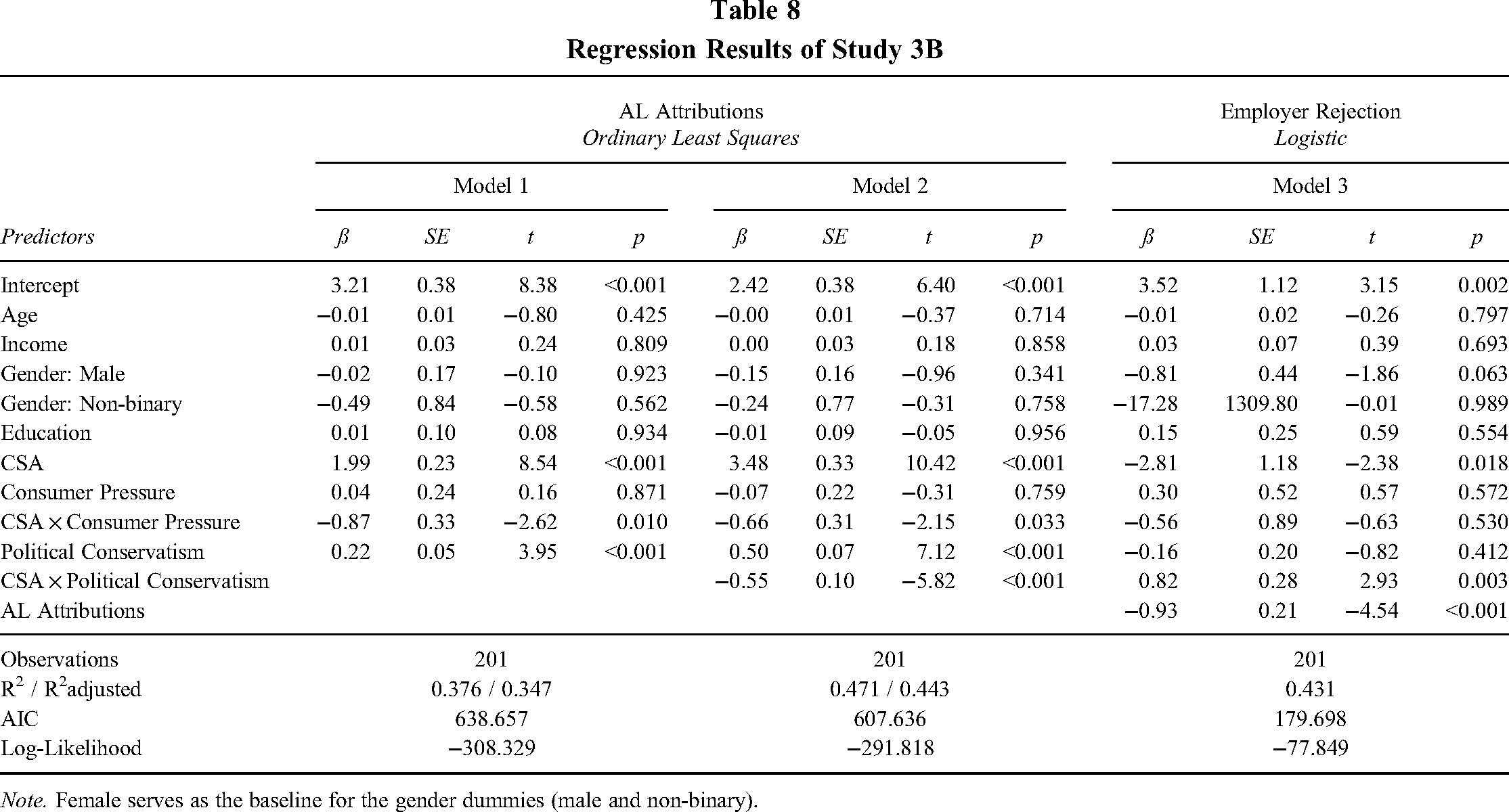
Note. Female serves as the baseline for the gender dummies (male and non-binary).
AL attributions following CSA decrease as conservatism rises (β = −.55, p = .000; see Figure 2). We, therefore, add participants’ political conservatism as the moderator to a PROCESS model 8 while controlling for the personal vs. pressure condition. Supporting H4, CSA's indirect effect on employer rejection via AL attributions is initially negative but grows more positive as conservatism rises, reflected in a significant and positive index of moderated mediation (β = .53 [.26; 1.07]). Overall, we find full support for our hypotheses.
General Discussion
In three field experiments and one field survey (see Figure 1 for an overview of studies and findings), this research provides evidence that job seekers utilize CSA as a salient and costly signal for CEOs’ degree of AL and that this guides their subsequent employer preferences. Further, while job seekers generally attribute AL to activist CEOs, they do so to a lesser extent if their own political values are incongruent with the ones espoused in CSA or if the CEO engages in CSA as a response to customer (but not employee) pressure. While, on their own, each of our studies would be vulnerable to criticism concerning dimensions of internal or external validity, together, they allow for confidence in the hypothesized framework (Antonakis et al., 2010; Podsakoff & Podsakoff, 2019) and have several implications for theory and practice.
Theoretical Implications
Despite the relevance of signaling attractive work environments to job seekers (Breaugh, 2013; Rynes et al., 1991; Rynes & Barber, 1990) and decades of research documenting the increasing importance of moral approaches to leadership in these environments (Lemoine et al., 2019; Palanski et al., 2021; Podolny et al., 2004), management research has thus far neglected that job seekers might utilize signals to assess such leadership qualities in their employer choice. Therefore, we integrate the literature on AL into signaling theory along their shared focus on observable and costly behaviors to provide evidence that job seekers indeed use leadership signals such as CSA in their employer choice. By building and holistically testing this moderated mediation framework, we likewise address calls for more rigor concerning the causal mechanisms through which signals affect outcomes that remain “rarely tested, or even specified conceptually” (Connelly et al., 2011; Jones et al., 2014: 385). Further, in management research, the sender of signals is typically encouraged and assumed not to send negative signals to outsiders except by accident (Connelly et al., 2011). Yet, our findings suggest that sometimes signaling negative information to some receivers can constitute the necessary cost, granting credibility to the signal.
Our research also contributes to the literature on AL. We directly speak to calls for (especially experimental) research “clarifying the influence of attribution and perceptual processes on the creation of authentic leader–follower relationships” (Gardner et al., 2011: 1129; Sidani & Rowe, 2018; Yammarino, Dionne, Schriesheim, & Dansereau, 2008) by illustrating the causal process through which behavioral signals give rise to attributions of AL prior to entering a leader-follower relationship. Moreover, despite the prominence of AL, the behavioral antecedents of AL attributions remain under-researched, leaving much to be learned about how followers come to “authenticate the leader” (Cha et al., 2019; Gardner, Avolio, Luthans, May, & Walumbwa, 2005: 348; Gardner et al., 2011). In this regard, we show how signaling theory's salience and costliness requirements can lend theoretical guidance for identifying behaviors suited to convey AL (such as CSA). Moreover, the controversy contained in CSA provides a fertile ground to inform the debate on leader-follower value congruence in AL (Algera & Lips-Wiersma, 2012; Alvesson & Einola, 2019; Sidani & Rowe, 2018). Leveraging this context, we show how some receivers interpret the same behavior as a more or less reliable signal of AL depending on the degree of its match with their conception of what an authentic leader (rather than an authentic person) should behave like—which includes the orientation toward joint goals and values (Avolio & Gardner, 2005; Sidani & Rowe, 2018; Steffens et al., 2021). Indeed, we find that the impact of CSA is moderated by value congruence for AL but not for authenticity attributions, empirically supporting the argument that it is the attributed authentic leadership—and not authenticity per se—that is affected by value (in)congruence.
Finally, we contribute to the emerging literature on CSA. In their theoretical framework, Hambrick and Wowak (2021) emphasize the role of alignment between the political views espoused in CSA and those of employees and consumers in explaining subsequent outcomes via identification processes. We complement this perspective by suggesting that not only the content of CEOs’ political expressions but also the manner in which these values are expressed informs subsequent stakeholder reactions—after all, most CEOs hold distinct political values (Chin, Hambrick, & Treviño, 2013) but only some of them choose to make them known in such a vivid and costly way as CSA. Hence, the manner of CSA (e.g., whether it originates in personal convictions or customer pressures) appears central in explaining its impact and providing actionable guidance to practice. Moreover, while previous research has painted a more dismal picture of CSA's impact on interactions with consumers than proposed by Hambrick and Wowak (2021) (Mukherjee & Althuizen, 2020) and provides mixed support for their arguments on employee reactions (Burbano, 2021; Wowak et al., 2022), 10 our findings suggest that to the degree it is perceived an expression of AL, CSA could benefit companies’ talent acquisitions (also see Voegtlin, Crane, & Noval, 2020). Although, as we detail in our practical implications, CSA nonetheless poses substantial risks to companies’ talent acquisition and diversity on average, we thus identify not just how an alternative stakeholder group is affected by CSA but also an alternative perspective suited to explain any positive impact that CSA might have on stakeholder reactions. In this vein, there is a growing interest for upper echelons research (Hambrick & Mason, 1984) to identify the intermediary roles and cognitive processes of stakeholder groups that interpret and react to behavioral manifestations of CEO characteristics, thus mediating these characteristics’ ultimate impact on firm outcomes (e.g., König, Mammen, Luger, Fehn, & Enders, 2018; Neely, Lovelace, Cowen, & Hiller, 2020; Wowak, Gomez-Mejia, & Steinbach, 2017). We highlight job seekers as such a group of stakeholders that, based on observations of single CEO behaviors (CSA), adapt their interaction with the firm (seek employment) based on what they deem true about a focal CEO's characteristics (AL). Due to job seekers’ general interest in and reliance on easily observable leader behaviors—like those of CEOs—in their employer choice, organizational outcomes attributable to this stakeholder group (e.g., companies’ access to talent) may be particularly influenced by behavioral manifestations of upper echelons’ dispositions more generally.
Practical Implications
For practitioners, this research describes how a company's employer brand is affected by CSA and identifies levers that shape its impact. On the one hand, our findings suggest that CEOs can promote a sociopolitical cause and benefit their firms’ employer brand to the degree that their CSA is perceived as an expression of AL such that CEOs might, for example, want to base their activism on personal convictions rather than customer demands. On the other hand, because this impact depends on the credibility of CSA, its increasingly strategic use could cast doubt on its authenticity since “misleading signals . . . proliferate until receivers learn to ignore them” such that eventually “dishonest signals do not pay” (Connelly et al., 2011: 45). Moreover, while secondary to our theoretical arguments, the interactive effect of CSA and job seekers’ political incongruence on employer attractiveness evaluations and employer choice was negative across our studies. Thus, achieving AL attributions through CSA comes at the risk of alienating job seekers (and possibly extant employees, cf. Bermiss & McDonald, 2018) who, apart from their political values, might well fit the company and job, adversely affecting the available talent pool's and, ultimately, the staff's diversity. Thus, the cost of achieving AL attributions through CSA may be very high for companies and, given the potential of CSA to further polarize the already heated political landscape (Edelman, 2021, 2022), even for society.
Limitations and Future Research
In general, our empirical approach was guided by the interest in methodological triangulation and accommodating one study's weaknesses with the strengths of another (Podsakoff & Podsakoff, 2019). For example, the variables in Study 2 were not manipulated and hence not exogenous, limiting the internal validity of these findings, which is accommodated by the random assignment of the experimental conditions in the other studies (Hill et al., 2021). Vice versa, each experiment's treatments might be nongeneralizable, which is accommodated by, on the one hand, varying these treatments across the experiments and, on the other hand, relying on participants’ extant beliefs rather than experimental manipulations in Study 2 (Highhouse, 2009; Podsakoff & Podsakoff, 2019). Yet, in all studies, the samples consist of citizens from the United States where CEOs’ political involvement is more common (Hambrick & Wowak, 2021) and accepted (Edelman, 2021, 2022) than in many other countries. Citizens of countries in which such interference is less appreciated or common might either be more hesitant to attribute positive leadership qualities such as AL based on a CEO's political interference or, vice versa, consider it particularly exceptional, increasing its signaling effectiveness (Connelly et al., 2011). Overall, we hence wish to reiterate calls to consider how the same behavior might signal AL in some contexts but not in others (Palanski et al., 2021; Steffens et al., 2016) and propose countries’ variation along the above dimensions as exemplary contingencies shaping the interpretation of CSA as a signal of AL.
Moreover, future research could investigate whether CSA's efficacy to signal AL to job seekers is generalizable to and impactful for the behavior of other internal and external stakeholders. For example, compared to job seekers, extant employees can draw from a wider array of information in assessing their CEO's leadership (e.g., personal interactions, internal communications, or gossip). How do previous experiences with their CEOs’ leadership factor into the interpretation of CSA as reflective of AL? CEOs that are already considered authentic leaders by employees might only marginally increase these attributions via CSA, whereas refraining from CSA might violate employees’ expectancies toward authentic leaders. Vice versa, it is questionable whether CEOs who did not appear particularly authentic in their leadership thus far could evoke AL attributions via CSA or whether this behavior would, instead, incur hypocrisy attributions (cf. Cha et al., 2019). A related question is whether nonemployee stakeholders who are not as directly affected by a company's leadership (e.g., customers or infomediaries) are likewise motivated to infer CEOs’ AL from CSA and incorporate these inferences into their interactions with the firm. More generally, understanding the relevance of leadership signals for and attribution processes among different stakeholder groups is a promising avenue for future research and could further contribute to alleviating the “relational black box” surrounding executive leaders’ impact on stakeholder behaviors (Neely et al., 2020: 1037). Since, as previously discussed, the risks and likely downsides of signaling AL through CSA are substantial, this research could likewise identify less risky signals for positive leadership qualities, including AL. For example, job seekers and other stakeholders might utilize publicly available interviews with CEOs to infer their characteristics (cf. Hill, Petrenko, Ridge, & Aime, 2019), and research could assess whether distinct behaviors in these interviews are particularly potent in signaling certain leadership qualities.
The literature on implicit leadership theories—that is, individuals’ “implicit assumptions of (good) leaders” (Junker & van Dick, 2014: 1154) containing the “attributes and behaviors shared by different types of leaders” (Lord et al., 2020: 51)—might offer an encompassing basis for future research into leadership attributions following CSA and other leadership signals: Which (ideal) types of leaders would an observer expect to engage in CSA? The answer to this question likely depends on various contingencies that could be further expounded upon, such as the distinct manner in which CSA is enacted (e.g., driven by personal or stakeholder concerns), observers’ idiosyncrasies (e.g., their political congruence), or, as noted above, the cultural context (cf. Lord et al., 2020). In this vein, while we find that referencing customer demands in CSA reduces job seekers’ AL attributions, this behavior might, for example, match implicit ideas about servant leaders: In stark contrast to the unaltered self-expression of authentic leaders, servant leaders incorporate and prioritize stakeholder concerns in their leadership and, first and foremost, act as these stakeholders’ stewards (Greenleaf & Spears, 1977; van Dierendonck, 2011). Thus, referring to customer demands in CSA could diminish AL attributions but simultaneously propel those of servant leadership—which, if true, could also aid our understanding of the differentiating tenets of these correlated, yet conceptually distinct, moral approaches to leadership (cf. Hoch, Bommer, Dulebohn, & Wu, 2018; Lemoine et al., 2019).
Finally, Alvesson and Einola (2019: 390) recently argued that “authentic, morally good leadership may not exist, at least not in most business organizations among senior people being reasonably well adjusted to managerial life.” CEOs are arguably the most senior and adjusted members of a company's executive team (Finkelstein et al., 2009). Does that mean that they cannot lead authentically and that job seekers fall prey to a strategic illusion when they attribute AL to activist CEOs? Regarding CSA, some authors are convinced that it has a moral origin (Hambrick & Wowak, 2021), whereas others place some doubt on this proposition (Branicki et al., 2021). Similarly, there have been concerns about whether AL necessarily reflects a leader's moral character (Alvesson & Einola, 2019) and narcissism has been discussed as a driver of both CSA (Hambrick & Wowak, 2021) and AL (Alvesson & Einola, 2019; Gardner et al., 2021). Therefore, the literature on AL and on CSA would benefit from investigations of the dispositions and motives driving CSA and other behaviors (seemingly) reflective of AL.
Supplemental Material
sj-docx-1-jom-10.1177_01492063221110207 - Supplemental material for CEO Sociopolitical Activism as a Signal of Authentic Leadership to Prospective Employees
Supplemental material, sj-docx-1-jom-10.1177_01492063221110207 for CEO Sociopolitical Activism as a Signal of Authentic Leadership to Prospective Employees by Moritz Appels in Journal of Management
Footnotes
Acknowledgments
I am deeply grateful for the feedback I received from Marc Kowalzick, Torsten Biemann, Douglas A. Schuler, Kate Odziemkowska, Laura Marie Edinger-Schons, Himani Singh, Max Feser, and Christina Kannegießer on earlier versions of the manuscript. Moreover, I thank Rebecca Greenbaum and two anonymous reviewers for their outstanding guidance during the review process.
Declaration of Conflicting Interest
The experiments were funded by the “Add-on Fellowship for Interdisciplinary Economics and Interdisciplinary Business Administration” of the Joachim-Herz foundation. The funds were provided independent of the focal research and there are no competing interests.

Notes
References
Supplementary Material
Please find the following supplemental material available below.
For Open Access articles published under a Creative Commons License, all supplemental material carries the same license as the article it is associated with.
For non-Open Access articles published, all supplemental material carries a non-exclusive license, and permission requests for re-use of supplemental material or any part of supplemental material shall be sent directly to the copyright owner as specified in the copyright notice associated with the article.
