




Abstract
As the expectations to “be yourself at work” rise, leaders must determine which self they reveal in what settings. To explore how leaders balance their self-identity in steady contexts, as well as crisis situations, we adopt an exploratory and inductive qualitative approach to understand how they filter their intrapersonal experiences and why. We draw on 65 in-depth interviews with leaders in a variety of industries and occupations collected at two points in time. Integrating signaling theory, we advance a model that accounts for the process through which leaders filter intrapersonal information to their followers. We find that in a steady state, leaders aim to share information that is consistent with their leader identity in order to send cues to their followers that signal desired messages, such as competence and safety, which are necessary to lead effectively; however, in crisis, these same signals are cued differently. Our work extends research on leader identity, signaling theory, and authentic leadership by depicting a process that explains how leaders selectively filter their intrapersonal thoughts, feelings, and behaviors in order to match the contextual demands of the situation and lead effectively.
Leaders are increasingly urged to be “true” to themselves (e.g., George et al., 2007), which begs the question—which self (Ibarra, 2015)? There is increasing pressure on leaders to balance the demands of their role and their identity as a leader, while simultaneously being open and honest, sharing true thoughts and feelings with close followers while maintaining dignity appropriate to the work context (i.e., relational transparency; Walumbwa et al., 2008). These tenets are frequently extolled in the popular press as leaders in sport (Harrison, 2024), and entertainment (Gourani, 2024) are lauded for being their “true self” (e.g., Harter, 2002). Yet, recent evidence shows that the expression of unregulated thoughts and feelings is not ubiquitously positive (Choi et al., 2024), and that leaders must self-regulate to be perceived as “good leaders” (Nyberg & Sveningsson, 2014). Indeed, self-disclosure can be a selective process (Walumbwa et al., 2008) and there are situations where tension arises between a leader's self-identity and their job role (Markus & Wurf, 1987). However the process leaders apply to determine what to share, while maintaining their self-identity deserves more attention.
To explore how leaders decide how much interpersonal information to share in different contexts, we look to literature on leader identity. Grounded in evidence that the self is complex, multifaceted, and influenced by the demands of the context (Markus & Wurf, 1987), leader identity refers to the extent to which one views themself as a leader (e.g., Lord & Hall, 2005). Although we have some understanding of how leaders might shift identities (e.g., Nieberle et al., 2024) or adapt their self-schema to incorporate new roles or responsibilities (e.g., Ibarra & Petriglieri, 2010), there is a lack of knowledge on how leaders express different parts of themself to match the demands of the situation. Given that leadership is a function of both enacted behaviors and the supporting cognitive belief structure (i.e., identity; e.g., Miscenko et al., 2017), we suggest that social norms, situational context, and relational dynamics combine to determine how open a leader should be with their followers, in keeping with the dynamic nature of leader identity (e.g., Lord et al., 2016). This is commensurate with the notion that being true to oneself is influenced by both relational and contextual factors (e.g., Kempster et al., 2019). As identity maintenance is dependent, in part, on engaging in behaviors that reinforce identity (i.e., engaging in leader-like behaviors reinforces leader identity; Miscenko et al., 2017), we add to knowledge on how leaders present themselves across differing contexts without undermining their effectiveness as a leader.
Our research takes an inductive, exploratory approach (e.g., Unsworth et al., 2018) in order to better understand why leaders express or withhold their intrapersonal thoughts and feelings in stable and crisis contexts. Based on 65 interviews with 50 leaders conducted in the summer of 2020 at the onset of the COVID-19 pandemic (31) and again in early 2024 (34), we propose that leaders filter intrapersonal information through their leader identity to signal context specific cues to their followers that enable effective leadership. We apply signaling theory (Connelly et al., 2011) as an overarching framework that explains how leaders share and withhold personal experiences (e.g., opinions, negative emotions, judgements, personal situations etc.) in order to signal messages of competence, safety, follower-efficacy, and commitment to relationships in contexts of stability and crisis. Through an integration of signaling theory and leader identity, we examine the contextual boundaries that influence the intrapersonal information leaders disclose to their followers, and why.
This research offers three main contributions. First, we extend research on leader identity and how leaders adapt their behavior to the situation. The need to consider leadership within its broader context is all the more relevant given that within the last decade alone leaders have navigated high impact events (Collins et al., 2023) such as global financial and debt crises, multiple natural disasters, and, recently, a global pandemic (e.g., Venz & Boettcher, 2022). By exploring the information leaders filter to be consistent with their identity, we respond to calls to examine leadership in context in general (e.g., Osborn et al., 2002) and in relation to leader identity and leader prototypes specifically (e.g., Epitropaki & Martin, 2004).
The limited research examining leader identity in context focuses on new leaders and daily events or during a defined period of time (e.g., Hennekam et al., 2021; Nieberle et al., 2024), identity in the context of change or career transitions (e.g., Ibarra & Petriglieri, 2010), and identity construction (e.g., Lanka et al., 2020). Yet, leader identity is also dynamic and relatively ambiguous. It consists of a multitude of traits and personal attributes that are more (less) important in different contexts and situations, and lacks proscribed rules and expectations around the enactment of identity in different contexts (Gangestad & Snyder, 2010). We extend past research by showing how leaders bring different parts of their identity to varying situations and why they change what they share to match the needs of the context. Rather than being perceived as false or dishonest (Bedeian & Day, 2004), leaders who manage the disclosure of personal information may do so in order to lead effectively and without cost to the integrity of their self-identity.
Second, we extend signaling theory by suggesting that leaders can filter intrapersonal information through their leader identity to send context-specific signals to followers. Signaling theory is applied predominantly in the context of providing positive information and/or attributes that are imperceptible to outsiders (Connelly et al., 2011) and in a number of management contexts like recruiting (Ehrhart & Ziegert, 2005), firms communicating with capital markets (Goranova et al., 2007) and firms attracting investors (Elitzur & Gavious, 2003). Applied to leadership, signaling theory is used to explain perceptions of leader honesty and decision speed (Van de Calseyde et al., 2021), the effects of leader charisma in face-to-face and virtual environments (e.g., Bastardoz et al., 2022; Ernst et al., 2022), voice behavior (Xu et al., 2019), and leader physical characteristics as a signal of competence and personality (e.g., Olivola & Todorov, 2010). Much of the research on signaling in leadership focuses on the follower as they look for cues (e.g., of charisma, honesty) but we know comparatively little about how leaders decide what to signal, and this is particularly true when we consider intrapersonal information. We believe our research is among the first to examine leader intrapersonal emotions, thoughts, and personal experiences as asymmetrical information that can (or cannot) be deliberately signaled to followers. By examining how leaders signal information to their followers in different contexts, versus the interpretation of signals, we focus on how leaders decide how transparent to be with their thoughts, feelings, and behaviors.
Third, we shed light on how leaders choose to share and restrain parts of themselves in order to manage their role identity and influence their followers, which has implications for authentic leadership. By describing this process, we show how leader identity offers a filter that prescribes the regulation of emotions, thoughts, and behaviors in order to manage followers effectively, without compromising their “true self”. Capturing the filtering process adds knowledge to when leaders are more or less authentic (or inauthentic; Gardner et al., 2005) and, rather than examining the strengths or shortcomings associated with this conceptualization (e.g., Alvesson & Einola, 2019; Gardner et al., 2021), we ask how much transparency is authentic for whom, and why. This extends the limited research that integrates leader identity and authenticity (Nyberg & Sveningsson, 2014) acknowledging that leaders can have multiple, context dependent, selves (e.g., Lord & Brown, 2003).
To situate our research, first we review the literature on leader identity, highlighting the importance of considering identity in the context of leadership. Second, we integrate the literature on signaling theory and suggest that the context—whether turbulent or stable—will influence the strength that leader identity holds as a filter, as well as the goals of filtering. Finally, we present the findings of our interviews and put forth a model that demonstrates how leaders filter intrapersonal information through their leader identity to signal specific cues that enable effective leadership in different contexts.
Theoretical Framework
Leader Identity
Identity is discussed broadly in terms of the self-concept—cognitive structures that contain beliefs about the self, relevant attributes and attitudes, and help an individual interpret their environment and sense of self-worth (e.g., Oyserman et al., 2012). Because the self-concept holds a vast amount of self-relevant knowledge, it is separated into smaller self-schemas that are dynamic and active, forming the working self-concept and guiding behavior in specific contexts (e.g., Markus, 1977; Markus & Wurf, 1987). Leader identity is one such self-schema. Specifically, leader identity is the component of the working self-concept that includes all relevant information about oneself as a leader, including leadership experiences, self-views, and how one wishes to be seen as a leader in the future, serving to influence one's behavior in leadership roles (e.g., Day & Harrison, 2007; Epitropaki et al., 2017; Lord & Brown, 2003). Recent work also emphasizes the multifaceted nature of leader identity as it can differ in strength, the degree to which it is integrated across different life domains, levels (individual, relational, collective), and the meaning one ascribes to the leadership role (Hammond et al., 2017).
Given that the social environment guides the activation of self-schemas, leader identity is likely to be most salient when the contextual cues are consistent with leadership (e.g., Lord et al., 2016), and leader identity is motivating, since leaders are driven by both their self-perceptions and how they want to be seen by others (e.g., Hall, 2004). Importantly, leader identity is something that an individual can claim and something that can be granted by others in the process of social interaction (e.g., DeRue & Ashford, 2010). This means that individuals in a leader's social sphere play a role in helping to shape their identity (e.g., Ibarra et al., 2014). When leaders are increasingly recognized for their leadership, their confidence increases and their self-identity is strengthened and internalized (e.g., Ibarra et al., 2014). However, lack of validation and affirmation of one's self as a leader is demotivating and may weaken leader identity (DeRue & Ashford, 2010). Thus, leaders are likely to engage in actions that are consistent with their beliefs about the leadership in order to maintain a strong identity.
We propose that for leaders, the process of selecting what intrapersonal information to present to their followers and why may be contingent on their identity as a leader. Leaders need to manage their self-presentation and in order to maintain a strong identity, they must filter their emotions, personal experiences, and reactions to the work environment and their personal lives. Thus, effective translation of intrapersonal information, not otherwise readily available to followers, may play an important role in enabling positive outcomes for followers. It is incumbent on the leader to learn how to express their thoughts, feelings, and behaviors in a manner consistent with their identity as a leader, in order to communicate a desired state to their followers. However, the context in which leadership is enacted may necessitate flexibility in self-presentation, requiring leaders to adapt by sharing more or less of themselves so as to maintain an identity that is commensurate with effective leadership in a particular situation.
We suggest that leader identity may influence the choices that leaders make when sharing their intrapersonal reactions, feelings about both external and internal organizational events, and actions, and that these choices are context-dependent. Johns (2024) highlights the dearth of knowledge about leadership in context—elements of the environment or situation that can restrict or enable behavior (Johns, 2006; 2018). Yet, leader behavior is “ecologically embedded” within specific contexts of space and time (Emirbayer & Goodwin, 1994, p. 1416). For instance, in contexts that are high impact (e.g., external-unintentional; Collins et al., 2023) such as the COVID-19 pandemic, leaders may aim to create stability for followers (Schneider, 1992) by engaging in meaning-making that helps stakeholders make sense of the tumult of the situation (Christianson et al., 2009). In a high-impact situation like crisis, leaders may share personal information (e.g., fears, personal challenges) that would potentially undermine their leader identity (and effectiveness) in a steady state, in order to communicate their humanity and desire to relate to their followers on a more interpersonal level. In contrast, in a steady state (i.e., one of stability and predictability in operations and goals; Osborn et al., 2002), leaders may filter their personal feelings in order to maintain perceptions of competence and confidence on the part of their followers. Thus, leaders may intentionally alter the information they communicate to fit the context in which leadership occurs, sharing more or less of themselves in order to send a desired signal to their followers and maintain both their identity and their ability to lead effectively.
Signaling Theory
Through its application in a wide variety of topic areas (e.g., labor markets and job candidates, diversity, corporate governance, recruitment; Spence, 1973; see Connelly et al., 2011 and Taj, 2016 for reviews), signaling theory details the process through which information is disseminated in a manner that reduces informational asymmetry between parties; a signaler's overarching goal is to influence outcomes by communicating information that is unknown to others (Spence, 2002; Taj, 2016). Signaling can be viewed as a critical element of leadership, particularly when the signaling of information (whether positive or negative) is useful to the receiver (e.g., Kirmani & Rao, 2000) and has crucial implications. For example, investigations of presidential rhetoric demonstrate relationships between positive and negative signals and subsequent stock market volatility (Kiessling et al., 2017); and a CEO's sociopolitical activism (CSA) can function as a signal for job applicants, influencing subsequent employer choice (Appels, 2023). Similarly, Banks et al. (2023) explored ethical leadership through the lens of signaling theory, finding a taxonomy of eight verbal signals that ethical leaders use that influences subsequent follower behavior positively. Together, these results emphasize the importance of leader signaling.
Signaling theory also sheds light on the choices leaders make in disclosing intrapersonal information. According to the theory, leader actions and behaviors increase information salience by communicating one's intentions and preferences (Spence, 1973). Leaders are organizational insiders (Posey et al., 2013) and are required to make decisions about how much information to share (or what signals to send) to decrease the informational asymmetry with their followers regularly. However, a leader's intrapersonal experience (including their emotions and activities outside of work) is also largely unknown to followers. Understanding why leaders determine what intrapersonal information to share in light of the broader context, advances our understanding of how identity is maintained in the leadership role.
As leaders share more of their intrapersonal selves, they run the risk of weakening their self-identity and the extent to which their identity as a leader is granted by others, as signaling alternate identities (e.g., a friend or parent) potentially undermines a leader's ability to influence others. To maintain influence, leaders are likely motivated to engage in behaviors that signal their leadership consistently. While it is possible that certain contexts necessitate the purposeful signaling of alternate identities, if the signals are inconsistent with the situation and/or occur with frequency, leaders may undermine their self-identity and subsequent influence. Thus, leaders must consider the context when deciding how much of their personal selves to share with their followers and still maintain their identity. To learn more about how leaders make these decisions, we adopt a grounded theory approach to examine the relational and processual elements of leadership in a particular context (Glaser & Strauss, 1967; Kempster & Parry, 2011).
Method
Following Dunwoodie et al. (2023) who advocate for inductive qualitative research to explore relatively novel and complex phenomena in organizational psychology, we adopted a grounded theory methodology (Strauss & Corbin, 1998). In particular, we sought to understand how leaders filter intrapersonal knowledge through their identity as leaders, to send context-specific signals to their followers. The grounded theory approach is well-suited for exploratory theory building research as it allows major themes to emerge from the data (Bryman, 2004; Miles & Huberman, 1994) and captures contextually rich perspectives on processes shaping leadership (Dunwoodie et al., 2023; Kempster & Parry, 2011). Although we did not begin our study with a focus on signaling and leader identity, our iterative process between data collection, analysis, and consultation with the literature (Glaser & Strauss, 1967) revealed that these concepts were important to how leaders maintain their ability to lead effectively in different contexts.
Research Context and Data Collection
We collected our data from a sample of leaders in Canadian organizations over two periods of time. The first set of interviews were conducted amidst COVID-19, a global health crisis caused by the spread of the novel coronavirus, resulting in widespread illness, loss of life, and significant societal and economic disruptions. In Canada, March 2020 marked the first lockdown (March 2020), where Canadians were ordered to stay home, schools moved to online learning, and all non-essential businesses were closed. In June 2020, restrictions were eased and stay-at-home orders were lifted, and businesses began to open in stages based on risk and essential status. When the first set of interviews began (July and August 2020), most employes were working remotely, with the exception of those in health care and essential service sectors. Schools, which would go back to in-person learning in September 2020, had not yet opened from summer holidays. This context provided us a unique setting (Bamberger & Pratt, 2010) to explore how much leaders disclose when leading in crisis, while upholding their influence. Following the theoretical sampling technique that is crucial to the grounded theory approach and that supports the strategy of additional data gathering based on evolving concepts, we decided to further explore the emerging concepts that surfaced in the first set of interviews by conducting a second round of questioning (Strauss & Corbin, 1998). The second set of interviews were conducted in the Spring of 2024, one year after the World Health Organization declared COVID-19 was no longer a global health crisis, offering a context that was more stable and further removed from the peak intensity of the pandemic.
Overall, we conducted 65 total semi-structured interviews: 31 senior leaders (16 women) at Time 1 (T1) and 34 senior leaders (16 women) at Time 2 (T2). 15 participated at both T1 and T2. We used a snowball sampling approach reaching out to individuals in our personal and collegial networks to recruit participants from diverse backgrounds, occupations, and industries in an effort to obtain a broad domain of opinions and perspectives (Bryman, 2004), while focusing on leadership positions. This sampling approach follows a best practice in management research with elite informants and participants who offer “inside” knowledge to gather different views on the phenomenon under investigation and test the boundaries of our research (Solarino & Aguinis, 2021). Participants represented a variety of public and private sector organizations and industries including, mining, consulting, retail, financial services, media, and health care and held senior level positions (e.g., CEO, partner, founder; see Table S1 for summary). The first two authors conducted all interviews on Zoom, a video conferencing platform, following the interview guide (Dunwoodie et al., 2023; see S2 and S3 in the supplemental materials) while probing participants with follow-up questions to enrich the data. The interviews lasted between 50 and 75 min (64 min on average), and were automatically transcribed via Zoom.
Data Analysis
We followed the data analysis procedure of the grounded theory approach (Glaser & Strauss, 2017; Locke, 2001) that is also adopted in leadership and human resource management studies (Kim & Noh, 2022). First, we used open coding to separate our collected information into “discrete parts” to examine similarities and differences across data sources (Strauss & Corbin, 1998, p. 102). To facilitate this process, we generated descriptive codes from the raw data reflecting respondents’ language. Each author read and reread all the interviews thoroughly (Corbin & Strauss, 1990), and all authors coded multiple interviews independently using NVivo software. Codes were compared and discussed collaboratively to identify statements that were indicative of how leaders manage emotions and information, as well as the themes they represented.
The first round of interviews revealed differences between how leaders filter their experience and information in situations of crisis relative to steady contexts but to enhance validity and reliability, we collected additional data by interviewing our original participants in a second round, as well as recruiting new participants. This strategy was helpful as by T2, the context was more stable facilitating a richer comparison between steady state and crisis contexts. Furthermore, expanding our dataset enabled us to test the boundaries of our research, assess its transferability across a broader range of sectors and contexts, and ensure that our findings captured diverse gender perspectives in leadership roles.
Over four rounds of coding and discussions, we continued to revise our list of codes based on new ideas emerging from new interviews, until no new ideas emerged. We established a regular practice where we exchanged our thoughts on the raw data through written memos, questioned and debated each other's coding during meetings, and integrated the results of these conversations into the subsequent open coding phase (e.g., Kim & Noh, 2022) discussing discrepancies until consensus (Guba & Lincoln, 1994). Although we achieved theoretical saturation by 46 interviews, we coded additional interviews to refine and deepen our understanding of key concepts emerging from the data, particularly around signaling and leader identity. Also, analyzing additional interviews helped us to enhance the credibility and persuasiveness of our findings (Patton, 2002).
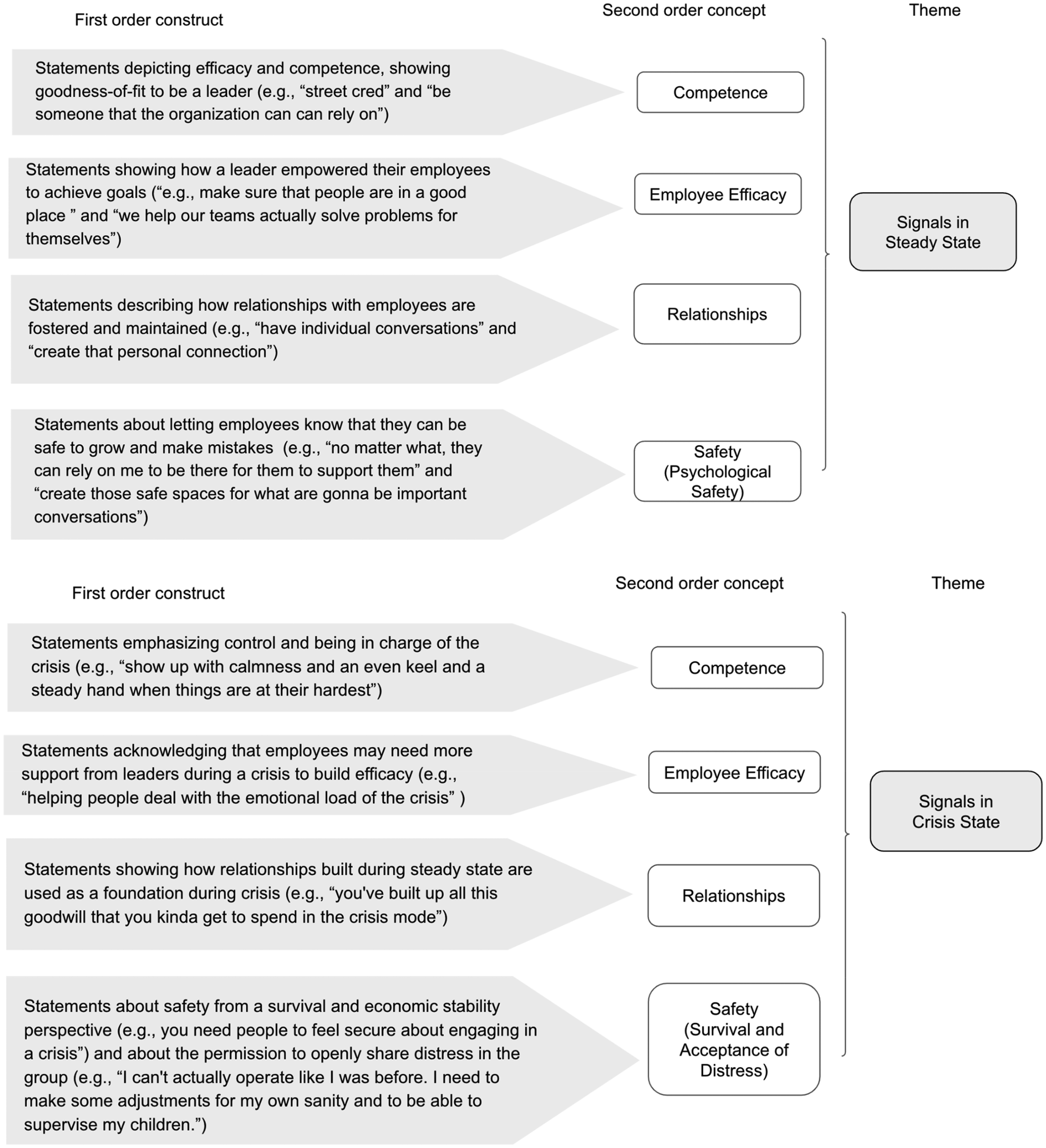
Next, we moved to axial coding, through which we identified categories of our initial codes, as well as relationships between them (Strauss & Corbin, 1998). This process allowed us to abstract our first-order codes into second-order themes. For example, we grouped statements about how leaders intentionally tried to demonstrate that they “listen to tone” and “want to be approachable” into a second order concept of “sensitivity”. We grouped statements about “not disclosing my insecurities” and “fear of seeming weak” as “vulnerable information.” We inferred these concepts based on the commonalities across the first order statements. Sensitized to repeated references to intentionally managing their inner emotions, words, and actions in order to project a certain image in hopes of achieving positive coping outcomes, we became curious about the filtering process and filtering criteria leaders were applying and to what end. Thus, we reviewed the literature on signaling and iterated again between the literature and emerging codes to develop a meaningful theoretical explanation. We created definitions for each second-order concept to reduce the discrepancy in the coding process between the authors and to increase confidence in the iterative process (e.g., Kim & Noh, 2022). Also, we were able at this stage to capture the differences in our concepts between signals at steady state and in crisis state.
In our third and final phase of analysis, we performed theoretical coding. This process involves the development of a dynamic, theoretical explanation for how our axial codes did or did not affect one another. Consistent with the approach outlined by Strauss and Corbin (1998), we used our second-order coding to identify relationships within and between the codes to convert them to more abstract categories that were consistent with our data but abstracted from our context. On many occasions we derived a tentative set of emerging relationships among concepts by writing out different models and drawing multiple arrows (Strauss & Corbin, 1998). We went back multiple times to the interviews to see if these theoretical relationships held. The final conceptual model is presented in Figure 1.
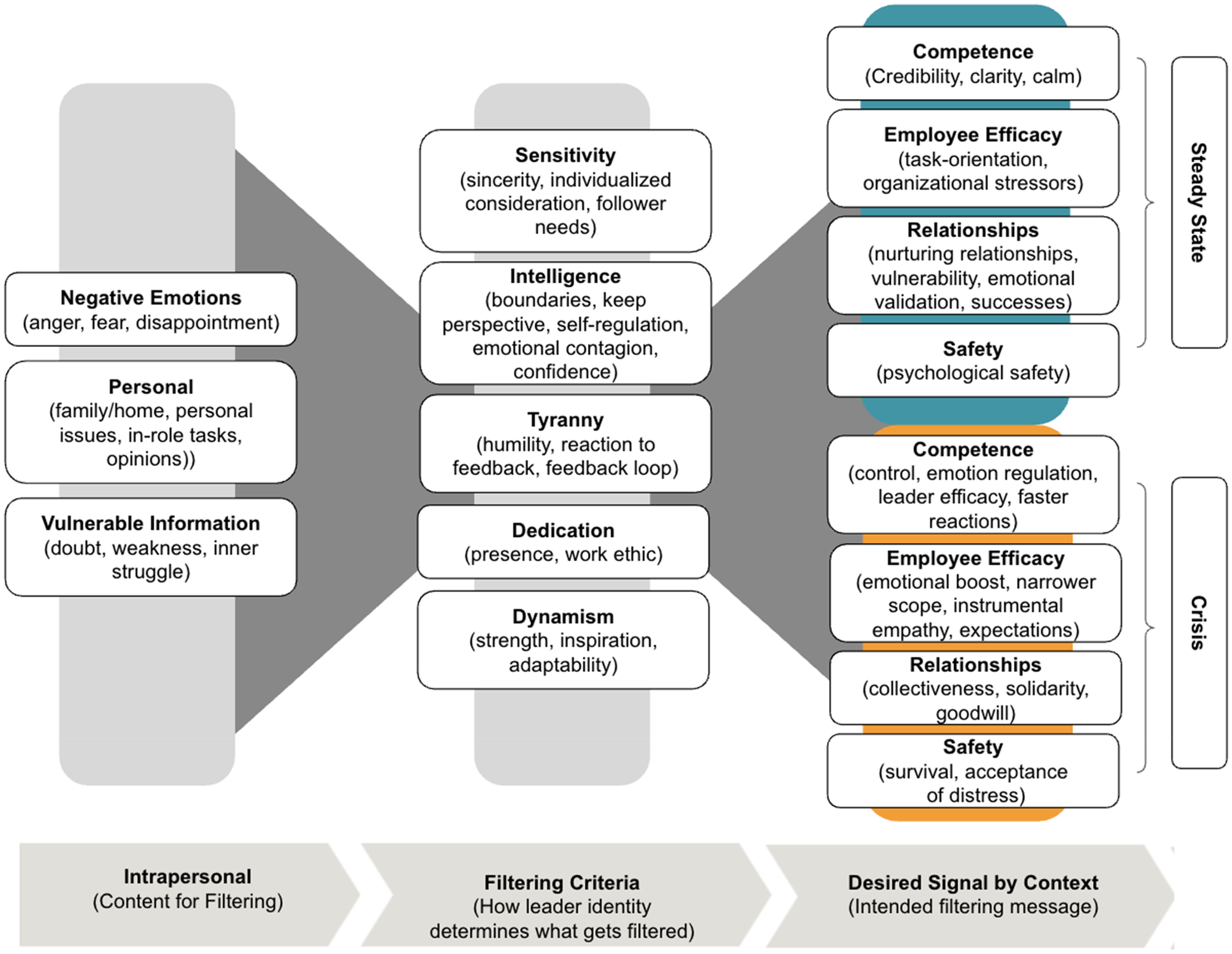
Conceptual framework.
Results
Through our interviews with leaders in a variety of roles and industries, we discovered that leaders engage in an intrapersonal process intended to manage follower perceptions by signaling messages—a process we refer to as filtering. Filtering requires leaders to make decisions about self-disclosure to project their leader identity to their followers because “You can't be falling apart as a leader, so I think you’ve got to park it from your team” (158). One participant, for example, described what they were experiencing intrapersonally, and how they regulated their internal experience for their followers in order to manage how they were perceived: I've had many, many situations where people are telling me things [I] don't want to hear. And I'm aware of what's arising. For me, it's like, I don't want to hear that. I don't want to deal with that. Oh my god, I'm tired. I can't deal with that right now. But as a leader, you know, you have to kind of stay in that space. Even when it's hard. (118)
1
Content Being Filtered
There were three themes that emerged categorizing what content leaders were careful to filter: Negative emotions, personal information, and vulnerable information
Filtering Criteria
Leaders decide what information to disclose based on their leader identity. We found that how the filter is applied, or how much of one's personal experience to let through to followers, was guided by participants’ leader prototype (Lord et al., 1984)—schematic representations of the traits leaders possess, that are used to make judgments about the leadership of others (e.g., Lord & Maher, 1991) and about oneself as a leader (e.g., Guillén et al., 2015). Following Epitropaki and Martin (2004), we employed the framework of implicit leadership theory (ILT; sensitivity, intelligence, tyranny, dynamism, dedication, and masculinity) and fit it to our data to depict the filtering criteria leaders apply with the exception of masculinity, an antiprototypical trait that was represented affirmatively through the dimension of sensitivity.
The first theme, sensitivity, pertains to the leader's efforts to appear sincere, and interested and compassionate to their followers as individuals. Here, leaders described individualized consideration, by attempting to get a better understanding of each follower's personal situation in order to obtain a better sense for how to keep them committed towards work goals (e.g., 101, 109, 112): “you need to be really attuned with how your team works, who they are, to figure out the best way to navigate through a difficult situation” (155). “But I still have to monitor and understand, can they all take it? Every single person on the team has a different personality and some can handle more than others” (160). Participants also acknowledged the importance of being sincere, which included being transparent, open, vulnerable, honest, and authentic as disclosing information candidly laid “the foundation for mutual respect” (102). “I want to be that person that's approachable, where they think they can say anything to me” (106 T2). Leaders filtered information that demonstrated care for relationships with followers by integrating follower needs when making decisions at work. This enabled a “two-way street” of understanding and decreased opportunities to “undermine” or “derail” (107) organizational objectives when stress was high or resources were scarce because “asking others to be resilient, along with you, demands kindness and empathy” (161).
Intelligence was a filter criterion that took on more of an affective (rather than cognitive) tone and concerned how much personal information leaders revealed that could potentially undermine follower perceptions of their wisdom, cleverness, and intellect. Notably, leaders recognized that filtering intelligence required self-regulation in order to avoid “wearing” the “ball of stress” they were carrying around or appearing unhinged and undermining their capacity (112): “When we lose control and we feel like we can't influence our circumstances, I think that's when setbacks and pressure have the chance to really become corrosive and tip people into the stress” (111). Another way to display intellect was to keep perspective and remind oneself that there was no need to “convert a molehill into a mountain” (102) because “being able to see the forest for the trees” (117) was an adaptive coping tactic that helped to manage challenges (e.g., 151). Participants recognized that their followers were looking to them for cues on how to feel about the situation and that what emotions they displayed could lead to emotional contagion. “I generally try to be fairly chill” (108 T2) since “any kind of Chicken-Little-the-sky-is-falling isn't a helpful kind of behavior” (101). Portraying confidence emerged as a means of bolstering influence, which honored how much self-doubt leaders experienced and then regulated intentionally in order to convey that having an “outer image of confidence” (118) would accordingly bolster the team's confidence in the leader (101, 158) and lend itself to a sense of calm in others (102). Finally, boundaries were acknowledged as a mark of professionalism where leaders described the need to balance how much personal information to share and how much emotional distance to hold. Leader (206) reflected on an experience with a follower/employe: “He knows I've got open ears when he's ready, and if he needs to share about it… But there's still going to be boundaries that I'm going to want to make sure I withhold”.
Another filter criterion concerned anti-tyranny where leaders described intentionally sharing information with followers to appear modestly unobtrusive, uncontrolling, and benevolent. They described the importance of humility because they recognized that the followers were an important part of the leader's success: “It can't just all be one way” (151). Projecting humility was necessary in order to bring the collective together as opposed to forcing their vision upon the group: In my better moments I remind people of our goals. I want to kind of say, ‘hey, listen, we're all trying to come together to do this. If you have another way of getting there that's better than this, let's look at that. I'm open to that’. (157 T2) I can disagree with you and I can have my own opinion. But there's a way to do that where I can be assertive and disagree, and it's with respect with deep respect and honoring your opinion. That is constructive. (104) I think feedback loops are really important. The actual practical answer is that I have a smaller test group. I will test the information with the unit leaders and I would assess the response. Adjust my message and then deliver it to the broader audience. (152 T2)
The fourth filtering criterion, dedication, refers to how leaders attempt to demonstrate their work ethic and motivation to their followers. Leaders described role modeling work ethic through their time spent in the office: I'm always trying to set a good example for my team and that impacts the type of lifestyle I lead, my work ethic, my willingness to be available to my team and show up for them when they ask me to. (203)
Leaders also recognized that they served as role models in challenging times: I'm grateful for this job. I'm going to work my fucking ass off so that nobody can say, oh, he gets off easy…I care about doing a good job, and I want to show people, lead by example. Lead by example in crisis moments. Okay, in the other moments, where it was more mundane, I think I still always had that, you know, what are people thinking of me? I gotta make sure I'm doing a good job. (103 T2)
Interestingly, as much as they modeled hard work, they also respected work-life balance for example, “I started noticing no one was taking vacation, so I took vacation” (161) and
[I] hide how much I work because—some of my directors know it, because they get emails from me late at night—but I'm not going to broadcast that because they don't necessarily see all, and I don't want them to think that's what I require from them (158 T2). Commitment was intentionally shared with followers by being accessible and present in situations where leaders wanted to publicly demonstrate their support: “She just brought her full self to the game like she was so compassionate and so caring and so aware of the decision. She was fully there and it was exhausting for her, not what she signed up for, not what she had bought, but she was in the role. (118)
The final theme, dynamism, represents strong, energetic, and uplifting qualities leaders aimed to depict to their followers. Strength was filtered by showing resilience in the face of challenge, protecting their followers from unexpected shocks, and demonstrating optimism amidst great difficulty. Leaders described the desire to “provide positive energy to them” (119) and that showing up as a force of “positivity” helped to “create progress for us as a team” (111). “The worst thing you can do is have a team that's worried, and it's on you to take the burden off of them” (208). Leaders wanted to serve as an “umbrella” to protect their followers from external hazards (157) even if it was simply by letting followers know “I’m here and the door is open” (110). Leaders aimed to inspire their followers to accomplish tasks and meet the demands of the situation: You can be inspiring and say, we're gonna save the earth and 2050, we're gonna be there. And those words are inspiring, which is one aspect of leadership. But you also want to inspire in the way that you are kind of very impactfully getting there. (107 T2)
Finally, leaders were intentional about showing followers that they were able to adapt to the context by demonstrating that they cared to change their approach depending on the situation (e.g., “different leadership styles depending on your shareholder” (107 T2), or the characteristics of their followers: With guys, they are so surface, they're so jokey, they just want to bro down. They don't get in depth in anything. As long as you can jive with them, or banter with them on their level, then you're semi-accepted into the out-fringes of their boys club. With females in the office, I would definitely have more of an emotional connection and more of a relationship, have those deeper conversations, know more about each other, share feelings. (106 T2)
Desired Signal by Context
Leaders filter information about themselves according to how they believe leaders should act. Filtering information according to their leader identity criteria enables leaders to manage follower perceptions by presenting them with a curated signal that followers can then interpret and ascribe meaning to. Our analyses of the filtering criteria revealed four main desired signals: competence, employe efficacy, relationship, and safety; however, these four signals showed several distinct nuances in steady state versus high-impact crisis situations.
In any context, competence is an essential signal because it makes up a large part of the currency through which leaders earn the credibility to exert influence. “It's on you to make sure that you've got everything. And basically say, ‘Hey, don't worry. It's okay. We got everything’” (208). The data revealed three hallmark subthemes underpinning competence in steady state: credibility, clarity, and calm. Credibility involves filtering inadequacies in order to earn follower trust: People who know me well and have seen me in action for a long time, they see strength. They would probably see it as like, ‘Wow! She's able to display confidence and convince people that she knows what she's doing when she doesn't. But I have fears of being called out in a public environment for not knowing something that I really should know. (109 T2) I show strength in terms of when I actually make my decisions, and even my presence within the office. My team remains calm. It allows them to do work without having to worry. I stick to my decisions. I'm confident when I make a decision, and that gives the team the clarity. (208)
In crisis, competence was signaled in different ways. Calm remained important but in particularly intense situations, control became more salient for leaders to signal. Exhibiting control signaled that followers did not have to fear and that they could trust in the competence of their leader. I think it's more detrimental to the team to freak out in a crisis because they're looking to you for stability. It's not that you don't want them to feel stable in a regular situation, but because everyone is already under a lot of stress in a crisis, everything needs to appear as steady as possible so that they're able to lower their stress and do their work. (101 T2)
Emotion regulation was critical in muting the fear and anxiety leaders experienced because they recognized their own steadiness served as an indicator of the severity of the situation: In [a] crisis state it just requires a little bit more thought process to it. I have to be more conscious about it because I don't want this ripple effect to happen like we're all in crisis. In crisis, I think we're all a little bit on edge. I show more of the ‘things will work out’, ‘we're gonna figure this out’, ‘we're gonna work together’, so that they don't take on any of the added burden and stress pain. (202) I do think at the heart of this is how quickly I can establish a sense of self-efficacy for myself like I have the power to impact these circumstances, and there are things that I can do to begin to make progress. (111)
The second signaling theme relates to the myriad ways leaders attempted to bolster employe efficacy and attempted to filter information in a way that would empower their employes. One participant noted “my success lies in the ability of my staff to feel confident and still willing to contribute and put all their all into the organization and its success” (105). Others described providing tools, skills, and training so that followers felt better equipped to take on challenges (152). Leaders noted that holding a task-orientation helped advance goals by focusing follower's attention on what action could be taken to manage the process. Additionally, leaders attempted to protect their employes from organizational stressors, which might otherwise detract from followers’ ability to carry out their work: I would hide any additional noise. Maybe put inner politics outside. Maybe other stuff that's like this is outside the scope of what you need to care about. Don't worry about it. I'm managing all the other things involved. So I can get you to focus on that thing. (156 T2)
Leaders described that signaling employe efficacy in crisis situations ensured followers believed in their ability to execute work tasks, which was necessary for organizational survival. Leaders adjusted expectations in two ways. First, where possible, leaders described giving “grace on productivity” (253) to give followers some space to adjust to the shocks they were facing: I tried to decrease our expectations at work because I knew at home people were dealing with a lot of stress, and you really can't drive. If your personal life is a mess and your work life is a mess, people fall apart. So I was trying to create more room and work for them to handle what's going on at home. (157 T2) Anything that falls outside of us completing the tasks doesn't matter. It doesn't matter what my personal feelings are. We need to get this thing done…there's no time for fucking small talk. It's just like, do the job, don't complain. There's time for complaining right now is not that time. (103 T2) Finding the emotion in each of them, that kind of connects to that moment. I spend a lot of time thinking about how we create that connectivity. And then how you convey that in an emotional sense this happened [a good outcome] because of you. (255)
In steady state, leaders signaled the importance of relationships. Leaders described nurturing relationships with their followers by proactively and consistently investing in the quality of their relationships: “My focus has been a lot on being relationship-based. So for me, relations are critically important. It's important because I want to build trust with my team and my colleagues individually and as a team” (205). “Getting to know the people on your team” was deemed important because I think if they realize that you really have taken the time to get to know them and when you say something that's specific to them, I think that's the best way that you can authentically signal that you know you do care about their development and their wellbeing. (254) I love words of affirmation. I love to tell everybody that they're doing a good job. I love to pump people up. I have found in my experience that showing people I'm pleased with them or telling them they've done a good job, being really supportive in that sense has great impact. (106 T2) I acknowledge my sense of their anxiety. I say ‘I'm sensing that you're feeling anxious, or I'm sensing that you're feeling sometimes overwhelmed. I hope you know that if there is anything that I could share with you, I would. Is there anything that I could do to help alleviate what you're feeling?’. (202)
In a crisis, the foundation of relationships was tested. Using a bank account metaphor, leaders who had invested in their relationships by depositing time, interest, and empathy into their followers had forged stronger connections (e.g., 116, 160) that could withstand stress and conflict during crisis and rally follower commitment: “I spend a lot of time upfront spending quality time with them so that we have a good relationship so that when there are times of crisis, we know that there's already a strong foundation there” (112 T2). In order to advance goals, leaders described attempts to direct follower focus towards organizational goals, which might get “derailed” in stressful situations without enough trust (107). Leaders needed to cue collectiveness and obtain follower “buy in” (110) because “you have to be able to get people to rally around something that really matters to them if they are going to be able to recover when they take that big shove off balance” (111) and “you need them to understand why they're buying in” (110). While leaders acknowledged the need to signal solidarity more saliently in crisis, rallying individuals around collective goals was hard if the team had not previously forged strong relationships (e.g., 116, 160). Leaders aimed to create solidarity around the collective experience and shared suffering in order to motivate followers by acknowledging dire circumstances and then asking “what do we need to do to help one another?” (107). This involved drawing followers into a “stronger cohesive unit” (106) around a communal idea, for example: “people are much more willing to give themselves to something if they feel like they're part of the solution” (106). Additionally, leaders suggested that solidarity involved a delicate balance between their own pressure to “move the needle forward” and caring for the needs of others (119). To ask followers to “roll up our sleeves and work harder than ever”, leaders recognized they had to “draw on the goodwill that you have with your colleagues” (209): In a crisis ‘all hands on deck’ moment, we just can't worry about people's feelings in those moments. You hope you build up so much rapport and empathy in moments before where it wasn't the degree of magnitude of crisis. So you've built up all this goodwill that you kinda get to spend it in crisis mode. (102 T2)
The final signaling theme we identified was safety. In steady state, leaders wanted to show their followers that they were open to mistakes, open to feedback, and open to dissent. By taking accountability for how their reactions could encourage the candor for followers to contribute more fully: I've seen so many leaders that just get angry. They're frustrated that things aren't going well and then everyone around them is terrified because their leader is angry and frustrated and they don't know if they're going to keep their job or get yelled at, or be humiliated. (118)
In crisis, safety included psychological safety, but also included survival, and acceptance of distress. COVID-19 threatened survival from a health and economic perspective. “You don't disappear when things get bad. That's when you stand up and you say, you know, we're here for a reason. And maybe we don't know what exactly we're supposed to do today, but we're here” (118). Accordingly, participants aimed to signal great care for the actual safety of their followers by showing that “leaders got their back” (116) and could be relied upon as “a source of comfort” and “stability” when everything in the situation is unpredictable (105). Additionally, they signaled economic stability by attempting to offer certainty around the viability of followers’ employment, or the health of the firm more generally. “I would make sure that they can see there is fiscal stability, that the business is making money” (101 T2).
Acceptance of distress was unique to safety in crisis in that openly disclosing personal challenges and fears to the group might be considered non-normative if shared in a steadier state. Leaders made a concerted effort to share distress because it built an empathetic bridge between themselves and their followers: I actually shifted and started to open up more and share more … not shifting the burden to them but at least being open with them about the things I was experiencing such that they were able to then actually have empathy for me. And that actually made them feel better in some ways because you know there's no ‘everything's fine’ because they're like, ‘everything's not fine. Why are you acting like everything's fine?’ (151)
Indeed, being vulnerable was described as an act of courage where “bonds were forged through shared suffering” (116). Leaders were open to showing that they were struggling without any “false bravado, or hollow confidence” (111). Leaders found that by allowing “space for their own and others’ fear” (118), created permission for followers to be more authentic such that there was “no stigma” to say “I'm not okay” (152). As part of normalizing distress, leaders made an active effort to check-in and explicitly inquire as to the mental health of their followers in relation to the stressful context: “The mental health and the physical health become almost sort of survival mode and you're monitoring vital signs through the whole process…I want them to feel that the leader's got their back or is helping them through” (116). The final structure of the data is presented in Figure 2.
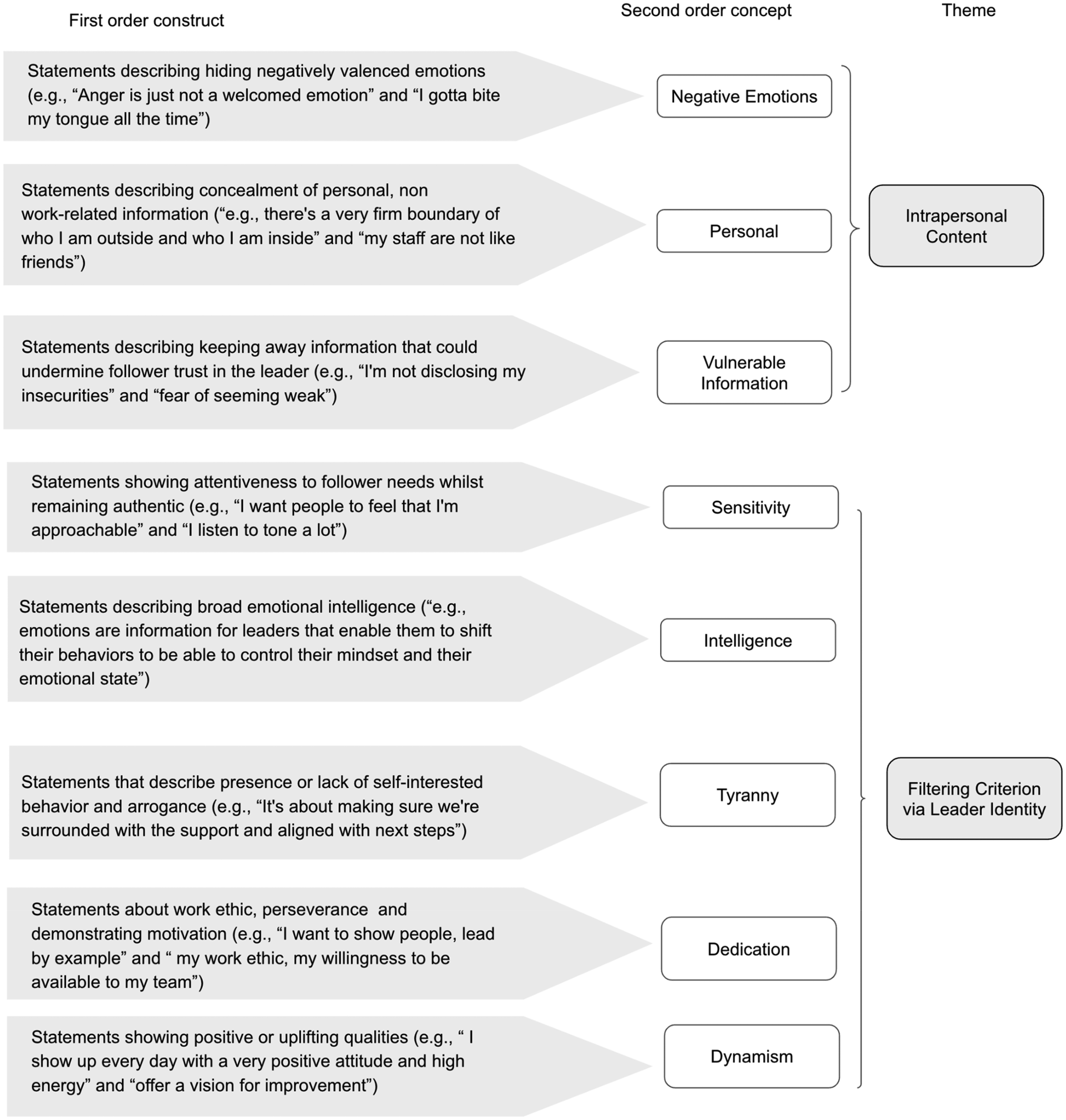
Final data structure.
Discussion
Our results demonstrate a process through which leaders consider what needs to be filtered and why, in order to produce a desired signal to their followers. Doing so, while burdensome, allows them to lead effectively in times of stability and crisis by skillfully filtering information to followers according to leader prototypes, specifically, elements of the ILT (e.g., Epitropaki & Martin, 2004). We discuss the contribution of our results to the literature on leader identity, signaling theory, and authentic leadership.
Leader Identity
First, we find that leaders filter negative emotions, personal information, and vulnerabilities through their leader identity and, specifically, via elements of the ILT, contributing to the existing work demonstrating that leaders, and not simply perceivers, use ILTs (e.g., Schyns et al., 2020). We note, however, that our findings deviate somewhat from the six ILT dimensions put forth by Epitropaki and Martin (2004). First, we do not find any evidence that the leaders in our sample considered masculinity as part of their identity. This is quite reasonable in light of the fact that masculinity is considered an antiprototypical trait. Similarly, tyranny, which is also antiprototypical, emerged in our data as its opposite: leaders actively filtered their thoughts, emotions, and directives with the aim of being viewed as modest and unobtrusive. Finally, the evidence that we found for intelligence deviates from its typical sub-traits of knowledgeable, clever, and educated (Epitropaki & Martin, 2004). However, as we noted in the results, the expression of affective intelligence enabled leaders to filter personal information that could undermine follower perceptions of intelligence.
Adding to the limited research that has examined ILTs in context (e.g., Den Hartog & De Hoogh, 2024; Tavares et al., 2018), we also show that filtering is somewhat context dependent. Much of the literature incorporating context into the study of leader identity examines identity development (e.g., Lanka et al., 2020) and the contextual factors that function as facilitators or impediments (e.g., time: Hennekam et al., 2021; change: Ibarra & Petriglieri, 2010). Our results demonstrate that leaders consider the demands of the situation when filtering intrapersonal information to send different cues in situations that are steady and predictable, or extreme and uncertain (Collins et al., 2023). Leaders in our study seemed to recognize how failing to filter and oversharing personal information in the wrong context could undermine their identity based on whether their followers viewed their disclosures as leader-like. Notably, this is predicated on an assumption that both filtering and identity maintenance are done in service of others. However, recent theoretical examinations of the leader identity literature have uncovered the underlying motivations of leader identity maintenance, which provides an interesting application for future research. Specifically, McBride et al. (2024) discuss theoretical assumptions in the literature focused on leader identity as a strength (assumption #1) or as self-aggrandizement (counterfactual assumption #1). Our data largely speaks to the former, as our participants sought to maintain their identity across contexts; however, our data does not discern whether the underlying motivations were altruistic. Future research could explore whether personal and/or contextual factors drive identity maintenance for altruistic vs. self-serving reasons. Moreover, future research could extend this by examining the flexibility of leader identity in stable and crisis situations through the lens of levels of identity (i.e., individual, vs. relational, vs. collective; e.g., Lord & Brown, 2003) to establish how individual versus relational goals influence filtering. This may be particularly fruitful as our research demonstrates that there is a relational element to the filtering process.
Relatedly, although our focus was on leader identity, our research may also have implications for understanding follower social identity. As McBride et al. (2024) discuss, current assumptions in the literature are such that the prevailing premise views social identity crafting by leaders as genuine and positive by followers. However, that is not necessarily the case, and leader rhetoric may be at odds with actual practices (McBride et al., 2024). Incorporating followers and examining their perceptions of leader signals (and filtering) may help to understand when (and if) these processes lead to social identity formation in followers.
Finally, our results may have relevance for the continued examination of identity development, and particularly cross-domain identity development. That is, as leaders filter according to the demands of the context, they likely increase their competence as leaders. As Hammond et al. (2017) highlight, increased competence will likely carry over to other domains in which one identifies as a leader (i.e., in life domains beyond the formal proscribed leader role).
Signaling Theory
Our research also extends signaling theory, and in particular, the type of information that is considered asymmetrical (Spence, 2002). We believe our research is among the first to examine leader intrapersonal emotions, thoughts, and personal experiences as asymmetrical information that requires signaling (or not) to followers. We find that leaders aim to signal messages to their followers through the process of filtering; our results demonstrate four broad categories of desired signals—competence, employe efficacy, relationship, and safety—that are expressed differently depending on the context. Moreover, much of the content that leaders discussed filtering or withholding was valenced negatively (e.g., negative emotions, challenges, negative perceptions or reactions), which contributes to the literature examining the signaling of negative information (e.g., Matthews et al., 2022). We note that we deviate from a more typical application of signaling theory in that leaders in our study sometimes highlighted that filtering information was necessary in order to produce an effective signal. While this contrasts somewhat with signaling theory's focus on the disclosure of information that is known to only one party, we maintain that leaders who are choosing not to disclose information are still sending a signal to their followers and that incomplete disclosure itself may be an intentionally context specific cue.
From a theoretical perspective, our results also illuminate how the filtering process functions to aid leaders in producing an accurate signal; one that is consistent with the demands of the broader context and serves to help them maintain their leader identity. Signal cost is a key characteristic of signaling that has been examined in applications to charismatic leadership (Antonakis et al., 2016) and political values and leader perceived authenticity (Appels, 2023); signalers who lack the attributes they are trying to signal are apt to send a false signal and lose credibility (Connelly et al., 2011). In our research, signal cost reflects i) failing to filter personal information through leader identity and ii) weighing the costs of sharing personal information that may undermine one's identity and effectiveness. As our results demonstrate, this requires leaders to consider not only what information to communicate, but also how to filter it in order to transmit a signal that is appropriate to the context. In our data, participants discussed the importance of filtering uncertainty, fear, and emotions during times of crisis, as they believe expressing it undermines follower confidence and perceptions of leader competence. However, in steady states, allowing negative affect and doubt to filter through enabled leaders to create a sense of psychological safety with their followers. Leaders who filter skillfully are able to engage in behaviors and actions that align with their leader identity and the contextual demands of the situation, enabling them to lead effectively.
Authentic Leadership
Our findings add to knowledge on the relational and contextual factors that influence authentic leadership (e.g., Gardner et al., 2021), and more specifically, relational transparency (e.g., Alvesson & Einola, 2019) by demonstrating that leaders recognize the importance of being transparent and open with their followers, while simultaneously acknowledging the perils of oversharing or appearing inconsistent (Bedeian & Day, 2004; Ibarra, 2015). Participants noted that during challenging times, followers look to them for cues on how to navigate the situation, reinforcing Walker and Pagano's (2008) assertion on the importance of skillfully managing “how people might perceive, dissect, and disseminate the information that is revealed” (p. 3). The decisions behind relational transparency serves as a complex and multifaceted lynchpin in this process of perception management (Alvesson & Einola, 2019; Iszatt-White & Kempster, 2019) and underscore that authenticity is not determined by the totality of a leader's self-disclosure, but what information is pertinent to share in a particular context. Many of our participants emphatically described themselves as authentic, while also describing how they monitored and controlled how they present themselves to their followers with their words, displays of emotions, and personal thoughts. As our data demonstrate, the context (stable vs. crisis) is one boundary condition that determines how transparent leaders should be. Leaders in our study highlighted the multitude of ways the contextual demands require different presentations of the varying aspects of one self. Whereas self-monitoring refers to “the extent to which people cultivate public appearances in diverse domains of social functioning” (Gangestad & Snyder, 2000, p. 530), we found leaders share different parts of themselves depending on what signals need to be sent to their followers. For example, leaders described how COVID-19 required more personal self-disclosures in order to signal acceptance of distress. In contrast, in periods of stability, leaders filter their distress to followers because it reflects a mismatch with situational demands (i.e., a false signal, Connelly et al., 2011) and may undermine their ability to influence.
The burden expressed by many participants in balancing openness with their leadership roles align with identity theory, particularly leader identity (e.g., Ibarra, 2015; Lord & Brown, 2003; Markus, 1977). Critics of authentic leadership argue that authenticity requires the endorsement of followers, emphasizing that legitimacy is established through an identity-granting process within the group (Sidani & Rowe, 2018). This perspective resonates with the bi-directional formation of leader identity, where it is both asserted by leaders and recognized by followers (DeRue & Ashford, 2010). Consequently, our data underscores the existence of a complex and multifaceted self-concept (e.g., Markus & Wurf, 1987) and highlights the contextual factors that influence self-presentation and enable effective leadership.
Limitations
Despite our attempts to collect rich qualitative data to examine how leaders express their identity in times of stability and crisis, we acknowledge that there are limitations to our inductive approach. First, since our research focused exclusively on individuals who occupy leadership roles, the perspective of the follower is somewhat underrepresented. This means that although our participants were clear on their intentions in signaling, we do not have corresponding perspectives from followers to understand how the signals were received. Our participants, however, described attuning to how followers noticed their cues and explicitly checking in to clarify assumptions and ensure their signals were received as intended. We highlight that our goal was to examine how leaders filter their personal feelings, thoughts and behaviors, rather than their effectiveness at doing so; however, to understand the signaling process in a fulsome manner, follower data is needed. We encourage future research to incorporate followers in order to examine how followers interpret the signals leaders are sending in these contexts. Doing so will enable the examination of how leader identity is granted by followers and not simply claimed by leaders (DeRue & Ashford, 2010). Additionally, past research has found in-groups typically demonstrate loyalty and have earned the trust of the leader, whereas out-groups are perceived to lack motivation or trustworthiness (Graen & Uhl-Bien, 1995). Given the quality of relationships will vary across followers, future research might explore how leader signals are interpreted in different groups.
Second, all of our participants were leaders in Canadian organizations, which limits our ability to generalize our findings to populations of leaders outside of Canada. Indeed, research demonstrates that despite some evidence for the universality of some ILT traits, others are culturally specific (e.g., Den Hartog & De Hoogh, 2024). This suggests that the intrapersonal content that leaders choose to filter and the lens through which they filter it may be dependent on the prevailing cultural expectations of leadership (CLTs; Den Hartog & De Hoogh, 2024) and future research incorporating culture might further extend our findings. Additionally, our sample consisted primarily of senior-level leaders. While this was intentional, it may limit the generalizability of our findings to lower-level leaders due to their greater experience. However, the unique circumstances of the COVID-19 pandemic suggest that leaders at all levels, regardless of experience, likely faced many of the challenges described by our participants. Therefore, we expect our findings to apply across different leadership levels, although future research is needed to confirm this.
Although our T1 data was collected during the peak of the COVID-19 pandemic, we recognize that the unique nature of this context—while meeting the criteria for a high-impact crisis (Collins et al., 2023)—may render some of our findings specific to this event. However, in our T2 data, participants noted how they applied their COVID-related learnings to other high-impact situations. Nonetheless, we recommend further research on leader identity in both stable and event-based contexts, particularly regarding their relational engagement with followers.
Conclusion
We opened this paper by asking “which self” should leaders be “true” to? Through the lens of Implicit Leadership Theories (ILTs), our research proposes a model that explains how leaders filter personal information to convey competence, employe efficacy, commitment to relationships, and safety to their followers. We demonstrate that leaders understand that different contexts impose varying demands on how they filter information; failing to filter appropriately during crises or steady-state situations can compromise their leader identity and diminish their influence. Our findings indicate that the aspects of the self a leader chooses to share are contingent on situational requirements, functioning to reinforce their identity without undermining their authenticity. In sum, we recommend that leaders remain true to their leader identity by selectively sharing information that upholds their influence according to the specific demands of the situation.
Supplemental Material
sj-docx-1-jlo-10.1177_15480518251337261 - Supplemental material for The Me You (Don’t) See: How Leaders Filter Intrapersonal Information at Work
Supplemental material, sj-docx-1-jlo-10.1177_15480518251337261 for The Me You (Don’t) See: How Leaders Filter Intrapersonal Information at Work by Ellen Choi, Kristyn A. Scott, Pearlyn H. S. Ng and Ramzi Fathallah in Journal of Leadership & Organizational Studies
Footnotes
Declaration of Conflicting Interests
The authors declared no potential conflicts of interest with respect to the research, authorship, and/or publication of this article.
Funding
The authors received no financial support for the research, authorship, and/or publication of this article.

Supplemental Material
Supplemental material for this article is available online.
Notes
Author Biographies
References
Supplementary Material
Please find the following supplemental material available below.
For Open Access articles published under a Creative Commons License, all supplemental material carries the same license as the article it is associated with.
For non-Open Access articles published, all supplemental material carries a non-exclusive license, and permission requests for re-use of supplemental material or any part of supplemental material shall be sent directly to the copyright owner as specified in the copyright notice associated with the article.
