



Abstract
Focusing on the interface between CEOs and top management teams (TMTs), we argue that CEO self-monitoring positively impacts a firm's pursuit of corporate entrepreneurship through the intervening role of TMT behavioral integration. We additionally argue that the impact becomes stronger as the firm's discretionary slack decreases because decreased slack creates an organizational context more favorable to the influences of both CEO self-monitoring and TMT behavioral integration. Results based on multisource (CEOs and TMTs) and multiwave data from 110 firms support the model and associated hypotheses.
Keywords
Corporate entrepreneurship (CE) strategies play a critical role in enabling firms to sustain competitive advantages, adapt to changing environments, and achieve superior performance (Boone, Lokshin, Guenter, & Belderbos, 2019; Chin, Zhang, Afshar Jahanshahi, & Nadkarni, 2021; Zahra, 1996). Given the risk and uncertainty inherent in CE, strategy scholars have long been interested in whether and to what extent CEO traits influence CE (Dess, Ireland, Zahra, Floyd, Janney, & Lane, 2003). Several studies examining a host of specific CEO traits have reported evidence supporting a significant effect (e.g., Baron & Tang, 2011; Chen & Nadkarni, 2017; Chin et al., 2021; Simsek, Heavey, & Veiga, 2010). Together, these studies suggest that CEO traits have a significant role in a firm's CE strategy and provide evidence for a direct impact of diverse CEO traits on CE.
Nonetheless, the CEO–top management team (TMT) interface perspective suggests that CE inherently demands a contextually embedded set of relational behaviors between the CEO and TMT members, which remain poorly understood yet may provide valuable insights for both theory and practice (Dess et al., 2003; Ling, Simsek, Lubatkin, & Veiga, 2008). Simultaneously, despite the growing body of work on the CEO-TMT interface (for reviews, see Georgakakis, Heyden, Oehmichen, & Ekanayake, 2019; Simsek, Heavey, & Fox, 2018), the contextual conditions that might influence those relational behaviors remain disconnected from the broader research on the upper-echelons view of the firm. In upper-echelons research, the notion of contextual conditions can take on different meanings depending on the phenomenon of interest (Carpenter, Geletkanycz, & Sanders, 2004). The resource slack in a firm, being one of the more significant contextual variables relevant to CE (Simsek, Veiga, & Lubatkin, 2007; Zahra, 1996) and behavioral and agency explanations of managerial behavior (Bourgeois, 1981; Tang, Nadkarni, Wei, & Zhang, 2021), seems to hold particular promise for informing the relational mechanisms at the CEO
Accordingly, our goal is to move toward a deep theoretical understanding of the effect of CEO traits on CE by envisioning the effect as conditional and indirect, that is, mediated through specific relational mechanisms at the CEO
We start by arguing that CEO self-monitoring will shape CE through the relational interface mechanism of TMT behavioral integration, which refers to the degree to which team members engage in mutual and collective interaction (Hambrick, 1994; Ou, Waldman, & Peterson, 2018; Simsek, Veiga, Lubatkin, & Dino, 2005). Self-monitoring theory suggests that individuals differ in the sources of information that they generally rely on to guide and regulate behaviors in social interactions (Sasovova, Mehra, Borgatti, & Schippers, 2010; Snyder & Cantor, 1980). High self-monitors are highly responsive to social cues and use these cues to facilitate cooperative and smooth social interactions, whereas low self-monitors care less about social appropriateness in their interactions with other people (Campagna, Dirks, Knight, Crossley, & Robinson, 2020; Oh & Kilduff, 2008). We thus reason that high-self-monitoring CEOs will have interpersonally oriented behaviors and thus engender high levels of behavioral integration within their team. We further reason that this relational interface will become stronger as the firm's slack resources decrease because high-self-monitoring CEOs, more adept at avoiding conflict situations and polarization within the TMT, will facilitate behavioral integration in the pursuit of CE. We test the model using multisource (CEOs and TMT members) and multiwave data from 110 firms. Our results show that CEO self-monitoring indirectly affects CE through TMT behavioral integration and that this indirect effect is more pronounced in a low discretionary slack context.
Our study makes three contributions. First, studies have established the vital role of CEO affective traits in the pursuit of CE (Baron & Tang, 2011; Foo, Uy, & Baron, 2009), and we enrich this line of research by identifying how and when CEOs’ tendency to regulate their emotional expression may influence CE. Second, CE research has underscored that CEO attributes shape how they perceive and interpret CE opportunities (Baron & Tang, 2011). Distinct from such cognitive mechanisms, our study is the first to examine a specific relational interface mechanism, TMT behavioral integration. In doing so, it advances a behavioral explanation of how CEO traits may influence firm behaviors. Third, studies have focused overwhelmingly on environmental conditions (e.g., dynamism) as a contextual contingency (Baron & Tang, 2011; Wei & Ling, 2015). Our study moves beyond the environmental context and instead focuses on discretionary slack. Thus, our results hold several implications for the further development of the CEO
Theory
CE, which is defined as the sum of a firm's innovation, corporate venturing, and strategic renewal acts, serves as a critical channel for firm success (Boone et al., 2019; Chen & Nadkarni, 2017; Chin et al., 2021; Simsek & Heavey, 2011; Zahra, 1996). Garvin and Levesque (2006: 102) emphasized its importance as follows: “Because of maturing technologies and aging product portfolios, a new imperative is clear: Companies must create, develop, and sustain innovative new businesses.” As an example of CE, Trident Systems, a small business providing consulting services to major U.S. Department of Defense contractors, has contemplated various strategies to increase the creativity of its workforce and cultivate CE to achieve a sustainable competitive advantage (Mazzei, Flynn, & Haynie, 2016). Along with this anecdotal example, studies have shown that CE relates positively to key firm outcomes, such as sales growth and profitability, across various industry settings (Simsek & Heavey, 2011; Zahra & Covin, 1995).
Given its theoretical significance and prescriptive value, research has viewed CE as a critical intermediate performance outcome, which offers a precise and fine-grained understanding of the relationship between CEO traits and firm outcomes (Chen & Nadkarni, 2017; Chin et al., 2021; Dess et al., 2003; Zahra, 1996). Specifically, CEOs shoulder the primary responsibility for championing and assessing a firm's entrepreneurial actions and integrating them into an overall strategic posture (Zahra, Filatotchev, & Wright, 2009). However, with the exception of Ling et al. (2008), studies have not examined how CEOs’ traits shape CE activities.
Enriching the upper-echelons theory (Hambrick, 2007; Hambrick & Mason, 1984), the CEO
In the transmission of CEO effects to strategic outcomes, scholars have thus far emphasized one key relational mechanism, TMT behavioral integration, which represents the extent to which TMTs engage in mutual and collective interaction (Hambrick, 1994; Simsek et al., 2018). A behaviorally integrated TMT engages in collaborative behaviors and enjoys social cohesion in that TMT members are psychologically attracted to each other (Ou et al., 2018; Simsek et al., 2005). Moreover, TMT behavioral integration emphasizes joint decision-making (Reina, Zhang, & Peterson, 2014). TMT members communicate, exchange information, and discuss different perspectives when making strategic decisions (Lubatkin, Simsek, Ling, & Veiga, 2006). The social and task processes in such teams are mutually reinforcing and capture a TMT's wholeness and unity of effort (Hambrick, 1994; Ling et al., 2008).
TMT behavioral integration is distinct from TMT diversity. TMT diversity, a team input variable, refers to the degree of dissimilarity of TMT members’ cognition, experiences, and other characteristics. In contrast, TMT behavioral integration is a team-process variable and emphasizes the interaction and communication within the team. Scholars found that TMT diversity influences TMT behavioral integration and distinguished TMT behavioral integration from other TMT processes, such as social integration (Lubatkin et al., 2006). For example, Simsek et al. (2005: 70) wrote that “behavioral integration more fully captures the salient aspects of TMT process, because it includes not only social and affective TMT tendencies, which are captured by measures of social integration, but also task and behavioral tendencies.”
As an inclusive TMT process variable, TMT behavioral integration has been considered the central means through which CEO leadership styles influence strategic behaviors and outcomes. For example, Ling et al. (2008) found that TMT behavioral integration mediates the relationship between CEO transformation leadership and CE. Similarly, Carmeli, Schaubroeck, and Tishler (2011) showed that TMT behavioral integration mediates the effect of CEO empowering leadership on firm performance.
Tested Model and Hypotheses
Our tested model integrates self-monitoring research and the CEO
Given the potential implications of CEO self-monitoring for TMT behavioral integration, we argue that it can enrich the current understanding of CE in two fundamental ways. First, the recognition of CE opportunities calls for information exchange and knowledge sharing between top executives. The exchange of different types of information allows top executives to stay alert to environmental changes (e.g., customer preferences, technological developments) and to develop new ways of seeing, both of which are necessary for identifying new opportunities (Simsek, Lubatkin, Veiga, & Dino, 2009). Because the attendant processes often entail significant uncertainty, extensive discussion and knowledge sharing are also helpful in overcoming the sense of doubt top executives may feel regarding the feasibility and desirability of CE opportunities (Chen & Nadkarni, 2017; Heavey, Simsek, Roche, & Kelly, 2009).
Second, the implementation of CE opportunities inevitably gives rise to tensions and relational conflicts, as it involves a significant resource commitment and the deployment of new competencies (Chin et al., 2021; Dess et al., 2003). For example, the old and new initiatives will compete for limited resources, and the culture associated with the new business may conflict with the existing culture (Garvin & Levesque, 2006). Indeed, the pursuit of CE hinges in part on negotiation, coordination, and compromise to overcome tensions between top executives (Chen & Nadkarni, 2017). Because high self-monitoring CEOs can solve conflicts through compromise with other top executives, the sociopolitical dynamics associated with the CE process are likely to enhance the relevance and salience of CEO self-monitoring, especially in resource-constrained, low-slack contexts.
Together, the proposed moderated-mediated model (Figure 1) examines how and when self-monitoring exerts effects. Specifically, we hypothesize a causal chain whereby CEO self-monitoring is mediated instead of having a direct effect on CE. First, we propose that CEO self-monitoring will be positively related to TMT behavioral integration. Second, we propose that TMT behavioral integration will be positively associated with CE. CEO self-monitoring, then, will have an indirect effect on CE through TMT behavioral integration. Finally, we hypothesize that firm discretionary slack moderates the indirect effect of CEO self-monitoring on CE.
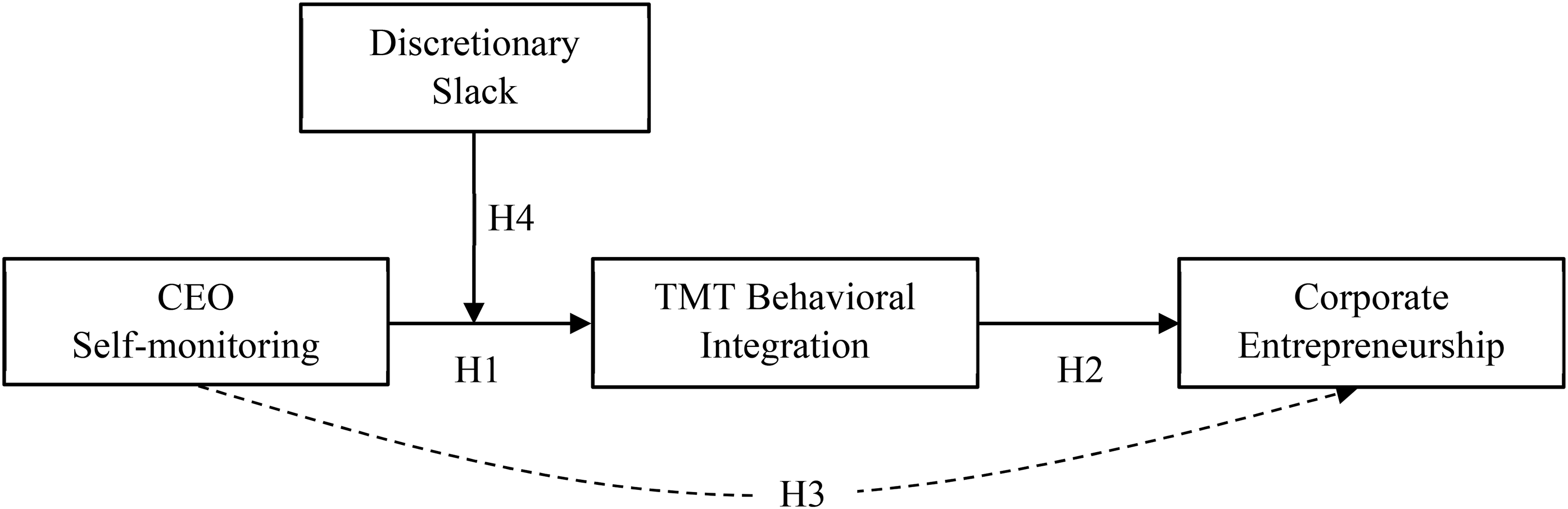
Tested Model
CEO Self-Monitoring and TMT Behavioral Integration
In organizational contexts, high self-monitors have two defining tendencies in social interactions. First, they are willing to spend time and effort understanding others to facilitate information sharing and collaboration (Sasovova et al., 2010; Snyder & Cantor, 1980). Because high self-monitors care about social appropriateness and strive for expressive behaviors suitable in specific situations, they tend to collect comprehensive information about other people and are knowledgeable about other people's traits, inner states, and attributes (Flynn, Reagans, Amanatullah, & Ames, 2006). Such knowledge allows them to relate to people across different situations and facilitates collaboration by motivating others to share thoughts and insights (Kleinbaum et al., 2015; Oh & Kilduff, 2008). Studies report that self-monitoring is positively related to cooperation (Danheiser & Graziano, 1982) and high performance in boundary-spanning activities in which information integration are necessary (Caldwell & O’Reilly, 1982).
Second, high self-monitors, being “emotional helpers,” are effective at conflict management (Toegel, Anand, & Kilduff, 2007). They are sensitive to other people's emotions and thus acutely aware of conflict when it occurs (Baron, 1989; Campagna et al., 2020). When interacting with anxious people, high self-monitors are likely to initiate conversation and inject positive affect and humor to lift their spirits. To create a favorable impression, high self-monitors pick up on social cues and modify their verbal and emotional expression accordingly; in this way, they strive to relate to the diverse needs of different people and resolve conflicts through compromise (Mehra, Kilduff, & Brass, 2001). Indeed, Snyder (1987: 42) argued that the “lubricating” techniques used by high self-monitors “would have warmed the heart of Dale Carnegie.” Research has shown that self-monitoring is positively related to conflict management (Baron, 1989; Kilduff & Day, 1994) and social interaction (Day et al., 2002).
We thus expect that CEO self-monitoring will engender a high level of behavioral integration within a TMT because of its influences on the team's social and task processes. High self-monitors are keenly attentive to social and interpersonal cues and strive to regulate their emotions to adapt to others’ needs and expectations (Flynn et al., 2006; Snyder, 1974). They can also lift the spirits of anxious people, listen to and relate to diverse needs, and solve conflicts constructively through cooperation or compromise instead of confrontation (Baron, 1989). In contrast, low self-monitors attend more to internal attitudes than social cues and are less skilled at conflict management (Mehra et al., 2001). Thus, it is reasonable to expect high-self-monitoring CEOs to build good social relationships and earn the respect of TMT members, thus promoting team cohesion and harmony. Such social cohesion is essential to TMT behavioral integration (Ling et al., 2008; Lubatkin et al., 2006; Ou, Tsui, Kinicki, Waldman, Xiao, & Song, 2014).
Moreover, CEO self-monitoring can facilitate information sharing within TMTs. High self-monitoring individuals tend to invest cognitive effort in understanding others’ perspectives and reading others’ emotions (Danheiser & Graziano, 1982; Snyder & Cantor, 1980). As a result, high self-monitors excel more in boundary-spanning activities than do low self-monitors and can filter and transfer information across organizational boundaries (Caldwell & O’Reilly, 1982). Therefore, we expect high-self-monitoring CEOs to develop extensive and accessible stores of knowledge about other TMT members and how to facilitate information sharing and knowledge exchange between TMT members. When working with high-self-monitoring CEOs, team members might also share their thoughts and perspectives with ease. Such extensive information exchange enhances TMT behavioral integration (Carmeli et al., 2011; Heavey et al., 2009; Ou et al., 2018; Simsek et al., 2005). We, therefore, propose the following:
Hypothesis 1: CEO self-monitoring is positively related to TMT behavioral integration.
TMT Behavioral Integration and CE
The pursuit of CE calls for the knowledge, judgment, and insights of the entire TMT (Dess et al., 2003). Without behavioral integration between senior executives, a firm's capacity to pursue an integrated CE strategy will likely be disjointed; conversely, a top team's behavioral integration can facilitate two vital aspects of the CE process: opportunity recognition and execution (Chen & Nadkarni, 2017; Dess et al., 2003).
First, recognizing pertinent CE opportunities is “an active process involving human cognition” (Baron, 2007: 170). Behaviorally integrated TMTs can share a comprehensive set of information and thus develop a rich understanding of environmental demands and changes, connect seemingly unrelated information, and develop unconventional thinking (Carmeli et al., 2011; Simsek et al., 2005). Information sharing allows them to collaborate and integrate various perspectives through constructive debate (Ou et al., 2018). Such discussion can mitigate the sense of doubt instilled by uncertainty (Heavey et al., 2009). Accordingly, behaviorally integrated TMTs can facilitate knowledge transfer and develop creative ideas, thus facilitating recognition of new CE opportunities (Burgers & Covin, 2016).
Second, because CE initiatives are expensive and risky, top executives need to be strongly committed to obtaining and allocating the financial and human resources necessary to realize the initiatives (Chin et al., 2021; Zahra et al., 2009). Investing in potential CE activities requires executives to balance the existing systems and new initiatives and manage potential conflicts arising from diverse subunits that might compete for limited financial and temporal resources (Burgers & Covin, 2016; Dess et al., 2003). Given their unified effort and joint involvement in making strategic decisions (Reina et al, 2014), behaviorally integrated TMTs develop unified commitments, communicate new initiatives to organization members effectively, and coordinate the resources necessary to carry out CE activities (Hambrick, 1994). They embrace conflicts constructively and can address conflict through communication and coordination to ensure the implementation of CE activities, as studies have demonstrated (e.g., Ling et al., 2008). We, therefore, propose the following:
Hypothesis 2: TMT behavioral integration is positively related to corporate entrepreneurship.
We further propose TMT behavioral integration as a critical mechanism linking CEO self-monitoring to CE. First, high self-monitors collect comprehensive information and excel at boundary-spanning activities (Caldwell & O’Reilly, 1982; Kleinbaum et al., 2015). Thus, compared with low-self-monitoring CEOs, high-self-monitoring CEOs have a relatively broad vision, develop an acute awareness of a broad range of stimuli, and are open to new ideas. Because strategic leadership is a shared activity for TMT members (Hambrick, 2007; Simsek et al., 2018), high-self-monitoring CEOs can better encourage TMT members to share information intensively and integrate information effectively, facilitating the recognition of CE opportunities.
Second, high-self-monitoring individuals are keenly alert to conflicts and adept at conflict management (Campagna et al., 2020; Toegel et al., 2007). Thus, high-self-monitoring CEOs can better detect the sociopolitical dynamics around resource allocation decisions associated with CE initiatives. High-self-monitoring CEOs are very skillful at managing the conflict between TMT members and can promote team harmony to realize CE. Combined with the logic grounding our previous two hypotheses, we thus predict the following:
Hypothesis 3: CEO self-monitoring has an indirect effect on corporate entrepreneurship through TMT behavioral integration.
Moderating Role of Firm Discretionary Slack
Because firm discretionary slack represents an essential resource in realizing CE (Simsek et al., 2007), we propose that the effect of CEO self-monitoring on TMT behavioral integration and CE will be more substantial under the condition of low discretionary slack. A paucity of slack limits the range of available options and provides little flexibility for top executives to pursue strategic agendas (George, 2005). Personal or subunit political motivations lead TMT members to compete to gain more resources or preserve their current resource levels. Thus, a lack of slack can worsen subunit conflicts and create suspicion and mistrust (Tang et al., 2021). Under such conditions, high-self-monitoring CEOs can better intervene to help TMT members work collaboratively. Being acutely aware of potential resentments arising between TMT members, they can facilitate discussion and interaction to focus the team's attention on the “big picture” in pursuing CE. Moreover, because high self-monitors can influence interpersonal dynamics, such as cooperation and communication (Campagna et al., 2020; Oh & Kilduff, 2008), they can build friendly relationships within TMTs.
In contrast, ample slack resources ease capital restrictions, allow experimentation, and provide high levels of flexibility (Nohria & Gulati, 1996; Voss, Sirdeshmukh, & Voss, 2008). Under the condition of high discretionary slack, TMT members are less motivated to compete for scarce resources and thus experience little conflict (Tang et al., 2021). Because CEOs have enough leeway to satisfy TMT members’ divergent demands with a subjective decisional calculus (Vanacker, Collewaert, & Zahra, 2017), CEO self-monitoring is not as critical to behavioral integration as it is in the situation of low slack. Besides reducing the conflict between old and new CE projects, high slack may lessen the need for a top team to act in a behaviorally integrated manner to pursue CE. It follows that CEO self-monitoring is likely less critical to TMT behavioral integration and CE in the situation of high slack relative to low slack. Put differently, the impact of CEO self-monitoring on CE will be more substantial as the firm's discretionary slack decreases because decreasing slack creates a context in which CE amplifies the need for TMT behavioral integration. We, therefore, propose the following:
Hypothesis 4a: CEO self-monitoring is more positively related to TMT behavioral integration when the firm's discretionary slack is low.
Hypothesis 4b: CEO self-monitoring has a greater positive indirect effect on corporate entrepreneurship through TMT behavioral integration when the firm's discretionary slack is low.
Method
Research Setting
The population for this study consisted of Chinese small- and medium-sized enterprises (SMEs). SMEs have emerged as a critical force in the national economy, making up more than 60% of China's gross domestic product (GDP; China Statistical Yearbook, 2016). Although China's rapid economic development has created new opportunities (e.g., innovation and business expansion), Chinese SMEs face significant challenges and are more vulnerable to economic volatility than large and state-owned firms (Forbes, 2018). The opening up of Chinese markets to foreign firms has also intensified competition for SMEs. CE is a crucial path for SMEs to survive and succeed.
Chinese SMEs also offer an appropriate setting to examine CEO self-monitoring, given the significant challenges routinely confronted by these firms’ top executives in pursuing CE. CEOs’ inherent tendency to regulate expressive behaviors in social interactions could be particularly critical to navigating firm strategies. Moreover, in comparison to large public firms, SMEs have fewer corporate governance bodies, such as boards of directors and capital markets; CEOs in SMEs thus have significant managerial discretion (Hambrick & Finkelstein, 1987) and exert a substantial influence on top executives in the pursuit of CE (Ling et al., 2008). Therefore, the SME context also offers a proximal test of the effect of CEO self-monitoring on CE.
Sample and Data Collection
We collected data between 2016 and 2017 at three separate times from SMEs located in the Sichuan province and Chongqing municipality. Both municipalities belong to the West Triangle Economic Zone, an economic powerhouse of western China. Since the central Chinese government launched the “Western Development Program” (also known as the “go west” policy) in 2000, Sichuan and Chongqing have received substantial investments in logistics infrastructure through the development of science parks and high-tech clusters. Over the years, Sichuan and Chongqing have served as home to many SMEs. Sichuan's GDP grew by 8% to US$597.9 billion in 2018 (Xinhua News, 2019). In collecting the primary data from CEOs and TMTs in the three time periods, we received support from a regional SME bureau with which one of the coauthors had connections.
Data collection involved several steps. First, we developed reliable survey instruments by creating an English version of the questionnaire based on established psychometric measures. We followed the established back-translation practice (Qian, Cao, & Takeuchi, 2013), asking two raters to translate the survey instruments independently from English into Chinese and another two raters to translate them back into English. All of the raters knew both English and Chinese very well and were not involved in the study. We also conducted a pilot test on 10 senior Chinese managers (not included in the primary sample) to improve face validity and modified the wording of instructions and some survey items to incorporate their feedback.
Next, we obtained a list of SMEs from the Sichuan and Chongqing Small and Medium Enterprises Bureau. To reduce sample selection bias (Certo, Busenbark, Woo, & Semadeni, 2016), we randomly selected 500 firms from the list. With the SME bureau's support, we contacted the CEOs of these 500 firms by telephone. We asked if they and their top managers would participate in the study by completing and returning three questionnaires. We also requested the CEOs to share the names of their TMT members who were key decision makers and to encourage them to participate (Nadkarni & Herrmann, 2010).
Finally, consistent with previous CEO studies using primary data (e.g., Nadkarni & Herrmann, 2010), we used a designated approach to collect our data. We delivered the questionnaires to a designator (in most cases, a receptionist or human resources assistant) in each firm in person. The designator then distributed the questionnaires and collected responses from the CEO and each TMT member in sealed envelopes without visible identifiers (e.g., names, job titles).
The CEOs of 156 of the 500 SMEs initially agreed to participate. This response rate of 31% is significantly higher than the typical response rates of 12% to 14% reported in prior studies on TMTs with similar research designs (Hambrick, Geletkanycz, & Fredrickson, 1993). We compared the means of firm size (t = 0.74, ns) and firm age (t = 0.86, ns) between responding firms and nonresponding firms in our initial survey to assess response bias. T test comparisons showed no significant differences.
We collected the data at three separate times. At time t1, we asked the CEOs to fill out scales on self-monitoring, demographics, and slack resources. At time t2, 2 weeks later, we asked the TMT members to fill out the TMT behavioral integration survey. At time t3, 6 months later, we sent the CE scales and asked the TMT members to fill them out. The time lag of 6 months is an appropriate time frame for multiwave studies examining the effect of CEO traits on strategic behaviors (Nadkarni & Herrmann, 2010). We retained SMEs from which we had at least three TMT members’ responses. We received completed data for all three time periods from 110 firms. Our response rate was thus 71% (out of 156 participating firms). On average, 3.4 TMT members from each firm responded, representing about 50% of total TMT members from each firm in our study.
Measures
CEO self-monitoring
We measured self-monitoring with an 18-item scale (see appendix) developed by Snyder and Gangestad (1986). This scale has been shown to have strong validity and reliability and has been used widely in research (e.g., Oh & Kilduff, 2008; Toegel et al., 2007). Following previous research (Day et al., 2002; Sasovova et al., 2010), we used a response format and asked the CEOs to rate these items using a 5-point Likert scale (1 = strongly disagree, 5 = strongly agree; α = .79).
TMT behavioral integration
We measured TMT behavioral integration with a nine-item scale (see appendix) developed and validated by Simsek et al. (2005). This scale has been demonstrated to have strong reliability and validity (Ling et al., 2008). At least three TMT members in each firm rated this scale using a 5-point Likert scale (1 = strongly disagree, 5 = strongly agree). Cronbach's alpha was .71 at the individual level and .77 at the team level. Checks for aggregation of the TMT behavioral integration scale revealed acceptable values (ICC[1] = .33; ICC[2] = .63; mean rwg(j) = .96; F = 2.51). We averaged the responses of the TMT members to derive the TMT behavioral integration scores.
CE
We assessed CE using a validated and widely used 16-item scale (see appendix) that measures a firm's actual entrepreneurial activities (Ling et al., 2008; Simsek & Heavey, 2011; Zahra, 1996). We asked at least three TMT members in each firm to fill out this scale. Cronbach's alpha was .82 at the individual level and .86 at the team level. Checks for aggregation of the CE scale revealed acceptable values (ICC[1] = .37; ICC[2] = .67; mean rwg(j) = .97; F = 2.76). We averaged TMT members’ responses to derive the CE scores.
Discretionary slack
We measured discretionary slack by the four-item scale (see appendix) developed by Simsek et al. (2007). We asked the CEO to rate these items on a 5-point Likert scale (1 = strongly disagree, 5 = strongly agree; α = .78).
Controls
We controlled for industry-, firm-, TMT-, and CEO-level variables. We controlled for environmental dynamism, defined as the unpredictability of technological and market changes (Dess & Beard, 1984). In dynamic environments, firms experience high pressure to renew themselves and pursue CE (Zahra, 1996). We measured dynamism using a four-item scale developed by Simsek et al. (2010). We asked the CEOs to rate these items.
At the firm level, we controlled for firm size and past performance, both of which influence firms’ pursuit of CE initiatives (Zahra, 1996). We measured firm size as the number of employees, information that was provided by CEOs. We measured past performance by asking the CEOs to compare their firms’ past performance with their major competitors on profitability and sales (six-item scale; Ling et al., 2008).
Moreover, we controlled for three TMT demographics: TMT size, TMT tenure, and TMT functional diversity. TMT size and TMT tenure influence the skills and knowledge of TMTs and thus shape CE activities (Ling et al., 2008). We asked the CEOs to provide the names of their TMT members who were directly engaged in making strategic decisions. We then calculated the number of members constituting a TMT. We measured tenure as the number of years that the TMT members had spent in the firm until the data collection point. We asked the TMT members how many years they had worked in the firm. We also controlled for TMT functional diversity, which captures the cognitive diversity within TMTs and greatly influences CE (Boone et al., 2019). We first asked the TMT members to specify their dominant specialized functional expertise. We then calculated TMT functional diversity using the Herfindahl-Hirschman Index.
Finally, because CEO demographics are likely to shape CEOs’ skills and perspectives in pursuing CE (Chen & Nadkarni, 2017), we controlled for three CEO demographic factors: CEO age, CEO tenure (the number of years the CEO had been in the firm), and CEO education. The CEOs themselves provided this information. We also controlled for CEO trait positive affect and negative affect because CEO affective or emotional traits shape the strategic decision-making process and drive how firms pursue entrepreneurial activities (Baron & Tang, 2011). We measured CEO affective traits using the 20-item scale developed by Watson, Clark, and Tellegen (1988). Each trait was measured by 10 items. The alpha reliabilities for CEO trait positive affect and negative affect were .83 and .85, respectively.
Analysis and Results
We tested the hypotheses using stepwise hierarchical regression (Aiken & West, 1991). In Step 1, we entered only the controls. In Step 2, we added CEO self-monitoring. In Step 3, we added the interaction term. We mean-centered our variables. We tested for moderated mediation using the PROCESS model introduced by Preacher, Rucker, and Hayes (2007). We chose the PROCESS model instead of structural equation modeling (SEM) in our main analysis because our final sample is significantly smaller than the minimum sample (200) acceptable for SEM (Kelloway, 1998) and SEM is not suitable for a complex moderated mediation model (Hayes, Montoya, & Rockwood, 2017). Table 1 shows the descriptive statistics and correlations. Table 2 shows the regression results. Tables 3 and 4 report the bootstrapping results. Figure 2 plots the interaction.
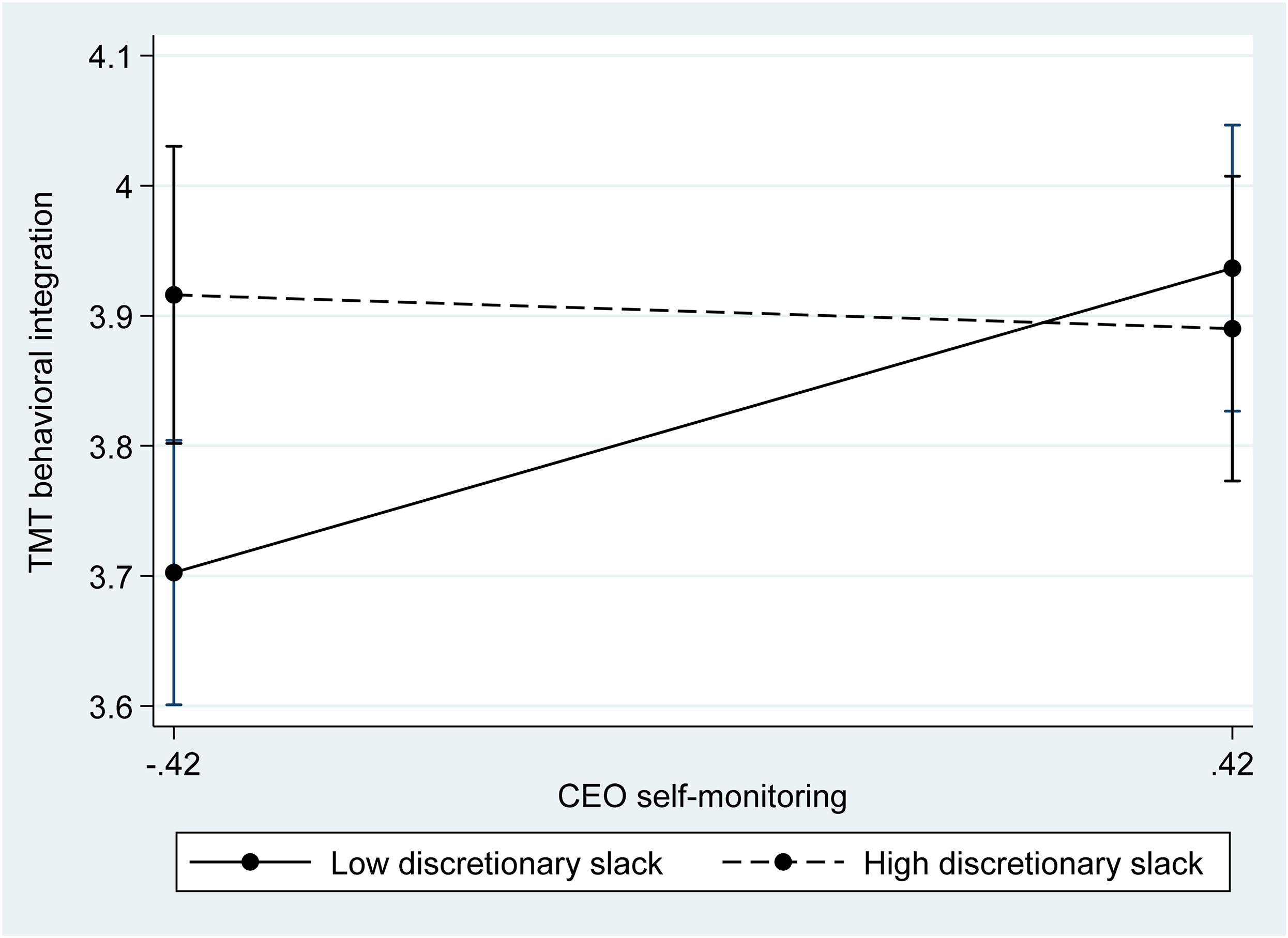
The Interaction of CEO Self-Monitoring and Discretionary Slack on Top Management Team Behavioral Integration
Means, Standard Deviations, and Correlations
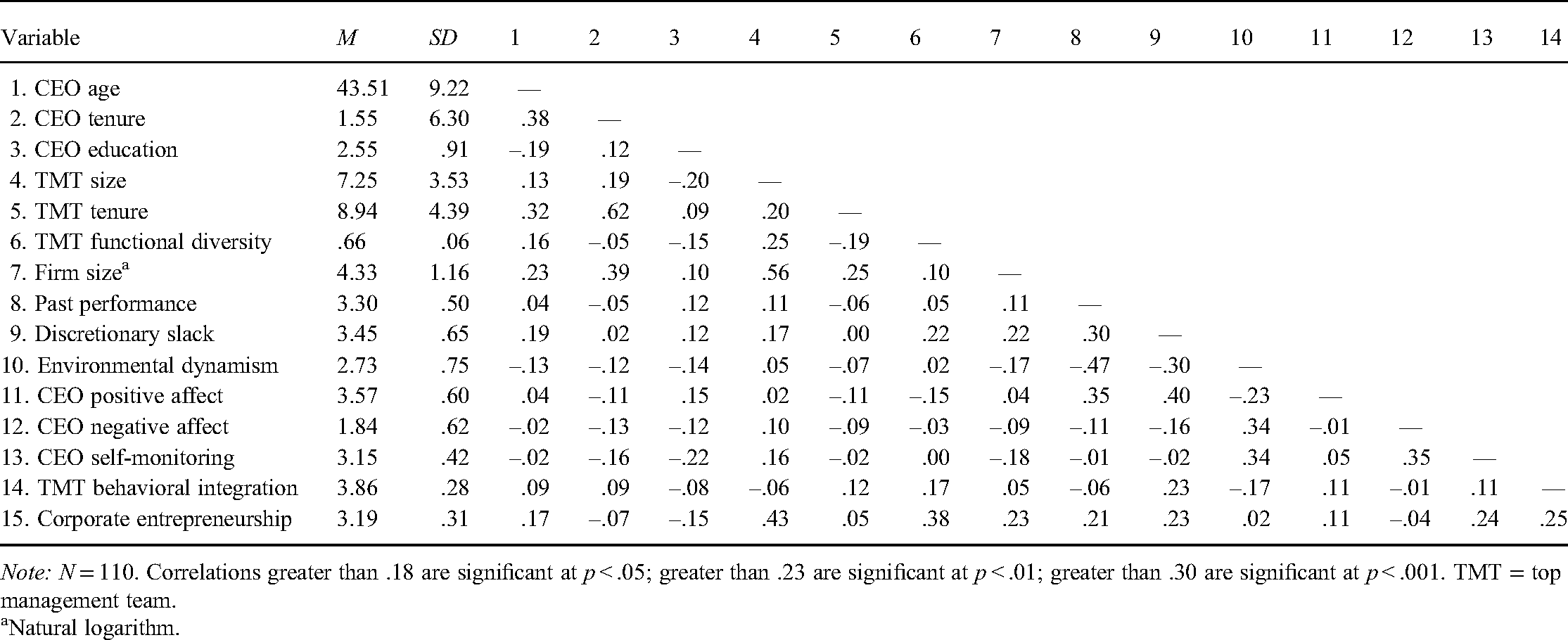
Note: N = 110. Correlations greater than .18 are significant at p < .05; greater than .23 are significant at p < .01; greater than .30 are significant at p < .001. TMT = top management team.
Natural logarithm.
Regression Results
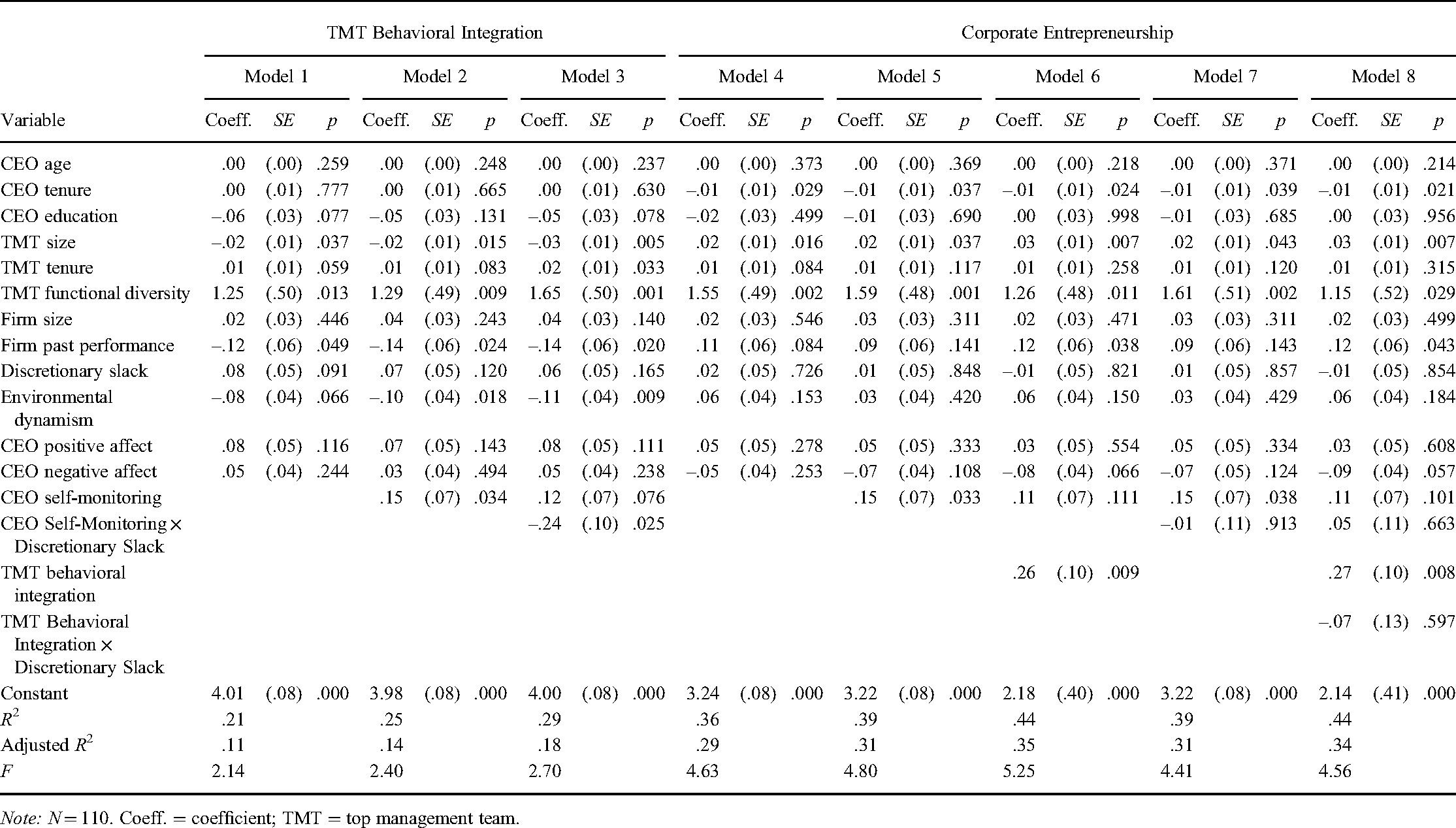
Note: N = 110. Coeff. = coefficient; TMT = top management team.
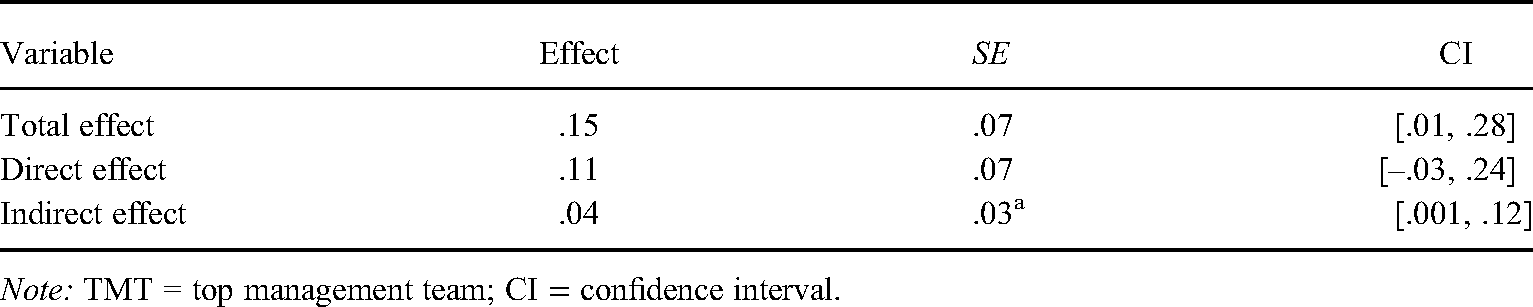
Bootstrapping Results of CEO Self-Monitoring on Corporate Entrepreneurship Through TMT Behavioral Integration
Note: TMT = top management team; CI = confidence interval.
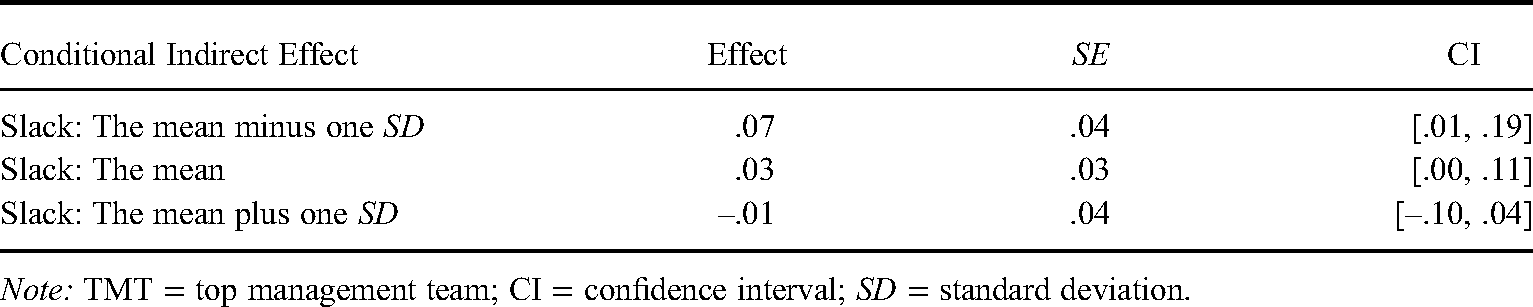
Bootstrapping Results of CEO Self-Monitoring on Corporate Entrepreneurship Through TMT Behavioral Integration at Different Levels of Discretionary Slack
Note: TMT = top management team; CI = confidence interval; SD = standard deviation.
CEO Self-Monitoring, TMT Behavioral Integration, and CE
H1 proposed that CEO self-monitoring would be positively associated with TMT behavioral integration. Results of Model 2 in Table 2 show that CEO self-monitoring was positively related to TMT behavioral integration (β = .15, SE = .07, p = .034), supporting Hypothesis 1. Hypothesis 2 proposed that TMT behavioral integration would be positively related to CE. The results of Model 6 in Table 2 show that this relationship was significant (β = .26, SE = .10, p = .009). Thus, Hypothesis 2 was supported.
For testing mediation effects, we used the approach of Preacher et al. (2007) to conduct a bootstrapping test of indirect effects. This test provides evidence of mediation if the 95% confidence interval (CI) does not include zero for indirect effects. We used Hayes’s (2013) SPSS macro “PROCESS” to evaluate the indirect effects of CEOs’ self-monitoring on CE through TMT behavioral integration. The results in Table 3 show that the indirect effect was positive and significant (β = .04, 95% CI = [.001, .12]). The proportion of the total effect that was mediated was 26.7%. Thus, Hypothesis 3 was supported.
Moderating Effects of Discretionary Slack
Hypothesis 4a proposed that discretionary slack would moderate the effect of CEO self-monitoring on TMT behavioral integration. The results of Model 3 in Table 2 show that the interaction effect was negative and significant (β = –.24, SE = .10, p = .025), supporting Hypothesis 4a. We graphed the interaction plots using “margins” and “marginsplot” commands in Stata (see Figure 2). The simple slope tests indicate that CEO self-monitoring was positively related to TMT behavioral integration (gradient of slope = .28, t value = 3.15, p = .002) when the slack was low (one standard deviation below the mean). However, when the slack was high (one standard deviation above the mean), the effect was not significant (gradient of slope = –.03, t value = –.29, ns).
Hypothesis 4b proposed that the indirect effect of CEO self-monitoring on CE through TMT behavioral integration would be dependent on the firm's discretionary slack. We tested Hypothesis 4b by adopting the approach of Preacher et al. (2007). This method uses a product of coefficients and a bootstrapping approach to test for the significance of the conditional indirect effects without imposing the assumption of normality of the sampling distribution. We adopted Hayes’s (2013) SPSS macro “PROCESS” to assess the conditional indirect effects of CEO self-monitoring on CE through TMT behavioral integration at different values of slack. The conditional indirect effect was significant for low levels of slack (one standard deviation below the mean) (β = .07, 95% CI = .01, .19) (Table 4). Thus, Hypothesis 4b was supported.
Common method bias
We undertook several additional steps to mitigate concerns about common method bias. First, we collected our independent variable, mediator, and dependent variables for each of the three time periods separately. Such temporal separation allows us to reduce biases (e.g., consistency motifs and illusionary correlations) associated with the cross-sectional design (Podsakoff, MacKenzie, & Podsakoff, 2012). Second, we conducted Harman’s (1967) single-factor test and did not find significant common method variance in the data. The exploratory factor analysis showed that the one-factor model could explain only 18.4% of the variance in the study variables. We also followed Podsakoff et al. (2012) by performing a general factor covariate technique test. When we added the first unrotated factor as a control in our models, the results were consistent with our main results. Third, researchers have suggested that common method variance bias is not a concern for studies that examine an interaction effect, such as ours (Siemsen, Roth, & Oliveira, 2010). Finally, Podsakoff et al. (2012) suggested that common method bias can be controlled for through an instrumental variable approach and two-stage least squares (2SLS) analysis. We conducted the analyses, with details provided in the section on endogeneity correction. Taken together, these analyses lead us to conclude that our findings are unlikely to be tainted by common method bias.
Robustness checks
We conducted several robustness checks. First, we included additional controls, such as firm age and CEO founder status. The results remained consistent. Second, we controlled for the number of TMT member responses and obtained consistent results. Third, we conducted statistical power analysis. A statistical power level of 0.80 or higher is commonly accepted for social science research (Cohen, 1988). In our analysis, the statistical powers for Hypothesis 1, Hypothesis 2, and Hypothesis 4a were 0.76, 0.97, and 0.87, respectively, indicating that our study has sufficient statistical power.
Finally, we performed SEM. We first established the measurement model of our four main variables (CEO self-monitoring, discretionary slack, TMT behavioral integration, and CE) using confirmatory factor analysis and then ran our hypothesized model. We finally examined the mediation path and the conditional indirect effects at low and high levels of discretionary slack. Although some indexes of the baseline measurement model and our hypothesized model failed to meet the thresholds because of our small sample size and complex theoretical model, the SEM results were consistent with our primary analysis using hierarchical regression and the PROCESS model. The results are available upon request.
Correction for potential sample selection bias
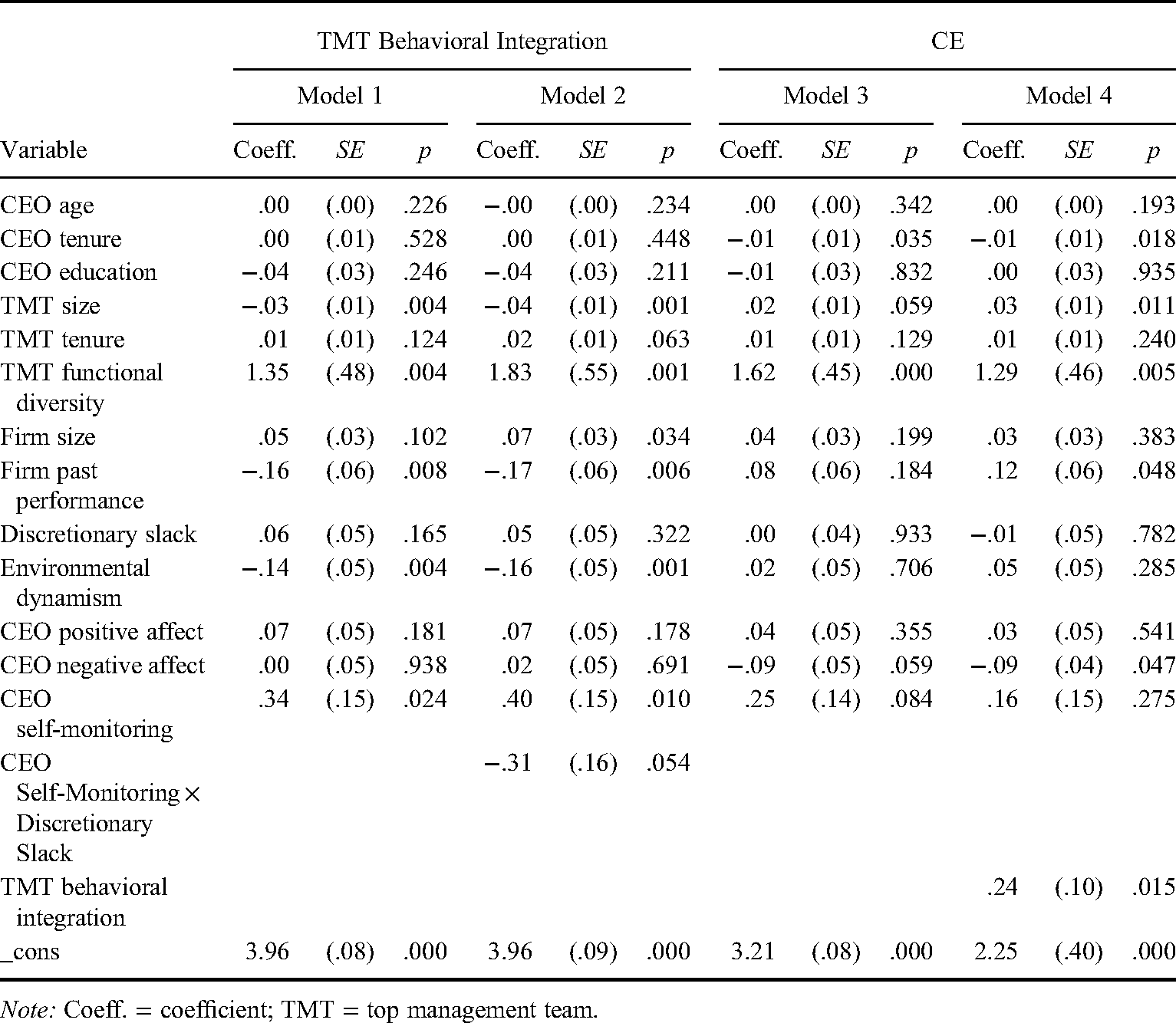
Conducting primary research on CEOs and TMTs is difficult because “it requires very intrusive access to large numbers of executives and TMTs, who are notoriously unwilling to submit themselves to scholarly polling and probing” (Hambrick, 2007: 337). Despite our best efforts, some CEOs did not respond, creating a sample selection problem. To correct for this potential bias, we used the two-stage procedure suggested by Heckman (1979). In the first stage, we used a dichotomous variable to indicate observations to be included in the second stage. Researchers have suggested that when Heckman models are used for sample selection bias correction, we should include “at least one variable in the first stage that does not appear in the second stage” (Certo et al., 2016: 2644). Thus, we used a probit model and regressed the dichotomous variable on firm location (which appeared only in the first stage), firm age, and firm size. We computed the inverse Mills ratio and added it as the control in the second stage. The lambda was insignificant (β = –.04, SE = .29, p = .890), suggesting that there was no sample selection bias in our sample. The coefficient for CEO self-monitoring was positive and significant (β = .15, SE = .07, p = .025), and the coefficient for the interaction term (CEO self-monitoring × discretionary slack) was negative and significant (β = –.24, SE = .10, p = .014). These results were consistent with those of the main analyses.
Endogeneity correction
Because firms may differ in unobserved ways that may explain CEO self-monitoring and CE, there are concerns about omitted variables in addition to endogeneity originating from reverse causality. The instrumental variable approach allows us to address such concerns. We followed Semadeni, Withers, and Certo’s (2014) approach to identify appropriate instrumental variables to correct for endogeneity. Critically, these variables must predict the independent variable but be unrelated to the dependent variable.
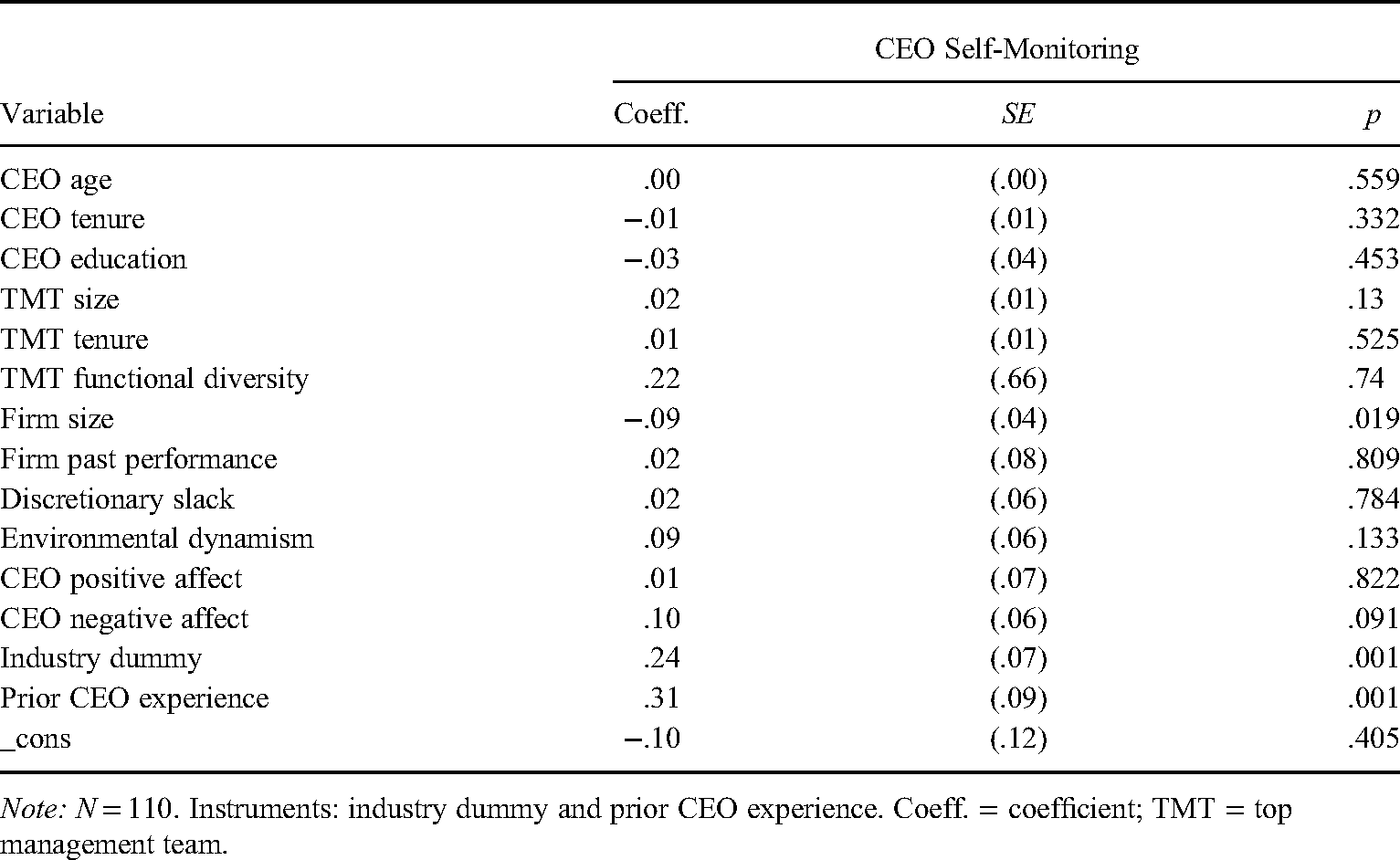
After considering several alternatives, we settled on two instruments: prior CEO experience (0 = no prior CEO experience; 1 = occupied CEO position in another firm) and firm industry (0 = service, 1 = manufacturing). Prior experience as a CEO of a different firm may help CEOs develop self-monitoring skills but cannot directly influence the CE activities of their current firms. In our study, prior CEO experience was not significantly related to CE (r = .12, ns). Moreover, firms in manufacturing industries, which have diverse and complex network ties, may favor self-monitoring CEOs, whereas other industries may favor low self-monitors. In addition, although specific industry contexts, such as dynamism, directly influence firms’ CE activities, whether firms are operating in service or manufacturing industries is not directly related to their CE activities. For example, entrepreneurial initiatives may be common in some service industries, such as software, and less so in others, such as financial services. In our study, the correlation between the industry dummy and CE was not significant (r = .14, ns).
We further assessed the relevance and exogeneity of the instruments (Semadeni et al., 2014). We used the Stata command “ivregress 2sls” along with “estat endog,” “estat firsstage,” and “estat overid.” First, the F test was significant, indicating that our instruments were strong (F = 12.07). The F value also exceeded the recommended threshold of 11.59. Second, the results of the Durbin-Wu-Hausman test (p = .141) supported the exogeneity of CEO self-monitoring. Finally, we tested the overidentifying restrictions by using the Sargan test. The test was not significant (χ2 = 0.376; p = .539), suggesting that the two instruments are valid. The results for the first- and second-stage models are reported in Tables 5 and 6.
2SLS Regression Results: First-Stage Regression
Note: N = 110. Instruments: industry dummy and prior CEO experience. Coeff. = coefficient; TMT = top management team.
2SLS Regression Results: Second-Stage Regression
Note: Coeff. = coefficient; TMT = top management team.
Implications and Conclusion
Theoretical Implications
Scholars have long considered CEO affective traits particularly vital to CE (Baron, 2008; Baron & Tang, 2011). The primary rationale is that CE is frequently associated with intense emotions because it entails considerable uncertainty, and CEOs with an inherent tendency to experience positive affect are better equipped to enlarge their field of vision, develop an acute awareness of new opportunities, and effectively persuade others to mobilize the resources necessary to realize entrepreneurial opportunities (Baron, 2008). Studies have found that CEO positive affect contributes to firm innovation (Baron & Tang, 2011) and new venture efforts (Foo et al., 2009). The fundamental assumption in those studies has been that CEOs express their actual, “raw” emotions and that such emotional displays matter in CE.
Our study extends this line of inquiry by applying self-monitoring in the executive setting. Emotional expression and emotional regulation are distinct concepts, as individuals who experience positive or negative affect may not necessarily express their felt emotions; instead, they may control how they express emotions to suit specific social settings (Gross, 1998). As Huy and Zott (2019: 28) suggested, emotional regulation is considered the “affective underpinnings of dynamic managerial capabilities.” Our results show that CEO self-monitoring significantly affects CE when the effects of CEO affective traits are controlled for. In doing so, our study suggests that CEOs’ emotional regulation matters for CE.
We found a significant indirect effect of CEO self-monitoring on CE through TMT behavioral integration. A more generalizable implication may be that CEO self-monitoring may significantly affect other strategic behaviors and outcomes. For example, because self-monitors are effective at conflict management, CEO self-monitoring may influence how the strategic role conflicts between senior executives and middle managers are handled. It would be interesting to examine the effect of CEO self-monitoring on the interaction between TMTs and middle managers. In addition, individual self-monitoring not only influences social interactions (where it exerts its main effects) but also moderates the effects of other personal traits, such as positive affect (Toegel et al., 2007). As we had data on CEO affective traits, we examined the possible role of CEO self-monitoring in moderating the effects of CEO affective traits on TMT behavioral integration. However, we found insignificant results. Future studies could further explore the interaction between CEO self-monitoring and other traits.
Moreover, studies seeking to explain the relationship between CEO traits and CE have generally highlighted a cognitive mechanism (Baron & Tang, 2011; Chin et al., 2021; Foo et al., 2009), with the assumption that CEOs’ traits shape how they scan external environments, selectively perceive and interpret strategic stimuli, and choose strategic options. In contrast, our study highlights a behaviorally rooted mechanism for explaining the relationship between CEO traits and CE; that is, CEO self-monitoring exerts an indirect influence on CE through TMT behavioral integration. While the cognitive mechanism focuses on inner processes (perceiving and interpreting), the behavioral mechanism underscores the interaction and communication within TMTs. Scholars have called for more research using the CEO
Finally, studies have drawn on the managerial discretion argument (Hambrick & Finkelstein, 1987) to examine the moderating role of slack in studying the effect of CEO traits (e.g., Tang, Qian, Chen, & Shen, 2015). Because slack provides flexibility and leeway for firms to pursue strategic options, CEOs have a high level of discretion in the presence of ample slack. Accordingly, slack strengthens the effects of CEO traits on strategic behaviors and outcomes. This argument suggests that slack's moderating effect may be universally positive, regardless of which CEO traits are examined. However, in our study, we found that CEO self-monitoring exerts a stronger impact on TMT behavioral integration and CE in the presence of scarce slack. This suggests that even as slack enables considerable discretion, it is likely to draw considerably on CEOs’ self-monitoring tendencies. Future studies could further examine the shaping influence of other firm-level contingencies, such as past performance.
Practical Implications
A key implication of our findings is that CEOs in SMEs can increase behavioral integration in their top teams by monitoring and controlling their self-regulation of expressive behaviors. A related implication is that SME management teams need to achieve a high level of behavioral integration to increase the pursuit of entrepreneurial activities, especially when functioning under a context of low discretionary slack. When CEOs overlook the social dynamics of their top teams and do not monitor and control their own and others’ expressive behaviors (feelings and attitudes) in information exchange and social interactions, the resultant behavioral disintegration within their TMTs can hinder the firm's ability to pursue CE.
Admittedly, incorporating self-monitoring as a selection criterion may not be feasible for many boards, and many SMEs might still be run by founder CEOs. Still, executive training programs and strategic retreats could address how to assess, monitor, and enable expressive behaviors and behavioral integration at senior executive levels. From our experience, executives tend to value such workshops, as they provide opportunities for personalized reflections. That said, whether such seminars or training workshops would have their intended effects (i.e., increased TMT behavioral integration and CE) is itself an empirical question for future research. One challenge that we foresee is that changes to CEO traits will likely prove to be an evolutionary process driven by a range of factors from individual development to life and career experiences.
Limitations and Future Research
This study's theoretical and practical implications need to be viewed in the context of its limitations, which provide opportunities for future research. First, our sampled firms were from western China and may not be representative of the broader population of Chinese SMEs, limiting the generalization of our findings. Future studies could collect data from other regions of China or extend the investigation to other types of firms, such as publicly traded firms.
Second, our sample consisted only of Chinese SMEs. China is known for its collectivist culture, where social harmony is highly valued. Accordingly, high behavioral integration might be the norm for China's TMTs, resulting in a limited range in our main variables and making it difficult to obtain significant results. If so, our Chinese sample might provide a conservative platform from which to test our hypotheses linking CEO self-monitoring, TMT behavioral integration, and CE. Nonetheless, our findings may not be generalizable to public firms or firms in other countries. Future studies can attempt to replicate our results in another country.
Third, owing the structure of our data, we cannot infer any cause-effect relationships or rule out the issue of reverse causality. Future studies could examine the effect of CEO self-monitoring using a longitudinal research design. In addition, although we have adopted several approaches (e.g., temporal separation) to mitigate common method bias, we had common respondents for some of the variables. Future studies could use external observers to rate CE or collect CE data from archival sources, if feasible, to avoid common method bias.
Conclusion
We developed and tested a model of how and when CEO self-monitoring affects CE. The results show that CEO self-monitoring has an indirect effect on CE through TMT behavioral integration and that this indirect effect is more pronounced in the presence of low discretionary slack. We are hopeful that these findings will spur additional research on other strategic consequences of CEO self-monitoring, including indirect effects through other TMT dynamics and processes. To the extent that CEO
Footnotes
Acknowledgments
The first two authors contributed equally to this research. We would like to thank two anonymous reviewers for their valuable and developmental feedback during the review process. The research was supported by the grants funded by National Natural Science Foundation of China (Grant No. 71672108 and No. 71871184) and the Fundamental Research Funds for the Central Universities (No. JBK190504).
