



Abstract
Ecosystems—communities of interdependent yet hierarchically independent heterogeneous participants who collectively generate an ecosystem value proposition—often emerge through collective action, where ecosystem participants interact with each other and the external environment. When such organizational forms are emerging, they require legitimacy to overcome the “liability of newness.” Adopting a collective action lens and taking a legitimacy-as-process approach, we propose a process model of ecosystem collective action, where an orchestrator, complementors, users, and external actors together drive ecosystem legitimacy. We identify three key legitimation processes—discursive legitimation, performative legitimation, and ecosystem identity construction—and demonstrate how these three processes together facilitate the emergence of ecosystem legitimacy and reduce the liability of newness of emerging ecosystems.
There has been increasing interest in ecosystems as a way to coordinate economic exchange (Jacobides, Cennamo, & Gawer, 2018; Shipilov & Gawer, 2020). Ecosystems are communities of hierarchically independent yet interdependent heterogeneous participants who collectively generate an ecosystem value proposition (Thomas & Autio, 2020) and are typically orchestrated by a focal actor that possesses key technology (such as a platform) or other resources (Adner, 2017; Jacobides et al., 2018). While extant research has focused on how economic and technological complementarity binds autonomous actors together (e.g., Dattée, Alexy, & Autio, 2018; Hannah & Eisenhardt, 2018), we know much less about how emerging ecosystems acquire legitimacy—the social acceptability, plausibility, and credibility beyond their material resources and capabilities (Suchman, 1995).
Legitimacy acquisition in ecosystem contexts is challenging as ecosystems are typified by complex systemic interdependencies (Adner, 2017; Adner & Feiler, 2019) among heterogeneous actors that are “legally autonomous and not linked through employment relationships” (Gulati, Puranam, & Tushman, 2012: 573). Legitimacy is particularly important during an ecosystem’s emergence, when it faces a “liability of newness” (Freeman, Carroll, & Hannan, 1983; Singh, Tucker, & House, 1986; Stinchcombe, 1965). Such liability of newness occurs when there is an absence of information and evidence regarding the viability of the emerging ecosystem (Aldrich & Fiol, 1994; Autio & Thomas, 2018), especially regarding the ecosystem value proposition (Dattée et al., 2018; Snihur, Thomas, & Burgelman, 2018). Furthermore, emerging ecosystems face doubts as to their long-term sustainability in the face of incumbent response (Ansari, Garud, & Kumaraswamy, 2016). Thus, a key question is how an emerging ecosystem can be perceived as legitimate by ecosystem participants and other actors in the broader environment.
Although authors of recent literature have begun to consider legitimacy in the context of emerging ecosystems (e.g., Ansari et al., 2016; Garud, Kumaraswamy, Roberts, & Xu, 2020; Snihur et al., 2018; Uzunca, Rigtering, & Ozcan, 2018), they leave questions unanswered regarding the particular role that different actors collectively play. For instance, while it is well known that ecosystem orchestrators have an important role in ecosystem emergence (Autio & Thomas, 2018; Dattée et al., 2018; Gawer & Phillips, 2013), understanding how complementors, users, and external actors contribute to legitimacy construction is equally important. For instance, ecosystem value creation is very much dependent on the number, nature, and relationships of the complementors (Adner, 2017; Autio & Thomas, 2020; Jacobides et al., 2018). User perceptions of the distinctiveness of an emerging ecosystem value proposition are also crucial to its success (Cennamo, 2020; Taeuscher, Bouncken, & Pesch, 2020). Similarly, external actors—such as regulators, competitors, media, and analysts—have a major role in facilitating ecosystem emergence and broader legitimacy construction (Ansari et al., 2016; Garud et al., 2020; Snihur et al., 2018).
In this article, we develop a theory of ecosystem legitimacy emergence, adopting a collective action lens. To do so we consider legitimacy as a process, focusing on the processual aspects that lead to the emergence of legitimacy (Suddaby, Bitektine, & Haack, 2017). We ground our arguments in two mutually complementary theories of collective action: social movement theory (Davis & McAdam, 2000; McAdam & Scott, 2005) and institutional entrepreneurship (Battilana, Leca, & Boxenbaum, 2009; Hargrave & Van De Ven, 2006). We distinguish three ecosystem legitimation processes: discursive legitimation processes, which promote ecosystem acceptance and comprehensibility; performative legitimation processes, which demonstrate the viability of the ecosystem; and ecosystem identity construction, comprising the emergence of a mutual understanding of what the ecosystem is about and what it seeks to achieve, and how it seeks to do this. We present these interlinked processes in a parsimonious process model of ecosystem legitimacy emergence.
We contribute in several ways. First, we provide an institutional view to understand how collective action reduces the liability of newness of emerging ecosystems. Building on a previous focus on the legitimation efforts of orchestrators (Autio & Thomas, 2018; Garud et al., 2020; Gawer & Phillips, 2013; Uzunca et al., 2018), we demonstrate how an analysis of ecosystem emergence and legitimation benefits from a collective, multiagent perspective, where different ecosystem participants have particular and mutually reinforcing roles.
Second, we introduce the construct of the ecosystem identity, defined as the set of mutual understandings among ecosystem participants regarding the central, enduring, and distinctive characteristics of the ecosystem value proposition. Building on earlier research that began to consider ecosystem identity (Gawer & Phillips, 2013; Lindgren, Eriksson, & Lyytinen, 2015; Wareham, Fox, & Cano Giner, 2014), we propose it as central to ecosystem legitimacy emergence. We argue that an ecosystem identity promotes legitimation from the point of view of both the external environment and ecosystem participants.
Third, we contribute by formulating a dynamic model of legitimacy in emerging ecosystems. We show how both discursive and performative legitimation processes interact through virtuous feedback loops to construct an ecosystem identity. While much of the ecosystem literature has focused on technological and economic inderdependencies, our inclusion of discursive processes helps also to explain the emergence of cognitive interdependencies. Our dynamic model also helps to explain issues such as contestation and conflict between ecosystem participants, processes of stigmatization and delegitimation, and how legitmacy emerges and is maintained in ecosystems.
Ecosystem Legitimacy Emergence as Collective Action
An ecosystem is a community of hierarchically independent yet interdependent heterogeneous participants who collectively generate an ecosystem output and related value offering (Adner, 2017; Thomas & Autio, 2020). 1 By cospecializing in compatible offerings to deliver a shared value proposition, ecosystem participants collectively deliver an output greater than any single participant could deliver alone (Adner, 2017; Jacobides et al., 2018). Given this cospecialization, each ecosystem participant coevolves with the other participants, as technological investments need to be adjusted over time to maintain their complementarity (Aarikka-Stenroos & Ritala, 2017; Thomas & Autio, 2020). Coordination of these idiosyncratic investments is made possible via alignment structures, such as platforms, that enable ecosystem participants to specialize in specific roles not always defined by formal contracts (Jacobides et al., 2018).
Ecosystems can be distinguished from other community constructs in management, such as fields, industries, supply chains, and networks, through their participant heterogeneity, type of system-level output, variety of participant interdependence, and nature of governance (for recent discussions, see Möller, Nenonen, & Storbacka, 2020; Shipilov & Gawer, 2020; Thomas & Autio, 2020). For instance, in contrast to industries, networks, and supply chains, participant heterogeneity in ecosystems is broader and can span multiple industries and transcend the boundary between public and private sectors. In a similar way, ecosystem value propositions are often more generative than other constructs with system-level outputs, such as supply chains, in that they can produce unprompted innovation (cf. Zittrain, 2006). In contrast to fields and industries, which are collections of related (but not necessarily cospecialized or interdependent) firms and actors, ecosystems feature a combination of technological, economic, and cognitive interdependencies that enable the shared value proposition. Finally, ecosystems rely primarily on noncontractual mechanisms, such as role definitions, supermodular complementarity, and the coalignment provided by a specific coordination structure (e.g., a platform), to strike a balance between generativity and coherence in ecosystem outputs (Jacobides et al., 2018; Wareham et al., 2014).
When an ecosystem is emerging, like other new organizational forms, it often struggles to gain resources and institutional support, leading to high failure rates in the early phases (Freeman et al., 1983; Singh et al., 1986; Stinchcombe, 1965). This “liability of newness” is driven by a dependence on cooperation from strangers as well as a lack of legitimacy (Freeman et al., 1983; Singh et al., 1986). To overcome the liability of newness, new organizations need to establish and maintain legitimacy, internal coherence, and external distinctiveness in order to survive (Stinchcombe, 1965; Yang & Aldrich, 2017). The distinguishing features of ecosystems result in specific challenges when it comes to overcoming the liability of newness. First, participant heterogeneity means that an emerging ecosystem needs to address a wide variety of stakeholders across multiple markets and industries, and establishing legitimacy across diverse audiences is difficult (Fisher, Kuratko, Bloodgood, & Hornsby, 2017). Second, the systemic nature of the ecosystem value proposition means that its initial value realization suffers from a “chicken-and-egg” problem of launch and adoption (Caillaud & Jullien, 2003). While this problem is well known for platforms, it also applies to ecosystems more generally when there are insufficient participants to enable an appealing ecosystem value proposition. Third, the emergence of technological, economic, and cognitive independencies is a complex, multiagent process, requiring the establishment of collaborative routines and coherent boundaries among ecosystem participants that are limited in their understanding of interdependence-related risks (Adner & Feiler, 2019; Yang & Aldrich, 2017). Finally, emerging ecosystems lack the coalignment structures that shape governance. While technological coalignment through platforms and similar technologies faces the liability-of-newness challenges of new technologies (cf. Ansari et al., 2016; Snihur et al., 2018), coalignment through a mutual sense of “who we are” and “what we do” (Navis & Glynn, 2010) requires the development of a collective identity, which itself requires legitimacy (Gawer & Phillips, 2013; Patvardhan, Gioia, & Hamilton, 2015).
We argue that collective action among different ecosystem participants enables an emerging ecosystem to overcome its liability of newness. Collective action considers groups of actors as causal agents and how their interaction facilitates and constrains the emergence of a shared goal (Hargrave & Van De Ven, 2006). Collective action is particularly relevant for ecosystem emergence, as ecosystems arise from the interactions between various participants in pursuit of the shared value proposition. Similar to the classic meaning of collective action (cf. Olson, 1965), emerging ecosystems require independent actors to take (often costly) actions themselves while leading to outcomes that affect all involved. Most literature has focused on the role of the orchestrator in establishing the value proposition around which the ecosystem is created (e.g., Dattée et al., 2018), which is not surprising given the importance of orchestrator entrepreneurial behavior in emerging ecosystems (Hannah & Eisenhardt, 2018). However, a focus on the orchestrator overlooks a major aspect of overcoming the liability of newness—the lack of existing linkages within the heterogeneous industrial and institutional contexts and a related lack of legitimacy (Freeman et al., 1983; Singh et al., 1986). We argue that ecosystem legitimacy emergence is a process where the liability of newness is overcome by collective action among the orchestrator, complementors, users, and external actors. To this end, we draw from two established theories of collective action: social movement theory and institutional entrepreneurship.
Social movement theory explains how the actions of groups of individuals can change institutions (Davis & McAdam, 2000; McAdam & Scott, 2005). It considers three broad, interrelated factors that make up social movements and collective action: an opportunity structure consisting of the opportunities and constraints facing the movement, a mobilizing structure that comprises the formal and informal organizing structures available, and framing processes that lead to the generation of shared meanings (Davis & McAdam, 2000). If an emerging ecosystem can mobilize social movement–type processes where different stakeholders over time build joint understandings and infrastructure (King, 2008), then the legitimacy challenges related to the loosely coupled nature of the ecosystem as an organizing form might become a strength. This logic follows the “identity movement” approach within social movement theory (see Rao & Dutta, 2018; Rao, Monin, & Durand, 2003), which considers how movements can promote feelings of unity through participant discourse (Taylor & Whittier, 1999). 2 For instance, the Finnish start-up ResQ Club, established in 2015, is building an ecosystem around food-waste reduction by connecting restaurants with urban consumers who purchase that leftover food at a reduced price. This emerging ecosystem benefits from the social movement–like awareness of the circular economy and food-waste reduction. 3 We suggest that such collective action processes are central to ecosystem legitimacy emergence.
Institutional entrepreneurship considers the actions of a lead agent within a collective and provides insight into the discursive and legitimation processes that drive institutional change (Creed, Scully, & Austin, 2002; DiMaggio, 1988). While institutional entrepreneurship has mainly focused on how a single actor drives institutional change, scholars have begun to highlight the importance of collective action in legitimization and mobilization (Battilana et al., 2009). Collective action in institutional entrepreneurship contexts is based upon the recognition that there needs to be multilateral action that constructs both the social arrangements and the actors themselves (Battilana et al., 2009). For instance, Garud, Jain, and Kumaraswamy (2002) demonstrate how collective action helped Sun Microsystems address the contradictory pressures of mobilization and maintenance to support the adoption of its Java technology. Thus, we suggest that ecosystem legitimacy is also linked to both orchestrator-driven institutional entrepreneurship and related collective action by other ecosystem actors.
A Process Model of Ecosystem Legitimacy Emergence
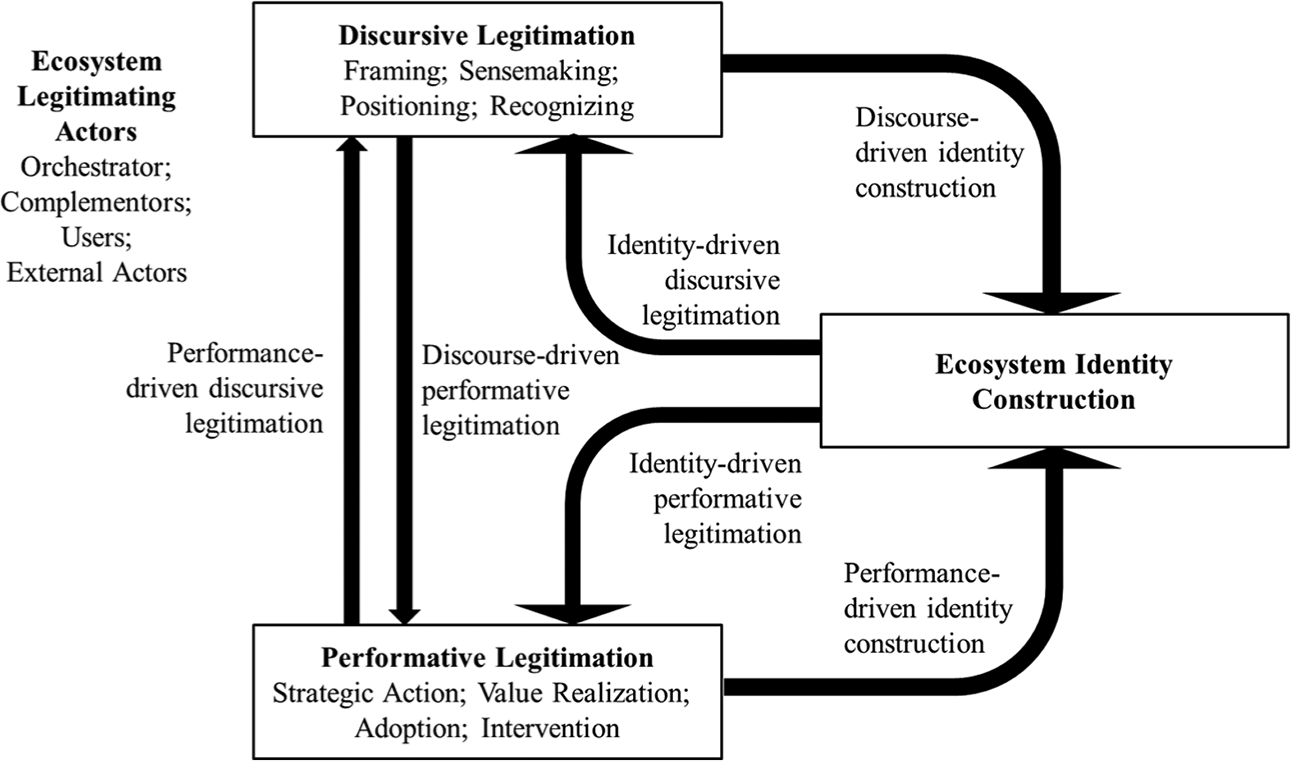
Legitimacy is the “generalized perception or assumption that the actions of an entity are desirable, proper or appropriate within some socially constructed system of norms, values, beliefs and definitions” (Suchman, 1995: 574). It is “possessed objectively yet created subjectively” (Suchman, 1995: 574) and is a condition reflecting perceived consonance with relevant rules and laws, normative support, and alignment with cultural-cognitive frameworks, which are displayed in a way that is visible to outsiders (Scott, 2008). We focus on normative and cognitive legitimacy. 4 Normative legitimacy is the degree of congruence between the actions, characteristics, and form of an entity and the beliefs and cultural values of the broader social environment in which it resides (Scott, 2008; Suchman, 1995). In organizational contexts, this is often reflected in the perceived viability of the entity—how it performs in the broader economic environment (Autio & Thomas, 2018). For instance, a study by Wade (1995) demonstrated how user adoption of microprocessors led to normative legitimacy for the semiconductor industry. Cognitive legitimacy is based on comprehensibility and taken-for-grantedness of an entity (Aldrich & Fiol, 1994; Suchman, 1995) and is driven by discursive processes. Hargadon and Douglas (2001) provide an example of how electric lighting was made comprehensible using terms grounded in the existing gas lighting system prevalent at the time. In summary, ecosystem legitimation leans on two complementary aspects: actions that align with normative expectations and discourses that build cognitive coherence. In this study, we build on these two dimensions of legitimacy and adopt a legitimacy-as-process view (Suddaby et al., 2017) to develop a process model of ecosystem legitimacy emergence (see Figure 1).
A Process Model of Ecosystem Legitimacy Emergence
We first identify the ecosystem-legitimating actors that collectively interact during the process of ecosystem emergence. These include the ecosystem orchestrator, complementors, users, and external actors. Each actor has a distinct, yet interconnected, role in the processes of ecosystem legitimacy emergence, as depicted in Figure 1.
We next describe the processes driving ecosystem collective action. Discursive legitimation processes drive cognitive legitimacy by giving the emerging ecosystem meaning through the processes of framing, sensemaking, positioning, and recognition. Performative legitimation processes drive normative legitimacy by proving the viability of the ecosystem through the processes of strategic action, value realization, adoption, and external intervention. Ecosystem identity construction consists of the emergence of a set of mutual understandings among ecosystem participants regarding the central, enduring, and distinctive characteristics of the ecosystem value proposition.
Finally, we show how these three processes interact. As depicted in Figure 1, discursive and performative processes are mutually complementary: Collective action in one process influences the other. We also show how discursive and performative legitimation both drive the construction of an ecosystem identity. Furthermore, as an ecosystem identity is established, this in turn drives collective action in the form of stronger discursive and performative legitimation. Our model follows social movement theory in recognizing how collective action drives identity formation (King, 2008; Rao et al., 2003) and institutional entrepreneurship in emphasizing the role of an orchestrator in guiding collective action by shaping common ground and identity (Battilana et al., 2009; Wijen & Ansari, 2007).
Ecosystem-Legitimating Actors
The orchestrator and complementors are commonly considered the main contributors to an ecosystem value proposition and are usually portrayed as composing the ecosystem structure (Adner, 2017; Jacobides et al., 2018; Shipilov & Gawer, 2020). However, to explain ecosystem legitimacy emergence, other actors need to be considered since an ecosystem value proposition does not emerge in isolation from the external environment. Thus, another relevant actor is the user (or set of users) that the ecosystem value proposition is directed at, while a further set of actors are the multiple audiences external to the ecosystem, such as regulators and the media. 5 These numerous dispersed actors interact to overcome collective inaction and achieve the sustained collaboration that typifies an ecosystem (Wijen & Ansari, 2007).
The ecosystem orchestrator, also referred to as the hub or keystone actor (e.g., Iansiti & Levien, 2004), is the focal organization that advocates the ecosystem value proposition to other actors within and without the ecosystem, similar to an institutional entrepreneur. 6 From a collective action point of view, the ecosystem orchestrator is central to the health and stability of an ecosystem (Iansiti & Levien, 2004), as it increases the ease with which complementors and users can connect to each other due to the orchestrator’s ability to shape the goals, identity, and design of the ecosystem (Gulati et al., 2012). To accomplish this, ecosystem orchestrators use tangible and technical governance mechanisms as well as more relational means of governance (Wareham et al., 2014). Often a digital platform is used as the coordinating framework that other ecosystem participants can leverage to enhance their own performance and to drive generativity (Cennamo & Santaló, 2019; Thomas, Autio, & Gann, 2014). 7 The actions of the orchestrator are particularly relevant in emerging ecosystems, as it needs to reassure participants that there is a general consensus that value will be cocreated (Autio & Thomas, 2020; Gawer & Phillips, 2013) as well as convince users and societal stakeholders of the ecosystem’s viability (Dattée et al., 2018).
Given their central role within the ecosystem, orchestrators have a wide range of strategic actions they can take to normatively legitimate the ecosystem as well as discursive strategies that facilitate cognitive legitimation (Ansari et al., 2016; Snihur et al., 2018). Orchestrators can act in the role of an institutional entrepreneur when the ecosystem value proposition requires the introduction and legitimation of new economic logics (Battilana et al., 2009; Kaplan & Murray, 2010). Further, the orchestrators’ actions are vital for themselves to be recognized as central to the ecosystem and to have the right to make decisions (Gawer & Phillips, 2013). Indeed, orchestrators that act in ways that are not congruent with ecosystem norms may no longer be taken for granted as leader. While much of the ecosystem literature focuses on the role of orchestrator in ecosystem emergence (e.g., Dattée et al., 2018; Hannah & Eisenhardt, 2018), collectives can also self-organize without central coordination (Wilhoit & Kisselburgh, 2015). Thus, as ecosystem activity can take place through self-organization and interaction among other ecosystem actors, an orchestrator really only partially directs the coordination of the ecosystem. Therefore, we need to examine other actors beyond the orchestrator.
Complementors are ecosystem participants that provide complementary products, services, or inputs that contribute to the ecosystem value proposition (Jacobides et al., 2018; Shipilov & Gawer, 2020). 8 Complementors are vital during ecosystem legitimacy emergence, as without their participation, the ecosystem value proposition is unable to be formulated or delivered—after all, without complementors, there is no “ecosystem.” Complementors provide normative legitimacy through the mere act of participating, as access to complementary assets is vital for delivering the ecosystem value proposition. Furthermore, the quality of the complementary assets that they provide can influence ecosystem viability (Cennamo & Santaló, 2019; Taeuscher & Rothe, 2020). Complementors can also lead to cognitive legitimacy through their participation in the discourse around the ecosystem (Autio & Thomas, 2018). Furthermore, complementors within emerging ecosystems also need to build legitimacy for their own contributions, and in doing so, their interactions can take on a social movement–like character as they collectively seek to prove their own viability and that of the ecosystem value proposition (Swaminathan & Wade, 2001). Thus complementors’ participation and their discursive practices can enhance the comprehensibility and taken-for-grantedness of the ecosystem for both ecosystem participants as well as nonparticipants.
Users become legitimatizing actors through their adoption of the ecosystem value proposition, driving the emergence of both normative and cognitive legitimacy. For instance, users can trigger normative legitimacy through higher rates of adoption and signals of viability (Schilling, 2009). Furthermore, high-profile, large, and powerful users adopting a product can be a powerful normative legitimating mechanism (Tushman & Rosenkopf, 1992). Users can also drive cognitive legitimacy through their perception of the distinctiveness and value of the ecosystem (van Werven, Bouwmeester, & Cornelissen, 2015). By consuming the ecosystem value proposition and demonstrably benefiting from it, as well as through discursive explanations of why they are consuming the ecosystem value proposition, users enable non–ecosystem participants to better comprehend the value of the ecosystem.
A final set of legitimating actors are external actors to the ecosystem, such as the media, financial analysts, competitors, and regulators. Media have been shown to be an important influence on ecosystem legitimacy (e.g., Snihur et al., 2018), similar to how they assist social movements (King & Soule, 2007) and institutional entrepreneurs (Lounsbury & Crumley, 2007). Financial analysts are also relevant as they signal to investors and other external stakeholders the value of the ecosystem (Beunza & Garud, 2007). Competitor entry can drive ecosystem legitimacy by signaling viability by driving adoption and performance improvement (Agarwal & Bayus, 2002). Finally, regulators can legitimate ecosystems by establishing and enforcing standards, underlining the new reality of the ecosystem and its societal role (Garud et al., 2020; Uzunca et al., 2018).
Discursive Legitimation Processes
Discursive legitimation processes are those activities that motivate and convince others to accept and participate in the ecosystem as well as build a shared understanding of its purpose with the wider economic and social environment (Battilana et al., 2009; Phillips, Lawrence, & Hardy, 2004). Discourse refers to the conversation and written material that occurs in conjunction with ecosystem emergence as well as the generation and dissemination of symbolic elements that mediate between the legitimating actors, the ecosystem, and the broader context (Phillips et al., 2004). Central to all discursive legitimation processes are the generation of shared meaning and the emergence of cognitive legitimacy.
We identify four discursive processes that drive cognitive legitimacy and, relatedly, the comprehensibility of an ecosystem and its value proposition (Aldrich & Fiol, 1994; Suchman, 1995). The purpose of discourse is dependent on the legitimating actor. Orchestrators seek to make the ecosystem comprehensible by using framing to focus attention on specific features, resembling the way that institutional entrepreneurs frame institutional change. The discourse of complementors is similar to discourse within social movements, where participants engage in sensemaking, seeking to adapt and perform. Users help to discursively position the ecosystem value proposition, while external actors, such as the regulators, media, and analysts, provide legitimacy by recognizing the existence of the ecosystem (King & Soule, 2007). Although we have ascribed specific discursive roles to particular actors, discursive legitimation often involves the interaction of legitimating actors, and as such, as we will note, they may participate in several of these processes.
Framing
Framing consists of the construction of meaning that focuses attention on selected salient features to organize experience and guide action and is an important aspect of collective action (Battilana et al., 2009; Benford & Snow, 2000; Cornelissen & Werner, 2014; Navis & Glynn, 2010). Framing is undertaken by ecosystem orchestrators to shape how an ecosystem is characterized (Lindgren et al., 2015; Snihur et al., 2018). Similar to how institutional entrepreneurs create the conditions for collective action (Battilana et al., 2009; Rao, Morrill, & Zald, 2000), orchestrators frame a vision that identifies the issues at hand, demonstrate why the ecosystem should be preferred to alternatives, and present compelling motivations to act. And similar to social movements, at times framing can be undertaken by participants, particularly when the collective action seeks to create a sense of unity and belonging (Benford & Snow, 2000; Creed et al., 2002; Rao et al., 2003).
Framing is often done in terms of “familiarity” (Hargadon & Douglas, 2001; Pan, Li, Chen, & Chen, 2020). For instance, Pan et al. (2020) show how framing an opportunity in terms of familiarity positively influences the amount of venture funding entrepreneurs can access. The use of familiarity is often successful in mobilizing collective action as it increases resonance (Giorgi, 2017; Snow & Benford, 1988), which facilitates understanding about the ecosystem value proposition through analogy to older and more familiar ideas (Cornelissen & Clarke, 2010). Frames focused on the “public interest” can also lead to legitimacy. For instance, Gurses and Ozcan (2015) explain how an orchestrator introducing pay TV in the United States emphasized the public interest to legitimize its offering despite strong resistance from incumbents. Framing can also focus on market leadership. For instance, Snihur et al. (2018) show how Salesforce leveraged its social position as the leader of the nascent software-as-a-service market to legitimate itself, resulting in increased media exposure, user satisfaction, and access to resources.
Sensemaking
Discursive legitimating activity is also typified by sensemaking, where complementors collectively begin to comprehend the ecosystem value proposition and build a springboard for action (Autio & Thomas, 2018; Cattani, Sands, Porac, & Greenberg, 2018; Weick, Sutcliffe, & Obstfeld, 2005). Ecosystem sensemaking is akin to social learning—a highly participative process where ecosystem participants develop and share insights, categorize the various components of ecosystem value proposition, and form shared views of what is feasible and technically desirable (Autio & Thomas, 2018; Cattani et al., 2018; Weick et al., 2005). As part of this process, complementors (and sometimes the orchestrator) engage in experimentation and a search for good practices to comprehend the technologies, tools, and potential value of the emerging ecosystem (Autio & Thomas, 2018; Kaplan & Tripsas, 2008). In this way, sensemaking can take on a social movement–like character as participants collectively seek to understand the ecosystem (Swaminathan & Wade, 2001). Sensemaking is often facilitated through shared narratives, appealing rhetoric, and culturally powerful analogies and metaphors that emphasize agency, control, predictability, and taken-for-grantedness (Cornelissen, Clarke, & Cienki, 2012; Suddaby & Greenwood, 2005). Sensemaking can also be facilitated by events, such as conferences, workshops, and outreach activities, that set expectations and encourage participation (Snihur et al., 2018).
Positioning
Ecosystem positioning occurs when users collectively make sense of what is distinctive and valuable about the ecosystem value proposition and why. In contrast to sensemaking, where ecosystem participants collectively experiment and search for the ecosystem value proposition, ecosystem positioning consists of users collectively agreeing on the relevance of the ecosystem value proposition. 9 As part of this process, users collectively engage in discursive practices to make sense of the elements that characterize the technological and market identity of the ecosystem (Cennamo, 2020; Hakala, Niemi, & Kohtamäki, 2017). As a consequence, users begin to comprehend the ecosystem value proposition in terms of its distinctiveness to other offerings (Cennamo, 2020; Taeuscher et al., 2020). Such ecosystem distinctiveness needs be perceived as legitimate so that users commit to an offering (Navis & Glynn, 2011; van Werven et al., 2015). Furthermore, users as a collective ultimately determine the value of the ecosystem offering as well as the comparative value against potential competitors’ offerings (Taeuscher et al., 2020). This process of evaluating an ecosystem offering is thus necessarily a cognitive one—as the perceptions of user value are not only economic but also functional, emotional, and symbolic (e.g., Kaplan & Tripsas, 2008; Snow & Benford, 1988).
Recognizing
External recognition is particularly relevant for the discursive legitimation of an emerging ecosystem, given that cognitive legitimation really becomes feasible only when ecosystem outsiders recognize it (Drori & Honig, 2013). In the same way that the discursive actions of the media, analysts, regulators, and other actors in wider society can influence the success of a social movement or an institutional entrepreneur (Lounsbury & Crumley, 2007; Strang & Soule, 1998), such actors can also influence ecosystem legitimacy emergence. Relevant discursive actions include entering the general lexicon; referencing in art; winning awards; and the release of books, magazines, academic or medical research or press that substantively discusses the ecosystem (Phillips et al., 2004).
When an ecosystem becomes successful, it becomes subject to intense scrutiny by media and analysts, who introduce and often promote it to wider society (Beunza & Garud, 2007; Snihur et al., 2018). For instance, despite differing opinions and approaches, the intense analyst coverage of Amazon.com during the dotcom period had the effect of signaling its legitimacy to investors (Beunza & Garud, 2007). Changing societal opinions of a new organizational form can also lead to legitimacy; for instance, Greenwood, Suddaby, and Hinings (2002) show how external opinions legitimated new organizational forms arising within the accounting profession. Competitors can also provide recognition, often through meaning construction (Cattani et al., 2018; Snihur et al., 2018). For instance, Snihur et al. (2018) show how the incumbent’s response to Salesforce’s guerilla marketing helped legitimate its emerging ecosystem value proposition. Regulators can also provide recognition. For instance, when the Securities and Exchange Commission provided detailed guidance as to how revenue would be recognized for Salesforce’s IPO, this legitimated its then-novel software-as-a-service business model (Snihur et al., 2018).
Performative Legitimation Processes
Performative legitimation processes result in normative legitimacy for the ecosystem—they demonstrate the viability, if not superiority, of the ecosystem to the broader social environment (Aldrich & Fiol, 1994; Suchman, 1995). Performative processes relate to ecosystem performance and reflect the importance of effective “mobilizing structures” within social movement theory (Davis & McAdam, 2000; King, 2008). However, unlike ecosystem performance as an outcome, performative legitimation is an ongoing process where ecosystem legitimacy emerges via signals of performance. Thus an orchestrator can drive ecosystem performance through strategic actions, such as technological design, governance design, and organizational signaling (Autio & Thomas, 2018; Gulati et al., 2012), playing a role similar to an institutional entrepreneur in initiating changes and actively participating in implementing those changes (Battilana et al., 2009). Complementors can influence ecosystem performance through their decision to participate in the ecosystem, providing the required resources and ability to scale the delivery of the ecosystem value proposition. Users influence ecosystem performance through their adoption of the ecosystem value proposition, demonstrating viability and congruence with market and external norms. External actors, such as financiers, competitors, and regulators, can also influence ecosystem performance through investment, market intervention, and competition.
Strategic action
Ecosystem viability can be signaled through strategic action—specific acts undertaken by participants to enhance the performance of the ecosystem. While strategic actions are mostly the preserve of the orchestrator, these can also be taken by complementors. An important strategic action is ecosystem-specific investment into the resources and technologies that underpin the ecosystem value proposition (Schilling, 2009). For instance, Uzunca et al. (2018) show how Uber invested to optimize the quality of the Global Positioning System in Egypt, strengthening its legitimacy with key local stakeholders. Orchestrators can also signal their dedication via organizational structure and marketing capabilities. Gawer and Henderson (2007) show how Intel used separate divisions with their own profit-and-loss accounts to signal engagement and that both Intel and complementors could make money in the emerging ecosystem. Signaling ecosystem viability can also consist of symbolic actions, such as offering free services, so that potential complementors and users can participate (Uzunca et al., 2018).
Strategic action can also take the form of technological design of the underlying ecosystem technologies, as these often directly influence the performance of an ecosystem (Jacobides et al., 2018; Thomas et al., 2014). For instance, Uzunca et al. (2018) show how Uber customized its payment options in Egypt, leading to increased appeal from the general population. Design decisions relating to modularity, complementarity, and complementor mobility, which allow ecosystem participants to coordinate without direct coordination, can signal the ecosystem’s value to complementors and of the ecosystem value proposition (Jacobides et al., 2018; Jacobides, Knudsen, & Augier, 2006). Decisions as to standardization can signal the availability and size of economies of scale and scope, as the level of standardization can have significant economic impacts (Farrell & Saloner, 1985).
Another strategic action is governance design, referring to the establishment and application of rules that control activity within the ecosystem, including those efforts to establish norms of behavior and procedures to solve collective action problems that may arise (Bridoux & Stoelhorst, 2020; Wareham et al., 2014). Wareham et al. (2014) has shown successful ecosystems require active governance that balances complementor standardization and variety, process control and autonomy, and individual versus collective incentives. These tensions can be balanced through technical, legal, market, and normative standards that define “normal” processes involved in the delivery of the ecosystem value proposition (Aldrich & Fiol, 1994; Garud & Kumaraswamy, 1993). Similarly, membership rules, governance control, and pricing (costs) can be varied in order to encourage adoption and to send signals of ecosystem viability (Tiwana, Konsynski, & Bush, 2010). Furthermore, while at times governance is controlled extensively, if not completely, by an orchestrator, more open governance models can signal to participants their potential control of ecosystem evolution and, hence, future performance (Bridoux & Stoelhorst, 2020; Schilling, 2009).
Value realization
Ecosystem viability can also be demonstrated through the successful realization of the ecosystem value proposition. Value realization occurs when the ecosystem-level value offering, sometimes referred to as the “ecosystem value blueprint” (Adner & Kapoor, 2010; Jacobides et al., 2018), appears to be more effective than alternative forms of collective organization in delivering viable solutions to user needs (Autio & Thomas, 2020). For the orchestrator and complementors, this effectiveness is often simply demonstrated by the ecosystem as a collective, generating revenue. At other times, participants may be seeking value realization through the mere “satisfaction” of delivering the ecosystem value proposition or the associated recognition involved in delivering it (Jeppesen & Frederiksen, 2006). For instance, Jeppesen and Frederiksen (2006) show that rather than receiving pecuniary benefits, electronic musical instrument designers in the Propellerhead ecosystem realized value through the recognition they received for participation. Value realization is an ongoing process, in the sense that the value realized needs to meet with at times indeterminate and changing standards of value (Autio & Thomas, 2018) as well as align with the evolving requirements of the market environment (Hannah & Eisenhardt, 2018; Snihur et al., 2018). Consequently, there is a process of constant adaptation as the orchestrator and complementors seek to ensure that the ecosystem value proposition enables value realization. For instance, Snihur et al. (2018) show how Salesforce continually adapted its value proposition in response to feedback from complementors and users to ensure value realization. Value realization therefore benefits from constant collective action, driven by both orchestrator and other ecosystem actors.
Adoption
The viability of an ecosystem is also demonstrated through the adoption of the ecosystem by both complementors and users. Complementors are required for the establishment of interdependencies that typify ecosystems (Jacobides et al., 2018; Thomas & Autio, 2020), and as complementors collectively possess the skills and resources that enable the value proposition delivery, they underpin the realization of value (Adner, 2017; Hargrave & Van De Ven, 2006). Complementors can signal the viability and performance of the ecosystem by simply participating, similar to participation in social movements (Wade, 1995). In addition, many emerging ecosystems have clearly identifiable complementors, and the participation of high-status complementors can send a strong legitimacy signal (Taeuscher & Rothe, 2020). For instance, Ritala, Golman, and Wegmann (2014) show that in the early stages of the Amazon Kindle, Apple’s decision to support the Kindle app on the iPad platform, regardless of being an e-book competitor at the time, was a strong signal of viability.
In terms of users, the adoption of the ecosystem value proposition can signal viability by providing “extra” momentum to the ecosystem (Schilling, 2009). The adoption of the ecosystem by high-profile users, such as government as well as large and powerful organizations, can also positively influence legitimacy emergence. For instance, Snihur et al. (2018) point out that once SunTrust Banks, a Fortune 500 company and one of the United States’s largest commercial banks, became a customer of Salesforce in 2004, many more large customers followed. Adoption can also drive network effects, where user value increases through adoption by other users and complementors (Katz & Shapiro, 1986). A network effect can act as a strong force in driving participant adoption, so that a small lead (either random or through first-mover advantage) will inexorably drive more users (and complementors) to the ecosystem through increasing returns (Parker & Van Alstyne, 2005). 10 Together, these have a virtuous cycle effect, as a greater number of participants leads to more rapid adoption of the ecosystem, which in turn attracts even more participants.
Intervention
The intervention of external actors can also influence legitimacy by demonstrating the viability of the ecosystem and its congruence with the broader social environment. One set of external interventions is the actions of financiers, such as through seed investments, venture capital investments, loans, initial public offerings, and stock issuance. These interventions can send a strong signal of legitimacy as, similar to social movements, such resources are required to scale, take on incumbents, and ride out the negative costs of the transitional period during which the ecosystem is likely to be unknown (Garud et al., 2002; Swaminathan & Wade, 2001). For example, Salesforce’s successful IPO legitimated its then-novel subscription cloud-based business model (Snihur et al., 2018). Another set of external interventions that lead to legitimacy is quality and certification competitions, where media and analysts award an ecosystem “best in class” accolades (Rao, 1994). Relatedly, successful ecosystems will motivate others to compete for the same value propositions (Rao et al., 2000). Thus incumbent responses to the emerging ecosystem (Ansari et al., 2016; Snihur et al., 2018), as well as the entry of new competitors, can serve as legitimacy signals, as can sales takeoff and competitive technological improvement (Agarwal & Bayus, 2002). A further set of external interventions is actions of regulators, such as investigation by competition authorities, the establishment of standards, and even the passing of statutes that relate to the ecosystem (Ozcan & Gurses, 2018; Uzunca et al., 2018). The introduction of such regulation can lead to altered participant relationships, changing power-relations and value-realization conditions and threats to established interdependencies (Garud et al., 2020; Holm, 1995).
Ecosystem Identity Construction
Identity—those characteristics that are central, enduring, and distinctive (Albert & Whetten, 1985; Dhalla & Oliver, 2013; Peteraf & Shanley, 1997)—is a minimum necessary criterion for the establishment of any type of organization (Dobusch & Schoeneborn, 2015; Lant, 2017). For collectives of organizations, collective identity forms the basis of the shared perceptions and actions that qualitatively differentiate a collective from others (Cornelissen, Haslam, & Balmer, 2007; Gulati et al., 2012; Polletta & Jasper, 2001). Both institutional entrepreneurship (Wijen & Ansari, 2007) and social movement theory (King, 2008; Rao & Dutta, 2018) view collective identity construction as a key outcome of collective action. An ecosystem collective identity is required for the delivery of an ecosystem value proposition, as there needs to be sufficient alignment of individual organizational identities with a broader collective identity (Ahrne & Brunsson, 2005; Wareham et al., 2014). The importance of ecosystem identity construction during ecosystem emergence has been commented on by a number of ecosystem scholars (Gawer & Phillips, 2013; Lindgren et al., 2015). 11 For instance, in the context of a mobile ecosystem in Sweden, Lindgren et al. (2015) show that an ecosystem collective identity needs to be aligned with the emerging ecosystem value proposition or conflict occurs.
We propose the construct of “ecosystem identity,” which we define as a set of mutual understandings among ecosystem participants regarding the central, enduring, and distinctive characteristics of the ecosystem value proposition. This parallels the classic definition of organizational identity of Albert and Whetten (1985) as well as industry (Dhalla & Oliver, 2013) and strategic group (Peteraf & Shanley, 1997) definitions in its focus on central, enduring, and distinctive characteristics. However, similar to a strategic group identity, an ecosystem identity differs from industry and organizational identities in that it consists of mutual understanding rather than a shared understanding. This is due to the fact that ecosystems and strategic groups—in contrast to industries and organizations, where all members belong to the community—consist of heterogeneous participants who self-identify with the community. As a consequence, its definition must be consistent with the general principles of cognitive categorizing (Peteraf & Shanley, 1997; Rosch, 2002). Thus, an ecosystem identity requires a common understanding among members that a community of some sort exists, paralleling the definition of strategic groups but differing from industry and organizational identities. However, an ecosystem identity differs from all three in that it applies at the ecosystem level of analysis, which comprises multiple industries and hence is broader than industry, strategic group, and organizational identities. While an ecosystem identity has similarities to field-level collective identities (cf. Creed et al., 2002; Patvardhan et al., 2015; Polletta & Jasper, 2001), ecosystems involve a system-level value proposition that is specific to the collective (Gulati et al., 2012; Thomas & Autio, 2020) rather than a generic normative or cognitive group of actors, as in the case of a field-level collective identity (as well as strategic groups and industries). Thus, an ecosystem identity is a particular type of collective identity that is qualitatively different from identities that occupy lower levels of analysis, such as organizational identities, as well as distinct from other identity constructs at the industry, strategic group, or field level.
Following Patvardhan et al. (2015) and similar to social movement theory (Polletta & Jasper, 2001), we consider an ecosystem identity as encompassing both the cognitive and social aspects of identity. An ecosystem identity embodies the constellation of claims that gives meaning to the questions of “who we are” and “what we do” (Navis & Glynn, 2010) and provides familiarity, making the market and technology challenges of an ecosystem understandable and able to be responded to (Lounsbury & Glynn, 2001). Furthermore, an ecosystem identity can make the claims of the orchestrator more salient (Polletta & Jasper, 2001). Thus, an ecosystem identity facilitates the mutual understanding of the ecosystem value proposition, that is, what the ecosystem is about, what it seeks to achieve, and how it seeks to do this (Gawer & Phillips, 2013; Lindgren et al., 2015). It reduces cognitive distance by raising the awareness among participants that they are engaged in a common enterprise. For example, the “hacker ethos” in open-source software ecosystems facilitates shared interpretations about competing and complementary technologies and offerings and about the future development of the software.
Empirically, an ecosystem identity is at times clearly visible. Ecosystem participants often advertise their inclusion in the ecosystem as well as their level of participation through logos and other insignia, underlining the collective identity. Some participants reflect the ecosystem identity within their corporate brand and identity, reflecting the reciprocal relationship that exists between organization-level and collective identities (Cornelissen et al., 2007; Irwin, Lahneman, & Parmigiani, 2018). For instance, in the Windows software ecosystem, many software developers integrate the Windows logo and the colors of Windows branding within their own product. Similar affirmation takes place via visible identity signals across user communities (Hakala et al., 2017) as well as other external audiences (Navis & Glynn, 2010), highlighting that a coherent collective identity is often observable and easily communicated (Cornelissen et al., 2007; Tripsas, 2009).
Process Interactions
Ecosystem identity construction is challenging due to a lack of formal authority and coordination mechanisms that are typical of simpler organizational forms (Ahrne & Brunsson, 2005; Lindgren et al., 2015). Furthermore, establishing an ecosystem identity requires the emergence of both a common understanding among members that community of some sort exists, and the mutual understanding of the central, enduring, and distinctive characteristics of the ecosystem and its value proposition (Peteraf & Shanley, 1997; Wareham et al., 2014). We argue that an ecosystem identity is constructed through the interaction of discursive and performative legitimation processes (see Figure 1), which also feature feedback loops. As the ecosystem identity is constructed, these two processes of legitimation themselves are strengthened as the foundations of collective action become stronger. We also argue that the processes of discursive and performative legitimation complement each other.
Discourse-related identity dynamics
Discourse-driven identity construction helps to establish the ecosystem identity through a variety of discursive practices—that is, those practices generally recognized as enablers of collective identities (Ybema, 2010). In ecosystem contexts, these discursive processes involve the same framing, sensemaking, and positioning processes that underpin the emergence of the shared understanding of how the ecosystem functions (Creed et al., 2002; Peteraf & Shanley, 1997). These legitimating accounts are intertwined with the construction of identities, which serve to legitimate, on the one hand, participation in the discourse and set of claims and, on the other hand, the involvement of participants (Creed et al., 2002). Legitimating accounts can range from the valorization or demonization of particular actors or practices, the idealization of particular attributes or practices, or the authorization of particular practices to the problematization of specific issues or actors (Hardy & Maguire, 2010). Thus, similar to social movements, a collective identity is formed via interactions and negotiations among members (Patvardhan et al., 2015).
Ecosystem identity is often shaped through “identity work,” where participants discursively make sense of tensions between existing identities, learn about other participants and related coordination and collaboration opportunities, and begin to work toward the establishment of the new identity (Creed, DeJordy, & Lok, 2010; Gawer & Phillips, 2013; Peteraf & Shanley, 1997). As judgments of reliability and trust begin to be grounded in the ecosystem rather than in specific members, the ongoing identity work results in a cognitive shift toward an ecosystem identity that is more than the sum of its members (Peteraf & Shanley, 1997; Wareham et al., 2014). Ecosystem identities can also be shaped through events, such as conferences, award ceremonies, and trade shows (Lampel & Meyer, 2008), where much effort is expended upon reducing cognitive distance through the promotion of shared understandings. For instance, consider Steve Jobs launching new Apple products—global viewing of such events have helped participants of the Apple ecosystem build a strong collective identity.
While collective identity is constructed via discursive practices, that discourse also benefits at the same time from the emerging identity. Identity-driven discursive legitimation occurs where the ecosystem identity enables more discourse by ecosystem participants as well as external actors. As identities act as antecedents for legitimating accounts (Creed et al., 2002), identity itself is “reproduced through ongoing communicative activities that take place through people and organizations” (Lindgren et al., 2015: 231). Relatedly, strong ties and familiarity can breed social capital and improve communication across participants (e.g., Nahapiet & Ghoshal, 1998). Therefore, as an ecosystem identity is constructed, and familiarity and ties are established, communication and commitment to mutual discourse become easier.
Performance-related identity dynamics
Performance-driven identity construction considers how ecosystem performance influences the construction of the ecosystem identity. As ecosystem participants observe ecosystem performance, they can become convinced of the feasibility of the ecosystem value proposition. This experience of economic and technical feasibility, combined with ongoing participant interaction and coevolution, supports collective identity construction. Furthermore, as ecosystem participants begin to act collectively, they start to be bound together through dependencies. The activities that develop endogenously among the participants, such as the establishment of specific routines and practices (Polletta & Jasper, 2001), can lead to cospecialization and asset specificity. This emerging dependency drives the formation of a common identity and interests and provides the means for stakeholder strategic action (King, 2008; Lindgren et al., 2015). Increasing economic dependency between the participants can also lead to mobility barriers that both enhance ecosystem attractiveness and reduce the ability of participants to leave the ecosystem (Patvardhan et al., 2015; Peteraf & Shanley, 1997). Furthermore, this economic dependence can demonstrate the distinctiveness of the ecosystem as a coherent economic structure (cf. Hannah & Eisenhardt, 2018), assisting in the construction of a collective identity.
Ecosystem identity construction also feeds back to performative processes. This identity-driven performative legitimation occurs as ecosystem identity construction results in the perspective of ecosystem participants shifting from the individual to the collective (Wareham et al., 2014), a process related to “population-level learning” that makes collective action possible (Peteraf & Shanley, 1997). In doing so, ecosystems participants begin to jointly confront the challenges that lie beyond their own immediate responsibilities and start to consider how they want to organize and address the risks of mutual interdependency. This reinforces the willingness of both ecosystem participants as well as external actors to engage in actions that promote the performance of the ecosystem, thus helping to resolve the collective action problem of emerging ecosystems. Furthermore, a strong collective identity increases the ease in recruitment of new ecosystem participants (Ahrne & Brunsson, 2005) as well as assists in resolving identity conflicts and coordination issues (Lindgren et al., 2015; Wareham et al., 2014), which in turn contribute to performative legitimation.
Discursive and performative legitimation interaction
The processes of discursive legitimation and performative legitimation positively influence each other. As ecosystem participants increasingly comprehend the meaning and purpose of the ecosystem and its value proposition, then they feel increasingly confident to participate and contribute (Pan et al., 2020; Zhang & White, 2016). Put differently, as ecosystem-related activities become taken for granted and readily accepted, the threshold for taking concrete action, that is, performative action, is lowered. For instance, Snihur et al. (2018) show that as the software-as-a-service model became increasingly accepted as a mode of software delivery, then resistance among more traditional organizations to adopting Salesforce as a software solution decreased.
Similarly, as an ecosystem performs and participants collectively deliver the value proposition, as well as when the external environment responds in such a way that reinforces the ecosystem, then discursive legitimation mechanisms are promoted. This interaction is crucial, since without performative evidence of the ecosystem’s viability, cognitive legitimation is difficult. Given the fact that many complementors and users are simultaneously participants in multiple ecosystems (Bosch-Sijtsema & Bosch, 2015), the ecosystem that provides the highest added value or is the most visible is best able to facilitate discursive legitimation. For instance, the failure of Nokia’s Symbian ecosystem has been attributed to its inability to provide users with complementor apps and, relatedly, a reliable platform for complementors to build those apps. On the other hand, Google was able to provide early evidence of well-functioning apps in a broader ecosystem, resulting in discursive legitimation.
Discussion
We have developed a theory of ecosystem legitimacy emergence to explain how emerging ecosystems overcome the liability of newness. We considered legitimacy as a process and grounded our arguments in a collective action view by integrating insights from social movement theory and institutional entrepreneurship with ecosystem literature. We contribute by proposing a dynamic view of ecosystem legitimacy, by conceptualizing ecosystem identity, and by taking an institutional view of ecosystem emergence.
A Dynamic View of Ecosystem Legitimacy
We contribute to ecosystem literature by proposing a dynamic view of ecosystem legitimacy and presenting a process model of ecosystem legitimacy emergence (Figure 1). While there has been recognition of the importance of ecosystem legitimacy, we significantly develop these insights by describing how ecosystem legitimacy emerges through the processes of discursive and performative legitimation, ecosystem identity construction, and their interaction. Our dynamic view provides several directions for further consideration.
Legitimation processes often feature contestation and conflict (Creed et al., 2002; Gulati et al., 2012). For instance, two ecosystem complementors may be competitors, either in the focal market or in other markets, and potentially competing for the orchestrator’s favor. Similarly, there may be ongoing conflict between the orchestrator and complementors—for example, ecosystems with delivery-based value propositions often have ongoing conflict with their riders on the incentive structure and with restaurants critiquing the ecosystem value proposition. 12 Yet despite such contestation, ecosystems are often still legitimated. We believe this occurs as ecosystem participants, despite the conflict, learn that there is potential for profitable cooperation and hence begin to identify with the emerging ecosystem (cf. Peteraf & Shanley, 1997). In fact, the process of contestation may help understand why some ecosystems feature stronger bonds and alignment among participants and are less likely to fail. While extant research attributes this to the orchestrator’s integrative capability (Helfat & Raubitschek, 2018), we complement this by showing how collective identity and legitimation processes may mitigate inherent conflicts between the orchestrator and its complementors (or between different groups of complementors, users, or external actors). Indeed, these processes suggest the importance of the governance regime in maintaining ecosystem legitimacy and identity so that they can act as a defense mechanism. However, more research is required to confirm these intuitions.
Relatedly, our dynamic view of ecosystem legitimacy could be fruitfully applied to various stages of ecosystem evolution beyond emergence, such as maintenance and renewal. While established ecosystems already have normative and cognitive legitimacy, increasing complexity (Kostova & Zaheer, 1999), emerging controversies (Patriotta, Gond, & Schultz, 2011), structural realignment (Adner, 2017), conflict between participants (Vasudeva, Leiponen, & Jones, 2020), and competition (Thornton & Ocasio, 2008) mean that ecosystem legitimacy is continually in flux, at times requiring active maintenance and repair. We suggest that our model could apply to a continuous process of ecosystem legitimation, starting when the ecosystem first begins to attract participants and which coevolves with the ecosystem value proposition during the ecosystem life cycle. 13 Thus, as ecosystem legitimacy evolves, the ecosystem identity would coevolve, as well. This implies that the challenges facing an ecosystem could result in a focus on one aspect of the model or on a particular interaction. For instance, at times discursive legitimation may be more important; at other times, performative legitimation; and yet at other times, ecosystem identity. This aligns with the insight of Autio and Thomas (2018), who argue that the standards of legitimacy can shift as different criteria are applied in different situations. Similarly, Garud et al. (2020) show that ecosystem orchestrators move between market and nonmarket strategies over time to generate legitimacy. To reveal these and other dynamics, the application of our model to different stages of an ecosystem life cycle as well as differing ecosystem challenges will need to be confirmed and elaborated through future research.
Furthermore, our model also provides potential implications for stigmatization, an extreme kind of social disapproval where there is “a collective stakeholder group-specific perception that an organization possesses a fundamental, deep-seated flaw that deindividuates and discredits” (Devers, Dewett, Mishina, & Belsito, 2008: 157). Stigmatization can seriously damage legitimacy emergence, not only due to the “cognitive distress” experienced by participants but also due to the fundamental questioning of direction, leadership, and accepted constructions of identity (Elsbach & Kramer, 1996; Tracey & Phillips, 2015). Relatedly, we tentatively propose that our model could be inverted, where similar dynamics in reverse could lead to delegitimation. For instance, declining ecosystem performance could result in increasing discursive delegitimation, through publicly voiced complaints and concerns over ecosystem performance. Delegitimation could start through a legitimacy shock, such as the stigmatization of the ecosystem or its participants, and stigmatization’s corrosive effect on identity may lead to these processes eroding and downplaying the ecosystem identity (Tracey & Phillips, 2015) and, by extension, damaging ecosystem performance. However, more research needs to be done before drawing further conclusions, since stigmatization and delegitimation at the ecosystem level of analysis might involve more complex dynamics that we have identified here (see, for instance, Vaara & Monin, 2008).
Conceptualizing Ecosystem Identity
We also contribute by proposing the construct of ecosystem identity, which we define as a set of mutual understandings among ecosystem participants regarding the central, enduring, and distinctive characteristics of the ecosystem value proposition. This construct contributes to management literature in general, as at “higher levels of analysis . . . we have inadequate understanding of collective identity formation processes, despite the centrality of identity to regulation and maintenance of a collective” (Patvardhan et al., 2015: 406). Echoing this broader lacuna, the ecosystem literature has paid little attention to the role of collective identity. While collective identity is relevant to all organizing (Dobusch & Schoeneborn, 2015), we argue that the construction of an ecosystem identity in emerging ecosystem contexts underpins the meta-organizational nature of ecosystems (Gulati et al., 2012). A strong collective identity helps to enroll new members, resolve identity conflicts between individual organizations and the collective, and mobilize action toward the system-level goals (Ahrne & Brunsson, 2005; Lindgren et al., 2015; Wareham et al., 2014).
Beyond ecosystem identity, there may be other identity constructs relevant in ecosystem emergence contexts, such as organizational, industry, strategic-group, and field-level identities, and recent research has begun to identify their nested interactions (Irwin et al., 2018). Furthermore, among the ecosystem participants, there are also social and corporate identities (Cornelissen et al., 2007). Given that multiple organizational identities at differing levels can lead to intractable conflicts (Fiol, Pratt, & O’Connor, 2009), future research should also consider the role that other identities play in ecosystem emergence.
An Institutional View of Ecosystem Emergence
We believe our study is one of the first to consider ecosystem legitimation as a process of collective action and as an institutional process. Our adoption of institutional theories of collective action—social movement theory and institutional entrepreneurship—enabled us to generate insights into ecosystem legitimacy emergence. Social movement theory provided insight into the processes and factors that drive ecosystem emergence from the perspective of the ecosystem participants and that align with scholarship adopting social movement theory in strategy and organizing (e.g., Rao & Dutta, 2018; Swaminathan & Wade, 2001). Institutional entrepreneurship provided an alternative view of an orchestrator as an agent who purposefully introduces changes into the existing structures (Autio & Thomas, 2018; Battilana et al., 2009), especially when an emerging value proposition requires the introduction of new economic logics or uncertain technologies (Gavetti, Helfat, & Marengo, 2017; Kaplan & Murray, 2010).
We highlight two avenues of institutional theory that provide promising research directions. Our identification of “identity work” in ecosystem emergence offers the promise of applying the more general notion of “institutional work” to ecosystem contexts, defined as “purposive action of individuals and organizations aimed at creating, maintaining and disrupting institutions” (Lawrence & Suddaby, 2006: 215). This approach focuses attention on individual participant action in ecosystem emergence. 14 A second avenue of future research could consider the relationship between ecosystems and organizational fields, defined as “sets of organizations that, in the aggregate, constitute a recognized area of institutional life; key suppliers, resource and product consumers, regulatory agencies, and other organizations that produce similar services or products” (DiMaggio & Powell, 1983: 148). While ecosystems have been viewed as having commonalities with organizational fields (Autio & Thomas, 2014), others have viewed them as distinct (Möller et al., 2020). The embedded nature of ecosystem participants within multiple fields, industries, and markets calls for further research into cross-level dynamics, particularly from an institutional perspective.
Boundary Conditions
Though we have sought to develop a generally applicable framework, our arguments carry particular cogency when there is no established agreement concerning the ecosystem value proposition, target user, competitive scope, and governance regime. Indeed, it is situations like these where the social aspects of ecosystem emergence can take precedence over technological and economic aspects. These conditions exist most clearly where new ecosystems emerge with uncertain technologies or new economic logics. Furthermore, our arguments will be more relevant for situations where technological, economic, and cognitive interdependencies are required for the realization of a value proposition. Interdependencies provide an important precondition for ecosystem identity, and an ecosystem identity is fundamental to the emergence of ecosystem legitimacy. An example of such interdependencies is those compatible products and services that are more useful when utilized together than separately—that is, they have supermodular complementarities (Jacobides et al., 2018). These are conditions characteristic not only of emerging ecosystems but also of those that are undergoing revolutionary transformation. Such contexts are the most relevant when interpreting the implications of our process model.
Similarly, it is helpful to point out situations where our model does not apply. When an emerging ecosystem is orchestrated by a well-known and powerful organization, it is possible that it can overcome the lack of linkages and build legitimacy without discursive and performative processes. In this case, “ecosystem orchestrator legitimacy” as well as existing interdependencies and resources can help overcome some aspects of the liability of newness. For instance, Amazon has shown successful evidence of legitimacy extension to new services, where existing performative evidence and identity provide a type of a “halo effect” so that there is less additional legitimation required. That said, however, there are examples where existing firms have been unable to create a new ecosystem, for instance, when Seibel attempted to respond to the threat of Salesforce. Our arguments are also not fully applicable to those ecosystems that have spatial interdependencies, such as entrepreneurial ecosystems (Autio, Nambisan, Thomas, & Wright, 2018). While some of the processes of legitimacy emergence may be applicable, the geographically bounded nature of these ecosystems introduces additional factors, such as proximity, that we do not consider here.
The cogency of our arguments is also diminished in contexts where a technological or economic interdependency is dominant. For instance, ecosystems that are coordinated through “transaction platforms” (Cennamo, 2020) may not exhibit the full array of potential interdependencies, as there is a clear economic calculus to joining. Here the cognitive interdependencies would be less relevant in this more market-like context. Similarly, ecosystems with strong technological interdependencies may find establishing performative legitimation, particularly adoption and value realization, more straightforward. For instance, in ecosystems associated with technological interdependencies that cross technology generations (for an example in the lithography industry, see Adner & Kapoor, 2016), participants are mostly concerned with their own utility and are driven by both technological and economic calculi. Similarly, ecosystems coordinated through platform architectures with a preestablished governance regime (e.g., the roles are determined by the platform owner) may be more technologically determined; here, network effects driven by modularity and standardization may drive performative legitimation. We suggest, however, that the legitimation processes depicted in our model would still be relevant, even if the interplay between performative and discursive process dynamics would be different. We also expect that the strongest ecosystem legitimacy is one that emerges through both discursive and performative processes.
We hope that our model of ecosystem legitimacy emergence inspires other scholars to further investigate ecosystem emergence, ecosystem legitimacy, and ecosystem identity.
