



Abstract
Scholars across management fields have paid increasing attention to the dark side of interorganizational relationships. We first summarize the concept of the “dark side” and its manifestations in interorganizational relationships. We then map the main findings on the antecedents, consequences, and moderating factors of the dark-side manifestations. We relate research gaps to opportunities in our integrative framework. Furthermore, we present a research agenda to advance theory on the manifestation characteristics, the entities and their motivations, the temporality issues, and the positive outcomes of dark-side manifestations.
Keywords
Interorganizational relationships (IORs), such as alliances, buyer-supplier relationships, and R&D consortia, are central to economic activity. Alongside the widely reported benefits of IORs, which range from learning to tapping into resources (Cropper, Ebers, Huxham, & Ring, 2008; Mesquita, Ragozzino, & Reuer, 2017), the dark side of IORs has received increasing attention across different management fields, such as business ethics, marketing, and supply chain management.
The term “dark side” has been broadly used to refer to the negative dimensions of IORs, which range from detrimental outcomes (Villena, Revilla, & Choi, 2011) to ill-intended behaviors (Narayanan, Narasimhan, & Schoenherr, 2015) or unethical practices (Carter, 2000). In this review, we define the dark side of IORs as the set of generally damaging aspects of IORs; these aspects can be voluntary or involuntary and are generally driven by competence or integrity issues. Our approach excludes the IOR as a dark entity, such as cartels and mafia networks (Bertrand & Lumineau, 2016; Raab & Milward, 2003).
Several decades of research across management fields have revealed the importance of knowing more about the dark side of IORs (Abosag, Yen, & Barnes, 2016; Anderson & Jap, 2005). Although IORs often experience dysfunctions and failure (Dyer, Kale, & Singh, 2001; Huxham & Vangen, 2000; Lunnan & Haugland, 2008), management scholars still have limited knowledge about these underlying dysfunctions and their consequences. The dearth of knowledge is due, to a large degree, to the absence of dialogue across management fields. We know little about the degree of advancement produced by prior research into the different aspects of the dark side of IORs. We thus propose an integrative review of the literature to address the following questions: What are the main manifestations of the dark side in IORs? What are the main drivers of these manifestations? Which factors moderate the relationship between the antecedents and manifestations of the dark side of IORs? What are the consequences of the dark side? From our review, we suggest strategies to prevent and mitigate the detrimental and dysfunctional outcomes for organizations and IORs. More broadly, the study of the dark side represents an opportunity to extend our understanding of how IORs actually operate.
The lack of coherence of the theoretical and empirical evidence accumulated thus far makes it challenging to identify the main insights and shortcomings concerning the dark side of IORs. The term “dark side” is often used to refer to the trade-offs and tensions that emerge throughout IORs. As such, the existing reviews of the literature that explicitly refer to the dark side mostly study the “tipping point” above which a given construct is detrimental to organizations or the IOR as a whole. (In Supplemental Appendix 1, available online, we list the IOR-related research overviews that explicitly use the term “dark side.”) Extant overviews of the literature focus, for instance, on the drawbacks of close relationships (Anderson & Jap, 2005) or trade-offs of trust in IORs (Zhong, Su, Peng, & Yang, 2017). A notable exception is a review of manifestations of the dark side of IORs by Johnsen and Lacoste (2016). However, their review focuses on buyer-supplier relationships in industrial marketing research; it neglects factors of the dark side studied in other types of IORs published across management fields. In parallel, a growing body of research studies the dark side of IORs as a phenomenon in its own right (Jap, 2003; Van de Vijver, Vos, & Akkermans, 2011). Indeed, considerations about the dark side of IORs feature at the core of widespread theoretical frameworks used in the study of IORs, such as opportunism in transaction cost economics (TCE), principal-agent conflict in agency theory, or unethical practices in the corporate social responsibility literature.
The objective of our integrative review is threefold. First, we aim to identify and synthetize the main manifestations of the dark side of IORs. This literature remains a patchwork of viewpoints perpetuated by silos among disciplines. For instance, the marketing literature emphasizes conflict in distribution channels (Dant & Schul, 1992), the business ethics research focuses on unethical practices (Ferrell, Hartline, & McDaniel, 1998), and the general management research has long been concerned with opportunistic behavior (Poppo, Zhou, & Zenger, 2008). We bring together dispersed literature streams to gauge what we know about different manifestations of the dark side of IORs.
Second, we organize prior research into an integrative framework of the dark side of IORs. We provide a synthesis of the antecedents of the dark side of IORs. We also pay attention to research on the moderating factors in the relationship between specific antecedents and widespread manifestations of the dark side of IORs (ex ante moderators). Furthermore, our review insights extend to the consequences of manifestations of the dark side and the moderating factors (ex post moderators) of the manifestation-consequence relationship. Building on our synthesis of the literature, we discuss what specific fields can learn from each other as a way to address major conceptual shortcomings.
Finally, we present an agenda for future research about the dark side of IORs. We discuss research opportunities in four interrelated domains: manifestation characteristics, entities and their motivations, temporality, and the positive outcomes of dark-side manifestations.
Systematic Search of a Dispersed Literature
We now present the procedures used to search a literature dispersed across fields. In addition to building on the procedures used in prior reviews (Majchrzak, Jarvenpaa, & Bagherzadeh, 2015; Parmigiani & Rivera-Santos, 2011), we had to develop procedures that addressed challenges concerning the conceptual fragmentation and field-specific terminology associated with the dark side of IORs. Supplemental Appendix 2 (available online) details the tasks carried out in each search step. Future researchers may find our approach useful in reviewing a dispersed literature on an ambiguous concept.
Step 1: Demarcation of the Concept of “Dark Side”
We first searched for reviews that used the term “dark side” applied to IORs. We then searched for conceptual and empirical articles that explicitly used the term “dark side” within the literature on IORs (total = 85 articles). Our list of keywords concerning IORs was based on Parmigiani and Rivera-Santos (2011: 1190). We established a variety of definitions and keywords associated with the dark side of IORs. We compared our list of words against conceptual pieces (e.g., Vaughan, 1999) and the only systematic review of the dark side in the context of IORs (Johnsen & Lacoste, 2016). Our procedure captured what has been meant in the literature as the dark side, as opposed to arbitrarily choosing a particular definition.
Furthermore, we found that a set of descriptors of the dark side in IORs appeared across articles (e.g., opportunism and conflict). However, we also found a great diversity of descriptors of the dark side of IORs, ranging from malfeasance to malpractice and misconduct. Such diversity reflects the multifaceted aspect of the phenomenon we studied. Nonetheless, it also posited concerns about the tractability of a systematic search of the literature. Using the keyword “dark side” together with others keywords related to “IORs,” our initial search of the data set Business Source Elite yielded over 4,000 results.
Step 2: Specification of the Review Scope
We felt an imperative to balance coverage, by specifying a list of journals across fields of research, and depth, by pursuing saturation of search terms concerning the dark side of IORs. First, we identified a list of top-tier journals that publish empirical, conceptual, or review articles. We specifically focused on top-tier journals in general management, accounting, business ethics, marketing, and supply chain management. This approach captured different treatments of the dark side of IORs across multiple fields of research.
Second, we addressed the challenge of conceptual fragmentation surrounding the dark side. We progressively built our list of search words based on reviews, conceptual and empirical articles, and definitions of the dark side until we reached saturation in the number of search results, that is, the inclusion of new words yielded only a few additional results. Table 1 shows how we built sets of search words. We implemented a set of search words that was inclusive of both different definitions and multiple forms concerning the dark side. With this approach, we took extra care to ensure that our search words retrieved relevant articles that may have used different terminologies across diverse management fields (e.g., marketing vs. business ethics).
Saturation of Search Words: A Procedure for Ambiguously Defined Constructs
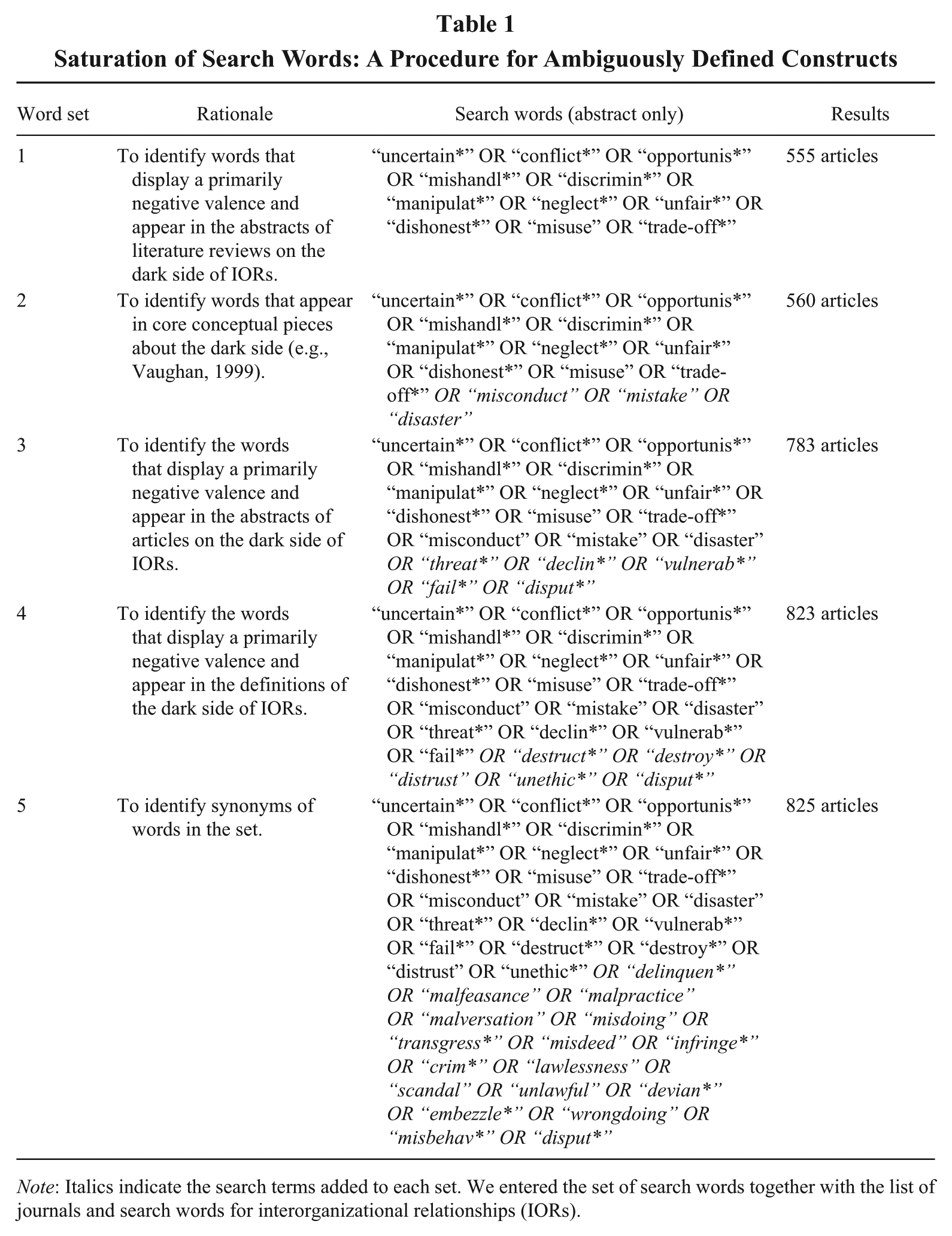
Note: Italics indicate the search terms added to each set. We entered the set of search words together with the list of journals and search words for interorganizational relationships (IORs).
Finally, we implemented two main criteria to identify relevant articles: (1) focus on IORs and (2) study of the dark side. Two coders independently coded each article for relevance on the basis of these criteria. We found strong intercoder reliability (.88; Cohen, 1960). The coders discussed and settled disagreements. We placed no date restriction on our search; our time window started in 1943 (first search result available in Business Source Elite) and ended in 2017. In total, out of 825 initial results, the coders identified 178 relevant articles.
Manifestations of the Dark Side of IORs
We first examine the main findings about the manifestation of the dark side of IORs. The prior literature mainly studies manifestations of conflict, opportunism, and unethical practices. Figure 1 shows the evolution of the number of articles according to the three most studied dark-side manifestations. The period between 1993 and 1997 is the first turning point: the dominance of the research on conflict is overtaken by the rapid growth of studies about opportunism in IORs, which is linked to the growing application of TCE to study IORs. After that period, we observe a steady interest in other manifestations of the dark side, particularly in unethical practices. In the period between 2013 and 2017, unethical practices emerge as the second most studied manifestation of the dark side of IORs. Overall, although there is a shift in the interest in specific dark-side manifestations, the set of the three most examined manifestations remains unchanged.
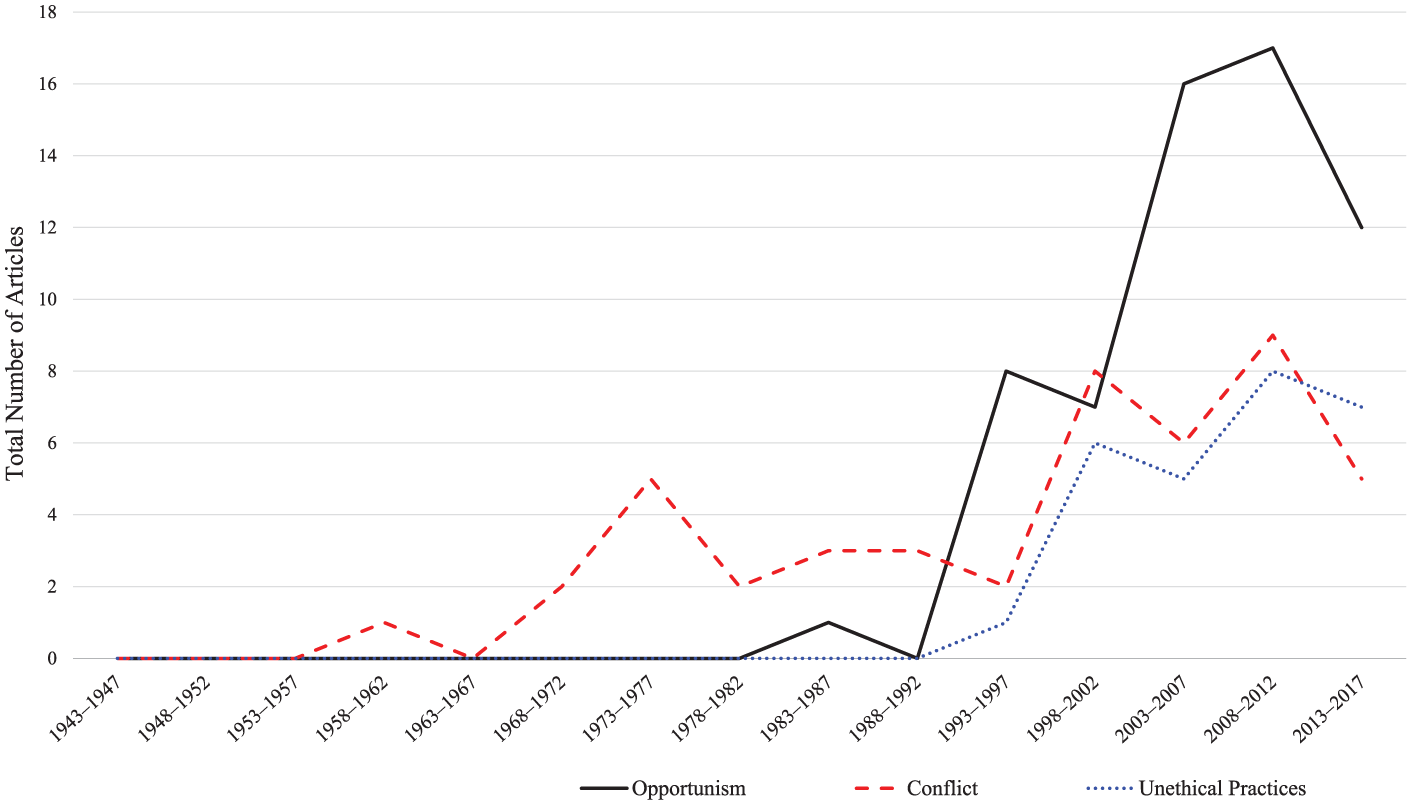
Research Output on the Main Manifestations of the Dark Side of Interorganizational Relationships (1943–2017)
Together, articles about conflict, opportunism, and unethical practices represent 75.28% of the 178 reviewed articles on the dark side of IORs. (Below, we discuss studies that examine other dark-side manifestations.) Given its prominence, we first synthetize the literature on these three manifestations of the dark side. For each manifestation, we explore whether the articles focus on actual versus potential manifestations or whether they study the dark side as a single dimension versus multiple dimensions. Table 2 shows a typology of the manifestations of the dark side of IORs.
Typology of the Main Manifestations of the Dark Side
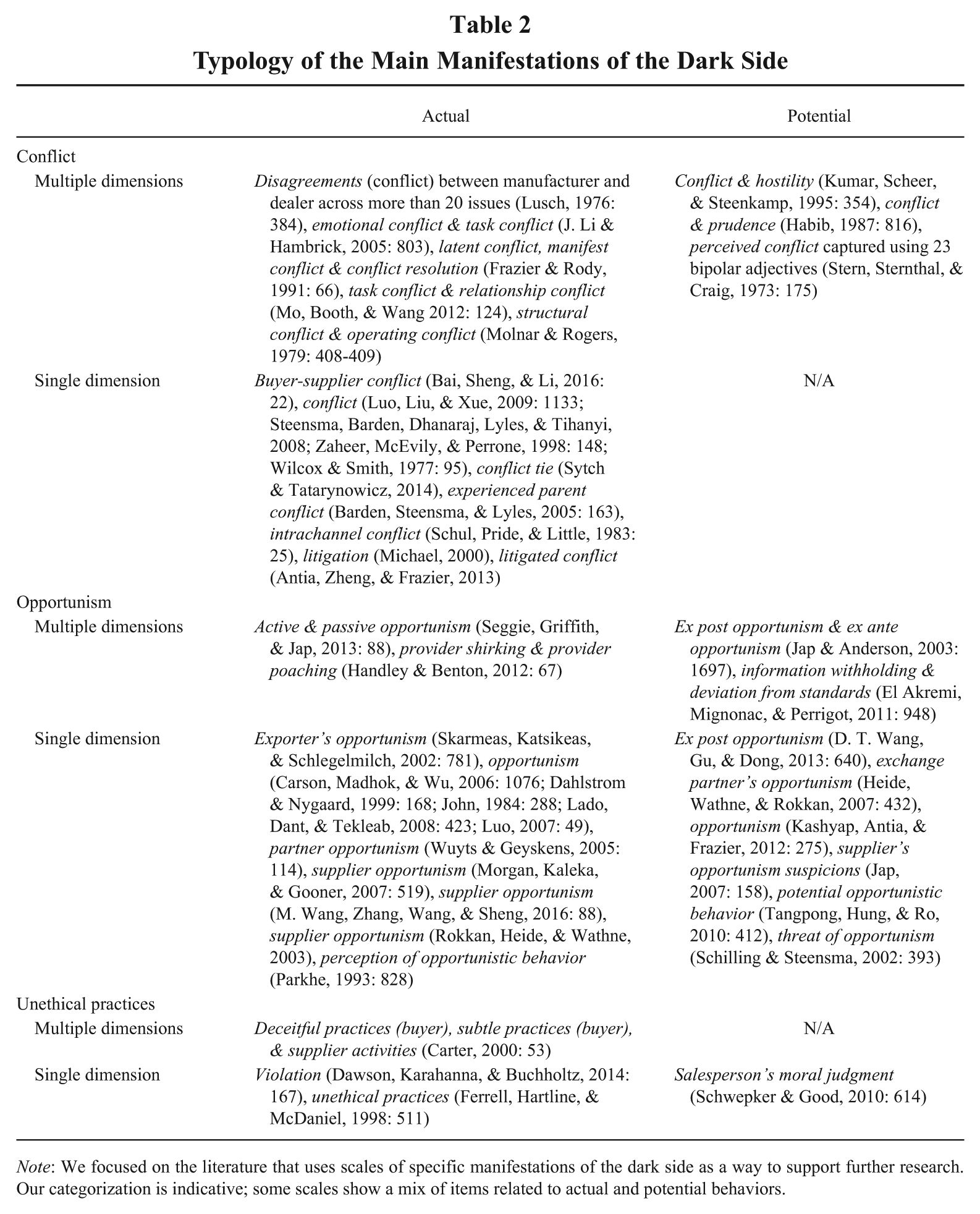
Note: We focused on the literature that uses scales of specific manifestations of the dark side as a way to support further research. Our categorization is indicative; some scales show a mix of items related to actual and potential behaviors.
Conflict
Research on conflict in IORs examines instances of disagreement, clashes, lawsuits, or friction involving partners or individual representatives. One stream of this research focuses on actual conflict by examining past and ongoing disagreements between partners or behaviors that are detrimental to the IOR (Lusch, 1976; Zaheer, McEvily, & Perrone, 1998). Researchers often capture conflict in a single conceptual dimension (Antia, Zheng, & Frazier, 2013; Sytch & Tatarynowicz, 2014). As summarized in Table 2, studies that use a single conceptual dimension focus on varied types of conflict, such as litigation (Antia et al., 2013), conflict ties (Sytch & Tatarynowicz, 2014), or channel conflict (Schul, Pride, & Little, 1983).
Studies that capture multiple dimensions of conflict focus on the coexistence of emotional conflict and task conflict (J. Li & Hambrick, 2005), disagreements between manufacturers and dealers (Lusch, 1976), and structural and operating conflicts (Molnar & Rogers, 1979). In particular, the literature on joint ventures emphasizes personality conflict and cultural conflict (Barden, Steensma, & Lyles, 2005) and emotional and task friction between IOR managers (J. Li & Hambrick, 2005). These studies stress the emotional burden of conflict that arises from exchanges over issues about control, rent sharing, priorities, and strategic decisions concerning an IOR (Frazier & Rody, 1991; Mo, Booth, & Wang, 2012).
Most of the research examines actual conflict; however, some studies also provide evidence suggestive of potential conflict around issues of hostility (Kumar, Scheer, & Steenkamp, 1995) and prudence (Habib, 1987). This research prefers the study of multiple dimensions over single dimensions.
Conflict is largely studied in the fields of general management (24 out of the 46 articles on conflict) and marketing (12 out of 46 articles). Supply chain management and marketing studies primarily examine litigation and disputes in distribution channels (i.e., actual, single-dimension conflict). Researchers across research fields have yet to make inroads into the psychological aspects surrounding conflict (i.e., actual or potential, multiple-dimension conflict) experienced by managers working in IORs.
Opportunism
Studies of opportunism primarily build on TCE, which conceptualizes opportunism as self-interest seeking with guile (Williamson, 1975: 6). In addition to blatant forms of opportunism (e.g., lying, stealing, and cheating), recurrent forms of opportunism involve subtle modes of deceit and calculated efforts to mislead, disguise, or confuse (Williamson, 1985).
One strand of research examines actual opportunism as episodes of self-interested behavior by at least one of the parties or its representatives (Carson, Madhok, & Wu, 2006; Kashyap, Antia, & Frazier, 2012; Wuyts & Geyskens, 2005). For instance, Carson et al. survey a manager’s agreement with a set of statements about past actions, such as “the contractor sometimes altered facts to get what it wanted” (2006: 1076). Evidence of actual opportunism is gauged by surveying managers about unfulfilled promises (John, 1984), abusive behavior (Morgan, Kaleka, & Gooner, 2007), information withholding (Kashyap et al., 2012), or strategic use of contractual loopholes (D. T. Wang, Gu, & Dong, 2013).
In line with the original conceptualization of opportunism in TCE (Williamson, 1975), opportunism is also studied as the likelihood of a counterparty’s behaviors of self-interest seeking. The concern relates to the counterparty’s potential opportunism, such as “bad faith” toward the partner (Jap, 2003), propensity to opportunism (Nooteboom, 1996), opportunistic intent (Lampel & Shapira, 2001), or threat of opportunism (Schilling & Steensma, 2002).
Most of what we know about opportunism is based on quantitative analyses, mainly using self-reported data (Handley & Benton, 2012; Jap & Anderson, 2003). Two qualitative exceptions are a study by Korczynski (1996), who draws on interviews with managers to learn about subtle opportunistic practices in the construction industry in the United Kingdom, and a study by Moretti and Zirpoli (2016), who report on interviews with managers working in the Venice Film Festival about suppliers’ opportunism and political tensions among parties. Qualitative studies suggest that opportunism is a nuanced dark-side manifestation, thus also calling for diversity of research methods.
Across research fields, opportunism is the most studied manifestation of the dark side of IORs (61 out of 178 articles in this review). Much of the research on opportunism appears in the fields of general management (35 articles), marketing (13 articles), and supply chain management (10 articles).
Unethical Practices
Unethical practices refer to ongoing activities of parties in the IOR who carry out actions considered morally wrong or improper. Prior research focuses on whether organizations display “preferential treatment” toward specific suppliers (Nguyen & Cragg, 2002), corporate research departments knowingly disseminate faulty conclusions (Ferrell et al., 1998), a partner unilaterally decides to withdraw from the alliance (Bakker, 2016), or an organization consistently exploits its counterparty (Connelly, Miller, & Devers, 2012). A few studies also note the role of specific managers who display cynicism in their interactions with counterparties (Free, 2008), breach promises (Dawson, Karahanna, & Buchholtz, 2014), and act in ethically questionable ways against organizational guidelines (Saini, 2010).
The prior research mainly captures a single conceptual dimension of unethical practices (for an exception, see Carter, 2000; see Table 2). In contrast to studies on conflict and opportunism, the research on unethical practices examines multiple parties in a transaction, such as buyers, suppliers, clients, and subcontractors. For example, Ferrell et al. (1998) show that corporate research departments, marketing research firms, and data subcontractors mutually influence one another’s unethical practices in the context of marketing research. Overall, prior research has made more progress in developing a multiparty perspective to study unethical practices than in theorizing the multiple conceptual dimensions of these practices in IORs.
We found very limited research on potential unethical practices by an organization or a manager (see Table 2). For instance, Schwepker and Good study salespersons’ moral judgment (e.g., “I paint too rosy a picture of my products to make them sound as good as possible”; 2010: 621-622) under different scenarios in business-to-business sales. Managers’ moral judgment captures, to some extent, managers’ future behavior.
The research on unethical practices is concentrated in the field of business ethics; the leading journal in that field tops the number of articles (11 out of 27 articles about unethical practices). We found a growing interest in varied aspects of business ethics in journals of general management (10 out of 27 articles) and supply chain management (5 out of 27 articles).
Discussion Points
First, the research on the manifestations of the dark side of IORs largely focuses on conflict, opportunism, and unethical practices. A few articles also study illegality (Agrawal, Cockburn, & Zhang, 2015), illegitimacy (Spitzeck, 2009), distrust and cynicism (Free, 2008), and misunderstandings (Thomas & Treviño, 1993). The prior literature displays greater conceptual richness regarding the definition of the dark side of IORs—as shown in Table 1—than in the set of manifestations captured in empirical analyses (i.e., conflict, opportunism, and unethical practices). This imbalance between theory and empirics may be due, in part, to the challenges of data access concerning the dark-side manifestations in IORs.
Second, different manifestations of the dark side are often measured in remarkably similar ways. As an illustration, Carter, who studies unethical practices in buyer-supplier relationships, enquires whether buyers “use obscure contract terms to gain an advantage over suppliers” (2000: 53); those terms share similarities with items used in measures of opportunism (e.g., “we will try to take advantage of ‘holes’ in our contract to further our own interests”; Heide, Wathne, & Rokkan, 2007: 432).
Finally, the focus on a specific manifestation of the dark side is desirable from the viewpoint of tractability and parsimony. At the same time, the attention to a given dark-side manifestation is confined to specific research traditions. For example, studies that draw on TCE focus on opportunism while overlooking related aspects of conflict or unethical practices. The notion that IORs experience only one dark-side manifestation at a time is nevertheless problematic. The findings of in-depth studies in alliances are suggestive of the coexistence of conflict, perceived unfairness, and dysfunctional behaviors (Ariño & de la Torre, 1998; Doz, 1996). In a given IOR, the dark side probably occurs as a “bundle of manifestations” in the sense that a set of dark-side manifestations may be tied together. We suggest that our knowledge about the manifestations of the dark side will remain incomplete without systematic research that explores the consequences of the interplay between manifestations in terms of intensity, scope, and duration. For instance, a buyer’s perception of a supplier’s opportunism might contribute to conflict within the IOR, or task-related misunderstandings between the parties might be mistakenly perceived by one of the parties as opportunism on the part of the counterparty. It is also plausible that unethical behaviors by one party prompt conflict in the IOR, or perhaps more interestingly, ongoing conflict might prompt one party’s unethical practices intended at offsetting potential losses or obtaining revenge on the other party. Studies of the interplay between dark-side manifestations could explore how one specific manifestation might evolve or escalate to other manifestations.
Furthermore, the interplay between actual and potential behavior remains a “black box” or at best, an area of confusion. Received wisdom provides little theorization of potential versus actual behavior. The research on opportunism pays considerable attention to potential behaviors, whereas the research on conflict and unethical practices is dominated by a focus on actual behaviors. Readers of past research often must inspect the measurement of the manifestation to determine whether the findings concern actual or potential behavior.
Antecedents, Consequences, and Context
We review the main findings about the antecedents, ex ante moderating factors, consequences, and ex post moderating factors concerning the dark side of IORs. These aspects provide the infrastructure to our review that follows. Table 3 summarizes the reviewed literature. We underscore how the different aspects of the dark side are nested across levels of analysis.
Literature on the Dark Side of Interorganizational Relationships: An Overview
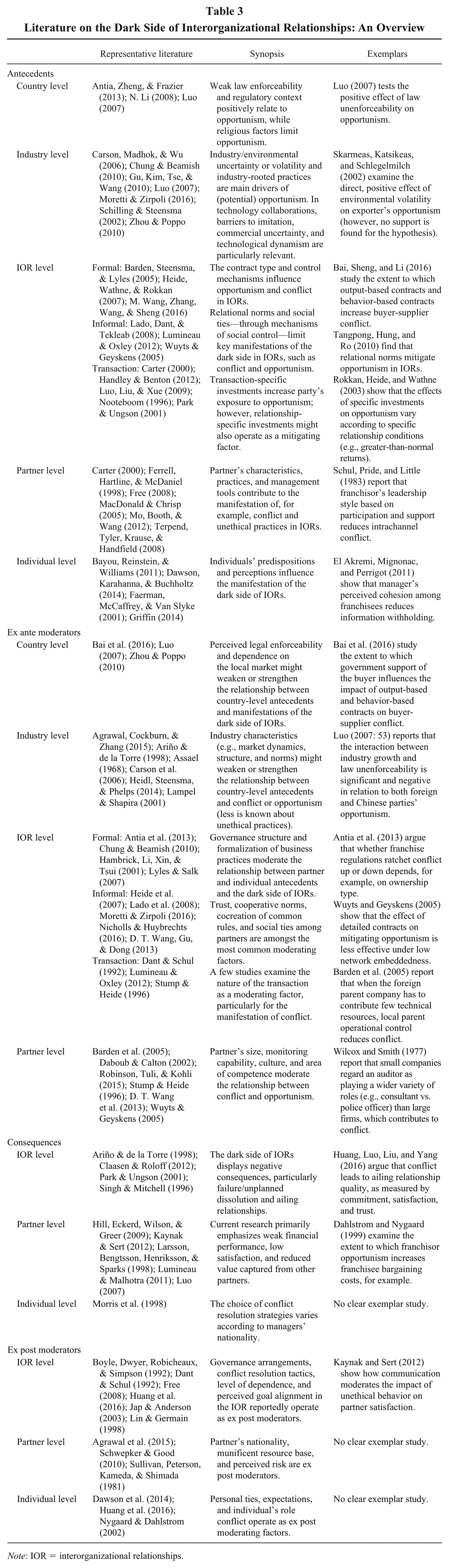
Note: IOR = interorganizational relationships.
Antecedents
A country’s formal and informal systems of regulations, values, and beliefs prompt the dark side of IORs. Much of the literature that has emphasized country-level factors builds on TCE (Antia et al., 2013; Luo, 2007). A key finding is that where law enforceability and the regulatory context are weak, managers are more likely to act in their own self-interest or extract advantages for their organization at the counterparty’s expense. Although less studied, religion may curb opportunism and unethical behavior by providing moral restraints on individuals (N. Li, 2008).
Industry volatility and industry-rooted practices are found to drive (potential) opportunism among partners (Gu, Kim, Tse, & Wang, 2010; Korczynski, 1996; Zhou & Poppo, 2010). However, several studies also report a weak association between industry uncertainty and partners’ opportunism (Luo, 2007; Skarmeas, Katsikeas, & Schlegelmilch, 2002). Quantitative studies provide extensive, although inconclusive, evidence of the influence of industry uncertainty on opportunism in IORs. In-depth analyses further show that industry practices (Korczynski, 1996) and regional power politics (Moretti & Zirpoli, 2016) may perpetuate self-seeking behaviors.
An extensive line of research focuses on whether the formal aspects of the IOR, as well as the nature of the transaction, support or hinder manifestations of the dark side (see Table 3). The research on formal antecedents reports that contractual procedures influence the development of opportunism and conflict (Barden et al., 2005; M. Wang, Zhang, Wang, & Sheng, 2016). For instance, Bai, Sheng, and Li (2016) find that output-based contracts reduce buyer-supplier conflict, while behavior-based contracts increase buyer-supplier conflict. The content of the contract (Heide et al., 2007; D. Malhotra & Lumineau, 2011; Zhou & Xu, 2012), governance regime (Antia et al., 2013; Carson et al., 2006), and partnering and organizational modes (Carter, 2000; John, 1984; Molnar & Rogers, 1979) delineate expectations and obligations between parties. Prior research on formal aspects largely concerns the role of control characteristics, such as narrow versus broad (Groot & Merchant, 2000), coercive versus noncohesive (Lusch, 1976), and bilateral versus quasi-hierarchical structure (Zhou & Xu, 2012), in the emergence of conflict and opportunism.
Informal aspects curb manifestations of the dark side of IORs (Boyle, Dwyer, Robicheaux, & Simpson, 1992; Wuyts & Geyskens, 2005). Personal relationships among managers promote social control (Saini, 2010), solidarity (Rokkan, Heide, & Wathne, 2003), and norms of cooperation (Lumineau & Oxley, 2012) while reducing conflict, opportunism, and unethical practices (Kennedy & Lawton, 1993; Martínez, 2003). Drawing together TCE, personality traits, and contingency theories, Tangpong, Hung, and Ro (2010) find that values and shared priorities limit opportunism between exchange partners. Communication procedures promote goal congruence and frame alignment (Nygaard & Dahlstrom, 2002), particularly in IORs with diverse partners, as seen in cross-sector partnerships (Le Ber & Branzei, 2010). These studies illustrate that the nuanced nature of dark-side manifestations calls on researchers to integrate different yet complementary theoretical approaches.
The literature on interorganizational governance shows that the nature of the transaction influences the manifestations of the dark side in IORs (Handley & Benton, 2012; Luo, Liu, & Xue, 2009; Nooteboom, 1996; Rokkan et al., 2003; Saini, 2010). This literature mainly builds on TCE, which might explain the focus on opportunism over other dark-side manifestations in IORs. For example, Rokkan et al. (2003) provide interesting findings in that while TCE research predicts that specific investments place the partner in a vulnerable position to the counterparty’s opportunistic behavior, they suggest that specific investment might bond the parties (see Table 3). According to their study, such a bonding effect is expected to occur when the focal relationship’s time horizon is long and strong solidarity norms are in place. The main finding of Rokkan et al. is that specific investments increase one party’s vulnerability and augment the power differences within the IOR.
Taking a more granular view, other studies focus on partner and individual characteristics. Partners’ low perceived personality dissimilarity (Mathews, Wilson, & Monoky, 1972) and high cultural sensibility, such as the understanding of domestic business practices (Skarmeas et al., 2002), reduce conflict and opportunism. Prior research largely discusses the role of communication and the formation of unspoken rules in the reduction or prevention of conflict, while social control operates to curb opportunism. Partners’ beliefs about the purpose of the IOR (MacDonald & Chrisp, 2005), trading practices (Carter, 2000; Terpend, Tyler, Krause, & Handfield, 2008), knowledge diversity (N. Malhotra, 2003), and corporate leadership styles (Mo et al., 2012) have a bearing on unethical practices and conflict. For instance, a study by Schul et al. (1983) finds that a franchisor’s leadership style that is perceived to emphasize participation, support, and direction in channel activities significantly reduces intrachannel conflict. The business ethics literature pays particular attention to partners’ training and codes of conduct in preventing unethical practices (Claasen & Roloff, 2012; Free, 2008; Halter, Arruda, & Halter, 2009). In a study of U.K. supermarkets, Free (2008) shows how supermarkets’ purchasing managers pursue self-interested actions under the label of “management efficiency,” which results in distrust and cynicism between supermarkets and their suppliers. This study shows the importance of analyzing how actors develop narratives about the prevention of unethical practices that in fact are intended to tighten control over other parties in the IOR.
At the individual level, El Akremi, Mignonac, and Perrigot (2011) report that a manager’s perceived strong social cohesion among franchisees reduces information withholding and deviation from franchising chain standards. Research on individual-level antecedents of dark-side manifestations mainly shows that opportunism and conflict in IORs is rooted in managers’ limited willingness to trust (Zaheer et al., 1998), low disposition to cooperate (Faerman, McCaffrey, & Van Slyke, 2001), or breach of the psychological contract (Dawson et al., 2014). At the same time, research on unethical practices foregrounds managers’ judgment (Griffin, 2014) and moral values (Bayou, Reinstein, & Williams, 2011) to enable the individual to probe managerial practices. The literature on individual-level antecedents of conflict and opportunism differs from the literature on unethical practices in the sense that the latter ascribes considerable agency to individuals to question and decide to pursue actions commonly viewed as dark side.
Manifestations of the dark side are often prompted by trade-offs that characterize the management of IORs (Das & Teng, 2000; Uzzi, 1996). Trade-offs may be represented as an inverted curvilinear effect with an optimal level beyond which a construct with a traditionally positive valence (e.g., trust or information sharing) becomes detrimental for the IOR. Past research mainly focuses on the linkage between IOR governance and the likelihood of opportunism and conflict (Huemer, 2004; Lumineau, 2017; Vlaar, Van Den Bosch, & Volberda, 2007). The roles of trade-offs as drivers of unethical practices have yet to benefit from future theorizing.
Ex Ante Moderators
A scattered but growing literature examines the factors that mitigate or exacerbate the relationship between specific antecedents and particular dark-side manifestations. We call these factors ex ante moderators (see Table 3). At the national level, past research examines the moderating role of high perceived legal enforceability and high dependence on the local market in the relationship between antecedents and conflict (Bai et al., 2016) and opportunism (Luo, 2007). In a study of buyer-supplier relationships in China, Bai et al. (2016) report that the interplay between contractual control and legal enforceability reduces conflict, whereas the interplay between contractual control and unilateral government support increases it.
Industry characteristics are the most studied moderators of the relationship between country-related antecedents and conflict or opportunism (Assael, 1968; Carson et al., 2006; Heidl, Steensma, & Phelps, 2014; Lampel & Shapira, 2001; Villena, Choi, & Revilla, in press). For instance, Luo (2007: 53) finds a significant and negative interaction between industry growth and law unenforceability in predicting foreign and Chinese parties’ opportunism. Prior studies converge toward the idea that industry’s idiosyncratic rules and values (Lampel & Shapira, 2001; Luo, 2007) and patterns of interaction among firms in the industry (Heidl et al., 2014) may not only mitigate but also exacerbate the relationship between the antecedents of the dark side and its manifestations.
Like the research on antecedents, studies on ex ante moderators primarily focus on IOR-level factors. For example, the extent to which franchise regulations ratchet conflict up or down depends on the extent to which franchisors rely on franchisee-owned units (Antia et al., 2013). Other formal moderators include governance structure (Boyle et al., 1992; Kivleniece & Quélin, 2012), shared control versus split control (Hambrick, Li, Xin, & Tsui, 2001), and franchising type (Barthélemy, 2008).
Researchers also study informal ex ante moderators; these include trust (Lado, Dant, & Tekleab, 2008), common rules (Nicholls & Huybrechts, 2016), network dynamics (Moretti & Zirpoli, 2016), social ties among partners (D. T. Wang et al., 2013; Wuyts & Geyskens, 2005), and social contracts (Heide et al., 2007). In a study of purchase decisions made by 838 small-to-medium-sized firms in The Netherlands, Wuyts and Geyskens (2005) report that the effect of detailed contracts on mitigating opportunism is less effective under low network embeddedness (i.e., few ties among suppliers and their partners). This study is particularly interesting because it provides a rare combination of TCE and social network theory in an attempt to coalesce economic and sociological perspectives to advance theory on opportunism.
Issues of asymmetric power between partners (Assael, 1968; Dant & Schul, 1992) and specific investments made by one of the parties (Stump & Heide, 1996) in the context of the transaction are also studied as ex ante moderators in addition to being tested as antecedents of dark-side manifestations. In the context of international joint ventures, Barden et al. (2005) find that the local parent’s operational control reduces conflict when the foreign parent is required to contribute few technical resources. This study suggests the importance of accounting for the coordination needs and type of resources in specific IORs as a way to develop generative knowledge about the mitigating factors of opportunism, as well as other manifestations.
We found only a handful of studies on partner characteristics. In a study of auditor-client relationships, Wilcox and Smith (1977) suggest that small companies, more than large firms, report that the auditor fills a wide variety of roles (e.g., consultant vs. police officer). They then report that these discrepancies account for different levels of conflict between the parties. Other partner-level ex ante moderators include partner’s size (Robinson, Tuli, & Kohli, 2015), ability to evaluate counterparties (Stump & Heide, 1996), monitoring capability (D. T. Wang et al., 2013), area of competence (Daboub & Calton, 2002), uncertainty avoidance, collectivism, and power distance (Wuyts & Geyskens, 2005). The examination of partner-level ex ante moderators has yet to result in a coherent set of theoretical insights.
The diversity of partner-level ex ante moderators is in stark contrast to the lack of studies about individual-level factors that may moderate the relationship between the antecedents and manifestations of the dark side of IORs. Current theory provides little insight into the role of managers in mitigating or exacerbating the dark-side manifestations in IORs. This situation thus represents an opportunity for individual-oriented perspectives to complement existing theory.
Consequences
IORs are touted as a fundamental strategy to attain competitive advantages. However, manifestations of the dark side contribute to ailing relationships between partners (Huang, Luo, Liu, & Yang, 2016; J. Li & Hambrick, 2005) and in extreme cases, to failure (Ariño & de la Torre, 1998; Bakker, 2016).
As far as the dark-side literature is concerned, the failure or unplanned dissolution of an IOR often follows conflict, behavior that is perceived to be opportunistic, or a dysfunctional governance structure in the face of coordination and control needs in the IOR (for a discussion of alliance failure, see Park & Ungson, 2001). The typical case of failure occurs when, for example, an alliance ceases activity without fulfilling the objectives that were agreed upon between parties (Bakker, 2016).
In addition to failure of the IOR, conflict and opportunism are found to damage the relationship between partners even if cessation of operations or disintegration of the IOR team does not occur (Huang et al., 2016; J. Li & Hambrick, 2005). Opportunism is linked to reductions in relationship performance (Barthélemy, 2008; Lado et al., 2008) and satisfaction with the relationship (Jap, 2003). In a study of conflict, Huang et al. (2016) provide an interesting argument about how conflict prompts ailing relationship quality by weakening commitment, satisfaction, and trust. This study makes the case for studying nonfinancial consequences. In fact, analyses of the eroding qualitative aspects of the relationship would provide unique insights into the underlying social processes of the manifestation-consequence linkage. In our examination of past research, we found no study that directly examines the extent to which specific unethical practices bring about negative consequences for the IOR.
Research on the dark side is also concerned with consequences for partners. From a financial viewpoint, Luo (2007) shows that joint venture partners’ opportunism decreases their own financial returns and sales growth. Drawing on the TCE assertion that opportunism increases transaction costs, Dahlstrom and Nygaard (1999) uncover that partners incur additional costs following opportunistic behaviors or unethical behavior by their counterparties (Kaynak & Sert, 2012; Lumineau & Malhotra, 2011). More generally, research shows that the manifestation of the dark side of IORs reduces the partner’s extracted value. Members often become less involved, such that a partner underachieves with regard to the fulfillment of strategic needs (Le Ber & Branzei, 2010) and experiences limited knowledge acquisition (Larsson, Bengtsson, Henriksson, & Sparks, 1998; Lyles & Salk, 2007).
We found limited IOR literature on the consequences of the dark side for individuals, such as stress and dismissal. We found only a study of a failed collaboration between a university and the Department of Public Welfare, which reports that the managers worried about their dismissal (Sebring, 1977). Our search of the literature suggests that we know little about the consequences for managers who, for example, pursue opportunistic practices in dealing with their counterparties.
The prior research focuses on how to suppress the negative consequences of the dark side or strategies that reduce the consequences to a level that is tolerable by the parties. In contrast, a few studies in our review directly examine the trade-offs surrounding the link between the manifestations and consequences of the dark side (see Table 3). For instance, Michael notes that “conflict on a particular issue may be bad, but compromise may be possible within the adaptive range, with tradeoffs made in other areas” (2000: 508). The notion of an “adaptive range” suggests that managers can make choices that might either mitigate or exacerbate the consequences of dark-side manifestations. We found no article that clearly examines the processes, decision-making, and paradoxes regarding the linkage between the manifestations and consequences of the dark side.
Ex Post Moderators
We found a handful of studies showing that the formal and informal aspects of the IOR mitigate the consequences of the dark side (Dant & Schul, 1992; Free, 2008). With regard to the formal aspects of IORs, the current research examines specific resolution strategies (Lin & Germain, 1998; Lumineau & Malhotra, 2011) and governance structures (Boyle et al., 1992) aimed at reducing conflict or litigated action between partners.
At the same time, informal aspects within the IOR might also operate as buffers against the consequences of unethical practices. In a study of 260 pharmacies in Turkey, Kaynak and Sert (2012) suggest that effective communication has a moderating effect on the impact of suppliers’ unethical practices on buyer satisfaction. In addition to communication, other informal buffers include the perceived alignment of business goals, in the link between opportunistic behavior and continuity of the relationship (Jap & Anderson, 2003), and discursive practices between the parties, in the link between self-interested actions and cynicism and distrust (Free, 2008).
A partner’s nationality (Sullivan, Peterson, Kameda, & Shimada, 1981), resource base (Bakker, 2016), organization type (Agrawal et al., 2015), customer orientation (Schwepker & Good, 2010), and perceived risk (Gu et al., 2010) are indicated as ex post moderating factors. In the context of international joint ventures between American and Japanese firms, Sullivan et al. conclude that “Japanese managers perceive a higher level of future trust when disputes are resolved through conferral [i.e., discussion], except when an American is in charge of operations” (1981: 803). Although conducted over 30 years ago, this study is still the exception in the research on partners’ cultural background as an ex post moderator in the analysis of the dark side of IORs.
Individual-level aspects—such as personal ties and expectations—are shown to play a moderating role in the relationship between dark-side manifestations and the consequences of such manifestations (Morris et al., 1998; Nygaard & Dahlstrom, 2002). Social ties support information processing and contribute to reducing ambiguity, particularly during the turbulent periods of IORs that are characteristic of conflict between partners. Individual organizational citizenship behaviors (Dawson et al., 2014) operate as buffers against the negative impact of a supplier’s unethical practices on a buyer’s satisfaction. However, we found a general dearth of research examining individual-level ex post moderating factors. This provides opportunities for dialogue among research fields to develop analyses of the individual aspects that underpin the dark side of IORs.
Muddling Through Research Fields: Actionable Research Steps
The above integrative framework aids us in identifying key shortcomings that have developed across research strands on the dark side of IORs. These shortcomings present immediate opportunities (“low-hanging fruits”) for cross-fertilization between the fields of general management, accounting, business ethics, marketing, and supply chain management. Table 4 provides examples of the benefits of further dialogue between research streams.
Research Opportunities Across Fields of Research
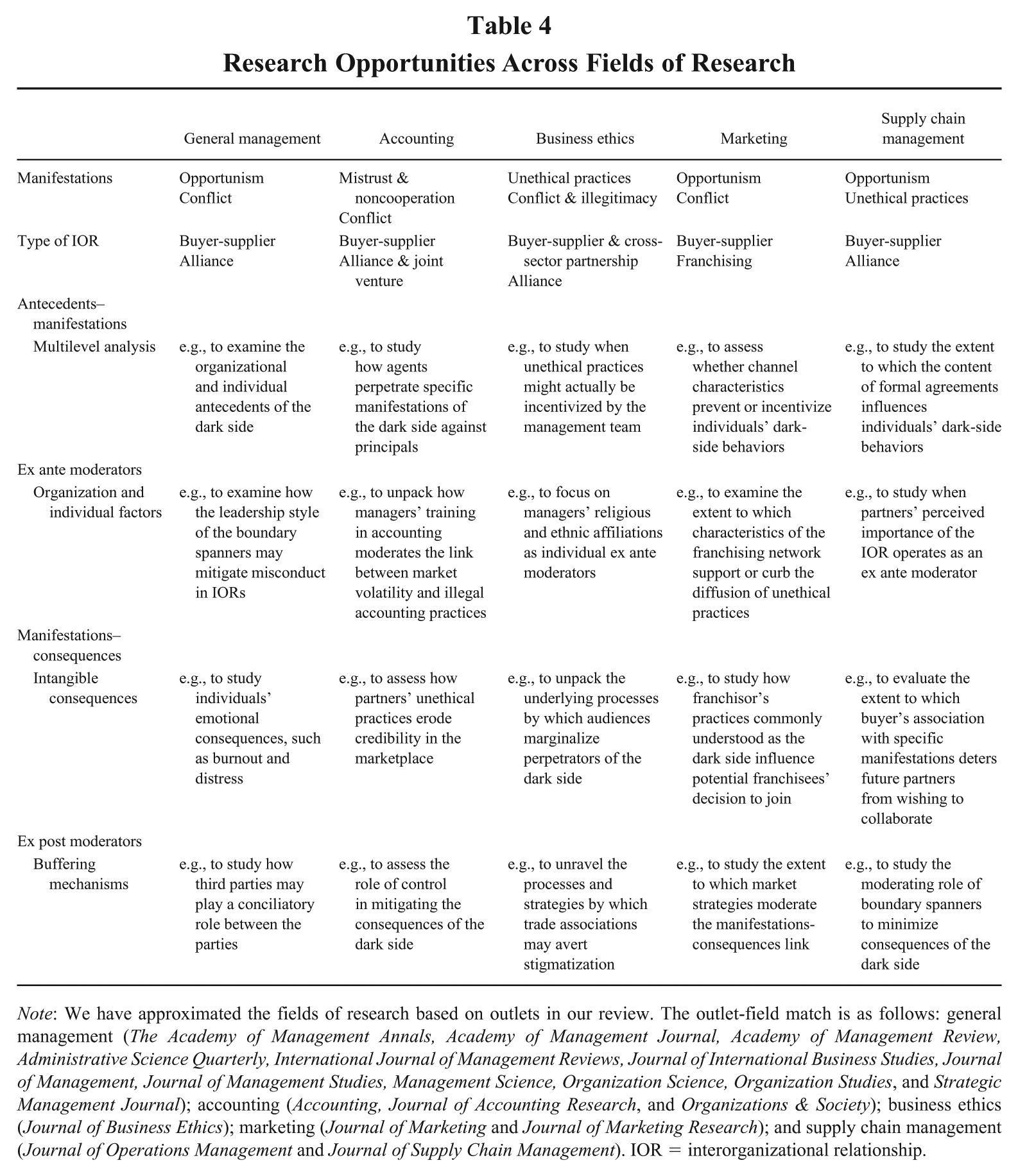
Note: We have approximated the fields of research based on outlets in our review. The outlet-field match is as follows: general management (The Academy of Management Annals, Academy of Management Journal, Academy of Management Review, Administrative Science Quarterly, International Journal of Management Reviews, Journal of International Business Studies, Journal of Management, Journal of Management Studies, Management Science, Organization Science, Organization Studies, and Strategic Management Journal); accounting (Accounting, Journal of Accounting Research, and Organizations & Society); business ethics (Journal of Business Ethics); marketing (Journal of Marketing and Journal of Marketing Research); and supply chain management (Journal of Operations Management and Journal of Supply Chain Management). IOR = interorganizational relationship.
Manifestations and Types of IORs
The literature devotes substantial attention to opportunism in alliances and buyer-supplier relationships (44 out of 178 articles). First, we acknowledge the importance of widening the set of manifestations of the dark side. For example, further studies on supply chain management might draw on business ethics to explore the erosion of legitimacy in buyer-supplier relationships by examining how different audiences attribute, deny, or remove legitimacy to or from an IOR. Other studies may leverage accounting studies of illegal management practices to advance theory on the extent to which governance controls may unintendedly support the emergence of illegal practices. We call for research on the dark side of IORs that analyzes the distribution of gains and losses as a way to understand whether the dark side usually operates as a zero-sum game. We know little about how the different manifestations of the dark side affect each partner differently in an IOR (Lumineau & Oliveira, 2018). Such studies may connect, in particular, with research on value creation and value distribution in IORs (Mesquita et al., 2017; Tjemkes & Furrer, 2010).
Second, we call for research that goes beyond buyer-supplier relationships (77 out of 178 articles) and alliances (38 out of 178 articles). The current knowledge remains restricted to a set of IORs that falls short of the diversity of IORs, such as cross-sector partnerships, networks, trade associations, and R&D consortia. It is plausible that some types of IORs are more affected by specific dark-side manifestations. However, current research provides limited insights into how structural and purpose differences among IORs influence the underlying processes of dark-side manifestations or the buffering factors concerning the dark side.
Antecedents and Manifestations
Prior research emphasizes industry and IOR factors that trigger opportunism and conflict. Future research should seek a dialogue among research fields to tap into the multiple-level nature of the antecedents of the manifestations of the dark side of IORs (see Table 4). General management can help researchers to examine whether the dark side is initiated by workers or is, instead, encouraged by managers at the top of an organization or by the top management of the IOR. Marketing and supply chain management researchers may draw on their knowledge of marketing channel characteristics and licensing agreements to study the extent to which the content of formal agreements influences individual behavior in specific ways that limit or promote the dark side (see Table 4). For example, the unethical practices observed under specific governance agreements might actually be incentivized or tolerated by management teams. Here, the literature on business ethics might prove particularly useful in studying the role of contextual aspects in supporting practices commonly viewed as unethical. Furthermore, the accounting research on white-collar crimes and misconduct by individuals would help to elucidate the psychological characteristics of perpetrators of specific manifestations of the dark side, such as illegality and illegitimate practices.
Ex Ante Moderating Factors
The interplay between formal and informal aspects of IORs has received limited attention in the literature on ex ante moderating factors. Future dialogue across research fields is needed to explore the organization- and individual-level factors that mitigate specific dark-side manifestations (see Table 4). We still know little, for example, about the organizational and individual characteristics that can help mitigate conflict in IORs (Lumineau, Eckerd, & Handley, 2015).
We suggest that general management should draw on the literature on boundary spanners to examine the extent to which the leadership style of those managers working across organizational boundaries operates as a buffer against misconduct in IORs. Marketing studies can take advantage of research on franchising agreements to determine the extent to which specific characteristics of the franchising network and the franchisor mitigate or, on the contrary, exacerbate the diffusion of specific misbehaviors. Further knowledge about ex ante moderators may be pursued by supply chain management researchers who study partners’ perceptions of the importance of the IOR. These perceptions provide an opportunity to expand our current knowledge into temporal aspects that might operate as ex ante moderators of the dark side of IORs. Accounting researchers may explore whether formal training in accounting-related topics weakens or strengthens the relationship between market conditions and illegal accounting practices that aim to deceive stakeholders. Other studies, especially in business ethics, may focus on managers’ religious and ethnic affiliations as individual-level ex ante moderators.
Manifestations and Consequences
Prior research has largely studied consequences in terms of failure of the IOR and financial costs for partners. A few studies examine the intangible consequences for partners and the IOR, such as partners’ low engagement and low satisfaction (Jap, 2003; Kaynak & Sert, 2012). We call for further research on such intangible consequences, particularly for individuals.
Studies in business ethics may explore the consequences that pertain to legitimacy loss, legal costs, and marginalization by stakeholders. For example, accounting researchers may explore the extent to which partners’ unethical practices lead to a loss of credibility in the marketplace, thus reducing the likelihood of obtaining funding from banks or in extreme cases, having their operating licenses revoked by regulators. Intangible consequences bear severe implications for partners and the operation of the IOR. Supply chain scholars should explore the extent to which a buyer’s association with specific dark-side manifestations—such as opportunism and fictitious accounting—might deter potential suppliers from entering a buyer-supplier agreement. Individuals who are found to engage in dark activities face stigmatization; consequently, their opportunities to find partners in the marketplace are hampered (Bruyaka, Philippe, & Castañer, 2018). Other costs might entail additional “checks and balances” or less favorable trading conditions. General management studies might draw on behavioral approaches to examine the intangible consequences for managers, such as burnout, exhaustion, and stress experienced by individuals involved in various manifestations of the dark side of IORs (see Table 4).
Broadly, research that clarifies the link between specific manifestations and consequences of the dark side is greatly needed. Such research could help to minimize managers’ attribution errors. A buyer may make attributions about a supplier’s opportunism that are actually inaccurate, which may lead to the buyer’s managerial actions on the premise of the supplier’s opportunism. For example, Smith, Bolton, and Wagner (1999) stress that justice efforts in response to a service failure must match the type of service failure to be effective at restoring customer satisfaction. Future research will advance theory on how one party perceives the dark side and attributes the blame to the counterparty. Ill-informed decisions about dark-side manifestations might become a self-fulfilling prophecy.
Ex Post Moderating Factors
Our review indicates that little attention has been paid to the buffering mechanisms of the dark side of IORs. In response to this shortcoming, we call for research on the specific buffering mechanisms of dark activities in different types of IORs (see Table 4).
General management has long been concerned with the performance implications of opportunism in alliances and buyer-supplier relationships. Management research would benefit from studies that examine how third parties, such as trade associations, play a conciliatory role between the parties, thus weakening the impact of dark activities and their consequences for organizations. We have yet to learn about how, and under which conditions, third parties might operate as ex ante moderating factors, particularly with regard to the intangible consequences for organizations. Third parties may actively minimize partners’ reputation loss following unethical practices in an alliance by, for example, working closely with stakeholders. Business ethics research could help to develop theory about the processes and strategies by which third parties may avert stigmatization through, for example, the adoption of strategies of stakeholder engagement. Marketing studies might explore the moderating factors of the relationship between dark-side manifestations and market reputation or brand value. From a supply chain management perspective, there is still limited knowledge about the role of boundary spanners in mitigating or exacerbating the consequences of the dark side in buyer-supplier relationships. We found no studies that examine managers’ psychological traits or network position as potential moderators of the relationship between dark-side manifestations and their consequences. Furthermore, we envisage opportunities for accounting researchers to explore how control-related aspects regulating the activity of boundary spanners succeed or fail to operate as ex post moderators.
Further Directions for Research
Our review stresses the nuanced nature of dark activities in IORs. To advance theory on the dark side, we now present a research agenda on four interrelated issues: manifestation characteristics, entities and their motivations, temporality issues, and the bright side of the dark side.
Manifestation Characteristics
Illegal vs immoral
Future research should study how issues of legality and morality—or a lack thereof—often present dilemmas. While some dark-side practices are immoral, they may be legal, or vice versa. For example, in an auditor-client relationship, an auditor can advise an alliance manager on deceitful strategies to reduce payable taxes. Tax reduction schemes may be legal, but they are perceived as immoral when they hamper the common good. We see many opportunities to examine the extent to which legal and moral aspects influence the persistence of particular manifestations of the dark side. Research that draws on business ethics (Schleper, Blome, & Wuttke, 2017) and accounting (Bayou et al., 2011), in particular, might be useful to advance theory on how managers navigate the illegal versus immoral tensions related to dark activities.
Covert vs overt
Manifestations of the dark side of IORs are often rooted in covert practices (Ermann & Lundman, 2002; Greve, Palmer, & Pozner, 2010; Vaughan, 1985). Overt practices are less common and refer, for instance, to instances of open opportunism and disputes. The covert versus overt distinction has important implications for victims because it may influence their ability to discover that they are being affected by the detrimental actions of their partner. Further research should examine whether the processes underlying the overt and covert manifestations of the dark side differ and if so, to what extent. An analysis of how institutional factors hinder or facilitate the development of covert versus overt manifestations of the dark side of IORs would be particularly interesting. It is plausible, for example, that specific organizational contexts are more lenient to open dark-side manifestations, while other contexts, as a result of strict formal or informal rules, discourage any overt forms of the dark side.
Entities and Their Motivations
Multilateral vs unilateral
Dark-side manifestations may be initiated by individuals or an entire organization. For instance, Pinto, Leana, and Pil (2008) suggest a distinction between an organization of corrupt individuals and a corrupt organization. In the context of IORs, a corrupt individual might be a sales representative or purchasing manager, while a corrupt organization refers to, for example, a supplier or R&D consortium partner. This distinction between the different levels at which dark activities are organized remains to be explored by researchers.
We call for research that connects with the literature on organized crime, such as clandestine groups, terrorist cells, gangs, mafia, cartels, and other dark networks (Bertrand, Lumineau, & Fedorova, 2014; Raab & Milward, 2003). This bridge among literature streams will help to advance theory on the use of unconventional modes of governance (e.g., pressure, violence, or intimidation) when organizations cannot resort to a court of law (Bertrand & Lumineau, 2016). The literature on organized crime may be helpful to address the lack of research on the role of social conventions, individuals’ social identities, and reciprocity mechanisms that underpin the actions associated with dark-side manifestations by either a single individual or an organization.
Deceptive vs honest
An unanswered question concerning the dark side of IORs is whether and when perpetrators act in a deceptive manner or, instead, the dark side results from an honest mistake. Much of the existing literature refers to deceitful behaviors intended to trick other parties. Managers often engage in passive forms of opportunism (Handley & Benton, 2012), but these passive forms require further research on their determinants and moderating factors.
However, many instances of the dark side are plausibly honest mistakes. These mistakes largely occur as a result of individuals’ bounded rationality (March & Simon, 1958), unawareness of task interdependences in the IOR (Heath & Staudenmayer, 2000), and organizational and technical complexity (Perrow, 1984). In the construction industry, for instance, cost overruns often stem from the project’s technical complexity rather than solely the main contractor’s opportunistic behavior to extract rents from the client (Oliveira & Lumineau, 2017). Future research should examine the factors that contribute to deceitful and honest manifestations of the dark side between parties.
Accountability vs impunity
Common sense would suggest that dark-side manifestations are more likely to occur under conditions of low accountability and high impunity. However, research in sociology and accounting also shows a more nuanced role of control in driving the manifestations of the dark side (Gabbioneta, Greenwood, Mazzola, & Minoja, 2013). Institutional factors can actually conceal illegal actions or protect perpetrators. We envisage opportunities to examine which factors influence an organization’s tolerance of specific manifestations of the dark side. Organizations may enforce strict formal and informal regulations, but future research should examine how such procedures might become a source of friction in the IOR.
Perpetrator vs victim
Our literature review reveals that we know little about the perpetrators’ motivations behind prevailing dark-side manifestations. Perpetrators can be motivated by intrinsic (e.g., Machiavellian) motives or extrinsic rewards (e.g., job promotion). The motivation-opportunity-choice (MOC) model is helpful in understanding how actors’ motivations also interact with context, which makes feasible a possible course of action and the rationalization and justification used to legitimize involvement in dark-side activities. The MOC model posits that unfulfilled needs and deficiencies often arouse emotions and actions that contribute to specific manifestations of the dark side (McKendall & Wagner, 1997; Murphy & Dacin, 2011).
At the same time, the victim’s perspective has received little attention within the literature on the dark side of IORs. This shortcoming is perplexing because the dark side of IORs is inherently a relational phenomenon that concerns at least two parties. We know little about who loses with dark activities in IORs. Future research should also examine to what extent perpetrators and victims differ in terms of individual (e.g., gender and religion) and organizational (e.g., firm size and firm age) characteristics. We suggest that further attention should be paid to the strategies and paradoxes that surround the interactions between perpetrator and victim organizations of the dark side of IORs.
Speed and Timing
Fast vs slow
We still know little about the speed of the manifestation of the dark side in IORs. For example, some opportunistic behaviors manifest quickly when a supplier knowingly sells a faulty component, while other opportunistic behaviors happen in slow motion and may be more pernicious, such as a partner’s ongoing activities to undermine its counterparty. Further research should examine the characteristics that influence the speed of the manifestation. What dark-side manifestations occur quickly versus slowly? How does the perpetrator versus the victim perceive the speed of the dark-side manifestation? We also call for studies on how speed interacts with intensity regarding how victims and perpetrators experience dark-side manifestations.
Early vs late
The timing of the manifestation of the dark side of IORs remains largely unexplored in the current literature. Drawing on the related research (e.g., trust repair; Lewicki & Brinsfield, 2017; MacDuffie, 2011), the timing of events is a nontrivial aspect of the consequences of the dark side of IORs. Lewicki and Brinsfield (2017) argue that trust violations are particularly damaging at the beginning of a relationship because the victim feels a particularly great sense of betrayal. We call for future research that examines whether the timing of the manifestation influences the attitudes and behaviors of perpetrators and victims in IORs and, in turn, the chances of success of specific remedying strategies.
Positive Outcomes: The Bright Side of the Dark Side
Operational vs strategic
By definition, the research has emphasized the negative aspects of the dark side. However, direct or indirect experience with dark activities can yield benefits for an organization’s daily management activities (i.e., operational aspect) and vision and long-term plans (i.e., strategic aspect). Experience with dark-side manifestations may change how organizations link operational and strategic activities to succeed in the market. For instance, conflict may add clarity with regard to the features of a managerial problem, which is particularly relevant to innovation and development efforts in IORs. Future research should examine how victims, but also perpetrators, adapt their operational procedures on the basis of their experiences with the dark side of IORs. We call for theory development about how organizations sustain change aimed at preventing dark-side manifestations in future IORs. We encourage future research into how experiences of the dark side enter the organizational strategic decision-making process. To what extent do managers’ experiences of the dark side influence their propensity to take risks or to engage in cooperative strategies? Research on the benefits of dark activities will contribute to understanding how managers integrate operational and strategic objectives, thus providing useful insights for designing successful IORs.
Learning vs forgetting
Organizations can learn how to contract in IORs to mitigate the risk of the dark side by, for example, adding more details to future contracts (Mayer & Argyres, 2004). IOR scholars should further examine how organizations can promote learning among members through the development of training programs concerning specific manifestations of the dark side.
Furthermore, we call for future research that examines the dynamics of learning and forgetting about the dark side of IORs (Argote, Beckman, & Epple, 1990; Benkard, 2000; March, 1991). Organizational forgetting refers to the depreciation of organizational knowledge over time. Future research should examine which characteristics of the manifestation precipitate forgetting about the dark side of IORs. This bridge between the literature on the dark side and organizational learning is important for understanding which firms, both as perpetrators and as victims, are able to learn from the dark side. It might be that some organizations develop capabilities to organize the dark side in an efficient way (Zyglidopoulos, Hirsch, Martin de Holan, & Phillips, 2017). They might, for instance, progressively learn and improve their skills in such a way that they know whom to target, with whom to collaborate, what is the best timing, or how not to be caught by their partner and enforcement authorities.
Managerial Implications
Our review sheds light on a number of prevention and mitigating strategies both for potential victims and for potential perpetrators. Firms may prevent the dark side in IORs by investing in screening of their potential business partners and may devote resources to develop relational norms with their current partners. Firms should also devise policies, procedures, codes of conduct, and training programs to prevent the different manifestations of the dark side.
As for mitigating strategies, managers may use formal and informal channels to allow employees to blow the whistle about ongoing individual or organizational dark practices. We suggest that a firm’s support of whistleblowers prevents the diffusion of dark-side manifestations as well as escalation of their consequences for partners and the IOR. Internal and external communication channels play an important role in framing dark-side manifestations in a way that facilitates intervention and minimizes their consequences. In particular, in the short term, firms should learn to identify the type and intensity of the dark side and, in turn, adjust their reaction strategy to display different levels of forgetfulness toward their partner. In the longer term, firms should devote efforts to learn from dark events in order to minimize their reoccurrence.
Ultimately, managers should lead by example by setting high standards for themselves. Principled management is pivotal in curbing manifestations of the dark side in any type of IORs.
Conclusion
We reviewed the literature on the dark side of IORs published across management fields (1943–2017). Having identified the main manifestations of the dark side, we reviewed its antecedents, consequences, and ex ante and ex post moderating factors rooted in multiple levels of analysis. We not only discussed actionable research steps aimed at addressing lacunae in the current knowledge but also presented a research agenda to advance the theory on the dark side of IORs. We hope that our review stimulates future research projects on the dark side of IORs. Our understanding of IORs is incomplete without generative knowledge about their dark side.
Supplemental Material
JOM804027_Supplement_Material – Supplemental material for The Dark Side of Interorganizational Relationships: An Integrative Review and Research Agenda
Supplemental material, JOM804027_Supplement_Material for The Dark Side of Interorganizational Relationships: An Integrative Review and Research Agenda by Nuno Oliveira and Fabrice Lumineau in Journal of Management
Footnotes
Acknowledgements
The authors would like to acknowledge Inge Geyskens, Jörg Raab, Jens Roehrich, Thomas Roulet, Tal Simons, and Verónica Villena for their valuable suggestions on earlier versions of this article. We also acknowledge the helpful suggestions of audiences at the 2018 European Academy of Management and 2018 Academy of Management conferences and the research seminar series at Tilburg University. Nuno Oliveira would also like to acknowledge Anna Grond for her research assistance. All errors are ours. The authors contributed equally to this paper.
Supplemental material for this article is available with the manuscript on the JOM website.

References
Supplementary Material
Please find the following supplemental material available below.
For Open Access articles published under a Creative Commons License, all supplemental material carries the same license as the article it is associated with.
For non-Open Access articles published, all supplemental material carries a non-exclusive license, and permission requests for re-use of supplemental material or any part of supplemental material shall be sent directly to the copyright owner as specified in the copyright notice associated with the article.
