




Abstract
Collaboration, coordination, and cooperation lie at the core of interorganizational activities. To address the confusion regarding the definitions of these three terms, recent works have proposed redefinitions. Although these proposals address an important concern, we believe that they might be premature because (1) they do not build on a systematic examination of how these terms have been used in the literature and (2) they seem to narrow the focus to a given theory and alliances only, which might unduly restrict the meaning of the terms defined. In this paper, we review the definitions of the three terms as they appear in nine top journals in the general management literature (1948-2017). By studying the definitions, we identify three interactional dimensions that are present to different extents in collaboration, coordination, and cooperation: attitude, behavior, and outcome. Our systematic review confirms the confusion and lack of parsimony in the extant definitions. The overlap in the content of these dimensions across the three terms does not provide a basis for distinctively defining collaboration, coordination, and cooperation. Thus, we further draw on our review to identify two discriminating dimensions that allow us to distinguish these three terms: the temporal stage and the type of goal. Our review contributes to theoretical development by offering a conceptual redefinition of the three terms that renders them distinct and thus facilitates knowledge accumulation and theory development. Moreover, the set of interactional and discriminating dimensions generates a host of managerially relevant research questions about a wide range of interorganizational relationships.
Keywords
The first step of science is to know one thing from another. This knowledge consists in their specific distinctions; but in order that it may be fixed and permanent, distinct names must be given to different things, and those names must be recorded and remembered.
Collaboration, coordination, and cooperation are at the core of interorganizational relationships (IORs), such as alliances, buyer-supplier relationships, and cross-sector partnerships. Collaboration, coordination, and cooperation are touted by practitioners (Ashkenas, 2015) as practices for successful IORs, and accordingly, this trilogy of terms has received extensive attention in the literature (Galaskiewicz, 1985; Oliver, 1990; Pfeffer & Salancik, 1978; Salvato, Reuer, & Battigalli, 2017). However, the distinction among these terms remains unclear. As an illustration, Hardy, Phillips, and Lawrence (2003: 323) define “collaboration as a cooperative, interorganizational relationship that is negotiated in an ongoing communicative process,” using the term cooperation to define collaboration. There have been calls for a clarification of the meaning of these three terms, as they are often used interchangeably, which is thought to hamper construct discriminant validity, parsimony, and cumulativeness. Clarification of these concepts is a first and necessary step in theoretical development leading to hypothesis formulation.
Acknowledging the necessity for elucidating these three terms in the literature on IORs, Gulati, Wohlgezogen, and Zhelyazkov (2012) and Kretschmer and Vanneste (2017) provide a first attempt in the context of strategic alliances. Gulati et al. (2012: 533-537) define coordination as “the deliberate and orderly alignment or adjustment of partners’ actions to achieve jointly determined goals,” while they define cooperation as the “joint pursuit of agreed-on goal(s) in a manner corresponding to a shared understanding about contributions and payoffs.” Their definitions of coordination and cooperation seem closely related: both definitions refer to some action taken toward agreed-on, joint, or common goals. Such an overlap might undercut what is generally understood as construct discriminant validity. They also propose that collaboration is the mere sum of coordination and cooperation among alliance partners.
Perhaps acknowledging the aforementioned validity concerns, Kretschmer and Vanneste (2017) redefine coordination and cooperation, also in the context of strategic alliances. These authors adopt a game theory viewpoint to submit that coordination refers to the alignment of actions and cooperation refers to the alignment of incentives. Because alignment refers to both to an action (process) leading to an outcome and to that outcome, we believe that their definition of cooperation (which is also an action; i.e., establishing aligned incentives) might be subsumed into that of coordination. Moreover, Kretschmer and Vanneste (2017) appear to challenge Gulati and colleagues’ (2012) view of collaboration as a mere umbrella term for coordination and cooperation; instead, they argue, collaboration represents the absence of free-riding, which refers to the pursuit of private goals at the expense of collective goals.
Hence, further research is necessary to establish whether the three terms are needed as distinct concepts in the IOR literature and, if they are, how they might be defined to reduce the conceptual ambiguity that has hampered the ability to achieve the basic properties of cumulativeness and parsimony in research about IORs. With that aim, we carried out a systematic assessment of the use of these terms to identify their definitions in the IOR literature based on a specific, homogeneous definition of IORs (forms) but without restricting our endeavor to any specific theory. In contrast, we are interested in seeing whether specific theoretical views emphasize particular dimensions when defining the three terms.
To the best of our knowledge, this is the first systematic review on the use of these three terms and their definitions aiming to ground a conceptual proposal about these three terms in IORs. A systematic review of the definitions of collaboration, coordination, and cooperation in the IOR context is required for the following reasons. First, as Table 1 shows, out of the 13 reviews that we found addressing any one of the three terms in the IOR context, only four reviews addressed all three terms (Gulati et al., 2012; Kretschmer & Vanneste, 2017; Salvato et al., 2017; 1 Tsanos, Zografos, & Harrison, 2014). The remainder of the reviews concern one or two terms; thus, by design, these reviews cannot draw conclusions about the distinction among collaboration, coordination, and cooperation.
Collaboration, Coordination, and Cooperation: Prior Reviews and Conceptual Shortcomings
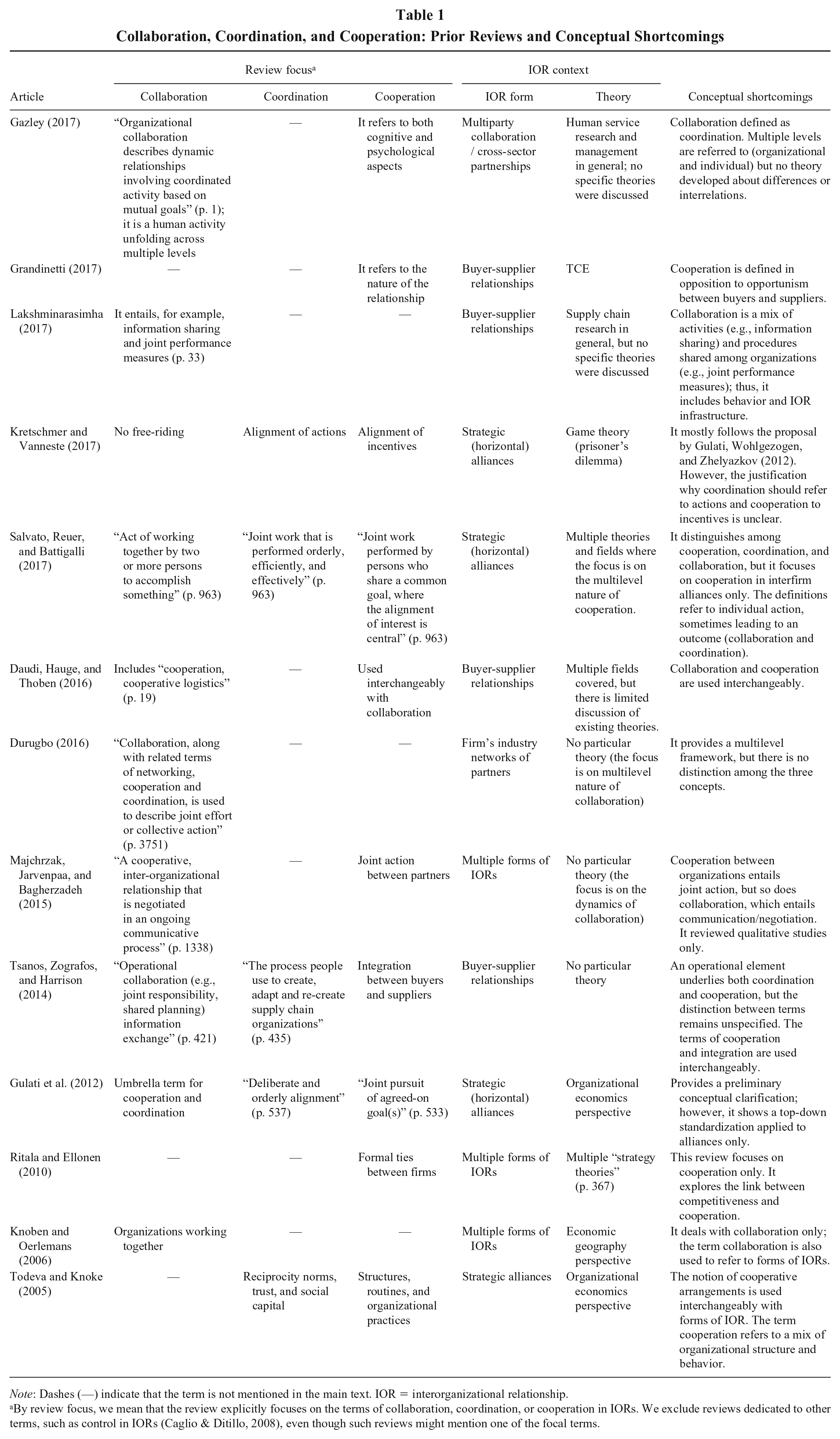
Note: Dashes (—) indicate that the term is not mentioned in the main text. IOR = interorganizational relationship.
By review focus, we mean that the review explicitly focuses on the terms of collaboration, coordination, or cooperation in IORs. We exclude reviews dedicated to other terms, such as control in IORs (Caglio & Ditillo, 2008), even though such reviews might mention one of the focal terms.
Second, the four reviews that address the three terms provide little systematic analysis of how prior literature has defined each term across a coherent set of IORs (Table 1). Without a systematic analysis of the previous literature on different forms of IORs, we risk a partial, incomplete view of the literature and thus risk developing a partial solution to a broad conceptual problem.
Third, Salvato et al. propose examining the Latin etymology of the three terms, which might help to clarify the distinct meanings of these terms. Coordination comes from the Latin cum ordinare—that is, putting in order, organizing, together with others. We believe that this definition is indeed helpful because it stresses a particular type of joint action—that is, organizing. In turn, cooperation originates in the Latin cum operare—that is, operating together with others. For collaboration, Salvato et al. note that it comes from the Latin cum laborare—that is, working together with others—which we could identify with a broader notion of joint action than the one assigned to coordination. Similar to Gulati et al., Salvato et al. also appear to treat collaboration as an umbrella term; it generally refers to the act of two or more persons working together toward an agreed-upon goal. However, it remains unclear whether collaboration (laborare) and cooperation (operare) carry distinctive meanings. The two terms refer to work and task execution. After all, Latin etymology might not provide distinct definitions of these three terms.
Fourth, of the 13 reviews, four address strategic (horizontal) alliances; four examine buyer-supplier relations; and one review concerns cross-sector partnerships (Table 1). The remaining four reviews address other forms of IORs. Those reviews that focus on a specific form of IOR tend to define the terms “collaboration”, “cooperation,” and “coordination” in a way that fits that specific form. For instance, the reviews on strategic alliances (Gulati et al., 2012; Kretschmer & Vanneste, 2017) emphasize issues of goal alignment and value appropriation in a form of IOR that reportedly displays acute tension between private and common interests (Hamel, 1991; Khanna, Gulati, & Nohria, 1998; Kogut, 1989). In contrast, reviews of the literature on buyer-supplier relationships stress technology integration across organizations (Lakshminarasimha, 2017; Tsanos et al., 2014), which is critical to supply chain management.
We focus our review on a coherent, homogeneous set of IORs in which the meaning of each term—“collaboration,” “coordination,” and “cooperation”—is more likely to converge. We study purposeful, direct IORs: IORs that result from the direct negotiation among (the representatives of) all the organizations involved in the IOR and that remain legally independent for the access, exchange (including pooling or sharing), and/or generation (jointly develop new) of resources. This definition of direct IORs excludes mergers and acquisitions (e.g., Haspeslagh & Jemison, 1991), in which at least one of the negotiating organizations usually ceases to operate as a distinct legally independent entity. It also excludes board interlocks, given that they do not result from direct agreements across (all) the interlocked organizations (Mizruchi, 1996) as well as other interorganizational network structures (Phelps, Heidl, & Wadhwa, 2012; Wassmer, 2010) that reach beyond those based on the direct agreement of all actors in the IOR (consortia are included, as well as trade unions where all members must accept newcomers).
A review that includes different forms of direct IORs offers the opportunity to examine whether authors consider the meanings of the three terms to differ according to the form of the IOR as well as the types of organizations involved (e.g., for-profit vs. not-for-profit). Our review thus complements existing reviews about specific forms of IORs, such as alliances (Shi, Sun, & Prescott, 2012), franchising arrangements (Combs, Michael, & Castrogiovanni, 2004), research and development (R&D) consortia (Eisner, Rahman, & Korn, 2009), and cross-sector partnerships (Selsky & Parker, 2005).
Fourth, Table 1 shows that only five reviews were not restricted to a particular theoretical framework and only one review explicitly discussed multiple strategy theories (Ritala & Ellonen, 2010). From a conceptual viewpoint, all thirteen reviews reinforce the conceptual confusion about these three terms by providing overlapping definitions. For instance, Gazley (2017) defines collaboration as involving coordinated activity, while Durugbo (2016) refers to collaboration, such as cooperation and coordination, as joint effort and collective action. Gulati et al. (2012) treat collaboration as an umbrella term for coordination and cooperation, but Kretschmer and Vanneste (2017) disagree.
Finally, in contrast to past reviews, our review encompasses the entire process of an IOR, thereby adding to existing reviews about the formation of IORs (Grandori & Soda, 1995) and the collaboration dynamics of IORs (Majchrzak, Jarvenpaa, & Bagherzadeh, 2015).
We designed our review to address the shortcomings in prior reviews. First, our review covers the use and definitions of the three terms in a set of similar forms of IORs. Second, it also includes the wealth of theories used in research about IORs. Third, we covered nine top research journals in management from 1948 to 2017. This almost 60-year time window encompasses the establishment and development of the management research field and, in particular, the study of IORs (Evan, 1965; Fombrun, 1986; Galaskiewicz, 1985; Van de Ven, Delbecq, & Koenig, 1976). Our aim was to contribute conceptual clarity (in terms of discriminant validity) and parsimony in the use and definition of collaboration, coordination, and cooperation in IORs.
We believe that we make at least five contributions to the IOR literature. First, we draw on a systematic analysis of the definitions of the three terms in the IOR context to explicate better the extent and nature of the conceptual confusion that other authors have already identified as a barrier to research cumulativeness. Second, using an in-depth analysis of the definitions, we progressively identify three dimensions (attitude, behavior, and outcome) that have been evoked in the definitions of collaboration, coordination, and cooperation. The three dimensions—which we call interactional dimensions—characterize the process of any interpersonal interaction (in the IOR context) and provide a preliminary way to differentiate among collaboration, coordination, and cooperation. We find that specific interactional dimensions are evoked in the definitions depends on the theoretical perspectives used, but we show that the interactional dimensions and the IOR context do not suffice to establish conceptual distinctiveness among collaboration, coordination, and cooperation. Third, our review helps us to identify the temporal stage and the type of goals as two dimensions that actually allow us to propose a redefinition of each of the three terms. Accordingly, we call the temporal stage and the type of goals “discriminating dimensions”. Because these are not based on a particular theoretical perspective or form of IOR, we can propose versatile and yet conceptually clear definitions of collaboration, coordination, and cooperation. Moreover, taking a IOR goal as the primary unit of analysis, we discuss how the proposed definitions might be used to theorize goal-related strategic decisions and implementation strategies. Fourth, the architecture of the conceptual dimensions (interactional and discriminating) upon which our redefinitions are built allow us to generate a host of managerially relevant research questions about the dynamics of IORs. We thus develop a research agenda that shows how this dynamic, goal-based approach is fruitful for advancing research on hitherto understudied aspects of IORs. Finally, our methodological approach to studying terms and their definitions might also be useful for designing future literature reviews.
Review Methodology
Literature Search (Raw Data)
We determined the review scope using several criteria. First, we selected the following set of journals that are generally regarded as the top-tier research outlets in the management field based on their 5-year impact factor and prestige (Shepherd & Suddaby, 2017): Academy of Management Journal, Academy of Management Review, Administrative Science Quarterly, Journal of Management, Journal of Management Studies, Management Science, Organization Science, Organization Studies, and Strategic Management Journal. These journals cover diverse epistemological and methodological views (Appendix 1 details our review procedures).
We purposefully selected journals in general management as opposed to journals that specialize in managerial areas (e.g., R&D management) or applied settings (e.g., public management) because research in general management is likely to use broad definitions that trickle down to research subfields, whereas sometimes specialist research might adopt conventions that fit a particular context. This journal list is, nonetheless, a boundary condition to our findings; it covers only top-tier journals in general management. A study of the convergence among the definitions of the three terms in a broad set of journals provides an avenue for future research.
Our focus on top-tier journals in general management was desirable given our aim. Journals generally viewed as impactful—based on a high number of citations—are expected to request that authors provide definitions, drawing from prior literature (for the sake of cumulativeness and parsimony). Thus, potential consensus around a concept may be easier to trace in top journals. If so, then our review provides a conservative estimate of the variety and perhaps messiness with regard to the definitions of collaboration, coordination, and cooperation.
Second, our review covers a long time window. We included all articles published in these journals since their inception—which for the oldest one (Administrative Science Quarterly) corresponds roughly with the creation of the first management research journal (1948)—until 2017.
We used keywords to identify potentially relevant articles in the Business Source Elite data set (managed by EBSCOhost), which contains all the articles for our selected journals since their inception. The keywords referred to the terms collaboration, coordination, and cooperation as well as all the forms of direct IORs. 2 Following past research (Oliver, 1990; Parmigiani & Rivera-Santos, 2011), we created a list of search words that captured the forms of direct IORs coved in our definition: alliances, joint ventures, buyer-supplier relationships, licensing, cobranding, franchising, cross-sector partnerships, networks, trade associations, and consortia (Appendix 1).
As reported in Appendix 1, we used the forms of direct IOR-related search words in conjunction with “collaboration”, “coordination”, or “cooperation”, thus conducting three separate searches, one for each of the three terms. We searched for the direct IOR-related words in the abstract, while the terms collaboration, coordination, and cooperation were searched in the full text. We identified 2,220 articles.
We considered an article to be relevant if it met two criteria: (1) true focus on any of the forms of direct IORs and (2) use of the terms collaboration, coordination, and/or cooperation in the main body of the article (not in the references only). As Appendix 1 details, despite the use of a search word (e.g., network), some articles were not referring to direct IORs. Two coders independently checked for the relevance of every article. Based on Krippendorff’s alpha (α = 0.92), the level of agreement between coders was high and well above the threshold of 0.70 (Hayes & Krippendorff, 2007). We identified 117 relevant articles on collaboration, 78 on coordination, and 177 about cooperation, for a total of 372 articles. This represents 16.76% of the initially identified articles; this figure shows that many of them were not concerned with collaboration, coordination, and cooperation in direct IORs.
Sourcing of Definitions
For the 372 relevant articles, we manually extracted every paragraph where the terms collaboration, coordination, and cooperation were written in the body of the articles. Automated procedures would have added error—the differences in article layout across journals (e.g., text organized in a single column versus two columns, page headers filled out with the author names vs. title of the article)—that we assessed as requiring greater effort to address than using manual extraction. We created a table for all the relevant articles with two columns: one for the article reference (authors and year) and another with the paragraphs where the terms were used. We only considered intensional definitions that define the essence of the term, thus excluding extensional definitions that list possible elements (instantiations) of the term. For instance, Briscoe and Rogan (2016: 2392) define coordination as “integrating or linking together different parts of an organization to accomplish a collective set of tasks”. We identified 45 articles providing an intensional definition of any of three terms of interest. Table 2 provides several examples of definitions for each of the three terms.
Examples of Definitions of Collaboration, Coordination, and Cooperation in IORs
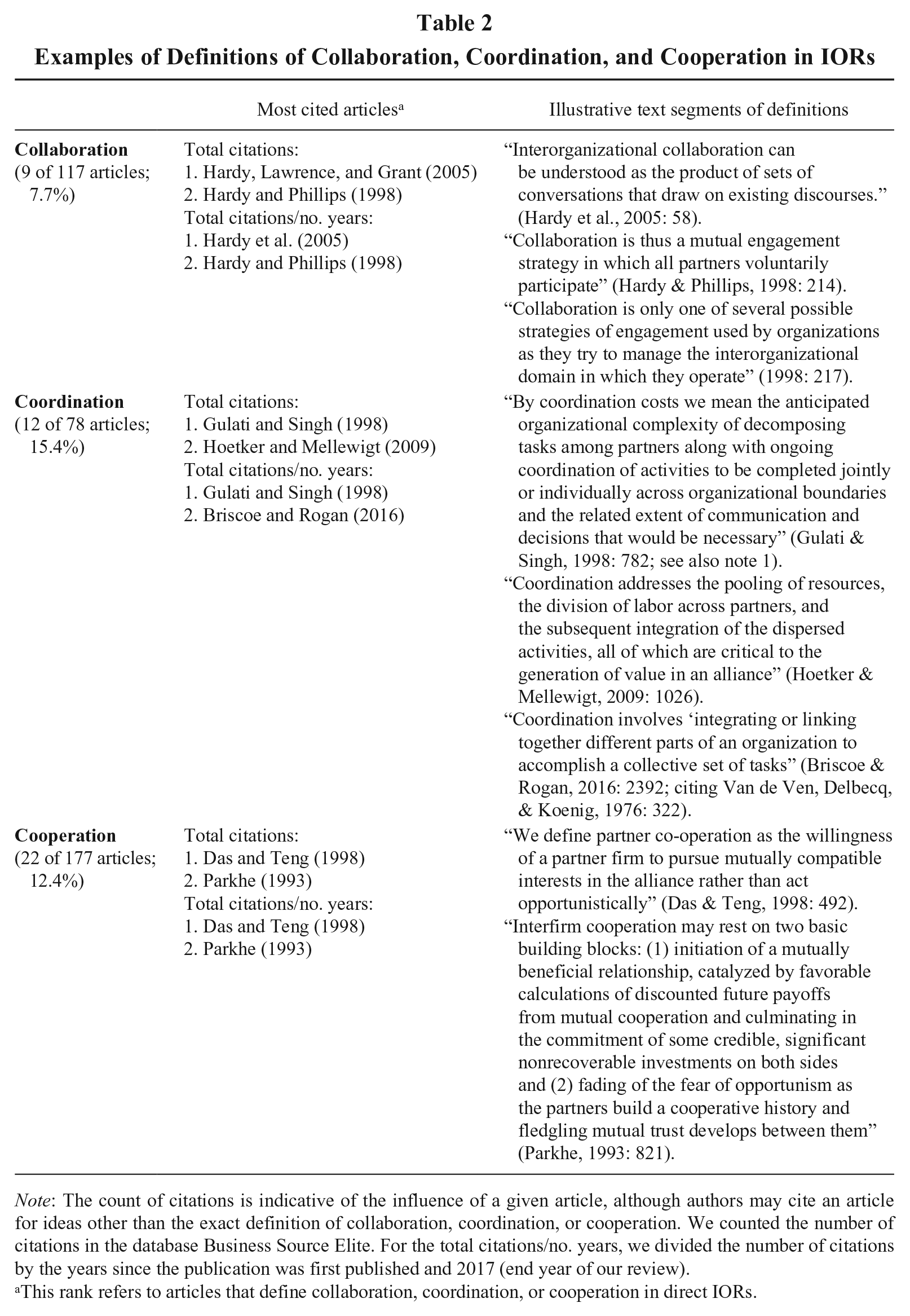
Note: The count of citations is indicative of the influence of a given article, although authors may cite an article for ideas other than the exact definition of collaboration, coordination, or cooperation. We counted the number of citations in the database Business Source Elite. For the total citations/no. years, we divided the number of citations by the years since the publication was first published and 2017 (end year of our review).
This rank refers to articles that define collaboration, coordination, or cooperation in direct IORs.
Figure 1 shows a stylized representation of the number of articles that provide definitions. Though there is variance across the three terms, their specific figures remain low: 22 articles out of 177 (12.43%) on cooperation, 12 articles out of 78 (15.38%) on coordination, and 10 articles out of 117 (8.55%) on collaboration. Across the three terms, the percentage of relevant articles that provide a definition is low (11.83%).
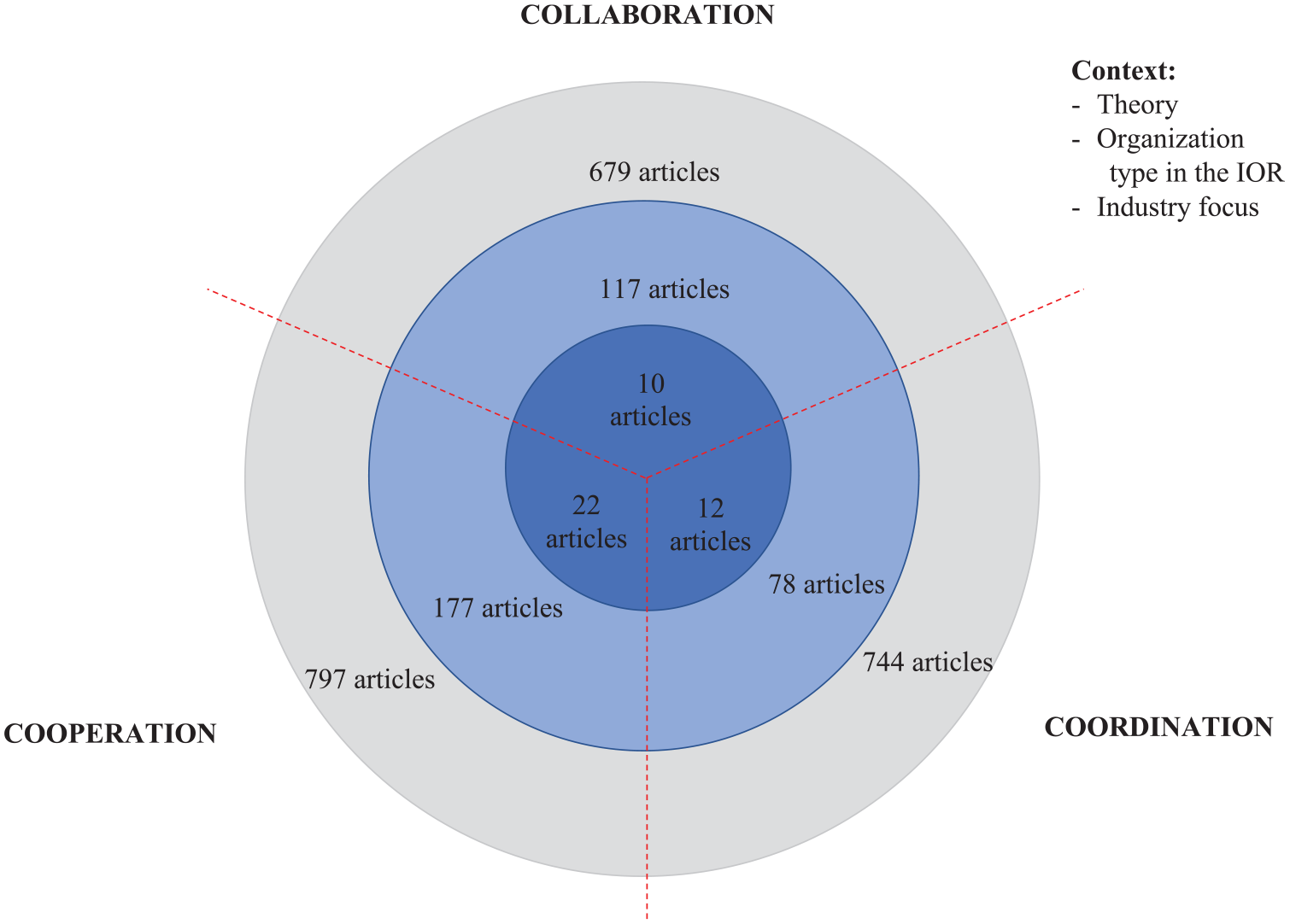
Schematic Representation of the Scope of the Literature Review
Data Analysis
Given our interest in exploring how consistently or differently the terms collaboration, coordination, and cooperation have been defined in research on IORs, we found the multiple-case study approach helpful for our data analysis (Eisenhardt, 1989; Leonard-Barton, 1990). This approach enabled us to compare and contrast the definitions within and across each of the three terms. The definitions of each term were treated analogously to data about a single case, say articles that define coordination. For each case, we analyzed the term’s definitions (concepts) and the article’s context (theory used and form of direct IORs) in which the researchers provided the definitions for us to identify patterns for each concept (alike within-case comparisons). We also compared articles across terms (alike cross-case comparisons) to learn about definitional similarities and differences across terms, such as identical definitions of different terms and whether the article’s context differed systematically across definitions of the three terms.
As it is customary in multiple-case study (Eisenhardt, 1989), our data analysis entailed interactions between emerging insights and the articles—that is, the data. Through the comparison of definitions, we progressively learned about the elements evoked by the authors for the three terms. In defining cooperation, for example, Das and Teng (1998: 492) evoke the “willingness of a partner firm” (thus, an attitude), while for the same term, Stadtler and Van Wassenhove (2016: 658) stress “working together” (thus, a behavior). We found an additional definitional dimension: outcome. For instance, Hardy, Lawrence, and Grant (2005) define collaboration as “the product of sets of conversations”. We thus used these three dimensions deployed by authors—attitude, behavior, and outcome—to organize the definitions. Our synthesis of the definitions was based on the following definitions of the three dimensions: attitude refers to a predisposition, willingness, or tendency to respond positively or negatively toward a certain idea, object, person, or situation; behavior refers to the way in which one acts, or conducts oneself; and outcome refers to the consequence of a specific action or behavior (Ajzen & Fishbein, 1977; Glasman & Albarracin, 2006).
Validity and Reliability
We took several steps to ensure validity and reliability in our review (Appendix 2). For instance, we addressed concerns about selection bias by explicitly specifying our selection criteria for searching relevant articles and by separately assessing the relevance of the articles. Furthermore, to ensure the reliability of the coding of the definitions—as referring to the attitude, behavior, and outcome dimensions—we recruited three management researchers who were unaware of the purpose of the study. We built a survey using Qualtrics software—shown in Appendix 3—that guaranteed anonymity of the raters’ responses. We also randomized the presentation order of the definitions. We found strong interrater reliability (Krippendorff’s alpha = 0.84).
We also explored whether journals headquartered in Europe versus the United States differed in the relative use of the three terms as a manifestation of different research traditions. We found that the use of any of the three terms was not conditional on the location of the journal’s headquarters (χ2 = 2.40, p > .10 [df = 2]). This finding suggests that the journals that we reviewed have a global reach and, to varied degree, are inclusive of different research traditions.
Interactional Dimensions of Collaboration, Coordination, and Cooperation Among Organizations
Our review findings show a growing interest in the terms collaboration, coordination, and cooperation (Appendix 4 reports on the evolution of the researchers’ interest in these three terms). However, we also find that researchers seldom define collaboration, coordination, and cooperation. The infrequent provision of definitions may suggest maturity of the research field reflected in the acceptance of standardized definitions provided by widely cited articles (Kuhn, 1962) and thus taken for granted. On the contrary, we find a proliferation of definitions for the same term, particularly coordination and cooperation, and limited cross-reference to early works when defining a term.
By reading through the definitions, we progressively identified three dimensions that were mutually exclusive and could occur across the three terms: attitude, behavior, and outcome (based on the definitions described in the Review Methodology section). The interplay between the literature on IORs (Ariño & De la Torre, 1998; Fombrun, 1986; Van de Ven et al., 1976) and our coding of these dimensions in the definitions showed that attitude, behavior, and outcome are analytically relevant to IORs. These dimensions cover the entire IOR process in both a sequential and recursive manner, as attitude leads to behavior, which in turn leads to some outcome that might then affect attitudes and so on. These three dimensions underlie the interaction among parties throughout IORs, so we label these three dimensions as interactional.
Our review analysis uncovers (1) which dimensions are evoked in each definition of a given term and (2) the differences in the dimensions included across the terms collaboration, coordination, and cooperation. Table 3 shows the distribution of definitions according to the interactional dimensions for collaboration, coordination, and cooperation. If we investigate the reference to the three dimensions (by column) across the three terms (cases), we observe that the behavioral dimension is featured across all three. Yet the outcome dimension mostly features in collaboration and appears in only one early definition of cooperation (Edström, Högberg, & Norback, 1984), but it features in no definition of coordination. The attitudinal dimension shows in definitions of cooperation only. Collectively, authors conceive the three terms as behaviors and much less as attitudes, perhaps because attitudes are thought more at the interpersonal rather than the interorganizational level (Zaheer, McEvily, & Perrone, 1998). As we detail here, the behaviors mentioned in definitions of coordination and cooperation are not substantially different; they overlap concerning resource sharing, exchange and pooling, and joint action. Furthermore, the meaning of outcomes is sometimes hard to differentiate from that of behavior. For instance, Hardy et al. (2005: 58) define interorganizational collaboration “as the product of sets of conversations that draw on existing discourses.” While the notion of product evokes an outcome, the definition also contains behaviors—such as conversations and bilateral communication—generating that outcome.
Coordination, Cooperation, and Collaboration: Provision of Definitions and Key Issues
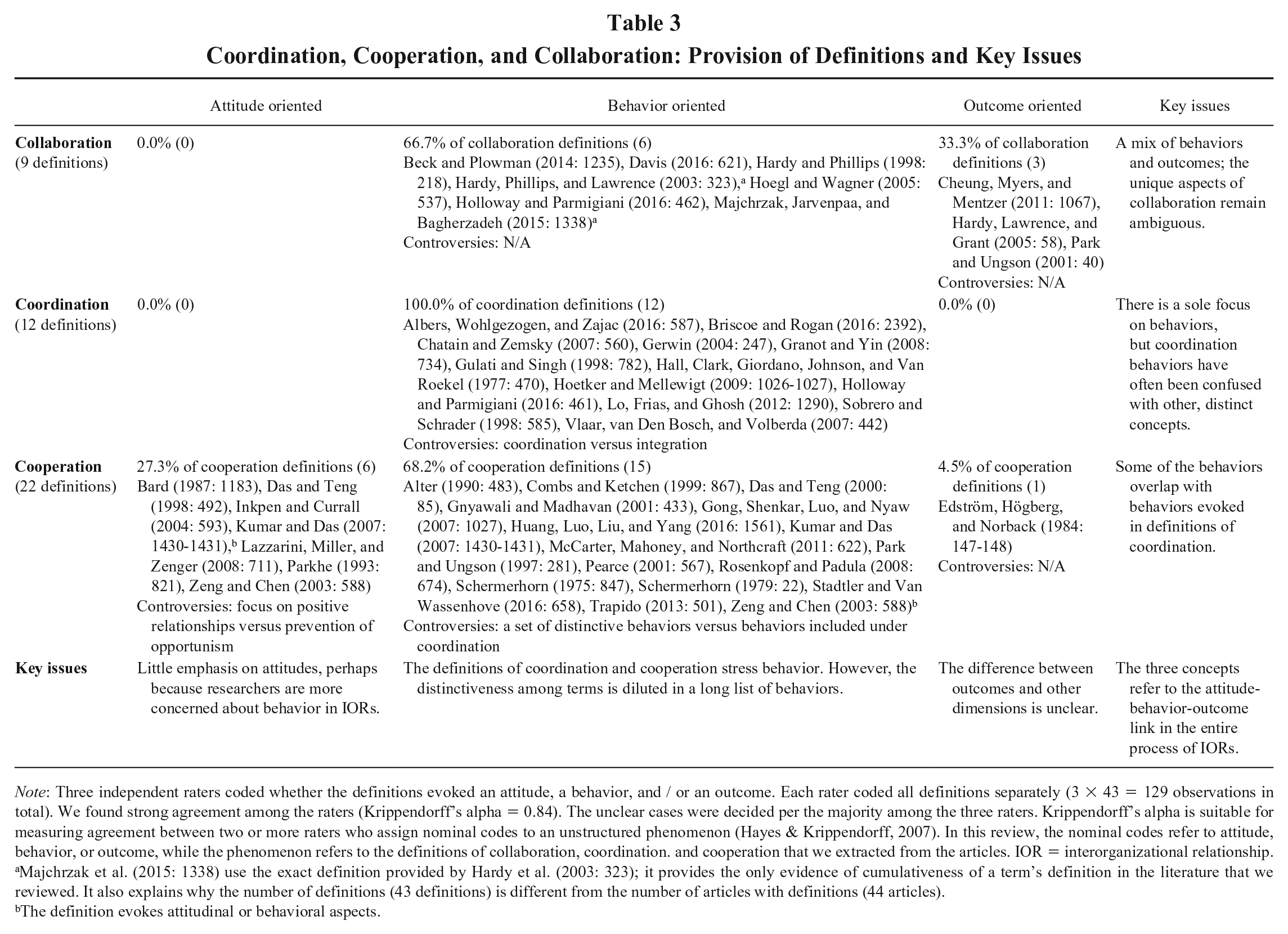
Note: Three independent raters coded whether the definitions evoked an attitude, a behavior, and / or an outcome. Each rater coded all definitions separately (3 × 43 = 129 observations in total). We found strong agreement among the raters (Krippendorff’s alpha = 0.84). The unclear cases were decided per the majority among the three raters. Krippendorff’s alpha is suitable for measuring agreement between two or more raters who assign nominal codes to an unstructured phenomenon (Hayes & Krippendorff, 2007). In this review, the nominal codes refer to attitude, behavior, or outcome, while the phenomenon refers to the definitions of collaboration, coordination. and cooperation that we extracted from the articles. IOR = interorganizational relationship.
Majchrzak et al. (2015: 1338) use the exact definition provided by Hardy et al. (2003: 323); it provides the only evidence of cumulativeness of a term’s definition in the literature that we reviewed. It also explains why the number of definitions (43 definitions) is different from the number of articles with definitions (44 articles).
The definition evokes attitudinal or behavioral aspects.
A pertinent question is whether each term should be associated with a particular dimension or a combination of the dimensions. A link between each term and a specific interactional dimension would bolster discriminant validity. However, researchers have consistently evoked the behavioral dimension in the definitions of collaboration, coordination, and cooperation.
Collaboration
We found no definition of the term collaboration that evokes attitudes (Table 3). Of the nine distinct definitions of collaboration (in ten articles), there are twice as many behavior-oriented definitions of collaboration as there are outcome-oriented definitions: six definitions evoke behaviors, with the remaining three definitions evoking outcomes. Our findings show no article with a definition for collaboration that simultaneously refers to behavior and outcomes.
Interestingly, however, two separate articles that share a coauthor define collaboration by evoking behaviors (Hardy & Phillips, 1998; see also Hardy et al., 2003) and outcomes (Hardy et al., 2005). Though, as we already pointed out, Hardy et al. (2005) refer to an outcome stemming from a particular behavior (conversations). This instance suggests that researchers may deal in distinct articles with specific interactional dimensions of the same term perhaps to capture nuances of the empirical phenomenon or to contribute to a specific theory. In this instance, the authors provide a rare and instructive study of collaboration in IORs in the not-for-profit sector, a research area that remains underexamined in the literature on IORs (Parmigiani & Rivera-Santos, 2011). In the three definitions evoking outcomes (Cheung, Myers, & Mentzer, 2011; Hardy et al., 2005; Park & Ungson, 2001), authors refer to dissimilar outcomes, such as collaboration quality and stability of the business relationship.
In contrast, behavior-oriented definitions display strong similarity. For instance, three of the six definitions refer to negotiation: negotiating roles, responsibilities, goals, and interests or negotiating the social order as the fundamental behavior of working together (Beck & Plowman, 2014; Hardy & Phillips, 1998; Majchrzak et al., 2015). Such similarity occurs because the definitions of Beck and Plowman (2014) and Majchrzak et al. (2015) concur with those of Hardy et al. (2003). This example of cumulativeness in the definitions of collaboration is encouraging. Still, Hardy et al. (2003: 323) define collaboration as “a cooperative, interorganizational relationship that is negotiated in an ongoing communicative process”; thus, the amalgamation of collaboration and cooperation renders limited discriminant validity. A similar issue is apparent in Hoegl and Wagner (2005: 544), whose survey measure of collaboration includes items capturing the extent to which the atmosphere among partners is cooperative.
One definition also evokes behaviors relating to common communication systems and language to facilitate collaboration, which is defined as joint learning and problem solving relying on knowledge transfer (Holloway & Parmigiani, 2016), which can be understood as both behavior (trying to learn) and outcome (having actually learnt). Interestingly, communication, a broader construct, is intrinsic to negotiation. Relatedly, one of the three outcome-based definitions treats collaboration as the product of sets of conversations (Hardy et al., 2005), reinforcing the centrality of bilateral, functional communication in the meaning of collaboration. However, as we detail below negotiation and communication behaviors are also evoked in the definitions of coordination and cooperation. The negotiation emphasis in collaboration definitions probably stems from a power/politics perspective about the IOR context in which different organizational actors need to find a common ground (Hardy et al., 2003; Hardy et al., 2005).
In terms of theory, these behavior-oriented definitions of collaboration originate partly on the embeddedness approach critique of early transaction cost economics (TCE) in explicating governance (Granovetter, 1985; Powell, 1987). For instance, Hardy et al. (2003: 323) state that “collaboration . . . relies neither on market nor on hierarchical mechanisms of control,” with market and hierarchy being the classical two governance choices in early TCE (Powell, 1987; Williamson, 1975, 1979). While the authors do not explicitly mention the specific governance form or mechanism that they believe pertains to collaboration (if not market or hierarchical mechanisms), we conjecture that they may be mainly referring to negotiation (see also Hardy & Phillips, 1998) 3 . In this regard, it is unsurprising that, following Hardy and colleagues’ (2003) definition, authors such as Beck and Plowman (2014) have explicitly added the development of shared rules, norms, and structures which come from the social embeddedness approach (Coleman, 1988; Granovetter, 1985; Jones, Hesterly, & Borgatti, 1997).
In contrast to the notion of collaboration as a mere umbrella term (Gulati et al., 2012), our review reveals that collaboration has been used to evoke distinctive elements of relational commitment or quality (Ariño & De la Torre, 1998) and fair behavior in alliances (Ariño & Ring, 2010; Luo, 2008). In their measure of collaboration in buyer-supplier relationships, Hoegl and Wagner (2005) include whether each party equally contributes to the common objectives, thus suggesting an expectation about contribution symmetry. Such symmetry raises issues of distributive fairness in terms that sometimes are associated with equality and equity—that is, relative to own and other contributions (Doz, 1996; Ring & Van de Ven, 1994).
Coordination
In all twelve definitions of coordination, authors evoke behaviors only (Table 3). However, the behavioral definitions of coordination exhibit a high degree of heterogeneity. The authors refer to task decomposition or the division of labor among partners (Gulati & Singh, 1998; Hoetker & Mellewigt, 2009; Holloway & Parmigiani, 2016; Vlaar, Van Den Bosch, & Volberda, 2007), pooling of resources (Hoetker & Mellewigt, 2009), communication (Gulati & Singh, 1998; Sobrero & Schrader, 1998; Vlaar et al., 2007), and integration between partners (Albers, Wohlgezogen, & Zajac, 2016; Briscoe & Rogan, 2016; Gulati & Singh, 1998; Hoetker & Mellewigt, 2009).
Our review findings indicate that coordination definitions draw from intraorganizational design theory, particularly from the work by Thompson (1967) on task interdependence (Gulati & Singh, 1998; Holloway & Parmigiani, 2016) as requiring coordination between partners and from the work by Lawrence and Lorsch (1967) on integration, a notion that has been defined as an ongoing endeavor to achieve unity of effort between partners (Gerwin, 2004) and thus is close to the notion of coordination. Indeed a point of confusion is that coordination and integration have occasionally been used interchangeably in the IOR literature (Inkpen & Dinur, 1998; for a discussion about these two concepts in the intraorganizational context, see Okhuysen & Bechky, 2009). The interchangeable use of coordination and integration further underscores the relevance to pursue conceptual clarity and parsimony.
Interestingly, Sobrero and Schrader (1998: 585) distinguish between contractual and procedural coordination. They define contractual coordination as “the mutual exchange of rights among parties”, while procedural coordination refers to the “mutual exchange of information among the parties”. Our analysis suggests that most authors may understand coordination as referring to the procedural kind—that is, as containing communication and information exchange. For instance, task decomposition and allocation or the division of labor among partners and the pooling of resources, which also feature in the definitions of coordination, presuppose communication. Integration occurs through communication roles or tools (e.g., liaison officers, committees or task forces), which Lawrence and Lorsch (1967) called integrative devices (Castañer & Ketokivi, 2018; Ketokivi & Castañer, 2004). However, communication about shared goals has remained implicit in the existing definitions of coordination that we reviewed.
It is also noteworthy that Gulati and Singh (1998: 782) distinguish coordination activities as being completed jointly or individually across organizational boundaries. This conceptual precision simultaneously enriches and adds ambiguity to the meaning of joint action: it may refer to working together (to do something together) or to act individually to accomplish common IOR-level goals.
Cooperation
The definitions of cooperation collectively evoke all three interactional dimensions. Table 3 shows that out of the twenty two definitions of cooperation, six focus on attitudes, fifteen on behaviors, and one on outcomes. The authors define cooperation as being mostly about behavior as compared with attitude or outcome.
The TCE approach (Williamson, 1979, 1991) and the social embeddedness perspective (Granovetter, 1985) have had a central role in framing most definitions of cooperation that focus on attitude. For instance, Parkhe (1993), Das and Teng (1998), and Lazzarini, Miller, and Zenger (2008) treat cooperation as the willingness to engage in or the expectation of nonopportunistic behavior—that is, not pursuing self-interest with guile. Indeed, three definitions of cooperation refer to the willingness to pursue or maximize joint or common interests or to create a mutually beneficial relationship (Das & Teng, 1998; Zeng & Chen, 2003).
Interestingly, several authors also draw on game theory (Axelrod, 1984) and reputation and signaling theory (Spence, 1974) to associate (successful) cooperation with irreversible investments that create credible commitments (Lazzarini et al., 2008; Parkhe, 1993). Exceptionally, one definition (Zeng & Chen, 2003) that evokes mainly attitudinal aspects also features a behavioral aspect. Zeng and Chen (2003: 588) primarily define cooperation as the willingness of a partner firm to maximize the joint interests of the alliance. Yet, they add that cooperation includes meeting the responsibilities ascribed in the written contract and making intangible contributions beyond the contract that help the alliance to operate more effectively. The effectiveness is a desired outcome arising from cooperation behavior.
Among the behavior-oriented definitions of cooperation, authors evoke a wide array of behaviors or actions, with no obvious differentiation with the behavioral dimensions of collaboration or coordination. Alter (1990) refers to joint activity, while Borys and Jemison (1989; see also Combs & Ketchen, 1999) and Das and Teng (2000) generally refer to the pursuit of mutual gain or interests and common benefits, which are close to the outcome-oriented definitions of collaboration (Park & Ungson, 2001). Thus, our review findings underscore a conceptual confusion between cooperation and collaboration in the literature on IORs.
Park and Ungson (1997), Gnyawali and Madhavan (2001), and Rosenkopf and Padula (2008) are more specific as they refer to making socioeconomic investments in the relationship, which include sharing resources, committing to common task goals, and sharing costs and risks. Gong, Shenkar, Luo, and Nyaw (2007) list different behaviors, such as establishing rules, engaging in mutual consultation, selecting staff, and executing plans. More recently, in an unconventional definition, Trapido (2013) discusses cooperation as informal behavior based on mutual help that is embedded in social ties (“interorganizational friendship ties”). Cooperation is different from collaboration, which according to the author, concerns contractual, formal relations only.
Similar to Zeng and Chen (2003), one definition (Kumar & Das, 2007) that is mainly behavior-oriented also evokes an attitudinal component. Kumar and Das (2007) state that cooperation might take several forms: it may imply a willingness and a readiness to exchange information or a sincere attempt to understand the other party’s perspective. Such a definition illustrates the struggle to assign an unidimensional, unequivocal meaning to cooperation.
Our review also shows instances of cooperation defined in relation to other terms. For instance, Pearce (2001) refers to coordinated action to define cooperation. Similar to Pearce (2001), Gnyawali and Madhavan (2001) identifies cooperation as being opposed to competition.
Edström et al. (1984: 147-148) provide the only definition of cooperation that evokes an outcome: for them, interorganizational cooperation refers to “the relationships of ownership or common hierarchy which develop between two or more independent organizations as a result of an explicit agreement concerning exchange of resources, concerted action, and/or joint decision making in the future”. This definition refers to an outcome that is an arrangement (an actual IOR involving ownership or common hierarchy) resulting from negotiation. In that regard, their definition of cooperation is similar to outcome-based definitions of collaboration.
Does the Article’s Context Matter?
We built on the findings above to develop a systematic analysis of whether the interactional dimensions evoked in definitions of collaboration, coordination, and cooperation were conditional on features of the article’s context. Namely, we examined the theory, the type of organizations involved, and the industry focus. As for theory, we built on prior research (Oliver, 1990; Parmigiani & Rivera-Santos, 2011) to distinguish between, broadly, organizational economics (TCE, agency theory, and the resource-based view and its associated perspectives, such as the knowledge-based view or dynamic capabilities) and organizational theory (resource dependence, stakeholder theory, institutional theory, and social networks—we did not find definitions drawing from population or organizational ecology). Next, we examined the types of organizations (i.e., for-profit vs. not-for-profit organizations) involved in the IOR. We also studied whether a single- versus multiple-industry focus was associated with the provision and type (dimensions evoked) of definitions 4 . Table 4 summarizes the role of the article’s context.
Context of the Articles Providing Definitions of Collaboration, Coordination, and Cooperation
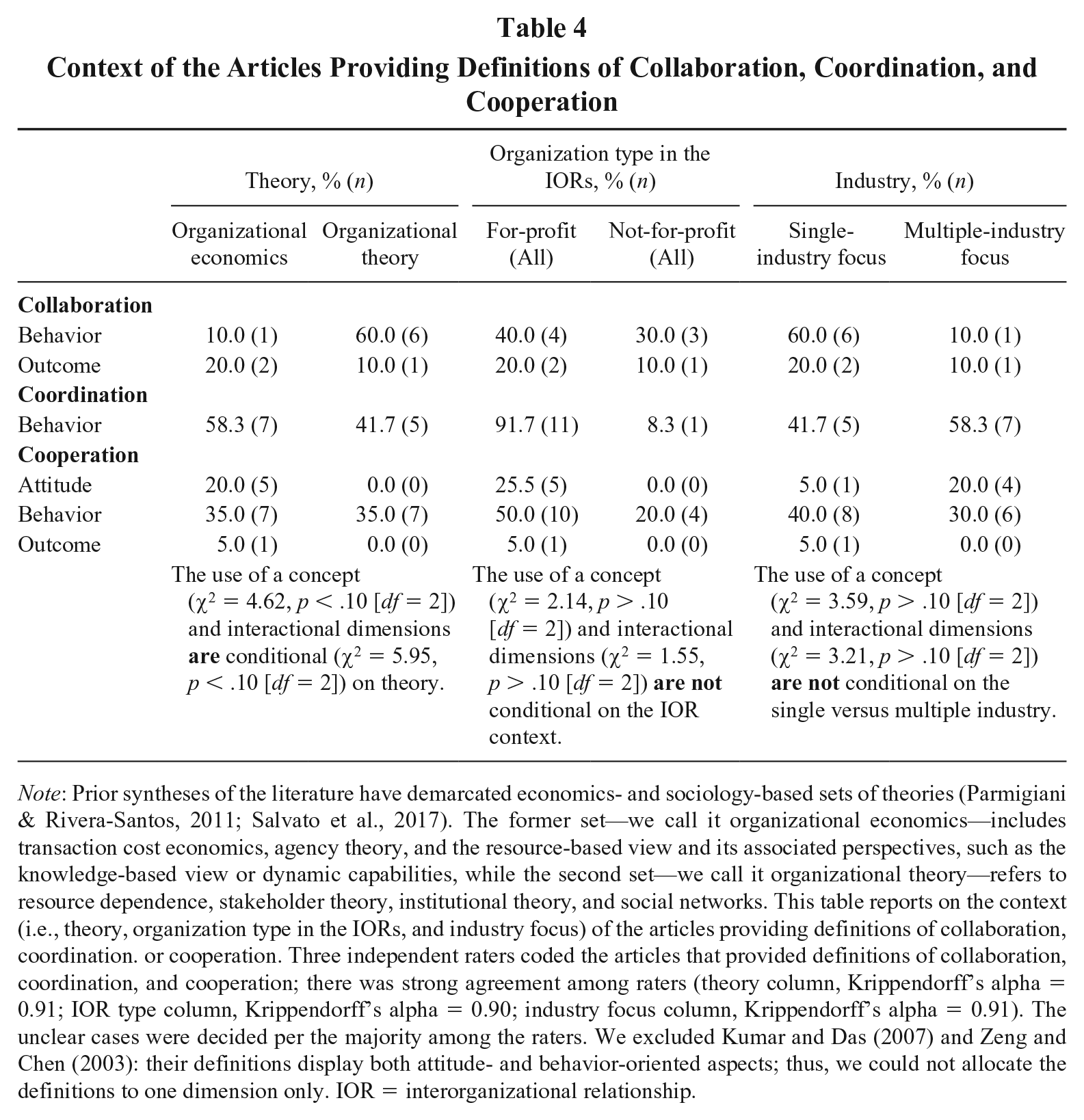
Note: Prior syntheses of the literature have demarcated economics- and sociology-based sets of theories (Parmigiani & Rivera-Santos, 2011; Salvato et al., 2017). The former set—we call it organizational economics—includes transaction cost economics, agency theory, and the resource-based view and its associated perspectives, such as the knowledge-based view or dynamic capabilities, while the second set—we call it organizational theory—refers to resource dependence, stakeholder theory, institutional theory, and social networks. This table reports on the context (i.e., theory, organization type in the IORs, and industry focus) of the articles providing definitions of collaboration, coordination. or cooperation. Three independent raters coded the articles that provided definitions of collaboration, coordination, and cooperation; there was strong agreement among raters (theory column, Krippendorff’s alpha = 0.91; IOR type column, Krippendorff’s alpha = 0.90; industry focus column, Krippendorff’s alpha = 0.91). The unclear cases were decided per the majority among the raters. We excluded Kumar and Das (2007) and Zeng and Chen (2003): their definitions display both attitude- and behavior-oriented aspects; thus, we could not allocate the definitions to one dimension only. IOR = interorganizational relationship.
The interactional dimensions are conditional on theory (χ2 = 5.95, p < .10 [df = 2]). Although cross-tabulation suggests only an association, this statistical finding is consistent with our qualitative analysis. A salient finding refers to collaboration: articles drawing on organizational theory mostly evoke behavior, while articles building on organizational economics stress outcome-oriented definitions. The reference to particular interactional dimensions is not conditional on a focus on (only) for-profit versus not-for-profit organizations in the IOR (χ2 = 1.55, p > .10 [df = 2]). A focus on a single industry versus multiple industries is not statistically associated with the interactional dimensions (χ2 = 3.21, p > .10 [df = 2]). Overall, the article’s context provides limited guidance in conceptually distinguishing these three concepts.
Toward Distinctive Definitions of Collaboration, Coordination, and Cooperation Among Organizations
A further analysis of the literature showed us that the temporal stage relative to a given IOR’s goal and goal type can actually enable future researchers (1) to distinguish between coordination and cooperation and (2) to show that collaboration is not the mere sum of coordination and cooperation. We call the goal type and temporal stage “discriminating dimensions”. The temporal stage refers to a time marker distinguishing the decision/deliberation from the implementation of the goal, while the goal type refers to whether a goal is private versus common.
(Goal-Related) Time as a Marker Between Coordination and Cooperation
Prior research has already hinted at the relevance of time for defining coordination and cooperation. Alter (1990: 483) proposed subsuming coordination under cooperation; her rationale is “that few organizations would undertake joint activity without deliberation and agreement on goals, so the difference between the terms is one of degree rather than substance”. Our review findings show that based on the definitions provided, coordination and cooperation vary in kind. Echoing Alter (1990), our critical analysis of the definitions suggests that time provides a way to differentiate between coordination and cooperation. Coordination refers to the attitudes, behaviors, and outcomes related to deliberation, negotiation, and agreement on a common goal, while cooperation refers to attitudes, behaviors, and outcomes related to the implementation of a common goal. For a given IOR, we are interested in goals set by the IOR partners.
By definition, for a given goal, cooperation follows coordination. This claim is supported by prior definitions of cooperation that treat cooperation as common goal implementation (Combs & Ketchen, 1999; Huang, Luo, Liu, & Yang, 2016; Pearce, 2001). For instance, Combs and Ketchen (1999: 867, emphasis added) define cooperation as taking place when “two or more otherwise sovereign organizations act in concert to pursue mutual gain,” while Gnyawali and Madhavan (2001: 433) refer to cooperation as an activity that involves “sharing resources”. Thus, the first implication 5 of our critical review is a redefinition of coordination and cooperation in IORs:
Implication 1: Coordination refers to the joint determination of common (IOR) goals, while cooperation refers to the implementation of those goals.
Our proposal maintains that both coordination and cooperation can entail an attitude, a behavior, or an outcome. A coordination attitude refers to the inclination to identify a common need and goal in the context of the IOR. A coordination behavior refers to the actions undertaken by the (potential) partners to prepare for, deliberate, and negotiate to reach or revisit an agreement on common goals—and potentially the writing up of a formal agreement in the initial IOR stage (Ring & Van de Ven, 1994). A coordination outcome might be a resulting common goal or the lack thereof, which signifies the impossibility of reaching an agreement (failed coordination attempts).
Similarly, we suggest that cooperation is studied as an attitude, a behavior, and an outcome during the implementation of an IOR goal. A cooperation attitude refers to the willingness to work toward the achievement of an agreed-on common goal. A cooperation behavior refers to actions undertaken by the partners to achieve the collectively envisioned goal. A cooperation outcome is, for example, the degree to which an agreed-on common goal is attained.
Coordination and cooperation might entail a predisposition (attitude) and joint activity (behavior)—that is, bilateral communication (including negotiation) among the partners aimed at setting common goals (in the case of coordination) or at achieving those goals (in the case of cooperation). Coordination requires joint action, given that it concerns the agreement on common goals through bilateral or multiparty communication in the IOR. However, cooperation is not restricted to instances where partners physically or virtually work together or partners maintain bilateral communication. As Gulati and Singh (1998) note, cooperation may also involve actions engaged in by partners individually in their own organization toward attaining a common goal of the IOR. Partners work within their own organizations has a bearing on relationship dynamics between IOR partners in the pursuit of cooperation—that is, the joint implementation of common goals (Brattström & Faems, 2019).
In light of the conceptual messiness mapped in our review, we believe that our redefinitions merit consideration by future research. Our conceptual proposal is not only based on a systematic review of the use of the terms “coordination” and “cooperation” in past research but also affords discriminant validity. Prior attempts at conceptual clarification (Gulati et al., 2012; Kretschmer & Vanneste, 2017) have not fully achieved discriminant validity. Gulati and colleagues’ (2012) definitions of coordination and cooperation (studied in the context of alliances only) partially overlap in that the two concepts refer to actions—pursuit or alignment and adjustment—taken for the attainment of common goals. A related but different issue occurs in Kretschmer and Vanneste (2017), who define cooperation as the alignment of incentives and coordination as the alignment of actions in alliances. It follows that cooperation may then be subsumed by coordination, as the alignment of incentives is also an action (process of aligning) or an outcome (the degree of alignment achieved).
Our conceptual proposal addresses the amalgamation of attitudes, behaviors, and outcomes across the definitions of coordination and cooperation. Coordination and cooperation, as temporally differentiated concepts at the unit of the goal, entail specific attitudes, behaviors, and outcomes. We believe a better specification of the attitude-behavior-outcome link during the determination and implementation of common goals is desirable to develop an activity-based view of IORs.
Goal Type as a Marker for Collaboration
Goals underlie the use of the terms “collaboration”, “coordination”, and “cooperation” among organizations. In the literature on alliances, for instance, researchers distinguish between “private benefits” and “common benefits” (Das & Teng, 1998; Khanna et al., 1998; Parkhe, 1993). Collective goals or mutual gains are treated as synonymous with common benefits. Private benefits are those obtained by each partner organization from the alliance and are distinct from common benefits, which are shared by all partners (Hennart, 1988). With the aim of facilitating research across types of IORs, we opt for the term “goal” over “benefit”. Benefit may suggest the dominance of economic profitability as a goal, which might be adequate for alliances between for-profit corporations but a less-fitting option for other types of IORs, such as cross-sector partnerships or social alliances (Selsky & Parker, 2005; Stadtler & Van Wassenhove, 2016).
A mix of private and common goals is present in every IOR such that IORs are generally understood as a mixed-motive situation (Schelling, 1980). Partners might agree to a common goal, such as jointly developing a technology or sharing costs and risks (Kogut, 1988), but their private goal may be to replicate their counterparty’s competences to make the alliance redundant, and the partner may be aiming to reinforce its position in the market, possibly as a competitor (Hamel, 1991; Khanna et al., 1998). Mixed motives are also reported for IORs among public service providers, where partners may privately intend to internally replicate partners’ skills and assert dominance in specific services and geographic areas (Oliver, 1990; Van de Ven & Walker, 1984).
Although private and common goals are featured in articles that address collaboration, coordination, and cooperation 6 , our review notes that knowing the type of goal is helpful in distinguishing collaboration from coordination and cooperation among organizations. In addition to common goals, collaboration might encompass a party’s private goal. Collaboration also features a distinct dimension of motivation (attitude) such that it can prompt behaviors and outcomes that differ from those associated with coordination and cooperation. We find that researchers’ use of collaboration distinctively evokes considerations about “the psychological best interests of the organizational parties” (Ring & Van de Ven, 1994: 107); “interpersonal care and concern for their counterparts in the partner organization” (Lioukas & Reuer, 2015: 1829); and the norms of reciprocity, solidarity, and mutual assistance toward counterparties (Dyer & Singh, 1998; Fonti, Maoret, & Whitbred, 2017; Jones et al., 1997). Similar norms and behaviors have been reported in partnerships between not-for-profit and for-profit organizations that voluntarily help each other improve the other’s internal performance (Galaskiewicz, 1985; Hardy et al., 2003; Rivera-Santos, Rufín, & Wassmer, 2017). In contrast, we did not find these norms and behaviors in the definitions of coordination and cooperation among organizations. Accordingly, we propose the following redefinition of collaboration as the second implication of our review:
Implication 2: Collaboration refers to voluntarily helping other partners to achieve IOR (common) goals or one or more of their private goals.
By helping to achieve a common (IOR) goal, we mean taking over some of the agreed-on tasks of other partners to achieve it. Our definition of collaboration thus only partly overlaps with cooperation when the helping behavior concerns an IOR (common goal), though it focuses on a particular dimension of its implementation. Hence, collaboration has a distinctive meaning from cooperation in that it might also concern helping for partners’ private goals.
Our review-based redefinition of collaboration provides a cautionary note with regard to Gulati and colleagues’ (2012) notion that collaboration is the mere sum of coordination and cooperation. Instead, our review indicates that collaboration refers to a distinctive, different phenomenon, thereby lending discriminant validity to the collaboration concept relative to the concepts of coordination and cooperation. Collaboration refers to attitudes, behaviors, and outcomes related to voluntarily helping a partner organization to achieve a common IOR goal or—this is the critical, distinctive element—to achieve a private goal that need not relate directly to the common goals agreed on in the IOR (Macneil, 1980; Vlaar, Van Den Bosch, & Volberda, 2006).
In referring to helping a partner with one of its private goals, we exclude opportunism, defined by Williamson (1975, 1979, 1991) as the pursuit of self-interest with guile. While the focal partner might not know all of the other partners’ private goals (Barney, 1988), we assume that the focal partner refrains from collaboration that might contribute to its own demise or IOR failure 7 .
We distinguish three types of private goals when firms voluntarily help other partners: (1) to feel like a “good citizen” to satisfy one’s own moral standards without expecting the partner’s reciprocity—the moral or principled-selfish way; (2) to ensure that the helped partner recognizes the assistance and feels indebted, perhaps increasing reciprocity and commitment toward the IOR (Das & Teng, 1998, 2000)—the instrumental way; or (3) to establish a reputation for being a good partner and hence being able to attract new partners (Williamson, 1993)—the reputational way. While it might be difficult for a manager to establish the motivations behind another partner’s behavior, this does not usually stop partners’ managers from making inferences or suppositions, such as evaluating trustworthiness (Barney & Hansen, 1994).
A collaboration attitude concerns the willingness to voluntarily help another partner in the accomplishment of a common goal or in the partner’s private goals not directly related to the IOR. An example refers to when an alliance partner is willing to help a counterparty who has been affected by an adverse event. Such an event might affect the counterparty at first, but it could also damage the reputation of all alliance partners. Such an event can prompt other partners to help the affected counterparty in order to prevent reputation damage from spillovers (Bruyaka, Philippe, & Castañer, 2018). Collaboration behavior consists of action taken to help a counterparty in achieving common goals or one or more private goals. A collaboration outcome is the result of such help in terms of common goal achievement or in supporting a focal partner’s private goal. Collaboration outcomes also include the consequences for helping the focal partner achieve its private goal—feeling of being a good citizen, indebtedness to the helping partner, or external reputation as a good partner.
A Goal-Oriented View of Collaboration, Coordination, and Cooperation
Our conceptual proposal uses the goal as the unit of analysis. The proposed redefinitions of collaboration, coordination, and cooperation equip researchers to study goal deliberation and implementation as the thrust of the dynamics of IORs. Figure 2 visually depicts the implications for research that ensue from our redefinitions of collaboration, coordination, and cooperation in IORs. At the top of Figure 2, we depict goal deliberation and implementation. In the rows, we represent the specific goals. The proposed conceptualization helps to identify ideal types of goal decisions and implementation strategies.
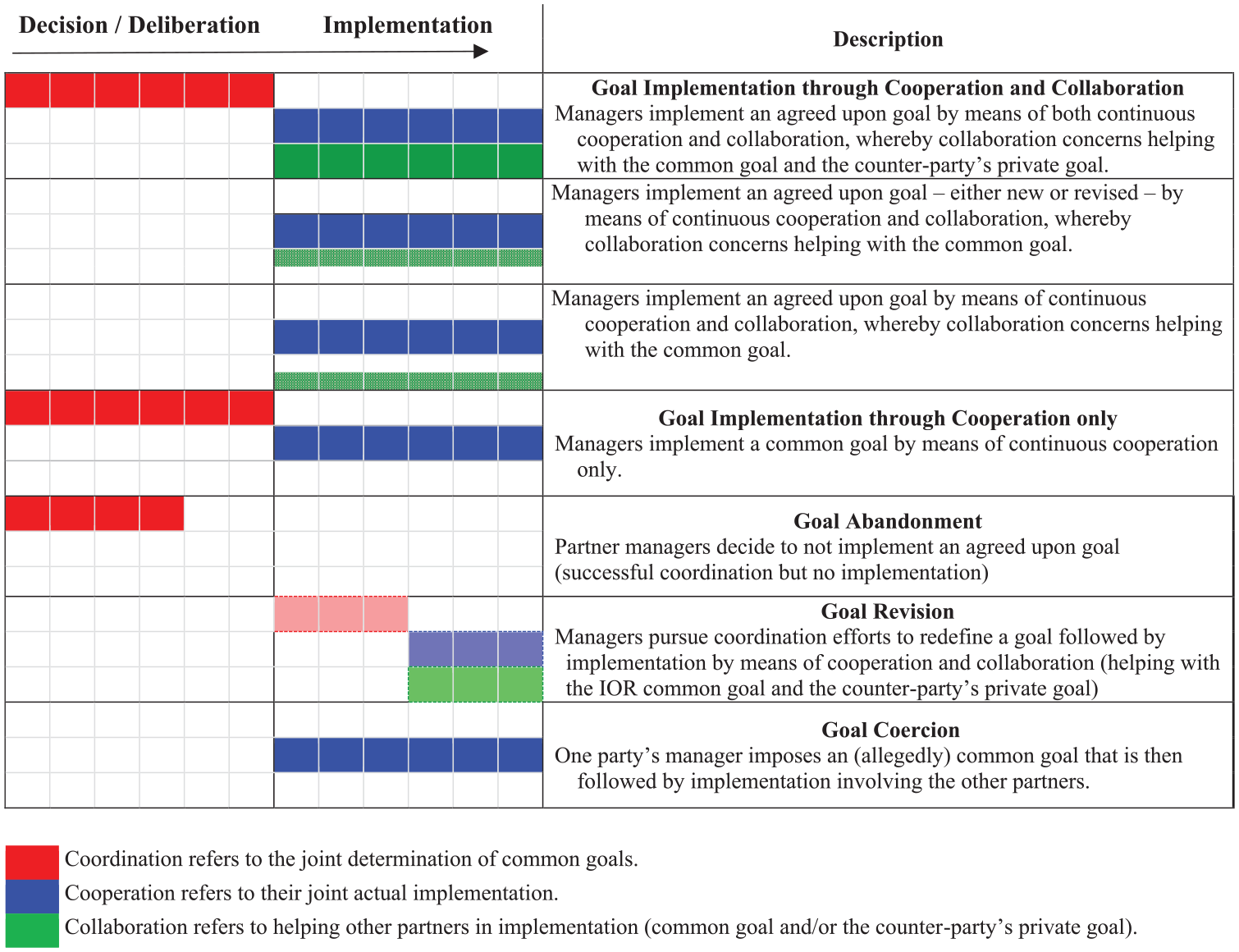
Typology of Common Goal-Directed Sequences in Interorganizational Relationships
Following the discriminating dimensions of (goal-oriented) time, the strategy for the implementation of a given goal might draw on cooperation and collaboration. Managers might adopt a strategy of goal implementation based only on continuous cooperation. Taking advantage of the conceptual distinctiveness of collaboration, researchers can carry out a granular analysis of the strategies of goal implementation that occur across multiple forms of IORs. Managers might implement an agreed-on goal by means of continuous cooperation and collaboration (voluntarily helping with the IOR’s common goal and the counterparty’s private goal). Another strategy is for managers to implement an agreed-on goal by means of continuous cooperation and collaboration, but collaboration focuses on voluntarily helping the partner with only the IOR’s common goal. Although less common, there might be instances where managers implement an agreed-on goal by means of continuous cooperation and collaboration, but collaboration is restricted to help with only the counterparty’s private goal. A focus on whether collaboration—as an attitude, a behavior, or an outcome—is directed at a common goal or a counterparty’s private goal opens up the opportunities to study heterogeneity of outcomes in IOR goal implementation.
By considering the temporal dynamics in IORs—that is, the fact that “things” might change (Doz, 1996; Ring & Van de Ven, 1994)—our proposed redefinition of coordination does not require that partners reach a single agreement about the (common) goal prior to IOR formation. For the duration of an IOR, there might be multiple moments of coordination where partners revisit, abandon, or renegotiate an IOR goal (Ariño & De la Torre, 1998; Doz, 1996). As shown in Figure 2, partners might decide not to implement an agreed-on goal (successful coordination but no implementation). Goal abandonment might occur at any point during goal implementation. Another decision might entail goal revision; that is, partners could pursue coordination efforts to redefine a goal, followed by implementation by means of cooperation and collaboration (helping with the IOR common goal and the counterparty’s private goal). Finally, a partner might impose an (allegedly) common goal, followed by coercing other parties in the IOR to implement the goal. While uncommon, such a goal decision might occur in cases where one party has disproportionately high power over the counterparties, as in captive buyer-supplier relationships.
Research Agenda
Attitudes, Behavior, and Outcomes
We envisage research opportunities that leverage the three interactional dimensions of the use of the definitions of collaboration, coordination, and cooperation that we identified in our review. Future research should examine the attitude-behavior-outcome link during goal deliberation and implementation in IORs (Table 5). To this end, we anticipate research opportunities investigating collaboration, coordination, and cooperation that leverage studies of cognition (Kahneman & Tversky, 1979). Future studies should explore how goals’ gain-loss framing might influence partners’ coordination, cooperation, and collaboration in IORs. For each concept, the study of goals’ framing will initiate the theorizing about tinner processes linking attitudes, behaviors, and outcomes across forms of IORs. We also encourage researchers to explore how managers perceive the counterparty’s need for collaboration during the implementation of goals. Researchers might build on a handful of studies about fairness and mutual help (Ariño & Ring, 2010; Luo, 2008) to pursue a research program on the different motives that prompt partners to voluntarily help counterparties.
Illustrative Future Research Directions Emanating from our Conceptual Proposal
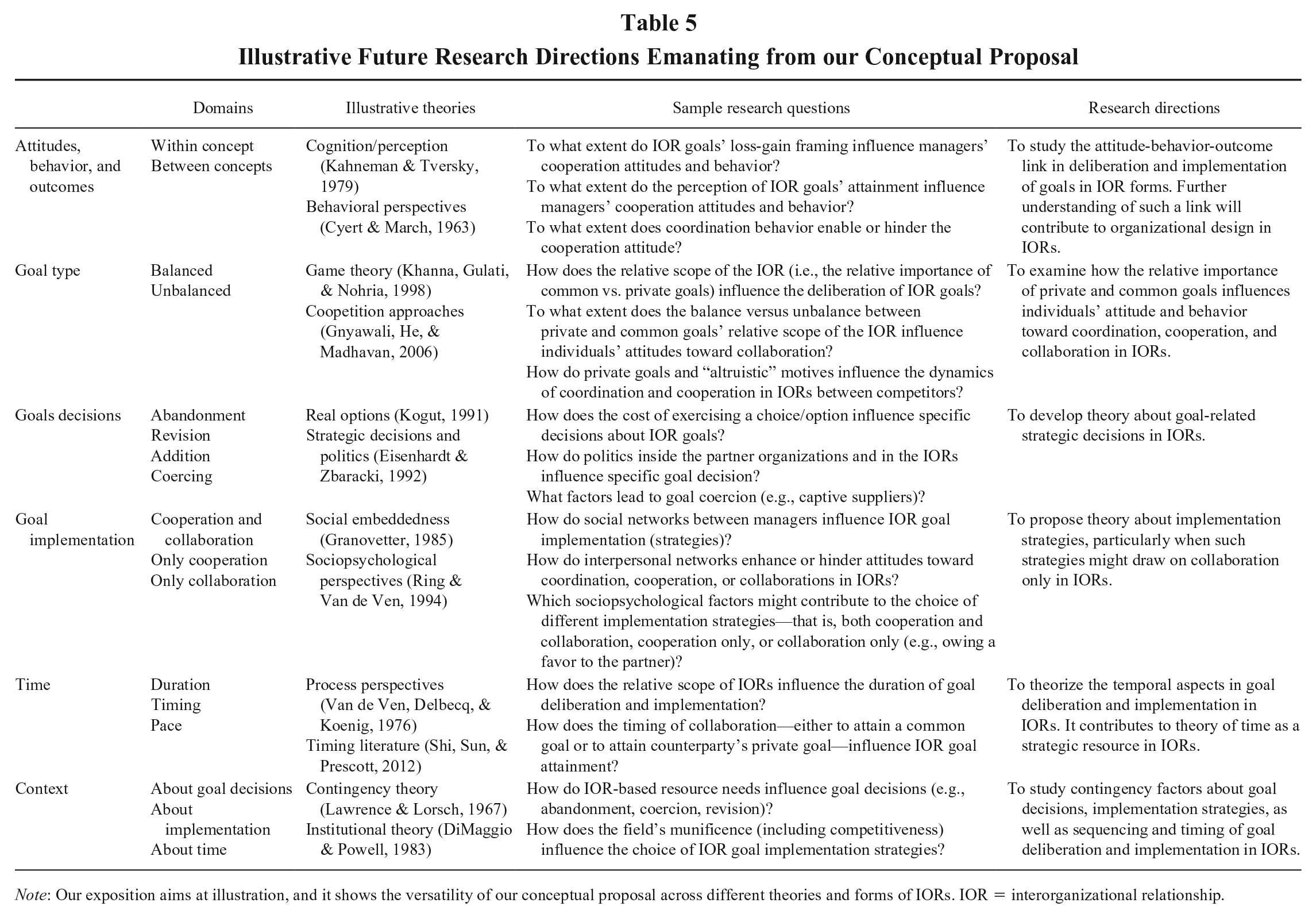
Note: Our exposition aims at illustration, and it shows the versatility of our conceptual proposal across different theories and forms of IORs. IOR = interorganizational relationship.
We call for research that explores the behaviors that help or hinder the transitions from deliberation to implementation of goals (Table 5). A potential research question is as follows: To what extent does coordination behavior enable or hinder the cooperation attitude? Our review revealed a growing practice of the joint use of the terms “coordination” and “cooperation” (Gulati & Singh, 1998), “collaboration” and “cooperation” (Abdi & Aulakh, 2017), and “collaboration” and “coordination” (Klijn, Reuer, Van den Bosch, & Volberda, 2013). Future research can draw on the proposed conceptualization to examine the behavioral foundations (Cyert & March, 1963) of the interactional process in IORs. Other studies might address an imbalance in prior literature by comparing coordination, cooperation, and collaboration behaviors in alliances with, for example, cross-sector partnerships and R&D consortia.
Goal Type
One of the insights of our review concerns the role of private goals versus common goals (Khanna et al., 1998; Parkhe, 1993). IORs might display either a balance or an imbalance between private and common goals. The relative importance of each goal type provides an interesting direction for future research. Researchers should examine how IORs’ relative scope influences the processes of deliberation for IOR goals. Other studies might examine how the IORs’ relative scope affects managers’ attitudes toward collaboration, particularly collaboration directed toward the counterparty’s private goals.
A case in point about future research on the goal type is coopetition. The term “coopetition” refers to the simultaneous presence of cooperation—sometimes called collaboration (Gnyawali & Park, 2011)—and competition between firms (Gnyawali, He, & Madhavan, 2006; Nalebuff, Brandenburger, & Maulana, 1996). The distinction between cooperation and competition is based on the analysis of goals (private vs. common; Bengtsson & Kock, 1999; Gnyawali et al., 2006). An instructive example is found in Das and Teng (2000: 85), who note that “whereas competition can be defined as pursuing one’s own interest at the expense of others, cooperation is the pursuit of mutual interests and common benefits in alliances”.
A central issue in coopetition concerns the relative importance of private versus common goals between competitors. The baseline prediction is that “a higher ratio of private to common benefits leads to greater departures from cooperative and toward competitive behavior” (Khanna et al., 1998: 194). Future research can explore the meaning of competition in relation to which goals each partner is pursuing. For instance, Das and Teng (2000: 85) seem to view competition as a zero-sum game rather than as a positive-sum game through emulation, where actors behave almost in an opportunistic manner: “competition can be defined as pursuing one’s own interest at the expense of others [italics added]”. If competition is viewed as the pursuit of private goals (or interests), actors do not necessarily need to be strict (market) competitors. Future research should draw on our interactional dimensions (i.e., attitudes, behaviors, and outcomes) to theorize on the interaction between partners when direct market competition or, more generally, the pursuit of private goals (whether selfish, opportunistic, or altruistic) is also present. Hoffmann, Lavie, Reuer, & Shipilov (2018: 3035) note that “accumulated research on cooperation has not been sufficiently integrated with literature on coopetition”, thus showing a shortcoming that calls for future research. In IORs between competitors, how do private goals and “altruistic” motives influence the dynamics of coordination and cooperation?
Goal Decisions
We envisage multiple research opportunities to theorize about the abandonment of goals, the revision of goals, and coercion toward the pursuit of goals. An original way to study goal decisions is through real options theory (Folta & Miller, 2002; Kogut, 1991; Mahoney & Qian, 2013). In the context of IORs, a real option might refer to decisions by IORs’ managers to defer, to abandon, or to grow an existing IOR or assets that belong to an IOR (e.g., alliance or consortium). High uncertainty in the operating environment might result in possibilities for partners to receive rents from exercising future decision rights, thus buffering against uncertainty (Table 5).
Future research on IOR goal decisions will augment the literature on strategic decisions (Eisenhardt & Zbaracki, 1992) by exploring how and when partners draw on cooperation and collaboration to revise goals. For instance, how do coordination outcomes influence the extent to which the partners draw on collaboration to implement a revised goal? In cross-sector partnerships between for-profit and not-for-profit organizations, for instance, future research is necessary to theorize on collaboration to help a counterparty achieve a common goal, its own private goal, or both. Managers might also abandon a goal or coerce a party toward achieving a goal. Future research on goal abandonment might examine the role of intraorganizational politics IOR in goal abandonment (for an exception, see Brattström & Faems, 2019). Such research will complement the existing literature that has either noted the role of conflict between parties or market factors in goal abandonment decisions (Wolf & Floyd, 2017). Received wisdom is largely silent about goal coercion—that is, the implementation of a goal without deliberation between parties, with the goal being unilaterally decided even if its implementation requires cooperation from other parties in the IOR. In an episode of the rivalry between Amazon and Walmart, a Reuters article titled “Mexico’s Walmart Pressures Suppliers on Pricing, Forcing Some to Ditch Amazon” reports that “Walmart’s Mexico unit has penalized food companies supplying groceries to rival Amazon” (Solomon, 2019). Walmart is believed to force individual suppliers to reduce their selling price under the common goal of retaining a leading market share following the entry of Amazon into the online market. Goal coercion opens up several research questions: What factors lead to goal coercion by a party? How do managers who are forced to contribute toward a goal develop coping mechanisms or, instead, boycott the goal?
Goal Implementation
We call for research that examines when goal implementation follows any of three strategies: cooperation only, collaboration only, or joint cooperation and collaboration (recall Figure 2). From a strategy implementation viewpoint (Mintzberg, 1994), our proposed conceptualization helps future researchers to theorize on the role of cooperation and collaboration in the implementation of strategic goals. While much of the existing literature has focused on strategic tools (Vuorinen, Hakala, Kohtamäki, & Uusitalo, 2018), we turn attention to the role of tools in the attitude-behavior-outcome link in IOR cooperation, coordination, and collaboration. We call for research that examines when specific tools enhance or hinder any of the three concepts or the relationship between concepts (e.g., coordination and cooperation).
From an embeddedness or social network perspective, an interesting line of enquiry concerns social ties among partners in IORs (Granovetter, 1985; Hage & Aiken, 1969). Of particular interest for future research is the role of social ties in supporting implementation that draws on collaboration, which is characterized by voluntary help in the IOR. For instance, which network properties foster collaboration between partners? We call for research that explores the extent to which personal networks among partners representatives might support the implementation of a counterparty’s private goal. At first, this scenario would appear unlikely. However, one reason for taking such action might concern the division of labor between partners, particularly in IORs that require specialist capabilities. A partner might be inclined to transfer knowledge toward the other party (e.g., two partners working to tackle a social issue). Future research is suggested not only to uncover the unique role of collaboration but also to unravel the social mechanisms of mutual assistance that occur during goal implementation. Research on these issues will contribute to a sociopsychological perspective about perceived equity, indebtedness, and perceived reciprocity as part of goal implementation in IORs (Luo, 2008; Ring & Van de Ven, 1994).
Time
By focusing on IOR-related goals, we envisage the future of IOR temporal dynamics across different forms of IORs, industries, and sectoral contexts. A commitment to examining the duration of IORs suggests the following research questions: Are there differences in the duration of coordination efforts versus cooperation efforts for a given goal? How do partners balance the duration of coordination in the decision/deliberation of goals and the time pressure to cooperate toward the implementation of goals in IORs that might have a short time span?
From a process studies and timing literature perspective (Majchrzak et al., 2015; Van de Ven et al., 1976), future research should unpack the underlying processes of decision/deliberation and implementation of goals as the basic activities that underpin the dynamics of IORs. We anticipate opportunities to expand the literature on timing in IORs (Oliveira & Lumineau, 2017; Shi et al., 2012) by studying, for example, how the timing of collaboration behavior influences the extent to which specific goals, if any, are attained in an IOR. The literature on alliances, for instance, has recommended that partners engage in ongoing interaction so they have the ability to establish the “right” pace at the “right” time, which subsequently helps “proactive planning efforts and timely implementation of key activities” (Standifer & Bluedorn, 2006: 916). Empirical research has nonetheless been slow in examining the issues of timing.
Future researchers should also focus on the pace of deliberation and the implementation of IOR goals. For instance, we anticipate opportunities for drawing on organizational theory about time in organizations to explore partners’ temporal work (Kaplan & Orlikowski, 2013). Researchers can explore how the pace of deliberation and implementation is related to how partners interpret the past, present, and future in developing strategic accounts of their interaction. For instance, a partner’s temporal interpretation might not only influence the pace of coordination or cooperation but also shape goal decisions (e.g., revision, abandonment).
Context
We envisage several opportunities to study how context influences goal decisions, goal implementation, and temporal aspects. First, future research should explore decisions to abandon, revise, or coerce others toward a goal that might vary according to contextual factors, such as the competitive environment and the industry diversity of partners. As future research widens the spectrum of forms of IORs, future studies of collaboration, coordination, and cooperation should pay attention to contextual factors to identify boundary conditions. For example, under what conditions do IOR-based resource needs influence goal decisions?
Second, institutional theorists argue that the practice of strategic planning and execution is influenced by “shared understandings, cultural rules, languages and procedures—that guide and enable human activity” (Whittington, 2006: 614). Future research should explore how the institutional context influences goal implementation strategies. In particular, we encourage research that focuses on the contextual factors that influence whether collaboration is manifested by helping a counterparty attain a common goal or its private goals. The institutional context plausibly influences managers’ attitudes toward helping others as well as their own expectations about receiving assistance from counterparties. A discrepancy between managers’ expectations and realized collaboration might be exacerbated by cultural differences (e.g., international vs. domestic alliances) or industry norms (e.g., cross-sector partnerships).
Finally, we call for research concerning the contextual factors that influence the duration, timing, and pace of collaboration, coordination, and cooperation. For instance, future research can study the conditions under which the severity of the industry’s competitive environment determines the pace of coordination between partners. Other studies might build directly on research about dedicated managers who run IORs (Heimeriks, Duysters, & Vanhaverbeke, 2007; Kale, Dyer, & Singh, 2002). Under what conditions would a dedicated manager enhance or hinder the temporal aspects of collaboration, coordination, and cooperation?
Methodological Implications
An immediate implication for future research is to devise measures that capture the redefined concepts. Our review shows a few methodological approaches that are partially consistent with our reconceptualization of collaboration (e.g., Hoegl & Wagner, 2005; although to help others is not fully captured in the measure), coordination (e.g., Holloway & Parmigiani, 2016; the allocation of task interdependences refers to decision/deliberation), and cooperation (e.g., Gong et al., 2007: 1027; the measure of “partner cooperation” mixes items “about deciding on the objectives” of the joint venture and “execution of new plans”) in IORs.
Furthermore, our review yields actionable advice for those interested in conducting a concept-oriented literature review. In reviews of a concept that might be unclear or used interchangeably with other concepts, we advise researchers to take extra steps to minimize retrieval and selection biases by, for instance, developing and testing a list of search words based on an inventory of definitions of concepts that have been used interchangeably. The importance of these steps is all the greater given the trend toward carrying out large automated searches of the literature. How do researchers ensure that they retrieve all the relevant articles on a given concept, even if they searched the entire body of literature?
Concluding Remarks
In this article, we systematically addressed the confusion over the meaning of collaboration, coordination, and cooperation, which Gulati et al. (2012) and others (Kretschmer & Vanneste, 2017; Sandfort & Milward, 2008) have identified as being problematic for conceptual clarity and parsimony in research on IORs. We conducted a systematic literature review of nine top-tier management journals (1948-2017), which provided a basis for a proposed redefinition of the concepts of collaboration, coordination, and cooperation in IORs.
First, we proposed to define coordination as the attitudes, behaviors, and outcomes of joint determination of common (IOR) goals, while cooperation refers to the attitude, behavior, and outcome of the implementation of those goals as agreed on. Second, our review findings showed the need for caution about the treatment of collaboration as the sum of coordination and cooperation (Gulati et al., 2012). Drawing on the use of the term collaboration in prior research, we propose that collaboration refers to voluntarily helping others to attain a common IOR goal or a private goal. Our conceptual proposal brings a nuanced view of the potential partner goals and behaviors in an IOR by adding (1) private altruistic goals to (2) private selfish—sometimes even opportunistic, that is, to the detriment of the other partner—goals, and (3) common or collective goals. The goal is the primary unit of analysis.
We leveraged the conceptual clarifications about collaboration, coordination, and cooperation to suggest future research in six domains: attitudes, behaviors, and outcomes; goal types; goal decisions; goal implementation strategies; time; and context. The versatility and inclusiveness of our conceptual proposal are evidenced in its application to issues that lie at the core of different theories and a wide spectrum of forms of direct IORs.
We hope that this review motivates researchers to seek a balance between the pluralism of research traditions and conceptual clarity as well as parsimony. Without such a balance, we risk wasted research efforts by creating conceptual disorder that hampers the cumulativeness of findings and progress in new research areas. As Carolus Linnaeus reminds us in the introductory quote, “the first step of science is to know one thing from another”.
Supplemental Material
Online_Appendix – Supplemental material for Collaboration, Coordination, and Cooperation Among Organizations: Establishing the Distinctive Meanings of These Terms Through a Systematic Literature Review
Supplemental material, Online_Appendix for Collaboration, Coordination, and Cooperation Among Organizations: Establishing the Distinctive Meanings of These Terms Through a Systematic Literature Review by Xavier Castañer and Nuno Oliveira in Journal of Management
Footnotes
Acknowledgements
The authors acknowledge Africa Ariño, Anne Parmigiani, and Marc Ventresca for their encouragement and valuable suggestions on earlier versions of this article. We also acknowledge the helpful suggestions of audiences at the 2018 Strategic Management Society conference, 2018 European Group of Organization Studies, seminar series in organization theory at Tilburg University, the 2017 collaboration workshop at HEC UNIL, and the Scandinavian Consortium for Organizational Research. The authors thank Alvaro Morales, Femke Schellings and Vere Werlotte for their research assistance. The authors are grateful to the senior editor, Jorge Walter, and two anonymous reviewers for their developmental comments throughout the review process. All errors are ours. The authors contributed equally to this paper.
Supplemental material for this article is available with the manuscript on the JOM website.

Notes
References
Supplementary Material
Please find the following supplemental material available below.
For Open Access articles published under a Creative Commons License, all supplemental material carries the same license as the article it is associated with.
For non-Open Access articles published, all supplemental material carries a non-exclusive license, and permission requests for re-use of supplemental material or any part of supplemental material shall be sent directly to the copyright owner as specified in the copyright notice associated with the article.
