




Abstract
Interorganizational scholars have long thought about how firms learn through buyer relationships. However, it is not clear whether dyadic learning gains are susceptible to imitation or are only inherited and whether these gains decay over time or are of an enduring nature. In this paper, I import ideas from the organizational imprinting literature into the interorganizational literature and apply the knowledge-based and learning views of the firm to examine how suppliers with differing initial endowments learn to work together with a buyer. The findings from an inductive multiple case study of spinoff and nonspinoff suppliers of an automotive manufacturer parent in Turkey reveal the following three learning mechanisms: informal relationships and social capital, transfer of routines, and shared identity. Although nonspinoff suppliers also exhibit evidence of several learning processes to a certain extent, spinoff suppliers’ deeper relationship, in particular their shared identity, with their parent based on their direct parental heritage tends to be more difficult for them to copy. No matter how hard nonspinoff suppliers try, they have “one hand tied behind their back,” they remain stepchildren, and they never truly become a biological child. By providing a novel setting and a rich set of qualitative data on the learning behaviors of these two types of suppliers, this study teases apart the knowledge and resources that can be “learned from external sources” versus those that can “only be inherited.”
Keywords
Interorganizational scholars have long thought about how supplier firms learn through buyer relationships (Hoetker, 2005; Zollo, Reuer, & Singh, 2002). The general premise is that cumulative patterns of partner-specific experience and interactions, such as interfirm coordination and cooperation routines (Dyer & Hatch, 2006; Zollo et al., 2002), relative absorptive capacity (Lane & Lubatkin, 1998), and relational capabilities and dyad-specific social capital (Dyer & Singh, 1998), can translate into improved transactional outcomes at the buyer-supplier dyad level. Despite the accumulating evidence substantiating the learning benefits that accrue to supplier firms from their buyers (Dyer & Hatch, 2006; Dyer & Nobeoka, 2000; Kotabe, Martin, & Domoto, 2003), it is unclear whether dyadic learning gains are susceptible to imitation or are only inherited (Marquis & Tilcsik, 2013). In addition, it is unclear whether these gains decay over time or are of an enduring nature. Our limited knowledge on the imitability versus inheritability and temporality versus persistence of interfirm learning advantages suggests a theoretical need to tease apart the effects of imprinting on buyer-supplier relationships.
Scholars suggest that organizations bear differing imprints at founding (reflected in their routines, social capital, and identity), which helps us understand their subsequent learning trajectories (Ferriani, Garnsey, & Lorenzoni, 2012; Marquis & Huang, 2010; McEvily, Jaffee, & Tortoriello, 2012). 1 That is, suppliers imprinted at birth with differing endowments of resources and capabilities might display persistent differences in how they develop capabilities to work together with a buyer (Marquis & Tilcsik, 2013; Stinchcombe, 1965). In this paper, I import ideas from the organizational imprinting literature into the interorganizational (and in particular the buyer-supplier) literature to compare how suppliers with differing initial endowments learn by collaborating with the same buyer. In particular, I apply the knowledge-based view of the firm (Grant, 1996; Kogut & Zander, 1992) to answer the following research question: How do different organizational heritages affect the learning processes within traditional suppliers versus buyers’ spinoffs? 2
A special type of supplier is the “spinoff supplier.” Spinoff suppliers are internal suppliers (à la Hoetker, 2005) with a clear parental heritage, whereas nonspinoff suppliers are external suppliers that do not have such a bond. Although many firms commonly use spinoff suppliers, for example, Denso of Toyota, Delphi of General Motors Company, and Visteon of Ford Motor Company, this supplier type has not attracted much attention in the literature. 3 In particular, the way in which their parental imprint affects their interorganizational capability development, such as how they enter into, develop, and sustain interfirm relationships with the buyer in pursuit of collective outcomes, remains understudied. This paper takes a step toward understanding this unique type of parent-supported, “supplying” spinoff. This is an important endeavor, as the success of buyer-supplier relationships is critically dependent upon the effectiveness of the channels through which knowledge is generated, combined, and transferred (Kogut & Zander, 1996). A close and empirically grounded observation of the diverse learning processes in terms of their persistence, decay, and imitability will enhance our understanding of the effectiveness of interorganizational learning. This understanding, in turn, will result in greater and more sustainable benefits accruing to suppliers from investing in their relative absorptive capacity with the buyer firm (Lane & Lubatkin, 1998).
Given the limits of extant theory on interfirm learning processes of suppliers with specific founding/imprinting characteristics (Dyer & Nobeoka, 2000; Grant, 1996), I employed a qualitative research design. Specifically, I conducted an inductive multiple case study (Yin, 2003) on three spinoff and four nonspinoff suppliers of the automotive subsidiary of the largest industrial and commercial conglomerate in Turkey. Manufacturing automobiles is inherently a cooperative process, and much of the value of a vehicle, that is, its cost and quality, depends upon productive collaboration between original equipment manufacturers and their suppliers. Therefore, this setting offers two advantages for the examination of interorganizational learning. First, because I can observe both spinoff and nonspinoff suppliers, I have the opportunity to examine which interorganizational learning processes are “imitable” versus “only inherited,” that is, which processes work for both spinoff and nonspinoff suppliers and which work only for spinoff suppliers. When such differences exist, the setting also allows me to examine the “temporality” of these theoretical mechanisms. Second, this setting allows me to examine in detail the different learning mechanisms 4 used by spinoff and nonspinoff suppliers.
The findings suggest that no matter how hard nonspinoff suppliers try, they have “one hand tied behind their back,” they remain stepchildren, and they never truly become a biological child. Possible mimetic behavior, that is, efforts by nonspinoffs to resemble spinoffs, closes at least part of the gap in their learning processes by replacing spinoffs’ naturally endowed learning mechanisms, such as the transfer of routines (TR) or social capital, with their functional substitutes. They can hire the buyer’s retirees, visit the buyer company, and increase face-to-face contact. Conversely, spinoff suppliers possess a shared identity (SI)—a sense of togetherness, of belonging to a collective, and of common purpose—with the parent that makes them committed, loyal, sensitive, receptive, and conscious to/about the buyer’s future and emerging needs. Spinoffs’ strong identification with their parent makes it more difficult for nonspinoff suppliers to actually copy them because the SI maximizes not only the ability of spinoff suppliers to learn from the buyer but also their willingness to do so (cf. Grohsjean, Kober, & Zucchini, 2016).
Overall, this paper makes three contributions to the literature on organizational learning and interorganizational relationships. First, I identify the specific mechanisms involved in supplier learning processes as well as these processes’ persistence, decay, and imitability. A supplier can learn from its buyer through transferring the buyer’s routines or through network relationships that provide access to the buyer’s knowledge and resources. However, this does not mean that suppliers are also willing to do all that they can. By contrasting spinoff and nonspinoff suppliers, I offer additional explanations and boundary conditions for interfirm learning and transactional outcomes in the buyer-supplier dyad. I argue that how much suppliers are willing to learn from their buyer depends upon how they feel about the buyer organization (i.e., whether they identify with the buyer). This SI can only be inherited by spinoff suppliers through imprinting. Incorporating these additional explanations and boundary conditions provides a deeper understanding of the effect of imprinting on the effectiveness of interfirm learning.
Second, following calls in the literature to study the dynamics of the organizational learning phenomenon (Langley, 1999), this paper offers insights into the detailed process through which organizations learn (Argyris & Schön, 1996; Grant, 1996; Visser, 2007). I study learning by supplying a combination of the endowment of static stocks of knowledge and resources and the renewal of these stocks through the dynamic processes of learning and capability development (Ariño & de la Torre, 1998; Vera & Crossan, 2006; Zahra & George, 2002). The majority of the imprinting literature stresses the importance of the founding period (Marquis & Tilcsik, 2013); however, the dynamics of how the effects of imprinting change over time require a process research focus. This study contributes to the literature by going beyond initial endowments to ascertain whether differences in (postspinoff) learning processes and “the continuation of the parent-spinoff relationship postseparation” can help further our understanding of how buyer-supplier relationships evolve over time (Corley & Gioia, 2004; Semadeni & Cannella, 2011). Through these processes, suppliers can develop an understanding of their buyer and adjust the collaborative process.
The third contribution is to uncover the strategies of nonspinoffs. Extant work has suggested that the parent firm is essentially out of reach for nonspinoffs (Klepper, 2009; Sapienza, Parhankangas, & Autio, 2004), which led nonspinoffs to be taken for granted as passive and devoid of agency. The findings suggest how nonspinoffs can actively engage in strategic action and replicate at least part of spinoffs’ learning gains through mimetic adoption of the imprinted features, a notion called “secondhand imprinting” (Marquis & Tilcsik, 2013). This approach offers a less deterministic and more dynamic perspective of interorganizational learning processes compared with the well-worn aspects of buyer-supplier relationships, such as dependence and power asymmetries. Overall, I add to the literature on how imprinting, particularly in the parent-spinoff context, can shape critical transactional outcomes between a buyer and a supplier.
Conceptual Background
What Is a Spinoff Supplier?
A spinoff supplier is a new firm that is born when the parent firm divests certain manufacturing operations into an independent or semi-independent firm that continues to operate as a primary supplier for the parent firm. Spinoff suppliers can be considered as similar to “industrial spinoffs” or “sponsored spinoffs” (Wallin & Dahlstrand, 2006). Most of the existing literature on spinoffs focuses on new research/technology-based firms from universities (A. Walter, Auer, & Ritter, 2006; Wright, Lockett, Clarysse, & Binks, 2006; Zahra, Van de Velde, & Larraneta, 2007) or high-tech organizations (e.g., Chesbrough, 2002; Chesbrough & Rosenbloom, 2002; Klepper & Thompson, 2005; Wezel, Cattani, & Pennings, 2006). However, what is unique about the spinoff supplier is that the buyer firm spins out certain in-house manufacturing operations that are not thought to produce revenue or to be part of the core of the parent firm’s activity area into an independent or semi-independent firm. This process allows the buyer firm to garner greater value from the spinoff supplier, which continues to operate as a primary supplier of the parent firm. For example, Denso, Delphi, and Visteon are auto parts manufacturers that have been spun off as wholly independent companies by their former parents, Toyota, General Motors, and Ford. The parents expected to gain cost-cutting advantages through this spinoff supplier process. The spinoff suppliers still conduct a major portion of their business with their parents.
The parent leads and supports the formation of the spinoff supplier into a new legal entity. It incubates the spinoff, whose founder has worked in the parent, by offering, for example, technology, space, technical facilities, business opportunities, training, counseling, office services, and networking. The spinoff supplier process can typically be considered a win-win situation. First, the parent spins off part of its manufacturing operations. By transferring extant technology that is no longer a part of its core activities, the parent decreases its overhead and achieves parity in its cost structure with the rest of its competition (Hartley & Choi, 1996). Second, focusing on its now-smaller and concentrated core business also helps the parent increase its agility and enables it to respond quickly to changes in its sector (Dahlstrand, 1997). Third, the parent enjoys more control over the supply chain by using spinoffs for supply activities that continue their relationships postseparation and that dedicate a vast majority of their capacity to their former employer, leading to a faster reaction to increased demand (Klepper, 2001).
Similarly, from the progeny’s perspective, the spinoff supplier enters the market with the support of its parent, protected from the risk of early failure that new entrants normally experience. Originated as instruments for encouraging entrepreneurship and growth within the firm (intrapreneurship), spinoff suppliers can benefit from spillovers, that is, products that no longer interest the parent firm (Burgelman, 1983). Thus, founders have the possibility of developing their companies in a quasimarket environment, with the necessary autonomy but without all of the risks connected with normal entrepreneurial activity. Furthermore, spinoff suppliers transfer the culture and business behavior of the parent firm, which means that they simply replicate their parent’s successful practices (Romanelli & Schoonhoven, 2001).
Interorganizational Learning Mechanisms and Suppliers’ Capability Development
How do different organizational heritages affect the learning processes within traditional suppliers versus buyers’ spinoffs? Although the existing literature does not address this question directly, it does suggest how suppliers gain access to their buyers’ knowledge and learn to better facilitate the collaborative relationship. One stream of literature relies on learning through informal relationships and social capital (IRSC). Nahapiet and Ghoshal (1998: 243), relying on Granovetter (1992), state that social capital is the sum of the actual and potential assets embedded within a network of interorganizational relationships that enables the new firm to tap into the resources of its exchange partner. Entrepreneurs who can bridge otherwise disconnected networks can access resources and become more successful (Burt, 1997). Suppliers that possess embedded relationships with their buyer can use these relationships to obtain access to the buyer’s resources when addressing their daily activities, such as reaching a specific provider for the maintenance of a broken workbench (Krause, Handfield, & Tyler, 2007). Conversely, despite evidence about how network ties are built over time (McEvily et al., 2012; Zollo et al., 2002), it remains unclear whether the learning advantages of these embedded relationships are susceptible to imitation or are only inherited (Marquis & Tilcsik, 2013).
A second set of explanations relies on the organizational routine/capability-based view, in which the transfer of managerial processes and routines from the parent forms the initial endowment of the organization (Corley & Gioia, 2004; Feldman & Pentland, 2003; Ferriani et al., 2012; Uzunca, 2011) and will have a long-term effect on its learning (Franco & Filson, 2006). 5 Knowledge relatedness between the supplier and the buyer company, defined as the similarity and overlap between the knowledge bases of the parties, is also an important learning mechanism in this sense (Kogut & Zander, 1992; Sapienza et al., 2004). It lowers the costs of communication between the supplier and the buyer and offers an appropriate environment for significant interfirm learning to occur (Roberts, 1991). However, the debate on whether routines can easily be transferred and imitated is ongoing (Aime, Johnson, Ridge, & Hill, 2010).
A third stream of literature relies on capability development through interorganizational learning, in particular on absorptive capacity (Cohen & Levinthal, 1990; Zahra & George, 2002). Although diverse definitions have been posed by researchers, many will agree with defining organizational learning as an improvement in the organization’s knowledge processing capabilities over time (Argote & Miron-Spektor, 2011). Cohen and Levinthal (1990) posit that distinct (learning) mechanisms at the interorganizational level—such as a broad and active social network of internal and external relationships, the transfer of knowledge, and the structure of communication—can influence the level of absorptive capacity. Furthermore, Dyer and Singh (1998) and Lane and Lubatkin (1998) posit that absorptive capacity is not an absolute phenomenon at the firm level but is rather relative to the dyad in which the firm learns. Therefore, the interorganizational context matters for absorptive capacity, and the learning embodied in a specific buyer-supplier relationship requires a dyad-level focus. This view of interfirm learning processes supports the dynamics of generation, renewal, and accumulation of different stocks of knowledge through a firm’s dyadic organizational learning base, that is, its relative absorptive capacity (Lane & Lubatkin, 1998). Although extant research offers a clear view of the importance of absorptive capacity for interfirm learning, it is unclear whether the effectiveness of learning through a particular type of absorptive capacity will be enduring or will decay and have only short-term benefits. Clarity on this issue is absent, particularly in the case of buyer-supplier learning and how imprinting can shape critical transactional outcomes in this context.
Here, it is important to distinguish between the first two and the third streams of literature because this study goes further than merely examining suppliers’ stocks of knowledge (embodied in TR) and their access to such stocks (embodied in IRSC). I focus on the dynamics inherent in organizational learning (Ariño & de la Torre, 1998; Vera & Crossan, 2006; Zahra & George, 2002), such as how these endowments are renewed through processes of learning. In summary, whereas the first two streams of literature speak to how IRSC and TR can be viewed as forming the initial mold of the supplier, they are not considered to be static in this paper. Instead, they are considered as learning mechanisms that accumulate a relative absorptive capacity, evolve through learning processes, and contribute to a firm’s capability development. These mechanisms might well operate differently for spinoff and nonspinoff suppliers as a result of their different levels of parental imprint. As mentioned above, this consideration is important for the persistence, decay, imitability, and inheritability of suppliers’ interorganizational learning processes. I therefore seek to determine how different organizational heritages affect the learning processes within traditional suppliers versus buyers’ spinoffs.
Method
Given the limited theory on interorganizational learning processes of suppliers with specific founding/imprinting characteristics (Dyer & Nobeoka, 2000; Grant, 1996), I focus on theory-building research (Eisenhardt, 1989). I use an inductive and multiple case design that allows me to understand the complex processes underlying the learning behaviors of spinoff and nonspinoff suppliers. The study is inductive; hence, it investigates a logical chain of evidence in the findings, allowing themes to emerge from the data. A multiple case design is utilized to provide cross-case comparisons, external validity, and literal replication and to facilitate generalizability of the research results (Yin, 2003). In addition to suppliers, interviewing the parent company allowed me to triangulate the data and the patterns emerging from them.
Case Selection and the Research Context
As is common in case study research, the case selection was purposive (Glaser & Strauss, 1967). First and most importantly, the selection of the parent, Millennium Motor Company (a pseudonym, hereafter MMC) was purposeful. MMC is an automotive subsidiary of the largest industrial and commercial conglomerate in Turkey. The conglomerate controls more than 70 companies with a total of 65,000 employees and operates in 15 countries in markets such as automotive, financial services, retail, cement, energy, insurance, telecom, textiles, tires and tire reinforcement materials, plastic, hotels, paper, and tobacco and earns US$15 billion in revenue. For the past 15 years, MMC has grown rapidly to become one of the giant players in the Turkish automotive industry. Along with its annual revenue of almost US$1 billion and payroll of more than 2,500 employees, MMC exports 60% of its production, 90% of which goes to Western Europe and the United States. Today, the company aims to be present in all commercial automotive vehicle markets, particularly buses, minibuses, and light trucks, with its own brand. After its foreign license agreement ended in 2001, MMC set up an R&D center in which it designs and produces its own branded models with over 200 engineers; thus, MMC is a fully independent world-class automotive manufacturer. The company emphasizes R&D and design, particularly focuses on hybrid power technologies and green design to allow lower fuel consumption, and sees these areas as its core business.
MMC is geographically located far from the main industrial core, namely, the automotive industry clusters in the northwest of Turkey that account for almost 70% of all automotive production (Wasti & Wasti, 2008). Thus, MMC was disconnected from its necessary suppliers, so it initiated efforts to build its own cluster of regional suppliers. Renowned primarily for its “component business” model—a strategy that describes a producer who buys main subassemblies from its suppliers and assembles them under its own brand—MMC aimed to differentiate itself by spawning smaller and highly decentralized spinoff suppliers as separate legal entities for its noncore business activities. The main reasons for “spinning off” these activities, such as metal plate and vehicle body processing, cabin trim, and phosphate treatments, are the lower labor costs of outsourcing them and their maturity (i.e., the activities were no longer as open to innovation as they were previously). The company also initiated a “supplier development center” (SDC) in an unused plant to enhance collaboration with its suppliers. The SDC hosts numerous companies that exclusively manufacture MMC parts (such as chassis, gearboxes, brakes, clutches, seats, air conditioners, and dashboards) under MMC’s quality control procedures.
The process of obtaining access to the proposed set of suppliers primarily progressed through the guidance of MMC. Following the first contact with MMC’s head of the Supplier Quality and Process Development Department (SQPDD), I had several follow-up phone calls and meetings to discuss the details of the study. The head of the SQPDD then explained the purpose of the study to the board of directors. Access to the site was granted after MMC’s top management provided the necessary permissions.
The case selection procedure followed a combination of snowball sampling and theoretical sampling. Initially, a small number of cases that are rich in information for gathering efficient and in-depth data were selected. I maintained flexibility to add supplementary cases as needed (Yin, 2003). The appropriate number of cases was decided by theoretical saturation (Eisenhardt, 1989; Glaser & Strauss, 1967). After two pilot studies, which were conducted with the parent firm and a nonspinoff supplier in two separate periods, I decided to include three more nonspinoff suppliers. These additions included one with a comparatively high ex-MMC employee ratio (6%), one with complete dependency (100% of sales) upon MMC as its single customer, and one with considerably lower dependency (19% of sales) upon MMC as its major customer. Conversely, three spinoffs were included from MMC’s supplier pool. This inclusion ensured variation in the level of imprints from and dependencies upon the parent firm across the cases, which helped the assessment of construct validity. In line with Eisenhardt’s (1989) suggestion regarding the ideal number of cases (between 4 and 10 cases, but considering research time and funding constraints), four nonspinoff suppliers (A, B, C, and D), three spinoff suppliers (E, F, and G), and the MMC authorities representing the parent company composed my cases. See Table 1 for descriptions of the set of firms and the case data.
Description of Set of Firms and Case Data
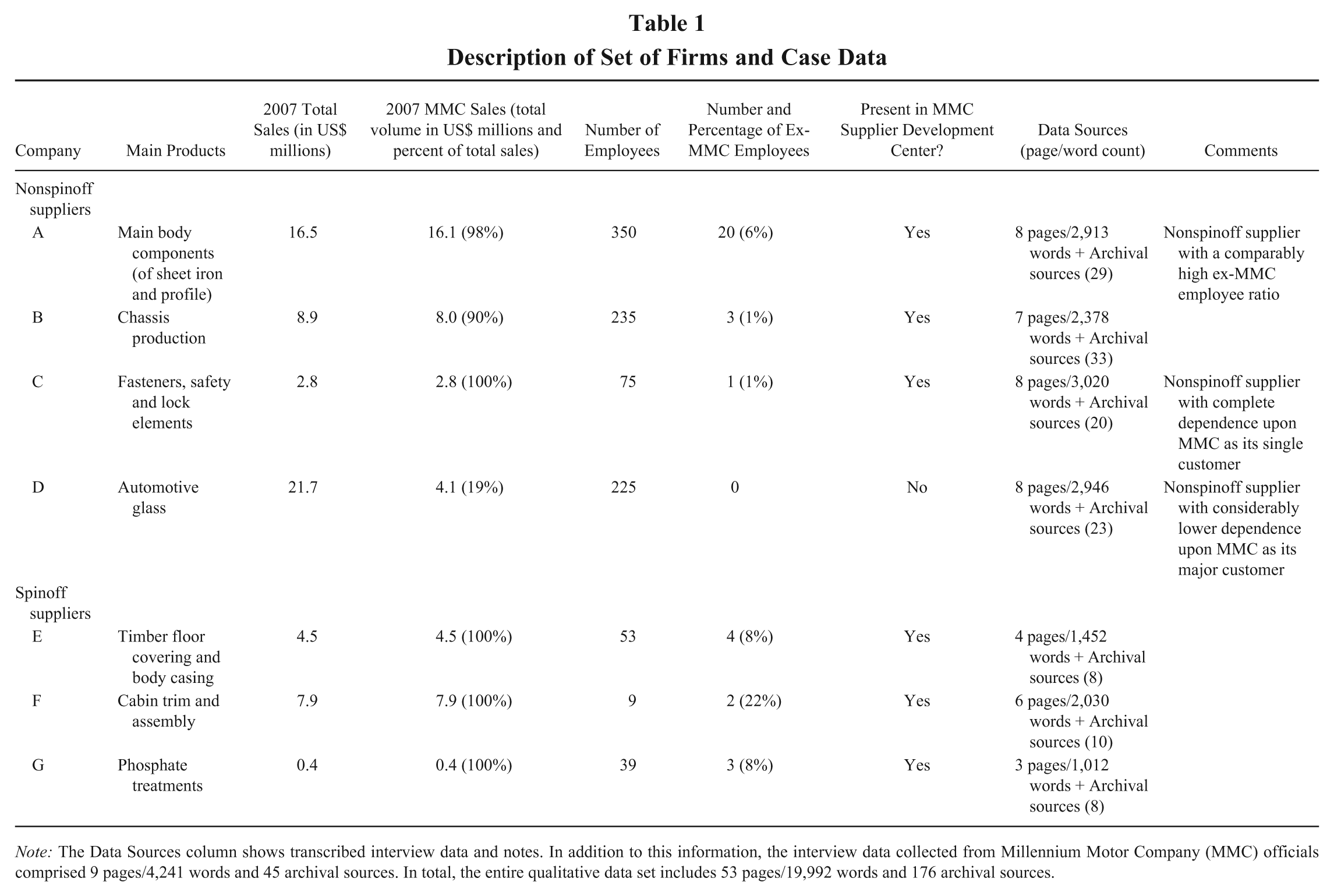
Note: The Data Sources column shows transcribed interview data and notes. In addition to this information, the interview data collected from Millennium Motor Company (MMC) officials comprised 9 pages/4,241 words and 45 archival sources. In total, the entire qualitative data set includes 53 pages/19,992 words and 176 archival sources.
Data Collection and Analysis
I used a combination of data sources, including semistructured interviews, observations, and secondary data sources. I personally conducted face-to-face interviews with the parent firm and with the spinoff and nonspinoff suppliers. These interviews took place in autumn 2008 and were audio recorded and transcribed verbatim, except for Spinoff Suppliers E and G. 6 The amount and types of data that I collected for each case are summarized in Table 1. The interview questions were initiated with an introductory section that included open questions, such as the number of ex-MMC employees in the firms and MMC sales as a percentage of total supplier sales. Through these questions, I was able to gauge how I should approach each particular respondent (i.e., I asked relevant clarification questions before the interview grew too complex). For example, the manager of Nonspinoff Supplier D was an elementary school graduate; thus, it was necessary to conduct the interview without using too many technical terms. Instead, I conducted the interview as though it were an informal conversation. All of the interviews were conducted in the respondents’ company buildings, usually in their office or in separate rooms, and each interview lasted 45 min on average.
In addition, I collected observational data during site visits on the everyday routines of the companies. Data triangulation reduced the possibility of misinterpretation of the interview data. Before each interview, I had the opportunity to tour the facilities of each supplier and directly observe the entire production process. I took notes and photographs to capture the similarities and discrepancies between the suppliers and MMC. I was able to speak to managers when I needed clarification on certain issues, such as “Is this process / equipment / machinery transferred from MMC?” or “How did you implement this improvement in your processes?” or “Did you learn or hear about this from MMC?”
The final source of data was secondary data, which included several hundred pages of archival material on my cases, such as press articles, company reports, organizational records, forms, documents, and material from the Internet. Some of these records were available publicly, and my interviewees provided access to private material. For example, all suppliers in the SDC jointly issue a quarterly published periodical that includes valuable information about specific circumstances, investments, and expansions of suppliers. I also asked the respondents to provide certain documentation and forms that were transferred or adopted from MMC. One of the most striking similarities I documented was a sample of transferred forms used in Nonspinoff Supplier C that was almost exactly the same as that used in MMC.
Procedures
I analyzed the data by using procedures recommended by Miles and Huberman (1994) and Strauss and Corbin (1990). Open and axial coding is applied to the data to label and classify meaningful pieces of information. During open coding, I worked through the segments of data, summarizing all of the transcripts to build basic blocks of data and saturate categories (Miles & Huberman, 1994; Strauss & Corbin, 1990). See Table 2 for an illustration of this coding process. The sentences depicted in the excerpts in Table 2—particularly the underlined parts—correspond to two concepts: “separate identities” and “obligation.” I noticed that nonspinoff supplier managers largely label MMC as “they” and themselves as “we” (Ashforth, Harrison, & Corley, 2008; Boivie, Lange, McDonald, & Westphal, 2011). Additionally, nonspinoff suppliers state that they “have to understand” MMC and they “have to be” in a good relationship with MMC. When reading other informants’ transcripts, I observed similar expressions and coded them with the same tag.
An Illustration of Open Coding and Axial Coding
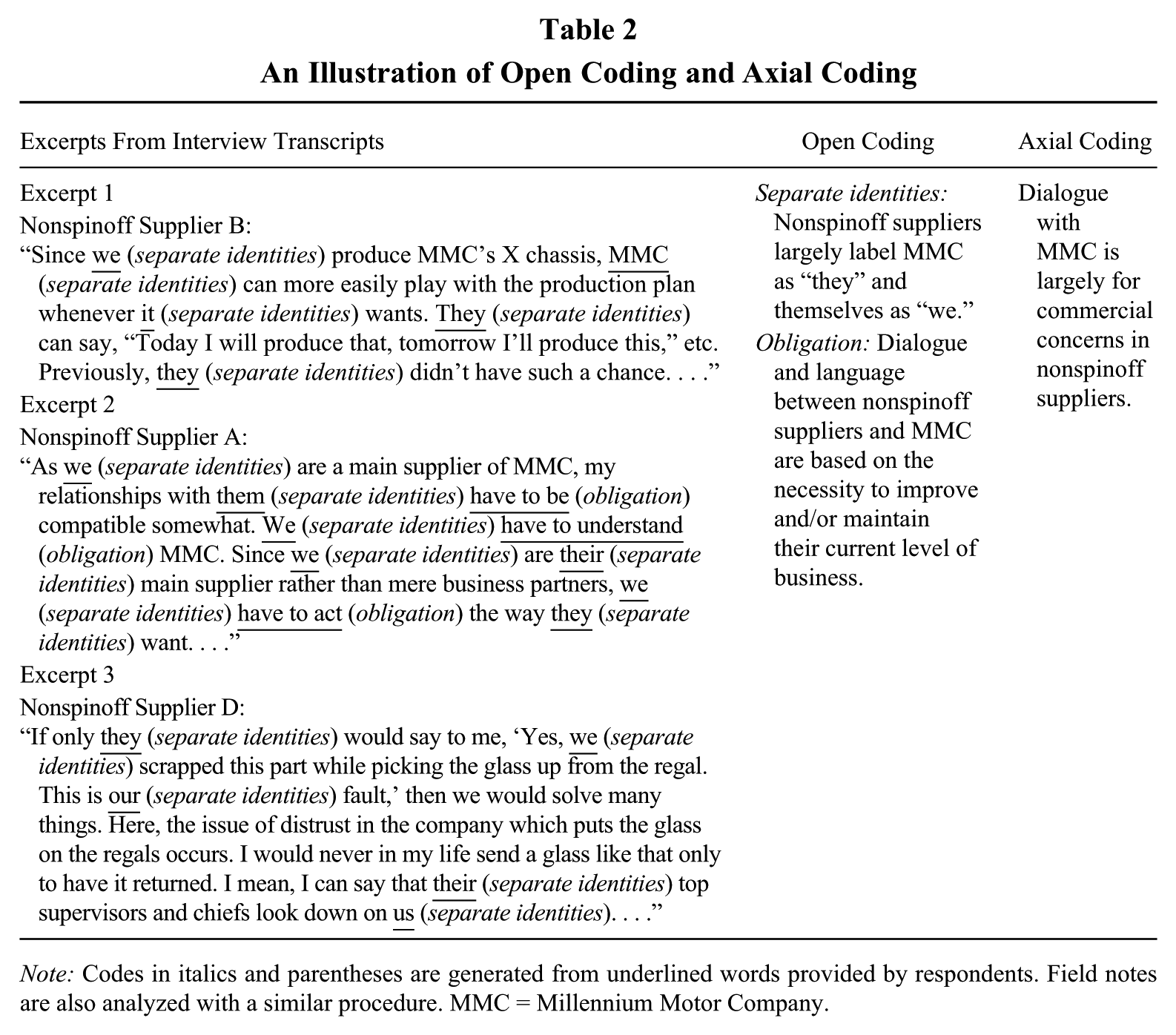
Note: Codes in italics and parentheses are generated from underlined words provided by respondents. Field notes are also analyzed with a similar procedure. MMC = Millennium Motor Company.
After inductively creating a list of first-order codes, the final step involved investigating potential connections between those categories through axial coding (Miles & Huberman, 1994; Strauss & Corbin, 1990; Yin, 2003). An example of this type of coding is illustrated in Table 2. The two codes, “separate identities” and “obligation,” taken together, suggest another pattern that links them: Dialogue with MMC is largely for commercial concerns in nonspinoff suppliers. Repeating this process allowed me to interpret all of the processes in detail and develop conclusions and testable propositions. The list of categories that emerged is displayed in Table 3. Additionally, I took steps to verify the adequacy and trustworthiness of my research design and findings. I performed a self-assessment of the research design by using the framework of Gibbert, Ruigrok, and Wicki (2008), which lists the requirements for a rigorous case study.
Key Factors of Supplier Learning Mechanisms
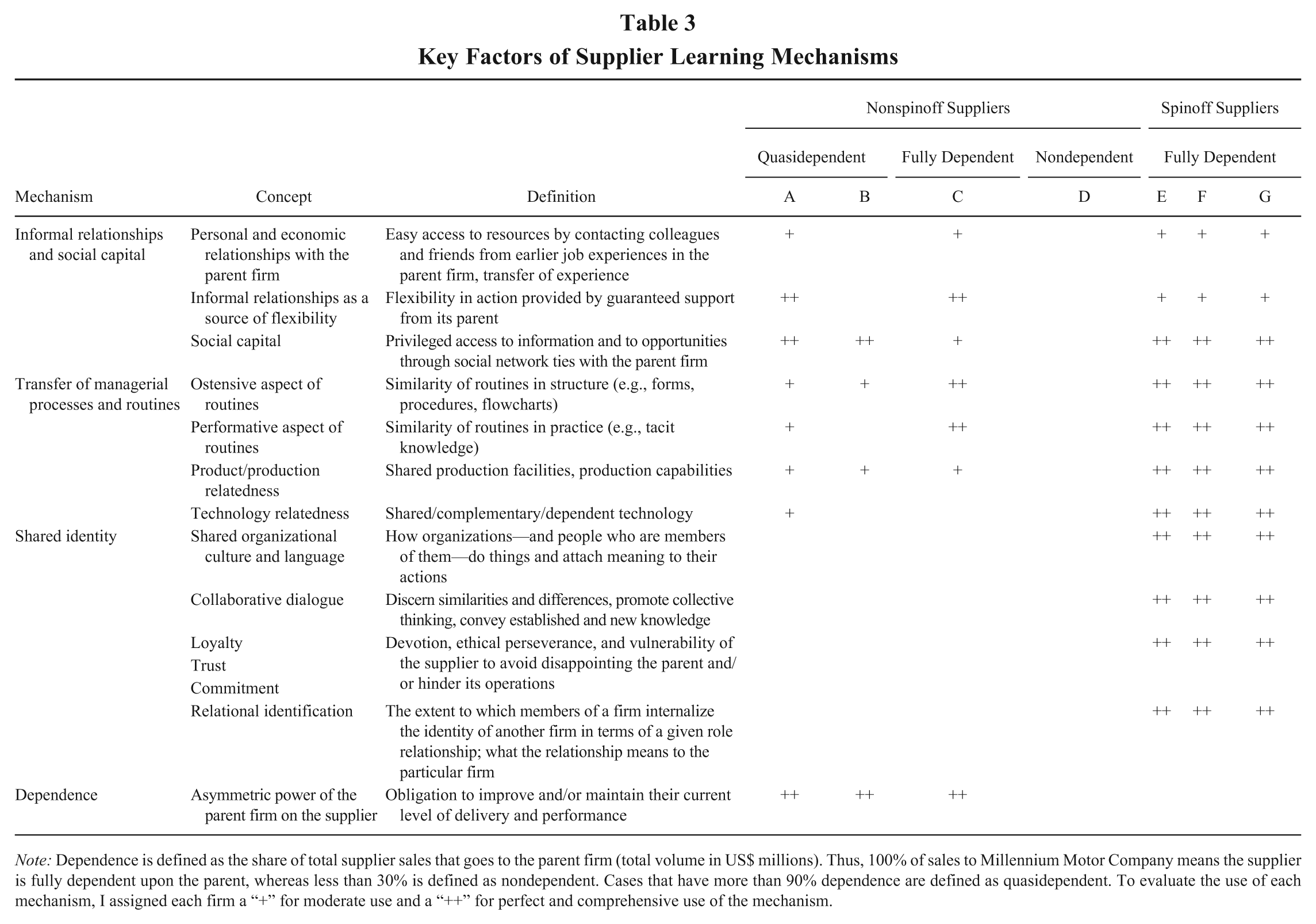
Note: Dependence is defined as the share of total supplier sales that goes to the parent firm (total volume in US$ millions). Thus, 100% of sales to Millennium Motor Company means the supplier is fully dependent upon the parent, whereas less than 30% is defined as nondependent. Cases that have more than 90% dependence are defined as quasidependent. To evaluate the use of each mechanism, I assigned each firm a “+” for moderate use and a “++” for perfect and comprehensive use of the mechanism.
Findings
In Figure 1, I present the inductive model, which includes the theorized and the emerged learning processes from the above analysis. I report the findings first for nonspinoff suppliers (A, B, C, D), then for spinoff suppliers (E, F, G), and finally compare the two. All of the cases in this study provided evidence for several learning processes at least to some extent, which is not surprising because all suppliers must achieve certain levels of delivery performance to be able to work with MMC.
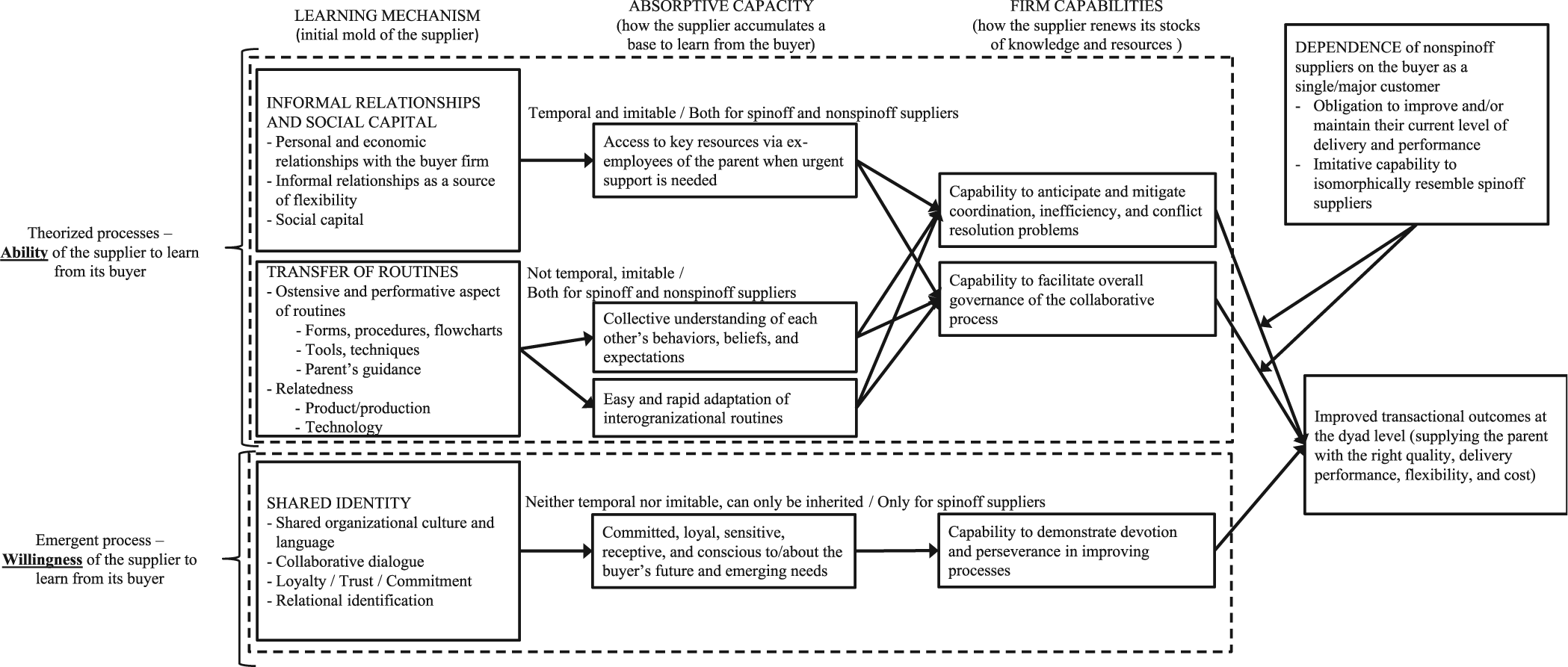
Proposed Model of Spinoff and Nonspinoff Supplier Learning Processes
IRSC
As argued in Figure 1, IRSC works as an efficient learning mechanism via (a) personal and economic relationships with the buyer firm, (b) informal relationships as a source of flexibility, and (c) social capital. These factors in turn contribute to a supplier’s absorptive capacity in terms of access to key resources via ex-employees of the parent when urgent support is needed. The last step in the process of learning through IRSC includes the formation of interorganizational firm capabilities, namely, (a) to anticipate and mitigate coordination, inefficiency, and conflict resolution problems and (b) to facilitate the overall governance of the collaborative process. I discuss these findings in detail below.
Personal and economic relationships
First, personal and economic relationships with MMC emerged as a salient pattern. Respondents repeatedly mentioned a pattern of easy access to MMC’s resources by contacting colleagues and friends from earlier job experiences at the buyer. The presence of ex-MMC employees provides an advantage in bilateral transactions for the nonspinoff suppliers who employ them (particularly Nonspinoff Supplier A, with its 6% ex-MMC employee ratio—see Table 1). The company manager from Nonspinoff Supplier A stated, “Ex-MMC employees speed up the process for making requests of MMC since they know the key people and procedures in the buyer.” With no ex-MMC employees, Nonspinoff Supplier D did not display this pattern. Nonspinoff Supplier D’s manager stated that there is no one from MMC with whom he keeps in personal contact out of work.
Furthermore, instead of utilizing the personal relationships of ex-MMC employees, all of the nonspinoffs emphasized institutionalization
7
because they are trying to establish a professional stance vis-à-vis MMC. The comments of the manager from Nonspinoff Supplier B are worth noting:
We act normally according to the requirements of business life. This means that when I enter through that firm’s [MMC] doors, that person there is someone I do business with; when I go out the door, we are friends. We try not to talk about work much outside of working hours. I mean, that is private, this is work. I pay attention not to mix those two. (Factory manager, 11 years of experience)
This refusal to mingle the private and business relationships occurs because the factory manager does not approve of making use of personal relationships as a means to access MMC’s resources and indeed finds doing so unethical. He rather highlights the importance of institutionalization vis-à-vis MMC. The same pattern is observed for Nonspinoff Supplier C, in which the company manager boasted that their new high-tech and expensive machinery purchase provided C with prestige and showed MMC that it is also a large, institutional company.
Conversely, spinoff suppliers are founded by MMC; thus, they start with previously established personal and economic relationships through this direct parental imprint. Many spinoff managers stated that the purpose for their foundation was MMC (i.e., MMC is the only authority for the spinoffs to ask for guidance in any business decision). Furthermore, failing to supply a part to MMC means a “business failure” for nonspinoff suppliers; such a failure might well also mean “disappointing a friend” for spinoff suppliers.
Reinforcing the findings above, the case analyses suggested that learning through personal and economic relationships endures only for the first few years after formation. Over time, personal and economic relationships stop providing easy access to the parent’s resources as the relationships mature. The following interview comments by the MMC official suggest such a decline:
Let me tell you this so that it gives you an idea: spinoffs have such an advantage, but what does the other company do? The other company, in administrative things, hires someone who has worked for MMC for years and has retired. So they make up for this disadvantage with them anyway—so nothing changes in the balance of power. However, it’s like this: in places where the purchase of goods is in large amounts, input control is very critical. Goods come continuously from many different companies, and these have an approval process. To speed up the process, or to immediately solve problems, it is an advantage to be acquainted with the person who gives the approval. Spinoffs already have established relationships; they do not need to develop a new relationship. The other companies, those in the region, may try to employ MMC retirees. Firms in Bursa and those in Istanbul try to visit this region regularly, try to meet. So it may seem like a disadvantage, but when you look on average, this only provides an advantage during the startup period. But, if a 3-5-year-old company is being considered, the relationships have already been formed. So, the relationships at the startup point are now pushed back to the second place. Because if you are a 3-year-old firm, the relationships have re-formed, and there are no longer gaps with other companies. (Quality and process development specialist, 5 years of experience)
Thus, the fact that spinoff suppliers have previously established personal and economic relationships with MMC does not necessarily deter nonspinoff suppliers from acquiring the same resources (or at least minimizing the gap in learning processes) by other means, such as hiring an MMC retiree (cf. Somaya, Williamson, & Lorinkova, 2008; Song, Almeida, & Wu, 2003). Such alternative sourcing is observed in nearly all of the nonspinoff suppliers (excluding D).
Informal relationships as a source of flexibility in business
Second, it emerged that IRSC was taken by some suppliers as a source of flexibility in action provided by the guaranteed support from the buyer. The ex-MMC manager I interviewed from Nonspinoff Supplier A stated, “It is important for any supplier to employ a skilled former worker of MMC, particularly from their assembly line. Ex-MMC employees know the processes in MMC, and they can visualize the assembly and functionality of a component.” Although it does not have such an employee, the same idea was expressed by Nonspinoff Supplier C. Nonspinoff Supplier B, however, stated that sector experience is more important. In contrast, spinoff suppliers enjoy guaranteed support from the parent, particularly in their start-up years. They already possess flexibility in their transactions with MMC because the founders, after working for many years, are retired from MMC. In the first years of formation, this flexibility is more evident, but following the growth stage, the advantages of IRSC as a source of flexibility start to decline; adapting to MMC’s system becomes more important.
Social capital
Finally, privileged access to information and opportunities through social network ties with MMC emerged as a salient pattern. The presence of ex-MMC employees can speed up some processes through their social capital with MMC, particularly when urgent support is needed. The ex-MMC manager I interviewed from Nonspinoff Supplier A indicated the importance of IRSC but followed with the caveat that “speeding up the process” does not mean skipping certain procedures:
In our communication with MMC, we can quickly get to the point. For example, let’s say that there is a test device for paint. “Where did you buy it from? How can we get one?”, or “From which company can we procure that device?” They help me in a short time. Welding machines, also the same way. . . . Whenever a problem arises, when there is quick intervention, it is different when our colleagues over there collaborate with us. We solve the problem in a short time period. There are big advantages. . . . It is important to know which resources will be provided from where. But, because they have previously worked for MMC, this staff may have advantages in helping to accelerate the process of finding out how to reach which resource, but this is not about bypassing anyone. This is about easy access to communication channels. (Quality control chief, 20 years of experience)
Nonspinoff Supplier D is again different because no major effect of social capital is observed. Conversely, spinoff suppliers, whose founders have more than 20 years of MMC experience, provided evidence of access to MMC’s resources through their social capital, which provided them the ability to facilitate the overall governance of the collaborative process with MMC. There are almost no problems among spinoff suppliers and MMC because both parties know one another well. The nature of their work and network of relationships with MMC provide spinoff suppliers easy access to MMC’s knowledge and resources, which they use to address problems that need urgent intervention without having to go through organizational hierarchies, thus speeding up the problem-solving process and increasing the adaptability of the progeny.
Theoretical implications of IRSC
In summary, although spinoff suppliers’ imprint of IRSC offers them learning advantages during the start-up period, this mechanism loses its effect in later years as institutionalization and adaptation to MMC’s system gain greater importance. This change is in line with Crossan, Lane, and White, who suggest,
As organizations grow larger and more people are involved, informal interactions do not suffice. What had happened more or less spontaneously must now be arranged; what had been an informal conversation over coffee about the future of the company becomes a formal planning process with interactive systems. (1999: 531)
This process is also imitable by nonspinoff suppliers through other means. On the basis of the case evidence, I conclude that the learning process through IRSC is both temporal and imitable:
Proposition 1a: The learning advantages of spinoff suppliers over nonspinoff suppliers based on access to the buyer’s key resources via IRSC decline over time.
It is also interesting to observe the learning processes of the nonspinoff suppliers based on their dependence upon the buyer, defined as their MMC sales as a percentage of total supplier sales. It is well recognized in the institutional theory that the dependence of one party upon another creates power imbalances and leads to mimetic isomorphism (DiMaggio & Powell, 1983). As a result of extensive power asymmetries between MMC and its highly dependent nonspinoff suppliers, these suppliers have a greater need to understand and respond to MMC. Therefore, it is plausible to expect that greater dependence (and, thus, the power asymmetry of nonspinoff suppliers vis-à-vis their buyer) increases the obligation of nonspinoff suppliers to improve and/or maintain their current level of delivery and performance. Possible mimetic behavior, that is, efforts by nonspinoffs to resemble spinoffs, is worth noting here. Observing the benefits of spinoff suppliers’ naturally built and smooth interorganizational relationship with the buyer, nonspinoff suppliers are obliged to develop an imitative capability isomorphically to resemble spinoff suppliers (DiMaggio & Powell, 1983; Marquis & Tilcsik, 2013). On the basis of these results, I argue that Nonspinoff Suppliers A, B, and C, with their greater dependencies (90% or more of their sales) upon MMC as their single/major customer, start acting similarly to spinoff suppliers. Nonspinoff Supplier D exhibits no such evidence because it does not possess a great dependency on sales to MMC. On the basis of these results and the data analyzed thus far, I advance the following proposition, which could be tested through variance-oriented quantitative empirical research:
Proposition 1b: The relative learning advantages described in Proposition 1a will decline faster with greater dependencies of nonspinoff suppliers upon the buyer.
TR
Figure 1 also illustrates TR as an efficient learning mechanism; it works via (a) ostensive and performative aspects of routines and (b) production and technology relatedness. These factors in return increase (a) collective understanding and (b) easy and rapid adaptation of interorganizational routines between the supplier and the buyer as a learning base (i.e., its absorptive capacity). In response, this absorptive capacity contributes to capabilities (a) to anticipate and mitigate coordination, inefficiency, and conflict resolution problems and (b) to facilitate the overall governance of the collaborative process. These findings are discussed in detail below.
Ostensive and performative aspects of routines transferred
In the cases analyzed, first, the transfer of the ostensive (visible) aspect of the parent’s routines (Feldman & Pentland, 2003)—similarities in structure, forms, procedures, and flowcharts—was observed. In Nonspinoff Suppliers A, B, and C, managers stated that tangible assets such as tooling, molds, jigs and fixtures, technical drawings, procedures, software, and performance data are provided by MMC. These suppliers use the same or similar forms and documents that are adapted and transferred from MMC. I also verified this usage with observational data during site visits to nonspinoff suppliers’ production facilities. For all of the nonspinoff suppliers except Nonspinoff Supplier D, managers mentioned certain transfer channels such as common software—computer aided design/technical drawing, e-mail, and production-planning software—and similarities with MMC in different stages of doing business (responding to a request and/or implementing quality processes). These transfer channels between MMC and Nonspinoffs A, B, and C promote a mutual understanding of one another, increasing the propensity of the supplier to interact with the parent openly and efficiently. Only Nonspinoff Supplier D is different; I observed no major similarity in the visible aspects of the routines. In fact, the manager I interviewed from Nonspinoff Supplier D clearly indicated that no tangible aspect of the routines was transferred from MMC. Conversely, Spinoffs E, F, and G, in addition to all of the ostensive aspects of routines observed in the nonspinoffs, noted the complete transfer of all of the facilities, equipment (e.g., shelves), and machinery from MMC, which helped them create a basis for the easy and rapid adaptation of their interorganizational routines with the buyer firm (cf. Zollo et al., 2002).
During site visits at the spinoff suppliers, I observed logo texts stating “MMC Property” spot-welded on many of the investment goods. Spinoffs are endowed with the machinery by MMC with no retained parent ownership. 8 Additional ostensive aspects of MMC’s routines, such as occupational health and safety standards and quality assurance standards and procedures, are transferred from MMC and used by all of the spinoff suppliers. Thus, spinoff founders were not required to make a significant investment during their start-up. The founder and general manager of Spinoff Supplier F stated, “So, I can actually say, when I come out of here [indicating facilities], someone else can continue the same business with very little investment.” As the parent’s supplier requirements change over time, using the same ostensive aspects of routines as the parent allows spinoff suppliers to better anticipate such changes and react accordingly.
Second, the transfer of the performative aspect of routines (Feldman & Pentland, 2003)—similarities in practice, that is, how people bring the routines to life—emerged from the data and was noted by the informants. Nonspinoffs A, B, and C demonstrated that MMC’s guidance (i.e., technical and investment consultancy) was important in expanding their production and technological capabilities. For example, the company executive from Nonspinoff Supplier C acknowledged that the procurement of new machinery was conducted under MMC’s consultancy and guidance. MMC’s SQPDD identifies and suggests certain machinery to be procured by nonspinoff suppliers to improve the quality of their output. When problems occur, this guidance provides collective problem solving during the process such that the supplier can avoid making similar mistakes the next time they acquire similar equipment. MMC’s guidance helps the nonspinoff suppliers learn to make their future investment decisions more successfully, facilitating the overall governance of the collaborative process. The analysis of the qualitative evidence suggested that Nonspinoff Supplier B learned how to prepare and present a sample to satisfy quality standards and how to document quality reports through the guidance of the parent:
A process of getting orders and marketing samples was initiated with another company. When getting the sample, the sample preparation, quality measurement reports, test reports, consignment of the sample to the company, packaging during transportation, product acceptance . . . all of these things were done with what we have learned from MMC. In the end, this knowledge allowed us to get one score ahead, and now these samples are accepted. (Factory manager, 11 years of experience)
The guidance of MMC is also evident in improvements in quality standards and certification. MMC requires all of its suppliers to obtain quality certification for International Organization for Standardization (ISO) 9001:2000 and ISO Technical Specification (ISO/TS)-16949:2002. Nonspinoff Supplier C noted that they have learned a great deal from MMC’s guidance and that this process would have been impossible without MMC. Conversely, spinoff suppliers transferred their know-how and all types of management applications from MMC. Thus, for example, the foundations of how the spinoff suppliers do business and what types of practices they implement during production come from MMC.
Relatedness
Relatedness emerged from the data in two separate components: production relatedness and technology relatedness. Relatedness is specifically crucial for suppliers to solve problems efficiently together with the parent, develop an understanding of one another, and adjust the collaborative process. These capabilities, in turn, lead to better learning. In all of the cases, I observed from job orders that production-planning activities are synchronous with MMC because MMC’s annual sales forecasting figures are shared with all of the supplier firms through MMC’s Internet-based portal. In this portal, all of the suppliers can access performance data, costs, and current accounts and receive orders daily (i.e., they see all critical information from a single source). Furthermore, they are able to notify MMC whether there are any parts that will be out of stock soon, allowing MMC to provide them production orders. The common packaging system and shared shipping software also contribute to the production relatedness between all of the suppliers and MMC.
Among the nonspinoff suppliers, A, B, and C exhibited relatedness in their production facilities with MMC. All of the nonspinoff suppliers have separate headquarters and production facilities; however, A, B, and C are also tenants of MMC’s SDC for their assembly activities. Only Nonspinoff Supplier D does not possess this type of relatedness. The manager from Nonspinoff Supplier D stated that the MMC production personnel who assemble their glass products for MMC vehicles do not use the silicon properly and added that they had to provide training to the buyer’s staff to do it correctly. Concerning the spinoff suppliers, all of them are located only in MMC’s SDC; they have no sites outside the SDC. Their machinery, equipment, and product know-how are provided by MMC. This assistance is not something related to the physical proximity of the sites but comes from sharing the same production facilities.
Technology relatedness was another component of the relatedness concept that the interviewees emphasized and the data suggested. Nonspinoff Suppliers B and C indicated that there has been neither technology transfer nor usage of shared or dependent technology with MMC. Conversely, all three Spinoff Suppliers E, F, and G were established utilizing complete technology transfer and know-how from MMC. For example, Spinoff Supplier F adapted the know-how of MMC for the production of its automotive parts. Therefore, there is a noteworthy difference in technology relatedness between the spinoff and nonspinoff suppliers, leading to differences in their ability to adjust their collaborative processes with MMC.
Theoretical implications of TR
Overall, these results, together with the quotes and observations, suggest that TR provides an absorptive capacity as an organizational learning base that enables both types of suppliers in return to improve the interorganizational transactions with their buyers. Relatedness to MMC facilitates solving problems collaboratively. Although the spinoff suppliers seem to have initial advantages over the nonspinoffs, these advantages weaken over time. The nonspinoff suppliers also enjoy the transfer of MMC’s routines to a certain degree because the parent’s supplier development and support activities allow them to access what the spinoff suppliers are naturally imprinted with. Similar to IRSC, although not temporal, the TR mechanism also offers a learning process that is imitable by the nonspinoff suppliers. Furthermore, again, as the volume of transactions with MMC increases, nonspinoff suppliers start developing the same learning advantages as the spinoff suppliers, leading to the following propositions:
Proposition 2a: The learning advantages of spinoff suppliers over nonspinoff suppliers based on routines transferred from the buyer firm decline over time.
Proposition 2b: The relative learning advantages described in Proposition 2a will decline faster with greater dependencies of nonspinoff suppliers upon the buyer.
SI
SI emerged from the data as a key differentiator for spinoff suppliers’ learning processes. It works through shared organizational culture and language, collaborative dialogue, loyalty, trust, commitment, and relational identification to/with the parent firm that, in turn, contributes to a learning base and to devotion and perseverance in improving the spinoff suppliers’ processes.
Shared organizational culture
All of the spinoff suppliers exhibited strong evidence of emulating MMC’s organizational culture. Organizational culture determines how organizations—and the people who are part of them—do things and attach meaning to their actions. For instance, the founder of Spinoff Supplier G indicated that he transferred the MMC culture to his company because he had absorbed this culture during his 20-year work experience there. The founder of Spinoff Supplier F states a similar pattern:
For one, MMC gives our company support in every area. . . . Also, we have been working here with 120 suppliers for 3 years. None of their payments have ever been late, not even for one day! But why is this so? Because that is the culture I have acquired from MMC. This is how MMC works. As this is what I have learned, I continued in the exact same way. (General manager, 23 years of experience)
Applying MMC’s culture helps the spinoff suppliers to be more receptive and conscious about the parent firm’s needs, thus providing a suitable learning base. Using SI as their learning mechanism, spinoff suppliers continuously pursue the renewal and updating of their business processes, which improves transactional outcomes with MMC and increases the likelihood of meeting buyer expectations.
Shared language and collaborative dialogue
The interviewees also emphasized the importance of shared language and collaborative dialogue—a shared understanding and the existence of open and effective transfer channels—with the parent firm (Crossan et al., 1999). However, the nonspinoff suppliers’ dialogue with MMC is largely for commercial concerns. Nonspinoff Suppliers A, B, and C are obliged to carry on an effective dialogue with MMC because it is their main/only customer. Thus, the nonspinoffs feel an obligation to use the same language with MMC to improve and/or maintain their current level of business. A manager from Nonspinoff Supplier A commented:
As we are a main supplier of MMC, our relationship with them has to be somewhat compatible. We have to understand MMC. Since we are their main supplier rather than mere business partners, we have to act the way they want because there is a known production plan. At certain times and certain dates, orders come from MMC to us; we have to comply with that. (Cost and planning chief, 2.5 years of experience)
It is interesting to note that the dialogue and language between the nonspinoff suppliers and MMC are based on commercial concerns and obligations, which does not fully suggest a strong motivation or willingness to learn from the buyer. For example, Nonspinoff Supplier D’s manager stated, “We did not learn anything from MMC. They want glass products, and that’s our business.” As the percentage of MMC sales of the supplier’s total sales decreases, such as with Nonspinoff Supplier D, the existence of open and effective transfer channels and understanding MMC through the use of shared language also declines:
If only they [people at MMC] would say to me “Yes, we scrapped this part while picking the glass up from the regal [a packaging unit similar to shelves that contains multiple automotive glasses together]; this is my fault,” then we would solve a lot of things. Here, the issue of distrust in the company that puts the glass on the regals occurs. I would never in my life send a glass like that only to have it returned. I mean, I can say that their top supervisors and chiefs look down on us. We have totally opposite ways of reasoning. We also work with Y [another automotive company]. Our rejection rate in that company is at most 2–3 percent. There [MMC], this rate goes up to 10–15 percent. On this issue, there is a considerable gap; there are more disparities than similarities between us. (Domestic sales manager, 21 years of experience)
Nonspinoff Supplier B also complains about MMC: “MMC requests the parts long before the necessary lead time, and we always try to manufacture them at the proper lead time. But MMC never listens to us.” A common theme in these quotes is that the nonspinoffs label MMC as “they” and themselves as “we” (Ashforth et al., 2008; Boivie et al., 2011). The nonspinoff suppliers demonstrate their own company culture and identity. This pattern is also observed in the SDC periodical, in which the nonspinoff suppliers discuss how well they met the demand from MMC, publishing their name and brand. For example, the manager from Nonspinoff Supplier B states,
Compared to the past, our transaction volume [with MMC] is increasing. The first reason for this is we do our work on time and within MMC’s requirements, which means both in terms of price and quality and on time delivery. . . . Since we produce MMC’s X [the brand name of MMC’s light truck model] chassis, MMC can more easily play with the production plan whenever it wants; they can say, “Today I will produce that, tomorrow I’ll produce this,” etc. Previously, they didn’t have such a chance. In order to do that, they needed to keep a large proportion of stock. Now, they can play with the program as they want without keeping stock. (Factory manager, 11 years of experience)
The emphasis on the separate identities of the nonspinoff suppliers impedes their openness to learn from the parent (Corley & Gioia, 2004). They are not as fully committed, loyal, sensitive, receptive, or conscious to/about MMC’s future and emerging needs as the spinoff suppliers are. Indeed, all of the nonspinoffs hesitated when they were asked whether they learned from MMC the best ways to cope efficiently with the challenges they face. The cost and planning chief from Nonspinoff Supplier A stated, “Actually, in some points, we taught MMC some things . . . it wouldn’t be ethical to say that only they taught us. For sure, they taught us some things, but we taught them some things, too, eventually covering each other’s inadequacies.” In other words, the nonspinoff suppliers do not fully agree that their learning occurs through MMC.
Conversely, the spinoff suppliers’ learning depends upon their open and effective transfer channels with the parent firm (Feldman & Pentland, 2003; Uzunca, 2011), which is built through the similarities in identity, shared language, and collaborative dialogue. They are fully motivated and willing to adjust their collaborative process with MMC. I elaborate more on this aspect below.
Loyalty, trust, commitment, and relational identification
Building on the above results, for the spinoffs, dialogue with MMC is not only for commercial concerns but also for loyalty concerns. Loyalty, here, means the devotion and ethical perseverance of the supplier to avoid disappointing MMC and/or hindering MMC operations. For example, the founder of Spinoff Supplier F explains how he has implemented what he learned from MMC in his own company, demonstrating his loyalty to MMC:
We have established a very flexible working arrangement here. I know that flexibility is one of the major factors in MMC’s work system. So, we set up a system that is highly adaptable to [MMC’s] changes of plan. Obviously, this perhaps requires working with a little extra inventory, but since the important thing is customer satisfaction, I can’t say we never experienced any hardships in meeting customer requests on time, but at least we did not cause any problems [for MMC’s production system]. Why? I, as the former planning director of MMC, know that this is MMC’s work system. (General manager, 23 years of experience)
The link between the spinoff founders’ loyalty to MMC and learning is that the loyalty of the spinoffs to MMC eliminates motivational barriers and fosters an extensive organizational learning base, that is, absorptive capacity, between the spinoffs and MMC (Kostova & Roth, 2002). The founder of Spinoff Supplier G stated, “During my visits to other cities, even to other countries, I feel touched whenever I see an MMC bus on the road; immediately, my eyes get filled with tears.” For the spinoff suppliers, the previous coworker-coworker relationship turns into a friend-friend relationship through the transfer of organizational identity, which is why the spinoff founder aims to increase the welfare that the significant other receives from the relationship (cf. Grohsjean et al., 2016). The spinoffs also demonstrate easy transfer of information because their founders trust MMC. Trust has a positive effect on the closeness of interfirm relationships (Ariño & de la Torre, 1998). Spinoff Supplier F’s founder and general manager indicated that F’s employees represent MMC and that they identify themselves with MMC (Sluss & Ashforth, 2007). He declares his loyalty, trust, and identification because F fully cooperates with MMC in its problem-solving processes:
We are actually working here as a part of MMC. The purpose of the foundation, the existence of this business here is MMC anyway. . . . A problem arises; MMC’s quality, production, we all come together. First, we come up with alternative solutions and present them. We discuss together which of them will be suitable. Then, we implement the suitable one. MMC checks [the process], reports the results. . . . Of course we check the process, but we used to get the official results from MMC, and we close the file the moment MMC states, “OK, the matter is solved.” (General manager, 23 years of experience)
All of the spinoff founders, each of whom has more than 20 years of experience at MMC, convey what they have learned there to their companies. They personally know how MMC works; thus, they understand the parent’s future and emerging needs better through their SI. This knowledge allows them to build capabilities such as awareness and persistence in continuously improving and adjusting their collaborative process. The operations manager from Spinoff Supplier G indicates:
Mr. Gursel [the founder of the company] has committed years to MMC. He has the experience to provide consultancy to MMC. They often call him to get information. He is the perfect MMC person. Upper management likes him very much and knows him personally. (Operations manager, 5 years of experience)
When compared with the earlier quotes from the nonspinoff suppliers in which the managers complain about MMC, Spinoff Supplier G does not complain about the parent. In fact, the data suggest that the spinoffs do not complain about MMC even when they have a problem. The spinoff suppliers do not hesitate when talking about their learning from MMC; for example, Spinoff F founder stated, “The years I spent in MMC contributed a lot to me. I guess 70-80% of what I have learned is from MMC.” The spinoffs learn better because they identify themselves with MMC (Kogut & Zander, 1992; Sluss & Ashforth, 2007); they still see themselves as a part of the “MMC family” (Corley & Gioia, 2004; Kostova & Roth, 2002). The link between complaining about MMC and learning is that through loyalty, trust, commitment, and relational identification, the spinoffs are willing to accept extra costs in return for not disappointing MMC, and they demonstrate devotion and perseverance in improving their processes (Crossan et al., 1999; Sluss & Ashforth, 2007). These findings suggest that SI is a distinctive learning mechanism for the spinoff suppliers.
Theoretical implications of SI
The spinoff suppliers are ardently committed to MMC in their relationships compared with the nonspinoff suppliers, which in contrast are more concerned about their level of business with the buyer. How the spinoff suppliers do business primarily depends on not disappointing MMC. Thus, they absorb some extra costs to avoid disappointing their parent and demonstrate flexibility in their supplying processes. Kogut and Zander state that “shared identity does not only lower the costs of communication, but establishes explicit and tacit rules of coordination” (1996: 503). While it is relatively easier to enact existing learned skills and routines (Nelson & Winter, 1982), it is more difficult to create them through social interactions when there is no context of dialogue and learning that encourages motivated behavior. Identification sets out the process by which learning is developed socially through the formation of common values and convergent expectations (Kogut & Zander, 1996). It does so by giving rise to a shared culture and language, collaborative dialogue, and common frameworks for action. The critical role played by identity is then to offer such a context in which the operation of higher organizing principles—such as the willingness to learn rather than the ability to do so (Grohsjean et al., 2016)—improves the transactional efficiency of the dyad. Such an endowment is difficult to be learned/imitated from external sources.
Thus, from the same type of exchange with the parent, the spinoff suppliers exhibit not only the ability but also the willingness to learn from the parent. They demonstrate devotion and perseverance in improving these processes, which helps them increase their awareness of the parent’s needs. From these results and the data analyzed thus far, I advance the following propositions that could be tested through variance-oriented empirical research:
Proposition 3a: Spinoff suppliers are more likely than are nonspinoff suppliers to demonstrate devotion and persistence in improving their processes due to their SI with the buyer firm.
Proposition 3b: The learning advantages of spinoff suppliers over nonspinoff suppliers based on SI with the buyer firm decline more slowly than the learning advantages that stem from IRSC (Proposition 1a) and TR (Proposition 2a).
Summary of the Theoretical Model
The buyer-supplier/interorganizational literature draws attention to the performance implications of prior ties and experience among collaborating firms (McEvily et al., 2012; Zollo et al., 2002). However, supplier learning processes can be more complex than merely partner-specific experience. Focusing explicitly on their decay, persistence, imitability, and inheritability, this study infers three separate learning mechanisms, IRSC, TR, and SI, through which firms with different imprints develop relational capabilities to learn to work with a buyer. These capabilities are (a) anticipating and mitigating coordination, inefficiency, and conflict resolution problems; (b) facilitating overall governance of the collaborative process; and (c) demonstrating devotion and perseverance in improving business processes. Observing the benefits of spinoff suppliers’ naturally built and effective interorganizational relationship with the parent, nonspinoff suppliers—with obligations stemming from their dependence upon the buyer—develop an imitative capability isomorphically to resemble spinoff suppliers. These dynamic processes are formed with, and in turn renew, the endowment stocks of the suppliers (cf. Ariño & de la Torre, 1998). Although nonspinoff suppliers also exhibit evidence of several learning processes to a certain extent, spinoff suppliers’ deeper relationship, in particular their SI, with the parent based on their direct parental imprint tends to be more difficult for nonspinoff suppliers to ever actually copy.
Discussion
Because buyer requirements change over time, suppliers must respond by adjusting their products, processes, stocks of knowledge, individual skills, routines, systems, and procedures accordingly. Organizational learning processes offer one means to promote this adaptability (Cohen & Levinthal, 1990). By providing a novel setting and a rich set of qualitative data on the learning behaviors of two types of suppliers, I identify a theory that merits more rigorous quantitative testing. I tease apart interorganizational knowledge and resources that can be “learned/imitated from external sources” versus those that can only be “inherited from the parent” through a clear parental heritage. Although the initial endowment of stocks can be substituted to some extent, the key is the dynamics and motives that are inherent in how these stocks are renewed through supplier learning (Ariño & de la Torre, 1998). I argue that SI based on trust, loyalty, commitment, and identification enables spinoff suppliers to be fully motivated to focus their managerial attention and enjoy a strong, lifelong relationship with their parent. This SI can only be inherited and cannot be imitated by external sources.
Another intended contribution of the paper is about the ability of stepchildren (i.e., nonspinoff suppliers) to imitate biological children (i.e., spinoff suppliers). Klepper (2001) and Klepper and Sleeper (2005) discuss the parent-spinoff phenomenon and denote their relationship as “parent” and “children.” I provide qualitative evidence for this type of a relationship, however, with the addition that other entrants (i.e., nonspinoffs) might become “stepchildren” of the parent company. Although the findings suggest that spinoffs are imprinted with certain traits that come from their parents that make them learn better compared with nonspinoffs, the results also suggest that, with higher dependencies upon MMC as the single/major customer, nonspinoffs start acting similarly to spinoffs (DiMaggio & Powell, 1983; Marquis & Tilcsik, 2013).
The development of an absorptive capacity takes considerable time and is subject to time compression diseconomies (Dierickx & Cool, 1989). Although some firm resources and capabilities are relationship specific and are not easily transferable (redeployable) to other networks, the findings of this study further recommend that certain interorganizational resources and capabilities can be substituted. For example, although IRSC is not tradable as an isolating mechanism (Dierickx & Cool, 1989), it can be substituted by nonspinoffs. Conversely, the SI mechanism requires a firm’s culture, identity, trust, and commitment to be transferred from one organization to the other only through imprinting, making it difficult to substitute by external suppliers and even harder to imitate. Although concepts similar to SI—such as interpartner trust and goodwill—are well established in the alliance literature (Ariño & de la Torre, 1998), the competitive aspects of these concepts are not. Identity is a well-known theoretical construct at the collective level (Ashforth et al., 2008; Sluss & Ashforth, 2007), and current work has begun to determine how it might transfer from one firm to another through mobile employees (Grohsjean et al., 2016). I contribute to this literature by arguing that SI is able to sustain learning heterogeneity between spinoff and nonspinoff supplier firms; that is, it is only inherited. Even the most dependent nonspinoff suppliers are not able to imitate this mechanism. This emergent learning process can be viewed as an extreme form of relational capital that merits further attention by interorganizational researchers.
Generalizability of Findings
Although applicable to a smaller set of companies—captive manufacturing firms that still have relationships with their parent long after their spinoff—this limitation should not raise concerns about the generalizability of the findings. The purpose of qualitative research is to generalize from the evidence to theory. In that sense, by contrasting spinoff and nonspinoff suppliers, I offer additional explanations and boundary conditions for interfirm learning and transactional outcomes in the buyer-supplier dyad. The boundary conditions comprise postspinoff learning events in the case of parental support; thus, the findings have the greatest applicability to spinoffs that retain their relationship with their parent after their founding. Although the majority of the literature focuses on the “moment of spinning off” (Ferriani et al., 2012), my theoretical model examines spinoffs’ founding conditions and postfounding relationships, with an extension of their relationships with parents to after they have been separated. Observing the postformation relationships of spinoffs with their parents, I argue that this distinctive type of supplier learns not only through its ability but also through its willingness and motivation due to its SI, which can only be inherited through imprinting.
My results also complement and challenge the current knowledge on interorganizational learning processes. For instance, the findings about the first mechanism, IRSC, are novel and more counterintuitive. Although I provide qualitative evidence for the influence of informal and personal relationships, I suggest that it cannot be claimed that IRSC offers spinoff suppliers sustainable learning advantages in the long term. Over time, institutionalizing and adapting to a parent’s system becomes more important (Crossan et al., 1999). For suppliers that operate in environments other than those of their buyers, this adaptation can be generalized as conforming to the norms and rules of the institutional setting rather than using informal relationships over the long term.
Managerial Implications
The capabilities identified in this paper have important implications for managers. Firms can benefit from investing in their relative absorptive capacity—the ability of a firm to recognize the value of new, external information from a specific partner; assimilate it; and apply it to commercial ends (Cohen & Levinthal, 1990). In terms of developing a capability to anticipate and mitigate coordination, inefficiency, and conflict resolution problems, firms can focus on openly discussing problem areas with a partner with which knowledge transfer channels are not effectively working (or do not exist). Thus, they can consciously develop an understanding of one another and adjust the collaborative process when these endowments are missing. For example, findings such as how nonspinoffs can close the learning gap by hiring former employees of the parent company not only are interesting in a theoretical sense because they help us understand the dynamic nature of supplier learning but also provide practical guidance to managers of nonspinoffs that are trying to overcome the initial disadvantages vis-à-vis spinoffs.
Through their SI with the parent, spinoff suppliers are in a unique position to demonstrate devotion and perseverance in improving their processes. To develop such a capability, firms can adopt practices that help breed relational assets such as commitment, trust, identification, and loyalty with the buyer firm. Although evidence of such adoption can be observed in some suppliers, such as Nonspinoff Suppliers A, B, and C, this evidence is largely based on their dependence and obligation to maintain their current level of business with the parent. Similar to Japanese buyer-supplier relationships, firms can invest in increasing their willingness to learn from the buyer firm through stimulating an SI. Nonspinoff (or external) suppliers’ managers can encourage a feeling of togetherness, belonging to a collective, and a common purpose with the buyer and place loyalty concerns, such as “improving a process to avoid disappointing a friend,” over commercial concerns.
Spinoff supplier formation efforts also point to managerial implications from the parent firm’s perspective. It is essential for parent firms to decide on their core and noncore activities so that potential spinoff targets are determined properly. Overall, this determination contributes to framing spinoffs as benevolent to parents instead of sustaining the dominant view in the literature, which views spinoffs as brain migrations from R&D companies resulting from disagreements within existing firms that drive frustrated employees to pursue their ideas in their own firms (Klepper & Thompson, 2010; S. G. Walter, Heinrichs, & Walter, 2014; Wezel et al., 2006). These managerial implications will help to clarify how a parent firm perceives a possible spinoff formation process and reacts to it.
Limitations and Future Research
Despite these findings, this study also has certain limitations. First and most importantly, I investigate a very specific supplier type, namely, manufacturing firms that still have relationships with their parent long after their spinoff and that continue their business totally dependent upon their sales to the parent. Although useful for this study, future research might also investigate spinoff suppliers that have less dependence upon their parents. Furthermore, I have examined only one industry and one country. I acknowledge that some factors (e.g., the uniqueness of the setting, geographic conditions, and being or not being in the SDC) might act as alternative explanations for my results. Although I used an embedded design and focused on a structurally heterogeneous case set (including both spinoffs and nonspinoffs), I am not able to verify whether analogous patterns might be observed in other settings. Thus, future research might increase the generalizability of the results to other settings. In particular, comparing the “SI” concept in the Turkish context to other contexts, such as Switzerland, the United Kingdom, or the United States, would be very beneficial.
Extensions
I focused on supplier learning mechanisms and built a case study design with an open mind to let the processual patterns emerge. These factors can be used to expand existing operationalizations to measure the constructs within these mechanisms. Currently, the existing definitions often lack construct validity because the theories defined in learning processes suffer from ambiguous operationalization in the literature. Additional studies with similar attempts would help to generalize the patterns found here.
Finally, it might be beneficial to utilize a longitudinal approach, ideally a panel data set, to quantitatively test this model and identify the extent to which each mechanism gives rise to superior supplier learning. For example, one can test the claim that IRSC does not matter for learning after t years, which implies testing whether the coefficient on IRSC beta goes to 0 moving from Y to Y + t. These factors warrant future investigation.
Conclusion
This article concerned understanding heritage-driven learning processes and their role in interfirm buyer-supplier relationships. In many industries, interorganizational relationships are found to be important for improving the transactional outcomes of the collaborative process among firms. However, which parts of these interorganizational traits stem only from other firms and which parts are imitable and/or substitutable is an important question, particularly if one is interested in whether learning will have enduring effects or will decay and have only short-term benefits. Through this study, I have attempted to inductively compare the learning processes of two types of firms with different imprints: spinoff and nonspinoff suppliers. The comparison of three main mechanisms, namely, IRSC, TR, and SI, together with the distinction of their levels of dependency upon the parent firm, suggest that the relationship with the parent matters for both types of firms’ learning, although through different dynamics and motives. Although imprints are persistent, their effects might vary over time, reflecting an interplay between the imprinted past and the present context (Marquis & Tilcsik, 2013). Furthermore, persistence does not imply permanence; thus, some learning advantages stemming from imprinted traits might decay over time, whereas others might be adopted by other firms via secondhand imprinting. Investigating postimprinting dynamics this way makes for a more interesting paper than simply rehashing the well-established (and likely overly deterministic) notion that imprinting matters. Put a different way, even if imprinting does matter, but there is nothing firms can do about it, it becomes less interesting from a (broadly speaking) strategy perspective. It is my hope that this study advances the ongoing conversation in the literature about the interorganizational learning of suppliers—particularly considering how and why their imprinting and historical conditions matter—and triggers further research on the empirical and theoretical development of this field because there are many ideas to be discovered and discussed further.
Footnotes
Acknowledgements
This article was accepted under the editorship of Patrick M. Wright. I thank my associate editor, Bill Schulze, and two anonymous reviewers for providing highly constructive and useful feedback that allowed me to improve the manuscript substantially. I wish to acknowledge my master’s thesis advisor, Professor Nazli Wasti Pamuksuz, who guided and supported me throughout the earlier versions of this study. I would also like to thank several people for their assistance in helping me to bring this research to fruition, including Eren Akkan, Africa Ariño, Birgul Arslan, Bruno Cassiman, Kerem Gurses, Coen Rigtering, Erik Stam, Murat Tarakci, and Pinar Ozcan Van Rens. Financial support from Utrecht University School of Economics and the Unit of Scientific Research Projects (BAP) of Middle East Technical University is acknowledged. Earlier versions of this paper have been presented at the 2009 European Group for Organizational Studies, 2011 Strategic Management Society, and 2012 Academy of Management conferences.