



Abstract
This article focuses on the negotiation of buyer–supplier relationships and the associated activities that are required to maintain them. After analysing and distilling contributions from the literature, we developed a 10-item questionnaire that was subsequently used as a guide for interviewing 36 practitioners in the field. These responses provided new insights into the attitudes and actions that contribute to relationship management success from a negotiations perspective. This led to the development of a framework that encapsulates key considerations for negotiation and relationship management specifically from a procurement process perspective.
Introduction
In August 2016, Volkswagen, the world’s largest carmaker by sales, announced it would have to halt production at six of its plants due to an ongoing dispute with two of its component suppliers (Car Trim and ES Automobilguss). The origins of the dispute can be traced back to June 2016, when VW Procurement Chief Francisco Javier Garcia Sanz wrote to their suppliers, warning the company would be seeking new ways to cut costs. He justified these measures by asserting that VW faced ‘epochal change’, driven in part by new technologies and customer requirements. In reality, in the aftermath of its diesel emissions scandal, VW had no choice but to begin cutting costs to recover from the subsequent €1.6 billion loss. VW proceeded to cancel a series of deals with its suppliers, including a €500 million order for special parts from Car Trim. Outraged by the abrupt cancellation, Car Trim retaliated by immediately halting all deliveries to VW. The carmaker’s just-in-time approach meant that its production lines were quickly affected due to lack of parts. After several weeks of wrangling agreements were reached, including compensation terms and the drawing up of a series of rules to protect both sides, should disputes arise again. The exact terms of the agreement were not made public but analysts estimate the dispute cost VW over €100 million (Handelsblatt, 2016; McGee, 2016; Sloat, 2016). More importantly, the longer-term relationship between manufacturer and suppliers remained problematic.
Mining forms a major part of the economic activity of Western Australia with, as an example, around 650 million tonnes of iron ore per year (over one-third of the world’s total) being mined for mainly Asian markets. The major mining companies each have a thousand or more contracts with suppliers ranging from earth-moving equipment to catering, to enable them to carry out their mining operations. Faced with falling world iron ore prices and so needing to cut costs, one of these companies unilaterally extended the payment terms (from 45 to 90 days) for their suppliers, with immediate effect. This severely affected the liquidity position of many of the supply companies, making bankruptcy a real possibility. As a result, a number of suppliers brought pressure to bear on the government – conveniently for them there were some international mining events happening around this time – leading to the public involvement of the Australian Prime Minister. After initially justifying their decisions, the companies backed down and reverted to their previous arrangements ( The Australian, 2016).
These examples demonstrate how, despite the rhetoric about the need for collaborative buyer–supplier relationships, critical decisions can cut right across those relationships with both short- and long-term consequences. Buyer–supplier transactions are becoming increasingly driven by technological processes, but relationships between buyer and supplier are dynamic and are subject to a range of pressures as the contract is being fulfilled. Once a negotiated contract has been finalised, the relationship between buyer and supplier is not always as mutual as might have been envisaged at the time the contract was signed. Pressure on the relationship can be experienced from two sources: first, it can arise out of non-performance issues relating to the terms and provisions of the contract; and, second, it can result from decisions taken elsewhere within the organisation that have a ‘knock-on’ effect on either the operational or financial implementation of the contract. As the two examples above have shown, the negotiation and maintenance of supply contracts can occur in the context of competitive pressures on the parties involved. What is particularly interesting to explore further is how the benefits of cooperation can be maintained over the long term in the context of these competitive pressures.
Exploring the role of negotiation in supplier relationship management
Substantial research has been carried out on supplier relationship management (e.g. Carr and Pearson, 2002; Chanchai and Young, 2009; Cousins, 2002; Humphreys et al., 2008; Imanipour et al., 2012; Lamming et al., 2005; Monczka et al., 2008; Qrunfleh and Tarafdar, 2013; Squire et al., 2009). Dominant themes are cooperation between the partners (some of the key characteristics of which are shared goals and objectives), open lines of communication, and professional respect and concern for the other’s profitability (McQuiston, 2001). From a different perspective, Strauss (1978) suggests that a myriad of negotiations occur throughout any organisation before any decisions are made and they then continue to occur as those decisions are implemented to achieve the organisation’s goals. This is certainly true of the supply chain process. Negotiations extend beyond the task of fixing the contract terms with an acknowledged role in establishing and maintaining buyer–seller relationships (Cummins, 2015; Handfield et al., 2015, Roxenhall and Ghauri, 2004).
The procurement manager may be the one to sit across the table from the supplier’s sales representative but many other negotiations will have occurred to reach this point, and many more will occur before the contract is fully completed. Detailed negotiations are required within the purchasing organisation to establish the contract scope and, almost inevitably, the corresponding financial parameters. The procurement manager is then tasked with securing the best possible terms with the suppliers. One route to efficiency in procurement is to reduce uncertainty and variation of outcomes through use of e-procurement systems (Angeles and Nath, 2007; Puschmann and Alt, 2005). This ensures there is little or no negotiation and hence reduced variation of preferred terms. However, if the ‘power play’ between the parties is approximately equal, that is, neither the buyer nor the supplier is in a dominant market position, negotiations will indeed occur and if conducted well may yield benefits to both parties (Chang et al., 2013).
Agreements reached in commercial negotiations usually take the form of a detailed document specifying the rights and obligations of the parties across a range of issues (IACCM, 2014). Even here, there is a growing recognition that contracts, and the approach of lawyers who draft them, should be proactive rather than preventative in approach (Barton, 2012). This encourages a relational, implemental mindset
With these considerations in mind, negotiation can be viewed not as a discrete segment of the supply chain process but instead as embedded throughout it (see Figure 1). Negotiation starts within the organisation to determine what is required and who might supply it, continues through the contract phase in which the extent of actual negotiation can be quite varied and moves on to negotiations to ensure the proper ongoing implementation of what has been agreed in the contract.

The buyer–supplier negotiation process.
The approach of both researchers and practitioners to negotiation has largely been dominated by the two strategies described by Walton and McKersie (1965), namely, the competitive, distributive bargaining strategy and the cooperative, integrative one that lead, respectively, to win-lose and win-win outcomes. In their analysis of business negotiations, Lax and Sebenius (1986) suggest the terminology of ‘creating value’ and ‘claiming value’ to reflect the sequence of strategy that is inherent in most negotiations. Tomlinson and Lewicki (2015) follow a similar approach in advocating an interest-based approach (Fisher et al., 1991). However, the approach taken in supply chain negotiations is both strategic, depending upon the nature of the relationship sought (distributive for an arms-length one and integrative for partnerships) (Zachariassen, 2008), and historical in being strongly influenced by the nature of the parties’ prior interactions (Thomas et al., 2015). Zachariassen (2008) found that even in partnerships the buyer might continue to use competitive strategies, whereas Geiger (2017) specifically identified a range of essentially competitive tactics used in business-to-business (B2B) negotiations. Negotiations are rarely wholly collaborative and an element of competitiveness is integral, even in the cooperative process (Olekalns et al., 2003; Ott et al., 2016; Putnam, 1990). As an example, in a situation where two companies had committed to cooperate over sharing resources, the negotiations themselves were still competitive (Fells, 2013). Both Fells et al. (2015) and Ramsay (2004) found an underlying competitiveness as evidenced in their surveys of business and supply chain negotiations.
The task of finalising and then implementing a supply contract may seem far removed from management negotiating with the unions in the workplace, but there are important similarities and the workplace negotiation literature is instructive. The goals of mutual gains bargaining and partnerships between managements and unions parallel those of approaches to supply chain management that emphasise the importance of the relationship between the buying and supplying organisations (Braziotis and Tannock, 2011; Fawcett et al., 2008). Having clear goals, the motivation to cooperate and the willingness to trust, exchange information and to put in place the surrounding structures that enable communication to be maintained and issues addressed quickly are all elements of a mutual gains approach to workplace relations (Kochan and Osterman, 1994; McKersie et al., 2004; Oxenbridge and Brown, 2004; Walton et al., 1994). Similarly, relationship management with regard to the supply contract is an important factor in success (Batt and Purchase, 2004; Handfield et al., 2015; McQuiston, 2001). Despite its importance, clarity on what actually happens during business negotiations, especially those involving B2B transactions, remains scarce (Fells et al., 2015; Geiger, 2017).
This review of the negotiation research gives an indication of the challenges facing any procurement and/or sales manager seeking to negotiate a buyer–supplier contract in a commercial setting. The pressure will be on to secure the best deal, but there will also be an expectation that the relationship will be managed – how can cooperation be developed in this situation? Elements such as trust, information exchange and the medium of communication all impact not only on the negotiation of the contract itself but also on negotiations that inevitably arise during the implementation of that contract. If one party appears not to be fulfilling the terms of the contract, the other may prefer negotiation rather than a contractual, legal approach to achieve compliance. Perhaps because of an unforeseen change in circumstances or the advent of a new technology, the purchaser may want to change some of the supply arrangements and again may prefer a negotiated approach to achieve this. Both parties might envisage a partnership developing with repeated contracts to their mutual benefit (again, negotiation would appear to be the process through which this partnership can be built). Despite the importance of negotiation in the supply chain process, the manner in which these negotiations are undertaken has been less well researched and is typically described in only general or prescriptive terms (Artz and Norman, 2002; Atkin and Rinehart, 2006; Fells et al., 2015; Gattiker et al., 2007; Handfield et al., 2015). Here, we seek to explore how supply chain practitioners manage their negotiations and their supplier relationships.
Research approach
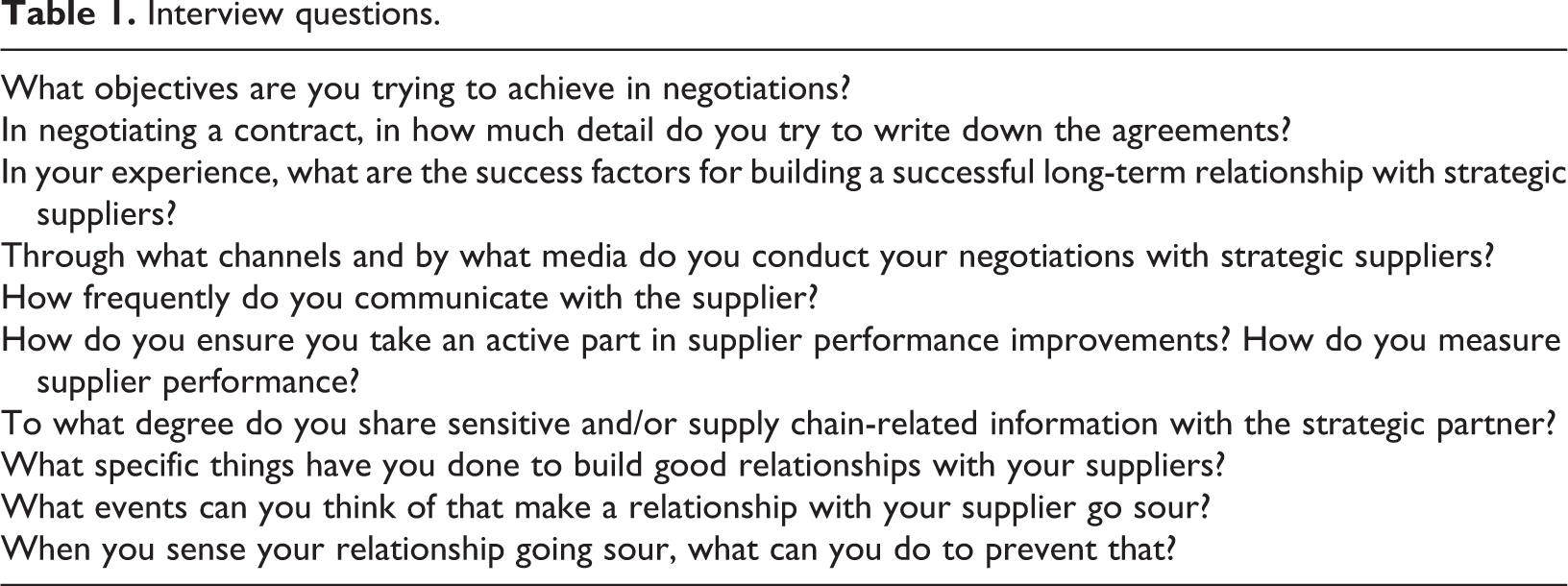
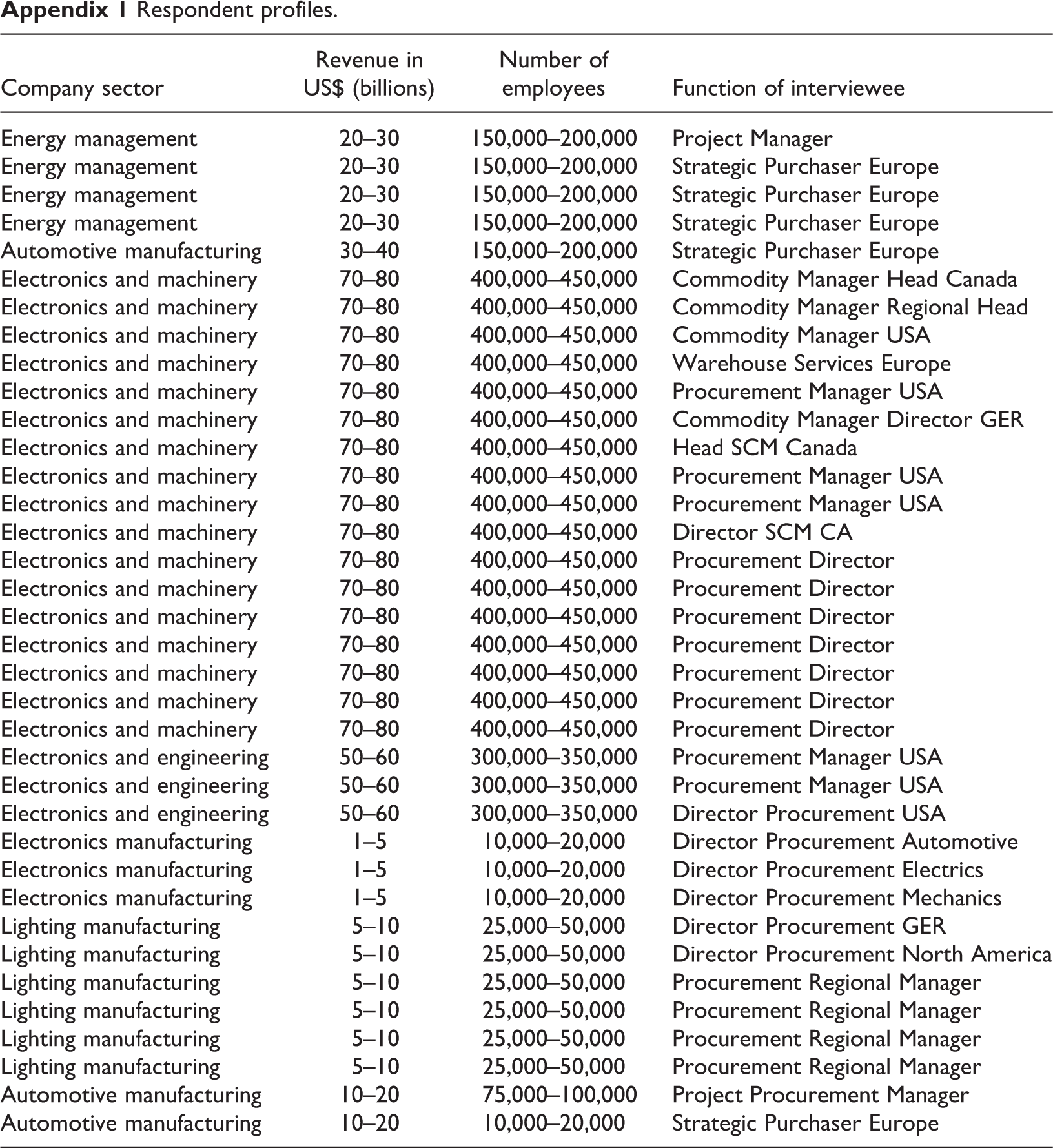
The research approach taken was to carry out an extensive literature review of relevant academic sources, together with interviews with 36 senior purchasing managers/executives from 8 large multinational companies in Europe and the USA with the following criteria: belonging to the high-tech automotive industry sector; revenue in excess of €1 billion; and over 10,000 employees. An anonymised overview is provided in Appendix 1. Each interview was carried out in a structured way using a 10-item questionnaire (see Table 1) based on the literature, and pre-tested by means of in-depth interviews with three academics researching in the area of supply chain management Two pilot interviews were carried out as part of the initial phase to test the interview protocol, and these allowed for minor refinements to the wording of the questions. For the main study, 36 interviews were undertaken (Hofstetter, 2013). All participating firms can be broadly categorised as belonging to the engineering sector, all coming from either the electro-mechanical or automotive sub-sectors. Respondents were all involved with procurement at a variety of levels and ranged from procurement managers up to directors and heads of purchasing for their respective organisations. Most respondents were located in Europe (two-thirds) with the remaining third being located in North America (mainly at regional offices of European companies). This provided a good insight into opinions from both head office and subsidiaries. Interviews were carried out by telephone, with the understanding that confidentiality would be observed. This maximised openness and objectivity. The questionnaire was sent in advance to all respondents, enabling fuller answers to be obtained. As part of the interview preamble, we asked the respondents to assume that in the procurement situation they described, the appropriate supplier had already been selected. Hence, the discussion started at the point of the actual supplier negotiations and ended with long-term relationship management activities. All interviews were conducted within a period of eight weeks. The interviews lasted between 45 to 60 minutes and all 36 were fully transcribed (in English), with the text being collated into spreadsheets to allow the responses to each question to be easily compared and contrasted. Analysis was then undertaken through thematic coding of the responses (based primarily on key words and phrases) to identify common themes.
Interview questions.
Analysis: the experience of practitioners
The initial negotiations
The interviews with the 36 senior procurement managers provide rich insights into how they manage their buyer–supplier relationships and, in particular, into the role of negotiations. As in any other context, buyer–supplier negotiations occur only because neither party is able to achieve its objectives without the involvement of the other (Fells, 2016). The ensuing negotiations not only set the terms of the contract but also establish the context in which the contract will be implemented. With regard to the issues for negotiation, the quality of the purchased product was cited by most respondents (21 out of 36) as the most important issue for negotiation, although often the quality of the product is regarded as a ‘given’, implying that quality is not really a discussion item. As one respondent (#33) stated, ‘quality is not negotiable’. Respondents replied in terms of what one called ‘the magic triangle of price, quality and delivery’ (#28). However, some recognised that the priority within these three may vary (#35, #27) and one respondent (#4) was more explicit, ‘it is all about goals – price quality and delivery are equally important. At least that’s the official party line. But when it comes down to it, price is number one.’ Respondent #6 added, ‘the management pretends that quality is the main goal but the emphasis lies on price reductions. So, the hands of procurement are essentially tied.’ This apparent centrality of price appears to sit uncomfortably with a dominant theme in the negotiation literature, which is to negotiate over interests, not positions (Fisher et al., 1991; Tomlinson and Lewicki, 2015); focusing on price is regarded as an unhelpful habit (Sebenius, 2001).
By far the most common form of communication to conduct negotiations was face to face, with subsequent maintaining of contact by phone and email to negotiate/sort out elements of the deal. Common responses were that face-to-face communication is the most important type. E-procurement systems are, however, used but for prospecting (information gathering) and pre-sorting, ‘In my opinion it is not sensible to use e-procurement solutions to finalise and close a deal.’ Respondent #23 reported on their more strategic – perhaps better expressed as ‘competitive’ – approach, our approach is always alternate your approach with a supplier. This year e-auction, face-to-face meetings for advanced negotiation; next year something else. Don’t do the same thing every year as the supplier isn’t supposed to be able to adapt to our negotiation tactics.
Control through the contract as well as in the negotiation
No procurement manager would seek to source a product that did not meet the required technical specifications, but in a supply chain context ‘quality’ also means maintaining the quality of implementation for the duration of the contract. For this reason, performance management becomes a topic for negotiation although, perhaps surprisingly, this issue was seldom raised by the respondents – one referred to ‘failure rates and liabilities’ (#30) and another to ‘performance improvement’ (#12), both of which relate to performance management. We will return to this question of performance management later in the article but, first, some respondents’ comments do offer insights into how the procurement managers used the contract itself in this regard, suggesting different approaches with regard to how the buyer–supplier relationship is subsequently handled.
The responses show that the procurement managers seek to draw up detailed contracts and, further, that a third of the respondents (13 out of 36) referred specifically to the use of standard contracts in their organisations. The negotiations then involve securing the supplier’s acceptance of clauses, or minor variations of them, with the real negotiation focusing on the non-standard items of price, quality and delivery. The clear impression is that the procurement manager is in control of the negotiation process and has control of the outcome, for example, ‘we regulate everything from price to delivery and quality…there is little space for customisation’ (#14) and, my meeting minutes are occasionally a mile long. It’s important that I can track what has been agreed upon one year later. We try not to leave the supplier a lot of freedom to ensure we reach our desired outcome. (#5)
The use of standardised contracts is an indication of one-sidedness in the negotiation process. This one-sidedness is also evident in other comments with regard to how the negotiations are conducted. For example, ‘we maintain the right in every negotiation to write the meeting minutes, which contain all agreements. The minutes are shared with the supplier (of course), ex-post’ (#30). Respondent #5 stated: ‘I sometimes give the supplier the freedom to choose on his own where to reduce the price.’ This is not, then, a negotiation of whether the price should be reduced – that is taken for granted by the buyer – but rather a case of giving the supplier the choice of how to accommodate the cut in price. From these comments, we can discern a contract compliance approach that seems to be at variance with other interview responses (sometimes from the same respondents) about the need for a cooperative relationship with suppliers.
Trust and long-term relationships
The respondents were asked about three key factors that contribute towards successful long-term relationships and, of these, trust seems to be central, as would be expected from any review of the literature on business relationships (Gattiker et al., 2007; Squire et al., 2009). ‘Trust’ is a broad term with a wide range of expression, but the interview responses together with references from the literature on trust in negotiation can offer further insights into the meaning of trust in a supply relationship context. From the responses, we can discern different dimensions of trust. First, trust is seen as being developed, over time, out of someone’s personal performance: ‘you need to do what you say you will do’ (#10), and ‘bring words and actions into line’ (#17). Trust is also about a person’s approach to handling issues, for example, fairness and openness, with fairness regarded by one respondent (#14) as ‘a primary catalyst’ for trust (although what is ‘fair’ may be viewed differently by each party). Regular interaction with counterparts provides opportunities for trust to develop as does ‘being open, with no secrets. Everyone needs to communicate one’s expectations. [There should be] no untruths towards capabilities or prices. It is also necessary to communicate where the journey is going, where potentials are’ (#25). Fairness is seen in terms of both parties getting something out of the relationship, and this leads to mutual commitment. Regarded in this way, trust is an aspect of personal integrity.
A deeper level of trust comes into play when the parties identify with each other and understand each other’s needs and aspirations. Lewicki and Weithoff (2000) call this identification-based trust and several respondents cited actions that could lead to this deeper level of trust. For example, five respondents (#14, #16, #22, #26, #27) stated that they share future outlooks with key suppliers, develop research alliances (#28) and assist suppliers to improve their own processes (#25) where, ‘the success, in the form of savings is split 50:50, so everybody wins’ (reflecting the notion of fairness again). The use of language may indicate the nature of the relationship, ‘we are not looking for suppliers, we are looking for partners’ (#15). But there must be substance too, ‘both parties must have an interest in the relationship, otherwise it is very difficult to grow together and create benefits for both parties’ (#4). Respondent #11 mentioned a situation where both buyer and seller worked jointly to address a technical problem, ‘everyone on the project worked hard and we showed our appreciation. That way we built a good relationship with the supplier.’ Respondents cited examples of situations in which they would recommend their supplier to others (#4, #19, #27). Two respondents showed an additional facet of the relationship – the procurement manager’s role within their own organisation, ‘You also need the courage to defend the supplier internally, when it wasn’t the supplier’s fault’ (#19), and ‘it is important for the strategic procurement manager to represent the interests of the supplier against his own organisation. By that, the supplier recognises that I am an honest negotiator, who is interested in a long-term relationship’ (#30). Actions such as these reflect an expectation that the relationship will continue beyond the current contract and be backed up by committed resources; these are tangible expressions of mutual commitment.
Between a personal trustworthiness as the basis of establishing a successful relationship and the deeper level of identification-based trust lies ‘calculus-based’ trust (Lewicki and Weithoff, 2000), which is more self-interested, that is, a negotiator trusts the other party simply because to do so should result in a better outcome than not trusting him/her. Viewed in this way, trust is almost a contractual exchange. Some comments from respondents seemed to reflect this, particularly in relying on the contract to form the foundation of the relationship, ‘we build commitment through contracts’ (#23), ‘defining the rules of the contract is critical in building trust and mutual commitment’ (#6) and, similarly, ‘contracts are the backbone of defining the business relationship with the supplier. The more detailed the contract, the better the relationship will be. It mitigates the business risk’ (#4).
In a similar fashion, when asked about what they had done to build good relationships with their suppliers, four respondents (#8, #14, #19, #36) seemed to take a control-based approach to building relationships through audits of the supplier’s performance. The need for the supplier to ‘earn’ the relationship from the purchaser is reflected by respondent #18, ‘a new supplier won’t receive the pleasure of a very close cooperation in the first year’. We note that this control approach is consistent with, and perhaps a result of the competitive approach to the initial negotiations that was identified in the previous section.
These responses contrast with others where a longer-term relational perspective emerged reflective of identification-based trust (Lewicki and Weithoff, 2000) and of an implemental mindset (Ertel and Gordon, 2007). The interview material did not give any indication as to whether this relational perspective was the consequence of an explicit proactive approach in the contract itself (DiMatteo et al., 2012) or of bilateral governance (Dauer, 2012), but appears to be more alliance-based. Five respondents reported that their organisation engaged strategically with the supplier through formal presentation of future plans, etc. Critical to any relationship is the information that is exchanged between the parties. Over a third of respondents (14 cases) stated they would share their strategic plans with their clients, although often on a selective basis, that is, only to core suppliers (in 4 cases). Twenty respondents stated they would provide forecasts on volume requirements (although this may be regarded as self-interested disclosure) and 12 respondents would go further and share company sales/inventory data. But, at the same time, the respondents who share information often do so with limitations, for example, only where there is a non-disclosure agreement (in 6 cases). Caution with regard to sharing information is reflected in responses such as, ‘we stay vague’ (#1) and ‘we are very careful with information, I try to determine what information the supplier needs to work properly and make informed decisions. But not more than is necessary’ (#5). Comments such as these seem to indicate that procurement managers cannot shake off an underlying competitive perspective with regard to their buyer–supplier relationships.
A relationship through managing performance
Clearly, an important aspect of the buyer–supplier relationship is the supplier’s performance in terms of their contractual obligations. Most respondents carried out supplier evaluations on a periodic basis and these were data driven, typically through KPIs with regard to price, cost, quality, logistics, etc. (cited by 24 out of 36 respondents). A typical description of the approach taken is, ‘we evaluate the performance of at least 80% of our suppliers. With cross-functional teams, we evaluate the performance of the supplier along the dimensions of quality, cost, technology and delivery’ (#16). Some go further (#22), two years ago, we launched a supplier collaboration tool to assess and evaluate suppliers…The suppliers receive feedback on their performance. We have a toolbox to improve the supplier performance. This contains value stream mapping, whereby we go to the supplier with our process expert team and implement process improvements.
The approach taken by some respondent organisations seems more ‘problem-driven’ than proactive, reflected in comments such as (#3), we do not actively seek to improve the supplier. Only if there are problems with the quality, do we try to actively improve things. Generally, we do not have the experts on the suppliers’ products at our disposal. The supplier usually knows their business better.
When relationships turn sour
Finally, as some of the above comments imply, not all contracts are negotiated smoothly and the relationship between buyer and supplier can be adversely affected. Respondents cited a number of reasons why the relationship can turn sour. These include: contract problems (e.g. poor delivery, quality and late payment) (17 responses); changes to contracts, such as price rises or an increase in volume (10 responses); and ‘unfair’ contracts (i.e. one side exploiting the other) (9 responses). A similar number of respondents mention interpersonal issues or questions of ethical behaviour as other causes of difficulty. Implicit in many of the responses is the presumption that it is the other party who has caused the relationship to go sour. Only one respondent had a contrasting view, ‘if mistakes have been made, apologise sincerely’ (#19).
With regard to how best to handle difficulties in the relationship, unsurprisingly, many respondents’ comments involved face-to-face communication and giving feedback, as well as referring to the importance of personal relationships (although three respondents also recognised that it can be the personal relationship that is the problem). Six respondents mention involving higher management, although one expressed the view that ‘most problems are located in higher hierarchy levels’ (#18). A different approach to addressing a problem might include ‘hint at no more business’ (#2) or more bluntly, ‘or simply switch suppliers’ (#33).
In considering the interviewees’ comments on this issue there is a sense that the respondents are commenting on circumstances where the relationship has already gone sour, rather than while it is going sour. This may reflect their organisational position and role, removed from the day-to-day implementation of the contract. This apparent reactivity highlights the need for organisations to pay attention to the role of line managers and the part they can play in maintaining constructive relationships at the ‘sharp end’ of the contract, that is, its implementation.
Reflection
Our analysis of the respondents’ comments offers many insights into the practices of procurement managers as they seek to effectively manage relationships with their suppliers. In contrast to much of the literature that advocates cooperation, an underlying competitive imperative is evident throughout the interviewees’ comments. However, these comments also reveal some clear practices that might be built on and then suggested as contributing factors in building and maintaining successful buyer–supplier relationships. We categorise these under three headings: enablers, practicalities, and relationship repair. These are shown in a revised model of the buyer–supplier negotiation process (see Figure 2).
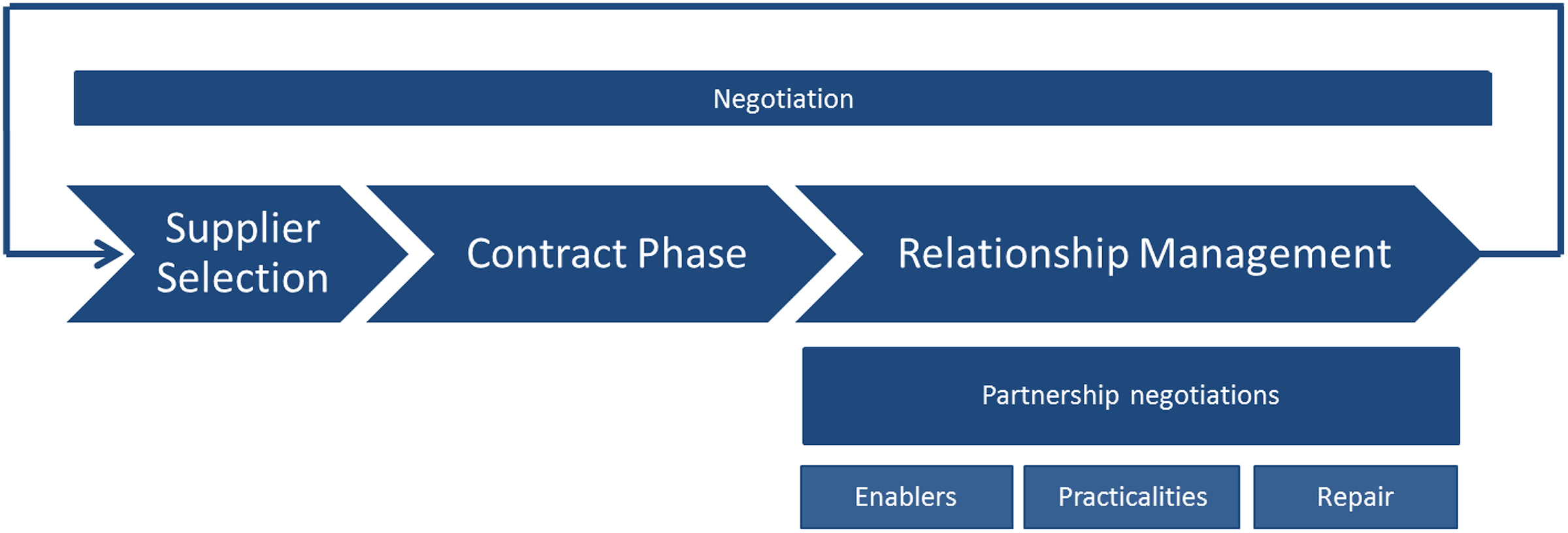
Revised model of the buyer–supplier negotiation process.
We suggest that open and, importantly, two-way communication is crucial. The buyer is usually (but not always) in control of the process. However, buyers should earn the cooperation (rather than mere compliance) of their suppliers through their approach to communication and the exchange of information. Trust is equally important, but it is easily presumed. Trust should be based on a person’s integrity and, more broadly, the reputation of the organisation should not be undermined by unilateral changes to the contract, no matter how severe the commercial imperatives may seem. In developing a relationship, the trust between buyer and supplier in the first instance will be mainly self-interested and calculative, but for even this basic level of trust to develop there must be certainty. Beyond this, the relationship manager should be looking for broader relationship opportunities. Circumstances may mean that, in fact, there isn’t any scope for further mutual gain, but an open mindset will be alert to any opportunities that might arise during the life of the contract and, additionally, convey cooperation to the supplier. On the other hand, some factors that might inhibit the development of a successful relationship can also be suggested. Inhibitors would include: having a one-sided, competitive approach to the contract negotiations, having a rigid contract compliance mentality; and, third, allowing intra-organisational pressures of competitiveness to cloud a person’s judgement.
In terms of practicalities, notwithstanding the extensive use of electronic communication, nothing beats face-to-face communication. Similarly, if a more successful relationship is sought, then investments must be made, particularly through sharing information that will enable the parties to understand each other more fully and so make decisions that look to the mutual growth of the relationship rather than just deal self-interestedly with the immediate problem. This may well include investing time and energy on behalf of the supplier (and for the buyer too). Any commercial relationship will almost inevitably have its difficulties. It follows that to remain successful, the parties should take a genuine problem-solving approach to any issues that arise, an approach that should start at the point of implementation of the contract, not just once the issue has reached the attention of the procurement manager.
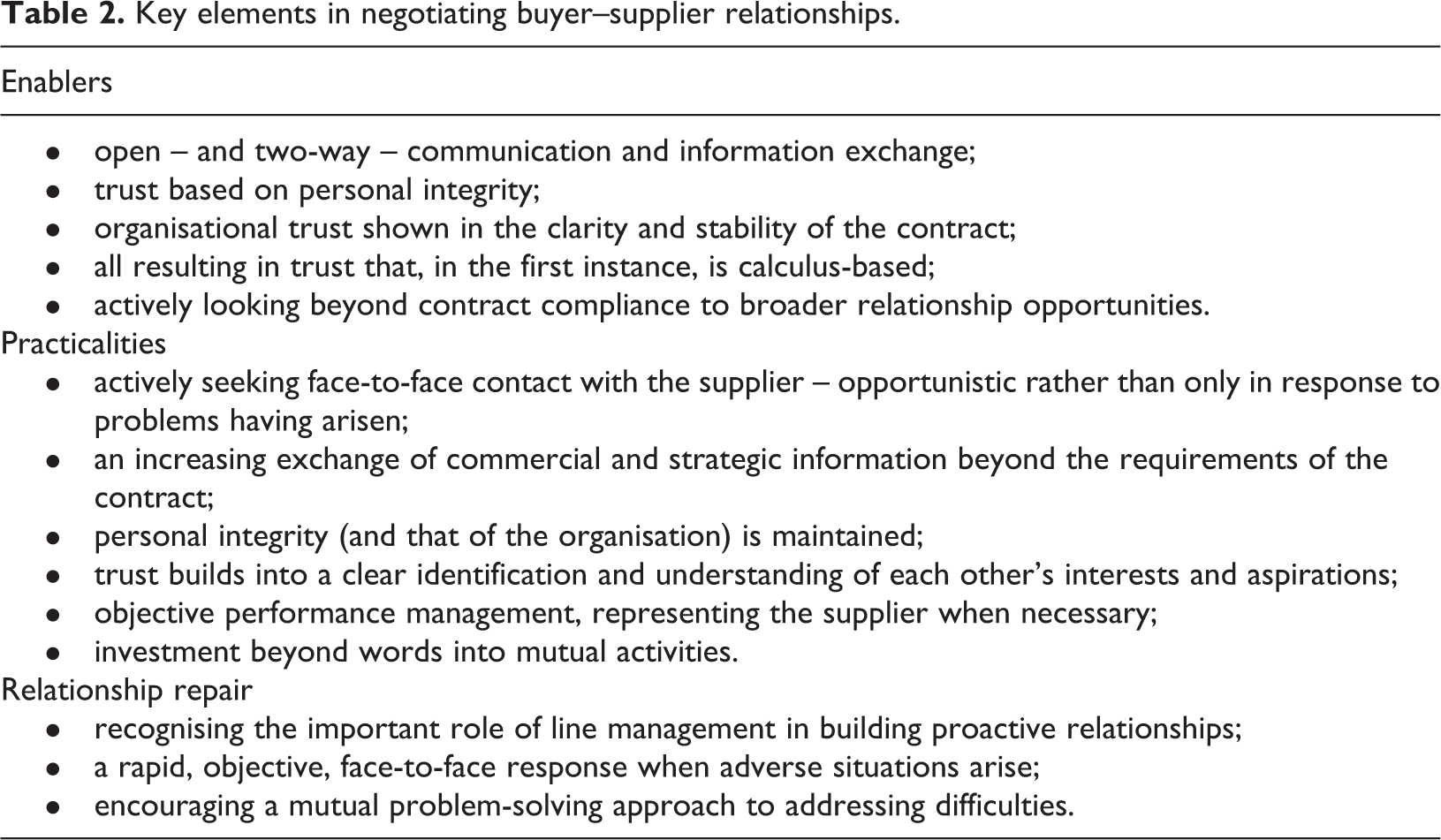
Drawing on the insights gained from this research, some key elements in negotiating buyer–supplier relationships are suggested, separated into enablers, practicalities and relationship repair (see Table 2), amplifying the model presented in Figure 2.
Key elements in negotiating buyer–supplier relationships.
Implications and conclusions
Notwithstanding the use made of bidding systems, such as the tender process and e-auctions, the data presented by practitioners’ negotiations shows that trust, shared objectives and long-term personal relationships continue to be central success factors in buyer–supplier relationships. These elements reflect the importance of taking a negotiation perspective when considering all aspects of the supply chain process.
One feature of the practitioners’ responses was the underlying competitive context within which they operate, typified in the comment of one practitioner, ‘it is all about price’. A second recurring theme is what might be termed a contract perspective, where the focus is on compliance with the contract terms. These two factors do not sit easily with exhortations to maintain collaborative and cooperative relationships with suppliers, but they are the reality of most procurement and contract managers. The framework presented in Figure 2, supported by the experience of practitioners, identifies the elements of a negotiation approach to the challenging task of maintaining open and constructive relationships with suppliers.
The three elements of the framework take our understanding of negotiation beyond the typical win-lose or win-win characterisation and show that relationships are not built by broad statements of intent but through constant managing of the interactions between the parties with an emphasis on personal conduct. This enables the parties to address hard issues constructively. Cooperation means more than keeping the peace through making a concession.
Similarly, the framework/negotiation perspective pragmatically provides a solution when difficulties arise. An over-confident approach that assumes cooperation will prevail ignores the tough realities that often face one or both parties in a buyer–supplier relationship. Recognising what might cause difficulties is a critical aspect of negotiating cooperatively.
The focus in this article has been on the management of the buyer–supplier relationship, but it is important to note that the relationship enablers – communication, trust, etc. – are equally significant in the earlier contract negotiation stage, doubly so if the person negotiating the contract is later going to be the person ensuring its implementation. A limitation of the research lies in the fact that the respondents were primarily procurement managers, meaning that the supplier perspective was not fully addressed. This is something for future research.
Further analysis of the present data set of interview responses will allow the opportunity to examine more closely whether the negotiation interactions reflect a cooperative or competitive orientation of the stakeholders. Given the emphasis on cooperative relations between buyer and supplier, the tension between the resolution of specific, perhaps pressing and costly issues, and the need to maintain a collaborative relationship will be explored. A further avenue of research would be to examine the content of communication (including negotiation) and whether there is any distinction in the mode of communication (face-to-face as opposed to email) with respect to contract negotiations and contract maintenance. The role of trust with regard to behaviour and outcomes in a relationship management context is an underlying issue that needs to be studied more closely. Further research could also examine whether face-to-face and email communications are used for different purposes, for example, is email actually used mainly to confirm, clarify and follow up on face-to-face discussions? Or, is it the case that issues and contracts are now negotiated and resolved entirely through email? And, if so, what impact does this have on the content of the contracts, and on the subsequent buyer–seller relationship?
These and other issues could be developed into a testable model of the relationship between buyers and suppliers, negotiation stages and relationship success. Further research into supply chain management though a negotiation lens would involve extending the research into other aspects of the supply chain. In particular, an important aspect to explore, perhaps through case studies, would be the negotiations that occur within an organisation to define what it wants from a new supply contract. Many of these aspects, such as the technical requirements, might well be non-negotiable. There might be organisation-wide requirements with regard to financial or insurance provisions that can’t be varied from contract to contract. Factors such as these may all shape the buyer’s proposal into a ‘take it or leave it’ offer, in which case, what sort of ‘cooperative’ relationship is being offered? Similarly, exploration of the views of suppliers as to the extent to which buyers are prepared to actually negotiate over key terms, and the suppliers’ perception of whether buyers are, in practice, relationship- or contract-oriented would be another important avenue for research.
Footnotes
Declaration of Conflicting Interests
The author(s) declared no potential conflicts of interest with respect to the research, authorship, and/or publication of this article.
Funding
The author(s) received no financial support for the research, authorship and/or publication of this article.
Respondent profiles.
| Company sector | Revenue in US$ (billions) | Number of employees | Function of interviewee |
|---|---|---|---|
| Energy management | 20–30 | 150,000–200,000 | Project Manager |
| Energy management | 20–30 | 150,000–200,000 | Strategic Purchaser Europe |
| Energy management | 20–30 | 150,000–200,000 | Strategic Purchaser Europe |
| Energy management | 20–30 | 150,000–200,000 | Strategic Purchaser Europe |
| Automotive manufacturing | 30–40 | 150,000–200,000 | Strategic Purchaser Europe |
| Electronics and machinery | 70–80 | 400,000–450,000 | Commodity Manager Head Canada |
| Electronics and machinery | 70–80 | 400,000–450,000 | Commodity Manager Regional Head |
| Electronics and machinery | 70–80 | 400,000–450,000 | Commodity Manager USA |
| Electronics and machinery | 70–80 | 400,000–450,000 | Warehouse Services Europe |
| Electronics and machinery | 70–80 | 400,000–450,000 | Procurement Manager USA |
| Electronics and machinery | 70–80 | 400,000–450,000 | Commodity Manager Director GER |
| Electronics and machinery | 70–80 | 400,000–450,000 | Head SCM Canada |
| Electronics and machinery | 70–80 | 400,000–450,000 | Procurement Manager USA |
| Electronics and machinery | 70–80 | 400,000–450,000 | Procurement Manager USA |
| Electronics and machinery | 70–80 | 400,000–450,000 | Director SCM CA |
| Electronics and machinery | 70–80 | 400,000–450,000 | Procurement Director |
| Electronics and machinery | 70–80 | 400,000–450,000 | Procurement Director |
| Electronics and machinery | 70–80 | 400,000–450,000 | Procurement Director |
| Electronics and machinery | 70–80 | 400,000–450,000 | Procurement Director |
| Electronics and machinery | 70–80 | 400,000–450,000 | Procurement Director |
| Electronics and machinery | 70–80 | 400,000–450,000 | Procurement Director |
| Electronics and machinery | 70–80 | 400,000–450,000 | Procurement Director |
| Electronics and engineering | 50–60 | 300,000–350,000 | Procurement Manager USA |
| Electronics and engineering | 50–60 | 300,000–350,000 | Procurement Manager USA |
| Electronics and engineering | 50–60 | 300,000–350,000 | Director Procurement USA |
| Electronics manufacturing | 1–5 | 10,000–20,000 | Director Procurement Automotive |
| Electronics manufacturing | 1–5 | 10,000–20,000 | Director Procurement Electrics |
| Electronics manufacturing | 1–5 | 10,000–20,000 | Director Procurement Mechanics |
| Lighting manufacturing | 5–10 | 25,000–50,000 | Director Procurement GER |
| Lighting manufacturing | 5–10 | 25,000–50,000 | Director Procurement North America |
| Lighting manufacturing | 5–10 | 25,000–50,000 | Procurement Regional Manager |
| Lighting manufacturing | 5–10 | 25,000–50,000 | Procurement Regional Manager |
| Lighting manufacturing | 5–10 | 25,000–50,000 | Procurement Regional Manager |
| Lighting manufacturing | 5–10 | 25,000–50,000 | Procurement Regional Manager |
| Automotive manufacturing | 10–20 | 75,000–100,000 | Project Procurement Manager |
| Automotive manufacturing | 10–20 | 10,000–20,000 | Strategic Purchaser Europe |