




Abstract
Academic and practitioner interest in how market-based organizations can drive positive social change (PSC) is steadily growing. This paper helps to recast how organizations relate to society. It integrates research on projects stimulating PSC—the transformational processes to advance societal well-being—that is fragmented across different streams of research in management and related disciplines. Focusing on the mechanisms at play in how organizations and their projects affect change in targets outside of organizational boundaries, we (1) clarify the nature of PSC as a process, (2) develop an integrative framework that specifies two distinct PSC strategies, (3) take stock of and offer a categorization scheme for change mechanisms and enabling organizational practices, and (4) outline opportunities for future research. Our conceptual framework differentiates between surface- and deep-level PSC strategies understood as distinct combinations of change mechanisms and enabling organizational practices. These strategies differ in the nature and speed of transformation experienced by the targets of change projects and the resulting quality (pervasiveness and durability), timing, and reach of social impact. Our findings provide a solid base for integrating and advancing knowledge across the largely disparate streams of management research on corporate social responsibility, social entrepreneurship, and base of the pyramid and open up important new avenues for future research on organizing for PSC and on unpacking PSC processes.
Keywords
Our societies face growing challenges in areas such as public health, education, social inequality, and environmental pollution. Market-based organizations can play an important role in addressing these challenges by stimulating transformational processes to advance societal well-being, referred to in this paper as creating positive social change (PSC). Popular management concepts such as “shared value” (Porter & Kramer, 2011), “inclusive growth” (George, McGahan, & Prabhu, 2012), and “base of the pyramid” (BoP) markets (Prahalad & Hart, 2002) reflect this potential and associate a range of organizational activities with PSC. Firms such as Unilever or Walmart initiate PSC projects to “do good and well” (Bansal & DesJardine, 2014), social enterprises leverage market-based activities to more effectively alleviate societal challenges (Mair & Marti, 2006), and investors seek to instigate social change while generating economic returns (Mair & Hehenberger, 2014).
Management research on these phenomena is on the rise but remains fragmented. It mainly focuses inward on organizational activities and rarely explores how these activities may have external effects stimulating societal well-being beyond organizational boundaries. The extensive research on corporate social responsibility (CSR) focuses largely on understanding why and under which conditions firms engage in socially responsible activity and how such activity affects their financial performance (Aguinis & Glavas, 2012; Carroll & Shabana, 2010). The increasingly popular research on social enterprises pays attention to possible tensions that arise from pursuing multiple and potentially competing goals (e.g., Besharov & Smith, 2014) and elaborates on their unique organizational structures, identity, and governance (Mair, Mayer, & Lutz, 2015; Wry & York, in press). Research on business activity at the BoP focuses on identifying new market opportunities (Prahalad & Hart, 2002), developing new business models (Seelos & Mair, 2007), and building inclusive markets (Mair, Marti, & Ventresca, 2012).
The tendency to introduce and hang on to distinct labels to demark the uniqueness of research areas hinders building cumulative knowledge on market-based activity and PSC across these different research streams. And the inward focus of these research streams limits their contribution to understanding how PSC may be stimulated by organizational activities.
As a result, PSC is vaguely defined and, importantly, the mechanisms underpinning transformational processes towards societal well-being and outside the boundaries of the organization are underspecified. Although not specifically focusing on market-based organizations, research in disciplines ranging from sociology and political sciences to development studies, public health, and psychology has unpacked mechanisms and levers of transformation towards societal well-being. We engage inductive and abductive methods to systematically review and integrate evidence from these literatures with existing work in management research and to develop an integrative conceptual framework. Our objective is to inspire empirical and theoretical management research by taking stock of and relating the mechanisms and organizational practices that organizations and their PSC projects mobilize to stimulate societal well-being.
We expose PSC as a process that is proactively initiated, multilevel in nature, and includes bottom-up dynamics. Using PSC projects as our analytical window to systematically review literatures, we specify deep- and surface-level PSC strategies as distinct combinations of change mechanisms and enabling organizational practices. These strategies differ in the nature and speed of transformation experienced by the targets of change projects and the resulting quality (pervasiveness and durability), timing, and reach of social impact. Our framework allows for a systematic perspective on how and why market-based organizations may stimulate PSC. Our paper helps to recast how organizations relate to society outside of their organizational boundaries by advancing a deeper understanding of change processes and their implications for the management and structure of organizations. It helps to integrate the largely disparate streams of research on CSR, social entrepreneurship, and BoP.
In the following sections, we define PSC and introduce existing research in management and in related disciplines relevant to PSC. We then elaborate on the review methodology and present our integrative conceptual framework and detailed findings. We conclude with a summary of our contributions and directions for future research.
PSC
Building on established sociological definitions of social change (Sztompka, 1993) and work in positive organizational scholarship (Cameron, Dutton, & Quinn, 2003; Golden-Biddle & Dutton, 2012), we define PSC as the process of transforming patterns of thought, behavior, social relationships, institutions, and social structure to generate beneficial outcomes for individuals, communities, organizations, society, and/or the environment beyond the benefits for the instigators of such transformations. The “beneficial outcomes” of this process are often referred to as (positive) social impact. We elaborate on key aspects.
First, our definition highlights PSC as proactively initiated through the activities of market-based organizations, that is, organizations that leverage market-based mechanisms to create value by operating in a competitive environment and producing or distributing products or services. This contrasts with change initiated by regulators or donation or membership organizations focused on advocacy (e.g., Amnesty International or Greenpeace) and reactive PSC resulting from a crisis, a breakthrough technological development, or shifting societal values. Also, this perspective allows us to assess (1) PSC across organizational and legal forms, which includes organizational activities and PSC initiated by nonprofit as well as for-profit organizations; (2) multiple and different PSC projects initiated by one organization; and (3) PSC projects initiated by alliances of several organizations.
Second, PSC typically relates to a multilevel, “bottom-up” process where changes in patterns of thoughts, behaviors, and social relationships among individuals underlie changes in organizations, industries, communities, regions, or even nations and their social structure and formal and informal institutions (Anderson et al., 2006; Hedström & Ylikoski, 2010). PSC involves transforming individuals and groups as the targets of PSC projects and outcomes of a “collective” nature. For instance, shifts in business practices, such as across supplier networks adopting sustainable production practices, ultimately result from aggregated changes in the behaviors of individual decision makers working in these organizations.
Third, PSC may entail different types of transformation outcomes, depending on how targets experience and are affected by PSC. We distinguish between changes in behavior that can be observed more directly and immediately (i.e., “surface” change) and changes in behavior that are based on altered beliefs, attitudes, and meanings (i.e., “deep” change).
In our review, we distinguish between (1) change mechanisms that stimulate behavior change towards PSC in targets external to the organization and are triggered by specific project actions; (2) organizational practices understood as the internal tools and procedures that organizations deploy to organize, manage, and execute PSC projects, and which may enable mechanisms; and (3) PSC strategies, combinations of change mechanisms and enabling organizational practices that may affect PSC targets differently and trigger qualitatively different processes and outcomes of transformation.
Finally, on the basis of our review, we identify four broad domains particularly pertinent for PSC projects: (1) environment, for example, increased energy conservation, recycling and responsible consumption, habitat conservation; (2) social and economic inclusion, for example, empowered marginalized groups, revitalized deprived neighborhoods, improved educational attainment, reduced community violence; (3) health and well-being, for example, increased preventive and reduced health risk behaviors, improved access to health care; and (4) civic engagement, for example, increased community volunteering, charitable giving, and responsible investing. PSC projects may involve several domains simultaneously. For example, SC Johnson’s joint venture with a nonprofit in the Kibera slum in Nairobi (Kenya) addressed health as well as social and economic inclusion. It improved household hygiene and thereby health, while creating employment for youth entrepreneurs and supporting them to set up their own business (Johnson, 2007).
Background Literatures
Two broad categories of literature form the backbone of our review. First, different streams in management research incorporate social change considerations as elements of the activities or strategies of market-based organizations. Second, research in related disciplines has focused more squarely on how change processes unfold and on specifying their mechanisms. Our ambition is to integrate these literatures.
Research Streams in Management
Three largely separate streams of management research, CSR, social entrepreneurship, and BoP, refer implicitly or explicitly to PSC. Research on CSR is broadly concerned with the organizational policies and actions that take societal expectations into account. See Aguinis and Glavas (2012) for a comprehensive review. CSR research has largely focused on (1) the instrumental, especially financial, returns of CSR activities for the firm and relating CSR to its competitive advantage (Carroll & Shabana, 2010; Wood, 2010); and (2) the individual, organizational, and institutional antecedents of firms’ engagement in CSR (Aguilera, Rupp, Williams, & Ganapathi, 2007; J. L. Campbell, 2007). More recently, research on the political activity of firms started to examine how firms’ activities influence policy making with the specific objective of benefiting society (Scherer & Palazzo, 2011). This trend importantly expands the scope of analysis beyond the firm. Yet empirical research exploring potential positive effects of organizations’ CSR activities on targets outside the firm and on society remains scant. For exceptions identified in our review, see for example, Carrigan, Moraes, and Leek (2011) and Muller, Vermeulen, and Glasbergen (2012).
Research on social enterprises—organizations that leverage market-based activities as a means to address societal challenges (Mair & Marti, 2006)—often remains stuck in conceptual debates (see Dacin, Dacin, & Matear, 2010, for a review). Empirical contributions typically focus on understanding the emergence of social enterprises (Renko, 2013; Seelos, Mair, Battilana, & Dacin, 2011; Stephan, Uhlaner, & Stride, 2015) or on intraorganizational aspects such as governance, identity management, and organizing processes (Battilana, Sengul, Pache, & Model, 2015; Mair et al., 2015; Pache & Santos, 2013). Fewer studies link social enterprise activities to PSC (examples in our review are L. Jones & Snelgrove, 2006; Perrini, Vurro, & Costanzo, 2010; Seelos & Mair, 2005).
BoP research originated from the proposition that firms can tap into new market opportunities by selling products to low-income market segments in emerging economies to generate profits whilst alleviating poverty (Prahalad & Hart, 2002). More recently, researchers have more explicitly related how firms and a broader set of organizations, such as nongovernmental or grassroots organizations, may not only generate profits but also stimulate PSC in such markets (see Kolk, Rivera-Santos, & Rufín, 2014, for a review). This literature highlights the importance of firm-specific organizational capabilities and innovation (Hart & Dowell, 2011), business models (Kistruck, Sutter, Lount, & Smith, 2012), alliances of different types of organizations (Webb, Kistruck, Ireland, & Ketchen, 2010), social capital (Ansari, Munir, & Gregg, 2012), and empowerment processes (Mair, Marti, & Ventresca, 2012). Studies in our review explore organizational features and change mechanisms at the BoP in relation to PSC (e.g., D. R. Brown, Dettmann, Rinaudo, Tefera, & Tofu, 2011; Seelos & Mair, 2007).
Research in these three streams has enhanced our understanding of how organizations pursue social objectives and has elaborated on implications for organizational performance. The impact of organizational activities on the individuals and communities targeted and affected by PSC projects and activities has received less empirical and theoretical attention. Similarly, the specific mechanisms that constitute PSC as a process that affects transformation in targets external to the organization have not been explored systematically.
Research on PSC in Related Disciplines
Research in related disciplines—sociology, political science, development studies, public health, and psychology—can inform our understanding of the mechanisms underpinning PSC in important ways.
Research in sociology, political science, and development studies focuses on the societal level and emphasizes the effect of context, including opportunity structures and access to resources and networks, on PSC (e.g., McAdam, 2010). Research in these disciplines is also increasingly paying attention to the individuals targeted by change efforts. For instance, studies applying social movement theory investigate how constructing meaning can motivate targets to leverage existing opportunity structures in the context of “greening” of industries (Sine & Lee, 2009; Weber, Heinze, & DeSoucey, 2008, in our review). Political science research instead typically focuses on opportunity structures defined through regulation and legal systems (e.g., Bernauer, 2013). Yet recent work, for instance, on deliberative democracy and civic engagement, highlights the need to develop citizens’ understanding of societal issues such that they can make better use of existing influence opportunities (e.g., John et al., 2011, in our review). Likewise, research in development studies emphasizes the need to transform the skill levels of microentrepreneurs alongside the provision of financial resources to stimulate PSC, resulting in the alleviation of poverty levels in developing countries (e.g., Leach & Sitaram, 2002, in our review).
Research in public health and psychology focuses on individual-centric explanations of stimulating PSC. For instance, public health research documents how interventions can trigger intraindividual mechanisms, such as beliefs, knowledge, and skills, to improve health behaviors (Cugelman, Thelwall, & Dawes, 2011; Hutchings et al., 2007, in our review). Studies in psychology show that enhancing individuals’ motivation and skills and changing their decision-making contexts stimulates more proenvironmental, healthier, and prosocial behaviors (Feiler, Tost, & Grant, 2012; Noar, Benac, & Harris, 2007; Osbaldiston & Schott, 2012, in our review). Behavioral economists document similar mechanisms under the label “nudging” (Thaler & Sunstein, 2008).
A recent trend in public health and psychology is the focus on understanding how more complex behaviors underlying PSC may be changed, drawing attention to organizational practices. For instance, community interventions in public health and psychology emphasize the need for participatory approaches (Cornell et al., 2009; Pascale, Sternin, & Sternin, 2010, in our review). They also highlight the enabling role of the resources and managerial practices of the intervening organization or alliance (Hoddinott, Britten, & Pill, 2010; Kaufman et al., 2006, in our review).
In summary, management research elaborates on organizational activities but tends to underspecify change mechanisms. Work in related disciplines identifies mechanisms but has paid less attention to organizational practices that enable change processes. Neither category of literature offers systematic insight on how mechanisms and practices may relate to each other or on the nature of the transformation that PSC targets experience. In this paper, we take stock of evidence and insights dispersed across these literatures and develop an integrative framework that allows for a more nuanced understanding of processes and potential outcomes associated with PSC.
Review Method and Overview of Reviewed Studies
We followed the systematic review procedure (Tranfield, Denyer, & Smart, 2003) and conducted broad searches of the academic and practitioner literature for empirical evidence linking organizational activities to PSC covering 20 years (1991–2012). Details can be found in the appendix. We screened 10,509 sources for inclusion and retained 118 sources, corresponding to 144 studies or pieces of evidence. We included qualitative, quantitative, and mixed-method research (51%, 21%, and 19%, respectively), primary research and reviews (90% and 10%), and published and unpublished research (see the appendix). Three researchers coded these studies, identifying how specific actions lead to PSC with the goal of understanding change mechanisms. This process also uncovered organizational practices. We worked iteratively, going back and forth between independently coding studies and team discussions until consensus was reached. We identified 17 mechanisms and 12 practices. The studies contained on average 2.6 mechanisms and 1.7 practices; 89% of studies contained mechanisms and 56% practices. We used the studies as data to generate our framework through induction, although we derived the PSC levers through abduction.
We give an overview of the reviewed studies here to illustrate how past research has studied PSC. Details for all 144 studies are included as a data table in the online supplemental material. This supplement also summarizes analyses exploring whether our findings differ across change processes, targets, instigators, disciplines, and domains. We find few differences.
Regarding the focus of the change process, most research studied individuals (as part of households, communities, or organizations or as members of society; 76%) as opposed to change processes related to fields (industries or markets; 21%). A total of 3% studied both. With regard to PSC targets, 66% studied individuals, 22% organizations, 13% households or families, 13% community changes, 8% industry changes, and 8% other targets (e.g., consumer groups, regions), while 20% included more than one PSC target. The distal targets that PSC projects sought to affect in the long term were communities, regions, industry, society at large, country, and consumer groups (44%, 33%, 23%, 15%, 11%, and 10%, respectively) as well as “other” (13%).
Instigators of PSC projects were businesses (14%) and social sector organizations (nonprofits, social enterprises, and community organizations; 29%). A total of 14% were researcher-led efforts, 13% were led by “other” organizations (e.g., local authorities, business associations), and 31% were efforts by alliances or collaborations. We included sources describing actions by researchers and local authorities, which could be easily adopted by organizations (e.g., distributing recycling reminder cards to households), as local authority services are often subcontracted to businesses.
In terms of disciplinary background (identified through the publishing outlet), 22% of studies originated in management and business, 17% in public health, 17% in political science, and 29% in other social sciences (e.g., psychology, sociology, development studies), and 15% were design studies and practitioner sources.
Towards an Integrative Conceptual Framework
We synthesize the review findings in the form of an integrative conceptual framework presented in Figure 1. We first summarize our framework and PSC strategies, which we generated inductively from the review findings. We then present the detailed findings on change mechanisms and organizational practices.
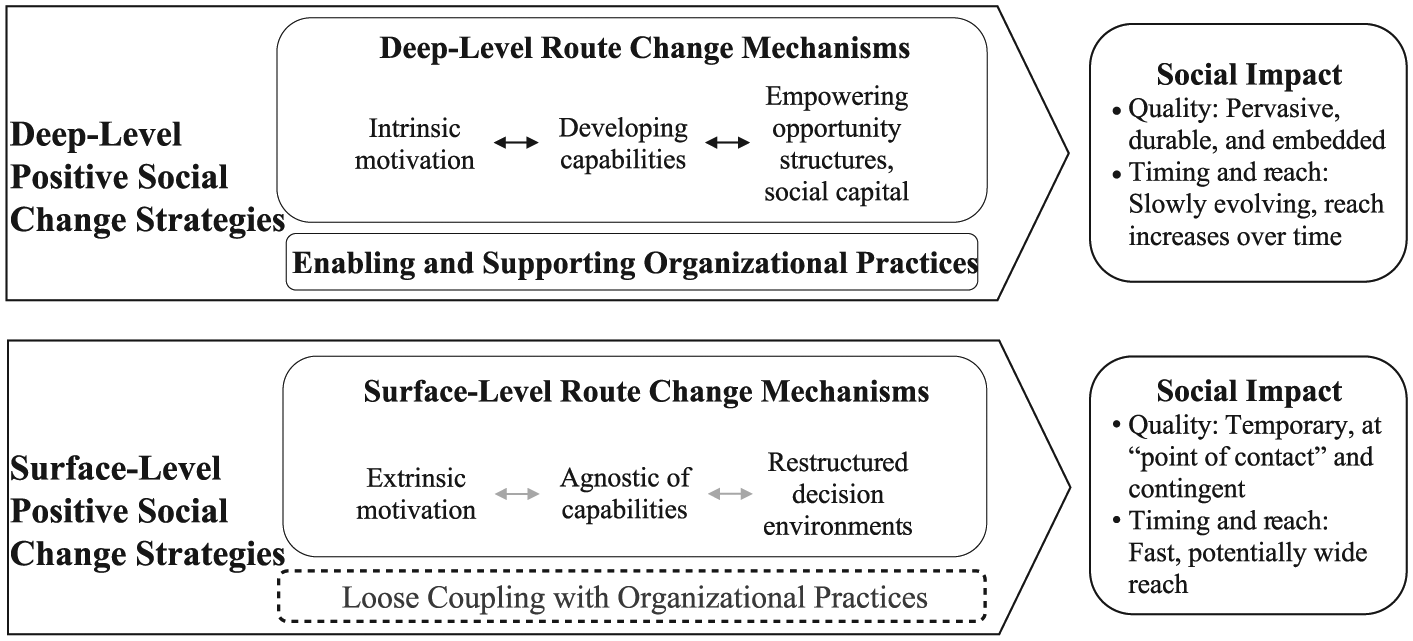
Positive Social Change Framework
Our framework differentiates between the deep- and surface-level PSC strategies that organizations mobilize to stimulate PSC. These strategies capture distinct combinations of change mechanisms enabled and supported by the organizational practices that we observed across the reviewed studies. The strategies differ in the nature and speed of transformation experienced by targets and the quality, timing, and reach of the resulting social impact (see Figure 1). However, evidence on the long-term effects of PSC strategies was scarce. Deep-level strategies typically targeted more complex behaviors compared to surface-level strategies. The mechanisms and practices constituting both strategies were used across all four change domains, suggesting that there exists a robust repertoire of change mechanisms and organizational practices that can be deployed in a diverse set of PSC projects. (Here we discuss the strategies as stylized types but recognize that in reality they form a continuum.)
Deep-level PSC involves close engagement with targets, and change in targets’ behavior is based on altered beliefs, attitudes, and meanings. Deep-level strategies rely on mechanisms that stimulate targets to change their behavior motivated by their own volition and on the basis of deliberation (i.e., intrinsic motivation), whilst simultaneously developing targets’ capabilities and creating empowering opportunity structures for targets to facilitate such change (see deep-level route change mechanisms in Figure 1). We find that a specific set of organizational practices (described below) supports and enables projects to deploy these mechanisms. Surface-level strategies engage with targets in a starkly different manner. They treat targets as “quasiautomatic responders” that react to extrinsic motivators (incentives and pressure) and altered decision-making contexts (see Figure 1). We observed no clear coupling of surface-level mechanisms with specific organizational practices in the evidence reviewed.
As part of our framework and on the basis of abduction, we identify three broad levers that enable organizations to generate PSC—motivation, capability, and opportunity (MCO). MCO frameworks are widely used in management research, for example, to theorize mechanisms and levers for proactive behavior (Grant & Parker, 2009) and social capital (Adler & Kwon, 2002), as well as in public health (Michie, van Stralen, & West, 2011). Categorizing change mechanisms and organizational practices according to MCO as levers of PSC allows us to organize the mechanisms and practices we identified in a theoretically and empirically meaningful way.
Especially for change mechanisms and organizational practices associated with deep-level PSC, the MCO levers indicate contingencies for the effectiveness of PSC projects. A lack of any of the MCO levers may undermine targets’ behavior change. A community initiative to encourage health behaviors and reduce the risk of heart disease among African American women illustrates the successful stimulation of mechanisms related to all three MCO levers. The initiative ran education campaigns to build targets’ knowledge and motivation, provided cooking lessons to enhance the women’s capability to produce healthy meals, and asked local food stores to stock healthy ingredients; otherwise, the women may not have had the opportunity to exercise their new skills (Cornell et al., 2009). Similar contingencies can be identified for organizational practices (see our discussion on practices below). We now describe the two PSC strategies in more detail.
Deep-level PSC strategies (see the upper half of Figure 1) were developmental, empowering, and often strengths focused in their approach to working with targets (see Cameron et al., 2003; Golden-Biddle & Dutton, 2012). They can be characterized as interventions in complex, self-regulating, and dynamically changing systems (see Tseng et al., 2002). PSC projects employing deep-level strategies typically targeted more complex needs and several PSC domains simultaneously (e.g., health and social inclusion) and lasted over a longer time span. The PSC stimulated by these projects had a narrow reach initially and often unfolded slowly but steadily over time as an increasing number of targets experienced transformation. The social impact associated with deep-level strategies appeared to be pervasive and durable as change was embedded in “deeper-level” transformations of both targets (their attitudes, beliefs, and capabilities) and their contexts (opportunity structures and social capital). Specifically, projects using deep-level strategies combined change mechanisms and organizational practices related to all three MCO levers. They developed targets’ intrinsic motivation, steadily built up targets’ skills and capabilities, and created empowering opportunity structures and social capital.
At the project level, such an approach required numerous project capabilities, such as being open to and soliciting input from targets to create empowering opportunity structures, while embedding the change project in the local context by closely working with targets to ensure that project developmental activities met their needs. This in turn often meant developing the projects’ own skill base accordingly. It entailed relational and motivational work for the project to connect organizations across sectors on the basis of a meaningful shared vision of making a positive difference to PSC targets. It also implied celebrating smaller successes along the way and making them visible to motivate project members. Finally, it involved creativity in designing business models and introducing innovations that sustained and broadened the project’s opportunities to stimulate PSC. In this regard, PSC projects using deep-level strategies were often aligned with the core competencies (“strengths”) of the organization instigating the project. An example is the cleaning/health focus of the Kibera project by SC Johnson, a large manufacturer of cleaning products.
The positive deviance approach (Pascale et al., 2010) is an example of a deep-level strategy. It is a systematic, community-driven approach to uncover existing strengths within a community and to scale those existing capabilities and opportunities whilst motivating and training community members to change their behavior. This is supported by practices such as continuous measuring and sharing of key PSC indicators to motivate project and community members and to solicit inputs for improvement. The project develops relationships with a wide range of stakeholders and throughout the community to support the change process. The creation of learning circles within the project helps it to continuously develop its skill base.
In surface-level strategies (see the lower half of Figure 1), targets are treated as mostly “reactive.” These strategies often combined motivation and opportunity mechanisms where targets changed their behavior in response to extrinsic motivators (financial or reputation incentives, social pressure) and restructured decision-making contexts (e.g., default options privileging healthy or proenvironmental choices). Surface-level strategies were more varied than deep-level strategies. Two prominent examples of surface-level strategies are approaches popularized as “nudging” in behavioral economics (Thaler & Sunstein, 2008) and those that specifically use threat and fear as motivating mechanisms (see below). The former are supported by more and by stronger evidence (e.g., experiments and randomized control trials) compared to the latter (see Table 1). Surface-level strategies typically did not consider targets’ capabilities. They seemed particularly suitable to stimulate PSC when behaviors were easy to perform and less complex and, hence, where targets’ capabilities did not necessarily need to be developed.
Overview of Change Mechanisms and Organizational Practices Studied in the Review
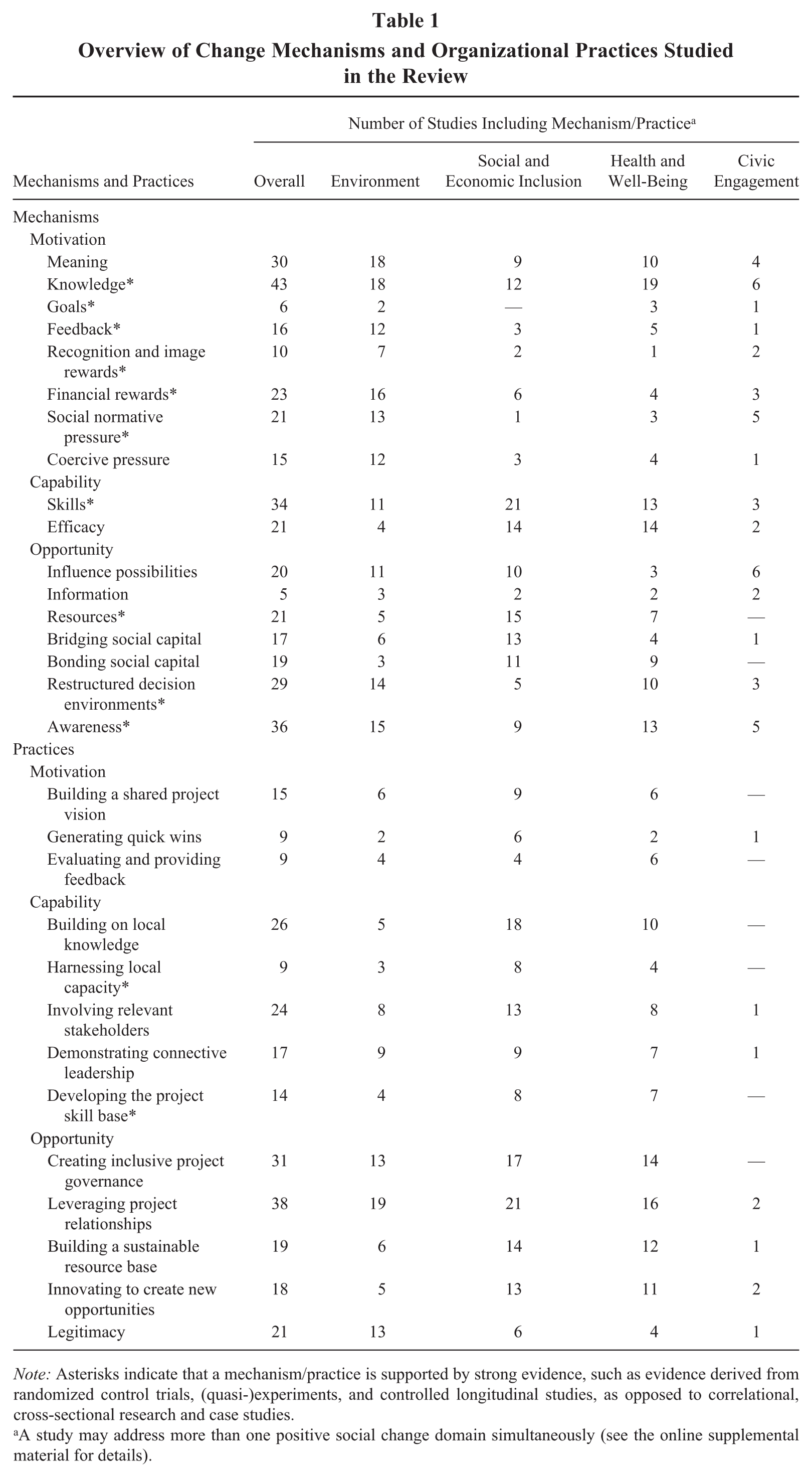
Note: Asterisks indicate that a mechanism/practice is supported by strong evidence, such as evidence derived from randomized control trials, (quasi-)experiments, and controlled longitudinal studies, as opposed to correlational, cross-sectional research and case studies.
A study may address more than one positive social change domain simultaneously (see the online supplemental material for details).
Surface-level strategies appeared to be effective in bringing about behavior change quickly (e.g., as soon as targets were exposed to an incentive or an altered decision-making environment) and with wide reach as these interventions could be implemented rapidly for a large number of targets. Evidence in the review indicated that the social impact resulting from these strategies may be more temporary and contingent on the permanent presence of a specific decision-making situation (e.g., healthy food positioned in visible places near cashiers in supermarkets to stimulate healthy eating) and on the specific design of the intervention (e.g., social norm interventions had mixed effects depending on how the norm was communicated to targets; see Feiler et al., 2012; John et al., 2011). Evidence in the wider literature suggests that surface-level strategies may lead to more durable social impact if the changed behavior becomes a habit or is internalized as a norm and, thus, generalizes to other, similar behaviors (Gardner, 2015; Peysakhovich & Rand, in press). However, evidence on longer-term effects is largely lacking.
Direct comparisons of deep- and surface-level strategies are very scarce. An example relates to surface-level strategies using threat and fear, for instance, when large firms used coercive pressure over their suppliers to stimulate more sustainable behaviors in their supply chain. The reviewed evidence suggests that threats may be less effective in stimulating PSC than more collaborative, deep-level strategies in the same domain (Muller et al., 2012; Raynolds, 2009). Threat and fear are also often used in attempts to change health behavior (e.g., healthy eating or smoking; see Alleyne, Basu, & Stuckler, 2011), with the aim of motivating targets to change their behavior to end the threat (e.g., stop smoking to end the threat of ill health). Yet such strategies have led to opposing effects, especially when targets did not have the efficacy or skill to change their behavior and, thus, felt overwhelmed and reacted defensively (Noar et al., 2007; Peters, Ruiter, & Kok, 2013). Hence, threat-based approaches can be a precarious strategy especially for stimulating individual-focused change in areas where challenges are large (climate change, community violence, social exclusion) and targets contribute little and indirectly to alleviating any threat (e.g., by recycling, neighborhood helping) and, thus, may feel overwhelmed and disengage.
Nevertheless, threat can have an awareness-raising function, which may make it a useful strategy in the early stages of field-focused PSC processes, especially for smaller businesses, such as newcomers to an industry and social sector organizations. Such organizations may draw attention to threats emanating from more powerful actors to help mobilize other organizations and customers for PSC (McAdam, 2003; Rao, 2009).
Figure 2 maps the detailed findings of the review. Table 1 lists all mechanisms and practices and gives an indication of the strength of supporting evidence. The three horizontal partitions in Figure 2 represent the three MCO levers. Change mechanisms associated with each lever are depicted on the right of Figure 2; organizational practices associated with each lever are portrayed on the left. Awareness is positioned as a precondition to most change mechanisms—all mechanisms except one require targets to consciously process information, that is, they require awareness. Legitimacy acts as an enabling condition for organizations’ PSC efforts; targets resist change if they perceive PSC activities as incompetent or disingenuous.
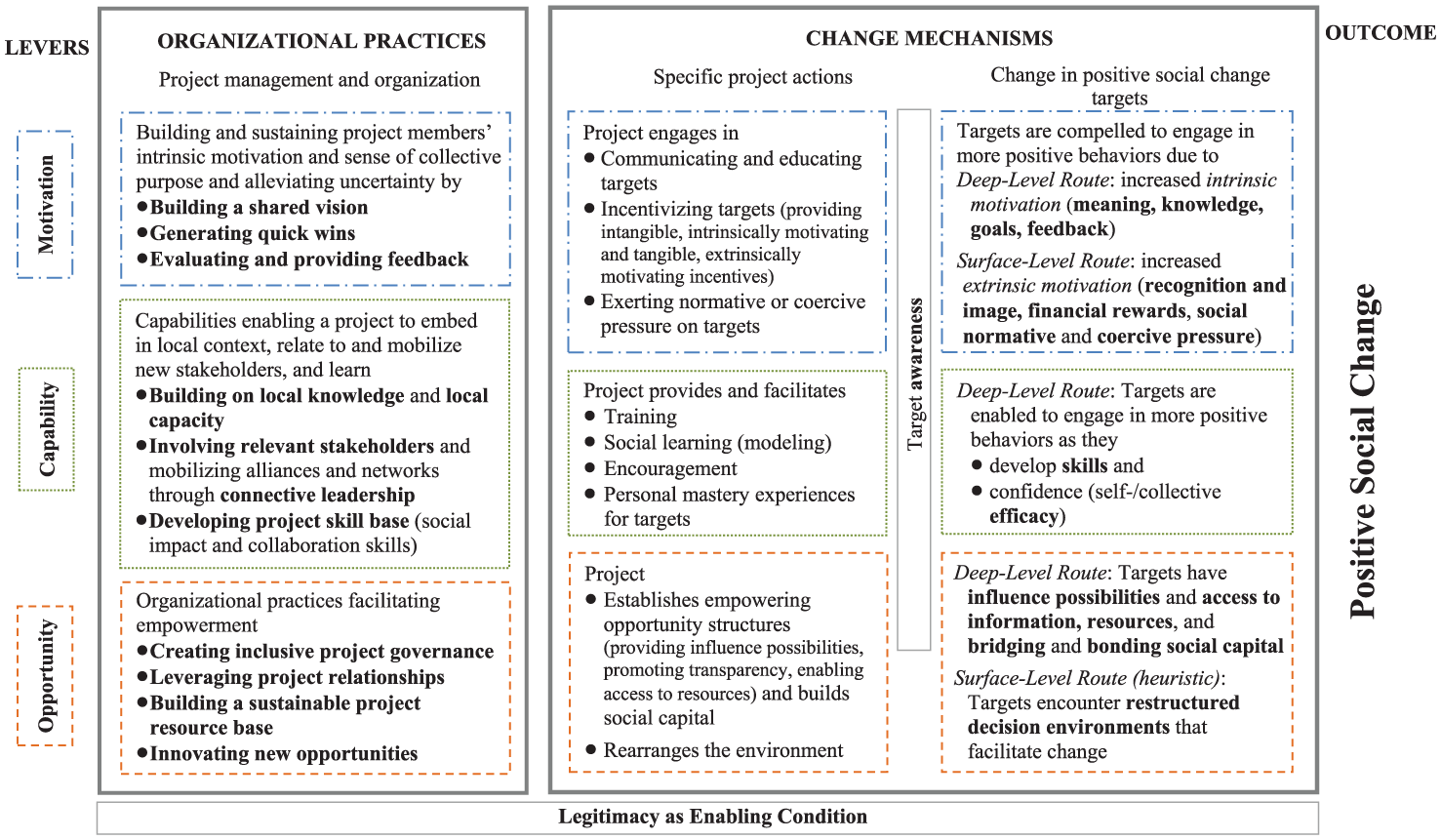
Mapping of Change Mechanisms and Enabling Organizational Practices Uncovered in the Review and Organized by Change Levers
Change Mechanisms—Stimulating Positive Behavior Change
This section presents the mechanisms we identified in the review. We label mechanisms by the change a specific project action (see the middle boxes in Figure 2) seeks to elicit in the targets to stimulate them to change their behavior towards PSC (see the right-hand boxes in Figure 2), for instance, conducting training to develop targets’ skills. The online supplemental material contains detailed descriptions of all 17 mechanisms, including examples for all four PSC domains and all sources providing evidence (also see Table 1). Here we provide a synthesis of the change mechanisms clustered according to each MCO lever.
Motivation
We identified eight motivation mechanisms affecting targets’ willingness, that is, their desire (reason) and drive (energy) to change their behavior towards PSC. The motivation lever aligns with self-determination theory, which differentiates motivation ranging from intrinsic (motivation following from individuals’ free volition) to extrinsic (motivation resulting from external influences) as mechanisms of behavior change (R. M. Ryan & Deci, 2000), which are represented as deep-level and surface-level route, respectively, in Figures 1 and 2. Compared to extrinsic motivation, intrinsic motivation is generally associated with greater persistence, performance, and sustained behavior change as targets are more engaged, interested, and personally committed.
Projects can stimulate targets’ intrinsic motivation by framing PSC issues in their communications in such a way that targets experience them as meaningful (personally relevant and important) and by building targets’ knowledge and understanding in a PSC domain. Intrinsic motivation can also be facilitated by setting goals that targets perceive as desirable or to which they commit (e.g., through pledging) or by providing feedback to targets when they achieve a desired level of behavior (or fall short of it and, thus, need to invest more effort). More instrumental, extrinsic motivation for behavior change (surface-level route in Figures 1 and 2) can be stimulated through incentives in the form of recognition and image rewards, where targets receive recognition for displaying behavior, which bolsters their individual or collective sense of esteem. Projects may also incentivize targets by providing financial rewards or stimulate targets’ extrinsic motivation by exerting social normative or coercive pressure. Social norms compel targets to change their behavior because they perceive pressure to conform to the behavior of others who are seen as representing the norm. Coercive pressure elicits behavior change because of perceived threat and the expectation of negative consequences.
Capability
We identified two capability mechanisms: developing targets’ skills and efficacy to perform positive behaviors stimulating PSC, for instance, through training, modelling, and encouragement. These capability mechanisms align with sociocognitive theory (Bandura, 2002), according to which developing skills as well as individual and collective confidence in using skills is central for behavior change and human agency more generally (see also Sen, 1999). PSC projects often developed targets’ capabilities whilst also stimulating their intrinsic motivation and creating empowering opportunity structures, with mutually supportive effects (indicated as deep-level route in Figures 1 and 2).
Opportunity
We identified a total of six opportunity mechanisms. These relate to changing targets’ situation by removing constraints and by supporting them to change their behavior towards PSC. Most opportunity mechanisms change contexts in such a way that targets have greater choice and control and thereby enable behavior change (see deep-level route in Figures 1 and 2). These opportunity-based mechanisms align with sociostructural theories emphasizing the importance of context for social change. For instance, social movements research discerns (political) opportunity structures as well as access to information, resources, and social capital as antecedents for the formation and spread of movements, understood as collective action to instigate social change processes (McAdam, 2003, 2010). Likewise, Spreitzer (2008) delineates access to opportunity, information, resources, and support as elements of sociostructural empowerment within organizations.
We found five mechanisms through which PSC projects can create opportunity structures that empower targets to change their behavior towards PSC. Targets gain greater levels of control over the PSC process if PSC projects provide influence possibilities that allow targets to participate in and shape relevant strategic decisions affecting them and if projects share information in a proactive and transparent manner to allow targets access to relevant information. Projects also make resources available to targets to empower them to engage in more positive behavior, such as microfinance projects. Furthermore, projects facilitate collaborations among previously unconnected actors to build weak-tie (or bridging) social capital, enabling targets to access new resources and new perspectives. The latter can promote tolerance, which is linked to greater social inclusion. Projects can also support strong-tie (or bonding) social capital by building on existing relationships and networks, for example, in communities or among organizations. Such strong ties can be a source of cohesion and social support empowering targets to change their behavior.
The final opportunity mechanism is restructured decision environments, which is not conceived of as empowering; rather, it refers to the rearranging of the physical decision-making contexts that targets encounter such that behavior change towards PSC becomes the easier choice (surface-level route in Figure 2). This opportunity mechanism appeals to targets’ heuristic thinking and quasiautomatic responses as opposed to deliberation and involvement.
Awareness
Raising awareness represents a mechanism referring to the mere recognition of a PSC issue. It is not aligned with any of the three levers as it does not imply that targets understand or evaluate a particular issue. Thus, awareness acts as a precondition (see also Ones & Dilchert, 2012) for all MCO mechanisms discussed above—with the exception of restructured decision-making contexts.
Organizational Practices as Enablers
Our analysis suggests that organizational practices act as enablers supporting the effective deployment of deep-level change mechanisms in particular. They thereby make projects more or less effective in stimulating PSC. This was especially the case for longer-term and more complex PSC projects. We identified 12 often interconnected practices (see the lower half of Table 1 and the left-hand side of Figure 2) relating to MCO. These capture how to motivate project members, develop project capabilities, build resources, and create opportunities to pursue PSC projects more effectively. The practices are also interdependent: Motivated project teams are more likely to be engaged and willing to build project capabilities and opportunities. The online supplemental material describes each practice in detail along with examples and the sources that provide evidence. Here we provide a synthesis of practices clustered according to each change lever and describe how they enable mechanisms.
Motivation
We identified three practices that help to build and sustain the intrinsic motivation of project members (staff, volunteers, partners, and stakeholders) over the course of a PSC project. None of the reviewed sources covered extrinsic motivation. Intrinsic motivation might be particularly important, especially in deep-level PSC projects, which often extend over longer time periods. Such projects benefit from intrinsically motivated members that are engaged, interested, and personally committed and persist despite setbacks (cf. R. M. Ryan & Deci, 2000). Intrinsically motivated project members are also likely to be more effective in interacting with and influencing targets. Related research on service organizations and the service-profit chain reports positive emotional and productivity spillover effects such that intrinsically motivated, committed, and satisfied staff have higher quality interactions with customers leading to more loyal and satisfied customers and higher firm performance (S. P. Brown & Lam, 2008; Hong, Liao, Hu, & Jiang, 2013).
We identified three practices that develop project members’ intrinsic motivation by building inspiring shared visions and facilitating feedback. Shared project visions motivate by providing project members with a common meaningful long-term goal, which improves coordination among members and reduces uncertainty about appropriate shorter-term goals and actions (cf. Baum, Locke, & Kirkpatrick, 1998). In PSC projects, shared visions can be particularly powerful by instilling a sense of positive collective identity and purpose. The very nature of PSC projects emphasizes making a positive difference to others, appealing to individuals’ universal basic need for relatedness (R. M. Ryan & Deci, 2000).
Projects facilitate motivating feedback by generating quick wins, which are small demonstrable achievements in stimulating PSC achieved in a short time span. This allows members to celebrate successes and creates momentum in the project start-up phase or rekindles motivation in later phases or when the change process may seem “stuck.” Similarly, evaluation provides motivating information about progress towards project goals. Both feedback practices also enable project members to make sense of the often complex change process and help to alleviate uncertainty, for example, about (in)effective project actions.
Capability
We uncovered five organizational practices resembling organizational capabilities as discussed in strategic management research, that is, the organizational procedural knowledge, experience, and routines involved in executing complex production processes that can be developed through organizational learning (Dosi, Nelson, & Winter, 2000). We define “PSC capabilities” as project routines and skills enabling a project to adapt to a PSC context and effectively execute activities stimulating PSC. Our review revealed that engaging in PSC often means entering an unfamiliar context for a project, which may not be chiefly governed by market principles but by deeply ingrained local community and cultural logics. Such contexts thus require projects to evolve new capabilities with respect to “learning how to learn” and how to relate to unfamiliar stakeholders (Hart, 1995; Hart & Dowell, 2011).
Our analysis identified five distinct but related capabilities. PSC projects develop capabilities to embed themselves in the local PSC context by building on local knowledge, harnessing local capacity, and involving relevant stakeholders (those affected by the social need or the proposed solution)—instead of trying to impose “one best way.” These embedding capabilities enable the effective execution of PSC projects as they allow projects to tailor their PSC efforts to the specific local context, experiences, values, and needs; to harness already existing local solutions and strengths; and to increase the acceptance of projects among local stakeholders and PSC targets. Such embedding capabilities enable project members to understand what is important to targets and motivates them, how to develop targets’ capabilities (skills and efficacy), and the constraints targets face. Thus, embedding capabilities enable the effective deployment of MCO mechanisms associated with deep-level PSC strategies. Building on embedding, projects can demonstrate proactive connective leadership, which refers to a relational capability and characterizes projects’ efforts to form and maintain alliances and networks by connecting and coordinating diverse stakeholders with the aim of delivering a PSC project with a broader scale and reach.
Finally, PSC projects took an active stance towards developing the project skill base, for instance, by developing project members’ skills to engage with new types of partners and stakeholders whilst also leveraging existing skills and competences within an organization. A project’s commitment to learning and building new skills enables the efficient use of embedding and relational capabilities as well as a range of motivation- and opportunity-based practices (e.g., negotiating shared visions among partners). It also ensures that change mechanisms can be deployed effectively as project members are competent in their actions.
Opportunity
We identified four opportunity-based practices that can help to create favorable conditions and mobilize resources to execute PSC projects more effectively. These practices enable and support the deep-level route opportunity mechanisms (i.e., creating empowering opportunity structures for PSC targets and building social capital), which are discussed above and in the sociostructural theories of empowerment (McAdam, 2010; Spreitzer, 2008). Our analysis suggests that the effectiveness of PSC projects is contingent on the following practices. First, projects are more likely to be able to grant targets influence possibilities if they create inclusive project governance structures. These are formal structures of project governance that give the PSC targets the opportunity to affect project decisions, for example, through co-ownership, joint ventures, or board membership.
Second, projects are more likely to be able to build targets’ social capital if they leverage project relationships, understood as the use of project collaborations and influence networks to open up new opportunities to help projects stimulate PSC. Project relationships can turn a PSC initiative into a concerted effort by multiple partners, increasing the chance that targets will be reliably exposed to the same PSC message as well as being offered consistent support from diverse partners in changing their behavior. A project’s influence networks are its connections to various powerful actors, including government. These connections can also directly support PSC efforts, for example, when a PSC project’s advocacy efforts result in legislative changes.
Third, projects are more likely to be able to provide targets with access to resources if they build a sustainable project resource base and engage in innovation to do so. A key challenge for PSC projects is to mobilize sufficient financial and human resources over time, especially for longer-term projects. Accessing resources from external sources (such as crowdfunding or philanthropic and public funders) often narrows the decision-making scope of projects, and resources may run out before social impact can be achieved (e.g., Chetkovich & Kunreuther, 2006). PSC projects may build a self-sustaining resource base by aligning PSC activities with the creation of surpluses, thus integrating PSC in their business model and generating potentially more predictable, long-term access to financial resources (e.g., Yunus, 2010).
Finally, projects innovate to create new opportunities for PSC, for example, by developing new products and services that can enable targets to change their behavior towards PSC by changing targets’ opportunity structures. Examples are innovative products, technologies, and services for poor communities, such as mobile phone–supported financial or telehealth services (Hecht, 2008; J. F. Jones, 2010).
Legitimacy as enabling condition
Project legitimacy emerged as a broad enabling condition affecting the deployment of change mechanisms, organizational practices, and PSC strategies (see the bottom of Figure 2). This finding complements existing work on CSR that has repeatedly argued that firms engage in CSR activities as a means to enhance their legitimacy (Lee, 2008). Conceptually, legitimacy aligns with insights from institutional theory that firms that are seen as legitimate (i.e., appropriate and competent) find it easier to access resources and gain collaboration from stakeholders and are more likely to succeed (e.g., Suchman, 1995). PSC project legitimacy refers to the perception of the project among targets and stakeholders as credible and competent to stimulate PSC. The reviewed evidence suggests that different organizations face specific legitimacy challenges. Social sector organizations may need to demonstrate their business-related and managerial competence, for instance, towards funders (Kaufman et al., 2006). Businesses can face difficulty in establishing their legitimacy related to social issues (Plambeck & Denend, 2008). Targets may perceive their projects as marketing tools rather than genuine efforts to stimulate PSC (Inoue, 2011).
Contributions
The objective of this paper is to draw scholarly attention to market-based organizations as drivers of PSC and to encourage and inform future empirical and theoretical inquiry in this area through integrating and developing existing knowledge and practice. This paper helps to recognize and understand the relationship between market-based organizations and society in a new way by embracing a broader view of organizations as purposeful and proactively contributing to societal well-being (e.g., Bies, Bartunek, Fort, & Zald, 2007; Golden-Biddle & Dutton, 2012; Hollensbe, Wookey, Hickey, George, & Nichols, 2014). It advances research on market-based organizations and PSC by clarifying the nature of PSC, by offering a conceptual framework that outlines how organizations may actively contribute to societal well-being through stimulating transformational processes beyond their boundaries, and by outlining what engaging in PSC means for the internal management and structure of organizations. Our review and framework enrich and advance management research on CSR, social entrepreneurship, and the BoP as well as research on PSC in related disciplines.
Our aim is to stimulate systematic research on PSC that is more centrally positioned within management scholarship. As a starting point, this requires a common understanding of PSC amongst management researchers. We clarify the nature of PSC as a multilevel transformative process triggered, enabled, and supported by organizational activity that is applicable across key PSC domains (environment, social and economic inclusion, health and well-being, and civic engagement). Our definition extends important definitional efforts in past management research, especially in research on positive organizational scholarship (e.g., Golden-Biddle & Dutton, 2012), by integrating them with well-established conceptualizations of social change in sociology (Sztompka, 1993).
Our framework—based on the synthesis of fragmented evidence across disciplines—unpacks surface- and deep-level PSC strategies as distinct combinations of change mechanisms enabled and supported by organizational practices. These strategies differ in the nature and speed of transformation experienced by the targets of change projects and the resulting quality (pervasiveness, durability), timing, and reach of social impact. It allows for a deeper understanding of both how and why PSC may be generated by market-based organizations and connects isolated attempts at specifying change mechanisms and organizational practices in previous research (e.g., Golden-Biddle, Dutton, & Feldman, 2012; Seelos & Mair, 2014). By outlining PSC strategies that capture qualitatively different change processes and outcomes, our framework adds novel insights to research on change processes more generally in three ways.
First, our framework introduces surface-level strategies as one pathway to PSC, which has been overlooked in the scarce literature addressing organizations and PSC. Instead, existing research engages with select deep-level change mechanisms or organizational practices, if it identifies mechanisms or practices at all. Yet surface-level strategies appeared surprisingly effective in stimulating PSC under certain conditions. (We except coercion and threat mechanisms from this discussion.) Thus, our framework draws novel attention to the varying nature of transformative processes (or the “depth of change”). The lack of consideration of surface-level PSC hinders a more comprehensive understanding of organizations and PSC. For instance, surface-level strategies may be useful starting points to reach targets that might be skeptical and not ready to engage in deep-level approaches. They may also enable certain organizations to start engaging in PSC in an authentic way, that is, without compromising the perceived legitimacy of the PSC project. Not all organizations are likely to be interested in or capable of engaging in deep-level strategies.
Second, our framework generates greater conceptual clarity on what “mechanisms” for PSC might be. It distinguishes outward-directed change mechanisms based on specific organizational activities from broader inward-focused organizational practices—which are often intermixed in past research. In addition, by introducing the three MCO change levers, our framework highlights important synergies and contingencies between different change mechanisms as well as between different organizational practices. This enables theoretical and empirical analyses of the effectiveness of PSC projects.
Third, our findings on the set of organizational practices enabling deep-level PSC expose a new understanding of organizing for PSC (Hart & Dowell, 2011; Mair, Battilana, & Cardenas, 2012) and highlight an important gap in management research more generally. Current macromanagement research is largely dominated by theories that conceive of organizations as “closed” and guarded, top-down controlled places of rational transactions and competition that are focused on shareholders but disconnected from local communities and most stakeholders (e.g., Ferraro, Pfeffer, & Sutton, 2005). They reflect an increasingly financialized economy (Davis & Kim, 2015). Conversely, the organizational practices associated with deep-level PSC strategies characterize organizations that are “open” to stakeholder influences, “embedded” in communities, “relational” in that they create social connections, “purposeful” as they are infused with meaning, as well as “strengths based,” that is, leveraging existing or building new strengths and capabilities (in targets and within the organization). As management researchers rarely investigate such organizations, we lack knowledge on their effective management and design. The set of organizational practices we identified provide a starting point for such research.
Processes of change are also the focus of research on organizational change management, where the targets of change are employees within the organization (Armenakis & Bedeian, 1999; Burnes & Cooke, 2012). There are some similarities with deep-level PSC strategies but also important differences with regard to the power relationships involved and the meaning of change for the change targets and those executing a change project. In PSC projects, targets change voluntarily towards a meaningful outcome (e.g., being healthier or less poor). In organizational change management, both staff executing an initiative and the employees targeted know that they change to benefit the organization and that they can be forced to change. As Pearce remarks, When our understanding of large-scale system change is dominated by the study of managers’ interests in changing their subordinates in large business organizations, we produce only one model of change, and perhaps not even the most effective one for any organization. (2012: 483)
These differences open up opportunities to gain a deeper understanding of organizational change initiatives (most of which reportedly fail; Burnes, 2011) by investigating PSC. Interestingly, organizational change management has also overlooked surface-level strategies, which may be able to enrich change management research, for instance, into how to stimulate change readiness and overcome resistance to change (Rafferty, Jimmieson, & Armenakis, 2013).
We illustrate how considering PSC, with its emphasis on voluntary, purposeful change, alters the nature of participation, leadership, and the experience of work. PSC is characterized by much deeper and more inclusive participation opportunities than those discussed in organizational change management research (Pascale, Millemann, & Gioja, 1997). These are enabled by open, inclusive, multistakeholder governance and strategy processes in PSC projects, which imply fundamental shifts in power relationships where organizations are no longer the provider of “solutions” and direction but are open to codeveloping products and services, and even organizational strategy, together with PSC targets and other stakeholders outside the organization. This shift in power relationships is also reflected in the nature of leadership, which is connective, inclusive, and power sharing, and mobilizes diverse stakeholders around the shared purpose of stimulating PSC in a specific area. By contrast, research in change management tends to emphasize transformational leadership often by individual change agents (Bommer, Rich, & Rubin, 2005) who seek to persuade employees that change is to their personal benefit and that of the organization.
Different power relationships are in part made possible because staff in PSC projects are likely to experience work as highly meaningful as it contributes to the greater good (e.g., Grant, 2008). Thus, rather than needing to rely on formal controls, employees and stakeholders are guided to a large extent by their motivation to benefit the PSC targets. Notably, work in PSC projects likely offers an experience of purpose that goes beyond those that have been the focus of past research. For instance, business organizations may leverage the effects of meaningfulness, such as engendering organizational commitment, through employee volunteering programmers (Grant, 2012). Yet when PSC becomes more central to the organization and part of everyday work, it may require new skills, processes, and procedures of employee management. However, many management theories and practices, such as incentive pay, are designed with individualistic, self-interested employees in mind and need adapting in PSC contexts (O. Andersson, Miettinen, Huysentruyt, & Stephan, in press).
Our framework helps management research on organizations and PSC to move beyond the more “siloed” approaches evident in the largely separate research streams on CSR, social entrepreneurship, and BoP markets. The commonality across these streams is their interest in organizational activity that can benefit society. Our integrative framework strengthens this commonality and enables fragmented scholarly work in these streams to transcend boundaries and achieve greater impact by focusing directly on PSC and society.
Similarly, our framework and review also contribute back to related disciplines investigating PSC and encourage a more integrated view. Different disciplines traditionally focus on change mechanisms related to only one or two of the MCO levers (e.g., psychology on motivation and capability, sociology on opportunity mechanisms) and rarely account for organizational practices. The shortcomings of insulated approaches are increasingly recognized (Bernauer, 2013; Michie et al., 2011; Ones & Dilchert, 2012). This reinforces the significance of management research as holding important insight not just for corporations and businesses but also for a broader range of organizing efforts for societal well-being and calls for collaboration with related disciplines to address PSC.
Looking Ahead: Future Research
Our review revealed that research on the mechanisms and processes underpinning the relationship between organizations and PSC is scarce, fragmented across different streams of research, and based on a range of research designs from experimental to ethnographic studies. Three areas are particularly pertinent for management scholarship to progress our understanding of market-based organizations and PSC. The first area centers on organizing for PSC. The second area encourages a more holistic engagement with PSC and its potential “dark side.” The third emphasizes building a deeper understanding of PSC processes.
Organizing for PSC
Future research can advance our understanding of how to effectively structure and manage open, embedded, relational, strengths-based, and meaning-based organizations. There are plenty of unanswered questions. For instance, how should open and inclusive governance and strategy processes be optimally structured? What are the associated benefits and costs, for instance, for stimulating PSC, for the legitimacy of the organization, for its financial performance, and for its employees? Similarly, how may connective leadership be developed and supported and what effects does it have on the organization, on PSC project staff, on external stakeholders, on network and alliance building, and on PSC targets?
What might the appropriate organizational design of PSC projects look like? PSC projects may be set up as autonomous entities organizationally and legally separated from the parent organization, or they may be closely integrated into the latter. What challenges and opportunities does each choice entail, and how does it affect the stimulation of PSC? Does separation perhaps enable more open, inclusive, multistakeholder governance and strategy processes but come at the cost of diminished positive effects for the organization in terms of employee motivation, knowledge, and skill spillovers as well as financial performance?
Finally, if we allow for a richer perspective on market-based organizations by acknowledging that they may pursue multiple goals, such as PSC alongside financial performance (Mitchell, Weaver, Agle, Bailey, & Carlson, in press; Wach, Stephan, & Gorgievski, in press), how does this change how organizations should be assessed? What might organizational performance measures that capture PSC alongside financial metrics look like? Our framework implies that measures of the three change levers (capability, opportunity, motivation) could be useful proxy indicators to capture the emerging outcomes of PSC projects and, thus, aid the measurement of PSC and evolving social impact. Research is also needed to understand how PSC itself unfolds over time to inform the assessment of the performance of PSC projects.
A Holistic Perspective on PSC
We hope to encourage more research on potentially detrimental aspects of PSC. The first pertains to staff working within PSC projects and the second to the often uncertain nature of PSC and the challenges of capturing social impact.
The nature of PSC project work is characterized by high levels of meaningfulness and prosocial motivation, which can have negative consequences for project staff (Bunderson & Thompson, 2009). Many PSC projects grapple with resource constraints, including those from funders who may pressure projects for short-term results even though social impact might evolve only in the longer term (Chetkovich & Kunreuther, 2006). Thus, staff may encounter repeated obstacles (lack of resources, time pressure, role overload) to making a difference to PSC targets, which may frustrate their prosocial motivations. Motivated by the purpose of their job, they may dedicate significant amounts of personal time to the project to compensate for the lack of resources provided, which in turn can negatively affect their families (Bunderson & Thompson). Such work designs can over time result in burnout, a state of physical, emotional, and mental exhaustion (Maslach, Schaufeli, & Leiter, 2001). The connective leadership practice could have an important buffering function through enabling contact with PSC targets, which can help making the effects of employees’ work more visible (Grant, 2008). Thus, research on employees’ experiences and employee management in PSC projects may provide an “extreme” setting that could shed light on the boundary conditions for meaningful work.
Future research is needed to shed light on how PSC projects may effectively navigate the uncertainty inherent in PSC and how this affects both the targets and the staff of PSC projects. This uncertainty stems from multiple sources, for example, from the inclusive, multistakeholder organizing processes and the fact that it is often unclear how an effective intervention or “successful PSC” might look a priori (Pearce, 2012). The nature of PSC and the societal needs involved also imply that there is no one single “end point,” since no individual PSC project is likely, for example, to eradicate poverty or alleviate environmental pollution. Uncertainty is often experienced as threating and elicits anxiety, while the lack of an “end point” might inspire resignation and even hopelessness. How do PSC project staff and targets make sense of this situation? How can they be effectively supported? Finally, if the outcomes of PSC are uncertain, how can effective decisions about investments and opportunity costs be made?
A Deeper Understanding of PSC Processes
Research on PSC processes is needed to unpack causal relationships. Research could deepen our understanding of the relationships between deep- and surface-level PSC strategies and the conditions under which they are effective. For instance, it is an open question whether, how, and when deep- and surface-level strategies may be compatible and can be combined in PSC initiatives. More evidence is also needed to corroborate the long-term social impacts and effects on PSC targets of both strategies. Such research was extremely scarce in the review.
Similarly, more research is needed to unpack the causal relationship between change mechanisms and organizational practices. Does the organization itself perhaps change in the process of stimulating PSC? Do organizational practices deployed in deep-level strategies trigger, result from, or evolve alongside the deep-level change mechanisms? An example is the relationship between organizational motivation-based practices and targets’ motivation. Research on the service-profit chain maintains that the motivation of organizational members is the precursor to clients’ satisfaction, suggesting that intrinsically motivated PSC project staff contribute to developing intrinsic motivation in PSC targets. However, emotional contagion processes and research on work motivation and beneficiary contact (Grant, 2008) suggest causality may run the other way. For surface-level PSC strategies, we did not observe a particular coupling of mechanisms with organizational practices. Is this perhaps due to contextual boundary conditions? If so, which?
In conclusion, we hope that our efforts to integrate and “put to use” knowledge generated by dispersed streams of literatures are beneficial in advancing our understanding of the relationship between market-based organizations and society. Management research has much to gain from leveraging existing knowledge generated by disciplinary research and much to offer to help alleviate social needs and advance societal well-being. The time is ripe for management scholarship to engage more centrally with PSC; the opportunities for theoretical, empirical, and practical contribution are plenty.
Footnotes
Appendix
Acknowledgements
The second and third authors contributed equally to this manuscript. The authors are grateful for the excellent friendly reviews and comments provided by Ian Macdonald, Andreana Drencheva, and Tima Bansal to previous versions of this manuscript. Tima Bansal, Pamela Laughland, Rob Briner, Jo Rick, and the Network of Business Sustainability (NBS) Leadership Council Guidance Committee provided valuable support and input whilst we conducted the systematic review. We thank Sylvia Acquah and Peter Crellin for providing research assistance. All mistakes remain our own. The authors acknowledge financial and intellectual support from the NBS in carrying out the systematic review. A practitioner report based on the completed systematic review—Stephan, Patterson, and Kelly’s (2013) Business-Driven Social Change: A Systematic Review of the Evidence—is available from the NBS Web site ( ). U. Stephan and J. Mair acknowledge financial support from the European Commission, Socioeconomic Sciences and Humanities Grant Agreement 613500 (Seforїs project) for work on this manuscript.
References
Supplementary Material
Please find the following supplemental material available below.
For Open Access articles published under a Creative Commons License, all supplemental material carries the same license as the article it is associated with.
For non-Open Access articles published, all supplemental material carries a non-exclusive license, and permission requests for re-use of supplemental material or any part of supplemental material shall be sent directly to the copyright owner as specified in the copyright notice associated with the article.
