



Abstract
Issue sellers employ a variety of tactics to create internal support for issues they seek to advance within an organization. While the relationship between internal issue “sellers” and “buyers” has been examined in prior work, we address a crucial omission in this body of literature, namely how issue sellers engage with external stakeholders to influence internal issue selling. We study corporate social responsibility (CSR) managers, their organizational counterparts who are expected to implement CSR, and external stakeholders (in our study non-governmental organizations). We find that issue sellers have three issue-selling tactics at their disposal that they employ dynamically and depending on internal buyers’ perception of the issue: First, mobilizing external stakeholders when internal support for the issue is low; second, buffering external expectations when they are incongruent with internal requirements; and third, moderating between external stakeholders and internal buyers when issues are difficult to implement. Our contribution is to explain why issue sellers’ role vis-à-vis internal buyers and external stakeholders can be better understood as that of “issue brokers” when they navigate strategically between external stakeholder expectations and organizational goals. This advances the issue-selling literature and research on brokerage roles and contributes to individual-level research on CSR.
Keywords
Introduction
Issue selling refers to “the process by which individuals affect others’ attention to and understanding of the events, developments, and trends that have implications for organizational performance” (Dutton et al., 2001: 716). Studies on issue selling “portray an organization as a pluralistic marketplace of ideas in which issues are ‘sold’ via the persuasive efforts of managers and ‘bought’ by top managers who set the firm’s strategic direction” (Dutton et al., 2001: 716), or by middle managers who promote strategic change (Rouleau, 2005; Toegel et al., 2022). Scholars have also acknowledged that external stakeholders confront organizations about their business practices and stress the importance of addressing certain issues (Amer and Bonardi, 2023; Bundy et al., 2013; Mena and Waeger, 2014). This requires issue sellers to strategically navigate between internal and external interests when selling issues and to engage with actors both inside and outside their organization.
However, despite the importance of external interests, the issue-selling literature has mostly focused on the tactics that sellers use to engage with internal “issue buyers” who are members of the same organization (Bansal, 2003; Heucher et al., 2024; Howard-Grenville, 2007; Lauche and Erez, 2023), including top management (e.g. Andersson and Bateman, 2000; Dutton et al., 1997; Sonenshein, 2016) and middle management (e.g. Lauche and Erez, 2023; Rouleau, 2005; Toegel et al., 2022; Wickert and De Bakker, 2018). This focus reveals a crucial limitation in prior work because many issues relevant to an organization emerge externally and are initiated by external stakeholders (e.g. Amer and Bonardi, 2023; Den Hond and De Bakker, 2007; Endenich et al., 2023).
Although relationships with actors outside of issue sellers’ “home” organizations are important, few studies have explored when and how issue sellers engage with external stakeholders and how this influences their internal issue-selling activities. While researchers have demonstrated that internal change agents can establish relationships with external stakeholders (Daudigeos, 2013; Gond et al., 2018; Sharma and Good, 2013) to support internal change (Augustine, 2021; Lauche, 2019), we still lack a more detailed understanding of this engagement and how the interaction between issue sellers, internal buyers, and external stakeholders works. Our research question thus asks: When and how do issue sellers engage with external stakeholders to sell issues inside organizations?
We studied this question in the context of corporate social responsibility (CSR), which is particularly suitable because the actors who sell CSR issues inside organizations—often titled “CSR managers”—have relationships with the two other focal groups that we investigated, and represent a type of middle manager. First, CSR managers must target and convince various internal buyers in their own organization, where CSR is to be implemented (Girschik, 2020; Osagie et al., 2019; Risi et al., 2023; Risi and Wickert, 2017). Second, they must deal with external stakeholders, such as influential NGOs, who stress the importance of certain social and environmental issues and expect them to be integrated into business practices (Amer and Bonardi, 2023; Den Hond and De Bakker, 2007; Endenich et al., 2023). However, their demands may be viewed by internal buyers as incompatible with prevailing organizational goals and business practices (Augustine, 2021; Sonenshein, 2016). Thus, depending on how an issue is perceived by the affected parties, sellers must strategically navigate between external expectations and organizational goals when advancing issues inside their organizations. Further to this, CSR managers have been characterized as “internal activists” who often share the social change agenda of non-governmental organizations (NGOs); thus, these issue sellers may have sympathy for those external stakeholders’ demands, yet they also remain committed to the organizations they work for (e.g. Augustine, 2021; Girschik, 2020; Wickert and De Bakker, 2018).
Based on interviews with issue sellers (CSR managers), issue buyers from the same organizations (managers from functional departments, such as operations or procurement), and relevant external stakeholders (representatives from NGOs), we find that issue sellers have three issue-selling tactics at their disposal: First, mobilizing external stakeholders when internal support for the issue is low; second, buffering external expectations when they are incongruent with internal requirements; and moderating between external stakeholders and internal buyers when issues are difficult to implement. Collectively, our findings suggest that the role of issue sellers can be better understood as that of “issue brokers,” since they need to navigate between and orchestrate the expectations of the other two groups involved. Based on this perspective, we consolidate our findings and the associated tactics into a conceptual model that explains the conditions of when and how issue sellers become issue brokers.
Our main contribution is to the issue-selling literature. While prior research has mainly conceptualized issue selling as an intra-organizational endeavor with internal “sellers” and “buyers” as focal actors (Howard-Grenville, 2007; Lauche and Erez, 2023; Wickert and De Bakker, 2018), we theorize when and how issue sellers engage with an important yet underexamined third party, namely external stakeholders. In doing so, we suggest that issue broker is a more accurate description of issue sellers who are confronted with the strong expectations of external stakeholders and the need to navigate between them and internal buyers. While the tactic of buffering suggests that an important role of sellers is to temper external expectations, the tactic of mobilizing demonstrates that external stakeholder expectations are not necessarily detrimental to issue-selling success but can also be perceived by sellers as helpful for creating internal issue support when the latter is low. This expands our understanding of how external expectations infiltrate organizations and how this process is strategically managed by internal actors who have the agency to mobilize such external expectations. Further to this, our study contributes to research on brokerage roles, as well as work on CSR implementation and the role of CSR managers therein by offering insights into CSR managers’ repertoire of engagement strategies and by showing how they navigate within a network of internal and external actors in order to actively manage the implementation of CSR issues.
Problematizing current approaches to issue selling
In the issue-selling literature (Dutton and Ashford, 1993; Dutton et al., 2002; Dutton and Jackson, 1987; Sonenshein, 2006), major attention has been given to the various tactics that issue sellers employ to make issues salient among buyers within organizations (Dutton et al., 2001; Heucher et al., 2024; Howard-Grenville, 2007; Sonenshein, 2016). For instance, Dutton et al. (2001) studied the issue-selling tactics that contribute to organizational change and found that sellers break issues up into bits and small commitments and present them incrementally. Overall, “achieving change through issue selling is closely tied to how effectively sellers orchestrate getting the right people involved at the right time and in the right way” (Dutton et al., 2001: 730). Other studies have examined the role of individual concerns and organizational values (Bansal, 2003) as well as the language that issue sellers use to make issues salient (Alt and Craig, 2016; Andersson and Bateman, 2000; Sonenshein, 2006; Wickert and De Bakker, 2018). Sellers are more likely to respond if organizational members are concerned about an issue; yet, an issue must be seen as consistent with organizational values and perceived as legitimate to elicit organizational responses (Bansal, 2003).
Scholars have also focused on the relationship between issue sellers and issue buyers (Howard-Grenville, 2007; Lauche and Erez, 2023; Wickert and De Bakker, 2018). Issue selling has been highlighted as a relational endeavor where sellers seek to find ways to overcome internal resistance to social issues (Wickert and De Bakker, 2018), as well as issue illegitimacy or issue equivocality (Sonenshein, 2016). Sellers learn from their interactions with buyers and then evaluate and adjust their issue-selling tactics (Howard-Grenville, 2007). During issue selling, disagreement over strategic choices may occur between sellers and buyers; whether this hampers or energizes issue selling not only depends on the moves of the seller but also on interactions between the seller and buyers and their prior relationship (Lauche and Erez, 2023). Thus, sellers’ relationships with their internal counterparts are critical for selling issues inside organizations, and previous research has mainly focused on such insider social change activities (Heucher et al., 2024). Yet, issue sellers not only need to relate to internal buyers.
Research examining the roles and responsibilities of internal change agents therefore also has considered how they mobilize outsiders and offers valuable insights for the analysis of issue selling. Some studies demonstrated that internal change agents may engage with external stakeholders for organizational change purposes (Daudigeos, 2013; Gond et al., 2018; Lauche, 2019). Daudigeos (2013), for example, shows how staff professionals within a large organization maintain strong ties with organizational members and relevant external parties, relying on them to create organizational change. In addition, we know from issue-selling research that sellers’ environmental context is important in shaping issue-selling behavior (Sonenshein et al., 2014), and coalition building with external partners and the use of public rather than private forums also seem effective for triggering organizational change (Ong and Ashford, 2016). Moreover, internal change agents employ inter-organizational collaborations to pursue internal change (Lauche, 2019), which highlights external stakeholders’ critical role in creating issue support inside organizations.
Yet, how internal change agents like CSR managers engage in “strategifying work” in challenging contexts, such as when they lack top management support, needs further examination (Gond et al., 2018), as do the ways they may use powerful external actors to mount external pressure on their organizations (Girschik et al., 2022). After all, as internal change agents, these CSR managers “are situated with access to networks both within and beyond their organization as well” (Heucher et al., 2024: 312). External stakeholders can provide internal change agents with resources to create social change within their organization (Buchter, 2021; DeJordy et al., 2020; Schifeling and Soderstrom, 2022). It has been shown that NGOs may use evidence-based tactics (Briscoe et al., 2015) to provide internal change agents with critical resources required for organizational change, for instance, on diversity policies (Buchter, 2021; DeJordy et al., 2020). They may also opt to embed members of their organization within partner organizations to advance issues (Augustine and King, 2024; Schifeling and Soderstrom, 2022). NGOs have their own agendas when they target organizations (King, 2008; McDonnell et al., 2015) and collaborating with CSR managers, boards, or customers of their target organizations may present them with an opportunity to achieve their objectives.
Relatedly, research suggests that internal change agents recognize that numerous challenges can only be addressed through collaboration with external stakeholders (Lauche, 2019). Thus, internal change agents could (try to) make use of NGOs’ agency and agendas, offering them an entry point into their organization while seizing the opportunity to advance their own internal issue-selling activities as opportunities arise for them to work together to create social change. However, issue sellers need to navigate between NGOs’ agency and agendas and business requirements when advancing issues within their organization. How they could do so remains understudied.
Taking an issue-selling perspective on the interaction between internal change agents and external stakeholders can further enrich our understanding of such dynamics, as it would put into perspective the view of issue sellers and when and how they engage with external stakeholders while considering the interests of internal buyers, an interplay that has received far less attention to date (Lauche, 2019). As such, the literature remains limited in explaining how issue sellers navigate between internal barriers of issue support (Heucher et al., 2024; Sonenshein, 2016; Wickert and De Bakker, 2018) and external demands for change (Amer and Bonardi, 2023; Briscoe and Gupta, 2016; Den Hond and De Bakker, 2007), as well as how those pressures and barriers influence issue sellers’ engagement with external stakeholders to support their internal issue-selling efforts.
Method
Research context
We conducted a qualitative study on CSR managers (understood as issue sellers), their organizational counterparts (middle managers in functional departments, understood as issue buyers), and representatives of a particular group of external stakeholders (NGOs). Empirically, CSR comprises “clearly articulated and communicated policies and practices of corporations that reflect business responsibility for some of the wider societal good” (Matten and Moon, 2008: 405). Examples of such policies and practices range from initiatives for minimizing waste and reducing CO2 emissions to promoting green procurement or organizational diversity. Selling CSR within business organizations is often associated with internal resistance (Kok et al., 2019; Osagie et al., 2019; Wickert and De Bakker, 2018) due to tensions between economic and social objectives (Pinkse et al., 2019). Meanwhile, organizations are increasingly pressured by external stakeholders, such as NGOs (Amer and Bonardi, 2023; Den Hond and De Bakker, 2007; Endenich et al., 2023), to engage in CSR. Therefore, CSR is a fruitful context in which to study issue selling since issue sellers need to balance internal requirements and resistance with external expectations to implement CSR.
We collected the data from the Netherlands, specifically focusing on multinational corporations (MNCs). Studying MNCs offers a rich context due to the many societal pressures on them to implement CSR (e.g. Lafarre and Van der Elst, 2019; Osagie et al., 2019). Because MNCs operate around the globe and are often similarly structured, our data are relevant in a wider context. After all, MNCs in the Netherlands face similar pressure to adopt CSR practices as those in, for instance, Germany, Scandinavian countries, Switzerland, and the United Kingdom (e.g. Endenich et al., 2023; Fontana et al., 2023; Girschik, 2020; Gond et al., 2018; Hunoldt et al., 2020; Risi and Wickert, 2017). Simultaneously, the Netherlands has a rich presence of globally active NGOs that engage with MNCs in various forms, ranging from collaboration to “naming and shaming.”
Data collection
First stage
The first stage of data collection took place between March 2017 and March 2019. To develop a solid sample of CSR managers from MNCs, we first conducted explorative interviews with a CSR manager and two consultants, which gave us an overall understanding of CSR managers’ daily work. We further developed our sample by drawing from a longlist of 250 CSR managers nominated for the Dutch CSR Manager of the Year award. We compiled our sample by filtering the CSR managers of Dutch stock-listed MNCs from the list and added a few non-listed companies that were similar in size, structure, or production processes to stock-listed MNCs to ensure industry variation. This led to an initial list of 32 CSR managers.
To enhance validity, we extended our sample by searching for CSR managers working at stock-listed companies that were not on the list. As organizations use different labels to describe their CSR policies, CSR managers are likely to have varied job titles. Following prior work on CSR managers (e.g. Risi and Wickert, 2017), we used the following search terms in both Dutch and English: “Director” or “Manager,” “Corporate Social Responsibility,” “Sustainability,” “Corporate Sustainability,” “Corporate Responsibility,” “Corporate Citizenship,” and “Quality, Environment, Safety and Health,” and we identified 10 additional CSR managers. We approached a total of 42 CSR managers, of whom 28 agreed to be interviewed. In total, we conducted 28 semi-structured interviews with CSR managers of 28 MNCs between March 2017 and December 2017.
We formulated open-ended interview questions, but we extended our interview guidelines throughout the data collection process as new themes emerged. We ensured the anonymity of all participants to build trust and make them feel comfortable. We thus obtained a rich understanding of why issue sellers employ certain issue-selling tactics. The interviews with the issue sellers, combined with insights from the developing literature, signaled that we needed to incorporate the side of issue buyers.
We continued by asking our informants to name a manager from another business unit with whom they had frequent contact, such as human resources, operations, procurement, sales, and supply chain managers. Several CSR managers proposed candidates from functional departments. Informed by these proposals, we searched for line managers based on the aforementioned criteria for the other organizations to ensure that the sample would not consist of buyers proposed by the CSR managers only, which might have led to biased results. Thus, the sample contained issue buyers proposed by CSR managers and randomly selected buyers based on our search criteria. We included managers from staff departments as well as operational managers to warrant variations in respondents from different functional departments, thus enhancing the generalizability of our findings. We conducted 21 semi-structured interviews with issue buyers from 21 of the 28 organizations in our sample between September 2017 and September 2018.
We noted that NGOs are important external stakeholders for MNCs and that CSR managers are frequently in contact with them. In a related research project supervised by the first author, two researchers conducted 11 semi-structured interviews with Dutch NGOs between January 2018 and March 2019. They discussed topics such as how NGOs influence the CSR strategies of organizations, their challenges in influencing said CSR strategies, whether and how they collaborate with organizations, and their relationship with the CSR managers. This stage of the data collection helped to create an overall understanding of the relationships between CSR managers, managers of functional departments, and NGOs. It also provided insights into how internal issue selling is significantly influenced by how those CSR managers engage with external stakeholders.
Second stage
We conducted a second wave of interviews between November 2022 and May 2023. In this stage, we focused on increasing our understanding of how CSR managers engage with NGOs for internal change purposes, how they manage the influence that NGOs exert on organizations, and how this influences internal issue support. We contacted CSR managers who were interviewed in the first wave and asked for a follow-up interview. In total, we conducted 13 additional semi-structured interviews with CSR managers. Two CSR managers moved to another industry, but we reflected on the previous interview and their time as CSR managers. For two organizations, we interviewed the CSR manager(s) in stage 1 and the CSR director in stage 2. In addition, one CSR manager was the successor of the CSR manager we interviewed in stage 1, one CSR manager became the CSR manager at another organization, and one organization and the corresponding informant was new to our sample but was insightful because of the frequent contact with NGOs. The additional data collection resulted in 30 MNCs in our final sample. Moreover, we approached NGOs frequently mentioned by the interviewees and conducted 12 semi-structured interviews with NGOs, including 5 directors as well as program managers and project leaders, to understand their side of the issue-selling process. The interviews held with NGOs in stage 1 and stage 2 resulted in 13 NGOs in our final sample. One interviewee was previously employed at an NGO and one interviewee stopped as a project leader, but we reflected on their time and engagement with CSR managers and MNCs. In this wave, we aimed to understand how CSR managers engage with NGOs and how their engagement influences internal issue support.
In total, we conducted 86 semi-structured interviews, resulting in approximately 4785 minutes of audio data. Most interviews were tape-recorded (85) and held in Dutch (76), while the remainder were held in English (10). Table 1 presents an overview of our interviewees. In the findings section, we label quotes from issue sellers with “IS,” issue buyers with “IB,” and NGOs with “NGO.” To increase the transparency and validity of our data, we classified the responses of our informants with a distinct company number (X), participant number (Y), and data collection stage (Z), creating a combined code of IS/IB/NGO-X-Y-Z for each interview.
Overview of interviews and informants.

Data analysis
We used a grounded theory approach to analyze our data in several steps (Gioia et al., 2013; Strauss and Corbin, 1998). The first step of coding our initial wave of interview data led us to identify several issue-selling tactics CSR managers use to create engagement and awareness for CSR among managers from functional business departments and that CSR managers engage with NGOs for social change purposes. It also pointed us toward several internal barriers that hamper CSR implementation, triggering us to further examine how CSR managers aim to overcome such barriers through strategic engagement with NGOs and mobilizing them for internal change efforts. However, we also found that NGO expectations are not always in line with the business agenda and organizational goals, and thus, CSR managers need to navigate between the interests of NGOs and their organizations when employing certain issue-selling tactics.
In the second step of our analysis, we thus moved from observing that this form of issue selling happens to understanding when and how it happens. We here zoomed into our second interview wave data to understand how CSR managers engage with NGOs and noted that a CSR manager’s role often is to act between NGOs’ influence strategies and internal buyers. Based on these preliminary insights, we started the second-order analysis. We further analyzed our data and consulted the literature to move from our findings toward more theoretically-informed constructs, namely tactics that specify how sellers engage with internal buyers and external stakeholders. These second-order themes helped us distill different tactics that issue sellers employ under certain conditions and how this engagement influences internal issue support. We thus entered what Gioia et al. (2013: 20) described as the “theoretical realm,” in which we analyzed whether the emergent concepts described our observations and extended existing concepts and insights in the literature.
Finally, we combined our theoretical constructs into three aggregate dimensions, which led us to identify when and how issue sellers employ distinctive tactics of mobilizing, buffering, and moderating. Our data structure is visualized in Figure 1 and presented in Tables 2–4.
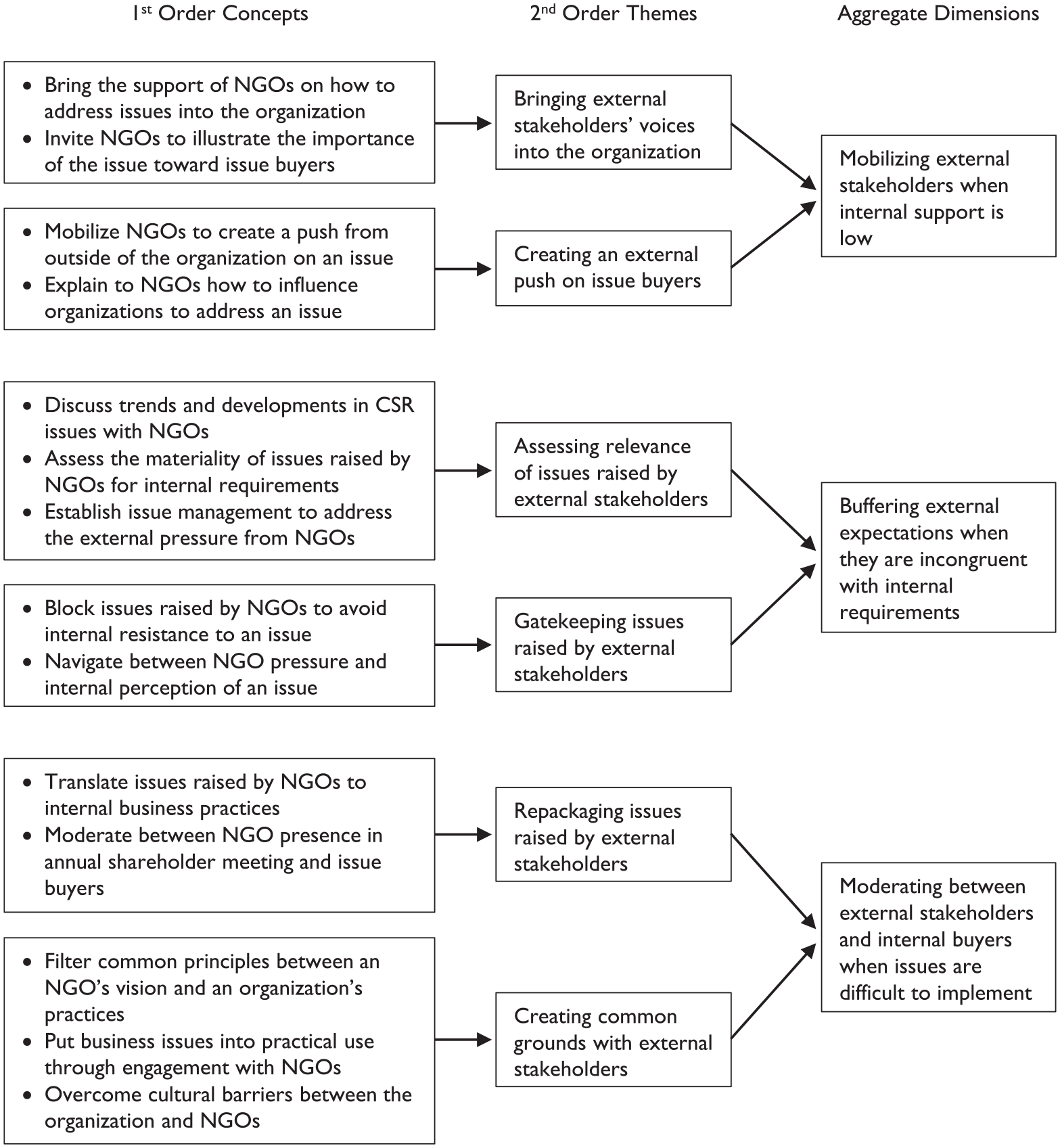
Issue-selling tactics.
Aggregate dimension: mobilizing external stakeholders when internal support is low.

Aggregate dimension: buffering external expectations when they are incongruent with internal requirements.

Aggregate dimension: moderating between external stakeholders and internal buyers when issues are difficult to implement.

Findings: when and how issue sellers engage with external stakeholders
In our analysis, we found that CSR managers are confronted with significant barriers when creating engagement for CSR (Augustine, 2021; Kok et al., 2019; Wickert and De Bakker, 2018). On the one hand, they experience reluctance among internal buyers to engage with emerging issues such as CSR. On the other hand, the expectations of external stakeholders, in particular NGOs, are often perceived as incongruent with internal requirements such that it appears as overwhelming to issue buyers. However, they can also be perceived as legitimate by internal buyers but still appear as abstract and difficult to put into practice. In response to these challenges, issue sellers have developed a set of tactics they employ strategically, depending on the type of barrier: When initial support for an issue is low, they can leverage the influence an NGO may have about certain issues by mobilizing their support; yet, in other situations, they may equally need to shield external expectations by buffering them from internal requirements; or they may need to create a common ground for moving forward by moderating between those groups. In the following, we outline three distinct but interrelated issue-selling tactics to better understand when and how issue sellers engage with external stakeholders.
Mobilizing external stakeholders when internal support is low
Our data revealed that sellers seek to actively mobilize external stakeholders when initial internal support for an issue is low. We first discuss how sellers bring external stakeholders’ voices into the organization, followed by how they create an external push to influence issue buyers. Thus, sellers mobilize external stakeholders’ support in favor of their internal change efforts.
Bringing external stakeholders’ voices into the organization
CSR managers who attempt to implement socially responsible practices in their organization need to create internal support. As NGOs are often at the forefront of raising new issues (e.g. emerging sustainability trends), they can create an external push on organizations to address them. As one issue buyer explained, NGOs raise issues that need to be discussed inside organizations: “They [NGOs] make it [CSR] discussable, they point out the problem” (IB-1-1-1). We found that CSR managers try to pull these external expectations inside the organization to create internal visibility and a strong impetus among top management and other internal buyers that these issues are important:
If I want to get something done, yes, then I can also use external stakeholders to influence top management, so to speak. (IS-29-1-2)
This happens when an issue has low support internally, for instance through a lack of awareness or a lack of attention to the issue. Therefore, when a CSR manager perceives that internal buyers need a “wake-up call” about an issue, they establish contacts with NGOs, bring their voice into the organization, and let them explain why addressing the issue is crucial to internal buyers, given that NGOs have a strong influence on public opinion and can affect reputation:
We had a good story, but I didn’t mind that they [NGO X] shook us awake to take the next step on that issue. Same with NGO 2 actually. We needed to go one step further with palm oil and convey this message, so I needed allies for this. First, I went to NGO 2 to get them on board, and then I went with NGO 2 to top management and explained that we needed to do something about this. More like, NGO 2 supports us, but be careful; I don’t know how long they will support us if we don’t do it, so let’s make use of this. This all went really smoothly. [. . .] It’s a way to use external stakeholders, NGOs, to make the theme [internally] visible. (IS-29-1-2)
Bringing the endorsement of NGOs into the organization increases internal attention to an issue when internal support is low. In addition, it can provide confirmation on whether the organization is on the right track with its policy. This form of approval by external stakeholders gives confidence to internal buyers when they lack knowledge, awareness, or attention when a CSR manager raises an issue internally:
And ultimately, I organize the sessions with suppliers, and also with NGOs where the management is present. So, they hear me asking questions. Asking critical questions or confirming questions to the experts, external experts, so to speak. And the management hears that, hey, the CSR manager is asking a good question or the validation is good. So, they receive confirmation from various external stakeholders that what we are doing is the right thing. And even critical NGOs find that interesting. (IS-29-1-2)
Furthermore, CSR managers explained that they invite NGOs to highlight the importance of addressing the issue to internal buyers. They ask, for instance, “can you hold up a mirror to us?” (NGO-8-4-2). This occurs through lunch seminars, general meetings, presentations, and stakeholder dialogue. Thus, an external stakeholder explains the importance of certain issues since “it’s easier to say something as an outsider” (NGO-11-1-2). One CSR manager explained that during the process of convincing issue buyers of the adoption and implementation of a CSR program, they invited external stakeholders, including an NGO, to highlight the importance of addressing CSR issues. It helps to raise internal support for implementing CSR issues when a director of an NGO that has a lot of “societal sympathy” outlines why a company needs to move in a certain direction:
We have also put the director of NGO 10 in front of [representatives of issue buyers] with a story like: we have many members in this country, we have a lot of publicity, and we have a lot of sympathy. In our opinion, companies like yours need to move in that [sustainable] direction. A better approach on the climate issue, more commitment to renewable energy, [and] better biodiversity conservation. (IS-13-1-2)
During such a presentation, this director (NGO 10) aimed to make a connection between what issues buyers perceive as important and the NGO’s interests. The NGO thus helped to place the issue (i.e. biodiversity) on the organization’s agenda and alert issue buyers about its societal importance:
You try to be compassionate for who they [issue buyers] are; you make your point about biodiversity very clear, including shocking statistics, that we’re at a very low [biodiversity] level in this country. [. . .] And also a bit of sadness and nostalgia about where we came from. And then you see whether you can find a common perspective together. It’s of course also interesting having NGO 10 on your side instead of as an opponent. (NGO-10-4-2)
In summary, our findings illustrated that issue sellers mobilize external stakeholders by bringing the support of NGOs on a specific topic into the organization when there is a lack of attention or awareness among issue buyers. In addition, issue sellers let NGOs explain to issue buyers why it is important to address certain CSR topics. These tactics raise internal attention when such attention initially is low and provide confidence to issue buyers that implementing the issue is the right way to move forward.
Creating an external push on issue buyers
Going beyond laying out NGOs’ agendas for subsequent internal discussion, we found that CSR managers also involve NGOs more directly in their internal issue-selling endeavors by creating an external push that would directly raise some expectations for action. These actions are complex for CSR managers since an NGO has its own agenda and objectives to achieve social and environmental change. Therefore, CSR managers need to carefully navigate and balance the interests of their own organization and the NGO objectives when creating an external push on the organization. Furthermore, they need to build a relationship of trust with NGOs since creating an external push also includes sharing insights on where they got stuck inside their organization:
It’s quite a complicated role. [. . .] You want to build a relationship of trust [with NGOs], in which you also tell them things that are strictly speaking not their business, because you want to provide them with some insight into the internal dynamics, you want to tell them what you’re doing, also the things that didn’t work yet, but where you’re working on. So, you want to show them a little bit about what happens behind the scenes, but you don’t want to put the shit on the table, which could result in a campaign against us. (IS-5-1-2)
One CSR manager mentioned discussing with an NGO, prior to the annual shareholder meeting, what that NGO would ask during that meeting and on which internal topics the CSR manager required support. The CSR manager explained that prior to the meeting, top management did not respond enthusiastically when they raised a specific issue internally, and thus, internal attention to the issue was low. Yet, once the NGO asked how the company addressed this issue during the meeting, top management realized that the issue was important, which internally enhanced the need to act. As a result, board members approached the CSR manager after the meeting to work on the issue. Thus, the issue seller mobilized an NGO to raise the attention of top management to address the issue:
So, I say monetizing is going to be an interesting issue in the coming years. ‘Yes, yes, we’ll see’ [top management]. And then I say to NGO 13, what is your perception of monetizing? [. . .] ‘We think that’s an important issue’ [NGO]. Well, if you find that so important, then it might be useful to ask a question about it. Then, during an annual shareholder meeting, they [NGO] ask a question: ‘What are you actually doing in the area of monetizing?’ Then you first see these people looking like, ‘I think the CSR manager talked about that a while ago?’ So, then they come to find me after this [shareholder meeting]: ‘Well, maybe we should do something with monetizing.’ Then I say, yes, good idea; let’s do that! (IS-19-1-1)
After all, the issue was perceived as more important because this NGO confronted top management during the annual shareholder meeting. The NGO illustrated indeed that CSR managers ask them to question how the organization addresses certain issues if a CSR manager experiences difficulties to move an issue forward because it receives low attention from top management inside the organization:
That also happens, yes. In that way. So, they can also indicate their problems, and we can do something with that. Yes, to help. (NGO-13-1-2)
In summary, we found that CSR managers mobilize NGOs to create engagement for CSR inside organizations when they feel a need for an additional, external push. They bring NGOs’ voices into the organization, helping to emphasize the importance of certain issues and create an NGO-driven push on internal buyers to act on certain issues.
Buffering external expectations when they are incongruent with internal requirements
Our findings indicated that CSR managers are usually the primary contacts in organizations for NGOs. In this role, they act as a buffer between often incongruent, overwhelming, and abstract NGO demands and the requirements and interests of internal buyers. While NGOs aim to bring an issue to the attention of internal buyers, who are ultimately responsible for implementing the required changes, we found that NGOs most commonly discuss the issue with CSR managers first. One CSR manager described their role as follows:
You are a broker of change management, adept at working with internal and external stakeholders. (IS-13-1-2)
Indeed, issue buyers explained that their work may be influenced by NGOs, but this usually goes through CSR managers. These managers are seen as important buffers between the demands of NGOs that may influence the organization’s targets, which one manager from a functional department explained as follows:
The target setting and so on might be influenced by that [NGOs], but that’s then coming in through the CSR director. (IB-13-1-1)
Our data suggested that buffering includes questioning the relevance of issues raised by external stakeholders while also gatekeeping between such external demands and internal requirements. CSR managers are at an organization’s frontline and, in this role, buyers perceive them as “the interface to the outside world” (IB-13-1-1).
Assessing relevance of issues raised by external stakeholders
CSR managers are typically among the first to hear about new issues from NGOs before other internal buyers (e.g. from functional departments) become involved and are the main point of contact for NGOs. CSR managers meet occasionally, either with or without the CEO of their organization, with representatives of NGOs, such as the CEO of an NGO and their program managers. Part of this approach to stakeholder management involves discussing with NGOs their CSR agendas and their perceptions of what would be the right way to address CSR. In this way, CSR managers assess the relevance of issues raised by NGOs for their internal issue-selling actions and act as a buffer when an issue is perceived as incongruent with internal requirements:
The CEO of NGO 8, our CEO, and myself, with the three of us, had a conversation of an hour about their agenda and our agenda. We have a good relationship with NGO 8 and we want to keep it that way –unless they are going to ask things to which we think, ‘you’re out of your mind.’ But because we have a good relationship, we can discuss it and explain that you’re emphasizing something right now we don’t believe in. And then you try to convince each other that you’re right. (IS-8-1-1)
NGOs scrutinize organizations, benchmark them and request organizations to develop policies that address the issue they raise. In addition, NGOs may suggest collaborating with organizations to address specific issues. We found that CSR managers need to manage such requests and assess whether issues raised by NGOs are congruent with internal requirements. Tensions may arise during such conversations because CSR managers may perceive the adoption of a policy as incongruent with internal requirements, while the NGO requests the organization to act. On the one hand, NGOs that raise issues increase attention inside organizations; however, on the other hand, when such issues are internally not perceived as material to internal business practices, this also decreases internal support:
It wasn’t fun; on many points, it wasn’t material. We often sat together for a long time discussing minor issues, nitpicking nonsense. And we felt like we were constantly being lectured, you know. There was absolutely no willingness to listen to our side of the story, so that wasn’t fun, but it did help. And I have to tell you, I’ve put a lot of hollow phrases in the policies. Oh, does NGO 7 want us to write that down? Sure, we’ll just write that down. We don’t really do all that, but if you want us to [write that down]. [. . .] And that often didn’t do well internally. NGO 7 increased attention for the issue, but a lot of people also got a bad taste in their mouths about it. (IS-1-1-2)
CSR managers perceive responding to issues raised by NGOs with an activist agenda as a time-consuming task and need to manage the issues raised. In addition, occasionally, CSR managers need to discuss the issues raised by NGOs with internal buyers. They illustrate that when NGO claims are not sufficiently substantiated and are perceived as incongruent with internal requirements, it decreases support for the issue internally:
Too often, a claim is made that my business colleagues dismiss, saying, ‘Pff, this really doesn’t make any sense at all.’ (IS-5-1-1)
Moreover, CSR managers argue that managing such issues comes at a cost, content-wise, of their internal issue-selling endeavors because “it distracts us from where we think we should be working on” (IS-5-1-1). Studies by NGOs about how organizations address CSR issues raise questions by external stakeholders and CSR managers need to respond to the questions of, for instance clients, who ask for explanation about studies conducted by NGOs:
It takes an awful lot of time, but we are affected to a limited extent, especially with, let’s say, public clients [. . .]. There’s always someone waving around a study from NGO 7 and saying: ‘We should leave your organization [. . .] because NGO 7 says,’ and then we have to explain that. (IS-5-1-1)
Meanwhile, the NGO argues that studies it conducted have increased the pressure on organizations to take action on CSR issues. However, the interviewee noticed that their studies have two effects on actors inside organizations. On the one hand, they increase public pressure which enhances internal attention to address the issue. On the other hand, CSR managers need to defend themselves internally about the way the organization addresses the issue:
Yes, it’s challenging, isn’t it? That’s just wonderful. Yes, I know, the CSR manager (IS-5-1-1), sometimes he was sour, sometimes he was in a better mood and was cheerful about it. We’ve also had really good conversations with each other. You don’t always have to agree, right? But yeah, at some point, the CSR manager had to defend himself, also internally, like, ‘we haven’t got it all sorted out yet.’ [. . .] That has put a lot of pressure on them [CSR managers]. Especially the practical studies. (NGO-7-1-2)
In sum, we found that CSR managers initially receive NGO pressure and act as buffers between NGOs and internal buyers. They assess the relevancy of issues raised by NGOs for organizations’ business practices since raising issues raised by NGOs internally when it is perceived as incongruent with internal requirements may decrease internal support for CSR issues.
Gatekeeping issues raised by external stakeholders
Buffering also requires CSR managers to carefully consider when and how to discuss issues received from NGOs with internal buyers. Direct communication may result in internal resistance to the issue, reducing internal support. Sometimes, CSR managers even block the issues raised by NGOs because they feel they would risk their own position by raising the issue in their organization. This occurs if they perceive the issue’s quality not to be sufficient for confronting internal buyers, such as if the research methodology lacks quality or the evidence is insufficient:
Then you say, as an issue seller, I’m not going to bother my colleagues with this. This doesn’t make any sense. I’m at risk now! I will damage my own reputation if I go forward with this, because this doesn’t make sense at all. (IS-5-1-2)
CSR managers need to navigate between the pressure of NGOs and internal perceptions on CSR issues when assessing their issue-selling actions. NGOs can raise issues they perceive as important, but organizations need to implement it in their business practices on the ground. CSR managers play an important role in assessing the feasibility of addressing CSR issues that NGOs raise. As a CSR manager explained, when collaborating with an NGO, the NGO argued that all palm oil in their products needed to be certified, but the CSR manager explained the complexities with such a request since it would take a long time to scrutinize all their products and engage with all actors in the supply chain. The CSR manager thus plays an important role in buffering between the NGO and internal buyers, by bridging different interests and assessing potential congruence with internal requirements:
Look, we are really focused on reality. We work with people on the ground, even ten steps back in a chain where it’s very complicated to take action with the people and so on. You know, taking a step there. So, we have to think with, kind of, the lens of reality. And for NGO 10, it’s very easy to say. For example, in the last collaboration, they said in one sentence: one hundred percent of your palm oil must be certified. Well, that took about three years of a full-time person to do. But for NGO 10, they can say and demand that in one sentence, very briefly. And for a company, it’s really three years of work to do that. Yes, that’s just a different reality. Because we really, yes, we really have to do it. We have to implement it. So, we have to talk to thousands of suppliers and figure out which products contain palm oil. Check if it’s certified and request all kinds of chain of custody audits. (IS-30-1-2)
The NGO argued that complexities when engaging with organizations go in both directions. From their perspective, contacting all the palm oil suppliers seemed a straightforward request, but this appeared to be different in reality. On the other hand, questions organizations ask to NGOs about specific topics may also be very complex for NGOs. Thus, tensions and complexities arise when organizations and NGOs engage because organizations and NGOs have different perspectives on how to address issues:
I also think that the complexity is occasionally forgotten when dealing with a simple question. This applies to us toward them as well because I remember that we also said, ‘Just ask all your palm oil suppliers to do x, y, and z.’ Well, they didn’t know who their palm oil suppliers were, while we were saying, ‘Just write a letter and done.’ So, from our side, it was very easy, but they can also ask us something where I think, ‘Wait, what you’re asking now, it’s not very easy to answer now with yes or no.’ But these are different worlds. (NGO-10-3-2)
In summary, we found that buffering between external stakeholder demands and internal buyers is a vital role for issue sellers when issues are perceived as incongruent with internal requirements. They assess the relevancy of new issues and decide how to bring them into the organization while also acting as gatekeepers by assessing whether issues raised externally meet internal requirements.
Moderating between external stakeholders and internal buyers when issues are difficult to implement
While the first two tactics concerned actively pushing for new issues (mobilizing) when internal attention is low and keeping others at a distance (buffering) when issues are perceived as incongruent with internal requirements, we found a third tactic—moderating—that focuses on bringing internal and external parties together when an issue is difficult to implement and implementation pathways are unclear for issue buyers. When moderating, CSR managers repackage externally raised issues such that they correspond to internal business practices. Moreover, they create common grounds with NGOs and their organizations based on mutual interests about an issue. As internal buyers noted, NGOs “inform my work” (IB-16-1-1), but if organizations collaborate with NGOs, it is important “that you can also connect it to business goals” (IB-8-1-1). This aligns the issue with internal business practices.
Repackaging issues raised by external stakeholders
We found that NGOs often raise issues that represent “big” problems that affect society at large and require large-scale organizational change and systemic transformation, such as human rights issues:
This was an issue about which we thought: everything comes together. This is about human rights related to their well-being, their habitat, as opposed to the interests of some companies, some multinationals. [. . .] Two Dutch organizations were involved [organizations 5 and 7]. [. . .] Due to these kinds of issues, you can make a company change their entire policy, and you need to take this opportunity and we do that. (NGO-8-1-1)
These expectations, however, often remained difficult to implement by issue buyers. In such cases, CSR managers argued that they were aware of the importance of the issue but did not want to use NGO pressure as an argument to create organizational change. Therefore, they needed to engage with top management and internal buyers from functional departments to see whether there was internal support for addressing the issue. In this case, top management asked the CSR manager to handle the issue, but the CSR manager needed to engage with buyers from functional departments and involve them in the process of taking action since addressing the issue may come at a cost for the business operations of the functional department:
And then, you see, the issue seller is actually engaged in a large internal negotiation about what needs to happen in terms of content, what commercial interests are at play, what the top management thinks about it, whether it receives attention or not, whether it becomes important or not, whether the reputation of the organization is at stake, you know? So, they make the plan. (IS-5-1-2)
The CSR manager translated the issue raised by the NGO for internal buyers, based on business arguments. Accordingly, the pressure from the NGO did create awareness of the issue but, as such, it was difficult to implement by buyers from functional departments. However, the CSR manager translated it into different terms that aligned it with internal policy arguments:
Then we have an internal argument, a policy argument, to say we’re going to take action, which is triggered by this NGO, but you never want to admit as an organization that you bow under the pressure of an NGO, because otherwise they knock on your door even faster the next time. [. . .] So, you absorb the pressure. As a seller, you do try to sell the issue internally, but you never try to sell it as a successful action of an NGO, because otherwise, you know, next time, you’re the first in line. (IS-5-1-2)
NGOs also raise issues at annual shareholder meetings to obtain a commitment from the board to address an issue. The board may, however, only make a commitment after an internal discussion about its feasibility. Here, the CSR manager moderates between the NGO and internal buyers to scrutinize the feasibility of implementing the issue inside the organization when the issue is difficult to implement by internal buyers. A benefit of such engagement is that it facilitates internal conversations between CSR managers and internal buyers to discuss its importance for internal practices. For example, before one NGO raised an issue at an annual shareholder meeting, the CSR manager has a conversation with the NGO, and thereafter, the CSR manager presented the issue to the board to assess the feasibility of implementing it. This not only created internal awareness but also made the issue more comprehensible internally:
This also worked internally really well because the board of directors read the questions in advance. I discussed the questions with them in advance. [. . .] Because of this, we had an extensive internal dialogue prior to the annual shareholder meeting. Really great. (IS-1-1-2)
Thus, our findings illustrated that issue sellers repackage issues when they are difficult to implement by internal buyers. Issue sellers, for instance, translate the issues raised by NGOs to internal business practices and moderate between NGOs and top management during annual shareholder meetings.
Creating common grounds with external stakeholders
CSR managers also play a critical role in creating solutions common grounds between their organization’s internal requirements and external stakeholders’ expectations. In many cases, CSR managers scrutinize the issues raised by NGOs to understand how they affected their organization. One informant explained that even if “external wishes don’t deviate that much from the internal goals” (IS-1-1-2), the main challenge for the CSR manager is to “bring this together” (IS-1-1-2), thereby creating common grounds. However, when creating common grounds between NGOs and internal buyers, CSR managers play a critical role here, since they speak the language of NGOs and internal buyers and bring NGOs’ vision and internal requirements together.
Organizations and NGOs may exhibit a general willingness to partner or collaborate but disagree on the details. The CSR manager plays an important role here in overcoming barriers for collaboration and illustrating the viability of addressing the issue by engaging with NGOs. For instance, one CSR manager exemplified such mutual interests, explaining that they deliberately engaged with NGOs from a strategic point of view since NGOs have contacts in different locations around the world and that their organization is able to reach out to these locations by engaging with NGOs:
We want to deliver our [product] solutions to, you know, all of society and we can reach some of society through the packaged goods that you and I buy in the supermarket, but there are other parts of society that we can’t reach and that we can only reach through those kinds of relationships [with NGOs]. And through those kinds of relationships, we’re able to innovate and invent new solutions that can be of benefit elsewhere in society. (IS-16-1-1)
The NGO with which this organization partners explained that said organization has its own business and CSR targets but can only achieve them by engaging with NGOs with contacts in parts of the world where they aim to sell their products. Meanwhile, the NGO has its own objectives, for which partnering and collaborating with business organizations is instrumental. As a result, putting issues into practical use by engaging with NGOs is vital to achieve business goals:
For instance, organization 16, they have several goals for the coming years. [. . .] They embrace some SDGs and have set goals on these [SDGs] as a company, but they can’t reach these goals by themselves only. They really need partners in the field to achieve this. Organization 16 offers several products, but they can’t help millions of people directly, because these people don’t buy it from them. Thus, one way is that they [organization 16] have goals in the area of CSR themselves and perceive us as a partner to really achieve these goals. (NGO-6-3-2)
Interactions between organizations and NGOs may also result in tensions between them due to cultural barriers when they address an issue together. CSR managers can play a crucial role in this respect by bringing the interests of the organization and the NGO together and managing complexities in the engagement process. For instance, a CSR manager explained that their organization clashes with NGOs in terms engagement pace. The organization wants to quickly move on while the NGO needed more time to discuss the collaboration internally:
We are all about speed, go, go, go. And that is also a culture clash. Major culture clash. I still notice that now. But yeah, that’s how it is. So, we have to be a bit calmer. A bit more patient, so to speak. And NGO 10 just has to be a bit faster. (IS-30-1-2)
More specifically, the CSR manager argued that most of the management in setting up the collaboration was about managing the pace of the NGO, selling to the board why the engagement proceeded at the pace it proceeded and why creating common grounds took more time. Thus, the CSR manager played an important role in overcoming cultural barriers between the organization and the NGO:
Where I had to do the most internal management, was in how slow they [NGO 10] were going. So, it was more like, you know, our CEO saying; okay, where are we? How far have we come? Why don’t I have a contract yet? And me really having to manage everything. Sort of; oh no, but they are working on it, and it takes a while. So yes, that was actually the difficult part for me. (IS-30-1-2)
At the same time, the NGO in case argues that organizations complain that NGOs are slow in their interaction with organizations, but that organizations, at the same time, are not very fast in implementing CSR issues. Organizations want to have quick responses to their questions, but answering such questions and discussing how to address an issue also requires discussions between members of the NGO:
We always hear this, are considered slow. It might be true in certain aspects, but I also believe we can say the same in reverse. Naturally, we think that many companies, including organization 30, could have moved much faster on certain issues. Sustainability doesn’t progress that quickly there, you know. [. . .] In terms of interaction, yes, they want quick answers, and we need to think about it and have internal discussions. That’s true, but in reverse, it’s not like their speed and implementation of sustainability are exceptionally high. (NGO-10-2-2)
In sum, we found that a crucial tactic of issue sellers involves moderating between external stakeholders’ expectations and issue buyers’ internal requirements when issues are difficult to implement by internal buyers. They repackage issues and aim to create common grounds when addressing an issue together and sell this to issue buyers inside their organization.
Overall, we argue that given the importance of external stakeholders in issue selling and issue sellers’ active engagement with them, as indicated by our data, their overall role of sellers in the issue-selling process can be better understood as that of issue brokers who sit between external stakeholders and internal buyers. The next section develops a conceptual model of when and how issue sellers become issue brokers in organizational contexts.
Toward a model of when and how issue sellers become issue brokers
Figure 2 presents the basic relationships between the three focal actors and associated tactics that issue sellers employ. This underscores how issue sellers move from their traditionally conceptualized, internally focused role to that of an issue broker in situations of strong external pressure on their organization to address specific issues. Our findings confirm that issue sellers engage with internal buyers to sell the need to implement CSR within their organizations’ functional departments, as the issue-selling literature has demonstrated (e.g. Howard-Grenville, 2007; Lauche and Erez, 2023; Wickert and De Bakker, 2018). Yet, departing from earlier work that has demonstrated the general importance of external stakeholders (Daudigeos, 2013; Gond et al., 2018; Lauche, 2019), we expand this perspective by demonstrating when and how issue sellers engage with external stakeholders and how this engagement influences issue selling inside organizations. While our findings allowed us to portray different tactics that issue sellers have available to them, we also identified important conditions that explain when those tactics are used, thus suggesting that issue sellers strategically navigate between external expectations and organizational goals.
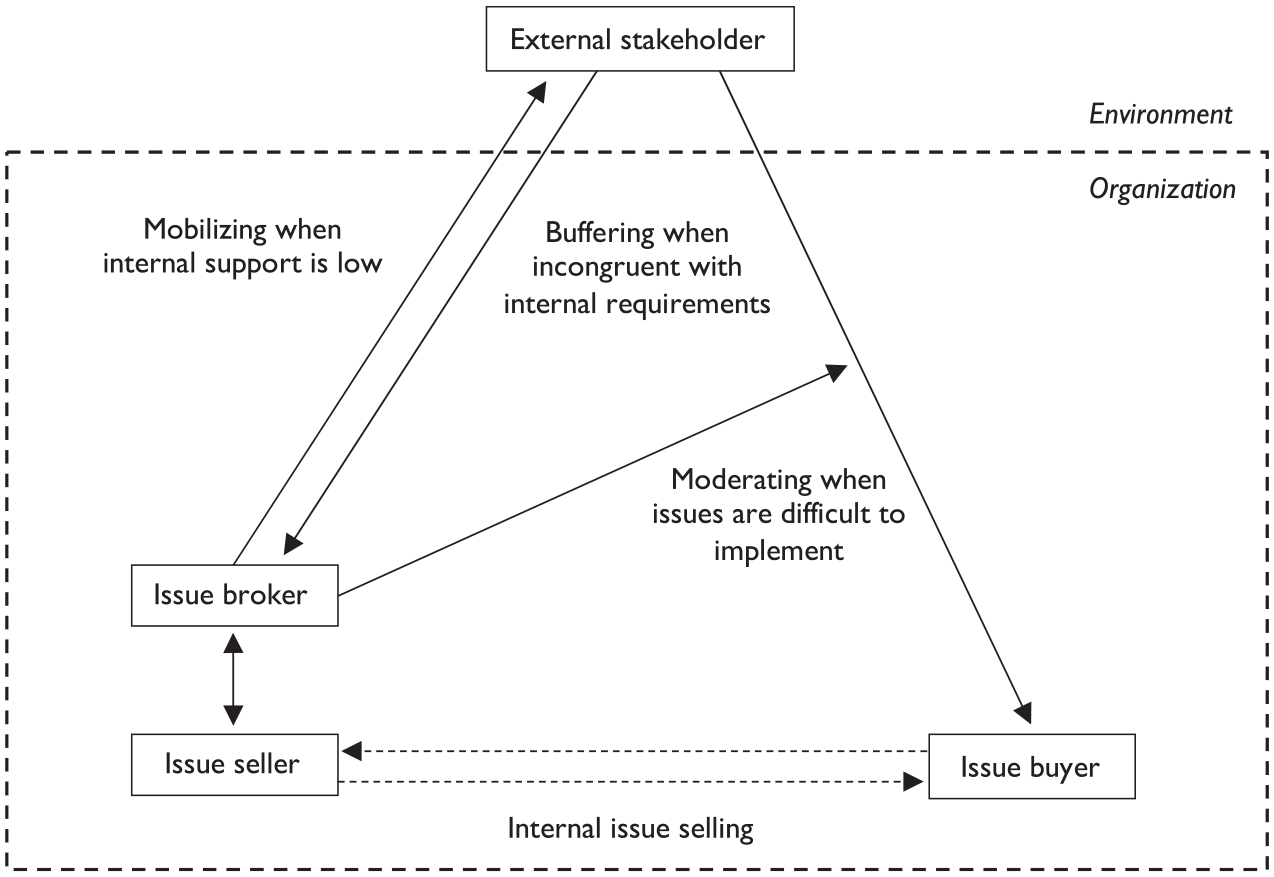
A model of when and how issue sellers become issue brokers.
Figure 2 depicts three main routes for engagement issue sellers have at their disposal. First, mobilizing external stakeholders when initial support for an issue is low to bring their voices inside organizations and create an external push to raise internal awareness and understanding of an issue, which adds strength to their own internal claims. Second, buffering between external stakeholders’ demands and internal buyers when external expectations are incongruent with internal requirements to avoid attending to non-material issues. Buffering allows sellers to retain ownership of implementation pathways, and they can select both which issues to work with, and how to work with them. Third, moderating between external stakeholders and internal buyers when issues are difficult to implement by internal buyers. Moderating involves repackaging the stakeholders’ expectations into the buyers’ terms and seeking to create common grounds between external stakeholders and the organization when addressing an issue together. Thus, they facilitate the engagement process. Based on these observations, we propose the role of an issue broker as a more suitable description for these issue sellers, who face high expectations from external stakeholders and must navigate between them and internal buyers to orchestrate their overall relationship and achieve their objectives.
Theoretically, this role resonates with and specifies the concept of brokerage, which refers “to an actor who facilitates transactions or resource flows” (Gould and Fernandez, 1989: 91). In the context of our study, and given the nature and agency of CSR managers, the facilitation of transaction or resource flows from external stakeholders toward internal buyers is especially present for those CSR managers that face strong expectations of external stakeholders, such as external regulations, social pressures and market forces. This emphasizes the role of CSR managers a lynchpin between external stakeholders and internal buyers by making sense of external expectations inside organizations. However, brokers also use different strategies and tactics, such as to “coordinate action or information between distant parties who have no immediate prospect for direct introduction or connection” (Obstfeld, 2005: 104). In addition, brokers may maintain and exploit some separation between parties or play an active role in facilitating interaction between them while maintaining a coordinative role (Obstfeld, 2005), such as mobilizing external stakeholders or buffering between them and internal buyers. Thus, as we illustrate, issue sellers that face strong external stakeholder pressure navigate between acting as a lynchpin between external stakeholders and internal buyers, but also strategically use external stakeholders to move their internal change agenda forward.
The literature has studied brokerage activities in social networks (Obstfeld et al., 2014; Quintane and Carnabuci, 2016), and some studies have used the brokerage lens to examine topics around social responsibility and sustainability in nonprofit settings (e.g. Phillips and Taylor, 2020; Van Wijk et al., 2013). In fact, there is also a growing body of research on the brokerage roles of middle managers inside organizations (Glaser et al., 2021; Shi et al., 2009; Van Grinsven and Heusinkveld, 2023). We build on and extend this literature on brokerage roles within organizational boundaries by going beyond said boundaries and introducing external stakeholders to the repertoire of brokerage roles, and illustrate that managers with brokerage roles also strategically engage with external stakeholders. More specifically, we distinguish different ways in which CSR managers act as brokers between internal organizational members and external stakeholders, and when they use different tactics dependent on how issues are perceived internally.
Discussion
Our research question asked when and how issue sellers engage with external stakeholders to sell issues inside organizations. Our conceptualization of a more accurate role for sellers as issue brokers, which they realize vis-à-vis both internal buyers and external stakeholders, and our specification of the conditions under which they employ the different engagement tactics answers this question. Overall, our main contribution is linking research on brokerage roles with the issue-selling literature to expand the prevailing internal perspective on issue selling, next to adding to research on CSR implementation and the role of CSR managers.
When issue sellers become issue brokers
Taking a brokerage view of issue selling when issue sellers engage with external stakeholders enriches our understanding and will allow issue sellers, firms, and external stakeholders to better understand their mutual interactions. We identified three routes for engagement, where issue selling involves a skillful interplay by sellers between mobilizing, buffering, and moderating between external stakeholders and internal buyers because each of these tactics becomes more adequate depending on how issue sellers and buyers perceive an issue at stake. Our study illustrates how a context of high stakeholder pressure shapes support for a social issue (Sonenshein et al., 2014) and highlights the role of issue sellers in engaging with actors in the organization’s context. While research on issue selling highlights that the organizational context shapes opportunities and barriers for issue selling (Howard-Grenville, 2007), our study advances this view by explaining how external stakeholders shape opportunities and barriers for issue selling and concomitant tactics and when issue sellers turn to which tactic. Sellers can mobilize stakeholders from organizations’ environmental context to create internal issue support when goals align; however, they must also act as a buffer between external expectations and internal requirements to avoid overwhelming external demands to potential issue buyers within the organization.
Studies on issue selling have further illustrated that sellers use packaging moves to create internal support for issues (Dutton and Ashford, 1993; Dutton et al., 2001). Our study demonstrates that issue sellers also repackage issues raised by external stakeholders to make them more compatible with internal buyers’ interests. This highlights a repertoire of engagement strategies that sellers must possess. Similarly, organizations will not respond to issues if there is no individual concern or congruence with organizational values (Bansal, 2003); yet, external stakeholders who pressure organizations to adopt an issue (e.g. Amer and Bonardi, 2023; Den Hond and De Bakker, 2007; Proffitt and Spicer, 2006) raise such concerns and provide issue sellers with arguments to move issues forward inside their organizations.
Our study also speaks to research on the relationship between sellers and buyers (e.g. Lauche and Erez, 2023; Sonenshein, 2016; Wickert and De Bakker, 2018). Research has illustrated that “relationship-building efforts to create mutual understanding of an issue” (Wickert and De Bakker, 2018: 67) and “collective interaction and the relational history” between sellers and buyers (Lauche and Erez, 2023: 554) are critical when selling issues. We expand such work by bringing a third party into the relationship—namely external stakeholders—and specifying the roles that indicate how issue sellers engage with those actors. Given the importance of such interactions, sellers must carefully balance external stakeholder demands and organizational goals. This implies that timing is crucial (Dutton et al., 2001) when sellers mobilize external stakeholders for internal change, as is acting as a buffer to maintain relationships with internal buyers if external stakeholder demands seem incompatible with individual concerns and organizational values (Bansal, 2003).
We also advance extant research on brokerage roles, which has focused largely on intra-organizational relationships (Gould and Fernandez, 1989; Obstfeld et al., 2014; Shi et al., 2009). Shi et al. (2009) distinguished between the different brokerage roles of middle managers inside organizations, specifically illustrating how they broker between their peers and between top and low-level managers. They also recognized that middle managers may engage with actors outside their organization and recommended future research to scrutinize those brokerage roles, enlarging the boundary of firms to include outside relationships (Shi et al., 2009). Our study answered their call by examining the brokerage roles that sellers adopt when engaging with external stakeholders. In fact, our findings expand the current repertoire of brokerage roles by demonstrating that issue sellers can mobilize external stakeholders to create internal change and achieve their strategic objectives. This brokerage role of mobilization adds to the brokerage role of representation outlined by Shi et al. (2009), as it indicates the potential to have a stronger impact on the way brokers can champion strategic initiatives. Moreover, their ability to repackage and transfer information and create common grounds with external stakeholders that cater to internal strategic initiatives enriches the traditional focus of middle managers’ brokerage roles, which remained within the boundaries of an organization (e.g. Glaser et al., 2021; Shi et al., 2009; Van Grinsven and Heusinkveld, 2023).
How CSR managers engage with external stakeholders to manage social change
Our study also adds to recent studies on how CSR managers take action to manage their internal social change efforts (Augustine, 2021; Girschik, 2020; Heucher et al., 2024; Osagie et al., 2019; Risi and Wickert, 2017; Wickert and De Bakker, 2018) and to the wider individual-level literature on CSR (Gond and Moser, 2021). Managing CSR implementation requires different competencies (Osagie et al., 2019), strategies for engaging with members of the organization (Wickert and De Bakker, 2018), and alignment between internal and external stakeholder interests (Girschik, 2020). We expand this literature by specifying how CSR managers strategically engage with one of their key external stakeholders, namely NGOs, to manage external stakeholder expectations vis-à-vis internal organizational conditions.
While the role of external stakeholders in CSR has long been acknowledged, the exact specification of when and how they are involved in firms’ CSR implementation is still missing, as is how relationships unfold between CSR managers who strategize and develop CSR initiatives, functional managers who are expected to execute them, and external stakeholders who reflect the societal pressure to adopt CSR (Risi et al., 2023). Thus, our findings speak to individual-level research about how individuals influence each other regarding CSR implementation (Gond and Moser, 2021). More specifically, our study answers the call to scrutinize how tactics toward internal and external stakeholders complement each other and how “internal activists” navigate the pressure stemming from outside their companies (Girschik et al., 2022). This complements a rich stream of research on CSR managers’ engagement strategies for implementing CSR within their organization (Hunoldt et al., 2020; Osagie et al., 2019; Risi and Wickert, 2017).
Furthermore, our conceptualization of the brokerage role of CSR managers extends research on them as internal change agents (Hunoldt et al., 2020; Kok et al., 2019; Wickert and De Bakker, 2018), broadening this perspective to change agents who can actively engage with internal and external stakeholders relevant for CSR implementation (Gond et al., 2018). We found that CSR managers not only internally advocate for CSR but also act as an interface to the outside world on issues of CSR. This brokerage role is challenging as they must deal with conflicting interests, translate different requirements, and bring them together or keep them apart.
Boundary conditions and future research
Our research has certain boundary conditions that emerged due to its qualitative nature and its specific focus. Thus, while we believe that we have offered rich insight into our case, the generalizability of our model needs to be treated with care. Crucially, we used CSR as an umbrella term for a basket of social and environmental issues to provide a broader understanding of the different tactics that CSR managers employ. While we attempted to tease out when they are more likely applied by brokers, future research may further examine whether they vary depending on the character of the issue (e.g. human rights in the supply chain versus biodiversity near production facilities), and the intensity and presence of stakeholders advocating action on those issues, which can differ across countries and industries. Future research should therefore investigate such circumstances to explain how the different tactics we found—mobilizing, buffering, and moderating—vary across different contexts and organizations. This includes expanding our model to other contexts beyond CSR, such as debates on the ethical implications of technological advancements, which are characterized by strong interplay between issue sellers and internal buyers as well as interaction with external stakeholders, thus rendering the brokerage role more adequate.
In relation to the above, we focused on a specific external stakeholder group (i.e. NGOs), which limits our findings’ generalizability. Attention to other stakeholder groups advocating for social change in organizations is important, as governments and investors, for example, play an increasingly influential role in the CSR landscape next to NGOs. In fact, our findings indicate that CSR managers also engage with other stakeholders, such as customers, local communities, and government agencies; yet, to retain analytical clarity, we focused on the stakeholder group for whom ties featured most prominently in our data. We do expect that when and how issue sellers engage with external stakeholders depends on the type of issue and the importance of the external stakeholder for internal buyers. Thus, while our focus was on issue selling within the context of CSR, we generally expect issue sellers to consider the effectiveness of their issue-selling tactics, such as mobilizing, buffering, or moderating, depending on the specific issue and the importance of the external stakeholder.
In terms of directions for future research, ethnographic studies (Bansal, 2003; Howard-Grenville, 2007; Vesa and Vaara, 2014) would be useful for studying when, how, and for what types of issues sellers engage with different external stakeholders. This is because some tactics may be more adequate and effective depending on the sequence or moment in which they are raised. Longitudinal studies may provide new insights into the patterns and sequences of issue selling to internal and external stakeholders. Furthermore, engagement with external stakeholders might over time invite for even tighter scrutiny of an organization by the involved external stakeholders as they gain more insight into internal dynamics. It is thus interesting to examine to what extent organizations would try to either promote or push back such scrutiny.
Conclusion
This study has illustrated when and how issue sellers engage with external stakeholders to sell issues inside organizations. We have extended the issue-selling literature, which had mainly focused on internal issue selling, by incorporating how issue sellers engage with external stakeholders. Our main contribution lies in the conceptualization of the role of issue sellers as issue brokers when they engage with external stakeholders along with internal buyers to address issues inside their organizations. Knowing more about the ways societal issues find their way into an organization is important in times where the societal role of business is increasingly debated.
Footnotes
Acknowledgements
We thank Co-Editor Amit Nigam for his excellent guidance during the review process and the three anonymous reviewers for their insightful comments. The manuscript has been presented at EGOS 2018 in Tallinn, at the Academy of Management Annual Meeting 2021, and the GRONEN Reading Group in 2023. We thank all the discussants for their valuable feedback.
Funding
The author(s) received no financial support for the research, authorship, and/or publication of this article.
Author biographies
 ). His research examines corporate social responsibility (CSR) and corporate sustainability as well as the broader relationship between business and society by drawing on various strands of organization and management theory. Christopher’s research has appeared in journals such as the Academy of Management Discoveries, Business & Society, Harvard Business Review, Human Relations, International Journal of Management Reviews, Journal of Business Ethics, Journal of International Business Studies, Journal of Management Studies, Organization & Environment, Organization Studies, and Strategic Organization, as well as in several book chapters. He is currently General Editor of the Journal of Management Studies.