



Abstract
This paper focuses on an emergent debate about the microfoundations of organizational social networks. We consider three theoretical positions: an individual agency perspective suggesting that people, through their individual characteristics and cognitions, shape networks; a network patterning perspective suggesting that networks, through their structural configuration, form people; and a coevolution perspective suggesting that people, in their idiosyncrasies, and networks, in their differentiated structures, coevolve. We conclude that individual attitudes, behaviors, and outcomes cannot be fully understood without considering the structuring of organizational contexts in which people are embedded, and that social network structuring and change in organizations cannot be fully understood without considering the psychology of purposive individuals. To guide future research, we identify key questions from each of the three theoretical perspectives and, particularly, encourage more research on how individual actions and network structure coevolve in a dynamic process of reciprocal influence.
Keywords
To what extent do individual people construct and shape the social networks in which they are embedded? And to what extent are these networks constitutive of the individuals themselves in terms of individuals’ characters and outcomes? These questions are at the heart of an emerging debate concerning the microfoundations of organizational social networks. The debate is between those who view the underpinnings of individuals’ network behaviors from a largely psychological perspective and those who view the network patterns by which individuals are constituted from a largely sociological perspective.
This debate has gone relatively unnoticed in prior reviews of organizational social network research (e.g., Carpenter, Li, & Jiang, 2012; Dobrow, Chandler, Murphy, & Kram, 2012; Phelps, Heidl, & Wadhwa, 2012). Indeed, basic questions concerning the microfoundations of social networks have been neglected despite regular calls for more social network research on micro-organizational behavior topics in general (e.g., Krackhardt & Brass, 1994) and on specific topics, such as leadership (e.g., Balkundi & Kilduff, 2006) and job design (e.g., Kilduff & Brass, 2010). On the other side of the debate, claims that “persons are contingent by-products” of social network systems (White, 1992: 346) have gone unanswered.
In this paper, we focus on this emergent debate about the microfoundations of social networks. We examine three distinct positions, asking whether the people, considered as individuals with characteristic traits and cognitions, make the network; whether the network, through structural patterning, makes the people; or whether people, in their idiosyncrasies, and networks, in their differentiated structures, coevolve (cf. Schneider, 1987).
On the side of the psychology of the individual, there is classic research concerning the ways in which personality differences (such as authoritarianism) predict individuals’ network preferences (Newcomb, 1961) and concerning the ways in which patterns in the mind anticipate patterns in social networks (e.g., De Soto, 1960; Heider, 1958). This research speaks to the view that individuals’ personalities and cognitions shape the network positions individuals occupy and the network patterns they utilize.
On the network patterning side of the argument is the view that individuals’ psychological states depend on the social situations in which people find themselves embedded (e.g., Lewin, 1936). This view asserts, for example, that individuals’ distinctive social personalities derive from participation in social networks (Warner & Lunt, 1941). The structural tradition in social network research bypasses the possibility that differences in psychology or personality lead to differences in social network outcomes (e.g., Mark, 1998; White, Boorman, & Breiger, 1976). The structural tradition traces individual differences to differences in the social network structures that enable and constrain individual action.
On the coevolution side, emerging research is investigating whether distinctive individuals on one hand and complex social networks on the other hand recursively influence and constitute each other (e.g., Schulte, Cohen, & Klein, 2012). Individual actors are constituted in part through their relationships with others in the network, but these actors also bring to the network idiosyncratic motivations, personalities, self-expressions, and perceptions (cf. Kilduff & Krackhardt, 2008).
Whatever one’s take on this debate, the irreducible fact is that each network involves individual people connecting or failing to connect across social space. Even at the level of organizational alliances, for example, trust is forged at the interpersonal level through social and work interactions before formal agreements are concluded (Larson, 1992). Friendship links are important not just for socializing outside of work but also for understanding CEO-level strategy formation (McDonald & Westphal, 2003). Patterns of friendship and kinship link companies together in ways not anticipated by assumptions concerning utility maximization (e.g., Uzzi, 1997). Company strategy can, indeed, be undermined by single individuals prominent in social networks but invisible to corporate hierarchy (R. S. Burt & Ronchi, 1990). Our focus on microfoundations, therefore, involves a focus on individuals and their social interactions.
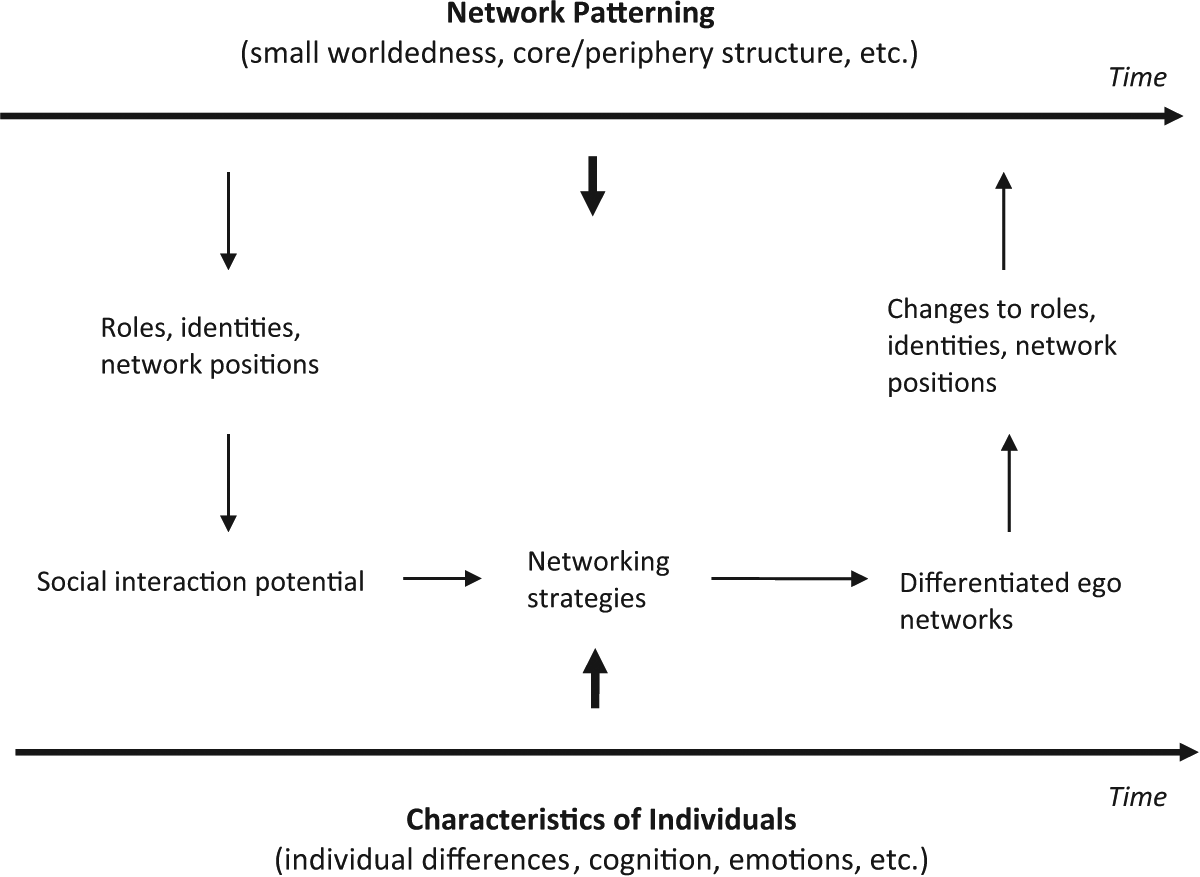
In advance of detailed articulation of the different perspectives, Figure 1 (which borrows from the bathtub model of micro-macro action developed by Coleman, 1986: 1322) offers an overview of our arguments. At the bottom of Figure 1, we depict how the characteristics that individuals bring to organizational settings (e.g., genetic differences, personality, cognition, emotions) are likely to feed into ongoing social interactions, networking strategies, and emergent ego networks. At the top of Figure 1, we depict how network patterning (e.g., small worldedness, core/periphery structures) shapes the roles, identities, and network positions that are available and that people fulfill within organizations. The figure as a whole depicts the recursive process by which individuals and organizational networks coevolve over time. Individuals who are new to organizations find themselves embedded within existing informal and formal networks that display structural features such as small worldedness. The roles, identities, and network positions that individuals find available offer potential social interactions. These interaction possibilities call forth individual differences in personality, cognition, and other attributes represented across the bottom of the figure.
The Coevolution of Individuals and Networks
The People Make the Network
The most defining characteristic of social network research is its emphasis on the study of relations between actors (Freeman, 2004), relations that connect individual actors on dimensions including friendship, advice, discussion, and dislike. As an early review of network research in organizational settings asserted, “The social network approach views organizations in society as a system of objects (e.g., people, groups, organizations) joined by a variety of relationships” (Tichy, Tushman, & Fombrun, 1979: 507). Because of this emphasis on links between members of dyadic pairs, characteristics of the individuals making up the dyads have tended to be neglected. Indeed, organizational network research has been characterized as part of a general movement “away from individualist, essentialist and atomistic explanations toward more relational, contextual and systemic understandings” (Borgatti & Foster, 2003: 991). Thus, social network research has typically subscribed to an anti-categorical imperative in avoiding or forbidding reliance on the analysis of attributes of actors (e.g., Erickson, 1988; Mayhew, 1980; McPherson, Popielarz, & Drobnic, 1992). This has led social network research to ignore actors’ identities, agencies, and history (Emirbayer & Goodwin, 1994) in ways that are increasingly challenged even among those sympathetic to a structuralist agenda (e.g., Pachucki & Breiger, 2010).
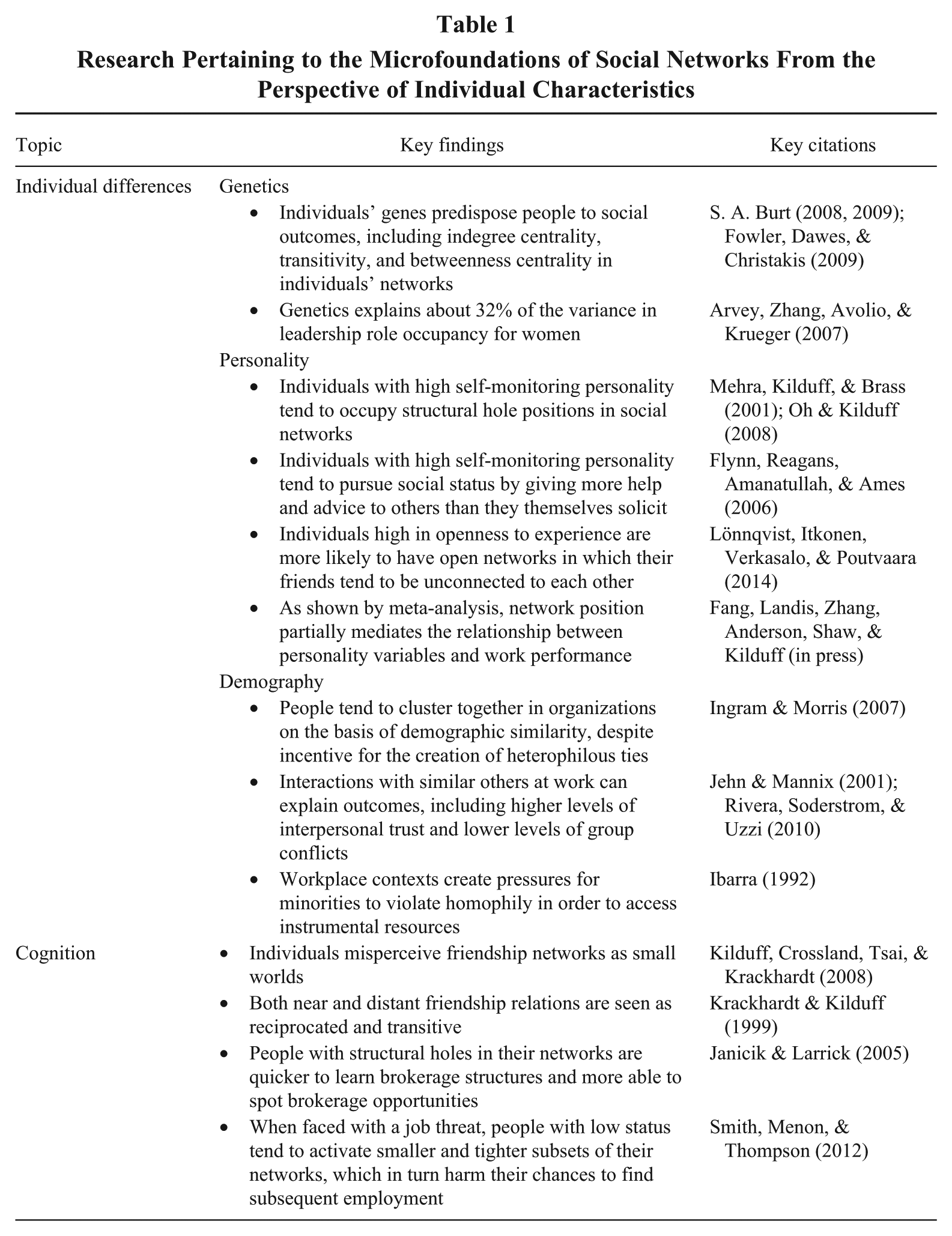
In response to the neglect of the individual in social network research (as noted by Kilduff & Krackhardt, 1994), there has been renewed emphasis on individual agency in the social sphere (Emirbayer & Mische, 1998). Individuals are active in choosing to pursue some relationships and forgo others and, therefore, active in helping to create the network of relationships that social network researchers focus on (cf. Bensaou, Galunic, & Jonczyk-Sédès, 2014). There is still ongoing debate, however, concerning the extent to which individuals can be considered purposive and instrumental in the construction of the social networks in which they are embedded. We discuss the relevance of individual differences that seem far removed from individual agency (e.g., genetic differences) as well as those that have been discussed in relation to agency (e.g., personality; see R. S. Burt, 2012). We consider also the relevance of demographic differences and cognitive biases in relation to this debate concerning agency. There is a growing but fragmented body of research on these topics that has never been integrated or systematically reviewed. By bringing together relevant studies (summarized in Table 1), we facilitate a systematic examination of evidence for the importance of considering individual characteristics and cognitions in the construction of social networks.
Research Pertaining to the Microfoundations of Social Networks From the Perspective of Individual Characteristics
Individual Differences
One of the current debates in social network research relates to whether taking into account the individual attributes of actors contributes explanatory power for understanding who occupies, and who benefits from the occupation of, advantageous network positions (Kilduff & Brass, 2010). The move to include attributes of actors as an integral part of social network research has been driven by organizational researchers for whom ideological arguments concerning the purity of structuralist explanations (e.g., Mayhew, 1980) hold little sway (see the arguments in Kilduff & Tsai, 2003). At the interpersonal level, organizational researchers have always been interested in how personality and demographic differences affect outcomes, and these variables have been integrated in organizational behavior research concerning social networks (e.g., Brass, 1985; Caldwell & O’Reilly, 1982). More recently, a parallel movement at the level of social network research in strategic management has led to the incorporation of properties of the firm into social network research. For example, firm properties such as absorptive capacity and bargaining power help explain cooperation with partners (Shipilov, 2006, 2009). These developments notwithstanding, research concerning actor attributes remains at the frontier of efforts to understand the microfoundations of social networks. We start with the most fundamental attributes of individuals—their genes.
Genetics
Within social science, there are calls for more engagement between genetics and social outcomes (e.g., Freese & Shostak, 2009; Schnittker, 2008). In the area of social networks, this demand has been answered by groundbreaking work of significant interest for understanding the microfoundations of networks (Fowler, Dawes, & Christakis, 2009). This research surveyed identical and fraternal twins across 142 school friendship networks and found significant explanatory power for genetic effects on whether individuals attracted incoming ties in the friendship network (i.e., indegree), whether individuals’ friends were friends with each other (i.e., transitivity), and the extent of brokerage—measured as the extent to which individuals bridged between friends who themselves were not connected (i.e., betweenness centrality).
Relatedly, research shows that genes predispose people to particular social outcomes, such as popularity among peers (S. A. Burt, 2008). Individuals, it appears, elicit or select experiences consistent with their genotypes. People are active in pursuit of a fit between who they are and the network positions they occupy. And, intriguingly, individuals with genotypes that predispose them to popularity engage in behavior that is likely to increase their favorability in the eyes of their peers (S. A. Burt, 2009).
Furthermore, research shows that individuals seek out circumstances that are compatible with their genotypes, resulting in groups of friends who share certain capabilities, such as the ability to transmit information or reciprocate cooperative exchanges (Fowler, Settle, & Christakis, 2011). However, not everyone with the genetic potential to be central in a social network is likely to occupy such a position. We need to understand why some people are more successful than others in leveraging their genetic endowment. The genetic approach to social networking is still preliminary in its implications, and further work needs to be done on important outcomes, including the connection between genetics, social networking, and organizationally relevant phenomena, such as leadership (cf. Arvey, Zhang, Avolio, & Krueger, 2007).
Personality
In discussing personality and social networks, we first focus on self-monitoring personality theory because of its relevance for how individuals relate to social worlds (Snyder, 1987: 59-84). The self-monitoring construct (Snyder, 1974, 1979; Snyder & Gangestad, 1986) distinguishes between those who are attuned to the role expectations of others (high self-monitors) and those who tend to be themselves irrespective of social expectations (low self-monitors). High self-monitors, relative to low self-monitors, tend to shape their behavior in accordance with the cues supplied by the social circles to which they belong (Snyder, 1979). Individuals high in self-monitoring are theorized to promote successful interactions with different groups of people (Ickes, Holloway, Stinson, & Hoodenpyle, 2006) in part because they are able to act out different, and potentially incompatible, roles (Snyder, 1987: 62-63). Thus, compared to other personality approaches, self-monitoring theory makes clear predictions concerning the effects of personality on the structuring of social worlds.
Because of its theoretical emphasis on spanning across different social worlds, self-monitoring has been referred to as the personality analog of brokerage (i.e., the network activity by which otherwise disconnected clusters are connected; R. S. Burt, Kilduff, & Tasselli, 2013). For example, research in a high-technology company showed that a high self-monitoring personality orientation predicted who was central in organizational friendship and workflow networks (Mehra, Kilduff, & Brass, 2001). Moreover, follow-up research on a sample of Korean expatriate business owners showed that high self-monitors tended to occupy structural hole positions in business acquaintance networks: They spanned between direct contacts, and they also tended to have acquaintances who themselves were not acquainted. In this sense, personality effects seemed to ripple across social structure in a striking example of how the microlevel affects the larger collectivity (Oh & Kilduff, 2008).
There is growing interest in understanding whether self-monitoring affects the extent to which people shape network configurations that represent sources of advantage at work. Longitudinal research in a hospital context showed that high self-monitors were more active than low self-monitors in managing for their advantage the structure of social interactions following organizational change: In the aftermath of technological change, they were more likely to attract new friends and occupy new bridging positions (Sasovova, Mehra, Borgatti, & Schippers, 2010). And, as research concerning small business owners in Canada showed, high self-monitors were agentic in pursuit of the advantages related to brokerage, whereas low self-monitors were agentic in pursuit of the advantages related to closure in social networks (Oh & Kilduff, 2008). Moreover, high self-monitors tend to be more accurate in perceiving who influences whom and, thus, more likely to acquire elevated status in networks of peers (Flynn, Reagans, Amanatullah, & Ames, 2006). High self-monitors also actively pursue status in organizational social networks by providing more help and advice to others than they themselves solicit (Flynn et al.). A meta-analysis of how personality relates to social network structures shows that, relative to extraversion and other Big Five personality variables, it is self-monitoring that predicts indegree centrality, and it is indegree centrality (more than brokerage) that relates to performance and career progress (Fang, Landis, Zhang, Anderson, Shaw, & Kilduff, in press).
Among the Big Five personality dimensions (that comprise openness to experience, conscientiousness, extraversion, agreeableness, and neuroticism), extraversion is the most studied in relation to networking behaviors (e.g., Klein, Lim, Saltz, & Mayer, 2004). Extroverted individuals, relative to introverted individuals, engage in more networking behaviors, and these behaviors tend to enhance managerial visibility in the workplace (Forret & Dougherty, 2001). Generally, extroverts, relative to introverts, have more friends (Amichai-Hamburger & Vinitzky, 2010; Lönnqvist, Itkonen, Verkasalo, & Poutvaara, 2014; Selfhout, Burk, Branje, Denissen, Van Aken, & Meeus, 2010). Given extroverts’ outgoing nature, it is not surprising that they are particularly high with respect to outdegree centrality (e.g., the number of friendship overtures sent to other people; Fang et al., in press). It is also, perhaps, no surprise to discover that high openness to experience predicts the extent to which individuals have open networks in which their friends tend to be disconnected from each other (Lönnqvist et al.). A wide-ranging meta-analysis of how personality relates to networking (Fang et al.) showed that conscientiousness, extraversion, and self-monitoring consistently predicted occupation of advantageous central positions in organizational networks.
Perhaps the frontier of research concerning personality and social networking relates to the relationships between personality, social networks, and job outcomes, including performance. In a sample of employees in a technology company, there were independent effects of self-monitoring personality and network centrality on performance outcomes (Mehra et al., 2001). Recent research on virtual world data showed that network-relevant personality predicted the occupation of brokerage positions but had insignificant effects on individuals’ performance outcomes (R. S. Burt, 2012). But a recent meta-analysis (Fang et al., in press) showed that network position partially mediated the relationship between certain personality variables (e.g., conscientiousness) and work performance, yet these mediated effect sizes were small.
Demography
One of the most often observed results in social science is homophily: “A tendency for friendships to form between those who are alike in some designated respect” (Lazarsfeld & Merton, 1954: 23). Research evidence is overwhelming in demonstrating this homophily principle across many different organizational settings (McPherson, Smith-Lovin, & Cook, 2001). There is growing interest in the possibility that people arrange themselves in social networks in part because of visible demographic characteristics that function as bases of identification among people (cf. Tajfel & Turner, 1986). The bases of similarity upon which people choose to affiliate in organizational settings are many, but the characteristics most often studied include gender (Ibarra, 1992) and ethnicity (Lincoln & Miller, 1979; Mehra, Kilduff, & Brass, 1998). Friendship networks in organizations feature people clustered together on the basis of these demographic variables (Gibbons & Olk, 2003).
Demographic similarity entails important organizational consequences, including team design and management. The design of demographically homogeneous teams can facilitate the development of trust and respect among team members. When interacting with similar rather than dissimilar others, people tend to reduce possible misunderstanding, they tend to develop shared value systems, and they tend to prevent conflict through open discussion during the stages of their team interaction (Jehn & Mannix, 2001; see also the review in Rivera, Soderstrom, & Uzzi, 2010). People like to interact with similar others not only in expressive networks such as friendship (Blau, 1977) but also when it comes to important projects such as entrepreneurial start-ups (Ruef, Aldrich, & Carter, 2003). Similar others help individuals evaluate ideas and abilities when outcomes are at stake (Festinger, 1954).
Moreover, similarity affects informal organizational structure, playing a role in who people collaborate within organizations. People have to find others who have complementary skills to their own in order to get work done, but they prefer to choose others with similar demographic traits that facilitate communication and trust (Casciaro & Lobo, 2008). Once people in teams begin to work with others who have complementary specializations, these collaborations tend to persist over time (Uzzi & Spiro, 2005). Indeed, there is a strong tendency for people to persist with interactions with similar others despite incentives and pressures to create more heterophilous ties (Ingram & Morris, 2007; Mollica, Gray, & Trevino, 2003). And the more underrepresented a demographic attribute in an organizational context, the more likely people are to use that demographic attribute as the basis for identification and friendship formation (Mehra et al., 1998). For example, the lower the proportion of women in an organization, the more likely it is that women will identify and form friendships on the basis of gender. Thus, similarity also helps explain the dynamic side of why people select themselves into and out of organizations. Attraction to an organization and attrition from it is affected by the characteristics of alters who work in that organization, and the composition of people who belong to the organization will restrict, in turn, the range of types of people who will be attracted (cf. Schneider, 1987).
Interpersonal social networks in organizations are not wholly under the control of individual volition, however. People show a preference for interactions with similar others (McPherson et al., 2001) but often find themselves embedded in mandated heterophilous relationships with coworkers, such as in the case of formalized interactions based on the workflow network (cf. Reagans, Zuckerman, & McEvily, 2004). Workplace contexts create pressure for minorities to violate homophily preferences in order to access instrumental resources from those with power and influence (Ibarra, 1992).
Cognition
The cognitive approach to social networks in organizations builds on the Thomas Theorem propounded over 80 years ago: If people define situations as real, they are real in their consequences (Thomas & Thomas, 1928: 572). Adapted to the field of social network cognition, this gives credence to the task of investigating perceptions of social networks as phenomena in their own right, rather than just as estimates of how accurately people recall social interactions (Krackhardt, 1987). Indeed, informants’ reports of their social network behavior often bear little resemblance to their actual behavior (Killworth & Bernard, 1976). People are relatively good at recalling long-term repeated patterns of social activity, however, even though they may misremember the specific and recent interactions within groups in which they regularly participate (Freeman, Romney, & Freeman, 1987). People expect to see familiar patterns of interaction, and this expectation leads them to misperceive specific instances of interaction.
In terms of the debate of interest to our review of the literature, there are two questions related to perceptions of social network relationships. First, there is the question of whether systematic patterns of distortion affect individuals’ actions and their social interactions. Second, there is the question of whether people’s cognitive biases with respect to social networks affect organizationally relevant outcomes.
With respect to the first question, there are decades of work detailing the cognitive biases characterizing social networks of individuals (see Brands, 2013, for a review). Thus, people tend to misperceive friendship relations as reciprocated and influence relations as exhibiting a strict pecking order even when actual network relationships violate these properties (De Soto, 1960). In terms of making errors, people tend to fill in the blanks so as to make their perceptions of networks conform to prior expectations (Freeman, 1992). Misperceptions of networks may serve to boost self-regard, given that people tend to see themselves as more central in friendship networks than they actually are (Kumbasar, Romney, & Batchelder, 1994). The tendency to misperceive one’s own friendship connections as reciprocated may be motivated by the avoidance of cognitive dissonance, whereas the tendency to misperceive the reciprocal friendship relations of relative strangers in organizations may be motivated by the avoidance of cognitive effort (Krackhardt & Kilduff, 1999). In terms of reducing the cognitive effort to keep track of complex patterns of social interactions, there is evidence across four different organizational settings that people tend to impose a small world structure on their perceptions: They arrange coworkers in dense clusters and connect the clusters with short paths (Kilduff, Crossland, Tsai, & Krackhardt, 2008). In the same study, evidence suggests that people tend to boost the social capital of leaders, exaggerating the popularity of perceivably popular people.
So, there is extensive work on the cognitive biases that people employ to keep track of and make sense of social network connections in organizational settings. But with respect to our second question, what is the evidence concerning the effects of these cognitive biases on individuals’ outcomes? The earliest relevant work related to job turnover and decision making in organizations. Individuals tend to quit their jobs when they perceive role equivalent people in communication networks leaving (Krackhardt & Porter, 1986). Moreover, individuals who perceive each other to be similar, or who consider each other to be personal friends, are likely to interview with the same organizations for job positions (Kilduff, 1990).
More recently, cognitive bias research has been connected to other relevant outcomes, such as learning and finding a new job (see Brands, 2013, for a review). Individuals who have developed a cognitive schema based on prior experience with networks that exhibit structural holes are quicker to learn brokerage opportunities relevant to building coalitions in the workplace (Janicik & Larrick, 2005). Thus, having cognitive expectations regarding the likelihood of seeing structural holes actually facilitates the outcomes that individuals can reap in bridging across those holes. There is also evidence that people of different status tend to spontaneously call to mind different subsections of their networks when faced with job threat. People with low status tend to activate smaller and tighter subsections of their networks, whereas people with high status tend to activate larger and less constrained subsections of their networks (Smith, Menon, & Thompson, 2012). The implication for work-related outcomes is that, faced with job threat, the cognitive narrowing of available network connections may eventuate in people of relatively low status reducing their chances of finding employment (cf. Granovetter, 1973).
There is also research showing that people’s cognitive biases relate to important outcomes for the targets of those biases, including reputation, opportunity of action, and work performance. Relatively early work on this question showed that individuals who were perceived by others to have a high status friend in an organization tended to have their reputation in terms of work performance boosted, whereas those individuals who actually had high status friends experienced no boosts to their reputation (Kilduff & Krackhardt, 1994). This perceived basking-in-reflected-glory effect has been generalized in the prism model of network perception according to which others estimate our qualities on the basis of the social network connections within which we are perceived to be embedded (Podolny, 2001).
Relatedly, research shows that (for those observers with strong need for closure) the ethnicity of others triggers a bias in network perceptions concerning how close those other individuals are perceived to be (Flynn, Reagans, & Guillory, 2010). This research, therefore, hints at the possibility that the agency of those others could be restricted if those others are perceived to have tighter networks than is actually the case. More recent work pushes this idea further in demonstrating that, indeed, one person’s bias can affect another person’s possibilities of action and also job performance. This research showed that men, relative to women, were misperceived as occupying agentic, brokerage roles in the workplace friendship network—those roles involving less constraint and higher betweenness and outdegree centrality (Brands & Kilduff, 2014). A second study from the same article showed that to the extent that gender stereotypes were endorsed by many individuals in a work team, women performed worse on their individual tasks. But teams in which members fell back on well-rehearsed perceptions of gender roles (men rather than women misperceived as brokers) performed better than teams in which members tended toward misperceiving women occupying agentic, brokerage roles. Taken together, these results show that cognitive biases related to gender affect the extent to which individuals are likely to be recognized in organizational settings as brokers, potentially helping explain the lower returns to brokerage for women in organizational settings found in prior work (e.g., R. S. Burt, 1992). These results also suggest that where women are recognized as brokers, this is likely to violate gender stereotypes and is likely to promote individual women’s accomplishments even though teams in which stereotypes are violated may display lower performance.
The Network Makes the People
The modern history of social network research has been premised on the view that structured social relationships represent a “more powerful source of sociological explanation than personal attributes of system members” (Wellman, 1988: 31). A key element in the developing social network paradigm of research (cf. Hummon & Carley, 1993) has been an emphasis on the importance of positions in a social system as a basis for explanation (cf. White et al., 1976). Irrespective of who occupies a structural position, the position itself elicits and demands certain role behaviors. And social structures and processes “vastly transcend the individual consciousness of actors” (Lorrain & White, 1971: 50).
This is not to say that actors are without purpose. Rather, “actors are purposive under social constraint” such that the positions occupied by actors “generate actor interests as perceptual norms and feelings” (R. S. Burt, 1982: ix). The network makes the people in that people who occupy similar social network positions tend to share the same norms, feelings, and attitudes. Two people who occupy similar positions in an organizational social network may therefore develop similar attitudes and behaviors even though they have no direct connection to each other (cf. R. S. Burt, 1982: 14). From this perspective, homophily among actors results from structural equivalence—the extent to which actors have ties to the same other actors (e.g., R. S. Burt, 1987). Thus, the structural perspective has implications for the microfoundations of social networks. The psychology of actors from this perspective is defined largely by the positions of the actors in social space (Friedkin, 1998: 211).
The theoretical roots of the “network makes the people” approach run deep in social network research. For example, weak tie theory (Granovetter, 1973) posits that macrostructures in the form of the network relations within and between communities affect the fates of individuals. Outcomes are typically outside the control of individuals: “The personal experience of individuals is closely bound up with large-scale aspects of social structure, well beyond the purview or control of particular individuals” (Granovetter: 1377). Individuals prosper or suffer as a result of the serendipitous arrival of new pieces of information (job openings, market opportunities) from chance encounters: “It is remarkable that people receive crucial information from individuals whose very existence they have forgotten” (Granovetter: 1372).
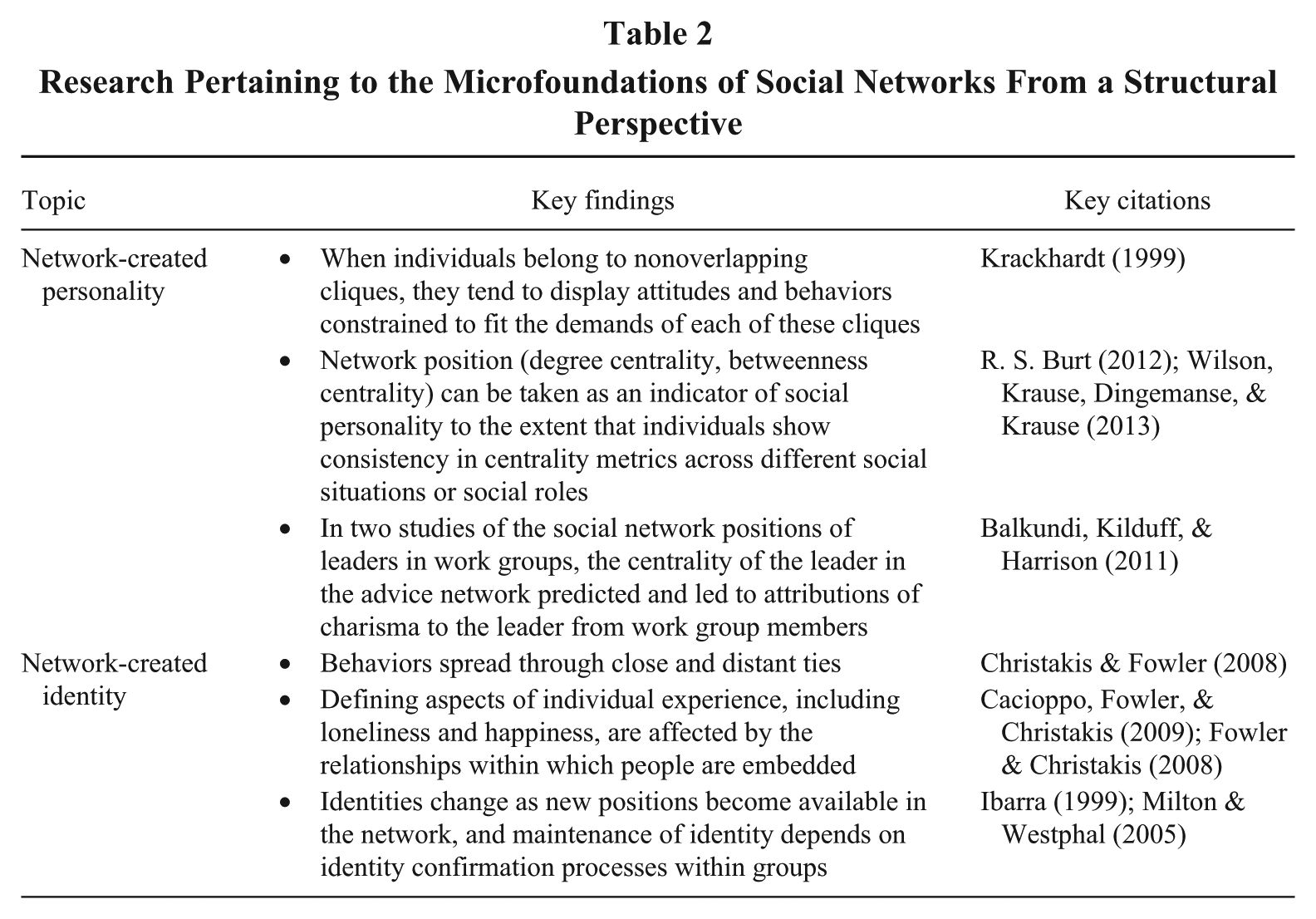
From this perspective, therefore, weak ties represent one way to increase serendipity by accessing different thought worlds outside of the individual’s current social network (cf. Baer, 2010). Weak ties, therefore, correlate with research creativity (Perry-Smith, 2006). The long-term benefits of trust derived from strong relationships, such as friendship (cf. Krackhardt, 1992), tend to be offset by the negative effects of homogenous norms, obligations, and expectations (McFadyen & Cannella, 2004). The network makes the individual in the sense that the overall structure of the network in which the individual happens to be embedded has profound effects on the likelihood of the individual’s success irrespective of agency, talent, or collaboration (Uzzi & Spiro, 2005). Individuals take actions, including making network connections with coworkers, and these network connections form aggregate-level patterns that become the context in which future actors operate. In the long run, therefore, the network produces the actors (Padgett & Powell, 2012). We examine this claim by reviewing relevant literature (summarized in Table 2) across two dimensions of individual distinctiveness: personality and identity.
Research Pertaining to the Microfoundations of Social Networks From a Structural Perspective
Network-Created Personality
A domain assumption of the structural approach is that “structural constraints and opportunities . . . exert a dominant influence on social relations that partly counteracts, and may suppress, the influences of cultural values and psychological preferences” (Blau & Schwartz, 1984: 14). Key aspects of individual distinctiveness derive from the social groups to which the individual belongs (Thomas, 1927/1966), specifically, from the set of nonoverlapping social circles (Simmel, 1922/1955). The more such nonoverlapping affiliations, the weaker the hold of any one group on the individual and the more structurally defined options the individual has (Blau & Schwarz). But in cases where two or more of these nonoverlapping groups are cliques—groups of actors in which everyone has a direct tie to everyone else—then the individual who belongs to these groups is likely to find attitudes and behaviors constrained to fit the demands of each group (Krackhardt, 1999). In these cases, the opportunities for individual decision making are shrunk by the social control exerted by coclique members. In a study of a union certification drive started by the employees of a technology company, an employee belonging to eight different work cliques asked to be given “leave” on the day of the vote for the union, and when his request was rejected, he preferred to resign from the company instead of voting. The constraints imposed by each of the cliques froze the employee’s decision-making ability because “no amount of artful persuasion on the part of the union could have overcome the conflicting demands of his loyalties” (Krackhardt: 206).
From this structural perspective, each individual has a social personality that derives from occupation of “a particular place in the social space of a given society” (Warner & Lunt, 1941: 26). And position in organizational networks (e.g., degree centrality, betweenness centrality) is taken as an indicator of social personality to the extent that individuals show consistency in centrality metrics across different social conditions (Wilson, Krause, Dingemanse, & Krause, 2013) or across different social roles (R. S. Burt, 2012). Is there, then, empirical evidence to support the widespread idea that social personality results from occupation of network position?
Remarkably, despite the importance of this claim for the structural thesis, and despite researchers speculating that individuals’ personality characteristics derive from social network characteristics (e.g., Boissevain, 1973), there is little empirical research concerning whether network position affects personality. However, recent work offered interesting clues for reinterpreting charismatic leadership from a network personality perspective. This investigation examined, across two studies, whether individuals central in social networks were seen as possessing the social personality characteristic of charisma or whether the causal arrow was the other way around, with individuals perceived as charismatic tending to occupy central network positions (Balkundi, Kilduff, & Harrison, 2011). In the first study of formal leaders of 56 work teams, results supported the view that it was the centrality of leaders within team advice networks that determined whether leaders were seen as charismatic by subordinates. Study 2 examined 79 teams in which networking activity and charisma were measured at two different points in time. The results showed that leader networking preceded judgments of leader charisma: The centrality-to-charisma model was supported with these longitudinal data but not the charisma-to-centrality model. These results provided credence to the view that “a person’s social environment elicits a specific personality” (R. S. Burt, 1992: 262). And from a conventional personality perspective, these results affirm that personality traits require appropriate situations to be exhibited and channeled (Winter, John, Stewart, Klohnen, & Duncan, 1998).
Network-Created Identity
Some of the most defining aspects of ourselves are dependent on network connections and structures. A person’s chances of becoming obese, for example, increase by 57% if he or she has a friend who becomes obese (Christakis & Fowler, 2007). A person’s likelihood of smoking cessation is similarly affected by social network connections, but this influence extends up to three degrees of separation (friends’ friends’ friends): Choices made by groups of people connected to each other both directly and indirectly affect the individual’s outcomes (Christakis & Fowler, 2008). Whether an individual is lonely or happy also depends upon the network. Nonlonely people who are around lonely people tend to grow lonelier over time through processes of contagion (Cacioppo, Fowler, & Christakis, 2009). Similarly, people surrounded by many happy people and people who are central in the network are more likely to become happy through processes of contagion (Fowler & Christakis, 2008). These structural results suggest that defining aspects of who we are depend not just on endowment, environment, or personal choices but also on the structure of relationships within which we are embedded.
Social networks confer social identity through the segmentation of social space into clusters of positions populated by actors who share social characteristics (White, 1992). Because of the division of labor, people necessarily have to enter into relations with other entities to accomplish tasks (Durkheim, 1984). The free agency of individuals to form and break social ties is therefore severely limited in work settings, given the importance of maintaining reputation and identity (Podolny & Baron, 1997; Xiao & Tsui, 2007). A clear social identity, conferred by incorporation within a small cohesive network, integrates consistent role expectations and helps people succeed in promotion tournaments at work (Podolny & Baron).
People’s identities are likely to change as access to new positions in networks becomes available (Ibarra, 1999). One classic example showed that as each person within a dyad experienced altered relationships with members of the surrounding personal network, the reciprocal understandings between the members of the dyad changed (Bott, 1957). In effect, individuals’ identities changed in response to network change. The maintenance of identity is itself dependent on identity confirmation processes within groups (Milton & Westphal, 2005). Actors who maintain multiple kinds of relationships are likely to develop multiple identities (Shipilov, Gulati, Kilduff, Li, & Tsai, 2014). Thus, from a structural perspective, an individual’s identity is constructed from social resources.
People and Networks Coevolve
We have traced a divergence between a mainly psychological perspective that emphasizes individual-level antecedents of people’s occupation of network positions and a mainly sociological perspective that emphasizes network constraints that shape individuals’ distinctiveness. A third perspective concerns coevolution—the process by which the social network activities of individuals contribute to macrolevel network change, which, in turn, affects individual and organizational outcomes (cf. Kossinets & Watts, 2009). The challenge, from a coevolution perspective, is to bring together social psychology (e.g., an emphasis on individual characteristics) and structure (e.g., an emphasis on individuals’ occupation of advantageous network positions) to enhance our understanding of how people pursue opportunity. A coevolution perspective requires consideration of social dynamics and the reciprocal influence of individuals and the situations they occupy (e.g., Lomi & Stadtfeld, 2014; Schulte et al., 2012).
A coevolution perspective particularly addresses questions concerning the extent to which individuals can be attributed with agency for their networking behaviors and outcomes. From the perspective of organizational behavior, individuals engage in purposeful striving toward desired goals, although the extent of any individual’s motivation at any point in time depends on that individual’s psychological makeup and the characteristics of the social context (Barrick, Mount, & Li, 2013). From a structural perspective, the network positions that people occupy represent indicators that managers and other observers rely on to estimate quality and the extent of potential knowledge (Nerkar & Paruchuri, 2005). So, agency from this perspective inheres in the structural positions that individuals occupy (cf. Padgett & Ansell, 1993). Individuals’ opportunities can be enhanced by the serendipity of being in the right place (Brass, 1984). Thus, individuals can doubly benefit if they occupy strategic positions in an intrafirm network in a firm that itself occupies a strategic position in its interfirm network (Paruchuri, 2010). Similarly, individuals can obtain more knowledge to the extent that they belong to project teams with short interunit network paths to units that possess related knowledge (Hansen, 2002).
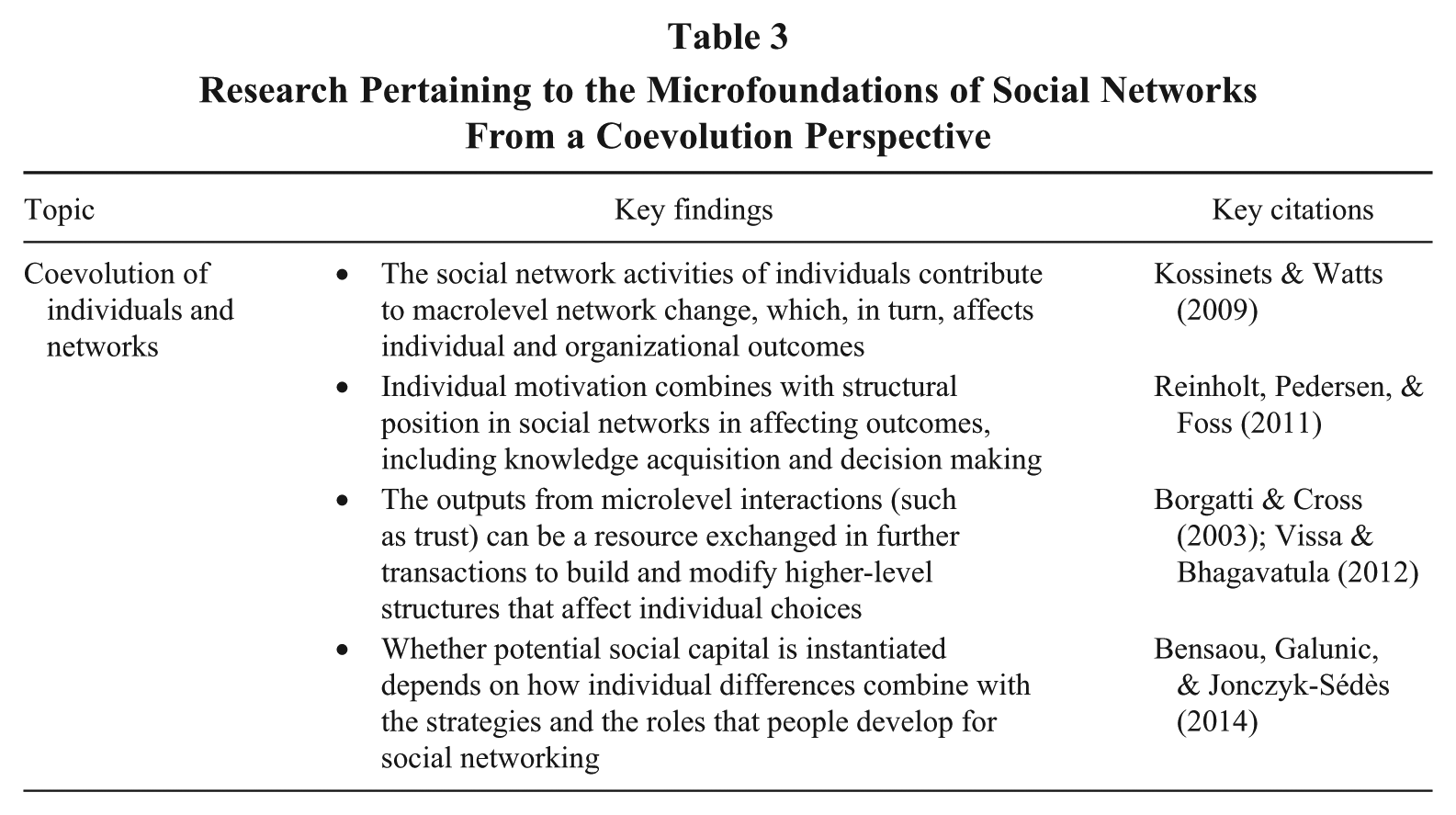
The interplay of individual attributes and network structure in predicting individual-level and organizational-level outcomes is captured by an emerging literature that we summarize in Table 3. Social network positions provide individuals with opportunities for achievement, but it is those people with higher motivation who take advantage of these opportunities. In a large sample of business consultants, individuals’ knowledge acquisition and provision were highest when both network centrality and autonomous motivation were high (Reinholt, Pedersen, & Foss, 2011). Sometimes the people with higher motivation happen to be on the periphery of social networks and see themselves as combating entrenched interests, forming alliances with other motivated peripheral actors in other organizations to influence decision makers’ strategies (Sgourev, 2013; Stevenson & Greenberg, 2000). In other cases, it is people who are central in social networks in terms of brokerage who strive to bring people together (e.g., Obstfeld, 2005) or keep people apart (e.g., Lingo & O’Mahony, 2010) in order to accomplish vital organizational tasks.
Research Pertaining to the Microfoundations of Social Networks From a Coevolution Perspective
The study of the dynamic interplay of individuals and networks also helps illuminate the processes by which microlevel interpersonal interactions relate to higher-level organizational outcomes. Research on the dynamics of social exchange (cf. Emerson, 1976) suggests that a particularistic benefit, such as trust, develops as a result of interpersonal exchange and, in turn, provides the foundation for further successful exchanges and for the development of trust in the whole intraorganizational network (Molm, 2000). Thus, the output of a microlevel interaction can be a resource exchanged in future interactions to build higher-level outcomes (cf. Cropanzano & Mitchell, 2005: 889). And macrolevel network structures can recursively affect individual choices, influencing who seeks whom for information (Borgatti & Cross, 2003).
Whether potential social capital is instantiated depends on how individual differences combine with the strategies that people develop for social networking. As recent inductive research on newly promoted service professionals operating within two firms shows, some people thoroughly enjoy the active management of their social networks at work (devoted players), whereas other people see social networking as either a chore to be avoided (purists) or as an activity largely restricted to local contacts (selective players; Bensaou et al., 2014). As people develop different styles of social networking leading to differentiated ego networks, their existing roles, identities, and network positions are likely to shift to accommodate changing sets of relationships. These local structural changes can ramify into changes to overall network patterning. And, as shown by longitudinal empirical analysis on a sample of Indian high-technology entrepreneurs, individual actors’ social networking can then result in modifications to social structure (e.g., Vissa & Bhagavatula, 2012).
Discussion and Future Research Directions
Do the people make the network, does individuality emerge from network patterning, or is it that people and networks coevolve? We reviewed evidence that purposive individuals utilize their attributes and cognitions in pursuit of network advantage. And we reviewed evidence that network structures conspire to generate individual outcomes, such as social personality and identity. These different approaches to the question of agency and social network research derive from separate literatures in the psychological and sociological traditions. We also considered a third approach, one that combines both views in a coevolutionary account of a dynamic process of mutual influence. From an organizational behavior viewpoint, studying the coevolution of individuals and networks allows researchers to bridge the structural hole between approaches that, on one hand, assume people to be “purposive actors who display creativity and choice in social action” (Bensaou et al., 2014: 29), and approaches that, on the other hand, assume that “actors congeal out of iterations of . . . constitutive relations” (Padgett & Powell, 2012: 3).
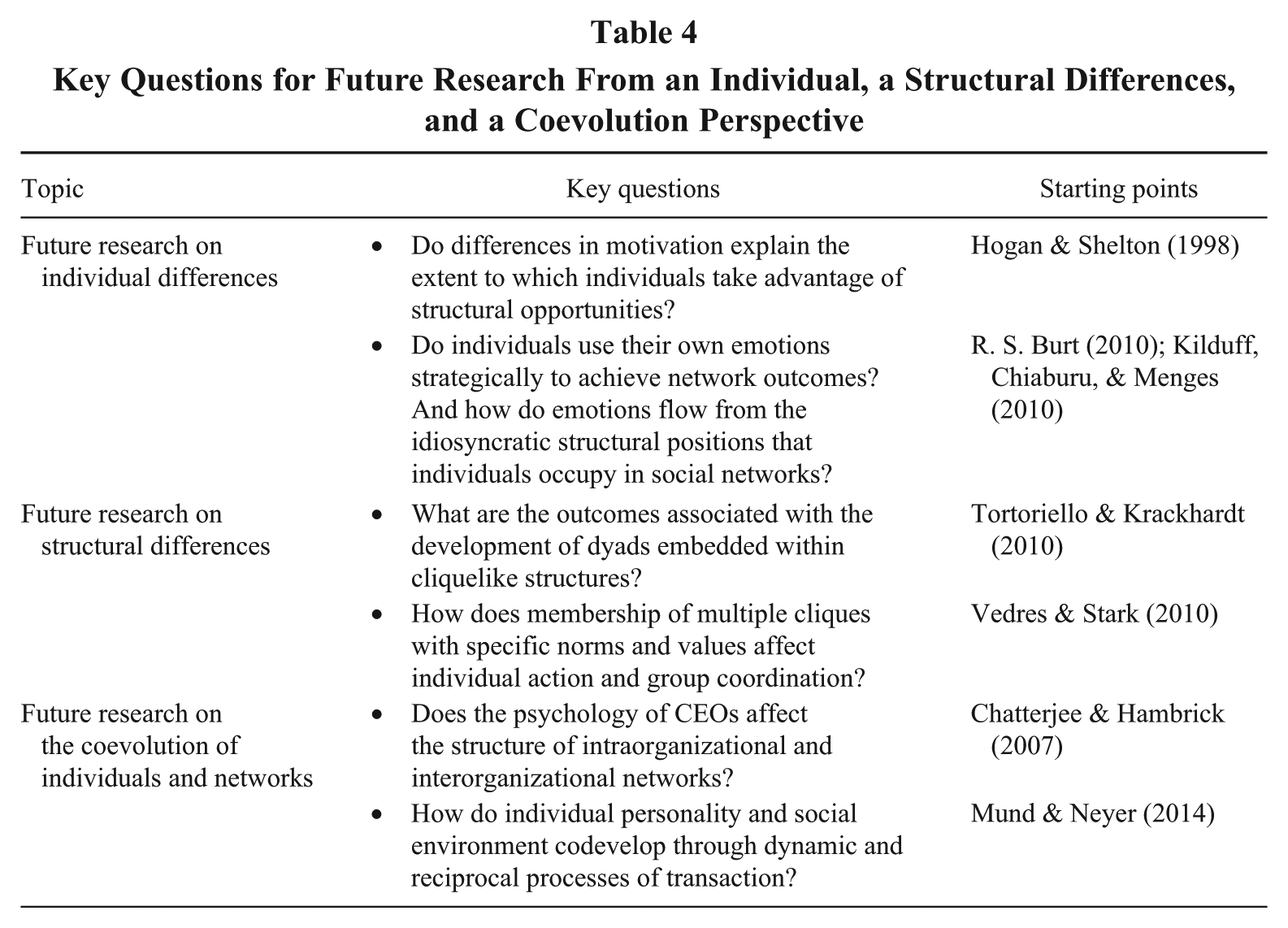
Figure 1 summarizes and integrates the three perspectives, showing how the characteristics of individuals and the structure of networks combine to inform the recursive, coevolutionary process by which individuals shape networks and networks shape individuals. The possibilities for research concerning the microfoundations of social networks flow from each of the three perspectives. In Table 4, we outline some of the most promising future research directions and questions.
Key Questions for Future Research From an Individual, a Structural Differences, and a Coevolution Perspective
Microfocused Future Research on Individual Differences
Within organizational network research, the recent tendency has been to emphasize individuals’ agency in the construction of their networks. Individuals are depicted as strategically arranging relationships to maximize outcomes (e.g., Lingo & O’Mahony, 2010). The focus of network advantage has shrunk to the immediate network of ties that surrounds the individual (e.g., Podolny & Baron, 1997) together with an understanding of the personal networks of crucial others, such as leaders (Galunic, Ertug, & Gargiulo, 2012; Sparrowe & Liden, 2005).
For the future, we expect rising interest in dispositional variables related to motivation, given the relative absence of research on whether people with different motivations enact different types of networks. Social network research has long operated on the principle that motivation and opportunity can be treated “as one and the same” (R. S. Burt, 1992: 36). This has been a useful simplification for research unconcerned with microfoundations of social networks or individual differences in the extent to which people take advantage of structural opportunities. But with an increased attention to microfoundations of networks, the study of motivation is likely to uncover systematic differences in the kinds of social networks people build. For example, the two basic motives of pursuit of status and pursuit of communion with others (Hogan & Shelton, 1998) may lead actors in the direction of brokerage on one hand versus closure on the other.
A further promising but neglected area of research concerns emotions, given that social relations are infused with affect (Casciaro, 2014). The study of emotions has generally focused on intrapersonal rather than social processes (van der Löwe & Parkinson, 2014), but recent research has shown the diffusion of emotions such as happiness (Fowler & Christakis, 2008) and loneliness (Cacioppo et al., 2009) across social network connections. Despite this promising work, the potential debate concerning whether individuals use emotions deliberately to achieve network ends is yet to be fully engaged. On the side of emotional agency, there is theorizing concerning how people with high emotional intelligence resist emotional contagion from others in the network while being able to influence how others feel. Emotionally intelligent supervisors may be astute in eliciting emotional displays from others while themselves controlling emotional display appropriate to different social groups and different dyadic interactions (Kilduff, Chiaburu, & Menges, 2010).
When employees experience negative emotions, including envy toward structurally equivalent peers (R. S. Burt, 2010), they may tend to undermine their coworkers unless their feelings of identification with team members are strong (Duffy, Scott, Shaw, Tepper, & Aquino, 2012). Social undermining includes “intentional actions that diminish a target’s ability to establish and maintain positive relationships” (Duffy, Ganster, & Pagon, 2002: 333). Thus, it is possible that structurally produced envy may motivate intentional undermining that results in negative outcomes and emotions for others in the network. It would be of interest for future work to investigate whether and how such negative emotions can spread across the organization to affect employees’ cooperation and work performance.
Macrofocused Future Research on Structural Differences
Structuralists emphasize that social network connections and configurations determine intrinsic aspects of the individual, including personality and identity (cf. White, 1992). This configurational approach focuses on the effects on actors of overall properties of social networks, including small worldedness (e.g., Uzzi & Spiro, 2005), centralization (e.g., Sueur, Deneubourg, & Petit, 2012), and density (e.g., Balkundi & Harrison, 2006). Network structures can exacerbate small initial differences among actors to produce large inequalities (DiMaggio & Garip, 2012). From this structural perspective, network configuration helps determine individuals’ outcomes.
An emerging stream of research that examines microfoundations from the perspective of network structure builds on the work of Simmel (1922/1955) and further theoretical development by Krackhardt (1998, 1999) to investigate a range of questions concerning individuals and dyadic relationships embedded within one or more triadic and other cliquelike structures. People embedded in triadic cliques tend to exhibit higher dyadic consensus concerning the culture of the organization to which they belong relative to people whose ties are not part of the same clique (Krackhardt & Kilduff, 2002). And dyadic relationships that are embedded in triadic cliques and that also cross departmental boundaries tend to generate innovation (Tortoriello & Krackhardt, 2010). Of particular interest for further research is the idea that individuals who are members of multiple cliques are subject to multiple sets of constraining norms and values (Krackhardt, 1999). Recent research on the same structural idea (individual nodes that are common to multiple groups) raises questions for future work concerning whether such structural intercohesion is disruptive of group coordination and cohesion even as it promotes entrepreneurial innovation (Vedres & Stark, 2010).
From a structural perspective, we also expect future investigation of whether and how the opportunities for individuals arising from their network interactions depend on the structure of alters’ social networks. There is evidence that the influence gained by an employee within the organization through the quality of the relationship with his or her leader also depends on the extent to which the leader occupies a central position in the organizational advice network (Sparrowe & Liden, 2005). And a recent study on bank employees and branch managers shows that the leader’s perceived status in the eyes of subordinates was stronger when subordinates were less central in their own peer networks (Venkataramani, Green, & Schleicher, 2010). This raises the question of how the structure of social networks beyond the individual’s direct contacts exerts effects on the individual’s network cognitions.
Future Research on the Coevolution of People and Networks
From a coevolution perspective, individual agency can be understood as “embedded in concrete, ongoing systems of social relations” (Granovetter, 1985: 487). And social structure can be said to emerge from the process through which localized actions, relationships, and identities cohere into higher-level network structures (e.g., Padgett & Ansell, 1993). For the future, we expect growing interest in the simultaneous exploration of bottom-up and top-down influence processes between individual agency and social structure.
Coevolution can be studied from a structuration perspective (Giddens, 1984) that depicts how social environments that constrain and enable individuals emerge from choices made by individuals whose subsequent behavior is then constrained by these social environments. Thus, there is a reciprocal engagement over time between the microactivities of individuals and the social structures that achieve an apparently objective facticity. Although this insight has rarely been applied to organizational social networks (but see Barley, 1986, for an exception), it is facilitated by the provision of new tools, such as the SIENA software platform, that analyze the coevolution of social networks and individual behaviors through the joint consideration of longitudinal network data and attributes of individual actors (Snijders, van de Bunt, & Steglich, 2010). These tools facilitate research on interindividual dependencies in social networks (e.g., transitivity, reciprocity) and enable the modeling of interdependencies between network and behavioral dynamics (Burk, Steglich, & Snijders, 2007: 397; cf. Steglich, Snijders, & Pearson, 2010). These tools also fuel current interest in the dynamics of social networks (e.g., R. S. Burt, Merluzzi, & Burrows, 2013). Coevolutionary network dynamics can be estimated also by examining changes in individuals’ network structures and personalities at different points in time (e.g., Balkundi et al., 2011).
From a coevolutionary perspective, we expect future research on whether network-level properties arise from the idiosyncrasies of interacting individuals (cf. Ployhart & Moliterno, 2011); whether these aggregate phenomena influence, in turn, individual action; and whether and how intraorganizational and interorganizational networks reflect the psychology of particular individuals. There is evidence that specific organizational strategies and decision-making processes are influenced by the personalities of chief executives (e.g., Miller & Toulouse, 1986). Furthermore, prior work shows that CEO personality affects structural differentiation within organizations (Miller, De Vries, & Toulouse, 1982). Future work can examine whether network structures affect the emergence of CEO personality and whether the personalities of chief executives contribute to the positions occupied by organizations within interorganizational networks. We know that narcissistic CEOs pursue strategic dynamism, increase the number and size of acquisitions (Chatterjee & Hambrick, 2007), and pursue investments in new technological domains (Gerstner, König, Enders, & Hambrick, 2013). CEO personality, therefore, has the potential to radically alter interorganizational networks and opportunities for individual managers.
This research on CEO narcissism relies on unobtrusive measures of leader personality (cf. Hill, White, & Wallace, 2014). These techniques could be extended to other measures of personality so that, for example, CEO self-monitoring could be assessed in the absence of self-report measures. This would allow research concerning the interplay between CEO personality and network structures at the interorganizational level to proceed. We could then address such questions as to whether firms with high self-monitoring CEOs play brokerage roles in interfirm networks. The strategy at the design firm IDEO of “being the high-technology company for low-technology companies” (Hargadon & Sutton, 1997: 730) is suggestive of high self-monitoring. By contrast, the closed-network strategy adopted by Apple Computer, that featured closely-knit internal networks and separation from other actors in the field, would seem to reflect the distinctive personality of its founder, Steve Jobs (cf. Isaacson, 2012).
Future research is likely to investigate whether individual personality coevolves with social structure and whether individual identity itself can be said to emerge from stable patterns of variability in behaviors across different social situations (cf. Mischel, 1968). Previous work on personality and social networks has assumed that human personality consists of stable traits that exert generalized effects on network outcomes, effects that are often shown to be small (e.g., Klein et al., 2004). But a coevolution perspective has emerged in personality research suggesting that individual personality and social environment are both agentic and codevelop through dynamic, continuous, and reciprocal processes of transaction (Mund & Neyer, 2014). The individual’s personality affects relationships in the environment and this environment, in turn, changes the individual’s personality.
Moving away from the conception of human personality as the “operations of a hypothetical ‘average’ mind” (Allport, 1937: 61), new research is needed to examine the complex processes through which a person functions psychologically across different network structures (Mischel, 1973). For example, a person who exhibits embeddedness in closely knit networks in the workplace may span across distinct social groups in a different social setting. From an idiographic perspective, we suggest that variability in networking patterns across social situations can be defined as an individual behavioral signature (cf. Shoda, Mischel, & Wright, 1994: 674). From this perspective, individuals display characteristic social network patterns related to individual personality (R. S. Burt, 2012).
Conclusion
In reviewing the literature on the microfoundations of social networks, we considered three perspectives: a microfocus on how individual differences and cognitions contribute to network structuring, a macrofocus on how the structure of networks shapes individuals’ distinctiveness, and a coevolution perspective that incorporates the possibility that individuals and social networks coevolve. The key message of this review is that individual attitudes, behaviors, and outcomes cannot be understood without considering the structuring of social contexts in which they are embedded, and social network structuring and change cannot be understood without considering the psychology of purposive individuals. The coevolutionary perspective emphasizes this possibility that individual actions and network structure coevolve in a dynamic process of reciprocal influence. From this perspective, agency and structure are concurrent components of organizational social networks. In their heterogeneity, individuals make sense of and seek to influence the sometimes turbulent and sometimes static social network contexts in which they live and work, and from such efforts individual identity emerges and coheres (Erikson, 2013; White, 2008: 1).
Future organizational network research will benefit from a clearer recognition of the interdependence of individuals and social networks. This interdependence is well illustrated by the anecdote of Marco Polo describing for Kublai Khan a bridge, stone by stone:
“But which is the stone that supports the bridge?” Kublai Khan asks. “The bridge is not supported by one stone or another,” Marco answers, “but by the line of the arch that they form.” Kublai Khan remains silent, reflecting. Then he adds: “Why do you speak to me of the stones? It is only the arch that matters to me.” Polo answers: “Without stones there is no arch.” (Calvino, 1972: 74)
Footnotes
Acknowledgements
We are grateful to the action editor Sucheta Nadkarni for her consistently helpful editorial guidance throughout the review process. We also thank two anonymous reviewers for their insightful comments. The basic ideas and structure of the paper benefited from presentation at the Microfoundations of Social Networks Workshop, Copenhagen, June 2014.