




Abstract
Radiation disasters cause direct radiation exposure and a variety of health issues, such as stress from evacuation life and prejudices based on incorrect perceptions of radiation. How the anxiety and risk perception of radiation exposure among residents living in the affected areas have changed is not well known. This study focuses on internal radiation exposure in infants and young children and parental radiation risk perception in Minamisoma City, which was impacted by the Fukushima Daiichi Nuclear Power Plant (FDNPP) accident. The study employs BABYSCAN data from July 2014 to November 2023. During the study period, 3936 infants underwent BABYSCAN testing, with no internal exposure to Cs134 or Cs137 detected in any of the participants. Surveys and counselling on food and water choices indicated a decrease in concerns about radiation contamination; however, anxiety about radiation among residents persisted. Additionally, there were concerns about the health effects related to the release of treated water from the FDNPP in 2023. The decline in participation rates in BABYSCAN and decreasing interest in radiation highlight the need for ongoing long-term risk communication and continued education for residents after radiation disasters.
INTRODUCTION
Radiation disasters cause direct radiation exposure and have a variety of health impacts, including socioeconomic aspects. These include psychological stress due to evacuation life, prejudices and discrimination based on incorrect perceptions of radiation, and reputational damage. A comprehensive understanding of these impacts is important for developing public health measures following radiation disasters.
The 2011 Great East Japan Earthquake and the Fukushima Daiichi Nuclear Power Plant (FDNPP) accident have changed the perception of radiation and its health effects in Japan. However, afterward, there is a possibility that the perceptions of radiation risk may have become fixed (Ministry of the Environment, 2022), necessitating the regular tracking of changes in radiation risk perception in the affected areas and the evaluation of long-term engagement with residents.
The release of radioactive materials (such as I131, Cs134, and Cs137) from the FDNPP accident has led to radiation contamination in the surrounding areas (UNSCEAR, 2022), causing concerns regarding the health impacts of radiation exposure among residents (Yoshida et al., 2016; Murakami et al., 2017). BABYSCAN, which is suitable for infants and toddlers, has been introduced to evaluate the internal exposure and the concerns of parents. In Fukushima Prefecture (Hayano et al., 2014), BABYSCAN has been initiated in three cities: Hirata Village (Hayano et al., 2015a) (from December 2013 to February 2020, with 2770 individuals), Iwaki City (Akiyama et al., 2015) (from March 2014 to October 2019, 729 individuals), and Minamisoma City (Hayano et al., 2015b) starting in July 2014. Currently, the testing continues only at the Minamisoma Municipal General Hospital because of a decrease in the demand for testing and the high costs of equipment maintenance.
Studies have been conducted on the changes in food avoidance among residents affected by the radiation from the FDNPP accident. However, how the anxiety and risk perception of radiation exposure among residents living in the affected areas have changed is not well known. This study aims to use data from BABYSCAN, which involves counselling with residents, to analyse the transition of radiation risk perception in the postdisaster area and collect and analyse the perception of parents regarding their anxieties about radiation. This is expected to provide new insights into the methods of engaging with residents in the long term after a disaster.
METHOD
Participants
The participants of this study were infants and young children aged 0–6 years residing in Minamisoma City, and they were examined at the Minamisoma Municipal General Hospital. This area is located 13–38 km north of the FDNPP. The study utilised data collected from 22 July 2014 to 28 November 2023, including previously published data from 2014 to 2020 (Tsubokura et al., 2020; Sugiura et al., 2022).
BABYSCAN
BABYSCAN measures radioactive Cs134, Cs137, and K40 in preschool children to assess their internal exposure dose. In Minamisoma City, examination invitations are sent by the city to eligible individuals, and tests are conducted for those who express interest (Hayano et al., 2014; Tsubokura et al., 2020). After the examination, medical professionals provide individualised explanations of the results to interested parents and offer counselling to address concerns and questions about radiation. This survey collected data on the annual number of participants, participation rate, and results of the internal exposure tests.
Survey and counselling
During the counselling sessions, surveys were conducted on the acquisition methods and consumption of six types of food: rice, meat, fish, vegetables and fruits, mushrooms, and milk, similar to previous studies (Tsubokura et al., 2020). Additionally, intentions regarding future whole-body counter (WBC) tests were surveyed, offering three options: (1) want to receive, (2) will receive if there is an opportunity, and (3) do not want to receive. The results of these surveys and the perspectives heard during the counselling sessions were used to clarify changes in the perceptions and behaviours of residents regarding radiation.
Ethics approval
This survey was conducted with the approval of the Ethics Review Committees of Minamisoma Municipal General Hospital (1-04) and Fukushima Medical University (3065). Additionally, written informed consent was obtained from the parents or legal guardians of the infants and young children who participated in the study.
RESULT
During the study period, 3936 infants and young children (including repeat participants) underwent BABYSCAN. Data were compiled for 3927 individuals who consented to participate in the survey.
The number of participants decreased over time, from 856 of 3069 eligible individuals in 2014 (participation rate, 27.9%) to 43 of 2125 eligible individuals in 2023 (2.0%) (Table 1). As of November 2023, the participation rate was higher among females than males, with 32 of 1050 eligible females participating (3.0%) compared with 11 of 1075 eligible males (1.0%). The internal exposure levels of radioactive Cs (Cs134 and Cs137) were below the detection limit of 50 Bq/body for all subjects.
Characteristics and results of participants in BABYSCAN screening (n =3936)
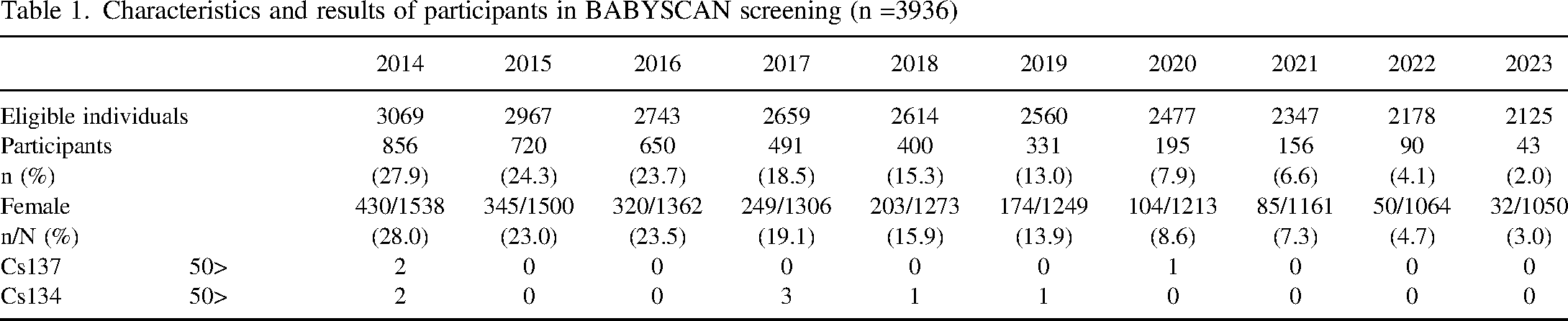
Characteristics and results of participants in BABYSCAN screening (n =3936)
Changes in the attitudes of parents toward the acquisition of various foods over time are shown in Fig. 1. There is a significant shift from 2014 to 2023. For rice, the choice of Type I (selecting the origin and avoiding Fukushima produce) decreased from 76.8% in 2014 to 16.3% in 2023. Simultaneously, the choice of Type II (not selecting the origin and not avoiding Fukushima produce) increased from 10.6% to 67.4%. Similar trends were observed for meat, fish, vegetables and fruits, mushrooms, and dairy products. Regarding water selection (Fig. 1), the use of mineral water decreased, whereas the use of tap water increased. The proportion of respondents who wanted to undergo the WBC testing decreased from 51.8% in 2014 to 7.0% in 2023, whereas the proportion willing to undergo testing if given the opportunity significantly increased from 46.7% in 2014 to 90.7% in 2023 (Fig. 1).
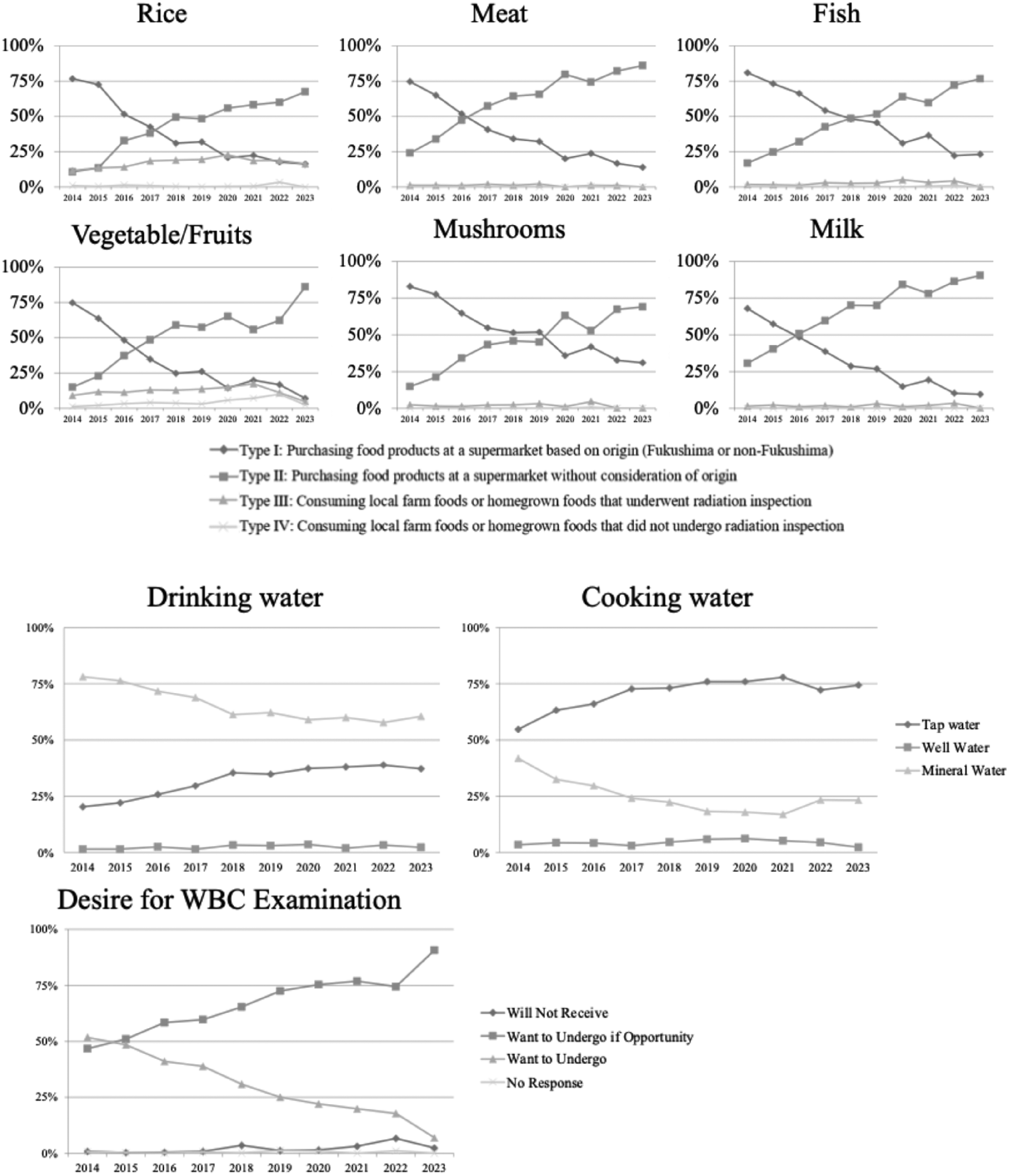
Yearly trends in the survey on concerns about food and water related to internal contamination and the desire for WBC testing.
The authors conducted counselling sessions for parents following the BABYSCAN examination. Many parents expressed relief owing to the test results, often saying, ‘That's good. I feel relieved’. Here, we introduce some concerns and inquiries from parents during counselling sessions between 2021 and 2023.
Among the participants who responded that they had no concerns related to the test results, several exhibited reactions of hearing about internal exposure to radiation for the first time, with responses such as ‘Is that so?’
‘My husband was exposed to radiation during the disaster; could it be hereditary?’ ‘A relative who lived in Minamisoma during the disaster developed cancer. I’m confused about what to do regarding food and radiation exposure’: There were expressions of anxiety regarding the hereditary effects of radiation exposure and the impacts of internal exposure in daily life.
‘They say it’s safe after the release of contaminated water, but…’ (2022). ‘I’m anxious about the health effects of the treated water release. I think it’s okay, but I don’t choose Fukushima fish for purchase’ (2023): Concerns related to the release of treated water from the FDNPP in August 2023 were heard.
‘I buy vegetables from the supermarket as they are properly tested, so I feel safe’. ‘My grandmother brings mushrooms, but I don’t let my child eat them,’ ‘I drink bottled water. For cooking, I use tap water’: Voices were heard from people making selective choices when purchasing food and consuming meals.
‘When driving through Tsushima in Namie, I keep the windows closed because I have children in the car’. ‘I was worried about my child playing outside, but I feel relieved after hearing these results’: There were expressions of concern about exposure to ambient radiation.
This study investigated the internal exposure testing of infants and young children and the changes in radiation risk perception among parents in areas affected by radiation disasters, suggesting the importance of risk communication with residents in the medium- to long-term postdisaster period.
Since the start of the testing in Minamisoma City, 3936 infants (approximately 15% of the target group) underwent BABYSCAN, with all internal exposure levels reported as ‘not detected’. These results align with those of previous studies (Hayano et al. 2015b, Tsubokura et al. 2020) and suggest a reduction in the anxiety of residents about radiation, as indicated by the reassurance expressed by the participating parents. Additionally, the survey results on food choices indicate a decreasing trend in concerns regarding radiation contamination. However, survey and counselling responses also reveal that concerns about internal radiation contamination still exist. This change may be attributed to the improved transparency in radiation measurements, information provision to residents, and ongoing communication. However, it is important to note the possible fading of the radiation disaster experience and a decrease in interest in radiation (Consumer Affairs Agency, 2023). In particular, new concerns about the release of treated water from the FDNPP in August 2023 were raised during the counselling sessions. These situations highlight the need for proper information provision and continuous risk communication with residents.
BABYSCAN (WBC) and counselling provide opportunities for dialogue with residents and play a crucial role in radiation risk communication (Murakami et al., 2017). These are the desired tools for residents to engage with radiation knowledge and assess the health impacts. The challenge lies in sustaining these initiatives amid declining test participation and the financial burden of equipment maintenance.
CONCLUSION
In Minamisoma City, an area affected by the disaster, BABYSCAN testing detected no internal radiation exposure. While radiation-related food avoidance has declined, concerns have evolved rather than disappeared. Sustained measurement and adaptive risk communication remain essential in the post-disaster context. Sustained measurement and adaptive risk communication remain essential in the post-disaster context. Despite decreasing participation rates in BABYSCAN testing, these findings underscore the importance of maintaining long-term risk communication with residents as an ongoing framework for education and community support.
Footnotes
ACKNOWLEDGEMENTS
We would like to extend our gratitude to Dr. Tsuyoshi Nemoto, Dr. Toshiyuki Kambe, Mr. Masatsugu Tanaki, and Ms. Kayo Suzuki, who are responsible for BABYSCAN and data management at Minamisoma Municipal General Hospital. We are also grateful for the cooperation of Mr. Hideo Sato from Hirata Central Hospital, Mr. Ayatomo Kambara and Mr. Shigeki Ando from Joban Hospital, and Mr. Yosuke Hirai from Minamisoma City Hall. We also thank Editage ( ) for English language editing.
FUNDING
This study was supported by the Program of the Network-type Joint Usage/ Research Center for Radiation Disaster Medical Science.