




Abstract
Six and a half years after the accident at Fukushima Daiichi nuclear power plant, an area of existing exposure situation remains. One of the main concerns of people is the higher level of ionising radiation than before the accident, although this is not expected to have any discernible health effect. Since the accident, several ‘abnormalities’ in environmental organisms have been reported. It is still not clear if these abnormalities were induced by radiation. It appears that the impact of the released radioactivity has not been sufficient to threaten the maintenance of biological diversity, the conservation of species, or the health and status of natural habitats, which are the focus in environmental protection. This highlights a difference between the protection of humans and protection of the environment (individuals for humans and populations/species for the environment). The system for protection of the environment has been developed with a similar approach as the system for protection of humans. Reference Animals and Plants (RAPs) were introduced to connect exposure and doses in a way similar to that for Reference Male and Reference Female. RAPs can also be used as a tool to associate the level of radiation (dose rate) with the biological effects on an organism. A difference between the protection of humans and that of the environment was identified: an effect on humans is measured in terms of dose, and an effect on the environment is measured in terms of dose rate. In other words, protection criteria for humans are expressed in term of dose (as dose limits, dose constraints, and reference levels), whereas those for the environment are expressed in terms of dose rate (as derived consideration reference levels).
Keywords
1. INTRODUCTION – RECENT RADIATION LEVELS AND CONCERNS
Six and a half years after the accident at Fukushima Daiichi nuclear power plant, the levels of radiation have reduced. In many areas, the evacuation orders have been lifted, and evacuation designated zones (371 km2) currently occupy 2.7% of the area of Fukushima Prefecture (13,783 km2) (Fukushima Prefecture, 2017).
However, people are still concerned about the level of radiation, which remains higher than before the accident. This is illustrated by the fact that radioactivity distribution maps as well as temperature distribution maps are shown in weather reports on television.
2. IMPACTS ON ENVIRONMENTAL BIOTA
One of the reasons for this concern has been the effects of radioactivity on environmental biota. Since the accident, some ‘abnormalities’ have been reported for blue grass butterflies (Hiyama et al., 2012) and Japanese fir trees (Watanabe et al., 2015).
Studies are ongoing, and some evidence has been shown for blue grass butterflies (Hiyama et al., 2017). However, data from another report suggest that the abnormality in the butterflies was not caused by radiation, but by other factors including microparticulate matter (Otaki, 2016).
For Japanese fir trees, reproducibility of the findings is now being investigated by the same group using gamma field and irradiation facilities (Watanabe, 2017). It remains unknown whether the abnormality or shape change was radiation induced, and further investigation is needed.
3. PROTECTION OF THE ENVIRONMENT
In Publication 103 (ICRP, 2007), the protection of the environment was described for the first time in the main recommendations. The aim of protection of the environment is to conserve biological divergence and maintain species.
Paragraph 30 of Publication 103 (ICRP, 2007) states that the ‘aim is…preventing and reducing the frequency of deleterious radiation effects to a level where they would have negligible impact on the maintenance of biological diversity, the conservation of species, or the health and status of natural habitats, communities and ecosystems’ (emphasis added by the present author).
In the protection system, the concept of Reference Animals and Plants (RAPs) was introduced: ‘A Reference Animal or Plant is a hypothetical entity, with the assumed basic characteristics of a specific type of animal or plant, as described to the generality of the taxonomic level of Family, with defined anatomical, physiological, and life-history properties, that can be used for the purposes of relating exposure to dose, and dose to effects, for that type of living organism’ (ICRP, 2007).
As a benchmark for protection of the environment, derived consideration reference levels (DCRLs) are defined (ICRP, 2008). A DCRL is ‘a band of dose rate within which there is likely to be some chance of deleterious effects of ionising radiation occurring to individuals of that type of Reference Animal or Plant (derived from a knowledge of defined expected biological effects for that type of organism) that, when considered together with other relevant information, can be used as a point of reference to optimise the level of effort expended on environmental protection, dependent upon the overall management objectives and the relevant exposure situation’ (ICRP, 2008) (emphasis added by the present author).
The object of protection of the environment is the species (i.e. population rather than individual), and the effects are assessed in terms of dose rate, rather than dose as used in the protection system for humans.
4. SIMILARITIES AND DIFFERENCES IN THE PROTECTION OF HUMANS AND THE ENVIRONMENT
4.1. Similarities
The system of protection of the environment has evolved in parallel with that of humans (Fig. 1). Similarities include the introduction of the concept of RAPs, which is the reference point to relate exposure to radioactive nuclides and dose to organisms, and dose to effects.
Evolution of two parallel pathways: radiological protection of humans and the environment (ICRP, 2008).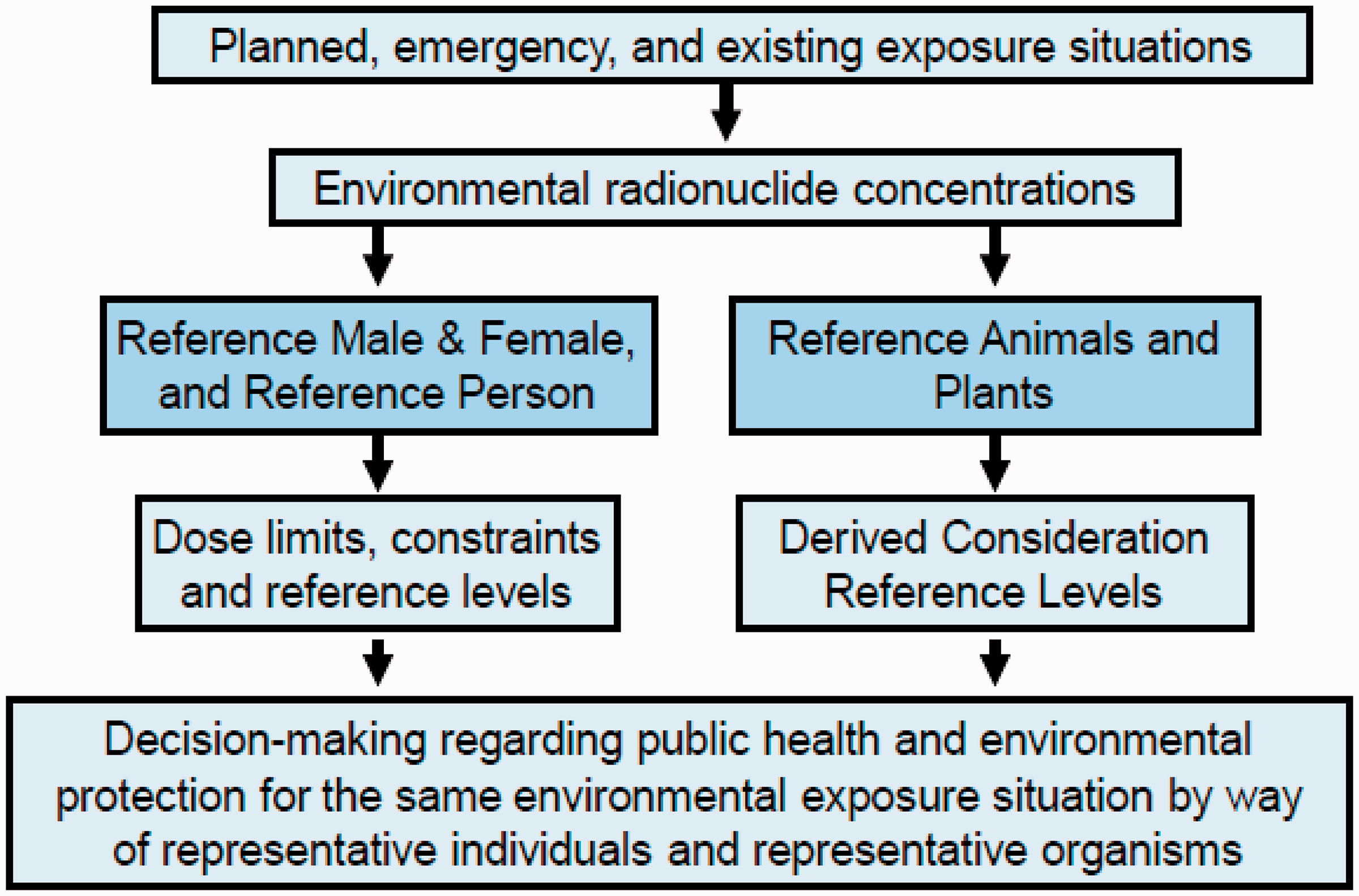
4.2. Differences
However, there are some differences between the protection systems for humans and the environment.
4.2.1. Object of protection
As described above, the object of the protection system of humans is the individual, while that of environmental protection is the species (i.e. population).
4.2.2 Dose vs dose rate as determinants of effects
In the systems for protection of humans and the environment, one of the striking differences is the parameter against which effects are considered (i.e. dose for humans and dose rate for environmental biota). In order to illustrate the relationship between dose and dose rate, a dose and dose rate map has been developed, where dose rate is plotted on the x-axis and total dose is plotted on the y-axis. In Fig. 2, some irradiation/exposure conditions [natural background radiation and atomic (A) bombs] are illustrated with DCRLs for the RAPs. By plotting effects on this map, analyses can be facilitated, considering dose, dose rate, and lifespan of the organism.
Dose and dose rate map. Conditions for acute exposure [atomic (A) bomb] and chronic exposure (high natural background radiation area) are illustrated. Also plotted are derived consideration reference levels (DCRLs) for Reference Animals and Plants (ICRP, 2008). (a) Pine tree, 0.1–1.0 mGy day−1, life span (LS) 200 years; (b) Deer, 0.1–1 mGy day−1, LS 15 years; (c) Duck, 0.1–1 mGy day−1, LS 11 years; (d) Rat, 0.1–1 mGy day−1, LS 2 years; (e) Frog, 1–10 mGy day−1, LS 10 years; (f) Flat fish, 1–10 mGy day−1, LS 10 years; (g) Trout, 1–10 mGy day−1, LS 6 years; (h) Brown seaweed, 1–10 mGy day−1, LS 5 years; (i) Wild grass, 1–10 mGy day−1, LS perennial; (j) Crab, 10–100 mGy day−1, LS 6 years; (k) Earthworm, 10–100 mGy day−1, LS 4 years; (l) Bee, 10–100 mGy day−1, LS 3 years.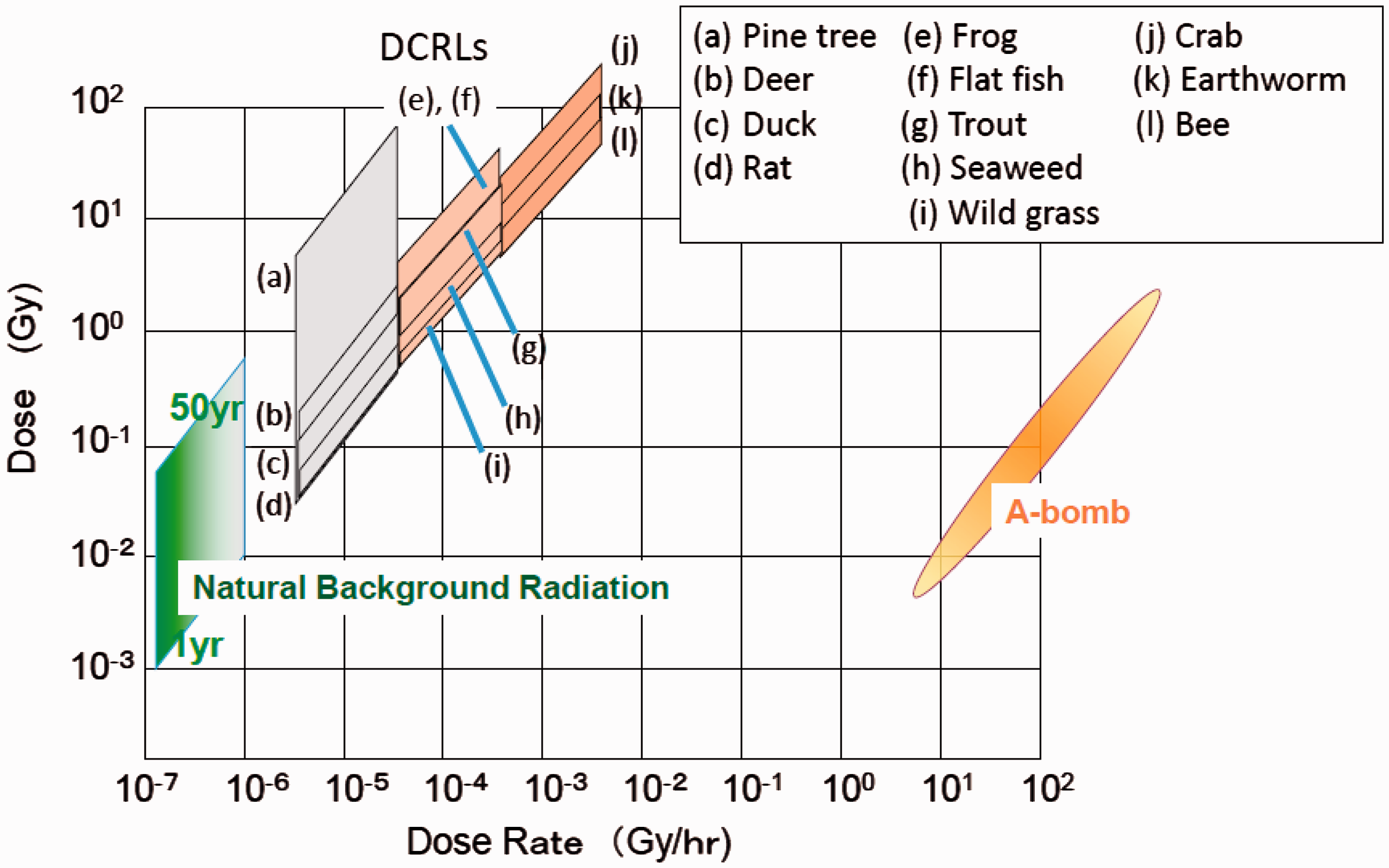
5. TOWARDS INTEGRATION
Radiation levels in Okuma Town in June 2011, and comparison with derived consideration reference levels (DCRLs) (UNSCEAR, 2013). The shaded boxes emphasize the similarity between the approach in human protection and that in environmental protection.
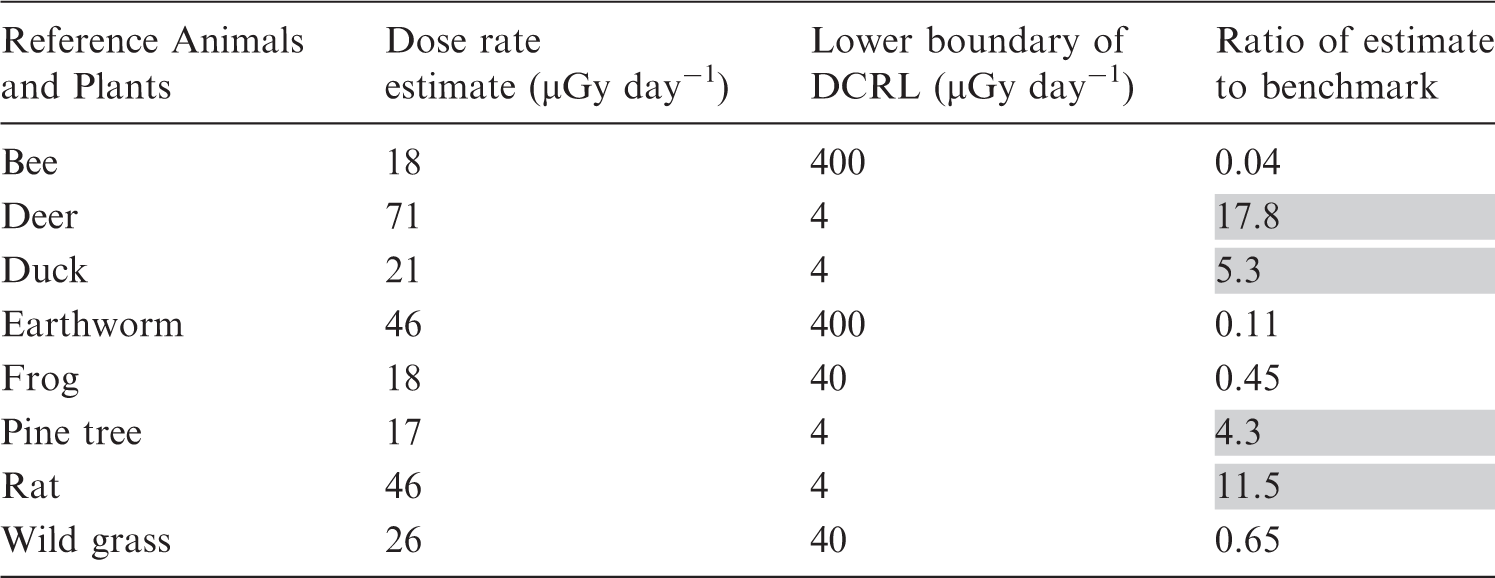
The exposure should, however, be considered as part of a temporal change in dose rate (Fig. 3). Fig. 3 shows that both the peak value and the duration at the higher dose rate should be considered. To evaluate the actual impact, the dose rate should be multiplied by the duration, and summed over the total period of exposure.
A temporal change in the environmental dose rate after an emergency event (ICRP, 2014).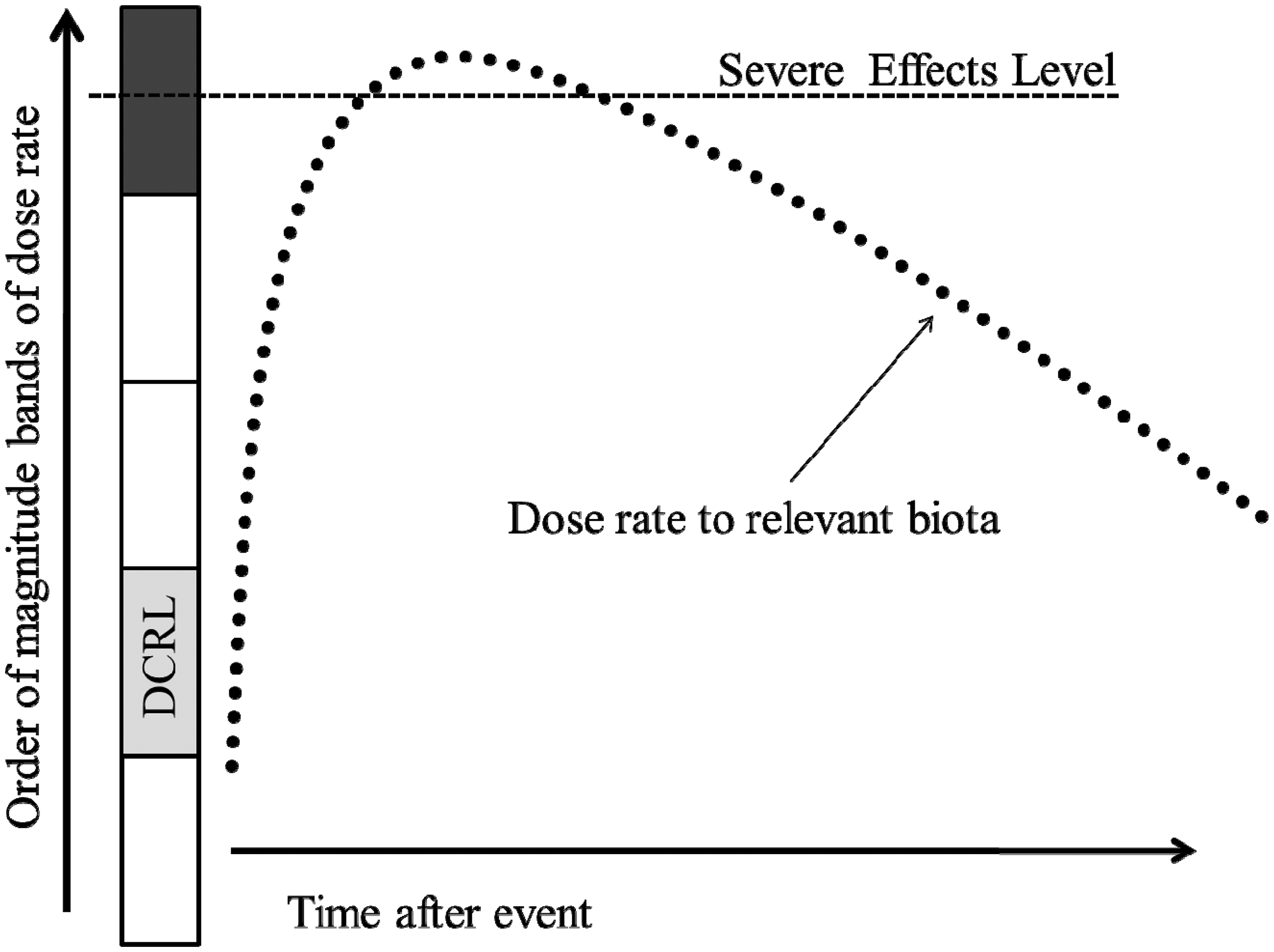
6. CONCLUSION
Although the system of environmental protection has evolved in parallel with that of humans, there are differences as well as similarities between the two systems. Differences include the object of protection (population/species for the environment and individual for humans), and the use of dose vs dose rate. Considering both dose and dose rate together would lead to an integrated radiological protection system. To achieve integrated protection of humans and the environment, the differences, rather than the similarities, between the current systems should be taken into consideration.