




Abstract
The importance of involving experts in the development of strategies for managing areas contaminated as a result of a nuclear accident is now well recognised. Following the Chernobyl accident in 1986, the initial focus, quite understandably, was on the technical aspects of reducing doses to the affected population. Subsequently, work carried out in the UK and elsewhere in Europe looked at the broader impacts of protective actions on agriculture, the environment, and society. From 1997, a group of experts from academia, government, and non-government organisations met regularly in the UK to debate these issues. One of the outputs included the first version of the UK Recovery Handbook for Radiation Incidents in 2005. Based on the success of the UK group, a European network of experts was established, leading to the development of European handbooks in 2009. The UK handbooks are living documents that are updated regularly with substantive input from experts.
1. INTRODUCTION
Recovery handbooks are tools to assist in the development of strategies for managing contaminated food production systems, inhabited areas, and drinking water supplies following a radiation emergency. The handbooks have been developed in conjunction with a wide range of experts, stakeholders, and end users. Depending on the prevailing circumstances, there are many potential protective actions (previously called ‘countermeasures’) that can be applied. Consequently, decision makers need guidance on how to select options according to: radionuclide(s) released, chemical forms, levels, and spread of deposition; time of year; land use in affected areas; timescales for preparing and implementing protective actions; legislative, physical, and societal constraints; and overall acceptability. It is impossible to have one generic strategy for all emergency scenarios.
There are three handbooks (food production systems, inhabited areas, and drinking water supplies), each of which is divided into several sections providing supporting scientific and technical information; an analysis of the factors influencing recovery; compendia of comprehensive, state-of-the-art datasheets for approximately 100 protective actions; and guidance on planning in advance for recovery. There is also a decision-aiding framework to select and combine protective actions, and several worked examples for illustrative radiation emergency scenarios.
The audience for the recovery handbooks is wide ranging and can include central government and agencies, national and local authorities, radiation protection experts, remediation contractors, agriculture and food industry, and drinking water providers. In terms of application, the handbooks have several functions. In the preparation phase, they can be used to engage stakeholders; to develop local, regional, and national plans; and to identify gaps in recovery capability. In the post-emergency phase, they can be used to aid decision-making. Finally, the handbooks can also be used during recovery exercises and for training and familiarisation purposes.
2. INVOLVEMENT OF EXPERTS IN HANDBOOK DEVELOPMENT
Timeline for the involvement of different experts in handbook development.
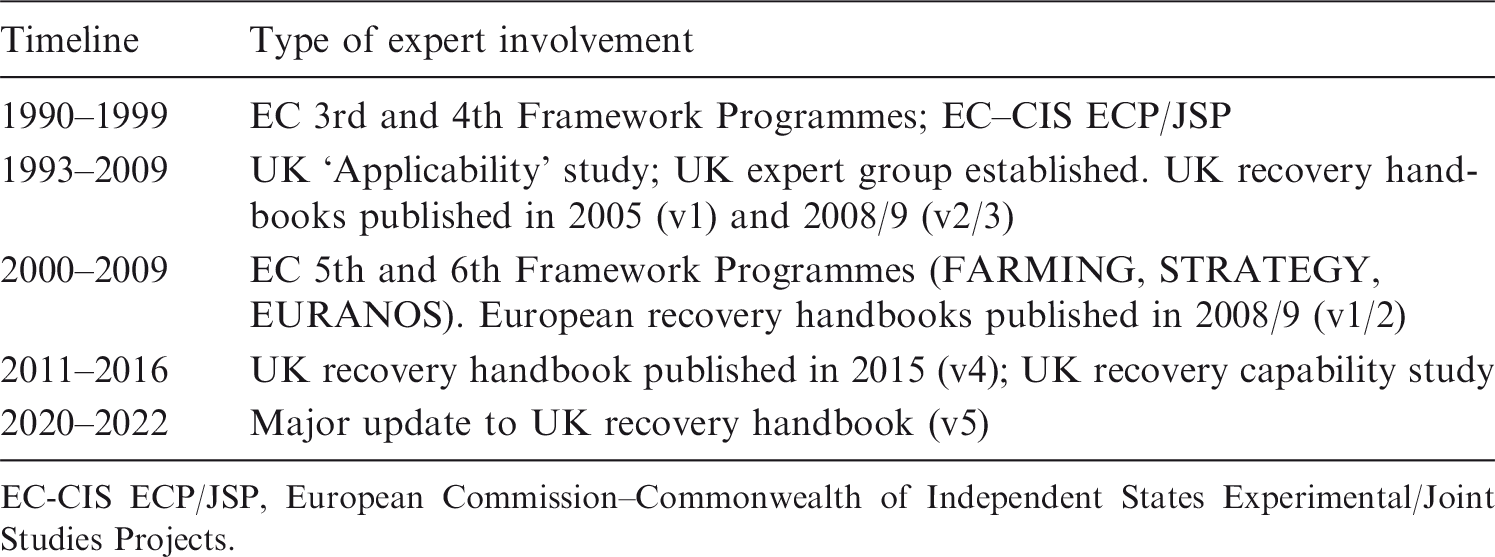
EC-CIS ECP/JSP, European Commission–Commonwealth of Independent States Experimental/Joint Studies Projects.
2.1. European experts: 1990–1999
During the period 1990–1999, the European Commission supported numerous research projects throughout Europe under its 3rd and 4th Framework Programmes. These projects involved scientific and technical experts from research organisations, radiation protection institutes, and academia. Their work provided data and information on mechanisms of radionuclide transfer to the population through, for example: physicochemical properties of soils; bioavailability of radionuclides in plants and animals; radio-ecological modelling; effectiveness of agricultural countermeasures; and decontamination options for inhabited areas. The results of these projects and other targeted studies with experts from the Commonwealth of Independent States (Russia, Belarus, and Ukraine) were published in numerous reports and peer-reviewed papers (e.g. European Commission, 1996; Sinnaeve et al., 1996). This provided a solid foundation for the handbooks.
2.2. UK experts: 1993–2009
UK scientists took the relevant outputs from the EC 3rd and 4th Framework Programmes to investigate the applicability to the UK of recovery strategies used elsewhere in the Commonwealth of Independent States and Europe (Nisbet, 1995). This involved broadening the types of experts consulted (e.g. economists, policy directors, farm managers), as well as the topics considered (e.g. resource availability, cost, and acceptability of the protective actions). The study concluded that the use of expert judgement to gauge the practicability of protective actions was useful, but also highlighted considerable divergence of opinion. Establishment of an expert working group was recommended as part of UK contingency planning. The new group, called the ‘Agriculture and Food Countermeasures Working Group’ (AFCWG), was set up in 1997 by the National Radiological Protection Board and Ministry of Agriculture (Nisbet and Mondon, 2001). Membership included a wide range of experts from government (e.g. central, regional, local; devolved administrations) and non-government organisations (e.g. retail, food processors, farming unions, consumer groups, environmentalists, academics). The aim of the expert group was four-fold: to encourage communication between experts; to disseminate relevant information; to debate practicability of protective actions for planning purposes; and to provide expert input during a radiation emergency. The group remained active until 2009. It provided a role model for the establishment of similar expert groups in Europe, as well as providing vital input to the first three versions of the UK Recovery Handbook for Radiation Incidents.
2.3. European experts: 2000–2009
The European Commission’s 5th and 6th Framework Programmes supported the FARMING (Nisbet et al., 2005), STRATEGY (Howard et al., 2005), and EURANOS (Raskob et al., 2010) projects. These played a key role in the development of recovery handbooks at the European level. These projects broadened the focus from agriculture and food to inhabited areas, drinking water supplies, and forests. A range of approaches were used to engage with the experts, including international and national working groups (initially through the FARMING network), scenario-focused workshops, and exercises. This led to the compilation of compendia of protective actions through the STRATEGY project, and opportunities to brainstorm the structure and content of generic European handbooks through the FARMING and EURANOS projects. These handbooks were published in 2009 (Brown et al., 2009; Nisbet et al., 2009a,b). Customised versions of the handbooks were subsequently produced in Scandinavia, Spain, Ireland, and Slovakia. Experts from multiple disciplines were engaged during the period 2000–2009 (e.g. radiation protection specialists, agriculturalists, foresters, veterinarians, radio-ecologists, doctors, environmentalists, journalists, engineers, hydrologists, economists, emergency planners, farming union representatives, consumers, computer scientists, meteorologists, and physicists).
2.4. UK experts: 2011–2016
The Fukushima accident in 2011 led to a period of reflection in the UK where many areas of emergency planning, response, and recovery were stress tested using input from a wide range of independent experts. Recovery capability (i.e. capability for monitoring, data and information collection and exchange, dose assessment, remediation, waste management, and stakeholder engagement) was one such area that was assessed by Public Health England. Findings from this study have subsequently led to a new and ongoing programme of work being co-ordinated by the UK Nuclear and Radiological Emergencies–Recovery Working Group (NRE-RWG). Priorities include a major update to the UK Recovery Handbook for Radiation Incidents, development of a waste management plan, and elaboration of models for the future provision of remediation capability, as well as monitoring, sampling, and analytical capability.
During the period 2011–2016, the UK Recovery Handbook for Chemical and Biological Incidents was published for the first time (Wyke et al., 2012; Pottage et al., 2015) based on the radiation counterpart with input from experts in chemical and biological hazards. There was also an opportunity to carry out a minor update to the fourth version of the UK Recovery Handbook for Radiation Incidents (Nisbet et al., 2015), incorporating some of the learning from remediation work after Fukushima.
3. MAJOR UPDATE TO UK RECOVERY HANDBOOK: 2020–2022
The last major update to the UK handbook was in 2009. Since then, there have been changes to international and national legislation relating to nuclear emergencies. Recovery guidance has also been updated (e.g. ICRP, 2020), and lessons have been learned not only from Fukushima but from other non-radiological events including Novichok poisoning in the UK and the worldwide coronavirus pandemic. NRE-RWG is supporting a new project, initiated in 2020 by Public Health England, to completely overhaul the UK Recovery Handbook for Radiation Incidents. PHE is working closely with, and is reliant on, experts in other government departments and agencies, as well as the private sector and local authorities. The experts span areas such as food, agriculture, environment, drinking water supply and quality, nuclear operation and decommissioning, remediation technologies, recovery policy, legislation, and regulation. NRE-RWG is providing access to other experts and potential end users who will peer review all aspects of handbook development.
Key features of the updated handbook include: expanding the scope to encompass a much wider range of scenarios; additional worked examples; a wider range of building structures, surfaces, materials, and food products; new frameworks for recovery planning and waste management; new information on protective actions and their effectiveness; revised datasheet template and content; and a simplified decision-aiding framework. Redundant material has also been identified and will be removed.
4. CONCLUSIONS
Experts have played a crucial role in the development of recovery handbooks over the last 30 years. European research projects carried out in the 1990s by scientific and technical experts led to a comprehensive understanding of the behaviour of radionuclides in the environment, and showed how protective actions (countermeasures) could be used to prevent or reduce exposure of the population. Subsequent UK studies engaged with a broader range of experts and looked beyond the radio-ecological effectiveness of protective actions to provide a better appreciation of their practicability. Working with expert groups such as AFCWG provided a sound basis for development of the first version of the UK Recovery Handbook for Radiation Incidents. Further multi-disciplinary European projects carried out over the period 2000–2009 established networks of expert groups with responsibility for further developing recovery handbooks for Europe. Recovery handbooks are living documents that need to be updated periodically to remain state-of-the-art. Consequently, a major update to the UK handbook was initiated in 2020 in collaboration with experts from a wide range of backgrounds.