




Abstract
Radiation protection issues on preparedness and response for a severe nuclear accident are discussed in this paper based on the experiences following the accident at Fukushima Daiichi nuclear power plant. The criteria for use in nuclear emergencies in the Japanese emergency preparedness guide were based on the recommendations of International Commission of Radiological Protection (ICRP) Publications 60 and 63. Although the decision-making process for implementing protective actions relied heavily on computer-based predictive models prior to the accident, urgent protective actions, such as evacuation and sheltering, were implemented effectively based on the plant conditions. As there were no recommendations and criteria for long-term protective actions in the emergency preparedness guide, the recommendations of ICRP Publications 103, 109, and 111 were taken into consideration in determining the temporary relocation of inhabitants of heavily contaminated areas. These recommendations were very useful in deciding the emergency protective actions to take in the early stages of the Fukushima accident. However, some suggestions have been made for improving emergency preparedness and response in the early stages of a severe nuclear accident.
Keywords
1. INTRODUCTION
The arrangements for nuclear emergencies in Japan were developed incrementally following the accident at Three Mile Island nuclear power plant in the USA in 1979. In 1980, the Japanese Nuclear Safety Commission (NSC) issued an emergency preparedness guide as one of the measures to maintain preparedness for severe accidents, such as the accident at Three Mile Island. The Chernobyl accident in 1986 did not have a particularly significant impact on the emergency management system due to differences between the reactor types. Several weaknesses in the emergency response system, such as prompt initial actions, collaboration of national and local governments, strengthening of the emergency response system, and clarification of the licensee’s responsibilities, were identified following the Tokaimura criticality accident in 1999. After the criticality accident, the Act on Special Measures Concerning Nuclear Emergency Preparedness was enacted in December 1999 and enforced in June 2000. While the legal framework of emergency preparedness and response in Japan had been established before the Fukushima accident, several weaknesses of the emergency response system were also found in the light of radiation protection. The decision-making process for implementing protective measures relied heavily on computer-based predictive models. Criteria for terminating urgent protective actions and for long-term protective actions, such as temporary relocation, had not been prepared in the NSC emergency preparedness guide.
The NSC emergency preparedness guide was based on recommendations in Publication 60 (ICRP, 1991) and 63 (ICRP, 1993). The International Basic Safety Standards for Protection against Ionizing Radiation and the Safety of Radiation Sources by the International Atomic Energy Agency (IAEA) considered these recommendations and guidance issued by ICRP, and provided guidelines, such as generic optimised intervention levels for urgent protective actions and generic action levels for foodstuffs (IAEA, 1996). NSC adopted these guidelines for generic intervention and action levels in the emergency preparedness guide. The 2007 Recommendations of ICRP (ICRP, 2007) evolved from the previous process-based approach of practices and interventions to an approach based on the characteristics of radiation exposure situations. Applications of ICRP recommendations for both emergency and existing exposure situations were issued as Publication 109 (ICRP, 2009a) and 111 (ICRP, 2009b), respectively. At the time of the Fukushima accident, the changes in the approach by ICRP had not been incorporated into international or national standards, and therefore could have been part of the problem for the response to the Fukushima accident.
This paper briefly describes the initial lessons learned from the Fukushima accident. In particular, the paper discusses some radiation protection issues on emergency preparedness and response in the early stages of a large-scale severe nuclear accident.
2. Radiological situation IN the early stages of the fukushima accident
At the Fukushima Daiichi nuclear power plant, the circulation of sea and land breezes is a predominant factor for dispersion of released radioactivity. At night, a west wind blows towards the Pacific Ocean. In the early morning, it shifts to the south, and subsequently to the south-west and west. From afternoon to evening, it blows to the north-west. Fig. 1 shows the ambient dose rate measurements at seven locations relatively distant from the site, and describes the radiological situation in the early stages of the Fukushima accident. The first peak in ambient dose rate was observed in Minamisoma City, approximately 20 km north of the plant, at approximately 20:00 h on 12 March 2011. This may have been due to transportation of the radioactive plume by the strong southerly winds when Unit 1 was vented, and the subsequent hydrogen explosion in the reactor building. The releases from Unit 3 on 13 and 14 March 2011 were mainly transported towards the Pacific Ocean.
Ambient dose rates observed at seven cities around the Fukushima plant in the early stages of the accident.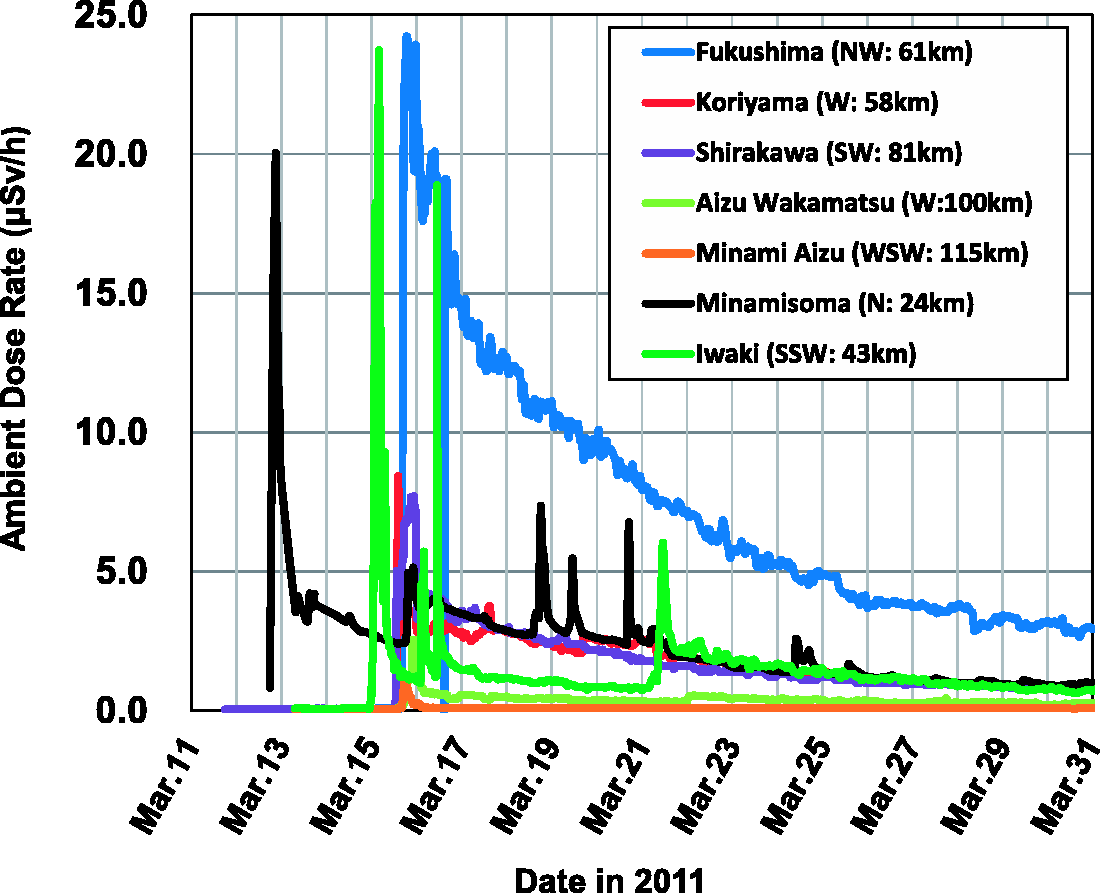
At midnight on 14 March 2011, Unit 2 underwent a core melt, and the onsite radiation levels began to rise. Further, at approximately 06:00 h on 15 March 2011, a sound of explosion was suspicious near Unit 2, and the reactor building of Unit 4 was damaged. At 04:00 h, outside the reactor site, radiation levels as high as 24 μSv h−1 were observed in Iwaki City, approximately 50 km south of the site. During this time, the prevailing winds, which were from the north, transported the radioactive plume to Ibaraki Prefecture, Southern Kanto areas, and even as far as Shizuoka Prefecture. In the afternoon, the radioactive plume reached the cities of Shirakawa, Koriyama, and Fukushima, and airborne radiation levels rose. In the evening of 15 March 2011, the entire prefecture of Fukushima experienced rain and snow, depositing the radioactivity on the ground during passage of the plume. Areas to the north-west of the nuclear power plant were thus heavily contaminated. The Ministry of Education, Culture, Sports, Science, and Technology (MEXT) of Japan, in cooperation with the US Department of Energy, conducted airborne monitoring within a 100-km radius of the power plant. According to the radiation map produced by this monitoring, the total depositions of caesium-134 and caesium-137 on the ground were strongly affected by the precipitation that fell when the plume passed over, and showed a non-uniform distribution (Fig. 2).
Deposition distributions of caesium-137 from airborne monitoring by the Japanese Ministry of Education, Culture, Sports, Science, and Technology and the US Department of Energy.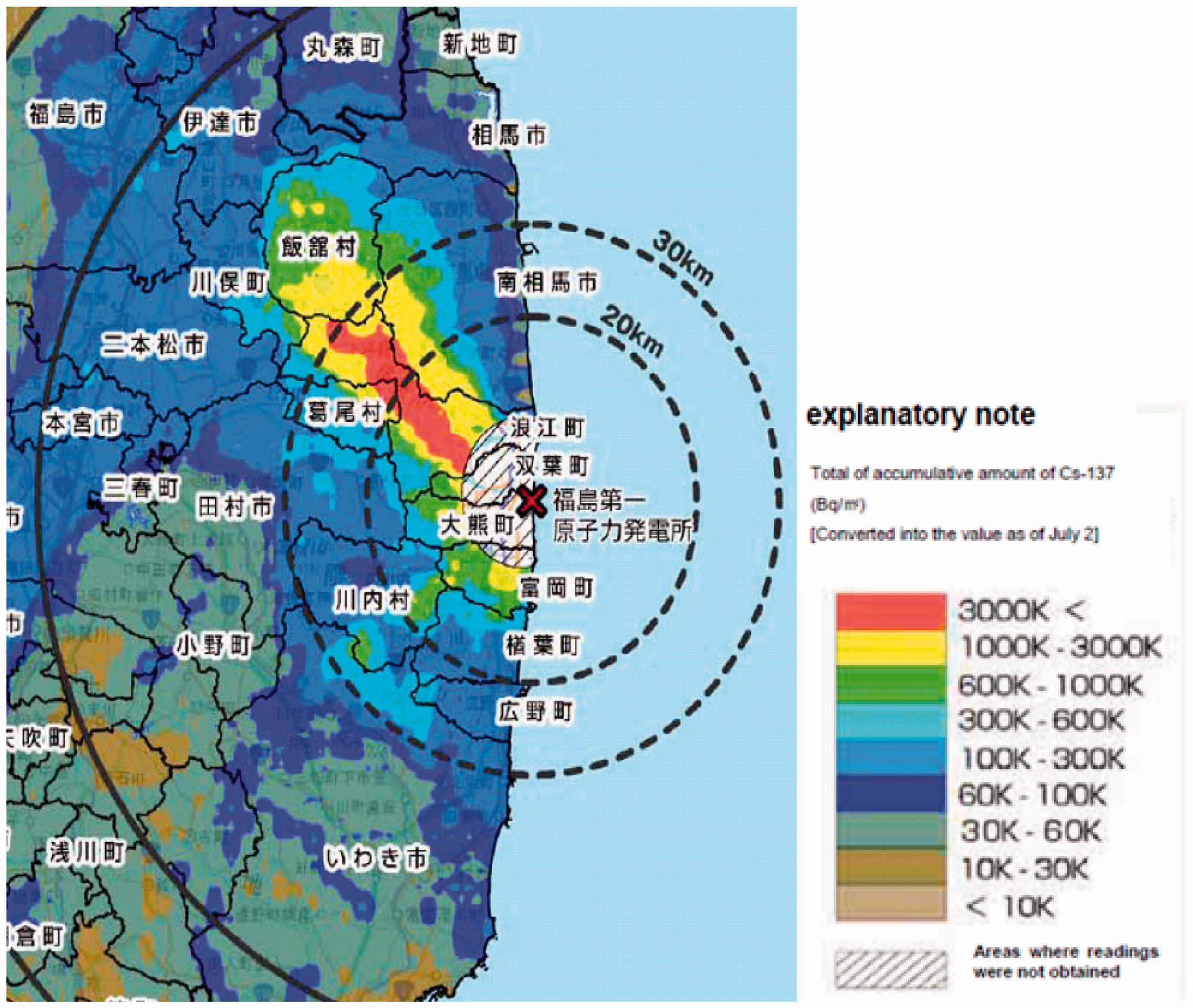
3. URGENT PROTECTIVE ACTIONS
In order to avert potential radiation exposure to the public, the Japanese authorities implemented the precautionary urgent protective actions to advise individuals within 3 km of the plant to evacuate, and those within 10 km to remain indoors on 11 March 2011. This was determined based on the plant conditions, as the reactor of Unit 1 had not been cooled. The Japanese Government officially reported that the evacuation had been completed at midnight on 12 March 2011. The evacuation zone was extended to a 10-km radius early on 12 March 2011, and then later to a 20-km radius after the hydrogen explosion in Unit 1. This was because the pressure in the primary containment vessel may have been increasing, and also to prepare for any possible risks that would occur simultaneously at multiple reactors, including the other units at the nuclear power plant. The ‘in house’ sheltering zone between 20 and 30 km of the plant was established on 15 March 2011. The Nuclear Industrial and Safety Agency (NISA) announced that the evacuation of the 20-km zone had been completed at 19:00 h on 15 March 2011. These precautionary urgent protective actions were taken based on the plant conditions.
In emergency exercises to date, recommendations on the implementation of urgent protective actions have been made based on projected dose (‘model predictions’) with intervention levels. The NSC emergency preparedness guide indicates that the projected dose will be evaluated by models that predict source terms of the accident and also the dose to the public. The disaster management basic plan assigns organisations with the role and responsibility to prepare and implement the computer prediction system. The emergency response support system, which predicts the progression of the accident at the plant, could not be used in the Fukushima accident because necessary information could not be obtained from the plant. In addition, the system for prediction of environmental emergency dose information (SPEEDI), which conducts a numerical forecast of atmospheric conditions, air concentrations, and depositions of released radioactivity and dose distributions, could not be used because the source terms could not be obtained via the emergency response support system.
After the Fukushima accident, the issue relating to disclosure of the results generated by SPEEDI to the public was raised in the media, and also discussed in terms of the national diet. The criticism claimed that if the information generated by SPEEDI had been provided more quickly, it could have helped local governments and the public to choose a more appropriate route and direction of evacuation. However, neither quantitative nor qualitative analyses have been presented to support such discussions. Fig. 3 shows the results of caesium-137 deposition patterns calculated by the Level 3 PSA code, OSCAAR developed at the Japan Atomic Energy Agency (Homma et al., 2005) using the source terms presented in the Government report on the Fukushima accident, submitted to IAEA in June 2011. The source terms were calculated using a severe accident analysis computer code MELCOR by NISA. The differences between Fig. 2 and 3 are mainly due to the release timing of caesium-137 calculated by MELCOR, and also the uncertainty of the atmospheric dispersion model that was used in the calculations. This highlights the difficulty of developing protective action recommendations based on computer model predictions.
Deposition distributions of caesium-137 calculated by OSCAAR using the source terms provided by MELCOR.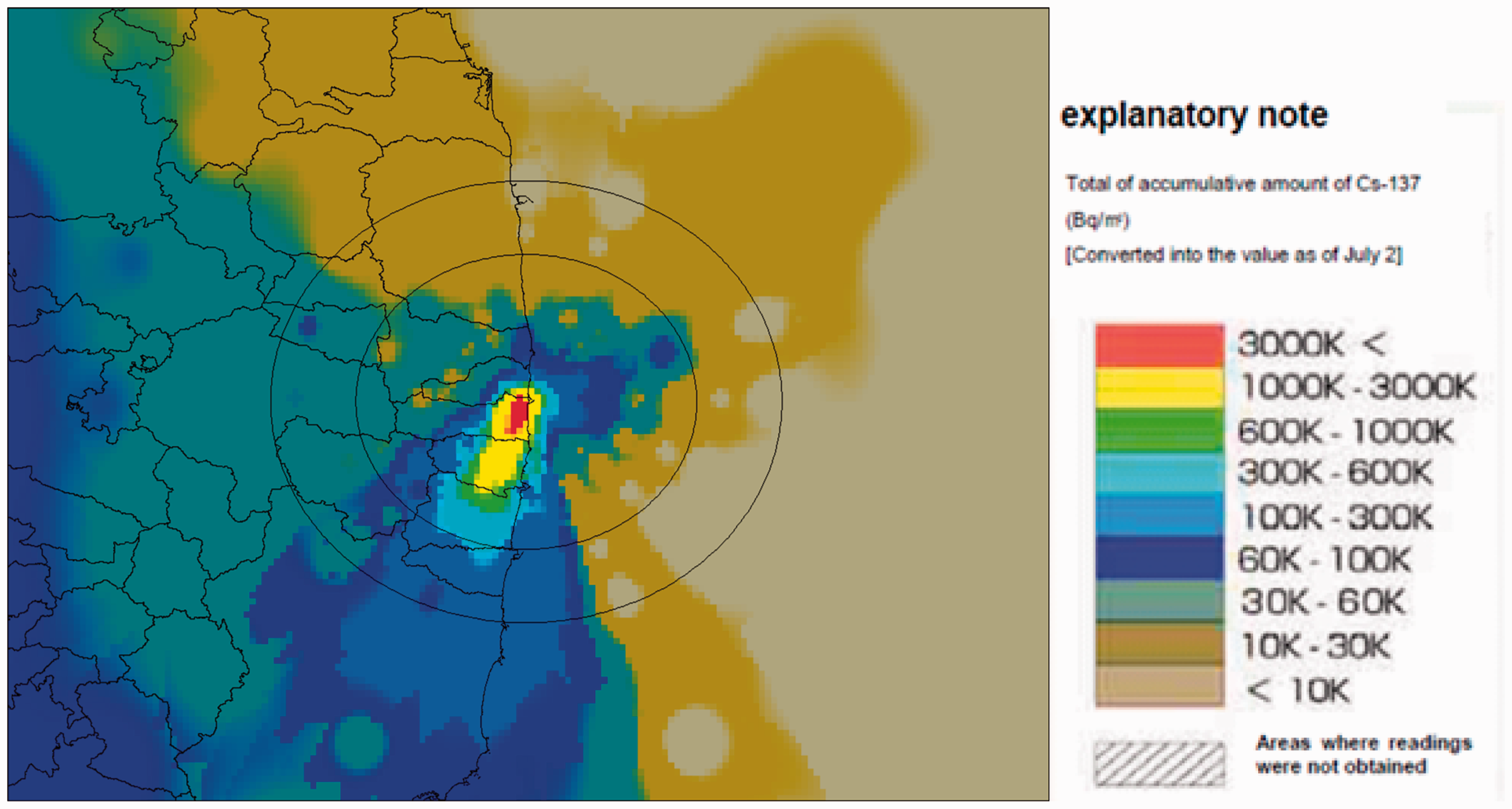
When implementing urgent protective actions, there is no time to undertake detailed exposure assessments in real time. There are also extremely large uncertainties associated with predictive models. It is therefore necessary to determine, in advance, a set of internally consistent criteria for taking such actions, and, based on these criteria, to derive appropriate ‘triggers’ for initiating them in the event of an emergency, as described in Publication 109 (ICRP, 2009a). IAEA also recommends that precautionary urgent protective actions should be taken before or shortly after a major release based on the plant conditions; implementation should not be delayed until after a release. The IAEA Safety Guide (IAEA, 2011) provides the basis for the emergency classification schemes, and an example of emergency action levels that are the criteria for classification.
4. RESTRICTIONs ON FOOD AND WATER
After heavy contamination of the ground in areas to the north-west of the Fukushima Daiichi nuclear power plant on 15 March 2011, high levels of radioiodine and radiocaesium were detected in foodstuffs and water. Radioiodine in tap water was first detected on 16 March 2011 in Fukushima City. On 20 March 2011, water samples taken in Iitate Village were found to have iodine-131 levels of 965 Bq kg−1, exceeding the provisional regulatory value of the Japanese Ministry of Health, Labour, and Welfare (MHLW) (300 Bq kg−1). For this reason, MHLW restricted consumption of water from private water supply systems. Kinase et al. (2011) reported that the estimated averted thyroid equivalent dose to infants in Iitate Village was approximately 8 mSv, although the effective half-life of iodine-131 in tap water was approximately 2.8 days. In addition, on 21 March 2011, MHLW announced that people should avoid using tap water for infants, including use in baby formula. This measure was enacted throughout March 2011 in several prefectures around the Fukushima plant, including Tokyo.
On 16 March 2011 in Kawamata Town, raw milk was found to contain 1190 Bq kg−1 iodine-131, which exceeded the provisional regulatory value of 300 Bq kg−1. Furthermore, on 18 March 2011, in Hitachi of Ibaraki Prefecture, 54,100 Bq kg−1 of iodine-131 and 1931 Bq kg−1 of radiocaesium were detected in spinach. These also exceeded the provisional regulatory values. Since 21 March 2011, when Fukushima Prefecture enacted restrictions on the distribution of raw milk, it has enacted similar distribution and consumption restrictions on vegetables. At a later stage of the accident, radiocaesium was found in shiitake mushrooms in April 2011 and in tea plants in May 2011. Moreover, in July 2011, beef cattle that had been fed with contaminated rice stalks had unacceptably high levels of caesium-137, and distribution of beef was restricted in four prefectures.
Radioactivity in food and drinking water caused significant anxiety amongst the public, and resulted in rumours being spread. Conceptually, protective actions on food consumption can be implemented for each different type of exposure situation because the transfer of radionuclides into the food chain depends upon the time and characteristics of the contamination. In the early stages after an accident, a quick response is needed to avert the ingestion of dose due to elevated levels of radioactivity, such as radioiodine that has been deposited directly on agricultural products and drinking water. Restrictions can be triggered using an operational intervention level, such as the gamma dose rate from a contaminated surface suggested by IAEA (2011). During intermediate and longer term stages after an accident, criteria for foodstuff restrictions should be considered in the process of optimisation for the whole protective strategy, considering factors such as radiological and nutritional impact, reference level and contribution of ingestion dose, realistic estimates based on dietary habits, market dilution, and harmonisation with internationally agreed standards.
5. EARLY PROTECTIVE ACTIONs
On 17 March 2011, the highest ambient dose rate (170 μSv h−1) was observed at a point outside the evacuation zone, approximately 30 km from the site. NSC collected monitoring data around the heavily contaminated areas, and advised the Nuclear Emergency Response Headquarters that the residents should be asked to voluntarily evacuate from those areas where a relatively high dose was expected. After reviewing the situation, NSC considered modifying the urgent protective actions implemented, and the process of implementing temporary relocation of residents in those areas. As there were no criteria for long-term protective actions in the NSC guide, the revised recommendations of Publications 103, 109, and 111 (ICRP, 2007, 2009a,b) were taken into consideration in determining the temporary relocation of the inhabitants in the heavily contaminated areas.
On 22 April 2011, the areas beyond 20 km from the site, where annual cumulative dose for the inhabitants would potentially reach 20 mSv, were established as ‘deliberate evacuation areas’. The criterion of 20 mSv was used based on the bottom end of the reference level of 20–100 mSv in emergency exposure situations. Inhabitants in the deliberate evacuation areas were asked to leave by the end of May 2011. At the same time, the remaining sheltering areas, between 20 and 30 km from the site, were established as ‘evacuation-prepared areas in case of emergency’, with the inhabitants prepared to shelter or evacuate in the event of a further emergency. In addition, on 16 June 2011, hot spot areas with a dose above 20 mSv year−1 were identified and established as ‘specific spots recommended for evacuation’. Inhabitants in these hot spots did not have to evacuate immediately, but had to take precautions in their daily activities in order to prevent their dose exceeding 20 mSv.
The new criterion of annual dose of 20 mSv year−1 was used as an intervention level for justifying temporary relocation instead of a reference level during implementation of the optimisation process for exposures in emergency exposure situations. In addition, during the discussion on the implementation of temporary relocation, a further issue was raised related to the criteria that would be applied to the use of contaminated playgrounds by children in April 2011. MEXT selected 20 mSv year−1 from the dose band for an existing exposure situation recommended by ICRP. This was because ICRP described how the transition from an emergency exposure situation to an existing exposure situation may take place at different geographical locations at different times, such that whilst some areas are managed as an emergency exposure situation, others are managed as an existing exposure situation. This level was selected as a starting point for optimisation. MEXT subsequently advised the prefecture to reduce the dose to 1 mSv year−1, but selection of the same value as that used for relocation raised concern amongst the public.
6. POTENTIAL EXPOSURE
One of the lessons learned from the Fukushima accident is that loss of land use resulting in social disruption in communities cannot be prevented, but appropriate emergency preparedness and response can prevent radiation health effects following a severe reactor accident. This may be an issue for nuclear safety, such as severe accident management, but from the viewpoint of radiation protection, risk attributes from potential exposure should be discussed thoroughly to protect individuals, society, and the environment.
In December 2003, the Special Committee on Nuclear Safety Goals established by NSC proposed that qualitative and quantitative safety goals should be applied consistently to all types of nuclear activities, and future efforts should be made to investigate performance goals for each field of utilisation of nuclear energy in the Interim Report on the Discussion of Safety Goals (NSC, 2003). The proposed quantitative goal should be objective and common to various nuclear facilities and activities that give rise to potential adverse health effects from radiation exposure to the public. Among various types of adverse effects of nuclear accidents, individual risks of both early fatality and cancer fatality to members of the public were established as risk indicators for the quantitative safety goals.
The Special Committee on Nuclear Safety Goals had considerable discussions about various risks such as collective risk, societal risk, and risk to individuals covered by safety goals. Fig. 4 shows the exploratory calculations using the Level 3 PSA code, OSCAAR to determine the extent of land contamination as a function of different releases and weather conditions. It shows that the release limit at approximately 0.1% fraction of caesium to the core inventory (3200 MWth) ensures that a larger societal impact which would result in long-term ground contamination does not occur beyond site boundaries. However, the Special Committee on Nuclear Safety Goals concluded that no criteria were selected in terms of societal risk because it was difficult to quantify the overall societal impact rather than human health effects, and there was no benchmark of societal risk levels to be restricted.
Area of land contamination that corresponded to permanent relocation vs release fraction of caesium to the inventory.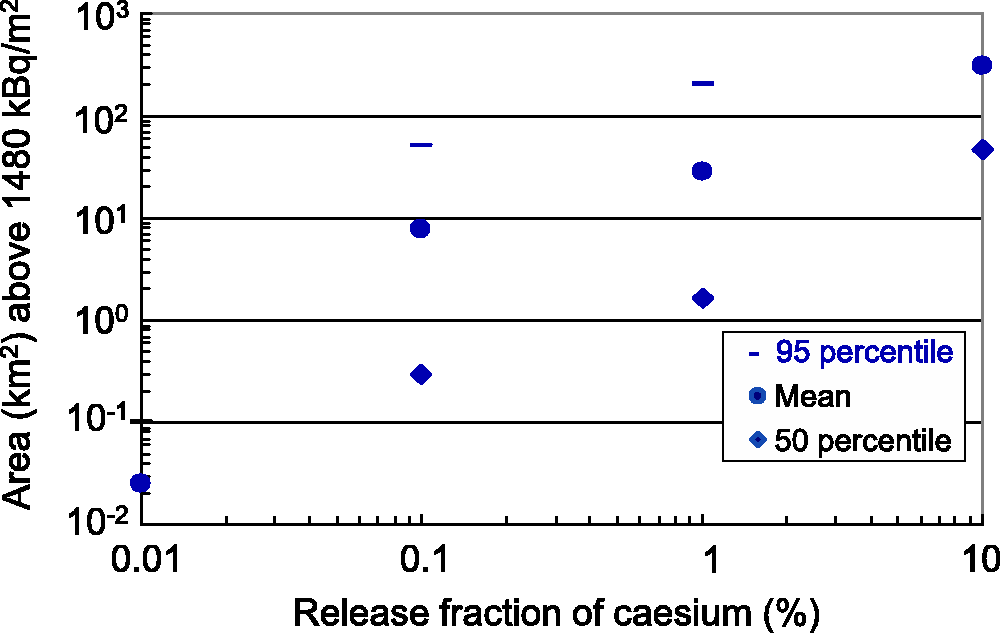
The risk of a severe accident in a nuclear power plant can be managed as a potential exposure in the context of planned exposure situations. In the safety goals for nuclear installations in Japan, only individual health risks were used as metrics. The Fukushima accident, however, indicated the importance of societal risk, such as countermeasures needed to protect individuals and land contamination, rather than individual health risks. ICRP should consider whether it should further elaborate the recommendations for protection from potential exposure.
7. CONCLUSIONS
A general lesson learned from the Fukushima accident, as well as the accidents at Three Mile Island and Chernobyl, is that there was an implicit assumption that such severe accidents could not happen, and thus sufficient attention had not been paid to preparedness for the accidents by the operators and the regulatory authorities. Although arrangements for preparedness and response for severe nuclear accidents in Japan had not been well established at the onset of the Fukushima accident, the ICRP recommendations described in Publications 60, 63, 103, 109, and 111 (ICRP, 1991, 1993, 2007, 2009a,b) were very useful in deciding the emergency protective actions to take in the early stages of the Fukushima accident.
Among several initial lessons learned from the Fukushima accident, it is recommended that arrangements should be established for taking precautionary urgent protective actions before a release based on the plant conditions.
The following suggestions have been identified to improve emergency preparedness and response in the early stages of an accident:
to make practical recommendations for control of contaminated foodstuffs and water; to clarify the intended use of the concept of dose limits, dose constraints, and reference levels for protection of the public; and to consider whether the recommendations for protection from potential exposure should be further elaborated.