




Abstract
This paper does not necessarily reflect the views of the International Commission on Radiological Protection.
1. INTRODUCTION
The All Kindai Kawamata Town Reconstruction Assistance Project was a cross-faculty project launched by Kindai University to support the early reconstruction of Kawamata Town in Date District, Fukushima Prefecture by making full use of its research capabilities as a comprehensive university with 14 faculties and 48 departments. Reconstruction support measures proposed by Kindai University faculty members were split into groups for: (i) agriculture/industry/town development promotion; (ii) decontamination promotion; (iii) mental health and physical care; and (iv) radiation/radioactivity measurement. These support measures started in earnest on 31 May 2013, incorporating the intentions of the residents of Kawamata Town. Support is provided while incorporating the opinions of residents in terms of ‘reconstruction support’, such as revitalisation of the local agricultural industry and the development of education and culture, and ‘regeneration support’ following the accident, such as decontamination research and health management.
2. KINDAI UNIVERSITY'S RECOVERY SUPPORT IN KAWAMATA TOWN
The radioactive materials released by the accident at Fukushima Daiichi nuclear power plant were distributed over a wide area covering eastern Japan. Kindai University is a comprehensive university based in western Japan, and its main campus is located approximately 570 km south-west of Fukushima Daiichi nuclear power plant. In late March 2011, Kindai University Atomic Energy Research Institute (AERI) opened a telephone consultation hotline (three lines) regarding the health effects of radiation with the cooperation of 44 nuclear personnel (including retirees) in the Kansai region, and efforts were made to alleviate anxieties by providing consultations with residents and providing information on radiation and the situation as it stood. This was held for 10 days from 24 March 2011, and 705 enquiries were handled.
Kawamata Town is located more than 30 km north-west of Fukushima Daiichi nuclear power plant. The population was 15,352 in May 2011. This is not the town where the nuclear power plant is located, nor is it adjacent to this town. From March 2011, evacuees from Namie Town, living within 20 km of Fukushima Daiichi nuclear power plant, were being accepted in Kawamata Town. On 22 April 2011, the Japanese Government decided to set an area >20 km from Fukushima Daiichi nuclear power plant with an estimated cumulative dose of >20 mSv by 11 March 2012 as the planned evacuation area. As such, Yamakiya District, which is part of Kawamata Town, was designated as part of the planned evacuation area. Approximately 8% of the residents of Kawamata Town lived in the Yamakiya District. In early April 2011, information was indirectly received that the Mayor of Kawamata Town was looking for someone who could give advice on radiation protection. Hence, as there are researchers specialising in nuclear power and radiation at Kindai University AERI, which has an educational reactor with a thermal output of 1 W, contact was made with Kawamata Town and the town was visited on 30 April 2011. An investigation was started into the pollution situation by measuring the air dose rate, examining the effect of reducing the dose rate by removing surface soil, and collecting environmental samples in collaboration with the town. The purpose of the investigation was to understand the actual situation, and collect data that would contribute to the proposal of countermeasures. From May to June 2011, AERI received questions from the town and undertook sample measurements as requested. Most of the questions and requests were related to schools, and a detailed survey of outdoor pools was undertaken, including recommendations on how to remove surface soil in the schoolyard, advice regarding the need to wear masks, and recommendations on the safety of opening classroom windows. For agricultural land, radioactivity levels of vegetables in vegetable gardens, water in ponds, sunflowers, and paddy fields were measured and data were provided. In this way, as radiation experts, Kindai University and Kawamata Town built a relationship of trust while receiving consultations on the interpretation of data on radiation in the town and proposals for countermeasures against radiation.
On 21 June 2011, Kindai University was commissioned by Kawamata Town as an ‘earthquake reconstruction advisor’. Kindai University has provided reconstruction assistance for the Great East Japan Earthquake with funds of approximately 200 million yen from faculty and staff. Part of this was used for support activities in Kawamata Town. Since radioactive substances that are widely distributed in the environment cause radiation exposure, it was thought necessary to have a means to measure radiation, so radiation measuring instruments were donated. In addition to the glass badges described later, 50 pocket dosimeters, four portable radiation measuring instruments, two in-vehicle dose rate recording systems with GPS function, and five air radiation dose rate electric display systems were provided . Air radiation dose rate electric display systems were installed at the entrances of five kindergartens and nursery schools, and the parents of the attending children gained some relief from seeing the dose rate decreasing each day. Lecturers were provided and various lectures were held. At Kindai University Higashi-Osaka campus, an exhibition of Kawamata Town produce was held alongside university events to promote the support activities.
The following four points were kept in mind regarding reconstruction support: (i) support should be implemented in consultation with the town and in response to requests; (ii) build a strong trusting relationship between Kindai University and Kawamata Town; (iii) all the data obtained belong to the town, and presentations are made jointly with the town; and (iv) support is given in order for Kawamata Town to become a model district for reconstruction, to lead ultimately to broad reconstruction of Fukushima Prefecture.
3. INDIVIDUAL DOSIMETRY OF CHILDREN USING GLASS BADGES
In May 2011, during consultations in Kawamata Town about radiation countermeasures, concerns were raised about the exposure of children. In response, Kindai University proposed individual dosimetry using glass badges. These dosimeters can easily measure the dose received by an individual. It is possible to estimate the dose from the air dose rate and present and explain the level, but as the individual dose varies depending on the behaviour of the individual, it is better to measure the dose to each individual. Even if there is no impact on health, it is important to know the current status of each individual. A measurement service provided by Chiyoda Technol Corporation was used for personal dosimetry using glass badges. Kindai University provided financial support for measurements, and helped to analyse the values measured and create advice based on the results at the request of the town. Kawamata Town Board of Education took the lead in distributing and collecting glass badges and organising measurement data. The first measurements were taken in June 2011 for approximately 1700 children from one nursery school, four kindergartens, six elementary schools, two junior high schools, students, and teachers for all children from nursery schools to junior high schools in the town. Glass badges were sent to each school and distributed to every child in every class. Each school undertook collections. After wearing the glass badges for 3 months, one cumulative dose was obtained to make one cycle. This measurement was taken continuously for approximately 3 years until the end of March 2014, and the total number of measurements in the 11-cycle measurement was approximately 16,800. As of June 2011, this was the first project in Japan to measure the daily exposure dose of residents for every individual. Subsequently, measurements using glass badges started to be taken in other areas.
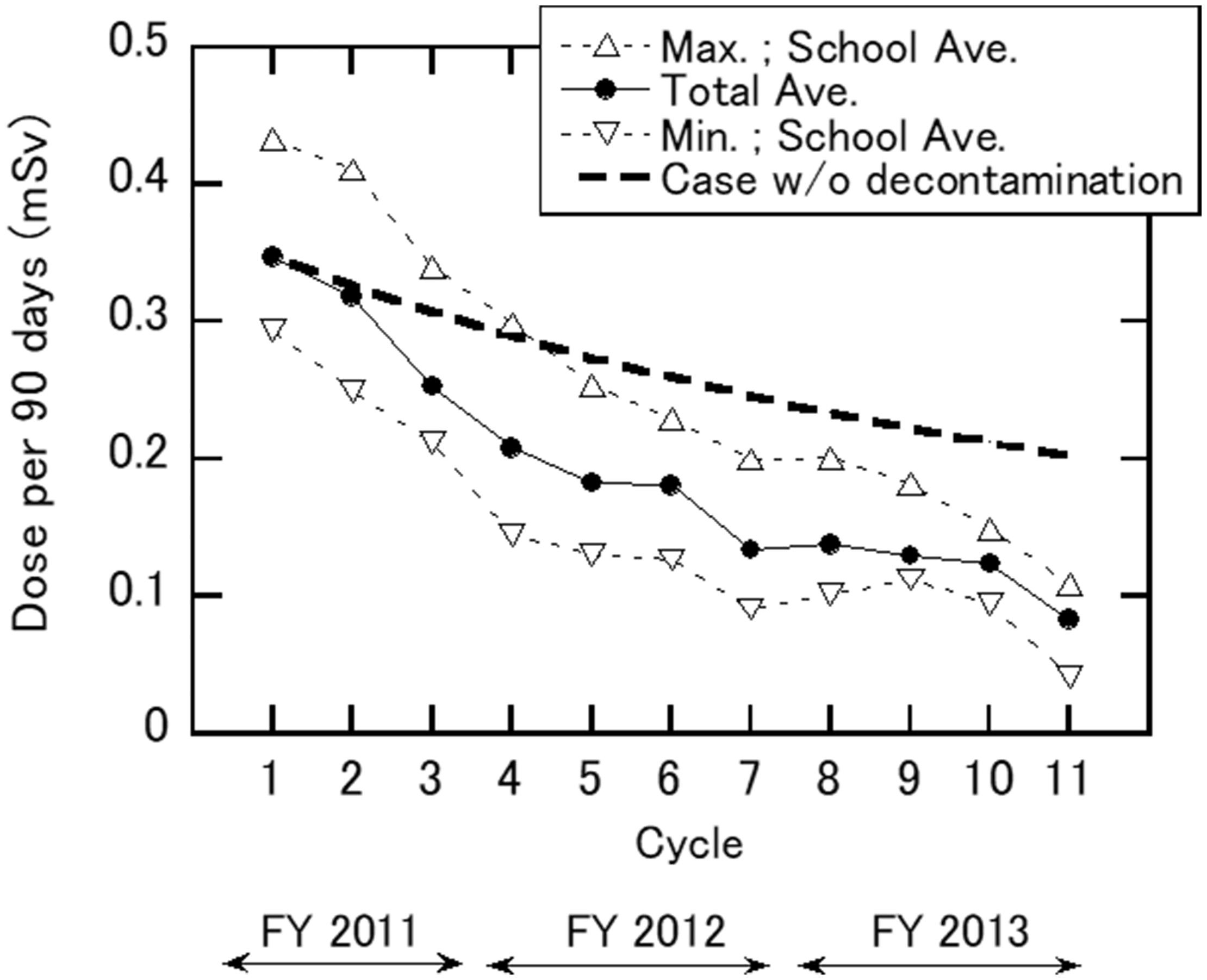
The cumulative dose for 3 months was taken as one measured value. The minimum dose unit is 0.1 mSv. For the natural background dose, the dose before the accident (annual dose 0.54 mSv) in Oarai-machi, Ibaraki Prefecture, where the glass badge measurement service facility is located, was adopted, converted into days, and then subtracted uniformly from the measured value. By subtracting it uniformly, it becomes easier to revise the measured dose at a later date. A histogram of the dose in the first cycle is shown in Fig. 1. As shown in Fig. 1, the maximum value was 2.0 mSv, the average value was 0.39 mSv, and the dose ranged widely. The dose decreased with each round of measurements, and in the final (11th) cycle, the maximum value was 0.3 mSv, the average value was 0.08 mSv, and the distribution was narrow with a mode of 0.1 mSv. The maximum dose for 1 year from June 2011 was 3.6 mSv and the average was 1.14 mSv, and it became clear that the dose was not at a level of concern for human impact. Fig. 2 shows the change in dose over time. The vertical axis shows the dose converted over 90 days. The maximum and minimum of the average values for each school are also shown. The dose decreased over time. Fig. 2 also shows the decreasing curve for ‘cases without decontamination’ estimated by the physical attenuation of radioactive caesium, starting with the first dose. The measured values are below this curve, which is considered to be indicative of the effect of topsoil runoff and decontamination due to rain.
Dose histogram (June–September 2011). Changes in dose over time.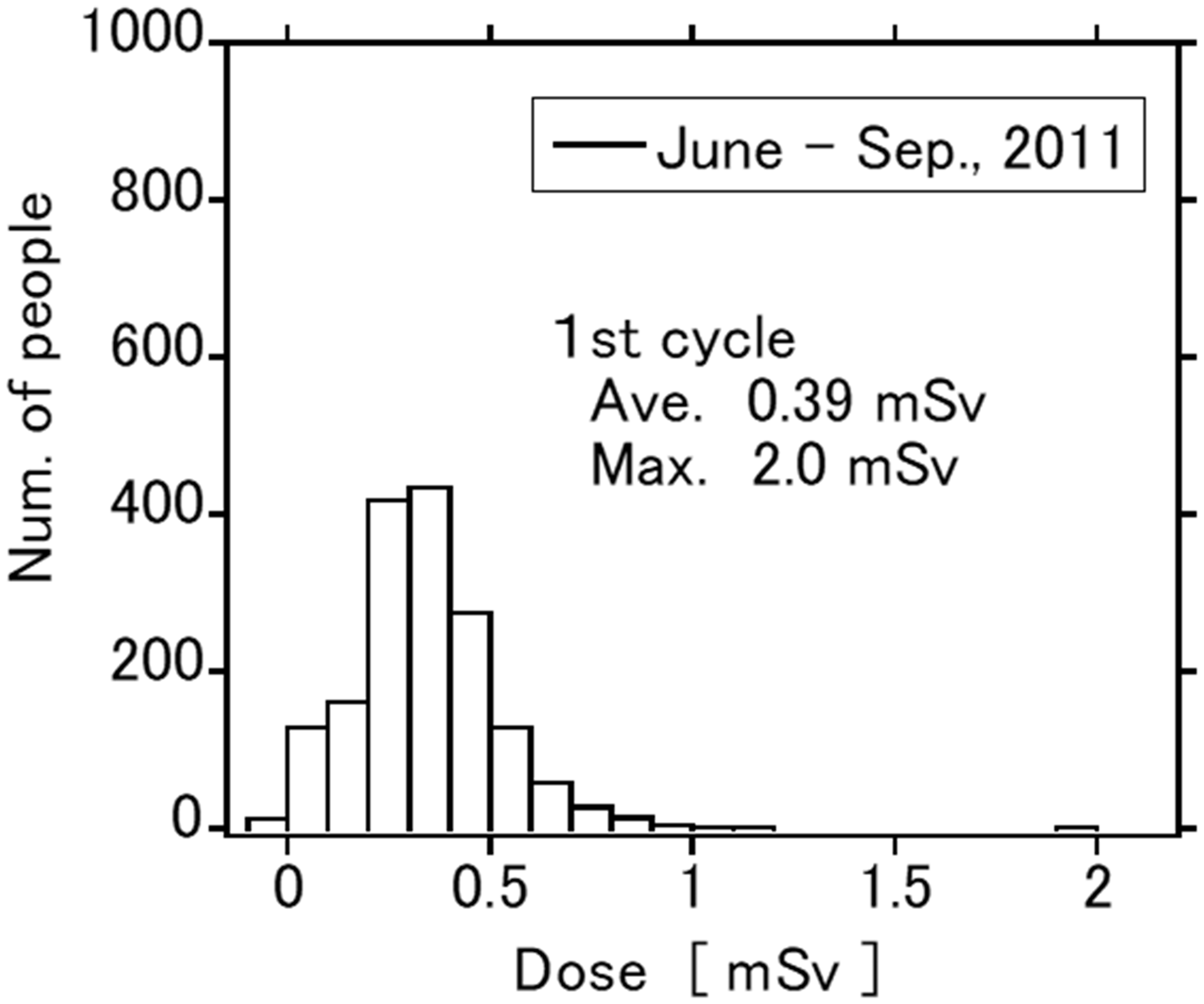
It was thought that measuring external exposure dose with glass badges in a radiation field where radioactive caesium was widely distributed on the ground surface following the accident at Fukushima Daiichi nuclear power plant might not be an appropriate dose evaluation. In contrast, a joint study between the Japan Atomic Energy Agency and the National Institute of Radiological Sciences demonstrated that the results of external exposure dose measurements using individual dosimeters can be evaluated with almost no underestimation of the effective dose (JAEA, NIRS, 2015). Moreover, for small children, the dose is higher than for adults, even in the same radiation field. The following results have been reported. As for the conversion coefficient from the peripheral dose equivalent to the individual dose equivalent, a value of 0.7 is appropriate for adults, whereas the value is 0.8 for those aged 3 to 18 years. (NIRS, JAEA 2015). This also makes it apparent that measuring the individual dose of children is of great significance. As described above, although measurements were implemented as it was thought that it would be useful to have an approximation of the dose level for each child, it was, in fact, possible to provide a value close to the effective dose for each individual.
4. CONCLUSION: FACTORS FOR SUCCESS
Due to the impact of the accident at Fukushima Daiichi nuclear power plant, radiation exposure was no longer ‘somebody else’s issue’. Faced with this, the residents of Kawamata Town wanted information from experts and wanted to gain knowledge about radiation in order to gain peace of mind. To live a life with peace of mind in a radiation-exposed environment, it is necessary to clarify the exposure dose by taking measurements. This article reports dosimetry of children using glass badges. The main reason for the success of this task was that Kawamata Town took the lead in using experts to gain reassurance. The situation was managed using dosimetry, and asking experts to interpret the data and provide advice; the advice obtained helped the residents to gain peace of mind. The main measuring party was Kawamata Town Board of Education, and data were obtained for each individual and for the town. The main intentions were clear, namely that ‘materials should be measured to give reassurance’, and ‘the meaning of the values, not just the values, should be conveyed’. When measurements commenced, schools got involved in the collection and distribution of glass badges after explanations were provided to principals and school nurses in charge of risk communication. Thanks to the efforts of the schools, the recovery rate was 90% or more each time, and the reliability of the measurements was high. Information was communicated between the board of education, the principal, the class teacher, and the parents. Each communicator communicated in a state where the content was convinced at each level. As a result, the dose to children could be determined, which led to peace of mind. It was clear that the target of the information was the children and their parents. Consideration was given so that the measurement results could be understood. Kawamata Town Board of Education summarised the cumulative dose results for each cycle and notified the parents with a personal report; this was sent out with advice on measurement results prepared by Kindai University. Measurements were not just taken and left, but briefing sessions were held on the measurement results as appropriate. At the same time, individual sessions on health were held to try and ease concerns. The first briefing session was held on 13 November 2011, and the sixth and final briefing session was held on 23 March 2014. There was a 3-year summary report on 6 July 2014.
Measurements with glass badges provided peace of mind to all parents with children. As collections were made by the schools, the collection rate exceeded 90% each time due to the schools’ efforts. This enabled the situation for the entire town to be determined as measurements were not only taken for those who wished to be measured. As a result, the measurements were highly reliable, which led to great comfort.
Footnotes
ACKNOWLEDGEMENTS
The authors wish to thank Mayor Furukawa and other people in the town hall, especially Deputy Director of Education Nakae and Superintendent of Education Kanda who played strong parts as promoters. The huge efforts of the school staff and Kawamata Town Board of Education have led to completion of the measurements.