




Abstract
Estimates of thyroid doses to the public from radioiodine intake following the accidents at Chernobyl and Fukushima Daiichi nuclear power plants are compared. The basis for thyroid dose estimates after the Chernobyl accident was a large set of measurements of 131I thyroidal content for approximately 400,000 residents in Belarus, Ukraine, and Russia. Due to a lack of direct thyroid measurements after the Fukushima accident (just over 1000 residents were measured), thyroid doses were estimated based on ecological models and are therefore associated with much higher uncertainty than those based on direct thyroid measurements. Thyroid dose estimates for evacuees were up to 50,000 mGy for Chernobyl and up to approximately 100 mGy for Fukushima. This large difference in thyroid dose to the public is mainly due to the different dominant pathways of radioiodine intake: ingestion of fresh, locally produced cows’ milk (Chernobyl) and inhalation of contaminated air (Fukushima).
1. Introduction
The accidents at Chernobyl and Fukushima Daiichi nuclear power plants are the most serious to have occurred in the nuclear industry. Numerous thorough studies have been undertaken regarding the health effects in the population exposed to radioactive releases after the Chernobyl accident. As a result of these studies, the scientific community has agreed that the sharp increase in the number of cases of thyroid cancer among those individuals exposed in childhood in the severely contaminated areas could be attributed to the Chernobyl accident. Additionally, it has been concluded that ‘there has been no persuasive evidence of any other health effects in the general population that can be attributable to radiation exposure’ (UNSCEAR, 2011).
According to estimates of the atmospheric releases from the two accidents, the quantities of radioactive isotopes of iodine and caesium released in Fukushima were assessed to be approximately an order of magnitude lower than those released in Chernobyl (UNSCEAR, 2011, 2014). Nevertheless, based on the Chernobyl experience, there is understandable concern about possible health effects in the population due to thyroid exposure to radioiodine following the Fukushima accident. This article compares the levels of thyroid exposure in the population following the Chernobyl and Fukushima accidents.
2. Thyroid exposure pathways
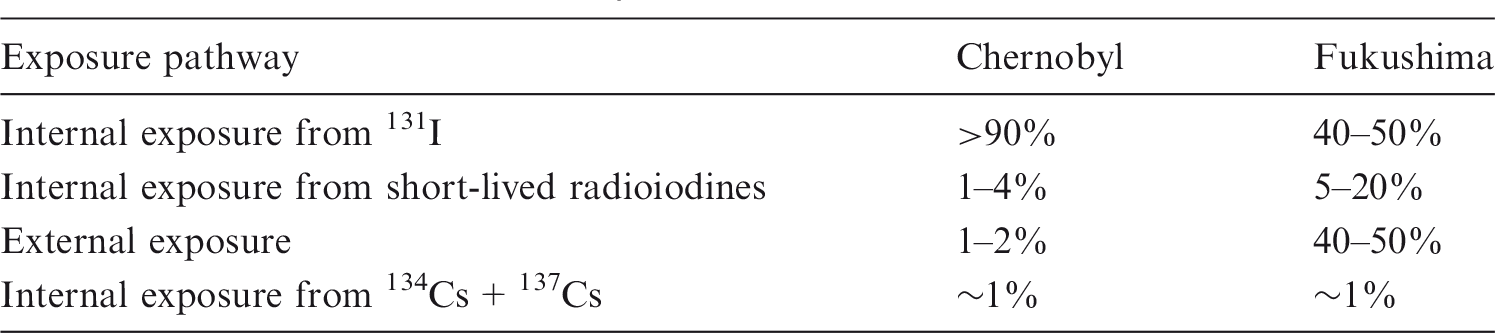
Typical contributions of various pathways to thyroid doses for the public living in contaminated areas after the Chernobyl and Fukushima accidents.
3. Exposure to the public after the chernobyl accident
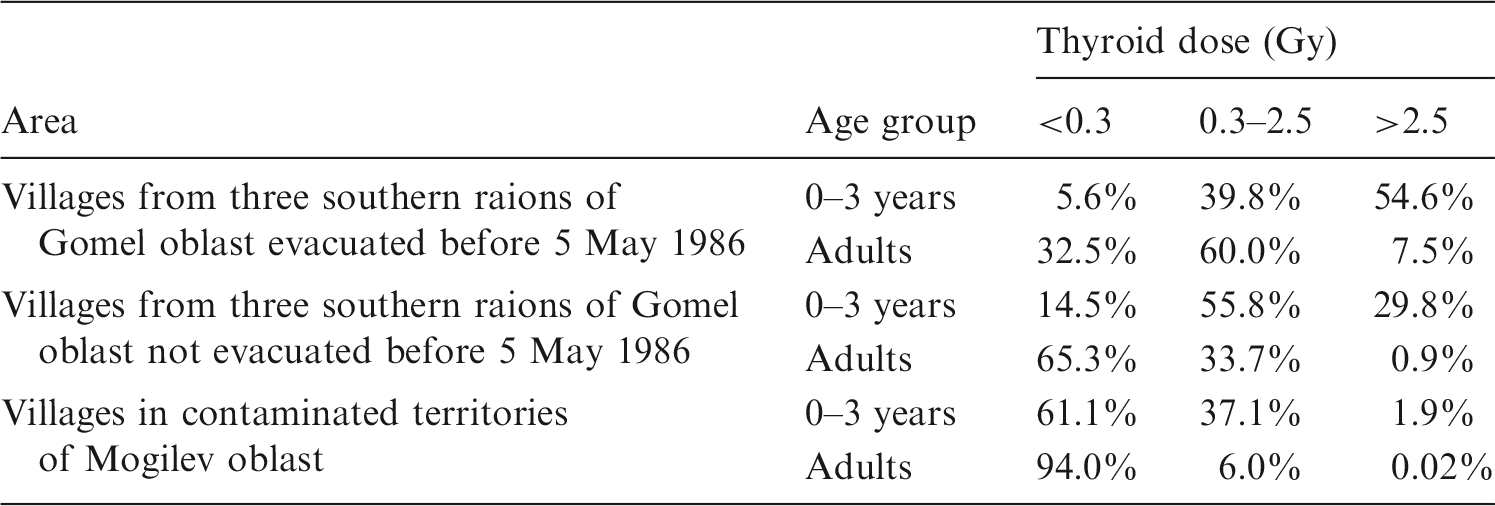
The most reliable estimate (i.e. associated with the lowest possible uncertainty) of thyroid dose for a member of the public is based on in-vivo monitoring of the 131I thyroidal content of that person. In May–June 1986, large-scale monitoring was conducted in the three most contaminated countries: Belarus, the Russian Federation, and Ukraine. By the end of June 1986, measurements of 131I in the thyroid had been conducted on more than 400,000 people, including more than 200,000 in Belarus, 45,000 in the Russian Federation, and approximately 150,000 in Ukraine (Uyba et al., 2018; ICRP, 2020). Consumption of fresh milk from cows grazing on contaminated pastures was the main pathway of radioiodine intake for the majority of residents after the Chernobyl accident. This arose because of delays in notifying the public after the accident and a delay in the application of urgent countermeasures. The daily rate of consumption of fresh milk was not found to vary much with age. However, thyroid mass increases with age from birth to adulthood by a factor of approximately 10. Therefore, while the thyroidal uptake of iodine from the diet does not depend upon age, the average thyroid dose for infants is approximately 10 times that for adults. This contributed to large thyroid doses, especially in children living in rural areas in the vicinity of the damaged reactor.
Distribution of estimated thyroid doses in residents (children up to 3 years of age and adults) from contaminated areas in Belarus, based on direct thyroid measurements (Savkin and Shinkarev, 2007).
As a rule, the distribution of individual thyroid doses estimated on the basis of direct thyroid measurements can be described satisfactorily with a lognormal function. This distribution can then be applied to individuals in an area with similar exposure conditions. An example of a lognormal distribution of thyroid doses derived from direct thyroid measurements for 226 children up to 17 years of age from the evacuated village of Pogonnoe in Khoiniki raion of Gomel oblast is presented in Fig. 1. The geometric mean of that distribution was estimated to be 2.1 Gy with a standard deviation of 3.1 (Uyba et al., 2018). The highest estimates of thyroid doses to children derived from direct thyroid measurements were found to be as high as 50 Gy (Shinkarev et al., 2008).
Lognormal distribution of individual thyroid doses derived from direct thyroid measurements for children up to 17 years of age from the evacuated village of Pogonnoe in Khoiniki raion of Gomel oblast.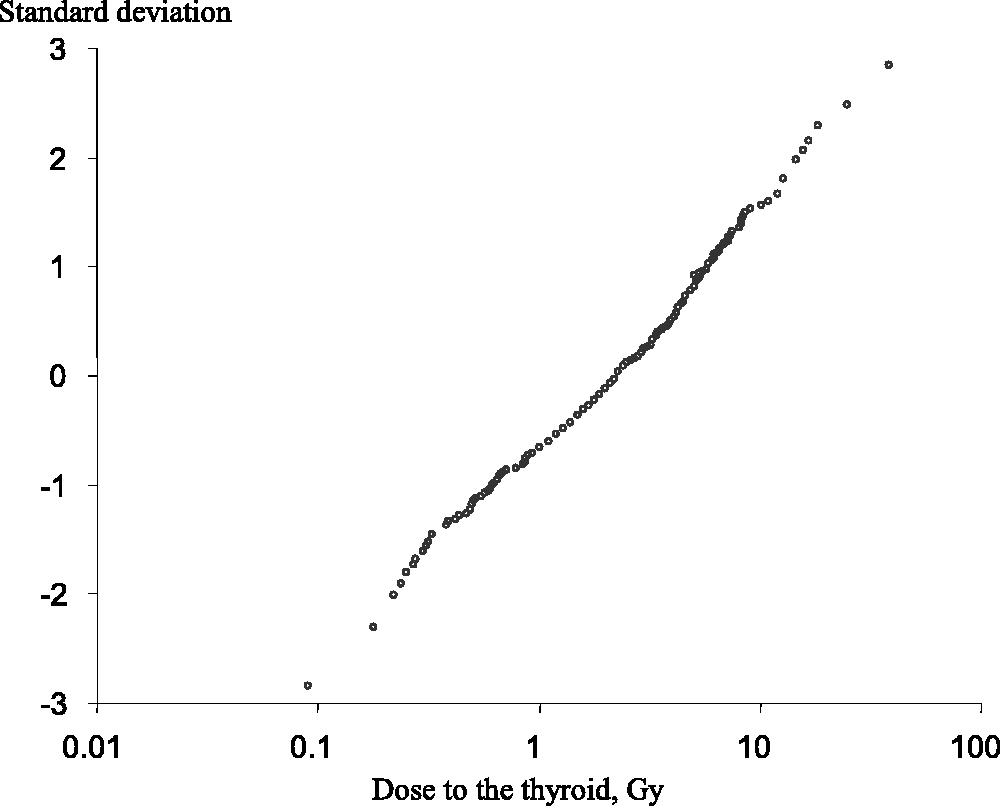
A typical contribution of short-lived radioiodines to the thyroid dose for the public in contaminated areas was estimated to be a few percent of the contribution from 131I. Of the short-lived radioiodines, 133I and 132I (due to the intake of 132Te and its radioactive decay to 132I in the body) made the greatest contribution in terms of internal dose to the thyroid (Gavrilin et al., 2004).
4. Exposure to the public after the Fukushima accident
After the Fukushima accident, in-vivo monitoring of the 131I content in the thyroid was conducted for just over 1000 residents in March–April 2011 (UNSCEAR, 2014; IAEA, 2015a). Due to the small number, the measurements were only used to test a radio-ecological model of thyroid dose reconstruction. According to the United Nations Scientific Committee on the Effects of Atomic Radiation (UNSCEAR) report, the settlement-average thyroid absorbed dose estimates in the first year after the accident for evacuated residents from Fukushima Prefecture were in the range of 0.007–0.035 Gy for adults and 0.015–0.083 Gy for infants aged 1 year. For residents from settlements in Fukushima Prefecture and six neighbouring prefectures that were not evacuated, the thyroid absorbed dose estimates were in the range of 0.001–0.017 Gy for adults and 0.003–0.052 Gy for infants aged 1 year (UNSCEAR, 2014). However, due to the small number of direct thyroid measurements, the UNSCEAR estimates were based on an assumption that a substantial contribution to the thyroid dose was from ingestion of 131I, which resulted in overestimation of the thyroid doses for the public.
An analysis of direct thyroid measurements conducted on 26–30 March 2011 for 1080 children from three settlements – Iwaki City, Kawamata Town, and Iitate Village – showed that inhalation of 131I was the dominant pathway, rather than ingestion (IAEA, 2015b). According to the International Atomic Energy Agency (IAEA) estimates, the geometric means of the distribution of individual thyroid equivalent doses 3 for children aged 0–15 years, derived from direct thyroid measurements, were 3.2 mSv for 134 children of Iwaki City, 2.2 mSv for 647 children of Kawamata Town, and 6.0 mSv for 299 children of Iitate Village (IAEA, 2015b). According to another re-assessment of internal thyroid doses to those children, all dose estimates were <30 mSv (Kim et al., 2020). The prevalence of the inhalation pathway for 131I for the measured children was a result of early notification of the public and application of urgent countermeasures following the Fukushima accident. In this way, the ingestion of 131I in contaminated drinking water and foods was avoided for the majority of residents. Where inhalation is the dominant pathway, the average thyroid dose to adults from 131I is less than that to infants from the same settlement by a factor of approximately 2 (compared with a factor of 10 when ingestion of cows’ milk dominates), which reflects an increase in breathing rate with age by a factor of approximately 5 from infant to adult. A typical contribution of short-lived radioiodines to the thyroid dose for the residents who lived in areas where the main fallout occurred on 15 March 2011, and who did not consume contaminated drinking water and food, is estimated to be within 15% of the dose to the thyroid from 131I. The contribution of short-lived radioiodines to the thyroid dose for the residents who lived in areas where the main fallout occurred on 12 March 2011 may have been as high as 30–40%. Among the short-lived radioiodines, the main contributors to the thyroid dose were 133I and 132I through the intake of 132Te (Shinkarev et al., 2015).
5. Conclusion
Consumption of cows’ milk contaminated with 131I, for which prompt countermeasures were lacking, was the dominant pathway of radioiodine intake for the public following the Chernobyl accident, and this resulted in high thyroid doses (up to 50,000 mGy). Conversely, timely notification of the public and urgent application of countermeasures following the Fukushima accident enabled ingestion of 131I from contaminated drinking water and food to be avoided for the majority of residents. The dominant pathway for those residents was inhalation of 131I in contaminated air. This resulted in much lower thyroid doses (up to just over 100 mGy).
Footnotes
Acknowledgements
The author would like to express his sincere gratitude to Dr Anne Nisbet (Radiation Recovery Lead, Public Health England, Centre for Radiation, Chemical & Environmental Hazards, Chilton, UK) for her very helpful and valuable revision of the paper, including language revision.
This paper does not necessarily reflect the views of the International Commission on Radiological Protection.
1
A raion is a political unit approximately equivalent to a county in the USA.
2
An oblast is a political unit approximately equivalent to a state in the USA.
3
Thyroid equivalent dose expressed in millisieverts is numerically equal to thyroid absorbed dose expressed in milligrays.