




Abstract
This paper does not necessarily reflect the views of the International Commission on Radiological Protection.
1. Introduction
Hirosaki University and Namie Town in Fukushima reached an agreement on cooperation for recovery in September 2011. Three support plans were proposed, as follows: (i) recovery of Namie Town (e.g. decontamination and promotion of renewable energy); (ii) security and safety of residents (e.g. health consultation and environmental radiation monitoring on demand); and (iii) accumulation of scientific findings (Tokonami et al., 2015). Since then, numerous support activities have been undertaken. Evacuees were allowed to return to their homes in Namie Town from March 2017. As of November 2020, 1500 residents had returned, representing 7% of Namie Town’s total original population (Ogura et al., 2021). A new research project was commenced on dose estimation for residents of Namie Town. This project proposed a comparable measure of radiation risk with doses derived from natural radiation sources. This article will give an overview of the project on dose assessment as well as other support activities conducted by the Institute of Radiation Emergency Medicine, Hirosaki University.
2. Characteristics of Namie Town
In 2011, the Japanese Government designated a ‘special decontamination area’, where measures were implemented for the decontamination of soil, etc. This area includes three zones, as shown in Fig. 1. The difficult-to-return zone is areas where the annual cumulative dose estimated from the ambient dose rate has not fallen below 20 mSv, even 6 years after the accident. Areas where the annual cumulative effective dose estimated from the ambient equivalent dose rate exceeded 20 mSv but < 50 mSv as of March 2012 was designated the ‘restricted residence zone'. Areas where the annual cumulative dose was confirmed to be ≤20 mSv were designated as ‘evacuation-order-lifted areas’.
Map of Namie Town and surrounding area (Fukushima Revitalization Station, 2021).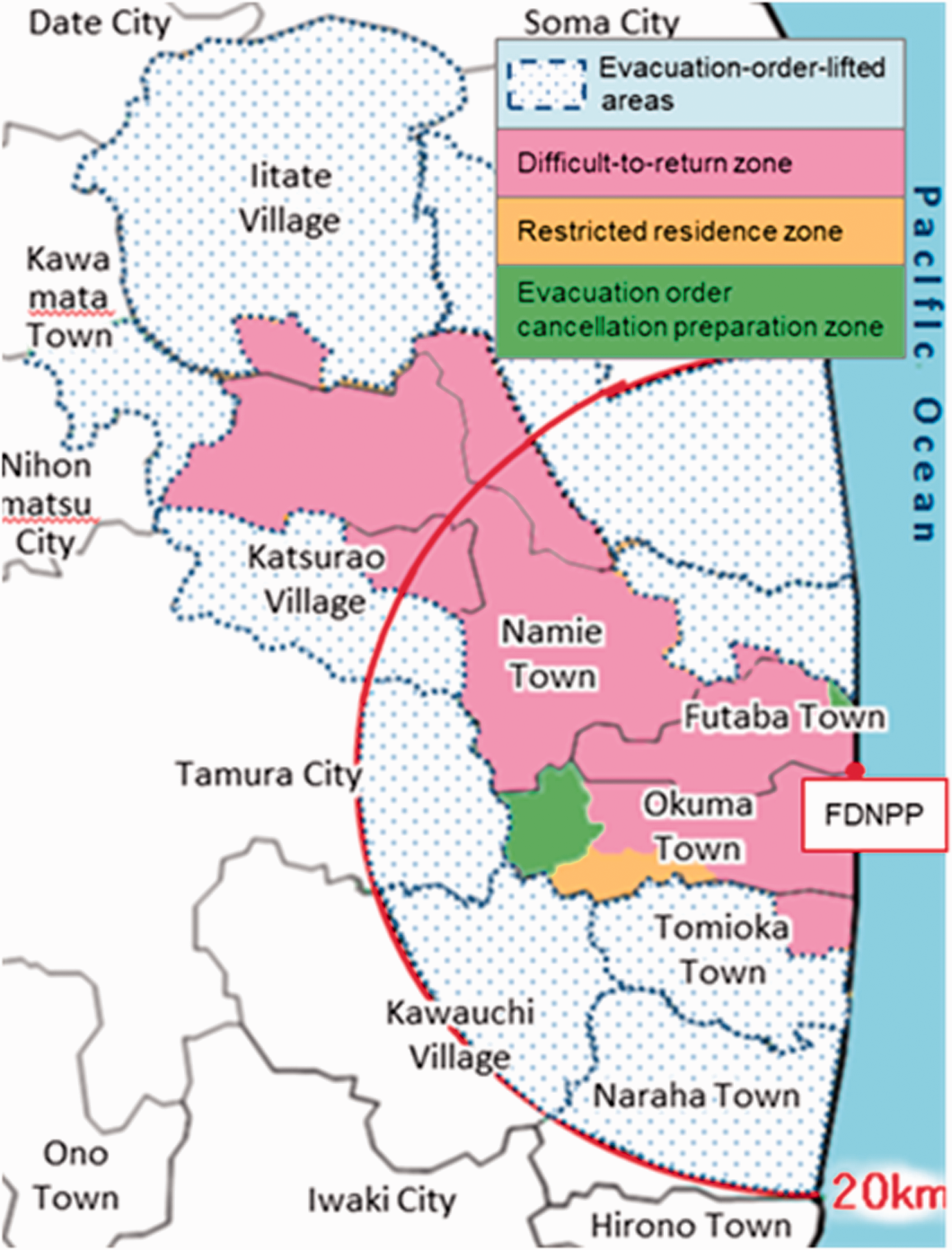
3. Support activities in namie town
3.1. Dose estimation for residents in Namie Town
Concentrations of radon and thoron progeny were measured using passive-type monitors (Fig. 2) in 93 houses to evaluate the inhalation dose for residents (Ploykrathok et al., 2021; Thamaborn et al., 2021) . Measurements were taken during the period from August 2017 to November 2019. Measurements were taken over four 3-month periods (October–December, January–March, April–June, and July–September) in each dwelling to cover a whole year. Radon concentrations varied from 6 to 242 Bq m−3, and the median values in each period were 32, 28, 27, and 31 Bq m−3, respectively. Thoron progeny concentrations (equilibrium equivalent thoron concentration) varied from 0.1 to 20 Bq m−3, and the median values in each period were 0.7, 0.7, 0.8, and 0.8 Bq m−3, respectively. The annual average indoor concentrations of radon and thoron progeny were evaluated as 31 and 0.7 Bq m−3, respectively.
Schematic drawings of the passive-type radon and thoron discriminative detector (left) and the thoron progeny monitor (right) (Tokonami et al., 2005; Tokonami, 2020; Hosoda et al., 2017).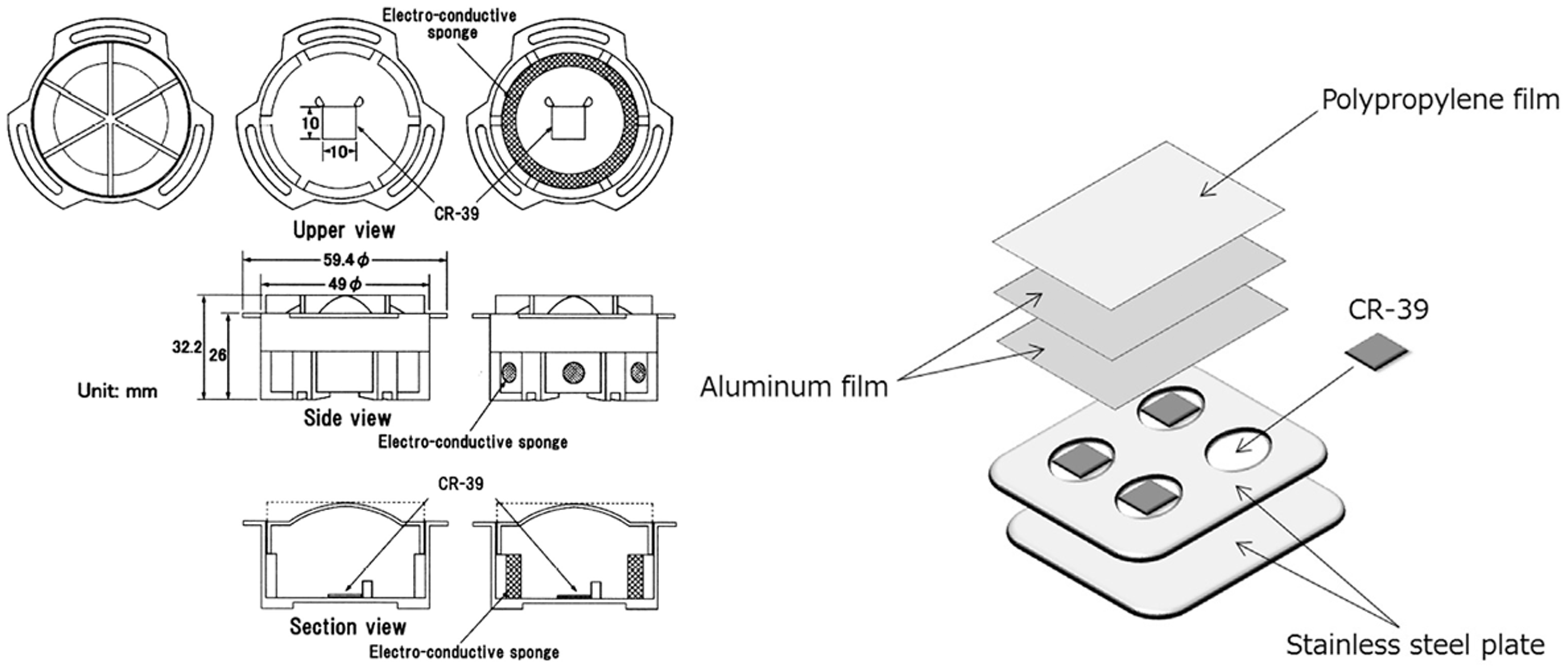
Annual effective doses due to inhalation of radon and thoron progeny were estimated in accordance with the United Nations Scientific Committee on the Effects of Atomic Radiation (UNSCEAR, 2010). The residents of Namie Town completed a questionnaire on estimated indoor and outdoor occupancy factors, and these values were found to be 0.83 and 0.17, respectively. Annual effective doses from radon and thoron progeny were estimated to vary from 0.6 to 2.3 mSv and from 0.1 to 3.4 mSv, respectively. The total annual effective dose due to radon and thoron varied from 0.7 to 5.5 mSv, with a median value of 1.4 mSv.
In addition, airborne radiocaesium was measured using a high-purity germanium detector at five sampling points in Namie Town from August 2017 to September 2019 (Hegedüs et al., 2020a,b). The maximum activity concentration of 137Cs of 1.28 ± 0.09 mBq m−3 was observed on 23 August 2017, and subsequently the value decreased towards the detection limit. The annual effective dose due to inhalation of airborne 137Cs was estimated to be <83 nSv for all age groups at the maximum observed activity concentration. The estimated inhalation dose was found to be much smaller than the inhalation dose from radon and thoron progeny, which are natural components.
To estimate external doses from natural and artificial components, measurements of gamma-ray pulse-height distribution were taken using a 3 × 3-inch NaI(Tl) scintillation spectrometer at the 130 accessible points that divide Namie Town into a mesh of 1 km × 1 km (Ogura et al., in press). Fig. 3 shows the dose rate maps of natural and artificial components (Ogura et al., in press). The median and range of absorbed dose rates in air from artificial radionuclides were evaluated as 133 and 67–511 nGy h−1, respectively, in the evacuation order cancellation zone, and 1306 and 892–2081 nGy h−1, respectively, in the difficult-to-return zone. These values were corrected to 1 April 2020 based on the analysis of radiation monitoring data obtained from 103 monitoring posts in Namie Town. The median annual effective doses due to external exposures from natural and artificial radionuclides were estimated to be 0.19 and 0.40 mSv, respectively, in the evacuation order cancellation zone, and 0.25 and 3.9 mSv, respectively, in the difficult-to-return zone.
Map of absorbed dose rate in air from natural radionuclides (left) and artificial radionuclides (right) (Ogura et al., in press).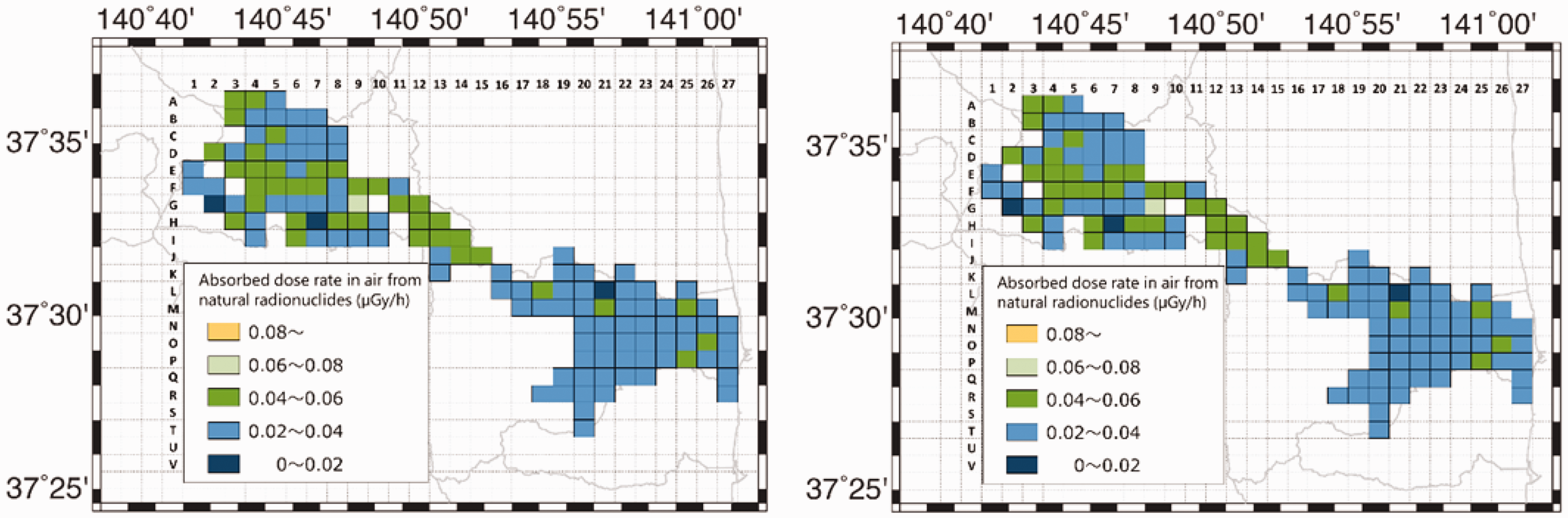
3.2. Other support activities
Following the accident at Fukushima Daiichi nuclear power plant, many types of radionuclides as well as radiocaesium were released into the environment. Assessment of these other radionuclides was important to ensure safety and identify the sources of contamination. A new analytical method was developed for radionuclides that are difficult to analyse, such as 90Sr, 129I, 236U, and 135Cs, using solid phase extraction and mass spectrometric techniques (Yang et al., 2016, 2018, 2019a,b; Tazoe et al., 2018). Novel methods were applied to environmental samples collected in Namie Town and the coastal areas in Fukushima Prefecture to assess the impact of the accident.
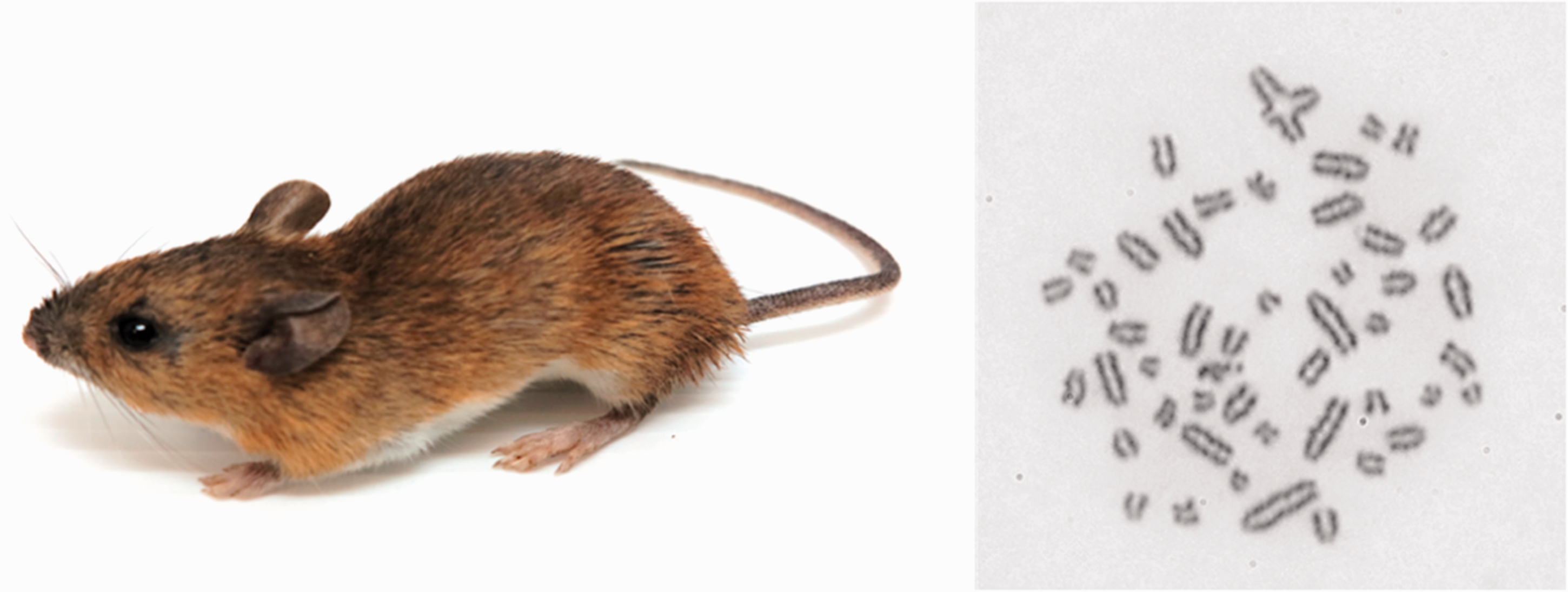
Regarding the biological effects of radioactive substances released into the environment due to the accident at Fukushima Daiichi nuclear power plant, analyses were undertaken of chromosomal translocation in peripheral blood lymphocytes obtained from evacuees aged <18 years, radiation effect surveys on wild mice living in the contaminated area (Fig. 5, Fujishima et al., in press), and transition of deposition of radioactive substances in the reproductive organs of free-roaming cats. These results were reported to the local government of Namie Town for risk communication and utilisation with residents.
135Cs distribution in soil before the accident at Fukushima Daiichi nuclear power plant (Yang et al., 2016). Apodemus speciosus collected in Namie, Fukushima (left) and metaphase spread with chromosome aberration (right).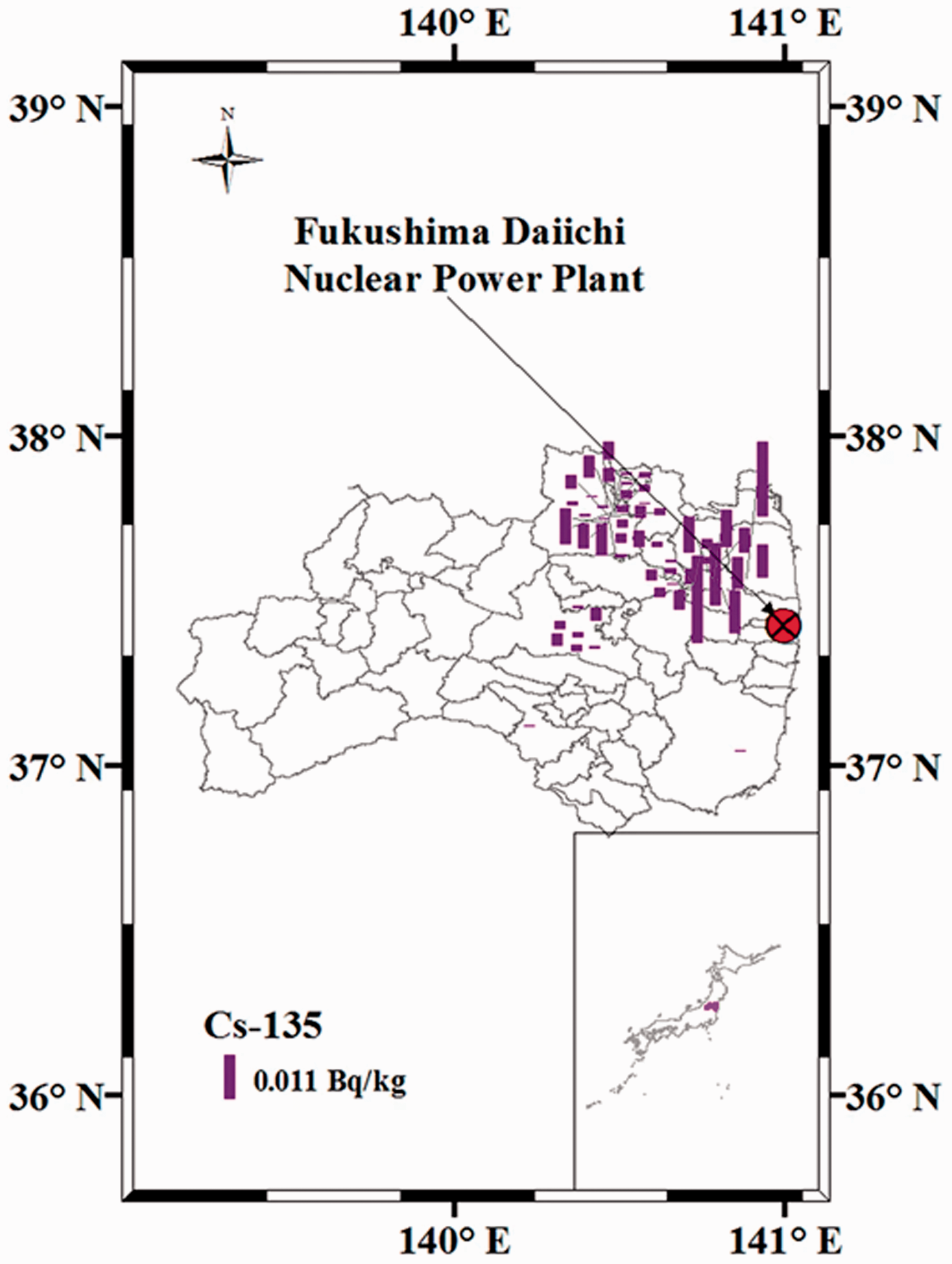
Footnotes
Acknowledgements
This work was supported by Research on the Health Effects of Radiation organised by the Ministry of the Environment, Japan. The authors wish to thank the local government of Namie Town who kindly provided the research opportunity.