




Abstract
Medical disaster response training is provided for international students in Kawauchi Village to share the lessons learnt from the accident at Fukushima Daiichi nuclear power plant. At present, this is difficult due to the coronavirus disease 2019 (COVID-19) pandemic. The purpose of this article is to report the development of hands-on medical training software on a topic that does not require in-person attendance. The ‘Kawauchi Legends’ disaster simulator was developed as a useful tool to teach the medical response to various disasters, and this was applied in a 3-day webinar in October 2020. Fourteen students participated in the webinar and successfully learnt medical management, manipulating their avatars in the virtual environment. This software can be an effective substitute for in-person disaster training without physical involvement. Such innovative teaching methods mean that lessons from the Fukushima accident can continue to be shared, even in the COVID-19 pandemic situation.
Keywords
1. BACKGROUND
One of the important missions for responders to the accident at Fukushima Daiichi nuclear power plant is to share the lessons learnt. As part of this, a disaster response training seminar is run in Kawauchi Village, Fukushima Prefecture for both domestic and international students regarding uncertain hazards following the accident. However, face-to-face training has become difficult recently due to the coronavirus disease 2019 (COVID-19) pandemic (Fig. 1).
Changes in practice and training environment due to the coronavirus disease 2019 (COVID-19) pandemic.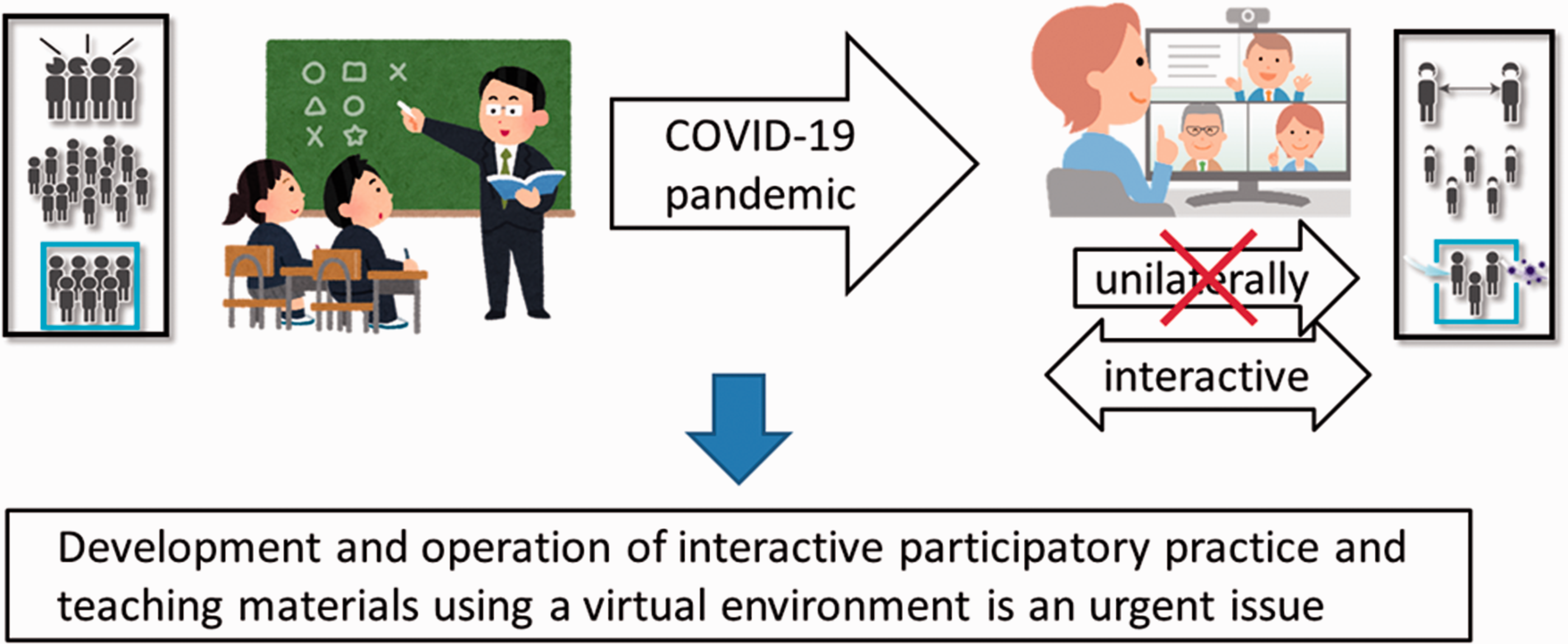
2. OBJECTIVE
The purpose of this project is to develop tools for a practical medical response to uncertain hazards when in-person presence is not possible, and to continue sharing lessons learnt from the Fukushima accident with the next generations.
3. METHODS
3.1. Concept of software development
The disaster simulator ‘Kawauchi Legends’ was developed for practical medical training. The simulator concept was created by the Department of Radiation Disaster Medicine of Fukushima Medical University and the Kawauchi Branch of the Futaba Fire Department, and the software was produced by Mark-on Ltd. The software concept and development overview is shown in Fig. 2.
Development of the practical medical training online simulator.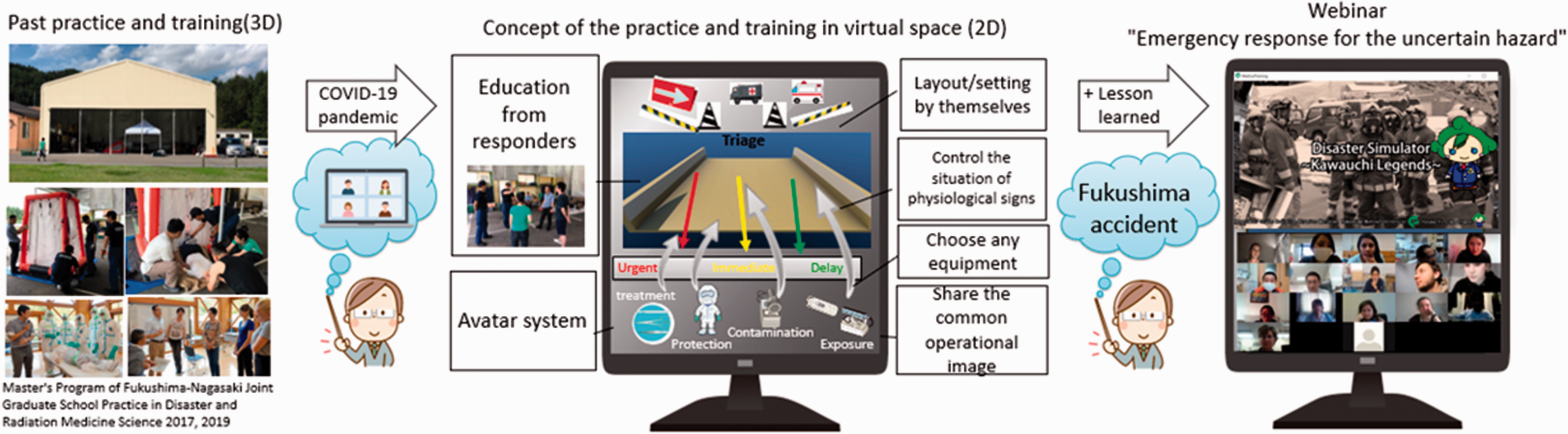
3.2. Webinar
After development and testing of the ‘Kawauchi Legends’ simulator, the international webinar ‘Emergency response for uncertain hazards’ was organised via a Zoom video conference hosted by Fukushima Medical University on 19–21 October 2020.
3.3. Questionnaire survey
After the webinar, a web-based questionnaire survey was applied, consisting mainly of questions using four- or five-point Likert scales to estimate the application of the software in training (Table 1). Before the questionnaire survey, the concept of the survey was explained, and the participants gave their informed consent.
4. RESULTS
4.1. Basic function of ‘Kawauchi Legends’
The ‘Kawauchi Legends’ disaster simulator was designed for Windows and Mac OS platforms; currently, tablets and smartphones are not supported. Deploying compressed application files makes the application available. Both Japanese and English interface languages are available. The user can choose from one of four practice scenes using the selection menu: Disaster Site A (a nuclear power plant), Disaster Site B (a dirty bomb), a triage scene, and a medical site. A common operation scene can be shared with up to 20 people at the same time. Appropriate protective gear and equipment (e.g. chest drainage tube, dosimeter, decontamination gear, zone barrier, etc.) can be selected. A teacher (trainer) can set up any type of medical condition in a victim by changing an injured person avatar and data on its vital signs monitor. The user can estimate the physical findings of the victim, set up a triage tag, and move the injured person to an appropriate place already zoned by other users.
Examples of using the software are shown in Fig. 3.
Basic functions of ‘Kawauchi Legends’. (a) The user can estimate physical findings of victims on a vital signs monitor. (b) Rescue training on Disaster Site A (a nuclear power plant). (c) Training on the triage scene. (d) Resuscitation and decontamination on the medical site.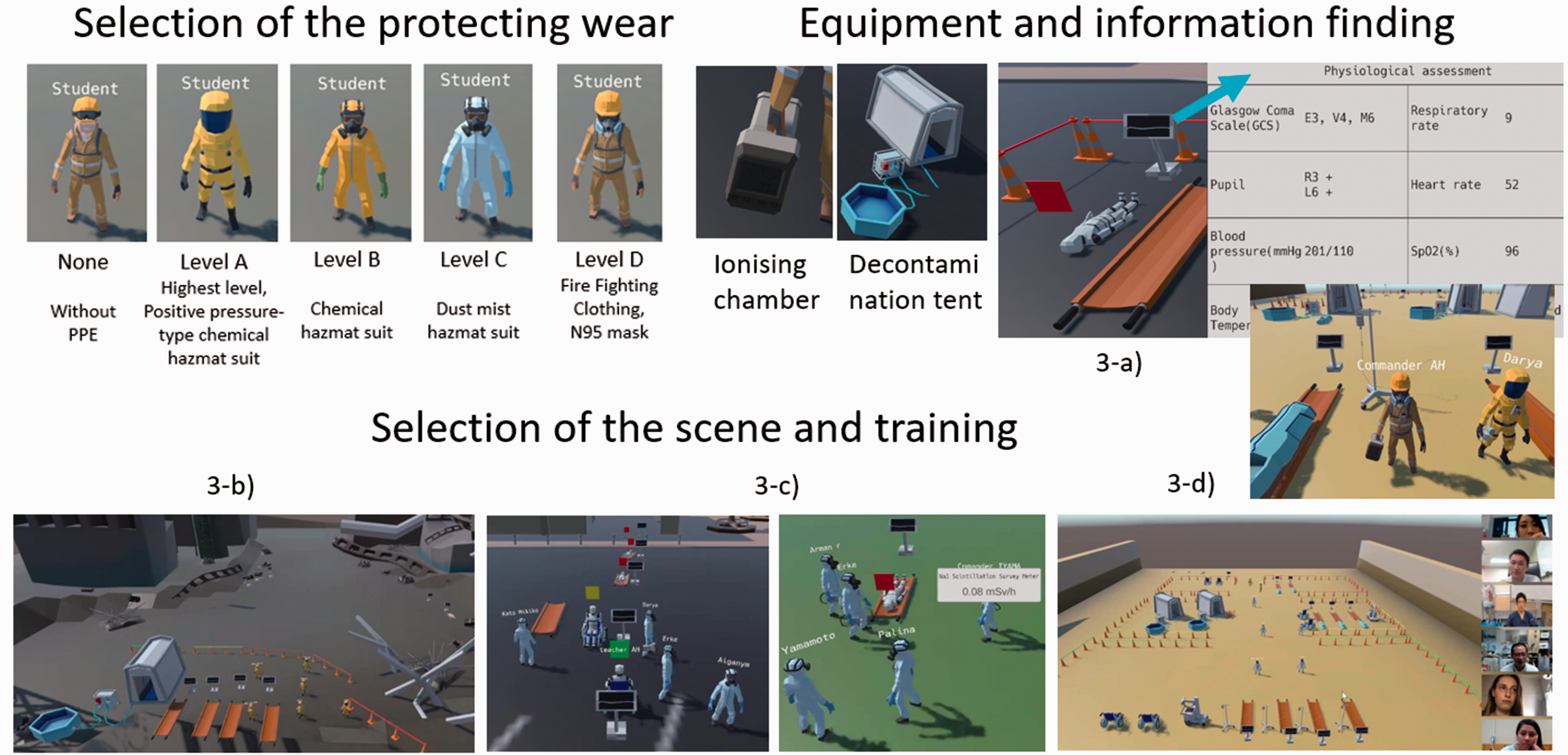
4.2. Results of the questionnaire survey
Results of the questionnaire survey.
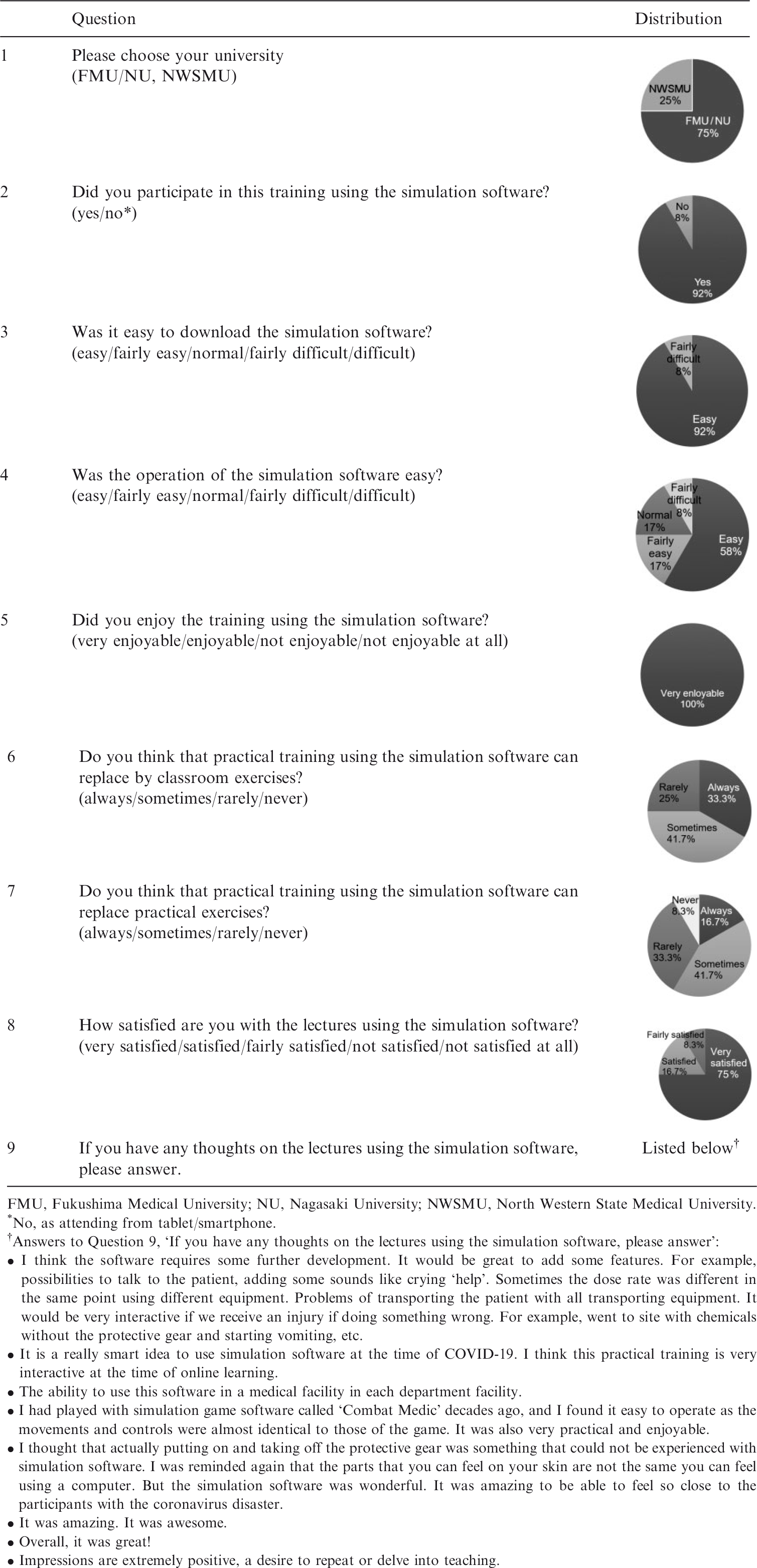
FMU, Fukushima Medical University; NU, Nagasaki University; NWSMU, North Western State Medical University.
*No, as attending from tablet/smartphone.
†Answers to Question 9, ‘If you have any thoughts on the lectures using the simulation software, please answer’:
• I think the software requires some further development. It would be great to add some features. For example, possibilities to talk to the patient, adding some sounds like crying ‘help’. Sometimes the dose rate was different in the same point using different equipment. Problems of transporting the patient with all transporting equipment. It would be very interactive if we receive an injury if doing something wrong. For example, went to site with chemicals without the protective gear and starting vomiting, etc.
• It is a really smart idea to use simulation software at the time of COVID-19. I think this practical training is very interactive at the time of online learning.
• The ability to use this software in a medical facility in each department facility.
• I had played with simulation game software called ‘Combat Medic’ decades ago, and I found it easy to operate as the movements and controls were almost identical to those of the game. It was also very practical and enjoyable.
• I thought that actually putting on and taking off the protective gear was something that could not be experienced with simulation software. I was reminded again that the parts that you can feel on your skin are not the same you can feel using a computer. But the simulation software was wonderful. It was amazing to be able to feel so close to the participants with the coronavirus disaster.
• It was amazing. It was awesome.
• Overall, it was great!
• Impressions are extremely positive, a desire to repeat or delve into teaching.
5. DISCUSSION AND CONCLUSION
Software was developed to share the disaster response experience of the Fukushima accident. According to the questionnaire results, the ‘Kawauchi Legends’ software could not fully replace all the effects of in-person training, but it was found to be a sufficiently effective substitute for the classroom and practical face-to-face exercises. This confirms that even during the COVID-19 pandemic, it is possible to maintain high-quality standards of education through innovative methods.
It was fairly difficult for injured workers to access medical services at the time of the Fukushima accident due to a lack of information, knowledge, and skill about radiation for responders (National Diet of Japan, Fukushima Nuclear Accident Independent Investigation Commission, 2012; Tominaga et al., 2014). This may have been one of the causes of disaster-related deaths, defined as deaths due to the deterioration of underlying medical problems due to poor medical access or illnesses (Hasegawa et al., 2015, 2016). Therefore, education in disaster management plays an important role as a countermeasure to the diverse and lasting effects on society after a large-scale nuclear accident (Ohtsuru et al., 2015).
There is a need to ensure that we can overcome the COVID-19 pandemic by reducing social communication distance through a variety of modern technologies, such as the ‘Kawauchi Legends’ simulator, while maintaining physical distance.
Footnotes
ACKNOWLEDGEMENTS
The authors wish to thank Professor Noboru Takamura (Nagasaki University), Mr Tomoi Uesugi (Kawauchi Branch of the Futaba Fire Department), Dr Elena Ryzhii (Fukushima Medical University), and Mr Daisuke Kobayashi (Fukushima Medical University) for valuable advice and support.