




Abstract
In Australia, worker exposure to radon in underground uranium mines has been a focus of policy makers and regulators, and has been well controlled in the industry sector. That cannot be said for public exposure to radon. Radon exposure studies in the late 1980s and early 1990s demonstrated that the levels of radon in Australian homes were some of the lowest in the world. The International Basic Safety Standards, published by the International Atomic Energy Agency, requires the government to establish and implement an action plan for controlling public exposure due to radon indoors. When considering different policy options, it is important to develop radon prevention and mitigation programmes reflecting elements that are unique to the region or country. The Australian Radon Action Plan is being considered at a national level, and presents a long-range strategy designed to reduce radon-induced lung cancer in Australia, as well as the individual risk for people living with high concentrations of radon. In Australia, workers who are not currently designated as occupationally exposed are also considered as members of the public. In the Australian context, there are only a limited set of scenarios that might give rise to sufficiently high radon concentrations that warrant mitigation. These include highly energy efficient buildings in areas of high radon potential, underground workplaces, workplaces with elevated radon concentrations (e.g. spas using natural spring waters), and enclosed workspaces with limited ventilation. The key elements for a successful plan will rely on collaboration between government sectors and other health promotion programmes, cooperative efforts involving technical and communication experts, and partnering with building professionals and other stakeholders involved in the implementation of radon prevention and mitigation.
1. Introduction
It has been recognised that exposure to radon-222 (herein radon) and inhalation of its decay products increases the risk of developing lung cancer. In 1941, the US Advisory Committee on X-ray and Radium Protection (NBS, 1941) set 10−8 µCi cm−3 (370 Bq m−3) as the value for the maximum permissible concentration for occupational exposure (40 h week−1) to radon plus its decay products. Since 1953, the International Commission on Radiological Protection (ICRP) has been recommending maximum activity concentrations of radon in workplaces and homes to keep the risk as low as reasonably achievable.
In 2014, ICRP introduced the concept of a national radon protection strategy (ICRP, 2014) as radon is ubiquitous; it represents a significant source of radiation exposure; and, in most circumstances, it can be controlled. This recommendation is reflected in Requirement 50 of the International Basic Safety Standards (IAEA, 2014) which states that countries ‘… shall establish and implement an action plan for controlling public exposure due to radon indoors’. To assist countries, the World Health Organization provides options to reduce the health risk of radon, and sound policy options for prevention and mitigation of radon (WHO, 2009).
Australia is currently developing a radon action plan, which is intended to be a long-range strategy to reduce radon-induced lung cancer in Australia.
2. Radon in Australia
2.1. Levels of radon in Australia
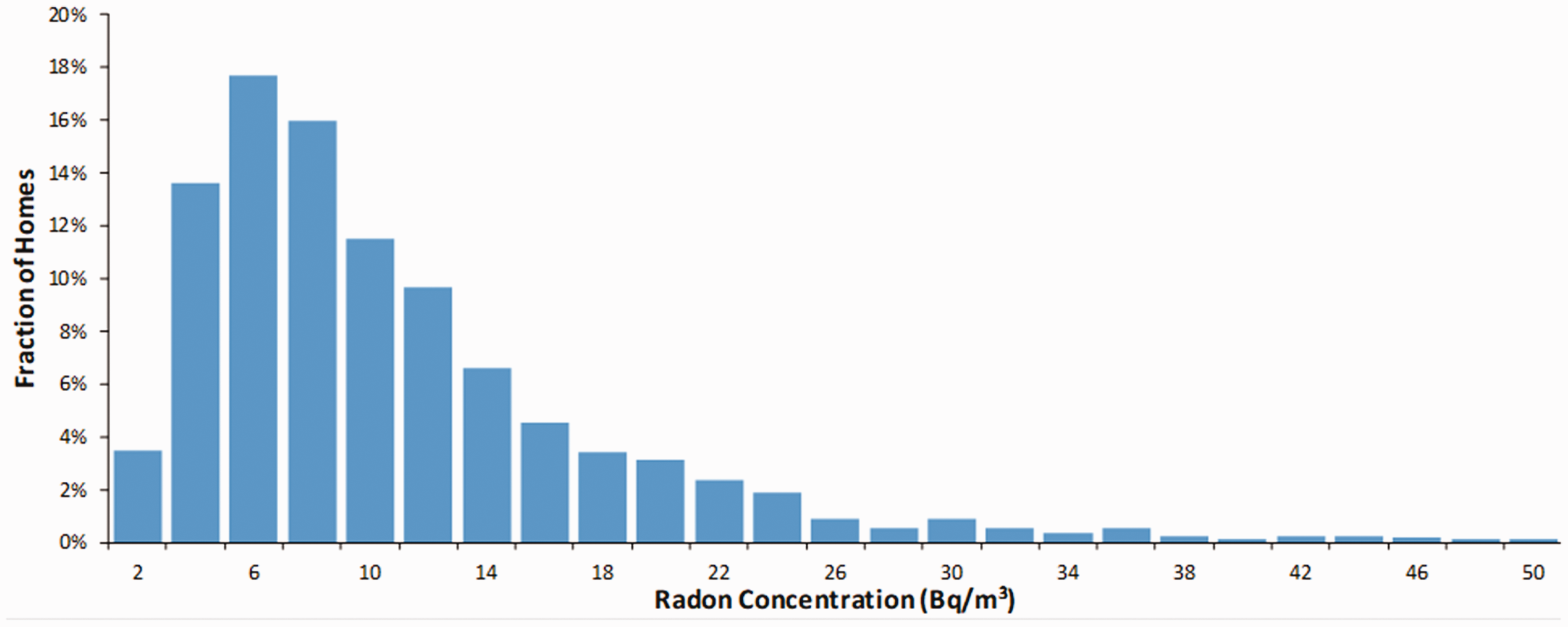
Relative to most other countries, the levels of radon in Australia are very low. Fig. 1 indicates that mean indoor levels of radon in Australia are the lowest amongst member countries of the Organisation for Economic Co-operation and Development. On average, radon contributes less than one-third of the total dose due to all sources of radiation in the Australian environment. Fig. 2 shows that, based on an extensive survey of Australian homes (ARL, 1990), 99% of homes had indoor levels of radon below 45 Bq m−3, and less than two in 10,000 homes had levels exceeding 100 Bq m−3.
Mean indoor radon concentrations in various member countries of the Organisation for Economic Co-operation and Development (WHO, 2009). Distribution of radon concentrations found in Australian homes.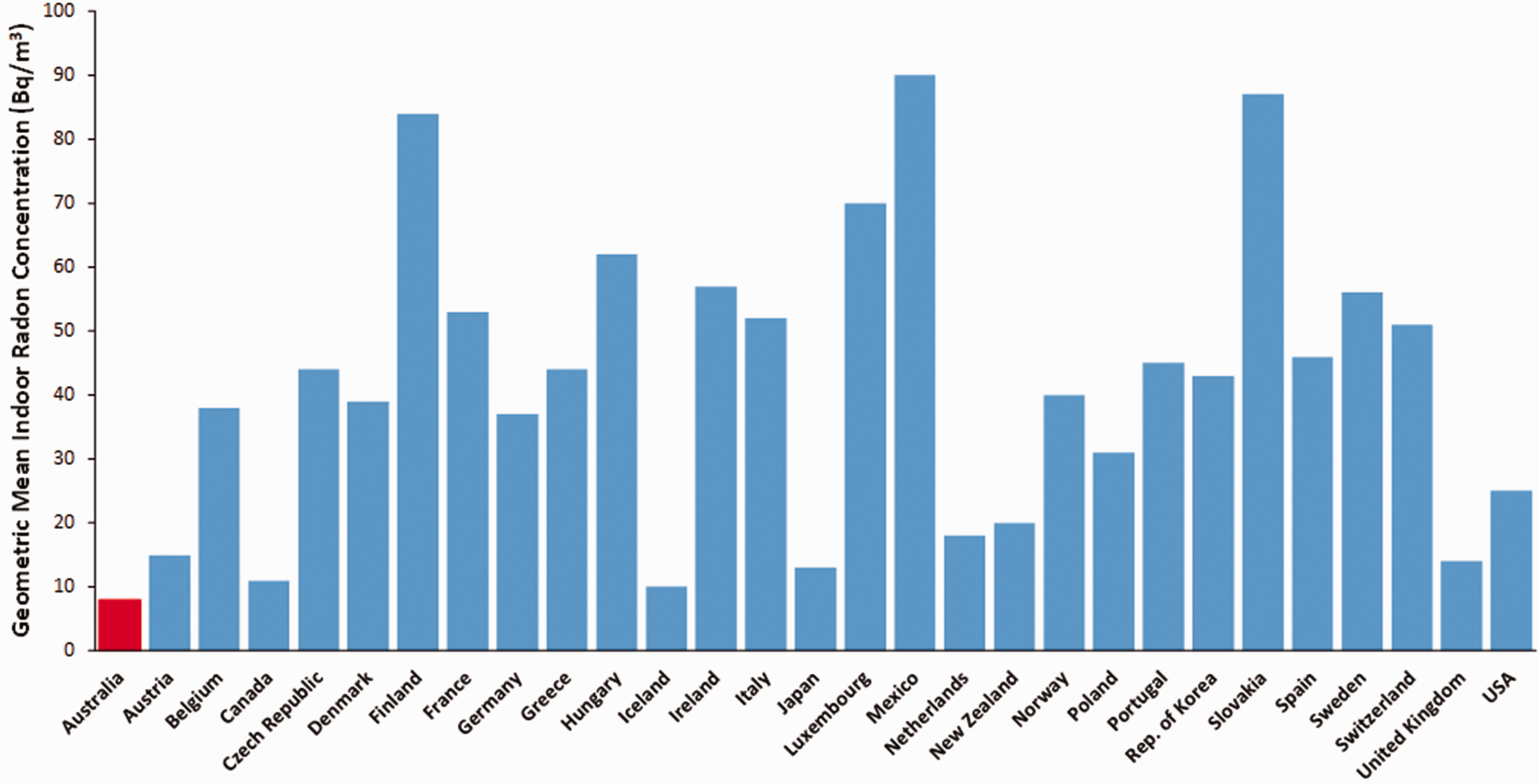
This means that the risk posed by radon is very low, except in circumstances where radon is allowed to accumulate to very high levels. In the Australian context, there are only a limited set of scenarios that might give rise to radon concentrations that exceed the reference level:
highly energy efficient buildings in areas of high radon potential; underground workplaces; workplaces with elevated radon concentrations (e.g. spas using natural spring waters); and enclosed workspaces with limited ventilation.
2.2. Guidance for radon exposure in Australia
Within the system of radiological protection, radon exposure has the characteristics of an existing exposure situation, as the source is unmodified concentrations of ubiquitous primordial natural activity in the Earth’s crust (ICRP, 2007). Human activities such as construction of buildings, operation of mines, or underground show caves (ARL, 1996) may create or modify pathways that increase exposure to radon and its progeny. These pathways can be controlled by preventative and mitigating actions.
The Guide for Radiation Protection in Existing Exposure Situations (ARPANSA, 2017) recommends a reference level of 10 mSv year−1 to provide an appropriate level of protection for the public and workers for exposure to radon in homes and workplaces in Australia. This guide recognises the challenges of measuring a dose from radon, and recommends derived reference levels that are consistent with a reference level of 10 mSv year−1.
A derived reference level of 200 Bq m−3 for dwellings and mixed-use buildings (those used by both workers and members of the public) and a reference level of 1000 Bq m−3 for workplaces has been established for Australian conditions.
In most workplaces, radon exposures of workers that are not a result of their assigned or regular work activities are considered to be adventitious, and are not considered to be occupational exposures.
The Guide for Radiation Protection in Existing Exposure Situations recommends a specific graded approach in workplaces to control the level of radon. Attempts should be made to reduce the concentration of radon to a level to the same derived reference level established for dwellings and mixed-use buildings. If difficulties are met in reducing levels, optimising protection is recommended using the actual parameters of the exposure situation, such as occupancy and other site-specific factors, together with a derived reference level of 1000 Bq m−3, averaged over 1 year.
For exposures in workplaces that persist above the derived reference level of 1000 Bq m−3, averaged over 1 year, workers should be considered as occupationally exposed.
3. The Australian Radon Action Plan
The Australian Radon Action Plan proposes that the risk posed by radon in Australia will be minimised by taking action in four key areas:
raising awareness; assessing workplaces and public buildings that may have elevated radon concentrations; providing advice and guidance to those workplaces and public areas that have radon concentrations exceeding the reference level; and minimising radon concentrations in new buildings in areas with high radon potential.
3.1. Raising awareness
The potential health impacts from exposure to radon in the mining and milling of uranium ores and mineral sands have been of concern since the 1950s. For this reason, authorities responsible for radiation protection have regulated radon exposure of workers in those industries. In Australia, legislation regulating exposure to radon does not extend to people exposed to naturally occurring levels of radiation in homes or mixed-use buildings.
Previous assessments of the risk to people exposed to naturally occurring levels of radiation have determined that the risk posed by radon in Australia was very low. Therefore, the range of regulatory authorities responsible for public and workplace health do not currently consider controlling exposure to radon. However, ICRP has re-evaluated its estimates of the risk of lung cancer for radon progeny and doubled its estimate of risk from exposure to radon (ICRP, 2010).
The regulatory authorities responsible for public and workplace health already have direct engagement with the broad spectrum of stakeholders that can manage public and workplace exposure to radon. It is these bodies that should be engaged, through the Australian Radon Action Plan, to promulgate public and workplace awareness of the potential risks of radon exposure.
In particular, the Australian Radiation Protection and Nuclear Safety Agency (ARPANSA) will collaborate with Worksafe Australia, the Australian government statutory body established to develop national policy relating to workplace health and safety, to develop and publish a guide on radon exposure in the workplace.
3.2. Assessing workplaces and public buildings
In line with best practice in radiation protection and workplace health and safety, the strategy for dealing with radon in workplaces and public buildings should involve a graded approach to risk management and a careful targeting of resources.
In the first instance, radon should be recognised like any other potential hazard in workplaces and public buildings. Those responsible for the workplaces or public buildings should be encouraged to measure the concentration of radon to determine if it approaches the reference level.
In Australia, little is known about the level of radon in schools and preschools, presenting an opportunity for the education sector to conduct radon measurement surveys to better understand radon exposure and to introduce learning material into the classroom to raise awareness. In Australia, some underground show caves have been recognised as workplaces that have elevated levels of radon (ARL, 1996). In 2019, Solomon undertook a re-assessment of inhalation radon doses among Australian underground show cave workers. The re-assessment of historical data applied the new radon ICRP dose conversion factor, and identified that 15% of the workers exceeded 10 mSv year−1 and 6% exceeded 20 mSv year−1 from exposure to radon (Solomon, 2019). Although the total number of show cave workers in Australia is very small, the re-assessment indicates that radon exposure remains a significant radiation protection issue for show cave operators and workers.
ARPANSA has commenced work with show cave operators and workers to optimise protection against radon exposure for tour guides. This has involved site visits to educate workers, and collaboration with operators to develop protection strategies and monitoring programmes. ARPANSA will also explore cooperative arrangements with the mining industry to assess the levels of radon in underground mines.
3.3. Providing advice and guidance
Persons responsible for workplaces and public buildings found to have elevated levels of radon will require carefully considered advice and guidance on the potential health impact of past exposure and methods to minimise future exposure. Effective risk communication requires clear and coordinated messages aimed at target audiences. An assessment of perceptions and the level of knowledge regarding radon in the target audiences should be done both before and after a risk communication campaign.
In Australia, most control of elevated levels of radon will comprise of increasing ventilation in the building or workplace. However, there will be some cases where this may not be possible or cost-effective. In such cases, a radiation protection specialist will need to work with the management of the workplace or building to develop specific strategies to optimise protection against radon exposure. As community awareness increases and if there is a need to control radon exposure, regulatory authorities responsible for radiation protection will need to work with the radiation protection community to increase the number of services that can provide advice on radon exposure. By working with Worksafe Australia, ARPANSA can support the development of national uniform advice and industry-specific guidance on radon mitigation.
Through the development of a radon potential map, ARPANSA can map radon zones in Australia to identify areas of potential for elevated indoor levels of radon in homes and workplaces. The map is intended to help governments and other organisations to target risk reduction advice and guidance. Radon potential maps are developed using a combination of data on indoor radon measurements, geology, aerial radioactivity, and other geological information. A radon potential map builds on the post code maps generated as part of the 1990 survey of Australian homes (ARL, 1990).
3.4. Minimising levels of radon in new buildings
The 1990 survey of Australian homes (ARL, 1990) represents buildings that were constructed using building technology that did not focus on energy efficiency. This construction style resulted in well-ventilated houses that were typical for a majority of the Australian population, who live in temperate and subtropical climates. As Australia adopts new building technology to reduce total energy consumption and deliver more effectively heated and cooled dwellings, there is a need to understand and avoid negative impacts on indoor air quality. Modelling studies of home energy efficiency demonstrate that increasing the air tightness of dwellings can increase the mean indoor radon concentration (Milner et al., 2014). ARPANSA is committed to communicating with local governments in areas with high radon potential. This will alert local governments that new housing which aims to minimise air exchange to achieve energy efficiency may inadvertently elevate indoor levels of radon.
4. Conclusion
The Australian Radon Action Plan provides the overarching vision and direction for radon protection in Australia. It seeks to align priorities with national and international obligations, and presents a long-term strategy to optimise protection of people from exposures to radon and its progeny in homes and workplaces. The outcomes are designed to establish a strong foundation for future success.
It is recognised that indoor levels of radon in Australian homes are very low compared with most other countries. The shift from well-ventilated homes in subtropical and temperate climates to more energy efficient homes means that more Australians may be at risk from radon than ever before. When implemented, the goals of the Australian Radon Action Plan aim to reduce the risk of radon by increasing visibility and promoting broad attention for radon issues, research needs, and risk reduction practices for workplaces and public areas.
The success of the Australian Radon Action Plan will rely on stakeholder engagement and building partners who are affected by the actions or can influence implementation of the actions. As we build knowledge and monitor the performance of this plan, priority actions can be refined to better inform the steps we need to take to achieve the envisioned end result – reducing the risk of radon to the Australian population.