




Abstract
Committee 4 develops principles and recommendations on radiological protection of people in all exposure situations. The committee meeting in 2014 was hosted by GE Healthcare in Arlington Heights, IL, USA on 27 July–1 August 2014. The programme of work of Committee 4 encompasses several broad areas, including a series of reports covering various aspects of existing exposure situations, leading the efforts of the International Commission on Radiological Protection (ICRP) to update and elaborate recommendations in light of the accident at Fukushima Daiichi nuclear power plant for emergencies and living in contaminated areas, elaborating the underpinnings of the system of radiological protection, and developing focussed reports on specific topic areas in consultation with ICRP’s special liaison organisations. Committee 4 has six active Task Groups working on naturally occurring radioactive material; cosmic radiation in aviation; updates of ICRP Publications 109 and 111; ethics of radiological protection; surface and near-surface disposal of solid radioactive waste; and exposures resulting from contaminated sites from past industrial, military, and nuclear activities. In addition, there is a Working Party on tolerability of risk, and ongoing work with the various special liaison organisations of ICRP.
1. Introduction
Committee 4 of the International Commission on Radiological Protection (ICRP) is dedicated to developing principles and recommendations on radiological protection of people in all exposure situations. Committee 4 works closely with other Committees, and the Main Commission, to elaborate the practical application of the Commission’s recommendations, and provide information on how the system of radiological protection can be applied in the various exposure situations.
Committee 4 includes 17 members from 14 different countries, with a wide variety of research, academic, industrial, and regulatory perspectives. The most recent meeting was hosted by GE Healthcare in Arlington Heights, IL, USA on 27 July–1 August 2014.
The programme of work encompasses several broad areas, including a series of reports covering various aspects of existing exposure situations, leading the efforts of ICRP to update and elaborate recommendations in light of the accident at Fukushima Daiichi nuclear power plant for emergencies and living in contaminated areas, elaborating the underpinnings of the system of radiological protection, and developing focussed reports on specific topic areas in consultation with ICRP’s special liaison organisations. The following sections will describe the current programme, accomplishments, and anticipated work. Other sessions in this symposium will touch specifically on several of Committee 4’s areas of work.
1.1. System of radiological protection
The objective of the work of ICRP is to contribute to an appropriate level of protection against the detrimental effects of ionising radiation exposure without unduly limiting the benefits associated with the use of radiation. This is accomplished through recommendations intended to prevent serious detrimental tissue reactions, and to minimise, to the extent reasonable, the probability of stochastic effects, including cancer and heritable effects. Current work within the Commission is looking at non-cancer effects, where the mechanisms may challenge the previously rather simple separation of effects into two categories.
The foundations of the recommendations come from scientific information, experience, and social and ethical values. There will be a session within this symposium that is devoted to the ethical principles and values that support the recommendations, and how clarifying and eliciting these values can assist in decision making and in interactions with stakeholders.
The ICRP system of radiological protection is a fundamental framework for dealing with any exposure situation in a systematic and coherent manner. The components of the system are illustrated in Fig. 1.
System of radiological protection, illustrating the interrelationships of the principles of protection, the exposure situations, the categories of exposure, the dose criteria, and the requisites for implementation of the system.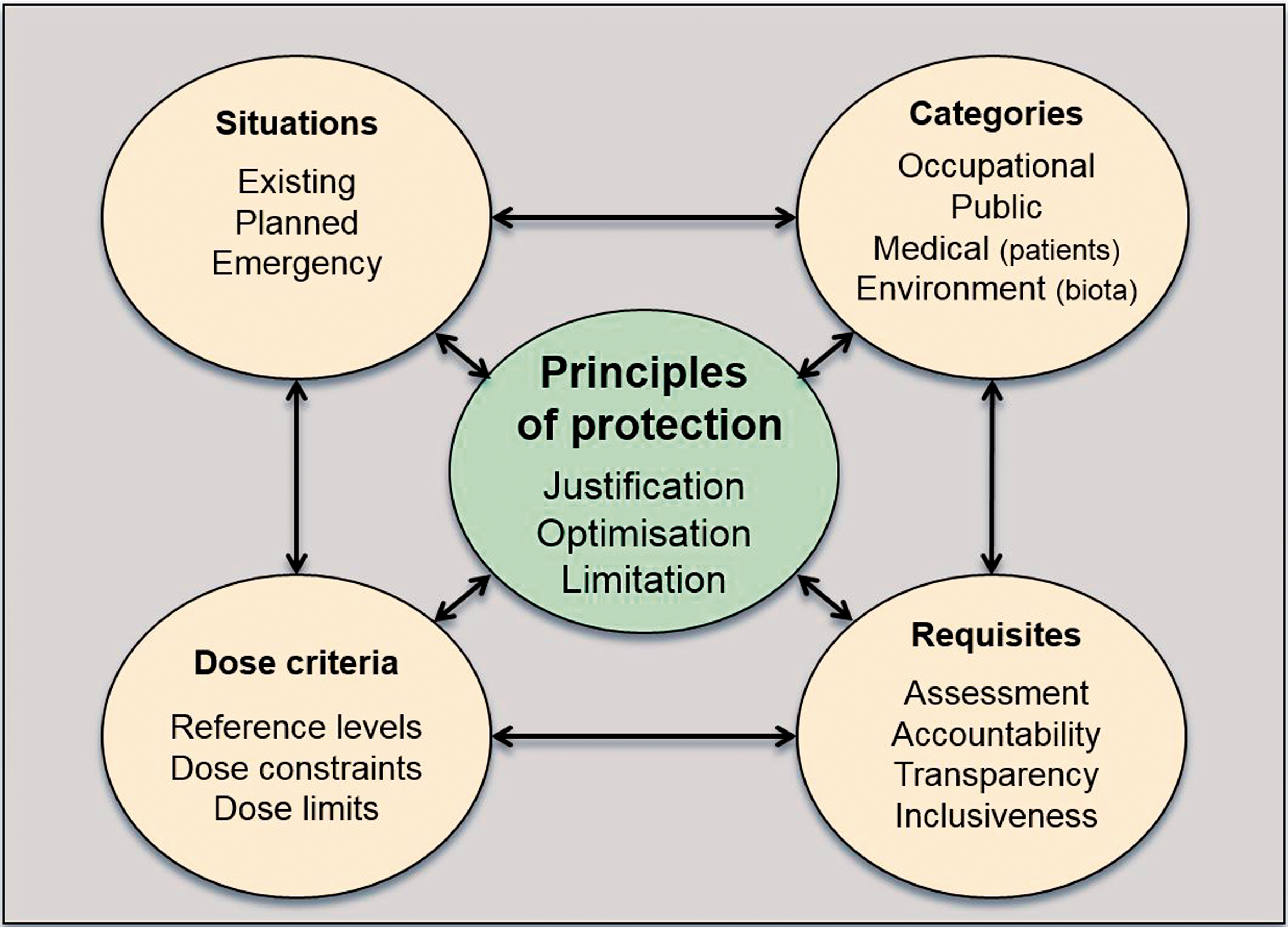
At the centre, the system of radiological protection relies on the three principles of justification, optimisation, and limitation. These principles are applied in the various exposure situations, shown in the upper left, of planned, existing, and emergency exposure situations. There are now four categories of exposure, namely occupational, public, medical (associated with medical diagnosis and treatment), and environmental (associated with protection of the environment). The dose criteria serve as boundaries within which the optimisation process takes place, and serve to reduce inequities of exposure. Finally, there are several requisites that must be in place in order for the system to be implemented effectively. These include the need for assessment of the exposures, provision of information in a clear and transparent manner, accountability for safety, and involvement of the relevant stakeholders.
Radiological protection is achieved in any exposure situation by the application of optimisation. Fundamentally, this means reducing exposures to as low as reasonably achievable, economic and societal factors being taken into account. This is illustrated in Fig. 2, where the process of optimisation is shown stylistically to move the dose distribution towards lower levels of dose, and reduce (preferentially eliminate) individuals who would be receiving an exposure greater than the selected dose criteria.
Optimisation of protection, showing the movement of the dose distribution towards lower levels of exposure, with a focus upon doses that may exceed a specified individual dose criteria.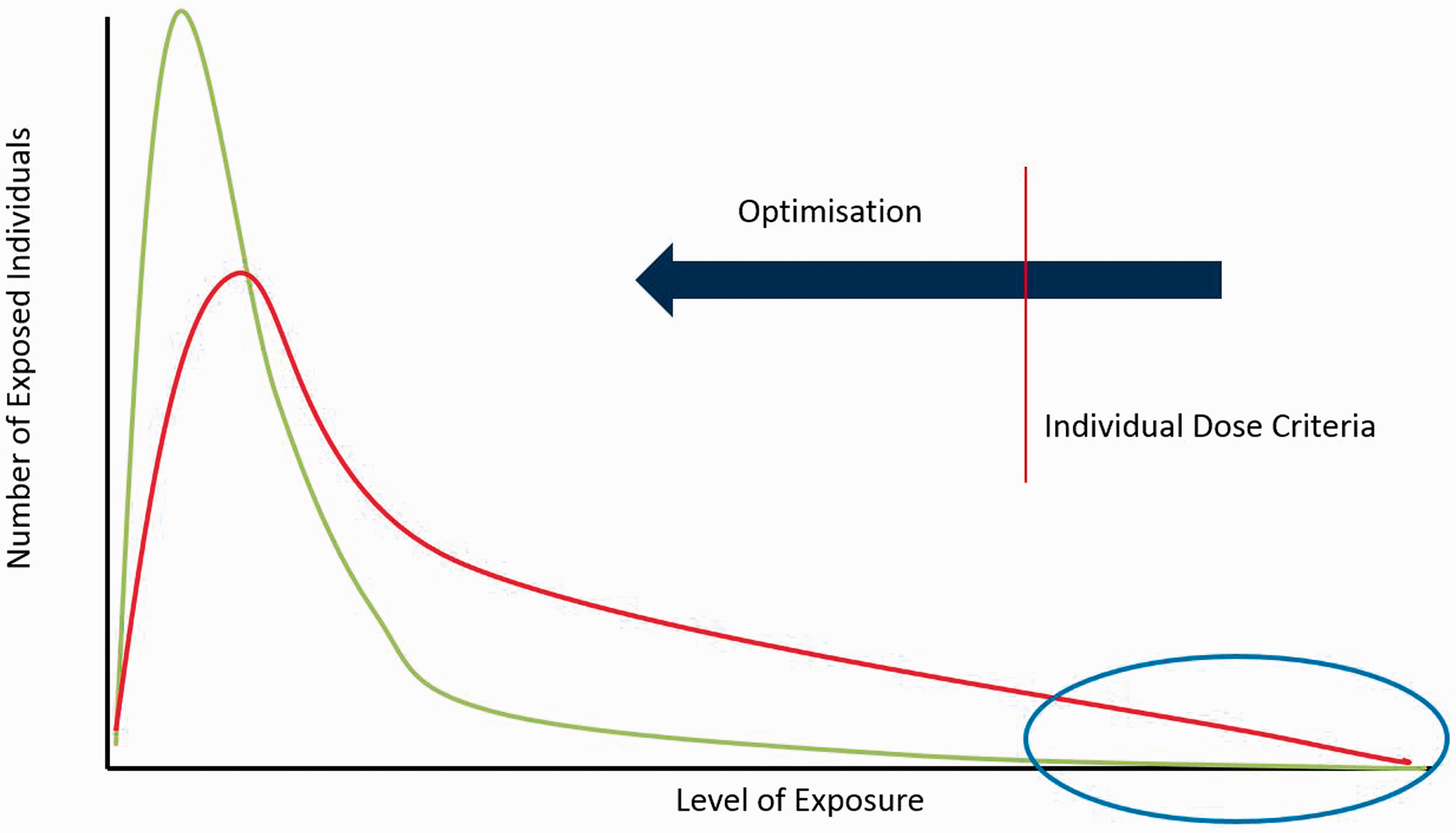
The name used for the individual dose criteria, shown in Fig. 1, has presented some questions, particularly in existing exposure situations. Dose limits, in the formal, individual related sense used by the Commission in planned exposure situations, are said not to apply in existing exposure situations. The Commission recognises, however, that national regulatory bodies prefer to have legally defined criteria with which to judge the adherence of a particular activity as being within the standards. If a particular existing exposure has been well characterised, it may be convenient for national authorities to apply the term ‘limit’ in such a legal context, particularly for occupational exposure. The session of this symposium dealing with existing exposure situations will elaborate further on this topic.
2. Programme of work
2.1. Existing exposure situations
Following ICRP’s 2007 Recommendations (Publication 103; ICRP, 2007), Committee 4 has embarked on a set of related efforts to elaborate the application of the system of radiological protection in existing exposure situations. The system of radiological protection was developed principally within the context of planned exposures, and the translation of the system for existing exposures requires a clear understanding of the situation, the opportunities for providing for protection, and the objectives to be achieved.
Within the system of radiological protection, the starting point for any consideration of radiological protection is an assessment of the exposures that may be occurring. Unlike a planned exposure situation in which the conditions can be predicted in advance, in existing exposure situations – in which the exposures are already occurring – the first requisite is to assess the situation, the pathways and magnitudes of exposure, and the status of any radiological protection that may be in place. For example, many industries using ores and other materials may have naturally occurring radioactive material (NORM) present, which may, or may not, have been recognised previously. Likewise, for radon in dwellings and workplaces, an assessment of the radon levels is essential before consideration can be given to the need for action.
The most recent publication in this area was Publication 126 (ICRP, 2014b). Committee 4 has six active Task Groups. Task Group 76 on application of the Commission’s recommendations to NORM will be presenting draft material at the Committee 4 meeting in Seoul, South Korea. NORM industries have a great diversity of applications and possibilities of exposure; in most cases, considerations of radiological protection have not, traditionally, been part of the safety concerns. Nevertheless, there is potential for relatively significant exposures, depending on the NORM being processed and the conditions of work.
Public consultation is ongoing for the draft report of Task Group 83 on radiological protection from cosmic radiation in aviation. In this report, the Commission provides updated guidance on the radiological protection from cosmic radiation in aviation, taking into account the current ICRP system of radiological protection, the latest available data on exposures in aviation, and the experience gained worldwide in their management. The report describes the origins of cosmic radiation, how it exposes passengers and aircraft crew, the basic radiological protection principles that apply to this existing exposure situation, and the available protective actions. For implementation of the optimisation principle, the Commission recommends a graded approach proportionate with the level of exposure that may be received by individuals. This can be accomplished in a relatively straightforward manner based on time spent in flight. The objective is to keep the exposure of the most exposed individuals to reasonable levels. The Commission also recommends that information should be disseminated to raise awareness about cosmic radiation, and to support informed decisions among concerned stakeholders. The draft will be reviewed based on the comments received, and a final version will be moved forward to approval and publication by the Commission.
Task Group 98 on application of the Commission’s recommendations to exposures resulting from contaminated sites was initiated in 2014. Several teleconferences have already been held to begin the development of a report.
2.2. Response to Fukushima
Closely related to the work on existing exposure situations is the work of Task Group 93, updating Publications 109 and 111 (ICRP, 2009a,b). Publications 109 and 111 were published just before the events at Fukushima Daiichi nuclear power plant, and application in the emergency, and in the time that has since passed, has raised a number of questions that the Commission intends to address. These questions include justification for and optimisation of emergency decisions, characterisation of the radiological situation, protection of emergency and recovery responders, decontamination and waste management strategies, withdrawal of emergency protective actions, protection of pregnant women and children, information sharing with stakeholders, and emergency and recovery preparedness. Thus, the work of Task Group 93 is to prepare additional material in light of the lessons from Fukushima, and recent international developments concerning the protection of people in emergency exposure situations, and people living in long-term contaminated areas after a nuclear accident or a radiation emergency. Task Group 93 has benefited greatly from the continuing set of dialogue meetings in Fukushima, initiated by the Commission in November 2011. Committee 4 expects to have extended discussions on draft material at the Committee 4 meeting in Seoul, South Korea.
2.3. Foundations of radiological protection
The Commission, through Committee 4’s Task Group 94, is currently examining the ethical foundations for the system of radiological protection. The report is expected to elaborate on the underpinnings of the system of protection, and is intended to improve our understanding and use of the system, and assist in developing decision approaches and communications. Task Group 94 has benefited from a series of workshops organised in cooperation with the International Radiation Protection Association (IRPA), beginning in 2013, and continuing in 2014 and 2015. The current plan is to have a report for preliminary consultation during the time of the 14th Congress of IRPA in South Africa in May 2016. A separate session of this symposium is devoted entirely to this subject.
Committee 4 is also examining the tolerability of risk through a Working Party of individuals. The issues of tolerability are, in a number of respects, related to the ethical considerations being developed by Task Group 94, and are highly dependent upon the prevailing circumstances of the exposure. A situation that would not be tolerable in normally well-controlled circumstances may be tolerated for a short period of time in circumstances of danger. This can be seen in a person’s reaction to, for example, a significant weather event. Once the event is over, the desire is always to attempt to return to a state of normalcy, preferably as close to the previous condition as possible. Such a return to normal may take a considerable period of time, as was seen in the wake of Hurricane Katrina which devastated the city of New Orleans, LA, USA, where reconstruction and rehabilitation of areas have taken a number of years.
2.4. Topical reports
With this term of the Commission, Committee 4 has initiated a series of reports that are focussed on specific topics where elaboration of the Commission’s recommendations would prove useful. Committee 4 specifically requested the organisations that have a formal relationship with ICRP to suggest topics where such reports would be useful. In retrospect, the first of the series could be considered as Publication 122 (ICRP, 2013). This report was developed in close collaboration with the Nuclear Energy Agency (NEA) of the Organization for Economic Cooperation and Development (OECD) and groups within the waste community, among others. The second in the series was Publication 125 (ICRP, 2014a), which addressed the unique challenges of use of ionising radiation in security screening settings.
The series continues with the work of Task Group 97 on application of the Commission’s recommendations for surface and near-surface disposal of solid radioactive waste. This Task Group was initiated in late 2014 following the request of NEA for a follow-up to Publication 122 (ICRP, 2013) for the area of surface disposal. Committee 4 is also considering the possibility of a document dealing with the application of the Commission’s recommendations for uses of mobile high-activity sources. Committee 4 welcomes further suggestions for topics that may be useful to particular groups.
2.5. Support to other Committees
Committee 4 works to support other Committees with application perspectives during the development of reports. At present, Committee 4 has members that are part of Task Groups of each of the other Committees, including support for considerations of effective dose (Task Group 79), occupational radiological protection in brachytherapy (Task Group 89), radiation risk inference at low dose and lose dose rate (Task Group 91), and terms and definitions (Task Group 92). During the meeting in Seoul, South Korea, proposals for joint work with Committee 5 will be under discussion, together with discussions on the concept of detriment.
3. Conclusions
Committee 4 has an active ongoing programme with four major areas of work, six current Task Groups, several Working Parties, and support for a number of additional Task Groups of other Committees. During the meeting in Seoul, South Korea, Committee 4 will be considering several additional proposals for work, as well as critical review of documents in preparation. The year 2016 should see completion of the work on radiological protection from cosmic radiation in aviation, and the public consultation for the work on ethics of radiation protection. Committee 4 is looking ahead to issues to be clarified and elaborated for the system of radiological protection.