




Abstract
The International Commission on Radiological Protection (ICRP) system of protection consists of existing, planned, and emergency exposure situations. With the 2007 Recommendations in ICRP Publication 103, a coherent approach has been established that emphasises the optimisation of protection with appropriate constraints or reference levels in each exposure situation. Existing exposure situations pose unique challenges because the source of exposure already exists, and it may not always be possible to control the source directly. This is the case for naturally occurring sources, which are ubiquitous in the environment and vary widely in the magnitude of exposures that may be received by individuals. Decisions on protection strategies must consider a graded, pragmatic, and flexible approach for dealing with exposure of members of the public, and those that may be occupationally exposed while working with naturally occurring sources. Although limits are not applicable, aspects of the management approach for planned exposure situations may be appropriate, depending upon the magnitude of exposures.
1. Introduction
The International Commission on Radiological Protection (ICRP) system of protection was updated and elaborated in Publication 103 (ICRP, 2007). The system of protection aims to contribute an appropriate level of protection for people and the environment against the detrimental effects of exposure to ionising radiation, without unduly limiting the desirable human actions that may be associated with radiation exposure. Application of the framework is intended to manage and control exposures to ionising radiation so that tissue reactions (deterministic effects) are prevented, and the risks from stochastic effects are reduced as much as reasonably achievable.
2. System of Protection
The system of protection is organised with three fundamental principles, three exposure situations, and three categories of exposure.
2.1. Principles
The first principle is justification. Decisions that alter the radiation exposure situation should do more good than harm. In the context of existing exposure situations, this justification may be more complicated than usual when introducing a source. The decisions that alter the radiation exposure are usually associated with altering the pathways, and may be intrusive or conflict with previously well-established behaviours. The second principle is optimisation. Exposures should be kept as low as reasonably achievable, taking into account the economic and societal factors that may be present. Optimisation is conducted within restrictions on individual exposure, referred to as ‘reference levels’ for existing exposure situations, in order to limit possible inequities in dose distribution.
The third principle is the application of dose limits. In planned exposure situations, the total dose to any individual should not exceed the appropriate limits as recommended by ICRP. This is a particular case of the more general concept of restricting individual exposures, and is important in planned exposure situations to ensure that multiple sources do not result in cumulative exposures that are inappropriate. The dose limits are not applicable in existing exposure situations. This has been one of the difficulties that many have seen with application of the system, particularly when there is a desire to control the situation in the same manner as a planned exposure situation.
2.2. Exposure situations
The principles of protection are applied in exposure situations. In its simplest terms, an exposure situation exists when there is a source, pathways of exposure from that source to a person, and exposure of individuals. Fig. 1 illustrates the components of any exposure situation.
Elements defining an exposure situation.
According to Publication 103, ‘Protection can be achieved by taking action at the source, or at points in the exposure pathways, and occasionally by modifying the location or characteristics of the exposed individuals’ (ICRP, 2007, Para. 169). In practical terms, the system of protection can only be applied when there are reasonable mechanisms for control. Preferences are always given first to actions on the source itself, such as shielding. The source can be secured to prevent access. Steps can be taken to avoid radioactive materials from migrating to the environment, be that the laboratory bench or the environment around a facility. In other cases, and particularly for most existing exposure situations, there is little that can be done about the source itself, and actions on the pathways or on the individuals must be considered.
After considering the source, protection control actions may be applied to the pathways from the source to an individual. This may be the amount of time spent in the area of the source, or the processing of effluents to remove radioactive materials before release. The possibilities are dependent upon the source being considered, and the circumstances, location, and amount of time that an individual may be present. The combination of the source and the pathways leads to the exposure of the individual. As can be seen, the categorisation of the exposure situation is clearly dependent upon the characterisation of the source and the characterisation of the pathways.
Using these elements, ICRP has defined three exposure situations that cover all of the situations in which individuals may be exposed. Existing exposure situations are situations where the source or sources already exist when decisions to control them are taken. Quite simply, there is a source present in the environment, and one must decide what to do about it. The source was already there when it was recognised or characterised, and a conclusion was made that controls need to be applied. Thus, characterisation of exposures is a prerequisite to control. At this point, it is important to note that the Commission considers long-term exposures resulting from a nuclear accident as an existing exposure situation.
Planned exposure situations result when exposures are the result of a deliberate introduction and operation of sources. Exposures can be anticipated and fully controlled. This is the case considered most often, and was the situation within which the protection framework was introduced and initially elaborated. In planned exposure situations, the decision is made to use a source for a particular purpose. By making that decision, it is possible to consider the characteristics of the source and the pathways, and provide appropriate controls. Emergency exposures result (almost always) from the loss of control of a planned source. These situations require urgent and timely actions in order to mitigate exposure. The controls that have been applied to the source are no longer present because something has happened that resulted in their unexpected loss. There is urgency in the actions, and the timing, to regain control and prevent exposures. The Commission considers exposures resulting from malicious acts as an emergency exposure situation.
As noted above, an important consideration in exposure situations is the time frame over which the exposure may occur, and the time available to take protective actions. In an emergency, there is urgency to take actions, to prevent deterministic tissue reactions, and to regain control of the source. In contrast, in existing exposure situations, there is no urgency requiring rapid actions to ensure protection. Time is available to consider the source, the pathways, and the possible protective actions more carefully. As the source already exists, protective actions can be implemented, and should be effective immediately. However, this does not mean that full control and an optimised situation is accomplished immediately. In many cases, a progressive approach of improving protection may occur in order to review the exposures continually, and consider how to further improve protection.
2.3. Exposure categories
Within the exposure situations, the exposed individuals may be categorised as medical, occupational, or public. From the Commission’s standpoint, occupational exposure is exposure incurred at work as a result of the exposure situation, that can reasonably be regarded as being the responsibility of the operating management. Medical exposure is the exposure of patients in diagnostic, interventional, and therapeutic procedures. This category has also included those individuals who may be specifically providing comfort and care, or voluntarily participating in research activities. Public exposure encompasses all other exposures, thus becoming anything that is not occupational or medical. This definition, perhaps oversimplified as ‘anything else’, completes the theoretical structure, although regulatory organisations often find it necessary to be more prescriptive in some circumstances. Individuals may fall into the three categories, respectively, as workers, patients, or members of the public. In fact, any particular individual may be in all three categories at various points during their daily activities.
3. Existing Exposure Situations
There are many types of existing exposure situation. For example, aircraft crew exposure to cosmic radiation is an existing exposure situation. The cosmic ray dose rate exists, dependent upon altitude, geographical location, etc. Likewise, exposure to radon in dwellings and workplaces is, for the most part, an existing exposure situation, because the naturally occurring decay chain of uranium has not been introduced deliberately.
Naturally occurring radioactive material (NORM) presents another existing exposure situation. This includes consideration of materials that are already present on the earth’s surface, and the transport of naturally occurring materials from deep within the ground to the surface as a result of activity such as drilling for oil or gas. Two other situations also fall within the general category of existing exposure situations. These are sites that may have contamination from past activities, perhaps from long ago, which may not, in light of today’s understanding and measurements, be considered acceptable. Likewise, contamination from a nuclear accident or radiation emergency eventually falls within this category; as it now exists in the environment, little can be done to modify the source, and actions have to be considered over the long term. The transition from an emergency exposure situation to an existing exposure situation continues to be an issue of considerable discussion, and is currently being examined by ICRP Committee 4 during updates to Publications 109 and 111 (ICRP, 2009a,b) in light of the experience from Fukushima Daiichi.
Existing exposure situations have a number of unique features, some of which have already been hinted at in the above discussion. First, and perhaps obvious, existing exposure situations are ubiquitous, and there can be wide differences between different types of situation. As such, each situation needs to be characterised and considered carefully before starting to take actions for control. The time frame for taking protective actions is not urgent, and characterisation is important to the process of justifying and optimising the recommended actions.
Control of the exposure to individuals is mainly through the pathways, as the source itself will not, in many cases, be amenable to direct control and modification. This does not mean that actions on the source are excluded, and consideration can be given to such actions when it is reasonable. Likewise, because of the wide variability, there may be a large distribution in individual exposures. This has been seen many times, such as in the contaminated zones in Chernobyl where individual habitats and locations, even within a single village, resulted in widely variable individual exposures.
The ubiquity of existing exposure situations means that workers may be receiving exposures that are adventitious, and not part of the specific work that is being done. Further, the sources may not be under the control of the operating management or employer because the source exists within the environment. In many situations with NORM, there may be a lack of experience with radiation protection, or even a lack of awareness that exposures are occurring.
The lack of existing radiation protection culture can make the introduction of control measures more difficult to accept by the individuals who are being exposed. However, it is these individuals, be they workers or simply members of the public, who are living in the existing exposure situation who can have the greatest influence on their own exposure. Informed personal behaviours, based on information, support, and knowledge, can be one of the most significant mechanisms to reducing the risk to these individuals. This individualised action has been referred to as ‘self-help’ protective actions.
Finally, existing exposure situations are unique because they require a long-term perspective. The sources exist, are characterised, and actions are taken. This does not mean that the situation goes away. Instead, this is an ongoing process, and it is important to continue to consider the source, the protective actions, and what might be reasonable and possible to improve the situation further over time.
The introduction of the three exposure situations in Publication 103 (ICRP, 2007) was designed to emphasise the commonality of the approach to radiation protection, irrespective of the circumstances. Most are familiar with the classic approach when the introduction of the source is planned. A dose limit controls the sum of all the exposures of an individual. Further, a restriction of the exposure from a particular source to a particular individual serves as a boundary of what is considered as acceptable in planning the exposure and optimising the protection.
What was not at all obvious previously was that the same approach was equally applicable in existing and emergency exposure situations. In this case, a restriction of what would be considered a priori as acceptable for planning can be established as a reference level. Optimisation acts to improve protection, irrespective of whether the initial exposure levels are greater than, or less than, the reference level. Optimisation is the unifying approach to radiation protection, and always challenges one to consider if there are reasonable and appropriate measures to further reduce exposures to levels that are as low as reasonably achievable, economic and social factors being taken into account. The commonality of the approach is illustrated in Fig. 2.
Commonality of the approach for planned, existing, and emergency exposure situations.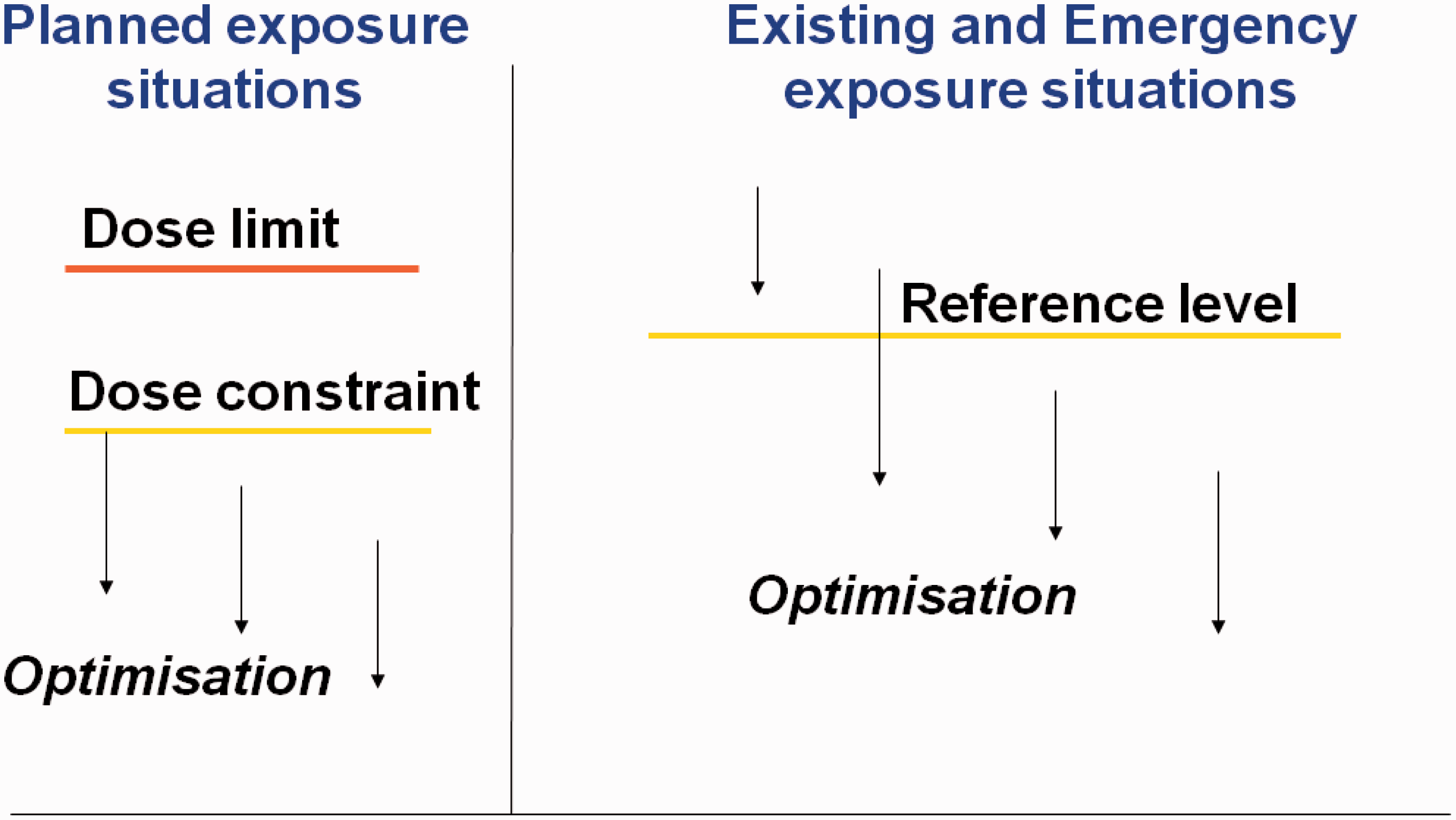
4. Application to NORM
NORM is one particular example of existing exposure situations that presents a number of challenges and areas where there is confusion. ICRP has classified NORM as an existing exposure situation. Primarily, the source is the various concentrations of the natural radionuclides in the earth’s crust. Human activities may create new pathways of exposure or alter the pathways and/or concentrations that may be present. In many cases, a combination of preventative and corrective actions can be taken.
As shown above, the protective approach, namely optimisation of exposure below a dose restriction, is fundamentally the same as for other exposure situations. In fact, NORM exposure can be managed in the same manner as a planned exposure situation. Regulatory organisations may choose to use the common tools applied to other planned situations in the case of NORM when it is reasonable to do so, and the characteristics of the source and pathways can be handled as such. There are also situations where the source can be removed, or where the natural material is, in fact, extracted or modified to make a more traditional radiation source.
One consideration for NORM is whether there is some modification to the concentrations and locations of the material. Without modification, NORM exposure may be unamenable to controls. However, humans tend to modify their environment, and thus the source and pathways become different from the naturally existing environment.
Modifications of the source may be adventitious or may be deliberate. In this case, ‘deliberate’ refers to specific activities that use the radioactive materials for some purpose. These could become planned exposure situations, because there is the opportunity to plan what is being done, consider the source, provide controls over the source such as containment, ventilation, etc., and control exposures adequately. Adventitious modification is more complicated because there may, or may not, be an awareness of the source, either historically or in the initial activities. Nevertheless, in all cases, a modified source is present, there are pathways, and there will, as a consequence, be exposed individuals.
For an existing exposure situation, it is possible, under the ICRP exposure categories described above, to organise exposures as occupational or public on the basis of whether the situation can reasonably be regarded as being the responsibility of the employer. In either case, control actions have to be justified, and protection is provided by application of optimisation within restrictions on what is considered as appropriate restrictions on individual exposure. It should be noted that this differentiation into occupational vs public is not on the basis of the magnitude of the exposures. The exposures may reasonably be regarded as being within the responsibility of the employer, and not be a challenge to an appropriate reference level. Likewise, this differentiation is not based on the choices that might be made by an employer, or regulatory organisation, regarding the types of requirements that may be employed in a regulatory context.
ICRP Committee 4 has been carefully examining the practical approach to radon, NORM, and other situations. One key to this is the use of a graded approach. Pragmatically, protection should be commensurate with the risks that are presented by the specific situation, and the opportunities to provide protection. The strategies used must be appropriate and adapted for the circumstances. Existing exposure situations, and NORM in particular, need to be characterised so that the level of ambition for protection can be established, there can be realism in what is considered, and the effectiveness of the actions can be assessed and modified as necessary.
Regulatory organisations often wish to have specifications for all the requirements so that compliance can be assessed, and enforcement taken when necessary. While appropriate, it must be remembered that this must also be influenced by the risks that are presented by the situation. In certain circumstances, it is reasonable and appropriate to specify legal responsibilities including specific mandatory provisions, again in a graded approach. Of course, there may be circumstances where there are no reasonable mechanisms for control, or where the levels of exposure are such that the most appropriate oversight is an exemption.
ICRP has stated many times that constraints and reference levels are not ‘limits’. This is particularly important in existing exposure situations. The reference level indicates the boundary that, from a planning standpoint, one should not plan to exceed. This differs from ‘compliance'. It may not be possible to achieve all exposures below the desirable value immediately, and it would not be appropriate for a regulatory organisation to translate the reference level into an enforceable limit. On the other hand, if the situation is well characterised and controls are well established, it may be reasonable to apply the types of requirements and structures that are used in planned situations.
There are a number of complications that need to be taken into account when considering existing exposure situations. First, the principle of application of dose limits is actually a specific example in planned exposure situations of the broader concept for restricting individual doses, which applies in all exposure situations. Dose limits are explicit in planned exposure situations, where there is clearly the ability, and the duty, to manage an individual’s exposure to within the recommended limits, and, in fact, further restrict individual doses through the use of constraints in the process of optimisation. In an existing exposure situation, dose limits do not formally apply. However, the underlying concept of restricting individual doses, through the use of an appropriate reference level in the optimisation process, still functions to ensure that there is no inequity in exposures to certain individuals.
When regulatory requirements are established, there is a tendency to specify requirements clearly. Regulators often use the concept ‘limits’ because they are clear, precise, and unambiguous. While the ICRP system of protection does not specify dose limitation as one of the principles for existing exposure situations, the use of such a regulatory construct could be appropriate, depending on the specifics of the exposures, and the degree to which the activities are well characterised and can be well controlled.
Another complication is what might be called ‘back-fitting’. When a situation is characterised and a conclusion is reached, there need to be some controls to provide radiation protection properly. The imposition of those requirements may be difficult and may be expensive. No one particularly likes someone coming into their activities and demanding that they expend resources to make changes, particularly if they cannot fully appreciate the risks that may have been unrecognised previously. In this case, there must be careful consideration of the justification for establishing requirements, and a balance drawn between the radiation risks, other risks that may be present or introduced by the introduction of controls, and the costs and benefits of the control measures.
5. Conclusions
The overall objective of the ICRP system is protection of people and the environment, and this is applicable irrespective of the exposure situation. In order to justify and optimise protection effectively, it is necessary to know what is being dealt with. Characterisation of the exposure, and the available options, is critical to obtaining an optimised protection strategy. That strategy and approach must match the circumstances if it is to be effective and sustainable. Further, responsibilities must be clear and stakeholders must be involved. Unlike in an emergency exposure situation, where the urgency of action requires that some preplanned protection strategies are implemented with limited information, existing exposure situations can be well characterised and the affected stakeholders can be involved in the decisions. It is clear that if these individuals are not involved in their own protection decisions, they will be much more difficult to implement. It is very easy to become alienated when there is a perception that you are simply a victim, or have something imposed upon you.
ICRP’s system of protection consistently establishes that exposures are to be optimised. While there may be a variety of expectations and regulatory tools in a graded approach based on the level of risk, the over-riding approach is optimisation, and looking to see if there are reasonable steps that can improve protection.
Individual exposures are considered in the restriction of individual dose by constraints or reference levels. These restrictions are the boundary for the optimisation process, and help to ensure that there is equity for all individuals. In some cases, it is reasonable and possible to apply the regulatory structures of planned exposure situations, including limits, for a particular case of existing exposure based on ethics and safety.
Finally, it must always be remembered that existing exposure situations are not a ‘one size fits all’. Just as each case is unique, so too are the decisions to be made, and the control tools that may be used have to be commensurate with the risks.
Footnotes
This paper does not necessarily reflect the views of the International Commission on Radiological Protection.