




Abstract
On 19 April 2011, the Ministry of Education, Culture, Sports, Science, and Technology designated 13 elementary schools, including Tominari Elementary School in Date city, as high-dose schools that needed to restrict outdoor activities due to the effects of the accident at Fukushima Daiichi nuclear power plant. Approximately 1 week later, the municipal government took action to remove the topsoil from the school grounds, and the prohibition of outdoor activities at Tominari Elementary School was lifted. The school staff continued to work on decontaminating the surrounding areas using high-pressure washers and brushes. There were certain positive outcomes, but a more effective decontamination method was required. In July 2011, the municipal government started an environmental remediation project, both inside and outside the school buildings, with researchers and decontamination workers at Tominari Elementary School, involving members of the Parent–Teacher Association (PTA), local communities, and volunteers using various effective and specialised forms of decontamination. As a result, Tominari Elementary School was able to recommence swimming lessons at the end of the first semester, which had been thought to be impossible. This article will provide information about the importance of ‘dialogue’ for decontamination, how engagement of the experts gave members of the PTA and the local community a feeling of ‘security and safety’, and how the decontamination work was an ever-expanding collaborative work of a large number of people.
Keywords
1. INTRODUCTION
Tominari Elementary School is located approximately 60 km northwest of Fukushima Daiichi nuclear power plant in beautiful natural surroundings. Initially, it was thought that the school would not be affected a great deal by the accident, and an entrance ceremony was held with all the pupils in April. However, in mid-April, Tominari Elementary School was designated as a high-dose school and outdoor activities were restricted. This came as a great shock to the staff, the members of the Parent–Teacher Association (PTA), and particularly to the entire community.
Contaminated soil was removed from the school grounds by the municipal government, and buried in the ground; there were concerns about whether or not the local community would accept the decontamination project at the school. However, what was a large-scale professional-standard decontamination process at that time was carried out. This decontamination process was subsequently used in other parts of the city. The decontamination work was an example of true collaborative work, involving members of the PTA, local inhabitants, and volunteers from across Japan who answered the calls of the project leaders.
This article will report how a safe and secure environment was created around Tominari Elementary School by describing the processes of this collaborative decontamination project involving municipal authorities, experts (radiation researchers and professional decontamination specialists), and school staff.
2. THE FIRST DECONTAMINATION
In mid-April 2011, Tominari Elementary School was designated as a school with an ambient dose > 3.8 µSv h−1, and outdoor activities were restricted. At this time, most schools in Fukushima Prefecture were limiting outdoor activities due to fear of radioactivity. Therefore, the official designation notice led to no changes in the school activities. However, following the announcement that Tominari Elementary School was one of the high-dose schools, the school started to receive telephone calls with invitations to evacuate from other prefectures, reporters from the media requested interviews, and anxiety levels increased in the community. Briefing sessions and workshops were held for members of the PTA and school staff, which helped them to understand the overall situation, units of measure, and calculation of safety criteria. However, a greater concern was how to deal with the existing situation and the possibility of changes to the reference value. The school staff did everything possible to continue with ‘ordinary school life’, believing this to be the best way to reduce anxiety among children and their parents.
The municipal government decided to start decontamination work, giving high priority to children’s daily life, by reducing radiation dose in the grounds of those schools with prohibition of outdoor activities. At the end of April 2011, scraping of the topsoil in the school grounds commenced (Fig. 1). This involved scraping 15 cm of topsoil, removing the scraped soil, and replacing it with non-contaminated soil. The work was undertaken over the weekend when the children were not at school. Originally, waste soil was planned to be stored temporarily in the community area, but it had to be buried on the school grounds due to opposition from local residents. The soil from digging the hole for burying the topsoil was taken outside the community area. Although the issue of how to treat waste soil remained, the average dose in the school grounds was < 0.37 µSv h−1 after decontamination; this was the second lowest dose at the school, with the lowest dose found in the gymnasium, built of reinforced concrete.
Following decontamination of the school grounds, the restriction on outdoor activities was lifted. However, the next step was to think about decontamination of high-dose areas in the surroundings, as there were more and more demands from parents that decontamination was not progressing around the wooden school buildings, or to lower the dose of the children as much as possible. By this time, many parents had dosimeters and were able to access dose information in the area, including at school.
Soon after, the city authorities distributed washers for decontamination, and the PTA agreed to take part in the decontamination work. At Tominari Elementary School, the staff spent 3 days measuring 12 different places in the school premises to create a dose distribution map and perform test decontamination. After measuring with the dosimeters provided (maximum measurement 10 µSv h−1), high-pressure washers and brushes were used for decontamination.
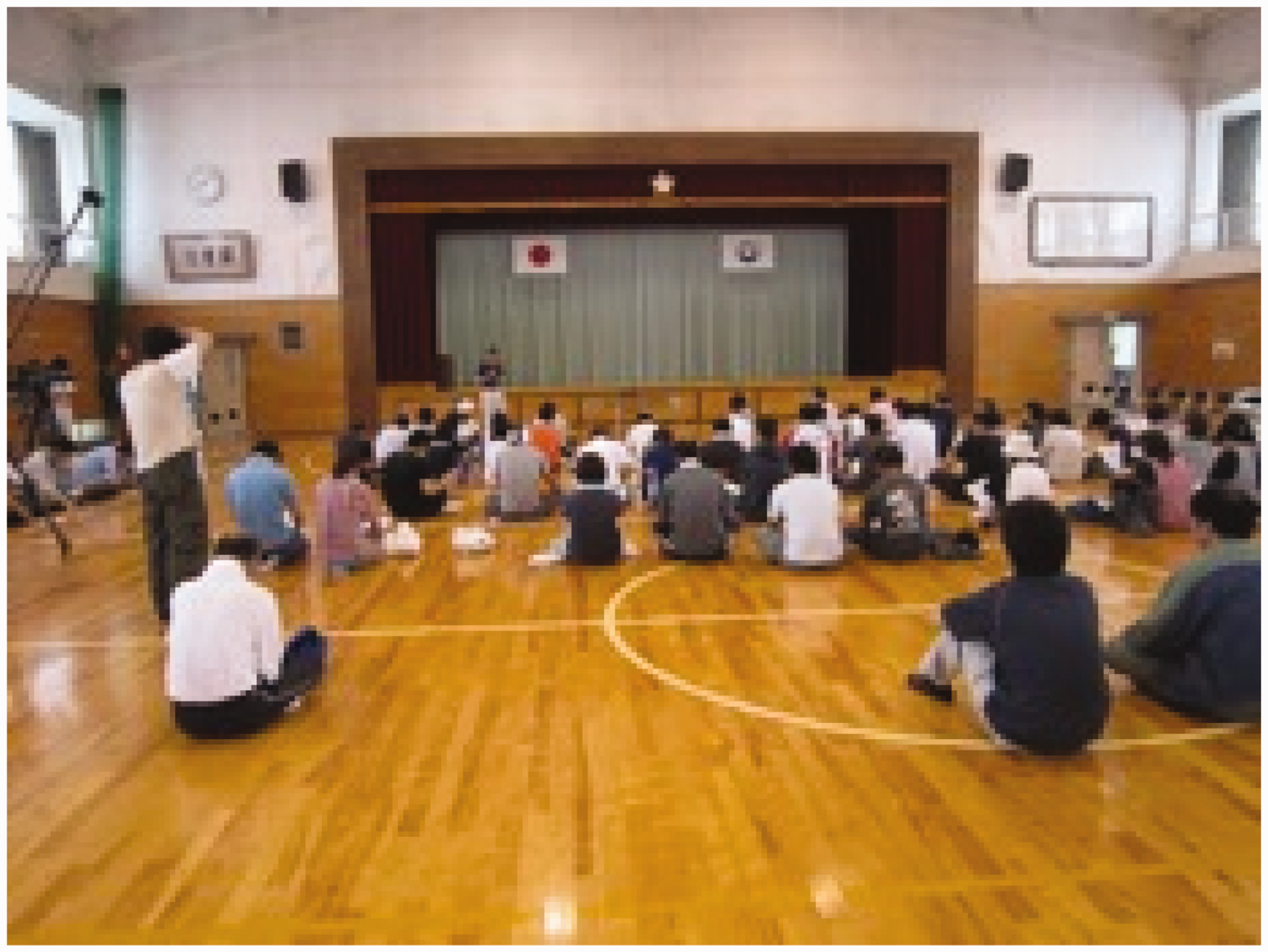
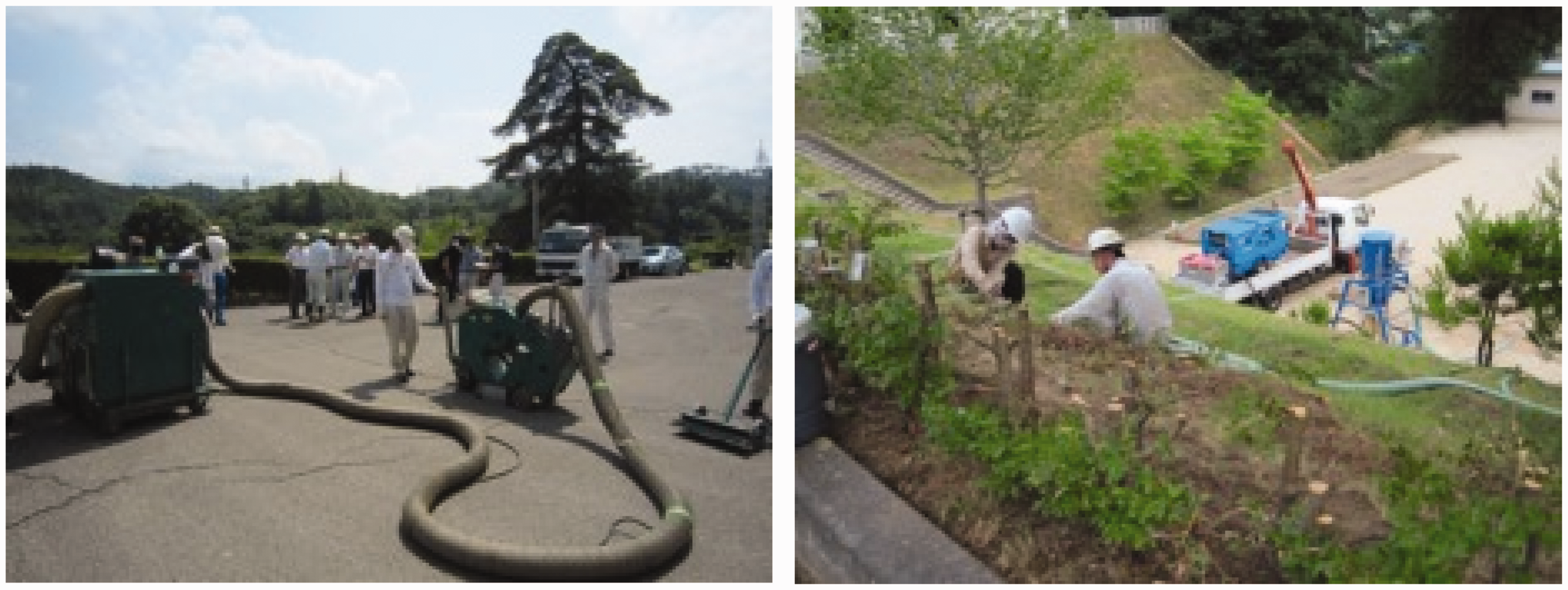
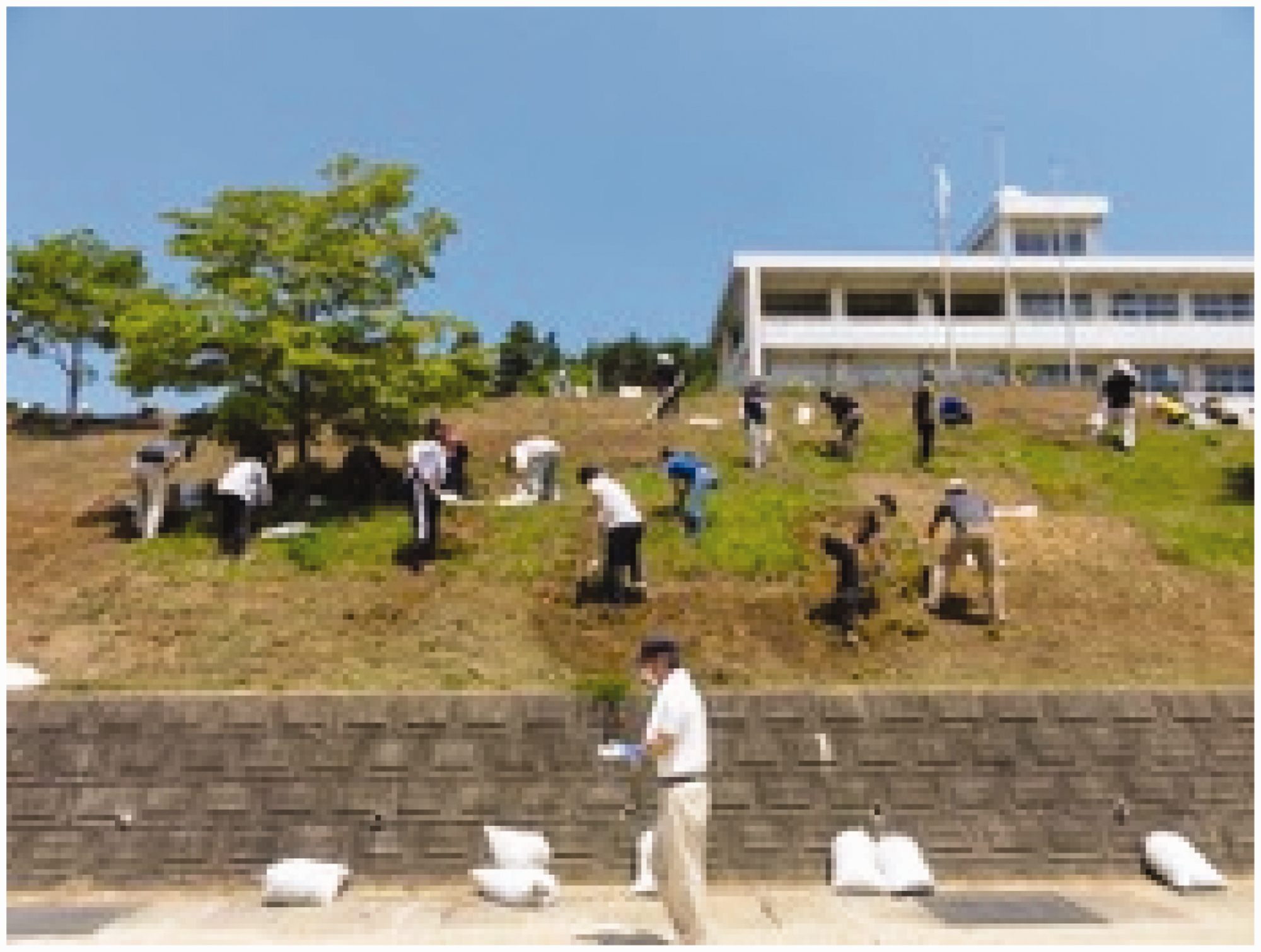
Decontamination of school grounds (3 µSv h−1 ⇒ <0.37 µSv h−1). Briefing session to parents (3 July 2011). (Left) Sandblast method (8 µSv h−1 ⇒ <0.7 µSv h−1). (Right) Electric cutter method (3.5 µSv h−1 ⇒ 1 µSv h−1) Decontamination of the slopes by volunteers from around the country (16 July 2011).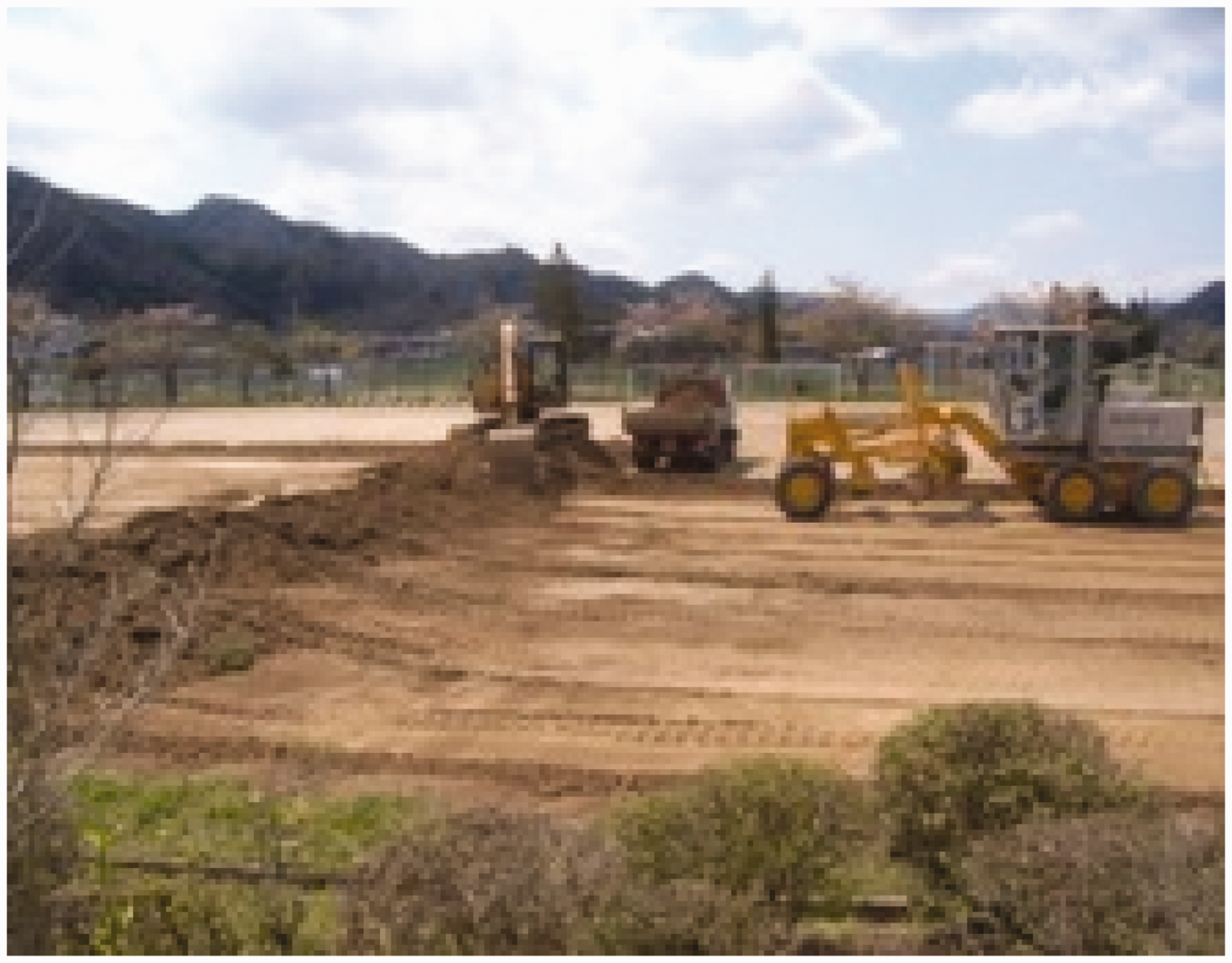
As a result, it was found that certain places, such as drain ditches, had ambient dose rates > 10 µSv h−1, and that the dose rates at rainwater pipes (>8–10 µSv h−1) and catch basins (3–12 µSv h−1) could be reduced by a factor > 2 by washing decontamination. On the other hand, the dose at brick walls and the surface of paved asphalt roads in front of the school building, decreased by < 0.1 µSv h−1 following decontamination.
Doses differed with location and building materials. There were also hotspots scattered here and there. A more efficient decontamination method was needed for places such as outer walls, as walls tend to peel from washing. High-dose areas were marked with signs showing ‘No entry zone’. The municipal authorities were asked to measure the dose in areas that could not be measured with dosimeters, and these areas were excluded from the decontamination areas under the responsibility of the PTA. How to decontaminate the areas that did not improve following the initial decontamination measures remained a challenge.
3. DECONTAMINATION PROJECT STARTS
3.1. Briefing sessions for decontamination around the school premises
In June 2011, as decontamination progressed in all the school grounds in the city, the decision was made to install air conditioners in all classrooms as summers in Fukushima are very hot. It was also at this time that the timeline for environmental decontamination around the school buildings and the surroundings was decided. However, it was not known whether or not the remaining issues facing the inhabitants would be solved by decontamination.
Two weeks prior to the PTA-led decontamination, the municipal government appointed an advisor for effective decontamination, and the decontamination project was ready to start. It was proposed that this project would be carried out jointly with the PTA members. This proposal was discussed, and implementation of the project was decided after reaching a consensus regarding the objective and timing of the decontamination.
Initially, a meeting was held with the PTA members, the principal (the author) and assistant principal of the school, representatives of the municipal government, and the advisor to report the results of the experimental decontamination carried out to date, as well as the remaining issues. The representatives of the municipal government and the advisor explained the most recent decontamination methods that were to be used and the anticipated numerical results. The school members asked various questions about radiation and the decontamination methods, and received clear answers from the government team. Following the meeting with the representatives of the municipal government, the school members asked for a briefing session prior to starting the decontamination work. This was to inform each member of the PTA, in plain language, about the issues that arose in the decontamination of the school grounds, such as ‘explanation of radiation/radioactivity’, in order to carry out this project successfully.
A briefing meeting led by the advisors and decontamination specialists took place on Sunday (Fig. 2). The large-scale decontamination had been announced through the media and on the internet, and many participants from kindergartens and other areas came along. The same instructions were given, each with specific reasons, as those given for the previous decontamination efforts, such as how to wipe windows and shelves effectively, and the most up-to-date methods for decontaminating slopes, walls, and the ground with minimum exposure were also explained. Explanations were given in easy-to-understand language, and each question was answered carefully. One of the welcome yet surprising revelations was that masks, long-sleeved shirts, and long trousers were no longer required.
At first, the atmosphere was tense, but a peaceful and friendly atmosphere prevailed in the room as people started to talk to each other. The PTA members suggested that everyone could start by weeding the school ground slopes, which was not included in the plan, but local residents and parents of children stood up to get the weed whackers. As time went on, in July 2011, the meetings turned into dialogue-style discussions and lasted for four times as long. The main reason why the local residents and volunteers were able to carry out this collaborative decontamination work was due to the very thoughtful and scrupulous explanations given by the professionals, which removed the doubts and anxiety of the local residents.
3.2. Three decontamination projects
Decontamination projects were divided into three areas: interior of school buildings (classroom, windows, berms, gutters, veranda); outside the school buildings (plants, garage, outer stairways, approach, embankment, playground equipment); and the swimming pool (pool water, facilities around the pool, building). These were carefully planned, explained, and implemented.
Decontamination inside the school buildings was performed by members of the PTA after the following thorough instructions: clean floors and windows carefully using mainly chemical and water rags, which should be folded after each wipe; and smooth surfaces should be dusted with diluted kitchen detergent or chemical rags. The same decontamination method was used in homes and local buildings.
With this decontamination, the air dose was reduced from 0.11 µSv h−1 to 0.06 µSv h−1 at 50-cm height in the classroom, and from 10 µSv h−1 to < 1 µSv h−1 in the gutters.
Decontamination outside the school buildings involved scraping the ground and walls around the school buildings using machines. This work was undertaken by professionals, except for the slopes. Asphalt surfaces and other small holes that had been filtrated by radiation were decontaminated using the sandblast method (Fig. 3). This method involves scraping the area with a fine abrasive media of sand, which is then sprayed using equipment with filters attached. If there were cracks in the surface to be decontaminated, weeds were removed, and the cracks were filled with asphalt. Plastics such as playground equipment were cleaned using chemicals or just wiped.
Weeds were cut from the slopes and the roots were removed by scraping. Planted areas were pruned with electric cutters fitted with a vacuum cleaner bag (Fig. 3).
The effects of this decontamination test work showed results that could be confirmed both visually and numerically.
School staff struggled with decontamination of the asphalt surfaces, yet the air dose decreased from 8 µSv h−1 to 0.7 µSv h−1, the school ground dose decreased from 3–5 µSv h−1 to 1–1.5 µSv h−1, and the dose around the planted areas decreased from 3.7 µSv h−1 to 0.7 µSv h−1.
Decontamination of the swimming pool involved a highly technical method. After the accident, it was thought that it would not be possible to use the pool for some time as the drainage would be directly connected to waterways used for newly planted paddy fields. It was felt that the inhabitants would not agree to this drainage method as it had been difficult to persuade them to accept surface soil from the school grounds.
Decontamination of the swimming pool was performed in three phases, confirming the effectiveness after each phase. Similar work was performed simultaneously in the fish pond.
Professionals purified and drained the water in the 200-ton swimming pool, followed by decontamination in and around the swimming pool by professionals together with members of the PTA. The last phase was to supply water to the pool through a filter.
The pool water was purified to reduce the contaminated water to the reference value for drinking water (tap water standard < 50 Bq l−1). Zeolite was used to absorb radioactive caesium, coagulating sedimentation with blue-green algae, and collected as sludge. It was dried, put into plastic bags, and left in temporary storage as waste material.
A briefing session was held on the first day of decontamination of the swimming pool. The project team explained about water purification and performed a demonstration experiment for the officials of the waterway union who had come to the school. The murky contaminated pool water (650 Bq l−1) went through the decontamination device, and came out clear and measuring < 50 Bq l−1. The members of the union who saw this result agreed immediately that it was acceptable to drain the water, and left. It was considered that visible proof of numerical facts had proved most convincing.
Work to decontaminate the swimming pool continued for 10 days, involving water purification and thorough decontamination inside and in the peripherals of the swimming pool. Clear pool water measuring < 50 Bq l−1 was drained out of the swimming pool, the air dose was 0.7 µSv h−1 in the surroundings, and the dose at the surface of the pool was 0.39 µSv h−1. The children wanted to start swimming in the pool again, and the school principal conveyed their words to the advisor. He demonstrated the actual dose that the children would receive while swimming, and stated that the effect of water shielding made the dose lower than that in the classrooms. Despite this, there was much resistance from many PTA members who said that there was considerable anxiety regarding letting the children swim in swimming costumes when decontamination of their homes had not yet commenced. As such, it was decided that there would be a presentation on the results of decontamination, and a briefing (dialogue) about opening the swimming pool.
The most convincing explanation at the meeting was the experiment performed by the experts. This showed that the dose hardly changed with or without a heavy thick towel around them, and that the shielding effect of water was proven to lower the dose still further.
Three days after the meeting, the swimming pool was opened. Children with parental agreement became the first children to enjoy swimming lessons in Date city. Physical education classes were held in the gymnasium for those children whose parents remained undecided about letting their children swim. After the summer holiday, all children were able to enjoy physical education classes in the swimming pool.
4. DECONTAMINATION PROJECT AND BEYOND
The decontamination project, a collaborative project involving the local community, school, volunteers, and experts, came to an end in late July 2011. The day that the team was due to leave the school, a teacher brought a letter to the principal’s office with beautiful drawings, written by a number of the children who wanted to hand their letter of gratitude to the team. The letter was given to the team leader in the afternoon, and he looked very pleased, saying ‘the team members will be very happy’. However, the principal still felt a sense of regret that the children had not received a full explanation about decontamination.
Subsequently, the city authorities continued their decontamination work in various ways, focusing on the unity within the community and communication. At Tominari Elementary School, an environment has been established whereby each parent is confident of the safety of their child/children.
Today, there are 24-h monitoring dosimeters set up in all the public facilities in Fukushima Prefecture. The ambient dose at Tominari Elementary School was 3.9 µSv h−1 at a spot 1 -m high in April 2011. It was reduced to 0.17 µSv h−1 on 7 December 2015, indicating a safe environment. Following completion of the project, decontamination measures continued behind the school buildings with the Forestry Cooperative, and on the slopes around the school with volunteers (Fig. 4). Numerous discussions were held with parents, community members, and city authorities, and a map of dose distribution at the locations related to school activities was drawn up.
5. ACHIEVEMENTS AND CHALLENGES OF THE DECONTAMINATION PROJECT
5.1. Achievements
Having implemented this project, members of the PTA and school staff came to understand what it was to ‘fear correctly by understanding radiation’. They learned the methodology of decontamination, and worked in close contact with the children to maintain a safe and secure environment at school. The school was considered to be the safest place in the community due to the collaborative and effective decontamination with the participation of professionals, community members, volunteers, and many more. This achievement provided a huge boost to subsequent reconstruction activities at the school.
5.2. Remaining challenges
The author would like to maintain a mechanism for sharing information with the school and local residents, with a goal of mutual understanding. Something that the author was unable to, but would have liked to included in this project, was find a way of involving the children and pass on the spirit of cooperation and solidarity displayed by the local residents throughout the decontamination process.