




Abstract
Before the accident at Fukushima Daiichi nuclear power plant in March 2011, I never thought about radiation. After the accident, I originally evacuated with my two sons, but we returned home a few weeks later to be with my husband and parents-in-law as I felt that life with my family was what mattered and the very basis of my happiness. Today, 5 years after the accident, some people are able to think positively about the situation, and some remain uncertain. This article offers my experience and thoughts as a mother to help enable others to feel less stressed about eating food produced in Fukushima, and suggests ideas to help lift their spirits.
1. our daily life before the earthquake
I live, with my family, at the foot of Ryozen, a small mountain (825 m above sea level), in Date city, Fukushima Prefecture. I moved here 9 years ago when I got married. We are a family of six consisting of myself, two small boys, my husband, and his parents. Before the accident at Fukushima Daiichi nuclear power plant, our sons loved to play outside (Fig. 1), picking and eating fruit from our blueberry trees and strawberry fields, running around in the fields, stepping on the growing vegetables, and picking beautiful flowers. My parents-in-law used to laugh at them saying, ‘Well, what can we do (with these little ones)?’ When I prepared supper for my family, I harvested onions and carrots from our fields and felt grateful that we were so blessed.
Between our house and the foot of the mountain, there is a large (10,000 m2) area of grass and flowers that has been maintained and protected by previous generations. Although it is not unusual to have plenty of open space in rural areas, I occasionally think that this land is excessively spacious.
2. after the disaster
The Great East Japan Earthquake took place on 11 March 2011 followed by the tsunami. Radioactive fall out covered our rich green natural surroundings and our house.
Our sons were aged 3 years and 1 year at the time of the disaster. Despite the power outage immediately after the earthquake, we used our own power generator to try to gather information from the television and radio. When I saw the images of the tsunami on the television, I was shocked and could not believe that what I was seeing was real. I just kept staring at those images, petrified. As the damage from the tsunami became more severe, news of the accident at Fukushima Daiichi nuclear power plant was reported. The situation became worse as time passed, and I was panic stricken. I wanted to just run away but I could not. I believe many people felt the same. On 14 March 2011, when we heard of the hydrogen explosion at Fukushima Daiichi, we decided to evacuate to my parents’ home in Aomori Prefecture, 350 km north of our home in Fukushima. At that time, everyone in Fukushima wanted to run away as far away as possible; however, many people had nowhere to go and had run out of fuel, so had no option other than to remain in Fukushima. We were fortunate to have sufficient fuel and a place to stay in Aomori.
Our house is 46 km from Fukushima Daiichi nuclear power plant. It is located next to Iitate village, which was designated as an evacuation zone because the annual radiation dose exceeded 20 mSv. Although evacuation was not mandatory, 46 people, representing 14 of the 44 families in the village, many of them with children, evacuated following the Government’s evacuation order. This was the start of our life of repeated evacuations. 1
3. evacuation to aomori
On 14 March 2011, our family left home in Fukushima and headed for Aomori at 9 pm. While driving along in the dark, we passed a red emergency vehicle heading to rescue the tsunami victims along the coast. In the uncomfortably heavy atmosphere, we were listening to repeated warnings on the car radio not to go outside unnecessarily, to wear masks and nylon jackets when going outside, and to remove mud from shoes before entering the house. Over the few days since the accident, this was the only information and advice provided by the Government. No information was given regarding how far the radioactive material would reach. As we drove through Fukushima, Miyagi, and Iwate Prefectures, everywhere was dark due to complete power outage as we drove along the bumpy roads damaged by the earthquake. I remember driving slowly and carefully, seeing long queues of cars waiting for petrol stations to open, even though it was the middle of the night.
Early in the morning of 15 March 2011, as we entered Akita Prefecture, the radio reported the second explosion at Fukushima Daiichi nuclear power plant. I remember feeling desperate, with a sense of having to protect our children at all cost. My husband’s parents had remained at home in Fukushima, despite our pleas for them to evacuate with us. They said that all their siblings and relatives were in Fukushima, and they could not leave them and run away. They said, ‘You go ahead and escape with the children’. I could not understand why they would not come with us, but I finally came to understand, through their words, how they were feeling. I still remember very clearly when they saw us off. I was speechless and torn, thinking that I would never be able to return to our home.
4. evacuation life in aomori
As days went by, the magnitude and severity of the situation placed the entire country in a state of fear. On arrival in Aomori, I knew that we would have to live with radiation for a long time, so I ordered a dosimeter immediately. It was delivered, if I remember correctly, in April 2011. The people in Aomori welcomed us warmly when they heard that we had evacuated from Fukushima. However, my husband had to return to Fukushima for work. He did not have sufficient fuel to drive back to Fukushima, but the owner of the closed petrol station generously offered him a full tank of fuel when he noticed, from the license plate, that my husband was from Fukushima, saying ‘We must help each other in times of need’. At that time, Aomori was also suffering from a shortage of fuel and poor logistics. My husband was fortunate – I heard some terrible stories through the media and local rumours that some people refused to fill cars with Fukushima license plates with petrol, and that children from Fukushima were being bullied. I felt that our family would fall apart if we continued to live separately from my husband and parents-in-law. I felt a sense of crisis that we might not be able to return to our old life. Although I did not want to breathe the air in Fukushima, I thought it was best to talk everything over with my family to determine if Fukushima was really so bad that we were unable to live there. I thought it would never be too late to make a final decision about evacuating to Aomori with my children, so I decided to return to Fukushima to view the situation for myself.
5. our family life in fukushima
On 3 April 2011, we made a temporary return home to Fukushima after 3 weeks in Aomori. This marked the start of my daily work of measuring radiation dose. The measurement read 3 µSv h−1 inside the house and in higher places, and >5 µSv h−1 outside. Radiation dose was particularly high in the gutters and under the roof, measuring 20–40 µSv h−1. Unable to wait any longer, we started decontamination measures ourselves. We scraped 5 cm of surface soil from around the house and from the vast meadows using heavy machinery. We had the gutters cleaned and replaced. We cut down two of the four rows of cedar trees, which served as a windbreak. We tried many things, such as covering the surface soil with concrete and getting our drinking water inspected at the inspection agency. To our disappointment, some of the measures that we tried, such as high-pressure washing of the roof, and planting amaranthus which is said to absorb caesium in the fields, were not effective. My parents-in-law did much of the manual work, using scoops to decontaminate the area around our home. We started in April 2011 and had almost completed our work by November. The municipal office in our area finally started decontamination measures in December 2011, nearly 1 year after the disaster; this was relatively early compared with other areas of Fukushima. We tried to decontaminate every possible area that we could think of by collecting any information available. This extensive decontamination was not easy for an ordinary household. However, fortunately, we were operating a construction business and therefore owned heavy machinery and dump trucks. I felt very fortunate that I had married into this family.
Most of the people in my neighbourhood are elderly. Fourteen families have children of kindergarten age or school age; we were the only family who had preschool children at home during the day. Therefore, we had a deluge of television and newspaper reporters from the mass media every day for over a month, asking questions such as, ‘Is it safe for the children to live here?’ ‘Aren’t you going to evacuate?’ It made me feel uneasy and my heart was shaken. I almost went crazy and was really stressed. My 3-year-old son started to soil his underwear, maybe due to the terrifying experience of the earthquake or maybe because he picked up on my own feelings of insecurity. I was obsessed with thoughts of iodine and caesium, and I felt desperate when I heard that strontium had also been detected. I was anxious, I was stressed, and even my sweet-natured mother-in-law who never complained said, ‘Who can live in such a place…?’ My entire family was pushed to the edge.
At a conference on radiation, a doctor told us that, following the accident in Chernobyl, citizens in the contaminated area felt insecure for a long time and many became sick due to anxiety and stress. The doctor told us to make sure we had the correct information and to be afraid for the right reasons. That particular phrase caught my attention. I have subsequently attended various conferences to gather information regarding how to live with radioactive materials. As a result, ironically, I found it difficult to distinguish between who was telling the truth and who was not. Gradually, I settled down.
What was most important was protecting the children from internal exposure by being very attentive to what they ate. I learned that radioactive material is discharged from the body. The only way to fight against it was to build up immunity and boost metabolism by building a strong, healthy body. I was once again reminded of my responsibility as a mother. From very early after the disaster, I told my children that it was safe to play outside as long as decontamination had been completed. Of course, there were still many places within our property and in our neighbourhood that were untouched and remained contaminated. After decontamination, I measured the radiation dose and found levels of 0.08–0.19 µSv h−1 inside the house and 0.14–1 µSv h−1 outside, including areas that were untouched. I was happy to discover that the radiation had reduced over time. I used to stare at the dosimeter all the time in the beginning, but 18 months after the accident, I stopped using it. Having gone through many internal struggles, I was finally sure of what it meant to raise my children in Fukushima, and I was freed from feelings of insecurity and fear. Although I thought I knew how to deal with radiation, I was so afraid of feeling insecure and depressed again that I stopped using the dosimeter or measuring radiation dose.
6. experiencing the disaster
I needed a strong sense of determination to stay in Fukushima with my children. Some of my friends evacuated as far away as Okinawa Prefecture. I almost gave up many times, but each time I told myself that there was nothing better and happier than keeping our family, a family of six, together. I am not sure how this life will affect my children’s future, but when I think of the many other things that affect our health, such as smoking, food additives, agrochemicals, electromagnetic waves, etc., I can remain positive and consider radiation as just another evil on the list.
Looking back, I have learned many lessons, and gained a great deal, from this event. My mother-in-law tells me that she feels happy when she is making ‘Daifuku’ rice cakes with me. She also tells me that she feels happy that we can all live together as a family. I have come to find happiness and gratitude in things that I previously took for granted. I am happy that I was given the opportunity to take a fresh look at my life and to make new discoveries. There were extremely tough and difficult decisions, but happy surprises too. I certainly never dreamed that I would start running marathons.
7. future of fukushima
Despite the severity of the accident at Fukushima Daiichio nuclear power plant, I was very fortunate. It was a painful experience for everyone, regardless of whether they remained, left, or returned to Fukushima. Five years after the accident, some people are able to think positively about the situation, and some remain uncertain. Many mothers are still not convinced that is it safe to live in Fukushima. I think it is totally understandable that there are people ‘who are still afraid to buy vegetables produced in Fukushima’ or ‘who do not want to learn about radiation because nuclear power plant related information from television news and newspapers only makes them cry’. I think this is a normal reaction by mothers who care deeply about their children.
In order to be physically and mentally healthy, it is best to have a good balance of nutritious food and exercise. It is often said that one needs to be with other people or involved in the community in order to be mentally healthy and to reduce anxiety and stress. In Japanese rural culture, there is an old custom called ‘Ochanomi’ (tea drinking), and we enjoy this in our family. At 6 am, our neighbours come round without letting us know in advance. When the weather is good, we all sit on our porch with our tea cups and tell each other stories, such as having seen wild boars and snakes. It is important to create more opportunities like this, where people can talk their hearts out. I would also love to listen to the voices of mothers if that could be of help.
Our home environment where children play outside.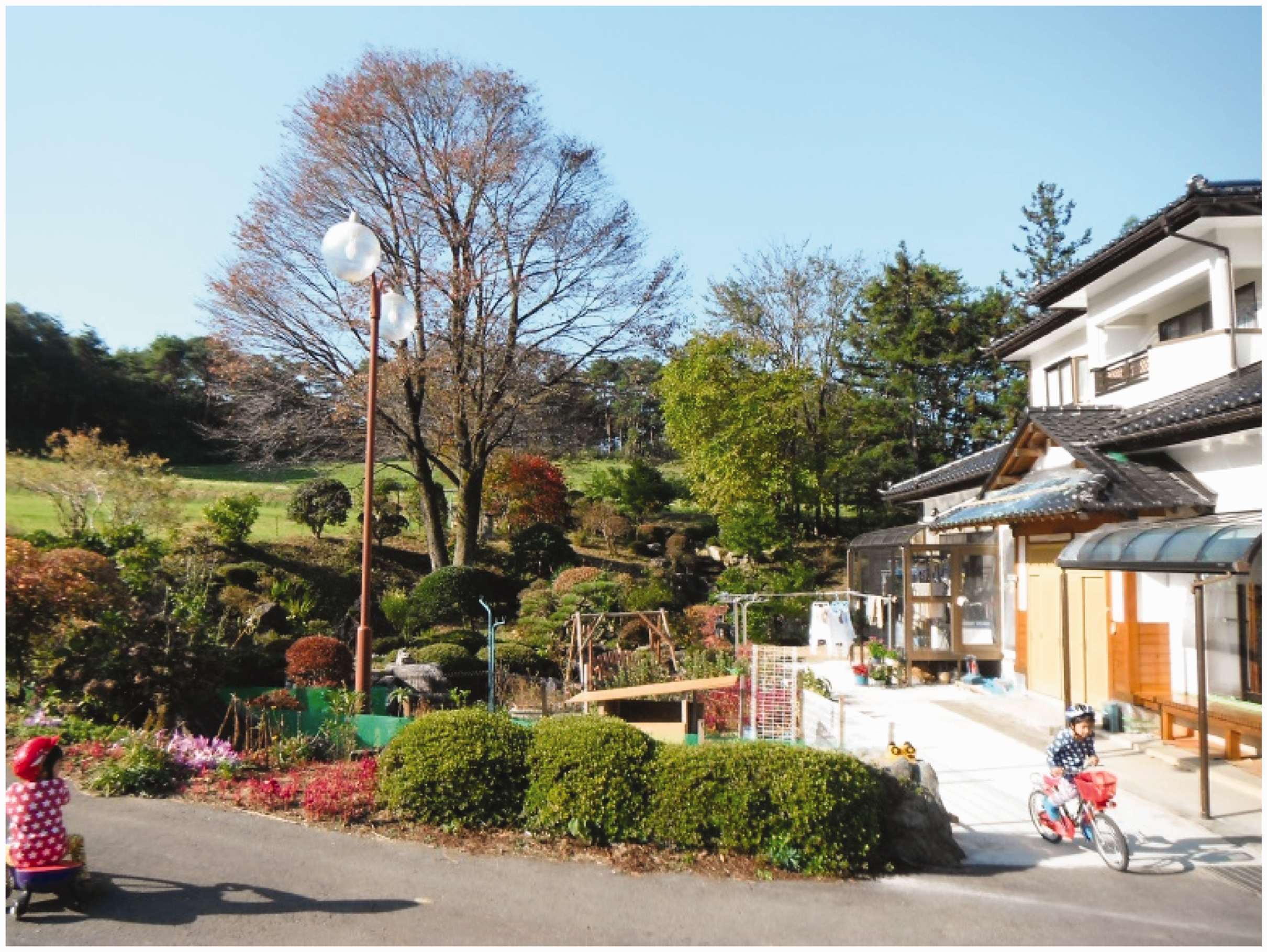
In Fukushima, what we need in the future is not decontamination (with the exception of some areas), but dialogue and to be with and listen to people who need to be heard. Education and human development are very important, and experts who can speak the same ‘language’, with simple and comprehensible words, are indispensable.
Footnotes
1
Evacuation record: March 15–April 3: evacuation from Fukkushima to Aomori; April 3–July 7: temporary return to Fukushima; July 7–June 2012: evacuation to municipal housing prepared by Date city, as well as five more two-week periods spent in Aomori.