




Abstract
Protection of the environment is integral to the system of radiological protection, as outlined in the 2007 Recommendations of the International Commission on Radiological Protection (ICRP, Publication 103). The Commission’s activities in this area are mainly pursued by Committee 5 and its associated Task Groups. Publication 91 broadly outlines the approach to radiological protection of the environment, and its alignment with approaches to environmental protection from hazardous substances in general. Publications 108 and 114 provide the cornerstones of the environmental protection system and relevant databases. Publication 124 considers its application in planned, existing, and emergency exposure situations. The system centres on 12 Reference Animals and Plants (RAPs) with broad relevance for environmental protection based on their ubiquity and significance as well as other criteria, as described in Publication 108. The databases comprise general biology of the RAPs, transfer parameters, dose conversion coefficients, and effects data. Derived Consideration Reference Levels (DCRLs) were established for each RAP; a DCRL represents a band of dose rates that might result in some deleterious effects in individuals of that type of RAP. Newly established Task Group 99 will compile the RAP-specific reference information into monographs, with the view of updating information and improving the applicability of the system in different exposure situations. For certain scenarios, more precise and ecosystem-specific protection benchmarks may be justified, which would have to be informed by consideration of representative organisms (i.e. representative of a particular ecosystem and relevant to the specific scenario; Publication 124). Committee 5 will explore this further, making use of a limited number of case studies.
Keywords
1. INTRODUCTION
Committee 5 of the International Commission on Radiological Protection (ICRP) is concerned with radiological protection of the environment. It aims to ensure that the development and application of approaches to environmental protection are compatible with those for radiological protection of people, and with those for protection of the environment from other hazardous substances. This paper sets out to review recent activities of Committee 5 and its associated Task Groups, the plan for future activities, and how they contribute to a consolidated and increasingly user-friendly system for radiological protection of the environment (the ICRP system for environmental protection will, for convenience, be herein referred to as the ICRP environmental protection system).
Chapter 2 briefly outlines the major elements of the ICRP environmental protection system and its application; readers interested in further details regarding the origin and evolution of the ICRP environmental protection system can refer to articles published in connection with the First and Second ICRP International Symposia on the System of Radiological Protection (e.g. Pentreath, 2012a; Larsson et al., 2015; Pentreath et al., 2015).
Chapter 3 outlines the Committee’s current programme of work, as well as new information to date.
2. ELEMENTS of the ICRP ENVIRONMENTAL PROTECTION system
2.1 Assessment and management of an exposure scenario
The ICRP environmental protection system is outlined in Publications 91, 108, 114 and 124, (ICRP, 2003, 2008b, 2009, 2014). In addition, it is outlined briefly in Publication 103, (ICRP, 2007), which also states the objectives of the ICRP environmental protection system: ‘The Commission’s aim is now that of preventing and reducing the frequency of deleterious radiation effects to a level where they would have negligible impact on the maintenance of biological diversity, the conservation of species, or the health and status of natural habitats, communities and ecosystems.’
The system requires understanding of the exposure scenario (such scenarios can occur within the general framework of planned, existing, and emergency exposure situations). In the ICRP environmental protection system, this understanding is facilitated by modelling the scenario on certain organisms in the environment for which relevant databases have been generated [‘Reference Animals and Plants’ (RAPs)]; identification of dose-rate ranges where some deleterious effects may be expected in RAPs that could warrant consideration of protective measures [Derived Consideration Reference Levels (DCRLs)]; and an approach to the application of the environmental protection system in different exposure situations. Essentially, the components needed for assessing an exposure scenario (illustrated by the arrow pointing towards the right in Fig. 1) and for managing the exposure scenario for the purpose of environmental protection (the arrow pointing towards the left in Fig. 1) are the same as those used in the radiological protection of people. Indeed, the systems for protection of people and for protection of the environment can be used in an integrated manner – when warranted – to protect people and the environment. While protection of people is the primary concern in most situations, certain scenarios may benefit from an integrated approach; other situations may require decisions based solely on environmental considerations (Copplestone, 2012; Pentreath, 2012b; ICRP, 2014; Pentreath et al., 2015; Copplestone et al., 2016).
Elements of the International Commission on Radiological Protection environmental protection system that enable assessment of the consequences of a specific exposure scenario (arrow going to the right), and the management of the exposure scenario based on a system for protection (arrow going to the left), in planned, emergency, or existing exposure situations. DCC, dose conversion coefficient; Ext/Int, external/internal; RAP, Reference Animal and Plant; RBE, relative biological effectiveness.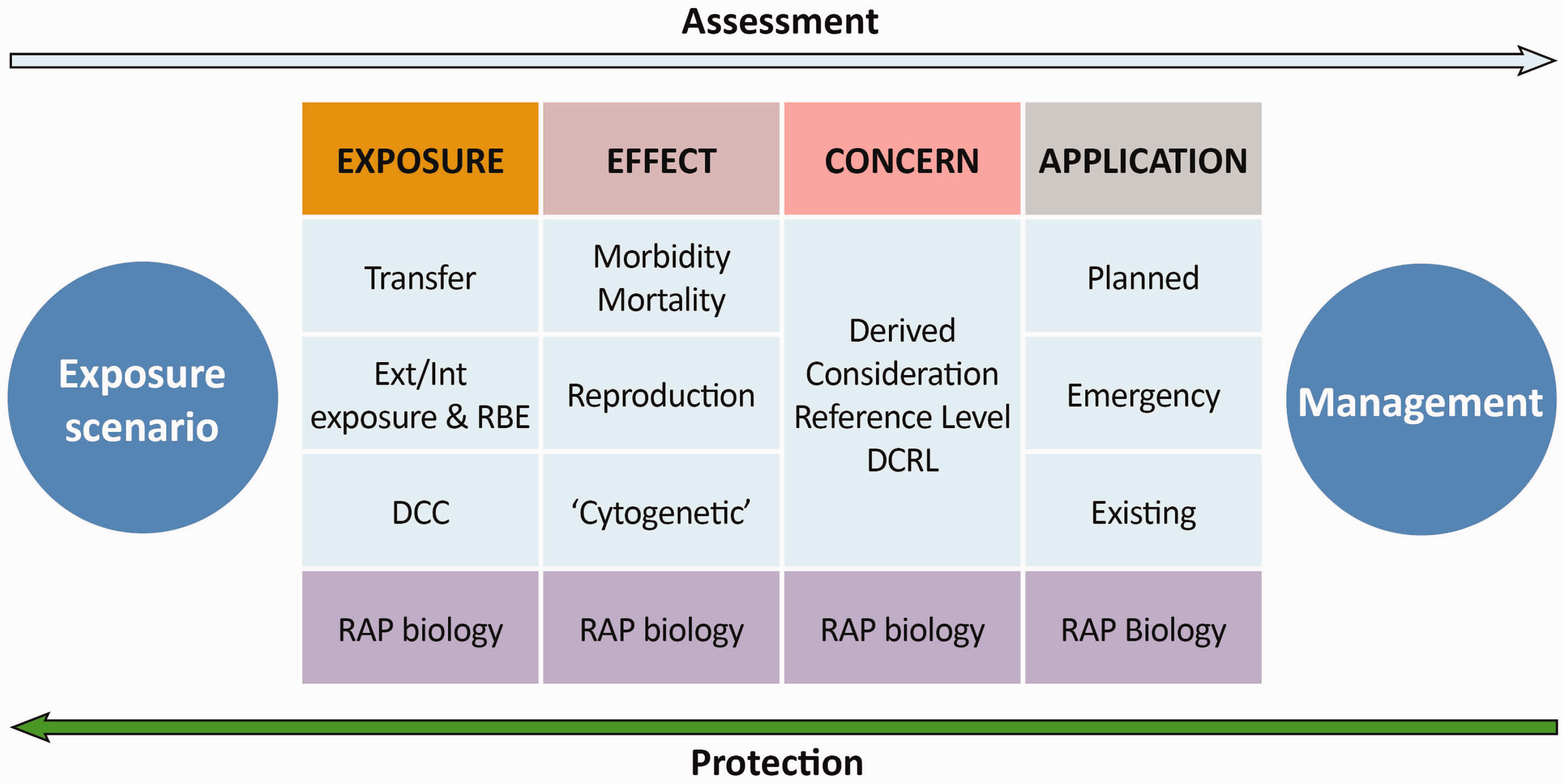
2.2 Application in different exposure situations
Publication 124, (ICRP, 2014) outlines the approaches recommended by ICRP when applying the environmental protection system in planned, existing, and emergency exposure situations. The benchmark that informs decision making is the DCRL, given as bands of absorbed dose rate. It is important to draw attention to the following terms:
consideration (i.e. DCRLs should not be viewed as ‘limits’ or ‘constraints’, but ranges of absorbed dose rates to any RAP where it may be reasonable for an assessor or regulator to pause and consider whether environmental effects of radiation are likely, and/or whether the exposure scenario needs to be managed); and reference (i.e. DCRLs are akin to reference levels that guide optimisation of protection of people, and that are used in existing and emergency exposure situations).
The recommended application of DCRLs in different exposure situations was outlined in Publication 124, (ICRP, 2014), and is illustrated in Fig. 2 for planned and existing exposure situations.
Use of Derived Consideration Reference Levels (DCRLs) to guide decisions to manage exposures in planned exposure situations (left) and in existing exposure situations (right). For explanations, see Publication 124, (ICRP, 2014). RAP, Reference Animal and Plant.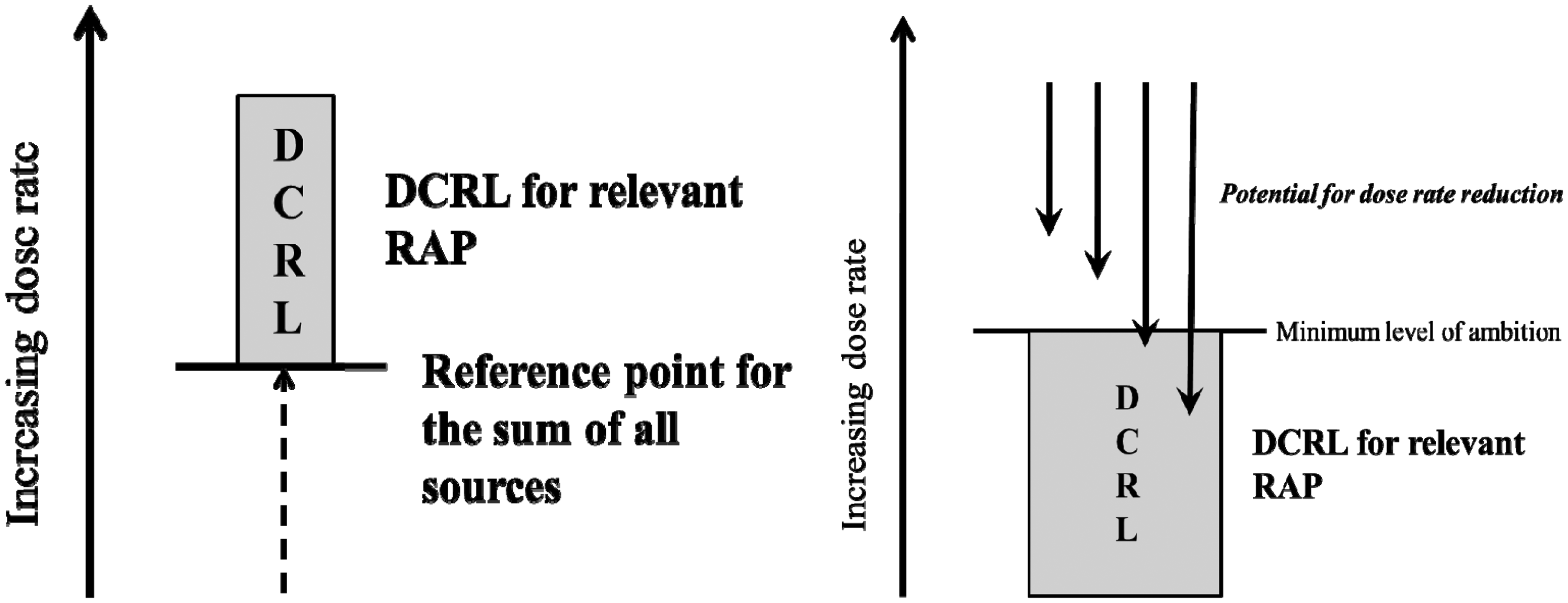
The aim in planned exposure situations would be to use the lower end of the DCRL for the relevant RAP as a reference point for the sum of exposures from all sources (left part of Fig. 2). In most situations, there will be a dominant source of exposure. The RAPs and DCRLs that may have to be considered may be very few. However, other situations can be foreseen or come to light (see Section 3.4 for further discussions of circumstances where a simple RAP-based approach may not always suffice).
For existing exposure situations, ICRP recommends that the aim should be to bring exposures to within the DCRL (right part of Fig. 2). While this may not be achievable when considering costs and other ramifications of activities aimed at environmental restoration (including unwanted indirect environmental effects), the DCRL may still inform assessments as well as long-term management decisions.
Early protective actions in emergency exposure situations will, in their entirety, be directed towards the protection of people. This will remain as one primary consideration and also in the long term, but so will environmental management. Restoration work may commence even during an emergency, and the preferable environmental management option, even if the main purpose is the protection of people, may have to be identified, with due consideration given to long-term aims for environmental protection. In order to inform this decision-making process, it may be helpful to consider the likely evolution of environmental exposures over time in relation to relevant DCRLs, as outlined in Fig. 3.
Use of Derived Consideration Reference Levels (DCRLs) to inform decisions on management options during and following an emergency. For explanations, see Publication 124, (ICRP, 2014).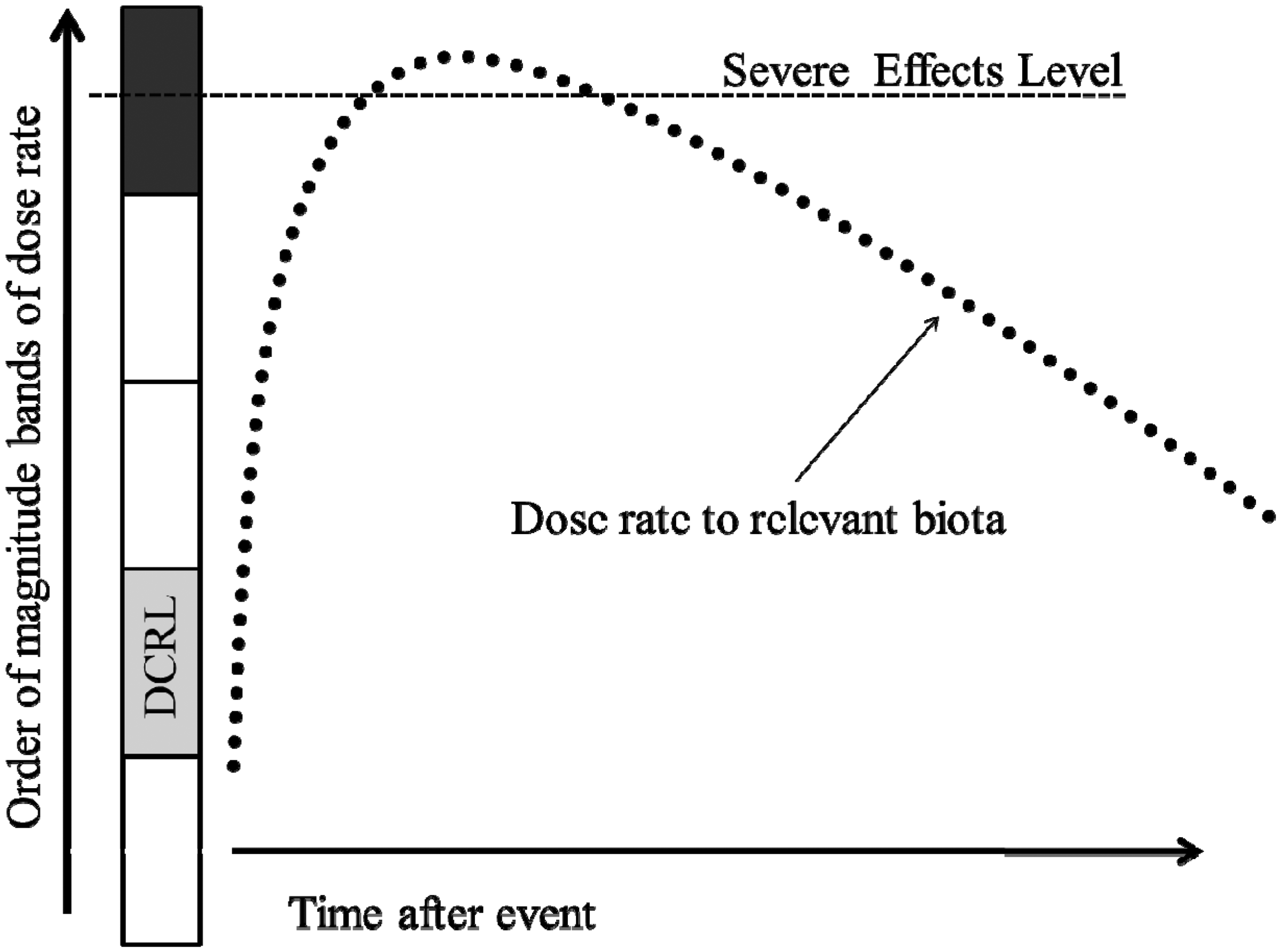
3. Consolidation of the ICRP ENVIRONMENTAL PROTECTION system
While it is clear that the ICRP environmental protection system is robust and has stood the test when ‘road-tested’ in various situations, further work is underway to consolidate the system and strengthen its scientific basis. A number of elements of the system have already been the subject of further work; these relate mainly to exposure and include:
dosimetry for RAPs; the extent to which radiation quality and relative biological effectiveness (RBE) are matters that need to be taken into consideration (e.g. by applying ‘weighting’ factors that would be akin to weighting factors used in radiological protection of people); and the extent to which internal distribution of specific and dose-dominant radionuclides may affect assessment results and protection approaches.
In addition, Committee 5 is gathering and updating data [e.g. with observations following the 2011 earthquake, tsunami, and nuclear accident in Japan; and drawing on ongoing programmes such as the International Atomic Energy Agency (IAEA) Modelling and Data for Radiological Impact Assessments project (https://gnssn.iaea.org/RTWS/modaria/SitePages/Home.aspx)] and guidance for the best use of RAPs in support of application of the ICRP environmental protection system in planned, emergency, and existing exposure situations. This Chapter reviews the results to date and plans for the future.
3.1 Dosimetry: Task Group 74
The basics of estimation of absorbed doses to RAPs were outlined in Publication 108, (ICRP, 2008b). The models pragmatically assume simple body shapes with uniform composition and density, homogeneous internal radionuclide distribution, and a limited set of idealised external radiation sources for aquatic and terrestrial animals and plants, and truncate the radioactive decay chains. In order to refine the approach, ICRP established Task Group 74, and the draft report will be subjected to public consultation in 2016. Significant methodological changes since Publication 108, (ICRP, 2008b) include: transition to the radionuclide database of Publication 107, (ICRP, 2008a); implementation of a new approach for external exposure of terrestrial animals with extended sets of radiation sources in soil and air; range of organisms and their locations; assessment-specific consideration of contribution of radioactive progeny to the dose coefficients of parent nuclides; and use of generalised allometric relationships to estimate biokinetic or metabolic parameters. The dose conversion coefficients (DCCs) have been revised.
Comparisons of DCCs suggest that RAP- and exposure-scenario-dependent variations in DCCs are generally small and can be scaled to suit the assessment or management purpose (a calculator is being developed to support the estimation of fit-for-purpose DCCs for different scenarios). The refined dosimetric approach is further discussed in Ulanovsky (2016).
3.2 RBE and weighting for radiation quality: Task Group 72
Task Group 72 is concerned with data for RBE for the endpoints that are relevant to the ICRP environmental protection system. Specific consideration has been given to exposure to low-energy β radiation from tritium, and α radiation. The Task Group will propose, if possible, helpful factors akin to the radiation weighting factors used for radiological protection of people (i.e. underpinning the use of the radiological protection quantity, equivalent dose). Task Group 72 has essentially completed its task; the plan is to start public consultation in 2016 [see Higley et al. (2012)].
Not unexpectedly, data for relevant endpoints and for several RAPs are scarce. In addition, most data are obtained at exposure levels that are one to several orders of magnitude higher than the DCRL for the corresponding RAP. For tritium, and excluding strictly stochastic endpoints, relevant RBEs range from approximately 1 to about 4. For α radiation, values range from just above 1 to close to 40.
The derivation of a ‘weighting factor’ (a term other than ‘weighting factor’ may be preferable to avoid confusion with weighting factors for stochastic effects used in radiological protection of people 1 ) to be applied across exposure scenarios and RAPs on the basis of the existing database should be made with caution. Without pre-empting the finalisation work done by Task Group 72, it can be suggested that for deterministic endpoints following exposure to α radiation, a value in the range of 5–10 could be considered appropriate. This is in agreement with the recommendation by the United Nations Scientific Committee on the Effects of Atomic Radiation (UNSCEAR) in its 2008 report (UNSCEAR, 2011) of a ‘nominal (generic) value of 10 to reflect the RBE for internally deposited α emitters’, which was also used in UNSCEAR’s assessments of levels of exposures and effects in the environment following the 2011 nuclear accident in Japan (UNSCEAR, 2014).
For example, Pentreath (1999) suggested ‘dose equivalent for fauna and flora’, and Trivedi and Gentner (2000) suggested ‘ecodosimetry weighting factor’ specifically for deterministic effects.
UNSCEAR (2011) noted that the most appropriate factor to reflect the RBE of low-energy β radiation remains an open question. The pragmatic approach taken in radiological protection of people is to use the same weighting factor for low-energy β radiation (including from tritium) as for other β radiation, as well as γ radiation (i.e. a value of 1). Optimisation efforts based on dose constraints (as in planned exposure situations) would eliminate any considerable influence of potential underestimates of the RBE for low-energy β radiation on the protection of people (Cox et al., 2008). This remains a valid approach; however, optimisation in the ICRP environmental protection system is based on DCRLs that are dose bands where some effects may be expected to occur. Under such situations, it might be appropriate to consider whether tritium is a significant source of exposure, and make use of the full dataset in the assessment and/or management decisions when circumstances justify doing so.
3.3 Monographs: Task Group 99
The outcomes of Task Groups 72 and 74 will contribute to the consolidation of the ICRP environmental protection system; they will strengthen the basis for the system but not cause fundamental changes. Their finalisation will give Committee 5 an opportunity to focus on other elements of the environmental protection system (cf. Fig. 1) where data are scarce and where further work may strengthen its scientific basis. This work is being carried out by the recently established Task Group 99 on RAPs monographs.
The objective of Task Group 99 is to gather and update basic data and guidance for the best use of RAPs in support of the application of the ICRP environmental protection system in planned, emergency, and existing exposure situations. The reports (intended to cover a number of RAPs in each volume of a series of perhaps three reports) will contain generic background text outlining the methodology for collating and analysing information, followed by separate treatment of: biology/ecology; transfer; dosimetry (outside of what has been accomplished by Task Groups 72 and 74); and biological effects. One of the primary objectives of this exercise is to underpin the chosen DCRLs; while the confidence in the DCRLs is generally high, new and expanded data need to be considered and the appropriateness of the DCRLs needs to be reassessed.
As reviewed in Section 3.1, the dosimetry database is robust for simplified geometries and for a range of exposure scenarios, and assumes internal exposure from homogenously distributed radionuclides. The validity of the simplified geometries for internal dose assessment can be tested by mapping organ distribution and other tissue characteristics (such as density), and assumes preferential partitioning of internal radionuclides to any particular organ. This approach has been put in practice, including the use of voxel phantoms to represent RAPs (Higley et al., 2015).
Fig. 4 provides one example that illustrates the consequences of assuming that all radionuclides are partitioned to one specific organ, for the exposure of that organ and other organs, in relation to what the dose would have been if the particular radionuclide had been distributed uniformly. Other and more complex examples are described by Higley et al. (2015). The specific example of Fig. 4 illustrates that organ dose estimates may be affected by an order of magnitude by introducing assumptions of preferential distribution of radionuclides to particular organs. A challenge for Task Group 99 is to analyse the radionuclide/organ/RAP combinations for which such considerations become important, and to what extent this affects the assessment and/or the ways in which exposure scenarios should be managed.
Left: Voxel phantom of a crab (one of the set of 12 Reference Animals and Plants) used for mapping organ distribution (courtesy of Kathryn A. Higley, Oregon State University, Corvallis, OR, USA. Right: Dose to source and target organs, assuming 100% partitioning of activity to the source organ and expressed as a ratio to dose if uniform distribution was assumed. From Higley et al. (2015).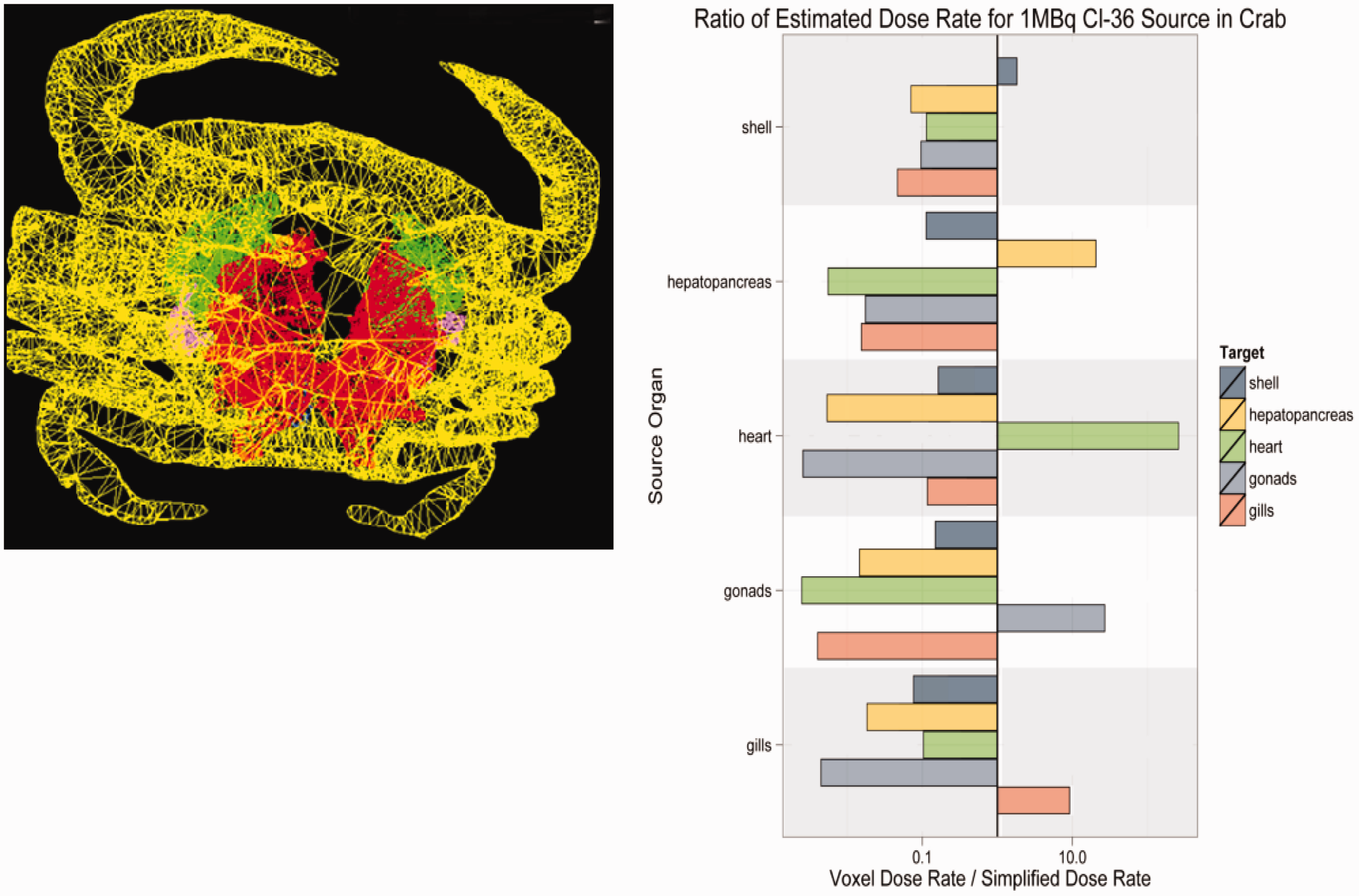
Of relevance to Task Group 99 are the studies of effects, or lack thereof, of radiation exposures in the environment on animals and plants following the earthquake, tsunami, and nuclear accident in Japan in 2011. These studies expand the very significant body of data that exists already, which includes data from experimental irradiation under field and laboratory conditions, and observations after accidents and in natural environments with chronically elevated radiation levels [reviewed, for example, by UNSCEAR (2011)]. It is outside the scope of this paper to carry out a fulsome review of the new information following the nuclear accident in Japan, but such reviews have been published recently (UNSCEAR, 2014, 2015; IAEA, 2015).
Reference Animals and Plants (RAPs), corresponding Derived Consideration Reference Levels (DCRLs), and ratios between exposure levels in Okuma Town and the lower end of the DCRL for those RAPs for which data exist. Data from Publication 108, (ICRP, 2008b) and UNSCEAR (2014).
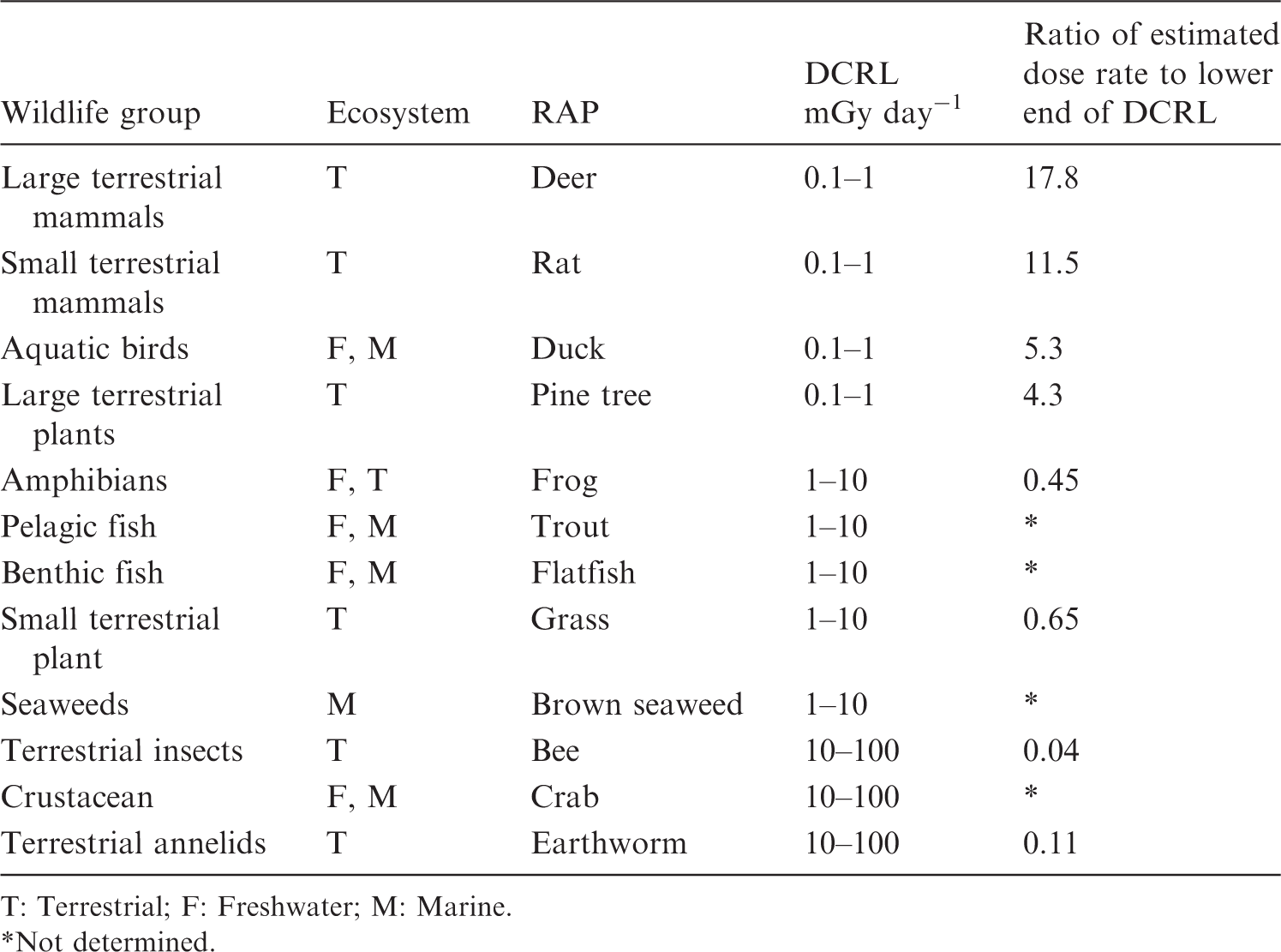
T: Terrestrial; F: Freshwater; M: Marine.
Not determined.
The evacuation of people and resulting disturbance to the semi-natural ecosystem is one potential confounding factor when assessing census data (Deryabina et al., 2015). The observations from Fukushima should be taken seriously, although their attribution to radiation and the influence of confounding factors need further evaluation. A further consideration was noting how well data that have been obtained from laboratory experiments translate into field conditions (Garnier-Laplace et al., 2015b). Causal relationships and dose dependence should be firmly established, and then the data can be accommodated within the dataset that underpins the DCRLs.
3.4 Further development of the system for application in specific exposure scenarios
Work is planned to deliver additional guidance to that given in Publication 124, (ICRP, 2014) on application of the ICRP environmental protection system in different exposure situations, including case studies, and with focus on emergency and existing exposure situations. It is unlikely that planned exposure situations are going to require much additional guidance and advice in the short term, partly because the advice was clear in Publication 124 and partly because IAEA is currently finalising safety guides on environmental impact assessment and control of radioactive discharges. Furthermore, the ongoing update of the IAEA generic models for assessing the impact of radioactive discharges (IAEA, 2001) is providing examples of planned exposure situations.
Copplestone et al. (2016) provided examples of case studies and sites available for studies of environmental protection under emergency and existing exposure situations. Key messages to date state that such exposure scenarios require site-specific decisions, and that sometimes both humans and biota need to be considered when developing the management strategy. However, questions remain, such as how to handle decisions on the management decisions needed where people are considered to be protected, but biota may not be. Consideration will also be given to convert the DCRLs into environmental concentrations and other measures (e.g. ambient dose equivalent) to aid in communication and understanding for existing and emergency situations.
The case studies will be used to determine how decisions governing optimisation of protection can be made for exposure scenarios where:
people need protection (and the consequent impacts on the environment); the environment needs protection (and people are protected); and people and the environment need protection.
The lessons learned will be explored and extracted to provide generic advice and guidance for use when undertaking design-based accident/incident scenarios, and for application in real emergencies and existing situations.
As pointed out by Pentreath (2012b) and Larsson et al. (2015), and elaborated on in Publication 124, (ICRP, 2014), in situations where there is reason to expect that a scenario of environmental concern exists or will/can evolve, the aim should be to make the assessments with real organisms in real environments. A ‘real’ organism may well be one of the RAPs, and existing databases can be used without further consideration. In other circumstances, the representative organism may not be well represented by one of the RAPs, and the differences will need to be assessed. In this case, the Commission has recognised the need to define representative organisms, typical for a particular exposure scenario in a particular ecological context, each characterised by its own:
biology, such as life span or life cycle; dosimetry related to physiology, size, shape, and location; and response to radiation.
Both the monograph series of reports and the proposed work to further develop the application approaches outlined in Publication 124, (ICRP, 2014) will provide practical recommendations on how to deal with real scenarios of environmental significance and concern, building on existing databases for the 12 RAPs.
4. Acknowledgements
The author wishes to thank and acknowledge all past and present members of Committee 5 for their contribution to the work of the Committee, and for many stimulating discussions and laughs during the long and enjoyable meetings. The current members are: David Copplestone, Jacqueline Garnier-Laplace, Kathryn A. Higley, Jianguo Li, Almudena Real Gallego, Kazuo Sakai, Per Strand, Alexander Ulanovsky, and Jordi Vives I Batlle.