Abstract
The International Commission on Radiological Protection (ICRP) established Committee 5 in 2005 in response to the need to provide direct demonstration of environmental protection from radiation in accordance with national law and international agreements. The development of the ICRP system for environmental protection was facilitated by research over the previous decades, as well as by ICRP’s evaluation of the ethical and philosophical basis for environmental protection as laid out in ICRP Publication 91. The 2007 Recommendations (Publication 103) incorporated environmental protection as one of the integral elements of the radiation protection system. Over a relatively short time, the system has evolved to incorporate a set of 12 Reference Animals and Plants (RAPs), which is a small enough number to develop comprehensive databases for each RAP, but wide ranging enough to provide some insight into radiation impact and protection against such impact, as appropriate, in terrestrial, freshwater, and marine ecosystems. As necessary, the databases can be used to derive supplementary databases for Representative Organisms typical for a particular exposure situation of concern or under study. The system, to date, details biology of the RAPs (Publication 108); outlines transfer factors for estimation of internal concentrations of radionuclides of environmental significance under different situations (Publication 114); provides further information (Publication 108) on dosimetry, biological effects, and derived consideration reference levels (bands of environmental dose rates where potential detrimental effects may deserve attention); and provides information on application of the system in planned, emergency, and existing exposure situations (Publication 124). Currently, a review of experimental determinations of relative biological effectiveness, to guide derivation of specific weighting factors for use in environmental radiation protection if possible and necessary, is being concluded, as is work on improved dosimetry. Further work in this area involves consolidation of databases, recommendations for derivation of specific databases for Representative Organisms on the basis of the RAP data, and recommendations for application of the system to environmental protection in relation to certain human activities of potential environmental concern. Consideration needs to be made for the wider range of ecosystem effects that may be covered in ecological risk assessments, which incorporate the complete suite of stressors that result from human activity, and their effects, to understand the role of radiation effects in this context.
Keywords
1. Introduction
This paper sets out to describe the genesis of the International Commission on Radiological Protection’s (ICRP) approach to environmental protection, the way the system has evolved, and how it can be applied under different exposure situations. This paper also outlines planned activities to further consolidate the system, and improve its applicability to decisions on projects of environmental significance. It serves as an introduction to the system; the system is explained in detail in recent ICRP publications, including Publication 108 (ICRP, 2008), Publication 114 (ICRP, 2009), and Publication 124 (ICRP, 2014).
A number of specific elements of the system were covered in the Proceedings of the First ICRP Symposium on the International System of Radiological Protection (Copplestone, 2012; Higley et al., 2012; Larsson, 2012; Pentreath, 2012a; Ulanovsky and Pröhl, 2012).
An outline of the work of Committee 5 was presented at the First ICRP Symposium by the then Chair of Committee 5, Professor Jan Pentreath (2012b). The aim of the present paper is to provide an update relative to the situation at the time of the First Symposium and to introduce the work of ICRP Committee 5 and the system of environmental radiological protection to all readers previously unfamiliar with this topic and system.
2. Genesis
Environmental protection only became an integral part of the ICRP system for radiological protection with the 2007 Recommendations on radiological protection, outlined in Publication 103 (ICRP, 2007). The 2007 Recommendations superseded the 1990 Recommendations (ICRP, 1991), in which the environment was primarily considered as the medium through which radiation exposure was delivered to humans. However, the inclusion of protection of the environment in its own right in the 2007 Recommendations did not just happen; it was preceded by significant international scientific developments, as well as the gradual recognition by ICRP of the need to demonstrate compliance with environmental standards and criteria as expressed in national legislation and in international ‘instruments’, whether binding or incentive. The International Atomic Energy Agency (IAEA, 2002) summarised the obligations for protection of the environment as laid out in international instruments as follows:
Activities within a jurisdiction should
not cause damage to the environment of other states; maintain ecosystems and processes that are essential for the functioning of the biosphere; maintain biodiversity; and observe the ‘principle’ of optimum sustainable yield in the use of living natural resources.
A full review of the developments referred to above cannot be made within the constraints of these Proceedings. These involve a series of conferences held in Stockholm, Sweden in 1996; Ottawa, Canada in 1999; and Darwin, Australia in 2002; culminating in the IAEA Conference on Protection of the Environment from the Effects of Ionizing Radiation in Stockholm, Sweden in 2003 (IAEA, 2005a). Of significance is the following quote from the President’s report on findings and recommendation from the Stockholm conference (IAEA, 2005a):
While accepting that there remain significant gaps in knowledge and that there needs to be continuing research, the conference accepted that there was an adequate knowledge base to proceed and strongly supported the development of a framework for environmental radiation protection. The ICRP and the IAEA have important roles to play, and it is vital that the framework be developed in a consultative and inclusive manner. The conference supported the approach based on the development of reference animals and plants, and it noted that these may also serve as a basis for site specific assessments.
On the basis of the findings presented at the Stockholm conference, IAEA decided on the ‘Plan of activities on the radiation protection of the environment’ (IAEA, 2005b), and set up a co-ordination group to promote the plan and monitor progress; this group is still in operation today.
ICRP responded to these international developments by commissioning a task group, chaired by the then ICRP Chair-Elect Dr Lars-Erik Holm, to develop a protection policy and suggest a framework for environmental protection based on scientific and ethical-philosophical principles. This resulted in Publication 91 (ICRP, 2003), which can be regarded as the ‘genesis’ of the ICRP system for environmental protection as well as for Committee 5 on environmental radiological protection, which commenced its work in 2005. This is further reviewed below.
3. PUBLICATION 91 AND THE INCEPTION OF COMMITTEE 5
Publication 91 (ICRP, 2003) can be considered the founding publication for the work of ICRP in environmental protection, for the ICRP system of environmental protection, and for Committee 5 of ICRP, although this would not have been possible if the developments briefly reviewed above had not been ongoing and delivered new insight into this area.
The fundamental issues stemming from Publication 91 were summarised in the Guest Editorial of Publication 114 (ICRP, 2009) and by Larsson (2012) and Pentreath (2012b). Publication 91 explores the applicability of different approaches developed for environmental protection in general, and to environmental radiation protection in particular, while acknowledging that any approach to protection of the environment from radiation needs to be harmonised with the system for human radiation protection. ICRP already foreshadowed in the report that:
a possible future ICRP system addressing environmental assessment and protection would focus on biota, not on the abiotic component of the environment or on environmental media (soil, air, water, sediment); the system should be effect-based so that any reasoning about adequate protection would be derived from firm understanding of harm at different exposure levels; and the system should be based on data sets for reference fauna and flora (subsequently termed ‘Reference Animals and Plants’ (RAPs). The definition of a RAP as subsequently developed by ICRP in Publication 108 (ICRP, 2008) is:
a hypothetical entity, with the assumed basic biological characteristics of a particular type of animal or plant, as described to the generality of the taxonomic level of Family, with defined anatomical, physiological and life history properties, that can be used for the purposes of relating exposure to dose, and dose to effects, for that type of living organism.
The RAPs approach would be analogous to the use of the Reference Person concept in human radiation protection, and guide the assessment of effects and the derivation of dose rate benchmarks to guide protective actions.
In 2005, ICRP established Committee 5 to take charge of the Commission’s work on environmental protection, with the view of reviewing progress in this area with time. Committee 5’s task is summarised as follows:
Committee 5 is concerned with radiological protection of the environment. It will aim to ensure that the development and application of approaches to environmental protection are compatible with those for radiological protection of man, and with those for protection of the environment from other potential hazards.
Committee 5 is now entering into its third term. The challenges and outputs are briefly reviewed below.
4. The evolution of a parallel pathway
4.1. Basic elements of the parallel pathway
Committee 5 approached the issue of delivering in accordance with its task by developing a pathway for environmentally informed decision-making that is complementary to, analogous to, and parallel to the pathway of reaching a decision based on the aim to protect humans. This ‘parallelism’ is illustrated in Fig. 1.
The parallel pathways of reaching a ‘holistic’ decision on management of radiation risks; the risks are to human health, to the environment, or both. For further explanations, see the text. Based on Publication 108 (ICRP, 2008).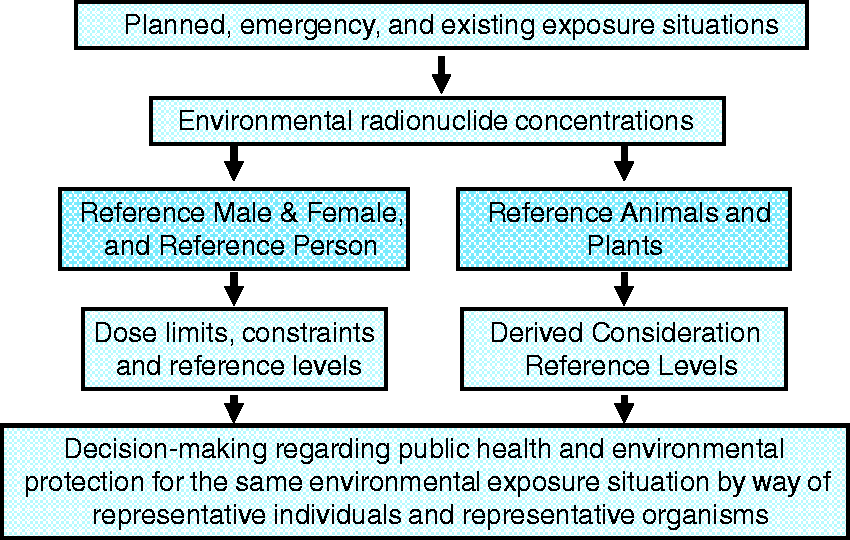
Core to the parallel pathway is the creation of two points of reference. First is the creation of a ‘reference entity’, analogous to the Reference Person, which serves as a basis for developing the necessary reference data sets that are required in order to either assess environmental consequences or – by back tracking from levels of concern – to define environmental circumstances that may be considered ‘safe’, in the broad sense of the word, to the environment. These ‘entities’ are the RAPs. The selection of such RAPs has been reviewed previously (Pentreath, 2012b).
The other reference point in this approach is the definition of derived consideration reference levels (DCRLs), analogous to reference levels that are used in the radiological protection of humans. DCRLs are bands of environmental dose rate, spanning one order of magnitude, that are specific for each RAP and can be defined as (ICRP, 2008):
… a band of dose rate within which there is likely to be some chance of deleterious effect of ionising radiation occurring to individuals of that type of Reference Animal or Plant, derived from knowledge of defined biological effects for that type of organisms that, when considered together with other relevant information, can be used as a point of reference to optimise the level of effort expended on environmental protection, dependent on the overall management objectives and the exposure situation.
Broadly defined wildlife groups, general type of environment and derived consideration reference levels (DCRLs) (shaded) for the 12 Reference Animals and Plants (RAPs) currently included in the ICRP system for environmental protection.
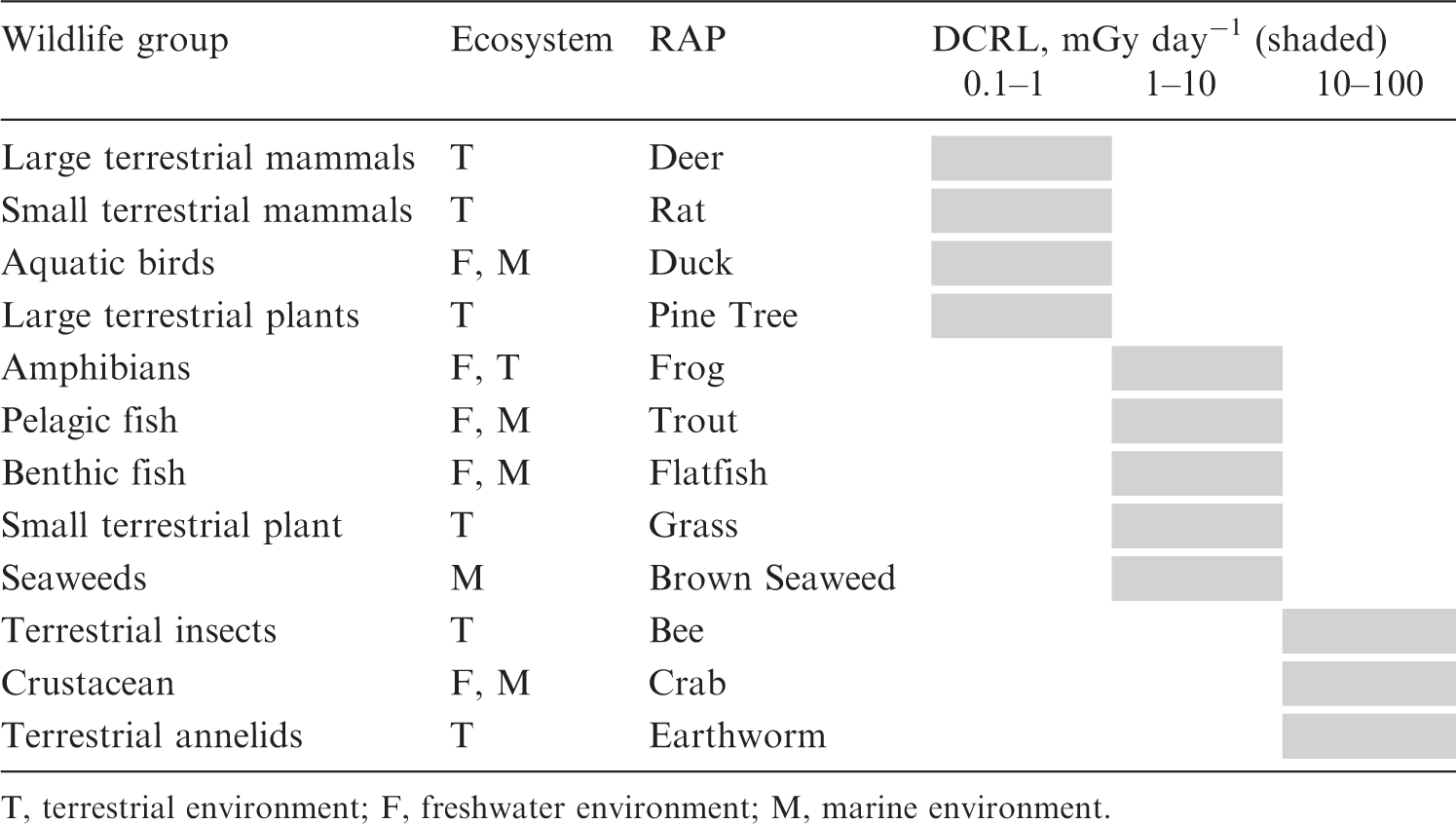
T, terrestrial environment; F, freshwater environment; M, marine environment.
4.2. Transfer, dosimetry, biology, and effects
While Fig. 1 outlines the components of the system for protection of the environment, it does not describe the type of information and data sets necessary to make it work, i.e. how to go from the exposure situation to the (real or postulated) effect – or, from the protection aim and ambition back to an exposure that is commensurate with the aim and ambition. The types of information and data that are necessary can be summarised as follows:
Biology and ecology; this forms the basis for the selection of the RAPs, the number of which is as low as possible but as large as necessary to provide a reasonable coverage of exposures typical for organisms and environments within terrestrial, freshwater, and marine ecosystems. The biology of the RAPs has been reviewed in Publication 108 (ICRP, 2008). Transfer; this primarily concerns the concentration factors denoting the internal concentration of radionuclides in relation to that of the surrounding medium. Publication 114 (ICRP, 2009) lists such ratios for the 12 RAPs and for radionuclides of 40 elements based on actual measurements or otherwise inferred. Dosimetry; dose conversion coefficients for internal and external exposure for geometries and sizes defined for the 12 RAPs are listed in Publication 108 (ICRP, 2008). Effects; effects data, essentially grouped in the umbrella end-point categories of mortality, morbidity, reduced reproductive success, and subtle genetic effects, have been used to derive the DCRLs. The DCRLs and the rationale for their derivation are outlined in Publication 108 (ICRP, 2008).
4.3. Application in planned, emergency, and existing exposure situations
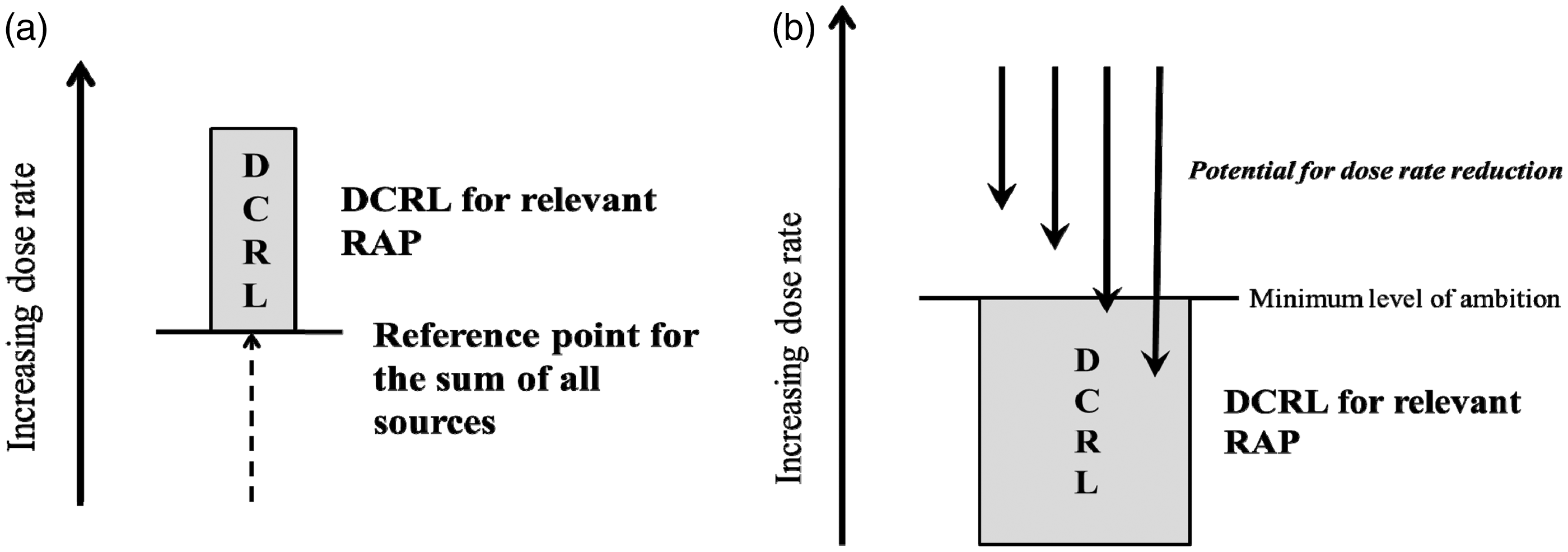
The application of the ICRP system for environmental protection in planned, emergency, and existing exposure situations has been outlined by Pentreath (2012a) and is elaborated further in Publication 124 (ICRP, 2013). In Publication 124, ICRP recommends the use of DCRLs under all circumstances where there is, or may be, an environmental exposure of significance above the natural background locally experienced by the relevant biota. In planned exposure situations, the lower boundary of the relevant DCRL band should be used as the appropriate reference point for protection. Application of the system under planned exposure situations requires some judgement regarding the size of the area under consideration, and the potential presence of other sources other than the one(s) under consideration in the planning stage. In the case of multiple sources of exposure – for example, from historical discharges or multiple sites – these other sources should be taken into account in comparison with the DCRLs when assessing protection options. If the assessed dose rates are below the appropriate reference point, the level of control is determined by selection of the most reasonable protective action.
For existing exposure situations, it may be difficult, or impractical, to significantly reduce the concentrations or quantities of radioactive material that exist in the affected environment. If dose rates are within the DCRL band, consideration should be given to reduce exposures, assuming that the costs and benefits are such that further efforts are warranted. The DCRLs may be used as the criteria for mitigating environmental exposures, just as reference levels are used for mitigating individual exposures for human protection in such situations.
In emergency exposure situations, the levels of exposure may be orders of magnitude greater than the DCRLs. The temporal and spatial patterns of exposure need to be given attention in order to understand the likelihood of effects over the short and long term. The DCRLs may still be considered useful reference points for such assessments, as elaborated further in Publication 124 (ICRP, 2014).
4.4. Information sources for the system of environmental protection
Fig. 3 outlines how the different components of the ICRP system for environmental protection relate to each other and how they are covered in the ICRP publications. The scheme outlines how source term or dispersion data (observed or modelled) can be progressed through the different steps in the assessment process in order to estimate the likelihood and/or magnitude of environmental effects, which will underpin the appropriate decisions on environmental management. The system can also be used in a reverse manner, so that, on the basis of a desired environmental protection outcome, the appropriate constraints or limits can be set on the discharges into the environment.
Schematic representation of assessment of environmental impact using the ICRP system, and where relevant information can be sourced in the suite of ICRP publications. P108, P114 and P124 refer to the ICRP Publications with the same numbers; C5, ICRP Committee 5; DCC, dose conversion coefficient; CR, concentration ratio; DCRL, derived consideration reference level; EP, environmental protection; RAP, reference animals and plants; RP, radiation protection.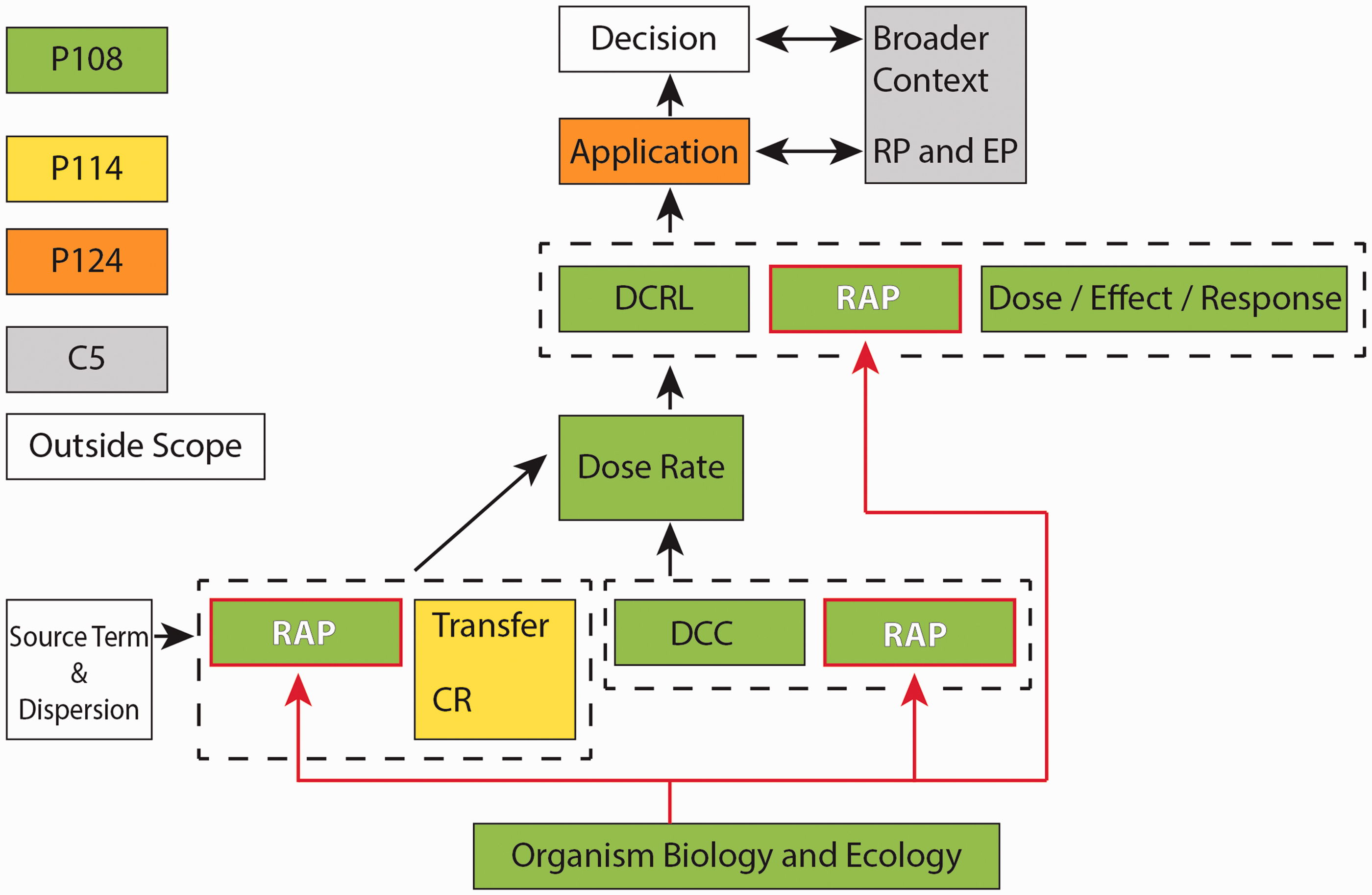
5. Future challenges
During the third term, Committee 5 will work to consolidate the system for radiation protection of the environment by broadening and consolidating the scientific basis that underpins the system, and by drawing on the experience gained in its application in the three exposure situations considered by ICRP.
5.1. Consolidation of the system
Since Publication 108 and 114, new data on transfer factors, dosimetry, and radiation-induced effects on several RAPs have become available. Thus, one of the tasks for the next term will be to compile and analyse the new data available, and to update the existing databases. The consolidation of the databases will facilitate the attempt to generalise across different types of animals and plants, i.e. moving from the RAPs to the Representative Organisms (see below) in specific exposure scenarios. The updated databases will also permit evaluation of the uncertainties associated with transfer factors, dosimetry, and radiation-induced effects, and their relative importance in assessments and setting protection goals.
Use of the new dosimetric information and methods will contribute to shedding further light on some of the gaps in current knowledge, including the lack of information on: (1) the concentration of relevant radionuclides (alpha and low-energy electron emitters) in the tissues or organs of interest of the RAPs; (2) the precise geometry of important organs, such as the gonads, for animals of body mass of approximately 1 kg or more [Reference Deer (adult), Reference Duck, Reference Trout, Reference Flatfish, and Reference Crab] exposed to photons; and (3) the dosimetry of terrestrial plants, particularly for Reference Pine Tree. The voxel phantoms developed for several RAPS is an example of the new methodologies that can contribute to fill some of the gaps in dosimetric knowledge.
Regarding the transfer factors, as stated in Publication 114 (ICRP, 2009), there is a need to further broaden the transfer database for some RAPs and their life stages, as well as for transfer values for a number of RAP/element combinations.
With regard to the radiation-induced effects in animals and plants, all the information available needs to be analysed as a whole in order to develop methodologies that will help to solve the complex issue of extrapolating from: (1) high acute doses/dose rates of low-linear energy transfer radiations to lower doses/dose rates; (2) one organism to another; (3) effects in the individual organism to possible impacts at population and community levels; and (4) laboratory conditions to field conditions.
5.2. Application to real organisms in real environments
The RAPs, and their associated databases, can be used as the default in a variety of situations where an assessment of the significance of environmental exposures is needed to support decisions on environmental management. However, as pointed out by Pentreath (2012b) and elaborated further in Publication 124 (ICRP, 2014), in situations where there are reasons to expect that a scenario of environmental significance will or can evolve, the ambition should be to make the assessments for real organisms in real environments. A ‘real’ organism may well be one of the RAPs, and existing databases can be used without further consideration. In other circumstances, the Representative Organism may not be well represented by one of the RAPs, and the differences will need to be assessed. In this case, ICRP has recognised the need to define Representative Organisms, typical for a particular exposure scenario in a particular ecological context.
Due to the vast variety of potential Representative Organisms, there may be considerable differences between the chosen or necessary Representative Organisms and the set of 12 RAPs. If the set of RAPs does not include all or any of the animal or plant types requiring protection, there will be differences in terms of:
biology, such as life span or life cycle; dosimetry, because of size, shape or location; and response to radiation at similar dose rates or total dose.
Nevertheless, the reference databases for the RAPs illustrate the types of data that need to be compiled to understand the complexity of an exposure scenario, and suggest the extent to which existing data can be extrapolated to the Representative Organisms. Committee 5 intends to focus on the methodology to identify Representative Organisms and how to link them to the RAP databases in this third term of its deliberations, in order to provide practical recommendations on how to deal with real scenarios of environmental significance and concern.
6. Concluding remarks
Notwithstanding the continuing effort to broaden and consolidate the databases underpinning the ICRP system for environmental protection (an effort that is shared with the system for protection of humans), the system is robust and providing valuable guidance to understanding, and protection from, environmental consequences of radiation (Copplestone, 2012; Telleria et al., 2015). This substantiates the statement made during the IAEA Stockholm conference mentioned above (IAEA, 2005a). While under most circumstances, it is clear that the environmental consequences are most likely to be very small (again, a shared feature with radiation protection of humans), the experiences from the aftermath of the Great East-Japan earthquake and tsunami, with acute releases of large amounts of radioactivity and ongoing releases years after the event, illustrate the need to consider environmental exposures both during the planning stage and in the event of an emergency and its legacies. While this was an extreme and rare event, the ICRP system for environmental protection adds a dimension to the decision-making process that allows the decisions to be made on the basis of a holistic understanding of consequences for health and the environment. It is the ambition of Committee 5 to improve the support for such well-founded decisions through its work during the third term.
Application of Reference Animal and Plant (RAP)-specific derived consideration reference levels (DCRLs) to the management of environmental exposures in (a) planned and (b) existing exposure situations. Based on Publication 124 (ICRP, 2014).