



Abstract
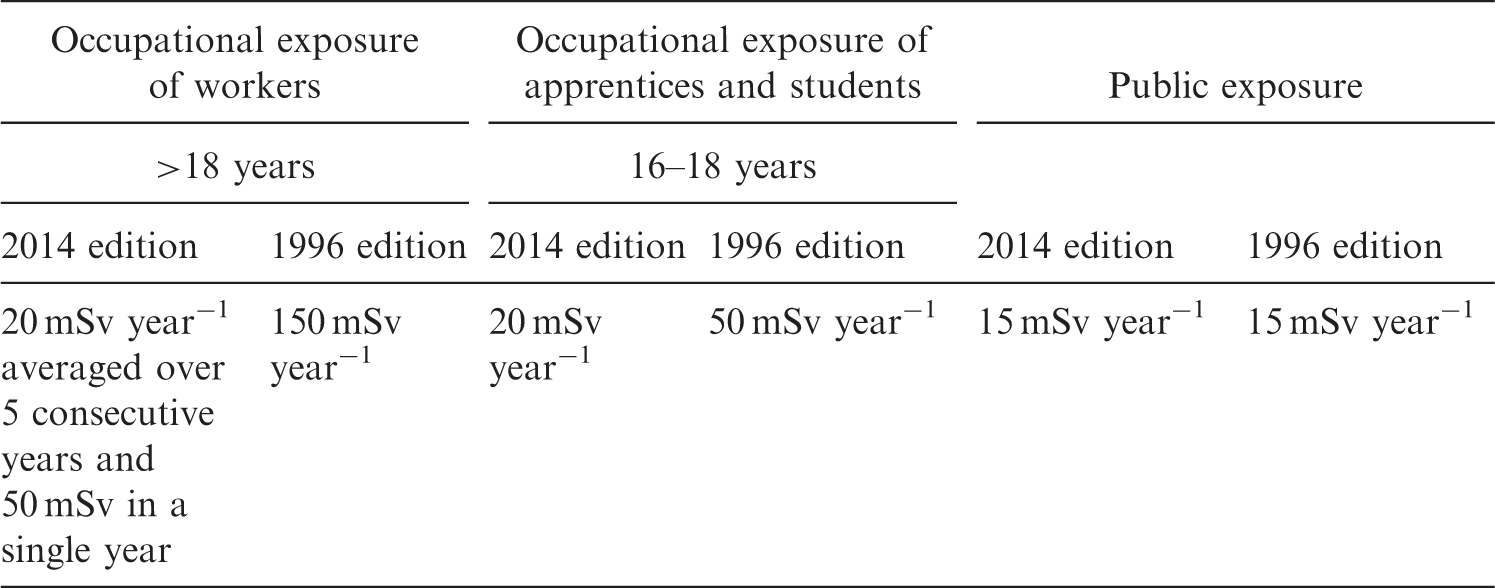
The International Atomic Energy Agency (IAEA) safety requirements: ‘General Safety Requirements Part 3 – Radiation protection and safety of radiation sources: International Basic Safety Standards’ (BSS) was approved by the IAEA Board of Governors at its meeting in September 2011, and was issued as General Safety Requirements Part 3 in July 2014. The equivalent dose limit for the lens of the eye for occupational exposure in planned exposure situations was reduced from 150 mSv year−1 to 20 mSv year−1, averaged over defined periods of 5 years, with no annual dose in a single year exceeding 50 mSv. This reduction in the dose limit for the lens of the eye followed the recommendation of the International Commission on Radiological Protection in its statement on tissue reactions of 21 April 2011.
IAEA has developed guidance on the implications of the new dose limit for the lens of the eye. This paper summarises the process that led to the inclusion of the new dose limit for the lens of the eye in the BSS, and the implications of the new dose limit.
1. Introduction
The statute of the International Atomic Energy Agency (IAEA) (IAEA, 1956) authorises IAEA: … to establish or adopt, in consultation and, where appropriate, in collaboration with the competent organs of the United Nations and with the specialized agencies concerned, standards of safety for protection of health and minimization of danger to life and property, … and to provide for the application of these standards …
The requirements in the BSS are governed by the objectives, concepts, and principles of the fundamental safety principles (IAEA, 2006), and draw upon information derived from the experience of states in applying the requirements of the previous edition of the BSS (IAEA, 1996). They also draw upon the extensive research on the health effects of radiation exposure, in particular the findings of the United Nations Scientific Committee on the Effects of Atomic Radiation and the recommendations of the International Commission on Radiological Protection (ICRP). In addition, when the IAEA Board of Governors first approved radiation protection and safety measures in March 1960 (IAEA, 1960), it was stated that ‘The Agency’s Basic Safety Standards… will be based, to the extent possible, on the recommendations of the International Commission on Radiological Protection (ICRP)’.
2. icrp recommendations on the dose limit for the lens of the eye
ICRP published its 2007 Recommendations in Publication 103 (ICRP, 2007). These recommendations reiterated ICRP’s three general principles of radiation protection, which concern justification of exposure, optimisation of protection, and application of dose limits. The ICRP recommendations also maintained the numerical values of the dose limits given in its earlier recommendations (ICRP, 1991) and the 1996 edition of the BSS (IAEA, 1996). However, ICRP pointed out in Publication 103 (ICRP, 2007) that the annual equivalent dose limit for the lens of the eye was currently being reviewed by an ICRP task group, with account being taken of new data on the radiosensitivity of the eye with regard to visual impairment.
In Publication 118, ICRP published its review of recent epidemiological evidence and concluded that there were some deterministic effects of radiation exposure, particularly those with very late manifestation, where threshold doses are or might be lower than previously considered (ICRP, 2012). Threshold dose was defined for practical purposes as the dose resulting in 1% incidence of specified tissue or organ reactions (i.e. deterministic effects). For the lens of the eye, the threshold for absorbed dose is now considered to be 0.5 Gy and, on that basis, ICRP has reduced its recommended dose limit for the lens of the eye.
In April 2011, ICRP issued a statement on tissue reactions in which it recommended, for occupational exposure, a dose limit for equivalent dose to the lens of the eye of 20 mSv year−1, averaged over defined periods of 5 years, with no annual dose in a single year exceeding 50 mSv. Previously, this dose limit had been 150 mSv year−1. ICRP did not specifically address the dose limit for the lens of the eye for members of the general public.
3. The international basic safety standards
3.1 Process for including the new dose limit for the lens of the eye in the BSS
The revision process for the 1996 edition of the BSS commenced in early 2007. A technical meeting was held in July 2007, with the participation of representatives of the sponsoring organisations. 1 The technical meeting concluded that the new edition of the BSS should follow, to the extent possible, the new recommendations of ICRP. The IAEA Safety Standards Committees and groups of experts from some of the sponsoring organisations provided comments on draft texts of the revised BSS in 2008 and 2009. A further technical meeting with the participation of the sponsoring organisations was held in December 2009 to discuss a statement on radon that was issued by ICRP in November 2009, and to assess its implications for the new edition.
The draft text of the new edition was submitted for comment to IAEA member states on 28 January 2010 for a 4-month comment period. The text was revised after a review of the comments.The draft text of the revised BSS was approved by the IAEA Safety Standards Committees at their meetings in November and December 2010. The Committees noted that ICRP was to release a statement relating to the dose limit for the lens of the eye, which should be taken into account prior to endorsement by the Commission on Safety Standards of the draft text of the new edition.
ICRP issued a statement on tissue reactions in April 2011. The Commission on Safety Standards endorsed the draft text of the new edition at its meeting in May 2011, and requested that member states and the sponsoring organisations be consulted on the proposed new dose limit for the lens of the eye. This process resulted in the new dose limit for the lens of the eye being included in the revised BSS. The text of the revised BSS was then approved by the IAEA Board of Governors in September 2011, and the 2014 edition was published in July 2014.
3.2 The new dose limit for the lens of the eye in the BSS
Limits on the equivalent dose to the lens of the eye in the 2014 edition of the International Basic Safety Standards (BSS) and the 1996 edition of the BSS.
4. Guidance on the implications of the new dose limit for the lens of the eye
4.1 Safety guides for the provision of guidance on the new dose limit
Safety guides provide recommendations and guidance on how to comply with the safety requirements. At the time when the 2014 edition of the BSS was approved, the Secretariat was asked to develop guidance as early as possible to assist member states in the observance of the new dose limit.
Guidance in relation to the new dose limit for the lens of the eye is to be provided in two safety guides that are currently being developed, entitled ‘Occupational radiation protection’ (DS453) and ‘Radiation safety in the medical uses of ionising radiation’ (DS399). It is foreseen that these two safety guides will be published in 2015–2016. DS453 is a general safety guide that is intended to provide generic guidance for all facilities and activities. DS399 is a specific safety guide that will provide guidance on all aspects of radiation safety for medical facilities, e.g. occupational protection, protection of patients, safety of sources, etc. DS399 will cover specific guidance for the occupational radiation protection of medical practitioners performing interventional procedures that will not be covered in DS453. It is recognised that guidance material is required before these two safety guides are finalised in order to allow member states the opportunity to put appropriate actions and planning in place to address the introduction of the new dose limit for the lens of the eye.
TECDOCs are developed by IAEA to provide explanatory material or interim guidance to support the safety standards. A TECDOC was therefore developed to provide advice on the implications for occupational radiation protection of the new dose limit for the lens of the eye, and to allow comment on detailed recommendations that may be incorporated into the above safety guides.
4.2 Process for development of the TECDOC
As a first step towards developing the TECDOC (IAEA, 2013), a technical meeting was held in October 2012 that was attended by 47 experts from 25 IAEA member states and eight international organisations. Experts from ICRP made presentations on the scientific basis of the new dose limit for the lens of the eye, and on the process for establishing the new dose limit. There were also presentations on the practical issues for implementing the dose limit to the lens of the eye in relation to medical, industrial, and nuclear facilities.
The discussions and the report of the meeting formed the basis of the content of the TECDOC. The text of the TECDOC was drafted in early 2013, and circulated to all participants in the technical meeting for comment. The draft text was provided to the Radiation Safety Standards Committee for information and comment at their meeting in early July 2013.
4.3 Guidance on implications of the new dose limit for the lens of the eye
The guidance in the TECDOC covers the following topics: safety assessment; workers for whom exposure of the lens of the eye might be important; optimisation of protection; monitoring of doses to the lens of the eye due to external radiation; health surveillance; and exposure of emergency workers.
An example of the guidance in the TECDOC is that provided for monitoring of the dose to the lens of the eye. The TECDOC states that the most accurate method for monitoring the equivalent dose to the lens of the eye is to measure Hp(3) with a dosimeter worn as close as possible to the eye, and calibrated on a phantom representative of the head. However, dosimeters designed for Hp(3) are not broadly available. The TECDOC provides guidance on when Hp(0.07) or Hp(10) dosimeters can be used, and when Hp(3) dosimeters have to be used. The TECDOC recommends that routine monitoring of dose to the lens of the eye should be undertaken if annual equivalent dose to the lens is likely to exceed 5 mSv.
Footnotes
1
The joint sponsors of the BSS are: European Commission, Food and Agriculture Organization of the United Nations, International Labour Organization, International Atomic Energy Agency, Nuclear Energy Agency of the Organisation for Economic Co-operation and Development, Pan American Health Organization, United Nations Environment Programme, and the World Health Organization.