




Abstract
Although research has examined partnered individuals’ expectations about romantic relationships, little is known about singles’ expectations for relationships. Using six waves of longitudinal panel data (N = 5,113), we explored how singles’ expectations relate to experiences in singlehood and future partnerships. Women expected more intimate and more negative outcomes from relationships than men, whereas men were more likely to expect relationships to enhance their status. At both within- and between-person levels, higher intimacy expectations were associated with lower singlehood satisfaction and higher partner desire; within-person increases in negative expectations were associated with lower satisfaction and partner desire. Individuals with higher intimacy expectations were less likely to remain single and felt more satisfied in future relationships; negative expectations were associated with a greater likelihood of remaining single and lower future relationship satisfaction. Together, our data suggest that singles’ image of partnership is related to satisfaction in singlehood and future romantic relationships.
Introduction
“Would I be happier if things were different?” is a question everyone has asked themselves at some point. The answer to this question is related to well-being outcomes: More positive (and less negative) future expectations across various life domains are associated with higher levels of psychological and even physical health (Lench, 2011; Scheier & Carver, 1993). One domain where expectations about alternative circumstances may hold particular influence is in the context of close relationships. Indeed, positive relationship expectations among partnered individuals are associated with better interpersonal functioning and higher satisfaction within the relationship (Lemay & Venaglia, 2016).
With singlehood becoming a more common and visible life path around the world (Kislev, 2019; Organisation for Economic Co-Operation and Development, 2020; Tang et al., 2019; U.S. Census Bureau, 2023), understanding the single population has become increasingly important. The number of singles continues to rise, with nearly half of American adults now single (i.e., divorced, widowed, or never married; U.S. Census Bureau, 2023), and many of these singles are not looking to enter a relationship (Brown, 2020a). Similarly, in Canada, the number of people living alone has more than doubled over the last 35 years, with two-thirds of those living alone also reporting not being in a romantic relationship (Tang et al., 2019). With these trends, a growing body of work has begun to examine singlehood, often focusing on the correlates of well-being in singlehood (e.g., how satisfied one is with one’s single status; Adamczyk, 2017; MacDonald & Park, 2022; Park et al., 2022). Arguably, this research has focused on the influence of factors related to an individual’s experiences in singlehood such as family, friend, and sexual relationships (e.g., Park et al., 2021). Very little research, however, has considered the influence of comparison to the alternative to singlehood: romantic partnership (cf. Beauparlant et al., 2024). That is, the extent to which well-being in singlehood is shaped by specific expectations about the upsides and downsides of romantic partnership is currently unclear.
Relationship Expectations in Interdependence Theory
Interdependence theory, a social exchange theory that broadly describes how individuals interact and make decisions in relationships (Kelley & Thibaut, 1978; Thibaut & Kelley, 1959), posits that relationship satisfaction is determined by weighing the rewards gained against the costs incurred from the relationship. If perceived rewards outweigh costs, individuals are likely to feel satisfied; if costs outweigh rewards, satisfaction may suffer (Thibaut & Kelley, 1959). These evaluations are often guided by a comparison level, or the “quality of outcomes that the participant feels he or she deserves” (Kelley & Thibaut, 1978, p. 9). Satisfaction, then, reflects “the magnitudes of the rewards to be enjoyed and costs to be incurred in relation to [the] CL [comparison level]” (Kelley & Thibaut, 1978, p. 70). From this perspective, expectations for a relationship can be understood as beliefs about the rewards a person expects to gain and the costs a person expects to endure. Thus, dissatisfaction in romantic relationships may stem not only from actual relational experiences, but also from the expectations individuals bring to relationships about how they expect relationships to go. Indeed, prior research has established the importance of expected future satisfaction for those in relationships; expected satisfaction is a stronger predictor of relationship commitment and maintenance behaviours than current satisfaction (Baker et al., 2017).
Although there has typically been a focus on how costs and rewards function in populations of partnered individuals (e.g., Apostolou et al., 2023; Boon et al., 2011; Monteoliva et al., 2016; Muise et al., 2023; Overall et al., 2014; Sedikides et al., 1994), they may well be relevant for singles’ well-being. Although singles do not have a current relationship to evaluate, they may assess romantic partnership more generally through anticipated rewards and costs. At times, researchers distinguish between relationship standards (the quality of outcomes one feels one deserves) and expectations (predictions of the future; e.g., Baker et al., 2017). In the current study, we focus on expectations.
Past research has identified a relationship between singles’ quality of alternatives (i.e., being partnered) and well-being in singlehood; when alternatives are evaluated more favourably, singles feel less satisfied with and less committed to their singlehood (Beauparlant et al., 2024). Thus, it seems reasonable that an important contributor to perceptions of alternatives to singlehood may be an individual’s expectations of what being partnered would be like. An interdependence theory lens allows us to examine this issue with particular fidelity by focusing not on overall satisfaction, but on expectations for rewards and costs specifically. If an individual expects a relationship to be beneficial (i.e., strong anticipated rewards), this imagined alternative may be especially attractive, making singlehood feel less fulfilling. Alternatively, singles who expect relationships to be problematic (i.e., strong anticipated costs) may then evaluate their current situation more positively, with singlehood perceived as the best possible outcome.
Gender Differences in Singles’ Expectations
Notably, these expectations may not be uniform across all singles and may vary by gender. Past research has suggested that men and women differ in what they expect from a romantic relationship. For instance, college students differ by gender on what they expect their future partner to earn and accomplish (Ganong & Coleman, 1992); men and women have also been found to differ on expectations regarding values held by the partner and duties performed by the partner (e.g., men expect to limit their household responsibilities and assume a provider role, whereas women expect a more egalitarian approach to household maintenance; Sherman, 2017). Less is known, however, about gender differences regarding more general relationship expectations: Do single women or men have the more positive outlook on what a relationship would bring them?
There is reason to believe women’s expectations may be less positive. Research has suggested that women report greater happiness in singlehood than men (Hoan & MacDonald, 2024) and have more of a history of disappointment in romantic relationships (Vangelisti & Daly, 1997). These outcomes may arise from women’s experiences in and narratives about romantic relationships. For example, women are more likely to feel romantic relationships place an unfair burden of labour on them (e.g., inequitable proportion of household chores; van Anders et al., 2022). Women, then, may believe they have less to gain from partnering than men, expecting more costs than benefits to partnership. Single men, in contrast, may have more positive expectations, with prior research suggesting men reap more benefits from romantic relationships, particularly in terms of mental and physical health (Qin et al., 2026; Wahring et al., 2024). If single men recognize these relational advantages, they may hold more positive expectations, expecting more rewards from a relationship.
Singles’ Relationship Expectations and Singlehood
Expectations may be relevant to how singles evaluate their contentment with singlehood. As interdependence theory suggests, if singles expect more costs than rewards to come with romantic relationships, they may feel more satisfied with singlehood and have less desire to change their situation by entering a partnership. In contrast, if a romantic relationship is expected to offer more rewards than costs, singles may feel dissatisfied and more motivated to seek a romantic partner. These calculations may, in turn, influence decisions about whether to pursue romantic opportunities. Individuals who believe a romantic relationship would be preferable to being single may be more likely to pursue and enter a partnership; conversely, if singles expect a relationship to be worse than their current situation, they may be more inclined to avoid romantic involvement.
These expectations for relationships may also be associated with actual outcomes experienced following transition to romantic partnership, both because expectations can reflect stable personality characteristics (e.g., optimism) and, importantly, because they can have self-fulfilling qualities. More positive, or optimistic, individuals may feel more satisfied in their relationships, perhaps because of a cognitive disposition to expect positive outcomes (e.g., Srivastava et al., 2006). Although positive expectations may reflect a general disposition, specific relationship expectations also appear to play a distinct role in shaping outcomes. For instance, Joel et al. (2023) found that partnered individuals who expect more positive behaviours from their partner tend to perceive such behaviour, enhancing perceived relationship quality. Indeed, when positive expectations are met, coupled individuals report more stable satisfaction, but when they are unmet, relationship satisfaction may suffer to a greater extent than if initial expectations had been lower (McNulty & Karney, 2004). Thus, holding positive expectations may be beneficial, but may also be counterproductive, depending on the quality of the relationship. Overall, singles’ positive and negative relationship expectations may influence both the decision to partner and how satisfying those relationships are once formed.
The Current Research
In the current study, we first examined potential sex differences in singles’ expectations. We also examined how singles’ relationship expectations related to how satisfied they are with singlehood and to what extent they desire a partner. Using longitudinal data, we tracked whether participants entered a relationship over time and, for those who partnered, assessed how expectations predicted relationship satisfaction.
Method
Transparency and Openness
The following study and analyses were exploratory, and as such, no hypotheses were preregistered. The data used for this study cannot be publicly shared due to data sensitivity and usage rights of the secondary dataset employed, but the code used to reproduce the primary results of this study can be found at: https://osf.io/nrb4q/.
Data
This study analyzed data from the first 11 waves of the German Family Panel (pairfam), funded by the German Research Foundation (DFG; Brüderl et al., 2024; Huinink et al., 2011). Pairfam began collecting data on an annual basis in 2008, with a starting sample of 12,402 participants. It focuses on the themes of intimate relationships and family dynamics, collecting data through personal interviews with focal participants (referred to as “anchors”) annually. Specific variables vary in their inclusion throughout waves; for example, relationship expectations are measured every other wave, beginning in Wave 1. As relationship expectations are our main variables of interest, our analyses include data from every other wave. These expectations were not collected past Wave 11; thus, our analyses include 6 waves in total. These data can be accessed by applying to pairfam: https://www.pairfam.de/en/data/data-access/.
Participants
We excluded participants who indicated they were in a relationship in the first wave. See Table 1 for demographics across the waves.
Demographics Across Waves.
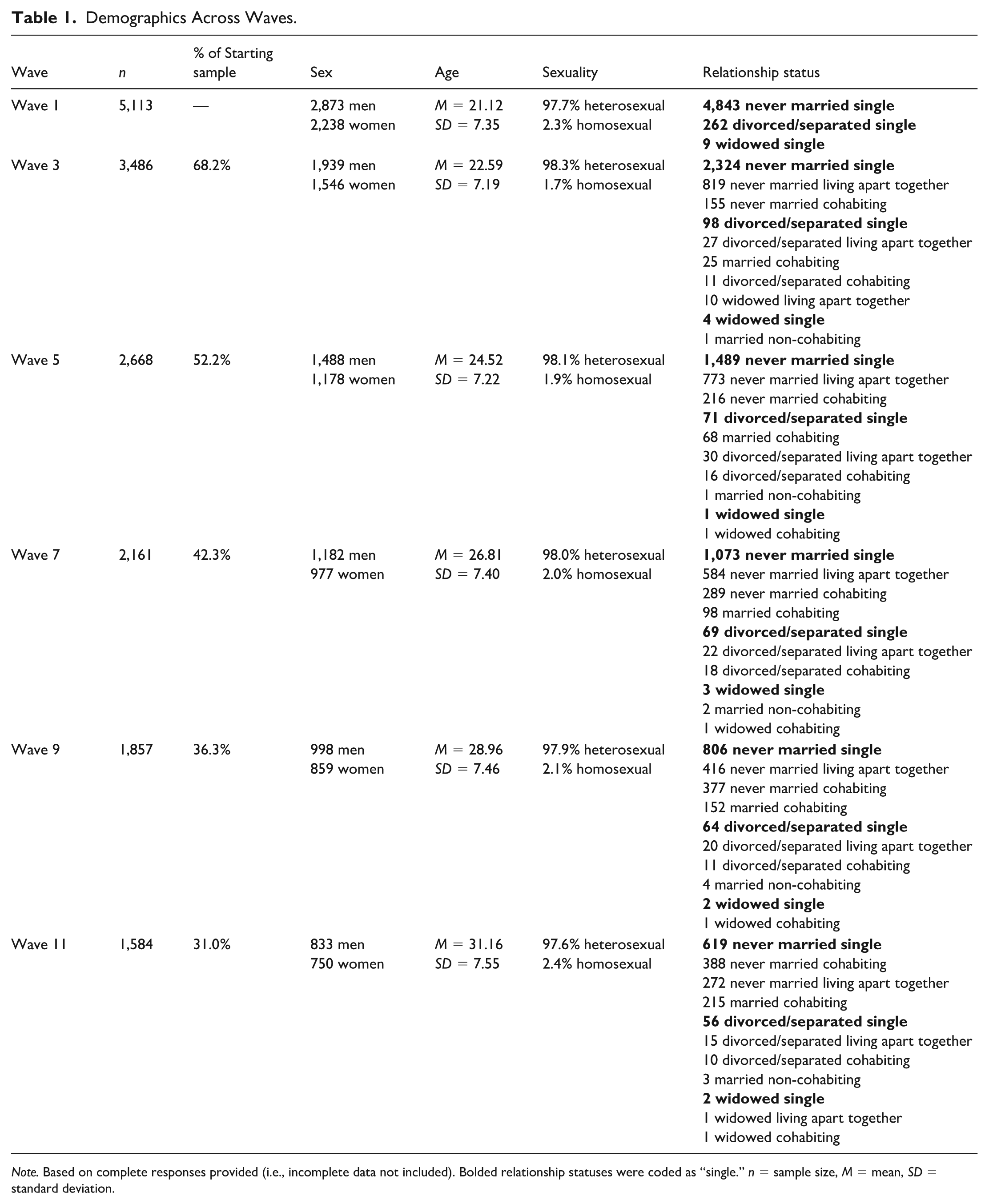
Note. Based on complete responses provided (i.e., incomplete data not included). Bolded relationship statuses were coded as “single.” n = sample size, M = mean, SD = standard deviation.
Due to the nature of secondary data analysis, we were unable to conduct a priori power analyses. Moreover, post hoc power analyses are generally uninformative, in part due to redundancy with reported effect sizes (Lakens, 2022; Zhang et al., 2019). As such, we instead conducted sensitivity power analyses to calculate the minimal detectable effect for each model at 80% power, based on our analysis and sample size. These analyses demonstrated that our sample provides sufficient power (i.e., 80%) to detect our primary effects. More detail and power curves depicting statistical power along a range of effects can be found in Supplemental Material.
Materials and Procedure
In each wave, participants completed the following measures, listed among a larger set of questionnaires.
Sex
Participants were asked to indicate their sex (1 = male, 2 = female).
Age
Participants were asked to indicate their age.
Relationship Expectations
Relationship expectations were assessed using the value of partnership scale developed by pairfam (Thönnissen et al., 2024). Participants were instructed: “Let’s now turn to the topic of partnership and your wishes and expectations. People may associate positive or negative expectations regarding relationships. How about you?” In the current research, we only focus on items that were present in all relevant waves. To assess positive expectations, participants were asked how strongly they expected to (a) participate in activities with a partner, (b) receive affection and have a feeling of security in a relationship, (c) achieve social status by having a partner, (d) get support from a partner if they need help or are ill, and (e) have financial advantages in a relationship. To assess negative expectations, participants were asked to what extent they feared (a) becoming bored, increasingly familiar in a relationship, (b) that their family or friends would not accept a partner, (c) experiencing stress related to a relationship, and (d) that a partner will limit them. All items were rated on a 5-point scale (1 = Not at all, 5 = Very strongly). Participants could also respond to these items by stating they have “no clear idea”; these responses were coded as missing in our analyses.
Satisfaction With Singlehood
Singlehood satisfaction was assessed with a single item (i.e., “How satisfied are you with your situation as a single?”; Thönnissen et al., 2024). This item was rated on an 11-point scale (0 = Very dissatisfied, 10 = Very satisfied). Only participants that reported being single received this item.
Desire for a Partner
Desire for partnership was assessed with a single item (i.e., “I would like to have a partner”; Thönnissen et al., 2024). This item was rated on a 5-point scale (1 = Not at all, 5 = Absolutely). Only participants that reported being single received this item.
Likelihood of Being Single
Participants reported their current relationship status. We created a dummy variable for relationship status for each wave: Participants were assigned a 1 if they were single (i.e., never-married single, divorced/separated single, widowed single) or a 0 if they were in a relationship (i.e., never married living apart together, never married cohabiting, married cohabiting, married non-cohabiting, divorced/separated living apart together, divorced/separated cohabiting, widowed living apart together, widowed cohabiting). To predict participants’ likelihood of being single for the following five waves, we then divided the number of waves they reported being single by the total number of waves they participated in (Park et al., 2021). Thus, we calculated a likelihood of singlehood for all participants, with values ranging between 0 and 1.
Relationship Satisfaction
Relationship satisfaction was assessed with a single item (i.e., “All in all, how satisfied are you with your relationship?”; Thönnissen et al., 2024). This item was rated on an 11-point scale (0 = Very dissatisfied, 10 = Very satisfied). Only participants that reported being in a relationship received this item.
Control Variables
Personality
Personality was assessed using a short version of the Big Five Inventory (Rammstedt & John, 2005). Participants responded to four items measuring extraversion (e.g., “I get enthusiastic easily and can motivate others easily”), four items measuring neuroticism (e.g., “I easily become depressed or discouraged”), four items measuring agreeableness (e.g., “I trust others easily and believe that people are inherently good”), four items measuring conscientiousness (e.g., “I completely my takes thoroughly”), and five items measuring openness (e.g., “I am interested in many different kinds of things”). These items were rated on 5-point scales (1 = Absolutely incorrect, 5 = Absolutely correct).
Self-Esteem
Self-esteem was assessed with three items (i.e., “I like myself just the way I am”; “All in all, I am pleased with myself”; “Sometimes I believe that I’m worthless”; Thönnissen et al., 2024). These items were rated on 5-point scales (1 = Not at all, 5 = Absolutely).
Life Satisfaction
Life satisfaction was assessed with a single item (i.e., “All in all, how satisfied are you with your life at the moment?”; Thönnissen et al., 2024). This item was rated on an 11-point scale (0 = Very dissatisfied, 10 = Very satisfied).
Analysis Plan
Although pairfam researchers characterize the expectation items as assessing positive and negative dimensions, they also describe an intention to measure specific dimensions of costs and benefits, including comfort, stimulation, affect, status, and autonomy (Thönnissen et al., 2024). Therefore, we ran an exploratory factor analysis (EFA) at each wave to examine how these individual expectations load together.
To account for the nested nature of the data (observations nested within individuals), we used multilevel models for analyses predicting relationship expectations, desire for a partner, singlehood satisfaction, and relationship satisfaction. To account for individual variability in both baseline levels and trajectories of change, models included random intercepts for participants and random slopes for time.
To disentangle the effects of within-person fluctuations from stable individual differences, we used a person-mean centring approach for all predictors that varied across waves. Specifically, predictors that varied across waves were disaggregated into two distinct components: a within-person variable, calculated as the deviation of a participant’s score at a given wave from their own across-wave mean (person-mean centred), and a between-person variable, calculated as the participant’s average score across all waves (grand-mean centred).
To examine potential sex differences in relationship expectations, we conducted three distinct multilevel models. In each model, one type of expectation was treated as the dependent variable, and sex was treated as a predictor. We controlled for the other types of relationship expectations at both the within- and between-person levels, time (wave), and sexual orientation. The latter was included a covariate because we theorized expectations may vary depending on sexual orientation; for example, queer singles may not anticipate status boosts from a partnership due to potential discrimination (e.g., van der Toorn et al., 2020).
We conducted multilevel models to examine how relationship expectations are associated with singlehood satisfaction and desire for a partner. These models included each type of relationship expectation as predictors (split into within- and between-person components) and controlled for sex, time, and sexual orientation. For these models, we subset the data to include only single participants.
Relationship satisfaction was examined using lagged analyses. This approach was necessary to test the predictive validity of expectations held during singlehood on subsequent relationship outcomes, as the analysis crossed the transition from single to partnered. For single participants who entered a partnership during the study, relationship satisfaction reported at the first wave of partnership was regressed on expectations reported at the most recent wave of singlehood.
The likelihood of being single outcome was analyzed as an outcome using a standard linear regression, with average relationship expectations (aggregated across waves) as predictors.
All statistical analyses were conducted in R (RStudio version 2024.9.0.375; R Core Team, 2024;), using R packages haven (Wickham et al., 2023), tidyverse (Wickham et al., 2019), lme4 (Bates et al., 2015), lmerTest (Kuznetsova et al., 2017), parameters (Lüdecke et al., 2020), Hmisc (Harrell, 2024), psych (Revelle, 2024), EFAtools (Steiner & Grieder, 2020), lavaan (Rosseel, 2012), semTools (Jorgensen et al., 2025), and r2glmm (Jaeger, 2017).
Results
Correlational analyses and descriptive statistics of the variables of interest can be found in Table 2.
Correlations and Descriptive Statistics Between Variables.
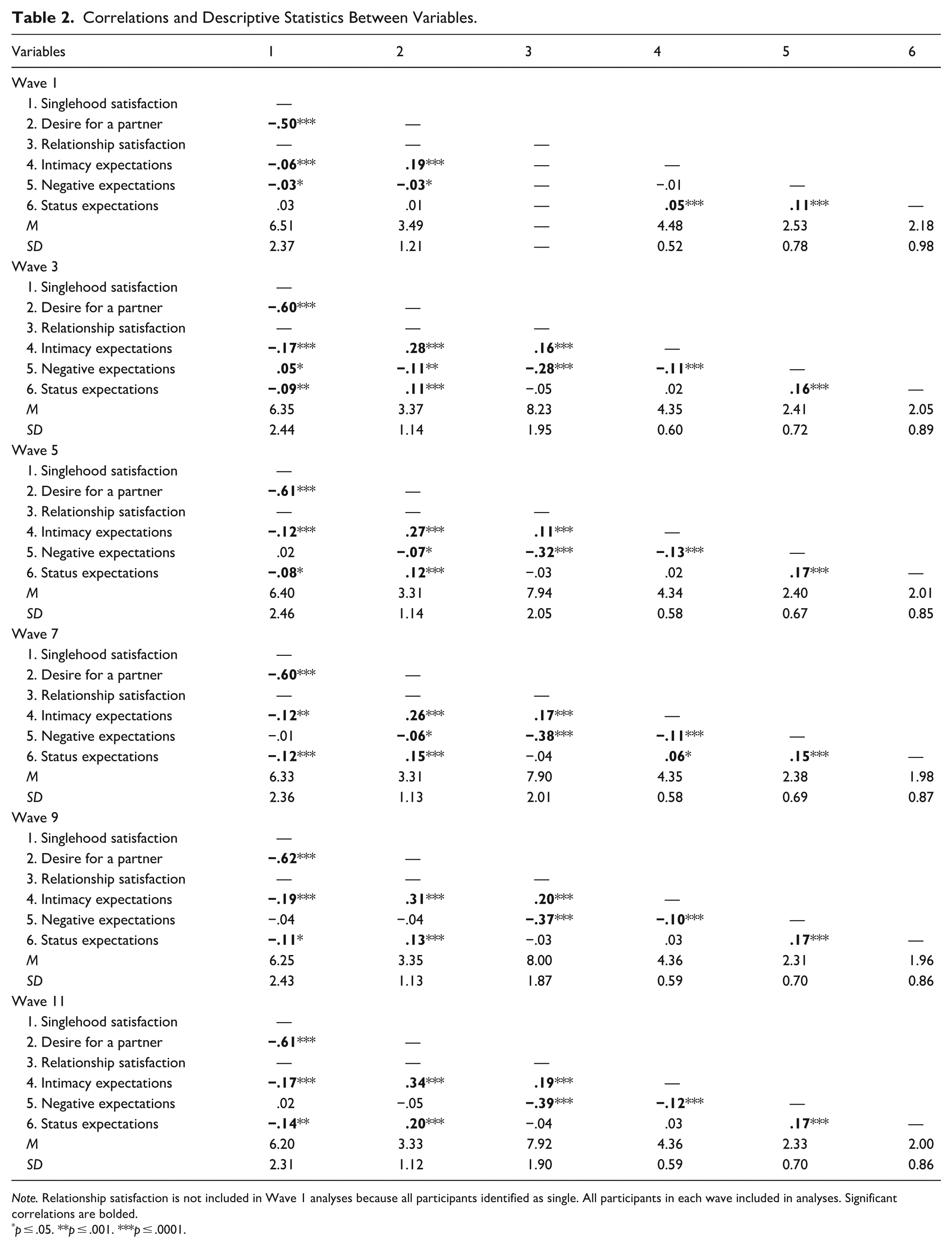
Note. Relationship satisfaction is not included in Wave 1 analyses because all participants identified as single. All participants in each wave included in analyses. Significant correlations are bolded.
p ≤ .05. **p ≤ .001. ***p ≤ .0001.
EFA of Relationship Expectations
An EFA was conducted on the relationship expectations reported in Wave 1 to examine the underlying factor structure. 1 A Keiser–Meyer–Olkin’s test indicated adequate sampling (KMO = 0.64, with KMO ≥ 0.6 considered adequate; Howell, 2007) and Barlett’s test of sphericity was highly significant (p < .001; Field, 2009). Parallel analysis using PCA eigenvalues (Lim & Jahng, 2019) suggested a three-factor solution, which was confirmed by visual inspection of the scree plot (see Supplemental Material). A maximum likelihood EFA with promax rotation was then conducted to allow for correlated factors. The three factors accounted for 37% of the total variance. No items were characterized by cross-loadings, and all items were retained on their original factor. We determined that the three factors were best labeled “negative expectations,” “status expectations,” and “intimacy expectations” (see Table 3 for factor loadings and explained variance).
Factor Loadings of Items Assessing Relationship Expectations.
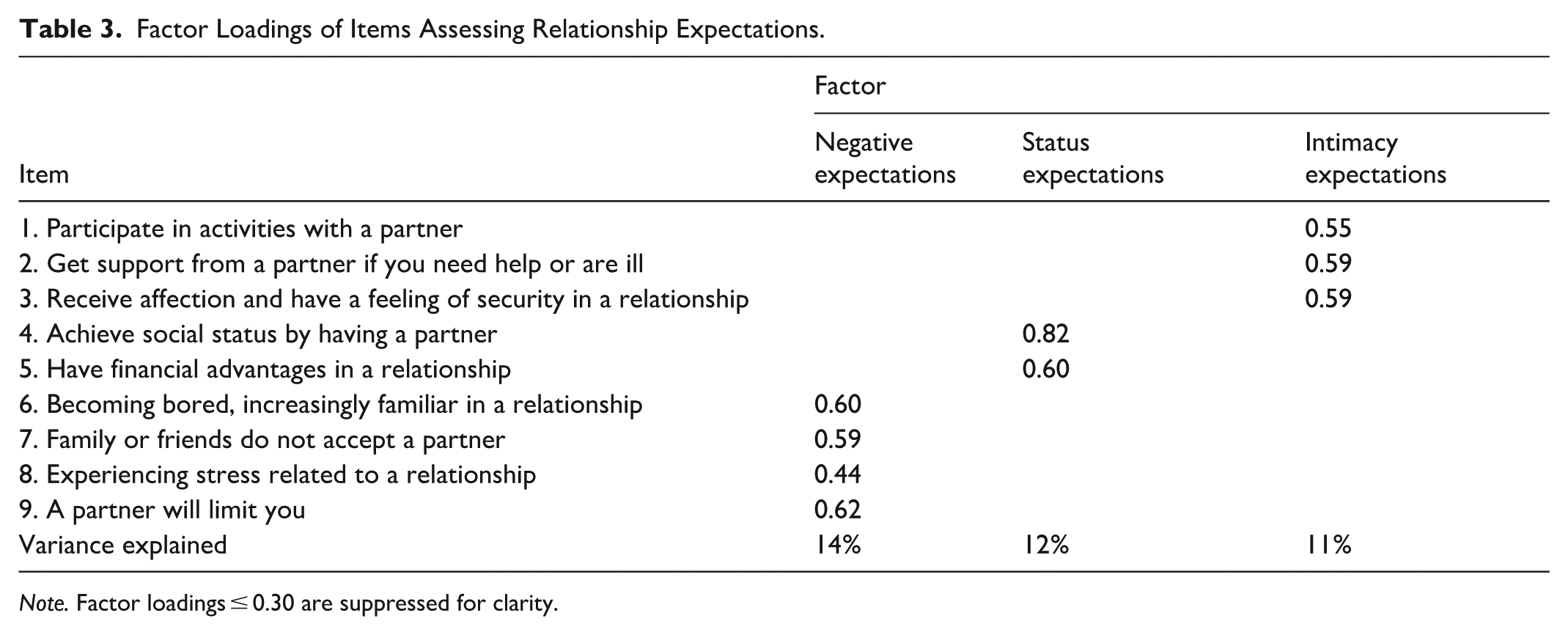
Note. Factor loadings ≤ 0.30 are suppressed for clarity.
Relationship Expectations and Sex
We first explored whether relationship expectations differed by sex. Women reported significantly higher intimacy and negative relationship expectations, whereas men reported higher status expectations (see Table 4). Full model parameters, including fixed effects for all covariates and random effect variances, are available in Supplemental Material. In additional models, we examined whether sex interacted with relationship history (i.e., never married vs. previously married in Wave 1). These interactions were not significant, suggesting that the sex differences in intimacy (b = −0.10, SE = 0.06, t = −1.67, p = .095), negative (b = 0.09, SE = 0.08, t = 1.13, p = .260), and status (b = 0.17, SE = 0.10, t = 1.61, p = .108) expectations were consistent across never married singles and previously married singles.
Sex and Relationship Expectations.
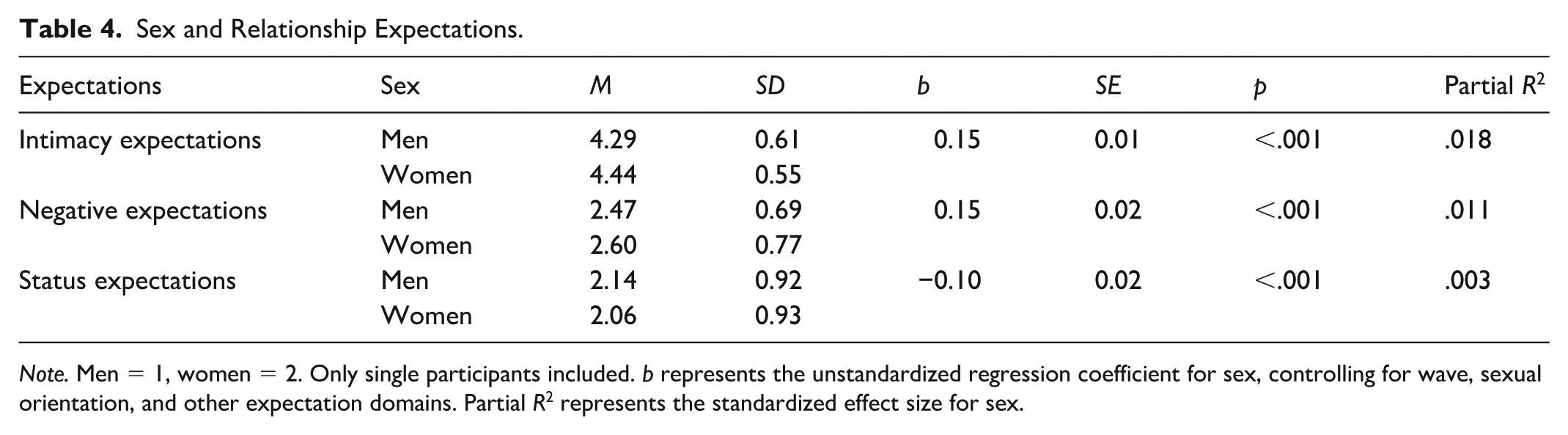
Note. Men = 1, women = 2. Only single participants included. b represents the unstandardized regression coefficient for sex, controlling for wave, sexual orientation, and other expectation domains. Partial R2 represents the standardized effect size for sex.
Relationship Expectations and Singlehood Satisfaction
Women reported significantly higher satisfaction with singlehood than men (b = 0.14, p = .016; see Table 5). Satisfaction with singlehood declined significantly over time (b = −0.04, p < .001). At both the within-person (b = −0.27, p < .001) and between-person (b = −0.58, p < .001) levels, higher intimacy expectations were associated with lower singlehood satisfaction. Within-person increases in negative expectations were associated with higher singlehood satisfaction (b = 0.09, p = .028); between-person differences in negative expectations, however, were not significantly associated with singlehood satisfaction (b = −0.08, p = .118). Status expectations were unrelated to singlehood satisfaction at both the within-person (b = −0.07, p = .054) and between-person (b = −0.06, p = .116) levels. In an additional model, we examined whether sex (0 = male, 1 = female) moderated the associations between relationship expectations and singlehood satisfaction; no significant interactions were found (all ps > .177).
Associations Between Relationship Expectations and Outcomes.
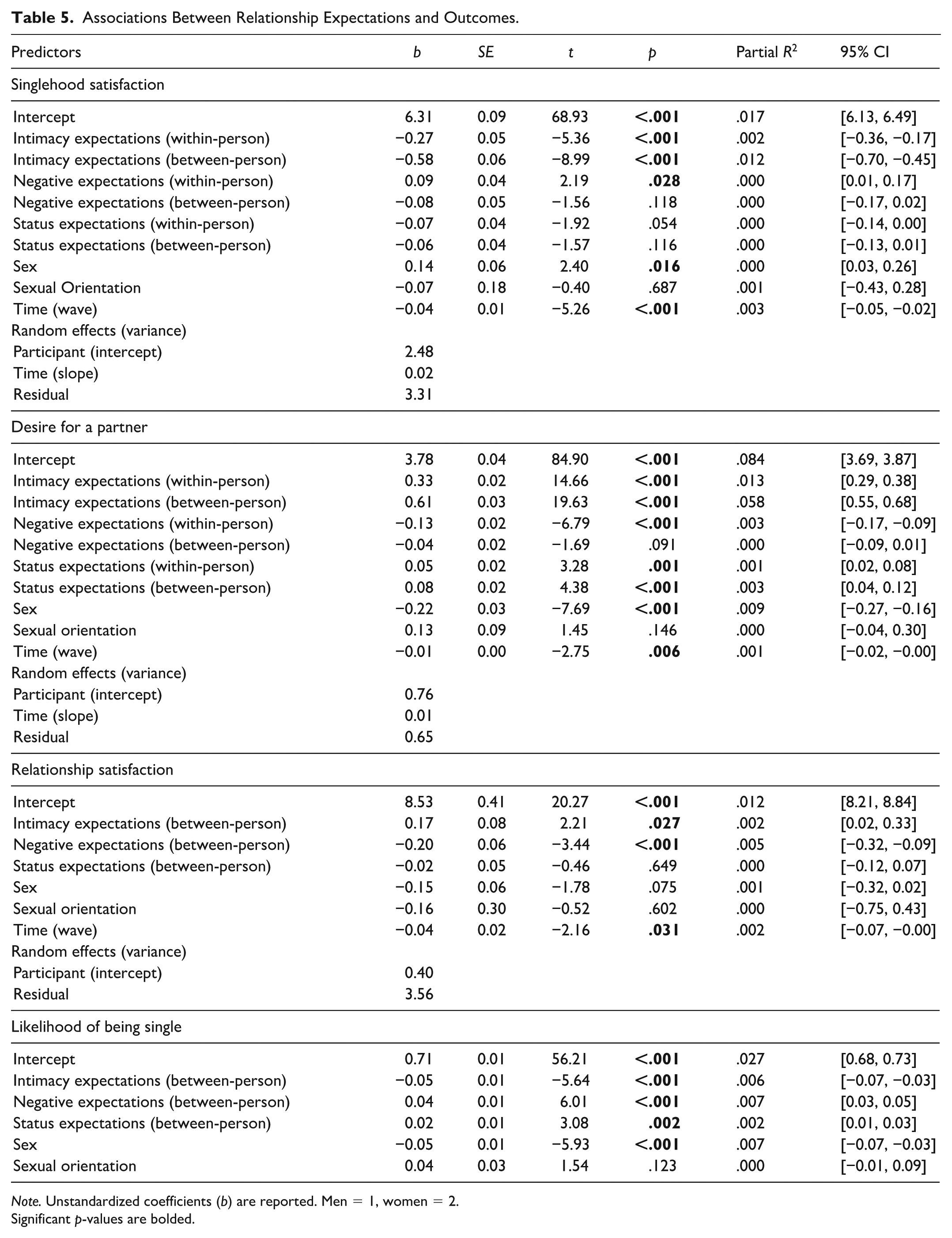
Note. Unstandardized coefficients (b) are reported. Men = 1, women = 2.
Significant p-values are bolded.
Relationship Expectations and Desire for a Partner
Men reported significantly higher desire for a partner than women (b = −0.22, p < .001). Desire for a partner significantly decreased over time (b = −0.01, p = .006). Both intimacy and status expectations were positively associated with desire. At the within-person level, when participants reported higher intimacy (b = 0.33, p < .001) or status (b = 0.05, p = .001) expectations than what was typical for them, they reported higher desire. Similarly, at the between-person level, individuals with higher average intimacy (b = 0.61, p < .001) and status (b = 0.08, p < .001) expectations reported higher desire. Within-person increases in negative expectations were associated with lower desire (b = −0.13, p < .001), though between-person differences in negative expectations were not significantly associated with desire (b = −0.04, p = .091). In an additional model, we examined whether sex moderated the associations between relationship expectations and desire. Significant interactions were found at the within-person level for both intimacy (b = −0.14, SE = 0.05, p = .002) and negative (b = 0.11, SE = 0.04, p = .002) expectations. These interactions suggest that men’s desire for a partner was more sensitive to within-person fluctuations in these expectations than women’s desire; specifically, the slopes for both intimacy and negative expectations were significantly steeper for men. No other significant interactions were observed (all ps > .243).
Relationship Expectations and Future Partnerships
Relationship Expectations and Likelihood of Partnering
Over the course of the study, 2,113 (41.3%) participants reported being in a relationship in at least one of the surveyed waves. Men were more likely to remain single than women (b = −0.05, p < .001). Individuals who held higher average intimacy expectations were significantly less likely to remain single (b = −0.05, p < .001). Conversely, individuals who held higher negative (b = 0.04, p < .001) and status (b = 0.02, p = .002) expectations were more likely to remain single. In an additional model, we examined whether sex moderated the associations between relationship expectations and likelihood of partnering; no significant interactions were found (all ps > .619).
Relationship Expectations and Future Relationship Satisfaction
For those who partnered, we examined whether expectations held during the most recent wave of singlehood predicted relationship satisfaction in the first wave of the new partnership. Higher intimacy expectations while single predicted higher relationship satisfaction in a future partnership (b = 0.17, p = .027), whereas higher negative expectations predicted lower relationship satisfaction (b = −0.20, p < .001). Status expectations (b = −0.02, p = .649) and sex (b = −0.15, p = .075) were not significantly associated with postpartnering relationship satisfaction. Notably, this analysis employed relatively fewer observations, limiting our power to detect significant effects; specifically, sensitivity power analyses showed that our data were only sufficiently powered to detect an effect of at least b = 0.22, which is larger than our observed effect of b = 0.17 (see Supplemental Material). In an additional model, we examined whether sex moderated the associations between relationship expectations and relationship satisfaction; no significant interactions were found (all ps > .307).
Robustness Checks
To test the robustness of our findings, we re-ran our analyses controlling for additional variables. We controlled for the Big Five personality traits, 2 self-esteem, and life satisfaction to investigate whether expectations in the current research simply reflected general positivity bias or underlying personality traits, or were, in fact, unique constructs. We also examined whether these results varied depending on participant age and relationship history. Results were largely consistent across models, though specific associations shifted in significance once these covariates were introduced. Notably, the associations between intimacy expectations and all outcomes remained robust (see Supplemental Material for more detail). Controlling for personality, self-esteem, and life satisfaction revealed significant between-person associations between negative expectations and both singlehood satisfaction and desire for a partner; the association with desire was also significant when controlling for age. Conversely, the association between negative expectations and relationship satisfaction became non-significant when controlling for personality, self-esteem, and life satisfaction. Status expectations (at both between- and within-person levels) were significantly associated with singlehood satisfaction when controlling for personality, although the link between status expectations and the likelihood of partnering became non-significant after controlling for personality, self-esteem, life satisfaction, and age.
Discussion
Our results suggest that singles’ expectations for romantic relationships may provide information about their experiences in both singlehood and future partnerships. Across waves, singles’ endorsement of intimacy expectations was close to the top of the scale, suggesting that singles hold relatively optimistic expectations for relationships. In contrast, singles reported lower endorsement of negative expectations, with the average across waves closer to the midpoint of the scale; status expectations were less endorsed. These findings suggest that, on average, singles expect romantic relationships to bring more benefits than costs. In addition, our findings related to status expectations offer a contrast to narratives in Singlehood Studies that suggest that the presence of singlism should mean an increase in social standing as a result of partnering (e.g., Apostolou & Esposito, 2020; DePaulo & Morris, 2005; Girme et al., 2022; Kislev, 2024), with singles reporting little expected gain in status.
Sex Differences in Relationship Expectations
Our data suggested that single women may have a picture of romantic relationships as somewhat of a mixed blessing. Single women held higher negative relationship expectations than single men, suggesting that single women expect entering a relationship to pose more challenges to their well-being than men. These findings may reflect relationship experiences more likely to be reported by women, such as disappointment and excessive housework burden (e.g., van Anders et al., 2022; Vangelisti & Daly, 1997), as well as women’s higher levels of neuroticism (Chapman et al., 2007; Costa et al., 2001), which may lead to more negative expectations across multiple domains. At the same time, single women also reported higher intimacy expectations. Indeed, research has suggested that women expect more intimacy from romantic partnership than men (e.g., Rusbult et al., 1993; Sedikides et al., 1994). Given women’s higher levels of agreeableness, particularly in the facet of compassion (Rammstedt et al., 2025; Weisberg et al., 2011), women’s intimacy expectations may be founded on recognition of their greater tendency towards intimacy relative to men. Across relationship types, such as friend and family relationships, women do indeed develop relationships with higher levels of intimacy than do men (Monin et al., 2008; Pearce et al., 2021).
Where men did have more positive expectations than women was in relationships’ role in boosting status, with single men reporting higher status expectations than women. This finding may reflect single men accurately detecting that there can be financial advantages to partnership for men. For instance, married men, on average, earn more than single men (Hopcroft, 2021; Pollmann-Schult, 2011). Future research unpacking what exactly leads men to expect a status boost upon entering partnership would be of interest.
Although expectations differed by sex, results suggested that sex does not moderate the associations between relationship expectations and singlehood satisfaction, the likelihood of partnering, or future relationship satisfaction. This indicates that for the most part, the implications of relationship expectations for singlehood and relationship outcomes are similar for men and women. However, within-person fluctuations in intimacy and negative expectations were more strongly associated with desire for a partner among men than among women. Specifically, when men reported higher intimacy expectations than typical, they reported a sharper increase in desire; conversely, higher-than-usual negative expectations were associated with a more pronounced decrease in desire for men. This suggests that men may rely more on immediate appraisals of relationships as a gauge for their current interest in finding a partner, whereas women’s desire may be less contingent on these shifts.
Relationship Expectations and Current Outcomes
Singles with higher intimacy expectations, on average, reported lower satisfaction with their own singlehood and expressed a higher desire for a partner. In addition, in waves when individuals reported higher intimacy expectations than usual, they felt less satisfied with singlehood and higher partner desire. As suggested by interdependence theory, singles who anticipate more rewards from romantic relationships may view singlehood less favourably. This pattern also aligns with principles of cognitive consistency (Gawronski & Brannon, 2019). Indeed, if an individual holds the belief that a relationship would be highly rewarding, maintaining a coherent belief system may require viewing their current state of singlehood as comparatively less satisfying. Although we cannot infer causality in the current analyses, our data suggest that intimacy expectations are not simply a reflection of general positivity. If individuals who have higher intimacy expectations tended to evaluate everything more favourably, this would be reflected in more positive (rather than more negative) evaluations of singlehood. In addition, we conducted robustness checks to ensure intimacy expectations were distinct from other measures of positivity, including life satisfaction, self-esteem, and personality traits: All findings related to intimacy expectations remained significantly associated with singlehood outcomes. Thus, intimacy expectations appear to be unique from general positivity bias.
There were no significant between-person associations between negative expectations and satisfaction with singlehood or desire for a partner. In this case, it is possible that chronic negative expectations, to some degree, reflect a more pessimistic disposition which could lead to both negative perceptions of relationships and relatively negative perceptions of singlehood. At the within-person level, however, singles who reported higher-than-usual negative expectations did report higher singlehood satisfaction and lower partner desire. Notably, the effect sizes for these associations are small, making future replication of these effects important. If ultimately shown to be meaningful, these findings may reflect that day-to-day (rather than chronic) perceptions suggesting drawbacks associated with romantic partnering may help single people appreciate their relationship status more, at least in the short-term. Such a finding would be consistent with the benefits typically associated with downward counterfactual thinking, which suggests that comparing one’s current state to a hypothetical worse alternative can enhance positive emotions or produce a sense of relief (Roese & Epstude, 2017).
Status expectations were unrelated to singlehood satisfaction, but at both the within-person and between-person levels, higher status expectations were associated with higher desire for a partner. Importantly, our sensitivity analyses suggest these findings may not be reliable and thus should be interpreted with caution. Further, the size of effects for status expectations was quite small, again indicating a need for caution. Nevertheless, research has suggested that status and particularly finances are a salient concern to individuals contemplating their relationship status. Singles with higher incomes have been shown to be more interested in partnering and more likely to transition to partnership over time (Peetz & MacDonald, 2025). Thus, an important starting place for understanding status expectations in future research may be further information on individuals’ own status and income.
Relationship Expectations and Future Outcomes
Singles with higher intimacy expectations, on average, were more likely to transition to partnership in our longitudinal analyses. As Joel et al. (2013) discuss, individuals often base partnering decisions on anticipated future outcomes (i.e., potential costs and benefits), suggesting that these positive intimacy expectations may spur intrinsic motivation for pursuing relationships (MacDonald et al., 2025). This result is particularly interesting in that individuals with higher intimacy expectations also indicated lower satisfaction with singlehood. In Singlehood Studies, low satisfaction with singlehood is often interpreted as a negative and is considered indicative of poor coping in singlehood. However, just as the negative state of hunger motivates remedial action, dissatisfaction with singlehood may spur actions that can lead to successfully partnering. As such, Singlehood Studies scholars should be mindful of individuals’ relationship status goals in interpreting the meaning of dissatisfaction with singlehood.
Singles with higher negative expectations were less likely to partner; costs expected to come with a relationship appear to be one important source of motivation for maintaining singlehood. Singles with higher status expectations were also less likely to report being in a relationship across the waves, in this case despite higher desire to partner. This finding may be related to research by MacDonald et al. (2025) showing that motivation to partner to increase one’s sense of self-worth (introjected motivation) or to impress others (extrinsic motivation) was either unrelated or negatively related to partnering. Negative introjected motivation, in particular, was related to higher anxious attachment and fear of being single; these individual differences are associated with presenting as less attractive and struggling to attract partners (McClure & Lydon, 2014). As such, concerns over one’s status may interfere with partnering attempts, particularly among individuals who view romantic relationships as a way to enhance their status.
We also found that if participants entered a relationship, singles’ expectations about relationships predicted relationship satisfaction in these partnerships. Although status expectations were not significantly associated with future relationship satisfaction, singles with higher intimacy expectations reported greater relationship satisfaction. Negative expectations, in contrast, predicted lower levels of relationship satisfaction. These findings align with existing research suggesting that relationship expectations predict future satisfaction within a partnership (Baker et al., 2017; Joel et al., 2023), extending this to expectations formed during singlehood. Thus, how singles feel about relationships is predictive of both how likely it will be that they enter a relationship and how satisfied they will feel in a relationship, highlighting the importance of understanding singles’ expectations. Our analyses related to relationship satisfaction, however, had power limitations due to decreased observations, and thus should also be interpreted with caution.
Limitations and Future Directions
Although we report on three types of relationship expectations in the current research, our data were limited to those included in the pairfam questionnaire, and as such there may be additional dimensions that are relevant for singles that were not captured. For instance, past research has examined expectations more closely related to partner characteristics such as physical attractiveness or personality traits (e.g., Eastwick et al., 2014; Figueredo et al., 2006). Such expectations may play a key role in how singles evaluate potential relationships, possibly adjusting their expectations to align with available partners, such as friends or co-workers. Uncovering unmeasured relationship expectations may also further explain the sex differences found in the current analyses; for example, men may hold higher positive expectations on dimensions that were not adequately captured by our existing items (e.g., sexual expectations). As such, further research is needed to identify and assess other types of expectations that may be salient and meaningful for singles.
It is also important to validate these expectations in other populations. These data come from young German singles; understanding how these expectations translate across cultural contexts and demographic groups is crucial. For instance, the expectations measured in the current study may be more commonly endorsed in Western cultures, so examining expectations held by singles in different cultures would add depth to our understanding, and may also be relevant regarding sex differences. Further, because our sample consisted of individuals who were single in the first wave of data collection, we largely tracked young adults. Expectations, however, may differ across age groups. Although 41% of Americans aged 18 to 29 identify as single, so do 36% of Americans over 65 years of age (Brown, 2020b). Older singles may hold different relationship expectations, and the implications of these expectations may also vary. Our use of the pairfam dataset also limited our sample in terms of gender identity and sexual orientation. The current analyses only include the perspectives of men and women, limiting our ability to examine gender differences and excluding non-binary and gender-diverse individuals. Moreover, although sexual orientation was included in our models, a large majority of our sample identified as heterosexual, limiting us from drawing conclusions about expectations held by queer singles. Expanding future research to include a broader range of identities would enhance the inclusivity and applicability of these findings.
Although we were able to demonstrate relationship expectations as distinct from a general positivity bias or underlying personality traits, we were limited to variables present in the pairfam study as covariates. In future work, it would be informative to control for additional factors, such as attachment (Pepping & MacDonald, 2019). It may also be possible that the expectations measured in the current research are reflective of participants’ global attitudes towards relationships, such that singles who view romantic relationships as generally good may be more likely to endorse positively valenced items. Notably, however, all positive expectation items did not load together in our EFA. In addition, the factors composed of the positive items (i.e., intimacy and status expectations) are not highly correlated, suggesting that this may not be the case and, rather than viewing relationships more positively, participants have specific expectations that vary by dimension. Furthermore, the low correlations between positive (i.e., intimacy, status) and negative expectations suggest these may be orthogonal dimensions, mirroring the independence of “stay” and “leave” motivations in established relationships (Joel et al., 2018). This suggests that singles may experience a form of relationship ambivalence similar to that observed in coupled individuals (e.g., MacDonald et al., 2013; Mikulincer et al., 2010; Zoppolat et al., 2022). Future research could apply these existing frameworks to better understand the complex, often conflicting relationship expectations single may hold.
We also controlled for relationship history (i.e., never married singles vs. previously married singles). Notably, we were not able to determine whether never married singles in Wave 1 had a previous partnership: pairfam did not collect information beyond whether participants had previously been married. Singles who have been in dating relationships may have a better idea of what a partnership would bring, leading to endorsement of different expectations compared to those who have never been in a romantic relationship. Thus, examining previous romantic history would be an interesting avenue for future work.
Future research should also examine the basis of what forms these expectations. According to interdependence theory, comparison level can be shaped by personal experiences, social observations, and cultural ideals (Kelley & Thibaut, 1978); one’s expectations for anticipated costs and rewards of relationships may come from similar sources. Given that many participants in our sample were young adults, a significant proportion may not have had prior relationship experience, suggesting their expectations may be shaped more by external sources. Media, for example, has been shown to influence young adults’ ideas about romantic relationships (Osborn, 2012), and although media can provide role models for relationship behaviors, it can also promote unrealistic expectations (Vaterlaus et al., 2018). Understanding what inspires these expectations can help clarify why certain beliefs are held and how they influence outcomes. Men and women may draw from different sources when forming relationship expectations, explaining the sex differences we observed regarding expectations held.
Conclusion
The current research explored the types of relationship expectations held by singles and how these expectations relate to their experiences in singlehood and future relationships. This work both extends interdependence theory and advances the singlehood literature by examining how singles feel about romantic relationships, which has been largely overlooked in past research. We found that relationship expectations are significantly associated with how satisfied one is with one’s singlehood, how much one desires a partner, and how likely one is to enter a relationship. When individuals did form relationships, expectations were also associated with relationship satisfaction. In addition, we observed sex differences in expectations, suggesting that women and men may view romantic relationships in different ways. Overall, this research provides new insights into the perspectives of singles, emphasizing the importance of individual differences in relationship expectations, and outlines future directions aimed at understanding the origins of these expectations and how they may differ across contexts.
Supplemental Material
sj-pdf-1-psp-10.1177_01461672261438616 – Supplemental material for Happily Ever After? Singles’ Expectations of Romantic Relationships Are Associated With Singlehood Satisfaction and Future Romantic Outcomes
Supplemental material, sj-pdf-1-psp-10.1177_01461672261438616 for Happily Ever After? Singles’ Expectations of Romantic Relationships Are Associated With Singlehood Satisfaction and Future Romantic Outcomes by Tayler Wells, Elaine Hoan and Geoff MacDonald in Personality and Social Psychology Bulletin
Footnotes
Acknowledgements
This article used data from the German Family Panel (pairfam) funded by the German Research Foundation (DFG) and led by Josef Brüderl, Karsten Hank, Johannes Huinink, Bernhard Nauck, Franz Neyer, and Sabine Walper.
Ethical Considerations
Pairfam was approved by the ethics committee of the Faculty of Management, Economics and Social Sciences of the University of Cologne (19016KH).
Funding
The authors received no financial support for the research, authorship, and/or publication of this article.
Declaration of Conflicting Interests
The authors declared no potential conflicts of interest with respect to the research, authorship, and/or publication of this article.
Data Availability Statement
Syntax is freely available on the Open Science Framework: https://osf.io/nrb4q/. Data and materials can be obtained by applying to pairfam:  .
.
Supplemental Material
Supplemental material is available online with this article.
Notes
References
Supplementary Material
Please find the following supplemental material available below.
For Open Access articles published under a Creative Commons License, all supplemental material carries the same license as the article it is associated with.
For non-Open Access articles published, all supplemental material carries a non-exclusive license, and permission requests for re-use of supplemental material or any part of supplemental material shall be sent directly to the copyright owner as specified in the copyright notice associated with the article.
