




Abstract
Romantic partners regularly encounter conflicts of interests and sacrifice their self-interest for their partner or the relationship. But is this relationship maintenance behavior always appreciated by the partner receiving the sacrifice? We examined whether expectations of sacrifices (i.e., beliefs that sacrifices are necessary, normal, and expected in relationships) predict people’s appreciation for their partner and, ultimately, their relationship satisfaction. Utilizing a daily experience procedure among romantic couples in the Netherlands (N = 253 individuals), we found that when participants perceived a partner’s sacrifice, they experienced greater partner appreciation (i.e., gratitude and respect) and, in turn, felt more satisfied with their relationship when their sacrifice expectations were low, rather than high. In contrast, perceiving a partner’s sacrifice had no effect on appreciation and relationship satisfaction when the sacrifice recipient held strong sacrifice expectations. These findings illustrate the power that expectations have in influencing the receiver’s appreciation of their partner’s pro-social behavior.
Keywords
Oftentimes, people encounter conflicts of interests in their romantic relationship. From disagreeing on where to go to dinner to whose family to visit for the holidays, these conflicts can increase stress and reduce relationship satisfaction (Righetti, Gere, Hofmann, Visserman, & Van Lange, 2016). An efficient way to resolve these situations is to sacrifice one’s preference to benefit one’s partner and the relationship (Van Lange et al., 1997). While sacrificing can help solve these daily dilemmas, do people always appreciate their partner for their sacrifice? Given the central role of partner appreciation in cultivating high relationship quality and longevity (Algoe, Gable, & Maisel, 2010; Gordon, Impett, Kogan, Oveis, & Kelter, 2012), it is important to unravel under which conditions partners’ sacrifices elicit appreciation—or fail to do so—and ultimately impact romantic relationships.
Sacrifices are diagnostic situations in intimate relationships, as they can signal that one is invested in the relationship and attentive to the other’s needs (Impett, Gable, & Peplau, 2005; Rusbult & Van Lange, 2003). Not surprisingly, when people receive a sacrifice, they are likely to feel cared and loved by their partner and they appreciate this gesture (e.g., Holmes, Clark, & Reis, 2004; Visserman, Righetti, Impett, Keltner, & Van Lange, 2017), with potential positive consequences for relationship well-being (e.g., Gordon et al., 2012; Visserman et al., 2018). However, recent work by Visserman, Righetti, Impett, Keltner, & Van Lange (2017) shows that perceiving a partner’s sacrifice does not always elicit appreciation, in an unconditional way. In fact, Visserman et al. (2017) found that people need to perceive their partner’s sacrifice as altruistically motivated, intended to benefit the receiving partner specifically. If the sacrifice is perceived as driven by self-interest, the receiver does not experience appreciation. Thus, there may be situations in which appreciation may be more (or less) likely to occur after perceiving a sacrifice. In the present work, we utilize a daily experience methodology to explore another important boundary condition to the emergence of appreciation after receiving sacrifices in romantic relationships. We propose that people’s expectations of sacrifice (i.e., the extent to which people perceive sacrifice to be necessary, normal, and expected in relationships) will shape their appreciation—specifically their gratitude and respect—for their partner and, ultimately, impact how they feel about the relationship in general.
Sacrifice expectations in romantic relationships
Conflicts of interests can be costly for the partners and threatening for the security of the relationship (Impett et al., 2005; Righetti et al., 2016). As sacrificing one’s own self-interest is an efficient mean to solve such dilemmas (Van Lange et al., 1997), partners likely have developed norms on how to behave in these situations, giving rise to expectations about each other’s sacrifices. Indeed, like other aspects of social life, romantic relationships are governed by social norms. These socially transmitted rules regulate interactions and can be relationship and partner specific. Importantly, these norms influence the expectations partners place on each other as well as their own emotional and behavioral responses (Rusbult & Van Lange, 1996; Thibaut & Kelley, 1959).
The expectations partners place on each other can have important relational consequences (for a review, see Lemay & Venaglia, 2016). A useful framework through which to understand the impact that expectations can have on people’s personal and relational well-being is through Expectancy Violation Theory (Burgoon & Hale, 1988). According to this theory, expectations are schemas through which people interpret and evaluate others and are based on behavioral norms developed over time. In romantic relationships, partners create expectations based on personal views, relational history, observation of others, and knowledge of one another (Kelley & Burgoon, 1991). Critically, these expectations can be violated, either in a positive or in a negative way. In either circumstance, deviating from the range of predicted behavior triggers the receiver to pay more attention to the enactor and form a judgement as a mean to manage the unexpected behavior. Indeed, when the sacrifice is unexpected, the surprising element of the gesture is likely to turn the spotlight on the partner, increasing the perceivers awareness of their partner’s conduct (Afifi & Metts, 1998).
A positive violation is a behavior that exceeds expectations, for example, when a partner who typically prefers to stay inside decides to accept their more extraverted partner’s invitation to go out for the evening. Such behaviors trigger the attention of the receiver and lead to positive outcomes, such as liking the enactor more, finding them more socially and physically attractive, and deeming them as an interesting and valuable interaction partner (Afifi & Burgoon, 2000; Afifi & Metts, 1998). Thus, a positive violation typically provides an evaluative boost for the actor and, on a relational level, can subsequently increase relationship satisfaction (Frei & Shaver, 2002; Gordon et al., 2012; Vangelisti & Daly, 1997).
On the other hand, a negative violation is a behavior that falls short of expectations, for example, when a partner fails to go grocery shopping when they had promised to do so. Such behaviors also trigger the attention of the receiver but instead can lead to negative outcomes, such as liking the enactor less, finding them less socially and physically attractive, and deeming them as less interesting or valuable interaction partners (Afifi & Burgoon, 2000; Afifi & Faulkner, 2000; Afifi & Metts, 1998; Bevan, 2003; Frisby & Sidelinger, 2013; Dixon, Gordon, Frousakis, & Schumm, 2012). Thus, a negative violation can hamper the partner’s evaluation toward the violator. Violations that are characterized as particularly negative by the receiving partner (e.g., breaking monogamy expectations or lying about an important matter) are also associated with lower relationship satisfaction, lower relational quality, hurt feelings, and greater likelihood of relationship dissolution (Bachman & Guerrero, 2006; Bevan, 2003; Planalp & Honeycutt, 1985; Vangelisti & Alexander, 2002). Finally, conformity to expectations has no effect in either a positive or negative direction, as the enactor is acting within the predicted set of behaviors.
Interdependence Theory is also aligned with this reasoning, underscoring the importance of expectations in determining relationship satisfaction: people evaluate their relationship more positively and experience higher relationship satisfaction when the rewards obtained from the relationship exceed their expectations (Rusbult & Van Lange, 2003; Thibaut & Kelley, 1959). Moreover, when expectations are exceeded, such as in the case of a positive expectancy violation, people view their relationship in a more positive light as compared to when expectations are not met, such as in the case of a negative violation (e.g., Dixon et al., 2012; McNulty & Karney, 2004). Therefore, although perceiving a partner’s sacrifice can generally elicit appreciation toward the sacrificer (Visserman et al., 2018), the receiver’s expectations may play a key role in shaping their evaluation of the partner and the relationship. That is, they may appreciate the gesture and the enactor to varying degrees based on their own beliefs surrounding how common and expected sacrifices are in relationships.
Partner appreciation and relationship satisfaction after sacrifice
Partner investments, such as a sacrifice, are generally positively regarded by the receiver of such gestures and can trigger appreciation for the actor (e.g., experience a boost in gratitude; Joel, Gordon, Impett, McDonald, & Keltner, 2013; Righetti & Impett, 2017). In the present work, we characterize appreciation as greater felt gratitude and respect for the partner following sacrifice and hypothesize that sacrifice would elicit both a positive feeling (i.e., gratitude) toward the sacrificer as well as a positive evaluation (i.e., respect) of them, but only when a positive violation has occurred.
Gratitude and sacrifice expectations
As a sacrifice is a provision of benefit that signals that the receiver is cared for and loved by their partner (Reis, Clark, & Holmes, 2004), it usually elicits feelings of gratitude—a positive emotion that arises in response to an intentionally rendered benefit that was costly to the benefactor and valuable to the receiver (Algoe et al., 2010; Joel et al., 2013; McCullough, Kilpatrick, Emmons, & Larson, 2001; Visserman et al., 2018). However, not all costly and valuable gestures elicit gratitude in the same way, and the same behavior can have different relational consequences based on the type of violation (Afifi & Faulkner, 2000). For example, a benefactor’s kind gesture in a newly formed friendship is particularly appreciated when it is surprising to the receiver (i.e., when a positive violation occurs; Algoe, Haidt, & Gable, 2008). While a different relational context, in established romantic relationships, the recipient of a sacrifice may also feel more appreciative toward their partner when the sacrifice is not expected or when it exceeds the level of expectation compared to when it is perceived as highly normative. Indeed, in a study with married couples, Dixon, Gordon, Frousakis, & Schumm (2012) found that the greater the discrepancy between expectations and observed partner behavior, the greater influence that behavior had on the relationship.
In line with Expectancy Violation Theory, Interdependence Theory, and recent findings showing that sacrifices do not elicit gratitude unconditionally (Visserman et al., 2017), we expect that seeing a partner sacrifice may be more likely to induce general feelings of gratitude for their partner when it exceeds the receiver’s general sacrifice expectations than when it simply conforms to their relational norms. In turn, as gratitude can elicit greater relationship satisfaction (e.g., Algoe et al., 2010; Gordon et al., 2012), we expect that when a positive violation occurs, the gratitude people feel toward their partner should in turn promote greater relationship satisfaction (see Figure 1).
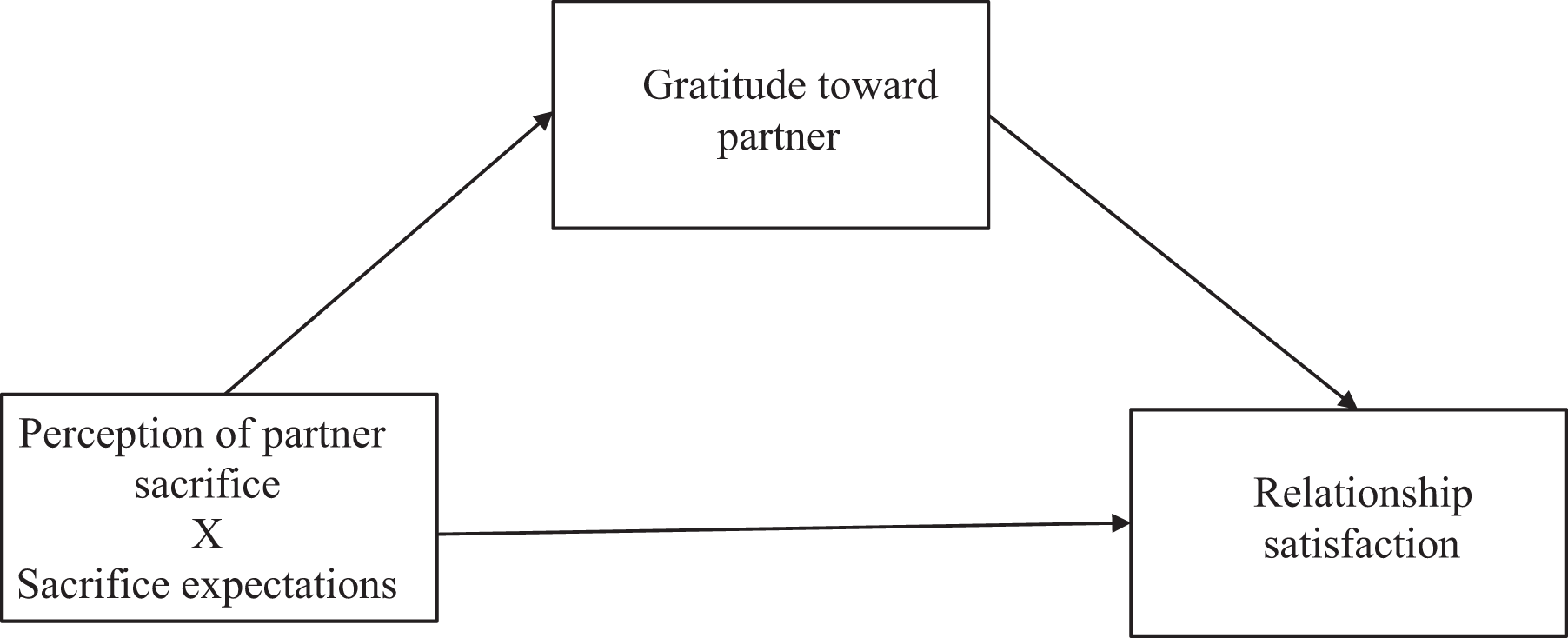
The proposed model: Sacrifice expectation as a moderator between perception of partner sacrifice and relationship satisfaction, mediated by gratitude toward the partner.
Respect and sacrifice expectations
Furthermore, as positive expectancy violations shape people’s perceptions of the provider of the benefit, rendering them more attractive and valuable (Afifi & Burgoon, 2000; Afifi & Metts, 1998; Burgoon & Hale, 1988), we also expect the sacrificing partner to receive an evaluative boost. Specifically, in addition to receivers feeling more grateful after an unexpected sacrifice, the receiver’s appreciation of the partner is also likely to be reflected in greater felt respect toward their partner. Respect is the extent to which one partner views the other as worthy of honor and high regard (Kumashiro, Finkel, & Rusbult, 2002) and is felt when perceiving the other as a good, considerate, and trustworthy person (Frei & Shaver, 2002). Thus, as sacrifice can signal that one cares for and is attentive to their partner (Visserman et al., 2017), witnessing a partner’s sacrifice may also elicit greater overall respect toward the sacrificer. However, again, such positive evaluative boost may only occur in light of a positive violation, when the sacrifice was not expected. In other words, the positive effects of sacrifice on respect may depend on the general sacrifice expectations of the receiving partner. Finally, as respect can elicit greater relationship satisfaction (Frei & Shaver, 2002), we expect that when a positive violation occurs, the respect people feel toward their partner should in turn promote greater relationship satisfaction (see Figure 2).
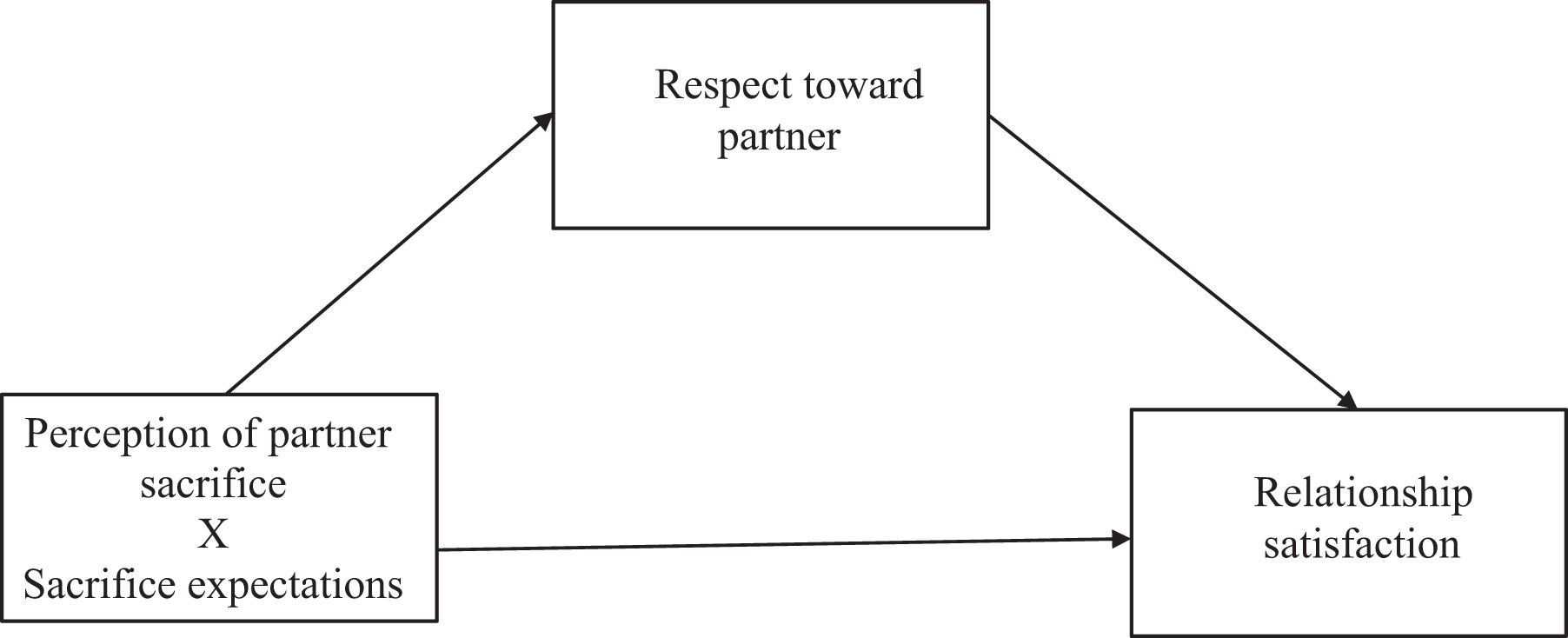
The proposed model: Sacrifice expectation as a moderator between perception of partner sacrifice and relationship satisfaction, mediated by respect toward the partner.
Present study and hypotheses
We used a daily experience procedure to examine whether sacrifice expectations (i.e., the extent to which sacrifice is perceived as necessary, normal, and expected) moderate the relationship between perceiving sacrifices from one’s partner and appreciation for the partner (i.e., gratitude and respect), with consequences for relationship satisfaction. We expect that on days on which participants perceive their partner to have sacrificed, they experience more gratitude and respect for their partner and, in turn, feel more satisfied with their relationship if their sacrifice expectations are generally low, and thus more easily exceeded. In contrast, perceiving their partner to have sacrificed will not affect gratitude, respect, and ultimately relationship satisfaction, when the recipient of the sacrifice strongly believes that sacrifices are to be expected in their relationship.
Methods
Participants
Participants were 126 Dutch couples and 1 individual whose partner dropped out (N = 253). Participants’ mean age was 23.3 years (standard deviation (SD) = 3.7; ranging from 18 years to 43 years). Over half of the participants (63.6%) were students, 34% were working full-time, and 2.4% were both working and studying. Couples reported being involved for 2.8 years (SD = 29 months; ranging from 4 months to 17 years) and 35% lived together. Data comes from a larger project on romantic relationships (see Visserman et al., 2018) and should provide sufficient statistical power (>.80) given anticipated small-to-medium effect sizes (Kenny, Kashy, & Cook, 2006; Maas & Hox, 2005).
Measures and procedure
Participants first came to a laboratory intake session, where they signed an informed consent form before they started their participation. They completed a questionnaire on their general expectations of sacrifice in relationships (α = .85; 4 items; “In general, sacrificing is a necessary component of close relationships,” “People need to sacrifice to preserve a healthy relationship,” “It is normal to engage in sacrifices in close relationships,” “I expect my partner to sacrifice in our relationship”), measured on a 7-point scale (from 1 = completely disagree to 7 = completely agree). They were then instructed on the daily experience study and how to recognize daily sacrifices in their relationship—defined as giving up one’s preferences for the partner or relationship. Experimenters explained that sacrifices could result from mundane differences in interests, and sacrificing must involve a cost to the self, such as foregoing one’s dinner preference to accommodate their partner’s. On the first Saturday after the intake session, participants commenced the diary portion of the study. For 8 days, participants received a short survey on their mobile phone (using Survey Signal; Hofmann & Patel, 2015), with a response rate of 87.6% (1,709 of 2,080 daily reports in total; for full description of procedure, see Visserman et al., 2018).
During the daily experience sampling, partners reported at the end of each day on their gratitude (“Right now, I feel very grateful to my partner”), respect toward their partner (“Right now, I feel a lot of respect for my partner”), and relationship satisfaction (“Right now, I feel satisfied with our relationship”), each measured on a 7-point scale (from 0 = not at all to 6 = very much). They also reported on whether they had perceived their partner to have sacrificed that day (yes/no), which resulted in perceived occurrence of partner sacrifice on 1.91 days on average (SD = 1.73, ranging from 0 to 7 days). The sacrifices that participants reported were relatively mundane, with the average rated costs of sacrifices being rather low (M = 2.75, SD = 1.5, on a 7-point scale). See Table 1 for an overview of the means, SDs, and correlations between key variables.
M, SDs, and correlations of variables of interest.
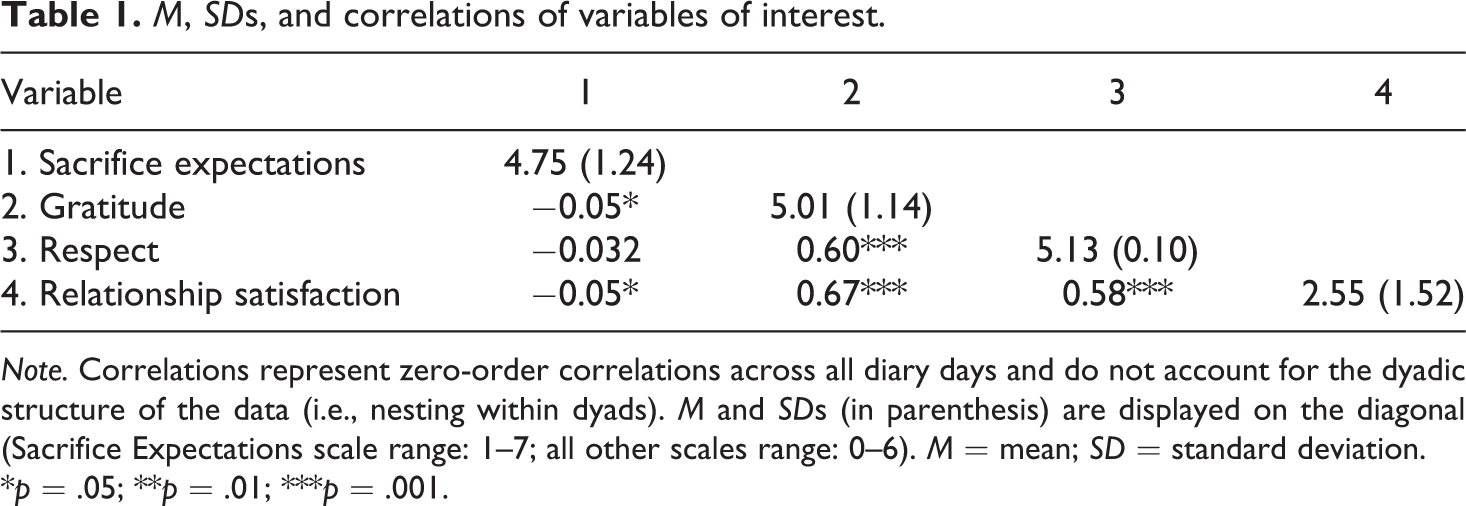
Note. Correlations represent zero-order correlations across all diary days and do not account for the dyadic structure of the data (i.e., nesting within dyads). M and SDs (in parenthesis) are displayed on the diagonal (Sacrifice Expectations scale range: 1–7; all other scales range: 0–6). M = mean; SD = standard deviation.
*p = .05; **p = .01; ***p = .001.
Results
Analysis strategy
Multilevel modeling was used to account for the multiple measurement occasions within participants and the nesting of participants within couples (Kenny et al., 2006). We utilized a two-level cross-model in which participants and the daily measurements within participants (i.e., time) were treated as crossed and nested within the dyad. Dyads were treated as indistinguishable as gender did not moderate the findings. Intercepts were allowed to randomly vary, whereas slopes were treated as fixed effects. Sacrifice expectations were grand-mean centered. To test for mediation, we used the Monte Carlo method for assessing mediation with 20,000 simulations (Selig & Preacher, 2008).
Key analyses
First, we examined a model in which partner sacrifice, sacrifice expectations, and their interaction term were entered to predict gratitude toward partner. As expected, we found that the effect of partner sacrifice on gratitude toward the partner is moderated by sacrifice expectations (b = −.09, standard error (SE) = .04, 95% confidence interval (CI) [−.17, −.01], t = −2.13, p = .034). Next, we conducted simple slope analyses for high (+1 SD) and low expectations (−1 SD). For people with high sacrifice expectations, partner sacrifice only marginally significantly elicited gratitude (b = .13, SE = .07, 95% CI [−.00, .26], t = 1.91, p = .056), while this association was much stronger for people low in sacrifice expectations (b = .34, SE = .07, 95% CI [.20, .49], t = 4.61, p < .001).
Next, we examined a model in which partner sacrifice, sacrifice expectations, and their interaction term were entered to predict respect toward the partner. Again, we found a significant moderation by sacrifice expectations (b = −.09, SE = .04, 95% CI [−.17, −.02], t = −2.45, p = .015). Simple slope analyses were conducted as per the first model. For people with high sacrifice expectations, partner sacrifice was unrelated to respect for the partner (b = −.06, SE = .06, 95% CI [−.18, .06], t = −1.02, p = .308), while for people with low sacrifice expectations, partner sacrifice elicited greater respect for the partner (b = .17, SE = .07, 95% CI [.03, .30], t = 2.43, p = .015).
We then examined a model in which partner sacrifice, sacrifice expectations, and their interaction term were entered to predict relationship satisfaction. In this case, the interaction term marginally significantly predicted relationship satisfaction (b = −.06, SE = .03, 95% CI [−.13, .01], t = −1.76, p = .079). Simple slope analysis revealed that for people with high sacrifice expectations, partner’s sacrifice was unrelated to relationship satisfaction (b = −.01, SE = .06, 95% CI [−.13, .10], t = −.24, p = .812). For people with low sacrifice expectations, partner’s sacrifice was associated with greater relationship satisfaction (b = .14, SE = .06, 95% CI [.01, .27], t = 2.18, p = .030).
To then examine whether the interaction effect of partner sacrifice and sacrifice expectations on relationship satisfaction was mediated by gratitude and respect for partner, we performed a mediated moderation analysis (Muller, Judd, & Yzerbyt, 2005). First, we regressed relationship satisfaction onto partner sacrifice, sacrifice expectations, and gratitude; the interaction between partner sacrifice and sacrifice expectations; the interaction between sacrifice expectations and gratitude; and the interaction between partner sacrifice and gratitude. This analysis revealed a significant main effect of gratitude on relationship satisfaction (b = .47, SE = .02, 95% CI [.43, .51], t = 25.43, p < .001), whereas the interaction effect of partner sacrifice and sacrifice expectations on relationship satisfaction decreased from marginally significant to nonsignificant (b = −.03, SE = .03, 95% CI [−.09, .03], t = −.96, p = .339). The indirect effect was significant (95% CI [−.08, −.005]), indicating that the moderating effect of partner sacrifice and sacrifice expectations was mediated by gratitude (see Figure 3).
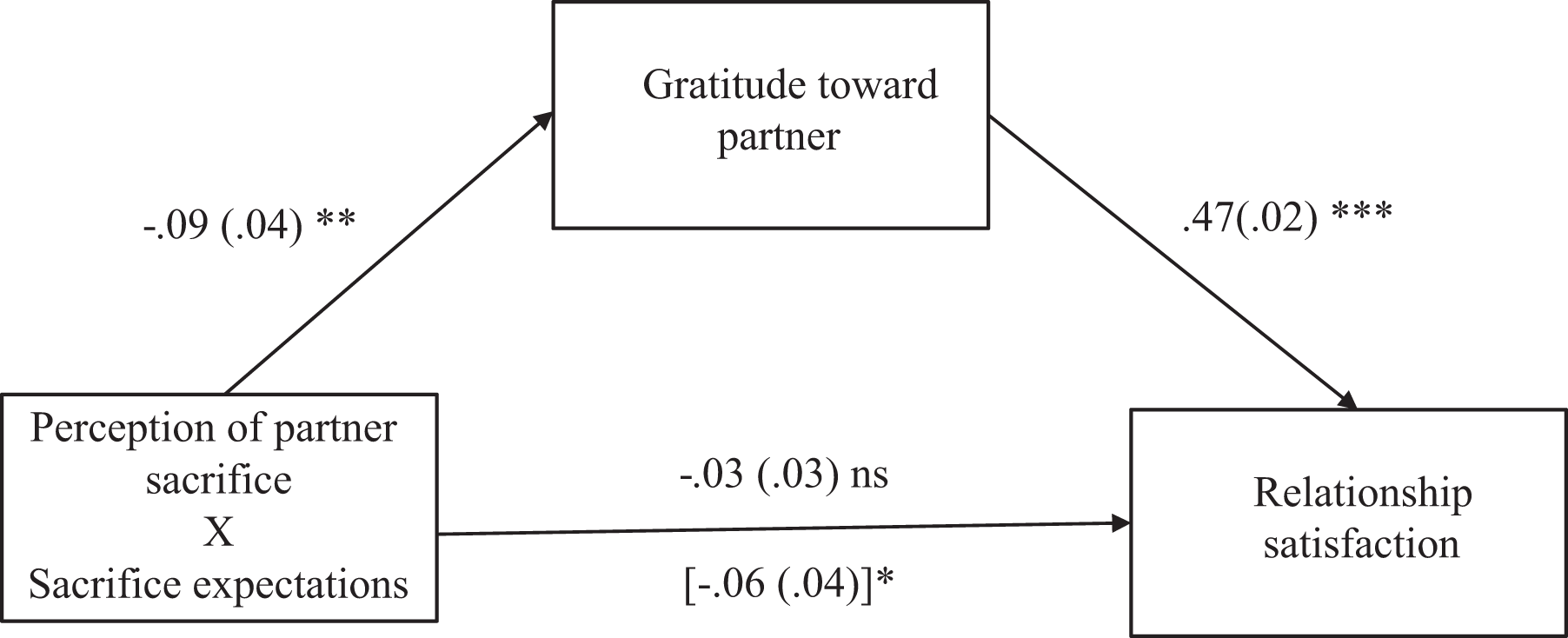
The moderation of partner sacrifice and sacrifice expectations on relationship satisfaction, mediated by gratitude toward the partner. All reported values are unstandardized estimates (b values), with their SE reported between parentheses. Within brackets is the total effect of partner sacrifice and sacrifice expectations on relationship satisfaction. *p < .10; **p < .05; ***p < .01. SE = standard error.
Next, we conducted the same mediated moderation analysis with respect for partner as a mediator and found a significant main effect of respect on relationship satisfaction (b =.41, SE = .02, 95% CI [.37, .45], t = 18.92, p < .001), whereas the interaction effect of partner sacrifice and sacrifice expectations on relationship satisfaction decreased from marginally significant to nonsignificant (b = −.03, SE = .03, 95% CI [−.09, .04], t = −.79, p = .431). The indirect effect was significant (95% CI [−.069, −.005]), indicating that the moderation effect of partner sacrifice and sacrifice expectations was mediated by respect (see Figure 4).
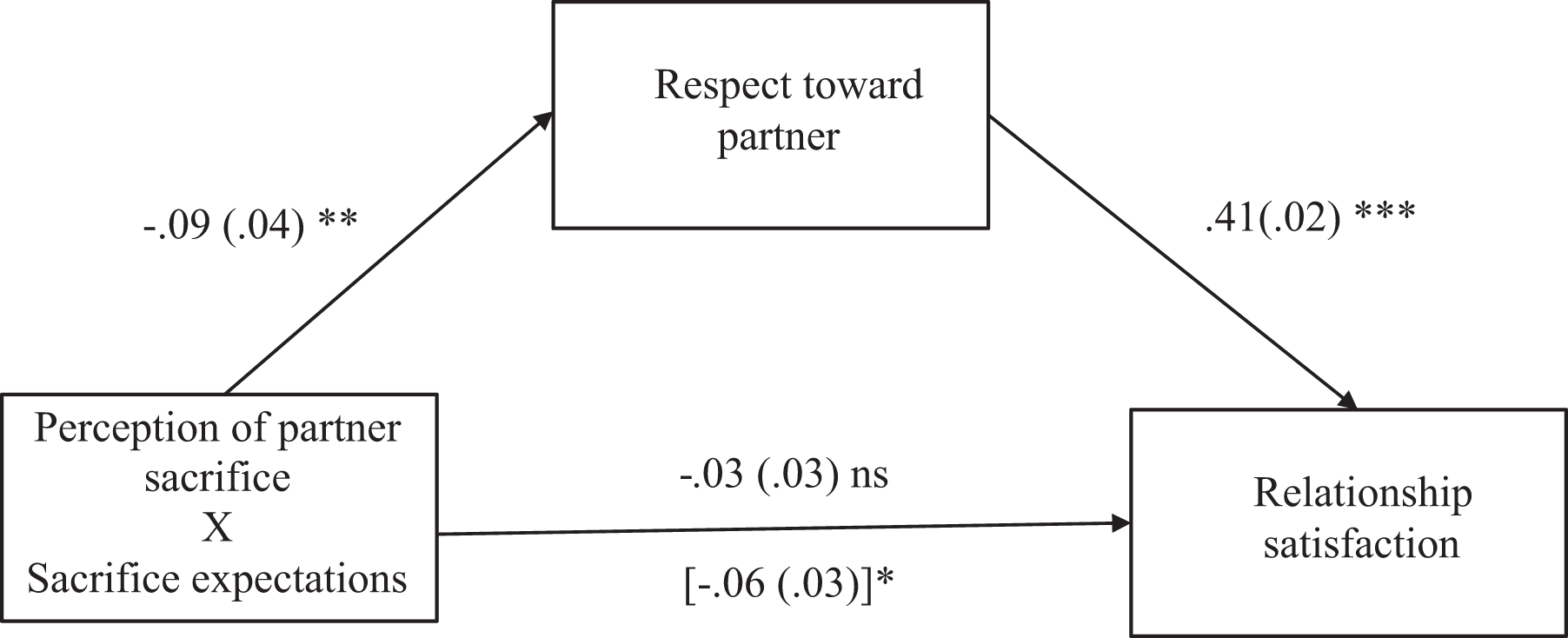
The moderation effect of partner sacrifice and sacrifice expectations on relationship satisfaction, mediated by respect for partner. All reported values are unstandardized estimates (b values), with their SE reported between parentheses. Within brackets is the total effect of partner sacrifice and sacrifice expectations on relationship satisfaction. *p < .10; **p < .05; ***p < .01. SE = standard error.
Finally, to examine whether gratitude and respect were unique mediators, we reran each mediated moderation models controlling for the other mediator. Results confirmed that both gratitude (p < .001) and respect (p < .001) were independent mediators.
Auxiliary analyses
As the data come from a larger study on romantic relationships in which both members of the couple participated, we additionally explored potentially relevant dyadic effects. First, we examined whether the sacrificer’s relationship satisfaction is related to the recipient’s sacrifice expectations and appreciation for them after a sacrifice. Given that relationship satisfaction is influenced by expressions of gratitude and respect (Frei & Shaver, 2002; Gordon et al., 2012), and that receivers are more likely to feel more appreciation toward their partner in light of a positive violation, it would follow that the level of sacrifice expectations that the receiver holds may not only affect the receiver’s but also the sacrificer’s relationship satisfaction. We performed the same mediated moderation analysis as for our key analyses but with the sacrificer’s relationship satisfaction as the outcome. In two separate models, we find that gratitude (b = .13, SE = .02, 95% CI [.09, .17], t = 6.67, p < .001) and respect (b = .11, SE = .02, 95% CI [.06, .15], t = 4.84, p < .001) each promote the relationship satisfaction of the sacrificer. However, the interaction between receivers’ perception of partner sacrifice and their sacrifice expectations did not predict sacrificer’s relationship satisfaction (p = .783). Thus, sacrificer’s relationship satisfaction might not be affected by differing levels of the receiver’s sacrifice expectations when they perceive the partner to have sacrificed.
Second, we examined to which extent partners held similar levels of sacrifice expectations and whether the sacrificer’s expectations interacted with the receiver’s expectations to affect the sacrificer’s relationship satisfaction. For example, if the sacrificer holds low sacrifice expectations while the receiver of the sacrifice holds high expectations, the sacrificer may view their sacrifice as having been particularly worthy of gratitude and respect, but may not receive such appreciation from their partner, and consequently may feel less satisfied with their relationship. Results revealed that partners’ expectations were only weakly correlated (r = .11, p < .001), thus partners hold somewhat different levels of sacrifice expectations. We then tested a three-way interaction with the sacrificer’s own expectations, the receiver’s expectations, and the receiver’s perception of sacrifice predicting the sacrificer’s relationship satisfaction. Although trending, this three-way interaction was not significant (b = .04, SE = .03, 95% CI [−.02, .1], t = 1.41, p = .158). Next, because here we focus on the sacrificer’s relationship satisfaction and perceived sacrifices do not always accurately correspond with sacrificers’ own report of having sacrificed (Visserman et al., 2018), we reran this same model but with the sacrificer’s own report of having sacrificed. Again, the three-way interaction did not reach significance (b = .03, SE = .03, 95% CI [−.02, .09], t = 1.140, p = .255). Thus, the sacrificer’s relationship satisfaction was not affected by partners’ different levels of sacrifice expectations.
Overall then, and in line with previous work, these auxiliary analyses suggest that the perceiver’s gratitude and respect toward the sacrificer promote the sacrificer’s satisfaction with the relationship (e.g., Frei & Shaver, 2002; Gordon et al., 2012). However, perceivers’ sacrifice expectations did not seem to affect the sacrificers’ relationship satisfaction but primarily affect the perceiver’s relationship satisfaction through the gratitude and respect they feel toward the partner.
Discussion
In the present work, we used a daily experience methodology to investigate how expectations shape peoples’ appreciation in response to a partner’s sacrifice. Although previous research on sacrifice in romantic relationships indicates that a perceived sacrifice can elicit gratitude toward the benefactor (Visserman et al., 2018) and that partner appreciation promotes relationship satisfaction (Frei & Shaver, 2002; Gordon et al., 2012), our work examined a critical boundary condition to this effect: sacrifice expectations in relationships. In line with Expectancy Violation Theory (e.g., Afifi & Metts, 1998) and Interdependence Theory (Rusbult & Van Lange, 2003; Thibaut & Kelley, 1959), perceiving a partner’s sacrifice elicited an increase in partner appreciation (i.e., gratitude and respect) and ultimately promoted the receiver’s relationship satisfaction only if the receiver’s sacrifice expectations were low. In this case, a positive expectancy violation occurred as the sacrifice behavior exceeded the receiver’s expectations. The sacrificing partner may be perceived as having gone out of their way in order to benefit the other, thus triggering a positive evaluation from the recipient. In contrast, when the receiver holds high expectations, perceiving a sacrifice was not related to appreciation of their partner and the relationship, as the behavior simply conformed to relational norms. Thus, although sacrifices are an effective mean to resolve inevitable conflicts of interests in relationships (Van Lange et al., 1997), people may not always appreciate this partner’s behavior. The present research supports the argument that certain behaviors in romantic relationships may not be beneficial per se, but rather contingent on other factors, such as the interpretation of such behaviors by the observing partner (Afifi & Faulkner, 2000). Indeed, the role that sacrifice plays in relationship appears to vary based on the general expectations of the receiver, with important implications for the relationship itself.
Broader implications
A possible implication of our key results is that having low levels of sacrifice expectations may sometimes be more beneficial than having high sacrifice expectation, as the receiver is likely to feel more positively toward their partner and the relationship when a sacrifice occurs. Indeed, a sacrificer whose partner has lower sacrifice expectations has greater opportunity to positively impress the receiver. In these situations, the sacrifice sits outside of the regular expected norms of behavior and is thus more likely to capture the attention of the partner than if it were construed as normal. As it represents a positive violation, both the sacrificing partner and the relationship experience an evaluative boost (Afifi & Metts, 1998).
Lower expectations may also be helpful in avoiding negative violations and their undesirable consequences (Afifi & Burgoon, 2000; Afifi & Metts, 1998; Bachman & Guerrero, 2006). Indeed, while not assessed in our investigation, expectations of sacrifice may also be violated when a sacrifice is absent, that is when a sacrifice is expected but does not occur. If expectations are low, partners are less likely to feel hurt and upset by not receiving a sacrifice. Instead, when people hold high expectations of sacrifice and encounter a situation of diverging interests in which they expect their partner to sacrifice, the absence of a sacrifice could more easily trigger a negative expectancy violation. Because of this violation, the partner is likely to place greater attention on the way the other partner has behaved (Afifi & Metts, 1998) and decide how to react. When a violation is viewed as particularly serious, people judge their partner negatively and experience lower relationship satisfaction (Bachman & Guerrero, 2006). This would also suggest that, while partners may not always be appreciated for their sacrifice, engaging in an unappreciated sacrifice may still be more beneficial than not engaging in one, especially if partners hold high sacrifice expectations. In these situations, it may be less costly to sacrifice one’s own self-interest than risk the consequences of a negative violation. Future research could investigate this possibility, and the role of sacrifice expectations and appreciation, more generally, when couples encounter divergence of interests in their relationship and may or may not decide to sacrifice.
The upside of having relatively low expectations is consistent with research, suggesting that romantic partners may, at times, benefit from having somewhat lower standards. A lower standard could mean that the partner has greater chances to meet expectations and to positively impress the partner, thereby creating more room for feelings of satisfaction to arise (e.g., Fletcher, Simpson, & Thomas, 2000; Thibaut & Kelley, 1959). However, low expectations may not always be ideal. High expectations can motivate people to achieve greater goals (e.g., Wigfield & Eccles, 2000), possibly resulting in preferable relational outcomes. Further, as willingness to sacrifice is positively associated with enhanced couple functioning (Van Lange et al., 1997), couples who view sacrifice as normal and expected may benefit from healthier relationship dynamics, as they may be more willing to resolve potentially stressful conflicts of interests. Thus, although the present investigation indicated that sacrifice was unrelated to the receiver’s appreciation and relationship satisfaction for those with high expectations, it is possible that sacrificing is still beneficial in ways that were not captured in the present study. Indeed, future work could investigate ways in which sacrifice may benefit the relationship indirectly, even when it remains unseen, such as by limiting the number of conflicts partners may have.
Recent work reconciles these differing views—whether higher or lower expectations are more beneficial—by proposing that the solution may not lie in the expectation levels per se, but rather in the characteristics of couples (Finkel, Hui, Carswell, & Larson, 2014; McNulty, 2016; McNulty & Karnay, 2004). Couples in which partners possess the ability to reach high expectations—either through their individual, relational, or social attributes—benefit from high standards, as partners can push each other to grow and commit further to the relationship. On the other hand, those who face challenges in meeting those standards—due to personal, relational, or social challenges—experience greater relationship satisfaction when standards are lower (McNulty, 2016). In both cases, an appropriate level of expectations can set couples up to succeed as meeting and surpassing expectations is predictive of greater relationship outcomes, while falling short of expectations can have deleterious consequences (Afifi & Burgoon, 2000; Afifi & Metts, 1998; Thibaut & Kelley, 1959). Thus, it is possible that partners with greater levels of sacrifice expectations benefit from these high standards only when their partner is capable and willing to meet such high expectations. When these high expectations are surpassed—even if only from time to time—partners benefit from greater felt appreciation for one another, contributing to the well-being of the relationship (Algoe et al., 2010). In light of this reasoning, the benefits of high and low sacrifice expectations may be context dependent (Lemay & Venaglia, 2016) and may differ based on the characteristics of the partners within the couple.
The current findings on the emergence of gratitude and respect as contingent on people’s general expectations of sacrifice have practical implications for research and practice. Considering that beliefs and expectations in romantic relationships tend to be quite resistant to change (Johnson, 2011; Sharp & Ganong, 2000) and that the effects of high and low expectations are contingent on the couple’s skills and abilities to meet expectations, research in this area could focus on how partners can improve at exceeding each other’s expectations. For example, as people tend not to notice half of their partner’s sacrifices (Visserman et al., 2018), future work could look into how partners can better notice the acts of love and care offered, thus allowing for the opportunity to meet or exceed expectations for the sacrifices that are already being made within the relationship. Future research could also investigate whether the verbalizations of expectations to one another could help partners better meet each other’s expectations and avoid negative violations. As behavioral norms are often implicit and unspoken (Rusbult & Van Lange, 1996), it is no surprise that people can even unknowingly or accidentally negatively violate their partners’ expectations as well as miss opportunities to engage in positive violations. Practitioners working with couples could focus on equipping their clients with skills to help reach and surpass expectation, as the successful deployment of such skills is linked with relationship quality (Hawkins, Blanchard, Baldwin, & Fawcett, 2008; McNulty & Karney, 2004). Moreover, understanding how people can lower their expectations—even if challenging—and when it is most appropriate to do so, would also be a valuable focus for research and practice, particularly for couples who struggle to develop the skills necessary to meet each other’s expectations.
Strengths and limitations
A major strength of the present investigation is the use of daily experience sampling. This methodology offers an ecologically valid account of couples’ everyday interactions and perceptions by capturing reactions to partners’ behavior in their natural environment and close to their occurrence, and thus limiting retrospective bias (Bolger, Davis, & Rafaeli, 2003). By doing so, the present research provides an important contribution to the growing literature on sacrifice behaviors as they naturally occur in close relationships (Righetti & Impett, 2017) and provides new insights into critical boundary conditions that determine the daily relational consequences of sacrifice.
However, a limitation of the same research method is the correlational nature of the data, and thus casual conclusions cannot be made. Future research could employ experimental procedures (e.g., manipulating sacrifice expectations) to establish causality. Furthermore, although the present research investigated partners’ sacrifices in couples’ daily lives, the current findings are bound to relatively mundane types of sacrifices. A larger sacrifice such as moving to a different city or country to support a partner’s career represents a costlier sacrifice as compared to giving up a dinner preference. Such sacrifice may be perceived as much less normal, and the receiving partner may feel particularly appreciative toward their partner, especially if they do not view sacrifice as an expected and normal part of the relationship—a result that would be in line with the present investigation. However, they may also feel guilty, burdened, or indebted by the enormity of the sacrifice, which could detract from their relationship satisfaction. Future research could investigate the role of sacrifice expectations in costlier sacrifices.
In addition to the relatively mundane nature of the sacrifices captured within the study, another boundary condition of the present investigation is that the couples’ relationships were relatively young (2.8 years, SD = 29 months). While we are unaware of any longitudinal research on the evolution of expectations over the course of a relationship, initial evidences suggest that although expectations tend to be generally stable over time (Johnson, 2011), they can also be subject to change (e.g., following an educational intervention; Sharp & Ganong, 2000). In such cases, based on the direction of the change (higher or lower levels of sacrifice expectations), people may experience more or less appreciation toward their partner in response to sacrifice that they would have at an earlier stage in the relationship. Thus, given the implications of gratitude and respect on relationship satisfaction, understanding the evolving nature of expectations (and the extent to which they do change) would be a fruitful avenue for future research.
Furthermore, it is worth noting that the sample included only Dutch couples, and thus results should be interpreted within this cultural context. However, previous work investigating sacrifice and gratitude in romantic relationships (Visserman et al., 2017, 2018) found parallel findings for both a Dutch and American sample. This suggests that the role that sacrifice expectations play within romantic relationships will be similar in other Western cultures such as the U.S.
Finally, the present investigation offers an important theoretical contribution to the romantic relationship literature by presenting an important boundary condition to the emergence of gratitude and respect in romantic relationships. Indeed, while the positive role that gratitude plays in romantic relationships is widely studied and acknowledged within relationship science (e.g., Algoe et al., 2010; Gordon et al., 2012), the nuances of how gratitude is triggered— and thus the boundary conditions under which it operates—still remain a fertile ground for investigation. Secondly, and perhaps contrary to gratitude, respect has received little attention in the romantic relationship literature, despite initial evidence for its central role in relationship satisfaction (Frei & Shaver, 2002). In the present study, we find that respect—just like gratitude—also plays an important part in the link between sacrifice and relationship satisfaction. Thus, we argue that more attention should be placed on examining the role of respect within couples.
Conclusion
Conflicts of interest are inevitable in any romantic relationship. To navigate through these potentially stressful situations, partners can sacrifice their own self-interest and benefit the relationship (Righetti & Impett, 2017). Our findings suggest that individual differences in beliefs about whether sacrifice behaviors are normative in a relationship are important for relationship outcomes. While sacrificing is an essential pro-social behavior in committed relationships, it may not always be met with appreciation by the receiving partner. Thus, the present work highlights the complexity of sacrifice and offers a more nuanced view on whether sacrificing may benefit or harm the relationships (Righetti & Impett, 2017). When receivers hold low expectations, only then is this behavior perceived and welcomed as a nice surprise.
Footnotes
Funding
The author(s) disclosed receipt of the following financial support for the research, authorship, and/or publication of this article: This research was supported by a grant from the Netherlands Organization for Scientific Research [451-12-024] awarded to Francesca Righetti.

Open research statement
As part of IARR’s encouragement of open research practices, the authors have provided the following information: This research was not pre-registered. The data used in the research are available. The data can be obtained by emailing: