




Abstract
Some lay beliefs people hold are harmful to their romantic relationships because they reduce relationship satisfaction. Two studies were conducted in two different national settings (N = 253 in the UK and N = 132 in Hungary) to test the effects of three potential dysfunctional beliefs: an aversion to disagreement between the partners, an expectation that mindreading should happen, and a belief that relationships are formed due to destiny. When predicting two different indices of relationship satisfaction, consistently across both national settings, results revealed that an aversion to disagreement was negatively linked with relationship outcomes, whereas the other two beliefs were not. Findings are discussed in terms of their applied value: Those working with struggling couples will want to know which lay beliefs, out of several potentially dysfunctional beliefs, have the strongest negative effect on relationship outcomes because those should be tackled first in interventions.
Keywords
Some couples seem blissfully happy together, and others seem to loath each other’s company. Many factors have been linked to romantic relationship satisfaction, from external pressures that put strain on relationships (e.g., money worries; Relate, 2020) to personality factors such as neuroticism in one or both of the partners (Solomon & Jackson, 2014). One issue that is likely to affect levels of relationship satisfaction are expectations of what is normal, normative, and desirable in relationships. The literature on relative deprivation (Smith & Pettigrew, 2015) suggests that whether or not people are satisfied with certain outcomes depends on the comparisons they make: with other people, with themselves in the past, and with expectations they hold (Brown & Zagefka, 2006; Festinger, 1954; Zagefka & Brown, 2005). Hence, lay theories about what should happen in romantic relationships should also inform how content people are with the state of their romantic ties. Lay beliefs (Fehr, 1999) that amount to expectations that are unrealistic and unattainable will have harmful effects because they will lead to normal romantic interactions being perceived as less than ideal or unacceptable (Sullivan & Schwebel, 1995). Such beliefs are thus potentially dysfunctional because they hamper the formation of healthy romantic bonds. This article aims to investigate beliefs that potentially have a harmful effect on relationship satisfaction. Specifically, the focus will be on three beliefs: (a) a belief that disagreement in relationships is a sign of something being wrong (aversion to disagreement), (b) a belief that it is a sign of something being wrong in the relationship when the partner does not know intuitively and without discussion what one thinks or wants (mindreading expected), and (c) a belief that relationships are not the result of compromise and work but are formed due to a higher order power or fate (belief in destiny).
Review of previous work
There are some important previous studies that have investigated the effects of lay beliefs on relationship satisfaction. The work by Eidelson and Epstein (1982) represents maybe the most focused attempt to generate an inventory of harmful beliefs that can be useful in counseling contexts. The authors identified five potentially harmful beliefs, that is, “disagreement is destructive,” “mindreading expected,” “wish to be sexually perfect,” “sexes are different,” and “partners cannot change.” However, as will be discussed below, not all of these dimensions appear to have satisfactory psychometric properties (James et al., 2002).
A further seminal paper on lay theories of relationships is the work by Knee (1998). This work juxtapositions a “belief in destiny” (partners are either meant for each other or they are not) with a “belief in growth” (relationships can grow and develop through work, see also Cobb et al., 2013). This distinction draws on the work by Dweck (2006) and others which has investigated, across many domains but with a particular focus on achievement, lay beliefs that suggest that attributes and outcomes are either fixed (destined) or developed (grown). Believing in one or the other has been shown to have important consequences, for example, when it comes to beliefs about intelligence and subsequent motivation to achieve and the effort expended to achieve certain goals (Dweck et al., 1995). Applying the distinction between fixed or malleable traits to the topic of relationships, Knee (1998) found that a belief in destiny (rather than growth) can have a positive effect on relationship longevity: The relation between initial satisfaction and relationship longevity was stronger for those who believe in romantic destiny.
Various other scales have been proposed to measure different relationship-relevant lay beliefs. The Romantic Beliefs Scale by Sprecher and Metts (1989; see also Sprecher & Metts, 1999) emphasizes the dimensions “love finds a way,” “one and only,” “idealization,” and “love at first sight.” Regan (1998) focuses on lay beliefs about the “role of sexual desire” in romantic relationships. More recently, Franiuk et al. (2012; see also Vannier & O’Sullivan, 2017) have distinguished between a “soulmate theory” (need to find the right person to have a successful relationship) and a “work-it-out theory” (relationships require work to be successful).
Lack of more recent work
However, as can be seen from this literature review, research activity on this topic peaked in the 1980s–1990s, and few more recent studies are available. Of course, society and ideas about relationships evolve. For example, same-sex relationships have been legalized and become more widely socially accepted in many countries since then. Indeed, several of the scales tested in the 1990s were geared toward heterosexual couples: For example, the Eidelson and Epstein (1982) Relationship Belief Inventory (RBI) includes a dimension on the idea that male and female sexes are fundamentally different, and this belief is clearly less relevant to nonheterosexual couples. Surely, relationship counselors working with couples will wish to know whether the findings from 20 years ago still apply, and they would wish to consult evidence that potentially speaks to a wider range of romantic couples, beyond the heterosexual mold. This is what the current article aims to offer.
Behaviors stemming from lay beliefs
Various other theoretical approaches to the study of romantic relationships do not directly investigate lay beliefs, but they emphasize behaviors or patterns people engage in that can be assumed to be rooted in lay beliefs and assumptions people make about what is desirable or appropriate within romantic contexts. This work provides further evidence that beliefs can be a powerful driver of behavior in couples and that these beliefs therefore merit examination. One example of this is the work by Hendrick and Hendrick (1986) who argue that people have different “love styles,” that is, modes of relating to romantic partners. Another example is the Relationship Profile Test, in which Bornstein and Huprich (2006) measure certain relationship patterns (“destructive overdependence,” “dysfunctional detachment,” and “healthy dependency”) that are theoretically rooted in attachment theory (Ainsworth et al., 1978; Feeney, 1996; Julal & Carnelley, 2012). Although neither love styles nor relationship patterns are the same as relationship beliefs, they can be assumed to be derived from and based on certain relationship beliefs or lay theories that may or may not be implicit or unconscious.
Origins of lay beliefs about relationships
There is widespread agreement among scholars that romantic behavior and patterns stem from experiences when growing up (Amato, 1996; Sinclair & Nelson, 1998; Yu & Adler-Baeder, 2007), and this can also be assumed to be true for people’s lay theories about marriage and romantic relationships more broadly (Masarik et al., 2013). In direct support of this idea, Sinclair and Nelson (1998) found that having divorced parents affected at least one of the relationship beliefs from the RBI (Eidelson & Epstein, 1982). In sum then, there are many lay beliefs that might stem from prior experiences and that might affect relationship satisfaction although notably many of the studies are now somewhat dated.
Rationale for choosing the relationship beliefs to be investigated here
Given that Eidelson and Epstein’s (1982) inventory was one of the first seminal approaches to the study of relationship beliefs, and probably the one that has attracted the most widespread interest (see, e.g., the work based on the RBI conducted by Bradbury & Fincham, 1993; Goodwin & Gaines, 2004; Holt et al., 2016; James et al., 2002), we used the RBI as a starting point. However, Eidelson and Epstein’s (1982) goal was to validate the RBI, and they did not focus on the question of which of their five dimensions is most strongly related to relationship outcomes, and which belief should therefore be prioritized in treatment. But, this question will be very relevant to counselors trying to design interventions intended to improve relationship quality. The goal of the present contribution was to speak to this question. It was chosen to focus on only two of Eidelson and Epstein’s (1982) original five dimensions, for two reasons. First, it has been noted that the psychometric properties of the RBI leave room for improvement (Bradbury & Fincham, 1993). James et al.’s (2002) investigation into the factor structure of the RBI revealed that two of the original dimensions (“sexes are different” and “partners cannot change”) had problematic psychometric properties, which meant we ruled them out for the current investigation. Another reason for dropping the “sexes are different” dimension was that it only applies to heterosexual couples and we did not, as outlined above, limit our focus in this way. Second, out of the three dimensions which performed well in James et al.’s (2002) analysis (“disagreement is destructive,” “mindreading expected,” and “wish to be sexually perfect”), the first two are potentially relevant to counselors’ interventions focused on couple interaction, whereas the latter would be more relevant to treatment focused on sexual dysfunction. We wanted to limit the present focus to couple interaction via communication and not via sexual behavior, and we hence retained only the first two dimensions.
Given the immense body of work in support of the importance of implicit theories across different dimensions (Dweck, 2006), we concluded that Knee’s (1998) application of these concepts to romantic relationships in the form of “destiny beliefs” is another aspect that should be included. The present contribution focused on destiny rather than growth beliefs because the present focus was on potentially harmful beliefs that might be addressed during couple counseling. Growth beliefs have typically been associated with desirable outcomes (Dweck, 2006). Notably, although Knee (1998) studied destiny beliefs, those were linked to coping mechanisms in response to relationship stressors and conceptualized as moderators of effects on relationship longevity. Knee did not directly test the effect of a belief in destiny on relationship satisfaction, so this remains an open question the current investigation aimed to address. In sum then, the present research focused on aversion to disagreement, mindreading expectations, and belief in destiny.
Applied relevance of the present work
If lay beliefs about romantic relationship have the potential to negatively impact relationship satisfaction, then they are a prime leverage point for counselors to use in couple interventions. One reason for this is that lay beliefs can be assumed more malleable than many other factors that put strain on couples. Of course, there is evidence that people often have strongly held beliefs about romantic relationships and that they might be motivated to defend these beliefs and ideologies when challenged (Day, 2016). However, there is also evidence that lay beliefs about romantic relationships are malleable and changeable (Canevello & Crocker, 2011). Indeed, it will be easier for counselors to encourage reflection on beliefs than it will be to try to change many other factors that impact on relationships, such as the clients’ personality and neuroticism (Solomon & Jackson, 2014), or external stressors such as financial hardship. Lay beliefs, then, have excellent potential for the design of effective interventions.
There are indeed some promising findings that demonstrate that interventions can successfully correct dysfunctional relationship beliefs. Holt et al. (2016) focused on the classic RBI (Eidelson & Epstein, 1982) and ran a randomized controlled trial to examine how a relationship education intervention affected maladaptive relationship beliefs. They found the intervention to be effective in the correction of maladaptive relationship beliefs although the mode of delivery mattered: Facilitated group discussion proved much more powerful than self-facilitated online delivery of the intervention. Nonetheless, these results are encouraging for the potential to achieve positive change by addressing beliefs. An open question that remains and that will be addressed here is which beliefs have the strongest negative impact on relationship satisfaction and should therefore be the main focus of interventions.
In sum, the aim of the investigation was to test which of the three potentially dysfunctional beliefs (aversion to disagreement, mindreading expectations, and belief in destiny) would have the strongest effect on relationship satisfaction and should therefore be prioritized by counselors during treatment. This was investigated in two studies and in two different national contexts to test the generalizability of the results: The first study had a British sample and the second one a Hungarian sample.
British Study
Method
Participants
Two hundred fifty-three people in Britain currently involved in a romantic relationship participated in the study (197 females, 56 males, mean age 23.13 years). This was a convenience sample accessed by undergraduate research assistants recruiting via their personal contacts and encouraging the recruitment of others via a snowballing effect. A sample size of 200 was aimed for, and data collection was stopped upon the first check that revealed that the sampling goal had been met. This cross-sectional correlational study included the following measures.
Measures
The three types of dysfunctional relationship beliefs were measured with items adapted from the RBI by Eidelson and Epstein (1982; 1 = strongly disagree to 7 = strongly agree). Aversion to disagreement was measured with two items: “When my partner and I disagree, I feel like our relationship is falling apart” and “I find it really hard to handle when we have a disagreement,” α = .77.
Mindreading expectations were measured with three items: “A partner should know what you are thinking and feeling without you having to tell,” “My partner should know me inside out, so that I don’t have to explain what I think,” and “If a couple works well, they should understand each other without needing to talk,” α = .80.
Belief in destiny was measured with three items: “Potential relationship partners are either destined to get along or they are not,” “Whether a couple works out or not is due to fate more than anything,” and “My partner and I have found each other because it was written in the stars,” α = .65.
Relationship satisfaction was measured with the one-item measure previously used by Solomon and Jackson (2014): “How satisfied are you with your romantic relationship?” (0 = not at all to 10 = very much).
Relationship evaluation was measured with two items adapted from La Guardia et al. (2000; 1 = strongly disagree to 7 = strongly agree): “I feel loved and cared about by my partner” and “I feel a lot of closeness and intimacy with my partner,” α = .83.
The questionnaires for both studies also included a number of other questions which are not relevant in the present context and which will not be discussed further here. Full materials are available upon request. All aspects of the research were in line with the ethics guidelines of the American Psychological Association and the British Psychological Society. Participation was voluntary and no monetary compensation was offered. The data for both studies are available from the author upon request.
Results
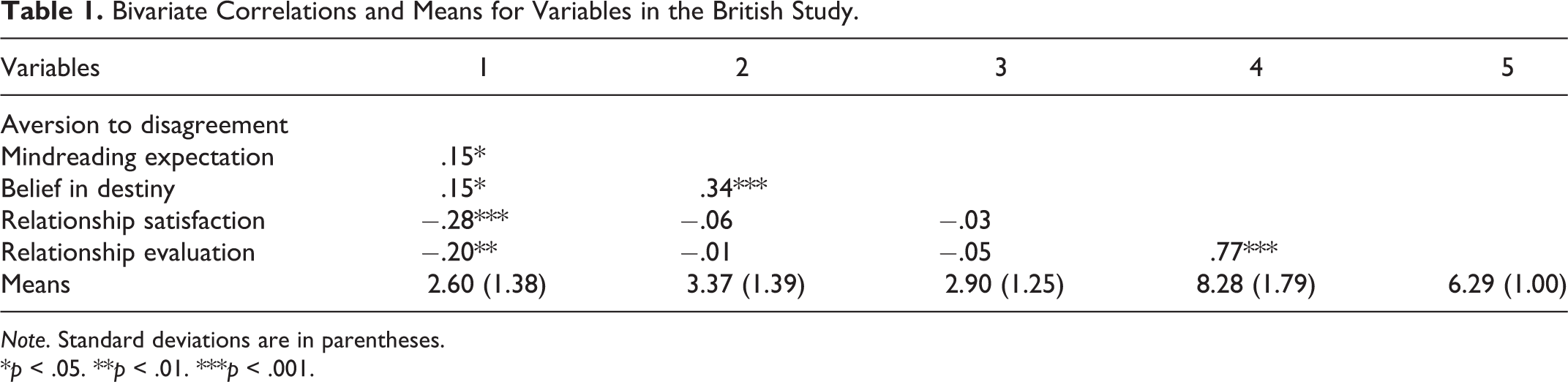
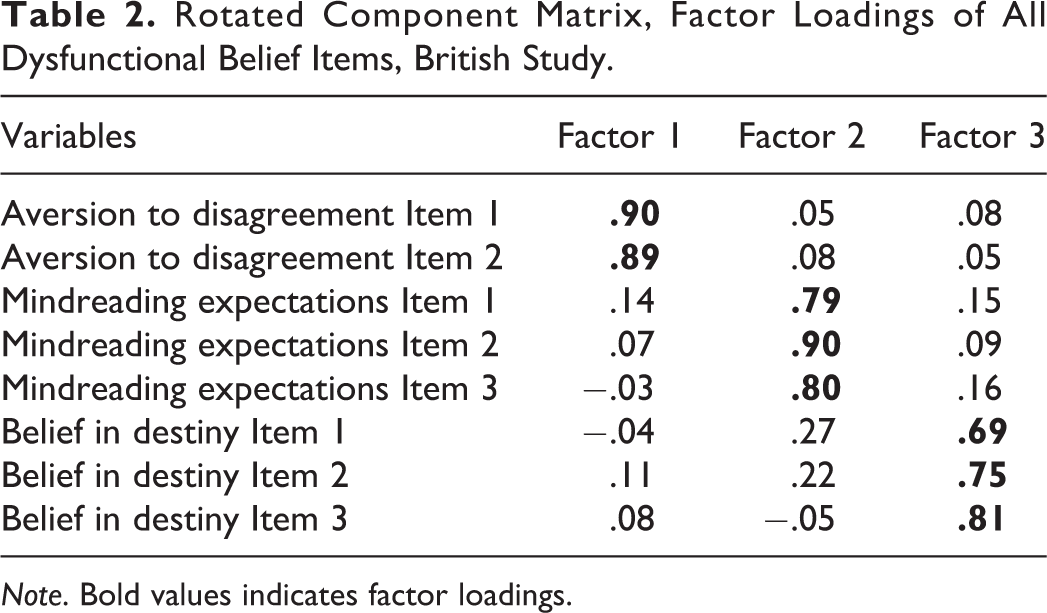
Descriptives and bivariate correlations for all measures are displayed in Table 1. To ensure that the three types of dysfunctional relationship beliefs would indeed be empirically distinct from each other, before testing the main hypothesis a factor analysis was conducted with Varimax rotation to ascertain that the dysfunctional belief items would indeed load on three distinct factors. Using an extraction criterion of eigenvalue = 1, as expected three factors were extracted, and the factor loadings were in line with expectations, as seen in the rotated component matrix in Table 2.
Bivariate Correlations and Means for Variables in the British Study.
Note. Standard deviations are in parentheses.
*p < .05. **p < .01. ***p < .001.
Rotated Component Matrix, Factor Loadings of All Dysfunctional Belief Items, British Study.
Note. Bold values indicates factor loadings.
To test the effect of the three types of dysfunctional beliefs on relationship satisfaction, two regressions were run, one with relationship satisfaction as criterion and one with relationship evaluation as criterion. When predicting relationship satisfaction, the overall model was significant, R 2 = .08, p = .001. Neither mindreading expectations (β = −.02, ns) nor belief in destiny (β = .01, ns) significantly predicted the outcome but aversion to disagreement did (β = −.28, p = .001). When predicting relationship evaluation, the overall model was significant, R 2 = .04, p = .05. Neither mindreading expectations (β = .03, ns) nor belief in destiny (β = −.04, ns) significantly predicted the outcome but aversion to disagreement did (β = −.19, p = .01). Hence, across both outcome measures that tap into relationship satisfaction, aversion to disagreement was the only dysfunctional belief that had a significant effect.
Given that the first study was more exploratory in nature, with no specific a priory expectation held that aversion to disagreement would prove to be more important than the other two beliefs, it was deemed important to replicate this finding. To test whether effects would hold across different cultural settings, the second study was run not in Britain but in Hungary. It was expected that, once again, aversion to disagreement would have a stronger impact on relationship satisfaction than mindreading expectations and belief in destiny.
Hungarian Study
Method
Participants
One hundred thirty-two Hungarians currently involved in a romantic relationship participated in the study (104 females, 28 males). Participants were slightly older than for the British sample, with only 3% being 23 or younger, 18% being between 24 and 29, 33% being between 30 and 39, 19% being between 40 and 49, and the rest being older. Again, this was a convenience sample accessed by student research assistants recruiting personal contacts and encouraging them to recruit others via a snowballing effect. A sample size of 100 was aimed for, and data collection was stopped upon the first check that revealed that the sampling goal had been met. This cross-sectional correlational study included the following measures.
Measures
The three types of dysfunctional relationship beliefs were measured with the same items as before but on 6-point scales (1 = strongly disagree to 6 = strongly agree), with the following changes: Aversion to disagreement also included an additional item: “In a good relationship, there should not be much disagreement,” α = .60. Mindreading expectations were measured with the same three items as before, α = .81. Belief in destiny was measured with the same three items, but the scale had suboptimal reliability in the Hungarian context, α = .32. Therefore, only the first item was retained as an index for this construct.
Relationship satisfaction was measured with the same item from Solomon and Jackson (2014) as before, but in addition to the two items measuring Relationship evaluation in the British sample now a third, reverse-scored item was included in the index: “I feel a lot of distance in our relationship,” α = .89 for all three items.
Results
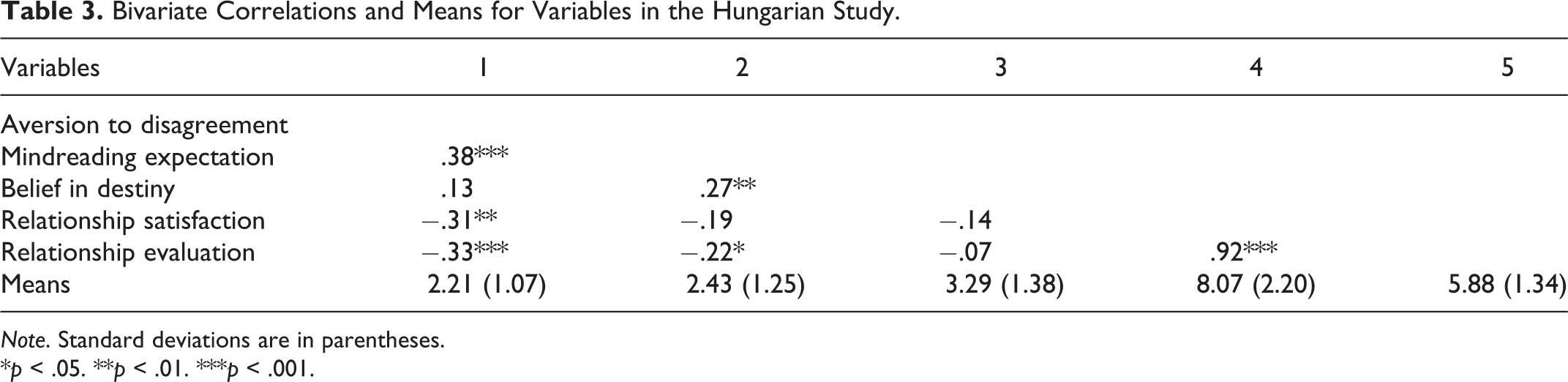
Descriptives and bivariate correlations for all measures are displayed in Table 3. To test the effect of the three types of dysfunctional beliefs on relationship satisfaction, two regressions were run, one with relationship satisfaction as criterion and one with relationship evaluation as criterion. When predicting relationship satisfaction, the overall model was significant, R 2 = .13, p = .05. Neither mindreading expectations (β = −.12, ns) nor belief in destiny (β = .17, ns) significantly predicted the outcome but aversion to disagreement did (β = −.27, p = .03). When predicting relationship evaluation, the overall model was significant, R 2 = .14, p = .01. Neither mindreading expectations (β = −.14, ns) nor belief in destiny (β = .14, ns) significantly predicted the outcome but aversion to disagreement did (β = −.29, p = .01). Hence, once again, aversion to disagreement was the only dysfunctional belief that had a significant effect.
Bivariate Correlations and Means for Variables in the Hungarian Study.
Note. Standard deviations are in parentheses.
*p < .05. **p < .01. ***p < .001.
General Discussion
The present contribution suggests that in order to most effectively treat couples who struggle with unrealistic expectations, counselors should focus on aversion to disagreement, which seems to have a stronger impact on relationship satisfaction than mindreading expectations or a belief in destiny. This was true consistently across two cultural contexts, Britain and Hungary. In a nutshell, in order to improve relationship satisfaction, it seems pertinent to teach couples not only how to disagree constructively, which is already the focus of many couple interventions (Hendrix & LaKelly Hunt, 2013; Lebow et al., 2012; Moore, 2016; Rosenberg, 2003). What seems also crucially is to teach clients something more basic than that: the fact that disagreement in romantic relationships is normal, and not the sign that there is something fundamentally wrong with the relationship.
From their lay theories about relationships, people extrapolate behavioral guidelines. Lay theories affect information processing, that is, they affect the lens through which people perceive the world (Fehr, 1999). They inform whether people feel that their relationship meets their expectations and whether they want to continue or terminate the relationship. Problems arise when lay theories result in unrealistic expectations. Of course, it is desirable for someone to terminate a relationship because there is an unacceptable level of frequent, vehement, or violent disagreement. However, most counselors will see it as their duty to prevent relationship breakdown over minor routine disagreements that are to be expected in any relationship. Such minor disagreements might seriously jeopardize relationship health when dysfunctional, harmful beliefs about the role of disagreement in relationships is present, and counselors could work with couples on the clients’ beliefs that in good relationships disagreements should not arise.
The message that aversion to disagreement is detrimental to relationship functioning is in line with the bivariate correlations originally reported by Eidelson and Epstein (1982) 40 years ago. It is also in line with research that shows that romantic partners who believe that conflict should be avoided subsequently report lower marital happiness (Crohan, 1992). Further corroborating evidence comes from Cramer (2004) who manipulated relationship conflict by having some participants imagine an important conflict in their relationship and imagining holding beliefs about the destructiveness of disagreement in relationships. These manipulations significantly affected relationship satisfaction. A belief that disagreement is destructive reduced relationship satisfaction, especially in situations of actual disagreement (Cramer, 2004). Taken together, then, there are several pieces of evidence that corroborate the present results, that is, that an aversion to disagreement has detrimental effects for relationship satisfaction.
There are several exciting avenues for future research. As mentioned at the start, this contribution focused on beliefs about what constitutes healthy verbal communication in couples. However, of course, another important aspect of healthy romantic relationships is healthy sexual functioning. Beliefs about this could be included in research going forward (e.g., by using a version of Eidelson and Eidelson’s, 1982, “Sexual Perfection” Scale). Effects found here were rather small, and future research could focus on other factors that explain variance in the outcomes.
Another interesting issue for future research would be to investigate the effects of helpful, rather than harmful, relationship beliefs. As mentioned above, growth beliefs (the idea that attributes and skills can be improved via practice and effort; Dweck, 2006) are often linked to favorable outcomes, and future research could test the effects of this and potentially other protective lay theories that help—rather than hinder—relationship satisfaction.
Finally, another interesting issue would of course be to test whether the patterns found here would generalize to yet other cultural settings, beyond Britain and Hungary. Indeed, there is some prior evidence that suggests that the effects of dysfunctional beliefs are not necessarily constant across cultures (Goodwin & Gaines, 2004), so this would be an important avenue for future exploration, especially given the fact that many counselors operate in urban, highly multicultural settings. Those working with diverse client bases will want to know whether or not insights are culturally appropriate to clients from different backgrounds (Sam & Berry, 2006; Tip et al., 2012).
Last but not least, future research could look into the boundary conditions of the effects found here. Rather than concluding that certain beliefs are, on average and overall, harmful or helpful, this research could test whether the effects of lay beliefs might depend on the situational circumstances. As emphasized by the findings by Knee (1998), certain beliefs can have good or bad effects depending on context: Although often beliefs in attitudes being fixed rather than malleable is associated with less desirable outcomes (Dweck et al., 1995), Knee found that beliefs in destiny can have positive effects on relationship longevity under certain circumstances. When testing boundary conditions of the effects of certain beliefs, one topic of particular interest should be interactions between beliefs brought to a relationship by both partners. The work on intergroup relations shows that the effects of one group’s beliefs often depend on the degree of fit with the other group’s beliefs (Bourhis et al., 1997; Zagefka & Brown, 2002). Likewise, the effects of one romantic partner’s beliefs might depend on the effects of the other partner’s beliefs. Indeed, there is some evidence that certain relationship beliefs are more harmful when the fit between partners is poor as well (Franiuk et al., 2012). For example, an aversion to disagreement might be particularly harmful if it is shared by both partners because then neither partner will be willing to confront problems. Alternatively, an aversion to disagreement might be less harmful if it is shared by both partners because partners then concur on how the relationship should be conducted. Both effects seem plausible, and future research could focus on such interactions between both partners’ beliefs.
In sum, then, the present study shows that aversion to disagreement has a stronger detrimental effect on relationship satisfaction among romantic couples than an expectation that the partner should “mindread” or a belief that couples find each other through “destiny.” An important take-home message for relationship therapists is that struggling couples might need to be taught not only how to disagree but also to accept the basic fact that disagreement in relationships is “normal.” Having said this, much work still needs to be done to test the cultural specificity of these effects and to test how beliefs of both people in a couple might interact with each other in affecting relationship outcomes.
Footnotes
Declaration of Conflicting Interests
The author(s) declared no potential conflicts of interest with respect to the research, authorship, and/or publication of this article.
Funding
The author(s) received no financial support for the research, authorship, and/or publication of this article.
