



Abstract
Third-party punishment communicates with offenders to resocialize them. However, little is known about what it communicates to victims. Considering group contexts, the current research focuses on the effects on victims of either one individual or the entire group punishing offenders. Five preregistered experiments (N = 1,231; student and online adult samples from Germany and the United Kingdom) demonstrate that various forms of third-party punishment empower victims (Studies 1, 3, 4, and 5) and that this effect is amplified when the entire group supports the punishment (Studies 1–4). Sequential mediation analyses and experimental designs show that punishment restores value consensus, which in turn revalidates victims’ group membership status, thereby empowering victims. Regardless of explicit messages, stand-alone punishment empowers victims (Studies 4 and 5). These findings emphasize the communicative effects of third-party punishment on victims, contributing to our understanding of how punishment can support them in coping.
Keywords
Introduction
Third-party punishment by observers, authorities, or institutions in response to interpersonal offenses serves the greater goal of justice (Buckenmaier et al., 2021; Bun et al., 2020). While punishment sends a message to offenders (McGeer & Funk, 2017; Sarin et al., 2021), little is known about what it communicates to victims. Some argue that support from third parties can satisfy victims’ needs (e.g., Gromet, 2012; Vidmar, 2001), but these benefits have also been debated (Christie, 1977; Orth, 2004). The current research addresses whether and how third-party punishment by individuals and groups supports victims in regaining their sense of power, considering intragroup processes. This contributes to the understanding of how third parties can assist victims in coping with their experiences and facilitate reconciliation processes.
Third-Party Punishment as Communicative Act
Interpersonal offenses range from breaches of trust, to harassment and bullying, to prejudiced behavior, and criminal actions. Third parties may respond with punishment, defined as “a negative sanction intentionally applied to someone perceived to have violated a law, rule, norm, or expectation” (Miller & Vidmar, 1980, p. 568). Such sanctions include the deprivation of rights and freedoms, monetary costs, direct confrontation, and indirect actions such as whistleblowing and gossip (Molho et al., 2020). 1 Their application has been observed in justice and organizational systems (e.g., Cushman, 2015), in everyday life (e.g., Hofmann et al., 2018), and in experimental settings (e.g., Fehr & Fischbacher, 2004).
In the past, psychological theories on punishment focused mainly on its goal of retribution and deterrence (Carlsmith & Darley, 2008). Recently, communicative theories have suggested that punishment sends a message to offenders (Sarin et al., 2021) that is consistent with rehabilitation goals. However, third parties also punish on behalf of victims: They punish more harshly if they empathize (Hechler & Kessler, 2018a; Pfattheicher et al., 2019) and identify with victims (Bernhard et al., 2006), and are more satisfied with their punishment when the victims are (Gromet et al., 2012). Relatedly, purely altruistic punishment may be scarce but increases when third parties care about the victims’ well-being (Pedersen et al., 2013, 2018, 2020). Bystanders seem to grasp this aspect, interpreting third-party punishment as a signal of alliance with victims (DeScioli & Kurzban, 2013). To date, however, it remains unclear how third-party punishment affects victims.
Victims’ Psychological Needs After Interpersonal Offenses
Interpersonal offenses happen in social contexts, where explicit or implicit rules and values apply. Such normative frames are provided by groups, ranging from higher-order groups, such as nations or organizations, to smaller groups, such as school classes, work teams, or circles of friends, all of them presupposing mutual trust and cooperation (Brewer, 2007; Hechler et al., 2016; Katzir & Posten, 2023). Offenses that violate these mostly prosocial (but also other) values or rules elicit concerns about their validity and raise status/power concerns (Wenzel et al., 2008).
Experiencing harm additionally results in a loss of personal power, control, self-worth, as well as status and honor for victims, rendering them in need of empowerment (see SimanTov-Nachlieli et al., 2013 for an overview). Following the needs-based model of reconciliation, empowerment has been found to be a major victim’s need (Shnabel & Nadler, 2015). In line, reactions that empower victims prevent conflict escalation and facilitate conflict resolution by fostering victims’ willingness to forgive (Strelan et al., 2017) and to reconcile (SimanTov-Nachlieli et al., 2017). Thus, victim empowerment seems to be crucial to address victims’ challenged needs.
Victim Empowerment via Victim and Offender Responses
Victims’ empowerment can be facilitated by different sources: the victims themselves, the offenders, and third parties. In fact, empowerment is one key motive for second-party punishment (i.e., punishment by victims). Victims retaliate to get even (Frijda, 1994), to protect themselves from self-esteem threats (Baumeister et al., 1996), and to reduce the relative advantages of offenders (Bone & Raihani, 2015; Hechler & Kessler, 2022). By punishing their offenders, victims regain their sense of power (Fischer et al., 2022; Strelan et al., 2020). Nevertheless, victims often refrain from punishing offenders due to affective and normative reasons (e.g., Gollwitzer et al., 2016; Lambert et al., 2014) or fear of counterretaliation (Schumann & Ross, 2010).
Offenders can contribute to victims’ sense of power via apologies, displays of remorse, and empowering messages (Hechler et al., 2022; Ohtsubo et al., 2012) but not by changing their attitudes (Hechler et al., 2023). However, various reasons – including shame and ignorance – can prevent offenders from empowering victims (Okimoto et al., 2013; Schumann, 2018).
Victim Empowerment via Third-Party Responses
As victims and offenders may not engage in conflict resolution, third-party interventions (i.e., by observers and peers) become particularly important. Focusing on the communicative aspect of punishment, we argue that third-party punishment sends a message of shared values and alliance to victims and thereby empowers them. Third-party punishment produces various effects relatable to empowering factors. Punishment degrades and humiliates offenders (Vidmar, 2001), restores moral balance (Carlsmith & Darley, 2008), regulates social hierarchies (Redford & Ratliff, 2018), and rearranges power/status relations between offenders and victims (Okimoto et al., 2012). Third-party responses also signal shared values between punishers and victims, reinforcing the victims’ perspective: They render offenders responsible (Hildebrand et al., 2020), signal allyship (DeScioli & Kurzban, 2013), and resolve relational concerns (Okimoto, 2009).
Interpersonal offenses occur in social contexts where other people witness or hear about them, highlighting the importance of group processes. Previous studies examined the effects of third-party punishment by one individual independent of other bystanders (e.g., Chu & Ashburn-Nardo, 2022; Estevan-Reina et al., 2021; Strelan et al., 2017), leaving it unclear how others react (for an exception, see Hildebrand et al., 2020). In these contexts, unified punishment not only amplifies the group’s power due to strength in numbers (Turner, 2005) but also serves as a potent signal of shared moral values (Okimoto & Wenzel, 2009). Signaling shared norms, for example via punishment, may protect against future transgressions (Fehr & Fischbacher, 2004), prohibit intragroup harm (Bernhard et al., 2006), and provide safety for members (Brewer, 2007), particularly when they are prosocial.
Third-party punishment further affirms victims’ status as group members (Bilz, 2016; Okimoto & Wenzel, 2011), implying that victims are explicitly protected by ingroup norms. Environments that provide psychological safety, for example, in the workplace, have been shown to be empowering because they allow people to speak, act, and take risks without fear of negative consequences (Simonet et al., 2015). Arguably, the more consensual the punishment, the more protected victims should feel through their group – thereby increasing their sense of empowerment. Accordingly, punishment by all bystanders provides victims with a sense of security that resembles psychological safety (Hildebrand et al., 2020).
The Present Studies
Five studies investigated how third-party punishment empowers victims of interpersonal conflicts within groups. We hypothesize that: (
Across studies, participants were confronted with an interpersonal offense that rendered them to be victims – either imagined (Studies 1–4) or experienced (Study 5). All experimental conditions were randomly assigned to subjects. The studies relied on role-playing scenarios and experimental games in different group settings. Offenses included racist remarks (Studies 1 and 2), free-riding (Study 3), trust violations (Study 4), and disregarding team members (Study 5). We operationalized third-party punishment in multifaceted ways, modeling real-life situations described by Molho et al. (2020) in an experience sampling study, including public confrontation and boycott (Studies 1, 3), whistleblowing and work-related consequences (Study 2), costly punishment (Study 4), and public evaluations (Study 5). Importantly, the negative consequences for offenders were constant across punishment conditions, such that differences in punishment severity cannot account for effects. To mimic formal sanctioning mechanisms, punishment was assigned by one individual or the entire group (Studies 1–4) or by one designated punisher (mirroring authorities or institutions, e.g., O’Gorman et al., 2009; Studies 3 and 5).
Transparency and Openness
All studies and hypotheses were preregistered and received ethical approval. Data, materials, R-scripts, and comprehensive results are available on the Open Science Framework (https://osf.io/gcq4t). We report our a priori sample size determination, all data exclusions, all manipulations, and all measures. Data exclusions and analyses did not deviate from preregistrations unless noted differently.
Methods Across Studies
Studies were conducted online via SosciSurvey (Leiner, 2021). Participants first gave informed consent. They then imagined to be the victim of an interpersonal offense within a group context, which violated prosocial norms. Subsequently, participants’ perceived victim status was assessed to detect possible randomization errors, which were not present in any study (see Supplementary Online Materials [SOM] on OSF). Next, punishment and other conditions were manipulated, and participants answered the same main dependent variable (empowerment) and the process variables (perceived value consensus and group membership status) across all studies. All variables reached acceptable internal consistency (Cronbach’s Alphas ≥.62, McDonald’s Omegas ≥.63). Scales were formed using mean indices. All scale reliabilities, descriptive statistics, and correlations are displayed in the SOM. At the end of each study, participants were thanked and debriefed.
We measured two facets of empowerment (individual and group-based empowerment) and combined them into one empowerment measure for greater intelligibility because they were highly correlated (all rs = .68–.72). This analytical approach differed from preregistration. All preregistered analyses 2 and additionally assessed variables 3 are reported in full in the SOM. Analyses were performed in RStudio (RStudio Team, 2020; R version 4.4.1; R Core Team, 2021), planned and post hoc contrasts were conducted using emmeans (Lenth et al., 2018), and mediation analyses using lavaan (Rosseel, 2012). Power analyses were performed in G*Power (Faul et al., 2007) with a significance level of α = .05 and a power of 80%, based on the effect sizes obtained in two pilot studies. 4 Power analyses for each study are reported in the SOM. As preregistered, analyses were limited to participants who were at least 18 years old, completed the study, and passed an attention check (“Please answer ‘very much’ when you read this question?”). In Studies 3 and 4, we included manipulation checks asking for the number of people punishing and disapproving, which showed the intended significant effects (all ps < .001, all η2 ≥ .21), speaking to the validity of the manipulations.
Study 1
Study 1 tests if punishment by third parties empowers victims (H1), if this is increased if all group members punish (H2), and if this is mediated via value consensus and the victim’s perceived membership status (H3). The study relied on the description of racist offense, where participants imagined a third-party confrontation as one form of punishment that previously showed positive effects on targets (Chu & Ashburn-Nardo, 2022; Hildebrand et al., 2020).
Method
Participants and Design
To increase the ecological validity of the study, we recruited 175 participants (100 female, 17 other genders, Mage = 31.86, SDage = 9.15) on a German University campus and in communities of racialized people, who had been targets of racial offenses and thus could relate to the scenario. They were assigned to three between-subjects conditions: no punishment, individual punishment (i.e., by one group member), and group punishment (i.e., by the entire group). As preregistered (https://aspredicted.org/fy96-z76b.pdf), we excluded 11 participants from the original sample who did not complete the full study, 45 participants who failed to correctly answer 3 attention checks, and 34 participants who reported that they had not experienced racism. University students received course credit for participation.
Materials and Procedure
Interpersonal Offense Scenario
Participants read about a racist remark from the perspective of a target during a group cooking event and indicated their perceived victim status (four items; Wenzel & Okimoto, 2015; e.g., “How weak do you feel compared to others considering the event?”).
Punishment Manipulation
Depending on the experimental condition, participants then learned that no one reacted (no punishment) or one group member confronted the offender, stating “It’s not okay what you are saying! That’s totally racist!” and destroyed their product. All other bystanders either “look[ed] at the floor” (individual punishment) or “agree[d] with [the punisher]” (group punishment).
Empowerment
Then, we measured empowerment composited of individual empowerment (four items; Strelan et al., 2017; e.g., “I have regained control over the situation”) and group-based empowerment (eight items; e.g., “I feel strong being a member of [this group]”).
Process Variables
Subsequently, we asked for perceived value consensus (five items; Okimoto & Wenzel, 2009; e.g., “I feel that my [fellow group members] embrace commonly shared beliefs and values.”) and perceived membership status (four items; Okimoto & Wenzel, 2011; e.g., “How much do you feel valued by your [fellow group members]?”). All variables were assessed on scales from 1 = not at all to 7 = very much. In the end, we assessed two additional attention tests. 5 Finally, participants indicated whether they had been targets of racism before. We refrained from asking participants about their concrete ethnic group membership because it was not of primary interest. Such questions are not commonly asked in German surveys or everyday life, and can evoke negative feelings (Hoffmeyer-Zlotnik, 2003; Jugert et al., 2022).
Results
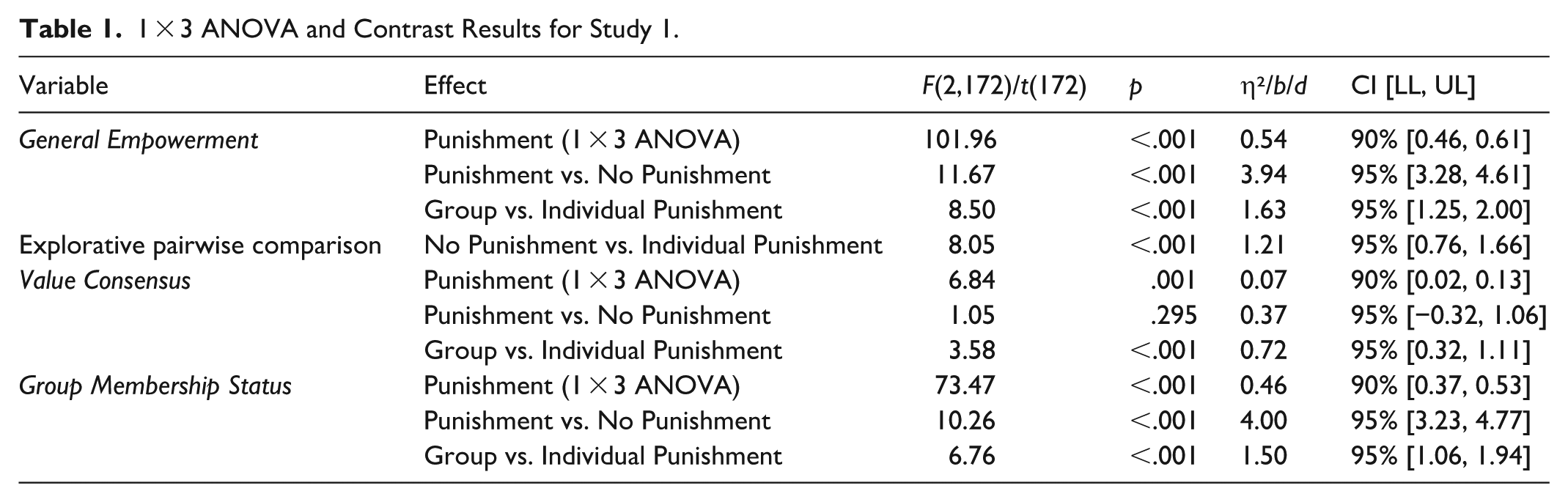
Figure 1a and Table 1 present descriptive and inferential statistics.
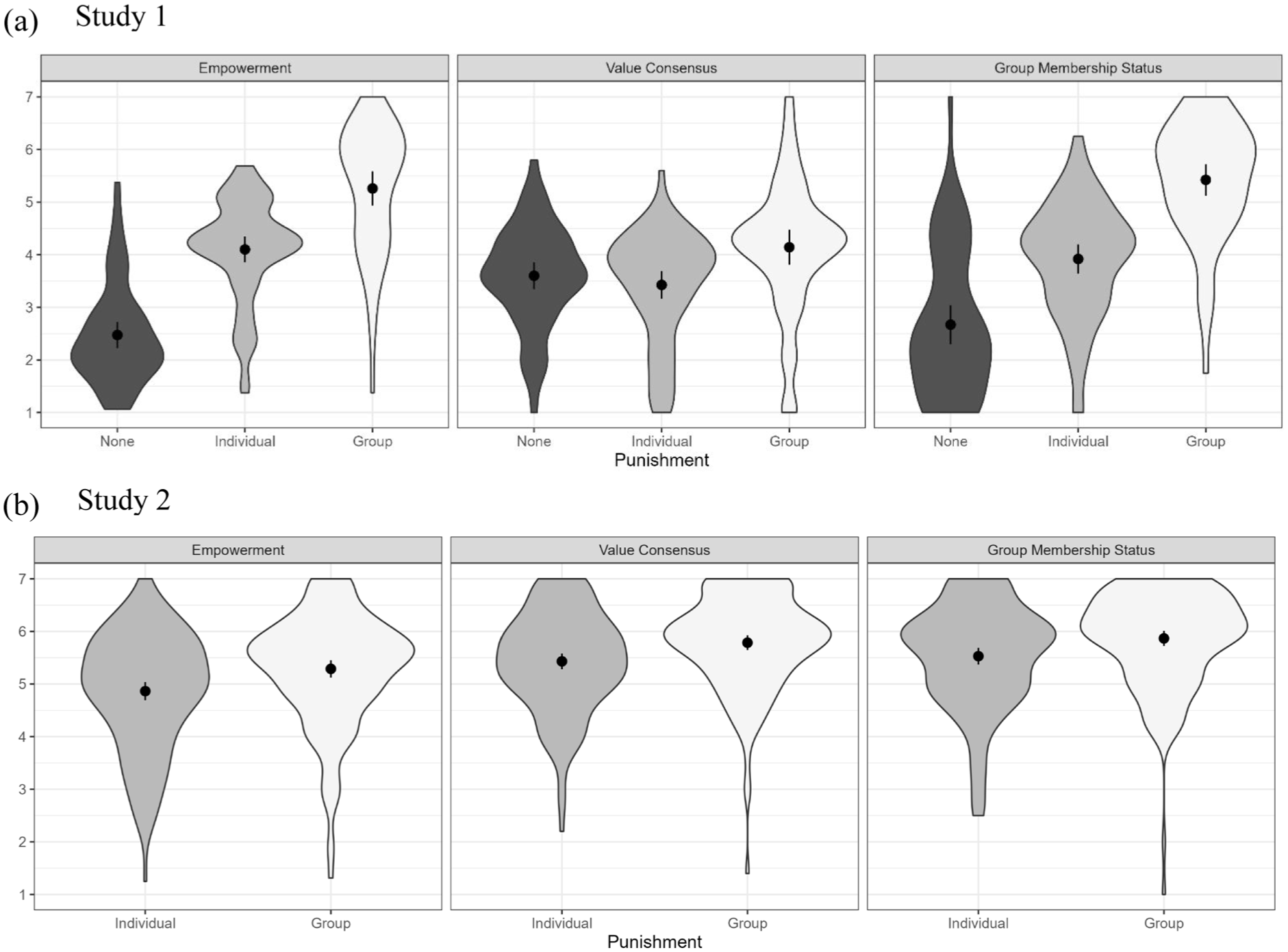
Density plots of empowerment, value consensus, and group membership status per condition, Studies 1 and 2. (a) Study 1. (b) Study 2.
1 × 3 ANOVA and Contrast Results for Study 1.
Empowerment
An ANOVA indicated that punishment significantly affected empowerment. Post hoc planned contrasts showed that the punishment conditions (individual and group punishment) significantly increased empowerment relative to no punishment, as did punishment by the group relative to punishment by one person. We exploratively applied pairwise comparisons to find that even punishment by one individual increased empowerment over no punishment.
Process Variables
Punishment significantly affected perceived value, consensus, and group membership status (see Table 1). Participants did not perceive more value consensus comparing both punishment conditions to the no punishment condition, but they perceived significantly more consensus after group punishment than after individual punishment. Further, perceived group membership status was higher after punishment compared to no punishment and after group punishment compared to individual punishment.
A sequential mediation model with empowerment as dependent variable, source of punishment (individual = 0 vs. group = 1) as independent variable, mediation paths estimation via maximum likelihood, and bootstrapped confidence intervals for indirect effects (5,000 bootstrap draws) showed a significant indirect effect of individual versus group punishment on empowerment via perceived value consensus, B = 0.12, 95% CI = [0.004, 0.24], p = .044, and via group membership status, B = 0.40, 95% CI = [0.22, 0.61], p < .001, and a sequential effect, B = 0.12, 95% CI = [0.04, 0.24], p = .016 (see Figure 2 for integrated mediation results combining Studies 1 and 2).
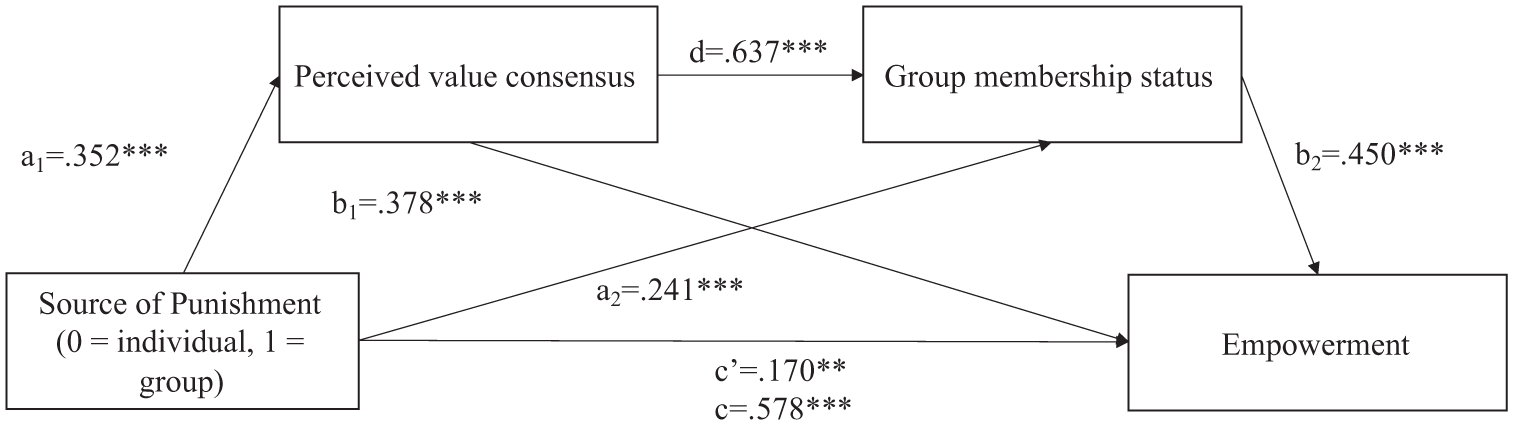
Integrated sequential mediation model of source of punishment on empowerment via values consensus and group membership status, Studies 1 and 2.
Discussion
The results confirm our hypotheses: third-party punishment empowers victims more than no punishment, punishment by the entire group empowers victims more than punishment by an individual, and process measures showed that group punishment particularly enhanced perceived value consensus and group membership status in victims, which sequentially mediated empowerment. The findings indicate that punishment can empower targets of discrimination, extending research on allyship.
Study 2
Study 2 was conducted to consolidate the effects of group punishment and test them in the context of workplace bullying. It conceptually replicated Study 1, comparing the effects of individual versus group punishment on empowerment. The punisher(s) engaged in whistleblowing to HR, knowing that this would affect the offender negatively.
Method
Participants and Design
We recruited 325 participants via Prolific United Kingdom (female = 216, Mage = 33.48, SDage = 12.34) and randomly assigned them to an individual or group punishment condition. As preregistered (https://aspredicted.org/y8k3-yczc.pdf), data of 5 additional participants was not analyzed based on the attention check, and another 10 because of completion time (<3 min).
Procedure
Participants imagined that a superior insulted them in front of their colleagues. They read about one individual or the whole group: “one/all of your colleagues from the committee come/s to talk to you. He tells/ they tell you that he/they wrote a letter of complaint to the company management, because he/they found the behavior of [the superior] towards you unacceptable.” This letter prevented the offender’s promotion. Finally, participants completed the dependent variables.
Results
Group punishment significantly increased empowerment compared to individual punishment. Participants reported to perceive significantly more value consensus and indicated their status as a group member to be higher after the entire group was punished, in contrast to only one person (see Figure 1b and Table 2).
1 × 2 ANOVA Results for Study 2.

The sequential mediation model showed a significant sequential effect of individual versus group punishment on empowerment via value consensus and membership status, B = 0.08, 95% CI = [0.03, 0.14], p = .004 (see Figure 2 and SOM for details). Thus, the source of punishment predicted group membership status via value consensus, and both mediators predicted empowerment.
Discussion
Study 2 confirmed the previous results, showing that group punishment empowers victims more than individual punishment, and victims feel more empowered by punishment that increases the perceived shared group values and their status as group members. The offender experienced the same negative consequence (no promotion) in both punishment conditions, supporting the idea that the communicative aspects of punishment affect victims beyond the punitive consequences.
Study 3
The effect of punishment by the entire group, beyond punishment by an individual, and the statistical mediations suggest that group-based processes are involved in empowering victims. Study 3 directly examines these by manipulating consensus about punishment and the actual execution of punishment. We hypothesized that group consensus (i.e., punishment intentions by the entire group) as well as executed punishment (i.e., the execution of punishment) affect victims’ sense of power positively. Further, victims who experience consensus may feel even more empowered if the punishment is actually executed. Study 3 also explores the effects of punishment by an authority that executed the punishment.
Method
Design and Participants
We recruited 215 students (164 female, 4 diverse, Mage = 34.50, SDage = 13.56) of a German University for a 2 (consensus: yes/no) × 2 (punishment: yes/no) between-subject design. Four additional participants failed the attention check, and two disagreed with the usage of their data after debriefing (see https://aspredicted.org/jdh5-vfd6.pdf).
Materials and Procedure
Participants imagined that a fellow student was free-riding in a joint class assignment and then publicly mocked them. The class (group) discussed whether the offender should be punished or not. While in the consensus conditions all students agreed on punishment (“All seminar participants agree: [the offender’s] behavior . . . must have consequences”), in the no consensus conditions only half of the class agreed (“Almost half of the seminar participants think that . . . there should be consequences. . . . Other seminar participants vehemently disagree”). Consequently, the lecturer decided to punish the offender (make them redo the assignment) or not (give the credits). Then, group membership status and empowerment were assessed. We additionally assessed group-specific perceptions in relation to consensus and punishment manipulations (see SOM). Importantly, there was a large and significant effect of consensus on perceived value consensus.
Results
Empowerment
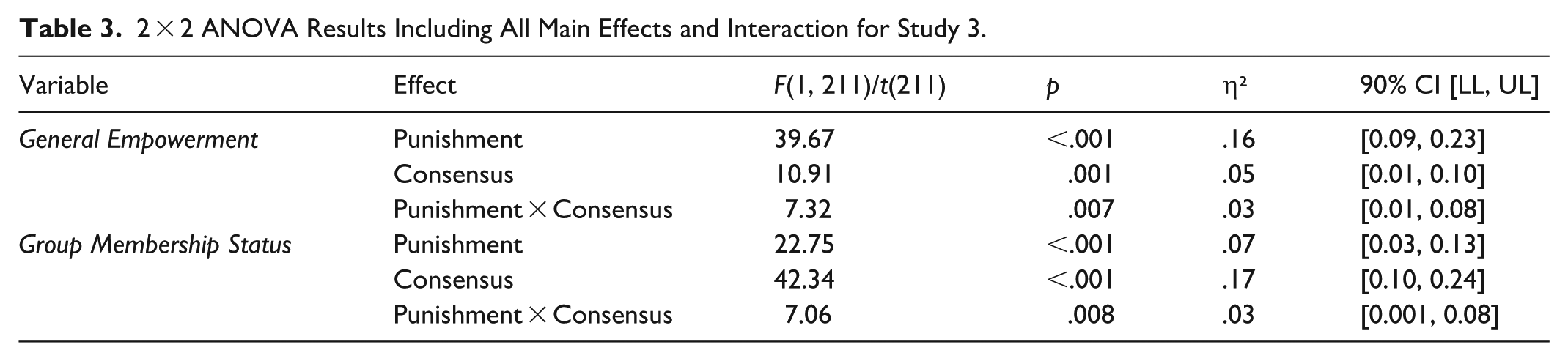
A main effect of punishment and a main effect of consensus on empowerment indicate that both increased the victims’ sense of power. The main effects were qualified by an interaction (see Figure 3 and Table 3). Post hoc contrasts show that – without executed punishment – victims felt more empowered when consensus prevailed compared to no consensus, p < .001. Group consensus did not accelerate empowerment when the punishment was executed, p = .676.
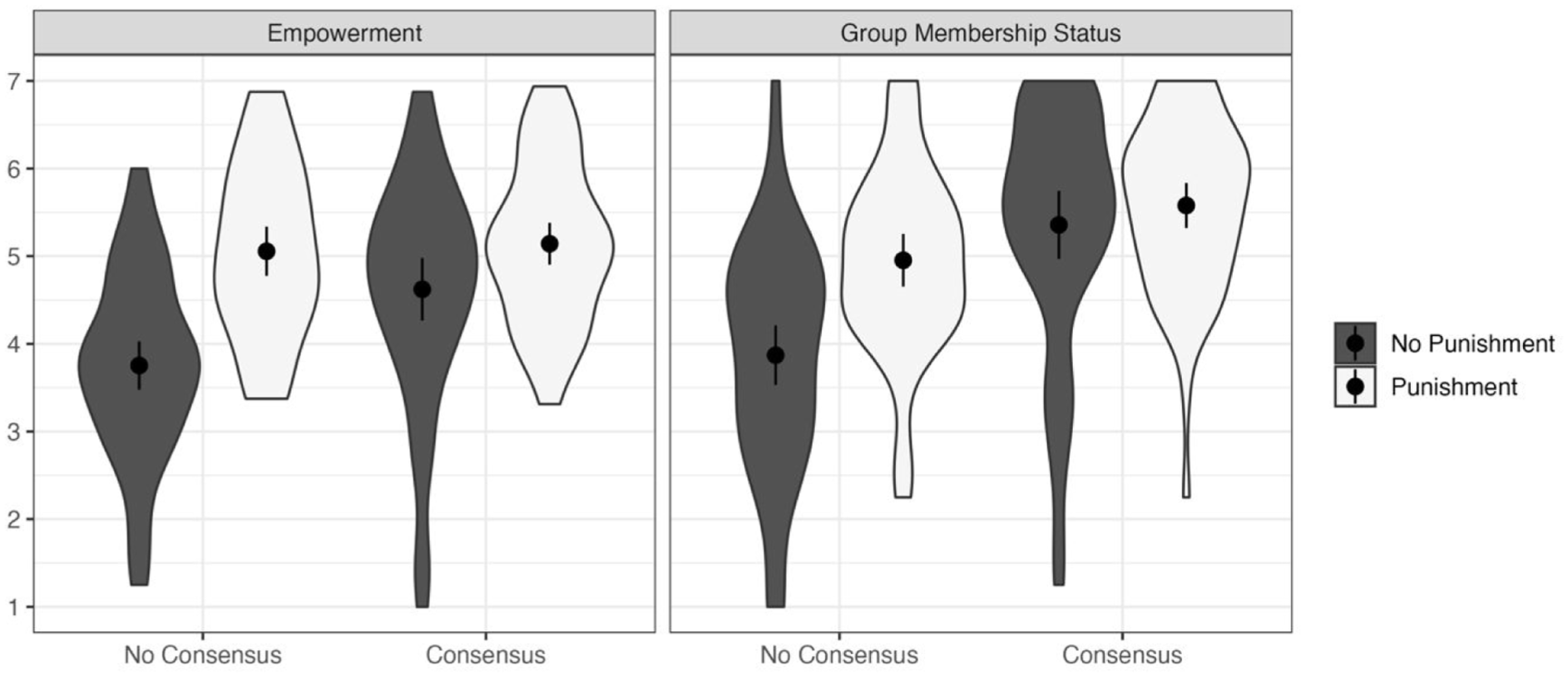
Density plots of empowerment and group membership status per condition, Study 3.
2 × 2 ANOVA Results Including All Main Effects and Interaction for Study 3.
Process Variable
Two main effects showed that consensus and punishment significantly increased group membership status. A significant interaction qualified these effects, indicating that punishment made victims feel higher status when there was no consensus, p < .001, but not when there was consensus, p = .335.
We conducted a moderated mediation analysis of the effects of consensus (0 = no consensus, 1 = consensus) via group membership status on empowerment, with executed punishment as a moderator of the a-path (0 = no punishment, 1 = punishment). Results showed that the indirect effect varied for punishment, B = −0.092, 95% CI [−0.158, −0.024], p = .008. In both punishment conditions, consensus positively affected victims’ group membership status and empowerment. This effect was smaller when there was punishment, B = 0.133, 95% CI [0.053, 0.215], p = .001, compared to when there was no punishment, B = 0.317, 95% CI [0.196, 0.430], p < .001, indicating some redundancy of consensus and punishment. There was no direct effect of group consensus on empowerment (see SOM, Figure A3).
Discussion
Study 3 showed the empowering effect of group punishment on victims, focusing on the causal role of group consensus. Executed punishment by an authority also empowered victims even without a univocal consensus. These effects were redundant; that is, consensus and punishment had no synergetic empowering effect. Restoration of the victim’s group membership status fully mediated the empowering effects of consensus. Thus, groups can restore victim power through their consensual value communication (i.e., agreement to punish) – a process that was particularly important when punishment was not executed.
Study 4
In the previous studies, the punisher(s) sent an explicit verbal message to the victim that accompanied their behavioral punishment, such as “We punished because the offender mistreated you.” It remains unclear whether stand-alone behavioral punishment empowers victims or whether the verbal message adds crucial communicative value. Study 4 extends the preceding findings in a different scenario, 6 in which participants imagined being deceived in an economic deception game. We examined whether punishment and an explicit message to victims are redundant or if the message drives or amplifies empowerment, by manipulating punishment (this time costly to the punisher) either alone or accompanied by a verbal message.
Method
Design and Participants
Participants were randomly assigned to one of five conditions: no punishment (control condition), individual punishment without an explicit message, individual punishment with an explicit message, group punishment without an explicit message, and group punishment with an explicit message. In all conditions (except for the no punishment condition), the same negative consequence occurred for the offender. A total of 324 (159 female, one other gender, Mage = 39.18, SDage = 12.62) participants were recruited via Prolific United Kingdom and received a compensation of £ 1.25. Six additional participants failed the attention test, and another 89 failed one or two reading tests of the deception game. Three participants chose to not trust their interaction partner and were thus not deceived. As preregistered (https://aspredicted.org/zzbz-wcz9.pdf), their data were not included in the analytic sample.
Materials and Procedure
Interpersonal Offense Scenario
Participants were asked to take part in an imagined online team event. They were teamed up with 11 fictitious “colleagues” to play a series of games against a competing team for bonus payments. In a first task, the team collectively estimated the number of dots on several pictures, won, and received an imaginary £5 each. We then asked how strongly they identified with their team (team identification). For the subsequent deception game (Gneezy, 2005; Posten & Mussweiler, 2013), each team member was paired with one partner, creating six dyads. Participants had to choose between two options (options A and B), knowing that one option would earn them more monetary rewards. Their partner, “Jamie,” knew the money distributions of both options and advised them in their decision-making. Jamie sent the following misleading message: “Option B will earn you more money than Option A.” All included participants chose Option B. They then learned that the bonus distribution of Option B gives them £0 and £11 to Jamie, and that Option A would have given each of them £10. They completed a comprehension test before indicating their satisfaction with the outcome.
Punishment and Message Manipulation
All team members were then presented with an anonymous punishment option to punish other advisors but not their own. Punishment would cost them £1 and deduct £5 from the advisor. In the next step, they could provide information about why they decided to punish, including “I thought the action was unfair to their colleague.” Participants then read that either none, one, or nine of their colleagues had invested incentives to punish their advisor, Jamie (no punishment vs. individual vs. group punishment). Subsequently, half of the participants in the punishment conditions were told that the punisher(s) explicitly communicated that the reason was unfairness toward the victim (message), while the others received no such message (no message). We then asked participants about their empowerment, value consensus, and group membership status.
Results
Empowerment
To investigate if source of punishment and message interact, the following contrasts accounted for the control condition (no punishment vs. punishment conditions), the main effect of source of punishment (source of punishment: individual vs. group), the main effect of explicit message (message vs. no message), as well as the interaction effect of source of punishment by message (see SOM, Table A13 for coding scheme). Statistics are displayed in Figure 4 and Table 4.
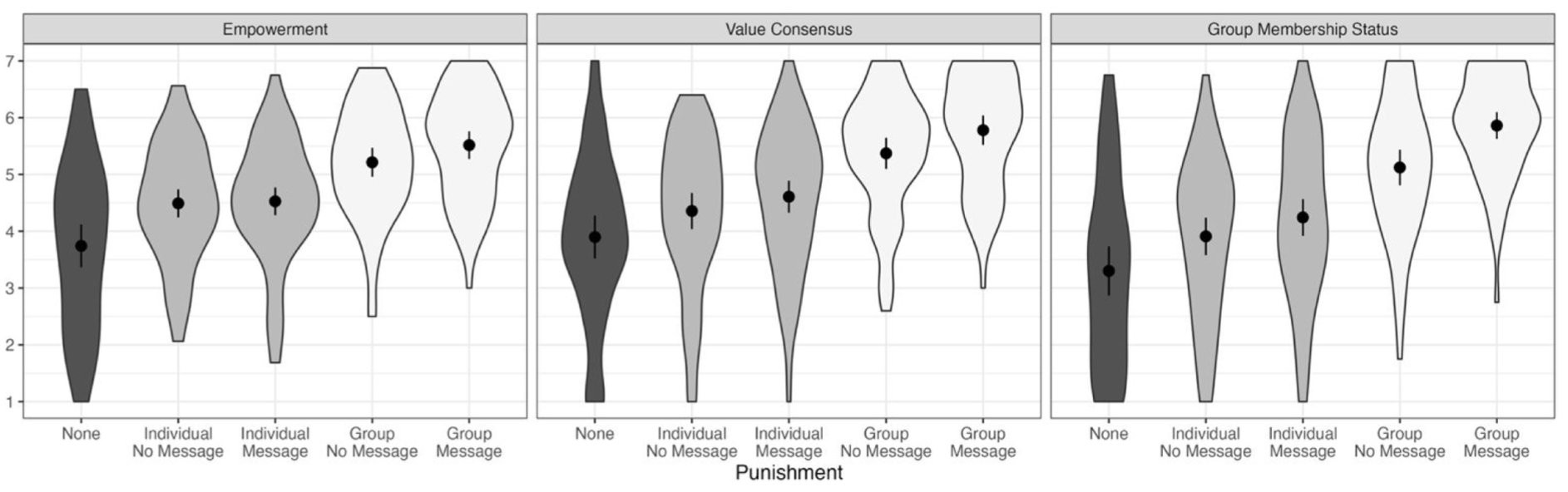
Density plots of empowerment, value consensus, and group membership status per condition, Study 4.
1 × 5 ANOVA and Planned Contrast Results for Study 4.
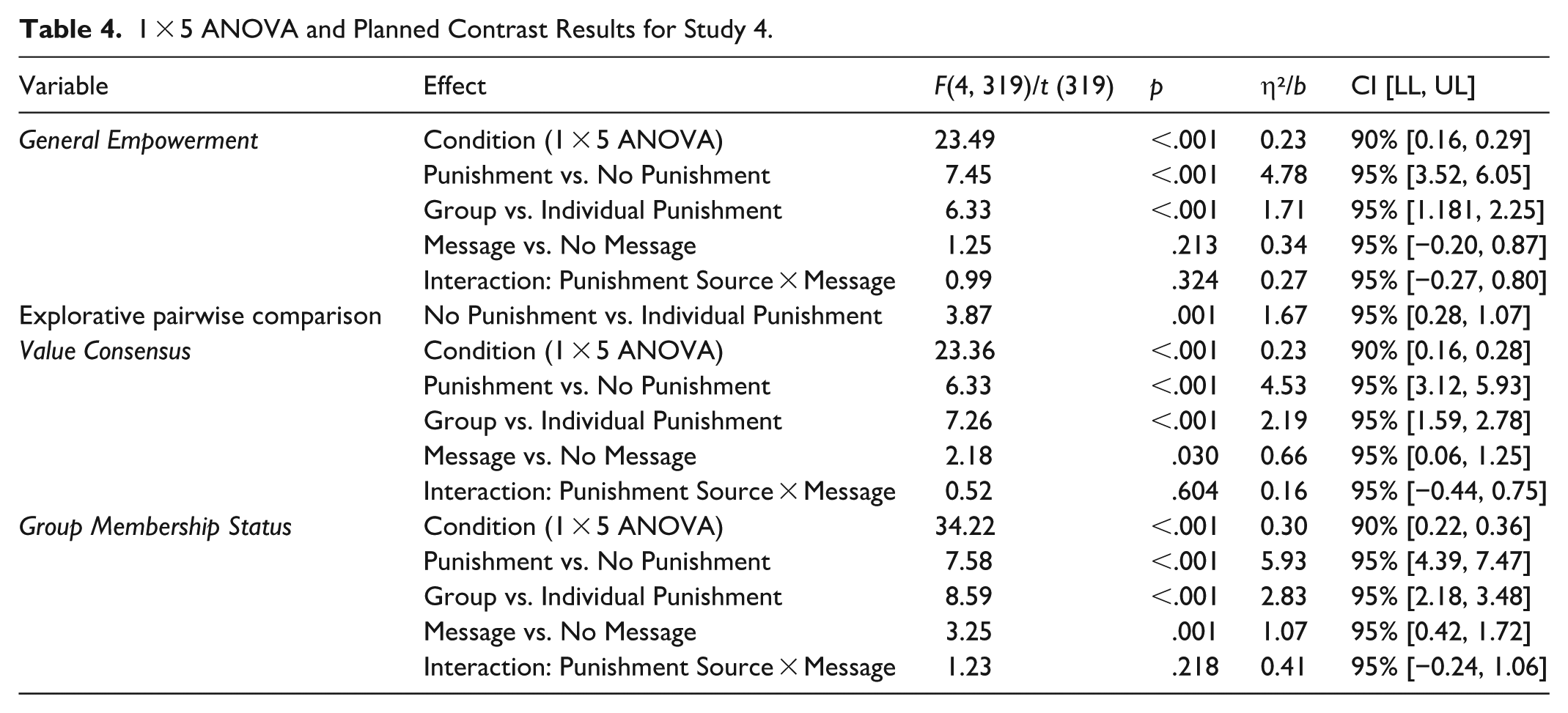
Overall, the condition significantly affected empowerment. Subsequent contrast analyses showed that punishment leads to more individual empowerment than no punishment and that punishment by the group increased empowerment compared to punishment by one person. There was no main effect of the explicit message and no interaction effect of message and source of punishment on empowerment. Explorative pairwise comparisons to probe H1 showed that the individual punishment condition without a message exceeded the no punishment condition in empowering victims.
Process Variables
Condition significantly affected the perception of the group’s value consensus and how valued participants felt as group members. Perceived value consensus was higher in the punishment conditions than in the no punishment condition and in the group versus individual punishment conditions. There was a main effect of message showing that the message increased the perceived value consensus. However, there was no interaction between the source of punishment and the message on value consensus (see Figure 4 and Table 4).
The significant effect of condition on group membership status was qualified by a significant effect of punishment versus no punishment, an effect of group versus individual punishment, and by an effect of message versus no message. There was no interaction of the source of punishment and message on group membership status.
Value consensus and group membership status sequentially mediated the effect of individual versus group punishment on empowerment, B = 0.18, 95% CI = [0.11, 0.26], p < .001 (see SOM, Figure A4).
Discussion
Study 4 showed that behavioral punishment alone affected victims’ sense of power, while an additional explicit message to victims from the punishers had no effect on this relation. Again, punishment empowered victims more if it was executed by the group compared to one individual. The message increased the perceived group consensus and victims’ group membership status but did not qualify the punishment-empowerment effect. The no message conditions resemble punishment in everyday life but also decisions by courts or institutions, in which punishment is often decided on without explicitly communicating with victims. Interestingly, victims seem to understand stand-alone third-party punishment to communicate shared values and restoring their value as group members, but punishment also implied an empowering component independent of value and status implications.
Study 5
Study 5 aimed to replicate the punishment-empowerment effects in an interactive online game. There was no message explicitly speaking to victims, but only behavioral punishment in the form of a public negative offender evaluation. This time, one designated individual had the responsibility to punish (e.g., mimicking judges in the justice system), similar to the punishment by an authority in Study 3. We compared the designated individual’s decision to punish or not to punish with that of the group.
Method
Design and Participants
One hundred ninety-two participants took part in the study (126 female, 2 diverse, 2 did not indicate their gender, Mage = 29.20, SDage = 12.34) with a 2 (Punishment: yes vs. no) × 2 (Source: designated punisher vs. all group members punish) between-subjects design and empowerment as the dependent variable. Participants were recruited via mailing lists and snowballing at a German University. They either received course credit or the opportunity to win a 10€ shopping voucher. According to preregistered criteria (https://aspredicted.org/vxps-b8xg.pdf), we excluded 35 participants from the initial sample: One participant’s duration exceeded the mean by more than 3 standard deviations, 10 participants failed to answer the attention check correctly, 24 failed at least one of two comprehension checks (“How many members does your group have?,” “How many squares does the playing field have?”). 7
Procedure
Participants were assigned to minimal groups using the “Dot Estimation Task” (e.g., Otten, 2016). All participants were members of the Orange group, together with five alleged other participants. The group then played four rounds of TicTacToe against the Blue group, in which each group alternately had to decide how to place three crosses in line within a 3 × 3 matrix (see Figure 5). In each round, two members from the Orange group played against two members from the Blue group. Both players of each group communicated with each other and were granted equal rights in the decision process. Participants were informed that, for technical reasons, only one team member would be able to log in to their joint decision. The behavior of the two players would then publicly be evaluated by either one other team member (designated punisher) or all team members (group members punish). In the first two rounds of the game, the participants observed other team members, who communicated cooperatively to reach a joint decision. In the third and critical round, the participant (Orange member #6) played with another team member (Orange member #4), who was entitled to log the decision. During this round, the participants’ comments were either ignored or – if a move was inevitable from a tactical point of view – their suggestion was commented on with the words “That’s obvious,” displaying uncooperative behavior. Messages from other team members than the actual participants were scripted for all possible moves.
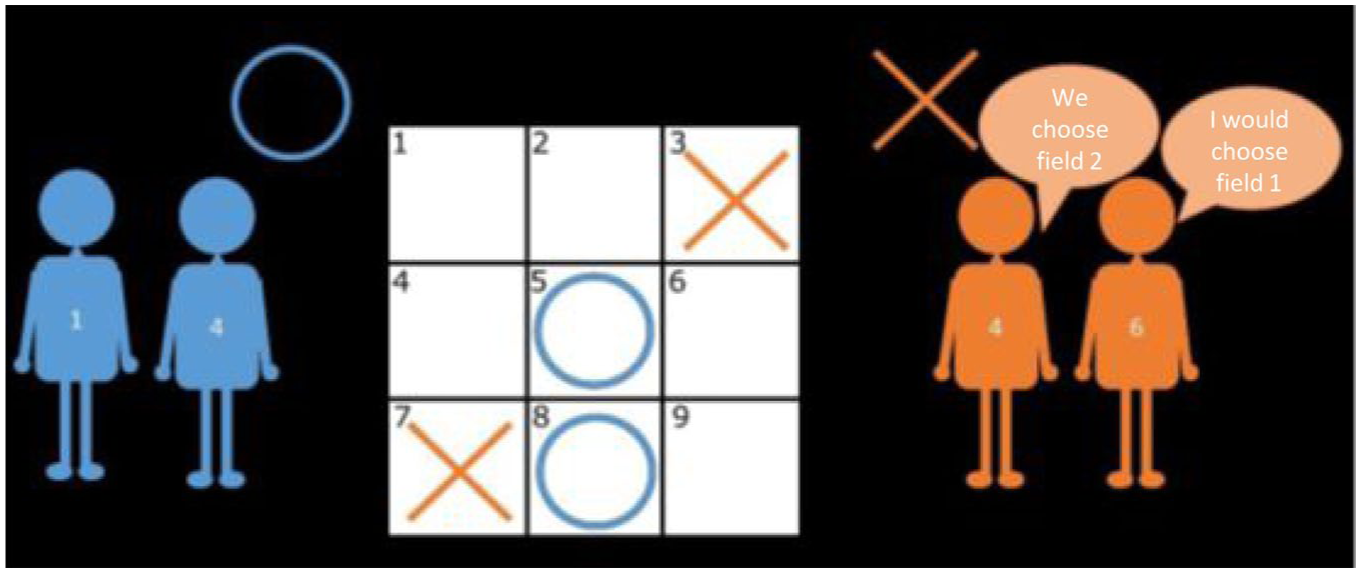
Illustration of the TicTacToe gaming situation as presented to participants.
Punishment Manipulation
Then, participants observed how the punisher(s) evaluated the behavior of the decision-maker on popularity, collegiality, importance for the group, and respectfulness, using an answer scale of 1 = not at all, 2 = medium, and 3 = very much. According to the script, the punisher(s) evaluated the offender negatively in the punishment conditions and positively in the no punishment conditions. After the critical round, the dependent and mediating variables were assessed. 8 Participants finally answered the reading tests.
Preliminary Study
A preliminary study (see SOM for details) with an independent sample (N = 30) tested whether the uncooperative behavior would be perceived as unfair and the corresponding responses (punishment or no punishment) as appropriate. Uncooperative and cooperative behavior appeared in random order. Participants felt inferior to others and judged the incident as more severe after the uncooperative compared to the cooperative behavior. Furthermore, they found the negative evaluation of the uncooperative behavior (i.e., punishment) more appropriate than the scale midpoint, and no different from appropriate than the positive evaluation of the cooperative behavior. Finally, the offender was perceived as suffering more and being more humiliated after receiving negative compared to positive evaluations.
Results
Empowerment
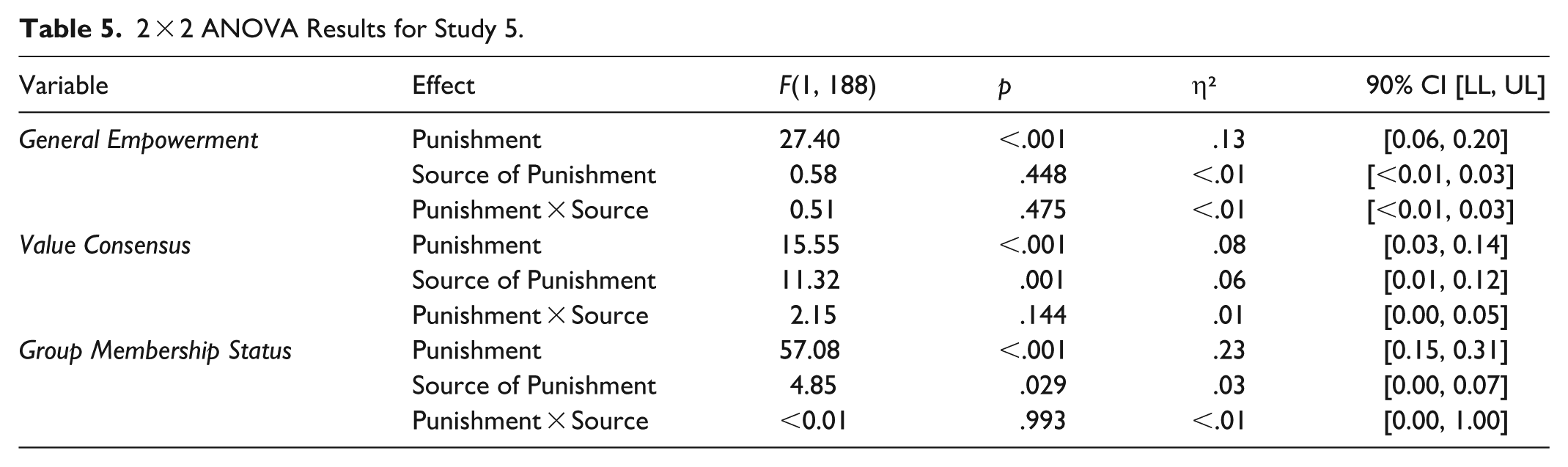
Participants reported higher empowerment when the offender received punishment, in contrast to no punishment. Source of punishment did not have an effect, and no interaction effect emerged. Participants felt higher levels of empowerment after punishment, irrespective of whether one designated punisher or the entire group punished (see Figure 6 and Table 5).
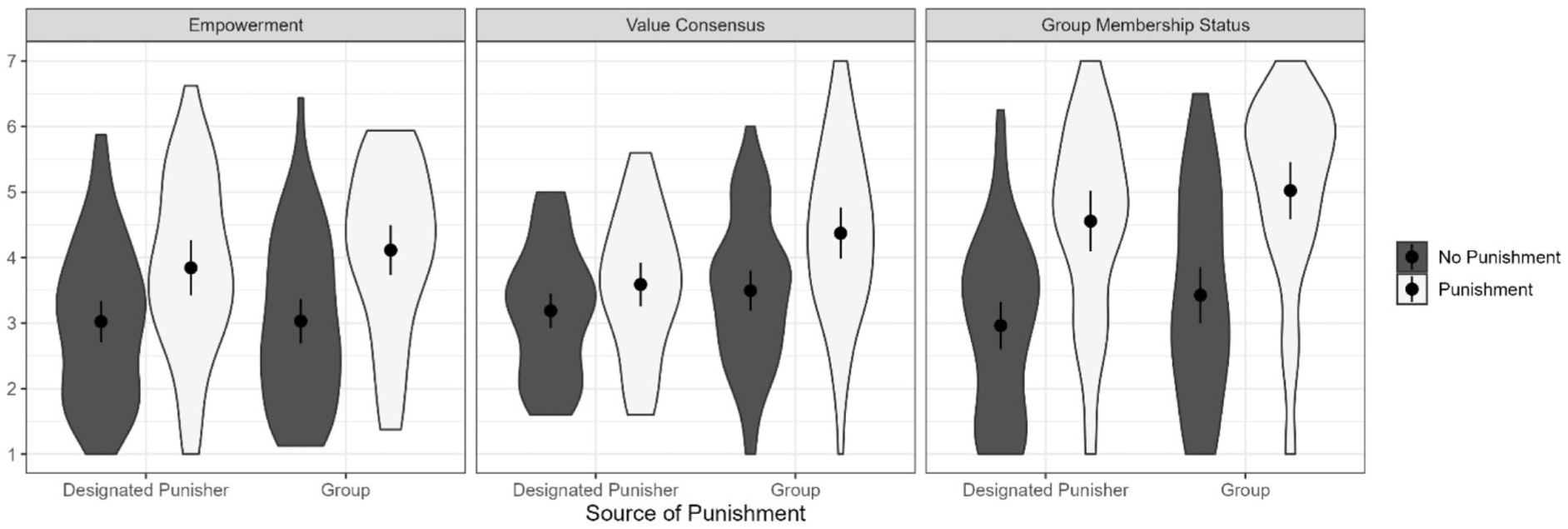
Density plots of empowerment, value consensus, and group membership status per condition, Study 5.
2 × 2 ANOVA Results for Study 5.
Process Variables
A significant effect of punishment indicates that perceived value consensus increases with punishment compared to no punishment. There was also a main effect of source of punishment on value consensus, indicating greater consensus after punishment by the group compared to punishment by the designated punisher. There was no interaction effect. This limitation might be due to the small sample size: Preregistered post hoc contrasts indicate that there was more perceived group consensus when all group members punished compared to when the designated punisher did, p = .002, but no difference between the sources when they did not punish, p = .153.
Participants reported a significant increase in group membership status after punishment compared to no punishment. There was also a main effect of source, indicating that perceived group membership was greater when the entire group had the chance to punish instead of when only one person did. As there was no interaction effect, both main effects emerged independently.
Discussion
Study 5 reproduced the empowering effects of third-party punishment on victims in an illustrated intergroup game without an explicit message addressed to the victim. The study is an important addition to the previous findings since it measures victims’ reactions after being treated unfairly in a staged live interaction. Results demonstrate the empowering effects of third-party punishment. Punishment empowered victims irrespective of the source being one designated punisher or all group members. Punishment also increased perceived value and group membership status independently of its source.
Note that we preregistered the individual punishment condition to be less empowering for victims than the group punishment condition (H2). However, individual punishment in Study 5 differed from that of the previous studies in one important respect, namely that it relied on a designated punisher, leaving others without choice, thus making the punisher’s decision the best guess of the group’s general behavior. The results resemble the findings of Study 3, where punishment executed by an authority empowered victims even without full group consensus. Many social groups and justice systems rely on such designated punishers or authorities with the responsibility to punish according to shared values (i.e., rules or laws). Further research is needed to determine whether punishment by a designated authority is as empowering to victims as punishment by all group members.
General Discussion
Five preregistered experiments systematically established that third-party punishment speaks to victims, demonstrating – to our knowledge for the first time – that it increases victims’ sense of power. Results show first that punishment by one individual is sufficient to empower victims compared to no punishment (Studies 1, 3, and 5). Second, victim empowerment is amplified when an entire group or a designated group authority punishes (Studies 1–4) – even when punishment is merely behavioral (Studies 4 and 5). Third, group processes drive this amplification: value consensus and group membership mediate the effects (Studies 1 and 2), and value consensus alone positively affects victims’ empowerment (Study 3). Overall, the studies provide evidence that third-party interventions can address victims’ need for empowerment.
Theoretical Implications
The fulfillment of retributive goals (Carlsmith & Darley, 2008) is a likely source for the empowering effect on victims. However, they cannot fully explain the differential effects of group versus individual punishment, since the effective consequences for offenders were kept constant across conditions. Notably, group punishment could have been perceived as more severe and humiliating than individual punishment. Nevertheless, the effect also emerged when offenders did not know that the group agreed on their punishment (Study 2) and thus could not feel more humiliated. Importantly, group punishment better addresses potential value threats than individual punishment because it symbolically labels an act as wrong in the group context (Okimoto & Wenzel, 2009). An authority or a designated punisher also may instigate these processes, who, compared to any individual, may be perceived as more legitimate to punish (e.g., Mulder, 2018). The group’s defense of prosocial values contributing to victims’ sense of power aligns with prior research indicating that bystanders who confront offenders help victims regain a sense of security (Hildebrand et al., 2020). This, in turn, can empower victims (Simonet et al., 2015). The current research extends previous arguments by providing evidence for the role of group consensus in victim empowerment following third-party punishment.
The findings fit well with psychological approaches to justice restoration (Wenzel et al., 2008), which find that post-conflict responses restore justice when they re-establish violated values and status/power balances. Next to the effect of group versus individual punishment, Study 3 indicates that consensus about punishment suffices for victim empowerment – even without executed punishment. If there is no visible disagreement among group members, our results show that punishment implies value consensus and consequently empowerment (see Studies 1, 2, 4, 5). This indicates a consensus-empowerment pathway, in which value restoration and empowerment of ingroup victims are intertwined, as shared values define who is allowed to treat whom in what way. Accordingly, third-party punishment varies with offender status (Redford & Ratliff, 2018). By establishing that group processes contribute to the empowering effect of third-party punishment, our findings extend previous research, which suggests that value restoration promotes perceptions of justice (Wenzel et al., 2008) and that justice promotes empowerment (Strelan et al., 2017). The mediating role of victims’ group membership status further highlights the particular role of group processes in victims’ empowerment following third-party punishment. Feeling valued as a group member positively affects victims’ self-worth (De Cremer & Tyler, 2005). The sequential mediation and experimental effects in Study 3 suggest that expressing value consensus through punishment re-establishes victims’ status as group members. However, the reverse relationship could also be true: valuation of ingroup victims may signal that prosocial norms are being upheld.
Further, executed and consensual punishment by the group or designated punishers increases empowerment in victims, giving credence to the notion that effective value restoration through the group is an important process variable. This reflects the theory of group-based control (e.g., Fritsche, 2022), in which being a member of an agentic group can provide a sense of control to those deprived of individual control, such as victims of interpersonal offenses. Further studies are needed to clarify whether this effect is due to the recognition of others and/or group-based control. This also raises the question whether a number of unconnected individuals (as in online interactions), suffices to produce these effects, or whether a cohesive group is a necessary precondition.
The present findings fit nicely into a vast body of research on the interplay of resocialization, deterrence, and cooperation within groups. It has been argued that the option to punish augments the belief in others’ cooperation, leading to a societal equilibrium that nourishes cooperation (Dasgupta, 2009). Following this train of thought, if punishment not only speaks to the actual offender but vicariously speaks to all potential future offenders and observers (Hechler & Kessler, 2018b; Mulder, 2018), the same might be true for victims. Then, punishment could create a social equilibrium on the victim level and empower potential future victims, leading to a balance in society that hinders interpersonal offenses in the first place. To date, this thought remains speculative in nature.
Generalizability and Limitations
The set of studies mirrored different contexts, transgressions, forms of punishment, and assessed different sample populations. Particularly, Study 1 shows the effects of reacting to racist offenses. Studies 2 and 3 demonstrate the effect within the domain of bullying and free-riding in work and university contexts. Studies 4 and 5 use violations of trust and fairness in interactive games. Further to account for the abundance of punitive actions, punishment varied between public confrontation with boycott activities (Study 1), negative job consequences (Study 2), additional workload (Study 3), monetary harm (Study 4), and negative public evaluations (Study 5). This speaks to the width of the spectrum of domains that the findings can inform. However, the offenses were relatively mild, so we do not know how this translates into more serious transgressions. Bilz (2016) showed that crime victims also report higher group membership status after institutional punishment, suggesting that the effects may extend, at least in part, to serious crimes that are prosecuted by law.
The use of hypothetical situations and experimental games decreases ecological validity, although the set of studies shows high internal validity. Their situational features exemplify confronting racism, organizational rule enforcement, and interpersonal evaluation, such as rating supermarket staff or gossiping about colleagues. In Study 3, participants rated the likelihood of similar situations occurring in their environment above the scale midpoint (1 = not at all likely; 7 = very likely; M = 4.90, 95% CI = [4.67, 5.12]), indicating its relatedness to real-life. In everyday situations, participants in the Netherlands reported punishing offenders through physical or verbal confrontation in 35% of cases, and through indirect acts such as gossip in 44% of cases (Molho et al., 2020). Apart from punishment, third parties intervene in various other ways (Pedersen et al., 2020). In some small-scale societies, for instance, third parties have been found to use restorative and less punitive means (Fitouchi & Singh, 2023; Singh & Garfield, 2022).
The present studies account for a variety of groups with respect to their size (e.g., small experimental groups of n = 6 in Study 5 to larger teams) and levels of trust, familiarity, and similarity of group members (e.g., strangers in Study 5, coworkers or fellow students in Studies 2–4, and interest-based groups in Study 1). As specific group-defining factors are likely to determine the extent to which punishment affects ingroup victims, they require systematic future investigations. Speaking to the generalizability across different populations, we recruited samples from racialized individuals (Study 1), student and convenience samples (Studies 3 and 5) from Germany, and online workers from the United Kingdom (Studies 2 and 4). Nevertheless, the studies lack diversity with respect to cultural norms and values, which vary, for instance, along the dimension of individualism and collectivism (e.g., Jetten et al., 2002). This dimension seems to be important, as group processes (i.e., value consensus) were driving factors of the effects. If values differ along this dimension, the proposed punishment-empowerment effects may also differ.
Our findings do not allow us to distinguish whether the stronger empowering effect of group punishment is due to the punishing group enhancing the effects or the silent bystanders suppressing them. The effects of designated punishers (Studies 3 and 5) speak for the bolstering rather than the suppressive effect.
Practical Implications
The current findings stress the importance of third-party reactions considering victims’ needs. Particularly, victims who regain a sense of power perceive conflict resolutions as more just, are more willing to forgive, and are more ready to reconcile with offenders (Shnabel & Nadler, 2015; Strelan et al., 2017). On a smaller scale, this suggests anti-bullying training in organizations and schools, and workshops on civil courage to include a focus on victims’ needs in interventions in everyday offenses. On a larger scale, the empowering effects of third-party punishment can support low-status individuals or groups in coping with (illegitimate) power relations, such as racism (see Study 1). Observers who contest prejudiced behavior that is not formally sanctioned emphasize the anti-discriminatory norms that protect potential targets (e.g., Estevan-Reina et al., 2024). The current studies emphasize the role of the entire group in strengthening targets of prejudice.
Most groups, such as societies but also organizations, companies, or families, hold implicit or explicit rules about who is responsible for punishment, such as judges (Molho et al., 2024; O’Gorman et al., 2009). A key feature of legal punishments is that they are enacted in the name of the people, as outlined in the Preamble of the U.S. constitution (U.S. Const. pmbl.) or preceding governing sentences rendered by the Federal Constitutional Court in Germany (BVerfGG, § 25 Abs. 4). Legal punishment, compared to a failure to punish, also increases crime victims’ social standing in the eyes of observers (Bilz, 2016). Our research further indicates that victims can regain a sense of power through authoritative decisions to punish offenders. Thus, legitimate authorities may have effects similar to group punishment because they speak and punish on behalf of the people they represent – an interpretation that requires support from future research.
Finally, previous research suggests that private messages from third parties alone do not meet the victims’ needs (Shnabel et al., 2014). Others argue that verbal confrontation serves as punishment (Molho et al., 2020) and that restorative approaches can address victims’ needs (Gromet, 2012). The latter are often based on victim-perpetrator dialogues that aim at repairing the harm done and may also involve community members as third parties. We approached third-party punishment by including material punishment (Studies 1–4) and verbal punishment in the form of public evaluation (Study 5), which yielded similar results and encouraged the thought that social condemnation may suffice to empower victims.
Conclusion
In conclusion, the findings from five experiments provide evidence that third-party punishment serves as an important communicative tool for victims of interpersonal offenses. When third parties administer punishment, it enhances victims’ sense of power, particularly when the punishment comes from the entire group. This is important in settings where victims and offenders have limited opportunity to react for themselves or where their reactions contribute to escalation rather than conflict resolution. Victims’ sense of power is tied to the third-party signals of value consensus and victims’ group membership status. By recognizing that victims gain a sense of validation and power through the actions of others, organizations and societies can design interventions and justice systems that focus not only on punishing offenders but also on victims’ needs. Ultimately, punishment by the entire group signals what the group stands for and who belongs, which in turn empowers individual victims.
Supplemental Material
sj-docx-1-psp-10.1177_01461672251399943 – Supplemental material for You Are Not Alone – Third-Party Punishment by Individuals and Groups Empowers Victims
Supplemental material, sj-docx-1-psp-10.1177_01461672251399943 for You Are Not Alone – Third-Party Punishment by Individuals and Groups Empowers Victims by Stefanie Hechler and Ann-Christin Posten in Personality and Social Psychology Bulletin
Footnotes
Declaration of Conflicting Interests
The authors declared no potential conflicts of interest with respect to the research, authorship, and/or publication of this article.
Funding
The authors disclosed receipt of the following financial support for the research, authorship, and/or publication of this article: This research was funded by the University of Cologne (C-SEB Junior Start-Up Grant #Rd10-2020-JSUG-Posten) and the EASP (Seedcorn Grant 2021). We thank Luca Grün, Josephine Köhler, and Liv Conde-Hochhäuser for supporting Studies 1, 3, and 5.

Supplemental Material
Supplemental material is available online with this article.
Notes
References
Supplementary Material
Please find the following supplemental material available below.
For Open Access articles published under a Creative Commons License, all supplemental material carries the same license as the article it is associated with.
For non-Open Access articles published, all supplemental material carries a non-exclusive license, and permission requests for re-use of supplemental material or any part of supplemental material shall be sent directly to the copyright owner as specified in the copyright notice associated with the article.
