




Abstract
Research on the relation between hormones and unethical behaviors and tendencies has provided mixed results, hindering the understanding of the potential biological regulation of unethical behaviors and tendencies. We conducted an exploratory, longitudinal study (N = 257 women) allowing to estimate relations between, on the one hand, steroid hormones (testosterone, cortisol, estradiol, and progesterone) and conception probability and, on the other hand, a broad variety of measures related to unethicality (self-reported personality variables, cheating in committed relationships, self-serving economic dishonesty in a behavioral task, namely, the mind game). Contrary to theoretical assumptions of and results from some previous studies, we find no consistent relation between hormones and unethical behavior or tendencies in the majority of analyses. Yet, some small, exploratory associations emerged that call for (preregistered) replications, before more firm conclusions can be made.
Introduction
Financially motivated unethical acts such as corruption, money laundering, or scams typically have tremendous consequences for individuals and societies at large. For example, in 2019 alone, U.S. citizens reported losing more than $667 million to so-called imposter scams. Therein, scammers pretend to be calling from a family member, the government, a romantic interest, or a well-known business with an emergency and request payments. While law enforcement can assist in some cases, the money most often remains lost (Vaca, 2020). Unethical behaviors and tendencies are a pervasive problem in society, negatively affecting individuals and organizations across contexts.
Reflecting the widespread occurrence and consequences of unethical behaviors and tendencies, researchers from various disciplines have aimed to reveal and understand their driving factors. For example, research on situational factors fostering unethical behaviors suggests that individuals are less likely to act unethically when being monitored (e.g., Gneezy et al., 2018; Lilleholt et al., 2020), when punishment is severe and likely (e.g., Thielmann & Hilbig, 2018), or when country-level prevalence of rule violations is low (e.g., Gächter & Schulz, 2016). Research on interindividual differences related to unethical behaviors suggests that younger individuals are typically more likely to act unethically for a financial gain than older individuals and that men tend to be more likely to act unethically for a financial gain than women (Gerlach et al., 2019). Furthermore, different personality dimensions such as honesty-humility (e.g., Heck et al., 2018), the dark factor of personality (D; e.g., Moshagen et al., 2018), or narcissism (e.g., Schröder-Abé & Fatfouta, 2019) have been linked to unethical behaviors (for meta-analyses, see, e.g., Thielmann et al., 2020; Zettler et al., 2020). For example, honesty-humility is negatively linked to unethical behaviors in different economic games (e.g., Heck et al., 2018; Vranka & Bahník, 2018), unethical cognitions (Ścigała et al., 2020, 2023), and criminal acts (e.g., Rolison et al., 2013).
Concerning other person characteristics, it has been proposed recently that the endocrine system might play an important role in fostering unethical behaviors and tendencies (e.g., Lee et al., 2015). Corresponding evidence is mixed, however. Herewith, we contribute to this stream of research by investigating whether women’s steroid hormones such as testosterone, cortisol, estradiol, and progesterone, which fluctuate naturally across different days and systematically across their menstrual cycle, as well as women’s fertility (i.e., conception probability), are linked to various factors representing unethical behaviors and tendencies.
Testosterone, Cortisol, and Unethical Behaviors and Tendencies
Steroids that function as hormones, such as testosterone, cortisol, estradiol, and progesterone, play an important role in various physiological processes, including the development and maintenance of reproductive function, glucose metabolism, and stress response (Viau, 2002). Testosterone and cortisol have been suggested as key hormones predicting unethical behaviors more broadly (Lee et al., 2015). More precisely, higher testosterone was reported to interact with lower cortisol in predicting antisocial-approach strategies or income-generating crime (Armstrong et al., 2022; Mehta et al., 2017; Popma et al., 2007). While the evidence for this dual-hormone hypothesis is rather mixed (Dekkers et al., 2019; Grebe et al., 2019), one study reported that higher testosterone levels are associated with more financially motivated unethical behavior (i.e., lying about the own performance in solving matrices for a financial gain), but only when cortisol levels were high (Lee et al., 2015). In contrast, two studies found that testosterone administration is rather linked to less financially motivated unethical behaviors (Henderson et al., 2018; Wibral et al., 2012).
Further unethical cognitions and behaviors, such as behavior in economic games or cheating in committed relationships, may be influenced by hormone levels. One study reported that testosterone administration increased reciprocity in a trust game (Boksem et al., 2013), whereas a different study found that testosterone levels were associated with generous behavior toward distant others, but not with prosocial intentions and behavior (Wang et al., 2022). Also, it has been reported that men with higher testosterone levels were more often sexually unfaithful in committed relationships (Klimas et al., 2019), but this association remains unclear in women.
Relations between personality characteristics that are closely related to unethical cognitions and behaviors, such as aversive traits (e.g., Schröder-Abé & Fatfouta, 2019) or honesty-humility (Ścigała et al., 2020; Zettler et al., 2020), and both testosterone and cortisol are mixed. In a study by Pfattheicher (2016), for instance, testosterone was positively related to higher levels of grandiose narcissism, but there were no significant relations to Machiavellianism and psychopathy. Furthermore, cortisol was not related to any of the three characteristics and did also not interact with testosterone in predicting them. Other studies revealed mixed findings on whether baseline levels of cortisol are related to grandiose narcissism (Reinhard et al., 2012; Wardecker et al., 2018). Moreover, a recent meta-analysis suggests that previously reported findings linking aversive personality characteristics to interacting levels of testosterone and cortisol might not be robust (Dekkers et al., 2019).
The Relation Between Ovarian Hormones, Conception Probability, and Unethical Behavior and Tendencies
Another line of research suggests that ovarian hormones also regulate unethical behavior and tendencies. For example, women with higher average estradiol levels reported a higher likelihood for opportunistic mating, that is, they reported a higher likelihood to engage in unfaithful behavior in committed relationships, such as having a one-night stand or affair with a man who is not their primary partner (Durante & Li, 2009). Furthermore, it has been suggested that (financially motivated) prosocial behavior may be influenced by hormonal contraceptives altering ovarian hormone levels (Strojny et al., 2021) or may vary systematically with hormonal fluctuations across women’s ovulatory cycles (Eisenbruch & Roney, 2016; Lucas & Koff, 2013). Women’s ovulatory cycles are approximately 28 days long (with strong intraindividual and interindividual variations), and women are only fertile (i.e., elevated conception probability) for up to 6 days per cycle. Different cycle phases and different conception probabilities are marked by substantial hormonal changes across the cycle. High conception probability, also known as the fertile window, is characterized by higher levels of estradiol and lower levels of progesterone, whereas levels of estradiol are lower and levels of progesterone increase during the luteal phase, when conception probability is low (between ovulation and menstrual onset; Roney & Simmons, 2013). Different cycle phases are sought to be related to different cognitions and behaviors which respond to specific needs women have during that cycle phase (Fessler, 2003).
In line with this assumption, previous research has argued that in the luteal phase, when progesterone levels are high, the female body prepares for pregnancy, which leads women to behave more prosocial to foster relationships (Sellitto & Kalenscher, 2022; Stenstrom et al., 2018). Other research argued that, when fertile, women try to maximize the chances for successful reproduction by retaining financial resources, for example, through lower offers in the ultimatum game or reduced investment in the trust game (Eisenbruch & Roney, 2016; Lucas & Koff, 2013), which is strongly negatively linked to, for example, honesty-humility (Thielmann et al., 2020). Importantly, other studies reported effects in the opposite direction, with higher prosocial orientation in the follicular phase (Anderl et al., 2015), or no evidence for a link between estradiol or progesterone and prosocial orientation (Ranehill et al., 2018; Strojny et al., 2021; Wang et al., 2022).
Summary and Aims of the Current Study
In summary, mixed results and methodological variability (e.g., self-reports or behavioral measures) in previous research make it hard to know whether there is a biological basis (likely) regulating unethical behaviors and tendencies and to disentangle within-subject (e.g., cycle shifts or states) and between-subject (e.g., average hormone levels or traits) effects. Some of these mixed results might be due to variability in statistical power, cycle-phase determination, or hormone measure validity. Research on the effects of steroid hormones, for example, received criticism because many of the previous studies were (considered to be) underpowered and did not assess hormone levels directly (Gangestad et al., 2016; Grebe et al., 2019). Furthermore, recent research casts doubt on the validity of salivary immunoassays that are usually used to analyze hormone levels, suggesting the use of liquid chromatography tandem mass spectrometry (LC-MS/MS) as a more valid alternative (Arslan et al., 2023; Bae et al., 2016; Welker et al., 2016). Together, there is a need for large-scale studies in this research area aiming at replicating and extending previous studies while overcoming methodological shortcomings. Tackling this, we conducted an exploratory study with the aim to provide information about whether steroid hormones are related to different unethical cognitions and behaviors in women (who are generally underrepresented in this stream of research), as well as whether such relations vary intraindividually or interindividually. To this end, we investigate the relation between testosterone, cortisol, estradiol, and progesterone with different measures of unethical behaviors and tendencies: self-report state and trait measures (honesty-humility, narcissism, D), self-reported cheating in committed relationships, and a behavioral cheating paradigm (namely, cheating for financial benefits in the mind game). Note that cheating for financial benefits in behavioral cheating paradigms has been linked to a broad range of unethical behaviors such as fare evasion, school misconduct, or work absences (see Schild et al., 2021 for an overview). We employed a large sample with a longitudinal design that allows to disentangle within-subjects and between-subjects effects, validated conception probability estimates, and direct hormone assessments.
Methods
Open data, analysis script, and material are provided on the Open Science Framework (https://osf.io/p4qmb/). Preregistration of a larger data collection covers the sample characteristics, the procedure, and the measures (https://osf.io/dwcsm/) but no hypotheses and analyses for the study at hand. Thus, we do not make specific predictions, and results from this study should be interpreted as exploratory. All participants signed a written consent form, and the local ethics committee approved the study protocol (no. 225).
Participants and Recruitment
Our participants had to fulfill the following preregistered criteria to take part in the study: female, between 18 and 35 years of age, and naturally cycling, that is, no hormonal contraception for at least 3 months; no expected switch to hormonal contraception while in the study; no current pregnancy or breastfeeding; no childbirth or breastfeeding during the previous year; not taking hormone-based medication or anti-depressants; and no endocrine disorders. A total of 282 heterosexual female participants were recruited at a German university. Out of these, 257 participants (aged 18–35 years, M = 23.2, SD = 3.3 years) finished all sessions and were therefore included in further analyses. The 25 dropouts resulted from 16 women who attended only the introductory (but no testing) session and 9 women who only completed one or two testing sessions (see Supplemental Material for detailed reasons for dropouts). In addition, included participants reported their ovulatory cycles being of regular length between 25 and 35 days, at least during the last 3 months. Five of the participants reported having children. Our sample size largely exceeds the size required to achieve 80% power given a within-subjects design and anticipated effects of moderate magnitude, as suggested by a power simulation for sample sizes in ovulatory shift research (Gangestad et al., 2016). Furthermore, a power analysis using G*power 3.1.9.7 suggests that our sample had a 95% test power to detect a previously reported correlation coefficient of r = .22 between cortisol and narcissism and 83% test power to detect a previously reported correlation coefficient of r = .18 between testosterone and narcissism (Pfattheicher, 2016; our power analysis was for two-tailed tests and had a specified alpha error probability of .05).
Procedure
All participants took part in an introductory session in the laboratory, followed by an online questionnaire to be filled out at home, and four consequent individually scheduled testing sessions in the laboratory. In the introductory session, participants received detailed information about the general procedure, duration of the study, and compensation. A research assistant explained the luteinizing hormone (LH) ovulation tests and checked the inclusion criteria. The average cycle length and the dates of the last, the penultimate, and the next menstrual onset were assessed to plan the dates of the next sessions. After the introductory session, participants completed an online questionnaire (at home) assessing demographic information, personality characteristics, relationship information, and health variables. The online questionnaire was administered using the open-source software formr (Arslan et al., 2020).
The following four testing sessions were computer-based laboratory sessions and took place across different phases of the ovulatory cycle, scheduled based on backward counting and the observed LH test surge. All participants completed two sessions in their mid-to-late follicular phase (when expected being fertile) and two sessions in their expected luteal phase (in the mid-luteal phase and premenstrual). Scheduling was validated via LH test results and a follow-up to the next menstrual onset. The starting session for each participant depended on their current cycle phase at the introductory session and their personal schedule. Of all participants who finished all sessions, 134 participants started with the first session in their follicular phase, and 123 started in the luteal phase.
To control for possible effects of diurnal changes in hormone levels, all sessions were scheduled in the second half of the day (between 12 pm and 6 pm). At each testing session, when arriving at the lab, participants first completed a screening questionnaire, assessing their eligibility and some control variables for saliva sampling (Schultheiss & Stanton, 2009). Then, they completed the questionnaires including the items to assess state honesty and the mind game. Immediately after completing the mind game (~15 minutes after arriving at the lab), saliva samples were collected via passive drool. The timing of saliva sample collection was chosen on purpose to give the participants the opportunity to adapt to the lab situation and to avoid any influence of, for example, stressors or social situations on salivary hormone concentrations before coming to the lab. At the same time, this timing helped to avoid any influence of playing the mind game on hormone concentrations due to the time steroid hormones in saliva need to react to a specific event (which is considered to be about 10–30 minutes), as they first need to transfer from blood to saliva (e.g., Del Giudice et al., 2011; Kirschbaum et al., 1993; Schultheiss & Stanton, 2009).
All data in the lab were assessed using the open source framework Alfred (Treffenstaedt & Wiemann, 2018). Besides the tasks described in the current study, participants had to complete other tasks as a part of a larger investigation (see https://osf.io/dwcsm/?view_only=e042065672934440950259c86a68eb1b). All different tasks were fully randomized between participants and sessions. Upon completion of all sessions, participants received a payment of 60€ or course credit.
Measures
Hormone Measures
We collected four saliva samples from each participant in the laboratory (one per testing session). Contamination of saliva samples was minimized by asking participants to abstain from eating, drinking (except plain water), smoking, chewing gum, or brushing teeth for at least 1 hour before each session. The samples were stored at −80°C directly after collection until shipment on dry ice to the Kirschbaum Lab at the Technical University of Dresden, Germany (one freeze-thaw cycle), where progesterone, testosterone, and cortisol were assessed via liquid chromatography mass spectrometry (LCMS, Gao et al., 2015). Because the lab had no valid protocol for LCMS analysis of estradiol levels, the samples were reanalyzed for estradiol using the highly sensitive 17β-estradiol enzyme immunoassay kit (IBL International, Hamburg, Germany). The lab reported that their procedures yield coefficients of variation (a reliability measure) < 11%. We excluded outliers ≥3 SDs from the maximum values of all phases (n = 6 progesterone levels > 233.96 pg/ml; n = 12 estradiol levels > 9.94 pg/ml; n = 11 E/p > 6.88 pg/ml). For this purpose, following Roney and Simmons (2013), we divided the cycle into three categories (the day of ovulation and up to 9 days before; the 10 days after the day of ovulation; and all other days including very early follicular and premenstrual stages and all participants who did not have an LH surge and were possibly anovulatory). This procedure helps to avoid the misidentification of phase-specific peaks as outliers (e.g., as progesterone levels are much higher in the mid-luteal phase). We further excluded outliers ≥3 SDs from the mean for testosterone (>21.42 pg/ml, n = 9) and cortisol levels (>9.70 nmol/L, n = 16).
We centered all hormone values on their subject-specific means and scaled them afterwards (i.e., divided them by a constant), so that the majority of the distribution for each hormone varied from −0.5 to 0.5 to facilitate calculations in the linear mixed models (Figure S1 in the Supplemental Material). This is a common procedure to isolate effects of within-subject changes in hormones and to facilitate calculations in linear mixed models. Importantly, this procedure did not change any findings compared to analyses with untransformed or log-transformed hormone values. We averaged hormone levels for each participant to obtain a baseline hormone level for the between-subjects analyses but included single values from each session for the within-subjects analyses.
Conception probability
Participants’ conception probability (see Supplemental Table S1) was assigned based on highly sensitive (10 mIU) LH urine ovulation test strips from MedNet GmbH (Münster, Germany). Participants started LH testing after menstruation and continued until a positive test result was followed by 2 days with negative tests (as suggested by Roney, 2018). Participants were provided with a minimum of 10 LH tests each and provided daily pictures of the tests to the investigators. Based on LH test results (e.g., negative tests only) or irregular cycles (e.g., >40 days, <20 days), 22% of all participants (n = 57) were excluded for all conception probability analyses (as conception probability cannot be reliably assigned). Details can be found in the Supplemental Material. These numbers are comparable to or even lower than those in previous cycle studies (e.g., Marcinkowska, 2020). However, all 257 women were included in the hormone analyses. There was a significant, large association (β = 0.71, 95% CI [0.41, 1.01]) between conception probability and the estradiol-to-progesterone ratio (γ = 3.95, SE = .93, 95% CI = [2.12, 5.77], t = 4.24, p < .001), validating our conception probability measure.
Honesty-Humility
Honesty-humility was assessed once in the online questionnaire filled out at home between the introduction and the first testing session using the 10 respective items from the German version (Moshagen et al., 2014) of the HEXACO-60 (Ashton & Lee, 2009). This measure includes items referring to different facets of honesty-humility (with three items of each fairness and sincerity and two items of each greed avoidance and modesty), but facets are typically not considered when using the HEXACO-60. Responses regarding the items were made on five-point scales from 1 = “strongly disagree” to 5 = “strongly agree.” All items were averaged to create a scale score for honesty-humility, and McDonald’s omega was acceptable (ω = .74).
Dark Factor of Personality
D, a personality dimension that is strongly associated with, for example, distrust (Moshagen et al., 2020), was also assessed once in the online questionnaire, using the German version (Bader et al., 2022) of the D16 (Moshagen et al., 2020). The 16 items of the D16 originally refer to different aversive traits (e.g., three items to amoralism-crudelia and two items to Machiavellianism). Importantly, though, D explicitly conforms to the principle of indifference of the indicator (Spearman, 1927), meaning that D can be assessed irrespective of the exact items, as long as they cover aversive characteristics in some breadth (Moshagen et al., 2020). Correspondingly, the D16 does not have any facets. The same response scale as for honesty-humility was used for all items. Four participants did not fill out this scale, as we decided to include it in the study after they already completed the online questionnaire. All items were averaged to create a scale score for D, and McDonald’s omega was acceptable (ω = .77).
Narcissistic Admiration and Rivalry
We assessed the two-dimensional structure of narcissism using the 18-item version of the Narcissistic Admiration and Rivalry Questionnaire (Back et al., 2013) in the online questionnaire. This questionnaire includes nine items for assessing narcissistic admiration and nine items for assessing narcissistic rivalry. Each of the two dimensions contains three items for three facets: grandiosity, strive for uniqueness, and charmingness for narcissistic admiration and devaluation, strive for supremacy, and aggressiveness for narcissistic rivalry. The same response scale as for honesty-humility was used. All nine items for each subscale were averaged to create subscale scores for narcissistic admiration and narcissistic rivalry, and McDonald’s omegas were good (ωadmiration = .84, ωrivalry = .87).
Unfaithfulness in Committed Relationships
In the online questionnaire, participants were asked “Have you ever been sexually unfaithful in an exclusive, committed relationship?,” with answers “yes” coded as 1 and answers “no” coded as 0. Participants were also asked in how many of their committed relationships they have ever been sexually unfaithful. Twenty-six participants indicated that they have been unfaithful in one relationship, six stated that they were unfaithful in two relationships, and two participants reported unfaithfulness in three relationships. We further asked participants in how many committed relationships they have ever been and excluded participants who reported zero relationships in the past (n = 45) from further analyses that concern unfaithfulness in committed relationships.
Self-Serving Economic Dishonesty
Self-serving economic dishonesty was measured via the mind game paradigm (see Schild et al., 2019) in each testing session in the laboratory (i.e., four times per participant). That is, participants were instructed to choose a number between one and eight in private. Then, a random number between one and eight was displayed on a screen, and participants were asked if the displayed number matches the number they chose. If the numbers matched, participants received a bonus incentive of 2€. This scenario gave them the opportunity to cheat to gain more money, by reporting that the numbers matched even if they did not. The probability of economic dishonesty was then estimated as described in the study of Moshagen and Hilbig (2017). This approach corrects the observed proportion of win responses for the expected percentage of winners (participants should have experienced matched numbers in 12.5% of all trials) and, thus, allows for an unbiased estimation of cheating responses.
Feeling Honest
In each testing session (i.e., four times per participant), participants were asked to indicate whether the statement “today I feel honest” applies to them from 1 = “not at all applicable” to 5 = “very much applicable.”
Statistical Analyses
All analyses were done with the statistic software R 4.1.0 (R Core Team, 2021). The R packages used including the versions can be found in Supplemental Note d). All statistical tests were two-tailed. For between-subjects analyses, we computed correlation coefficients between continuous variables, such as self-reported personality characteristics or salivary hormone levels (averaged within participants between sessions), and linear models whenever interaction effects were modeled. We computed logistic regression models for categorical outcomes (unfaithfulness in committed romantic relationships). Within-subjects analyses were done by fitting multilevel linear (continuous outcomes) or logistic (economic dishonesty) models with a random intercept for participant ID to account for the nested structure of the data (repeated measures for each testing session).
Results
Between-Subjects Effects
Hormones and Personality Dimensions
Average cortisol levels were significantly negatively related to D (r = −.13, 95% CIs = [−.25, −.01], p = .038) and narcissistic rivalry (r = −.13, 95% CIs = [−.25, −.01], p = .035). These results indicate that participants with higher cortisol levels (on average) self-report scoring lower on D, as well as on narcissistic rivalry. Both effects were of small magnitude and would not remain significant after correction for multiple testing. No other significant relation between average hormone levels and self-reported personality dimensions emerged (see Table 1), but some of the non-significant effects had effect sizes comparable to those reported earlier. Furthermore, neither testosterone and cortisol nor progesterone and estradiol interacted in predicting personality dimension levels (see Supplemental Tables S2–S5).
Means, Standard Deviations, and Correlations With Confidence Intervals.
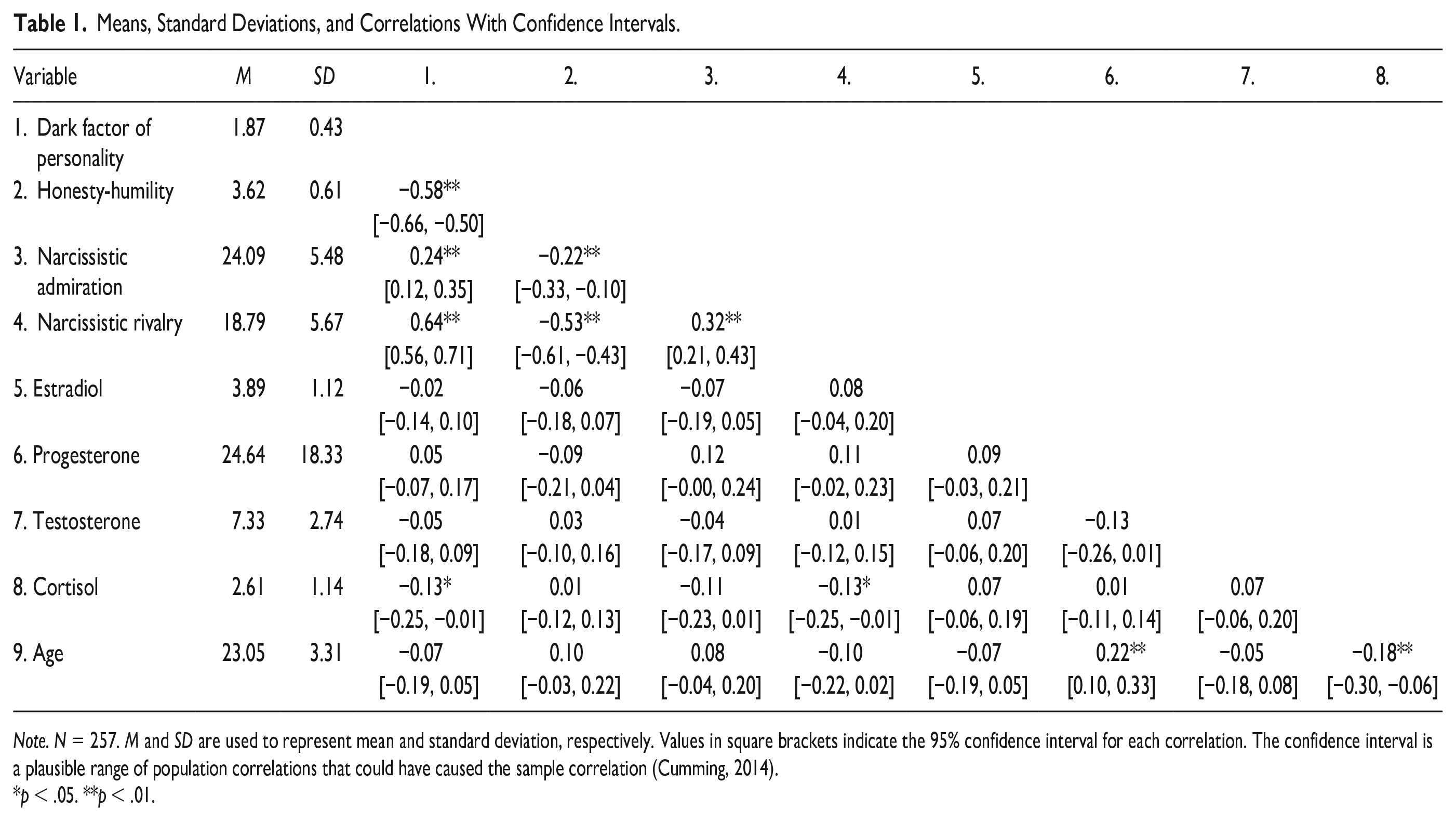
Note. N = 257. M and SD are used to represent mean and standard deviation, respectively. Values in square brackets indicate the 95% confidence interval for each correlation. The confidence interval is a plausible range of population correlations that could have caused the sample correlation (Cumming, 2014).
p < .05. **p < .01.
Hormones and Unfaithfulness in Committed Relationships
Logistic regression models showed no significant relation between average hormone levels (Supplemental Table S6), their interactions (testosterone × cortisol and progesterone × estradiol, respectively), and unfaithfulness in committed relationships (Table 2), providing no compelling evidence for a link between steroid hormones and unfaithfulness in committed romantic relationships.
Logistic Regression Analyses of Self-Reported Unfaithfulness in Romantic Relationships.
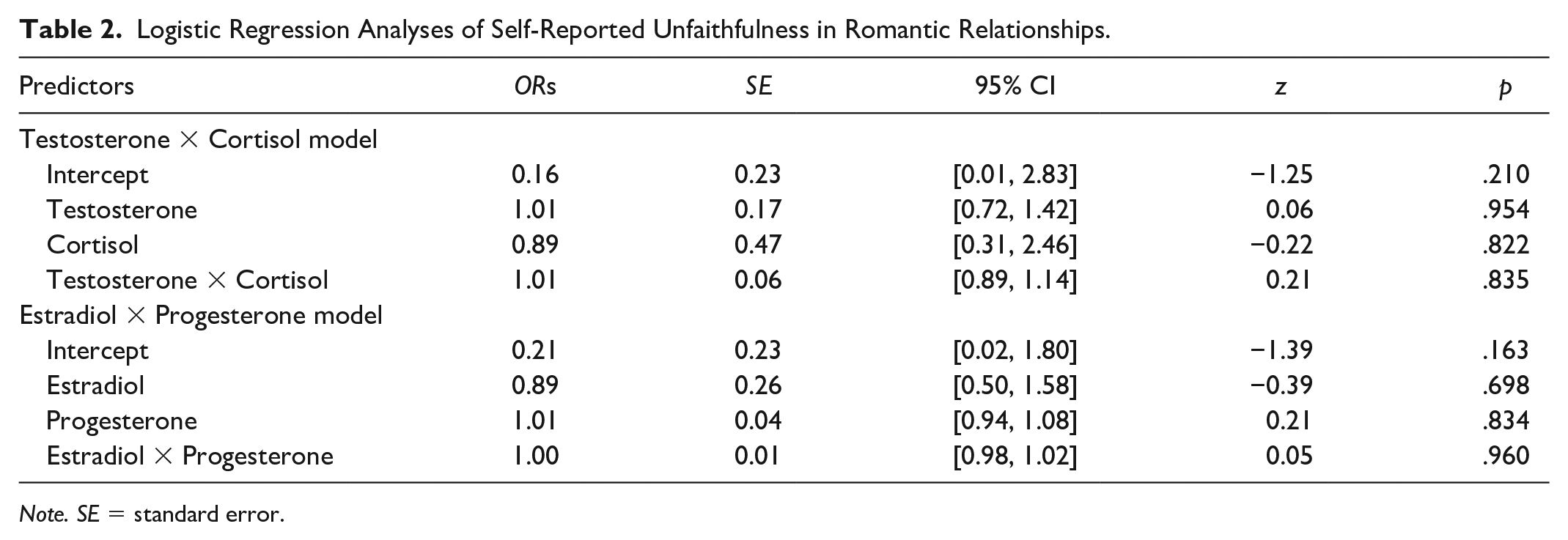
Note. SE = standard error.
Hormones and Behavioral Dishonesty
We tested whether steroid hormone levels were linked to behavioral dishonesty, that is, whether higher or lower average hormone levels were related to cheating more or less often in the mind game across sessions. Average progesterone was significantly related to the number of reported wins across sessions (r = .13, 95% CIs = [0.00, 0.24], p = .046); this effect was robust when adding estradiol to the same model, but would not remain significant after controlling for multiple testing. No other average hormone levels (Supplemental Table S7), nor their interactions (Table 3), were significantly related to the number of reported wins across sessions.
Regression Analyses of Economic Dishonesty.
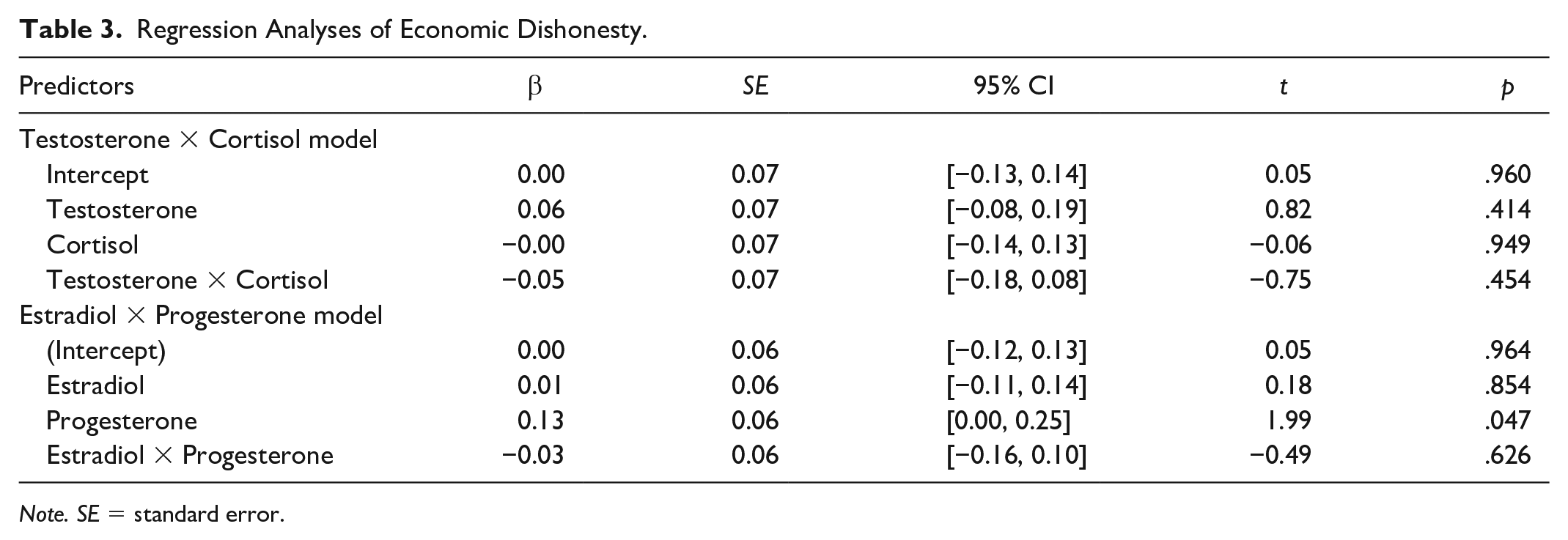
Note. SE = standard error.
Within-Subjects Effects
Hormones, Conception Probability, and State Honesty
Next, we investigated within-subjects effects or changes in hormone levels between testing sessions and whether these fluctuations are linked to self-reported or economic dishonesty. For this purpose, we fitted multilevel models which included hormone levels and random effects for each individual as predictors of state honesty ratings. We were also able to investigate participants’ conception probability as an indicator for fertility in the particular testing session. Our results suggest that neither hormone levels (Supplemental Table S9) nor their interactions (testosterone × cortisol and progesterone × estradiol; Supplemental Table S8) or conception probability (Supplemental Table S9 in the Supplementary Material) significantly predicted state honesty ratings.
Hormones, Conception Probability, and Economic Dishonesty
We fitted multiple models which included hormone levels and random effects for each individual. To estimate the relation between the proportion of dishonest individuals in the mind game and the hormone levels, a modified logistic regression model was used (see Moshagen & Hilbig, 2017). Neither hormone levels nor their interactions (testosterone × cortisol and progesterone × estradiol) did significantly predict the proportion of dishonest individuals (Supplemental Tables S10 and S11), with confidence intervals, especially for the interaction effects, being very wide, suggesting that these effects are too complex for the data structure.
Self-Reported Personality and Behavioral Measures
Finally, we tested whether we could replicate previously reported links between self-reported and behavioral dishonesty to validate these relations in our data. Self-reported honesty-humility was significantly negatively related to average economic dishonesty (β = −0.23, 95% CIs = [−0.35, −0.11], t = −3.69, p < .001). These results indicate that participants who self-reported being higher on honesty-humility cheated less often in the mind game. Furthermore, self-reported honesty-humility was significantly negatively related to self-reported unfaithfulness in romantic relationships (odds ratio = 0.53, 95% CIs = [0.30, 0.92], z = −2.25, p = .025), suggesting that participants self-reporting higher honesty-humility cheated less often on their partner in romantic relationships. Finally, self-reported state honesty (averaged) and honesty-humility were significantly related (β = 0.21, 95% CIs = [0.12, 0.29], t = 4.68, p < .001), but state honesty across sessions was not significantly related to cheating in the mind game (risk ratio = 1.07, 95% CI = [0.86, 1.33], z = 0.62, p = .533). Effect patterns regarding D were comparable to those of honesty-humility, but in the opposite direction (e.g., showing more dishonest behavior when self-reporting higher D, see Supplemental Note e). Effects for narcissistic admiration and rivalry were in the same direction as effects for D, but most effects were not significant (ps between .040 and .399, see Supplemental Note e). Correlation coefficients for averaged economic dishonesty as well as state honesty and the personality dimensions are reported in Supplemental Table S12.
Discussion
To better understand the biological basis that potentially regulates unethical behaviors and tendencies, we conducted a well-powered study that tested within- and between-subjects effects of a broad set of steroid hormones and both self-reported and behavioral measures of unethical behaviors and tendencies. We tested these associations in women, as (a) this gave us the opportunity to test links of unethical behaviors or tendencies and ovarian hormones (next to testosterone and cortisol) as well as of women’s conception probability as a marker of fertility and (b) as previously reported links between unethical behaviors or tendencies and testosterone or cortisol were often only tested in men, leading to less clarity whether reported effects apply to women as well.
Our exploratory results suggest no compelling evidence for most of our investigated relations between within- or between-subjects steroid hormone levels or conception probability that were assumed to be linked to a broad range of measures of unethical behaviors and tendencies. We found some significant negative relations between average cortisol levels and both D and narcissistic rivalry and a positive relation between average progesterone levels and behavioral dishonesty in a self-serving economic mind game. Effect sizes were rather small, and confidence intervals barely excluded zero, however, and effects would not remain significant when controlling for multiple tests. Furthermore, the association between progesterone and behavioral dishonesty was only found between women but did not change across women’s ovulatory cycle with fluctuating progesterone levels. Nevertheless, these results provide some evidence that women with higher baseline cortisol levels self-report lower levels in D and narcissistic rivalry, whereas women with higher average progesterone levels cheat more often in an economic game to earn more money. None of the other investigated relations between either hormones or conception probability and self-reported or behavioral measures were significant, with effect sizes being close to zero.
As a validation check for our used measures, we replicated well-known patterns of results regarding relations across different self-report and behavioral measures of dishonesty. For example, the results that honesty-humility and D are related to economic dishonesty (Heck et al., 2018; Klein et al., 2020; Moshagen et al., 2018) or unfaithfulness in committed relationships (Reinhardt & Reinhard, 2023; Schild et al., 2020) are fully in line with previous research.
Interpretation of Mixed Findings
The reported links between average cortisol and both D and narcissistic rivalry, as well as between average progesterone and behavioral dishonesty, are novel findings, but generally in line with the idea that hormones are biological markers of individual differences (as summarized in the study by Sundin et al., 2021). Although they are in need of a preregistered replication before more firm conclusions can be drawn, these findings provide interesting initial clues that should be explored in future studies. In contrast to previous findings (Armstrong et al., 2022; Klimas et al., 2019; Lee et al., 2015; Mehta et al., 2017; Pfattheicher, 2016; Popma et al., 2007), we did not observe links between unethical behaviors or tendencies and testosterone, nor a testosterone × cortisol interaction effect. Furthermore, our results do not support previous claims of links between estradiol and opportunistic mating in committed relationships (Durante & Li, 2009). Moreover, we did not find compelling evidence that different measures of unethical behaviors and tendencies varied systematically across women’s ovulatory cycle, or with fluctuating hormone levels. These findings are in contrast to previous evidence reporting more self-serving behavior in economic games when women were fertile (Eisenbruch & Roney, 2016; Lucas & Koff, 2013) or more prosocial behavior when being fertile (Anderl et al., 2015), as these behaviors, as well as behavior in the mind game, show strong links to, for example, honesty-humility (Heck et al., 2018; Thielmann et al., 2020). However, they are in line with more recent research finding no evidence for a link between measured estradiol and progesterone with different measures of prosocial orientation (Ranehill et al., 2018; Wang et al., 2022).
Different methods likely explain these differences in results. Some of our measures clearly differed from those used in previous studies (although they are very likely intercorrelated) that, for example, relied on self-reports of previously committed crime or measured prosocial rather than antisocial tendencies. Most previous studies did not use a repeated-measures design, being unable to investigate within-subject effects (although some cycle studies interpreted their findings as such, despite a between-subjects design, e.g., Anderl et al., 2015; Eisenbruch & Roney, 2016; Lucas & Koff, 2013). However, a within-subjects design comes with the risk of lacking variability in repeated measures, as participants might remember their responses in previous sessions and repeat these responses in following sessions. This might especially be relevant for categorial measures (such as the mind game). Nevertheless, within-subjects variability (SD = 0.57 on a five-point scale) in self-reported honesty was almost as high as between-subjects variability (SD = 0.61). Other studies, especially those investigating the dual-hormone hypothesis, employed social interactions (e.g., Mehta et al., 2017), while we relied on self-reports on observations of actual behavior outside social interactions. Hormones regulate social behavior, and it is possible that any relationship between steroid hormones and unethicality only emerges in social situations involving face-to-face contact, which could explain that the majority of our findings were null-findings.
Furthermore, methods of hormone assessment differed between studies: While most previous studies relied on immunoassays that have been criticized for questionable validity (e.g., Arslan et al., 2023; Schultheiss et al., 2019), we analyzed hormone levels (except estradiol) using the current gold standard method LC-MS/MS. Another reason for non-replicability might be the differences in test power. Moreover, it is possible that effects are smaller than expected or more complex and only occurring under specific conditions that we did not assess (i.e., behavior in other economic games, such as the ultimatum game investigated in Eisenbruch & Roney, 2016). A final reason for our findings might be that, put simply, neither average nor fluctuating hormones play an important role in regulating unethical behaviors and tendencies.
Strengths and Limitations
Strengths of the current study include the relatively large sample size, the within-subjects design, and the multiple averaged hormone assays that provide a better baseline measure of hormones than a between-subjects measure as well as single measures (Stern et al., 2022). Furthermore, we did not only rely on self-reported dishonesty but also combined these measures with behavioral observations (i.e., the mind game) and analyzed hormone levels using the current gold standard method LC-MS/MS.
Limitations include the fact that our study did not involve an actual social situation (Baumeister et al., 2007), although hormones evolved to regulate social behavior, which might explain the large share of our null-findings. Future studies should employ social situations with a higher ecological validity to investigate whether links between steroid hormones and unethicality emerge in social situations.
As another potential limitation, we had to rely on immunoassays for estradiol, as there was no valid protocol for the superior method LC-MS/MS. Salivary immunoassays have recently been criticized for lacking validity, as they may not correspond to conception risk or show the expected peak in the fertile phase (Arslan et al., 2023). Thus, other methods to analyze estradiol levels, that were (at that time) unfortunately unavailable at the lab where our samples were analyzed, would have been preferable, and we cannot rule out that respective different analyses would have led to different results.
Reflecting on strengths and limitations, our sample consisted of women, allowing us to investigate effects of conception probability or ovarian hormones, but a sample including all genders would be desirable for future studies. Nevertheless, it should be pointed out that previous studies did not report any differences between men and women (e.g., Lee et al., 2015), and the dual-hormone hypothesis makes no gender-specific assumptions. Still, there might be sex-specific hormonal effects that should be investigated in future studies.
Another potential limitation is that we did not assess all data in the same setting at the laboratory, but participants completed an online self-report questionnaire assessing the personality characteristics as well as cheating in a committed relationship at home. We cannot preclude that different settings influenced responses, for example, because participants felt more anonymous while filling the online questionnaire, which made them respond more or less honest. Overall, participants might not have honestly answered questions regarding unfaithfulness given that this is a sensitive topic. The lack of a continuous scale of unfaithfulness (i.e., asking participants how often they have cheated on their partner) further limits the significance of our findings and should be addressed by future studies.
Finally, the fact that neither hypotheses nor analyses of the current article were preregistered is a limitation with regard to the interpretability of our results. More precisely, the current investigation is purely exploratory, the significant effects were of small magnitude, their confidence intervals barely excluded zero, and the found (small) effects would not remain significant when controlling for multiple testing. The latter might be a problem of lacking test power for detecting small to very small effects in our data. To test if the found effects are real and replicable, preregistered replication studies with a larger sample size are needed.
Conclusion
Unethical behaviors and tendencies can have important consequences for peoples’ lives, leading scholars to investigate mechanisms regulating them. Our exploratory results suggest no compelling evidence that the steroid hormones testosterone, cortisol, estradiol, and progesterone play an important role in regulating dishonesty, unfaithfulness in committed relationships, prosociality, or related personality characteristics in women, although we report some small links between average cortisol or progesterone levels and the personality dimensions D and narcissistic rivalry, as well as behavioral dishonesty in a self-serving economic game. These results are in need for preregistered replications with larger samples. Overall, our findings add up to recent null-findings for hormonal links to unethical behaviors and tendencies. Future studies should aim for a more diverse sample and use the most valid (hormone assay) methods available to further inform research on the biological base of unethical behaviors and tendencies.
Supplemental Material
sj-docx-1-psp-10.1177_01461672231199961 – Supplemental material for Revisiting the Relation Between Steroid Hormones and Unethicality in an Exploratory, Longitudinal Study With Female Participants
Supplemental material, sj-docx-1-psp-10.1177_01461672231199961 for Revisiting the Relation Between Steroid Hormones and Unethicality in an Exploratory, Longitudinal Study With Female Participants by Julia Stern, Christoph Schild and Ingo Zettler in Personality and Social Psychology Bulletin
Footnotes
Acknowledgements
The authors thank Paula Bange, Laura Botzet, Sarah Forsthoff, Isa Garbisch, Kim Gloystein, Salome Johannigmann, Indra Kirchberg, Laila Knapp, and Sabine Ostermann for collecting the data.
Declaration of Conflicting Interests
The author(s) declared no potential conflicts of interest with respect to the research, authorship, and/or publication of this article.
Funding
The author(s) disclosed receipt of the following financial support for the research, authorship, and/or publication of this article: This research was funded by grants from the Deutsche Forschungsgemeinschaft (DFG, German Research Foundation; project number 254142454 / GRK 2070) to J.S. as well as by the Carlsberg Foundation (CF16-0444) to I.Z.

Supplemental Material
Supplemental material is available online with this article.
References
Supplementary Material
Please find the following supplemental material available below.
For Open Access articles published under a Creative Commons License, all supplemental material carries the same license as the article it is associated with.
For non-Open Access articles published, all supplemental material carries a non-exclusive license, and permission requests for re-use of supplemental material or any part of supplemental material shall be sent directly to the copyright owner as specified in the copyright notice associated with the article.
