




Abstract
Dominance and prestige are two strategies people use to regulate their social rank within group hierarchies. Despite a growing literature on dominance- and prestige-oriented leaders, little is known about how those strategies operate among people lower in social rank. Four studies tested the hypothesis that, among subordinates, dominance and prestige are associated with high levels of malicious and benign envy, respectively. Individual differences in prestige were positively and independently associated with benign envy, and negatively associated with malicious envy. Individual differences in dominance were positively and independently associated with both malicious and benign envy. Two experiments demonstrated that activating a prestige-oriented mindset (relative to a dominance-oriented mindset) caused people to display higher levels of benign envy. No experimental effects on malicious envy were observed. Theories of prestige and dominance provide a useful framework for understanding ways in which subordinate group members strive for high social rank.
Imagine being a faculty member in an academic department, and coming to recognize that one of your colleagues is more highly respected and has more clout than you do. Would you respond by lifting yourself up—by increasing your productivity so that you might eventually achieve the same high level of respect currently enjoyed by your colleague? Or might you instead tear your colleague down—by resenting them, subtly tainting their reputation, or undermining their work?
Research documents two types of reactions people have toward higher-ranking group members (Crusius & Lange, 2014; Lange & Crusius, 2015a, 2015b; Van de Ven et al., 2009). Sometimes people feel inspired by those above them and raise themselves up by emulating those people (“benign envy”). However, sometimes people instead feel antipathy and contempt for those above them and seek to tear those people down by hurting them or damaging their reputation (“malicious envy”). What causes people to experience benign versus malicious envy?
We propose that benign and malicious envy reflect broader strategies people use to navigate social hierarchies. We draw upon theories that distinguish between two fundamental strategies—dominance and prestige—used to regulate one’s place within social hierarchies (Cheng & Tracy, 2014; Maner & Case, 2016; Van Vugt & Smith, 2019). The current investigation advances the literature in several ways. First, although theories of dominance and prestige imply that the two strategies are commonly used by lower-ranking group members to attain status, empirical work inspired by those theories has instead tended to focus on how the strategies operate among those at the top—leaders and those in charge of making group decisions (e.g., see Maner, 2017). Much less work has focused on subordinates, despite the fact that there are far more people at the bottom than at the top. Investigating links between envy, dominance, and prestige is important also because the ways people respond to those above them in the hierarchy can be innocuous or even beneficial to the group, while in other cases those responses can involve behaviors that are harmful and destructive. Thus, identifying factors that lead people to experience malicious versus benign envy may shed light on ways to enhance the well-being of groups and their members. In four studies, we evaluate hypothesized connections between dominance, prestige, and envy. Two correlational studies (Studies 1 and 2) build on prior work involving dominance, prestige, and envy (e.g., Lange et al., 2019). Two experiments (Studies 3 and 4) provide the first causal tests of whether experimentally manipulated prestige versus dominance motives lead people to experience benign versus malicious envy.
Dual Strategies Theory of Social Hierarchy
Virtually all human groups involve some form of social hierarchy. Hierarchies facilitate coordination, promote cooperation, and provide a means for leaders to help groups achieve their goals (Magee & Galinsky, 2008; Van Vugt, 2006). Hierarchies are especially beneficial for those at the top. High-ranking people are free to pursue personal goals, enjoy high levels of social influence, and experience relatively unhindered access to group resources (Keltner et al., 2003; Willis & Guinote, 2011). Although lower-ranking group members gain benefits of social hierarchy (e.g., protection), their behavior is more constrained, and they tend to lack many of the benefits of high social rank. Thus, people are fundamentally motivated to strive for high social rank (Anderson et al., 2015).
Dual strategies theory suggests that people use two distinct strategies—dominance and prestige—to strive for high social rank (Cheng & Tracy, 2014; Maner & Case, 2016; Van Vugt & Smith, 2019). Dominance involves the use of coercion, intimidation, aggression, and fear (Cheng et al., 2013; Ketterman & Maner, 2021; Maner & Mead, 2010). A critical feature of dominance involves how social rank is conferred: through coercion and intimidation, dominance-oriented people can actively seize elevated social rank without relying on freely conferred deference from other group members.
Prestige, in contrast, involves the display of valued traits, knowledge, and skills and, consequently, the receipt of freely conferred deference (Henrich & Gil-White, 2001). People who gain social rank via prestige are typically viewed as role models, and they gain social rank through respect and admiration, rather than intimidation or bullying. Because their rank is based on freely conferred deference, people who rely on prestige are highly motivated to foster affiliative social relationships (Case et al., 2018, 2021), and gaining social rank via prestige hinges on one’s ability to foster networks of prosocial–affiliative relationships (Redhead & von Rueden, 2021; von Rueden et al., 2019). Conversely, having poor social relationships can undermine the status of a person who might otherwise gain social rank through prestige.
Benign and Malicious Envy
In the current research, we use the literature on dominance and prestige to generate hypotheses about the experience of envy among subordinate group members. Subordinates often engage in upward social comparisons that coincide with feelings of envy (Crusius & Lange, 2014; Hill & Buss, 2008). Envy is an emotion experienced “when a person lacks another’s superior quality, achievement, or possession and either desires it or wishes that the other lacked it” (Parrott & Smith, 1993).
Envy powerfully motivates social behavior (Hill & Buss, 2006). Envy sometimes provides the motivation to work harder to get what someone else has (Frank, 1999). However, envy can also involve being uncooperative and hindering group performance (Duffy & Shaw, 2000; Parks et al., 2002). Indeed, although benign and malicious envy both function to reduce rank differences between oneself and someone of higher rank, the cognitive and behavioral features of benign and malicious envy are quite different (Crusius & Lange, 2014; Van de Ven et al., 2009, 2011).
Benign envy involves a suite of responses that include forming a positive impression of the higher-ranking person and seeking to advance oneself (Lange & Crusius, 2015a; Van de Ven et al., 2009, 2011). A key component of benign envy is the desire to improve one’s social rank. Benign envy promotes attention to opportunities for improving one’s social standing (Crusius & Lange, 2014) and has been linked to actual improvements in performance (Van de Ven et al., 2011).
Malicious envy, in contrast, involves forming a negative impression of the higher-ranking person and enacting behaviors to undermine that person (Lange & Crusius, 2015a; Montal-Rosenberg & Moran, 2022). Malicious envy may also prompt people to collect information about the envied person that might be useful for undermining that person (Crusius & Lange, 2014). Consistent with this interpretation, malicious envy is related to the experience of pleasure at the misfortune of others, or Schadenfreude (Van de Ven et al., 2015).
Benign and malicious envy, in sum, represent distinct sets of cognitive, affective, and behavioral responses to upward comparisons in social rank. Both types of envy function to reduce the rank difference between oneself and someone of higher rank (Lange & Crusius, 2015b; Van de Ven et al., 2009), but they do so in different ways. Whereas benign envy involves attempts to raise oneself up, malicious envy involves attempts to tear down a higher-ranking person.
Prior work provides a useful springboard for understanding how the two forms of envy reflect broader strategies for pursuing social rank. Theoretical work, for example, suggests that appraisal patterns of benign and malicious envy are linked with orientations toward dominance versus prestige—circumstances that typically lead someone to experience benign envy (e.g., perceptions of high personal control and deservingness) mirror those in which prestige is especially effective, whereas circumstances that typically lead someone to experience malicious envy (e.g., perceptions of low personal control and deservingness) could indicate contexts in which someone can more easily attain social rank via dominance (Crusius & Lange, 2017). In addition, empirical work has found that viewing the failure of someone who displayed hubristic pride (a common correlate of dominance; Cheng et al., 2010) increased schadenfreude, and that effect was mediated by malicious envy (Lange & Boecker, 2019). Moreover, experimental manipulations of psychological entitlement have increased people’s motivation to pursue social rank through both prestige and dominance, which in turn predicted benign versus malicious envy, respectively (Lange et al., 2019). That same work documented associations between dominance and prestige motivation and the two forms of envy (Lange et al., 2019). However, a limitation of that work is that, even though dominance and prestige motivations were positively correlated, the associations with dominance and prestige were not assessed while controlling for one another, thus leaving questions as to their independent contribution.
In the current work, we identify the independent contribution of dominance and prestige, and we do so in two ways. First, in analyses pertaining to individual differences, we include dominance and prestige as simultaneous predictors to control for their overlap. Second, we use experimental manipulations of dominance and prestige to provide the first causal tests of their effects on envy.
Overview of the Current Research
We predicted that having an orientation toward prestige versus dominance would increase the likelihood of experiencing benign versus malicious envy, respectively. Prestige involves developing knowledge and skills, building alliances, and gaining freely conferred respect. Responding to higher-ranking group members with benign envy could enhance the ability of prestige-oriented subordinates to gain social rank. For example, treating higher-ranking group members as role models and supporting those people could help a prestige-oriented subordinate attain valuable encouragement and training from those above them. By supporting and fostering affiliative relationships with those above them, prestige-oriented subordinates could gain the knowledge and skill they admire, and in turn enhance their ability to gain social rank via prestige. This pattern would fit well with findings pertaining to prestige-oriented leaders, who tend to view skilled group members as allies, rather than as threats (Maner & Case, 2016). We reasoned that prestige-oriented subordinates would view higher-ranking group members as role models and sources of inspiration, seeking to lift themselves up, rather than tearing the higher-ranking group members down. Thus, we hypothesized that subordinates with a prestige-oriented mindset would respond to someone of higher social rank with benign envy.
In contrast, we expected that dominance would be associated with malicious envy. Dominant people adopt a competitive and adversarial stance toward group members who stand to earn the respect of their group, viewing those people as threats to their own social rank, and behaving in ways that reduce those threats (Maner & Mead, 2010; Mead & Maner, 2012). Dominant leaders, for example, use their power to isolate, control, and ostracize highly skilled group members (Maner & Mead, 2010; Mead & Maner, 2012). We reasoned that dominance-oriented subordinates would display antipathy toward higher-ranking group members, trying to tear those higher-ranking group members down to reduce the potential threats they pose and to increase their own relative social rank. Thus, we hypothesized that subordinates with a dominance-oriented mindset would respond to someone of higher social rank with malicious envy.
Across four studies, we examined links among dominance, prestige, and benign and malicious envy. In Studies 1 and 2, we conceptually replicated and extended prior work by focusing on individual differences in people’s orientation toward dominance and prestige. We predicted that an orientation toward dominance (but not prestige) would be positively associated with malicious envy. We also predicted that an orientation toward prestige (but not dominance) would be positively associated with benign envy. To provide converging evidence, we measured dispositional trait levels of benign and malicious envy (Study 1), and benign and malicious envy in the context of a scenario involving a group hierarchy (Study 2). In Studies 3 and 4, we used experimental manipulations to activate motivational orientations toward dominance or prestige. Following prior research (Case et al., 2018, 2021), we manipulated the type of hierarchy people were in to activate an orientation toward either dominance (power hierarchy) or prestige (status hierarchy).
Study 1
Study 1 examined relationships between individual differences in dominance and prestige and trait measures of benign and malicious envy. We predicted that dominance would be positively associated with malicious envy, whereas prestige would be positively associated with benign envy. In the Method sections below, we report all studies we conducted to test hypotheses, how we determined our sample sizes, all data exclusions, all manipulations, and all measures. Materials, data, and data analysis code for the studies are available at https://osf.io/haepu/?view_only=e1eb0854a97e4915bdf7c9372a6aaa93.
Method
Participants
Participants were 161 online MTurk workers who completed the study for $0.15. Eleven participants failed at least one of two attention checks embedded in self-report measures and were excluded from analyses. Analyses included 150 participants (56 men, 94 women). Because this study represented an initial test of hypotheses, we did not conduct an a priori power analysis. However, a sensitivity power analysis using G*Power indicated that, for a two-tailed test of a single coefficient in a two-predictor regression model (dominance and prestige as simultaneous predictors), 150 participants provided 80% power to detect effects as small as r = (±)0.22.
Procedure
Participants completed the Dominance-Prestige Scale (Cheng et al., 2010), which includes nine items measuring individual differences in dominance (e.g., “I am willing to use aggressive tactics to get my way”; α = .85; M = 3.16, SD = 1.13) and eight items measuring individual differences in prestige (e.g., “Others always expect me to be successful”; α = .85; M = 4.90, SD = 0.92; 1 = strongly disagree, 7 = strongly agree). The order of items was randomized.
Participants then completed the Benign and Malicious Envy Scale (Lange & Crusius, 2015a). This scale consists of five items measuring individual differences in benign envy (e.g., “When I envy others, I focus on how I can become equally successful in the future”; α = .90; M = 3.97, SD = 1.52) and five items measuring individual differences in malicious envy (e.g., “Seeing other people’s achievements makes me resent them”; α = .89; M = 2.65, SD = 1.31; 1 = strongly disagree, 7 = strongly agree). The order of items was randomized.
Results and Discussion
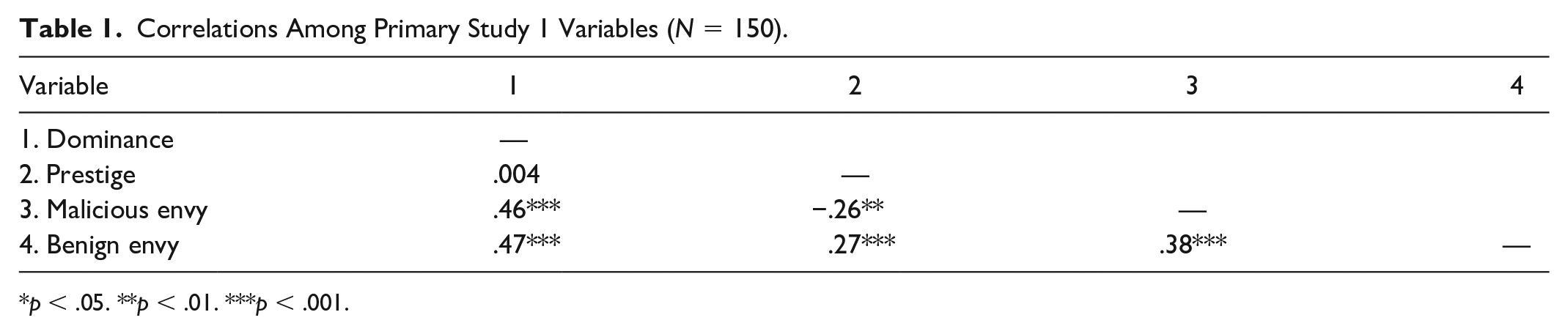
See Table 1 for correlations among primary study variables. An omnibus general linear model (GLM) tested relationships between envy type (benign vs. malicious; within-subjects) and individual differences in dominance and prestige, which were included as centered continuous predictors. We observed a significant interaction between prestige and envy type, F(1, 147) = 42.06, p < .001, η2 = .22, but no interaction between dominance and envy type, F(1, 147) = 0.76, p = .38, η2 = .005. Those findings indicate that prestige was differentially associated with benign and malicious envy, but dominance was similarly related to both forms of envy. There was also a large main effect of envy type such that people reported greater benign envy than malicious envy, F(1, 147) = 131.05, p < .001, η2 = .47.
Correlations Among Primary Study 1 Variables (N = 150).
p < .05. **p < .01. ***p < .001.
Primary regression analyses then evaluated the relationships among the two forms of envy, dominance, and prestige (see Table 2). Consistent with predictions, prestige was positively and independently associated with benign envy. Unexpectedly, dominance was also positively associated with benign envy. In the second model, individual differences in malicious envy were regressed on individual differences in dominance and prestige. As expected, dominance was positively associated with malicious envy. In contrast, prestige was negatively associated with malicious envy. Because benign and malicious envy were positively correlated in Studies 1 (see Table 1), 2, and 4, we also report regression models that include the other form of envy as a covariate (see supplemental analyses). None of those results alter the interpretation of the findings reported in the main text.
Regression Results for Study 1.

Note. Individual differences in dominance and prestige as simultaneous predictors of benign/malicious envy.
Findings provide preliminary support for the hypothesis that dominance is positively and independently related to malicious envy and prestige is positively and independently related to benign envy. We also observed a negative relationship between prestige and malicious envy; while not predicted prior to data collection, this relationship fits with our theoretical framework. If prestige-oriented individuals view talented superiors as role models, they may actively avoid undermining the person they view as a role model. Moreover, prestige-oriented individuals may avoid engaging in facets of malicious envy as a form of reputation management or relationship building. Because gossiping is typically frowned upon (Turner et al., 2003), prestige-oriented people may avoid gossiping about higher-ranking people as a way of maintaining positive relationships and protecting their reputation (cf. Case et al., 2018).
The positive relationship between dominance and benign envy was also unpredicted. One explanation may involve a relationship between benign envy and Machiavellianism (Lange, Paulhus, & Crusius, 2018). While benign envy is generally prosocial, it may at times also involve using subtle forms of social manipulation and charm as means toward self-advancement. Dominance could therefore promote benign envy insofar as benign envy may sometimes involve behaviors aimed at covertly influencing others in apparently prosocial ways. Doing so could help dominant people advance themselves while avoiding some of the negative ramifications of malicious envy. That possibility is consistent with evidence that dominance is associated with both coercive and prosocial social influence tactics (Ketterman & Maner, 2021). The link between dominance and benign envy requires replication, however, before any conclusions can be drawn.
Study 2
Study 2 investigated associations between individual differences in dominance and prestige and the experience of benign and malicious envy. Whereas Study 1 relied on trait measures of benign and malicious envy, Study 2 assessed the experience of benign and malicious envy in the context of a hypothetical workplace scenario.
Method
Participants
An a priori power analysis using G*Power indicated that, to achieve 0.95 power to detect an effect size matching the smallest key effect in Study 1 (partial r = −.29) in a two-tailed test of a single coefficient in a two-predictor regression model, a sample size of 144 was required. One-hundred sixty MTurk workers participated for $0.15 compensation. Fifteen participants failed the attention check or scenario comprehension question and were excluded. Analyses included 145 participants (55 men, 89 women, 1 did not report). Sensitivity analysis indicated that 145 participants provided 80% power to detect effects as small as r = (±) .23 in a two-predictor multiple regression model (two-tailed test).
Procedure
As in Study 1, participants completed the 17-item Dominance-Prestige Scale (Cheng et al., 2010) providing measures of dominance (α = .86; M = 3.03, SD = 1.12) and prestige (α = .86; M = 4.89, SD = 0.98). Items were presented in random order.
Participants read a scenario developed in previous research to evoke envy (Van de Ven et al., 2012). Participants imagined that they work in a call center with several friends. Each year, management evaluates the performance of employees and sets their wages accordingly. Participants then find out that a friend who they spend time with and get along with receives a higher wage.
After reading this scenario, participants responded to two items (from Van de Ven et al., 2012) designed to measure benign envy (“In this situation, I would be inspired by my coworker” and “In this situation, I would start to work harder”; α = .71; M = 4.90, SD = 1.29) and two items designed to measure malicious envy (“In this situation, I would secretly wish that my coworker would lose clients” and “In this situation, I would gossip about the coworker to others”; α = .69; M = 2.52, SD = 1.31; 1 = strongly disagree, 7 = strongly agree). The order of items was randomized. Participants then indicated whether the scenario asked them to imagine that the coworker received either a lower or a higher wage to verify that participants attended to this critical piece of information.
Results and Discussion
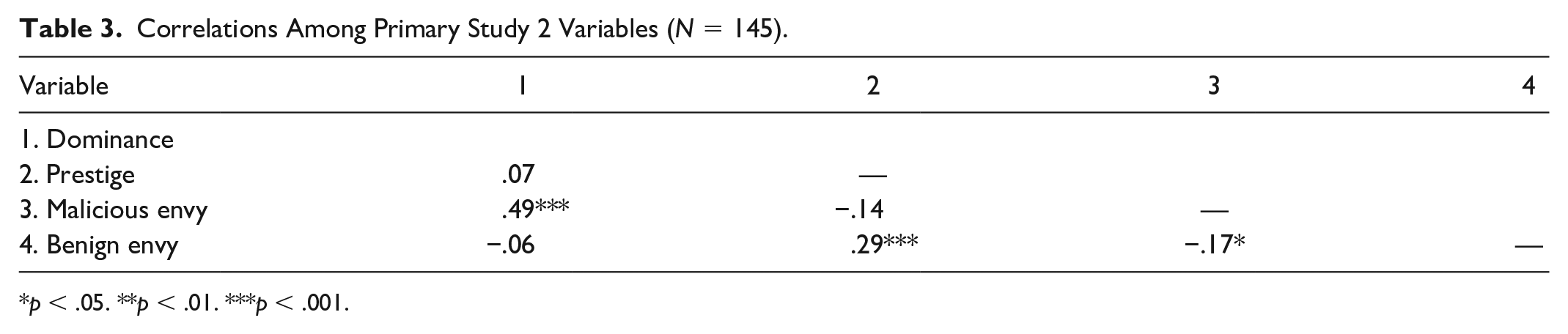
See Table 3 for correlations among primary study variables. An omnibus GLM tested effects of envy type (benign vs. malicious; within-subjects) and individual differences in dominance and prestige, which were included simultaneously as centered continuous predictors. As anticipated, we observed a significant interaction between envy type and dominance, F(1, 142) = 26.86, p < .001, η2 = .16, and between envy type and prestige, F(1, 142) = 17.18, p < .001, η2 = .11. Thus, dominance and prestige were differentially associated with benign versus malicious envy. There was also a large main effect of envy type with participants reporting greater benign than malicious envy, F(1, 142) = 256.03, p < .001, η2 = .64.
Correlations Among Primary Study 2 Variables (N = 145).
p < .05. **p < .01. ***p < .001.
Primary analyses tested two regression models aimed at understanding the nature of those associations (see Table 4). The first included prestige and dominance as predictors of benign envy. Replicating Study 1, prestige was positively associated with benign envy. Unlike Study 1, dominance was unrelated to benign envy. The second regression model included prestige and dominance as predictors of malicious envy. Results replicated Study 1: Whereas dominance was positively associated with malicious envy, prestige was negatively associated with malicious envy.
Regression Results for Study 2.

Note. Individual differences in dominance and prestige as simultaneous predictors of benign/malicious envy.
Study 2 provides further evidence that dominance is independently associated with malicious envy, whereas prestige is independently associated with benign envy. This study also replicated the negative relationship between prestige and malicious envy found in Study 1. The positive relationship between dominance and benign envy observed in Study 1 did not replicate.
Study 3
The first two studies were limited by their reliance on correlational methods and self-reported individual differences in dominance and prestige. Studies 3 and 4 advanced the investigation by using experimental methods to manipulate people’s motivational orientation toward dominance versus prestige. To manipulate dominance- versus prestige-oriented motivations, previous studies (Case et al., 2018, 2021) have manipulated the nature of the group hierarchy—whether it is based on power versus status (see Blader et al., 2016; Hays & Bendersky, 2015).
Power hierarchies are based on asymmetric control over resources, such that people influence others by using resources to reward and punish. Having power affords the ability to coerce others and to demand their deference. Those features of power often engender selfish and antisocial behavior and cause powerful people to view others in instrumental ways (e.g., Gruenfeld et al., 2008). Being in a power hierarchy thus activates a set of normative expectations and standards for behavior that involve intimidation and the manipulation of resources as a means of social influence. Indeed, placing people into a leadership position in a power hierarchy has been shown to activate dominance-oriented (as opposed to prestige-oriented) motives (Case et al., 2018, 2021). Similarly, we reasoned that dominance-oriented motives would be activated by placing people into a subordinate position in a power hierarchy (relative to a status hierarchy).
Status hierarchies, in contrast, are based on freely conferred deference, such that people regulate their place in the hierarchy by gaining admiration and respect from other group members (Anderson & Kilduff, 2009; Hardy & Van Vugt, 2006). This central feature of status hierarchies is conducive to a prestige-oriented strategy, in which people are motivated to gain respect, admiration, and freely conferred deference. Being in a status hierarchy thus activates a set of normative expectations and standards for behavior that involve influencing others by earning respect and admiration. Indeed, placing people into a leadership position in a status hierarchy has been shown to activate prestige-oriented (as opposed to dominance-oriented) motives (Case et al., 2018, 2021). Similarly, we reasoned that prestige-oriented motives would be activated by placing people into a subordinate position in a status hierarchy (relative to a power hierarchy).
As in Study 2, Study 3 assessed benign and malicious envy in the context of a workplace scenario. However, to provide evidence for generalizability, we varied the content of the scenario. In contrast to Study 2 (which involved envy toward a coworker), Study 3 assessed envy toward a group leader. We predicted that participants in a status (power) hierarchy would experience greater benign (malicious) envy.
Method
Participants
We conducted an a priori power analysis with effect size estimates from previous research using the same manipulation (power vs. status hierarchy; Case et al., 2018). That paper reported two between-subjects experiments (Studies 4 and 5). Achieving 80% power to detect the smaller of those effects (Study 4; d = .24) in a within-subjects design with two conditions and two dependent variables required a sample size of 140. One-hundred fifty-one MTurk workers participated for $0.50. Sixteen participants failed at least one attention check and were excluded. Analyses included 135 participants (93 men, 42 women). The design was fully within-subjects, thus maximizing statistical power. Sensitivity analysis indicated that 135 participants provided 80% power to detect effects as small as size d = (±) .24 (η2 = .015) in a repeated-measures analysis of variance (ANOVA) with two groups and two measurements.
Procedure
Participants imagined themselves in two scenarios. 1 All participants saw both conditions, presented in random order. Both scenarios involved working as part of a team in a mid-sized company and a description of the leader of the company. The Power versus Status manipulation was modeled after previous research (Case et al., 2018; Hays & Bendersky, 2015). In the Power condition, the description emphasized the degree of power held by the leader and his ability to reward and punish subordinates. The leader was described as able to make unilateral budget decisions, hire and fire whomever he wants, and conduct performance evaluations by himself. The instructions for the Status condition emphasized the status-oriented nature of the hierarchy. The leader in this condition was described as receiving respect and status, and it was stated that other group members often willingly defer to his opinion. Both scenarios ended by stating that although the person is seen as the leader of the group, the participant should imagine that he or she has a level of expertise similar to the leader. This last design element was included to reduce the possibility of floor effects in malicious envy. By having participants think of themselves as having similar expertise to the leader, we hoped to increase the possibility of participants forming a negative impression.
Following each scenario, participants responded to items measuring benign and malicious envy, adapted from prior research (Crusius & Lange, 2014; Van de Ven et al., 2009). Five items assessed benign envy (“I would feel inspired to attain more influence in the group”; “I would want to be like Tyler”; “I would consider Tyler likeable”; “I would want to try harder to attain a similar level of influence as Tyler”; “I would admire Tyler”). Five items measured malicious envy (“I would wish that Tyler failed at something”; “I would wish that Tyler didn’t have the level of influence that he has”; “I would have negative thoughts about Tyler”; “I would feel coldness toward Tyler”; “I would like to bad-mouth Tyler to other group members”). Malicious envy was measured in the power hierarchy (α = .92) and status hierarchy scenarios (α = .95). Benign envy was measured in the status hierarchy (α = .82) and power hierarchy scenarios (α = .82).
After the scenarios, participants completed the Dominance-Prestige Scale (Cheng et al., 2010) to assess individual differences in dominance (α = .79; M = 3.71, SD = 1.16) and prestige (α = .82; M = 4.77, SD = 1.03). This allowed us to evaluate the correlations between those variables and envy (as in Studies 1 and 2), as well as to explore possible interactions between those variables and the experimental manipulation.
Results and Discussion
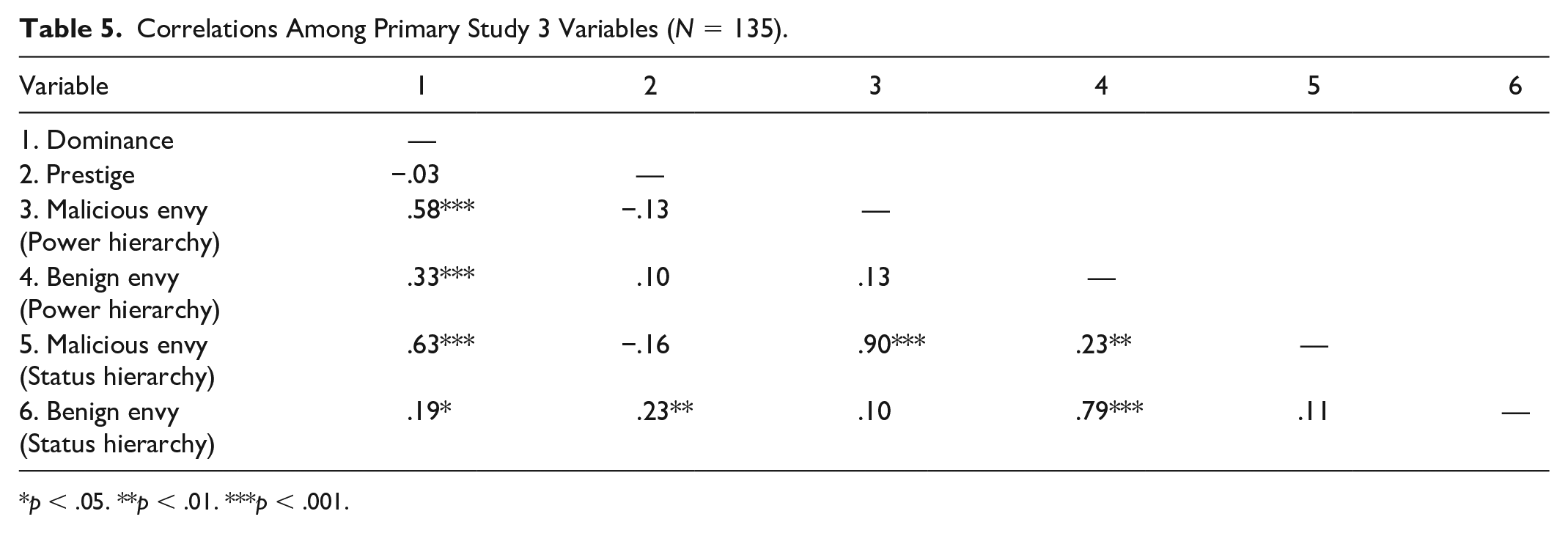
See Table 5 for correlations among study variables.
Correlations Among Primary Study 3 Variables (N = 135).
p < .05. **p < .01. ***p < .001.
Experimental findings
An omnibus repeated-measures GLM revealed the predicted interaction between hierarchy type and envy type, F(1, 134) = 8.57, p = .004, η2 = .06. Repeated-measures GLMs thus tested for differences in benign and malicious envy across experimental conditions. Consistent with predictions, compared with the power hierarchy (M = 4.75, SD = 1.23), participants reported greater benign envy in the status hierarchy condition (M = 4.92, SD = 1.15), F(1, 134) = 6.73, p = .01, η2 = .05. Also consistent with predictions, relative to the status hierarchy (M = 3.24, SD = 1.81), participants reported greater malicious envy in the power hierarchy condition (M = 3.39, SD = 1.75), F(1, 134) = 4.60, p = .034, η2 = .03. We also observed a main effect of envy type: participants reported greater benign envy than malicious envy across conditions, F(1, 134) = 85.24, p<.001, η2 = .39. There was no main effect of hierarchy type, F(1, 134) = 0.14, p = .71, η2 = .001.
Individual differences in dominance and prestige
Secondary analyses examined associations between individual differences in dominance and prestige and the two forms of envy. We tested a mixed-design GLM that included envy type, hierarchy type, and their interaction as within-subjects factors, with dominance and prestige entered simultaneously as continuous between-subjects predictors. As expected, results revealed a significant interaction between dominance and envy type, F(1, 132) = 26.39, p < .001, η2 = .17, and between prestige and envy type, F(1, 132) = 8.41, p = .004, η2 = .06.
Regression was used to evaluate these associations. We averaged across conditions to calculate single dependent measures of malicious envy (α = .95; M = 3.31, SD = 1.73) and benign envy (α = .88; M = 4.83, SD = 1.12; see Table 6). The first regression analysis included dominance and prestige as predictors of malicious envy. Results replicated the pattern found in Study 1 and Study 2. Dominance was positively related to malicious envy. The negative relationship between prestige and malicious envy approached significance. The second regression included dominance and prestige as predictors of benign envy. Results replicated the pattern found in Study 1. Benign envy was associated with both prestige and dominance. Exploratory analyses investigated potential three-way interactions between envy type (benign vs. malicious), hierarchy type (power vs. status), and individual differences in dominance and prestige (see Supplemental Materials).
Regression Results for Individual Differences in Study 3.

Note. Individual differences in dominance and prestige as simultaneous predictors of benign/malicious envy.
Study 3 used experimental methods to test causal effects of dominance versus prestige motives on envy. Findings suggest that activating prestige (vs. dominance) motives promotes benign envy, whereas activating dominance (vs. prestige) motives promotes malicious envy.
Findings pertaining to individual differences replicated earlier studies. We again observed a positive relationship between dominance and malicious envy, and a positive relationship between prestige and benign envy. As in both Studies 1 and 2, we observed a negative relationship between prestige and malicious envy, attesting to the replicability of this relationship. We also replicated the unexpected positive relationship (found in Study 1) between dominance and benign envy.
Study 4
Study 4 again manipulated hierarchy type to activate dominance (power hierarchy) or prestige (status hierarchy) motives. Whereas Study 3 involved a hypothetical workplace scenario, Study 4 involved a face-to-face laboratory study in which participants were assigned to a subordinate position in a group. The study advanced the investigation by using a more realistic laboratory setting in which participants anticipated participating in a group activity.
Method
Participants
We performed a power analysis based on the effect size of the experimental effects in Study 3 (on both benign envy η2 = .05 and malicious envy η2 = .03). To be conservative, we used the smaller of those effects (effect on malicious envy), which we converted to d = .352. An a priori power analysis using G*Power indicated that to achieve .80 power in a two-tailed test of a difference between two independent means required 256 participants. Two-hundred fifty-seven undergraduates participated. Nineteen participants voiced suspicion about either the existence of a group task or the prerecorded video, and their data were excluded. Analyses therefore included 238 participants (182 women, 55 men, 1 transgender). Sensitivity analysis indicated that, for a two-tailed test of the difference between two means in a between-subjects design, a sample of 238 participants provided .80 power to detect effects of the size d = (±) .36 (η2 = .032).
Procedure
Participants completed the Cheng Dominance-Prestige Scale providing measures of dominance (α = .76; M = 2.99, SD = 0.92) and prestige (α = .69; M = 5.32, SD = 0.65). Participants were then told they would participate in a group task across the hall with two other group members. They were told one of the three would be selected to be the leader of the group while the other two would be assigned to a worker role. Participants were told members of their group would be separated until the group task began because the study was investigating newly formed groups whose members were unacquainted with each other.
Next, we introduced a between-subjects manipulation adapted from prior research to manipulate an orientation toward dominance or prestige (Case et al., 2018). In the power hierarchy condition, instructions emphasized the degree of power, authority, and control the leader has over group decisions. Participants were told the leader would have the opportunity to evaluate workers’ performance and, based on those evaluations, make decisions about how to divide bonus rewards among the workers at the end of the session. In the status hierarchy condition, instructions emphasized the degree of status and respect that come with the leadership role. Participants were told leaders usually get to generate and work with important ideas, and that the responsibilities of the leader are typically admired and important.
After the manipulation, all participants were assigned to a subordinate (“Worker 1”) role and that one of the other participants had been selected as leader. We intentionally left ambiguous the factors that determined leader assignment, because we did not want participants to perceive the leader as the most highly qualified, which could inadvertently reduce feelings of malicious envy, or as selected randomly, which could increase feelings of malicious envy. Participants were told the leader was recording a video introduction, which would be shown to them and to the other worker. The video introduction was prerecorded and featured a confederate (matched to the participants’ gender). The confederate’s video was designed to be relatively neutral, such that participants could form either a positive or negative impression of the leader (see Supplemental Materials for a script of the video).
After watching the video, participants responded to questions regarding the leader. We adapted 10 items from Study 3 and prior research (Crusius & Lange, 2014; Van de Ven et al., 2009) to measure benign and malicious envy toward the leader. Five items measured benign envy (“I am motivated to attain a similar level of influence as the leader”; “I want to be similar to the leader”; “I admire the group leader”; “I feel inspired to attain a similar level of influence as the leader”; “I think the group leader is likable”; α = .76; M = 4.15, SD = 1.09). Five items measured malicious envy (“I would like it if my group leader were unsuccessful”; “I wish my group leader didn’t have the level of influence that s/he has”; “I have some negative thoughts about the leader”; “I don’t think the person selected as leader is the right person for the job”; “I would like to bad-mouth the leader to the other worker”; α = .79; M = 1.54, SD = 0.77; 1 = not at all, 7 = very much). One additional dependent measure assessed the desire to remove the leader from their role. This item read “The workers’ ratings of the leader will factor into whether that person remains in the leadership role for the second half of the group task: How deserving is the leader of the leadership role?” (1 = not at all deserving, 6 = very deserving).
Results and Discussion
Experimental findings
A GLM tested effects of envy type (benign vs. malicious) as a within-subjects factor, and hierarchy type (power vs. status) as a between-subjects factor. The interaction between envy type and hierarchy type was not significant, F(1, 236) = 1.12, p = .29, η2 = .005. We observed a main effect of envy type such that people responded with greater benign envy across conditions, F(1, 236) = 827.90, p < .001, η2 = .78. There was no main effect of hierarchy type, F(1, 236) = 1.20, p = .27, η2 = .005.
To replicate analyses from the previous study, one-way ANOVAs tested for differences in benign and malicious envy across experimental conditions. Contrary to predictions, results revealed no significant difference in malicious envy between the status hierarchy (M = 1.53, SD = 0.80) and power hierarchy conditions (M = 1.54, SD = 0.77), F(1, 236) = 0.012, p = .914, η2 = .00. Likewise, there was no difference in benign envy between the status hierarchy (M = 4.29, SD = 1.03) and power hierarchy conditions (M = 4.11, SD = 1.11), although the nonsignificant trend was in the predicted direction, F(1, 236) = 1.76, p = .186, η2 = .007. There was also no difference in ratings of the leader as deserving of their role in the status hierarchy (M = 4.72, SD = 1.02) versus power hierarchy condition (M = 4.55, SD = 1.15), F(1, 236) = 1.42, p = .23, η2 = .006.
Analyses of individual differences
See Table 7 for correlations among primary study variables. Secondary analyses investigated the association between individual differences in dominance and prestige and the two forms of envy. An omnibus GLM with envy type (benign vs. malicious) as a within-subjects factor, hierarchy type (condition) as a between-subjects factor, and individual differences in dominance and prestige as continuous between-subjects predictors provided evidence for two-way interactions between envy type and dominance, F(1, 232) = 14.92, p < .001, η2 = .06, and between envy type and prestige, F(1, 232) = 12.31, p < .001, η2 = .05. Three regression analyses assessed the nature of those associations (experimental condition was included as a covariate in each analysis; see Table 8). The first analysis included prestige and dominance as predictors of benign envy. Consistent with predictions, prestige was positively associated with benign envy. Dominance was unrelated to benign envy. The second analysis included dominance and prestige as predictors of malicious envy. Consistent with predictions, dominance was positively related to malicious envy. Prestige was unrelated to malicious envy. The third analysis included dominance and prestige as predictors of ratings of the leader’s deservingness of his or her role. Consistent with predictions, dominance predicted lower ratings of the leader’s deservingness of the role (i.e., greater desire to remove the leader from the role), β = −.23, p < .001, partial r = −.22, 95% confidence interval [CI] = [−.42, −.12]. Prestige was unrelated to ratings of leader deservingness, β = .04, p = .52, partial r = .04, 95% CI = [−.15, .29]. In Supplemental Materials, we report exploratory analyses investigating interactions between experimental condition and individual differences in dominance and prestige.
Correlations Among Primary Study 4 Variables.
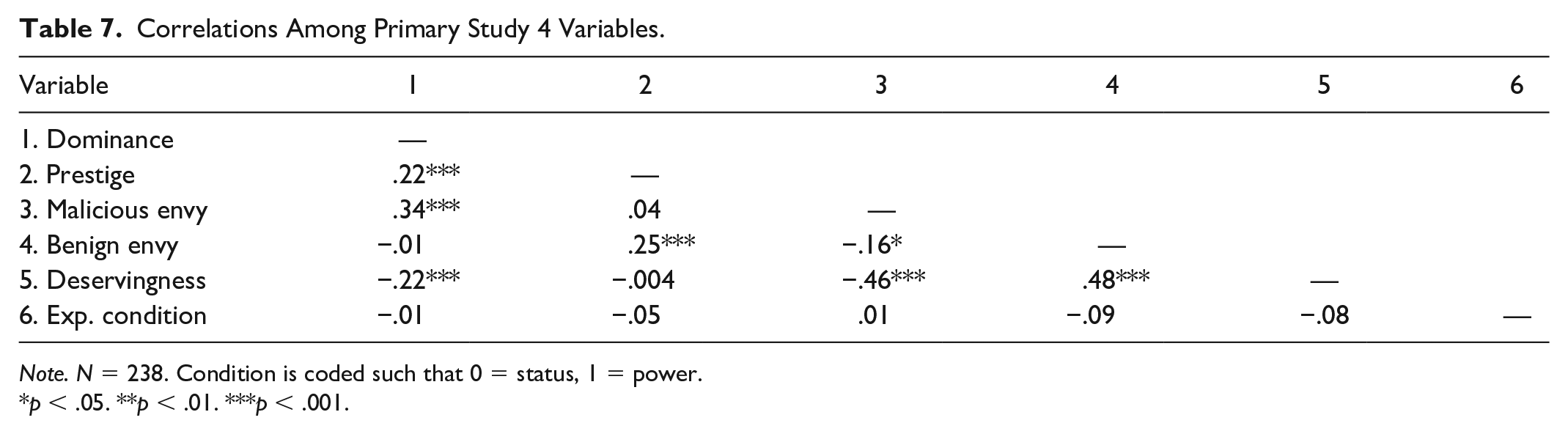
Note. N = 238. Condition is coded such that 0 = status, 1 = power.
p < .05. **p < .01. ***p < .001.
Regression Results for Individual Differences in Study 4.
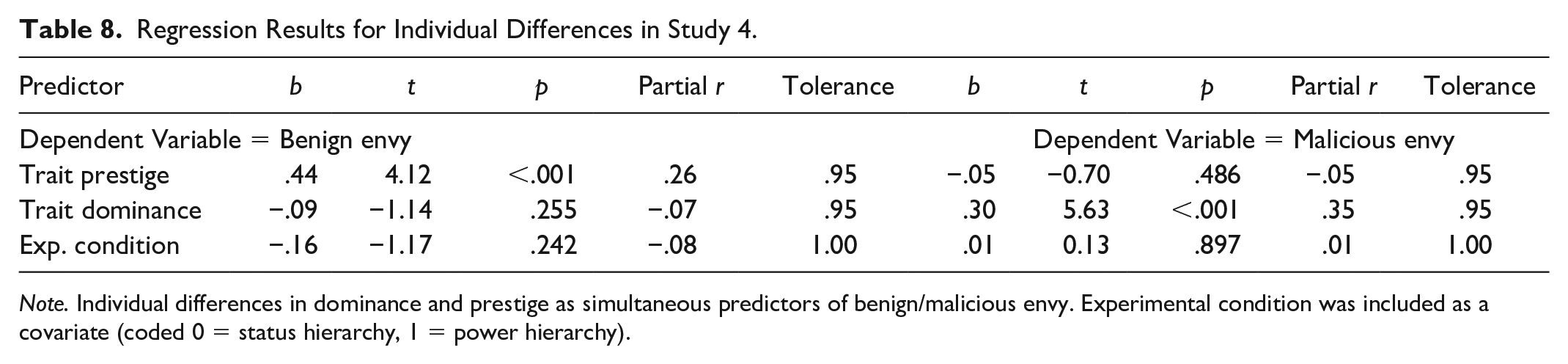
Note. Individual differences in dominance and prestige as simultaneous predictors of benign/malicious envy. Experimental condition was included as a covariate (coded 0 = status hierarchy, 1 = power hierarchy).
An experimental manipulation of power versus status hierarchy did not affect levels of benign and malicious envy. One possible explanation may be that individual differences in dominance and prestige were more influential than the experimental context. Indeed, in contrast to the experimental findings, the individual difference results from Study 4 conformed straightforwardly to predictions. Another possible explanation is that, because the hierarchy descriptions were delivered verbally (vs. a text format as in Study 3), participants may not have processed or later remembered the hierarchy description when responding to dependent measures. (Manipulation checks would have provided additional information about that possibility, but the study was limited by a lack of manipulation checks.) Findings pertaining to individual differences were consistent with prior studies. As in each of the previous studies, dominance was related to malicious envy, whereas prestige was related to benign envy. Given the inconsistent experimental findings, we conducted an internal meta-analysis to determine whether the effects of experimentally manipulated hierarchy type were significant across Studies 3 and 4 (see below).
Internal Meta-Analysis and Integrative Data Analysis (IDA)
Using meta-analysis and IDA, we analyzed findings across studies to provide overall tests of our hypotheses. We evaluated the reliability and magnitude of the relationships among individual differences in dominance, prestige, and envy. We also evaluated the reliability and magnitude of experimentally manipulated dominance and prestige.
IDA of Individual Difference Findings
We combined data from Studies 1 to 4 to assess associations between individual differences in dominance and prestige and the two forms of envy. A set of mutually orthogonal contrast codes were included to control for differences in study design (e.g., correlational vs. experimental, within-subjects vs. between-subjects; see Table 9). See Table 1 in Supplemental Materials for full statistical reporting of design codes. When aggregating results across all four studies, dominance was positively associated with both malicious and benign envy. Prestige was positively associated with benign envy, but negatively associated with malicious envy.
Integrative Data Analysis of Individual Difference Regression Results Across Studies.
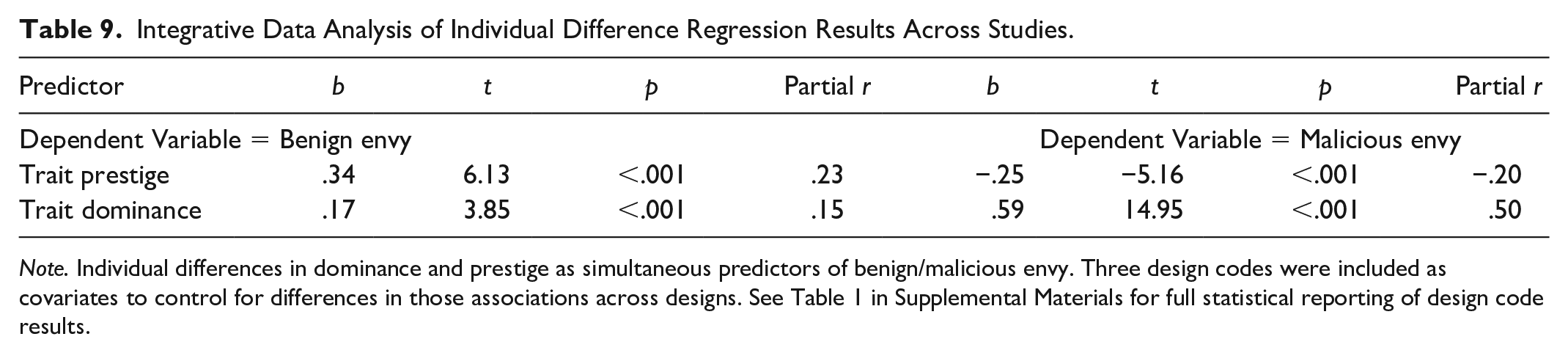
Note. Individual differences in dominance and prestige as simultaneous predictors of benign/malicious envy. Three design codes were included as covariates to control for differences in those associations across designs. See Table 1 in Supplemental Materials for full statistical reporting of design code results.
Internal Meta-Analysis of Experimental Findings
We conducted an internal meta-analysis across the two experimental studies using estimates of effect size from the primary GLMs in Studies 3 and 4. We assumed fixed-effects and did not adjust effect sizes for attenuation. Across the two experimental studies, we found a significant interaction between manipulated hierarchy type and envy type, r = .13, p = .01. Experimentally manipulated power versus status had a significant effect on benign envy in the predicted direction (greater benign envy in the status hierarchy condition), r = −.14, p = .01, 95% CI = [−.24, −.03]. Across the two studies, the effect of experimentally manipulated power versus status on malicious envy was in the predicted direction, but was not significant, r = .07, p = .176, 95% CI = [−.03, .17].
General Discussion
How do people respond to those above them in the hierarchy, and why might they be inclined to either undermine them—to tear them down—or instead to increase their own performance and advance themselves—to raise themselves up? To address this question, we differentiated between dominance and prestige as fundamental strategies for navigating social hierarchies.
The current research documents links between the strategies people use to navigate social hierarchies (prestige and dominance) and how they respond to those above them in the hierarchy (benign and malicious envy). We found converging evidence for positive associations between individual differences in prestige and benign envy and between dominance and malicious envy. These relationships were found using dispositional measures (Study 1), while measuring benign and malicious envy in the context of a specific scenario (Studies 2 and 3), and while measuring benign and malicious envy in the context of a realistic laboratory group (Study 4). These findings fit with prior work demonstrating links between the two types of envy and strategies for pursuing social rank (e.g., Lange et al., 2019). Although that work provided valuable evidence for associations between dominance and prestige and the two forms of envy, it fell short of assessing the independent effects of dominance and prestige. In the current work, we included dominance and prestige as simultaneous predictors to account for their overlap.
We leveraged the social psychological literature on power and status to manipulate an orientation toward prestige versus dominance. This allowed us to provide the first causal test of these strategies in promoting benign and malicious envy (Studies 3 and 4). We found evidence that prestige promotes benign envy. Among subordinates, an orientation toward prestige may cause people to look favorably on those above them and to treat them as role models. By viewing higher-ranking group members as role models and as potential sources of information, prestige-oriented subordinates may be able to more effectively develop knowledge and skills valued by the group. By responding prosocially to successful group members, prestige-oriented subordinates are also likely to foster positive relationships. Thus, a tendency to respond with benign envy may enhance the ability of a low-ranking group member to gain social rank via prestige (cf. Crusius & Lange, 2017).
For many of the same reasons that benign envy may be functional for gaining social rank via prestige, a tendency to respond with malicious envy may be problematic for that goal. Indeed, prestige was associated with low levels of malicious envy. Avoiding malicious envy could be beneficial for a prestige-oriented strategist because malicious envy could harm their ability to gain knowledge and skills or form positive relationships. Undermining skilled group members could reduce the likelihood of those people sharing valued knowledge and skills with the subordinate and could harm the subordinate’s reputation through being viewed as less trustworthy or likable.
Responding to successful group members with malicious envy, however, may be more functional for dominance-oriented subordinates. Dominant people are willing to use agonistic and selfish means such as manipulation and coercion to gain and maintain social rank (Maner, 2017). By seeking to undermine successful group members, dominance-oriented subordinates can increase their own relative social rank. Consistent with this idea, we observed a strong and reliable association between individual differences in dominance and malicious envy. While previous research provides evidence of antisocial behavior among dominant leaders, the current work suggests this pattern extends to subordinates who lack the ability to use formal power to undermine successful group members.
Causal evidence for the role of dominance in malicious envy was equivocal. In Study 3, a manipulation of dominance produced greater malicious envy, but this effect failed to replicate conceptually in Study 4. An important difference is that the scenarios in Study 3 asked participants to imagine they had the same level of experience as the leader. In Study 4, the introduction video from the group leader indicated that she or he had successful leadership experiences. One possibility is that perceptions of leader legitimacy in Study 4 might have reduced the tendency to experience malicious envy (see Lammers et al., 2008). Further research is needed before conclusions can be drawn regarding the role an orientation toward dominance may play in causing malicious envy.
Although not predicted at the outset of the investigation, we observed a small but reliable association between dominance and benign envy. This association fits with prior work (Lange et al., 2019) and could reflect a desire among dominant people to advance themselves by any means necessary, through undermining the leader in some circumstances or by modeling their behavior after the leader in other circumstances. The link between dominance and benign envy might also reflect a shared association with Machiavellianism, which includes relatively subtle and seemingly prosocial influence tactics such as charm (see Jonason & Webster, 2012; Lange, Paulhus, & Crusius, 2018).
Broader Implications
Most empirical research in the dual strategies literature focuses on those at the top: leaders and powerful decision-makers. However, this focus has left relatively understudied the larger proportion of people who reside at lower rungs on the social ladder. Because dominance and prestige represent strategies for gaining (and maintaining) social rank, dual strategies theory has direct relevance to the psychology of those who do not (yet) have power or status. By focusing on reactions to those above them in the hierarchy, the current work adds to a growing body of research on the psychology of subordinate group members.
This work also helps integrate the social psychological literature on power and status with the evolutionary psychological literature on dominance and prestige. Although virtually all existing research on dominance and prestige has relied on individual differences in those strategies, the current work adds to a small but growing body of research using experimental methods to manipulate motivational orientations toward dominance versus prestige. Power and status reflect structural aspects of the hierarchy (Keltner et al., 2003; Magee & Galinsky, 2008), whereas prestige and dominance reflect strategies people use to gain influence within the hierarchy (Cheng et al., 2013; Henrich & Gil-White, 2001; Maner & Case, 2016). By manipulating power versus status to elicit motivational orientations toward dominance versus prestige, the current research helps integrate theories of dominance and prestige with theories of power and status (see also von Rueden & van Vugt, 2015).
The current research is conceptually similar to work linking dominance and prestige to authentic and hubristic pride (Cheng et al., 2010; Lange & Crusius, 2015b; Tracy & Prehn, 2012). Pride has been conceptualized as a response to status attainment and a way to signal achievement (Tracy et al., 2010). The literature distinguishes between authentic (involving feelings of earned accomplishment and confidence) and hubristic pride (involving feelings of arrogance and narcissistic conceit; Tracy et al., 2009; Tracy & Robins, 2007). Connecting pride to the current work, previous work has found that experimentally manipulated pride displays (authentic vs. hubristic) can increase perceivers’ ascriptions of prestige and dominance. Those ascriptions, in turn, predicted benign and malicious envy, respectively (Lange & Crusius, 2015b). A burgeoning literature focuses on how rank displays of higher-ranking people can affect envy and how being envied affects the higher-ranking persons’ behavior (Lange & Crusius, in press). The current research suggests that, like the two forms of pride, the two forms of envy may reflect broader strategies used for navigating social hierarchies.
Limitations and Future Directions
Limitations of the current research provide valuable opportunities for future research. One limitation is that we focused on groups of unacquainted participants. Examining existing groups over time would be valuable for assessing whether the links between dominance, prestige, and envy generalize to familiar groups, and whether those links change or remain stable over time.
A second limitation is the lack of downstream measures. What happens when people either successfully gain—or fail to gain—social rank via benign versus malicious envy? Those strategies may have consequences for the way people are perceived by other group members and for group performance. Future work could assess whether benign (or malicious) envy is associated with better (or worse) group performance and well-being among group members, and whether those outcomes reflect the use of dominance and prestige. By seeking to undermine the group’s leadership, dominant subordinates who experience malicious envy might have negative effects on group performance or morale. In contrast, prestige-oriented subordinates might improve group performance by supporting effective leaders.
A third limitation is the use of unvalidated scales to measure benign and malicious envy in Studies 2 to 4. Those measures were based in previous research but adapted to fit the procedures in the current work. Such an approach is common, but can produce various problems, perhaps especially in research on emotions (Flake et al., 2017; Weidman et al., 2017). Future research would benefit from conceptually replicating the current work using validated measures of benign and malicious envy (see Lange, Weidman, & Crusius, 2018).
A fourth limitation is that, by conventional standards, some of the studies in the current work were slightly underpowered. For example, after excluding data from inattentive participants, Studies 3 and 4 fell short of the target sample size identified by a priori power analysis. This limitation is mitigated somewhat by the presence of multiple studies and the use of IDA, but future research would benefit from replicating conceptually the current findings in larger high-powered samples.
Future research would also benefit from investigating potential moderating variables. The links among dominance, prestige, and envy could depend on whether a leader’s position is legitimate or illegitimate. One possibility is that, even among dominance-oriented subordinates, perceiving a leader as legitimate might reduce malicious envy. Conversely, perceptions of illegitimacy might increase malicious envy and social rank challenges initiated by subordinate group members (Lammers et al., 2008). The presence of such challenges would be consistent with evidence that illegitimate powerholders are vigilant to signs of anger among those below them in the hierarchy (Stamkou et al., 2016). Future research could address these questions directly by experimentally manipulating perceptions of legitimacy.
Conclusion
Compared with those at the top, there are many more people at the bottom—those occupying relatively lower-ranking roles in hierarchically arranged groups. In providing evidence for links among dominance, prestige, and envy, this research sheds light on psychological processes experienced by subordinate group members. This work highlights the value of applying the dual strategies theory of social hierarchy not only to leadership, but also to followership. When faced with the presence of a higher-ranking person, some subordinates are inspired to work harder to improve themselves, whereas others feel malice and instead seek to undermine the senior person. In the opening to this article, we asked how people respond when finding themselves in a subordinate position—by raising themselves up, or by tearing others down. This research takes one step toward answering that question by suggesting that the broader strategies people use to navigate social hierarchies—dominance or prestige—play a critical role in determining the way people regard those above them in the hierarchy.
Supplemental Material
sj-docx-1-psp-10.1177_01461672221113670 – Supplemental material for Lifting Me Up or Tearing You Down? The Role of Prestige and Dominance in Benign Versus Malicious Envy
Supplemental material, sj-docx-1-psp-10.1177_01461672221113670 for Lifting Me Up or Tearing You Down? The Role of Prestige and Dominance in Benign Versus Malicious Envy by Connor R. Hasty, Sarah E. Ainsworth, Jose L. Martinez and Jon K. Maner in Personality and Social Psychology Bulletin
Footnotes
Declaration of Conflicting Interests
The author(s) declared no potential conflicts of interest with respect to the research, authorship, and/or publication of this article.
Funding
The author(s) received no financial support for the research, authorship, and/or publication of this article.

Supplemental Material
Supplemental material is available online with this article.
Notes
References
Supplementary Material
Please find the following supplemental material available below.
For Open Access articles published under a Creative Commons License, all supplemental material carries the same license as the article it is associated with.
For non-Open Access articles published, all supplemental material carries a non-exclusive license, and permission requests for re-use of supplemental material or any part of supplemental material shall be sent directly to the copyright owner as specified in the copyright notice associated with the article.
