



Abstract
Across four studies, the current paper demonstrates that smiles are associated with lower social status. Moreover, the association between smiles and lower status appears in the psychology of observers and generalizes across two forms of status: prestige and dominance. In the first study, faces of fashion models representing less prestigious apparel brands were found to be more similar to a canonical smile display than the faces of models representing more prestigious apparel brands. In a second study, after being experimentally primed with either high or low prestige fashion narratives, participants in the low prestige condition were more likely to perceive smiles in a series of photographs depicting smiling and non-smiling faces. A third study of football player photographs revealed that the faces of less dominant (smaller) football players were more similar to the canonical smile display than the faces of their physically larger counterparts. Using the same football player photographs, a fourth study found that smiling was a more reliable indicator of perceived status-relevant personality traits than perceptions of the football players' physical sizes inferred from the photographs.
Introduction
Debates about the information that an audience derives from a sender's facial displays (see Fridlund, 1994; Parkinson, 2003) have traditionally focused on whether these displays primarily advertise the mental states of the sender (e.g., whether the sender feels happy or sad) or signal the behavioral tendencies of the displayer (e.g., whether the displayer intends to help you or harm you). Research on one particular category of facial display—the smile—has recognized, however, that facial displays can also provide information about the sender's relative social status (e.g., Goldenthal, Johnston, and Kraut, 1981; Kraut and Johnston, 1979). This research has demonstrated that less dominant individuals smile more often than their more dominant counterparts. The current paper extends this research on the association between smiles and lower social status in three important ways: First, by exploring whether human smiles convey information about two distinct forms of status: dominance and prestige. Second, whereas previous research on human smile displays and status has focused on the behavior of senders (e.g., do lower status individuals smile more?), the current project extends this research to the question of whether the link between smiles and lower status appears in the psychology of the receivers of such displays. Finally, the association between smiles and lower social status is explored across two distinct forms of human smile: Duchenne happiness smiles and embarrassment/appeasement smiles.
Darwin (1872/1998) was among the first to suggest that human smiles might represent an evolutionary homology in the sense that smiles appear to have evolved across human and non-human populations to function as submissive gestures that prevent acts of aggression from higher status individuals (see also van Hoof, 1972). Indeed, this link between smiles and lower status is embodied in the primatologists' convention of identifying the top ranked individual as the only member of a particular primate group that does not express submissive behavior to other members of the group (e,g., Combes and Altmann, 2001). Darwin's insights regarding smiles suggest that in addition to providing information about the mental state of the sender (e.g., that they feel happy) or the behavioral tendencies of the displayer (e.g., that they intend to cooperate with you), a smile can also provide information about the relative social status of the displayer. Consistent with Darwin's observations, previous research has demonstrated a strong correspondence between human smiles and lower social status (Dovidio, Brown, Heltman, Ellyson, and Keating, 1988; Goldenthal et al, 1981; Keating, Mazur, and Segall, 1977). As Darwin noted, non-human primates also utilize smile-like, silent teeth-baring displays referred to as fear grimaces that function to preempt aggression from more dominant individuals by virtue of advertising the subordinate (and thus less threatening) status of the displayer (Preuschoft and Van Hooff 1997; Parr and Waller, 2006; van Hooff, 1972). Although human females tend to smile more than males (Hall, 1985), both men and women smile more when they are in a position of relatively less power 1 (Deutsch, 1987).
The literature on signaling in canines (wolves) adds to the well-established link between smiling and lower status by revealing that wolves “smile” by displaying their teeth with their mouth opened horizontally (as opposed to vertically) and this display is a reliable signal of submissive or friendly intentions (see Fox, 1970). While animal behavior researchers do not claim that these smile-like displays are isomorphic with human facial displays of emotion, the converging evidence across species suggests that evolution may have shaped human smile displays to advertise the displayer's relatively lower social status to conspecifics. Although previous research has demonstrated an association between smiles and lower status in humans, most of these studies have defined status strictly in terms of physical dominance. This leaves unexplored whether smiles can also convey information about less physical forms of status such as prestige.
There are at least two forms of low status in humans
Whereas early theorizing in evolutionary psychology viewed human status displays as analogous to dominance displays in other species (see Barkow, 1989), this assumption has been qualified by the recent insight that evolution has given rise to a uniquely human form of status known as prestige (Henrich and Gil-White, 2001; but see Horner, Proctor, Bonnie, Whiten, and de Waal, 2010 for evidence of non-human prestige). Prestigious individuals gain their status because others seek them out as models or teachers in order to copy them or to acquire from them the best available cultural information. By contrast with the dominance form of status, which often entails an individual controlling socially valued resources through the threat of physical force, the prestige form of status entails freely conferred (not coerced) deference toward an individual who possesses some exceptional ability or knowledge (Henrich and Gil-White, 2001). Thus, whereas dominance displays directed toward less dominant individuals often evoke submissive behaviors and avoidance, prestige displays directed toward less prestigious individuals, such as demonstrating one's knowledge of the latest digital technology in adolescent homo sapiens (see Miller, 2000; 2009), often provoke selective imitation of the displayer (not avoidance) and a variety of sycophantically ingratiating behaviors such as proximity seeking on the part of subordinates (Henrich and Gil-White, 2001). In this light, previous research demonstrating an association between human smiles and lower social status must be qualified by the acknowledgement of a second form of status, prestige, that is distinct from physical dominance. This recognition of two distinct forms of status in humans—dominance and prestige—raises an important research question: Do human smile displays function as signals of subordination for both forms of status?
Could individuals benefit from signaling their lower status?
Why would a subordinate individual ever signal their lower status, especially in cases where higher rank is defined in terms of prestige rather than dominance? In ethology and animal behavior, a signal can be defined as “any act or structure which alters the behaviour of other organisms, which evolved because of that effect, and which is effective because the receiver's response has also evolved” (Maynard Smith and Harper, 2003, p. 3). Given this definition, lower dominance individuals may benefit from signaling their lower dominance insofar as it reduces aggression from more dominant individuals. Possible benefits for signaling lower prestige are less obvious, but perhaps they are analogous to the benefit of signaling lower dominance. That is, perhaps signaling lower prestige, like signaling lower dominance, constitutes a form of strategic deference whereby one social agent benefits in the relative sense of avoiding costs they might otherwise pay if they challenged those above them in the status hierarchy. For example, less prestigious individuals who regularly receive benefits from more prestigious individuals could undermine that flow of benefits by failing to defer to their prestigious benefactors, and as a result of challenging these more prestigious individuals, reduce their benefactors' prestige and associated resource pool. Another way that less prestigious individuals might benefit from signaling their lower prestige is by conserving resources and energy that would be wasted in unwinnable prestige competitions with more prestigious individuals. For example, a less wealthy member of an indigenous group of native Americans who is not likely to benefit from entering into a gift-giving competition (i.e., a potlatch) with a much wealthier member of their group might avoid entering into such a costly competition by signaling their substantially lower status beforehand. Similarly, more prestigious individuals could also benefit from receiving these signals of lower prestige when doing so allows them to forgo costly displays of conspicuous consumption until a more relevant competitor arrives on the scene. All of these potential benefits of signaling lower status (and attending to such signals) provide plausible mechanisms that could result in the evolution of smiles as signals of lower status for both dominance and prestige forms of status.
Are happiness smiles as effective as embarrassment smiles at conveying information about lower status?
The question of whether human smiles convey information about both dominance and prestige is further complicated by the realization that human smiles have several functionally distinct forms that range from happiness smiles to embarrassment displays (see Figure 1). The canonical happiness display or so-called Duchenne smile involves activation of muscles around the eyes and the mouth and has traditionally been portrayed as a signal of one's internal state of “happy feelings” or positive affect rather than a signal of submissiveness per se (Davidson, Ekman, Saron, Senulis, and Friesen, 1990; Ekman, 2003; Frank and Ekman, 1993). By contrast, the human embarrassment display or appeasement smile typically involves a mouth-only smile but also includes a number of non-verbal behaviors such as head tilts, eye gaze aversion, and face touching (Keltner, 1995; Keltner and Buswell, 1997). Several studies suggest that the Duchenne smile co-varies with cooperative intentions (Brown, Palameta, and Moore, 2003; Mehu, Grammer, and Dunbar, 2007; Scharleman, Eckel, Kacelnik, and Wilson, 2001); whereas the embarrassment or appeasement display is a good candidate for an analog of the various submissive teeth-baring gestures observed in other species (Darwin, 1872/1998; Keltner, 2009). Given these findings it would be unsurprising to observe that the embarrassment display evokes inferences about the relatively lower dominance of the displayer. By contrast, it is unclear whether the Duchenne smile or true happiness display will also be associated with both forms of status because research to date has focused only on the physical dominance form of social status.

Two distinct forms of human smile: The “eyes and mouth” smile of the Duchenne smile or happiness display (left) and the mouth only smile associated with the embarrassment display (right)
Overview of the current studies
Across four studies, the current paper explores whether two distinct types of human smile display (happiness smiles and embarrassment smiles) are associated with two forms of lower status: lower prestige and lower dominance. These studies represent an attempt to not only demonstrate an association between displayer behavior (smile or no smile) and displayer status (high versus low) but also to test whether this association between smiles and status appears in the psychology of observers. In the animal signaling literature, this distinction between displayer behavior and observer psychology is conceptualized with the terms sender and receiver (see Dawkins and Krebs, 1978; Searcy and Nowicki, 2005; Smith and Harper, 2003). In the current studies we examine smiles from the standpoint of both sender behavior and receiver psychology.
Study 1
In the first study we evaluate the association between displayer smiling behavior and displayer prestige by examining whether the faces of fashion models representing less prestigious apparel brands are more similar to canonical smile displays than the faces of models representing more prestigious brands. Photos of fashion models were sampled from high and low prestige brand websites and rated in terms of their similarity to several canonical displays of emotion, including two displays involving smiles: happiness and embarrassment displays. In this study, status was defined in terms of prestige, as freely conferred deference from subordinates, rather than dominance.
Study 1 Materials and Methods
Twenty-one undergraduates at a large Southwestern University participated for extra credit in a seminar on emotion. Photos of fashion models were from brand websites for four different apparel categories: (1) men's white cotton, button-down shirts, (2) women's white cotton blouses, (3) men's and women's black V-neck sweaters, and (4) eyewear (glasses and sun glasses). Faces of fashion models representing high and low prestige brands of each apparel category were selected from the home page of each brand's website. If more than one model's face appeared on the home page for the brand website, a single face was randomly selected to represent that particular brand. If a brand did not have a website or if no model's face appeared on its homepage, this brand was excluded from the content analysis. For each apparel category, high prestige brands were defined as brands for which an apparel item was listed as above the median price for that particular product, whereas low prestige brands were defined as brands for which an item was listed as below the median price. Prices for these apparel items were collected from the e-commerce site Amazon.com between January and April of 2006. For example, the median price for men's black V-neck sweaters was $80 and the high prestige brands ranged from $90 to $410, whereas sweaters from lower prestige brands ranged from $33 to $70. Using this procedure, we identified N = 61 models' faces from brand websites across the four apparel categories (35 faces for high prestige brands and 26 faces for low prestige brands 2 ). The digital images of models' heads were cropped to show only the models' faces (e.g., no hair; see Figure 2) and were embedded in a PowerPoint slideshow in which each face appeared just once. On each slide—displayed alongside a single cropped photo of a model's face—were six canonical facial displays of emotion. These canonical displays corresponded to Facial Action Coding System (FACS) coded photos depicting facial displays of embarrassment, contempt, disgust, neutral, anger, and happiness (photos were from Ketelaar, Preston, Russell, Davis, and Strosser, 2007).
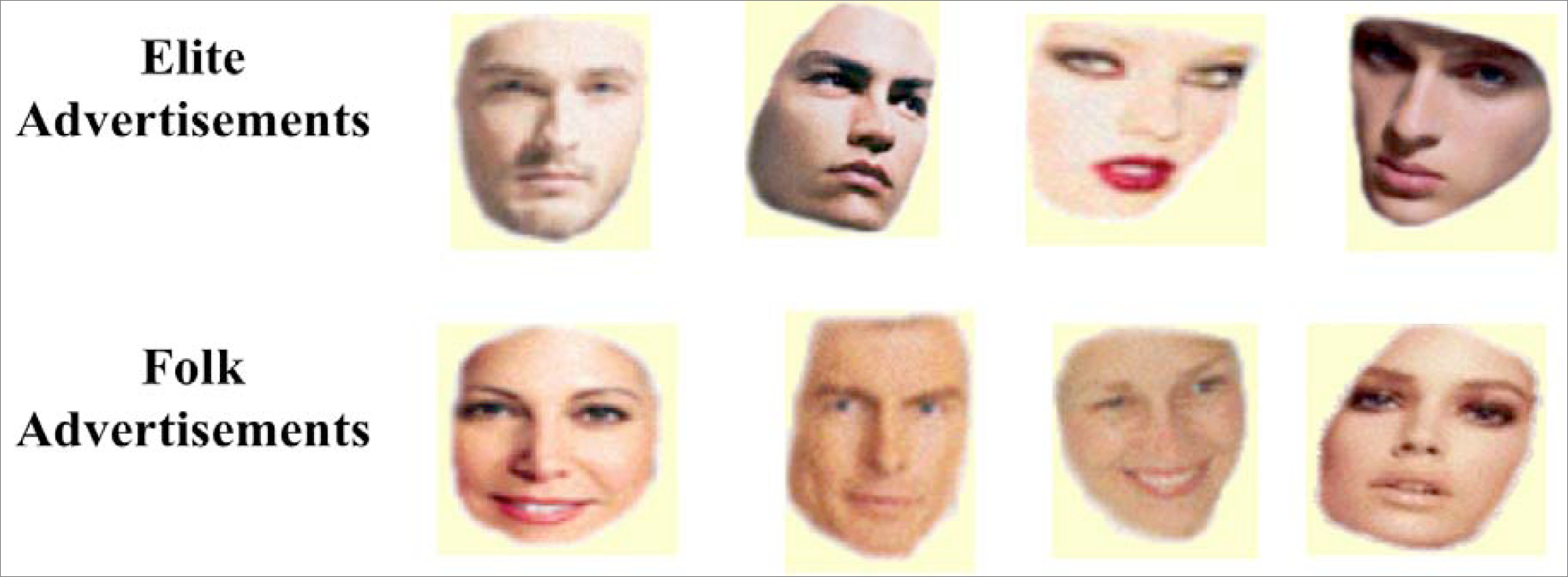
Study 1: Examples of headshots of fashion models from folk and elite apparel advertisements
Procedure
The PowerPoint slideshow was presented to participants, who were
Study 1 Results
For each participant we computed 12 mean emotion similarity ratings, one for each of the six distinct emotion displays separately for the high and low prestige brand models. Inter-rater reliability for each of these emotion similarity ratings (collapsing across model status) was adequate (Cronbach α's > .80 for each of six emotion ratings). We then tested the prediction that models representing the less prestigious brands would be rated higher on happiness and embarrassment displays than models representing the higher status brands using two paired-sample t-tests (one for happiness ratings and another for embarrassment ratings).
The faces of models representing less prestigious brands were rated as more similar to a canonical smile display than the faces of models representing more prestigious brands. Consistent with predictions (see Figure 3), participants rated the faces of models affiliated with the less prestigious brands as more similar to the canonical happiness facial display than the faces of the models affiliated with the more prestigious brands, t(19) = 8.70, p < .001, d = 2.06. Moreover, participants rated the faces of the models affiliated with the less prestigious brands as more similar to the canonical embarrassment facial display than the faces of the models affiliated with the more prestigious brands, t(19) = 6.18, p < .001, d = 1.40.

Study 1: Ratings of similarity between six canonical facial displays of emotions and photos of models' faces in folk versus elite advertisements.
Models for the more prestigious, higher status brands also displayed more negative and neutral emotions than models for the less prestigious, lower status brands. Although we did not have specific predictions regarding negative emotions, we tested the possibility that models representing the higher status brands would display more “negative” emotions (contempt, anger, and disgust) than models representing the lower status brands using a series of paired-sample t-tests (one for each emotion rating; see Figure 3). These analyses revealed that participants rated the faces of models affiliated with the more prestigious brands as more similar to the canonical anger facial display than the faces of models affiliated with the less prestigious brands, t(19) = 2.52, p < .05, d = 0.63. Participants also rated the faces of models affiliated with the more prestigious brands as more similar to the canonical disgust facial display than the faces of models affiliated with the less prestigious brands, t(18) = 2.81, p < .05, d = 0.73. In addition, participants tended to rate the faces associated with the more prestigious brands as more similar to the canonical contempt facial display than the faces of models affiliated with the less prestigious brands, t(19) = 1.26, p = .22, d = 0.29, although the latter finding was not statistically significant. Finally, participants rated the faces of models affiliated with the more prestigious brands as more similar to the canonical neutral facial display than the faces of models affiliated with the less prestigious brands, t(19) = 2.88, p < .05, d = 0.66.
Study 1 Discussion
Study 1 examined whether individuals associated with lower levels of prestige display more smiling than individuals associated with higher levels of prestige. Consistent with this hypothesis, the faces of fashion models affiliated with the websites of less prestigious brands were more similar to the canonical happiness and embarrassment smile displays than the faces of fashion models affiliated with the websites of more prestigious brands. Fashion models affiliated with the more prestigious brands not only displayed less smiling but also displayed more negative and neutral emotions. These findings suggest that the link between smiling and status can be extended beyond the realm of physical dominance where higher status is typically signaled by threats of physical force.
The finding that fashion models affiliated with the less prestigious brands smiled more than their more prestigious counterparts is consistent with several interpretations, including: 1) fashion models affiliated with the lower prestige brands are actually happier than their higher status counterparts and are signaling this psychological state by smiling, 2) fashion models affiliated with the higher prestige brands are actually instructed to not display signals of happiness, so as not to be inferred as possessing lower status (or conversely, perhaps lower prestige models are told to smile more than high prestige models), and finally, 3) fashion models affiliated with the lower prestige brands are actually signaling something other than happiness or lower prestige by smiling.
It is safe to assume that fashion models do not normally have the creative authority to pose as they please, including their facial expressions. Therefore the observed pattern of smiling or not smiling in fashion models may be more informative about the marketing intentions behind the corporations and decision makers who control a brand image, than they are about the emotional or personality characteristics of the models themselves. Consistent with the assumption that prestigious apparel brands would want to maintain their high status image by selecting images that avoid signals of lower status, our data showed that models representing the more prestigious brands did indeed smile significantly less than models for similar, albeit less prestigious apparel items. It seems unlikely that the smiling of fashion models affiliated with low prestige brands reflects these individuals actually being happier than the (non-smiling) models affiliated with high prestige brands. Indeed, these findings are opposite to what one would expect when considering that “Research on subjective well-being consistently reveals that the characteristics and resources valued by society correlate [positively] with happiness” (Lyubomirksy, King, and Diener, 2005, p. 803).
A more plausible explanation for these differences in smiling involves the implicit tradeoff between displaying a smile to convey positive affect (e.g., “I am happy”) and strategically suppressing a smile in order to convey higher prestige (e.g., “I am affiliated with a prestigious brand”). Thus, the non-smiling faces of the fashion models affiliated with the high prestige brands may not be attempting to convey that they feel less happy (by suppressing their happiness smiles), so much as they are attempting to avoid conveying the impression that they are affiliated with low prestige brands. Indeed, it is common knowledge in the fashion industry that high-end fashion brands demand “No smiling on the runway!” (see Tierney, 2007). As one former fashion industry professional remarks:
I myself have worked on fashion shoots for both the high-end (magazine editorial) and the mass-market end (catalogs, etc.) and yes, it's (sic) two completely different styles of modeling. In the mass-market shoots, the aim is to look approachable and friendly, simply because that's assumed to be what the potential customer of that type of product is attracted to … With the high-end jobs, it's all about creating a mood, about attitude, rather than getting people to identify with the product or model. (Tierney, 2007, para. 8)
The current findings suggest that instructions to suppress smiles have less to do with wishing to convey information about the sender's lack of positive affect (happiness) and instead have more to do with the desire to convey an image of high prestige. Although the current results may say more about the intentions of marketers and fashion executives than they say about the intentions of the actual fashion models themselves, these findings (that higher prestige is associated with less smiling) are nonetheless suggestive about the meaning that observers derive from a target's smile. These correlational findings suggest that, in the fashion industry, fashion marketers believe that smiling might undermine the high status image of a high prestige brand. Is it possible to provide an experimental demonstration that observers psychologically associate lower prestige with smiling? Study two was designed as a step in that direction.
Study 2
In study two, we examine whether this association between smiles and prestige (less prestigious individuals smile more) appears in the psychology of observers by extending the correlational approach in study one and experimentally priming participants with either high or low prestige fashion narratives. We predict that low-prestige primes will increase participants' tendencies to detect smiles in briefly presented photos of smiling and non-smiling faces.
Study 2 Materials and Methods
Ninety-five undergraduates (61 % female, ages ranged from 18 to 52) enrolled in an introductory psychology course at a large Southwestern University participated for subject pool credit.
The experiment and stimulus screens were created using the E-Prime 2.0 and Experiment Builder software and were run on a standard Windows 7 operating system. The faces used as stimulus images in the experiment were obtained from the Matsumoto and Ekman (1988) Japanese And Caucasian Facial Expression of Emotions (JACFEE) and a variety of Internet face databases [the Indian face database (Jain and Mukheriee, 2002), the Massachusetts Institute of Technology Center for Biological and Computational Learning face recognition database (“Face recognition database,” n.d.), Psychological Image Collection at Stirling (“PICS,” n.d.), Yale face database B (Georghiades, Belhumeur, and Kriegman, 2001)] and were not necessarily of people who had done any fashion modeling. We selected camera-facing headshots based on image suitability and picture resolution. Our final set contained 85 photos: 70 neutral (28 female) and 15 smiling (5 female) faces. For the smiling faces, we used only faces that featured a closed-mouth Duchenne smile. This was because a pre-test indicated that observers easily detected smiles when photos of smiling faces showed teeth—making such photos unsuitable for our purposes. All the images were converted to black-and-white, size adjusted, and cropped such that the image height was 400 pixels tall by 300 pixels wide, with the whole face still visible and occupying a central position to ensure uniformity across different images. The images were standardized using Adobe Photoshop CS5. We also used a visual white noise mask of the same size (400 by 300 pixels) created with the same image manipulation software.
Procedure
After providing informed consent, participants completed a brief demographics survey and then read one of two vignettes describing either a fictitious low-prestige brand or fictitious high-prestige brand (see Vigneron and Johnson, 2004). In the high prestige condition, participants read a vignette describing an elite, high-priced fashion brand that reflected “timeless elegance and redefining style,” “leading the avant-garde of fashion,” and “available in a small number of select boutiques.” In the low prestige condition, participants read a vignette describing a low-prestige, bargain fashion brand that reflected “the most current fashions at the greatest value,” “to make your look come together at the right price,” and providing “an affordable broad selection.” Immediately after reading the vignette, participants completed a 10-item manipulation check designed to test whether they understood what the vignettes were designed to convey. For this manipulation check participants rated their degree of agreement with ten statements such as “I think the advertised brand is very exclusive” and “In general, I think products under this brand are affordable.” After completing the manipulation check, participants were told that they would be viewing a series of pictures of fashion models representing the brand that they had read about. They were instructed to indicate whether each model they saw was smiling or not smiling by pressing designated keys on a keyboard connected to the computer displaying the photos.
A possible concern was that participants who knew more about fashion could have simply learned that models are trained to not smile and thus these participants might report seeing fewer smiling faces. To address this we included a factor we refer to as “fashion exposure” as a covariate in our design. Including this “fashion exposure” covariate was designed to rule out the possibility that individuals who are more familiar with fashion react differently to high and low prestige primes compared to participants with less exposure to fashion. Degree of fashion exposure was assessed after the smile detection task (see below) by asking participants to complete a brief survey assessing their prior experience with fashion (adapted from Fairhurst, Good, and Gentry, 1989; Goldsmith, Flynn, and Moore, 1996). After completing the fashion exposure survey participants were debriefed and dismissed.
The smile detection task. At the start of each trial of the smile detection task, participants were shown a central fixation cross in the middle of the screen for 1 second. A picture of a face, randomly chosen without replacement from the 85 in the set, was then displayed for approximately 20 milliseconds 3 . We selected the shortest duration available under E-Prime 2.0 intending that the faces would be shown so briefly that participants could just make out a face but could not reliably tell if the face was smiling or not. A white noise mask was shown for 1 second immediately after each face in the same location to limit iconic memory from increasing the duration of participants' perception of the face. Participants then indicated whether or not the face they saw was smiling by pressing designated keys on the keyboard. This process was repeated for all 85 faces. Participants in both conditions saw the same set of faces. All participants completed the 85 trials.
Design
The experiment was run as a between-subjects design with vignette type (high prestige vs. low prestige) as the independent variable. Forty-eight participants were assigned to the low prestige condition and 47 participants to the high prestige condition. The dependent variable was the total number of smiling faces perceived.
Study 2 Results
Consistent with predictions, participants in the low prestige condition were more successful in detecting smiles and had a less conservative bias (d'=0.31, c=0.16) in detecting a smile than did participants in the high prestige condition (d'=0.26, c=0.27). Specifically, participants in the low prestige condition tended to have higher rates for hits (M = 47.72%, SD = 19.10%) and false alarms (M = 37.44%, SD = 12.57%) than did those in the high prestige condition (hits: M = 44.49%, SD = 19.94%; false alarms: M = 34.56%, SD = 13.46%). An ANCOVA 4 comparing the number of smiles that participants reported detecting (hits and false alarms) across the conditions revealed a marginally significant effect of prestige, F(2,92) = 3.68, p = .058, η2 = .04. Across the 85 trials, participants in the low prestige condition reported seeing a greater proportion of smiles (M = 39.22 %, SD = 11.53%) than participants in the high prestige condition (M = 36.76 %, SD = 13.41%). Also, fashion exposure co-varied negatively with smile detection, F(1,92) = 2.88, p = .093, η2 = .03, although this association failed to reach conventional levels of significance 5 . There was no evidence for an interaction between fashion exposure and prestige condition.
Study 2 Discussion
Is there a top down perceptual bias to associate less prestigious individuals with smiling and more prestigious individual with not smiling? Consistent with the claim that human smile displays may have evolved to convey more than just the internal feeling states of the displayer (e.g., that they feel happy) the current findings revealed a clear association (in the mind of observers) between lower prestige and smiling. Specifically, individuals who were primed with low-prestige fashion narratives were biased toward detecting smiles and saw more smiles than individuals who were primed with high-prestige fashion narratives. At minimum, these first two studies of smiles and fashion models are consistent with the claim that the prestige form of status co-varies with the tendency to display two distinct forms of smile (study one) and the claim that the perception of smiles co-varies with observers' expectations regarding the prestige of the displayer (study two). The question remains, however, whether this later association between status and the perception of smiles holds in domains where social rank is conceptualized as physical dominance, such as the domain of competitive sports. Previous research in human psychology has already demonstrated an association between human smiles and lower dominance (see Dabbs, 1997; Ellis, 2006), but these studies have tended to operationalize dominance in terms of testosterone, rather than the control of resources via threat of physical force per se. With this question in mind, we turn now to the link between smiling and dominance in collegiate athletes and examine whether physically smaller (i.e., less dominant) football players smile more than their physically larger counterparts.
Study 3
In study 3, status was defined in terms of dominance where status is often achieved by agonistic threats. Our focus was on whether physically smaller football players—individuals who are presumably less likely to dominate in physical contests—would display more happiness and embarrassment smile displays as compared to football players who were physically larger (and therefore more likely to prevail in physical contests). Paralleling the framework for the first two studies, we begin by examining the link between sender behavior (whether or not they smile) and a distinct form of displayer status, dominance (study 3), and then, in our fourth study, we focus on receiver psychology and examine whether the association between smiles and dominance also appears in the mind of observers (i.e., do observers associate smiles with lower dominance?).
Study 3 Materials and Methods
Twenty-eight undergraduates (68% female, ages ranging from 20 to 45) enrolled in an evolutionary psychology course at a large Southwestern University participated in exchange for extra credit.
Photos of collegiate football players were culled from team websites of the Western Athletic Conference (WAC) between September and October of 2005. We first categorized each football player from the eight WAC teams into three categories of small, medium, and large based upon information about players' heights and weights provided on these websites. Football players were categorized as small if their height and weight was in the lowest 8% of the distribution of heights and weights in the total sample of male athletes examined. Using this procedure, small football players weighed less than 179 pounds and were shorter than 5'9”. Players were categorized as medium sized if their height and weight was in the middle 8% of the distribution of heights and weights of players in the sample. Medium sized football players weighed between 211–220 pounds and were between 6'1”−6'2” in height. Finally, players were categorized as large if their height and weight was in the highest 8% of the distribution of heights and weights of players in the sample. Large football players weighed more than 298 pounds and were taller than 6'5”. Headshots of players were then randomly selected from these three size categories, across seven team websites, to represent an approximately equal number of small, medium, and large sized football players. Players representing the University of Hawaii were excluded from this selection because the mean height and weight of this team differed significantly from those of the seven other teams. This method resulted in a final sample of 33 football player photographs:

Study 3: Headshots of three sizes of football players sampled from websites of the teams in the 2005 Western Athletic Conference
Procedure
The PowerPoint slideshow was presented to a group of participants who were
Study 3 Results
Our main prediction was that the more physically dominant (larger) football players would display less smiling than the less physically dominant (smaller) football players. To test this prediction, we computed 18 mean emotion ratings for each participant corresponding to the participant's ratings for each of the three categories of football players (large, medium, and small) in terms of how similar each football player's face was to the six canonical emotion displays.
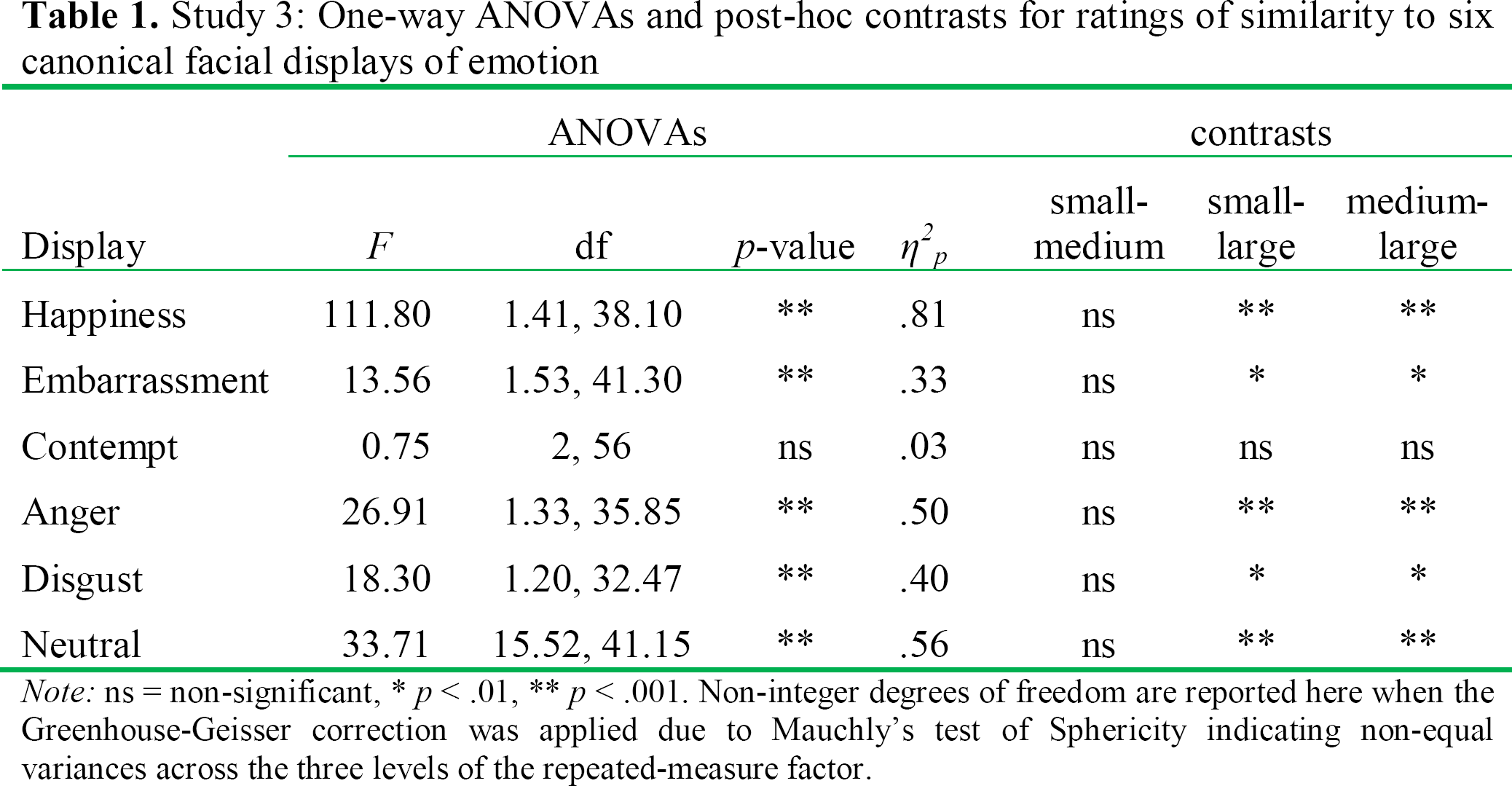
Smaller (less dominant) football players displayed more smiling than larger (more dominant) football players. To test the prediction that the less dominant (smaller) football players would display more happiness and embarrassment smiles than the more dominant (larger) football players, we performed two one-way repeated-measures ANOVAs, one for happiness ratings and one for embarrassment ratings. These ratings are displayed in Figure 5 and the statistics are reported in Table 1. Consistent with predictions, both happiness ratings and embarrassment ratings differed significantly across the three sizes of football players. Specifically, the more dominant (large) football players displayed less happy smiling than the small and medium sized football players, who did not differ from one another. Similarly, the more dominant (larger) football players displayed less embarrassment smiles than the small and medium sized football players, who did not differ from one another.
Study 3: One-way ANOVAs and post-hoc contrasts for ratings of similarity to six canonical facial displays of emotion
Note: ns = non-significant
p < .01
p < .001. Non-integer degrees of freedom are reported here when the Greenhouse-Geisser correction was applied due to Mauchly's test of Sphericity indicating non-equal variances across the three levels of the repeated-measure factor.

Study 3: Ratings of similarity to six canonical facial displays of emotion (upper figure) for small, medium, and large football players
More dominant (larger) football players displayed more negative emotion than less dominant (smaller) football players. To examine whether more dominant (larger) football players displayed more negative emotions (contempt, anger, and disgust) than the less dominant (smaller) football players, we performed a series of repeated-measures one-way ANOVAs (one for each emotion rating). As can be seen in Figure 5 and Table 1, more dominant (large) football players displayed more of both anger and disgust than did the small and medium sized football players, who did not differ from one another for either display. Contempt displays, however, did not differ across the three sizes of football player.
Study 3 Discussion
When photos of small, medium, and large college football players were randomly sampled from team websites and rated in terms of their similarity to several canonical displays of emotion it was observed that the less physically dominant (smaller) football players exhibited both more embarrassment and Duchenne smiles than their more physically dominant (larger) counterparts. These findings replicated previous research that has demonstrated a link between smiling and status, where status has been conceptualized in terms of testosterone and interpersonal dominance. Dabbs (1997), for example, noted that when men are asked to pose for smiling and non-smiling portraits, men who have higher levels of testosterone (as measured from a saliva sample) also tend to display smaller smiles than men with lower levels of testosterone. Paralleling the framework used in the first two studies, study 3 focused on displayer behavior—the link between displayers' dominance and their tendency to smile—whereas our final study (study 4) focuses on observer psychology and evaluates whether this association between smiles and physical dominance also appears in the minds of observers.
Study 4
In a fourth study, we investigate whether the association between smiles and dominance appears in the psychology of observers. To do so, we examine whether observers of photos of collegiate football players use the presence or absence of a smile as a more reliable indicator of the targets' status-relevant personality traits (e.g., pro-sociality) than perceptions of the football players' physical sizes as gleaned from their photographs alone. Specifically, study 4 addresses the question of whether any effects of the athletes' actual physical size on observer attributions of personality traits (e.g., cooperativeness, aggressiveness) are mediated by perceptions of the degree of smiling portrayed in the athletes' pictures controlling, of course, for perceptions of the athletes' actual physical size. Previous research has found that stronger individuals are more likely to become angry during conflicts with others (Sell, Tooby, and Cosmides, 2009). Given the link between physical size and strength, physical size may accurately predict personality traits associated with cooperativeness and aggressiveness. However, consistent with the idea that smiles convey (to observers) more than just information about the displayers' mental states (e.g., that they feel happy), we expected that the presence or absence of a smile would predict observers' attributions of status-relevant traits for collegiate football players, even while controlling for the effects of the players' actual sizes and/or an observer's perceptions of the player's size.
Study 4 Materials and Methods
Fifty-five undergraduates (81% female 6 , ages ranging from 19 to 49) enrolled in a developmental psychology course at a large Southwestern University participated in exchange for extra credit.
The PowerPoint slideshow utilized in study 3 was modified slightly for study 4 by removing the images of the canonical facial displays. Whereas the participants in study 3 rated the athletes' faces in terms of emotion, the participants in study 4 rated the faces in terms of how much each face embodied a variety of both hostile and non-hostile personality traits. These personality traits have been employed in previous studies of face perception (Johnston, 2005): aggressive, dominant, friendly, helpful, cooperative, and attractive (all Cronbach α's > .90). The anchors for these semantic differential scales followed the format of 1 = very unaggressive and 7 = very aggressive for all traits except dominance, which was anchored at 1 = completely submissive and 7 = completely dominant. Participants also rated the perceived physical stature of the athletes by rating each photo in terms of perceived height in feet and inches and perceived weight in pounds (Cronbach α's = .93 and .96, respectively). Finally, participants categorized the athletes into one of three size categories (below average, average, above average, that we coded as 1, 2, and 3, respectively) for both perceived height and weight (Cronbach α's = .93 and .96, respectively).
Study 4 Results
Status-relevant trait attributions. To test whether the presence or absence of a smile mediated the link between a football player's actual physical size and an observer's attributions of the player's status-relevant traits, we performed three types of analyses. First, we examined whether observers could detect differences in the physical stature (i.e., height and weight) of small, medium, and large football players from only the photos of the athletes' faces. Next, we examined whether observers generated different trait attributions to the faces of small, medium, and large football players. Finally, we used mediation analyses to determine whether any effects of the athletes' actual physical size on these trait attributions were mediated by perceptions of the degree of smiling portrayed in the athletes' pictures, controlling for observers' inferences about the athletes' physical size.
Observers discriminated the heights and weights of small, medium, and large football players. To determine whether observers could detect differences in the physical stature (i.e., height and weight) of the athletes from their photos alone, we performed a series of one-way repeated-measures ANOVAs on participants' ratings of the physical characteristics of the small, medium, and large male football players. These analyses revealed that, based upon photos of the athletes' faces, participants were able to differentiate the heights of small, medium, or large sized football players. Observers estimated different heights (in inches) for the small, medium, and large players, F(1.75, 94.70) = 1.94, p < .001, η2p = .19. We used paired-sample t-tests for post-hoc analyses. They indicated that large football players (M = 71.18 inches, SD = 1.79) were rated as taller than small (M = 70.49, SD = 1.49) and medium (M = 70.18, SD = 1.22) sized football players (p's < .006). Small and medium sized football players were not estimated to be different heights (p = .082). Participants were also able to distinguish small, medium, and large players in terms of perceived height categories (below average, average, above average), F(2, 108) = 19.94, p < .001, η2p = .27. Specifically, large football players (M = 2.39, SD = 0.31) were rated as larger than small (M = 2.21, SD = 0.26) or medium (M = 2.10, SD = 0.29) sized football players (p's < .002). Surprisingly, small players were rated to be taller than medium sized players (p = .009). Participants were also able to differentiate the weights of small, medium, or large sized football players using measures of perceived weight in pounds, F(1.48, 79.88) = 134.42, p < .001, η2p = .71. Large players (M = 208.46 pounds, SD = 20.41) were rated as heavier than small (M = 183.84, SD = 11.96) and medium (M = 182.95, SD = 10.36) sized football players (p's < .001). Small and medium sized players were not rated as having different weights in pounds (p = .433). Participants were also able to distinguish small, medium, and large players in terms of perceived weight categories (below average, average, above average), F (2, 108) = 157.18, p < .001, η2p = .74. Specifically, large football players (M = 2.73, SD = 0.20) were rated as larger than small (M = 2.13, SD = 0.31) or medium (M = 2.07, SD = 0.29) sized football players (p's < .001). Small players were not rated to be different in weight than medium sized players (p = .125).
Observers generate different trait attributions to the faces of small, medium, and large football players. To determine whether observers generated different trait attributions to the faces of small, medium, and large football players, we performed a series of repeated-measures one-way ANOVAs on participants' ratings of several status-relevant traits (see Table 1). These analyses revealed that participants perceived large football players as having significantly different levels of all of these status-relevant traits as compared to both medium and small football players (see Figure 6). Moreover, participants generally did not differentiate between small and medium football players in these trait attributions. The results were in the expected direction, with larger athletes rated as possessing higher levels of hostile traits and lower levels of pro-social traits. For this reason, we created a composite pro-sociality measure for the subsequent mediation analysis.
Study 4: One-way ANOVAs and post-hoc contrasts for attributions of traits to football players of different sizes

Note: ns = non-significant
p < .01
p < .001. Non-integer degrees of freedom are reported here when the Greenhouse-Geisser correction was applied due to Mauchly's test of Sphericity indicating non-equal variances across the three levels of the repeated-measure factor.

Study 2: Ratings of six status-relevant traits for small, medium, and large football players
Pro-social trait attributions to football players of different sizes are mediated by perceptions of the degree of smiling displayed on the athletes' faces. To examine whether the association between athletes' actual physical sizes and observers' attributions of status-relevant traits (e.g., cooperativeness, aggressiveness) was mediated by perceptions of smiling in the athletes' pictures, we constructed a composite pro-sociality measure for each football player by averaging participants' ratings for the following trait dimensions: friendly-unfriendly, helpful-unhelpful, aggressive-unaggressive (reverse coded), dominant-submissive (reverse coded) and cooperative-uncooperative. This composite demonstrated adequate internal consistency, Cronbach's α = .97.
Previous analyses (reported for studies 3 and 4) were within-participant, but for the mediation analysis we used football players as the unit of analysis. Therefore we had to calculate each football player's mean rating on emotion similarity and on the prosociality composite. This allowed us to compare emotion similarity ratings with trait attributions. Correlations between the composite measure of pro-sociality and the ratings of the similarity to canonical emotion displays from study 3 were in the expected direction, with pro-sociality correlating positively with pro-social emotions and negatively with hostile emotions. More specifically, pro-sociality ratings correlated positively with happiness ratings, r(31) = .94, p < .001, and embarrassment ratings, r(31) = .75, p < .001; whereas pro-sociality ratings correlated negatively with anger, r(31) = −.77, p < .001, disgust, r(31) = −.81, p < .001, and neutral, r(31) = −.90, p < .001. Surprisingly, pro-sociality ratings were not significantly correlated with contempt, r(31) = −.06, p = .755. A mediation analysis (Baron and Kenny, 1986) was then performed to determine whether the association between athletes' physical size and observers' attributions of pro-social traits (e.g., cooperativeness, aggressiveness) was mediated by perceptions of the degree of smiling in the athletes' pictures. As can be seen in Figure 7, the small/medium versus large contrast alone significantly predicted both pro-sociality ratings and degree of smiling. Moreover, degree of smiling alone significantly predicted pro-sociality ratings. In a multiple regression, degree of smiling predicted pro-sociality, but the small/medium versus large contrast did not significantly predict pro-sociality, and degree of smiling significantly reduced the ability of the small/medium versus large contrast to predict pro-sociality, Sobel z = 4.54, p < .001. These results are consistent with the claim that the association between athletes' physical size on perceptions of pro-sociality was mediated by perceptions of the athletes' degree of smiling. Controlling for participants' perceptions about the athletes' physical sizes, as well as including the small versus medium contrast in relevant models, did not substantially change the mediation analysis results. Similar analyses with ratings of other emotion displays indicated that the relationship between athlete size and perceived pro-sociality could also be mediated by degree of embarrassment, anger, disgust, or neutral (Sobel z's > 3.36, p's < .001), but not contempt. In sum, small and medium athletes smiled more than large athletes, and the more athletes smiled the more pro-social observers perceived them to be.

Study 2: Mediation analysis relating actual football player size and degree of perceived smiling to pro-sociality ratings
Study 4 Discussion
Consistent with the claim that smiles convey (to observers) more than just information about the displayer's mental states (e.g., that they feel happy), study 4 revealed that the presence or absence of a smile predicted observers' status-relevant trait attributions in collegiate football players, even after controlling for the effects of the players' actual sizes and observers' perceptions of the players' sizes. Specifically, study 4 revealed that the degree of smiling seems to mediate the link between athletes' actual physical size and an observer's inferences about the displayer's personality traits. Thus, although observers' attributions of status-relevant traits correlated highly with the physical stature of athletes (i.e., larger athletes were generally rated as less pro-social), the link between athletes' relative physical size and their perceived willingness to behave cooperatively (i.e., attributions about their pro-social traits) was mediated by perceptions of the degree of smiling in the athletes' pictures. Notably, the more participants in study 3 perceived an athlete to smile, the more participants in study 4 perceived that same athlete to be prosocial—the correlation between these two perceptions was extremely high, r = .94. Conversely, the athletes who smiled less were judged by observers as possessing not only larger size, but also possessing lower levels of various pro-social personality traits. In other words, smiling seems to convey information that is not limited to advertising the emotional state of the displayer (e.g., I feel happy) but also appear to generate inferences—in the mind of observers—about the dispositional characteristics of the displayer (e.g., I am friendly and non-threatening), a view that is consistent with facial expression research in the behavioral ecology tradition (Fridlund, 1994; Parkinson, 2003).
General Discussion
Although evolutionary psychologists have begun to recognize that dominance and prestige are distinct forms of status (Henrich and Gil-White, 2001), previous research linking smiles to lower social status did not incorporate this distinction. In this regard, the current findings suggest three conclusions. First, human smiles are associated with both forms of lower status: low dominance and low prestige. Second, the association between smiles and lower status appears in both sender behavior (individuals with lower prestige and lower dominance smile more than their higher status counterparts) and in receiver psychology (observers associate a smile with attributions of lower prestige and lower dominance). Finally, the association between smiles and lower status generalizes across two distinct forms of human smile display: happiness smiles and embarrassment smiles.
How could signals of lower status evolve?
Recent theoretical work on animal signaling suggests that relatively minimal cost signals—such as human emotion displays—could have evolved to solve a variety of social coordination problems in populations of individuals with different abilities or dispositions (see Silk, Kaldor, and Boyd, 2000, for an intriguing discussion of such signals). Specifically, signaling one's strategy type can allow agents to effectively coordinate with one another (i.e., locate equilibria) in social scenarios that resemble indefinitely repeated strategy games within a population of diverse strategy types (see Ketelaar, 2004; Ketelaar and Koenig, 2007; Skyrms, 1996). As mentioned in the introduction, we speculate that signals of subordination might function as a form of “strategic deference” whereby a social agent benefits from not challenging those above them in the status hierarchy. That is, individuals can use smiles to indicate to their superiors that they are not challenging them (and therefore are not exposing them to costs of defending their high status position) in order to access benefits available to subordinates that are produced as a byproduct of the existing status hierarchies. For example, being part of a social group often requires accepting a non-optimal place in a dominance hierarchy but provides benefits related to living in a group and, under the reign of some dominant individuals, extended periods of peace and safety. For prestige hierarchies, subordinates might benefit directly through accessing surplus resources of high prestige individuals or indirectly by accessing information, such as how to perform some action, that enables the low-prestige individuals to acquire their own resources. This speculation provides plausible explanations for how low-status signals could produce fitness benefits for signalers, but it does not address the phylogenic history of smiles, to which we now turn.
The finding that both forms of smile (happiness displays and embarrassment displays) convey information about dominance and prestige may also be informative for understanding the evolutionary history of smiles. Smiles appear to signal not only momentary emotional states, but also more enduring dispositional traits and relationship roles such as those associated with prestige and dominance (see Fridlund, 1994). Perhaps the smile display originally evolved across primate taxa to function as a signal of submission in the domain of physical dominance (Preuschoft and Van Hooff 1997; Van Hoof, 1972), but was later co-opted, evolutionarily or culturally, as a signal of mental states (e.g., happiness) and strategic dispositions (e.g., cooperativeness). According to this view, human Duchenne smiles evolved from a variant of the teeth-baring appeasement gestures that are common across primates as signals of submission and lower rank. We note that this speculation about the evolutionary history of human happiness displays is similar in some ways to accounts of how core disgust (which detects physical contaminants) has been described as an evolutionary precursor of disgust reactions that are currently observed in humans in response to other classes of elicitors, notably sexual and moral actions (see Rozin, Haidt, and McCauley, 2000; Tybur, Lieberman, and Griskevicius, 2009). In this view, disgust displays and smiles are similar in that an existing system maintained its original adaptive function but diverged to take on additional functions when humans faced novel social opportunities and threats.
In sum, to establish that smile displays evolved to function as signals, one would need to provide evidence not only that senders benefit from generating these displays (presumably by manipulating the behavior of recipients), but also that receivers benefit from generating responses to these signals (see Dawkins and Krebs, 1978; Searcy and Nowicki, 2005; Maynard Smith and Harper, 2003). In this regard it seems possible that humans could have evolved a reliably developing psychology of status if the link between status and smile displays has been a recurrent feature of human evolutionary history. Whether a receiver's knowledge of the association between smiles and status is the result of learned cultural knowledge or an evolved reliably developing psychological mechanism (or both) is an open question, but what is clear from the current findings is that the association between smiles and lower status appears in both sender behavior (individuals with lower status smile less than their higher status counterparts) and in the psychology of receivers (observers associated the presence of a smile with attributions of lower prestige and lower dominance).
Footnotes
1
Despite the robust association between smiles and lower status, there are contexts in which higher-status individuals sometimes smile more than lower-status individuals, such as when higher status individuals perceive that they have more “license” to smile than their lower status counterparts (Hecht and LaFrance, 1998), or in same sex female groups where women may be inclined to utilize affiliative behaviors (such as smiles) more than displays of formidability to gain higher status (see Cashdan, 1998).
2
Sixty-one models' faces were selected from high and low prestige brand websites across the five apparel categories: 3 faces for models advertising name brand women's V-neck sweaters, 8 faces for models advertising name brand men's V-neck sweaters, 8 faces for models advertising name brand women's shirts, 3 faces for models advertising name brand men's shirts, and 39 faces for models advertising name brand glasses.
3
The E-Prime image presentation duration was set to 1 ms. The display refresh rate was 60Hz, thus the base image display time was 17 ms. Also, we estimate that it took less than 5 ms of additional time for the software to move on to the subsequent slide in the sequence.
4
Prior to conducting this ANCOVA, we did a principal components analysis (PCA) of participants' responses to the fashion exposure survey. The PCA determined that the responses loaded significantly on a single component that accounted for 44.94% of the total variance (ε=4.49, all other ε's < 1). As expected, the valence of the coefficients mirrored the valence of the survey items; the values were: 0.682, −0.673, 0.714, −0.686, 0.694, −0.725, 0.631, −0.583, 0.644, −0.659. These coefficients were used as multipliers of the corresponding participants' survey responses and then summed in order to construct an aggregate measure of prior fashion exposure that was used as a covariate in the ANCOVA.
5
As a follow-up, we correlated fashion exposure and total number of smiles perceived to determine the nature of their relationship. As expected, these variables had a negative correlation, although it was not significant, r (94) = −.10, p = ns.
6
One participant did not indicate a gender.
Acknowledgements
Portions of this research were presented at the annual meeting of the Human Behavior and Evolution Society (HBES), Austin, TX (June, 2005), the Human Behavior and Evolution Society (HBES), Williamsburg, VA (June, 2007) and the annual meeting of the Society for Personality and Social Psychology (SPSP), Memphis, TN (January, 2007). Thanks to Peter Jonason and Jennifer Davis for their help preparing the materials for Study 2. This project benefited from helpful insights from Ashley Ward, Ben Neeley and Melissa Stauble, as well as numerous discussions with the members of Dr. Marcel Zeelenberg's research lab when an earlier version of this paper was presented at Tilburg University in Spring 2009. Thanks also to John Tierney for sharing a number of interesting and insightful observations from the readers of his NY Times science blog ( , 23, Feb. 2007). Finally, we wish to thank Rob Kurzban, Elizabeth Cashdan, and several anonymous reviewers for their helpful comments on earlier versions of this manuscript. The research presented in this paper was approved by the institutional review board at New Mexico State University.