




Abstract
The current research examines intolerance of protest actions by focusing on two major questions: (a) How intolerant are people of transgressive protest actions of their least-liked versus most-liked groups? and (b) how do individual differences in deontological and utilitarian moral predisposition relate to intolerance of transgressive protest actions by these two groups? In two survey-embedded experiments using nationally representative samples from two West European countries (Germany, Netherlands), we found that people were overwhelmingly intolerant of morally transgressive protest actions by both their most-liked and least-liked groups, although slightly less so for the former. In addition, deontological moral predisposition was related to increased intolerance of protest actions regardless of whether it was committed by a most-liked or least-liked group. Individual difference in utilitarian moral predisposition was related to increased acceptance of protest actions regardless of group, but especially when the actions were perceived as serving the greater good.
In September 2011, activists established the first “Occupy Wall Street” encampment in Zuccotti Park in the financial district of lower Manhattan. They had gathered there to protest against various things, including the governmental response to the 2008 financial crisis, growing income inequality, and corporate influence in American politics. The Occupation Movement spread to other U.S. cities and to other countries and used various transgressive protest actions for trying to influence public opinion and initiate social and political change. Similarly, in early 2022, a convoy of truckers used various transgressive protest actions including blockading roads and bridges in Ottawa, Canada to protest vaccine mandates. Similar protests against vaccine mandates have been occurred in other countries across the world.
Blocking roads, occupying public places and buildings, and spreading biased messages through the internet, are forms of transgressive protest actions and civic resistance (e.g., Feinberg et al., 2020; Wasow, 2020). Such actions attract media attention, set new agenda, and can raise public awareness about social injustices (Wasow, 2020). However, such protest actions might also backfire when they are seen as transgressing a moral boundary, which undermines public support for such causes (Bloch, 2020; Ekins, 2017; Feinberg et al., 2020; Simpson et al., 2018). The current work addresses two major goals: (a) to examine intolerance of transgressive actions of people’s most- and least-liked ideological groups and (b) to test whether individual differences in deontological and utilitarian moral predispositions differently shape intolerance of such actions. We address these goals using two well-powered survey-embedded experiments involving nationally representative samples from two West European countries (Germany and Netherlands). Compared with laboratory experiments, survey experiments are recognized as a powerful mean for combining the internal validity of an experimental design with the possibility to draw generalizable conclusions about social attitudes and beliefs (Schlueter & Schmidt, 2010; Sniderman, 2018). Furthermore, we examined in a pilot study whether people perceive these transgressive protest actions as mainly morally problematic, or as unusual (not normal), or rather as disruptive for social cooperation.
Intolerance of Protest Actions
In the literature, many distinctions are proposed for different types of protest actions such as normative and non-normative, extreme and moderate, rule-conforming and rule-violating, conventional and unconventional, moral and immoral, and disruptive and constructive (e.g., Feinberg et al., 2020; Piven & Cloward, 1991; Tausch et al., 2011). As recently noted by Teixeira and colleagues (2020, p. 921), “The multitude of terms interchangeably used by scholars to define normative and non-normative protest is a clear sign that these concepts overlap on more than one dimension.” Protest actions are typically perceived in relation to a constellation of dimensions and various terms are used in similar and different ways. For example, the term “(non-)normative” can be used in a descriptive and prescriptive sense. Descriptive norms indicate what is usual or common in society and, thus, what is the typical or normal behavior. In contrast, prescriptive or injunctive norms do not specify what most people actually do, but what ought to be done, or what constitutes morally (dis)approved conduct. In addition, the term non-normative is sometimes also used in relation to disruptive protests (Shuman et al., 2021), but the term “disruptive” has also been used to conceptualize challenges to interdependent and cooperative relations and thereby the functioning of society (Piven, 2008). Here, we prefer to use the term “transgressive” to indicate that we focus on protest actions that are deemed as violating a moral standard or transgressing a moral boundary.
Transgressive protest actions typically attract media attention by promoting public awareness of a group or movement and can be perceived to have constructive intentions in trying to bring about positive changes and improve society (Shuman et al., 2021). However, these protest actions can also undermine popular support (Orazani et al., 2021, for a review). Observational and experimental research has found that the use of transgressive protest actions is generally perceived negatively and as something that should not be tolerated (Bloch, 2020; Chong & Levy, 2018) because they are considered unreasonable, unsettling to normal life, threatening, and also immoral (Feinberg et al., 2020; Simpson et al., 2018) due to its emotional harm and infringement on the rights and freedoms of others. People tend to consider most matters of morality as absolute and to apply anywhere and everywhere (Graham et al., 2013; Skitka et al., 2021). Thus, in general, people can be expected to be intolerant of transgressive protest actions, both of groups to which they feel emotionally distant or close.
Typically, research into political (in)tolerance focuses on whether and when people are willing to be tolerant of ideological groups they do not belong to. More than that, political tolerance presupposes that the perceiver dislikes the target group (Gibson, 2006). It counts as an act of tolerance when a left-wing activist is willing to extend freedoms to right-wing activists, but not when it comes to extending those same freedoms to fellow left-wing people (and vice versa). Thus, the well-known least-liked group technique examines political tolerance by first asking people to indicate which group they like the least and subsequently whether they are willing to grant people of that group the full rights of citizenship (Sullivan et al., 1979). Although this content-controlled approach has its limitations (Petersen et al., 2010), it allows the examination of political tolerance of groups that people themselves dislike (Hurwitz & Mondak, 2002).
However, whereas negative affect toward a group is considered a precondition for the identification of tolerance, it is not a precondition for intolerance. It is possible to be intolerant toward a group one likes when a particular act or form of protest is in itself controversial. For example, people can believe that members of their most-liked group should not be permitted to burn group symbols or books, block public highways, or spread hate mail. These sorts of actions might be rejected, independently of the particular group engaged in it, including a group one identifies with. Acts of incivility have been found to erode support, also among those who view the uncivil actor positively (Frimer & Skitka, 2018), and disruptive and violent protest reduces support among strong group supporters and opponents alike (Feinberg et al., 2020), and even when used against a widely reviled group (Simpson et al., 2018). Furthermore, people have been found to be intolerant of morally questionable practices of groups similar to themselves (Hirsch et al., 2019; Sleijpen et al., 2020). Thus, we can expect that individuals will be intolerant of moral transgressive protest actions regardless of the group involved.
However, while individuals may be intolerant of transgressive actions from both their most- and least-liked ideological groups, the level of intolerance might differ for one’s most-liked group compared with one’s least-liked group because people tend to be more positive and accepting of ingroups (Hewstone et al., 2002). They are more likely to trust and value ingroup members and to justify their deviant behavior to maintain a positive ingroup identity. This does not mean that they will tolerate ingroup members inflicting (emotional) harm upon others or impinging on their freedoms and rights, but they might view transgressive protest actions of the group they identify with as less problematic or as a more justifiable, even if they are overall disapproving of those actions (Van Bavel et al., 2022). Therefore, we expect that people will be less intolerant of transgressive protest actions of their most-liked group compared with their least-liked group, and we used an experimental design to test this prediction.
Deontological and Utilitarian Morality
Transgressive protest actions can raise moral concerns (Feinberg et al., 2020) including questions about whether the ends justify the means. Support for transgressive protest actions has been analyzed in terms of balancing perceived disruption and perceived constructive intentions, with “constructive disruption” leading to the highest support (Shuman et al., 2021). However, this balancing might depend on people’s moral predispositions. Dual theories of morality reveal the independent nature of deontological (rule-based) and utilitarian (outcome-based) ways of moral reasoning about moral dilemmas which are both rooted in genuine moral concerns (Conway & Gawronski, 2013; Greene, 2013; Trémolière et al., 2018). People sometimes judge actions on the basis of the moral nature of the act itself (e.g., “killing someone is always wrong”), and at other times on the basis of thinking about the anticipated consequences (“killing someone might save hundred lives”; Greene et al., 2001). Furthermore, individuals not only judge dilemma situations differently depending on the moral concerns that are raised but also differ in their moral predisposition to focus on the nature of the act and on its consequences (Kahane et al. 2017). These two underlying moral tendencies are not directly opposed to each other but rather have been found to be largely independent individual difference predispositions (Conway & Gawronski, 2013; Tanner et al., 2008).
Intolerance of transgressive protest actions might vary depending on whether someone is generally inclined to adopt deontological or utilitarian morality. Individuals who have a stronger deontological predisposition might be more likely to perceive transgressive protest actions as upsetting to people’s lives and violating general moral rules relating to infliction of harm and the freedom of others. A deontological perspective focuses on the moral nature of the act itself and not on the underlying intentions, constructive or otherwise. Moral rules are considered to be objective and universally true, and thereby applicable regardless of group membership (Skitka et al., 2021). When people view an issue as violating a moral rule, they show greater discomfort with practices that are harmful for others (e.g., Houck et al., 2019; Leidner et al., 2017), and with dissenting beliefs and practices, and tend not to tolerate these, regardless of whether ingroup or outgroup members engage in them (Hirsch et al., 2019; Wright et al., 2008). This leads to the expectation tested in both studies that a stronger tendency to deontological morality is associated with higher intolerance of transgressive protest actions of both least-liked and most-liked groups.
By contrast, individuals with a stronger predisposition toward utilitarian thinking might instead be more likely to evaluate transgressive protest actions as being relatively reasonable, constructively disruptive, and instrumentally useful, and not necessarily as an unacceptable means to an end (e.g., Shuman et al., 2021). Although such individuals might not tend to emotionally approve of the nature of the actions per se and would not necessarily have reduced concerns about avoiding harm to others (Patil et al., 2021), they may be inclined to take into account the perceived constructive intentions of the actions for addressing societal unfairness and injustices, as, for example, with the Occupation Movement and the Black Lives Matter movement. Morally, it is unlikely that one endorses transgressive protest actions absent the belief that people are trying to improve society as a whole. Research has found that support for protest actions is stronger when the actions are perceived as constructively disruptive (Shuman et al., 2021), the protest is seen as a moral issue of fair treatment and justice (Mooijman et al., 2018; Zaal et al., 2011), and that perceived effectiveness of harm doing for achieving a morally good outcome leads to stronger acceptance of the harmful behavior (Houck et al., 2019). Utilitarian morality implies an impartial, general tendency to focus on the consequences for the greater good by deliberating about benefits and costs. Utilitarianism is grounded in the assessment of consequences for everyone affected which means that actions are judged on what they overall try to achieve rather than on who tries to achieve them, such as the group one likes or dislikes (Greene, 2013; Tanner et al., 2008). This leads to the expectation tested in both studies that individuals who have a stronger tendency for utilitarian moral thinking will be less intolerant toward transgressive protest actions for both their most-liked group and their least-liked group.
However, the tendency to think in terms of utilitarian morality should have nuanced implications depending on whether the actions of the protesting group are indeed perceived as trying to serve the greater good rather than, for example, promoting group-specific interests. Utilitarian thinkers tend to focus on the intentions and implications for the greater good and therefore can be expected to be more accepting of transgressive protest actions that are perceived to pursue a higher societal goal, despite harming or inconveniencing others. In such a case, transgressive actions can be seen as a means to a morally desirable end. In contrast, if the actions are perceived as not contributing to the greater good, utilitarianism should be less strongly related to acceptance. This expected moderation between individual differences in utilitarian morality and the perceived intention behind the group’s actions on intolerance will be examined in the second study.
Current Research
In a Pilot Study, we first examined what it is about a range of protest actions that people perceive as transgressive. We focused on three dimensions, which could underlie how much each action is perceived as transgressive: morality (i.e., normative in a prescriptive sense), commonality (i.e., normative in a descriptive sense), and disruptiveness. In this preregistered study, 1 we expected that people will make a distinction between protest actions that are morally problematic and actions that are considered disruptive for social relations.
We then focused on intolerance of protest actions that were deemed as transgressing a moral boundary (i.e., transgressive protest actions). Across two studies using nationally representative samples in the Netherlands and Germany, we tested whether people’s expected intolerance toward these transgressive protest actions differ depending on whether they are conducted by a least-liked versus most-liked ideological group. Furthermore, these studies examined whether individual differences in deontological moral predispositions are associated with higher intolerance of these transgressive protest actions for both the most-liked group and their least-liked group, and whether stronger utilitarian moral predisposition is associated with lower intolerance for both groups. In addition, in Study 2, we tested the prediction that utilitarian thinkers are less intolerant of the protest actions especially if these are seen to sever a higher societal goal.
Pilot Study
Method
Participants
The pilot study was part of a larger national data collection in the Netherlands on societal developments and neighborhood perceptions. Using the Kantar consumer panel for fieldwork, a representative sample of the Dutch population aged 18 years and older was compiled via a stratification procedure based on the characteristics gender, age, education, household size, and region. There were 506 participants between the ages 18 and 95 years (M = 49.6, SD = 11.2). Within the sample, 52.4% of the sample identified as female, and participants were, on average, politically centrist on a 7-point scale of political self-identification (M = 4.55, SD = 1.27), with 61 people opting not to self-identify. Participants had a range of educational backgrounds. Based on the classification of low, moderate, and high education levels from Statistics Netherlands (2021), 28.5% of participants would be considered as having low education levels, 42.1% moderate education, and 29.4% high education levels.
Measures
Following previous research (e.g., Feinberg et al., 2020; Shuman et al., 2021; Teixeira et al., 2020), participants were asked to compare eight types of protest actions on three dimensions using single items on 7-point scales (1 = do not agree at all, 7 = completely agree): “We ask you to indicate for each of those eight actions whether it (a) is morally wrong, (b) is not common or normal in the Netherlands, and (c) disrupts cooperation in the country.” The eight protest actions were: “giving offensive speeches,” “stopping other people from speaking in public,” “blocking roads at a demonstration,” “occupying public buildings,” “sending hate mail,” “trying to influence public opinion by spreading fake news,” “raise suspicions about someone on social media,” and “trying to influence people with biased news.”
Results
The mean scores and standard deviations for the three dimensions and the eight protest actions are shown in Table 1. The findings demonstrate that participants rated all eight protest actions strongest as being morally wrong, followed by being disruptive, and then as being not common. Thus, all actions were considered most clearly as morally wrong (all scores significantly above the neutral mid-point of the scale, ps < .001), and pair-wise t-tests showed that for all eight actions the average scores for being morally wrong were significantly higher than for being disruptive (ps < .007).
Mean Scores and Standard Deviations for the Three Dimensions (Immoral, Non-Normative, Disruptive) and the Eight Protest Actions.
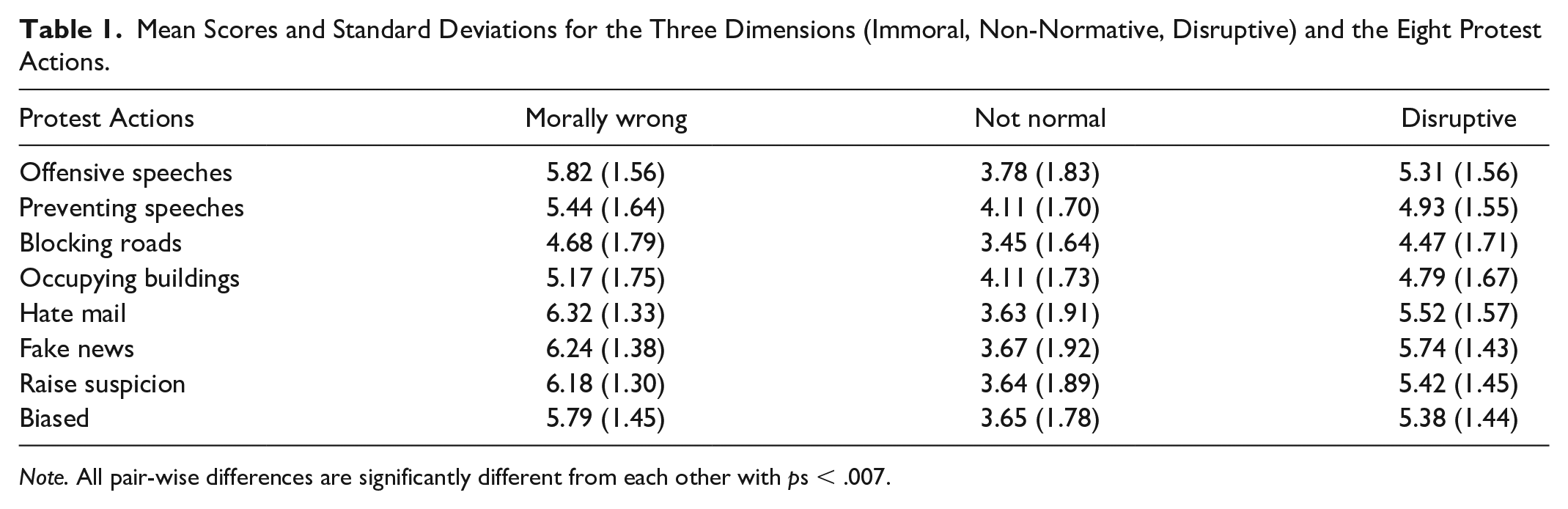
Note. All pair-wise differences are significantly different from each other with ps < .007.
For the eight assessments of morality, we then conducted an exploratory factor analyses with oblim rotation, and we found two factors with eigenvalues above 1. The first factor explained 46.7% of the variance, and six actions loaded highly on this factor (>.65, highest load on the second factor .14), namely giving offensive speeches, stopping other people from speaking in public, sending hate mail, spreading fake news, suspect on social media, and biased news. The other two actions, blocking roads, and occupying buildings, loaded highly (>.76) on the second factor (<.14 on the first factor) that explained 13.9% of the variance. Thus, respondents made a distinction between informational (first factor) and obstructive transgressive protest (second factor), whereby the former was considered relatively more strongly morally wrong than the latter, t(505) = 15.95, p < .001, d = .71.
Study 1
Method
Participants
As part of a large cross-national data collection on societal developments and cultural diversity, 3,762 ethnic majority adults from the Netherlands (n = 1,690) and Germany (n = 2,072) participated in this study. In the Netherlands, potential respondents were selected from the Kantar consumer panel for fieldwork. From this panel, a representative sample of the Dutch population aged 18 years and older was compiled via a stratification procedure based on the characteristics gender, age, education, household size, and region. In Germany, population data were derived from the MiniCensus and used to compile a representative sample of the German population aged 18 years and older via a stratification procedure based on the characteristics age, gender, and education. Participants’ age ranged from 18 to 100 years (M = 50.5, SD = 16.6), and 49.7% was female. Participants were, on average, politically centrist on a 7-point scale of political self-identification (M = 3.83, SD = 1.27), with 460 people opting not to self-identify. On a 9-point scale of educational attainment with higher values indicating a higher level of achieved education (M = 4.93, SD = 1.95), 30.5% of participants had qualifications that would be considered lower levels of education, 39.3% as moderate levels of education, and 30.2% as higher levels of education.
In the analyses, weights were added to correct for any deviations from the targeted quotas, thereby making the findings representative for the Dutch and German populations. Data collection was approved by relevant ethical boards and adhered to the legal requirements of respective countries. We conducted sensitivity power analyses to determine what effect size we would need to consistently find a two-tailed effect, given the sample size, alpha (.05), and desired power (.80). For the experiment (independent groups), we achieved sensitivity to detect at least small effects (d ≥ 0.091). For the multiple regression analyses, we determined that we achieved the sensitivity to consistently detect at least small R2 changes (f2 = 0.003). A Confirmatory Factor Analysis found that the three primary measures (intolerance as the outcome variable, and deontological and utilitarian orientations as predictors) formed the expected three latent factors (see Supplementary Material for details). The Supplementary Material including additional tables and measurement information, along with the data, can be accessed on the open science framework: https://osf.io/bve3w/.
As is common in large-scale, cross-country data collections, a multidisciplinary team was involved, which resulted in various topics being examined, such as attitudes toward child-rearing practices, secularism, slippery slope thinking, and prejudice. Here, we focus on all the questions and the manipulation that we were able to include in the questionnaire to empirically examine our research questions.
Manipulation
Least- and most-liked groups experiment
Using the well-established least-liked group technique, participants were randomly assigned to self-select from a list of preselected groups either their least-liked group or most-liked group. We adopted the preselected group approach because this does not lead people to focus on extremist groups (e.g., terrorists, violent criminals) that are beyond toleration by most. Participants were presented with a list of 12 ideological groups of different types across the political spectrum which provides “everyone an opportunity to express his or her intolerance” (Gibson, 1992, p. 574; see Supplementary Material).
Measures
Intolerance of protest actions
Participants indicated on 7-point scales (1 = always tolerated, 4 = neutral, 7 = never tolerated) whether or not they thought a list of six transgressive protest actions (i.e., giving offensive speeches, stopping other people from speaking in public, blocking roads, occupying public buildings, sending hate mail, and spreading fake news) should be tolerated when undertaken by the group that they had identified as the one that they liked the least or the most. We used exploratory factor analysis (EFA) and confirmatory factor analysis (CFA) on the data across both studies, and similar to the Pilot study we found that a two-factor model best fit the data across multiple datasets to avoid overfitting, χ2(7) = 187.11, comparative fit index (CFI) = .985, root mean square error of approximation (RMSEA) = .083 [.073, .093], standardized root mean square residual (SRMR) = .024, which differentiated between transgressive information (giving offensive speeches, stopping other people from speaking in public, sending hate mail, and spreading fake news), M = 6.06, SE = .02; α = .87, and transgressive obstruction (blocking roads, and occupying public buildings), M = 5.57, SE = .03; r = .64. See Supplementary Material for all items.
Deontological moral predisposition
In an earlier and separate section of the questionnaire, the extent to which participants engaged in deontological moral thinking was measured using four items based on Tanner et al. (2008) on a 7-point scale which formed a latent construct (e.g., “Some moral principles are generally valid, regardless of the circumstances”; see Supplementary Material for all items; M = 5.02, SE = .02; α = .61).
Utilitarian moral predisposition
Also based on Tanner et al. (2008), utilitarian moral predisposition was measured by using four items on a 7-point scale, three of which (one was removed based on fit statistics) formed a latent construct (e.g., “Whether something is right or wrong depends on the consequences”; see Supplementary Material for all items; M = 3.68, SE = .02; α = .57). Supporting the independent nature of deontological and utilitarian moral predisposition (Conway & Gawronski, 2013), these scales were weakly correlated, r = .11, p < .001.
Control variables
We included a number of control variables in the analyses to examine possible spurious effects. In addition to participant country (Netherlands = 0; Germany = 1), age and gender (male = 0), we considered political orientation given its relevance to tolerance. Political orientation was measured using the well-known single-item measure of political self-placement (Jost, 2006) on a 1 (extreme left-wing) to 7 (extreme right-wing) scale. As 460 participants opted not to self-identify, the missing values were imputed using multiple imputations in MPlus for use in analyses as a control variable. Educational attainment was measured on a one to nine scale based on the Dutch and German education systems, and similar to other research in Western Europe (e.g., De Graaf et al., 2000; Van Tubergen & Van de Werfhorst, 2007), education was treated as a continuous variable in the analysis.
Analysis
To examine whether the experimental randomization was successful, we tested for condition differences in age, education, political self-placement, gender, country of origin, and time in seconds to complete the overall survey. We found no significant differences (β < .012, ps > .484) in age, education, gender, country of origin, or completion time. However, there was a small but significant difference in political self-placement, β = -.016, SE = .007, p = .024, such that people in the most-liked group condition were somewhat more left-leaning than those in the least-liked condition. For all following analyses, we will report the results obtained in models with the control variables, which did not differ meaningfully from the results without controls (see Supplementary Material).
Results
Intolerance of protest actions
For descriptive purposes, we used SPSS to examine how intolerant the representative national samples of participants were of the protest actions of either their least-liked or their most-liked group. Following previous research on tolerance (Adelman et al., 2021a; Gibson et al., 2020) and the labeling of the response categories, we made a distinction between participants scoring at the intolerant side of the scale, the tolerant side of the scale, or those who chose the neutral response category. 2 As expected (Table 2), participants were generally rather intolerant of the protest actions across experimental conditions, with intolerance ranging from 55.5% to 87.3% of respondents, and tolerance from 4.6% to 17.7%. This high level of intolerance corresponds with the finding in the pilot study that all protest actions were considered morally problematic.
Study 1 Intolerance of Each Behavior by Most and Least-Liked Groups in Percentages.
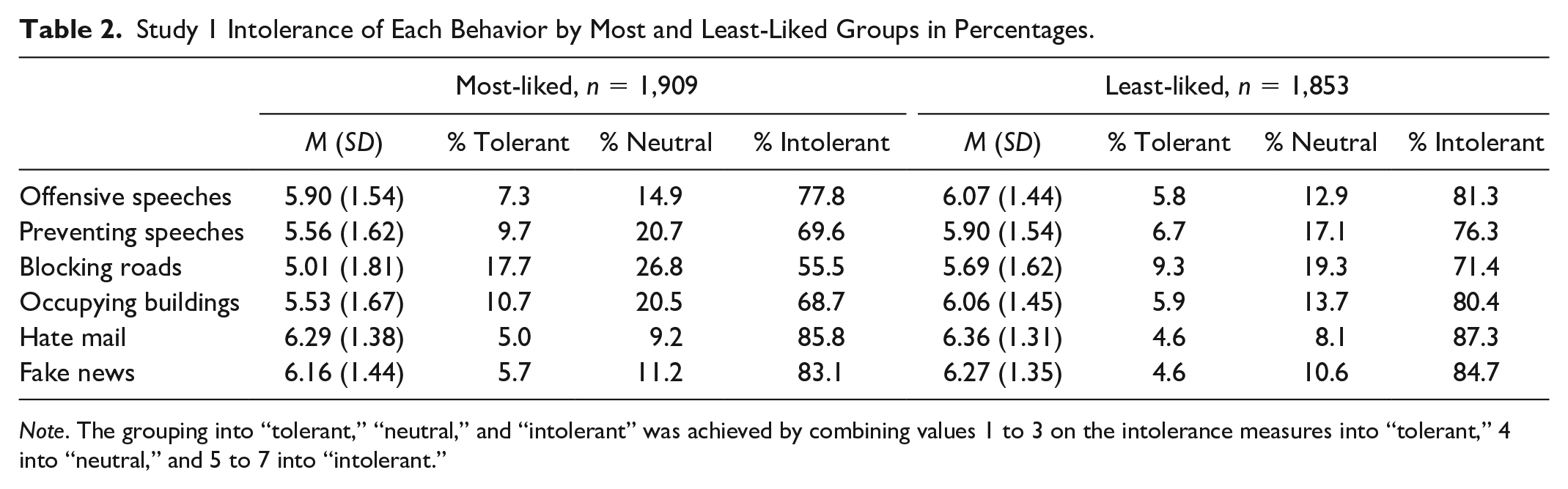
Note. The grouping into “tolerant,” “neutral,” and “intolerant” was achieved by combining values 1 to 3 on the intolerance measures into “tolerant,” 4 into “neutral,” and 5 to 7 into “intolerant.”
Comparing Most-Liked and Least-Liked Groups
Using MPlus and the maximum likelihood with robust standard errors (MLR) estimator to take the skewness of the continuous intolerance measure into account, we found significant effects of the experimental condition (the effect of being in the least-liked condition [1] compared with the most-liked condition [0]) on both intolerance of transgressive information, β = .072, SE = .016, p < .001, and intolerance of transgressive obstruction, β = .222, SE = .017, p < .001, overall model R2 = .185, such that people in the least-liked condition (Mobstruction = 5.87, SD = 1.40; Minformation = 6.15, SD = 1.21) were more intolerant than those in the most-liked condition (Mobstruction = 5.27, SD = 1.56; Minformation = 5.98, SD = 1.25).
Most of the control variables were significant predictors of both information-based and obstructive-based intolerance. Specifically, for the obstructive outcome, time taken on the overall survey, β = .108, SE = .018, p < .001, more right-leaning political orientation, β = .164, SE = .020, p < .001, age, β = .222, SE = .018, p < .001, and being female (vs. male), β = .088, SE = .017, p < .001, all predicting increased intolerance for such protest behaviors. Being from Germany (vs. the Netherlands) predicted lower intolerance, β = −.166, SE = .017, p < .001. For the informational outcome, time taken on the overall survey, β = .197, SE = .018, p < .001, level of education, β = .114, SE = .018, p < .001, age, β = .225, SE = .016, p < .001, and being female (vs. male), β = .141, SE = .016, p < .001, all predicted increased intolerance of informational protest outcomes. Being from Germany (vs. the Netherlands) also predicted lower intolerance, β = −.181, SE = .015, p < .001. However, further analyses indicated that the pattern of findings for intolerance and moral dispositions—reported below—was similar in both countries.
Intolerance and moral predisposition
Although participants were generally intolerant of transgressive protests, regardless of whether they are performed by the group they liked most or least, approximately 4.2% to 44.5% of participants were tolerant or neutral toward some of these forms of protest. Therefore, we constructed a regression model in MPlus to test whether intolerance of informational and obstructive protest is differently predicted by deontological and utilitarian moral predispositions, alongside the effects of the least- vs. most-liked group experimental manipulation and their interactions. In addition to showing the significant main effect of least-liked (1) versus most-liked (0) groups on both intolerance of obstruction, β = .227, SE = .017, p < .001, and of information, β = .076, SE = .016, p < .001, we found stronger deontological orientation to be associated with higher intolerance for information-based protest actions, β = .133, SE = .037, p < .001, but not for obstruction-based protest actions, β = −.018, SE = .039, p = .652, while a stronger utilitarian orientation was associated with lower intolerance for both obstruction, β = −.228, SE = .040, p < .001, and transgressive information, β = −.448, SE = .038, p < .001 (overall model R2 for obstruction = .237, and for informational = .315). There were no significant interactions (ps > .081) between the experimental condition and the two moral orientations, which indicate that the contrasting roles of deontological and utilitarian morality for intolerance of transgressive protest actions were similar in relation to the least-liked and most-liked group.
Discussion
Using large representative samples in two West European countries, we found that people, in general, tend to be intolerant of transgressive protest actions that are considered morally problematic (Pilot study), whether it comes in the form of spreading information or obstructive behavior, although somewhat less so for their most-liked group compared with their least-liked group. In addition, these protest actions also raised more general moral concerns (Bloch, 2020; Ekins, 2017; Feinberg et al., 2020; Simpson et al., 2018) as individual differences in utilitarian moral predisposition and deontological moral predisposition were associated with intolerance, independently of the groups concerned. Importantly these two moral orientations showed opposite relations with intolerance of these protest actions. A stronger deontological morality was associated with higher intolerance of transgressive information, while a stronger utilitarian morality was associated with lower intolerance of both informational and obstructive transgression.
Study 2
The aim of Study 2 was to further examine intolerance of transgressive protest actions and the role of utilitarian morality. First, the strong intolerance found in Study 1 could be due to the listing of some actions that might be considered extreme and as clearly falling outside the realm of acceptable protest. Specifically, sending hate mail and spreading fake news might be considered too extreme, as suggested by the finding that both actions were considered morally the most problematic in the Pilot study. Therefore, we replaced these two actions with similar but less extreme ones (raising suspicions about someone on social media, spreading biased news) that also had higher scores on the moral dimension than the norm and the disruptive dimensions in the Pilot study.
Second, in Study 1, stronger utilitarian orientation was associated with higher acceptance of these forms of protest. However, this association is likely to depend on whether these actions are perceived as intending to serve the greater good rather than group interests. Specifically, utilitarian morality may predict differential levels of intolerance for transgressive protest actions depending on whether one perceives their least- or most-liked group as engaging in morally problematic actions to serve the greater good versus the group’s interests. Thus, in further understanding the role of utilitarian orientation, Study 2 tested the prediction that utilitarian thinkers will be more accepting of the protest actions if they think that these were taken in pursuit of a higher goal that makes the actions an acceptable means to a morally desirable end.
Method
Participants
The procedures of data collection in both countries were similar to Study 1 using different participants from the same panels. A sample of 1,004 participants was randomly selected from a representative sample of ethnic majority adults from the Netherlands (N = 497) and Germany (N = 507) who participated in a large cross-national data collection on societal developments and cultural diversity. The data collection was again conducted by a team of researchers. Participants were middle-aged on average (M = 46.0, SD = 15.7; 10 participants with missing data), closely balanced on gender (49.7% female; 10 participants with missing data), politically centrist (M = 3.89, SD = 1.25; 200 participants chose not to respond), and around the midpoint of educational achievement (M = 4.90, SD = 1.81; 11 participants with missing data), with 25.5% participants lower educated, 47.4% moderately educated, and 27.1% highly educated.
Sensitivity power analyses on the unweighted subsample indicated sufficient sensitivity to detect at least small effects (d = 0.157) for between groups effects for multiple regression indicated a sensitivity to at least small R2 changes (f2 = 0.012). Confirmatory factor analysis of the three latent factors (intolerance as the outcome variable, and deontological and utilitarian moral beliefs as the predictor variables) supported the three-factor model (see Supplementary Material for model details).
Manipulation
Least- and most-liked groups experiment
The experimental manipulation in Study 2 was identical to that in Study 1, with one additional option added to the choices of least- and most-liked ideological groups (see Supplementary Material).
Measures
Intolerance of protest actions
As in Study 1, participants indicated on 7-point scales (1 = always tolerated, 4 = neutral, 7 = never tolerated) whether or not they thought a list of six protest actions should be tolerated when undertaken by the group that they had identified as the one that they liked the least or the most. Four of these actions were similar to Study 1 and two were slightly adapted to address other forms of spreading information to “to raise suspicion about someone on social media,” and “trying to influence public opinion by spreading biased news” (Van Bavel et al., 2022). As in Study 1, the two obstruction items (M = 5.28, SE = .05; r = .67) and the four informational items (M = 5.66, SE = .04; α = .84) formed two separate latent constructs, χ2(8) = 50.361, CFI = .985, RMSEA = .073 [.054, .092], SRMR = .021, with higher scores indicating higher intolerance.
Deontological and utilitarian moral predisposition
Prior to the experiment and the intolerance measure, deontological and utilitarian moral predisposition were measured with the same four items for deontological predisposition as in Study 1 (M = 4.86, SE = .03; α = .61), and three adapted items for utilitarian predisposition (see Supplementary Material, M = 3.32, SE = .04; α = .71). Again, and in support of the independent nature of deontological and utilitarian moral predisposition (Conway & Gawronski, 2013), the two scales were weakly and negatively correlated, r = −.15, p = .002.
Perceived intentions
We measured perceived intentions of the least- or most-liked group with a single item. The item directly asked participants their agreement with the statement that their most- or least-liked group was pursuing with their actions a higher goal even though it meant inconveniencing others, “To what extend do you think that [this group] tries to pursue a higher goal with their actions and thereby take the inconvenience for others into the bargain” (M = 3.90, SE = .06). 3
Control variables
Using the same measures as Study 1, we measured age, gender political orientation, educational attainment, and country (i.e., Netherlands or Germany). Multiple imputations in MPlus were used to replace all missing data and enable the use of these control variables in the following analyses.
Analysis
Experimental randomization was successful, with no significant effects of experiment on age, education, political self-placement, gender, and time in seconds to complete the overall survey (βs < −.034, ps > .296). Nevertheless, we again report the results obtained in models with the control variables, which did not differ meaningfully from the results without controls (see Supplementary Material).
Results
Intolerance of protest actions
For the representative sample (see Table 3), we again found descriptively that participants were generally intolerant of the protest actions across experimental conditions, with intolerance ranging from 48.3% to 84.2% and tolerance from 5.5% to 27.6%. These percentages are very similar to Study 1 (Table 2).
Study 2 Intolerance of Each Behavior by Most and Least-Liked Groups in Percentages.
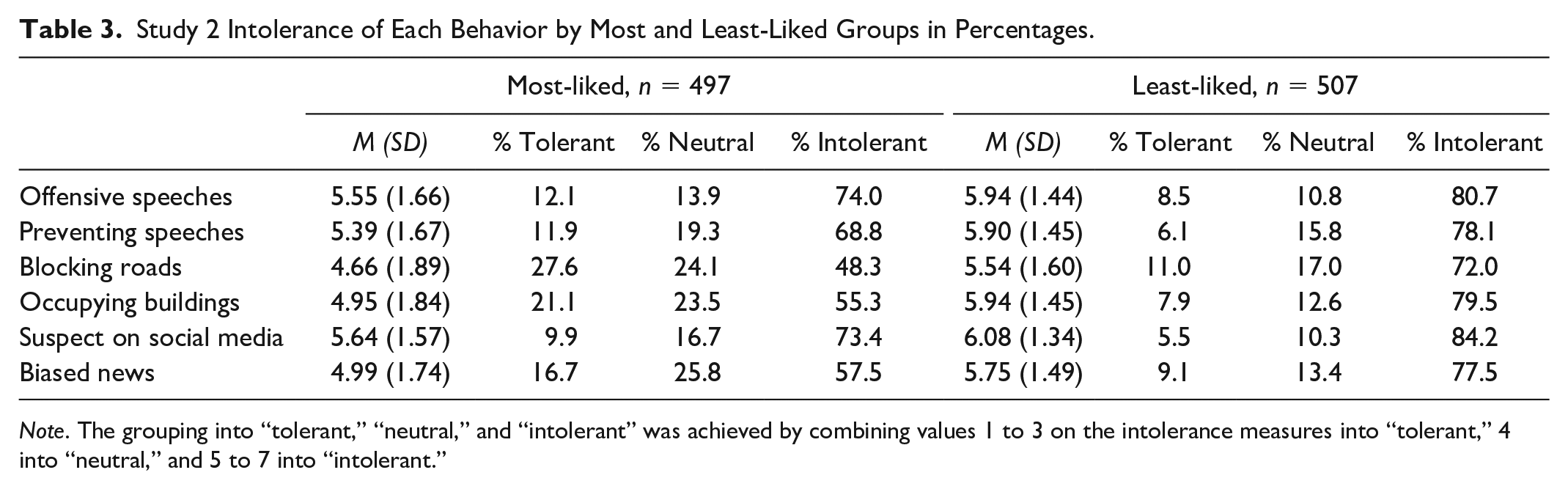
Note. The grouping into “tolerant,” “neutral,” and “intolerant” was achieved by combining values 1 to 3 on the intolerance measures into “tolerant,” 4 into “neutral,” and 5 to 7 into “intolerant.”
Comparing most-liked and least-liked groups
Using MPlus and the MLR estimator for the continuous intolerance measure, we found a significant effect of the experimental condition (the effect of being in the least-liked condition [1] compared with the most-liked condition [0]) on intolerance toward informational, β = .211, SE = .033, p < .001, and obstructive protests, β = .328, SE = .032, p < .001 (overall model R2 for informational = .120, and for obstructive = .191), such that participants again were somewhat more intolerant when they were asked about their least-liked group (Mobstructive = 5.74, SD = 1.40; Minformation = 5.92, SD = 1.18) compared with their most-liked group (Mobstructive = 4.81, SD = 1.69; Minformation = 5.39, SD = 1.33).
Furthermore, for intolerance of informational transgressive protest, time of survey completion, β = .115, SE = .032, p = .001, and age, β = .183, SE = .030, p < .001, predicted higher intolerance, while being from Germany (vs. the Netherlands) again predicted lower intolerance, β = −.151, SE = .033, p < .001. For intolerance of transgressive obstruction, more right-leaning political orientation, β = .126, SE = .040, p = .002, and age, β = .171, SE = .034, p < .001, predicted higher intolerance, with being from Germany (vs. the Netherlands) also predicting lower intolerance, β = −.175, SE = .035, p < .001. However, similar to Study 1, the patterns of associations found in further analyses did not differ by country.
Intolerance and moral predispositions
Next we tested whether intolerance is predicted by deontological and utilitarian moral predispositions, alongside the least- versus most-liked group manipulation, and the interactions between the moral predispositions and the least-liked (1) versus most-liked (0) group experiment. In addition to the significant main effect of the experiment on intolerance toward transgressive information, β = .214, SE = .032, p < .001, and intolerance toward obstructive behavior, β = .330, SE = .032, p < .001, we again found that stronger deontological predisposition was associated with higher intolerance, but now for both transgressive information, β = .127, SE = .055, p = .022, and obstructive behavior, β = .107, SE = .053, p = .045. We also again found that stronger utilitarian predisposition was associated with lower intolerance for both information, β = −.211, SE = .053, p < .001, and obstruction, β = −.163, SE = .050, p < .001 (overall model R2 for obstruction = .229, and for information = .189). There were no significant interactions between experimental group and morality for obstructive protest and for the interaction between utilitarianism and information-based protest, βs < −.025, ps > .561. Thus, the contrasting roles of deontological and utilitarian morality for intolerance of these protest actions were similar in relation to the least-liked and most-liked group. However, a significant interaction did emerge for the relationship between deontological moral reasoning and the experimental condition on obstructive protest, β = −.134, SE = .050, p = .008. For those in the least-liked group condition, increased deontological moral reasoning led to a steeper increase in intolerance than for those in the most-liked group condition.
Perceived intentions
Next, we tested the novel prediction of Study 2 that support for a utilitarian perspective would be associated with less intolerance, especially when people judged the group as trying to pursue a higher goal through their transgressive actions, despite the discomfort that these might bring. We used a model which included the main effects of the experiment, deontological and utilitarian orientation, and intention perception, along with two-way interactions between the perception of intention and both deontological and utilitarian orientations, and three-way interactions between the two moral orientations, intention perception, and the experimental manipulation on the two intolerance outcomes of behavioral and speech-based protest. We found a significant interaction between utilitarianism and perceived intention for information-based protest, B = −.074, SE = .028, p = .009, along with significant main effects of the experiment for both obstructive behavior, B = −.722, SE = .080, p < .001, and transgressive information, B = −.439, SE = .073, p < .001, and perceived intention for both obstruction, B = −.095, SE = .023, p < .001, and information, B = −.119, SE = .024, p < .001, but no other effects, Bs < .053, ps > .100.
Unpacking the interaction for transgressive information intolerance, we found that while utilitarian morality generally led to lower intolerance, this was especially the case when people were relatively more in agreement that the information-based actions of the target group intended to pursue a higher goal (+1 SD), B = −.210, SE = .041, p < .001, than when they were less so (−1 SD), B = −.067, SE = .031, p = .031 (see Figure 1).
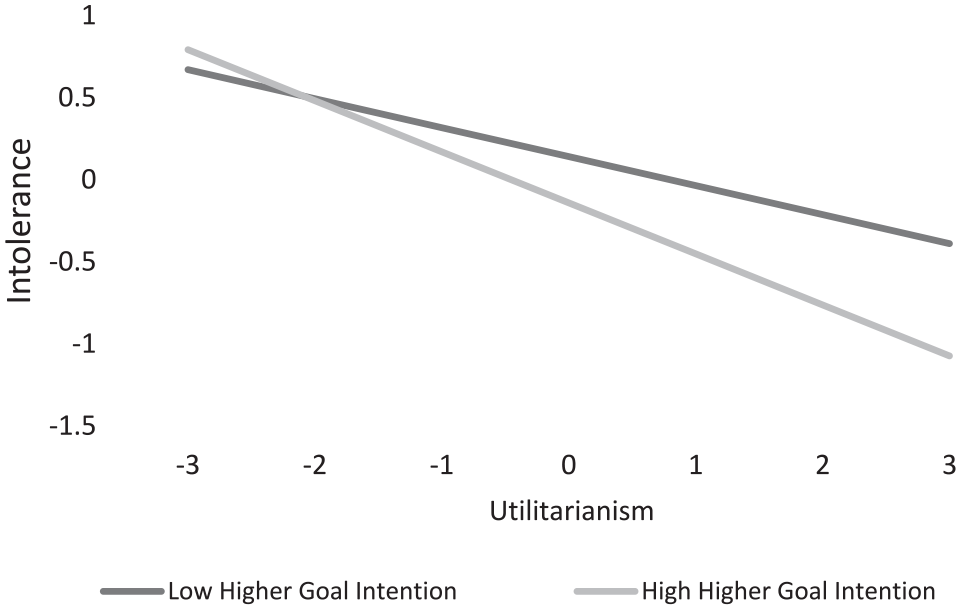
Plot of the interactions between utilitarian moral orientation and perception that the protestors intend to pursue a higher goal on intolerance of information-based protest actions.
Discussion
Replacing the two most extreme actions from Study 1 with less extreme ones in Study 2, we again found that in representative samples people were rather intolerant of transgressive protest actions although a little less so than in Study 1. Furthermore, the intolerance was again somewhat lower toward the most-liked group compared with the least-liked group. Also similar to Study 1, stronger deontological predisposition was associated with higher intolerance, and stronger utilitarian predisposition was associated with lower intolerance for both obstructive behavior and information-based transgressive protest, and independent of the groups concerned. However, the association between utilitarian morality and informational protest depended on the perceived intentions of the least- or most-liked group. Utilitarian thinkers were more accepting of transgressive informational actions if they thought that the group has constructive intentions in pursuing a higher goal with their actions. Such a goal makes the usually unacceptable protest actions a means to morally desirable ends and therefore is accepted more, both from the most-liked and least-liked group.
General Discussion
The results of our two survey experiments among representative samples of two European countries demonstrate that the public tends to be rather intolerant of transgressive protest actions, regardless of whether these are done by their most-liked or disliked group (see Feinberg et al., 2020; Frimer & Skitka, 2018). Using offensive speech, stopping other people from speaking in public, blocking roads, occupying public buildings, sending hate mail, and spreading false and biased information were all considered morally problematic actions that should not be tolerated in society.
The specific group involved in these actions was not very relevant to the intolerance, which corresponds with the finding that highly offensive acts are moralized and rejected under most circumstances (Adelman et al., 2021b; Hirsch et al., 2019; Hurwitz & Mondak, 2002). However, although our findings indicate that people are generally intolerant of transgressive protest actions, considerations of group liking were not absent. Participants tended to reject the protest actions of their most-liked group less, compared with their least-liked group. This suggests that group preferences can reduce, but not erase, the extent to which people are intolerant of transgressive protest actions, evidencing the intersection between people’s morality and their group preferences.
Although our pilot study and other research indicate that transgressive protest actions are generally perceived as immoral (Feinberg et al., 2020) and unreasonable (Simpson et al., 2018), the current findings indicate that this is more strongly for those guided by deontological perspectives on morality. Individuals differ in their general deontological and utilitarian moral tendencies and these tendencies are rather independent of each other (Conway & Gawronski, 2013; Kahane et al., 2017), a finding also reflected in the current research. In our research, a stronger deontological predisposition was associated with higher intolerance of the information-based (both studies) and behavior-based (Study 2) protest actions, independent of whether one was evaluating one’s least-liked or most-liked group. Thus, individuals who tend to focus on the intrinsic moral rightness or wrongness of acts, and not on the underlying intentions and aims, were more negative toward the protest behaviors, regardless of the actor.
In contrast, a stronger utilitarian predisposition was independently associated with lower intolerance of transgressive information-based and obstructive protest actions among both most-liked and least-liked groups. As a general and genuine moral predisposition, the tendency for utilitarian reasoning should indeed be independent of the groups concerned, which corresponds to our finding that there was no difference in its role for the intolerance of both groups. The association found suggests that utilitarian thinkers tend to perceive constructive intentions and consider what the transgressive protest actions tend to achieve: means for social and political change for the greater good, and perhaps even as morally righteous and necessary (Shuman et al., 2021; Van Zomeren et al., 2012; Zaal et al., 2011).
This interpretation is further supported in Study 2 in which it was found that the association between utilitarian morality and intolerance of information-based transgressive actions depends on the perceived intentions behind the group’s actions. Utilitarian thinkers can be expected to be more tolerant of transgressive protest actions if they think that the intention is to achieve a higher goal, even though it may cause inconvenience or disrupt others’ lives. In that case, the protest actions can be seen as forms of constructive disruption (Shuman et al., 2021) or acceptable means to a morally desirable end. In Study 2, it was indeed found that a stronger utilitarian orientation was more strongly associated with lower intolerance when the informational actions of the most or the least liked protesting group were perceived as intending to serve the greater good rather than group-specific interests. The fact that this was found for both groups further indicates that perceived intention was not simply used to justify disruptive protest actions of one’s most-liked group. However, perceived intentions did not affect the association between utilitarian thinking and intolerance of obstructive behavior. Thus, perceived intentions were associated with lower intolerance of behavioral and informational-based protest, but only the latter association was stronger for people with a stronger predisposition to think in utilitarian terms. The fact that this was not found for obstructive actions might be because these protest behaviors, while disruptive in a physical sense, are part of standard protests and thus more generally acceptable regardless of intention compared with harmful informational-based protests which routinely were considered more intolerable.
Limitations and Future Directions
The current research makes a novel contribution to the social psychological literature on the acceptability of transgressive protest actions by using data from two West European countries, by focusing on the difference between one’s least-liked and most-liked group, and by considering individual differences in both deontological and utilitarian predispositions. Moreover, we have used population data that we consider especially valuable in light of the continuing debate in social psychology about the societal relevance of experimental research that focuses on internal validity (e.g., Lin et al., 2021; Pettigrew, 1988), and the pitfalls of using convenient online samples such as MTurk (Zhou & Fishbach, 2016). Compared with convenient samples, collecting nationally representative data is relatively costly and time-consuming, but makes it possible to draw more externally valid conclusions. Although survey-embedded experiments are limited in terms of the manipulations that can be used, the questions that can be asked and the processes that can be tested, these experiments have the advantage of combining the internal validity of an experimental design with the generalizability of representative surveys (Schlueter & Schmidt, 2010).
Despite these benefits, our current approach limits our ability to closely investigate specific psychological processes underlying these findings. Therefore, future research would benefit from better understanding psychological processes involved in this work. For example, a limitation of relying on nationally representative data is that such data collection tends to involve a team of researchers and is costly, limiting the number of questions that can be asked for assessing different constructs. For example, deontological and utilitarian predisposition were measured with four items each (with utilitarianism measured using three items in Study 2) and although we used latent constructs that yield more accurate estimates, more extensive measures of both constructs would have been preferable.
Future experimental research would also benefit from manipulating the situational goals of the group rather than measure people’s perceptions of it. Although we found that perceptions mattered in a similar fashion for the most and least liked groups, an experimental design that systematically manipulates the specific goals of each group can further enhance our understanding of the role of group membership and motivation of the transgressive protest actions on tolerance. In addition, future research could examine the distinction between transgressive protest actions of ingroups and outgroups as a form of partisan bias (Van Bavel et al., 2022). Although group liking and group identification tend to be closely related, it might be that a sense of ingroup attachment versus outgroup distancing leads to stronger group differences in intolerance of transgressive protest actions than the contrast between least liked versus most-liked group that is commonly used in research on political tolerance (Hurwitz & Mondak, 2002).
Finally, the current research tested our research questions in the context of two relatively similar western liberal democracies and future work would benefit from examining the evaluation of transgressive protest actions in different historical and political contexts. In the current research, intolerance was higher in the Netherlands compared with Germany (see Scott & Delcker, 2018), but the pattern of associations was similar in these neighboring countries. Future research should examine the intolerance of transgressive protest actions and the role of moral predispositions in differing national contexts. For example, protest actions that are considered rather unacceptable in peaceful societies and toward democratic institutions might be evaluated quite differently in situations of protracted conflict in which there are historically strong animosities, or toward corrupt and dictatorial regimes. In addition, some countries may have stronger cultures of transgressive protest and greater acceptance of protest, which may then be more affected by who engages in the protest and toward what end.
In conclusion, we found that the public in two West European countries is in general intolerant of transgressive protest actions, although somewhat less toward their most-liked group. Furthermore, independent of group valence, a stronger deontological predisposition was associated with stronger intolerance of transgressive behavioral and speech-based protest actions. In contrast, a stronger utilitarian predisposition was associated with lower intolerance of these protest actions, but especially when the informational-based protest was perceived as intending to try to make a contribution to the greater good.
Supplemental Material
sj-docx-1-psp-10.1177_01461672221099709 – Supplemental material for Intolerance of Transgressive Protest Actions: The Differential Roles of Deontological and Utilitarian Morality
Supplemental material, sj-docx-1-psp-10.1177_01461672221099709 for Intolerance of Transgressive Protest Actions: The Differential Roles of Deontological and Utilitarian Morality by Maykel Verkuyten, Levi Adelman and Kumar Yogeeswaran in Personality and Social Psychology Bulletin
Footnotes
Author Contributions
M.V. wrote the theoretical introduction and discussion. L.A. conducted the statistical analyses and (re)wrote the results sections. K.Y. wrote parts of the manuscript. The three authors together designed the study and were involved in the data collection.
Declaration of Conflicting Interests
The author(s) declared no potential conflicts of interest with respect to the research, authorship, and/or publication of this article.
Funding
The author(s) disclosed receipt of the following financial support for the research, authorship, and/or publication of this article: This contribution was supported by a European Research Council (ERC) Advanced Grant under the European Union's Horizon 2020 research and innovation program (grant agreement No 740788).

Supplemental Material
Supplemental material is available online with this article.
Notes
References
Supplementary Material
Please find the following supplemental material available below.
For Open Access articles published under a Creative Commons License, all supplemental material carries the same license as the article it is associated with.
For non-Open Access articles published, all supplemental material carries a non-exclusive license, and permission requests for re-use of supplemental material or any part of supplemental material shall be sent directly to the copyright owner as specified in the copyright notice associated with the article.
