



Abstract
Despite being a classic social psychology topic, cultural variability in conformity has only been examined systematically in the last few decades. Vishkin et al. reported evidence that conformity of experienced emotions and of valued emotions is stronger in individualistic cultures. We tested the replicability of this finding using data from 28 nations (N = 6,168), incorporating two further relevant cultural predictors of cultural differences: flexibility-monumentalism and tightness-looseness. Contrasting effects regarding valence were found for conformity of experienced emotions and of valued emotions. Conformity of experienced positive emotions and of valued negative emotions was predicted by individualism, monumentalism, and looseness. The results are discussed in terms of the distinction between injunctive and descriptive norms and cultural variations in the salience of positive and negative emotions. Using additional indicators of cultural difference yields a fuller understanding of these effects than that provided by the contrast between individualism and collectivism. The use of deviation scores provides a useful operationalization of variations in conformity.
The incidence of conformity in differing cultural contexts has long been associated with Hofstede’s (1980) distinction between individualism and collectivism. Early evidence that behavioral manifestations of conformity are more prevalent in collectivistic cultures than in individualistic cultures was provided by a meta-analysis of studies that used the Asch (1956) conformity paradigm (Bond & Smith, 1996). Beyond demonstrating variation in its prevalence, these findings also indicated that in collectivistic contexts, conformity of behavior is considered a substantial contributor to the maintenance of harmony within one’s long-standing membership groups. Indeed, norm preservation and acquiescence are found to be central components of happiness in collectivistic cultures (Hitokoto & Uchida, 2015).
Studies of cultural variation in conformity have frequently focused upon contrasts in reported norm strength rather than on expressions of behavioral variations in conformity, often as a function of the related dimension of cultural tightness (Gelfand et al., 2011; Harrington & Gelfand, 2014; Talhelm & English, 2020; Uz, 2015). Although the dependent measures used in these studies have varied widely, greater conformity has been consistently linked to a group’s level of collectivism.
Most recently, however, it has been proposed that emotional conformity may be more characteristic of individualistic than collectivistic cultures (Vishkin et al., 2023). Drawing on the distinction between independent and interdependent views of the self (Markus & Kitayama, 1991), these authors proposed a functional perspective on conformity in which people adhere to the social norms of those dimensions of psychological experience that reinforce culturally valued facets (e.g., Schmidt & Tomasello, 2012). Members of collectivistic cultures may show greater adherence to norms for behaviors so as to mitigate risks to their valued social harmony. In contrast, members of individualistic cultures may show greater adherence to norms regarding the experience of emotions because internal states are central acts of valued self-expression (Vishkin et al., 2023). They therefore predicted that there would be less variation between individuals (taking low standard deviations as an index of greater conformity) in reported and valued emotions in individualistic cultures than in collectivist cultures, a prediction which they confirmed across four diverse cultural samples spanning 69 nations and more than 200,000 respondents. Their study thus emphasized the importance of distinguishing conformity in internal (emotions) and external (behaviors) domains, and in operationalizing a specific type of conformity in terms of within-sample uniformity. This contrasts with the emphasis on measures of norm strength employed by other recent authors (Matsumoto et al., 2008; Shteynberg et al., 2009) and builds on those findings of Matsumoto et al. (2008) that did also address within-sample uniformity as an indicator of conformity.
In the present study, we attempt to build upon and extend the findings of Vishkin et al. (2023), by replicating their original hypotheses and by providing additional tests of a broader range of possible culture-level predictors of conformity. First, we seek to replicate their results for conformity in experienced and in valued emotions. Second, we strive to specify more precisely the nature of the cultural contexts in which emotional conformity is most prevalent. Early formulations of individualism-collectivism summarized a broad mix of cultural differences in values, beliefs, attitudes, norms, and behaviors (Triandis, 1995). We therefore need to explore in more detail the specific cultural dimensions within this broad array that may be most relevant to explaining cultural variations in emotional conformity.
Broadening the Range of Predictors
To test what may be key components of the relationship between individualism and emotional conformity, we focus on two additional, more recently defined dimensions of cultural variation that have potential relevance to the incidence of emotional conformity: flexibility-monumentalism, and tightness-looseness.
First, based on a comprehensive summary of prior work, Minkov and Kaasa (2022) proposed that individualism-collectivism and flexibility-monumentalism are the two principal and most useful dimensions of cross-national variation, because they distinctively predict a wide range of objective national indices. Flexibility-Monumentalism was defined as a dimension of cultural variation by Minkov et al. (2018) as a revision of the dimension that Hofstede (2001) had named as Long-Term Orientation versus Short-Term Orientation. The core element in the revised definition is an emphasis on the stability of the self. This contrasts with the emphasis on interdependence that is characteristic of individualism-collectivism. Flexible cultures are conceptualized as those in which modesty and adaptability of behavior are emphasized (also highlighted in some collectivistic cultures), whereas monumentalist cultures are those characterized by an invariant sense of self, pride, and competitiveness (also highlighted in some individualistic cultures). Consequently, individuals in flexible cultures must adapt their behavior to align with norms, whereas those in monumentalist cultures have more choice in how best to behave to advance their goals. Flexibility-monumentalism correlates with individualism-collectivism at −.46 across 39 nations (Minkov & Kaasa, 2022).
A second major dimension of cultural variation is perceived cultural tightness (LTG) as defined by Gelfand et al. (2011). The extent of tightness versus looseness of a culture reflects the degree to which cultural norms are strongly enforced (typical survey items include “In this country, if someone acts in an inappropriate way, others will strongly disapprove,” and “People in this country almost always comply with social norms”), likely linking it to the extent of cultural conformity. Cultural tightness is characteristic of environments that are more vulnerable to a broad range of historical and contemporary threats. Across 49 nations, this index of tightness-looseness correlates with individualism at −.48 (Eriksson et al., 2021). An alternative conceptualization of tightness-looseness (LTU) was advanced by Uz (2015), who summarized nation-level variability in response to 124 items within the World Values Survey. This provided a generalized index of the prevalence of descriptive norms, which was found to correlate with individualism at −.42. LTU does not correlate significantly with LTG, most probably because LTG refers to injunctive norms whereas LTU refers to descriptive norms, which we discuss in the next section.
How Should We Understand Emotional Conformity?
In considering evidence for emotional conformity in relation to different cultural predictors, it can be useful to recall that there are variations in the conceptualization of norms. Cialdini et al. (1991) distinguished between injunctive norms that explicitly prescribe specific forms of conformity and descriptive norms that simply describe the uniformity of a given attribute within a population. Cultural variation in injunctive norms for emotional experience has been identified for instance by Matsumoto et al. (2008), who asked students in 32 nations to rate the ways in which one should express a variety of emotions that they might feel toward a range of different target individuals. Norms favoring stronger emotional expression were found in samples identified by Hofstede (2001) as more individualistic. However, there were substantial differences between the results for expression of different emotions. For instance, norms for expression of happiness were stronger in individualistic cultures while those for sadness were not. Similar variations in results for the rated desirability and appropriateness of different emotions were found within samples for two individualistic nations and two collectivist nations by Eid and Diener (2001). These two studies imply the need for a conceptual framework additional to that provided by individualism-collectivism in accounting for variations in injunctive norms relating to emotion.
In contrast, measures of descriptive norms have been frequently used to predict a range of cultural effects related to individualism-collectivism (Fischer et al., 2009; House et al., 2004; Morris et al., 2015; Shteynberg et al., 2009). However, the presence of uniformity within a cultural group (as reflected by descriptive norms) on some specific attribute only implies a tendency toward conformity if there is direct evidence that this attribute has value for the individual (Cialdini et al., 1991). In other words, evidence is therefore required of some adaptive value for those who are closer to the descriptive norm. Vishkin et al. (2023) provided such evidence for emotions in general by showing that emotional conformity is associated with enhanced life satisfaction. However, directly testing the value of emotional conformity by examining convergence in the emotions that are most desired within a sample can provide simpler and more effective evidence of what is normative. Consequently, to detect whether uniformity on emotional measures has normative implications (i.e., reflecting conformity), we need to ask respondents not just how they feel (their experienced emotions) but also how they would like to feel (their valued emotions). Measures reflecting this distinction have been most fully developed on the basis of Affect Valuation Theory (Tsai, 2007; Tsai et al., 2007).
The Present Study
Given the likelihood that the presence of descriptive norms cannot be considered as direct evidence of injunctive conformity, we formulate our hypotheses in terms of homogeneity versus heterogeneity of emotions (referred to as variance by Vishkin et al., 2023). Each of our four predictors are bipolar dimensions; for clarity, we formulate our hypotheses in terms of the pole of each dimension expected to associate with greater homogeneity. First, we aim to replicate within the present sample the findings of Vishkin et al. (2023), who found that emotional homogeneity was more prevalent in individualistic than collectivistic samples:
Second, we propose that the reasoning employed by Vishkin et al. (2023) in relation to individualism appears applicable to the contrast between monumentalism and flexibility as well, as monumentalism highlights fixity in internal attributes whereas flexibility highlights adaptability of internal attributes (Minkov & Kaasa, 2022); Extending their work, we therefore expect a greater degree of emotional homogeneity with higher levels of monumentalism:
Gelfand et al. (2011) showed that nations scoring high on their measure of tightness have greater population density, fewer natural resources, lower food supply, increased vulnerability to natural disasters, more health threats and greater exposure to threats from neighboring nations. Success in handling such threats requires coordination of response, which elicits the creation and maintenance of behavioral norms. Gelfand et al.’s (2011) scale items refer to perceived behavioral norms rather than emotions. If emotional conformity is more prevalent where individuals’ actions are less constrained by injunctive norms, it will be more characteristic of loose cultures. However, we lack evidence as to whether behavioral and emotional homogeneity (or, for that matter, conformity) are in fact negatively related to one another. It remains possible that societies characterized by high behavioral homogeneity could also show greater emotional homogeneity. Following Vishkin et al.’s (2023) reasoning that the two types of homogeneity are negatively associated, we test for greater homogeneity at higher levels of cultural looseness:
Uz’s (2015) measure of descriptive norms is essentially similar to conformity as operationalized by Vishkin et al. (2023), except in that it refers to a broad range of behaviors and attitudes rather than just emotions. In testing the relationship between the two measures, we are examining whether high emotional conformity is a specific expression of a more general lack of diversity in particular samples, which may be more strongly expressed within tight cultures. Uz (2015) presents evidence for the validity of her measure as a generalized index of tightness-looseness, and our reasoning is thus the same as advanced for Hypothesis 3, proposing greater emotional homogeneity at higher levels of cultural looseness:
Method
Participants
Participants were 6,168 students from 28 nations who completed an online survey. In each of three large nations (Russia, Brazil, and the United States), two separate samples were collected. In some locations, respondents received course credit, while in others they were thanked for their participation. Ethical consent for conducting the research project was obtained from each university that was sampled. Respondents recorded their agreement to participate and were assured that they could withdraw at any point.
The data were collected in 2021. A target was set of 200 respondents per sample. Data collection terminated when this target was passed (42% of all data collection sites) or when there was no prospect of further responses from the targeted sample (MedianSample Size = 160). Respondents provided details of their age, gender, country of birth, nationality, ethnicity, religion, and major subject of study. The survey was originally constructed in English and was then translated into the language for use at each location, with subsequent back-translation and corrections based on discussions with the translators (van de Vijver & Leung, 1997). Respondents who were not nationals of the location sampled were excluded from the data analysis, as were those who failed tests for careless responding (average 10% per sample). Details of the samples are provided in Table 1.
Details of Sample Characteristics.
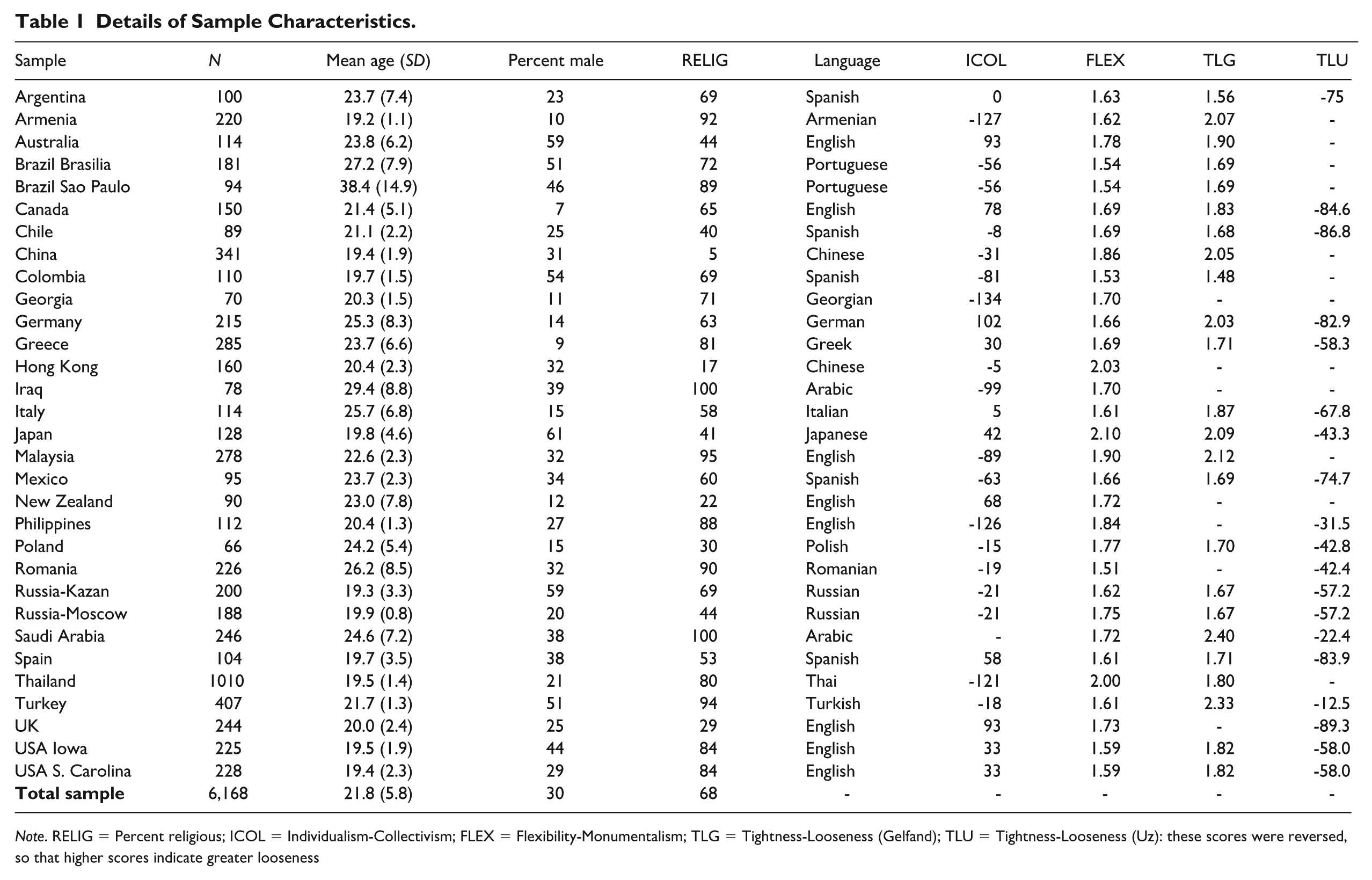
Note. RELIG = Percent religious; ICOL = Individualism-Collectivism; FLEX = Flexibility-Monumentalism; TLG = Tightness-Looseness (Gelfand); TLU = Tightness-Looseness (Uz): these scores were reversed, so that higher scores indicate greater looseness
Measures
The current paper focuses on a subset of measures that were part of a larger study designed to examine the cultural antecedents and outcomes of different cultural logics (Leung & Cohen, 2011). The overall survey also included measures of cultural logics, self-construal, self-esteem, self-face, other-face, social support, depressive mood, and normative discomfort that were not included in the present analyses and will not be presented here; further information about these measures can be found in Smith et al. (2021).
Emotions
We assessed emotions in two different ways: Participants first reported how often they normally feel each of 15 single-word emotions on 5-point scales (1 = very slightly or not at all; 5 = all the time) and then rated the same set of emotions for how frequently they would ideally like to feel each of these emotions. Eight of these emotions (angry, ashamed, close to others, friendly, frustrated, guilty, proud, self-esteem) referring to positive and negative engaged and disengaged emotions were drawn from the Implicit Social Orientation Questionnaire (Kitayama et al., 2009). Five further emotions referred to high and low arousal emotions (calm, elated, enthusiastic, excited, serene), reflecting the arousal dimension of the affective circumplex (Tsai et al., 2006). The remaining two items described general unspecified emotions (happy, unhappy).
Following the procedure of Vishkin et al. (2023), scores for emotional heterogeneity were computed as the absolute standard deviation of all experienced emotions within each sample, and as the absolute standard deviation of all desired emotions within each sample. We computed effects for the mean of positive and negative emotions (referred to by Vishkin et al. as “hedonic balance”), and separately for positive emotions and for negative emotions, because the balance between positive and negative emotions is known to differ between cultural groups (Miyamoto et al., 2017). Sample-level Cronbach alpha for the standard deviations of each emotion was .90 for experienced emotions and .87 for desired emotions. Scores on these measures for each sample are shown in Table 2.
Details of Emotion Scores for Samples.
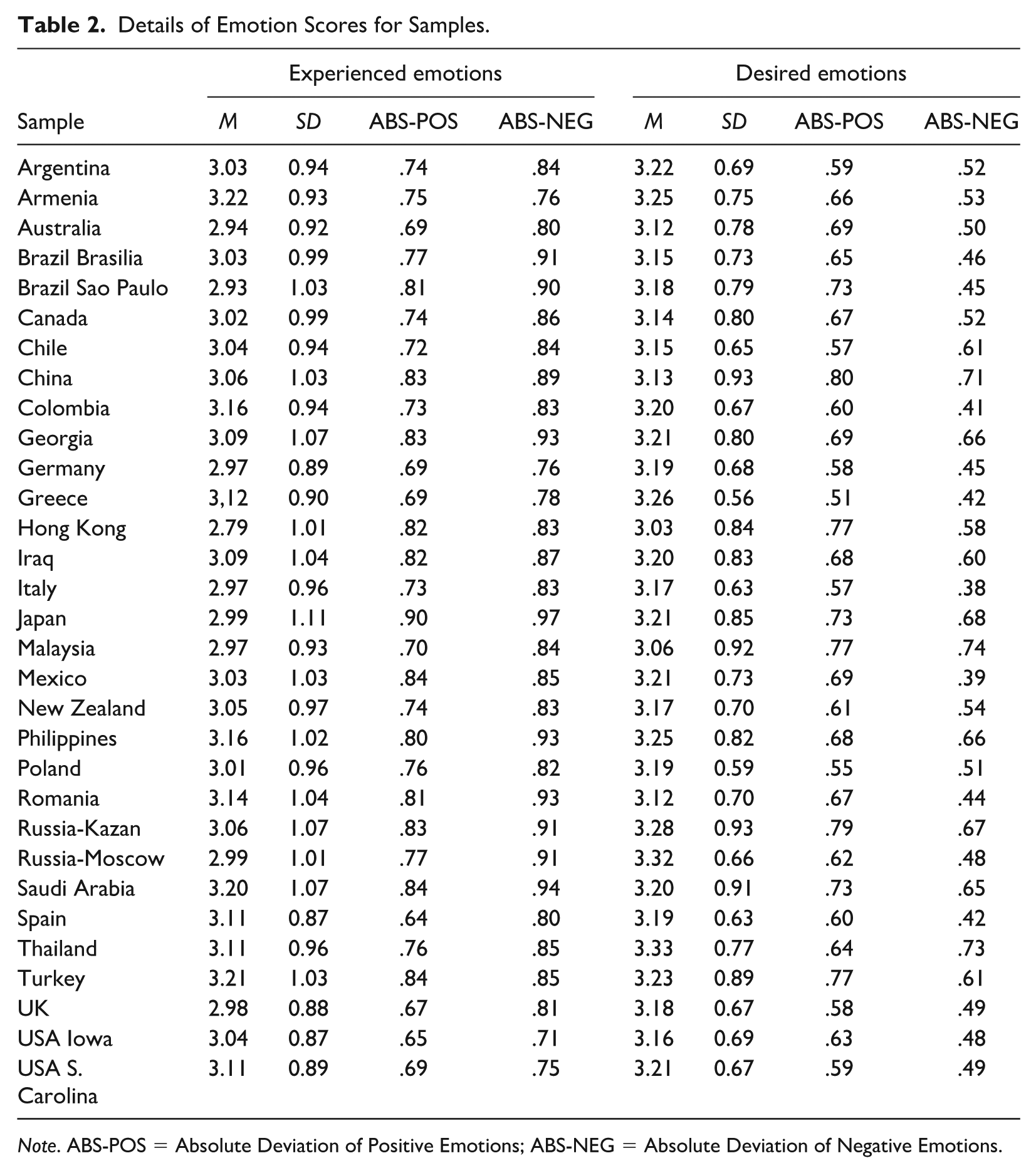
Note. ABS-POS = Absolute Deviation of Positive Emotions; ABS-NEG = Absolute Deviation of Negative Emotions.
Individualism-Collectivism
We obtained nation-level indices of individualism-collectivism for 27 nations from Minkov and Kaasa (2022; derived from World Values Survey data). In the three instances where we had two samples from a single nation, the nation-level index was used for each sample separately. Survey items used by Minkov and Kaasa (2022) to tap individualism are endorsement or justifiability of divorce, of homosexuality, and of abortion. The use of a survey format with just three response categories minimizes the salience of cultural differences in acquiescent responding (Johnson et al., 2010/2011; Smith, 2004). The items are provided in the Supplementary Materials (https://osf.io/4scbw). This measure correlates at .90 with Welzel’s (2013) measure of emancipative values, at .87 with Schwartz’s (2010) measure of autonomy-embeddedness values, and at .82 with objective indices relevant to individualism (Minkov & Kaasa, 2021). These recent scores are more adequately representative of nations than earlier surveys and reflect cultural change because the time of Hofstede’s (1980) initial identification of individualism. Nonetheless, the present scores correlate with those of Hofstede (2001) at .68. Higher scores represent a greater cultural tendency toward individualism.
Monumentalism-Flexibility
We used the seven items specified by Minkov et al. (2018) to tap this dimension of sample-level variance. For each item, respondents are asked to choose between two statements exemplifying aspects of monumentalism and flexibility, with a single middle scale point provided (e.g., “When something good happens to me, I feel it is just good luck,” “I am somewhere here between these two,” “Most of the good things that happen to me come from my own actions”). Evidence for the partial metric invariance of this sample-level scale is provided in the Supplementary Materials (https://osf.io/4scbw). Higher scores represent a greater cultural tendency toward high flexibility and low monumentalism.
Looseness-Tightness
We included two nation-level indices of looseness-tightness in our analyses. First, we included one index (LTG) from the Supplementary data provided by Eriksson et al. (2021), which reflects looseness and tightness as defined by Gelfand et al. (2011). This measure focuses on the respondents’ perceptions of the degree to which persons in their country abide by norms. Higher scores represent a greater cultural tendency toward tightness.
Second, we also included an additional index (LTU) from the scores for looseness-tightness (CTL-C) as provided by Uz (2015). This measure focuses on the nation-level standard deviations of responses to 124 items within the World Values Survey. These items do not include the three items used to define our measure of individualism-collectivism. Scores were reversed, so that higher scores represent a greater cultural tendency toward looseness.
Demographic Information
Prior to finishing the questionnaire, participants indicated their gender, age, nationality, country of origin, ethnicity, subject of study, and religion.
Analytical Strategy
Following the approach used by Vishkin and colleagues (2023), we tested our hypotheses through a series of multi-level regressions using the package lme4 in R (Bates et al., 2015), conducting separate models for each heterogeneity outcome (i.e., heterogeneity in experienced emotions and in valued emotions) and for each nation-level cultural dimension (i.e., individualism-collectivism, monumentalism-flexibility, and the two looseness-tightness indices). In each model, we predicted heterogeneity (the absolute standard deviation) with each cultural indicator as a level 2 predictor. In line with Vishkin et al. (2023), we nested our data within country and emotion type, with intercepts of samples and intercepts of slopes of emotions as random factors. A conceptual syntax can be written as follows:

Following Vishkin et al. (2023), we first tested our hypotheses for the complete set of included emotions, and subsequently in a set of complementary analyses for subsets of positive emotions and negative emotions separately. We conducted the analyses for all emotions once without any control variable and once including two control variables (gender and the absolute distance from the mean scale point), to take into account potential sources of error; for analyses looking at positive and negative emotions we only conducted analyses that included control variables. We controlled for gender because our samples varied in gender balance. Following Vishkin et al. (2023), we also controlled for the distance of emotion scores from their respective scale midpoints, because greater distance from the midpoint enhances the possibility of high deviance scores. We standardized all predictors prior to including them in our models. For clarity of understanding, when presenting the results we amended the signs for estimates, such that positive estimates indicate greater homogeneity in relation to the hypothesized pole of each predictor dimension. We therefore refer to monumentalism-flexibility rather than flexibility-monumentalism and looseness-tightness rather than tightness-looseness.
Results
Descriptive Correlation Analyses
Table 3 shows sample-level correlations between all variables. Positive signs are in the direction of support for the hypotheses.
Sample-Level Correlations Between Predictors and Measures of Emotional Homogeneity.
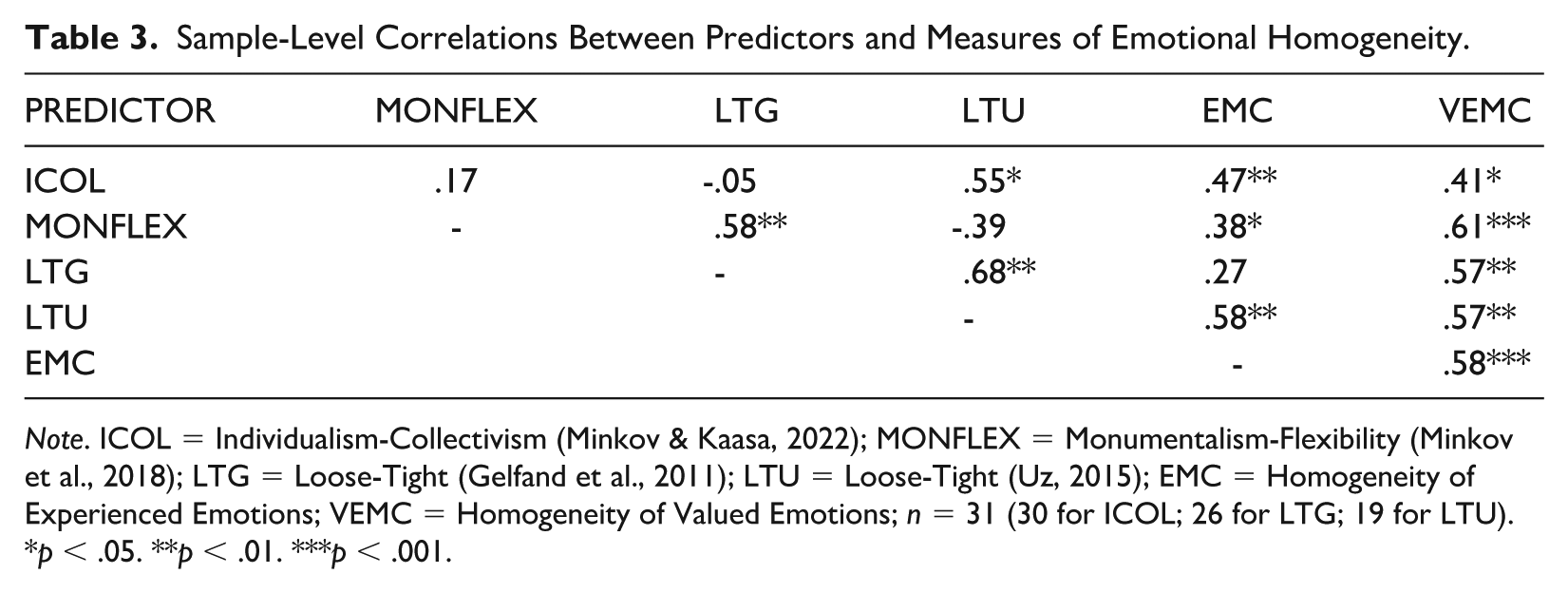
Note. ICOL = Individualism-Collectivism (Minkov & Kaasa, 2022); MONFLEX = Monumentalism-Flexibility (Minkov et al., 2018); LTG = Loose-Tight (Gelfand et al., 2011); LTU = Loose-Tight (Uz, 2015); EMC = Homogeneity of Experienced Emotions; VEMC = Homogeneity of Valued Emotions; n = 31 (30 for ICOL; 26 for LTG; 19 for LTU).
p < .05. **p < .01. ***p < .001.
Hypothesis Tests
Homogeneity in Experienced Emotions
Table 4 summarizes the results of analyses for experienced emotions, including control variables. Positive signs for estimates are in the direction of support for the hypotheses. A full model overview of the analyses involving experienced emotions is provided in Supplementary Tables S1 to S3 (https://osf.io/4scbw).
Cultural Predictors of Homogeneity in Experienced Emotions.
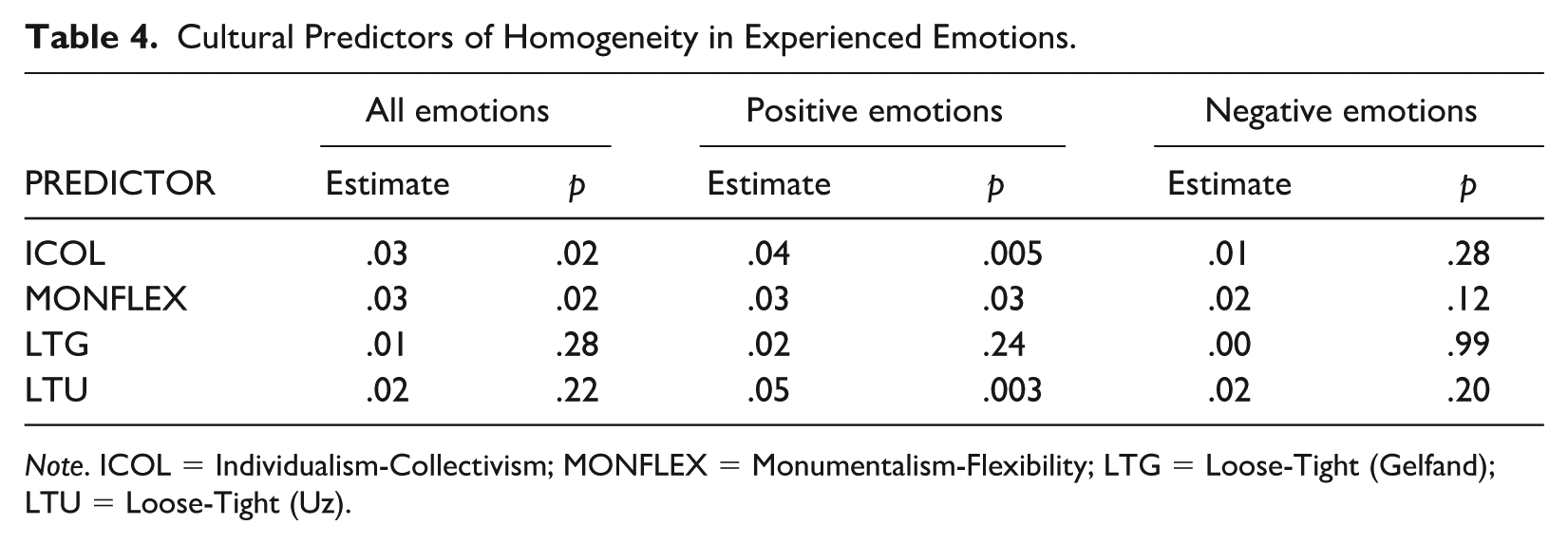
Note. ICOL = Individualism-Collectivism; MONFLEX = Monumentalism-Flexibility; LTG = Loose-Tight (Gelfand); LTU = Loose-Tight (Uz).
First, testing the replication of Vishkin et al.’s (2023) results regarding emotional homogeneity and individualism-collectivism, our analyses showed that a greater tendency toward individualism predicted smaller standard deviations, b = .03, p = .022, indicating greater homogeneity in experienced emotions overall. We further found that samples with a greater tendency toward individualism showed greater homogeneity in positive emotions, b = .04, p = .005, but not in negative emotions, b = .01, p = .277. Taken together, these results support H1a and replicate the finding of Vishkin et al. (2023).
Second, the remaining nation-level cultural dimensions (H2a to H4a) showed some, but not extensive support for a link with homogeneity in experienced emotions. Supporting our Hypothesis 2a, we found a comparable pattern of effects to those for individualism-collectivism for the dimension of flexibility-monumentalism, with greater monumentalism predicting greater homogeneity in experienced emotions overall, b = .03, p = .022, and in positive emotions, b = .03, p = .032, but not for negative emotions, b = .02, p = .116.
Hypothesis 3a was not supported, as we found no evidence for a link between Gelfand et al.’s (2011) looseness measure and homogeneity in experienced emotions, overall, b = .01, p = .278, in positive emotions, b = .02, p = .235, or in negative emotions, b = .00, p = .991.
Finally, we found mixed support for Hypothesis 4a: A greater degree of looseness as measured by Uz (2015) did not predict greater homogeneity in experienced emotions overall, b = .02, p = .224, nor for negative emotions, b = .02, p = .195, but greater looseness did predict greater homogeneity in positive emotions, b = .05, p = .003.
Homogeneity in Valued Emotions
Table 5 summarizes the results of analyses for valued emotions, including control variables. A full model overview of these analyses is provided in Supplementary Tables S5 and S6 (https://osf.io/4scbw).
Cultural Predictors of Homogeneity in Valued Emotions.
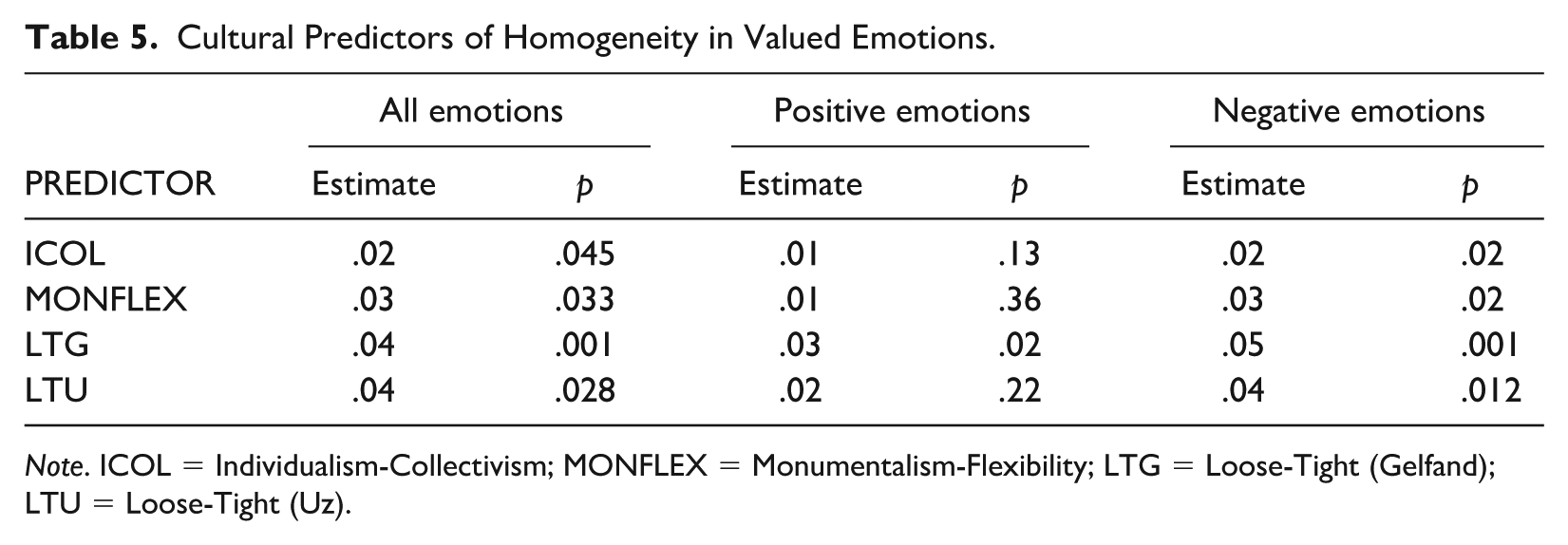
Note. ICOL = Individualism-Collectivism; MONFLEX = Monumentalism-Flexibility; LTG = Loose-Tight (Gelfand); LTU = Loose-Tight (Uz).
First, testing the replication of Vishkin et al.’s (2023) findings, our analyses for all emotions indicated that a greater tendency toward individualism was linked to greater homogeneity in valued emotions overall, b = .02, p = .045. However, and reversing our findings for experienced emotions, we found that greater individualism was linked to greater homogeneity in negative emotions, b = .02, p = .019, but not in positive emotions, b = .01, p = .134. Taken overall, these results support H1b and again successfully replicate the finding of Vishkin et al. (2023).
Second, the remaining nation-level cultural dimensions (H2b to H4b) also showed some support for links with homogeneity in valued emotions. Supporting Hypothesis 2b, we found that greater monumentalism predicted greater homogeneity in valued emotions overall, b = .03, p = .033. However, as is found with individualism, the results for different types of emotion are reversed compared with experienced emotions, with greater monumentalism predicting greater homogeneity in negative emotions, b = .03, p = .020, but not in positive emotions, b = .01, p = .361.
Fully supporting Hypothesis 3b, Gelfand et al.’s (2011) LTG measure showed greater looseness with greater homogeneity in valued emotions overall, b = .04, p < .001, and with both positive valued emotions, b = .03, p = .018, and negative valued emotions, b = .05, p < .001. In a similar way, Hypothesis 4b was supported with Uz’s (2015) LTU measure of looseness predicting greater homogeneity in valued emotions overall, b = .04, p = .028, as well as for negative valued emotions, b = .04, p = .012, but not for positive valued emotions, b = .02, p = .216.
Finally, as Hypotheses 1 and 2 were supported in similar ways, we next investigated whether individualism and flexibility accounted for the same variance in the dependent measures. As shown in full in Tables S7 and S8, when both predictors were entered concurrently, individualism remained a significant predictor of homogeneity of experienced emotions, b = .03; p = .009, whereas flexibility did not, b = .01, p = .617. Individualism also remained a significant predictor of homogeneity of valued emotions, b = .03, p = .016, whereas flexibility did not, b = .00, p = .992.
Discussion
Replication of Results for Individualism
In the current paper, we attempted to replicate and extend some aspects of the recent findings of Vishkin et al. (2023). Their basic claim that emotional conformity is stronger in individualistic countries was successfully replicated in our sample of 28 nations. Within our data for experienced emotions, these effects were significant for emotions overall, and for positive emotions, but not for negative emotions. In the most directly comparable analyses reported in Study 2 of Vishkin et al. (2023), the effects were equally strong for positive and negative experienced emotions. However, these authors also reported substantial variation in correlations between scores derived from individual emotions and collectivism. Their data were provided by six positive emotions and eight negative emotions, whereas ours were based on nine positive emotions and four negative emotions. The differential sampling of emotions may have contributed to the contrasting results, but the stronger effect for positive emotions is consistent with findings that positive emotions are more valued, normative, and beneficial in nations thought to be independent/individualistic (Eid & Diener, 2001; Miyamoto et al., 2017). However, the present results, like those of Vishkin et al. (2023), rest on a more conceptually secure basis, given that we did include an additional measure of individualism-collectivism.
Like the present study, Study 2 within Vishkin et al.’s (2023) research was based on student respondents, and the effects obtained may have been weakened by the likelihood that predictors based on national sampling will not be adequately represented by student populations. Vishkin et al.’s Study 3 was based on nation-representative European samples but used different emotion terms. This data yielded much stronger relationships with individualism for conformity of negative emotions than for positive emotions. So, the inconsistency in the results for negative emotions may depend on the representativeness of the populations sampled. Further investigations will be required to establish explanations for these variations in effect.
Our results for valued emotions are less directly comparable to those of Vishkin et al. (2023). We asked respondents how much they would like to feel each emotion, whereas Vishkin et al. asked how appropriate and valued each emotion is in one’s own society. Our results suggest that there is greater uniformity within individualistic nations in the emotions that one is less keen to feel than there is in collectivistic nations. A shared aversion to experiencing negative emotions is also consistent with the earlier findings that positive emotions are more characteristic of nations thought to be individualistic. One possible explanation may be that negative emotional experiences are more salient in these societies. Whereas positive feelings have been found to be more frequent than negative ones in individuals’ social lives in individualist countries (such as the United States), this difference has not been found for East Asian countries (such as Japan; Kitayama et al., 2000). When negative feelings do occur, they may thus be relatively more salient and carry relatively strong negative implications (e.g., highlighting goal obstruction or threatening interpersonal harmony, see, for example, Kwan et al., 1997, or compromising an individual’s positive self-image; see Barr-Zisowitz, 2000). This conscious processing of salience of negative emotions may be reflected in cultural differences of a greater “stigma” of feeling negative emotions in Western than East Asian societies: For example, European Australian participants reported that they perceived negative feelings as less socially accepted compared with East Asian participants; this perception was also more strongly related to negative self-evaluations alongside the experience of negative feelings (Bastian et al., 2012).
An alternative explanation for the lack of effects for positively valued emotions could rest on the fact that few of the 15 emotions included in our survey matched the 14 included by Vishkin et al. (2023). Guilt, pride, anger and shame were the specific emotions included in both studies. Table S9 shows that, for each of these emotions the correlations between homogeneity and collectivism are similar to those reported by Vishkin et al. (2023) in their Table S18. Conformity effects in both studies were more salient for some emotions than for others.
Results for Alternative Predictors
The results using the dimension of flexibility-monumentalism closely resemble those for individualism-collectivism, both for experienced emotions and for valued emotions. As shown in Table 3, these two major dimensions of cultural variation were independent of one another in the present data, so these results could reflect the contrasting variance contributed by individualism and by monumentalism. However, individualism proved to be a somewhat stronger predictor than monumentalism and we find that monumentalism, at least within the present data, does not add to the variance explained by individualism (see Tables S7 and S8 in the Supplementary Materials, https://osf.io/4scbw).
Vishkin et al. (2023) found no effects using Gelfand et al.’s (2011) measure of tightness-looseness as a predictor. Using the increased number of scores provided by Eriksson et al. (2021), we replicated this absence of effect for experienced emotions. However, as a predictor of valued emotions, looseness shows a strong pattern of effects similar to those found for individualism and monumentalism as predictors, predicting relatively greater homogeneity in valued emotions.
The looseness predictor provided by Uz (2015) yielded a significant effect for positive experienced emotions, similar to that found for individualism and monumentalism. The effect for overall emotion did not achieve statistical significance, perhaps because LTU scores are available for only 19 of our 31 samples. The pattern of results for valued emotions using this predictor again resembles those found in relation to individualism and monumentalism, with effects for negative emotions and for emotions overall but not for positive emotions.
To best understand the contrasting results obtained when using LTG and LTU as predictors, it may be important to focus on their differing conceptualizations. LTG is based on the perceived presence of injunctive norms, whereas LTU is in essence a measure of descriptive norms, derived from the distribution of scores within each sample. Scores for individualism-collectivism and for flexibility-monumentalism are factor scores derived from associations between survey items within samples and can therefore also be considered as tapping descriptive rather than injunctive norms. Further exploration will be required as to the reasons why the results using injunctive and descriptive predictors vary.
Within the results derived from the three different predictors based on descriptive norms, the consistent finding is that positive emotions show stronger associations with conformity for experienced emotions, but negative emotions show stronger associations with conformity for valued emotions. This result can be considered in terms of the broader literature concerning cultural differences in emotion. Cultural groups differ in the balance between experiencing positive and negative emotions, and in the balance between the experiencing engaged versus disengaged emotions (e.g., Chentsova-Dutton & Tsai, 2010; Kaspi et al., 2025; Kitayama et al., 2023; Miyamoto et al., 2017; Salvador et al., 2024; Uskul et al., 2023). As outlined above, it is possible that these differences stem from the prevalent frequencies and salience of positive and negative emotions in the respective societies; however, this question cannot be resolved within the present data and future research could explore what ecological factors may have given rise to these patterns.
The present data differ from prior characterizations of differences in emotion between samples in that they refer to within-sample variability rather than mean differences. While the present data showed no association between conformity of experienced negative emotions and collectivism, we did find an association between conformity of valued negative emotions and individualism-collectivism, suggesting greater diversity in whether negative emotions are valued or not in more collectivist societies. One potential explanation for this is that negative emotions may be relatively more accepted or less aversive in more collectivist cultures (e.g., due to dialectical belief systems: Miyamoto et al., 2017). As motivation to decrease unpleasant emotions tends to be lower within East Asian samples than in Western samples (Kaspi et al., 2025), we may speculate that some respondents in collectivist cultures (perhaps the majority) see less need to “damp down” (Miyamoto et al., 2014) their experience of negative emotions, resulting in greater variability (i.e., less conformity) in ratings; this may contrast with individualist samples, where there is less variability in the view that negative emotions are undesirable experiences (Miyamoto et al., 2017).
Limitations
The present data are derived from student samples, which may vary less from one another than did the majority of the populations sampled by Vishkin et al. (2023). Sample sizes were also moderate, and we included a different range of positive and negative emotions in our survey. As in many cross-cultural surveys, three of our predictors were based on representative nation-level samples, and we have noted that they may not accord closely with the profile of students from within those nations. All these factors could have limited the potential for detecting significant effects. However, the flexibility-monumentalism predictor was directly derived from our respondents and the broad range of included cultural samples enhances external validity and substantial convergence was found with key aspects of the earlier results.
A further limitation of both this study and that of Vishkin et al. (2023), is that no measures of measures of behavioral conformity were included. The hypothesis linking individualism and emotional conformity is based on the premise that emotional conformity is inversely related to behavioral conformity. Future studies could include explicit measurement of behavioral conformity and of behavioral norms to assess this possibility. This study shares another limitation with Vishkin et al. (2023) in that they both rely solely on self-report measures. Future studies would benefit from the inclusion of other ways of assessing emotions, such as physiological and behavioral responses. As Mauss and Robinson (2009) showed, the experiential, physiological, and behavioral measures of emotions are associated with unique sources of variance and are not interchangeable.
Conclusion
Overall, our results are supportive of the theoretical position of Vishkin et al. (2023) concerning variation in emotional conformity in differing cultural contexts. Inclusion of additional predictors has enabled us to show that some of this variation is attributable not just to individualism-collectivism, but also to flexibility-monumentalism and tightness-looseness. The indirect procedure for detecting conformity effects (Matsumoto et al., 2008; Murray et al., 2011; Uz, 2015; Vishkin et al., 2023) provides a valuable alternative to surveys tapping direct endorsement of injunctive or descriptive norms with greater specificity and less overt purpose.
Supplemental Material
sj-pdf-1-jcc-10.1177_00220221251376543 – Supplemental material for Which Cultural Dimensions Predict Variations in Emotional Conformity? An Extension of Vishkin et al. (2023) Across 28 Nations
Supplemental material, sj-pdf-1-jcc-10.1177_00220221251376543 for Which Cultural Dimensions Predict Variations in Emotional Conformity? An Extension of Vishkin et al. (2023) Across 28 Nations by Peter B. Smith, Alexander Kirchner-Häusler, Lusine Grigoryan, Vivian Miu-Chi Lun, Olga Lopukhova, Lorena Perez Floriano, Paola Eunice Diaz Rivera, Ammar Abbas, Antonia Papastylianou, Doriana Tripodi, Ceren Gunsoy, Anna Hakobjanyan, Claudio Torres, Ani Grigoryan, Ömer Erdem Koçak, Maria Luisa Mendes Texeira, Heyla A. Selim, Taciano L. Milfont, Alin Gavreliuc, Dana Gavreliuc, Michal Bilewicz, Catherine T. Kwantes, Joel Anderson, Matthew J. Easterbrook, Yasin Koc, Gisela Isabel Delfino, Phattanakit Chobthamkit, Ping Hu, Maria Efremova, Mary Angeline Daganzo, Byron Adams, Natsuki Ogusu, Chee-Seng Tan, Mary Ruth Guevara Maldonado, Siugmin Lay, Vladimer Gamsakhurdia and Vanessa A. Castillo in Journal of Cross-Cultural Psychology
Footnotes
Declaration of Conflicting Interests
The author(s) declared no potential conflicts of interest with respect to the research, authorship, and/or publication of this article.
Funding
The author(s) disclosed receipt of the following financial support for the research, authorship, and/or publication of this article: The work of Maria Efremova was supported by the framework of the Basic Research Program at HSE University. The work of Chee-Seng Tan was supported by the Universiti Tunku Abdul Rahman CAP RC Excellent Award (6401/0018). The work of Vivian Miu-Chi Lun was supported by Lingnan University Direct Grant (DR22B7). The work of Heyla A. Selim was supported by ORF-2025-1204, King Saud University, Riyadh, Saudi Arabia. The work of Anna Hakobjanyan and Ani Grigoryan was supported by the framework of the Basic Research Program at Yerevan State University.
ORCID iDs

Supplemental Material
Supplemental material for this article is available online.
References
Supplementary Material
Please find the following supplemental material available below.
For Open Access articles published under a Creative Commons License, all supplemental material carries the same license as the article it is associated with.
For non-Open Access articles published, all supplemental material carries a non-exclusive license, and permission requests for re-use of supplemental material or any part of supplemental material shall be sent directly to the copyright owner as specified in the copyright notice associated with the article.
