




Abstract
Paul proclaimed, “God made of one [blood] every ethnicity of humans …” (Acts 17:26). Most early sources read “of one blood” here, including 453 Greek manuscripts, many ancient language manuscripts, plus Irenaeus, Chrysostom, and Augustine. A few other manuscripts read simply “of one,” including Sinaiticus, Alexandrinus, Vaticanus, and P74. This Part A paper appraises the Greek manuscript readings for this passage, in the context of the attested readings at other Acts passages. Compared to other Acts passages with a distinctly Byzantine reading, this “of one blood” Byzantine reading at Acts 17:26 exhibits the most attestation, support, and connectivity. Our appraisal employs Editio Critica Maior III, the ECM computer apparatus, ECM’s Coherence Based Genealogical Method (CBGM) Flow Diagram, and other sources. Another Part B companion paper (Cannon 2025) focuses on patristic witnesses and other ancient language manuscripts at these Acts passages.
Much biblical scholarship has been devoted to discerning what is the initial text of the New Testament. Frequently, this appraisal has compared the Byzantine tradition to a small handful of early Greek manuscripts that include Sinaiticus, Alexandrinus, Vaticanus, and P74. During the 19th and 20th centuries, several biblical scholars had come to believe that these latter four Greek manuscripts were handwritten earlier and more carefully than others; and that the readings in these codices were the more important for discerning the initial New Testament text. Indeed, the manuscripts Sinaiticus, Alexandrinus, Vaticanus, and Papyrus P74 (plus several other later manuscripts) “guided the constitution of the NA28 and UBS text,” particularly in Acts (ECM III.1.1: 29*, Nestle-Aland 28th Edition 2012, United Bible Society: Aland et al. 2019). Also, Papyrus P45 is an important and very early Acts manuscript among these. However, much of P45 has been lost to decay, and only 16% of its Acts manuscript remains extant. At Acts 17:26, the first four of these manuscripts plus a few others read “God made of
In contrast, the overwhelming multitude of other early manuscripts read “God made of
However, during recent decades, textual scholars, aided by computer-based analyses, have been recognizing that this bias is not universally appropriate (Gurry 2019, 2018, 2017, Wasserman and Gurry, Wachtel 2017, 2017a). Recent scholars have come to recognize that some individual readings that subsequently became adopted by the Byzantine tradition were extensively attested in very early manuscripts and patristic quotations (Wachtel 2017a: 137). Scholars have called such individual passages the “roots” of the Byzantine tradition (Gurry 2018: 189, Wasserman and Gurry: 107-8).
An aim of this paper has been to discern which of these individual roots are the most extensively attested in Acts. To appraise this, we focused on Acts passages that hosted a Byzantine reading that was distinct from the Sinaiticus, Alexandrinus, and Vaticanus reading. Then, we discerned the extent of attestation for either of these juxtaposed readings among Greek, Latin, and other ancient language manuscripts, and among patristic witnesses. We found greater early attestation, continued support, and connectivity for the Byzantine “of
Resources for Appraising Acts Variant Readings
Aland’s Text und Textwert appraisal of Acts passages
Kurt Aland (1993), in his Text und Textwert, focuses on 104 Test Passages in the Acts of Apostles. For each of these Test Passages, Aland appraised which Greek manuscript attested what reading for all 470-550 Greek Acts manuscripts that are extant at a given passage. At Acts 17:26, Aland identifies an overwhelming 453 Greek manuscripts that attest the reading “of
Editio Critica Maior (ECM III) of Acts
The four-volume Editio Critica Maior of Acts (ECM III) appraises which manuscripts attest what variant reading in about 7,600 Acts passages (ECM III.1.1: 28*). Each “passage” (or “variation unit”) is a segment of a verse, identified by its chapter, verse, and word-count within the verse (for example Acts 17:26/6-9). The awesomely comprehensive ECM III critical apparatus chronicles all readings (i.e. variants) at each passage. These readings are chronicled in about 130-145 Greek Acts manuscripts that the ECM team selected as representative from among about 550 extant Greek manuscripts (ECM III.2: 7). The ECM texts also track readings of early papyrus fragments, several lectionaries, several Latin manuscripts, and as many as 16 other ancient languages. ECM also tracks Acts quotations by more than a hundred early patristic witnesses (ECM III.1.1 and III.1.2 throughout, Strutwolf (2017), Büsch (2017)).
Among all Acts passages, ECM offers a “Guiding Line” that they label as their Ausgangstext (German for “initial text” or “source text”). This Ausgangstext mostly matches the NA28 adopted text. However, in 155 passages, the ECM team came to a Split Decision regarding which of two variants they perceived as “initial.” (ECM III.1.1: 28*, 31*). Also, in another 52 passages, the ECM team made a Guiding Line Change, relative to what NA28 had adopted. The ECM III team derived this Ausgangstext in part by considering Genealogical Coherence (GC) and Transcriptional Probability (TP), as summarized by Wachtel (2017: 1-38).
Per Wachtel (2017a: 141), “A strong argument for assessing a variant as initial text is provided by an attestation that combines coherence and a broad range of diverse witnesses closely related to Ausgangstext-like (“A”) manuscripts.” At the top of the list of Ausgangstext-like (“A”) manuscripts are
The ECM team has also compiled a Coherence-Based Genealogical Method (CBGM) General Textual Flow Diagram. This depicts the associative relationships among the manuscript witnesses of about 176 Greek manuscripts, Greek lectionaries, and Greek papyrus fragments. ECM emphasizes that a manuscript is a witness to a text-type that may have existed prior to the writing of the extant manuscript that we now have. As presented by Wachtel (2017a: 137-148), this Flow Diagram depicts a single “probable ancestor” lineage for each of these Greek manuscript witnesses. Moreover, the CBGM modelers have chosen GA 03 (Vaticanus) as the “first probable ancestor” manuscript witness shown on this Diagram. Then the CBGM presents GA 01, P74, and P45 witnesses as first “descendants” of GA 03; and the GA 02 witness as first “descendant” of P74. Thus, these five SAVPP manuscript witnesses are at the very top of the ECM Acts CBGM Flow Diagram. As recognized by Wasserman and Gurry (5), “At its most subjective [level], the CBGM requires the user to make his or her own decisions about how variant readings relate to each other. Whether X goes above Y or Y goes above X at a particular point is determined by the user of the method, not by the computer.”
Thus, as a limitation, the CBGM layout involves an inherent degree of subjectivity and an unavoidable measure of circular reasoning. Nonetheless, the CBGM Flow Diagram offers a very important and comprehensive tool for visualizing the prospective relationships among Greek manuscripts.
As presented, this CBGM flow diagram does not include Acts manuscripts that were written in Latin, nor other ancient languages, nor patristic witness quotations (refer to Gurry 2017: 39). However these other writings have influenced the ECM team’s selection of initial text.
The ECM team has also posted on-line a critical computer apparatus (ECM Phase 3), which we have used to discern the percent agreement between one Greek manuscript and the other 130-145 tracked manuscripts throughout Acts. We have also used another component of this critical computer apparatus (ECM Phase 4), which can identify the flow diagram for a given variant-reading at any Acts passage.
ECM’s Byzantine-Identifying Passages in Acts
When working through the immense data set posed by hundreds of manuscripts at 7,600 Acts passages, the first question pertains to how scholars can detect, define, and distinguish the readings of a given textual tradition. Until recently, this was a nebulous and unwieldy concept that was difficult to quantify. However, in their 2017 compendium, the ECM team highlighted passages that host Byzantine-identifying readings in Acts. The Acts passages with these Byzantine-identifying readings include all those 727 passages listed in ECM III.2: 9-15. We have also included most (44) of those Guiding Line Change passages listed in ECM III.1.1: 34* (these include all passages except for those that do not have a unified “Byzantine” reading: namely excluding Acts 8:31/22-24, 9:12/6-10, 15:37/10, 16:12/12-16, 20:5/6, and 20:21/34). Together, these two groups sum to 771 Byzantine-identifying passages, where nearly all “Byzantine” manuscripts attest to one reading, while many (but sometimes not all) of the SAVPP manuscripts attest to a different reading.
For our analysis, we established two “benchmarks” by which to compare other manuscripts and patristic quotations. The one benchmark has been the Byzantine reading. The second benchmark has been the reading shared by the early manuscripts that have been rendered preeminent by NA28 and others—namely
B-D Passages that Host Distinctly Byzantine versus SAVPP Readings in Acts
From among the 771 Byzantine-identifying passages, we selected a subset of passages, for which all the extant SAVPP manuscripts attested to one reading, while the Byzantine manuscripts attested to another reading. We designated these passages as ones with a clearly
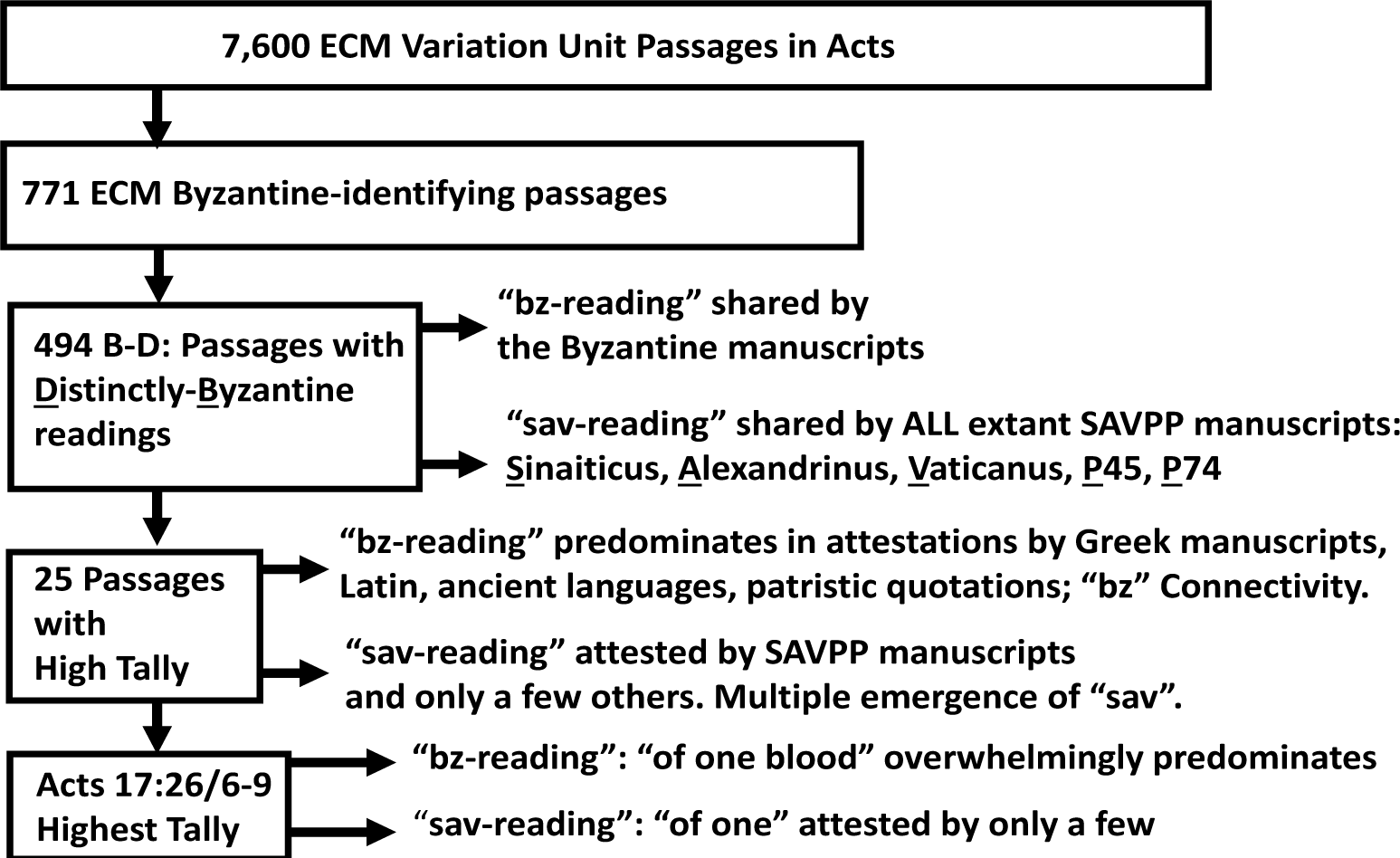
Approach and Focus of Acts variant readings analysis
Objectives and Hypothesis
The Objectives of our Part A and B papers have been:
For each B-D passage, identify which manuscripts and patristic witnesses attest to the Byzantine reading, and which attest to the SAVPP reading.
At each B-P passage, appraise the connectivity and coherence of Greek manuscripts, relative to the “sav” and “bz” readings.
Chronicle the Acts singular readings in the SAVPP manuscripts.
Employ these factors to garner insight regarding which “bz-readings” could be considered as initial text.
Appraise the attestation, support, and connectivity for the “of
We have hypothesized that earlier attestation and broader diffusion of a reading into multiple traditions, ancient languages, and early patristic quotations renders the reading a candidate as initial text, even when it is a “bz-reading.” The results of this appraisal exhibit that the “of
Our aim has not been to favor or endorse the Byzantine text as a whole over the SAVPP manuscripts. Rather, we have sought those individual “bz-readings” that had been attested very early on by a multitude of manuscripts and patristic quotations, and then subsequently became adopted into the Byzantine text-form.
In this Part A paper, we chronicle the appraisal of these B-D passages relative to Greek manuscripts. Then in a Part B companion paper (Cannon 2025), we appraise attestations for the “bz-reading” versus “sav-reading” among other ancient languages and patristic witnesses. We are not aware that others have quantitatively documented and appraised these B-D passages in such manner before.
Acts Greek Manuscript Clusters and Traditions
During the recent two centuries, scholars have aimed to characterize New Testament manuscripts by the grouping, clustering, tradition, and “genealogy” of their variations. Perhaps one of the simpler historical classifications has distinguished Greek manuscripts as either “Alexandrian,” “Byzantine,” or “Harklean” in tradition; along with the “Western” cluster of variants. (Metzger, ECM III.2: 8, Epp 2013, Boismard and Lamouille, Clark). The ECM team has sparingly employed these cluster designations. Particularly, the ECM III Acts team has departed from using the “Alexandrian” nomenclature, and instead has referred to “Ausgangstext-like” manuscripts. Also, the ECM team has found that the so-called “Western” terminology is somewhat of a misnomer (Gäbel 2017, Wachtel 2017a). We follow the ECM team’s lead herein, and we refer to clusters of Greek manuscripts just as the ECM III Acts volumes refer to them.
Ausgangstext-Like Manuscripts
ECM introduces the concept of Ausgangstext-like manuscripts by saying: “The following 24 witnesses agree more often with this hypothesis about the Ausgangstext than with all witnesses that do not feature the Ausgangstext as their closest relative.” These 24 manuscripts are (in descending order of agreement to the Ausgangstext): GA 03, P74, 01, 81, 02, 04, 1175, 1739, 33, 307, 610, 453, 181, 2818, 1678, 623, 1409, 2344, 5, 1875, 1642, 180, 94, and L1188. Also, per ECM III.1.1: 29*: “Papyrus P45, as an early text with many idiosyncrasies, doubtlessly ranks among the most important witnesses.”
Among these 25 manuscripts, we especially focus our benchmark on the earliest ones that also agree the most with the Ausgangstext, and have often been deemed the most important by 19th and 20th century textual scholars. These, again, are
Byzantine Manuscripts
The Byzantine tradition had early roots in patristic quotations; and it gained predominant adoption from the 9th century and onward. So much so, that the Byzantine text-form has been interchangeably referred to as the “majority text” by Robinson and Pierpont (2005), and by some others. Notably, an important portion of the readings that subsequently became adopted by the Byzantine text-form can be observed in the quotations of Irenaeus (185 CE), Chrysostom (400-401 CE), Augustine (350-420 CE); and in ancient language translations. Wachtel (1995) perceived that the Byzantine text-form did not spring forth as a whole, all at once. Rather it gradually emerged as the result of a several-centuries-long process of accumulating smoother, “more acceptable” readings. Per Wachtel (1995), this development occurred in three phases: 3rd-4th Centuries, 5th-6th Centuries, and 9th century.
ECM lists 73 Greek manuscripts that are “closest to the Byzantine text of Acts.” ECM (III.1.1: 19*) defines these Byzantine “Byz” manuscripts as ones that exhibit a 90% agreement with the majority reading at the 104 Acts test passages in Aland’s Text und Textwert (Aland 1993). These “Byz” manuscripts are listed in ECM III.2: 8. Among these, per ECM, “A solid Byzantine witness is shown by seven nearly pure Byzantine manuscripts which rarely depart from the group: GA 1, 18, 35, 330, 398, 424, 1241.” These seven agree with the Majority Text at 96.5-99.8% of the Acts passages (ECM Computer Phase 3).
Harklean Greek Manuscripts
The Harklean Greek manuscripts host remarkable agreement with the Syriac New Testament translation of Thomas Harkel of 616 CE (refer to Part B, Cannon 2025). These manuscripts are GA 614, 1292, 1505, 1611, 1890, 2138, 2412, and 2495. These all agree with GA 614 at 89.5 to 98.8% of Acts passages. This is more than these manuscripts agree with either the Ausgangstext or the Majority text.
The “So-called Western Cluster”
Wachtel (2017a: 141) identifies several Greek manuscripts as “W1” or “W2” in his CBGM Flow Diagram. Several of these are among the Greek Harklean Group. Those identified as “W1” or “W2” that are not among the Greek Harklean include P38, P46, P127, GA 05 (Bezae), 08 (Laudianus), 206, 383, 915, 1501, 1751, 1838, 1891, 2147, and 2652.
Wachtel (2017a: 137) addressed whether the so-called “Western” or Byzantine text-form came earlier:
In many cases, we cannot discern which is the chicken and which is the egg, as it were. We do know that the Byzantine tradition contains many variants with early witnesses. It is by no means inconceivable that the Byzantine variant was adopted, in many cases, by ‘Western’ witnesses where the attestation is mixed.
The Byzantine Tradition as an Occasional Host of Early / Initial Readings
ECM authors and others have come to recognize that in individual passages, several of the readings that have become adopted into the Byzantine tradition appear in some of the earliest recoverable readings of Acts. Per ECM (ECM III 1.1: 30*):
Since the Textus Receptus was overcome by the scholarly textual criticism of the 19th century, there is tenacious negative bias against the Byzantine majority text. Wherever well-known, older textual witnesses like Vaticanus and Sinaiticus, and even more so in combination with a papyrus, stand against the majority of minuscules, the decision against the majority text was often made easily, without seriously considering the quality of the variant in question… It is often overlooked that in the vast majority of variant passages, only a few witnesses differ from all the others. As a rule, the popular witnesses from the 4th/5th centuries and, if extant, from even earlier papyri, agree with the majority of all witnesses. This implies that at all these passages, the old age of the majority text is not in doubt… For the reasons given above, it is undoubtedly true that the [Byzantine] textual tradition as a whole goes back to a very early period and that the coherent transmission of the majority of all textual witnesses provides a strong argument for, not against, the variant in question. If the bias against the text of the majority of all witnesses has been overcome, then the variants transmitted by the majority will appear in a different light.
Wasserman and Gurry (2017: 107) and Wasserman (2019: 354) assert that:
We should not be surprised if the Byzantine witnesses attest initial readings against earlier witnesses even if it remains true that their distinctive text as a whole is not attested until much later. The reason is that our Byzantine manuscripts have early roots, and this has put them in a position in some cases to preserve the earliest reading in isolation from the rest of the tradition.” Indeed, “this is something all New Testament scholars will need to reckon with in Acts.
This “19th century negative bias against the Byzantine text” form was perhaps most influentially expressed by Westcott and Hort (1896: 163-164), who exclaimed:
If a reading is attested by the bulk of later Greek manuscripts, but not by any of the Uncials GA 01, 02, 03, 04, 05, 08 (nor possibly GA 33 nor 81) in Acts, and not by any Latin authority (except the latest forms of Old Latin), and also not by the Syriacs, nor Egyptians, and not by quotation of a Patristic witness earlier than 250 CE, then there is the strongest possible presumption that it is distinctively Byzantine, and therefore to be rejected at once as proved to have relatively late origin.
The ECM team, along with Wasserman and Gurry, have expressed push-back somewhat against this West-cott-Hort perspective, while also respecting the Sinaiticus-Alexandrinus-Vaticanus tradition. Moreover, Parker (402) admonishes against the Westcott-Hort perspective, saying “the old concept of text types with the good Alexandrian and the bad Byzantine at opposite ends of the development can no longer be sustained.”
Herein, we especially focus on a more complex issue that this Westcott-Hort quote raises: What if an individual “bz-reading” is attested by nearly all of these sources listed above in the Westcott-Hort quote, but not by GA 01, 02, and 03—nor by P74 nor P45? Per Zuntz (1953: 283) “the odds of choosing the right reading increases with each additional ‘authoritative witness’ that attests to a given reading.” Per Wachtel (1995: 191), “The more early witnesses a reading has, the greater the likelihood that it is a reading that was widespread early on.”
We have concurred with this perspective, and so we have derived a protocol for placing the attestations of these authoritative witnesses in more clear perspective.
B-D Passages Addressed by Text und Textwert, with Overwhelming Greek Manuscript Attestation to the “bz-reading”
With regards to Greek manuscript attestation, we noted above that at Acts 17:26/6-9, Aland TuT (1993: 558-559) identifies an overwhelming 453 Greek manuscripts that attest to the “bz-reading” (“of
B-D Passages Addressed by ECM, with Overwhelming Greek Manuscript Attestation to the “bz-reading”
ECM tracks 130-145 Greek manuscripts. When considering these at Acts 17:26/6-9, ECM (III.1.2: 657) chronicles 18 Bible manuscripts that attest the “of
Thus, among the 494 B-D passages, there were only 15 + 49 = 64 that had an overwhelming level of “bz-reading” attestation among Greek manuscripts. On careful inspection, we note that such overwhelming attestation has been garnered when the “bz-reading” has not only been attested by manuscripts of the Byzantine tradition, but also by most other traditions and clusters, including even many of the “Ausgangstext-like” manuscripts (see Cannon 2023). Particularly at Acts 17:26, the Greek manuscripts that attest “of
Appraising Consensus for Distinctly Byzantine Readings at B-D Passages
We aimed to derive a semi-quantitative, yet basic, protocol that would offer insight regarding the extent of attestations by numerous manuscripts, ancient languages, and patristic quotations. To this end, we devised a Tally of Attestation, Support, and Connectivity that compares the consensus for the Byzantine reading versus SAVPP reading at each of the B-D passages.
For this Tally protocol, the significance of “bz-reading” attestation was tallied from a high of +3 (strong, very early “bz” attestation, and significant support) to a low of -3 (strong “sav” attestation). These are per the tallying protocol shown in the footnotes of Table 1. These tallies emphasize Irenaeus (maximum tally of +3) and Origen (maximum tally of +2.5). Irenaeus and Origen offered considerably more very early quotations of Acts than did other patristic witnesses. Table 1 summarizes this appraisal for B-D passages that received higher Tallies.
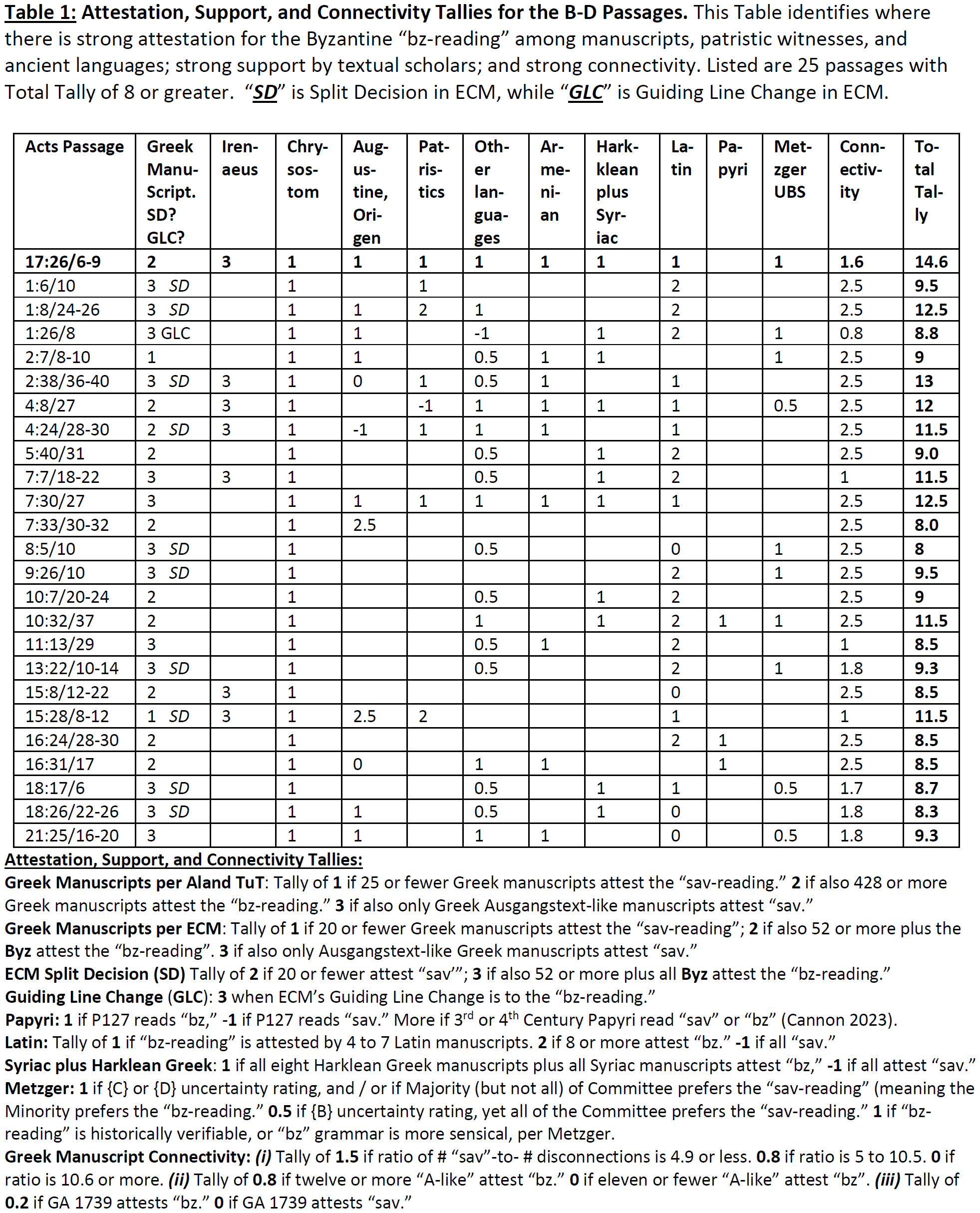
This Part A paper discusses the attestation, support, and scholarly appraisal of Greek manuscripts; and Greek manuscript connectivity. These are as appraised in Columns 2 and 11-13 of Table 1. Then in a Part B companion paper (Cannon 2025), we discuss the extent to which the “bz-reading” versus “sav-reading” was attested in the patristic quotations and other ancient languages. These attestations are reflected in Columns 3-10 of Table 1. Then the consensus sum of the Total Tally for a given passage appears at the far right, in Column 14 of Table 1. This Tally protocol is intended to be exploratory and introductory, rather than definitive.
Following is an example computation for Table 1 row 2, relative to Acts 17:26/6-9. For Column 2, assign a tally of 2, because an overwhelmingly high number of 453 Greek manuscripts attest “bz,” while only a few attest “sav” (Aland TuT 1993). Irenaeus attests “bz,” so assign a tally of 3, as do Chrysostom (tally of 1), and Augustine (tally of 1). Six patristic quotations attest “bz”: more than the two that attest “sav” (tally of 1). Also, more ancient languages (five) attest “bz” than the three that attest “sav” (tally of 1). Moreover, among these, the Armenian attests “bz,” so tally of 1. Also, both the Harklean Syriac and Peshitta Syriac plus ALL the Harklean Greek manuscripts attest “bz” (tally of 1). Four Latin manuscripts attest “bz” (tally of 1). Then Metzger-UBS scholars (Metzger 1998: 404-5) recently logged a “{B}” level of uncertainty relative to Acts 17:26, and a “majority” preferred “of
We tabulated this Total Attestation, Support, and Connectivity Tally for all 494 B-D passages, shown in Table 2 (refer to Cannon 2023). Among all these B-D passages, there were only 25 that offered a Total Tally of 8 or higher, and these are identified in Tables 1 and 2. Yet further, among these 25, there is only one passage with a Total Tally as high as 14.6, namely Acts 17:26/6-9. To repeat: among all Acts B-D passages that host a clearly distinct Byzantine reading, the Acts 17:26/6-9 “bz-reading”, “of
Acts 494 B-D passages.
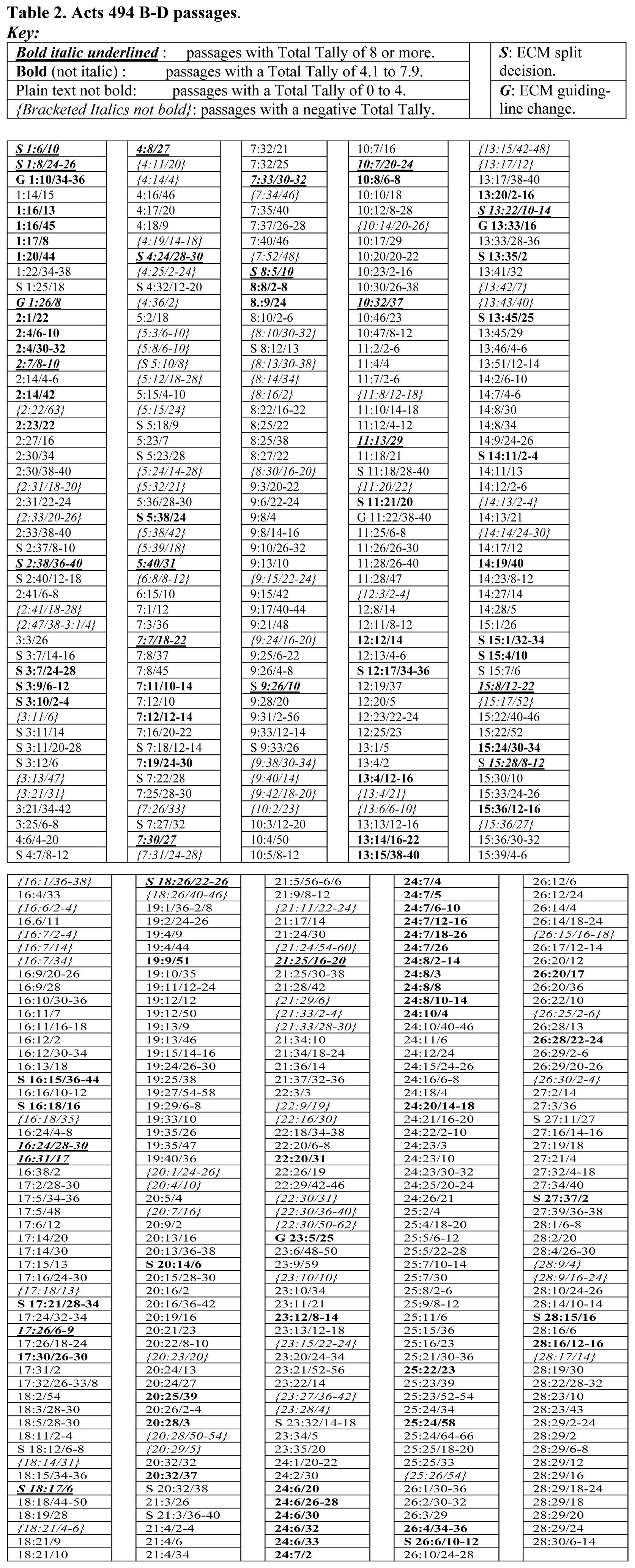
Table 2 lists all the B-D passages and identifies the range of Total Tallies for each of these. Among the 494 B-D passages, we tabulated 25 with a Total Tally of 8 or more, and 73 with a Total Tally of 4.1 to 7.9. With focus on this first and second group, this implies that perhaps 5 to 20 % of these “bz-readings” may deserve a more pronounced consideration as initial text. This is a small number relative to the roughly 7,600 passages ECM has identified in Acts.
In contrast, many of these B-D passages garnered a lower Total Tally: we found about 308 B-D (nearly two-thirds) with a Total Tally of 0 to 4. When the Total Tally ranged from 0 to 4, it generally meant that the ECM III text recorded few (or no) ancient language witnesses or patristic quotations of the “bz-reading” at these passages—other than by Chrysostom. This B-D group might appear less likely candidates as initial text—and also are generally less consequential. Yet further, we found about 88 B-D passages with even a negative Total Tally, meaning that the “sav-reading” was considerably favored there.
Passages Designated by ECM as “Guiding Line Change” or “Split Decision”
Among the 494 B-D passages, the ECM Ausgangstext adopts the “sav-reading” in 438 passages, and the “bz-reading” in 3 passages. These three are Guiding Line Change (GLC) passages. Then at Acts 13:33/16 ECM adopts a Guiding Line Change to another reading. Also, ECM ascribes a “Split Decision” (SD) between the “bz-reading” and “sav-reading” in 52 cases. Among the GLC and SD, only one GLC passage and ten SD passages exhibited a Total Tally of 8 to 13 (refer to Table 1). Moreover, only three GLC and 18 SD garnered a Total Tally of 4.1 to 7.9 (refer to Table 2).
Thus, among 55 B-D passages where ECM identified the “bz-reading” as either SD or GLC, only about half garnered a Total Tally even as low as 4.1. This highlights that the Acts 17.26 “of one blood” reading—with its considerably higher Total Tally of 14.6—deserves significantly greater consideration as a Split Decision or Guiding Line Change passage than do many passages that now feature those designations in ECM.
Connectivity Among Greek Manuscripts
ECM presents the following criteria for discerning the initial text, relative to ECM’s CBGM General Textual Flow Diagram (Wachtel 2017a: 141):
Strong coherence [for a variant reading] only materialized if the Ausgangstext (‘A’) is part of the attestation…If a range of A-related witnesses is connected with a multitude of further witnesses by chains of relatives, then this clearly signals coherence… [conversely]…an attestation lacking coherence is a sign of multiple emergence…Multiple emergence weakens the force of internal criteria that might be used to account for the priority of the variant.
In the spirit of this ECM Ausgangstext-centric vantage, we tallied the Greek Manuscript Connectivity for all 494 B-D passages. This Connectivity is offered as a quantitative correlate to the ECM qualitative concept of coherence, although it is not directly the same metric. Specifically, we have employed three criteria for quantifying Greek Manuscript Connectivity:
(i) Determine the extent of Multiple Emergence among Greek manuscripts that attest the “sav-reading.” To appraise this, we employed the ECM publicly available computer apparatus Phase 4 to plot a Flow Diagram for the Greek manuscripts that attest to “sav.” Figures 2 and 3 offer examples. On these figures, we counted the number of “sav-reading” manuscripts. Then we counted the manuscript-to-manuscript links that were disconnected by 10 or more separation-units. Then we divided the number of “sav-reading” manuscripts by the number of disconnected linkages.
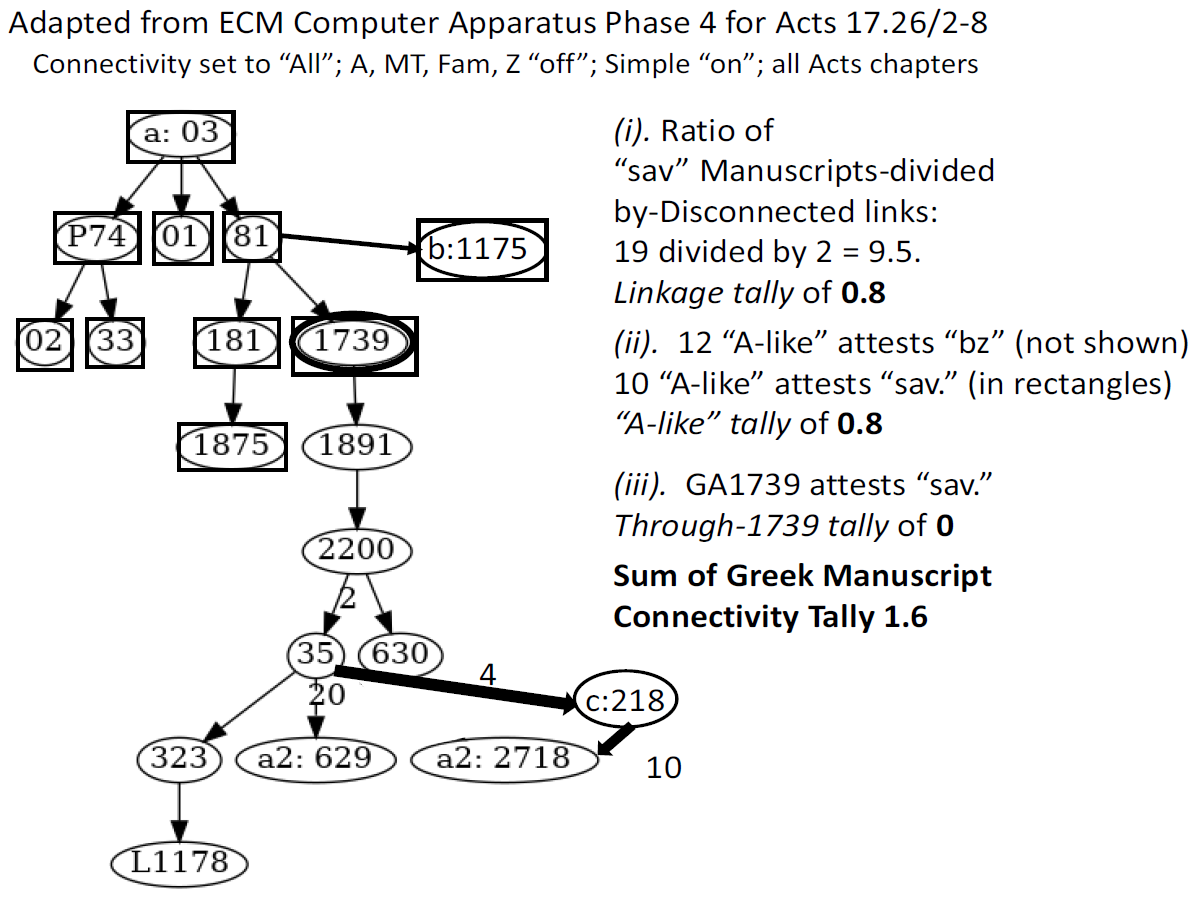
Acts 17:26/6-9 Flow Diagram for “sav-reading.”
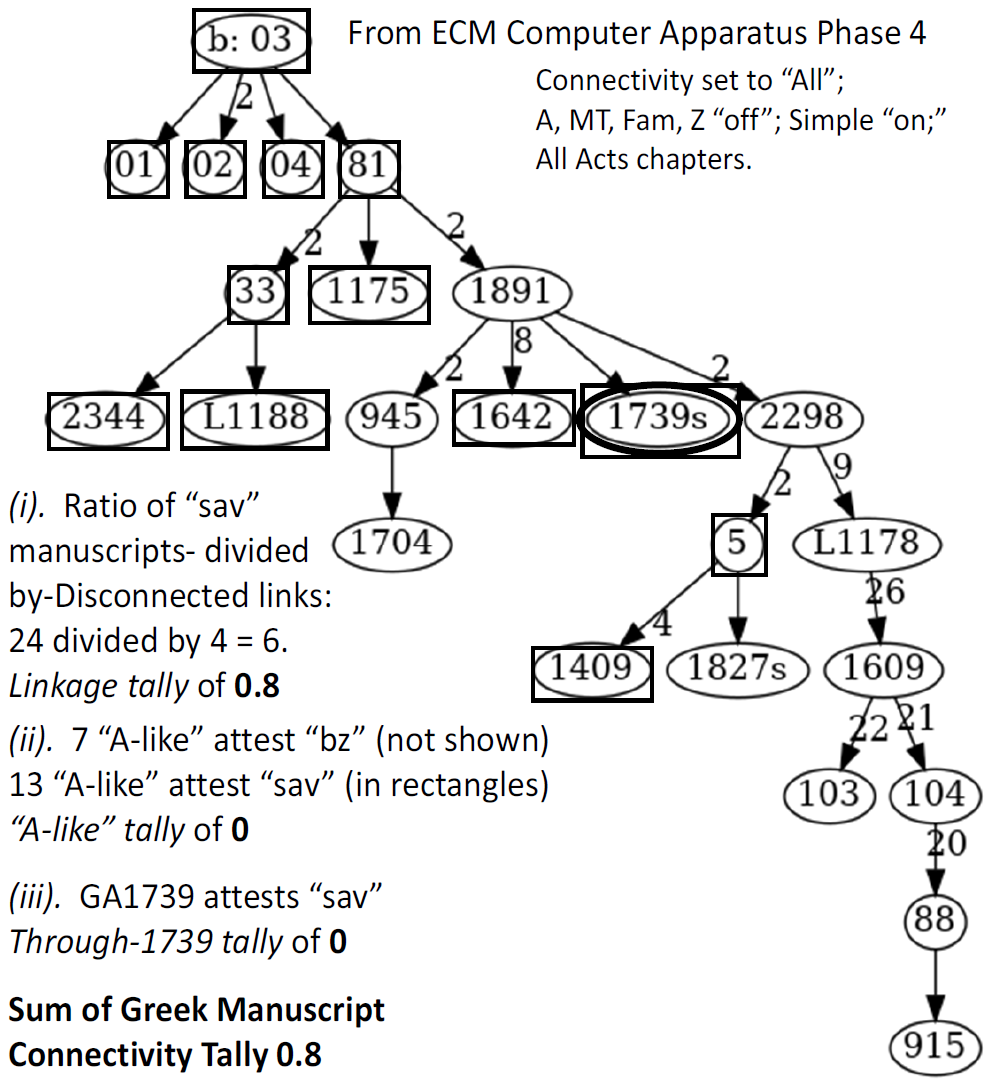
Acts 1:26/8 Flow Diagram for “sav-reading.”
When the ratio of “sav-reading” manuscripts-to-disconnected linkages was below 5, it denoted significant disconnection and extensive multiple emergence of the “sav-reading.” In ECM genealogical coherence (GC), this was portrayed by such narrations as “lack of coherence in the attestation of ‘sav,’ but not of ‘bz’.” (As for Acts 1:8/24-26 per Wachtel 2017: 5).
When this ratio ranged from 5 to 10.5, it signified a somewhat disconnected “sav-reading.” ECM GC portrayed this as: “the earliest A-related witnesses support ‘sav,’ accompanied by incoherencies.” (As for Acts 18:26/22-26 per Wachtel 2017a: 27). If this ratio exceeded 10.5, then “sav” was connected. ECM GC portrayed this as: “there is a considerably broader A-related core of witnesses for ‘sav’.” (As for Acts 7:18/12-14 per Wachtel 2017: 12).
We note that we have revised these ECM-Wachtel quotations by substituting our designations as either the “sav-reading” or “bz-reading.” We use these designations so as to avoid confusion. In comparison, the ECM team uses “a” for their Ausgangstext-reading—which is usually (but not always) the “sav-reading.” Then they use “b” for another reading, which is often (but not always) the “bz-reading,”
(ii) Discern whether a majority of the 25 Ausgangstext-like Greek manuscripts attest the “bz-reading” rather than the “sav-reading.”
(iii) Observe whether the “bz-reading” is connected through the tell-tale GA 1739 and its progeny. ECM GC portrayed this as: “The ‘bz’ variant has a coherent majority attestation, related to the Ausgangstext by GA 1739.” (As for Acts 15:4/10 per Wachtel 2017: 21).
(iv) We then summed the values from these three criteria as the Greek Manuscript Connectivity Tally, as presented in Table 1 column 13, per the Tally protocol in the Table 1 footnotes.
Figures 2 and 3 offer examples of how we computed the Greek Manuscript Connectivity Tally. As computed in Figure 2, the Greek Manuscript Connectivity Tally is 1.6 at Acts 17:26/6-9. Then the Greek Manuscript Connectivity Tally is 0.8 at Acts 1:26/8. Since 1.6 is greater than 0.8, the “bz-reading” at Acts 17:26/6-9 exhibits more Greek Manuscript Connectivity than it does at Acts 1:26/8.
At Acts 1:26/8, the ECM team selected the “bz” reading” for its Guiding Line. Wachtel (2017: 6) narrates the following GC rationale: “The attestation of the ‘bz-reading’ is perfectly coherent, while the ‘sav-reading’ seems to have emerged from ‘bz’ several times.”
We note that similar connectivity-related GC narrative could be offered for the “bz-reading” at Acts 17:26/6-9—yet with more connectivity attributed to “bz.” However, Genealogical Coherence is not addressed for Acts 17:26 by Wachtel (2017) in pages 1-38.
With regards to Transcription Probability (TP) at Acts 1:26/8, the “bz-reading” can be translated as “they gave (cast) lots for them” (when the Apostles choose between Justus and Matthias to replace Judas). In comparison, the “sav-reading” is more ambiguous, and can be translated as either “they gave lots to them,” or “they cast lots for them” (Wachtel 2017: 6 and Metzger 1998: 250). Because of this ambiguity, ECM selected the “bz-reading” as a Guiding Line Change.
We note that the same TP logic could be applied to Acts 17:26/6-9—and more so. “God made of
We prepared figures like Figures 2 and 3 for each B-D passage (Cannon 2023). We found that all the Connectivity Tallies for the GLC B-D passages were in this 1.6 range or lower (Cannon 2023). Moreover, among the 52 SD B-D passages, three quarters exhibited a Connectivity Tally in this 1.6 range or lower. Thus, the “of
Pre-genealogical Coherence via Closest Relatives Analysis
We employed the method of Wasserman and Gurry (2017: 46-57) to discern Pre-genealogical Coherence via a Closest Relative protocol. This protocol appraises how closely a manuscript with a given reading agrees with another manuscript that attests the same reading at a test passage. A higher (i.e. further apart) rank of closest relative with the same reading means that there are many manuscripts with the opposite reading that are in closer overall agreement with the evaluated manuscript. Thus, higher rank implicates multiple emergence and incoherence, whereas a lower rank exhibits coherence.
To process this protocol for Acts 17:26/6-9, we used the ECM Acts computer apparatus Phase 1 (accessed 2023), to call-up each of ECM’s Greek test manuscripts. As shown in Table 3, most ranks for relatives with the same reading are fairly low (1st to 4th rank), thus exhibiting coherence. However, this is with the exception of three manuscripts that attest the “sav-reading” “of one”, namely GA 35*, 218, and 629. For each of these three, their closest relative that also attests “of
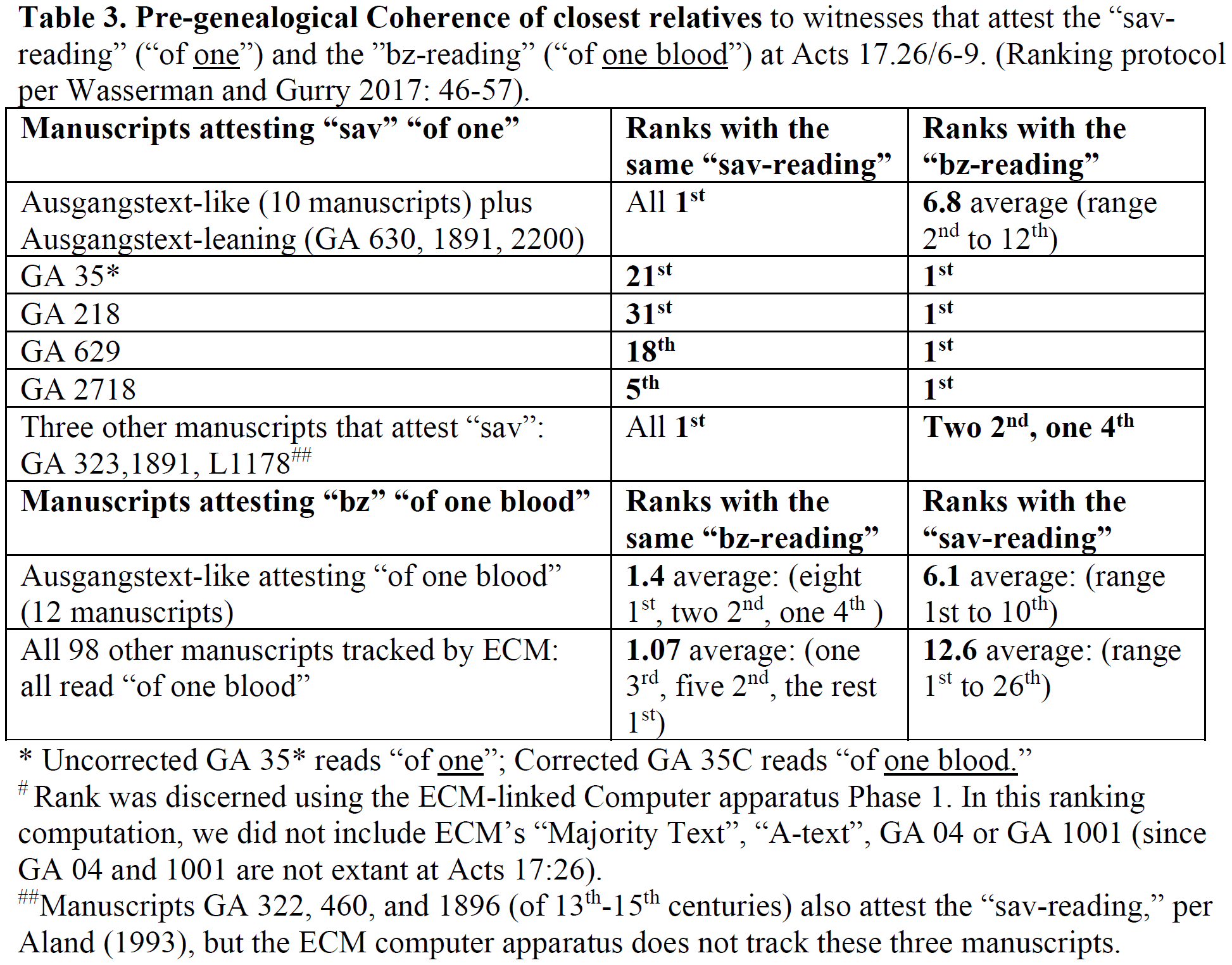
Uncorrected GA 35* reads “of
Rank was discerned using the ECM-linked Computer apparatus Phase 1. In this ranking computation, we did not include ECM’s “Majority Text”, “A-text”, GA 04 or GA 1001 (since GA 04 and 1001 are not extant at Acts 17:26).
Manuscripts GA 322, 460, and 1896 (of 13th-15th centuries) also attest the “sav-reading,” per Aland (1993), but the ECM computer apparatus does not track these three manuscripts.
Conclusion
In conclusion, among 7,600 Acts passages, ECM tabulates 771 Byzantine-identifying passages. Among these, we documented 494 clearly distinct Byzantine B-D passages where ALL the extant SAVPP manuscripts (Sinaiticus, Alexandrinus, Vaticanus, Papyrus P45, and Papyrus P74) read one way, whereas the Byzantine manuscripts read a different way. Among these 494 B-D passages, there are only 25 passages where both an overwhelmingly high number of Greek manuscripts, other language manuscripts, and patristic quotations attest to the Byzantine “bz-reading,” while simultaneously a very low number of manuscripts and patristic quotations attest the Sinaiticus-Alexandrinus-Vaticanus-P45-P74 “sav-reading.” Most prominent among these is the Acts 17:26/6-9 “of
The “of
While appraising the full array of these variant readings at multiple passages, we are struck by how minor and trivial many of these variations are. Most of these do not significantly affect the
We note that Acts 17:26/6-9 represents one of those few passages where its