




Abstract
Among handwritten manuscripts, Acts 17:26 most commonly reads “God made of one blood every ethnicity of humans…” Another reading here is “God made of one every ethnicity of humans…” This Part B paper documents that the “of one blood” reading appears very early and extensively across multiple language manuscript and patristic quotations—more so than for any other distinctly Byzantine reading of an Acts passage. We document a significant number of “Byzantine” readings that were already attested in Acts patristic quotations and ancient languages of the 2nd-5th centuries. We also show that singular reading omissions considerably outweigh additions in Sinaiticus, Alexandrinus, Vaticanus, and P74. This finding leads us to wonder whether “blood” was similarly an omitted word in these four manuscripts. Importantly, no first millennium manuscripts read “from one man” here, and this emendation has only become commonplace in English Bible translations since the 1960’s. A Part A companion paper (Cannon 2024) focuses on Greek manuscripts at these Acts passages.
When two or more variants appear in ancient manuscripts, Biblical scholarship aims to discern which reading of a Biblical text is more likely to have been the earliest recoverable reading. Discernment beckons such endeavors when appraising Acts 17:26, where the overwhelming number of handwritten manuscripts attest “God made of
For several recent centuries, biblical scholars have preferred a few Greek manuscripts over others when deciding which reading should be construed as “initial text.” In Acts, the preferred Greek manuscripts include
The use of patristic quotations and ancient languages in textual scholarship can be complicated by issues regarding language translation grammar, by melding quotes with discourse, and by transcription discipline issues (Warren, Strutwolf). Nonetheless, scholars are finding important key word “roots” of what became the Byzantine text-form in 2nd-5th century patristic quotations and ancient language Bible manuscripts (Gurry 2019, 2018, 2017, Wasserman and Gurry 2017, Wachtel 2017, 2017a).
The readings of both the Byzantine text and SAVPP manuscripts have been well-characterized by ECM III (2017). Thus, herein, we have been able to juxtapose the Byzantine and SAVPP text-forms as benchmarks by which to compare the readings attested in numerous other manuscripts and patristic writings.
Sinaiticus, Vaticanus, and Alexandrinus of the 4th and 5th centuries are perhaps the earliest complete extant Acts manuscripts in Greek. These three are generally consistent with one another. But then scholars ask: have these three manuscripts been consistent in attesting the “original” Acts text? Or, rather, have they consistently attested a text that had already slightly morphed from the “original” during the 2-4 centuries of intervening years since Luke penned Acts? How could we distinguish this now, two millennia later?
The aim of this Part B paper has been to appraise the 2nd to 5th century attestations of patristic quotations and ancient languages at a carefully selected group of Acts passages. We have focused our analysis on passages where ALL the extant SAVPP manuscripts attest one reading, whereas the Byzantine manuscripts attest a clearly distinct reading. Then, a Part A companion paper (Cannon 2024) addresses Greek manuscript readings at these same select passages.
Through this analysis of select passages, we found individual readings attested in the 2nd to 5th centuries that subsequently became adopted by the Byzantine manuscripts. This means that these Byzantine readings were concurrent with Sinaiticus, Alexandrinus and Vaticanus—and even preceding them (Gurry 2019, 2018, 2017, Wasserman and Gurry, Wachtel 2017, 2017a). These individual readings have been called the “roots” of the Byzantine tradition.
These early attestations have become particularly highlighted by analyzing the Biblical quotations of such patristic witnesses as Irenaeus, Augustine, and Chrysostom. Also, they are discerned by comparing the texts of other ancient-language manuscripts, including the Syriac dialects and the Armenian Bible. Recent scholars are realizing that the patristic authors and scribes of these ancient languages seem to have derived their sources from a transmission line of text that preceded the 4th and 5th centuries although that line has not remained extant. These centuries were long before the Byzantine text-form as a whole had become well-entrenched in the 9th century (Barbara Aland 1986, Wachtel 1995a).
Two early manuscript readings of Acts 17:26
In Acts 17:26, the attestation, “of
In the preceding paragraph, most citations are to ECM III.1.2: 657 and Aland TuT (1993: 558-9). Citations are also to Strutwolf (2017) and Kiel (54) for Irenaeus, Clark (112) for Augustine and Ephraem, Stevens et al. (“Oxford”: 435) for Chrysostom, Jennings and Gantillon (56) for Syriac, Staal (43) for Arabic, Ruis-Camps and Read-Heimerdinger (334) for Bede, and Uni-Mainz (2023) for Latin manuscripts. Greek manuscript dates throughout this paper are per ECM III.2: 5-6.
Another manuscript attestation of Acts 17:26 reads, “He made of
Approach and Overview for Appraising Acts Passages
In Acts, the NA28 (Nestle et al. 2012) and UBS (Aland et al. 2019) “adopted” text has heavily favored the SAVPP manuscripts. They have also favored several other Greek manuscripts that were written in the 9th-11th centuries. In contrast, Robinson and Pierpont (2005) advocated the Byzantine text-form as the “original” text. For Acts, ECM III presented their Ausgangstext (German for “initial text”) as mostly consistent with NA28, except at 155 passages, where they came to a “Split Decision”, and at another 52 passages where they identified a Guiding Line Change (refer to the Part A paper of Cannon 2024).
ECM III divided the Acts text into about
In order to appraise these attestations, we have compiled hundreds of pages of excel tables that are available to the reader through correspondence with the author (Cannon Tables 2023). For each B-D passage, we tabulated the extent of attestation for the Byzantine “bz-reading” versus the SAVPP “sav-reading” among ancient languages, and patristic writings (discussed in this Part B paper), and among Greek manuscripts (discussed in the Part A paper of Cannon 2024).
Importantly, we emphasize that our aim here has not been to favor or endorse the Byzantine text as a whole over the SAVPP manuscripts. Rather, we sought to find those individual “bz-readings” that had been attested very early by a multitude of manuscripts and patristic quotations. Our analysis revealed that among these B-D passages, BOTH the Byzantine tradition AND the Sinaiticus-Alexandrinus-Vaticanus tradition exhibited significant roots in 2nd-5th century manuscripts and quotations, rather than just the SAVPP tradition.
Attestation and Support for Byzantine versus SAVPP Readings at B-D Passages
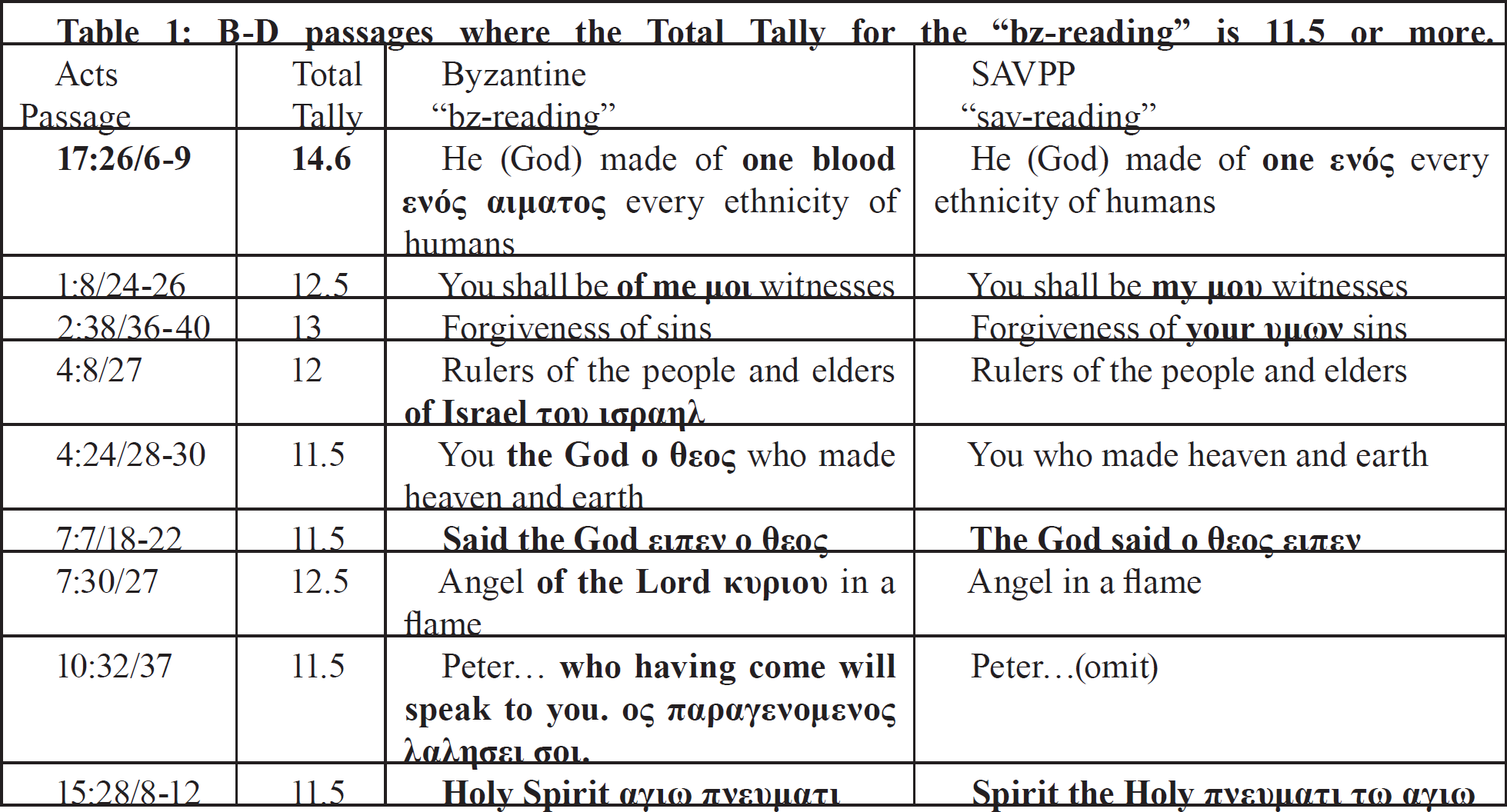
With the ECM database, computer apparatus, and other sources, we quantitatively juxtaposed the SAVPP readings versus the Byzantine readings among the Greek manuscripts, ancient languages, and patristic quotations. In our Part A companion paper (Cannon 2024), we introduced a protocol for tallying the Attestation, Support, and Connectivity regarding the B-D passages. Per that protocol, those B-D passages with Tallies of 11.5 or higher are presented here in Table 1. This table also identifies the wording of the “bz-reading” and the “sav-reading” at these passages.
B-D passages where the Total Tally for the “bz-reading” is 11.5 or more.
Patristic Quotations of Acts
ECM chronicles the quotations of numerous patristic witnesses for many Acts passages. We have particularly focused on several patristic witnesses that lived very early on, quoted numerous Acts passages, and thus bestowed a rather extensively representative quotation dataset for our appraisal. These include Irenaeus, Chrysostom, Augustine, Theodoretus, and Origen. Whereas Origen offers no extant quote at Acts 17:26, these other four all quote “of
We cannot know whether a given patristic witness quoted Bible passages from their memory or while directly reading the passage. Nonetheless, our key objective here is to focus on the significant words that emphasize the main point of the passages (Tuckett 2003, 2012, Büsch (190), Houghton 2010, Strutwolf (173), and Epp 2013). The patristic witnesses could surely have quoted the main points properly from either memory or direct reading. At Acts 17:26/6-9, haimatos-blood represents just such a significant main-point word.
Irenaeus
Of the roughly 600 Acts passages that Irenaeus quotes,
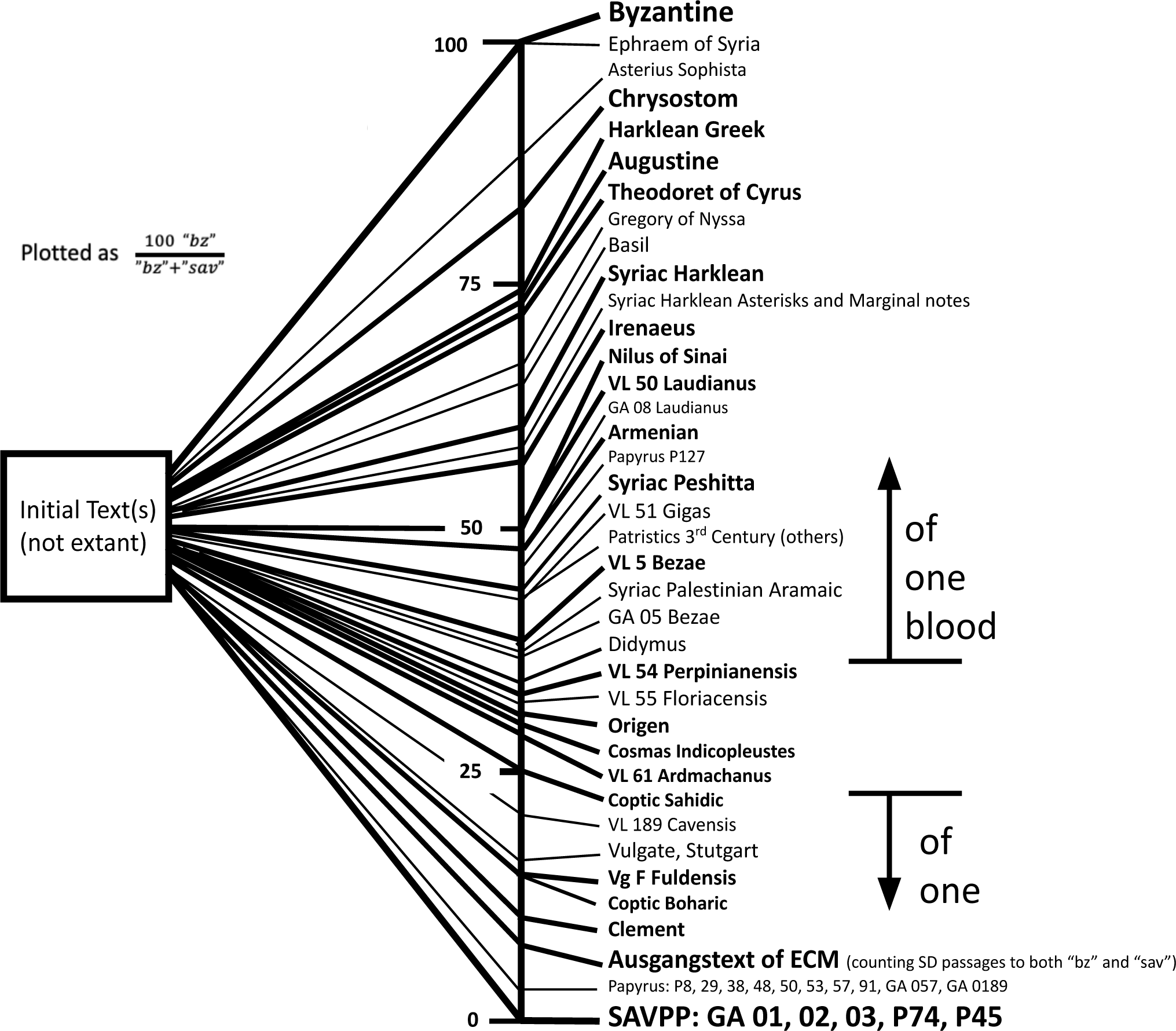
Concurrent Flow Diagram for early manuscripts and patristic witnesses, using Byzantine and SAVPP (GA 01, 02, 03, P74, P45) as benchmarks.
Barbara Aland perceived that Irenaeus was “among the most important witnesses, above all” (Aland 1986: 44). Strutwolf (181) recognized that “Irenaeus is a witness of an early text, which is still very close to the original text…Irenaeus can be [recognized] not as a witness to the early existence of any type of text, but rather as a representative of an early line of transmission of the Greek text.”
Per Harvey, the Irenaeus rendering of Acts reveals such similarities to the extant Syriac texts that Irenaeus must have accessed an earlier Syriac text (now lost). Indeed, there are 18 passages where ECM chronicles attestations by both Irenaeus and a Syriac manuscript. Among these 18 passages, Irenaeus agrees with a Syriac manuscript in 83% of these passages. Moreover, this agreement is to the “bz-reading” in 73% of the agreeing cases. Notably, the Acts 17:26 “of
Chrysostom
Chrysostom quotes almost all of Acts in his Homilies (400-401 CE), and other works (Büsch: 204-220, Stevens et al., Fee, Boismard, Gignac). Specifically, Chrysostom quotes
Augustine
Augustine quotations have been logged for several hundred Acts passages (Clark, Gäbel 2017, ECM III.1.1 and 1.2). Among these, Augustine quotes
Origen
Origen (175-250 CE) quotes
Theodoretus
Theodoretus of Cyrus (393-466 CE) quotes
Other Patristic Witnesses of the 2nd-4th Centuries
In Figure 1, we have plotted the “bz” over “sav” attestations for these and other ECM-tracked patristic witnesses from the 2nd - 4th centuries. As shown, the patristics’ attestations of “bz” over “sav” span a broad range—from
Latin Manuscripts of Acts
The Universität Mainz Vetus Latin edition of Acts hosts a website (Uni-Mainz, accessed 2023) that identifies the variant readings of about 90 Latin manuscripts. Herein, we have tracked 21 of these earlier Latin manuscripts regarding whether they attest the “bz-reading,” “sav-reading” or another reading. Among the 494 B-D, there are about 300 passages where Mainz has chronicled the readings of numerous Latin manuscripts.
In Acts, Houghton (2016: 233, 237) characterized Latin manuscripts VL 50, 51, and 61 as transmitting fully “Old Latin” readings. At Acts 17:26, these three read “of one sanguine-blood,” as does VL 05 Bezae. Then the “Latin Vulgate” manuscripts read “of
The manuscripts VL 5, 50, 51, and 61 attest the “bz-reading” over the “sav-reading” at 29-50% of these Latin B-D passages (Cannon Tables 2023). Then, the Stuttgart Vulgate and Fuldensis (546 CE) attests “bz” over “sav” at 15-16% of these cases. The other tracked Latin manuscripts attest “bz” over “sav” at 21-33% of these cases. Thus, the roots of both the Byzantine and SAVPP traditions can be found in all these analyzed Latin manuscripts, especially in the Old Latin and Bezae.
Augustine respected the translation accuracy of what he called Itala manuscripts. Houghton (2016: 15) recognizes the Itala to be linked particularly to VL 51 (which attests “bz” over “sav” at 43% of the cases). Also, Gäbel (2017) recognized Augustine quotations patterned after VL 55 (which attests “bz” over “sav” at 32% of the cases). These observations, taken together, document that some individual “bz-readings” that became adapted into the Byzantine tradition were already being attested in Augustine’s quotations and these Old Latin manuscripts.
Syriac Translation by Thomas of Harkel
In 616 CE, Thomas Harkel completed a literal word-for-word Greek-to-Syriac New Testament translation (Juckel 2017, 2011; Aland 1986). In the introduction to this Syriac Acts manuscript, Harkel explained that he used a “Greek copy that was very tested and reliable” (Zuntz 1945: 12-14, Juckel 2017, Gurry 2018: 188, B. Aland 1986: 58, Williams). This Harklean Syriac New Testament includes a main text and a Harklean apparatus. Its apparatus includes readings that Thomas of Harkel marked with an asterisk or placed in the margins of his text. Aland deduced that Harkel’s main text originated from his “reliable Greek text,” whereas the “Harklean apparatus” readings came from the Philoxenian Syriac (508 CE—no longer extant), which in turn originated from a pre-Philoxenian “GA 614 text-type” (Aland 1986).
Intriguingly, when recent scholars translated Harkel’s Syriac New Testament word-for-word back into Koine Greek, the product exhibited very close correspondence to a cluster of Greek manuscripts that were labeled as “Harklean Greek” (Aland 1986, Zuntz 1945, Juckel 2017). These included GA 614, which was written in the 10th Century, although its scribe apparently witnessed a far earlier text-type.
Aland (1986) recognized that the Harklean main text is particularly similar to manuscripts GA 1505, 1611, 2138, and 2495. Per Juckel and Aland, this means that these four witnessed a text-type that must have been present before 616 CE, and probably in the 6th century.
Both Juckel and Aland perceived that when asterisks and marginal notes were absent, the Philoxenian Syriac and Harkel’s “reliable Greek manuscript” must have substantively agreed with one another. Among roughly 7,600 Acts passages, the ECM text chronicles about 300 passages (3.9%) where Syriac readings are identified with an asterisk or in a marginal note (Cannon Tables 2023). With such a low percentage of asterisk and marginal note distinctions, there must have been considerable agreement between the Philoxenian source and the “reliable Greek manuscript” that Aland links to GA 1505, 1611, 2138, and 2495.
Aland hypothesized that a “type GA 614” manuscript was the source text type for this Philoxenian Syriac. She surmised that this “type 614” predated Bezae (GA 05, 5th century), Papyrus P38 (4th century), the Harklean apparatus, and other early manuscripts. She specifically wrote, “Such a type of manuscript as that of 614 is also easy to imagine…roughly estimated in the 2nd century or beginning in the 3rd century” (Aland 1986: p. 27 par. 2 lines 7-10). Aland repeats this 614-type early-dating theme throughout her 1986 paper (on p. 33, 49, 50, 51, 53, 61, 62, 64, and 65). Siddiqui (2021) also promotes this premise.
Herein, by employing the ECM computer apparatus Phase 3, we observed high agreement (89.5 to 98.8 %) between GA 614 and seven other manuscripts, namely GA 1292, 1505, 1611, 1890, 2138, 2412, and 2495 (Cannon Tables 2023). Together, we identify these eight manuscripts as the “
Using the ECM III.1.1 and III.1.2 data base, we found about 250 B-D passages that hosted Harklean Syriac manuscript(s) readings. Among these, there are 131 attestations to the “bz”, 89 to the “sav”, and 30 to “other” (Cannon Tables 2023). This yields a
In 71 cases, ALL the eight Harklean Greek manuscripts agreed with ALL the extant Syriac manuscript readings (Cannon Tables 2023). Significantly, one of these passages with complete Syriac-Greek agreement is Acts 17:26, where the eight Harklean Greek manuscripts, the Syriac Harklean, and the Syriac Pishitta ALL read “of
Other Ancient Language Translations of Acts
The ECM (III.1.1 and 1.2) also identifies how Acts passages are translated into several other ancient languages. In 42% of chronicled B-D passages, as many or more ancient languages attest the “bz-reading” as do the “sav-reading” (Cannon Tables 2023). Numerous scholars deduce that the roots of these ancient language Bibles extend yet further back than the dates of their extant manuscripts (Strutwolf 2017, Gurry 2018). The Armenian Bible (411 CE), attests “bz” over “sav” in 48% of the cases (Figure 1). At Acts 17:26, “of
Concurrent Flow Model for Early Manuscripts, Ancient Languages, and Patristic Witnesses
From the above discussions and Figure 1, we glean that the ancient language manuscripts and patristic witnesses of the 4th century and earlier exhibited a broad span of attestation to either the “bz-readings” or “sav-readings” at these B-D passages. Indeed, the attestations of “bz” over “sav” range from 100% to 0%. This broad range is not what we would have expected if in fact the initial Acts text was tightly aligned with the SAVPP manuscripts. Rather, this broad range connotes that the initial text (or texts—now no longer extant) resided somewhere midway between the SAVPP and Byzantine benchmarks, relative to these B-D passages. Figure 1 data implies that a
A foundational underlying premise of 19th and 20th century textual scholarship had been that a text very close to that of Sinaiticus, Alexandrinus, Vaticanus, P74, and P45 was the “initial” text. For some scholars, then, the history of textual transmission effectively became the study of how other manuscripts diverged from those five manuscripts. However, the data of Figure 1 is not consistent with that premise. Notably, we see a shift even from the P45 text of the 3rd century to the Sinaiticus-Alexandrinus-Vaticanus manuscripts of the 4th and 5th centuries. Among all Byzantine-identifying passages where P45 is extant, 18% of these had shifted from the Byzantine reading (held by P45) to the reading shared by the Sinaiticus-Alexandrinus-Vaticanus manuscripts.
We notice another intriguing relationship when viewing Figure 1 trends: all manuscripts and patristic quotations that attest “bz” over “sav” in 37% or more of the B-D passages, also read “of
Textual Scholars’ Appraisals Regarding Acts 17:26
Regarding Acts 17:26, Bruce Metzger (1998: 404-5) offers the following scholarly analysis, as summarizing the United Bible Society Committee (UBS) perspective:
“The Western text, with the support of a wide range of early versions and patristic witnesses, adds haimatos-blood after henos-one… In support of the longer text is the paleographical consideration that haimatos-blood may have been accidentally omitted [in some early texts], because it ends in the same letters as the preceding henos-one. It is also possible, though perhaps not probable, that someone deliberately deleted the word, since such a person may have perceived that this contradicted the statement in Genesis that God made man from dust — not blood (Genesis 2:7). There was some force in the consideration that haimatos is not a very natural gloss on henos—for that one would have expected anthropou-man or something similar. On the other hand, a majority of the (UBS) Committee was impressed by the external evidence supporting the shorter text, and judged that haimatos was a typical expansion so characteristic of the Western reviser.”
In overview, the majority of this UBS Committee preferred the “of
Wachtel (2017a: 145-146) added further insight:
“The addition of haimatos-blood does not lead to a known common phrase; one would rather expect something like anthropou-man to complement the short reading “of henos-one.” Parablepsis [skipping a word] might be the cause for an accidental omission of haimatos after henos. Genealogical coherence, however, tips the scales in favor of henos as the initial text. The phrase henos haimatos is not a common one…Metzger sees henos haimatos clearly as a “Western” reading that “passed into the Textus Receptus.” This statement clearly depends on the text-type concept, of course. A text-type neutral description would just state that the mainstream variant henos haimatos has early support from Irenaeus and Bezae.”
We highlight the perspective of Metzger, Wachtel, and numerous others who note that “one would have expected ‘from one anthropou-man’ or something similar.” However, none of these scholars point to any handwritten Bible manuscripts that attest to a “from
Boismard and Lamouille (123) perceived that haimatos-blood was part of the original, but then was lost by an eye-skip. Preuschen (109) proposed that “haimatos-blood was the original, but haimatos was [subsequently] deleted to align the passage with a biblical doctrine of creation.” Pervo (435) notes that haima-blood can also be understood to mean “seed,” or “semen.” Thayer (15) indicates that haimatos-blood “serves to denote generation and origin—in John 1:13, and also in the Greek classics.”
Internal Evidence: Omitted and Added Words in the New Testament, particularly within the SAVPP manuscripts
In addition to the internal and external evidence considered above, textual scholars have advocated employing another form of internal evidence regarding transcriptional probabilities. This form addresses the question succinctly posed by Schrock: “What is the author likely to have written, and what are copyists likely to have made him seem to write?”
However, Barbara Aland cautions against an overly subjective appraisal regarding what an author two millennia ago is likely to have written. Indeed, she asks, “why wouldn’t Luke occasionally write in an un-Luke-like manner?” (Aland 1986: 8-9).
Metzger (1998: 12-14) employed several criteria for assessing internal evidence, which he identified as “transcriptional probabilities” regarding habits of the scribes. Among these criteria are: “In general, the shorter reading is to be preferred [as likely to be initial],” and “In general, the more difficult reading is to be preferred.”
Regarding these criteria, Aland (1986) warns against circular reasoning. For example, one might presume that because longer readings came later, then when a textual scholar observes a longer reading, it is therefore inherently later. Or since some people might expect the Bible to say that all humanity came from one man, then therefore Luke must have meant to say “from one man” in Acts 17:26, even though no first millennium manuscripts attest to such a reading.
But let us consider one of these internal criteria so as to discern whether the pattern is even manifested in Acts: does it stand the test of analysis to presume that “longer is later and shorter is closer to the initial text?” To appraise this notion, we have evaluated the singular readings found in Acts within the manuscripts Sinaiticus, Alexandrinus, Vaticanus, P45, and P74.
Genealogical Relationships of Codices Sinaiticus, Alexandrinus, Vaticanus, and Papyrus
Among textual scholars, conjecture continues to swirl regarding whether GA 01 and GA 03 influenced one another, and whether the five SAVPP manuscripts witnessed common exemplar(s). In a companion Part A paper (Cannon 2024), we employ ECM’s Coherence Based Genealogical Method (CBGM) Textual Flow Diagram. An underlying premise of this CBGM is that these manuscript text types did indeed influence one another and manifest a flow progression. Per this CBGM premise, it follows that if a word was omitted from an early exemplar, such an omission could be transmitted to other manuscripts of the Sinaiticus-Alexandrinus-Vaticanus tradition.
Analyzing Singular Readings as Clues Regarding Variant Origins
Several textual scholars have observed that the singular readings found in a manuscript offer clues regarding the transcription habits of that manuscript’s scribe (Jongkind, Head, Hernandez, Wilson). Singular readings are variant readings that only one manuscript attests to, while all other manuscripts attest to other reading(s). So a textual scholar can track how often a scribe omits or adds words among these singular readings. Then one can postulate that the scribe practiced similar tendencies throughout a manuscript in other passages. Only in these other passages, the changes did not remain “singular,” in that such a manuscript was subsequently used as an exemplar for other manuscripts, from whence the addition or omission was transmitted forward. This tendency parallels analogues in genetic heredity and mutations (Spencer et al. 2002).
Jongkind appraised Sinaiticus’ singular readings in 1 Chron. 9:27-19:17, Luke 1-12, and five of Paul’s books. Among these, Jongkind found 45 omitted words and 20 added words—an
Royse appraised the singular-readings in six 3rd century papyri (mostly of the Gospels), and found that among these, the scribes omitted words
Omissions and Additions in Acts: Sinaiticus, Alex-andrinus, Vaticanus, and Papyrus P74
In light of these published omit-to-add ratios, we employed ECM III.1.1 and 1.2 to appraise the singular readings throughout all of Acts for Sinaiticus, Alexandrinus, Vaticanus, and Papyrus P74. (We appraised ALL of Acts, not just the B-D passages) (results in Cannon Tables 2023). In Sinaiticus, the Acts Scribe omitted 91 words, while adding 33 words, representing a
With these omit-to-add ratios, we next aimed to compare the SAVPP manuscripts to the Byzantine manuscripts relative to the ratio of shorter-to-longer phrases specifically among Acts B-D passages. Thus, by using the ECM data set, we could freshly appraise a lingering notion of earlier scholars, who presumed that the Byzantine scribes routinely added words with the intention of clarifying and smoothing the New Testament text.
To characterize this, we first found about 120 salient B-D passages where the distinctions between the Byzantine versus SAVPP readings pertained to more than mere word-order, “small” words, or synonymous words. Among these 120 salient B-D passages, there were 67 passages where the SAVPP reading was shorter than the Byzantine reading, whereas there were 28 passages where the SAVPP reading was longer than the Byzantine. This represented a SAVPP-versus-Byzantine
Was the absence of haimatos from the SAVPP manuscripts an omission from an earlier exemplar?
In light of the above omit-to-add and shorter-to-longer ratios, we now consider an important question: Was the absence of haimatos-blood in the SAVPP manuscripts at Acts 17:26 an attested omission from an earlier exemplar? As shown above, for singular readings, the omit-to-add ratios ranged from
Given this SAVPP scribal tendency towards omitting words, could an early exemplar have omitted the initial word haimatos-blood, and then could other SAVPP-like manuscripts have copied this omission? But then could this haimatos-blood reading have non-the-less been present in yet other very early exemplar(s) that were faithfully attested by most all other subsequent Greek traditions and ancient languages—other than the SAVPP tradition? We recall that last century’s textual scholars often presumed that the Byzantine readings were longer because scribes added words so as to “smooth” the text. But this singular-reading analyses plants doubts in that premise—at least relative to early manuscripts and among these B-D passages. Per Eldon Epp, (2011:107) “the traditional textual scholarship ‘canon’ that the textual scholar should ‘prefer the shorter reading’ has received the most scrutiny in recent decades.”
Thus, we connote with greater likelihood than perhaps could have been realized before ECM’s computer apparatus of this decade, that an exemplar of Sinaiticus, Alexandrinus, Vaticanus, P45 and P74 could indeed have deleted haimatos at Acts 17:26 from an earlier manuscript. Then, this unwieldy deletion could have been carried forward into these five manuscripts plus several others of this tradition, despite most other manuscripts not adopting the deletion.
Nature of Singular Readings in Acts Sinaiticus, Alexandrinus, Vaticanus, P45 and P74
We shed further light on this question by considering the nature of the singular readings among the SAVPP manuscripts. Although many of the singular readings are trivial, there are several dozen where the omissions and additions cause noticeable change. For example, at Acts 24.23, Sinaiticus has Paul guarded by a chiliarch—a commander of 1000 Centurions, whereas all other manuscripts have Paul guarded by one hekatontorcheh-Centurion. Also in Acts 8.5, Sinaiticus refers to “Caesarea,” whereas all other manuscripts read “Samaria.” Wachtel (2015), Jongkind, and Skeat thus deduce that Sinaiticus may have been transcribed in Caesarea (now in Israel).
Moreover, in about two dozen cases, the singular-reading changes seem perhaps mindfully made. For example, at Acts 7:8, Sinaiticus has Isaac circumcised on the hebdomeh-seventh day, whereas all other Acts manuscripts and Gen 21:4 have him circumcised on the hogdoeh-eighth day. Then at Acts 1:25, Alexandrinus has Judas turning aside to go to his just place, whereas all other manuscripts have Judas going to his own place.
Specifically regarding the word haimatos-blood, we note that P74 singularly omits haima-blood in Acts 2:19. Then in Acts 5:28, Alexandrinus singularly repeats “to haima to haima-the blood the blood.”
Perhaps roughly a tenth of the above-cited salient SAVPP omissions could be attributed to skipping a similarly-ending word. However, few similarly-ending Acts couplets host as closely similar endings as do henos and haimatos. As an example of a similar ending causing a skipped word, at Acts 2:9, only Sinaiticus omits “and Elamitai-Elamites” from the reading “Parthoi-Parthians and Medoi-Medes and Elamitai-Elamites…”
In a couple dozen cases, a SAVPP manuscript singularly omitted a word that left the balance of the sentence to be unwieldy, lacking, or vague. For example, at Acts 14:19, all manuscripts except Sinaiticus narrate that “they dragged Paul outside the city,” whereas Sinaiticus reads “they dragged Paul the city.” Then, in Acts 7:15, all but one manuscript reads “Jacob went down into Egypt, and he died.” In contrast, Vaticanus offers the unwieldy “Jacob went down and he died.”
In this light, perhaps scholars could surmise that it was likewise an omission of haimatos-blood at Acts 17:26 that caused the unwieldy “sav” sentence structure: “And God made of one every ethnicity of humanity….”
No Early Manuscripts Read “From One Man ”
No first millennium manuscripts read “from
An Old Testament narrative that some Bible scholars point to is Genesis 1-4. Notably, per Brown et al. (BDB: 8), Koehler et al. (HALOT: 14), and Gesenius (13) “Genesis 1:26-30 refers to adam-humanity / mankind / men and women plural.” This can be a humanity of one blood-line that preceded Adam and Eve. Then Genesis 2-4 can refer to individuals named Adam and Eve, who came from within that already-existing blood-line. This one blood-line of humanity is consistent with recent paleo-genetic findings (Jobling et al.: 601-608), which trace surviving Homo sapiens to one shared genetic source.
Conclusion
In conclusion, among the B-D passages, quite a few individual “bz-readings” that ultimately became adopted into the Acts Byzantine tradition were already attested in very early manuscripts, and could be candidates as initial readings. Perhaps the “bz-readings” that appear in about 25-100 passages could be further evaluated as prospective initial text. These individual “bz-readings” can be found in manuscripts and quotations that were concurrent with the Sinaiticus-Alexandrinus-Vaticanus tradition or preceded it.
Among B-D passages, the patristic witnesses Irenaeus, Augustine, and Chrysostom attest the Byzantine readings more often than they attest the SAVPP readings. The Syriac Harklean and its apparatus attest to the “bz” over “sav” in 58-60% of the cases. The Armenian Bible uses the Byzantine reading just as often as it uses the Sinaiticus-Alexandrinus-Vaticanus.
As we aim to discern the initial Holy Scriptures, this gives fresh credence to the notion that these individual “bz-readings” should be carefully considered as contemporary with the Sinaiticus-Alexandrinus-Vaticanus manuscripts—or even preceding them. Per Figure 1, an initial text (or texts) that existed considerably before the 4th century (but are no longer extant) could have attested elements of BOTH the Byzantine and SAVPP traditions. In this light, the “bz-readings” offer potential sources of initial text in some individual key passages (Wasserman and Gurry 2017: 107).
The “of
Thus, per multiple considerations, it would seem appropriate that if any clearly distinct Byzantine reading warrants consideration as the initial text, then this Acts 17:26 reading “of