




Abstract

In the 1890s, there was an explosive growth of new surgical techniques. The recently founded Johns Hopkins School of Medicine in Baltimore had managed to attract some of the finest young surgical innovators of their generation—Halstead, Cushing, Kelly, and Crowe. Sadly, the state of medical illustration at the time was wholly inadequate to communicate their newfound knowledge. At just this moment, Max Brödel appeared on the scene to establish the bedrock of 20th century medical illustration.
Brödel was born in 1870 in Leipzig, Germany to a musical family. He was a piano prodigy, but as a young teenager, rejected his father’s plans for a concert career. He quit his college preparatory gymnasium and enrolled in art school at Die Königliche Kunstakademie und Kunstgewerkeschule zu Leipzig. There he excelled in 3-dimensional drawing and learned techniques with charcoal, watercolor, oils, etching, and lithography. His obvious artistic talent did not guarantee employment in a Germany filled with accomplished artists and few paying jobs. Fortunately for Brödel, Dr Carl Ludwig, Director of the Leipzig Institute of Physiology came to the school looking for a student to prepare anatomic and histologic drawings—a menial job for a fine artist. Max, desperate for money to pay for art school, accepted. Their close collaboration helped define Max’s future interactive approach to medical illustration. Brödel wrote (in German): I have marveled at the patience with which the great Ludwig explains the heart to me. I did not know then that the only way to plan a picture is to leave paper and pencil alone until the mind has grasped the meaning of the object. . . in medical drawing full comprehension must proceed execution.
1
The physiology institute attracted visiting scholars from around the world. During Brödel’s tenure, Ludwig receive 2 physicians from the United States, William Welch and Franklin Mall—the future Dean and Chair of Pathology at Johns Hopkins. Both were impressed by Brödel’s skills. In part to avoid the threat of army conscription, Max accepted Mall’s offer to come to Baltimore as an illustrator and teacher.
Brödel believed that artists must distinguish between copying an image and illustrating it. He spent countless hours studying cadaveric dissections and operations to master his craft. Brödel focused on portraying how light interacted with tissues and instruments. His imaginative use of pen and ink was sufficient to convey basic anatomic concepts (Figure 1). To portray the glistening highlights of wet, living tissue no existing medium would suffice. Brödel therefore created his own method. Using heavy, hand-stippled paper coated with a layer of white clay, he transferred carbon pencil drawings on tracing paper and applied ink, pencil strokes and carbon dust creating shadow and soft light (Figure 2). For glistening highlights, he scratched away the outer layers to reveal white clay beneath.
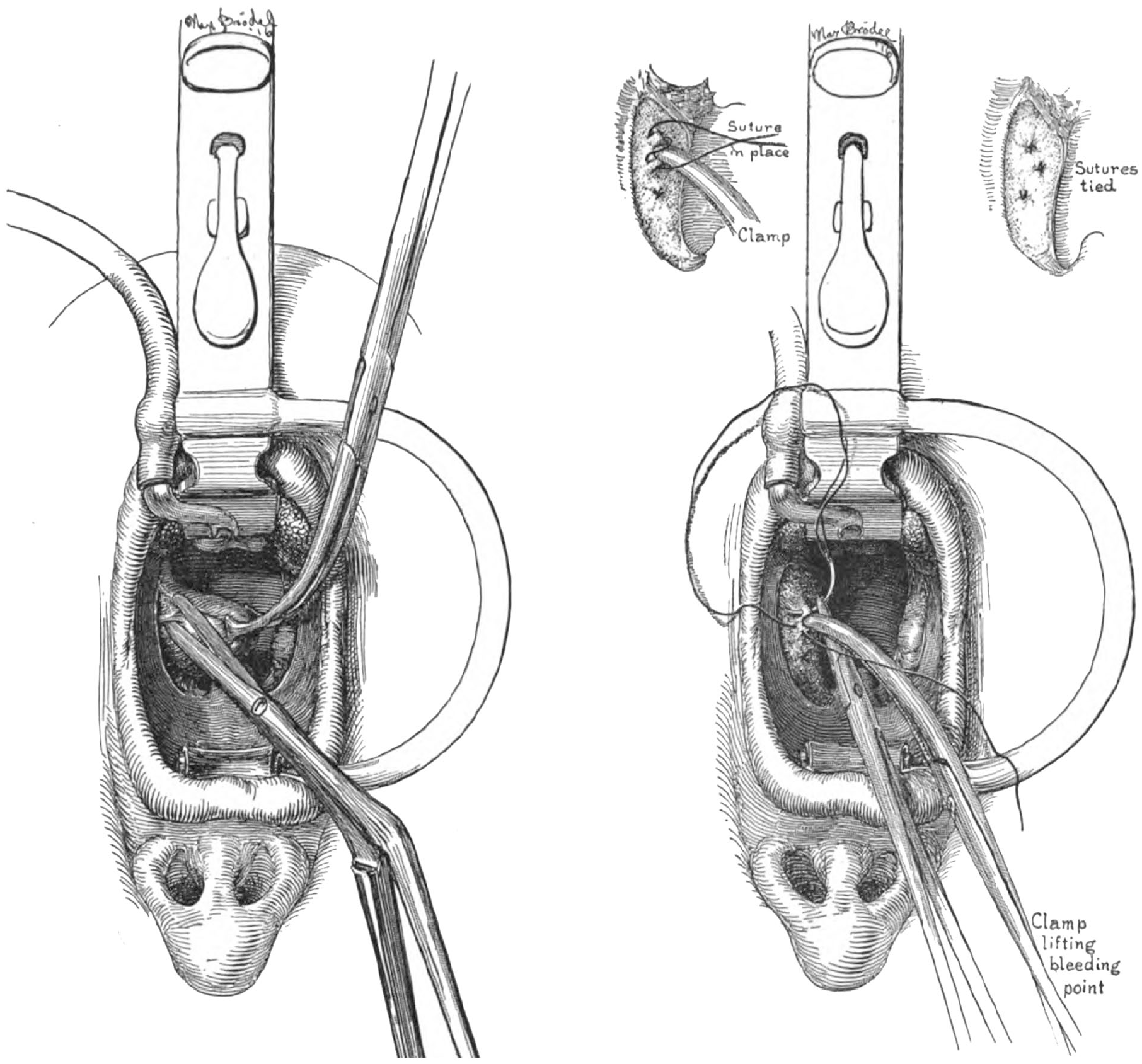
Pen and ink drawing of tonsillar dissection done in collaboration with Samuel Crowe MD. 2
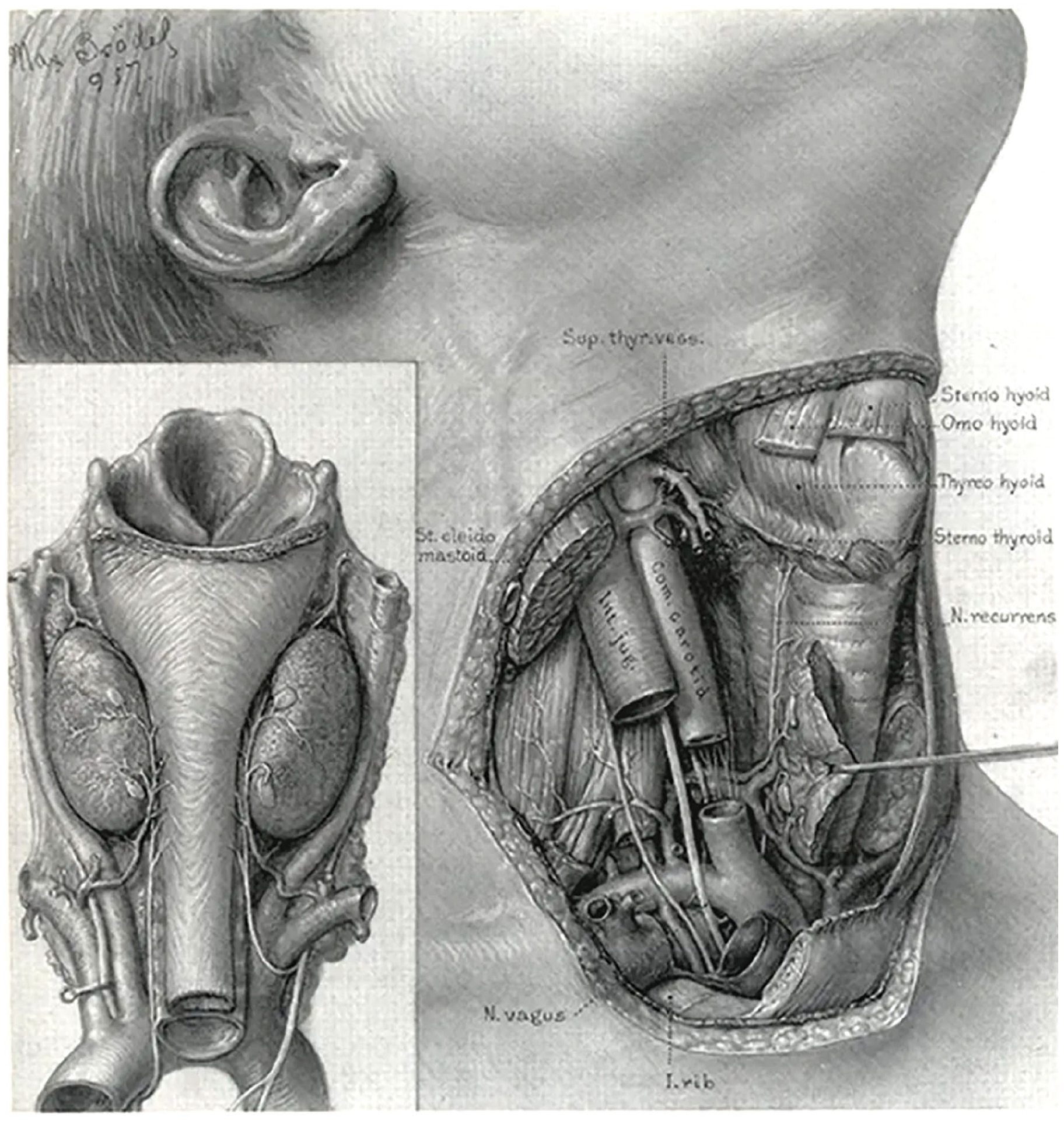
Carbon dust technique. Glistening highlights created by scraping away outer layers to reveal underlying white clay. 3
When the Mayo brothers tried to lure Brödel away, his colleagues found support from a local philanthropist to help him found the Department of Art as Applied to Medicine at Johns Hopkins. 4 Over 3 decades, Brödel trained more than 200 students. In addition to imparting the skill of “intimate observation” to his students, he emphasized a mastery of anatomy and had his students perform cadaveric dissections as he had.
During the later part of his career, Brödel began working closely with Samuel Crowe, the founder of the Division of Otology and Laryngology at Johns Hopkins.5,6 Crowe commissioned several drawings of head and neck anatomy. 7
Footnotes

Funding
The author(s) received no financial support for the research, authorship, and/or publication of this article.
Declaration of Conflicting Interests
The author(s) declared no potential conflicts of interest with respect to the research, authorship, and/or publication of this article.