




Abstract
Introduction
Septorhinoplasty, performed for functional and aesthetic purposes, is the fifth most preferred surgery in the world. 1 It accounts for 8.4% of all surgical procedures performed for aesthetic purposes. 2 Success is directly proportional to patient satisfaction with aesthetic operations. 3 Therefore, one of the essential ways to increase surgical success is to select the appropriate patient before the procedure. Determining which patient is suitable for septorhinoplasty depends on the surgeon’s experience. However, identifying a suitable candidate takes much work, especially with a clinical examination.
Previous studies have shown significant improvements in quality of life and psychological well-being after septorhinoplasty.4-8 However, it is known that postoperative dissatisfaction may be high in some patients. A review study examining the negative predictors of postoperative surgical outcomes revealed that male sex, young age, unrealistic expectations about surgical results, minimal deformities, and obsessive and narcissistic personality traits negatively affect surgical outcomes. 9 In addition, people with some psychopathological characteristics, such as alexithymic personality traits, body dysmorphic disorders, and low self-esteem, presented high negative feedback rates after the operation. Although studies have been conducted on appropriate patient selection methods, no standardized method exists.
Alexithymia is a multifaceted personality trait characterized by impaired recognition and expression of emotions.10,11 It is associated with many psychiatric illnesses.12,13 It has also been reported to be related to dermatological, 14 chronic pain, 15 and cardiovascular diseases. 16 However, few studies have investigated the effects of psychiatric scales applied to patients undergoing septorhinoplasty on treatment success.
Body dysmorphic disorder (BDD) is a psychiatric disorder characterized by excessive concern for a person’s physical appearance, especially mild or imaginary abnormalities of the body. 17 Even if there is a mild abnormality, the importance and degree that a person attributes to it are exaggerated. 18 In BDD, the level of delusion of one’s beliefs about one’s appearance is highly variable.18,19 These people often search for appearance-related treatment for their discomfort with their appearance. 20 However, these individuals express lower satisfaction with the surgical outcomes, leading to frequent subsequent surgical procedures. These individuals need to be recognized and receive treatment for their existing psychiatric illnesses. 21 The prevalence of BDD in patients presenting for cosmetic surgery is unknown, with a rate of 5% to 47% reported in studies. 19
Rhinoplasty Outcome Evaluation is an easy-to-use, highly sensitive, and specific questionnaire developed to evaluate septorhinoplasty surgery outcomes. It is used to assess patient satisfaction regarding aesthetics and functionality after septorhinoplasty.
As a result, the patient’s psychology is essential for surgical success. This study aimed to evaluate psychological conditions such as body image, alexithymic characteristics, and self-esteem in patients to determine whether these parameters affect surgical satisfaction and to advise surgeons about appropriate patient selection in the preoperative period. In addition, we examined the relationships between alexithymia, a multifaceted personality trait associated with various disorders, and several psychometric parameters.
Methods
Patients between the ages of 18 and 65 who applied and were scheduled to undergo septorhinoplasty at the Department of Ear, Nose, and Throat (ENT) at Bilecik Training and Research Hospital between March 2023 and March 2024 were included in the study. Patients were given the Rhinoplasty Outcome Evaluation (ROE) Questionnaire, Rosenberg Self-Esteem Scale (RSES), Toronto Alexithymia Scale (TAS), Temps-A Temperament Scale, and Body Perception Scale (BPS) before the operation, and RSES, BPS, and ROE at 3 months after the operation were given and asked to fill in.
ROE Questionnaire
The ROE scale was developed by Alsarraf et al. 22 It is an easy-to-use questionnaire that comprehensively assesses patient satisfaction with rhinoplasty. This study used the Turkish version of the ROE questionnaire, which has been tested for validity and reliability.
The ROE survey consists of 6 questions, each scored on a scale of 0 to 4. The total score, ranging from 0 to 24, is divided by 24 and multiplied by 100 to obtain a final score from 0 to 100. Higher scores indicate greater patient satisfaction with nose surgery.
Rosenberg Self-Esteem Scale
This self-report scale developed by Rosenberg in 1965 evaluates self-perception. The self-esteem scale consists of 63 items and 12 subcategories. There is also a 10-item short form of the RSES. The short form was used in the present study. Çuhandaroğlu carried out a Turkish validity and reliability study of the scale. 23 It is a 4-point Likert-type scale. The scores range from 10 to 40 (strongly agree 4, strongly disagree). Items 1, 2, 4, 6, and 7 of the scale are scored directly, and the reverse-scored items are 3, 5, 8, 9, and 10. Scores between 10 and 20 points indicate low self-esteem, between 20 and 30 points indicate medium self-esteem, and between 30 and 40 points indicate high self-esteem.
Body Perception Scale
The BPS, developed by Secord and Jourard 16 in 1953, aims to measure the degree to which people are satisfied with various body parts and their functions. Hovardaoğlu carried out a validity study of the scale in Turkey. 24 The scale has 40 items. The total score without a breakpoint ranges from 40 to 200. High scores indicate increased dissatisfaction with various body parts and functions.
20-Item Toronto Alexithymia Scale (TAS-20)
Bagby et al. developed the scale. 25 The Turkish version of the scale was validated, and its reliability was confirmed. 26 It is a 5-by-the-Likert-type scale (strongly disagree = 1; strongly agree = 5). As the scale score increases, alexithymic characteristics increase. Three subscales were defined: difficulty recognizing scale emotions, expressing (verbalizing) emotions, and extroverted thinking. Researchers who both developed the scale and conducted a Turkish validation study reported that a cutoff score of ≥51 is appropriate for the presence of alexithymia. 27
TEMPS-A (Temperament Evaluation of Memphis, Pisa, Paris, and San Diego Autoquestionnaire) Temperament Scale
The TEMPS-A, developed by Akiskal, 28 consists of 100 items to determine depressive, cyclothymic, hyperthymic, irritable, and anxious temperaments. A person answers yes or no, taking into account the whole life. Turkish validity and reliability studies were conducted. 29 Items 1 to 18 correspond to depressive temperament, items 19 to 37 correspond to cyclothymic temperament, items 38 to 57 correspond to hyperthymic temperament, items 58 to 75 correspond to irritable temperament, and items 76 to 99 correspond to anxious temperament.
Statistical Analysis
Frequency analysis was performed to obtain descriptive statistics. The Kolmogorov-Smirnov test was used to test whether the continuous numerical data were normally distributed. A chi-square test was performed for categorical variables. The paired-sample t-test for normally distributed data and the Wilcoxon Signed-Rank test for nonnormally distributed data were used to evaluate the preoperative and postoperative parameters. When 2 groups were formed according to the TAS cutoff score, the Student’s t-test for the normally distributed data and the Mann-Whitney U test for nonnormally distributed data were used. Pearson correlation analysis was performed to determine the correlation between the variables.
Results
Among 94 patients included in this study, 8 patients who did not complete a questionnaire during the postoperative period were excluded. A total of 86 patients were analyzed. Of those, 54 were female and 32 were male. The mean age was 24.0 ± 0.6 years. Thirty were married, 52 were single, and 4 were divorced. Of the patients, 16 were primary school graduates, 34 were high school graduates, and 36 were university graduates. While 38 patients had no active working life, 48 were actively working. While 4 patients had a previous diagnosis of psychiatric illness, 82 did not. The mean ROE score before the operation was 7.9 ± 0.4, the RSES was 32.6 ± 0.5, the BPS was 78.6 ± 2.5, the TAS total score was 49.2 ± 1.0, the TAS recognizing emotions subscale was 15.4 ± 0.5, the TAS expression emotions subscale was 12.4 ± 0.4, the TAS extroverted thinking subscale was 21.6 ± 0.6. Postoperative, 22 the ROE was 18.1 ± 0.4, RSES was 31.9 ± 0.5, and BPS was 80.3 ± 3.0. While there was no significant difference in terms of TAS and RSES scores in preoperative and postoperative periods, the total ROE score was significantly higher in the postoperative period (P < .001) (Table 1).
The Mean Scores of All Psychometric Parameters and Comparison of Preoperative and Postoperative ROE, RSES, and BPS Parameters.
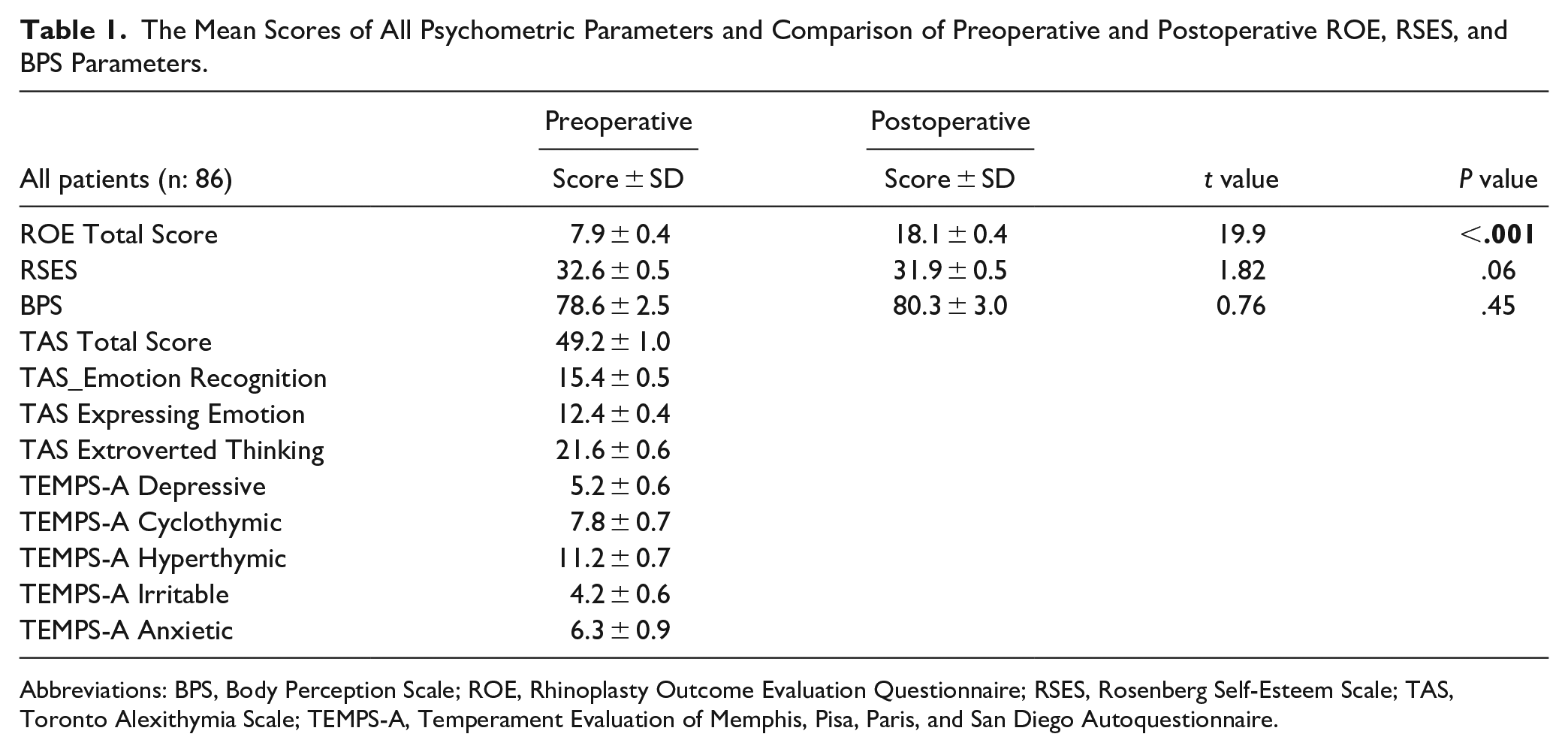
Abbreviations: BPS, Body Perception Scale; ROE, Rhinoplasty Outcome Evaluation Questionnaire; RSES, Rosenberg Self-Esteem Scale; TAS, Toronto Alexithymia Scale; TEMPS-A, Temperament Evaluation of Memphis, Pisa, Paris, and San Diego Autoquestionnaire.
Preoperative ROE scores were slightly correlated with preoperative RSES and hyperthymic temperament, moderately positively correlated with postoperative RSES, slightly negatively correlated with depressive, irritable, and anxious personality traits, TAS total score, TAS recognizing emotions and expressing emotions subscale scores, and postoperative BPS score. Postoperative ROE scores were moderately correlated with cyclothymic temperament traits, TAS emotion recognition and expressing emotion subscale scores, preoperative and postoperative BPS scores; slightly negatively correlated with depressive and anxious temperament traits and TAS total score; and slightly positively correlated with hyperthymic temperament and RSES postoperative scores (Table 2).
Correlations Between ROE Total Scores with Clinical Information and Psychological Parameters.
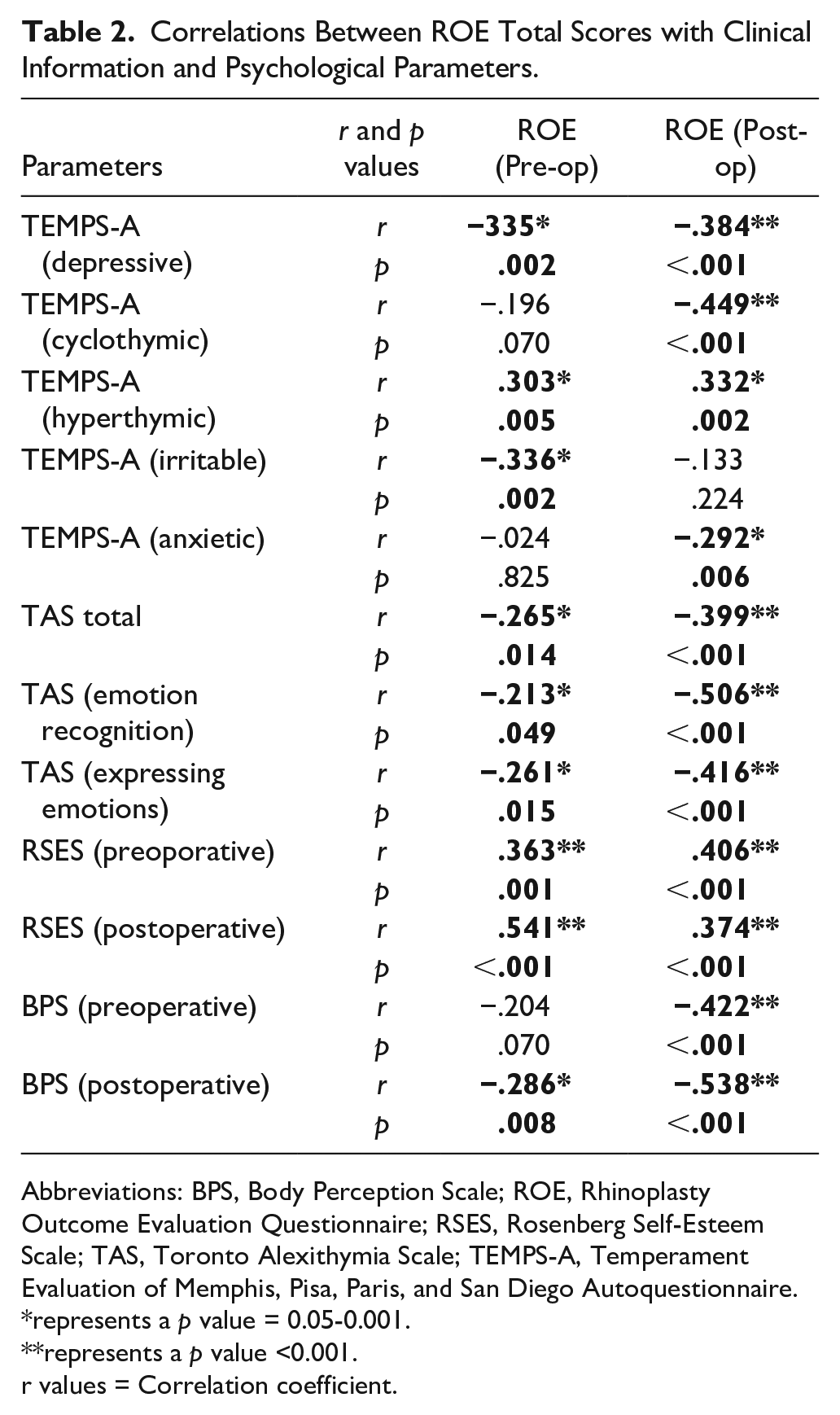
Abbreviations: BPS, Body Perception Scale; ROE, Rhinoplasty Outcome Evaluation Questionnaire; RSES, Rosenberg Self-Esteem Scale; TAS, Toronto Alexithymia Scale; TEMPS-A, Temperament Evaluation of Memphis, Pisa, Paris, and San Diego Autoquestionnaire.
represents a p value = 0.05-0.001.
represents a p value <0.001.
r values = Correlation coefficient.
When the cutoff score was accepted as 51 and above regarding alexithymic features, 30 patients were determined as alexithymia. When patients with and without alexithymia were compared, preoperative and postoperative ROE scores were significantly lower in patients with alexithymia than in those without alexithymia (P = .006; P < .001, respectively). Depressive, cyclothymic, irritable, and anxious personality traits and BPS total scores were higher in patients with alexithymia features. In contrast, postoperative RSES scores were lower in patients with alexithymia features than those without (Table 3).
Comparison of Sociodemographic and Psychometric Parameters in Groups With and Without Alexithymic Features.
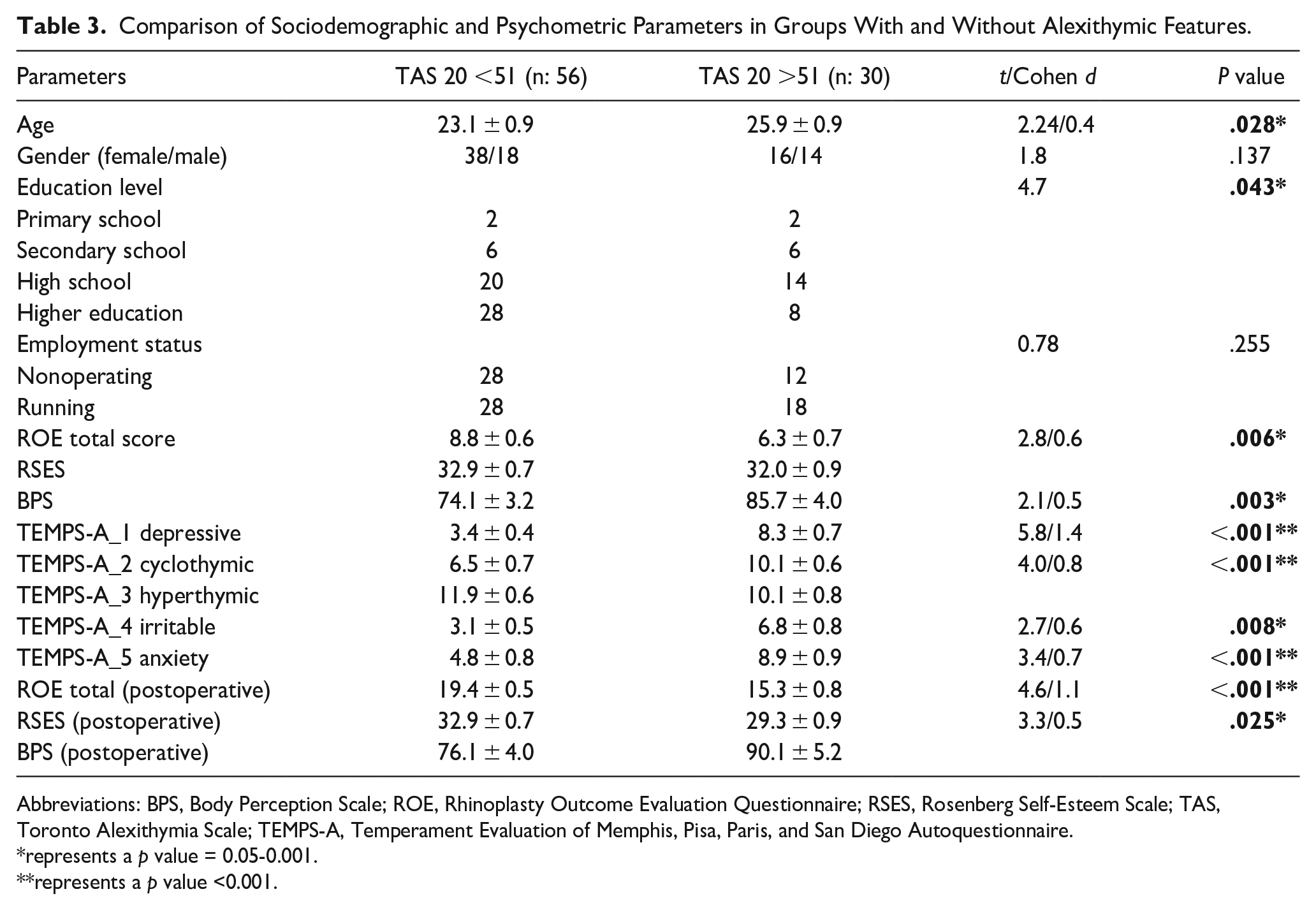
Abbreviations: BPS, Body Perception Scale; ROE, Rhinoplasty Outcome Evaluation Questionnaire; RSES, Rosenberg Self-Esteem Scale; TAS, Toronto Alexithymia Scale; TEMPS-A, Temperament Evaluation of Memphis, Pisa, Paris, and San Diego Autoquestionnaire.
represents a p value = 0.05-0.001.
represents a p value <0.001.
Discussion
Although agreement is reached with the patients in the preoperative interviews, the surgeon’s evaluation and patient satisfaction may differ in the long-term postoperative period. This may cause problems in patient satisfaction, which is perceived as surgical success in aesthetic surgeries. For this reason, surgeons tend to select patients suitable for surgery to maximize their chances of a successful outcome. Surgeons choose the appropriate patients based on their years of experience. However, there needs to be a standardized method in this regard. This study provides practical and essential information to help select preoperative patients. This study evaluated psychometric parameters such as personality traits, alexithymic traits, self-esteem, and body image in patients with septorhinoplasty. We examined their relationship with postoperative patient satisfaction. The number of studies evaluating alexithymia in septorhinoplasty patients is very limited in the literature. This is the first study to assess alexithymic and other personality traits in patients who underwent septorhinoplasty.
Medical, sociocultural, psychological, and environmental factors should be considered in patient selection for rhinoplasty. Kucur et al 8 suggested that performing the 36-item Short Form Health Survey questionnaire (SF-36) for the psychological evaluation of patients in the preoperative period is helpful. Borujeni et al. 23 suggested that aesthetic surgeries such as septorhinoplasty may result from a particular psychological status as aesthetic surgeries change people’s appearance, increase satisfaction, and increase self-confidence. 30 In a retrospective study conducted by Sarwer et al., 24 in which patients who underwent aesthetic and non-aesthetic surgery were retrospectively examined, it was reported that psychological disorders were observed at a high rate in those who underwent septorhinoplasty and other cosmetic surgeries and more psychiatric drug treatments were used. 31
Our study showed a significant increase in the total ROE score in the postoperative period compared to the preoperative period. There was no significant difference in RSES scores before and after the operation. Studies show that self-esteem32,33 and body perception34,35 increase after the operation in patients undergoing septorhinoplasty. On the contrary, there is also the view that aesthetic operations are not beneficial for mental health. 36 Dowling et al 30 reported that although the surgery reduced anxiety, depression, and body dysmorphic disorders in patients who underwent aesthetic surgery, it did not have a significant effect on self-esteem. Yu et al. showed that septorhinoplasty has little psychological impact on the patients. 37 Cook et al. 38 argued that there is insufficient evidence to demonstrate the effectiveness of cosmetic surgery on psychological components. In the present study, self-esteem did not increase during the postoperative period. This may be related to the short follow-up period and the fact that septorhinoplasty patients were not functionally or aesthetically separated.
In our study, it was observed that as alexithymic features and dissatisfaction with body image increased and self-esteem decreased, patients’ postoperative satisfaction decreased. Alexithymia is a multifaceted personality trait characterized by recognizing and expressing emotions (emotional component) and concrete, extroverted thinking (cognitive component). It can be found in many psychiatric disorders and personality traits. Many studies have argued that psychological factors affect septorhinoplasty patients.39-40 However, few studies evaluating alexithymic features in septorhinoplasty patients exist. In the study of Kütük et al., 26 a higher rate of alexithymia was seen in septorhinoplasty patients with cosmetic concerns. The researchers showed that functional and aesthetic results decreased as alexithymia scores increased. Therefore, they recommended examining alexithymia to evaluate psychological distress in patients with cosmetic concerns. 33 Our study divided 56 patients without alexithymic features and 30 patients with alexithymic features into 2 groups. Patients with alexithymia features had lower preoperative and postoperative ROE scores, higher body image dissatisfaction scores, and more depressive, cyclothymic, anxious, and irritable personality traits. In addition, Kütük et al 33 found a positive correlation between ROE and self-esteem. However, they reported that alexithymia was negatively correlated with ROE and self-esteem. Similarly, our study showed that the preoperative ROE score and preoperative and postoperative RSBE scores were lower in patients with alexithymic features than in those without.
BDD is considered a contraindication for septorhinoplasty surgery.3,41 Moosaie et al. 39 showed that patients with BDD were significantly less satisfied with the cosmetic results of septorhinoplasty. Similarly, our study observed that the ROE scores decreased as the BPS scores increased.
In cosmetic surgery patients, one of the essential psychogenic factors affecting postoperative satisfaction is the personality trait of the patient,42-44 in the study of Sharif et al., 43 in which 500 candidates who applied for septorhinoplasty surgery were evaluated with the temperament and character inventory (TCI), it was shown that TCI evaluation was instrumental in identifying and predicting good candidates for septorhinoplasty. Pecorari et al. 44 emphasized the importance of evaluating temperament characteristics in patients undergoing septorhinoplasty before the operation. In our study, satisfaction was negatively correlated with depressive, cyclothymic, and anxious personality traits, whereas there was a positive relationship between satisfaction and hyperthymic personality traits. Therefore, we showed that personality traits are essential in postoperative satisfaction with septorhinoplasty and should be considered in patient selection.
Our study has several limitations. One of these limitations is that the number of patients was small; thus, the results should be repeated in a larger sample. Second, the follow-up period was 3 months, which is relatively short; therefore, longitudinal studies are required. Third, alexithymia was evaluated only before the operation; there are findings in the literature showing that alexithymia changes after surgery, but it was only examined before the operation because it is considered a personality trait.
Conclusion
There is no standard method for selecting a good patient for a septorhinoplasty procedure. The importance of psychological evaluation during the preoperative period for septorhinoplasty patients is evident. Alexithymic traits and other psychological variables can produce a common judgment. Therefore, evaluating septorhinoplasty candidates in terms of alexithymic features as well as psychogenic parameters such as body perception disorders and self-esteem may guide surgeons in patient selection.
Footnotes
Acknowledgements
The authors acknowledged the patients who participated in this study.
Data Availability Statement
The datasets generated and analyzed during the current study are available from the corresponding author upon reasonable request.
Declaration of Conflicting Interests
The author(s) declared no potential conflicts of interest with respect to the research, authorship, and/or publication of this article.
Funding
The author(s) received no financial support for the research, authorship, and/or publication of this article.
Ethical Statement
The investigation was carried out in compliance with relevant laws and guidelines, following the moral standards of the Declaration of Helsinki. The study was approved by the Bilecik Seyh Edebali University Non-invasive Clinical Research Ethics Committee (approval number: E-10333602-050.04.01-155070 date: 10.02.2023).
Grant Number
No grant was obtained.
Informed Consent/Patient Consent
All patients gave written informed consent to be included in the study
Trial Registration Number/Date
Not applicable.
