




Abstract
Objective:
Despite increasing diversity in medical school entrants, disparities exist in academic leadership. This study sought to examine the proportion of women and visible minorities (VMs) among editorial board members (EBMs) of otolaryngology journals.
Methods:
Two reviewers collected journal, editorial board, and editor-in-chief characteristics using journal mastheads or official websites. Gender and VM representation on editorial boards and factors associated with increased representation were investigated.
Results:
Forty-one journals were explored, from January to April 2022. Of 2128 EBMs, 663 (31.3%) were VMs and 551 (25.9%) were women. Editor-in-chief roles were held by 12 (25%) VM individuals and 3 (6.2%) women. Gender differences in the distribution of editorial board positions were found (P < .001); women had higher representation as associate editors (24.5%, n = 551 vs 15.4, n = 1577%) and deputy/managing editors (2.2%, n = 551 vs 0.4%, n = 1577), while men were more represented as editor-in-chief (2.9%, n = 1577 vs 0.5%, n = 551). Similar VM representation existed between genders (31.0% male; 31.6% women) (P = .80). Journal impact factor quartile and gender were significantly correlated (P < .001); a higher proportion of women were represented in the first (27.0% vs 24.5%) and fourth (12.0% vs 4.9%) quartile. No significant factors were identified for higher women’s editorial board representation. Larger editorial board size (P = .002) and Asian/South American journals (P = .003 to P < .001) had significantly higher representation of VMs.
Conclusion:
Women and VMs are underrepresented in high-ranking editorial positions. Diversity in editorial boards is needed to ensure fair and balanced journal reviews and equity within otolaryngology.
Introduction
Equal gender representation remains a challenge among various organizations and industry, particularly in medicine. 1 Diversity within the general population is not reflected in the health care workforce within North America. 2 Statistics show that less than one-third of all full-time academic physicians are women, with only 4% belonging to underrepresented racial/ethnic groups. 3 When compared to their White or male counterparts, minority groups and women are less likely to be promoted, obtain fewer grants, and are compensated less. 4,5 These disparities become even more stark at the leadership level. 5 American data from 2010 demonstrated that women made up only 12.7% of practicing otolaryngologists. 6 From 2000 to 2019, female representation in otolaryngology-head and neck surgery (OHNS) increased in Canada; however, there was little change in the proportion of women in academic leadership positions. 7 In Canadian training programs, women comprised 3 of 14 OHNS program directors, none of the 13 chairpersons, and only 11% of all academic leaders. 8 Diversity in otolaryngology has been explored to a lesser extent outside of North America. In the United Kingdom, the proportion of women in otolaryngology is approaching equity at 48.2% of the workforce, according to a recent study. 9
For academic otolaryngologist-head and neck surgeons, the pursuit and publication of scholarly work is a key metric for advancement. 10 Leading faculty may be invited to join journal editorial boards, which are highly regarded in academic institutions, though the process is not transparent and may be subject to implicit bias. Multiple studies have illustrated the underrepresentation of women and ethnic groups in journal editorial boards across many fields in medicine and surgery. 11,12 Indeed, in a study evaluating gender parity in geriatric journals across the world, it was found that 36% of editorial board members (EBMs) and 32% of editors-in-chief were women. 13
OHNS EBM gender diversity has been examined in the past, with most recent data from 2017. 14 However, most previous work explores only the higher impact factor journals, and the distribution of visible minorities (VMs) in OHNS editorial boards has not previously been explored. The goal of this study was to examine the representation of women and VMs among EBMs of otolaryngology journals around the world, including all English-language indexed journals.
Materials and Methods
Data Collection
This study was exempt from institutional ethics board review, as it utilized publicly available data. 15 Participant consent was not required. A list of journals ranked by impact factor in OHNS was compiled using Journal Citation Reports (https://jcr.clarivate.com) in November 2021, and data was extracted from January 2022 to April 2022. Two independent reviewers (A.P. and P.S.) collected information about journal, EBMs, and editor-in-chief characteristics using journal mastheads and/or official websites. EBM information collected included name and editorial board position. Leadership positions such as editor-in-chief and associate or section editors were recorded. Section editor categories were separated by discipline as described on the masthead or journal websites (sleep medicine editor, radiology editor, rhinology editor, general otolaryngology, etc.). If section editors were titled as such without any subspecialty, they were called “not specified.” Those found only once or twice in the data set (ie, video editor, “how I do it” editor) were grouped as “other section editor.” Data were reported as a proportion of either the total number of editors in each category (combined) or as a proportion of the female or male editors in each category. EBMs that did not fit into one of these defined leadership categories were categorized as “Other.”
EBM gender and VM status were assigned based on Google™ searches for individual’s photographs and pronouns on official academic profiles. Statistics Canada’s definition of VM was used to characterize EBMs as “persons, other than Aboriginal peoples, who are non-Caucasian in race or non-white in colour” and within Canada, “consist mainly of the following groups: South Asian, Chinese, Black, Filipino, Arab, Latin American, Southeast Asian, West Asian, Korean and Japanese.” 16 Hispanic whites were also classified as VMs. Journal impact factor data from 2020 (most recently available at the time of search), continent, and country of origin were also collected.
Statistical Analysis
Descriptive statistics including frequency statistics and mean, standard deviation, medians, and interquartile range were undertaken for categorical and continuous data. Gender differences in EBM and editor-in-chief characteristics were evaluated via Pearson’s chi-squared statistics. Furthermore, the editorial board/editor-in-chief gender composition was categorized as either “female dominant” or “male dominant.” Editorial teams with ≥50% of women were considered female-dominant. If the number of male and women editors/editors-in-chief was equal, the journal was coded as female-dominant. Journals with a single editor-in-chief were classified according to the gender of this editor. Univariable logistic regression analyses were conducted to identify factors predictive of female editorial board dominance and female editor-in-chief dominance. Factors explored included quartile rank (first quartile describing those with the highest impact factor), impact factor, size of editorial board (median), and VM. Statistical significance was set a priori at P < .05.
Results
Forty-four OHNS journals were explored. Of these, 3 journals were excluded due to inaccessible online editorial board data, resulting in a total of 41 journals. A total of 2128 EBMs were identified among these journals. Positions included: 48 (2.3%) editor-in-chief, 18 (0.8%) deputy/managing editor, 378 (17.8%) associate editor, 137 (6.4%) section editor, 167 (7.8%) in other leadership positions, and 1547 (72.7%) as all other EBMs including general members of the editorial board without defined titles, and named or leadership roles not previously defined or separately analyzed. The complete list is provided in Table 1. Approximately 25% of included journals were attributed to each quartile (24.4% Q1; 26.9% Q2; 26.9% Q3; 22% Q4) where first quartile was comprised of the highest ranking journals and fourth quartile the lowest ranking journals by impact factor. Countries of origin included U.S., U.K., Netherlands, Germany, Ireland, South Korea, Switzerland, Belgium, Brazil, Canada, France, Italy, and Turkey. When comparing countries, most included journals were US-based (n = 18, 43.9%). Most journals were from North America (n = 19, 46.3%) or Europe (n = 18, 43.9%). The mean impact factor of all journals was 2.3 ± 1.1 (range: 0.01–6.22). The most common section editor category for EBMs was in otology/neurology (n = 35, 28.2%) and “section editor” without an additional/subspecialty title (not specified, n = 39.
All Other Editorial Members—Names Listed as Represented on Mastheads or Journal Websites.
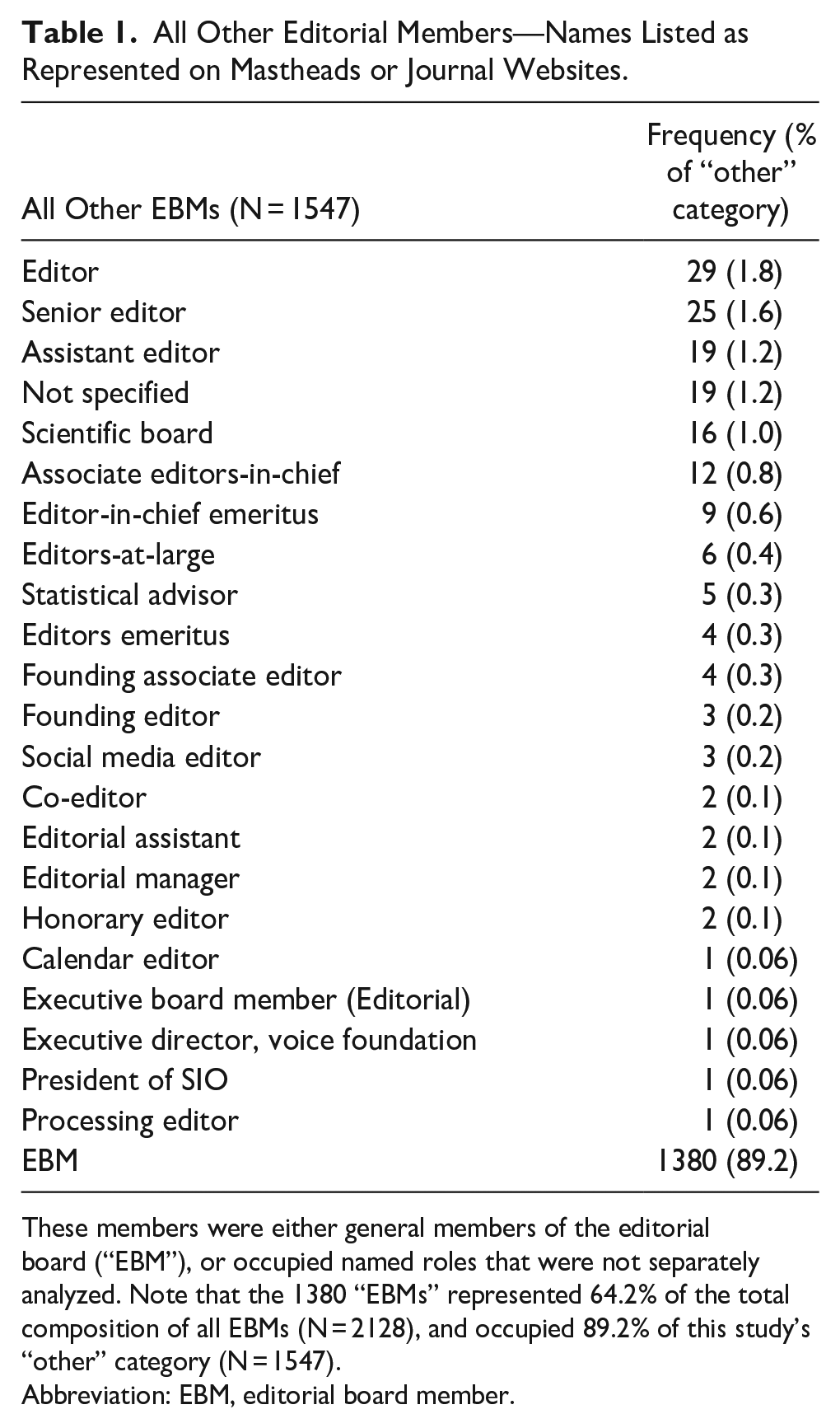
These members were either general members of the editorial board (“EBM”), or occupied named roles that were not separately analyzed. Note that the 1380 “EBMs” represented 64.2% of the total composition of all EBMs (N = 2128), and occupied 89.2% of this study’s “other” category (N = 1547).
Abbreviation: EBM, editorial board member.
Gender Data
Of all EBMs, 551 (25.9%) were women (P < .001) and only 3 of 48 (6.3%) editors-in-chief were women (P < .001). A gender difference in the composition of editorial board positions was found [χ2 (4) = 48.54, P < .00]. For deputy/managing editors and associate editors, there was greater female representation with 12 of 551 women (2.2%) compared to 6 of 1577 (0.4%) men and 135 of 551 (24.5%) women compared to 243 of 1577 (15.4%) men, respectively. The Other category, referring to all general EBMs not in a separately analyzed leadership role, had greater male representation with 1183 of 1577 (75%) men and 364 of 551 (66.1%) women. Section editors gender proportions were approximately equal, with 100 of 1577 (6.3%) males and 37 of 551 (6.7%) women. Gender distribution of EBMs is shown in Figure 1.
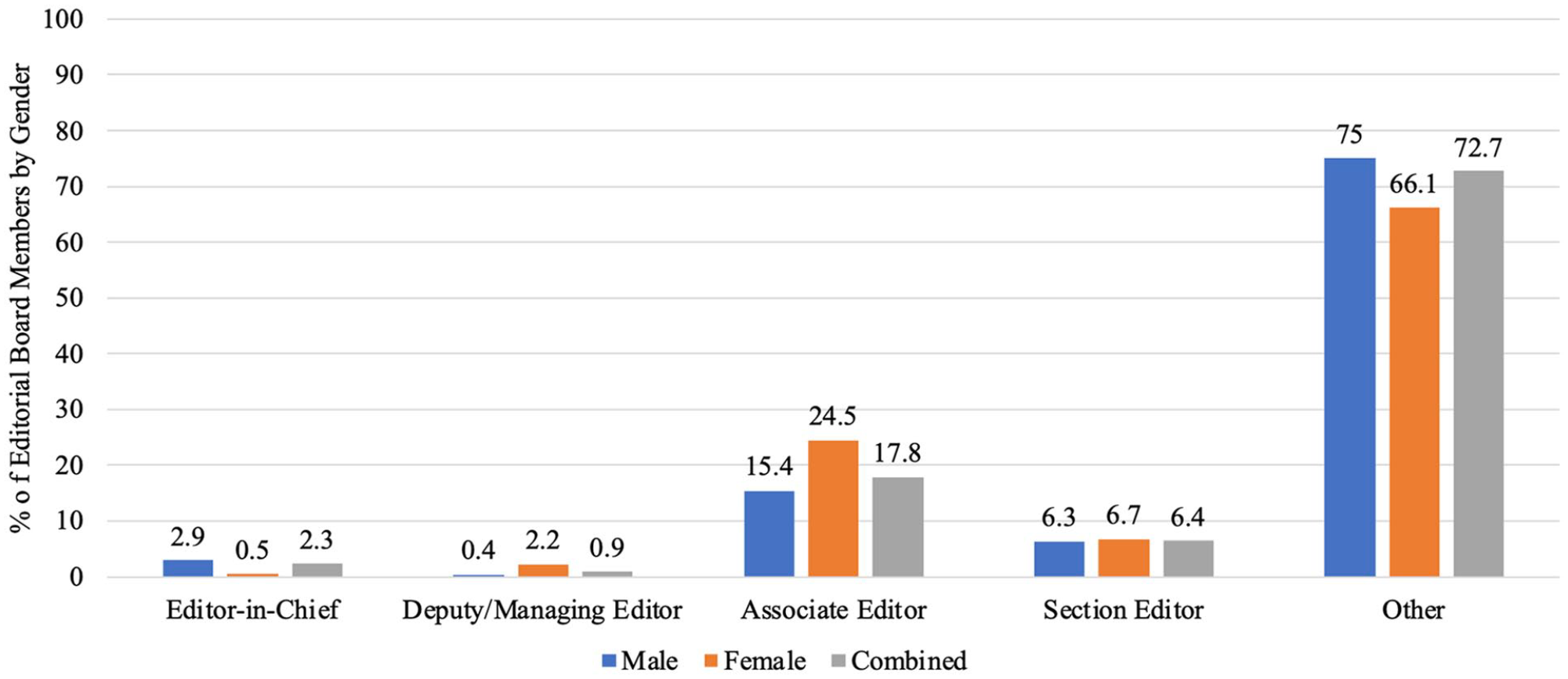
Editorial board positions. EBM, editorial board member.
Significant differences were found in gender distribution by journal quartiles [χ2 (3) = 37.38, P < .001. The first quartile and fourth quartile had greater female representation, with 149 of 551 female otolaryngologists (27%) in the first quartile and 66 of 551 (12%) in the fourth quartile. However, most EBMs of both genders were from journals in the third quartile (936, 44%). Significant gender differences were not found according to section editor category by subject area [χ2 (10) = 14.49, P = .15]. The distribution of section editors by discipline can be seen in Figure 2. Logistic regression analyses for female-dominant editorial boards and female-dominant editors-in-chief journals examining quartile ranks, impact factor, size of editorial boards, and proportion of VMs, found only nonsignificant associations (P > .05). Linear regression analyses for proportion of female editors also resulted in nonsignificant associations for quartile ranks, impact factor, size of editorial boards, proportion of VMs, and continent (P > .05).
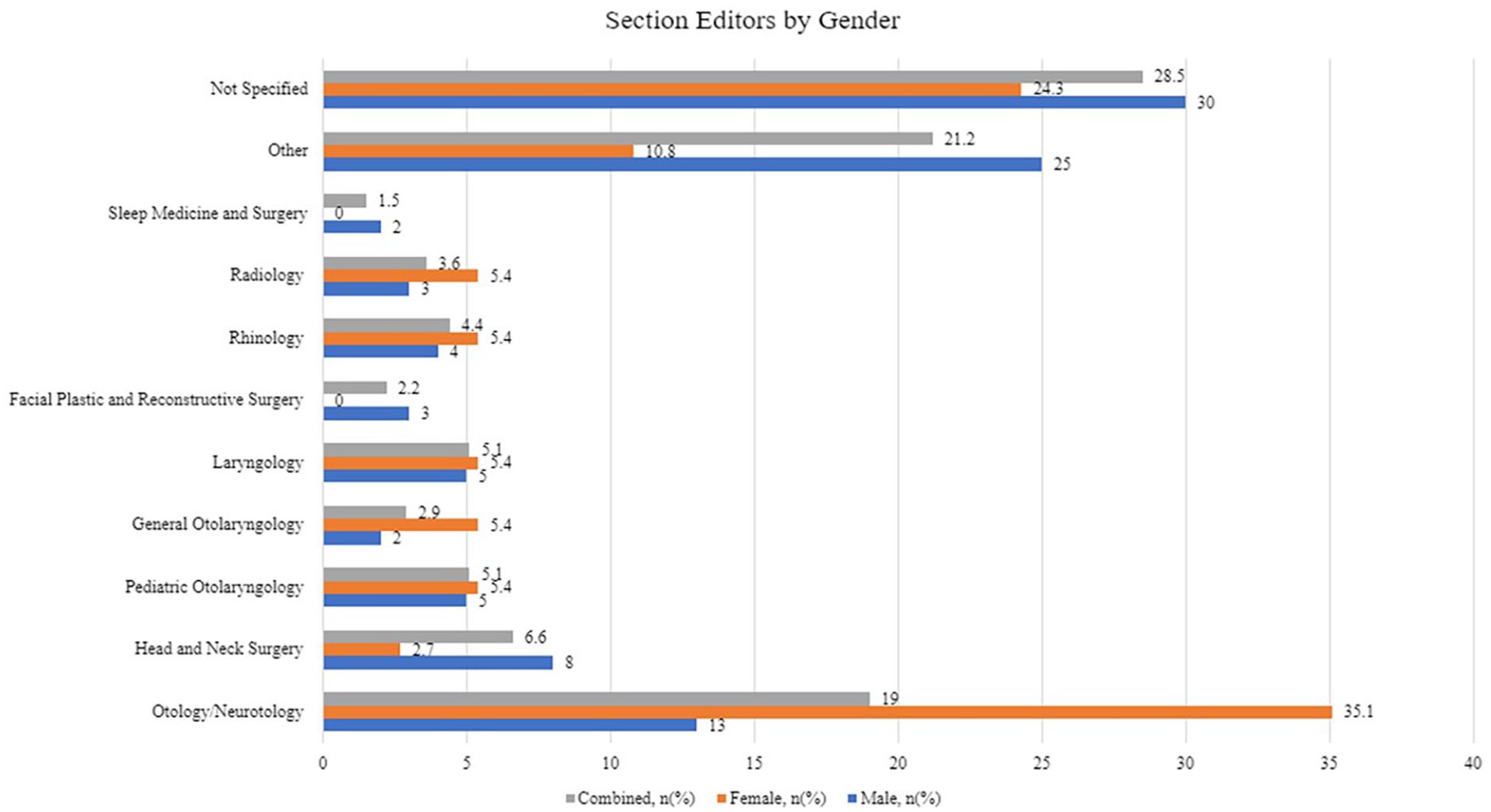
Gender differences of section editors by discipline.
VM Data
Of all EBMs, 663 (31.2%) were VMs and 12 (25.0%) of editors-in-chief were VMs (Figure 3). Significant differences between gender and VM status were not found [χ2 (1) = .07, P = .797] with 174 (27.0%) female VM editors and 489 (31.0%) male VM editors. Linear regression analyses demonstrated that a greater proportion of VM members were found in larger editorial boards (P = .002). Additionally, the linear regression model for VM EBMs from the 1 South American (P < .001) and 3 Asian (P = .003) journals showed a significantly higher VM representation compared to North American journals. There was no significant difference in the likelihood of an EBM being of VM status or a specific gender. No other significant associations were found between quartile rank, impact factor, female-dominant editorial board, or continents other than Asia and South America.
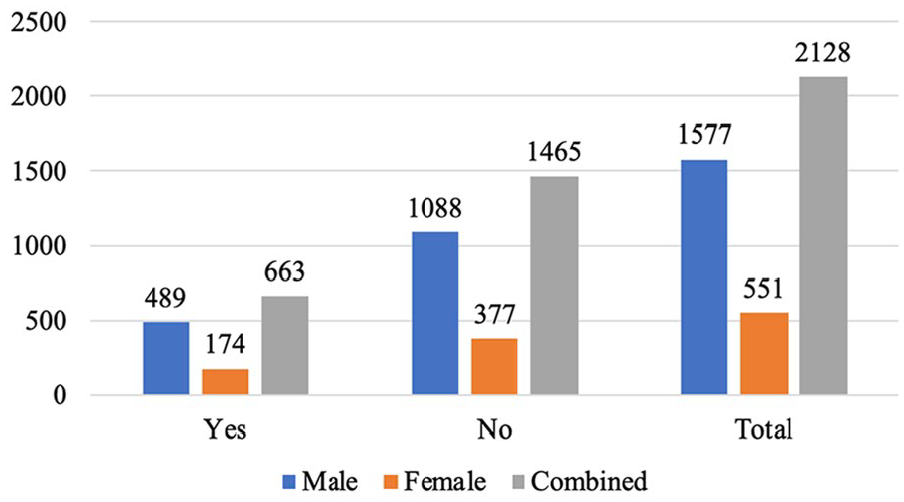
Visible minority editorial board members. EBM, editorial board member; VM, visible minority.
Discussion
North American studies have shown that women in otolaryngology are underrepresented in academic leadership positions including editorial boards. 8,14,17 Fewer opportunities for career advancement and higher gender discrimination are factors that are common among women in all surgical specialties. 7 Moreover, surgical specialties also have the greatest underrepresentation of VMs. With a lack of diversity in surgical editorial boards, our data shows similar findings of relatively low diversity across otolaryngology journals worldwide. Specifically, Our data showed there were almost 3 times fewer total women EBMs. The majority of the gender data illustrated a greater total number of men in the various editor roles, and a greater proportion of men compared to the proportion of women occupying prestigious leadership roles like editor-in-chief. However, we did find a greater proportion of female deputy/managing editors and associate editors compared to the proportion of men occupying these roles. The present study improves on existing literature by examining otolaryngology journals globally as opposed to a select few American journals. Additionally, this study includes VM data, which has not previously been examined in otolaryngology and most other specialties. Finally, the data provided in this study is the most up to date available in the current literature.
Previous studies have demonstrated that the field of otolaryngology lacks diversity, with women comprising 11% of practicing American otolaryngologists in 2021. 18 Choi & Miller found that despite low female membership in various otolaryngology societies and leadership positions, representation was proportionate when compared to the ratio of women in otolaryngology. 5 Litvack et al also found changes in representation of women in otolaryngology over time with an increase of 7.2% in editorial board membership from 1997 to 2017. 14 However, the authors found that the proportion of women EBMs across the 7 included journals was significantly less than the proportion of female academic otolaryngology faculty in the United States. 14 It was also found that the percentage of female associate and/or section editors was proportionate to that of female academic faculty, however there was ninefold variation between journals. 14 The present study delivers cross-sectional findings of editorial board data in 2020 that generally fit the trend reported in past studies. Our study found that 34.9% of total EBMs were women, which is greater than the cited 11% total practicing women otolaryngologists in the U.S. Nevertheless, in other ways the present study was in keeping with other findings, in particular that the total proportion of women in most editorial board leadership positions was less than 11%.
Insight into representation in otolaryngology as a specialty is difficult, given that most existing information originates from US statistics. The percentage of women in otolaryngology in the US varies according to different sources, but approaches 50% of the otolaryngology workforce in the United Kingdom. 9 The low proportion of women otolaryngologists in many populations is likely to a contributor to the seemingly unequal representation of women in editorial boards, but as proportions approach equality, so should the representation in the higher echelons of academia such as journal editorial board leaders.
The majority of editorial board data is based on U.S. statistics, however this study presents diversity data in the global otolaryngology community. There is no study to date that examines VM representation in editorial boards of otolaryngology journals. The findings of this investigation demonstrate that diversity in otolaryngology journals is a worldwide issue and the proportion of women with editorial board positions does not align with the percentage of practicing otolaryngologists, though again, estimates of workforce diversity vary and are lacking in many countries. Understanding the lack of diversity in otolaryngology emphasizes the need for improving representation in the academic community. Large gender disparities compared to the workforce exist in other surgical editorial boards in addition to other specialties such as emergency medicine and anesthesia. 19 Similar to studies in otolaryngology, a study examining plastic surgery journal editorial boards in the US found that women were proportionally represented in editorial boards when compared to the number of female plastic surgeons. 20
The value of diversity has been made paramount in fields both inside and outside of medicine. A global survey of corporate leadership across 21,980 firms from 91 countries found that the presence of women in leadership positions can improve firm performance. 21 A diverse editorial board membership reflects academic standing and leadership within a field and can promote balanced perspectives with more equity and fairness, a wider pool of peer-reviewers and encourage submission from researchers of diverse backgrounds. 22 A study among psychology PhD students found that under journals with all-white editorial boards, race scholars were less likely to believe that the journal valued racial diversity, their own research, race research, would publish their research, or be willing to submit to that journal. 23 It was also found that both race and nonrace scholars had more positive perceptions about journals with diverse editorial boards. 10 This study found that there was an approximately equal proportion of VMs across genders, with 30% VM EBMs. As VM data has not been analyzed previously, it is not possible to examine trends in VM representation over time. Of note, journals from countries with a VM predominance, such as in Asia, increases representation of VMs found within this study. Despite an international view, VM are greatly outnumbered. Thus, editorial board composition could impact the type and quality of studies that are submitted and published because a lack of diversity can signal to women and VMs that their perspectives are not welcome. Editorial board decision-making is associated with unreasonably high standards and decreased publication success for women authors. 24 Furthermore, as editorial boards regulate the conduct of research, editors play a role in improving representation of women in research studies which ultimately has implications for women’s health. 25
Some efforts have been made to improve diversity in EBM, although there is room for improvement. The Lancet announced the #LancetWomen project in December 2017 which was a successful initiative to achieve editorial board gender parity. 26 The Lancet serves as an example that explains findings of journals with higher impact factors exhibiting greater diversity. Other initiatives to diversify the medical profession include the Sullivan Commission at Duke University aimed at changing policies to increase diversity, however, no reports of its success have been made public. 27 Johns Hopkins also successfully launched a 10-year diversity program to improve female and VM representation in the Department of Otolaryngology. 27 Possible steps to reach equity include involvement of medical societies to outline plans to improve diversity, such as supporting women and VMs that have not yet been included on editorial boards to be offered these opportunities. 24 Journals should be transparent when publishing membership statistics and evaluate progress to achieve equity. In doing so, journals can be held more responsible for editorial board diversity efforts. 24 Mentorship and pipeline programs directed toward women and VMs in medical school can also serve as a method to increase representation, 27 and EBMs should also be educated on the impact of a lack of diversity, for example through the “Her Time is Now Report” which highlights the barriers to career advancement in medicine for women. 24
This study has limitations. A snapshot in time is presented, which precludes the examination of trends in editorial board composition over time. However, data from previous studies can be used as adjunct to our results. This study also relied on a binary definition of gender and does not account for individuals that identify elsewhere on the spectrum of gender identity. Additionally, gender and VM status were determined based on names and photos of EBM but may have been assigned incorrectly by reviewers. Lastly, only English-language indexed journals were included since English is the main language of academic medicine. This limitation may have impacted the results for VM. For example, if Spanish journals were included, more Hispanic VMs may have been included, or if French journals were included, more African VMs may have been included, where French is an official language due to colonization.
Conclusion
Women and VMs are underrepresented in high-ranking editorial positions globally, though the representation for women in otolaryngology on editorial boards may be approaching the proportion of practicing otolaryngologists in certain populations. Diversity in editorial boards is needed to ensure balanced journal reviews and equity within the specialty.
Footnotes
Data Accessibility Statement
The data herein is available for review upon reasonable request.
Declaration of Conflicting Interests
The author(s) declared no potential conflicts of interest with respect to the research, authorship, and/or publication of this article.
Funding
The author(s) disclosed receipt of the following financial support for the research, authorship, and/or publication of this article: This work was presented at the Canadian Society of Otolaryngology Annual Meeting, Vancouver, British Columbia, Canada, October 1, 2022.
