




Abstract
Objective
The success of note writing has been a topic of research dating back to the days of Plato. Students now have access to complete libraries of books and notes on computers, tablets, and even phones. Modern note-taking methods use premade handouts, “Chalk Talk” lectures with faculty, and prescribed note-taking strategies. Here, we discuss one such strategy, the Cornell Note system.
Methods
This is an updated review of the original Cornell Note system originally outlined in How to Study in College.
Results
A detailed outline of how to construct and use Cornell Note System and how to apply to medical training.
Conclusion
The outline and unique aspects of the Cornell Note system are discussed, along with how this system can be incorporated into the modern-day curriculum.
Introduction
Throughout history, people have strived to possess more knowledge than their prior generations. This continuous advancement of knowledge has led to novel techniques focused on memory and learning. Centuries ago, writing notes became the basis of learning, and that basis has continued to advance to this day. The process of note writing dates to the time of Plato, in his theory of Anamnesis in which he discusses the hypomnema, translated in English as “reminder, copy, or note.” 1 The question of whether note writing is effective has been researched numerous times over the past several decades, though the answer isn’t as simple as one might imagine. 2 In general, students who take notes do perform better on examinations than students who only listen. 2 However, the nearly universal indicator of success is whether those students review the notes they take. 2
Note writing has evolved dramatically since the days of Plato with technology continuously expanding at an unprecedented rate. Students now have access to books and notes on computers, tablets, and phones. Imagine Plato having access to every resource in the world in his hand, at a moment’s notice. The dramatic rise in the availability of literature has also allowed students to take their notes “on the go.” Nowhere is this more apparent than in medical education. A study published in 2019 involving medical students who were provided iPads for study use, showed that the two most common uses of these iPads were note taking and information seeking on the internet. 3
Approaches to note taking continuously evolve and as medical trainees seek to retain knowledge from lectures, textbooks premade handouts, “Chalk Talk” lectures with faculty, they turn to various prescribed note-taking strategies. Here, we discuss one such strategy, the Cornell Note System. The Cornell Note System was developed and used by students locally until it was published in the first edition of How to Study in College 4 written by Cornell University Professor of Education Walter Pauk in 1962. In addition to Walter Pauk, Ross J.Q. Owens was instrumental in the early use of the Cornell System.
Methods
This is an updated review of the original Cornell Note system originally outlined in How to Study in College.
Results
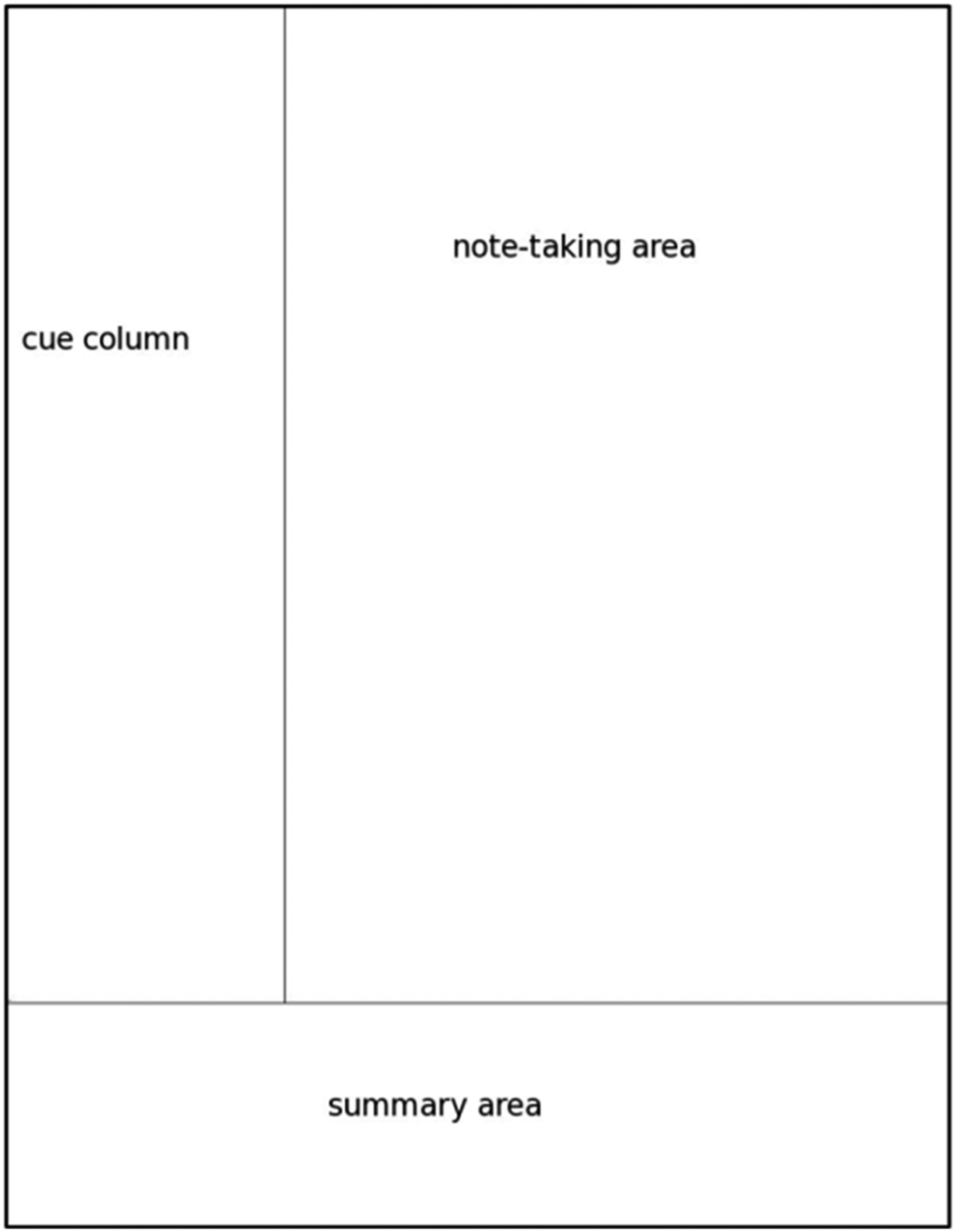
The Cornell Note system utilizes a unique layout in that it takes a single sheet of paper and separates it into three distinct sections.
4
The sections are labeled the “cue column,” “the note-taking area,” and the “summary area.”
4
In the updated edition of the Cornell Notes, Owens describes the measurements of each section as such: “To do this, draw a horizontal line two inches from the bottom of the page. Next, up at the top of the page, draw a vertical line two-and-one-half inches from the left side and extend it down to the line for the summary area. This is the cue column, a simple but powerful area upon which much of the success of the Cornell System rests.”
4
This layout is shown in Figure 1 and can even be found as a premade setting in new tablets, such as the Remarkable 2.
5
A representation of the Cornell Note layout is depicted here.
4
This method is more involved than simply taking notes. It is a system designed to master knowledge acquisition. The three sections each serve their own unique purpose. The note-taking area is reserved for note writing in the form of quick bullet points, graphs, drawings, and definitions. 4 This section is reserved for what the professor says and what is put on the board, with a goal of capturing the gist of what is said along with the important details. 4 The cue section is arguably the most important section of the entire system. In this section, the note writer adds a question for each note written in the note-taking area that will help them remember or organize the material. 4 This concept is akin to Jeopardy, where contestants answer a question with a statement, except in this instance the note writer answers a statement by developing a question. In the final section, the summary section, the note writer encapsulates the details from the notes section into a few sentences that paint the big picture. 4 The object of this section is to answer the question, “What is this page all about?” 4 When the note writer finishes writing or reviewing the notes section from a lecture, the summary section helps to provide an aerial view of what this set of notes is all about. While taking facts and digesting them into knowledge can be challenging, this is a vital step in the Cornell Note system and should not be skipped.
This system is designed to allow students to reflect on the material and quiz themselves on the material both throughout the lecture and while reviewing the notes post-lecture. 4 The Cornell Method provides a functional mini quiz that can be taken by placing blank sheet of paper over the note-taking area, exposing only the cues. The note writer then goes down the list of cues and quizzes themselves on the respective notes that accompany each cue. This reciting method provides instant feedback and motivation to continue. This activity allows the note writer to actively reflect on the information instead of passively reading it. The summary serves as a reflection of the key ideas for each page of the Cornell Notes.
Discussion
In 1885, Professor Hermann Ebbinghaus hypothesized that the course of memory over time and in studying his hypothesis, plotted the rate of his personal memory decline over time. This curve is now known as the “Ebbinghaus Forgetting Curve (Figure 2).”
6
This figure, representing Ebbinghaus Forgetting Curve, was taken from the Mind Tools Content Team.
6
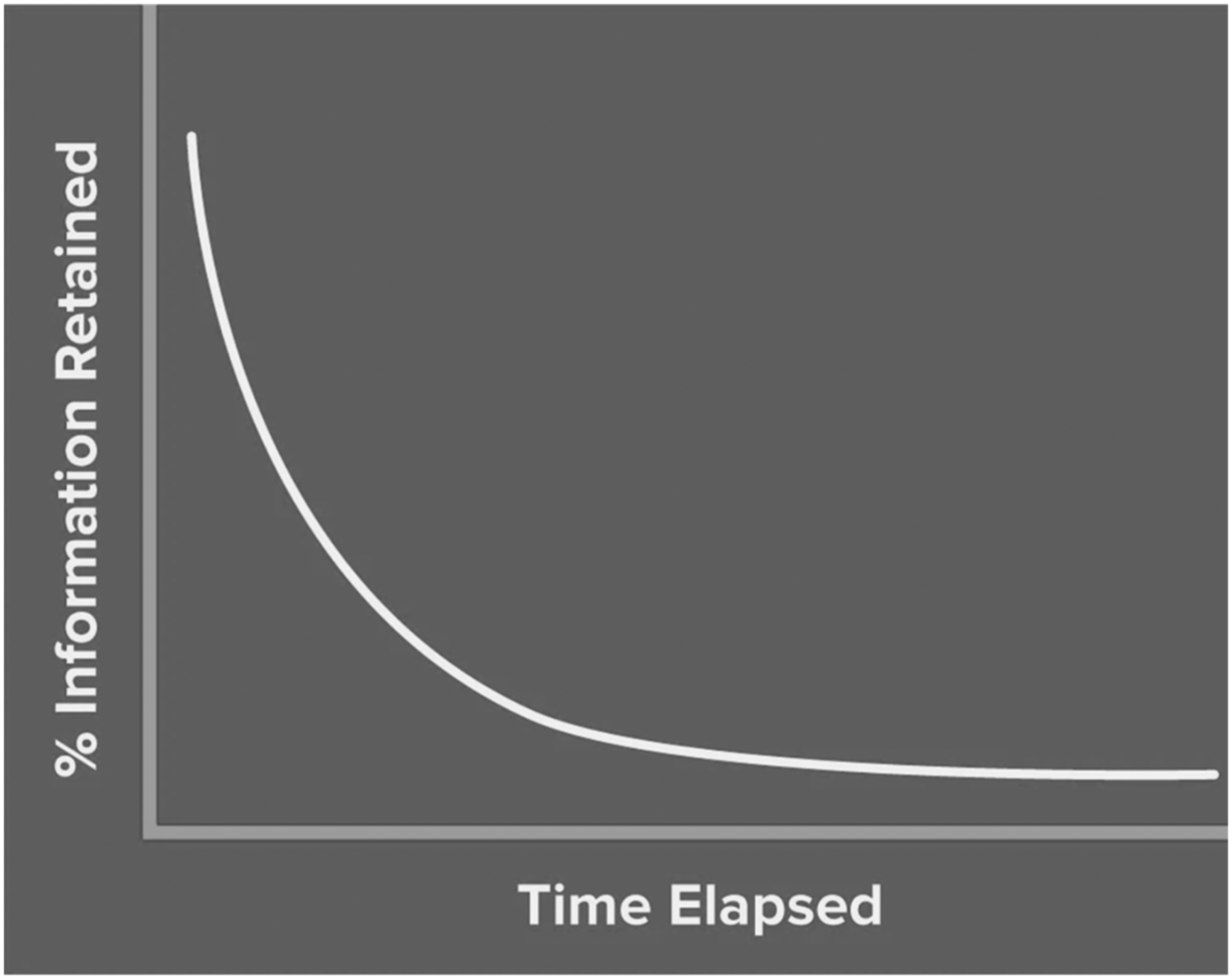
Ebbinghaus showed that over time, facts without meaningful attempts at retention are forgotten at a significant rate. 6 This curve demonstrates several key fundamentals and helps explain why traditional note writing may fail students. First, the steep slope of the initial curve shows that once notes are written down, the process by which they are forgotten begins almost immediately. If medical trainees take notes on a chapter or a lecture and then do not attempt to reinforce those same notes, the memory of those notes fades rapidly. The Cornell Note taking system provide students with an efficient method for reviewing, or reinforcing, notes, with the use of the cue section. Students can efficiently read the questions in the cue section while asking themselves if they understand the answers to those questions. Traditional note taking is often comprised of numerous consecutive bullet points listed on a seemingly endless piece of paper. Organizing notes into specific headings using the Cornell Notes system leads to improved retention as notes are written in a logical, organized fashion.
The Cornell Note method relies on the physical act of writing notes, which may provide a conundrum when you consider that 97% of college students own a laptop. 7 So why even use the Cornell System? Studies have consistently shown that taking notes on a laptop is less effective than writing those exact same notes by hand.8–10 The handwritten note writer physically cannot write as fast as the lecturer may talk; on average a person talks about ten times faster than they can write. 11 This speed discrepancy in one reason why handwritten notes are so successful. The note writer must comprehend what the lecturer is saying, and translate that into a handwritten note, all while the lecturer is continuously presenting new information. This ability to synthesize, record, and continue to collect new information simultaneously requires cognitive effort. Cognitive effort, combined with working memory, allow the note writer to effortfully summarize the lecture in their own words. As a study by Oppenheimer et al concluded, “… laptop note takers’ tendency to transcribe lectures verbatim rather than processing information and reframing it in their own words is detrimental to learning.” 12
The success of the Cornell Note lies in the cue column. The cue column forces the student to go back over their notes and ask themselves what question this specific note is answering. During the note review process, the cue column oftentimes serves an entirely new function; when a student goes over the questions in this cue column separately from the notes column, that student can oftentimes recite the notes from memory without looking at the notes themselves. For example, a note saying, “The mitochondria is the powerhouse of the cell” would be accompanied by a cue saying, “What is the powerhouse of the cell?” This cue column relies on active, rather than passive, learning. Active learning is broadly defined as any instructional method that engages students in learning, while passive learning is the traditional classroom style of learning where students passively retain information that is being lectured. 13 An additional recent study showed the use of interactive engagement in a physics class allowed students to score two standard deviations higher on conceptual understanding of topics. 12
The organizational layout of the Cornell Note system also allows students to efficiently annotate notes during the review period. Traditional forms of annotation often involve students highlighting entire passages in textbooks. This is inefficient and oftentimes unhelpful. The Cornell layout allows students to highlight a specific cue alongside the short bullet point associated with that cue.
4
This method results in minimal highlighting of only the important notes within a passage, rather than these large passages being highlighted in their entirety. This annotation process is efficient, yet effective. In Figure 3, the author provided his own notes written in the Cornell method. These notes written in the Cornell method do have areas of importance that are highlighted. Focusing on these areas of importance is efficient and often done with ease when compared to focusing on those same areas in the traditional annotation method. Author’s own personal notes, showing simple and efficient use of highlighting.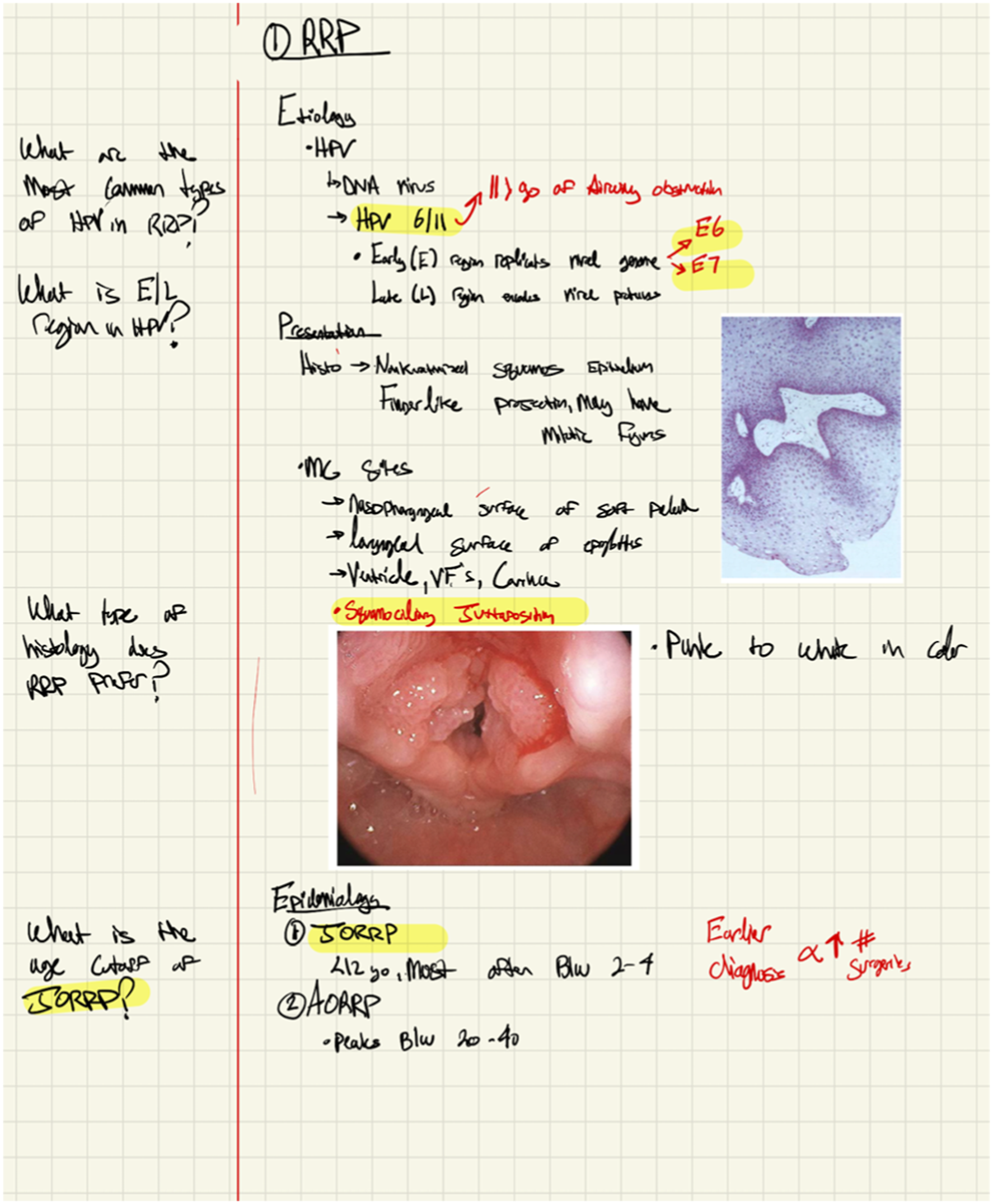
To more fully explore the effectiveness of the Cornell Note system, we would like to reflect on our personal experience with strategy. The primary author of this publication utilized the Cornell Note system while studying for the Otolaryngology In-Service Training Exam. In preparing for this exam, a thorough study of the textbook, Bailey’s Head and Neck Surgery: Otolaryngology, was completed using the Cornell Notes system in conjunction with an iPad. The iPad provided the author a means to not only read the literature but also to write notes using the side-by-side approach visualized in Figure 4. Using the Goodnotes
14
iPad application has streamlined this technique even further. Goodnotes offers a template based off the Cornell System that can be used for free. Goodnotes then saves the document and uploads it to the cloud where it can be accessed on other tablets, laptops, and even mobile phones to allow notes to be “on the go.” A representation of a modern day note-taking approach using an iPad is shown here.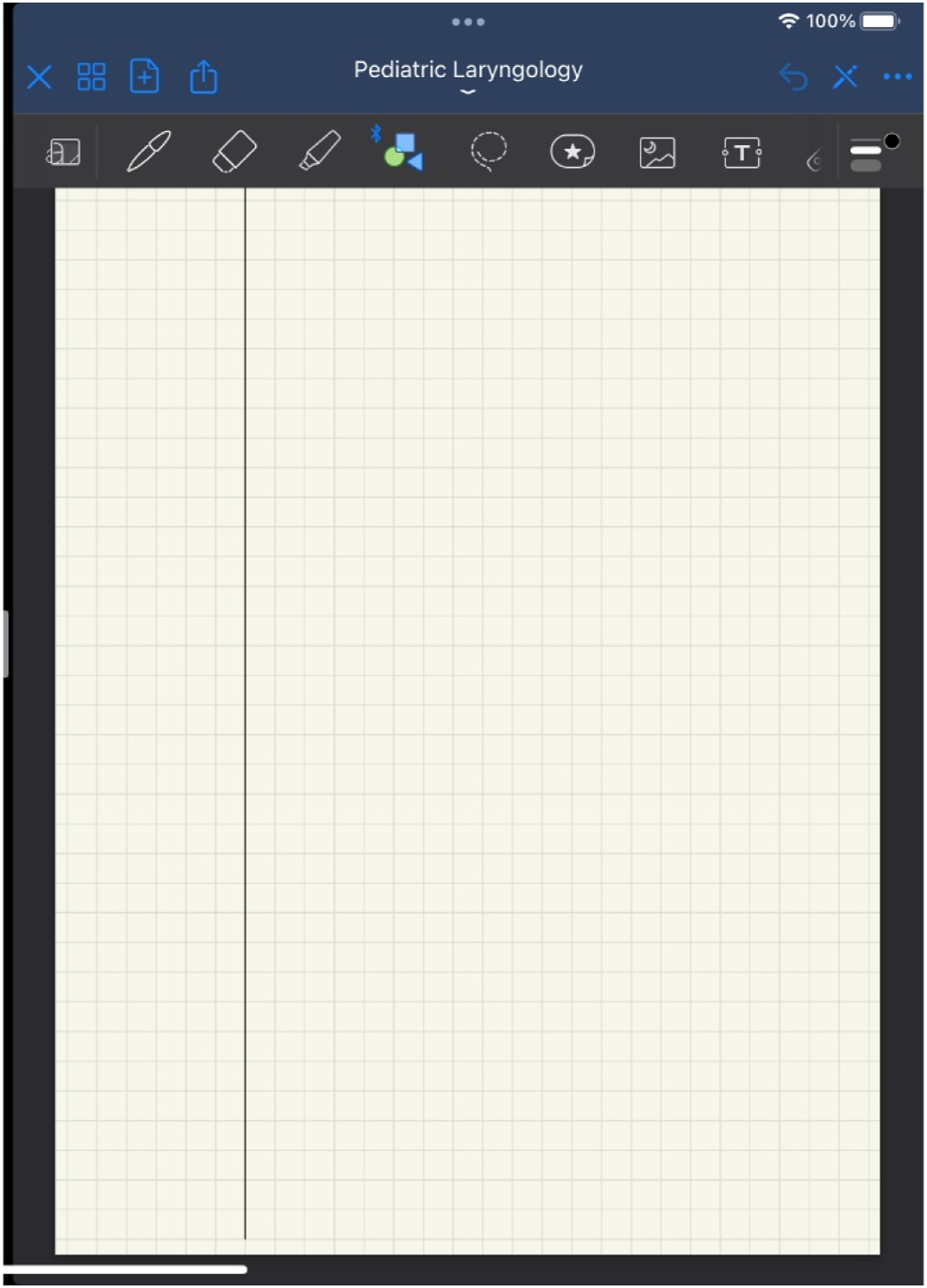
This approach allowed the author to increase retention by physically writing notes using the Cornell system, while simultaneously using a piece of technology available in most academic settings. Surgical residents of only a few decades ago were forced to rely on textbooks and handwritten notes to guide patient care. Given the exponential rate technology has embedded itself into healthcare and medical education, surgical residents of modern day are more dependent on technology than any prior generation. This approach demonstrates that residents can continue to utilize study methods that require the use of “pen and paper” in conjunction with modern technology. The Goodnotes cloud feature allows the notes to then be accessed easily during patient rounds or before surgical cases just as older generation of residents had done historically. This results in a more efficient and much less cumbersome way to review material that was available to previous generations of residents.
Conclusion
Students have been taking notes for hundreds of years, but we have come a long way since Plato’s hypomnemata. Advances in note-taking techniques and the methods by which these advances can be coupled with modern technology have resulted in tremendous advantages for the contemporary generation of trainees. This review outlined one such advancement; the Cornell Note Taking method. This method is effective in promoting retention of learned material by relying on cues that reap the retention benefits of a handwritten note. It can and has been easily incorporated into the ever-changing technological advances in the field of education.
Footnotes
Declaration of conflicting interests
The author(s) declared no potential conflicts of interest with respect to the research, authorship, and/or publication of this article.
Funding
The author(s) received no financial support for the research, authorship, and/or publication of this article.
Ethical approval
Written informed consent for publication of this deemed not necessary by the University of Pittsburgh Institutional Review Board.
