




Abstract
Eccrine hidradenoma is a relatively rare benign tumor of sweat gland origin but with possible malignant transformation. It usually consists of solitary, well-demarcated papules or nodules covered with normal skin. Common sites of involvement are the scalp, face, limbs, and anterior trunk. Although the lining of the nasal vestibule includes hair follicles, sebaceous glands, and sweat glands, an eccrine hidradenoma originating in the nasal vestibule has yet to be reported. Herein, we describe a rare clinical presentation of nasal eccrine hidradenoma, treated successfully using a transnasal endoscopic approach.
Introduction
Eccrine hidradenoma is a relatively rare benign tumor of sweat gland origin that rarely shows aggressive clinical behavior or malignant transformation.1,2 It is also known as clear cell hidradenoma, acrospiroma, nodular hidradenoma, and eccrine sweat gland adenoma.3,4 This tumor usually presents as solitary, well-demarcated papules or nodules 5 to 30 mm in size and covered with normal skin. 3 The most common sites of involvement are the scalp, face, limbs, and anterior trunk, whereas eccrine hidradenoma involving the nose and paranasal sinuses is extremely rare.1,4 Here, we report the first case of eccrine hidradenoma arising in the nasal vestibule. The tumor was completely removed using a transnasal endoscopic approach.
Case Report
An 83-year-old man was referred to our clinic with an incidentally found mass in the anterior nasal cavity. He was taking medications for high blood pressure and dementia. There were no other rhinological symptoms. The physical examination showed no abnormalities of the external aspect of the nose, but the endoscopic examination revealed a 1-cm, oval, nodular mass in the right nasal vestibule (Figure 1). An excisional biopsy was performed under local anesthesia, with removal of the mass in its full thickness through an elliptical incision, leaving a narrow margin of normal tissue. The pathologic findings were consistent with eccrine hidradenoma (Figure 2). The tumor was composed of a proliferation of uniform polygonal cells with a clear cytoplasm and distinct cell membranes. An endoscopic examination performed 1 year postoperatively demonstrated no evidence of recurrence.
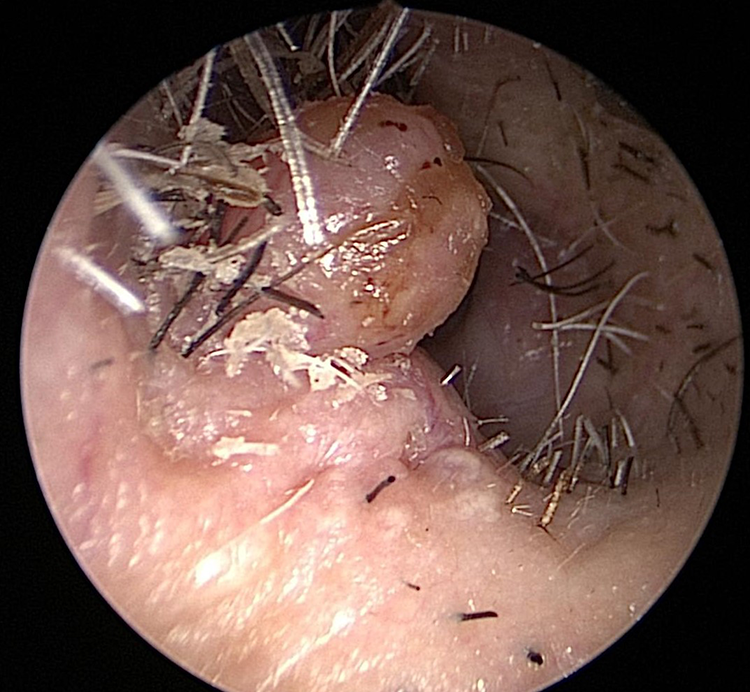
Preoperative endoscopic findings show a mass in the right nasal cavity. An oval, nodular mass in the right nasal vestibule is seen on nasal endoscopy.
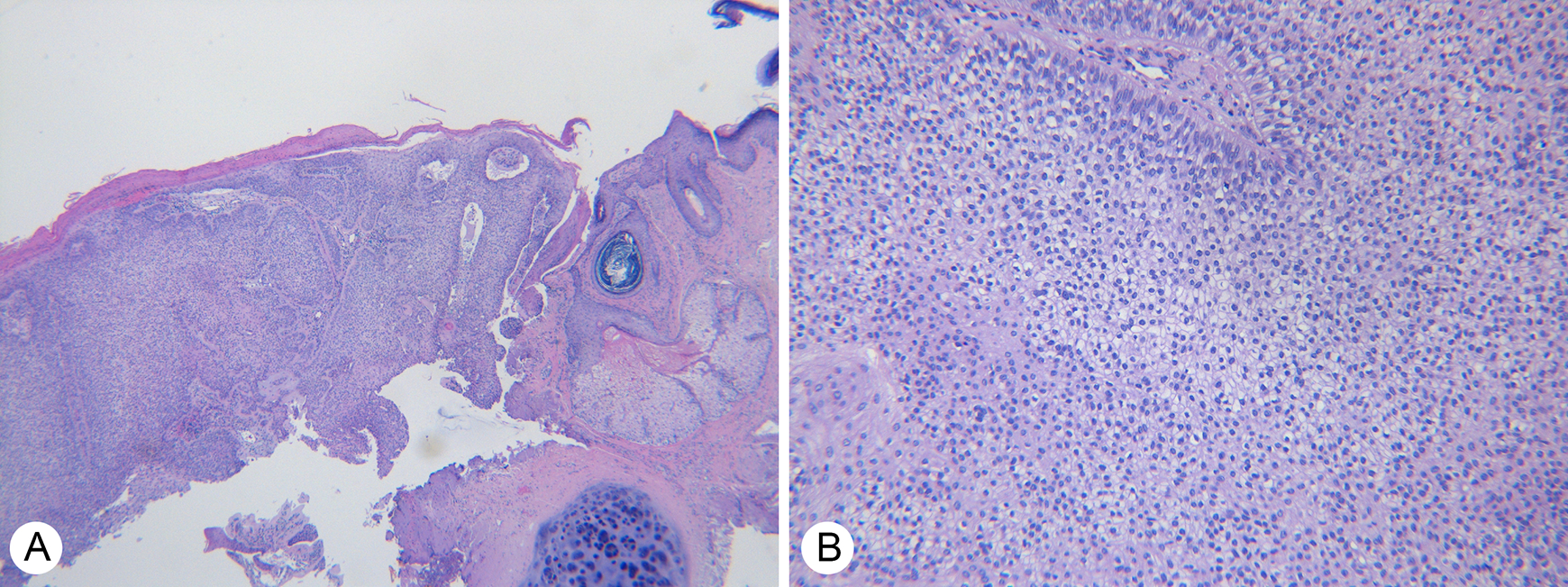
Histopathologic findings of eccrine hidradenoma. A, A well-circumscribed tumor composed of a proliferation of uniform polygonal cells without ductal structures (H&E, ×40). B, The tumor cells have a clear cytoplasm and distinct cell membranes (H&E, ×200). H&E indicates hematoxylin and eosin.
Discussion
Eccrine hidradenoma is a benign tumor originating from the eccrine sweat glands. It usually occurs during the third to fifth decade of life, with a slight female predominance. 5 Liu first described an eccrine acrospiroma in 1949. 1 The tumor is characterized by well-circumscribed nodules located in the dermis that may be connected to the epidermis and occasionally extend into the subcutaneous fat. 6 Although it can originate from any cutaneous site, no case of eccrine hidradenoma located in the nasal vestibule has been reported in the literature, to thus far. The nasal vestibule, the most anterior part of the nasal cavity, is lined with keratinizing squamous epithelium and contains components from the nasal cavity proper, including hair follicles, sebaceous glands, and sweat glands. 7 Both inflammatory and infectious diseases as well as benign and malignant tumors may originate in the nasal vestibule. 7 However, the symptoms they cause, such as unilateral nasal obstruction, pain, crusting, and epistaxis, are nonspecific and similar to those of other sinonasal pathologies. Our patient had no symptoms suggestive of eccrine hidradenoma arising in the nasal vestibule. The diagnosis of eccrine hidradenoma is confirmed by histopathologic examination. The tumor is predominantly solid but may also contain cystic spaces. 5 The solid portion comprises two types of epithelial cells: fusiform cells with elongated nuclei and a basophilic cytoplasm, and polygonal cells with round nuclei and a clear cytoplasm.3,5 The polygonal cells are the predominant cell type in eccrine hidradenoma, 6 as was also the case in our patient. The differential diagnosis of eccrine hidradenoma includes hemangioma, lymphangioma, lymphocele, ganglion cyst, sebaceous cyst, epidermal inclusion cyst, and trichilemmal tumor. 3 The treatment of choice is surgical excision. Although the tumor is benign, local recurrence is possible if the resection margins are insufficient. However, this must be balanced with maintaining the integrity of nasal vestibule, which is important functionally, and with avoiding scarring, for cosmetic reasons. In addition, regular follow-up is needed because, although rare, eccrine hidradenoma may undergo malignant transformation, with subsequent metastatic spread. 6
Despite the rarity of eccrine hidradenoma in the nasal vestibule, it should be considered in the differential diagnosis of a nasal vestibular mass, especially in older adults. Wide surgical excision is recommended, taking into account both the cosmetic and the functional aspects of the nasal vestibule.
Footnotes
Declaration of Conflicting Interests
The author(s) declared no potential conflicts of interest with respect to the research, authorship, and/or publication of this article.
Funding
The author(s) received no financial support for the research, authorship, and/or publication of this article.
