



Abstract
Neuroendocrine carcinomas are a spectrum of rare and highly heterogeneous malignant tumors. Neuroendocrine carcinomas mainly arise from neuroendocrine cells scattered throughout the body. They mainly occur in the lung and gastrointestinal tract. Atypical carcinoid of the larynx is a rare type of neuroendocrine carcinoma, which is easily misdiagnosed as hemangioma in appearance. We mainly feature the disease to you through the diagnosis and treatment of a case of atypical carcinoid of the larynx.
Introduction
Neuroendocrine carcinomas (NECs) are a spectrum of rare and highly heterogeneous malignant tumors. Neuroendocrine carcinoma of the larynx mainly arises from the neuroendocrine cells located in the laryngeal mucosa and, possibly, glandular epithelia. 1
The incidence rate of neuroendocrine tumors (NETs) is about 7/100 000 per year, 2 accounting for 3% of all cancers. 3 They mainly occur in the gastrointestinal (about 70%) and lung (more than 25%) tract, 4 -7 and rarely in the larynx. According to the 2005 World Health Organization classification of the NETs of the larynx, 4 main categories of neoplasms may be identified: typical and atypical carcinoid (AC), small cell carcinoma, neuroendocrine type, and combined small-cell carcinoma, neuroendocrine type. Different types of NEC have unique treatment and prognosis. Compared to NEC arising in the lung, NEC of the head and neck of patients had better survival rates, but worse survival rates than the squamous cell carcinoma. 6
Atypical carcinoid of the larynx is a kind of NEC, which is dark red and lumpy, and occasionally confused with hemangioma in appearance. We mainly introduce the disease to you through the diagnosis and treatment of a case of AC of the larynx.
Case Report
A 65-year-old man with 30 years of smoking history and pharyngeal paresthesia was admitted to our department in December 2019, because epiglottis mass has founded in the physical examination for 5 days. The patient’s vital signs were as follows: temperature 36.3 °C, respiratory rate 18 breaths per minute, pulse 92 bpm, and blood pressure 151/92 mm Hg. Blood counts, kidney function, and liver function were in the normal ranges.
Electronic laryngoscope showed that hemangioma-like mass was located on the left epiglottis laryngeal surface and the medial wall of the left aryepiglottic fold (Figure 1). No obvious abnormality was noted in lung computed tomography and color Doppler ultrasound of cervical lymph nodes.
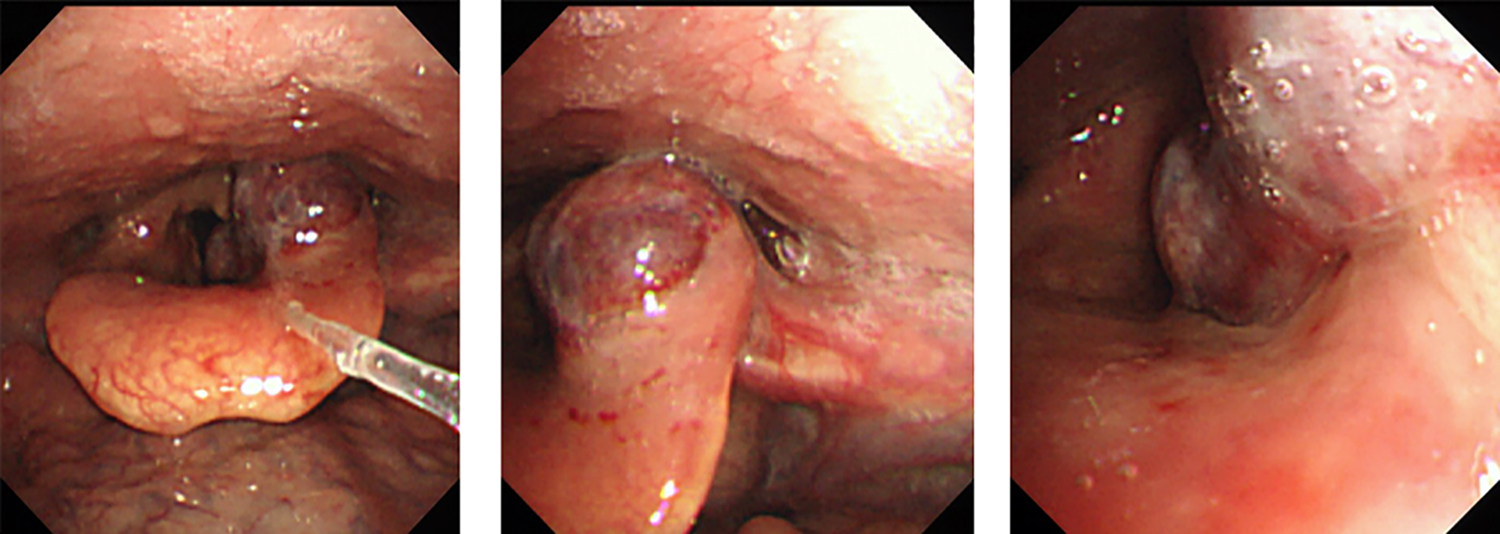
The result of electronic laryngoscope examination before operation.
One day after admission, the patient underwent laryngeal tumor resection with low-temperature plasma radiofrequency ablation assisted self-retaining laryngoscope under general anesthesia. The tumor was considered as a hemangioma. However, there was no obvious bleeding and found the tumor size of 1.8 × 1.4 cm during the operation. Intraoperative rapid pathological examination cannot exclude a malignant tumor. We explained the patient’s condition to his family, terminated the operation.
After a few days, postoperative pathological findings supported AC (Figure 2).The patient was operated again, and the left part of epiglottis and aryepiglottic fold was removed. No cancer was noted in the safety margin during the operation. The patient was discharged from the hospital after the operation and was followed up regularly (Figure 3).
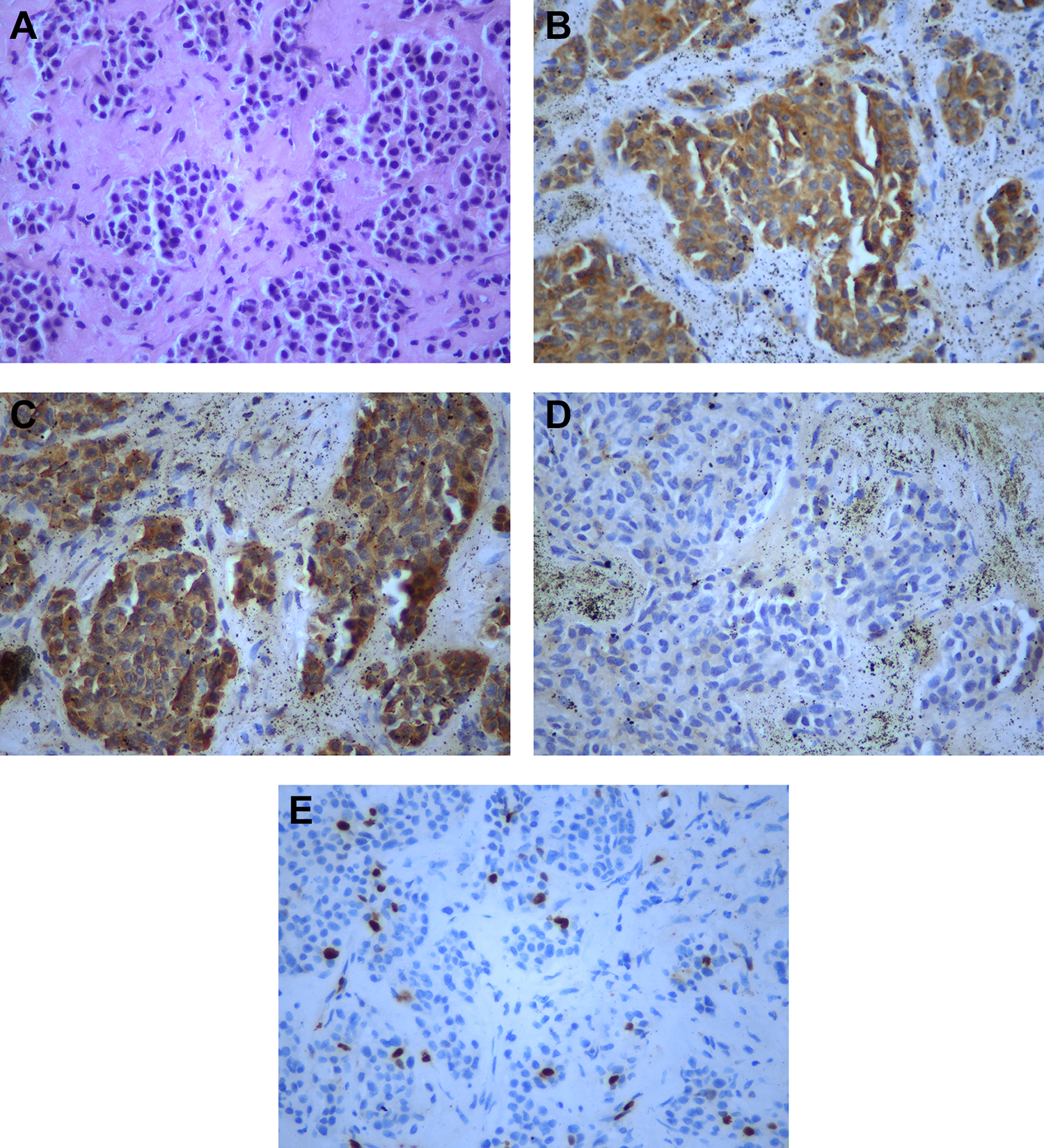
The result of pathological examination of tumor specimens. The tumor cells are arranged in small nests. The cells are large and the nuclei are often vesicular and contain prominent nucleoli(A, hematoxylin and eosin, 400×). On immunohistochemical staining, the tumor cells were positive for synaptophysin (B, 400×), and chromogranin (C, 400×), but negative for CD56 (D, 400×). The Ki-67 proliferation index was about 5% (E, 400×).
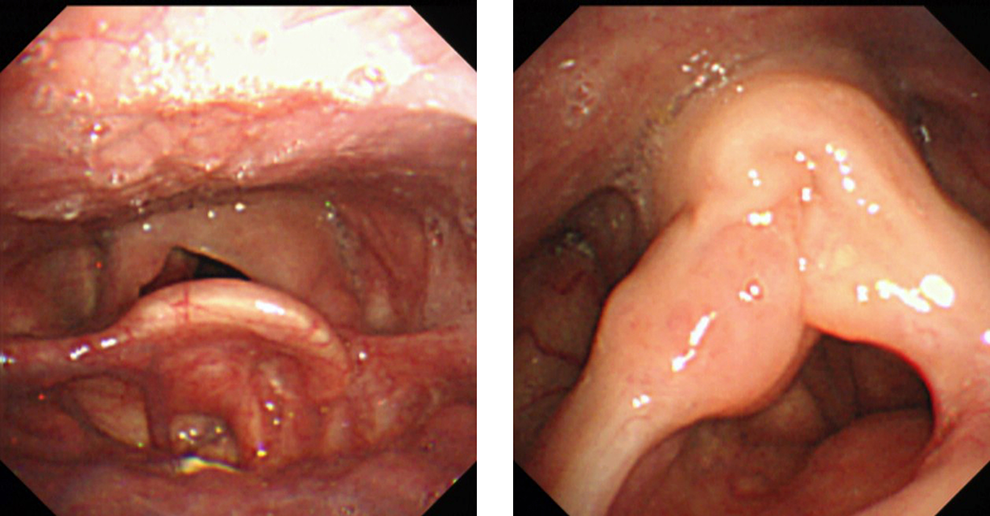
The result of electronic laryngoscope reexamination one and a half years after operation.
Discussion
Atypical carcinoid is the most common type of NETs of the larynx, and most patients have a long history of smoking. Over 90% arise in the vicinity of the aryepiglottic fold, arytenoid, or ventricular cord. 8 Most of the tumors were dusky red, massive and occasionally bleeding. These signs and symptoms are very similar in this case, but it is difficult to distinguish from hemangioma. Hemangioma generally does not affect life, but AC has a very damaging impact on the survival of patients.
However, we didn’t use the traditional method of injection of vascular sclerosing agent. So we have avoided the serious consequences. The prognosis of AC is very poor. Its 5-year survival rate is just 48%. 8,9 Death is usually caused by metastatic disease rather than local recurrence. 10 Ki-67 is deemed to be the most frequently used biomarker of prognosis, which is the basis for grading of NET. 2 In addition, Yuan et al 11 have suggested that INSM1 is of great significance in the diagnosis and classification of NEC of the larynx.
The patient chose partial laryngectomy without neck lymph node dissection after the pathology was confirmed. This is primarily due to the consideration of the subjective will of patients and the existing examination results. In addition, immunohistochemical results showed that only 5% of the cells in the hot spot of the tumor sample were Ki-67 positive. Nevertheless, the patient needs to be followed up closely after operation.
The patient didn’t receive radiotherapy after surgery. Because professors think that surgical resection is the primary choice for AC of the larynx and radiotherapy is ineffective, at present. Some studies of NEC of the larynx also showed that radiotherapy was not effective for late-stage disease and that surgery should be the primary choice for early grade tumors. 8,12,13 But a multicenter study from the United States suggests that the combination therapy of radiotherapy and other methods is valuable for locally advanced or metastatic AC of the lung. 14 It may have some guiding significance for the treatment of laryngeal tumor.
Footnotes
Declaration of Conflicting Interests
The author(s) declared no potential conflicts of interest with respect to the research, authorship, and/or publication of this article.
Funding
The author(s) received no financial support for the research, authorship, and/or publication of this article.
