




Abstract
Traditional research on coal seam borehole pressure relief has primarily focused on qualitative static stress transfer, while the continuous dynamic evolution of the pressure relief effect remains under-explored. Given the significant creep characteristics of deep coal, this study employed numerical simulation tests and in-situ electromagnetic wave computed tomography (CT) detection to investigate the dynamic evolution characteristics of stress transfer, energy release, and the rock burst hazard index in the roadway ribs following borehole pressure relief. Furthermore, the influence of parameters such as borehole diameter, spacing, and depth on the evolution of the pressure relief effect was examined. The results indicate that the evolution of the borehole pressure relief effect in deep creeping coal can be categorized into two stages: instantaneous pressure relief and creep-induced pressure relief. After drilling, the creep deformation of the coal mass increases, and fractures around the borehole gradually propagate. Consequently, the stress, stored energy, and the rock burst hazard index in the pressure relief zone continuously decrease, although this attenuation decelerates as the duration of creep increases. As the borehole diameter and depth increase, while spacing decreases, the reduction rates of stress, energy, and the rock burst hazard index during the creep-induced pressure relief stage accelerate significantly, thereby enhancing pressure relief efficiency. Field applications in roadways prone to rock bursts have demonstrated that the anomaly index of the coal mass's absorption coefficient within the electromagnetic wave CT detection area gradually increases, while the rock burst hazard index decreases. In deep mining roadways, it is crucial to accurately determine the advanced pre-relief distance to fully leverage the dual effects of instantaneous and creep-induced pressure relief, thereby enhancing the effectiveness of rock burst prevention.
Introduction
With the rapid advancement of coal mining technology and equipment in China, the intensity of mining operations has been steadily increasing, alongside a continuous extension of mining depths. Currently, the developmental depths of many large-scale mining areas in China have surpassed 800 meters. The high-stress and complex geological conditions encountered in deep coal seams significantly elevate the risk of rock bursts (He et al., 2018; Zhao et al., 2024). Consequently, the prevention and control of rock bursts have become routine operations in deep coal seam mining (Lyu et al., 2025; Qi et al., 2019).
Among various preventive measures, large-diameter borehole pressure relief technology has emerged as an effective control method, owing to its advantages of straightforward construction, low cost, ease of operation, and minimal disruption to normal production (Jiang et al., 2016; Yang et al., 2024). To further enhance the effectiveness of borehole pressure relief technology in preventing rock bursts, researchers both domestically and internationally have conducted extensive investigations into the mechanisms and parameter designs of borehole pressure relief. Structural control methods, such as roof cutting and directional blasting, have been extensively applied to optimize stress distribution and maintain the stability of coal mine roadways (Chen et al., 2025; Hu et al., 2023). While these macro-structural interventions address broad stress environments, localized destressing directly within the coal seam is equally critical for mitigating internal energy accumulation. Based on stress control theory, Gu et al. (2022) indicated that large-diameter boreholes create a plastic zone by compromising the integrity of coal and rock, thereby promoting the transfer of stress to deeper regions. Tezuka and Niitsuma (2000) theoretically analyzed the mechanisms of borehole pressure relief and proposed stability models, including the linear elastic and elastoplastic models. Furthermore, concerning energy dissipation and parameter optimization, Liu et al. (2018) examined the pressure relief energy dissipation laws of boreholes under both dynamic and static loads, revealing the regional pressure relief effects generated by fracture propagation. Li et al. (2022) experimentally investigated the pressure relief mechanisms of variable-diameter boreholes and the energy evolution characteristics of surrounding rock, discovering that the peak stress and the pressure relief energy release rate exhibit a nonlinear trend under varying parameters. Currently, most studies on the mechanisms and parameter optimization of borehole pressure relief focus on static analysis, primarily exploring the stable state after stress transfer has been completed.
Under the influence of mining-induced stress in deep roadways, pressure relief boreholes in the coal seam deform gradually over time, leading to the propagation of fractures. Throughout this process, the high stress in the shallow regions of the roadway rib progressively transfers to deeper areas. The pressure relief effect of the boreholes evolves continuously, exhibiting significant time-dependent characteristics. Zhao et al. (2020) investigated the deformation behavior of boreholes under constant load, revealing that borehole strain diminishes with increasing depth. Yin et al. (2025) identified four stages in the behavior of coal masses containing pressure relief boreholes: hole shrinkage deformation, fracture propagation around the hole, hole collapse, and hole closure. Considering the time-dependent characteristics and complex stress environments, Zheng et al. (2022) examined the relief mechanism and stress distribution characteristics of drilling holes in deep coal mines over time. Zhang et al. (2025) explored the response behaviors, such as the extent of the borehole pressure relief zone and the evolution of pressure relief amplitude, under varying levels of static and dynamic loads, and analyzed the limitations of rock burst prevention efficacy. According to the current national standard GB/T 25217.10-2019 (2019) , large-diameter pressure relief boreholes in mining faces must encompass the mining-induced influence area, extending a minimum length of 200 m. Prior to the advancement of the working face into the borehole pressure relief area, it is subjected to a mechanical environment characterized by high static loads and low dynamic disturbances. The creep characteristics of the coal mass influence the gradual effectiveness of borehole pressure relief, and the activation process directly affects the efficacy of pressure relief and rock burst prevention in the advanced influence area of the working face. Nonetheless, there is a paucity of studies addressing the evolution laws and time-dependent characteristics of borehole pressure relief. Therefore, this paper employs a comprehensive approach that integrates numerical simulation and field testing methods to analyze the evolution process of the borehole pressure relief effect in coal seams, taking into account the creep characteristics of coal. Additionally, it investigates the influence of pressure relief parameters on the processes of stress transfer and energy release in the roadway ribs. The findings of this research may provide theoretical guidance for optimizing the advanced pre-relief distance and borehole pressure relief parameters in deep roadways.
Evolution law of the pressure relief effect in roadway ribs considering coal creep
Model establishment and simulation scheme
To investigate the evolution of the borehole pressure relief effect in roadway ribs under deep and high-stress environments, a numerical model of a roadway featuring large-diameter borehole pressure relief at a burial depth of 800 m was established using the FLAC3D finite difference software, as depicted in Figure 1. A uniform load of 20 MPa, representing the gravitational force of the overlying strata, was applied to the upper boundary of the model. Simultaneously, a lateral stress of 16 MPa, reflecting horizontal tectonic forces, was applied to both the left and right boundaries. The Burgers–Mohr creep constitutive model was utilized in the simulation. The relevant mechanical parameters and creep constitutive parameters of the rock strata are presented in Tables 1 and 2, respectively.

Numerical model of roadway borehole pressure relief.
Lithology and parameters of rock strata (Yin et al., 2023).
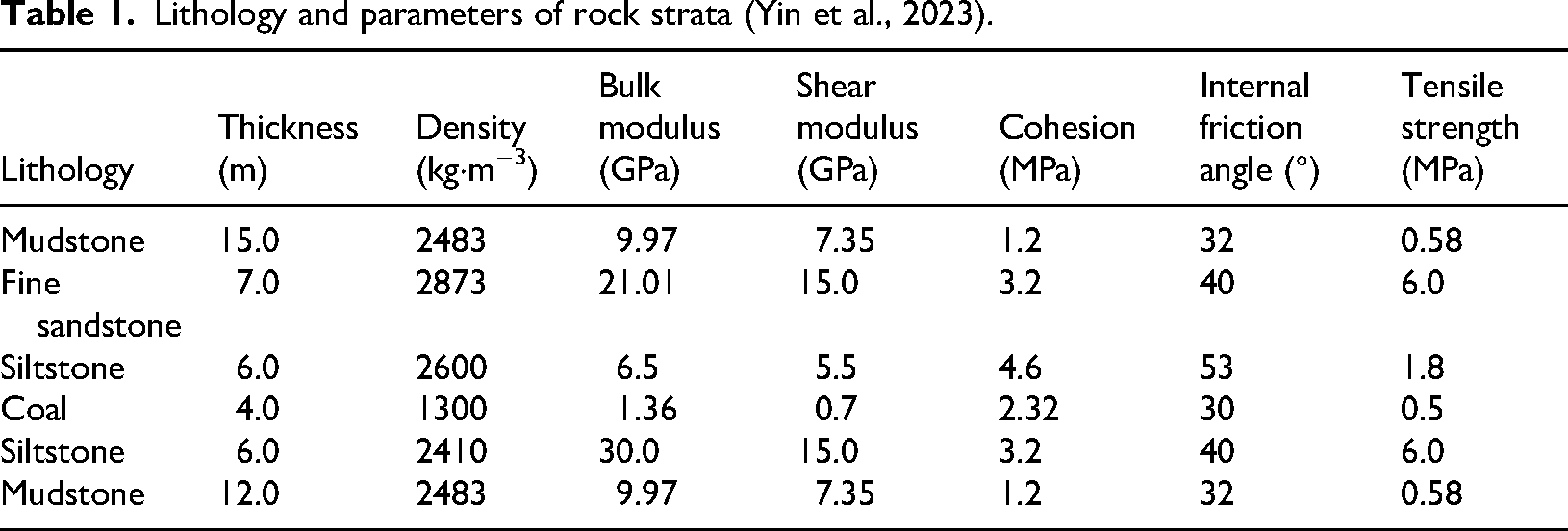
Creep constitutive parameters (Wang et al., 2019).

In the simulation process, the roadway excavation was completed initially, followed by the construction of large-diameter pressure relief boreholes along the roadway ribs. Subsequently, a creep loading of 60 days was applied to the model. To systematically investigate the influence of borehole parameters on the pressure relief effect, a baseline simulation scheme was established with a borehole diameter of 150 mm, a spacing of 1 m, and a depth of 20 m. Building upon this control group, three key variables were systematically adjusted: borehole diameter, spacing, and depth. The specific simulation schemes are detailed in Table 3. Monitoring points were arranged in the coal seam above the boreholes to acquire data on the stress evolution of the coal mass during the simulation. To quantitatively characterize the energy evolution law of the coal mass surrounding the boreholes, a coal mass element measuring 4 m × 4 m within the depth range of the borehole was selected for statistical and analytical evaluation of its energy.
Simulation schemes and variables for borehole pressure relief.

To quantitatively analyze the variation law of the coal seam rock burst hazard following borehole pressure relief, the rock burst hazard index K (Hu et al., 2023) was adopted to characterize the degree of rock burst hazard. The expression is as follows:
In the equation, Ue represents the elastic strain energy density stored in the coal mass, and Umin denotes the minimum energy density for dynamic failure of the coal mass (Zhao et al., 2003). The expression is as follows:
In the equation, E is the elastic modulus of the coal mass, and
Evolution law of the stress field in the roadway rib after pressure relief
This study simulates the borehole pressure relief process in a coal seam with a diameter of 150 mm and a depth of 20 m, analyzing the evolution of the pressure relief effect in the roadway rib while considering coal creep. The vertical stress distribution in the roadway rib post-pressure relief is illustrated in Figure 2. Following the drilling operation, the stress within the pressure relief zone of the coal mass decreases continuously, leading to an expansion of the low-stress zone. The stress distribution curve exhibits distinct time-dependent characteristics, indicating that the stress in the coal mass after drilling undergoes two stages: instantaneous pressure relief and creep-induced pressure relief. Upon completion of borehole construction, the deformation and yield of the borehole cause a sudden drop in stress within the coal mass surrounding the hole. Specifically, the stress at the original peak stress point decreases from 30 MPa to 11.86 MPa, marking the instantaneous pressure relief stage. As the coal mass experiences creep deformation, the plastic zone around the borehole gradually expands, and the stress in the hole area continues to decrease. Consequently, the borehole pressure relief effect is progressively enhanced, marking the onset of the creep-induced pressure relief stage. After 20 days of creep, the original peak stress decreases by an additional 3.32 MPa. As the duration of creep extends, the magnitude of the stress reduction gradually diminishes. During the interval from 40 to 60 days of creep, the stress decreases by only 1.07 MPa, indicating that the stress distribution in the roadway rib undergoes continuous adjustment and ultimately approaches a new equilibrium state. In contrast to the instantaneous pressure relief, following the creep-induced pressure relief of the coal mass, the average stress of the coal mass within the pressure relief zone is reduced to 72.1% of the pre-drilling level. The stress reduction at the original peak point is 6.72 MPa, which accounts for 56.7% of the stress reduction observed during the instantaneous pressure relief stage. Therefore, for deep roadways, before the working face advances into the borehole pressure relief zone, the high-stress zone in the coal mass continues to migrate deeper into the roadway rib under the influence of coal creep, resulting in a continuous decrease in stress within the pressure relief zone. A longer advanced pre-relief duration or a greater advanced distance yields a more pronounced stress transfer and pressure relief effect.
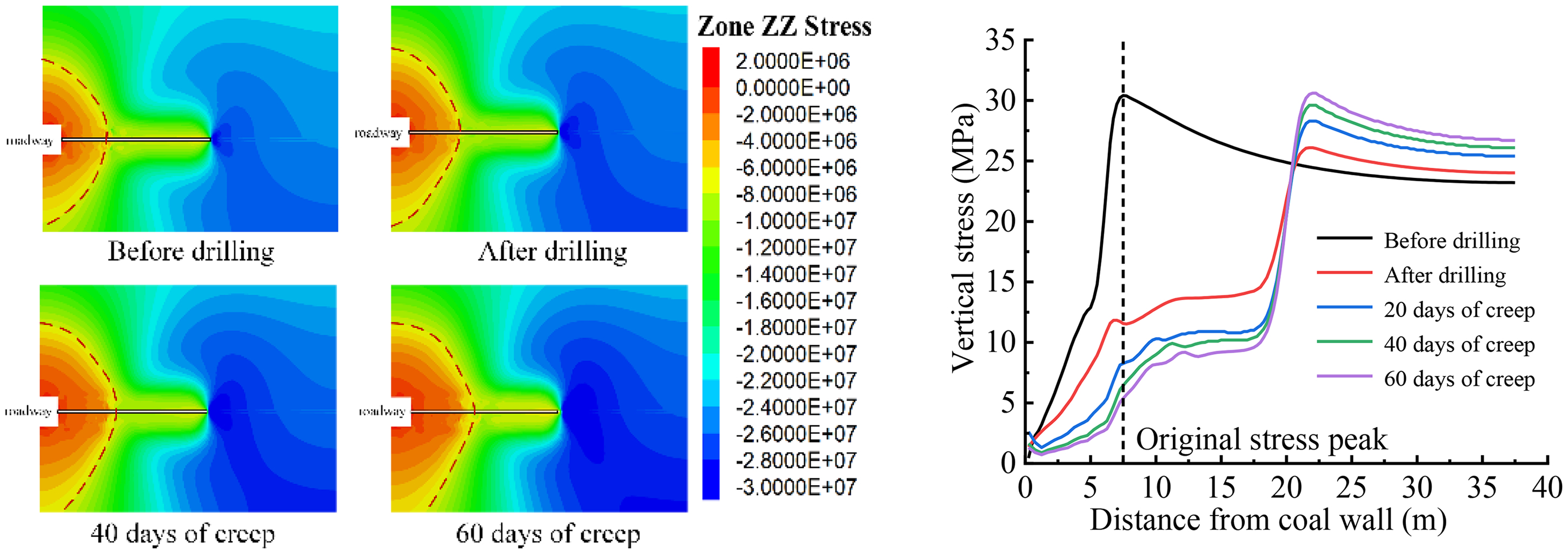
Evolution of vertical stress distribution after pressure relief: (a) contour of vertical stress distribution; (b) evolution curve of vertical stress distribution.
Evolution law of the energy field and rock burst hazard Index in the roadway rib after borehole pressure relief
Figure 3 illustrates the contours and evolution curves of the energy and rock burst hazard index in the roadway rib following borehole pressure relief. Prior to drilling, the shallow area of the roadway rib, extending 5.85 m, is characterized as a low-energy zone due to stress concentration, while the deeper area, ranging from 5.85 to 16.32 m, serves as a high-energy storage zone. Following borehole pressure relief, the coal mass in the shallow low-energy zone reaches a plastic state, resulting in minimal impact on the energy within this area. Energy release predominantly occurs within the range of 5.85 to 20 m. After pressure relief, fracturing of the coal mass in this region leads to a significant reduction in energy storage capacity and a substantial release of previously stored energy. Notably, near the original peak stress point, energy density decreases by approximately 36 kJ/m3. Concurrently, the low-energy zone expands to a depth of 7.38 m. During the creep-induced pressure relief stage, continuous stress transfer and creep compression of the coal mass facilitate ongoing energy release in the pressure relief zone, causing the low-energy zone to further expand. After 40 days of creep, energy release approaches its limit and subsequently stabilizes. At this juncture, the entire area within 8.85 m of the roadway rib is classified as a low-energy zone, functioning as an energy impedance zone (Liu et al., 2024).

Contours and evolution curves of energy and rock burst hazard index in the roadway rib after borehole pressure relief: (a) contour of strain energy density in the roadway rib; (b) contour of rock burst hazard index in the roadway rib; (c) energy release amount; (d) evolution of rock burst hazard index.
The rock burst hazard associated with the roadway rib is directly correlated with its internally stored energy; specifically, the rock burst hazard index in high-energy storage zones surpasses that of low-energy storage zones. As energy is released from the roadway rib, the rock burst hazard index within a 6-m range of the rib shows only slight changes, while a progressive decrease is observed in the 6- to 20-m range. The low rock burst hazard zone gradually extends into the deeper sections of the roadway rib, with the reduction in the hazard index occurring in tandem with energy release. During the instantaneous pressure relief phase, the peak rock burst hazard index decreases from 1.66 to 1.37. In the subsequent creep-induced pressure relief phase, the rock burst hazard continues to diminish. After 60 days of creep, the peak rock burst hazard index drops to 1.06, resulting in most areas within the drilling range being classified as non-rock burst hazard zones.
Compared to stress transfer, the impact of creep-induced pressure relief on energy release and the rock burst hazard index is more pronounced. After 60 days of creep, the energy released at the original peak stress point is 2.49 times greater than that of the instantaneous pressure relief stage, while the reduction in the rock burst hazard index is 1.06 times that of the instantaneous pressure relief stage. Rock bursts are energy-driven dynamic failure phenomena in coal masses, with the instantaneous massive release of energy stored in the roadway rib serving as the direct trigger. Borehole pressure relief can preemptively release the internal energy of the roadway rib, thereby achieving the objective of pressure relief. Following the advanced construction of pressure relief boreholes, the influence of coal creep ensures the maximum extent of energy release, which subsequently enhances the efficacy of pressure relief and rock burst prevention.
Influence of borehole parameters on the evolution of pressure relief effect
Influence of borehole diameter
The stress-energy evolution law of the coal mass in the roadway rib pressure relief zone, under varying borehole diameters following pressure relief, is illustrated in Figure 4. During the instantaneous pressure relief stage, the magnitude of stress reduction at the original peak stress point increases with the borehole diameter. Specifically, the stress reduction values at the original peak point for boreholes with diameters of 150 mm, 200 mm, and 250 mm are 1.53 times, 1.72 times, and 1.78 times greater than that of the 100 mm diameter borehole, respectively. Upon entering the creep-induced pressure relief stage, the stress at the original peak point for different borehole diameters gradually decreases over time. Moreover, the rate of stress reduction in the coal mass for small-diameter boreholes is significantly greater than that for large-diameter boreholes. For example, within 60 days of creep, the creep-induced stress reduction value for the 100 mm diameter borehole is 1.7 times that of the 250 mm diameter borehole. In summary, as the borehole diameter increases, the magnitude of stress reduction during the instantaneous pressure relief stage increases, whereas the magnitude of stress reduction during the creep-induced pressure relief stage decreases. This indicates that the stress reduction effect of the borehole is more pronounced and occurs more rapidly.
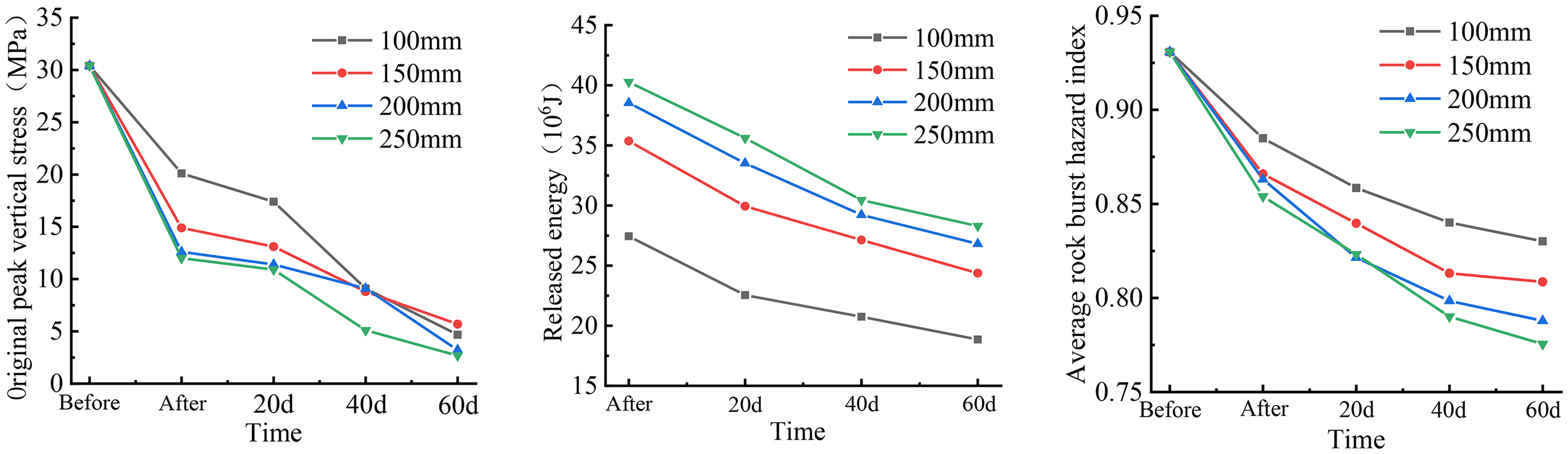
Stress and energy evolution in pressure relief zones with different diameter boreholes: (a) stress at the original peak point; (b) energy release amount in the pressure relief zone; (c) average rock burst hazard index in the pressure relief zone.
The energy release in the pressure relief zone, under varying borehole diameters, exhibits distinct differential characteristics. Notably, the energy released during the instantaneous pressure relief stage exceeds that of the creep-induced pressure relief stage. Furthermore, the incremental energy released within each specific time interval gradually diminishes as the duration of creep increases. While the energy release-time curves for the pressure relief zone across different borehole diameters are approximately parallel, an increase in borehole diameter correlates with a rise in both instantaneous and creep-induced energy release amounts in the pressure relief zone. This trend indicates that the energy release effect of large-diameter pressure relief boreholes is more pronounced.
In contrast to the energy release evolution, borehole diameter significantly influences the reduction rate of the rock burst hazard index. For a borehole with a diameter of 100 mm, the rock burst hazard index decreases from 0.931 to 0.885 during the instantaneous pressure relief stage, further declining to 0.83 within 60 days of creep. Conversely, for a 250 mm diameter borehole, the reduction in the rock burst hazard index is 0.077 during the instantaneous pressure relief stage and 0.078 during the creep-induced pressure relief stage, representing reductions that are 1.67 times and 1.42 times greater than those observed in the 100 mm diameter borehole, respectively. The reduction rate of the rock burst hazard for large-diameter boreholes during both the instantaneous and creep-induced pressure relief stages is significantly greater than that for small-diameter boreholes, demonstrating a more pronounced weakening effect on the rock burst hazard.
Influence of borehole spacing
The stress-energy evolution law of the coal mass in the roadway rib pressure relief zone under different borehole spacings is illustrated in Figure 5. Following borehole construction, the stress release amounts at the original peak point under spacings of 1 m, 1.5 m, and 2 m are approximately 0.79, 0.47, and 0.55 times that of the 0.5 m spacing, respectively. A smaller borehole spacing results in a greater magnitude of stress reduction at the original peak stress point during the instantaneous pressure relief stage. During the creep-induced pressure relief stage, the stress at the original peak point under different borehole spacings gradually decreases over time. Furthermore, a smaller borehole spacing correlates with a relatively faster stress reduction rate and a lower stress value at the end of the creep phase.
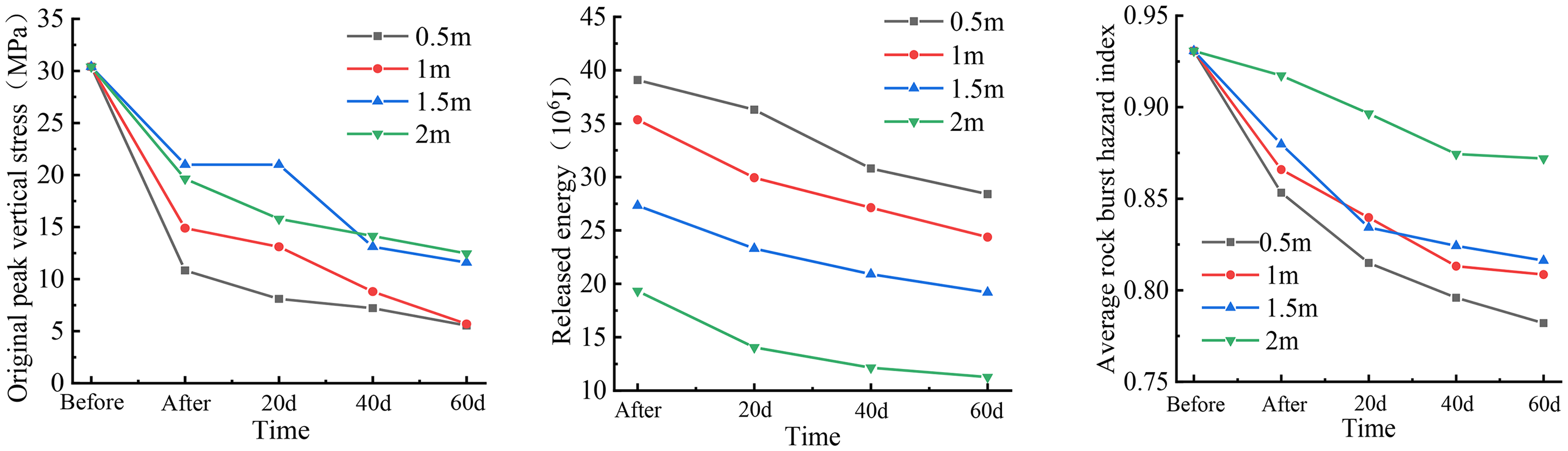
Stress and energy evolution in pressure relief zones with different spacing boreholes: (a) stress at the original peak point; (b) energy release amount in the pressure relief zone; (c) average rock burst hazard index in the pressure relief zone.
Similar to the influence of borehole diameter, the energy release-time curves of the pressure relief zone under different borehole spacings are approximately parallel. As the borehole spacing increases, the instantaneous and creep-induced incremental energy release amounts within each specific time interval in the pressure relief zone gradually increase. However, the energy release effect of small-spacing pressure relief boreholes is more pronounced. As the borehole spacing increases, the reduction rate of the rock burst hazard index in the roadway rib gradually decreases. In other words, the reduction rate of the rock burst hazard under small-spacing boreholes during both the instantaneous and creep-induced pressure relief stages is significantly greater than that of large-spacing boreholes, demonstrating a more pronounced weakening effect on the rock burst hazard.
Influence of borehole depth
The stress-energy evolution law of the coal mass in the roadway rib pressure relief zone under varying borehole depths is illustrated in Figure 6. The stress reduction curves at the original peak point of the roadway rib across different borehole depths approximately overlap, and their variation trends are fundamentally consistent. This observation suggests that borehole depth has minimal impact on the activation process of pressure relief in the original high-stress zone.
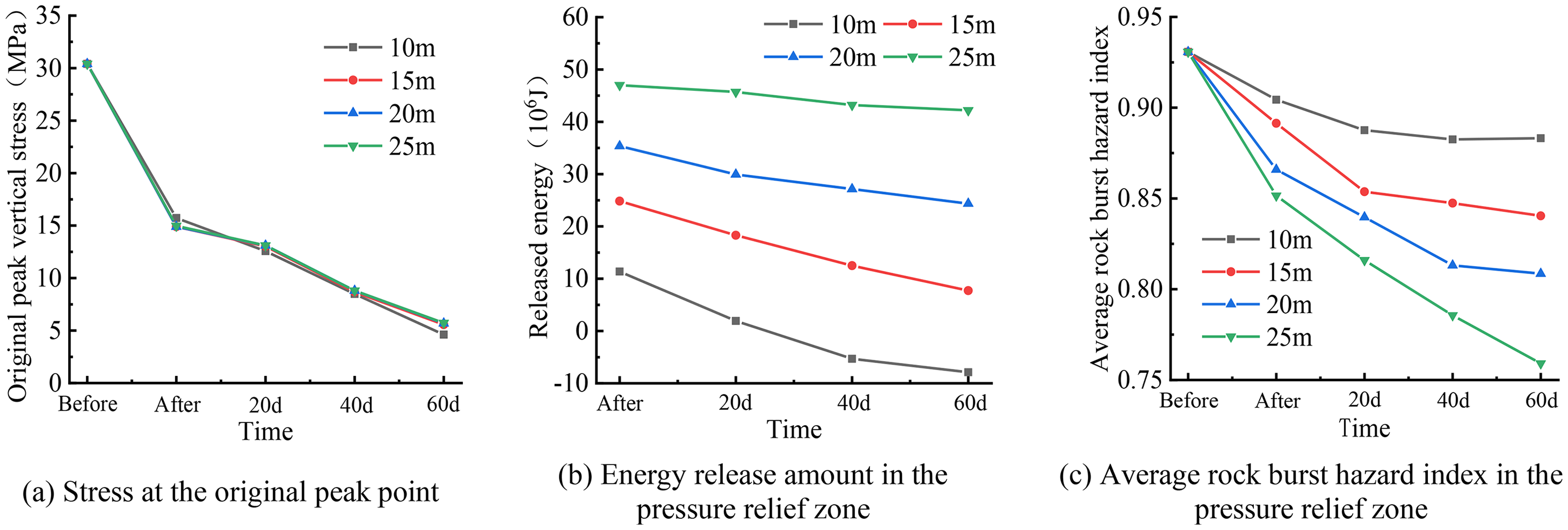
Stress and energy evolution in pressure relief zones with different depth boreholes: (a) stress at the original peak point; (b) energy release amount in the pressure relief zone; (c) average rock burst hazard index in the pressure relief zone.
In contrast to the stress reduction process, borehole depth significantly influences the energy release process within the pressure relief zone. To examine the effect of borehole depth on the energy regulation of the roadway rib, a statistical energy analysis was conducted on the coal mass surrounding the borehole within a 25 m radius of the roadway rib under various borehole depth conditions. During the instantaneous pressure relief stage, greater borehole depths correlate with a higher amount of energy released from the roadway rib. For instance, the energy release at a borehole depth of 25 m is approximately 4.3 times greater than that at a depth of 10 m. Upon entering the creep-induced pressure relief stage, the energy release trend begins to diverge. With an increased borehole depth, a significant amount of energy continues to be released; however, the incremental energy released during each specific time interval gradually decreases over time. For instance, during both the instantaneous and creep-induced pressure relief stages, the incremental energy release amounts for a borehole depth of 25 m remain consistently above 40 MJ within each specific time interval. Conversely, as the borehole depth decreases, the energy release rate during the creep-induced pressure relief stage gradually declines. Notably, at a borehole depth of 10 meters, energy release ceases after 20 days of creep, resulting in energy re-accumulation, which manifests as a negative energy release amount. This phenomenon indicates a failure in the borehole pressure relief process, as the creeping coal rapidly closes the shallow borehole and restores its load-bearing capacity.
The variation of the rock burst hazard index in the roadway rib is closely related to the energy release dynamics. Under conditions of large-depth boreholes, the rock burst hazard index of the roadway rib consistently decreases, reaching values of 0.852 and 0.759 during the instantaneous and creep-induced pressure relief stages, respectively, for a 25 m deep borehole. In contrast, when the borehole depth is relatively shallow, the energy released is limited, leading to a minor instantaneous reduction in the rock burst hazard index due to borehole pressure relief. Additionally, the decreasing trend of the rock burst hazard index during the creep-induced pressure relief stage is significantly diminished. For instance, with a borehole depth of 10 m, the rock burst hazard index remains relatively stable at approximately 0.88 after 20 days of creep. Consequently, insufficient borehole depth not only restricts the instantaneous pressure relief effect but may also contribute to energy re-accumulation during the subsequent creep stage, ultimately diminishing the overall pressure relief efficacy. Increasing the borehole depth appropriately can facilitate a continuous reduction in the rock burst hazard during both the instantaneous and creep-induced pressure relief stages, thereby enhancing the pressure relief and rock burst prevention outcomes.
Field monitoring of borehole pressure relief effect
Monitoring method
The borehole pressure relief effect in the roadway rib is closely related to the degree of fracture development. An increase in the number of fractures correlates with a decrease in the wave velocity of the coal mass. Consequently, the borehole pressure relief effect can be indirectly assessed by monitoring the wave velocity information within the roadway rib.
The electromagnetic wave computed tomography (CT) method serves as an effective technical approach for detecting and evaluating the rock burst hazard associated with the local surrounding rock. This technique employs electromagnetic waves as tools for detection and analysis. Based on the propagation characteristics of electromagnetic waves in coal seams, the absorption coefficient of the detection area is determined by analyzing the field strength received at various positions. Subsequently, this allows for the derivation of fracture development and the distribution of the rock burst hazard index within the borehole pressure relief area. According to the research conducted by Liu et al. (2019), the expressions for the rock burst hazard index using the electromagnetic wave CT method are presented as follows:


In the equations, D represents the rock burst hazard index, while BI denotes the absorption coefficient anomaly index, and GI signifies the absorption coefficient gradient index. The parameters a and b are weight coefficients, both of which can be assigned a value of 0.5.
The absorption coefficient anomaly index BI represents the degree of fracture development.
Monitoring scheme
The 6311 working face of the Shandong Tangkou Coal Mine is situated on the southwest side of the auxiliary track roadway in the No. 6 mining area. Approximately 465 m to the northeast lies the goaf of the 5308 working face, while 5 m to the southeast is the goaf of the 6310 working face. The F14 fault is located on the west side, and the south-wing auxiliary roadway of the No. 6 mining area is positioned to the northwest, with an unmined solid coal area to the south. The maximum burial depth of the working face reaches 956.5 m. Notably, the coal seams directly above and below have not been mined, indicating the absence of a goaf. Borehole pressure relief is employed as the primary method for preventing and controlling rock bursts.
To detect and analyze the evolution of the pressure relief effect in the roadway rib following drilling under creep action, electromagnetic wave CT was utilized to assess the wave velocity field information of the coal mass before and after pressure relief. Prior to mining the working face, an electromagnetic wave CT detection area measuring 20 m in length was established in the 6311 belt entry, 300 m from the setup room. Four large-diameter pressure relief boreholes, each with a diameter of 150 mm, were drilled within the detection area, spaced 4 m apart and extending to a depth of 20 m. The layout of the detection area is illustrated in Figure 7. Due to hole collapse shortly after the construction of the detection holes, the depths of the transmitting and receiving detection holes were adjusted to 10 m and 7 m, respectively. In the detection area, electromagnetic wave CT detection of the roadway rib was conducted before drilling, immediately after drilling, and 10 days post-pressure relief to investigate the evolution of the rock burst prevention effect of large-diameter boreholes under creep action.
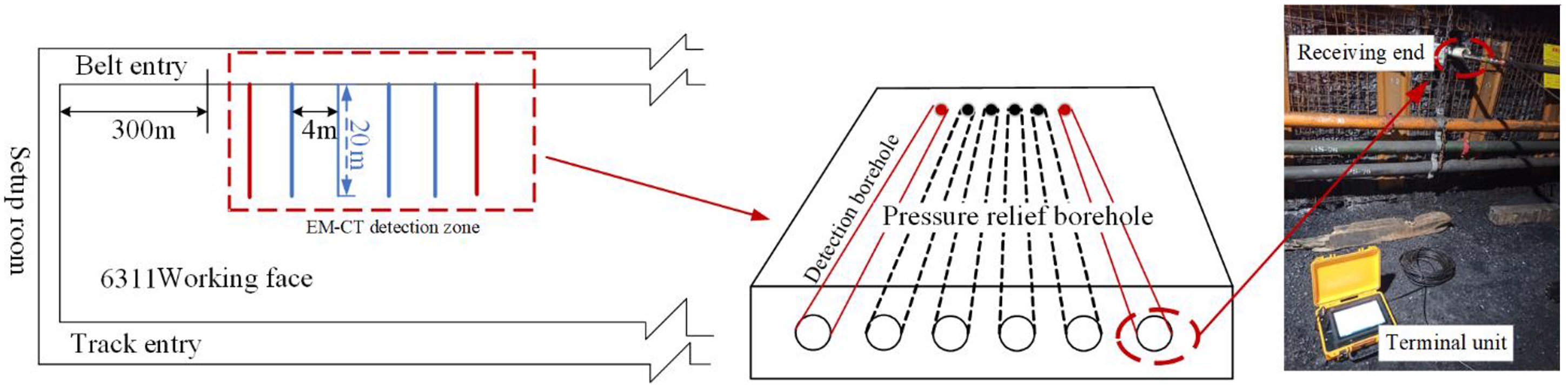
Layout of the electromagnetic wave CT field test.
Result analysis
The evolution of the absorption coefficient anomaly index and the rock burst hazard index in the detection area is illustrated in Figure 8. Prior to borehole pressure relief, the absorption coefficient anomaly index within the range of 0 to 5 m from the coal wall is relatively high, indicating significant fracture development within the coal mass, which corresponds to the plastic zone. In the 8 to 10 m range, the absorption coefficient anomaly index approaches or falls below zero, while the rock burst hazard index exceeds 0.25, categorizing this region as a weak rock burst hazard zone. Following the construction of large-diameter pressure relief boreholes in the test area, fractures in the coal mass develop rapidly within a short time due to the original stress concentration. The absorption coefficient anomaly index in the 6 to 10 m range rises above 0.15, and the rock burst hazard index in this area correspondingly decreases, with most values dropping below 0.15. Only a localized weak rock burst hazard zone remains within the 8 to 10 m range. Ten days after borehole pressure relief, in conjunction with the creep deformation of the coal mass, the absorption coefficient anomaly index within the 3 to 10 m range generally exceeds 0.15. The degree and extent of fracture development within the coal mass are further enhanced, leading to an additional release of stored energy within the pressure relief zone formed in the roadway rib. Consequently, the rock burst hazard index across the entire detection area is less than 0.25, indicating a non-rock burst hazard zone.

Results from electromagnetic wave CT detection: (a) evolution contour of absorption coefficient anomaly index; (b) evolution contour of rock burst hazard index.
Numerical simulations and field tests demonstrate that large-diameter borehole pressure relief in coal seams exhibits significant time-dependent characteristics, particularly in strongly creeping coal masses under deep, high-stress environments. Therefore, for deep mining roadways, the optimal pre-relief distance should be reasonably determined based on the parameters of the pressure relief boreholes, the stress environment, and the mechanical properties of the coal mass. This approach ensures the full utilization of both instantaneous and creep-induced pressure relief functions, thereby enhancing the efficacy of borehole pressure relief in preventing rock bursts.
Conclusion
(1) The borehole pressure relief effect in deep creeping coal masses exhibits pronounced time-dependent characteristics, which can be categorized into two distinct stages: instantaneous pressure relief and creep-induced pressure relief. During the instantaneous pressure relief stage, the stress within the coal mass experiences an abrupt decline. Conversely, in the creep-induced pressure relief stage, the propagation of the plastic zone facilitates a continuous decrease in both stress and stored energy within the pressure relief zone. However, as the duration of creep increases, the rates of stress reduction and energy release begin to decelerate. After 60 days of creep, the amount of energy released and the reduction in the rock burst hazard index at the original peak stress point are 2.49 times and 1.06 times greater than those observed during the instantaneous pressure relief stage, respectively. This finding underscores the significant continuous enhancement effect of coal creep on pressure relief.
(2) Furthermore, the parameters of coal mass boreholes exert a considerable influence on the evolution of the pressure relief effect. An increase in borehole diameter and depth, accompanied by a decrease in borehole spacing, leads to a gradual acceleration in the rates of stress reduction, energy release, and the reduction of the rock burst hazard index during the creep-induced pressure relief stage. Consequently, both the efficiency enhancement rate and the overall effectiveness of pressure relief are markedly improved. Insufficient borehole depth may result in energy re-accumulation within the coal mass during the later stages of creep. Therefore, appropriately increasing borehole depth is essential to ensure a continuous reduction in the rock burst hazard of the coal mass throughout the creep-induced pressure relief stage.
(3) Field electromagnetic wave CT monitoring reveals the evolution of the pressure relief effect in creeping coal masses following drilling. After borehole construction, the coal mass enters an instantaneous pressure relief stage, during which fractures develop rapidly and the area of the rock burst hazard zone decreases swiftly. Subsequently, it transitions into the creep-induced pressure relief stage, where fractures continue to propagate over time, the absorption coefficient anomaly index generally increases, and the risk of rock bursts is significantly reduced.
Footnotes

Funding
The authors disclosed receipt of the following financial support for the research, authorship, and/or publication of this article: This work was supported by the Youth Innovation Technology Project of Higher School in Shandong Province, Key Research and Development Project of Shandong Energy Group, Project of Taishan Scholar in Shandong Province, (grant number 2023KJ093, SNKJ2025A01-1-R02, Grant No. tstp20221126).
Declaration of conflicting interests
The authors declared no potential conflicts of interest with respect to the research, authorship, and/or publication of this article.