




Abstract
Electric vehicle technology has recently drawn a lot of interest on a global scale due to improved performance in its efficiency and the capability to solve the problems of carbon emission. As such, electric vehicles are the key to achieving sustainable development goals. This review article analyzes deeply the previous technical developments of electric vehicles, focusing on important topics like battery management systems, technologies of power electronics, techniques of charging, and the relevant algorithms and improvements. In addition, several critical problems, and difficulties are presented in order to pinpoint the gaps in the literature. To address the analysis of battery behavior, battery condition monitoring, real-time control design, temperature control, fault diagnostics, and efficiency of battery model are considered. This study highlighted the estimation techniques that predict the internal battery conditions such as internal temperature, state of health, and state of charge, which are difficult to be directly monitored and determined. A lithium-ion battery, a super-capacitor, and related bidirectional DC/DC converters constitutes the infrastructure of a hybrid power system. This review offers useful and practical recommendations for the future development of electric vehicle technology which in turn help electric vehicle engineers to be acquainted with effective techniques of battery storage, battery charging strategies, converters, controllers, and optimization methods to satisfy the requirements of sustainable development goals. Accordingly, this review article will be a platform and future guide for those who are interesting in the field of energy management and its development.
Keywords
Introduction
Over the past few years, electric vehicles attracted lots of interest. In the USA, an electric vehicle (EV) for road transportation was initially attempted in 1834 (Smit et al., 2018). The utilities also take into account pollution emissions as a result of fossil fuel use. Carbon oxides, sulfur oxides, and nitrogen oxides (NOX) are three types of pollutants that make up fossil fuels, which include petroleum, coal, and natural gas (Rahmat et al., 2016). In an effort to replace the complex and polluting internal combustion engines, more steps were required to develop improved storage and management systems and more efficient motors. Pure EVs adopt a number of advantages, including more streamlined and dependable infrastructure, up to 10 times less expensive transportation, and full power available over the entire revolution per minute range, also it has less frequent and less expensive maintenance, and subsidies that reduce taxes.
Despite the availability of alternative technologies like “Plug-in Hybrid Electric Vehicles” (PHEVs) and fuel cells, pure EVs offer the highest levels of efficiency and power production (Plötz et al., 2021). PHEV is a hybrid EV that has a larger battery capacity, and it can be driven miles away using only electric energy (Ahmad et al., 2014a, 2014b). It has many benefits over conventional internal-combustion engine (ICE) vehicles, but because the battery capacity is larger, it must be recharged from utility energy as a result, it has had higher popularity in recent years (Ahmad et al., 2014a, 2014b).
A battery is a type of electrical energy storage device that has a large quantity of long-term energy capacity. A control branch known as a “Battery Management System (BMS)” is modeled to verify the operational lifetime of the battery system pack (Pop et al., 2008; Sung and Shin, 2015). For the purposes of safety, fair balancing among the cells of the battery package has to be under instantaneous supervision. The utilization of BMS will provide a robust system infrastructure and prevent repeated repair actions. The BMS also paves the way to control the system temperature which has a direct impact on the profile of power consumption (Gabbar et al., 2021). The BMS unit is the essential part of the EV system which provides the following advantageous: features health monitoring of battery voltage, current, temperature, and state of charge (SOC), and achieving voltage balance among battery cells (Buccolini et al., 2016).
Any battery-based EV needs an energy management system (EMS) and control to achieve better performance in efficient transportation vehicles. This requires a sustainable flow of energy from the energy storage system (ESS) to the vehicle's wheels as demanded. In addition, an effective EMS can help to increase the driving range of EVs and to control quick discharge that happens during acceleration or a sudden change in speed. An effective EMS was designed based on the StateFlow approach for grid-connected NanoGrid composed of a photovoltaic (PV) array with a battery bank and super-capacitor ESS (Imad et al., 2023). The EMS is responsible for regulating EV charging and it participates in the electricity market as illustrated in Figure 1. The EVs also need an effective EMS to handle problems with the hybridization of energy sources. It may have the following features: high peak power usage, energy storage while braking, and long battery life (Sankarkumar and Natarajan, 2021).
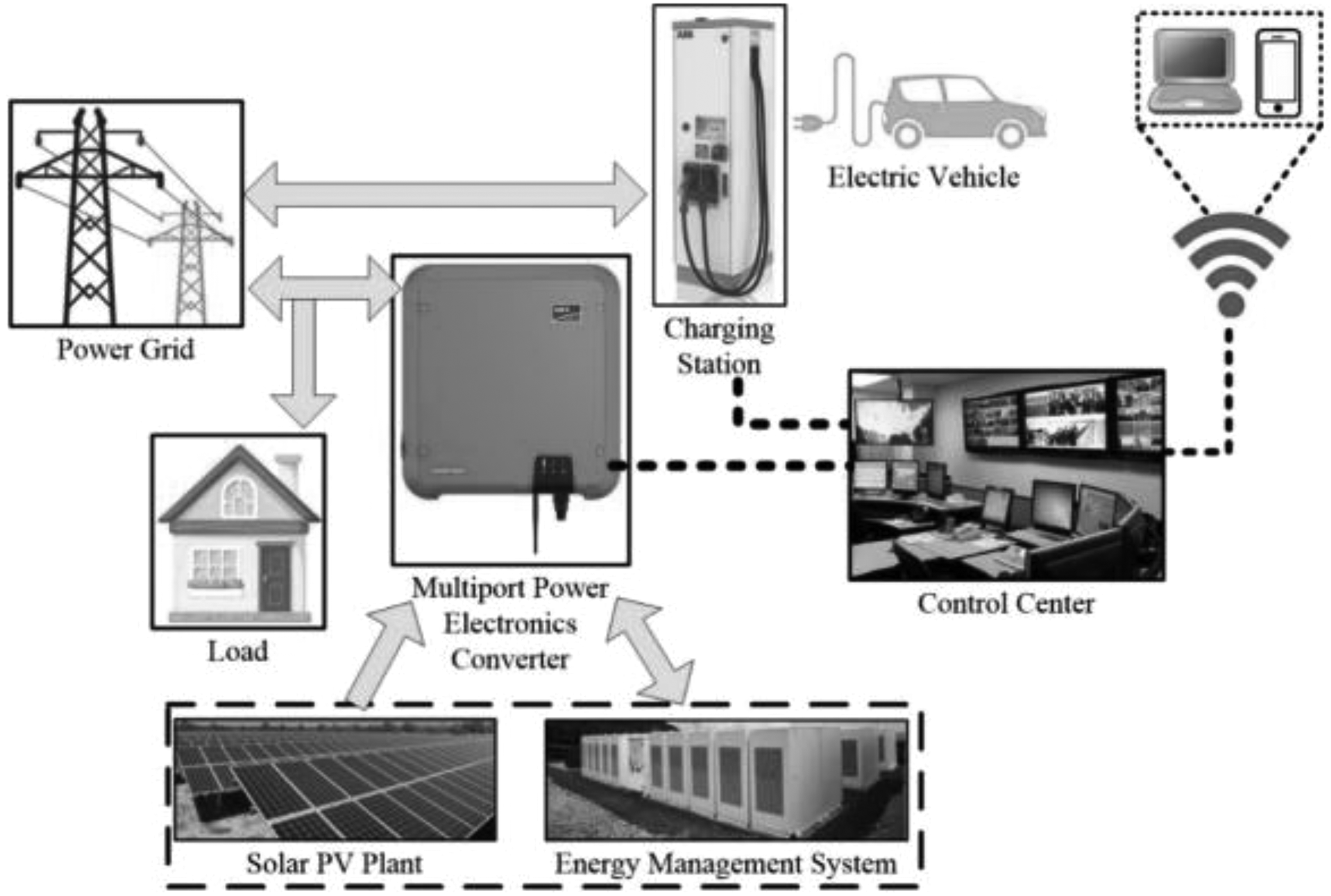
Energy management system for regulating the electric vehicle (EV) charging (Ha et al., 2019).
Numerous EMS strategies have been used to address the issue of the power division in battery combinations (Aruna and Vasan, 2019). Predictive planning and scheduling will extend the life and improve the energy efficiency of EVs by optimizing the maintenance procedures. Data storage and power exchange between motor controllers, batteries, and sensors for monitoring battery conditions are among the required technologies. The parameter setting is an essential part of production cost. The higher energy density is made possible by increasing the accuracy of parameters which in turn leads to lower kWh production costs. Moreover, by using smart inline quality management, battery aging can be reduced by up to 80%. This precise analytical method allows customers to detect the micro-short circuits in each cell without using any physical measures. The security issue is a very critical problem to be solved in order to prevent cyber-attacks taking into account the reliability issues. In battery-based vehicles, ideal power distribution and EMS work to reduce energy usage and to increase the battery life-time (Sakhdari and Azad, 2015).
This article presented a detailed overview of energy and BMSs for EVs and technologies used in EVs, as shown in Figure 1. The article outlines emerging technologies, such as recharging batteries, and battery types in EVs with their applications. The tabulation of common battery types with their fundamental construction elements used in EVs is presented. Existing methods and key technologies for BMS are explained by estimating the battery state studies. The current trends in EV manufacturing, recent gaps, and further potential are presented.
Recharging battery
Restoring the electrical energy that has been lost from the electric grid is necessary while charging a battery. The effectiveness of the charging process has a significant impact on the battery’s health and its life-time. The local distribution grid is impacted by uncontrolled EV charging in terms of harmonic distortion, power loss, grid unbalance, and transformer life decrease. These issues have been addressed by many research projects that have suggested various EV charging control approaches (Al-Ogaili et al., 2019). Thus, battery chargers are essential to assess the durability and effectiveness of recent industrial batteries in order to meet the needs of the battery's charging. An electrical or electronic device known as a battery charger is required to regulate output DC voltage from incoming AC line voltage (Brenna et al., 2020). Due to the increasing demand for EVs and renewal energy applications, rechargeable batteries are required with a long lifespan, and continuous and steady supply of power (Hannan et al., 2017). The EV has applied a variety of energy storage systems including lead acid, nickel-metal hydride (NiMH), and “lithium-ion” batteries (LIBs) (Liu et al., 2022). The LIB is the most widely used due to its high density of energy, excellent reliability, and high efficiency (Hussain et al., 2021; Liu et al., 2019). Due to the benefits of LIBs, many attempts have already been made to strengthen their stability and durability (Ravi, 2021). Despite having a high initial cost, the market for LIBs has been growing steadily and it is anticipated to be available largely in the future (Iclodean et al., 2017). LIBs have increasingly dominated in portable electronics with stationary energy storage. The fundamental drawback of battery technologies based on lithium is that they have far lower energy densities as compared to modern LIBs like sodium-ion batteries. Lead-acid and nickel–cadmium (NiCd) batteries are two examples of this technology. The lithium-metal batteries, particularly solid-state battery, is the most promising and rapidly evolving technology, which provides considerable energy density and a wide driving range of EVs (SSBs), To achieve the demands for long-life, fast charging, and affordability, this technology has to be research focused and developed (Liu et al., 2022).
Types of batteries and major BMS technologies
In order to maintain the safe and trustworthy operation of batteries, the usage of BMS in EVs allows for more efficient operation by monitoring and controlling how rechargeable batteries are charged and discharged (Liu et al., 2019; Ravi, 2021).
Battery types in EVs
The important of BMS technology is addressed in this part along with typical types of batteries. A variety of battery types can be used as power sources in EV applications. Batteries are often split into two groups based on how easily they can be recharged: primary and secondary batteries (Sundaram and Nanjan, 2022). The primary battery can only be used once, while the secondary battery can be recharged after being entirely used. For use in EV and HEV applications, the secondary battery must have a high power density and little energy loss. Lead acid, NiMH, Ni–Cd, and lithium-ion (Li-ion) are the most popular EV battery types. Some of the key characteristics of these popular battery types are illustrated in Table 1 (Hanifah et al., 2015; Iclodean et al., 2017; Sundaram and Nanjan, 2022). Lead acid batteries work worst for power more than 100 W/kg, while NiMH and LIBs can perform best up to 1000 and 3000 W/kg, respectively. Batteries made of nickel and zinc have lower cell voltages than LIBs, which have greater cell voltages. Lead-acid and NiMH batteries, on the other hand, provide the worst performance in terms of life cycles. The lithium batteries can support up to 3000 cycles. Accordingly, the current EVs utilize Li-ion technology as their powering batteries since they provide the best performance across nearly all categories (Sanguesa et al., 2021).
Common battery types used in EVs (Hanifah et al., 2015; Iclodean et al., 2017; Sanguesa et al., 2021; Sundaram and Nanjan, 2022).
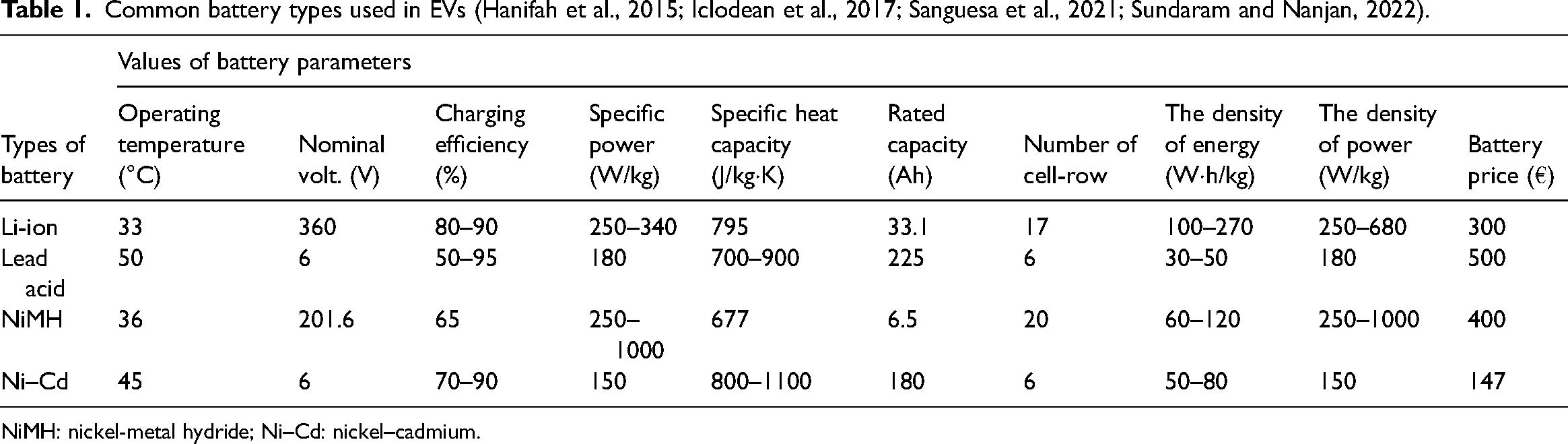
NiMH: nickel-metal hydride; Ni–Cd: nickel–cadmium.
Tables 1 and 2 list the common types of batteries used in EVs, their fundamental construction elements, benefits, and drawbacks. The operating temperatures of batteries are taken into account when conducting comparisons among the technologies. Batteries might be rejected due to the limit of their temperatures. Since they can withstand loading temperatures up to 20 °C, lead-acid and lithium batteries are the best temperatures in this regard, whereas LIBs suffer significant capacity loss at low temperatures due to self-discharge. Actually, 40 °C is the recommended operating temperature for this type of battery.
Common battery types with their fundamental construction elements, benefits, and drawbacks (Un-Noor et al., 2017).
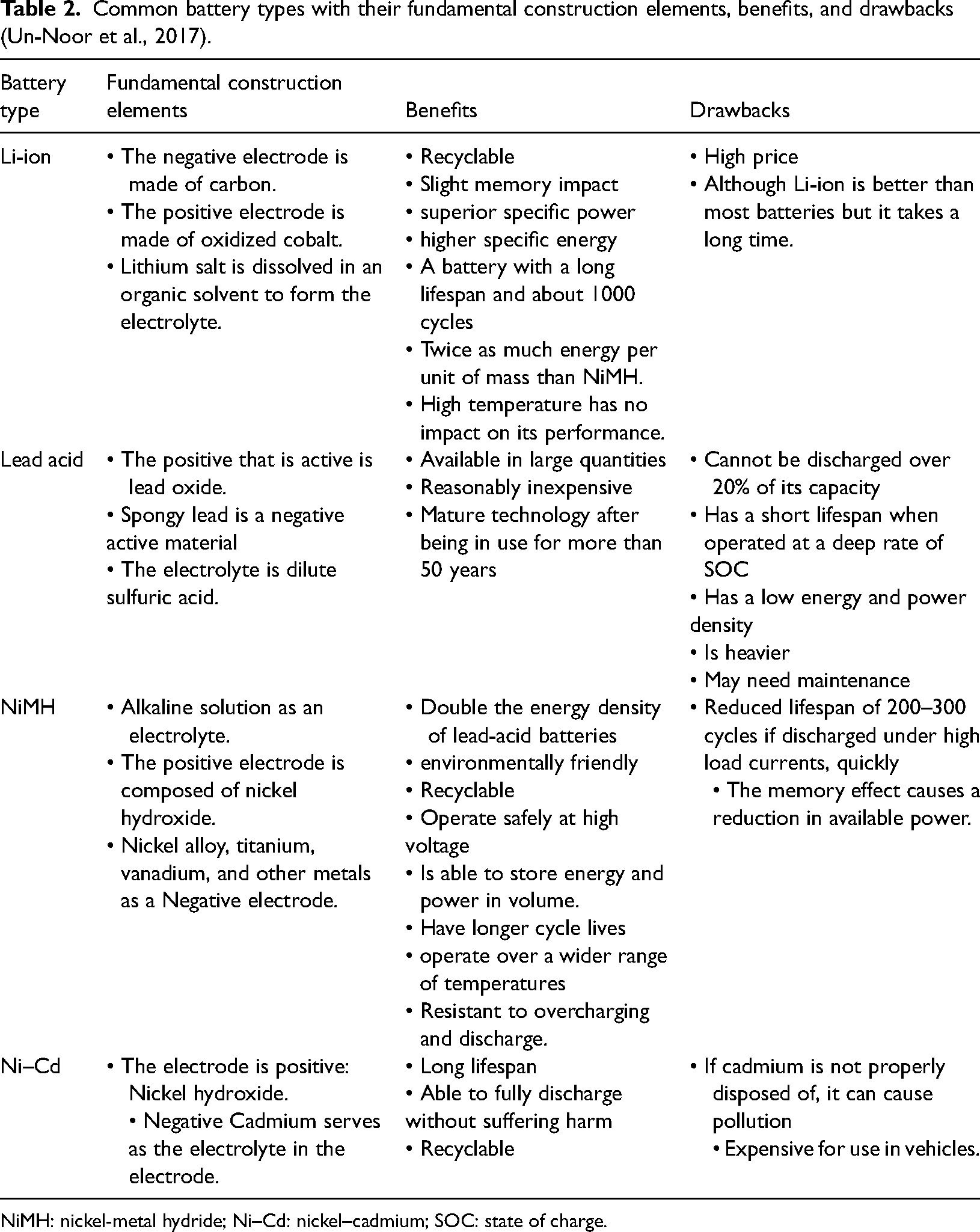
NiMH: nickel-metal hydride; Ni–Cd: nickel–cadmium; SOC: state of charge.
Existing methods and key technologies for BMS
The controller supporting BMS could save the battery package from excessive short-circuit current and voltage stress, and battery charging. Figure 2 shows the interconnections between important technologies. In EV applications, onboard sensors are used for current and voltage measurements, while other sensors or thermocouples are utilized for monitoring the values of temperature on the surface of the battery pack (Liu et al., 2019). Moreover, any abnormal conditions in the battery will be sensed and detected by safety control modules. Battery modeling, state estimation, and battery control constitutes the keys of BMS techniques, which have greatly flourished in the context of BMS/EV design.
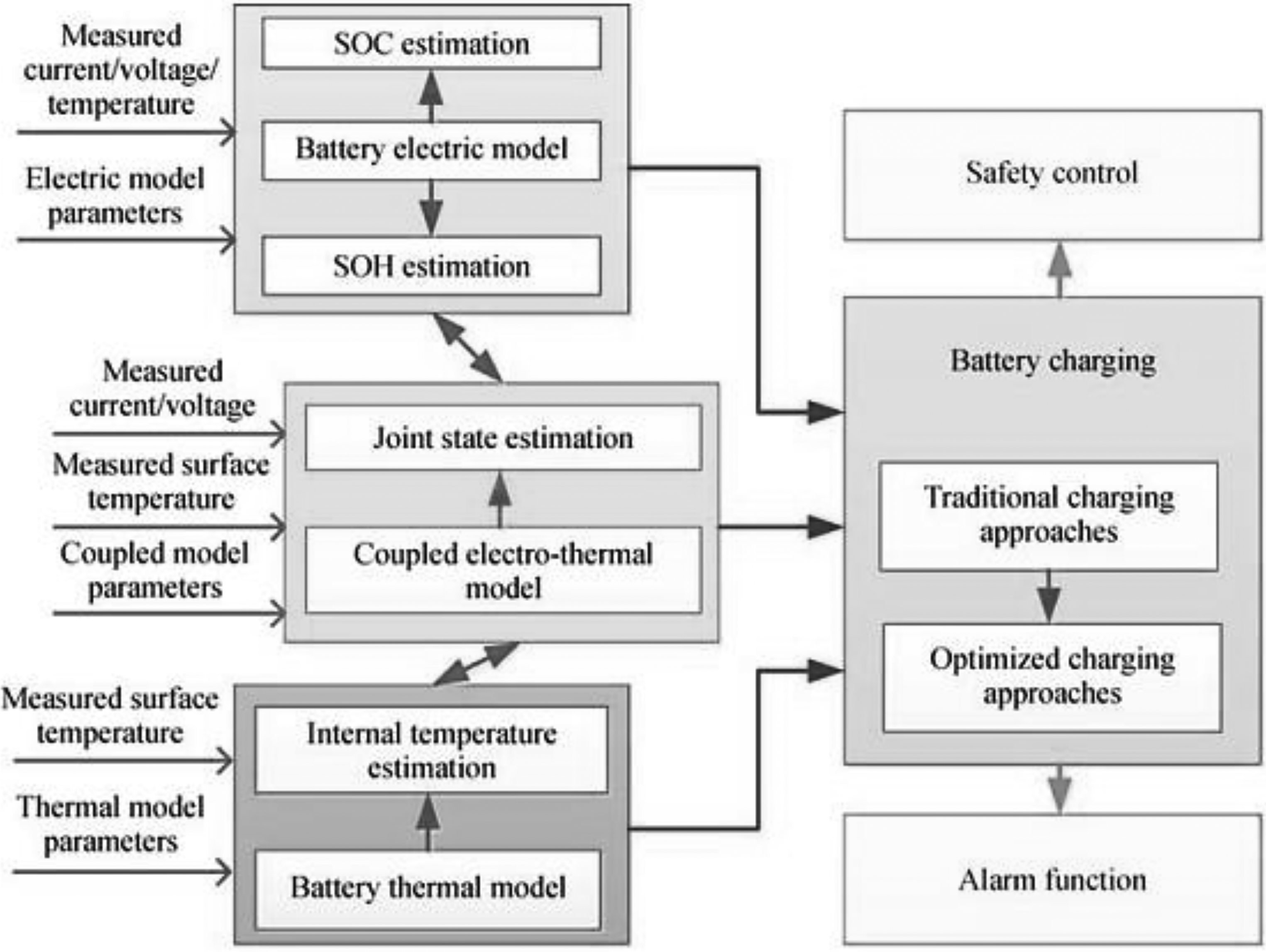
Shows the connections between the battery management system’s (BMS's) main technologies (Liu et al., 2019).
The BMS could help in solving the challenging problems related to regulating the temperature of the battery pack and controlling the charging and discharging cycles. The BMS saves the battery against excessive voltage-stress, and short-circuit current by employing the designed controller and supported sensors (Hannan et al., 2018). Accordingly, the main functioning units of the BMS scheme used in EV technology are presented.
Monitoring of battery cells
Typically, the EVs use a pack of battery cells. To achieve the BMS tasks in a proper manner, a monitoring strategy is required to achieve the diagnosis task and to observe the states of the battery such as temperature, health, charging and discharging status, and the responses of the battery between the charging and discharging conditions. The performance of the BMS can be enhanced by supporting some processes such as managing, securing, balancing, controlling, and monitoring batteries (Affanni et al., 2005; Lipu et al., 2020; Vincent and Marco, 2020; Vincent et al., 2021; Wang et al., 2016).
Measurement of voltage and current
The batteries are either connected in parallel or in series to supply the required amount of voltage and current. In EVs, hundreds of cells are used in the battery pack and they are connected in series connection to provide the necessary power. Accordingly, a large number of voltage-measuring channels are created in the battery packs of electric vehicles. There is accumulated potential present when a cell's voltage is measured, and each cell's combined potential is unique. In order to increase the autonomy EV, an appropriate and moderate charge must be provided for the battery cells (Alvarez-Diazcomas et al., 2020). The estimate of SOC and other battery states requires a precise measurement of the battery cell. The voltage divider technique is one of the popular methods in monitoring cell voltage, which is based on precise voltage reference and resistor. Other techniques can use distributed measurement, and different electronic components like discrete transistors, optical coupling relays, and optical coupling isolation amplifiers (Gan et al., 2017). The battery module current is monitored by high-voltage current sensors. The digital form of an analog signal can be transformed into a digital form utilizing an analog-to-digital converter. Based on voltage and current measurements, the SOC, state of health (SOH), and remaining useful life (RUL) are then accurately estimated and determined (Hou et al., 2017).
Data acquisition
The data acquisition system (DAS) is an essential part of the BMS, which is responsible for obtaining the data converted by the ADC module. The properties of the battery pack, including SOC, temperature, voltage, and current, are measured and estimated based on the DAS. This makes it easy to assess the current condition of the battery condition and to diagnose the faults of cells. Additionally, other information can be acquired by DAS such as battery aging, climate, and other variables. To exchange data with the BMS, a controlled area network bus and BMS DAS platform in the cloud are required as indicated in Figure 3 (Lelie et al., 2018; Meah et al., 2020; Svendsen et al., 2014; Yang et al., 2021).
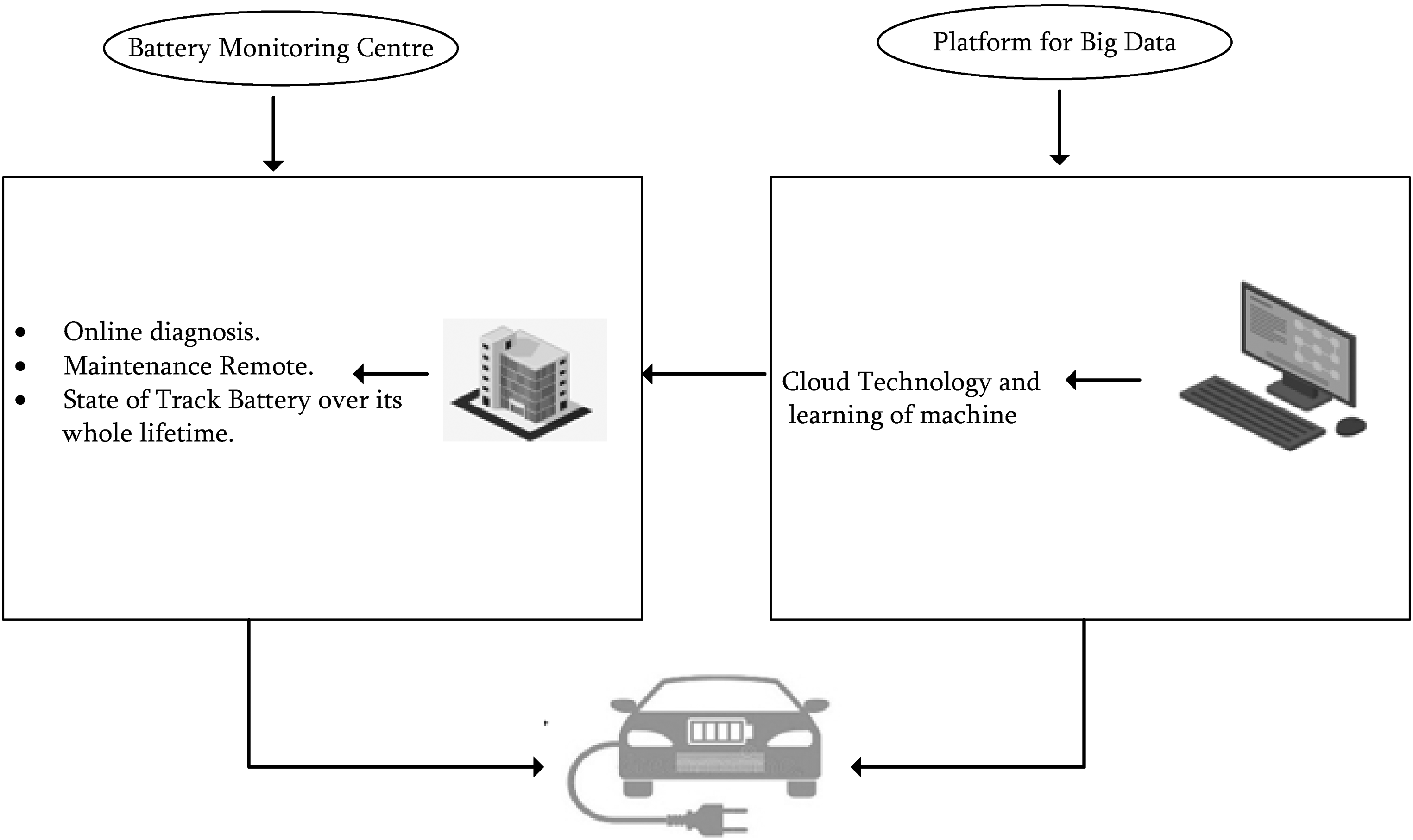
Shows an EV data-collecting framework based on a BMS and integrated with the cloud (Lipu et al., 2022).
Estimating the battery state
Determining the charge and health of the battery requires an indicator to be setup and evaluated. The status of the battery can be expressed by the following indices (Hu et al., 2019; Maures et al., 2022):
State of charge (SOC). The SOC represents the ratio of maximum capacity to the current capacity of the battery. The correct SOC assessment is necessary for optimal levels of energy management as well as battery protection against sudden changes. As the state cannot be measured directly from terminals, a mechanism must be developed to estimate it from measured data (Hannan et al., 2020, 2021; Hu et al., 2019; Kalikatzarakis et al., 2018). The techniques used in estimating the SOC include the Kalman filter (KF), machine learning (ML), discharge test method, neural network method, fuzzy logic method, impedance method, and internal resistance method. However, one of the most common methods to compute the SOC is the ampere-hour (Ah) and open-circuit voltage (OCV) methods (Dong et al., 2016; Lipu et al., 2020; Xiong et al., 2020). The Ah approach becomes a straightforward method for SOC computation since the charging or discharging current can be easily measured. In spite of high estimation accuracy, the “open-circuit voltage” method adopted in EV degrades due to an extended resting period (Zhang and Fan, 2020). The method based on KF for estimating SOC is characterized by high efficiency in spite of complex mathematical calculations (Rzepka et al., 2021). Due to their high accuracy, enhanced learning capacity, “higher generalization performance,” and quick convergence, ML and “deep learning algorithms” for SOC estimates have recently attracted a lot of interest (How et al., 2020). State of health (SOH). Understanding the capacity deterioration and battery internal resistance makes it simple to determine the SOH. It can be defined as the remaining maximum amount of capacity after the charge–discharge cycle (Lin et al., 2022). Three approaches have been developed for predicting the battery SOH, represented by model-free, model-based, and data-driven methods (Lipu et al., 2018). In comparison to direct methods, electrochemical impedance spectroscopy analysis is significantly more practical for calculating capacity and internal resistance in a model-free manner (Galeotti et al., 2015). Model-based techniques, on the other hand, use electrochemical and equivalent circuit models to predict the capacity and internal resistance of batteries. Similar to this, the data-driven technique measures the terminal voltage, current, and temperature. To calculate the SOH, use the following equation: Remaining useful life (RUL). Battery RUL affects the accuracy and performance of EVs. Continuous charging and discharging of the battery cause capacity degradation, which can have unfavorable effects like significant failure, financial loss, and safety concerns (Ansari et al., 2021a, 2021b; Lipu et al., 2021). Therefore, it is essential to calculate the battery RUL in order to ensure accurate, reliable, durable, and safe operation of EV technology. The RUL of the battery has been predicted using a variety of model-based and data-driven methods. Model-based techniques rely on intricate experiments and mathematical models, but they need a lot of data to determine the battery degradation trend. Data-driven approaches, on the other hand, rely on previous battery data that includes a variety of parameters, including voltage, current, impedance, capacity, and temperature. Data-driven techniques do not depend on complex mathematical models and they can determine the battery RUL based on previous and present data of the battery (Ansari et al., 2021a, 2021b). State of function (SOF). The SOF is defined as the battery capacity to finish an assigned duty. It describes how well the battery performed in terms of supplying the required amount of power. The SOF is defined as the ratio of the battery's usable energy to its maximum stored. The SOC, SOH, and temperature are the main measurements to estimate the SOF. Several techniques, such as fuzzy logic control, equivalent circuit models, and (adaptive) characteristic maps (Wang et al., 2019b), can be employed to establish the SOF. The parameters required for the characteristic-maps method are the SOC, power pulse duration, power, and voltage. Additionally, the KF method and artificial neural network algorithms are among the most model-based techniques for obtaining precise estimation of SOF. The fuzzy logic approach is used to predict the battery SOF and also takes into account the battery's SOC, SOH, and C-rate factors (Gan et al., 2017; Lai et al. 2022; Ouyang et al., 2020; Wang et al., 2019b).

BMS topologies
The BMS can be used to measure several battery characteristics, including temperatures, cell- and module voltages, and currents. The BMS also measures other properties such as SOC, SOL, SOP, and SOH (Xing et al., 2011). Gauge sensors discharging current are utilized to determine these criteria of the battery's charging. The aim of BMS is to maintain the safe, dependable, and efficient operation of batteries in all operating states (Ali et al., 2019). Accordingly, the BMS is composed of a number of modules, and sensors. Battery-based EVs and Hybrid EVs typically apply one of the following four BMS topologies.
Four BMS topologies:
Centralized: This architecture utilizes a single-channel connection to each battery module to collect and analyze data on a single module. On the other hand. Decentralized: This architecture uses distributed and modular sub-architectures. The commercial BMS adopts a decentralized modular fashion. Modular: The modular design consists of a master module connected to a number of slave modules. The master module adds up all of the measurements from each measuring module and evaluates the various states from them. The slave modules keep track of the temperatures, currents, and voltages at each battery module. Distributed: A main processing unit and a number of measurement units are also used to construct architectures (slaves). Unlike modular architecture, each battery cell is managed by a separate slave. Therefore, this topology frequently costs more than the others (Dai et al., 2021; Messier et al., 2018).
For each portion of a battery module, companies of produced batteries employ a single master (string) which interacts with various systems and clients as a computing unit. It provides measurements of data to other components and conducts them on how to proceed. As a result, the BMS is currently functioning as an ECU (Santeramo, 2019; Zebrowski, 2022).
Battery modeling
To replicate the general behaviors of a LIB, four levels of modeling must be considered. These levels can be represented by the following electrical, thermal, and battery-coupled models (Mesbahi et al., 2017):
Battery electric model (fast level) Thermal model (intermediate level) Battery coupled model Aging model
These three types all operate in a single loop. Thermal modeling is required to evaluate battery temperature, electrical modeling is needed to provide voltage variation and SOC during battery operation. The electrical model calculates the heat production based on joule losses; therefore, the thermal model is related to it. The aging model is another representation, that addresses how the operating conditions will affect battery lifetime. In this model, the battery impedance is initially variable depending on temperature and aging (Mesbahi et al., 2016).
Battery electric model
The electrochemical model is one of the four primary groups of battery-electric models (Mastali et al., 2016; Rahman et al., 2016; Sung and Shin, 2015; Yang et al., 2017), reduced order model (Bartlett et al., 2015; Han et al., 2015; Yuan et al., 2017; Zou et al., 2015), equivalent circuit model (Nejad and Gladwin, 2016; Widanage et al., 2016; Zhang et al., 2015), data-driven model (Deng et al., 2016; Gong et al., 2015; Wang et al., 2017). The electrochemical model for batteries should include the electrode potential for each phase, the Bulter-Volmer kinetic to control the intercalation process, and the spatiotemporal dynamics of battery concentration (Rahman et al., 2016). Optimization techniques like the particle swarm optimization (PSO) method can be applied to improve important model parameters, where the electrochemical model is constructed to replicate the electrochemical behaviors of batteries. The electrochemical model showed a very high prediction capability, but it requires a significant amount of computational work (Sung and Shin, 2015). Then, the BMS is integrated with the electrochemical model. The ability to have a fairly accurate description of electrochemical processes taking place inside the battery is the core advantage of using the electrochemical model. However, real-time applications practically prohibit the identification of a number of electro-chemical properties related to battery-like chemical compositions. The complexity of these electrochemical models also adds computational costs due to the need to solve several partial differential equations. By conducting certain assumptions, reduced-order models can approximate full-order electrochemical models. A physical-based electrochemical model can be established by approximating the distribution of the battery electrolyte concentration and solid phase diffusion. Han et al. calculated the SOC of LIBs (Han et al., 2015). A reduced-order electrochemical model for LiFePO4 batteries was developed by Zou et al. to predict the discharging capacity under various conditions (Zou et al., 2015). The reduced-order battery model can be then used to perform a reliable SOC estimation. The resulting simpler reduced-order models can lose some information; however, they are still preferred for real-time battery applications. The acquired current and voltage measurements can be used to determine the necessary parameters and reduced-order models with much lower computing costs. Equivalent circuit models have been developed to represent the electric behavior of batteries using a variety of circuit components, such as resistances, capacities, and voltage sources. The performance of battery data-driven models is significantly influenced by the test data and training techniques. In order to obtain an acceptable level of model accuracy and a high degree of generalization, the training variables methods should be accurately calibrated, and a test result should cover a significant variety of battery operation ranges. Moreover, the outcomes of battery modeling can be improved by applying adaptive data-driven methods (Li et al., 2016; Sbarufatti et al., 2017).
Battery thermal model
The temperature is another important factor in the BMS of EVs, which has a significant impact on battery performance and lifespan. There are a number of models which describe the thermal behaviors of batteries including heat production models, heat transfer models, reduced-order thermal models, and data-driven models. The activation, concentration, and ohmic losses result in non-uniform heat distribution inside the battery and their quantification is a prerequisite to describe the heat behavior of the batteries. Three common relationships are used for calculating the heat response in batteries, which are often utilized in real-time applications (Dai et al., 2015; Lee et al., 2017; Mehne and Nowak, 2017; Raijmakers et al., 2016).


Electro-thermal model with battery coupling
The current battery’s electric and thermal characteristics are closely related to each other. Several coupled electro-thermal models, including lump-parameter and distributed-parameter models, have been developed to simulate the electric and thermal behaviors of batteries, including surface and internal temperature (Dey and Ayalew, 2017; Lin et al., 2014; Perez et al., 2017). Goutam et al. (2017) presented a 3D electro-thermal model to describe heat generation and calculate battery SOC. The linked model is used to precisely determine the battery SOC and temperature distribution for both constant and varying currents. In Jiang et al. (2016), a simplified low-temperature electro-thermal model has been proposed and a battery with three cathode materials is used to validate the model. The model is precise enough to create a rapid heating and ideal charging strategy in low-temperature conditions. The battery temperature is affected by some factors including flow rate and discharge current which led to the creation of a connected 3D electro-thermal model (Basu et al., 2016). The analysis of this coupled model shows that the contact resistance is an important parameter in determining battery temperature.
Battery aging model
The aging of batteries is very complex due to the complexity of its electrochemical nature. When talking about aging, it is important to differentiate between aging effects, aging mechanisms, and impact factors. The aging model presented in this article focuses on the aging effects caused by the different impact factors. The input parameters are the temperature and the SOC which is passed to the model. The output of the model is an aging factor that is representing the lifetime consumed during a certain period of time. The model does not account for the physic-chemical processes therefore the aging mechanisms will take place inside the battery. It is a heuristic approach that is intended to support system integrators to identify optimum sizing and optimum operation strategy in order to minimize the life cycle cost of their application based on more or less simple parameterization of the battery and aging model. This model is not capable of making a statement about the optimization of the internal battery design (Magnor et al., 2009).
Energy management strategies
Reductions in energy usage and overall expenses can be achieved when energy usage is continuously tracked, managed, and conserved. These energy management strategies come in a variety of forms and designs. Three basic types of energy management strategies are shown below along with some associated techniques.
Optimization-based strategy. In order to increase the life-time of the battery, the distribution of load power has to be optimized under certain limits like state of charge and super-capacitor voltage. The optimization techniques based on optimization theory play vital roles in addressing these issues. The optimization methods can be either online or offline optimization, global, or local optimization. The use of offline optimization algorithms requires prior knowledge of the load profile and it consumes computation efforts. This makes their real-time implementation difficult. Dynamic programming (DP) (Tao et al., 2021; Zhang et al., 2015), stochastic DP (SDP) (Leroy et al., 2014), and the genetic algorithm (GA) (Lü et al., 2020; Panday and Bansal, 2016) are the most often used approaches due to its simplicity and maintain on its behavior during the search in wide solution space. These strategies are often applied as criteria for evaluating how well other technologies are performing. Given the present power load, the optimal way to distribute energy throughout a hybrid system can be determined using online optimization techniques. In this matter, the current state of the system influences the cost function (Shi et al., 2015). Model predictive control (MPC) and equivalent consumption minimization strategy (ECMS) are the most common techniques used for maximizing the output energy in online optimization (Dhifli et al., 2020; Huang et al., 2017; Lei et al., 2020). Rule-based strategy. On the other hand, the rule-based method is established on logistic knowledge based on IF-THEN conditions and consequences. These methods take three common forms: deterministic rule-based schemes, Boolean logic schemes, and fuzzy logic schemes. One of the most popular techniques is state machine control (SMC), which is based on heuristic control and is easy to implement in a real-time environment (Han et al., 2017; Konara et al., 2020). A fuzzy logic-based EMS is another option. It is quite reliable and its decision depends on the type of membership and the design of the knowledge base. The fuzzy logic is keen on optimization techniques. The critical drawback is that it depends on expert knowledge and expertise, which is not always available (Al-Sakkaf et al., 2019; Corcau and Dinca, 2020). Fuzzy combined-emission dispatch (FCED) is the technique of using fuzzy logic to the problem of combined emission dispatch. FCED is optimized using the differential evolution immunized ant colony optimization (DEIANT) approach which is a recently discovered optimization method. The use of fuzzy set modeling to establish the bounds on uncertainty. The fuzzy unit commitment problem has been optimized using a variety of intelligence techniques, such as PSO, ant colony optimization, and differential evolution immunized ant colony optimization approaches (Rahmat et al., 2013a, 2013b). Learning-based strategy. Deep learning (DL) and reinforcement learning are the most current advances in ML (Liu et al., 2020; Wu et al., 2020; Zou et al., 2016). The branch of artificial intelligence (AI) has considerably grown in application over the past ten years. It is widely used in energy management due to efficient classification. The database is the basis of most ML techniques, which must be used to train a model. However, in spite that advanced ML-based techniques being introduced, there are some problems in energy management that are still challenging. The generalization of models to cope with different databases is the main issue in the new search methodologies.
Energy management techniques
Energy management has been applied in the design, operation, and maintenance of most electrical power systems to ensure optimal usage of electric energy while operating according to standards and regulations. Table 3 shows early studies that apply energy management techniques. In the utility sector, the load management system is responsible for controlling the planning and implementation of utility activities such that it directs consumers to use electricity in a way to keep the requirements of utilities under load changes. Figure 4 illustrates the implementation of direct load control.
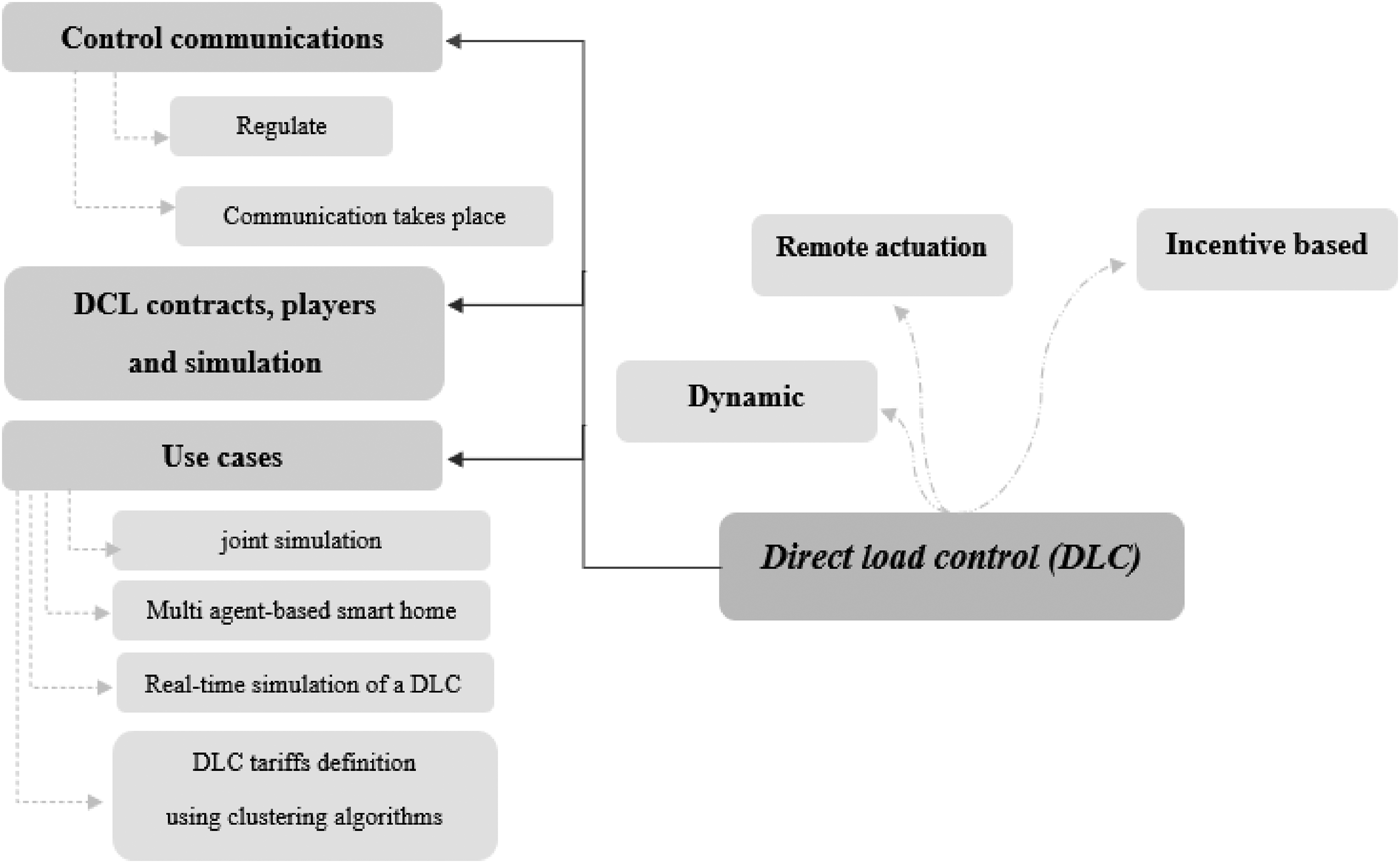
Direct load control implementation context and points of interest.
Early studies for energy management techniques.
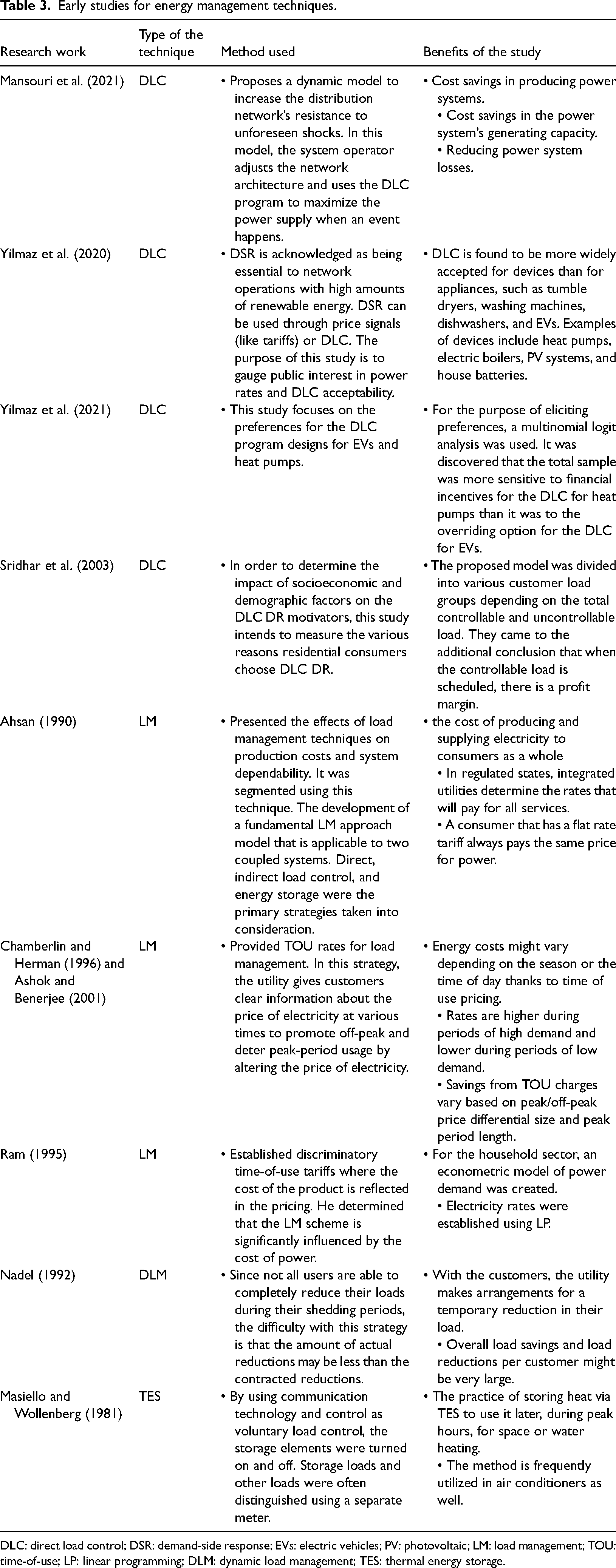
DLC: direct load control; DSR: demand-side response; EVs: electric vehicles; PV: photovoltaic; LM: load management; TOU: time-of-use; LP: linear programming; DLM: dynamic load management; TES: thermal energy storage.
The following subsections elaborate commonly applied energy management techniques are presented as mentioned below:
Direct load control (DLC). A DLC is an implementation approach for battery charging operations at charging stations for electric cars that are situated in parking lots. There are three different options for managing energy. The programming approach efficiently blends unique grid-to-vehicle energy exchanges, grid-to-vehicle charges, and grid-to-vehicle discharges. The objective is to give more net energy to batteries while lowering total energy prices. In a case study involving 50 plug-in automobiles, three different mobility patterns—household, commercial, and mixed—are studied. Load management (LM). In this strategy, load control is accomplished through the imposition of tariffs. When several EV supply equipment (EVSE) units are connected to the same circuit, a charge management system (also known as a local load management system) enables you to regulate how much electricity each charging station can consume. Dynamic load management (DLM). DLM, in the sense of EV charging, works to manage the charging loads so that electricity is distributed equally for all charging EVs such that charging occurs whenever there is sufficient capacity for electric energy. Thermal energy storage (TES). Batteries based on TES often consume less cost but take longer cycle life than electrochemical batteries. Using thermal batteries with high energy storage density can reduce vehicle costs, increase driving range, prolong battery life, and provide heat for EVs in cold climates. This is especially interesting for heavy EVs that demand a lot of heat, like electric buses. One has to consider how the temperature can affect the EVs and how much heat they need when the weather is cold outside (Ahsan, 1990; Ashok and Banerjee, 2001; Mansouri et al., 2021; Masiello and Wollenberg, 1981; Nadel, 1992; Ram, 1995; Sridhar et al., 2023; Yilmaz et al., 2020, 2021).
According to Table 3, one can utilize the methodologies and benefits of studies to help the researchers for conducting studies towards modifications, updating, and filling the gaps in future works.
Important progress in EV technology
This section discusses the various EV technologies and advances relevant to power electronics and charging systems.
To achieve the requirements for high reliability and efficiency by the automobile industry, power converter architectures must be reliable, light weight, low current/voltage ripples, and electromagnetic interference-free (Habib et al., 2020; Pahlevani and Jain, 2020). In EVs, power electronics largely process and control the flow of electrical energy. They also regulate the motor's speed and the torque it generates. Finally, power electronics transform and distribute electrical power to other vehicle systems like heating, ventilation, lighting, and information technology (Beraki et al., 2017). Inverters, DC–DC converters, and chargers are examples of power electronics components. Perfect synchronization between ESs and power electronic converters is key to the efficient performance of EVs (Sun et al., 2019). In EVs, many kinds of ESSs are connected to various kinds of power electronic converters. ESSs are typically charged via AC/DC converters at charging stations or through the grid. In order for the car to drive more quickly, ESSs have to transform the required power from a battery to the engine. Large voltage drops occur in the ESS-supplied power may lead to instability problems. In order to manage a variety of electrical loads and auxiliary power, DC/DC converters must have the capability to transform such that these variations are compensated.
The following subsections introduce two types of DC/DC converters that are used in EV applications.
DC/DC converter: non-isolated. Non-isolated converters are typically used when the voltage needs to be slightly increased or decreased. When the dielectric isolation is not of concern, several converter types can be used (Chakraborty et al., 2019; Mumtaz et al., 2021). Non-isolated DC/DC converters are better suited for use with mid- and high-range vehicles. When a small amount of DC voltage gain (4% or less) is needed, a normal boost DC/DC converter is typically used. The Cuk, switched capacitor, linked inductor, and quasi Z-source converters are the most five types of widely used DC/DC converters (Krithika and Subramani, 2018; Lipu et al., 2021). The structural simplicity and great modularity of the interleaved topology proposed by De Melo et al. (2020), lead to better heat dissipation and reduced current load on the switches. The current configuration of this converter, however, only permits it to be used with low-power EVs that can accommodate a maximum of two passengers. Super capacitors can be applied to extend the structure of high-power EVs, which make them complicated, heavy, and expensive. In Wang et al. (2019a), a two-phase bidirectional interleaved converter for EVs was suggested. This converter has quick and minimal overshoot switching performance and may be used in both buck and boost mode. The fact that this converter's operation depends so heavily on switching control is a significant disadvantage. This converter needs a fairly complicated control method called an optimum Bézier curve in order to function at its best. This converter's direct switching control has a low dynamic responsiveness for EVs. There are various limits between the two conducting modes depending on the load and duty cycle. Despite the fact that with little output voltage and current ripple, it showed good performance efficiency. Since modes change depending on the load conditions, transient situations have a direct impact on the converter's performance (Wen and Su, 2016). The Cuk converter (CC) allows for flexible regulation of output power in relation to input power. A single magnetic core was used in the development of the CC, it provides good efficiency, low ripples, and harmonics. The CC regulates the current ripple across the L-C filter to achieve improved performance efficiency, much like the DC/DC boost converter. For the Toyota Prius, a modified CC is proposed with tuning and filtering “proportional–integral (PI)” controller (Balachander et al., 2021). The real-time execution of this converter is debatable because the traditional PI controller has a number of performance degradations, including slow transient response, excessive overshoot, manual tuning, and inadequate filtration. Additionally, a bridgeless modified CC has been presented to enhance the power quality of the EV charger. Under fluctuations of main voltage, the suggested converter’s operation was confirmed, and it complied with the IEC 6100-3-2 criterion for lower current harmonics satisfactorily (Kushwaha and Singh, 2019). One of the most important problems with power quality is harmonic distortion. Shunt active power filter (SAPF) performance is evaluated in terms of the precision and speed of its developed controller in order to reduce harmonic distortion. Harmonic extraction, switching control, and DC-link capacitor make the controller in this situation (Al-Ogaili et al., 2020). The requirement for an additional flyback converter for current harmonic reduction that is connected via a transformer is the only drawback to the suggested construction. As a result, the cost of using this converter will be considerable, and its weight becomes heavier. Additionally, the EVs utilized “Switched-Capacitor Bidirectional Converter (SCBC),” which is proposed to perform turn-on and turn-off operations via synchronous rectification. The SCBC may offer steady voltage and current without magnetic coupling by making use of switched capacitors. Moreover, the use of extra components to increase the efficiency of power conversion is decreased with the use of power switches in SCBC (Zhang et al., 2018a, 2018b). In the literature, some researches have applied SCBCs in EV applications (Ahmed, 2012; Janabi and Wang, 2019; Zhang et al., 2018a, 2018b). However, the SCBC shows a number of issues, such as high harmonics and ineffectiveness over a wide range of input-to-output voltage. Therefore a created SCBC with no magnetic coupling is capable of supplying SC with balanced voltage across the switched capacitors and it provides continuous inductor current for use in EV applications (Zhang et al., 2018a, 2018b). Utilizing a 300-W prototype, the performance of the suggested configuration has been tested while taking into account a large voltage gain range and fluctuating low-voltage side (40–100 V). The result showed that in step-up mode the converter's maximum efficiency was 94.39%, and in step-down mode, it was 94.45%. For EVs powered by hybrid energy sources, the coupled inductor bidirectional converter (CIBC), as opposed to the SCBC, has higher performance efficiency due to its low-voltage stress and high-voltage gain (Farakhor et al., 2018; Zhang et al., 2018a, 2018b). In Ayachit et al. (2019), a reduced-component CIBC for EV charging applications was suggested. This design is capable of a broad range of voltage conversion because it can operate both in boost and buck modes. It had a high-performance efficiency reaches 95%. The practical results of the 400-W prototype were used by the authors to verify the proposed theoretical and characteristic studies of the converter. CIBC, as opposed to the SCBC, exhibits enhanced performance efficiency because of its low-voltage stress and excellent voltage gain (Farakhor et al., 2018). Another topology of CIBC for EVs has been proposed by González-Castaño et al. (2017). The simulation and test results were used to validate the operation in temporary circumstances. However, due to leakage inductance which has been inherited in these CIBC topologies, resonance and voltage spikes have been addressed (Faleh et al., 2022). A pair inductor-based converter for EVs was introduced by Wu et al. (2016) to decrease switching voltage stress and boost voltage gain. A 1 kW and 60–400 V model of the converter was established and tested for efficacy. Recently, “Quasi Z-source Bidirectional Converter (QZBC)” has been utilized in EV technology. It is characterized by common ground, a simple construction, as well as a variety of voltage gains. The conventional two-level QZBC structure is widely employed by the EV application. By increasing the output voltage gain, the QZBC substitutes the traditional Z-source DC/DC and is appropriate for high step-up voltage conversion (Zhu and Zhang, 2019). DC/DC converter: isolated. When the output is totally isolated from the input, isolated converters are necessary. Isolated DC/DC converters are typically used in low- and medium-power automotive applications (Lipu et al., 2021). This isolated DC/DC converter stores energy during the ON state and then transfers energy during the off state. FlyBack converters (FBCs) can be used in low-power applications due to a number of advantages, including reliability, high output voltage, and isolation from electricity (Taneri et al., 2019). The structural properties of FBC enable them to achieve high gain while minimizing leakage inductance and output current ripple (Kanthimathi and Kamala, 2015). In Sangeetha et al. (2015), a boosting multi-output FBC for EV application was suggested. Three different FBCs are used in this design to give multi-output voltage. Due to parallel connection, this topology can be used in high-power EVs in order to limit leakage inductance. The transformer winding technique is also necessary, which can dramatically raise the cost and weight of the design.
The “Push–Pull Converter (PPC)” operates in the same principle as the transformer, which converts power from primary to secondary. The PPC exhibits a straightforward topology which leads to reduced conduction loss, low peak current, and excellent efficiency. However, because of a low-impedance path and high-flowing current, extra attention has to be paid when using the PPC (Deshmukh et al., 2016).
Galvanic isolation is provided by “the multiport isolated converter (MPIC)”. This topology is capable of working with multi-input sources. Regenerative braking produces recovered power that can be used to power the input sources, which leads to high performance and increased functionality (Forouzesh et al., 2017). The recommended converter unit includes numerous input sources to accommodate multiple energy generation/storage units. The low count of switching components results in lower cost of power electronics interface which in turn leads to deployment of EVs. Despite the remarkable performance shown by MPIC, efficient energy management in different operating modes necessitates a sophisticated multipurpose algorithm. Another innovative MPIC with a built-in capability to regulate multidirectional power flow was proposed by Miah et al. (2021). EV development is still in mature, and new studies are still working to reduce their price and weight.
A resonant tank, made of a combination of inductors and capacitors, constitutes a DC–DC resonant converter (RC). Low switching loss, no circulating currents, zero-voltage switching, and high efficiency are only a few advantages of RC (Ahn et al., 2014; Kim et al., 2019). In RC, there are critical problems, which appear due to complex transformer design and high magnetizing current (Ahn et al., 2014). This requires more studies and improvements. The dual half-bridge topology on both sides of the main transformer serves as a zero-voltage switching converter (ZVSC). Due to a variety of benefits, such as simplified control, soft switching, and decreased circuitry design, the ZVSC is acknowledged as being well-suited for EV technology (Lin et al., 2016). Although if ZVSC has a power greater than 10 kW for automobiles, it can be used for BEV and PHEV power-trains (Pahlevaninezhad et al., 2011; Peng et al., 2004). It has been shown that the efficiency can be reached up to 96.9% for a 6 kW single-phase dual-active bridge (full-bridge), 53.2 V, 2 kWh low-voltage and high-current LIB energy storage system (Tan et al., 2011).
In Aswathi and Lakshmiprabha (2014), a more effective fuel bridge converter (FBC) was developed for efficient power conversion and EV charging. Faster operation, cost-effective performance, reduced switching loss and EV charger size are additional advantages. In addition, another different version of FBC based on phase-shift switching control has been proposed by Sharma and Agarwal (2021). Due to the useful properties of FBCs, they have been applied in EV applications (Mo et al., 2021).
The forward converter (FC) utilizes a forward balancing strategy to obtain quick good and straightforward regulation. It has one magnetic core, one primary winding, and many secondary windings, depending on the application. Recently, some FC topologies for EV applications have been developed by Farzan Moghaddam and Van den Bossche (2019) and Joseph and Devaraj (2019). Table 4 shows a comparison study of several power electronic converters for EV applications.
Compares different power electronic converters that can be used in applications for electric vehicles.
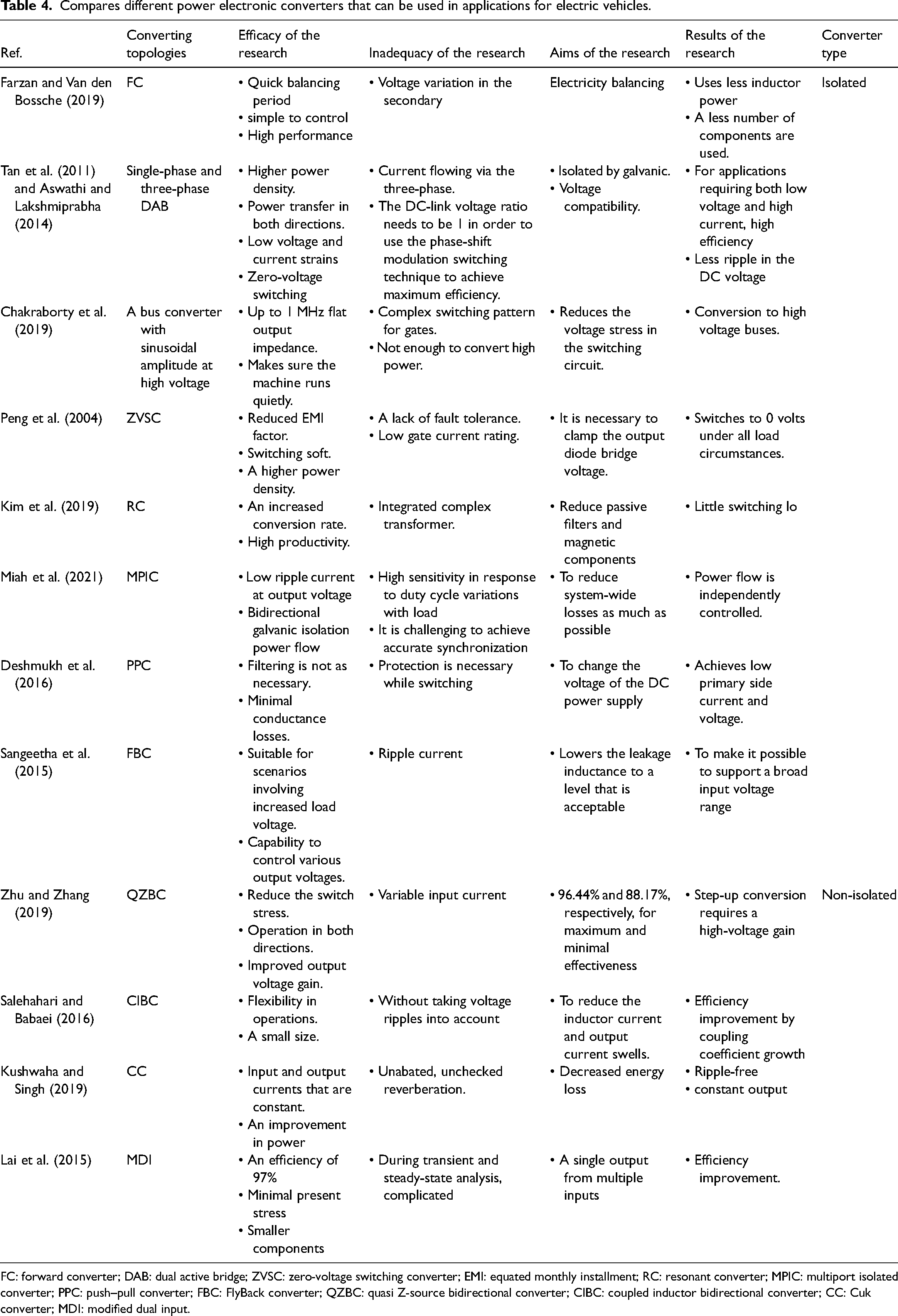
FC: forward converter; DAB: dual active bridge; ZVSC: zero-voltage switching converter; EMI: equated monthly installment; RC: resonant converter; MPIC: multiport isolated converter; PPC: push–pull converter; FBC: FlyBack converter; QZBC: quasi Z-source bidirectional converter; CIBC: coupled inductor bidirectional converter; CC: Cuk converter; MDI: modified dual input.
Recommendation and suggestions
It is believed that unique ideas can be helpful in overcoming the barriers to EV development after analyzing the most recent research on EVs. Some future recommendations are needed for those interested in the development and enhancement of EVs,
The battery is the primary energy source for EVs and HEVs, so how well it performs under all circumstances will have an impact on EV sales. Manufacturers are keen to advance BMSs and battery technologies. Battery degradation can occur due to the dependence of chemical changes within the battery on the operating conditions. Development of accurate battery modeling, ensuring cell balancing and battery state evaluation will provide significant challenges for BMS devices. The SOC, SOH, and SOL for batteries require more consideration. Due to their increased efficiency, highly automated cars may have longer daily travel distances, necessitating larger, more expensive battery packs or more frequent recharging (and downtime). In self-driving cars, the onboard electronics use a lot of power which has to be managed. Future EMS design and development should be focused on controlling the unpredicted environmental changes that occur when cars are on the road. Predictive EMS planning and scheduling parameters will optimize, extending life and improving the energy efficiency of EVs. Many solutions for distributing power among various energy sources have been discovered in the literature, ranging from rule-based through stochastic methods up to complex methods. Develop a new control strategy for EMS to supplementary load demand when the power of PV is not enough to supply load. To improve battery performance and ensure safe operation, it is necessary to develop a BMS that manages a rechargeable battery. Also, future techniques are required such that the BMS can protect and monitor EV battery pack from over-charging, over-discharging, and excessive current and monitor the parameters such as SOE, SOH, and SOC. To enhance the performance of the EV charging station by controlling the charging and discharging battery of the EV and maintain DC bus voltage by supplying the energy from DC–DC converter to the EV station. In the future, EMS should be designed and developed in such a way to take control of unpredictable changes in the environment when the vehicles are on the road.
The most important suggestion points for this review article are the following:
Conclusions
Since EVs will eventually become cost-competitive with ICE vehicles, this study truly gives an overview of the EV literature. This has major worldwide implications because EVs will make it possible to reduce CO2 and NOX emissions, which will reduce the environmental effect of transportation. In addition, the EMS of EV is essential since it prolongs battery life, improves battery thermal stability, and boosts the functional safety and dependability of powertrain components. This study has an overview of EVs that focuses on battery cell technologies, home EMS, BMS topologies, and energy management strategies. In addition, the paper suggests automatic demand control methods for effective demand management and urges further study of consumer-side load management tactics. This should be done to reduce environmental degradation, increase supply-side reliability, and reduce demand-side energy cost-bearing. This analysis should be viewed as a test for the electricity supply sector, particularly in those developing countries that have mature use of these technologies. This review article has surveyed and highlighted different theories, models, paradigms, techniques, algorithms, and methodologies that can help researchers who are interested in the field of vehicle energy management as a guide for their future works. In addition, fixing the problems and challenges in previous works can help researchers to fix and find their solutions for enhancing and developing this important branch of energy management. However, there are gaps that have not been filled in this article. The study has not addressed the design of converters, maximum power point tracking of PV panels for EVs, and the design of vehicle dynamic models. These limitations have to be addressed and solved in future work.
Footnotes
Declaration of conflicting interests
The author(s) declared no potential conflicts of interest with respect to the research, authorship, and/or publication of this article.
Funding
The author(s) received no financial support for the research, authorship, and/or publication of this article.
