




Abstract
Marine shale reservoirs have experienced intense tectonic movements in southeastern Chongqing, resulting in widely developed folds, faults and bedding slip deformation. The gas content is of a wide range while the organic matter content and thickness are sufficient for shale gas accumulation. Here, we review previous work and present outcrop and core data from 11 shale wells around southeastern Chongqing to analyze and summarize tectonic types and their combinations, as well as their influence on shale gas preservation and enrichment. Fault and bedding slips are prevalent in shale reservoirs, and they apparently influence shale gas content. Bedding slip crush is usually formed at the bottom interval where the total organic content is high from intense horizontal compression. Bedding slip crushing and well-developed high-angle natural fractures form a net fracture system where shale gas is enriched in an anticline structure or lost to air in a syncline structure laterally. Strata dip is the key geological factor that controls bedding slip deformation in shale reservoirs in certain areas. According to the established bedding slip geological model, when bedding slip occurred, the critical strata dips of the lower Silurian Longmaxi Formation were 13.34°, respectively. Bedding slip crushed anticlines without faults and synclines without faults and bedding slip crushing are the two tectonic patterns that are favorable for shale gas preservation and enrichment, which should be the focus of further explorations of lower Paleozoic shale gas in southeastern Chongqing.
Introduction
Shale gas is an unconventional gas reserve with substantial resources in southern China Commercial shale gas exploitation is underway in the Jiaoshiba shale gas field and Changning–Weiyuan shale gas block in the Sichuan Basin (Shi et al., 2022; Yang et al., 2016). Study on characteristics of shale gas reservoir focused on shale distribution, geochemical and reservoir characteristics, and gas bearing. Much attention has been given to preservation conditions since they are crucial for successful marine shale wells in southern China (Cai et al., 2013; Cao et al., 2022; Cao et al., 2023; Feng et al., 2022; Guo, 2014; Guo et al., 2014b; Guo and Liu, 2013; Guo and Zeng, 2015; Hu et al., 2014a; Hu et al., 2014b; Li et al., 2007; Li et al., 2013; Li et al., 2014; Nie et al., 2012; Pan et al., 2014; Qiu et al., 2021; Zeng and Guo, 2015; Zhang et al., 2013; Zhang et al., 2020). Compared with the Jiaoshiba shale gas field located west of the QiYaoshan fundamental fault, southeastern Chongqing has strong tectonic movement and complex geological structures. Nearly half of the shale wells in southeastern Chongqing have very low gas contents, and the gas content has a southeast‒northwest increasing tendency, which is in accordance with the southeast‒northwest decreasing tendency in tectonic deformation, as we note later. Therefore, tectonic conditions might be critical for shale gas preservation and enrichment in southeastern Chongqing.
Geologists have evaluated preservation conditions using methods for conventional hydrocarbon reservoirs for lower Paleozoic shale gas in the upper Yangtze region (Guo and Liu, 2013; Guo, 2014; Guo et al., 2014b; Hu et al., 2014a; Li et al., 2020; Nie et al., 2012; Pan et al., 2014; Zeng and Guo, 2015). Guo et al. realized the importance of bedding slip crushing for shale gas enrichment in shale gas exploration and exploitation in the Jiaoshiba shale gas field, but they did not realize that bedding slip crushing may destroy shale gas preservation conditions. Although people have reported the importance of smooth sliding on Shale gas enrichment, there are few studies on the impact of smooth sliding on the preservation of Shale gas resources. However, no one has determined the relationships between strata dip and shale gas preservation. Compressed by paleotectonic movement, strata were intensely uplifted and denuded in southeastern Chongqing. Thus, the lower Paleozoic shale layers, especially the lower Silurian Longmaxi Formation shale layers, are usually distributed in a syncline structure. However, shale layers easily slip in a syncline structure, which can cause shale gas to dissipate laterally and thus destroy preservation conditions.
Here, gas generation conditions, gas content and core observation data are compared and analyzed to assess the main tectonic factors that influence the gas content of lower Paleozoic shale in southeastern Chongqing. On this basis, a geological model for bedding slip in shale reservoirs is established to determine the critical condition for bedding slip occurrence in lower Paleozoic shale. Then, tectonic patterns favorable for shale gas preservation and enrichment are proposed, which may be helpful for lower Paleozoic shale gas exploration in southeastern Chongqing.
Geologic setting
Stratigraphy
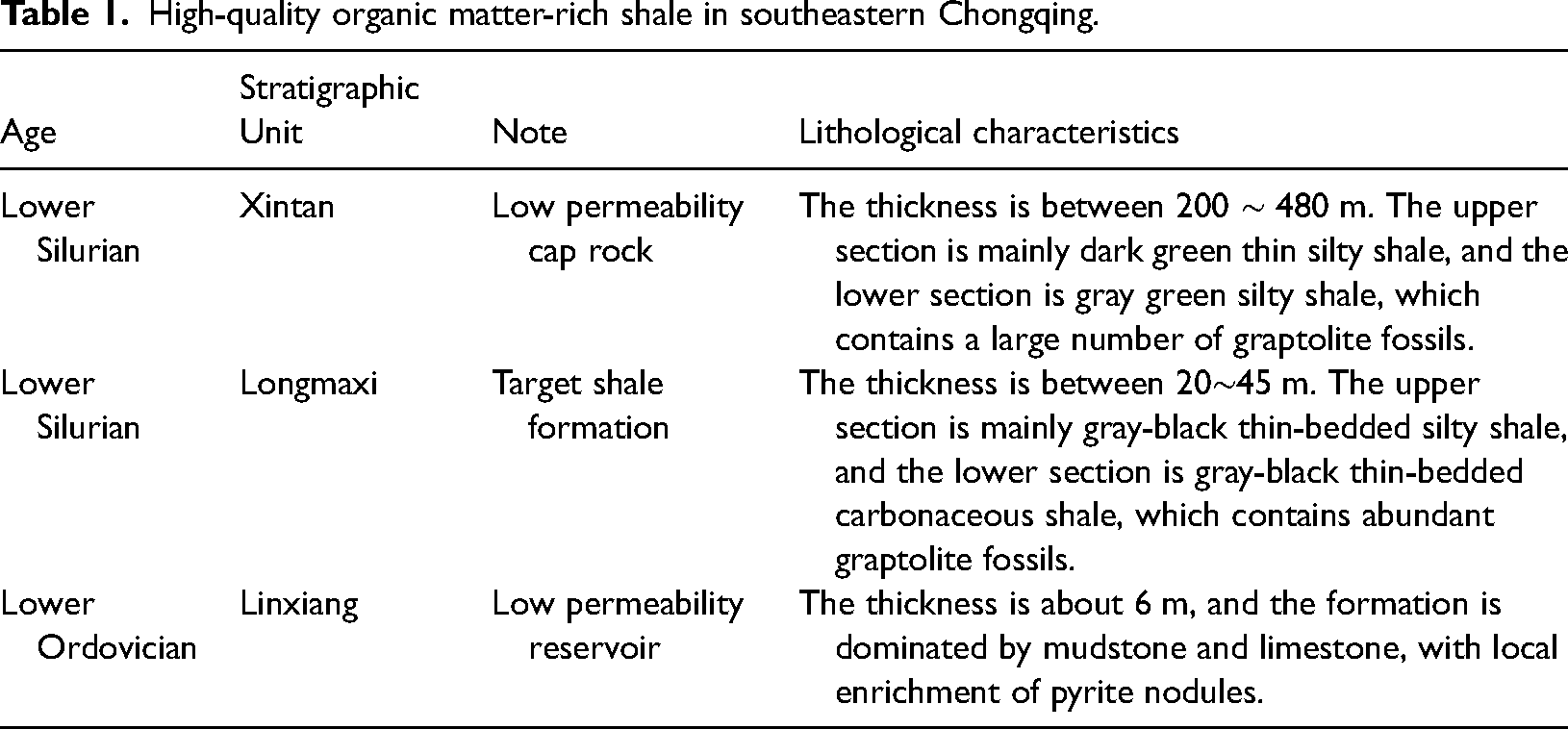
Southeastern Chongqing, located southeast of Chongqing and east of the Sichuan Basin in Southwest China, is separated from the Sichuan Basin by the Qiyaoshan fundamental fault (Figure 1). Southeastern Chongqing is a favorable reservoir area for shale gas in China. Two of the lower Paleozoic sedimentary strata, the lower Silurian Longmaxi Formation shale are marine strata with abundant organic matter (Table 1) and have been proven to have good exploration and exploitation prospects.
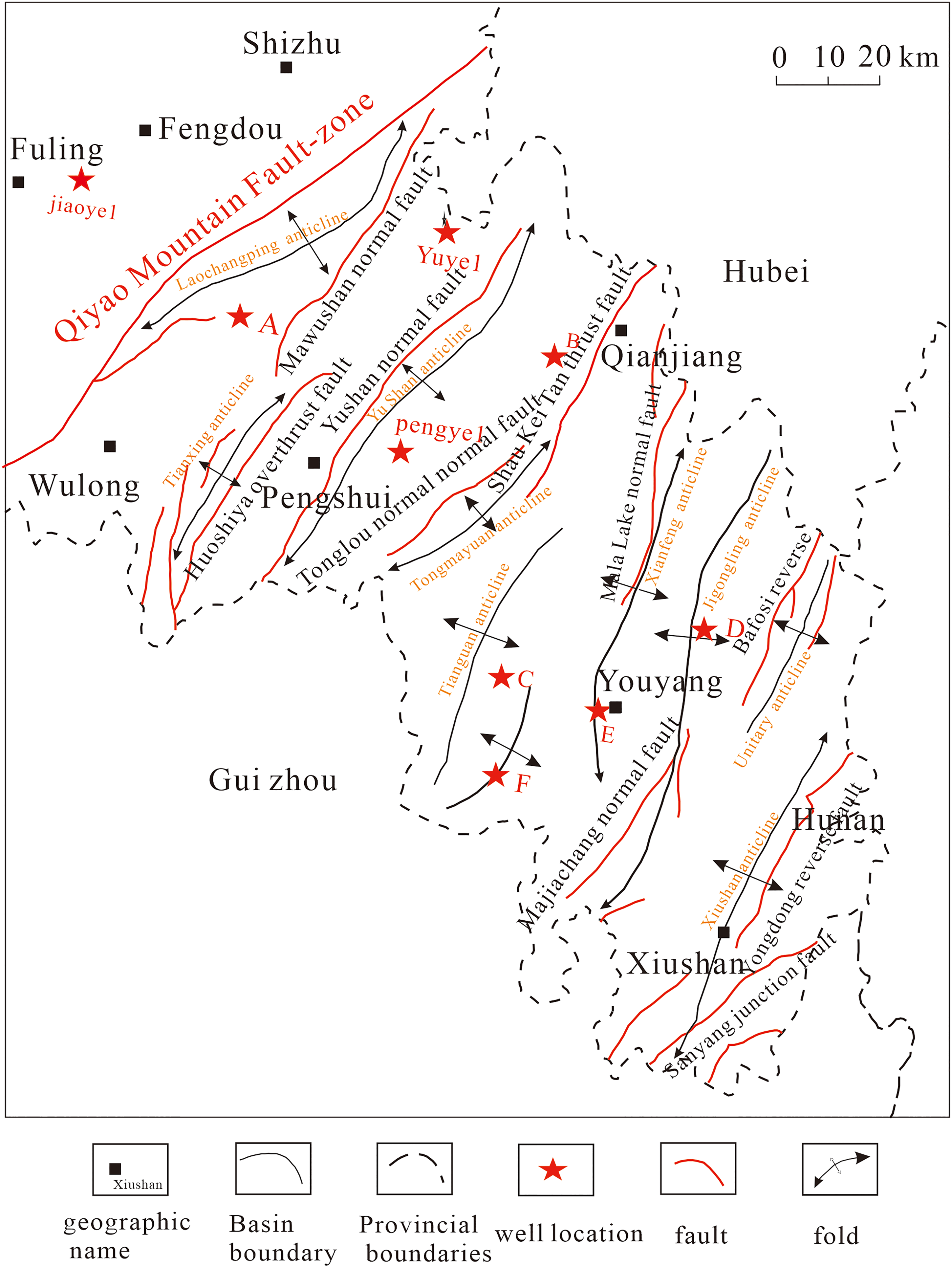
Location and geological setting of southeastern Chongqing.
High-quality organic matter-rich shale in southeastern Chongqing.
The structural deformation intensity and style in the southeastern region of Chongqing have obvious horizontal zoning, vertical segmentation, and vertical stratification. The structural deformation system includes thrust fold belts, barrier fold belts, trough fold belts, and barrier fold belts. The vertical multi-layer sliding system controls the construction style of different types. The boreholes in this study are mainly distributed in wide or tight synclines and anticlines with developed faults.
Geological structures
Southeastern Chongqing is part of the interior depression of the upper Yangtze platform in the Yangtze metaplatform geotectonic unit. Tectonic movements were intense and complex, and the Indosinian movement, Yanshan movement and Himalayan movement were the main tectonic movements.
The strata deformation has a southeast‒northwest descending tendency: the southeastern part is an ejective fold belt featuring an open anticline and tight syncline, the northwestern part is a trough-like fold belt featuring a tight anticline and open syncline, and the middle part is a transitional fold belt. There are abundant NNE-oriented folds and faults, as well as natural fracture systems and bedding slip tectonic deformation, forming a NNE-oriented dominant structural configuration (Figure 1). These tectonic factors have an important influence on the preservation, enrichment and percolation of shale gas in southeastern Chongqing (Ding et al., 2012; Guo et al., 2014a ; Hu et al., 2014a ; Wang et al., 2016; Zeng et al., 2016; Zhang et al., 2021).
Reservoirs
Shale Well B in Qianjiang is an exploration well and has an initial production above 3 × 10³ m3/d. However, shale well Jiaoye 1, close to southeastern Chongqing, has an initial production above 2 × 10⁵ m3/d. The other shale wells are stratigraphic wells and have a wide range of gas contents. Here, data from 11 shale wells are collected: 8 of the wells target the lower Silurian Longmaxi Formation shale.
General information of shale wells in southeastern Chongqing.
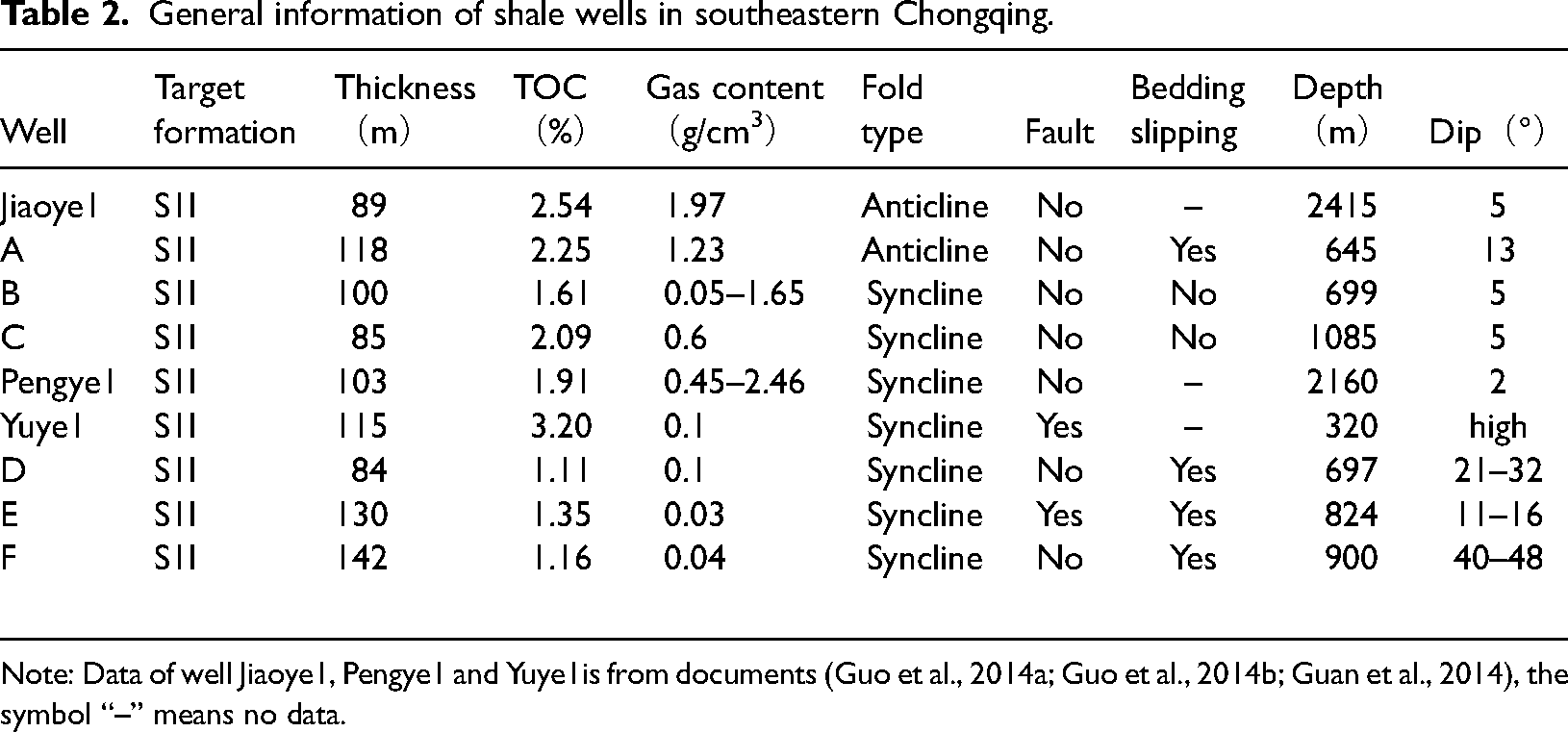
Note: Data of well Jiaoye1, Pengye1 and Yuye1is from documents (Guo et al., 2014a; Guo et al., 2014b; Guan et al., 2014), the symbol “–” means no data.
On the plane, the gas content distribution has a northwest‒southeast decay tendency. The gas contents of wells B and Pengye 1, which are close to the western ejective fold belt, have relatively high gas contents. Well C, which is located between the four wells, has gas contents slightly below those of wells B and Pengye 1. In the ejective fold belt, well A has a relatively high gas content, but the gas content of well Yuye 1, where a fault is found in the target shale interval, is nearly 0 g/cm3. Well Jiaoye 1 in the Jiaoshiba shale gas field located west of the QiYaoshan fundamental fault has a gas content of 1.97 g/cm3, which is much higher than that of shale wells in southeastern Chongqing (Figure 2).
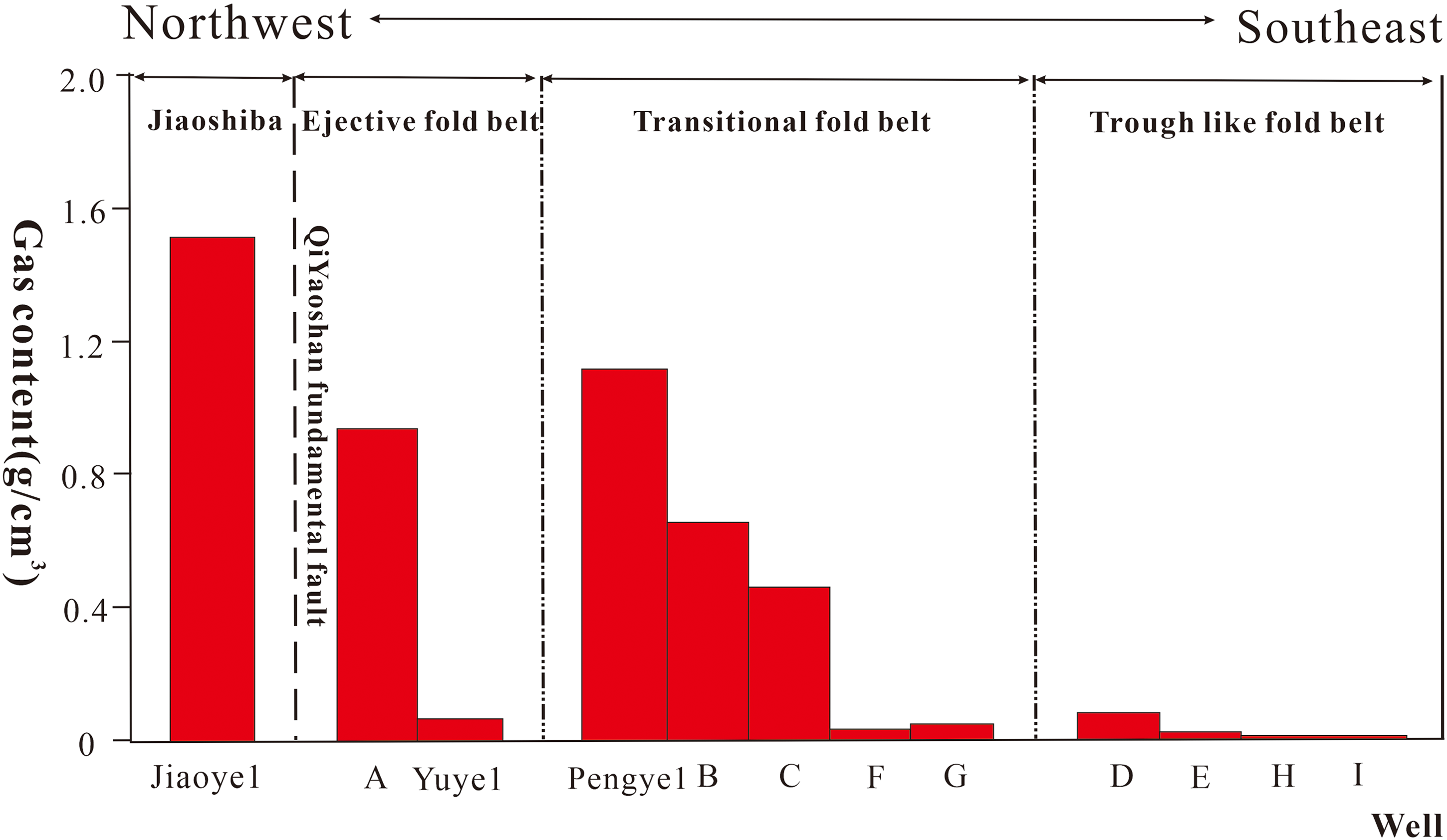
Gas content distribution of shale wells in southeastern Chongqing.
Thickness data and TOC data indicate that the lower Paleozoic shale has a good material base for gas generation, and the gas content has a southeast‒northwest decay tendency in southeastern Chongqing, which is best west of the QiYaoshan fundamental fault. In summary, the gas content distribution is in accordance with tectonic deformation that decays from southeastern Chongqing to the Jiaoshiba shale gas field.
Methods
The key to our analysis is subsurface cores and outcrops. Faults and bedding slip crush characterization and observations were based on 8 outcrops and approximately 2300 m of cores from 11 shale wells, among which wells Jiaoye 1, Pengye 1 and Yuye 1 are collected from documents (Guo et al., 2014a; Guo et al., 2014b; Zhang et al., 2019), and cores of the remaining 8 wells are stored at the Chongqing Institute of Geology and Mineral Resources. Strata dips, structure positions and gas contents of these wells were also characterized and compared to discuss tectonic factors that influence shale gas content.
Bedding slip crushing is observed in cores and outcrops to analyze its characteristics and mechanical origin. A geological model for bedding slip was established to discuss critical factors that controlled its formation, and the critical parameters were calculated based on collected rock mechanical data, depth data, and paleotectonic stress data. Finally, faults, bedding slip crushing, tectonic positions and their configurations were assessed and analyzed to find tectonic patterns favorable for shale gas preservation and enrichment.
Results
Gas shale derives from both source rock and reservoir rock; therefore, preservation conditions are not of special concern during shale gas exploration and exploitation in the US, where tectonic movements are not intense. Compared with the US, tectonic movements in southeastern Chongqing are so intense that fault system and bedding slip tectonic deformation are well developed, cutting across shale reservoirs horizontally and vertically, and gases are accumulated or lost to air in the faulted and fractured zones.
Based on shale well data, faults, fold types, bedding slip crushing and their configurations for each well are determined. Additionally, their influence on gas content is assessed and integrated with gas content data below.
Faults development and controls
Cores of each well are observed to find faults in the target formations. No faults are found in the target formations of wells A, B, C and Pengye 1 in southeastern Chongqing, as well as well Jiaoye 1 in the western part of the Qiyaoshan fundamental fault; they all have high gas contents. However, wells E, G and Yuye 1 in southeastern Chongqing have encountered faults, and they barely have natural gas in the target formations (Figure 3). Therefore, faults apparently influence the gas bearing of shale reservoirs.
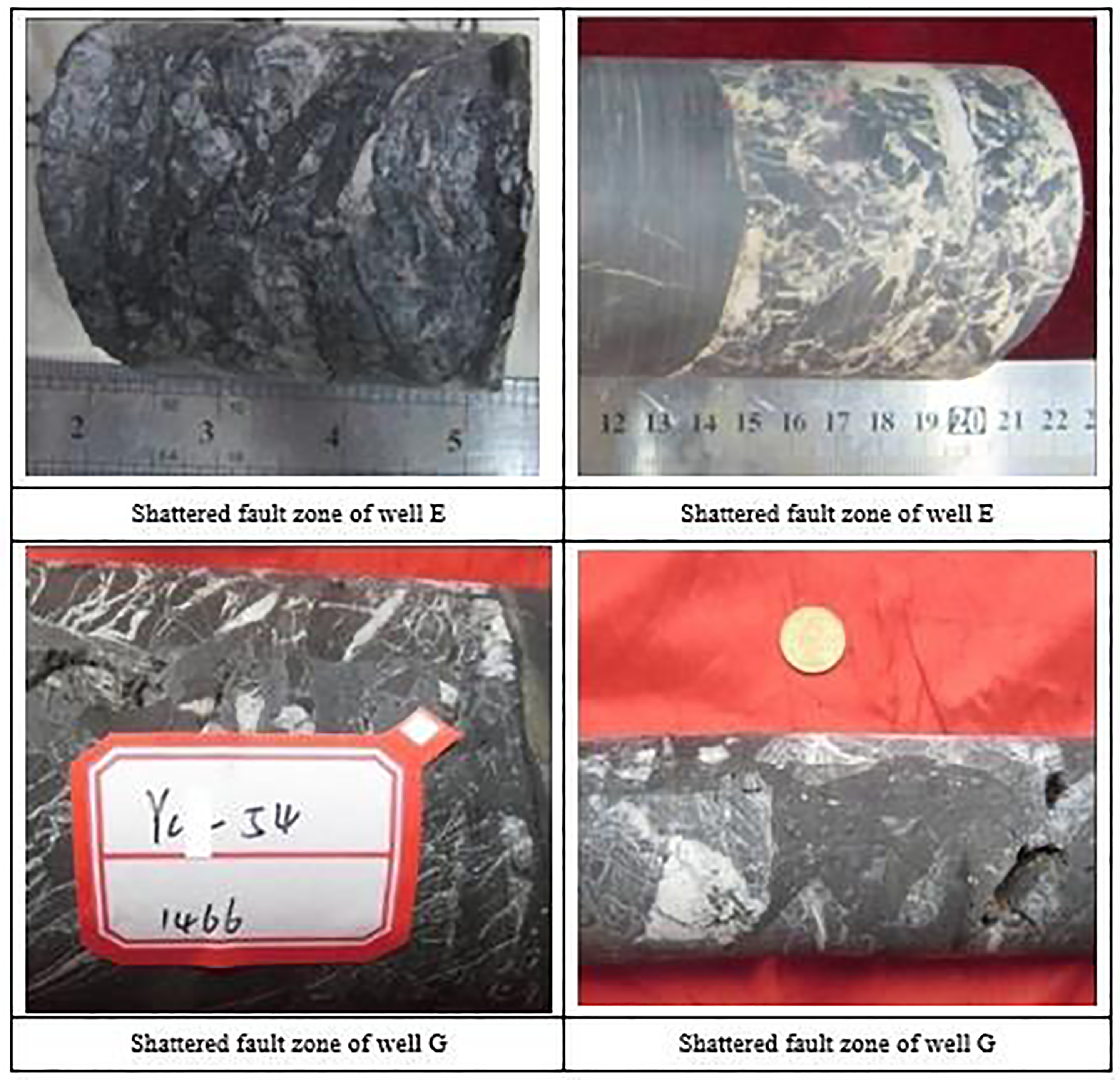
Fractures in cores from shale wells in southeastern Chongqing.
Faults can connect natural fractures and form a complex pathway through which gases migrate to highly permeable reservoirs or are lost to air. In these cases, the preservation conditions of shale gas are destroyed.
Bedding slip crush
Base intervals of lower Paleozoic shale have high organic matter content and thus are relatively ductile. However, rocks below the lower Paleozoic shale are primarily stiff limestone. Compressed by intense tectonic movement, base intervals of lower Paleozoic shale are readily bedding slipped (Liu et al., 2021; Yan et al., 2008; Zhang et al., 2009). Bedding slip crush in lower Paleozoic shale outcrops in southeastern Chongqing is a bedding crushed zone that develops deformation accommodation folds on top. Shear fractures that are parallel to the bedding plane or have a small angle with the bedding plane are well developed in the bedding slip crushed zone, which is different from a fracture system developed in a target formation where high-angle shear fractures are dominant. Slip crush zones observed from shale wells are usually 0.5–3.5 m long, cores in a slip crush zone are always discontinuous and scattered, and fractures in a slip crush zone are usually filled by calcite and other minerals that are scattered. Bedding parallel slip fractures and low angle slip fractures are developed in the crushed zone, formed by bedding shear stress and detached along shale lamellation (Zeng et al., 2007; Zeng and Xiao, 1999). These kinds of fractures are called bedding slip fractures. Slickenside striation, terrace and mirror characteristics are apparent in the bedding slip fracture surfaces, and some of the bedding slip fractures are filled by calcite and other minerals (Figure 4 and Figure 5).
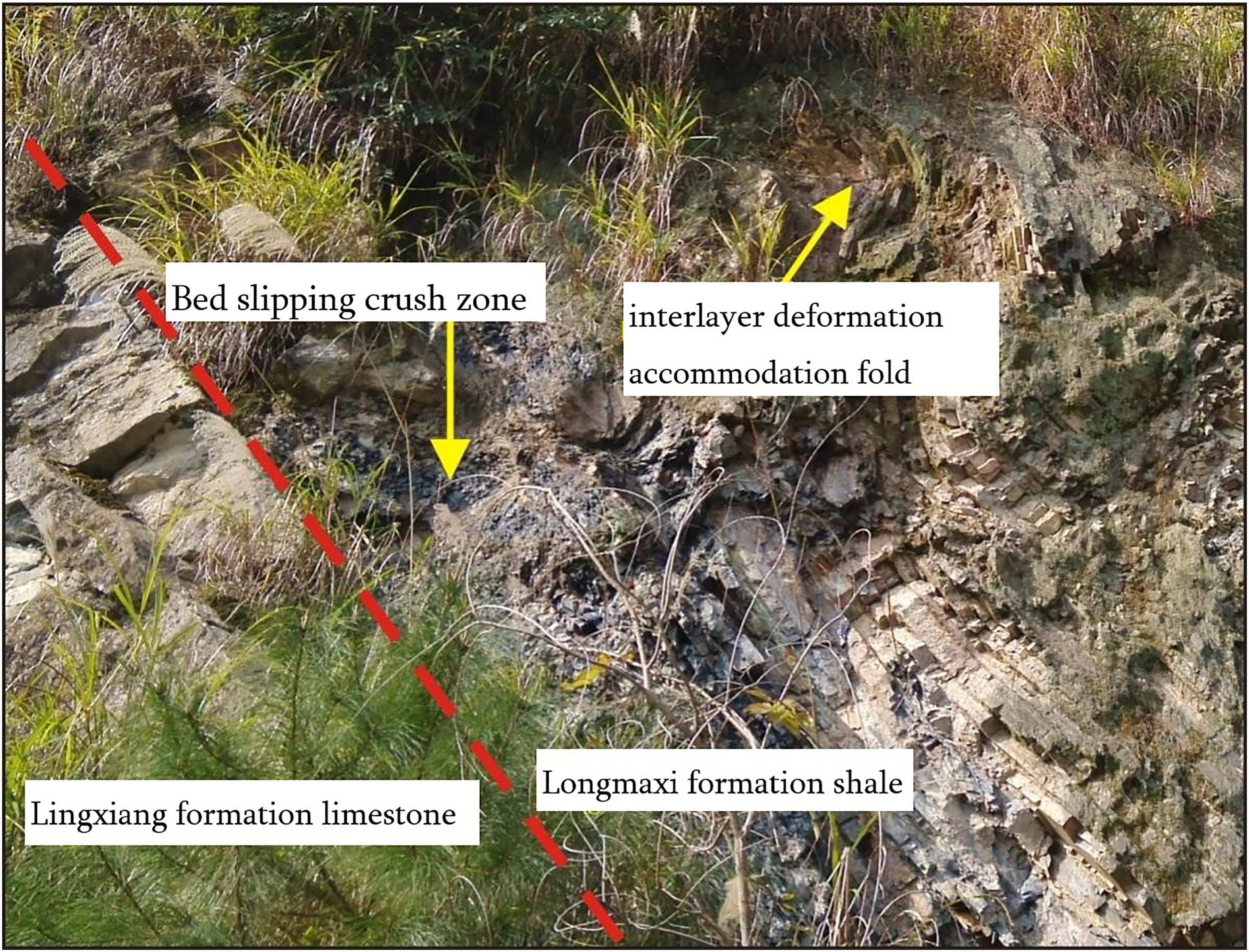
Bedding slip deformation in shale outcrops of southeastern Chongqing.
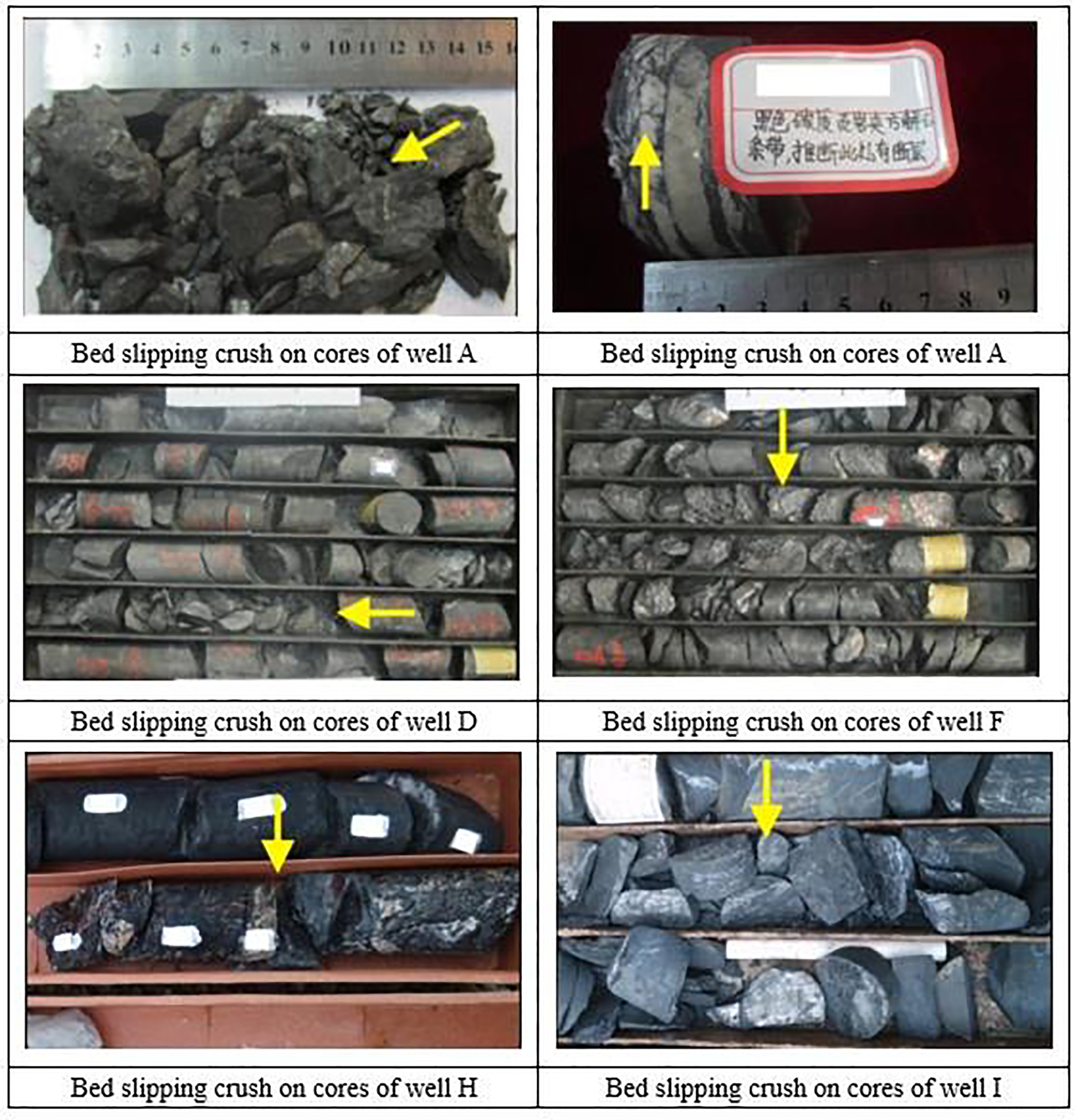
Bedding slip crush zone on cores from shale wells in southeastern Chongqing.
Two wells in an anticline structure have good gas bearing. Well A shows a bedding slip crushed zone in the cores. Well Jiaoye 1 only shows bedding slip fractures in cores, and they do not develop into bedding slip crushed zones. Therefore, bedding slip crushing will not destroy the preservation conditions of shale reservoirs in an anticline structure. In contrast, this may be beneficial for shale gas enrichment. The reasons may be represented as follows: (1) Paleozoic shale is ductile and high in organic matter content at the bottom in southeastern Chongqing, and it is the main interval that easily forms slickenside. However, on top of the slickenside interval is tight shale with lower porosity and permeability, which is a good isolated interval for the bedding slip crush zone. In this case, bedding slip crush will not destroy the preservation conditions of shale gas in an anticline structure. (2) The bedding slip crush zone in an anticline structure can connect high-angle natural fractures in the target formation and form a net fracture system, which will increase reservoir space and greatly enhance shale gas percolation. This may be the critical geological factor that influences shale gas enrichment in an anticline structure in southeastern Chongqing.
Wells B, C and Pengye 1 in a syncline structure have relatively lower gas contents, and no faults are found in the cores of these wells. Wells B and C do not have bedding slip crushed zones, and well Pengye 1 has no core data on bedding slip crushed zones. Therefore, well Pengye 1, which has a stratum dip of just 2°, seems impossible for bedding slip in the target formation.
Wells D, F, H and I, lying in a syncline structure, have very low gas contents in the target formation. Cores are observed in the four wells, and no faults are found, but bedding slip crushed zones are found at the bottom of the target formations. Compared with wells B, C and Pengye 1, which also lie in a syncline structure, bedding slip crushed zones will severely destroy the preservation conditions of shale reservoirs in a syncline structure. The reasons may be interpreted as follows: bedding slip crushing will destroy the connection between rocks above and below the bedding slip crushing zone and form a net fracture system, which will cause shale gas dissipation laterally and thus destroy the lateral preservation conditions of shale gas.
In summary, bedding slip crushing in shale reservoirs is very important for gas enrichment and preservation. Bedding slip crush in an anticline can form a net fracture system integrated with interlayer high-angle natural fractures, which can increase reservoir space and thus be favorable for shale gas accumulation and enhance gas percolation. Bedding slip crush in a syncline structure can connect interlayer high-angle fractures and extend along the syncline slope laterally, and shale gas will be lost laterally and thus destroy the lateral preservation conditions of shale reservoirs in a syncline. Relatively speaking, shale reservoirs in a syncline structure that have no faults and bedding slip crush will have better preservation conditions.
Discussion
Conditions for bedding slip in shale reservoirs
Southeast Chongqing is located in the Jura-type fold belt of the eastern Sichuan Basin. Jura-type fold belts are formed when sedimentary cap rocks slickenside along weak rocks (Yang et al., 2012; Zhang et al., 2009). Two conditions are needed to form bedding slip deformation: one is the lithologic condition that weak rocks are above stiff rocks, and the other is the stress condition that is needed for the occurrence of bedding slip deformation.
Because of their high organic matter content and clay mineral content, the lower Silurian Longmaxi Formation rocks are relatively soft and ductile at the bottom. However, rocks underneath the lower Silurian Longmaxi Formation are stiff Lingxiang Formation limestone and Dengying Formation limestone. Therefore, lower Paleozoic shale has favorable lithologic conditions for bedding slip occurrence. Tectonic activity and abnormal deep formation pressure cause the formation to slide along the weak surface, leading to the formation of fractures in different rock facies, and effectively improving the permeability of the reservoir (Liu et al., 2020).
Stress conditions are analyzed when bedding slip occurs in shale reservoirs that have lithologic conditions (Figure 6). The critical condition for bedding slip along shale lamellation is that the stress component in the lamellation direction reaches the shear strength of shale lamellation, that is: G = gravity of overlying strata c = cohesion of shale lamellation ø = internal friction angle of shale lamellation a = strata dip
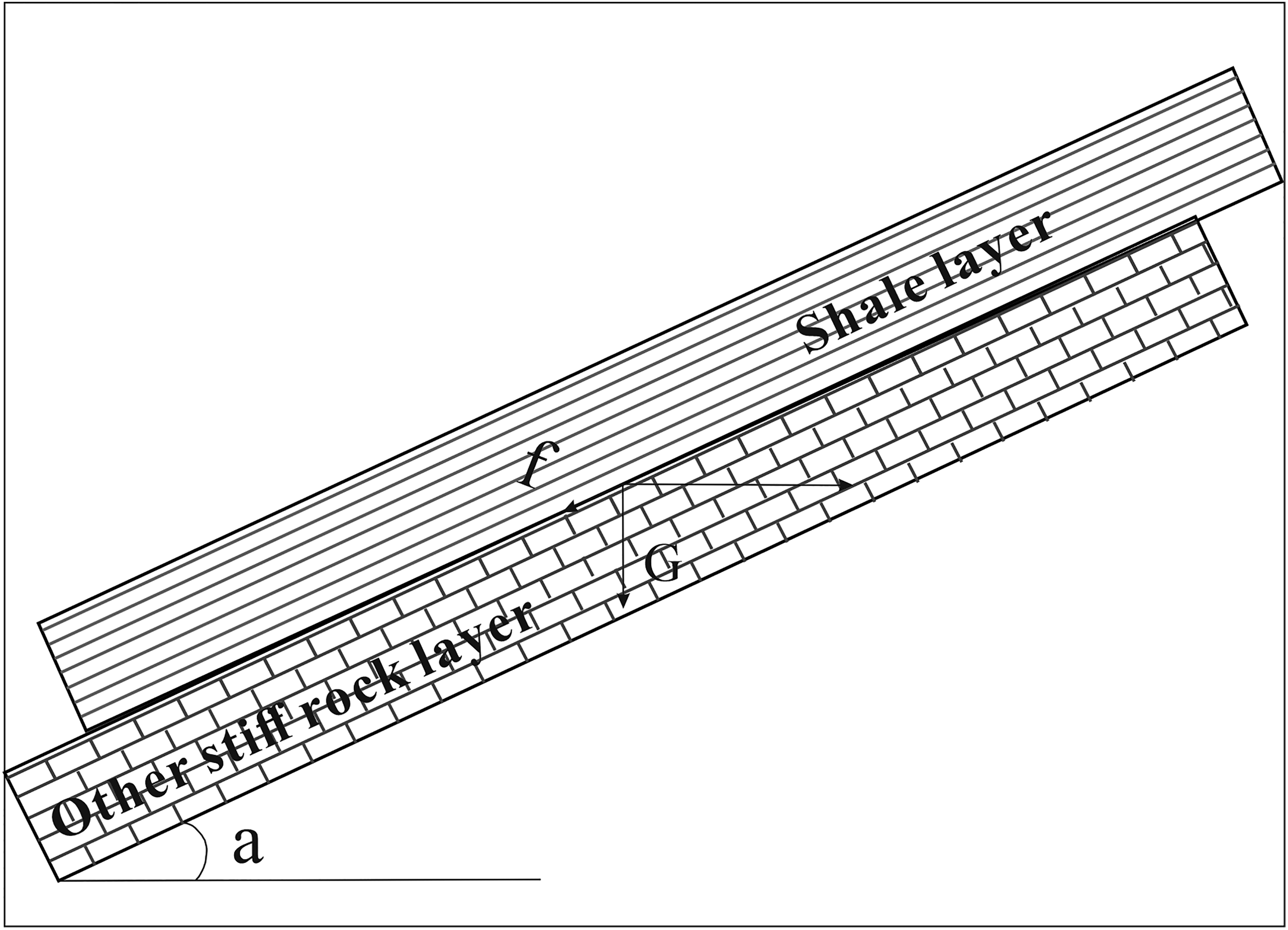
Force analysis map of the shale bedding plane.
As shown in Equation 1, the maximum horizontal paleotectonic stress, gravity of the overlying strata, cohesion and internal friction angle of shale lamellation are related to bedding slip occurrence. Cohesion and internal friction angle are related to shale mechanical properties, and they slightly vary for the same shale interval in a certain area. The maximum horizontal paleotectonic stress in a certain area also varies slightly. The gravity of the overlying strata is a function of depth. However, the strata dip varies over a wide range. Therefore, the strata dip is the key factor controlling bedding slip occurrence in a certain area.
The critical strata dip for bedding slip occurrence can be derived from Equation 1:
Parameters given to the established geological model for bedding slip occurrence.
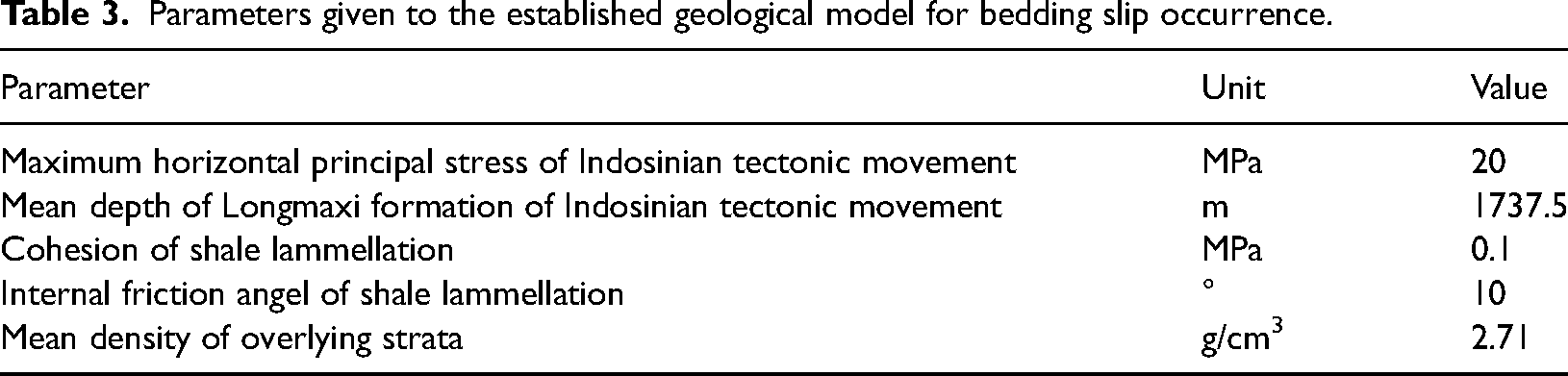
Strata dips of shale wells in southeastern Chongqing are characterized by cores. The strata dips of shale wells A, D, and F and Yuye 1 in which bedding slip occurred in the Longmaxi Formation are all above 13°. Strata dips, characterized by cores of shale well E, are distributed from 11° to 16°, with an average value of 13.5°. The strata dips of the above four wells are above or close to the critical dip calculated for bedding slip occurrence in the Longmaxi Formation. Strata dips, characterized by cores of shale wells B, C and Pengye 1 in which bedding slip did not occur, are no more than 5°, which is less than the critical dip calculated for bedding slip occurrence in the Longmaxi Formation.
Strata dips of lower Paleozoic shale where bedding slip occurred are basically in the range of critical dips calculated for bedding slip occurrence in shale in southeastern Chongqing, and there are only slight disparities. The reasons for the disparity are as follows: (1) strata dip is a dynamic parameter that changes in different places, so the critical dip at which bedding slip occurs in shale reservoirs will change in different places; and (2) there are differences between strata dips measured in cores and underground because of well deviation. Therefore, the established conceptual model for bedding slip in shale reservoirs is generally reasonable, and strata dip is critical for bedding slip occurrence in shale reservoirs.
Favorable tectonic patterns for shale gas preservation and enrichment
The analysis above indicates that structure is very important for lower Paleozoic shale gas exploration in southeastern Chongqing. Faults are a detrimental factor that destroy the preservation condition of shale gas. Bedding slip crushing occurring in different tectonic positions will have opposite effects on shale gas preservation and enrichment. Bedding slip crushing in an anticline structure will form a net fracture system that is favorable for gas enrichment, but bedding slip crushing in a syncline structure will destroy gas preservation conditions. Strata dip is the key factor that controls bedding slip occurrence, and the critical strata dips for bedding slip in the Longmaxi formation are 13.34° and 7.52°, respectively. Considering structure types and their combinations, there are two tectonic patterns that are favorable for lower Paleozoic shale gas preservation and enrichment in southeastern Chongqing: one is a bedding slip crushed anticline with no fault, the strata dip of which is above the critical strata dip for bedding slip occurrence; the other is a gently dipping syncline that has no fault and bedding slip deformation (Figure 7).

Two favorable tectonic patterns for preservation of lower paleozoic shale gas in southeastern Chongqing.
Conclusions
Lower Paleozoic shale has a good substance basis for gas generation in southeastern Chongqing. Controlled by intense tectonic movement, the shale gas content shows a southeast‒northwest descending tendency. Faults and bedding slip crushing and their combination with folds are the main tectonic factors that influence lower Paleozoic shale gas preservation and enrichment in southeastern Chongqing.
Strata dip is the critical geological factor that controls bedding slip occurrence in shale reservoirs. The critical strata dips for bedding slip occurrence in the Longmaxi formation are 13.34°.
Bedding slip crushed anticlines with no faults and gently dipping synclines with no faults and bedding slip crushing are the two tectonic patterns favorable for shale gas preservation and enrichment, which should be focused on and stressed for future shale gas exploration in southeastern Chongqing.
Footnotes
Acknowledgments
We thank Huang Rongan and Zeng Chunlin, senior engineers at the Chongqing Institute of Geology and Mineral Resources, for their constructive advice on the geology of the lower Paleozoic shale. We also thank Wang Shengxiu, Zeng Xiangliang and Xu Yao, engineers at the Chongqing Institute of Geology and Mineral Resources, for their help with field work and core observations. This study is financially supported by the enterprise research projects of Shanxi Xiyang Fenghui Coal Industry Co., Ltd (FH-02(ZJ)2206007).
Declaration of conflicting interests
The authors declared no potential conflicts of interest with respect to the research, authorship, and/or publication of this article.
Funding
The authors disclosed receipt of the following financial support for the research, authorship, and/or publication of this article: This work was supported by the the enterprise research projects of Shanxi Xiyang Fenghui Coal Industry Co., Ltd, (grant number FH-02(ZJ)2206007).
