




Abstract
Karst collapse columns (KCCs) are channels where groundwater and gas gather, and they pose a great threat to mining safety. In this study, a mechanical model and criterion for the roof collapse of KCCs were established, and simulations were performed to analyze the formation mechanism of KCCs in the Huainan coalfield of Northern China. The results showed that the roof collapse and upward development of KCCs were facilitated by increasing the cave radius of the KCC basement and decreasing the groundwater pressure, single-layer thickness of the roof strata, lateral pressure coefficient of the rock mass, and cohesion and internal friction angle between fractures. The KCC formation process in the Huainan coalfield could be divided into four stages: (I) early collapse, (II) middle-early rapid collapse, (III) middle-late slow collapse, and (IV) late filling compaction. The simulation results were generally consistent with actual KCCs observed in the Huainan coalfield, which verified the theoretical analysis. The results of this study provide an important reference for the formation mechanism and evolution of KCCs in Northern China.
Introduction
Karst collapse columns (KCCs) are a peculiar geological phenomenon caused by a cave collapse, and they were first discovered in a coalfield in Northern China (He et al., 2005). Their roots usually develop in the Ordovician or Cambrian carbonates and pass upward through the Carboniferous, Permian, and Triassic strata into the Jurassic, Cretaceous, and Quaternary strata (He et al., 2009). By the end of 2019, more than 10,000 KCCs had been found in 39 regions in Northern China: more than 8500 in Shanxi Province, more than 1200 in Hebei Province, and more than 300 in Henan, Shandong, Jiangsu, and Anhui Provinces (Xu et al., 2022). The presence of KCCs not only prevents the recovery of natural coal seams but also poses a huge threat to mining safety. Since 1964, KCCs have induced 22 water inrush accidents with volumes of 120–123,180 m3/h, which has resulted in huge losses to China and its people (Gui et al., 2017; Yin et al., 2019). Therefore, KCCs are a key concern in research on karst geology and hydrogeology in Northern China coalfields (Zhang et al., 2020a, 2021b; Zhao and Guo, 2014; Zhao et al., 2017, 2020, 2021; Zuo et al., 2009).
Currently, there are five main theories for the formation mechanism of KCCs: gravity collapse (Shi et al., 1998), gypsum dissolution collapse (Qian, 1988), vacuum suction collapse (Xu and Zhao, 1981), hydrothermal genesis (Pan, 1996), and groundwater internal circulation (Wang et al., 2007). The gypsum dissolution collapse, hydrothermal genesis, and groundwater internal circulation theories mainly explain the formation of the KCC basement cave from the perspective of erosion by fluid dissolution cycles, and the gravity collapse and vacuum suction collapse theories primarily explain the collapse of the KCC roof from the perspective of strata gravity and vacuum suction, respectively. However, the formation mechanism and evolutionary process of KCCs have not been studied in depth, which has limited understanding of their occurrence and prevalence.
This study focused on KCCs in the Huainan coalfield, which is at the southern margin of Northern China. A mechanical model and roof collapse criterion for KCCs were established based on limit equilibrium theory and the Mohr–Coulomb criterion. Numerical simulations were performed for inverse analysis of the formation mechanism and evolutionary process of KCCs.
Geological setting
The Huainan coalfield is on the southern margin of the Northern China plate at the intersection of the Dabie orogenic belt and Tanlu strike-slip tectonic belt (Zhang et al., 2020b). It shows an NWW–SEE trending offset fault fold tectonic belt. Like other areas in Northern China, the Huainan coalfield has experienced multiple stages of tectonic activities, such as the Caledonian movement in the Early Paleozoic and the Indosinian and Yanshanian movements in the Mesozoic (Shu et al., 2017; Xu et al., 2004; Zhang et al., 2022). This formed a large number of faults, folds, and fractures that became important channels for groundwater and hydrothermal fluid migration and promoted the development of paleokarst and KCCs in the Cambrian and Ordovician (Zhang et al., 2021a, 2021b). Gao (2018) found that the Huainan coalfield has 718 faults with a drop of greater than 20 m, including 532 normal faults and 186 reverse faults. In addition, there are three large-scale folds: the Panji anticline, Chenqiao anticline, and Xieqiao–Gugou syncline (Figure 1(a)). At present, the Huainan coalfield has 14 coalmines: Panyi, Pan’er, Pansan, Panbei, Zhuji, Dingji, Guqiao, Gubei, Zhangji, Xieqiao, Liuzhuang, Kouzi, Banji, and Yangcun (Zhang et al., 2019a, 2019b).
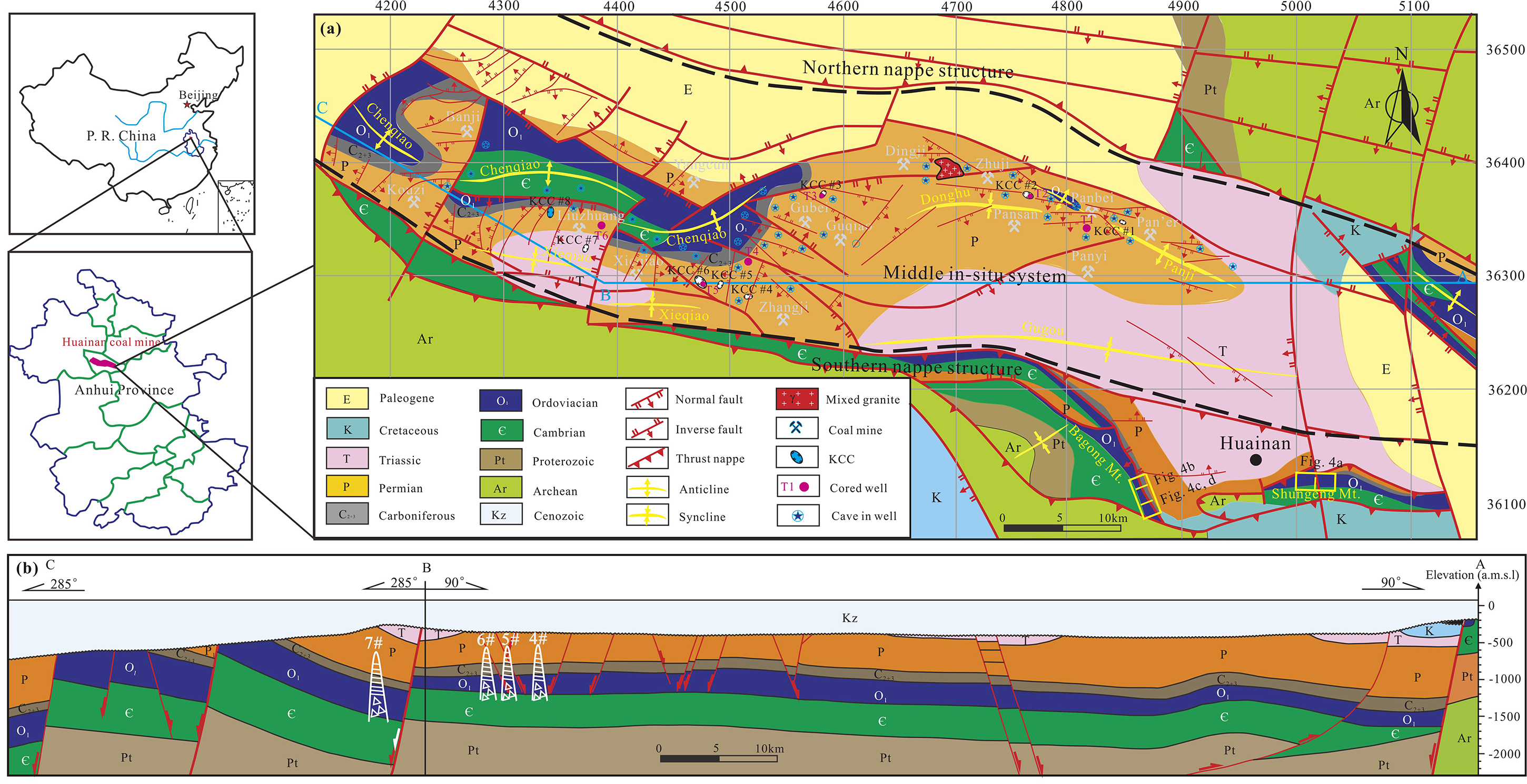
Geological setting of the studied area: (a) strata, structures and well locations in the Huainan coalfield of Northern China; (b) geological map of cross section A–B–C in the Huainan coalfield.
From oldest to newest, the strata of the Huainan coalfield are the Huoqiu group of the Upper Archean, Qingbaikou and Sinian systems of the Upper Proterozoic, Cambrian and Lower Ordovician systems of the Lower Paleozoic, Carboniferous and Permian systems of the Upper Paleozoic, Triassic and Cretaceous systems of the Mesozoic, and Paleogene and Neogene systems of the Cenozoic (Figure 1(b)). The Cambrian system mainly comprises dolomite, oolitic limestone, leopard skin limestone, and quartz sandstone; it is a deposit of carbonate platform facies with an average thickness of 1060 m. The Lower Ordovician mainly comprises limestone, argillaceous limestone, dolomitic limestone, and dolomite; it has limited platform facies and tidal flat sediments with an average thickness of 89 m. The Carboniferous and Permian strata are coal measures mainly comprising coal seams, mudstone, sandstone, and several thin layers of limestone in the Carboniferous Taiyuan Formation with a total average thickness of 1076 m. The Mesozoic and Cenozoic sediments mainly comprise continental sandstone and mudstone with a total average thickness of 930 m (Zhang et al., 2022; Zhang et al., 2023).
By the end of 2022, seven KCCs (i.e. #1–#7) were found in the Huainan coalfield along the south wing of the Panji and Chenqiao anticlines, as shown in Figure 1(a). The roots of KCC #1–#3 developed in the Ordovician carbonates, and the roots of KCC #4–#7 developed in the Cambrian carbonates. All of the KCCs pass through the Ordovician and Carboniferous strata and enter the Permian strata, as shown in Figure 1(b). Three-dimensional (3D) seismic exploration and drilling data show the KCCs in the Huainan coalfield as ellipses in planar view. The major axes are mainly in the NWW–SEE and NNW–SSE directions, with some in the NNE–SSW direction. The widths of the KCCs are generally tens to hundreds of meters, with a maximum width of 1150 m for KCC #6. The ratio of the major axis to the minor axis is generally from 1.2:1 to 3:1, with a maximum ratio of 11.3:1 for KCC #6. In the cross-sectional view, the KCCs mostly appear as cones that become progressively larger downward. Their vertical height ranges from 187.56 to 1369.54 m. In particular, KCC #6 comprises three smaller KCCs that appear as beads in the planar view and a hump in the cross-sectional view, as shown in Figure 2(a) and (b). Liu and Li (2006) and Cheng et al. (2013) believed that the formation of KCC #6 may be related to the faults and groundwater activities of the study area in the NNW and NWW directions. Three of the KCCs (#2, #6, and #7) were exposed by the working face of a mine or by roadway excavation. In the Cambrian and Ordovician strata, the KCCs are commonly filled with collapse breccia, gigantic calcite (Figure 3(a), (b), and (e)), and pyrite (Figure 3(d)). In the Carboniferous and Permian strata, the stratum beddings at the edges of the KCCs are chaotic, and the rock and coal blocks are broken and mixed. The KCCs are mostly filled and cemented with calcite and/or pyrite (Figure 3(c)). The strata inside the KCCs appear to have collapsed as a whole (Figure 3(f)), and the bedding and the vertical and high-angle fractures are very developed.
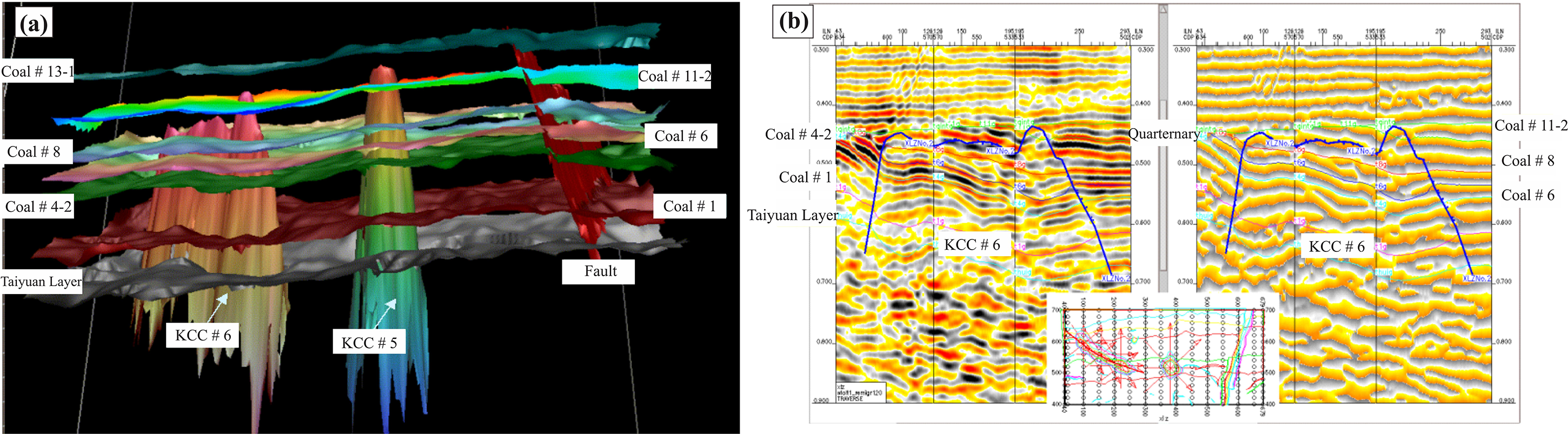
3D seismic morphological features of KCCs: (a) stereographic map of KCC #5 and KCC #6 in the Xieqiao coal mine; (b) 3D seismic sectional view of KCC #6 in the Xieqiao coal mine.
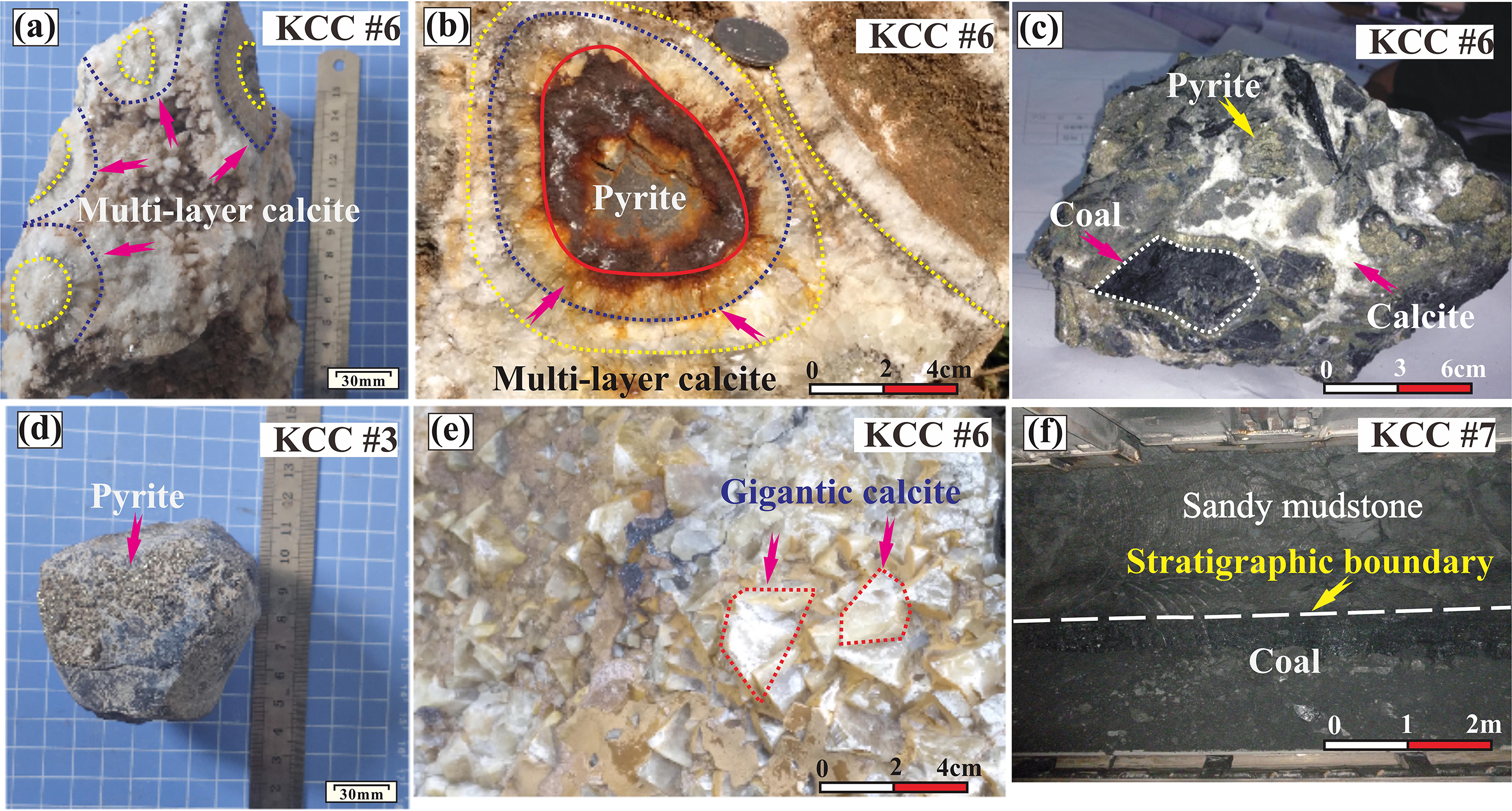
Fillings in KCCs in the Huainan coalfield: (a) calcite (distributed in the Carboniferous strata) in KCC #6 in the Xieqiao coal mine; (b) and (e) calcite and pyrite (distributed in the Ordovician strata) in KCC #6 in the Xieqiao coal mine; (c) calcite and pyrite (distributed in the Permian strata) in KCC #6 in the Xieqiao coal mine; (d) pyrite (distributed in the Carboniferous strata) in KCC #3 in the Gubei coal mine; (f) sandy mudstone and coal (distributed in the Permian strata) in KCC #7 in the Liuzhuang coal mine.
Sample and testing
Currently, 63 exploration wells in the Huainan coalfield fully penetrated the Permian, Carboniferous, and Ordovician strata. These wells are distributed throughout the study area and exist in the form of cores and drilling data, thus providing a solid foundation for this study. In this study, the observation and test data from the Cambrian and Ordovician carbonate outcrops (Shungeng Mountain and Bagong Mountain, see in Figure 1(a)), seven discovered KCCs (Figure 1(a)), and six representative wells (wells T1–T6, and wells T2, T3 and T5 are located in KCCs #2, #3 and #6, respectively, see Figure 1(a)) with a total core length of 2365.74 m were selected for detailed analysis.
Sixteen core samples used for rock mechanical parameter testing were made into cylinders with a diameter of 25 mm and a height of 50 mm. The top and bottom surfaces of these samples were parallel with each other. The rock mechanics tests for all core samples were carried out using the MTS-816 Rock Mechanics Test System (MTS Systems Corporation, Minnesota, USA) in the State Key Laboratory of Anhui University of Science and Technology. The experimental procedures were based on the Chinese national standard GB23561-2009-T “Method for determining the physical and mechanical properties of coal and rock.” For instance, uniaxial compression tests were performed to obtain the elastic modulus and Poisson's ratio of rocks. Brazilian splitting tests were performed to obtain the tensile strength of rocks. Triaxial compression tests were performed to determine shear strength data of rocks. Compressive strength, cohesion and internal friction angles were determined from fracture pressure, elastic modulus and Poisson’s ratio under different confining pressures. The confining pressures used in the triaxial rock compression tests were 0, 5 and 10 MPa, respectively (Zhang et al., 2022).
Theory and methods
KCC formation mechanism
Mechanical model and roof collapse criterion
Many studies have shown that the evolutionary process of KCCs in Northern China can be divided into two stages (He et al., 2009; Zhang et al., 2021b; Zuo et al., 2009). The first stage is the formation and expansion of the basement cave, which is mainly related to the dissolution of carbonate rocks. The second stage is the upward collapse of the cave roof after cave formation. Long-term research has shown that the basement caves of these KCCs usually developed in the thick limestone of the Cambrian or Ordovician systems. The upper part is often covered by multilayer coal measures (i.e. Carboniferous and Permian strata) with thin single layers, developed bedding, and low strength that is prone to fracture and collapse under the actions of tectonic stress, gravity, and groundwater activity (Shi et al., 1998; Xu et al., 2022; Yin et al., 2019).
The field investigation of the Huainan coalfield found well-developed caves, high-angle fractures, and joints in the Cambrian and Ordovician strata, as shown in Figure 4(a)–(d). Because the cave roof is often located in areas with a high density of fractures and joints (Figure 4(a)–(d)), cracks in different directions may be tangential to the edges of the caves (assumed to be elliptical) at different locations. As these cracks expand, they connect with each other and form an elliptical failure zone at the cave roofs. These cracks also expand upward, and when they extend to a certain rock stratum interface, an elliptical mesa block forms (Figure 5(a)) and separates the elliptical failure zone from the rock stratum interface. As shown in Figure 5(a), AD and BC represent high-angle fractures, and CD represents the rock stratum interface. As AD and BC expand to CD, they form the separation body ABCD as an elliptical frustum. If the separation body ABCD has a thickness b, the major axis of the upper elliptic arc CD has the radius r, and fractures AD and BC both have the dip angle α, then the major axis of the lower elliptical arc AB has a radius given by r + b/tan α. If the distance between the upper surface of the separation body ABCD and the ground surface is h, then the coordinate system can be established as shown in Figure 5(b). The mechanical model and criterion for the roof collapse of the cave can then be analyzed according to the limit equilibrium theory and Mohr–Coulomb criterion (Wang et al., 2015; Xu et al., 2008; Zuo et al., 2009).
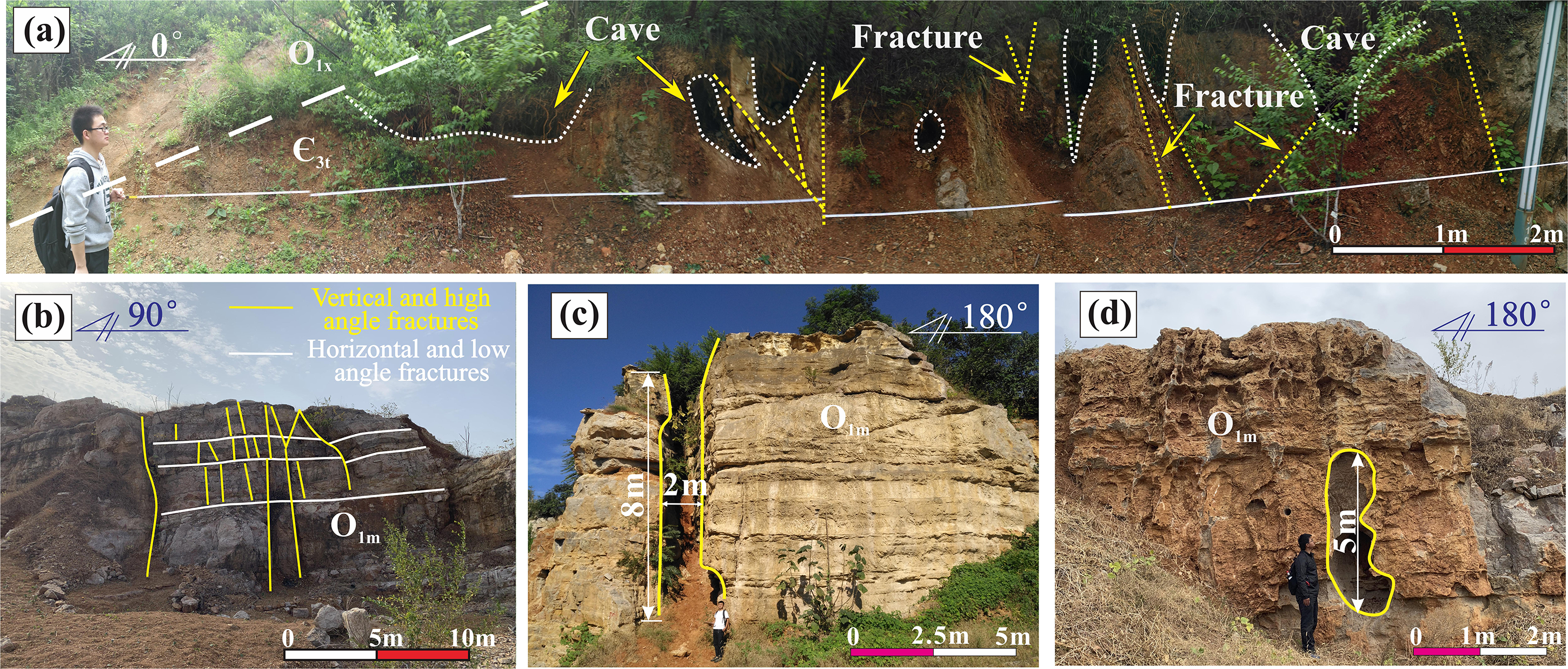
Photos of the Cambrian and Ordovician paleoweathering crust karst:(a) caves and fractures in the Cambrian paleoweathering crust in Shungeng Mountain section (Figure 1(a)); (b–d) caves and fractures in the Ordovician paleoweathering crust in Bagong Mountain section (Figure 1(a)).
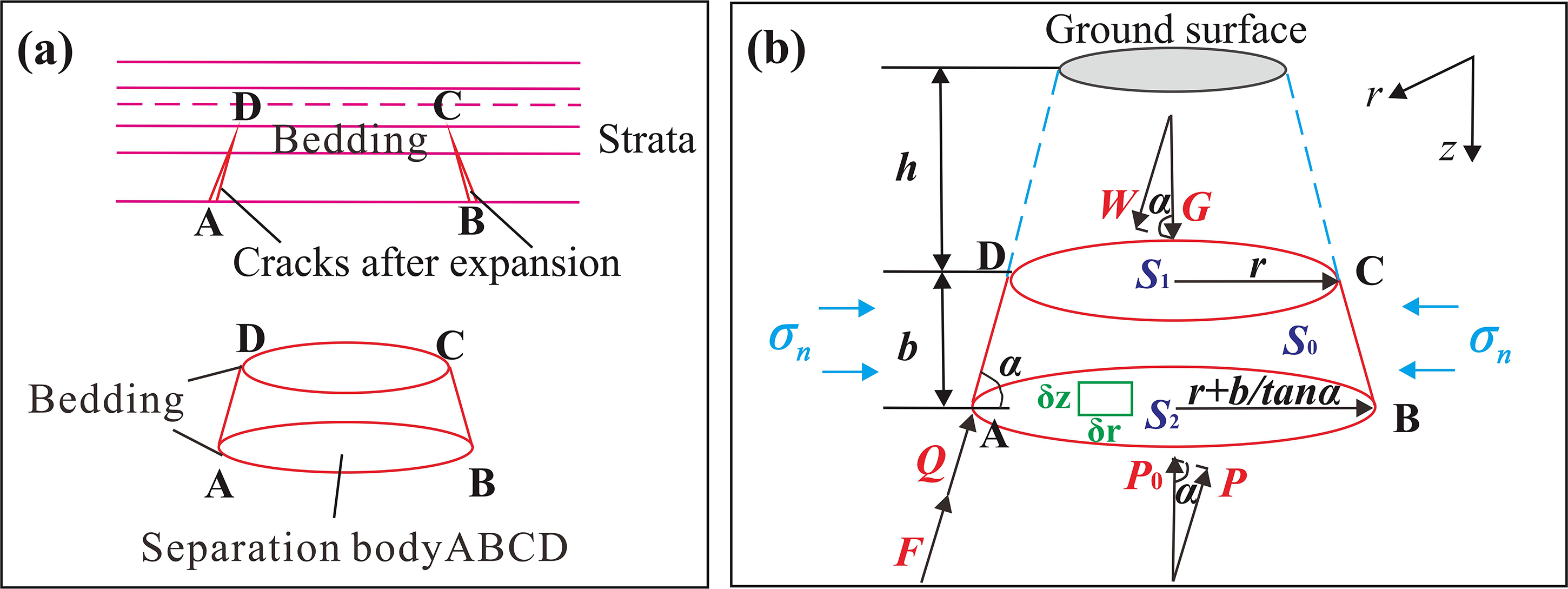
Forming process and force analysis of elliptical mesa block: (a) forming process of elliptical mesa block; (b) force analysis of elliptical mesa block.
The stress perpendicular to the original rock can be assumed as

If the lateral pressure coefficient of the rock mass is λ, then the horizontal stress is given by




Taking the horizontal stress as the normal stress and substituting equation (4) into equation (5) obtains


The component of horizontal stress along the slope is given by


The overburden load of the separation body ABCD is given by

Then, the component of the overburden load G along the slope is given by L is proportional to the cave radius r. The separation body collapses more easily with increasing r. L is inversely proportional to the thickness b of the separation body. The separation body collapses more easily with decreasing b. L is inversely proportional to the groundwater pressure P0. The separation body collapses more easily with decreasing P0. L is inversely proportional to the lateral pressure coefficient λ of the rock mass, cohesion c between cracks, and internal friction angle φ. The separation body collapses more easily with decreasing λ, c, and φ. L is correlated to the distance h between the upper surface of the separation body and the ground surface.




Development conditions for the cave roof
Upward development
The above analysis indicates that the overburdened strata of the cave collapse when L ≥ 1. During this collapse process, the volume of collapsed rocks increases because of crushing expansion (assuming that the crushing expansion coefficient η is generally greater than 1.0). The bending subsidence of the rock mass will occur before the collapsed stratum breaks (Lai et al., 2021; Wang et al., 2015). For a cave height H, caving zone height H1, bending subsidence zone (including the crack zone) height H2, and crushing expansion coefficient η, then the cave roof stops collapsing downward (i.e. the KCC stops developing upward) when H ≤ ηH1 + H2. If the groundwater runoff in the cave is very strong, the fallen rock will be taken away by the water flow, which empties the filled space and allows more rocks from the cave roof to fall. This allows the KCC to continue to develop upward.
Stopping of development
The collapse of the cave roof stops under one of the following conditions:
The runoff conditions change. If the groundwater flow is blocked and the runoff is slow, then the groundwater flow cannot take away the broken rocks. During the upward development of the collapsing cave roof, a rock stratum may be encountered that is of sufficient thickness and strength that L < 1. At this point, the collapse will not develop upward, but the collapsed rock stratum in the KCC will still sink down until condition 1 occurs. The cave roof continues to develop upward until it reaches the ground surface.
Numerical simulation
Numerical simulations were performed to verify the above theoretical analysis. Most numerical methods cannot deal with discontinuous deformation problems, but the discrete element method (DEM) is suitable for stress analysis of discontinuous media and jointed rock masses. The software 3DEC (Itasca Consulting Group Inc.) is based on DEM and is widely used in rock mechanics research to describe the behavior of discrete media behavior (Liu and Adam, 2020; Wang et al., 2015). In 3DEC, the discrete elements are controlled by discontinuities such as joints, and element nodes can be separated in the simulation process. The interaction forces between elements can be calculated according to the stress–displacement relationship, and the movement of individual elements can be determined by Newton's law of motion according to the magnitudes of the unbalanced force and unbalanced moment applied to the element (Liu and Adam, 2020; Wang et al., 2015).
In this study, 3DEC 5.2 was used to simulate the formation process of KCC #3 of the Huainan coalfield. The simulation comprised the following steps: establishment of a geological model, establishment of a mechanical model, model meshing, and model calculation.
Establishment of the geological model
The geological profile of KCC #3 was used to establish the geological model, as shown in Figure 6. The geological model comprised the Ordovician, Carboniferous, and Permian strata from bottom to top with thicknesses of 74.5, 113.0, and 162.5 m, respectively. The lithology of the Ordovician stratum was mainly thick limestone. The lithology of the Carboniferous stratum was mainly thin limestone, mudstone, and sandstone mudstone. The lithology of the Permian stratum was mainly coal seams, sandstone, mudstone, and sandy mudstone. The ground elevation was +25.0 m. The basement cave developed 45.0 m below the Ordovician roof (elevation: −780 m). The cave had a width of about 100.0 m at the base and a height of about 15.0 m (elevation from −780 to −765 m). The cave developed upward into coal seam 1 in the Permian (elevation: −600 m) with a total height of about 180.0 m, as shown in Figure 6. The slip surface of KCC #3 was determined by 3D seismic exploration and drilling.
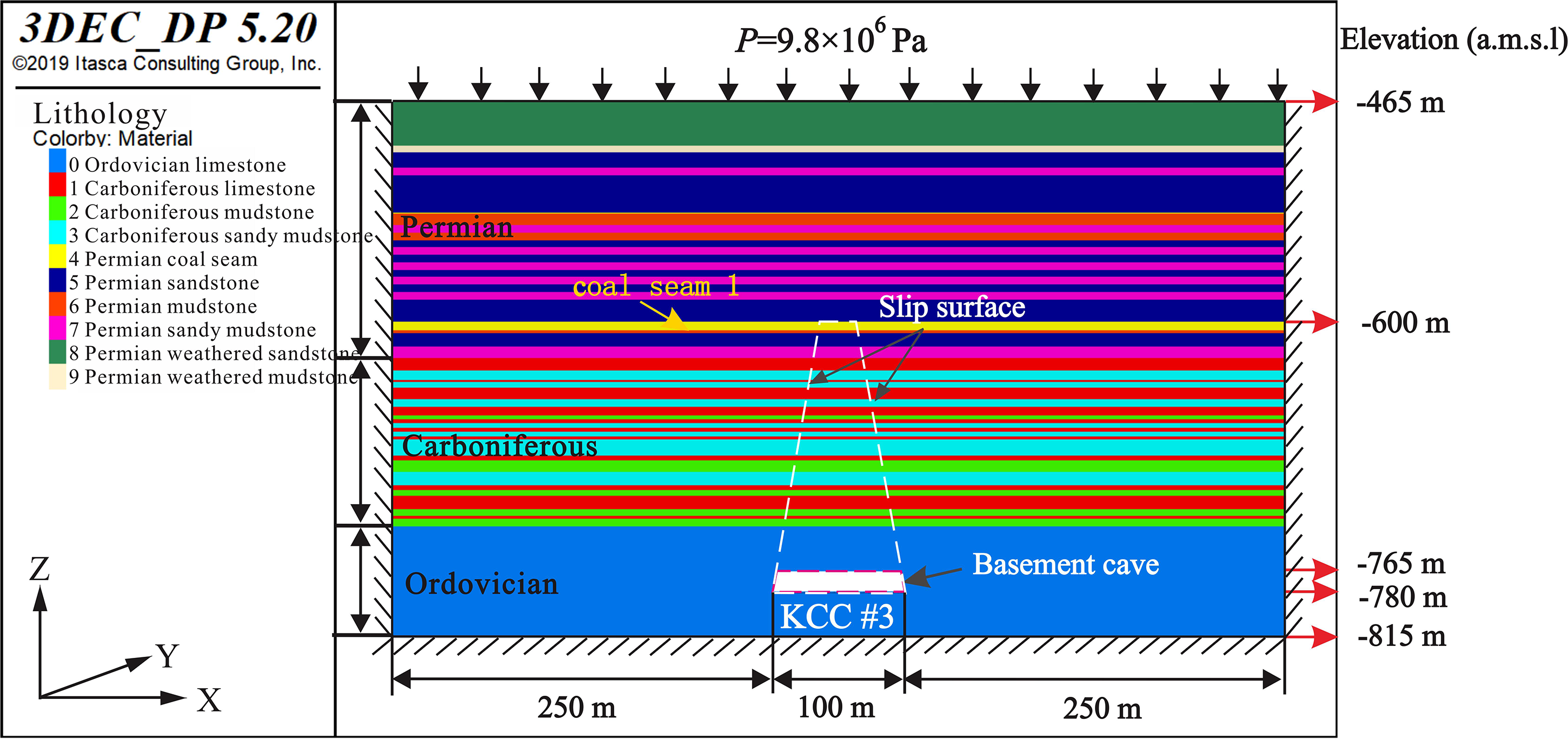
Geological model of KCC 3# in the Huainan coalfield.
To eliminate the influence of boundary effects on the simulation results, the model boundaries were increased appropriately. The left and right boundaries were extended 250 m outward. The upper boundary was extended outward to the top of the Permian stratum (elevation: −465 m), and the lower boundary was extended to the bottom of the Ordovician limestone (elevation: −815 m), as shown in Figure 6. Therefore, the geological model had a length (X-axis) of 600 m, a height (Z-axis) of 350 m, and a width (Y-axis) of 5 m, as shown in Figure 6.
Establishment of the mechanical model
The establishment of the mechanical model had two steps: determining the mechanical parameters of different units of the geological body and determining the size and constraints of the stress or strain on the boundaries of the geological body. The elastic–plastic mechanical model was selected, and rock failure was assumed to conform to the Mohr–Coulomb strength criterion (Lai et al., 2020; Wu et al., 2018). The physical and mechanical parameters of the rocks and coal seams were set based on the results of physical mechanics tests. The bulk modulus K and shear modulus G of the rock mass were calculated as follows (Zhou et al., 2006):


Physical and mechanical parameters of rock mass.
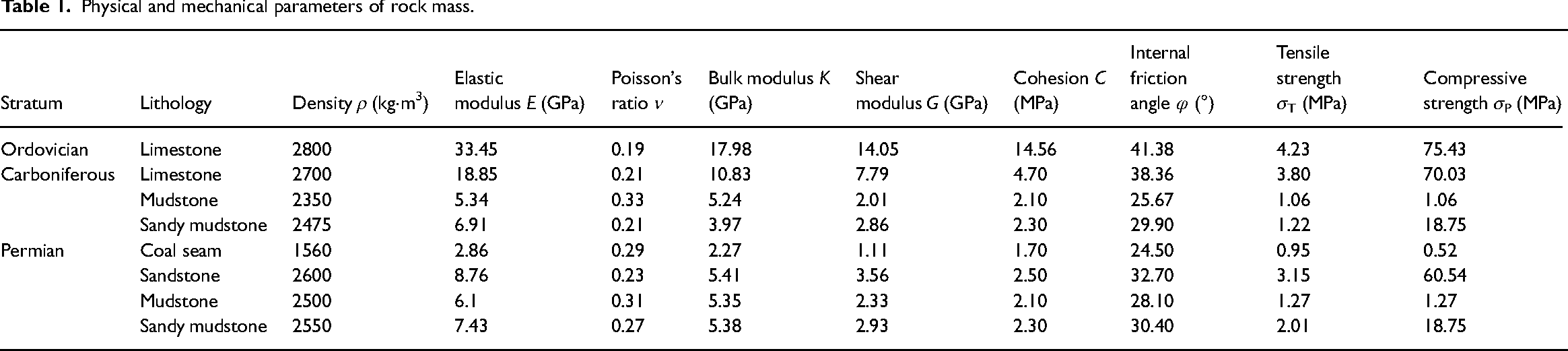
The normal and shear stiffnesses of joints are usually obtained according to equation (17) (Zhang et al., 2021):

The elastic modulus and shear modulus of the rock are related to the rock mass rating (RMR) classification index (Bieniawski, 1978). For a rock mass with an RMR index greater than 55, its elastic modulus can be obtained from the following formula (Bieniawski, 1978; Zhang et al., 2021).

Mechanical parameters of structural plane.

Previous studies have shown that, since the Paleogene, the initial stress field of the Huainan coalfield was primarily induced by gravity (Zuo et al., 2009). Therefore, the left, right, front, back, and bottom boundaries of the model were fixed, and the top boundary was approximated as the equivalent load of the overlying strata (Figure 6). This load P can be calculated as follows:

where ρ is the average density of the Cenozoic stratum (2.0 × 10³ kg/m3), g is the acceleration of gravity (approximated as 10.0 m2/s in this study), and h is the distance from the top boundary of the model to the ground surface (490.0 m).
In this study, the groundwater pressure in the model was defined as 0, thus the effect of stress−seepage coupling and groundwater erosion on the formation of KCC was not considered, which will be an important direction for further research.
Model meshing
To improve the accuracy of the simulation results, the model was refined. The model was divided into 129 blocks comprising 5,241,174 smaller units with a minimum length of 0.5 m and a maximum length of 10 m. The division of the model mesh met the accuracy requirements.
Model calculation
After the model was established and discretized, 3DEC 5.2 was used to simulate the changes in stress and displacement during the formation and evolution of KCC #3.
Results and discussion
Simulation results
The numerical simulation showed that cracks in the cave roof caused it to collapse because of continuous plastic deformation, and the broken rock debris was washed away under the action of groundwater flow. The cave roof continued collapsing until it reached the Permian stratum, which had a layer of thick sandstone above coal seam 1 that was difficult to damage. The simulation results were generally consistent with the actual conditions of KCC #3, which verified the theoretical analysis. The simulation results indicate that the formation process of KCC #3 can be divided into four stages: (I) early collapse, (II) middle-early rapid collapse, (III) middle-late slow collapse, and (IV) late filling compaction, as shown in Figures 7 and 8.
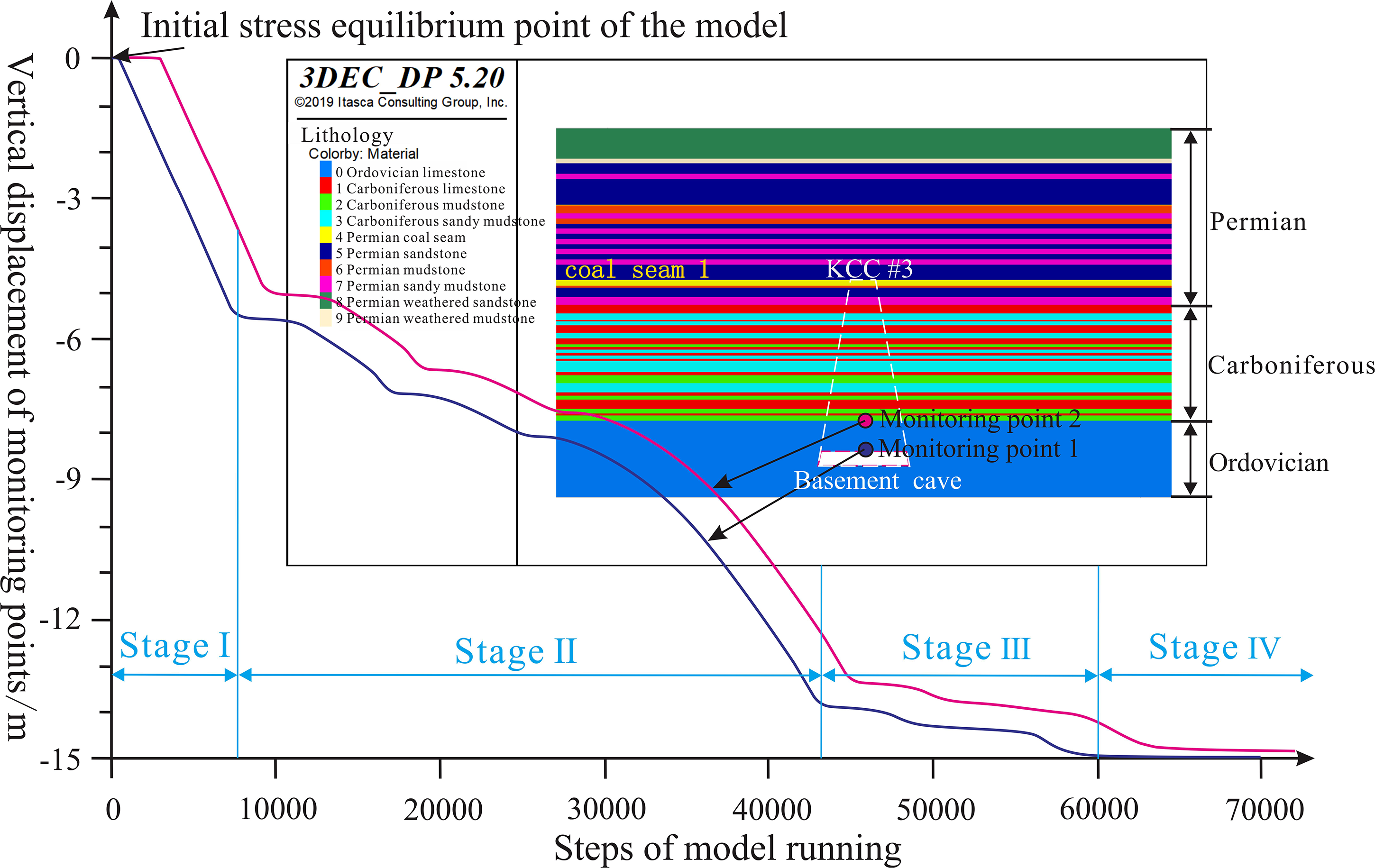
Vertical displacement of monitoring points during KCC #3 roof collapse.
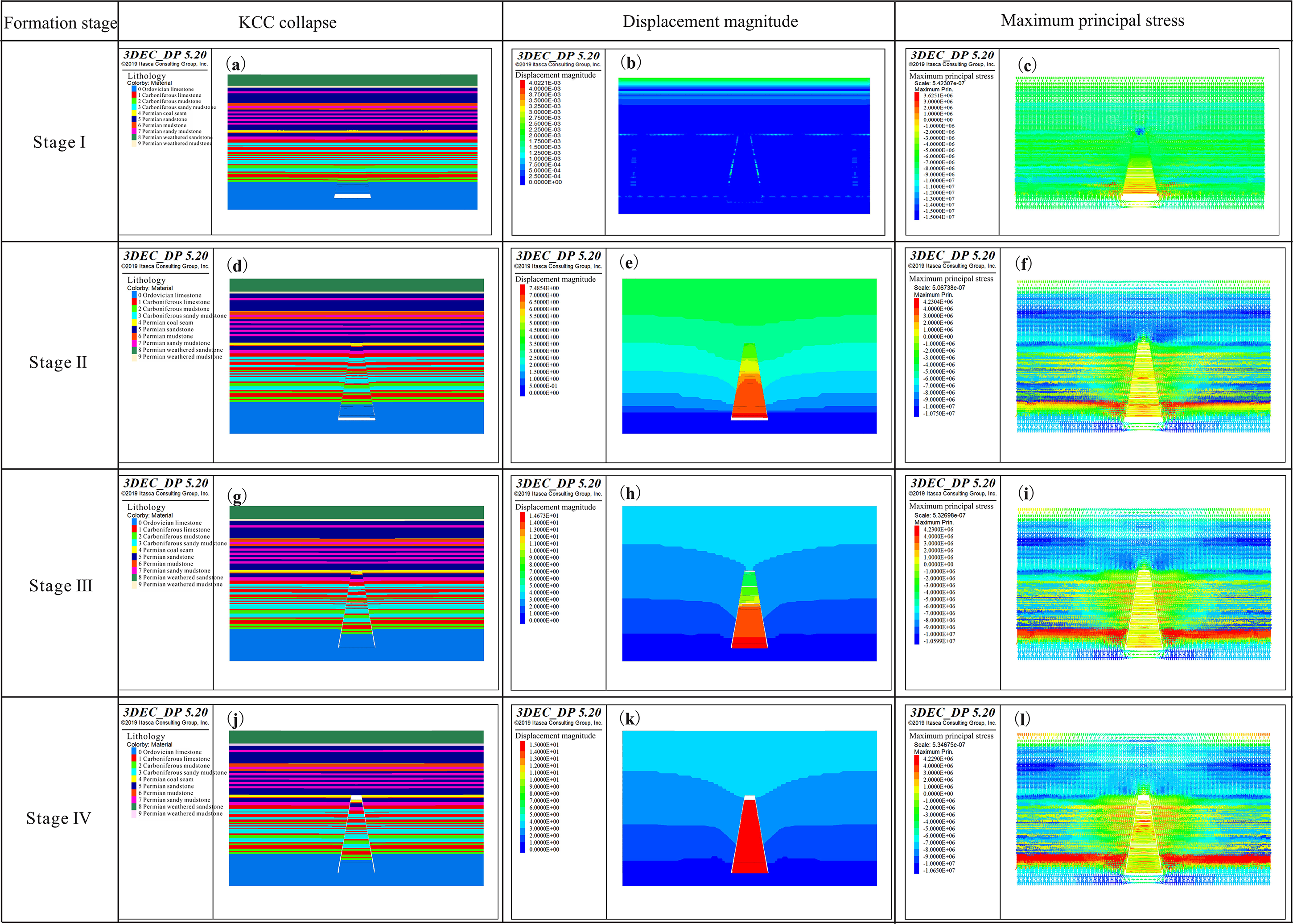
Dynamic changes of displacement and maximum principal stress during KCC #3 roof collapse.
In stage I, the cave developed in the Ordovician carbonates, which destroyed the stress balance state of the original rock (Figure 8(c)). This reduced the stress of the rock mass above the cave and the surrounding rock, which caused the deformation and destruction of the overlying rock layer and surrounding rock to varying degrees, as shown in Figure 8(b). In this stage, the cave roof collapsed rapidly but at a small scale. The collapse was mainly between the top of the Ordovician stratum and the lower part of the Carboniferous stratum, and it did not reach the Permian stratum (Figures 7 and 8(a)).
In stage II, the range and amplitude of the stress reduction area around the cave increased, and the stress concentration area on top of the cave moved continuously upward (Figure 8(f)). Under the combined action of the gravity load of the rock mass and external stress, the cave roof collapsed more quickly into the Permian stratum, as shown in Figure 8(d) and (e). Because of the crushing and swelling actions of the collapsed rocks and the bending and sinking actions of the overlying strata, a transient stress equilibrium state appeared that slowed down the speed of the cave roof collapse (Figure 7). However, the collapsed rocks in the cave were gradually washed away by groundwater, which broke the transient stress equilibrium. The overlying strata continued to collapse, which increased the speed of the cave roof collapse (Figure 7).
In stage III, as the cave was gradually filled and compacted (Figure 8(g) and (h)), the collapse amplitude above the cave started to decrease (Figure 7). KCC #3 stopped developing upward after collapsing to the roof of coal seam 1 (Figure 8(g)), which was a thick sandstone stratum with a thickness of 10.0 m. Above it was an interbedded layer of sandstone and sandy mudstone with a thickness of 40.0 m (Figure 7), which had sufficient mechanical strength to form a stable and natural arch in equilibrium. At the end of this stage, the strength and range of the stress concentration area at the top of the cave gradually decreased (Figure 8(i)), and the basic outline of KCC #3 had formed (Figure 8(g) and (h)).
In stage IV, the formation of the stable and natural arch stopped the collapse process of the KCC (Figure 7). The stress concentration area on top of the KCC also gradually disappeared (Figure 8(l)). The rocks and strata inside the KCC were continuously filled and compacted, and an unfilled space formed under the top plate (Figure 8(j) and (k)). This is consistent with actual onsite observations of KCC #3 (Liu and Li, 2006). The unfilled space formed because the formation of the natural arch prevented the further downward collapse of the roof strata.
Discussion
Zhang et al. (2021a, 2021b) used petrological, mineralogical, and geochemical methods to study the formation mechanism of KCCs in the Huainan coalfield, which they also divided into four stages. The first stage mainly occurred from the Middle Carboniferous to the Early Triassic. Caves in the Ordovician weathering crust collapsed at a small scale under the deposition, compaction, and released water dissolution of the overlying Carboniferous–Permian strata (Figure 9(a)). The second stage mainly occurred from the late Triassic to Paleogene. Multiple tectonic movements and magmatic activity during this period formed a complex fault structure and magmatic system (Shu et al., 2017; Xu et al., 2004), which led to the mixed dissolution of meteoric water and deep hydrothermal fluid through faults and fractures and promoted the continuous dissolution and expansion of caves and fractures formed in the earlier stage. These factors accelerated the collapse of the cave roof (Figure 9(b)). The third stage mainly occurred after the Neogene, during which the Huainan coalfield showed depression-type uniform settlement. The Neogene strata were deposited on the bedrock weathering surface, which blocked the supply of atmospheric precipitation to the bedrock stratum (Figure 9(c)). This stopped the development of deep paleokarsts (e.g. caves, fractures, and vugs) in the area. During this stage, the speed of the KCC roof collapse gradually slowed down. The fourth stage mainly occurred after the Quaternary. The sedimentary thickness of the Cenozoic strata (including the Neogene and Quaternary) was stable, the movement of deep groundwater was very slow, and the development of paleokarsts almost stopped. The KCCs reached a new mechanical balance after experiencing the processes of collapse, filling, compaction, and cementation. This stopped their upward development (Figure 9(d)).
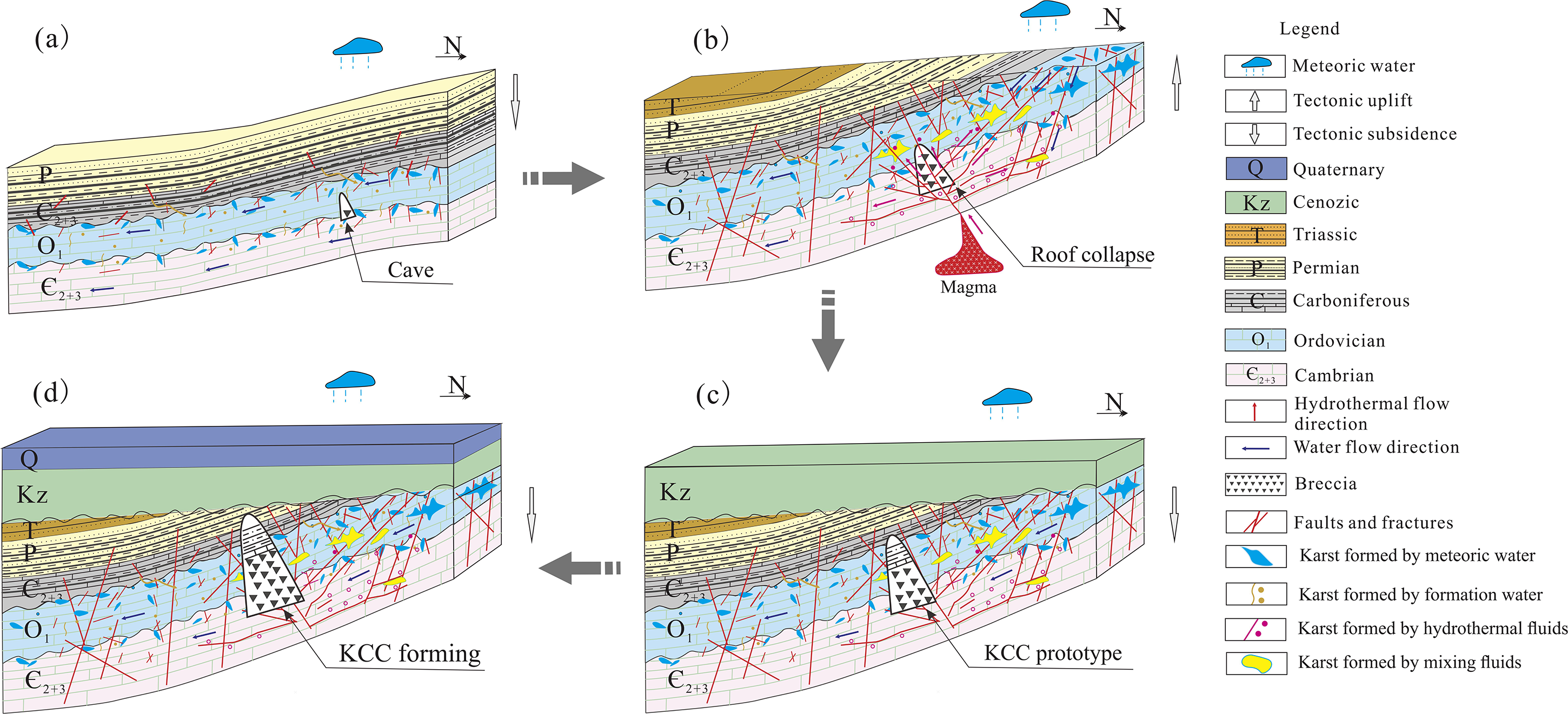
Evolution processes of KCCs in the Huainan coalfield (modified from Zhang et al. (2021b)).
The numerical simulation results in this study are basically consistent with the research results of He et al. (2009), Zuo et al. (2009), and Zhang et al. (2021b) on the formation and evolution of the KCCs in other coal mines. Some scholars combined the tectonic history of Northern China to consider that the KCCs in Northern China coalfield began to develop after the formation of the North China platform in the late Mesozoic era, most of which ended in the Yanshan period due to the loss of the corresponding hydrodynamic conditions, and a few of which continued to develop after the Yanshan period (He et al., 2009; Lu et al., 2013; Qian, 1988; Yin et al., 2019). Guo (2004), and Zhao and Guo (2014) used the uranium series dating method to determine that the formation period of the KCCs in Xishan, Taiyuan City, China was Quaternary, which is about 250,000–420,000 years ago. However, regional differences in the sedimentary environment, lithological structure, and geological evolution of Ordovician strata in Northern China may result in different formation mechanisms for KCCs in other areas. Based on previous research results (Shi et al., 1998; Xu et al., 2022; Yin et al., 2019; Zuo et al., 2009) and the developmental characteristics of the paleokarsts and KCCs in the Huainan coalfield, KCC formation in the Huainan coalfield was concluded to be based on Ordovician and/or Cambrian carbonate rocks dissolved in multiple stages by multiple types of corrosive fluids (e.g. meteoric water, formation water, hydrothermal fluid, and mixing fluid). Faults and fractures produced by multistage tectonic movements served as fluid migration channels, and caves formed under the action of long-term dissolution. After the caves formed, the combined action of the stress and gravity load of the rock mass, tectonic stress, and vacuum negative pressure caused the cave roofs to gradually collapse upwards and form KCCs, as shown in Figures 8 and 9.
Conclusions
The following conclusions can be drawn:
Seven KCCs have been found in the Huainan coalfield. Their roots developed in the Ordovician or Cambrian carbonates, and they all passed through the Ordovician and Carboniferous strata into the Permian strata. In the planar view, most of the KCCs appear as ellipses with widths of tens to hundreds of meters. In the cross-sectional view, the KCCs mostly appear as cones that become progressively larger downward with vertical heights of 187.56−1369.54 m. A mechanical model and criterion for the collapse of the cave roof were established. KCC formation is mainly related to the size of the basement cave, thickness of the roof strata, lateral pressure coefficient of the rock mass, and the cohesion and internal friction angle between cracks. The collapse and upward development of the KCC are positively correlated with the radius of the basement cave and are negatively correlated with the groundwater pressure, thickness of the roof strata, lateral pressure coefficient of the rock mass, and cohesion and internal friction angle between cracks. The numerical simulation results indicated that the KCC formation process could be divided into four main stages. In stage I, the basement cave that develops in the Ordovician or Cambrian carbonates destroys the original stress balance of the rock mass, which decreases the stress of the surrounding rock and causes a small-scale collapse of the cave roof. In stage II, the speed of the cave roof collapse accelerates, and the range and extent of the stress reduction area of the surrounding rock are further increased under the combined action of the rock mass, external stress, and groundwater flow. In stage III, the roof collapse amplitude of the cave begins to decrease gradually. The strength and scope of the stress concentration area at the top of the cave also decrease gradually, and the basic outline of the KCC forms. In stage IV, a stable and natural arch in equilibrium forms at the KCC roof. The upper part of the KCC stops collapsing upward. The rocks and strata inside the KCC are continuously filled and compacted, and an unfilled space forms beneath the roof.
Footnotes
Acknowledgments
This paper was supported by the National Natural Science Foundation of China (No. 42272281, 42172279), the Natural Science Research Project of Higher Education Institutions of Anhui Province, China (KJ2021A0441), the Scientific Research Foundation for High-level Talents of Anhui University of Science and Technology, China (2021yjrc26). The great support from the Huaihe Energy Holding Group Co., Ltd of China and the State Key Laboratory of Anhui University of Science and Technology are also greatly appreciated. The authors are also grateful to the two anonymous reviewers, whose comments improved the quality of this manuscript.
Authors’ contributions
Haitao Zhang wrote the main manuscript text and revised the manuscript text, Guangquan Xu revised the manuscript text, and Yanxi Zhang, Ming Tang, Gang Zhang, Xiaoguo Liu provided important materials. All authors reviewed the manuscript.
Data availability
The data sets analyzed during the current study are available from the corresponding author on a reasonable request.
Declaration of conflicting interests
The author(s) declared no potential conflicts of interest with respect to the research, authorship, and/or publication of this article.
Funding
The author(s) disclosed receipt of the following financial support for the research, authorship, and/or publication of this article: This paper was supported by the National Natural Science Foundation of China (Nos. 42272281, 42172279), the Natural Science Research Project of Higher Education Institutions of Anhui Province, China (KJ2021A0441), the Scientific Research Foundation for High-level Talents of Anhui University of Science and Technology, China (2021yjrc26).
