



Abstract
To figure out gas enrichment laws in Permian volcanic rocks, Sichuan Basin, an association among reservoir-forming elements was explored to analyze forming modes and point out exploration prospects in accordance with reservoir characteristics, gas source conditions, and fault elongation in Zhougongshan and Jianyang areas. Results show that there mostly exist porous volcaniclastic rock and lava reservoirs of explosive facies. In Jianyang with Lower Cambrian Qiongzhusi Formation as the principal source rock, early faults offered pathways to assemble ample initial oil and gas. Following an increase of burial depth, oil started cracking vastly to create oil-cracked gas. These elements constitute one reservoir-forming mode of Cambrian hydrocarbon supply–fault transporting–in-situ cracking in Jianyang. While in Zhougongshan with Lower Permian Maokou 1 Member as the main source, active faults during hydrocarbon generation and expulsion acted on trap preservation. Late kerogen-cracked gas gathered at structural highs far from giant faults. Thus, the other mode exhibited in Zhougongshan is Permian hydrocarbon supply–fault adjustment–effective trap accumulation. Reservoir-forming conditions in volcanic rocks present certain disparity among all kinds of tectonic settings inside the basin, giving rise to various volcanic gas reservoirs developed. The Permian volcanic rocks are expected to be a major domain for reserve and production increase in Sichuan Basin.
Introduction
As one sort of essential lithology in reservoirs, volcanics appeal to so much attention together with progressive breakthroughs in exploration and development technologies used for oil and gas in the world (Chen et al., 2017; Feng et al., 2008; Feng et al., 2011; Hu et al., 2021; Lu et al., 2019; Lenhardt and Götz, 2015; Magara, 2003; Nayoan, 1981; Sruoga and Rubinstein, 2007; Sruoga et al., 2004). Moreover, incremental proven reserves also mount stage by stage after their available exploration. Basic volcanic rocks in Sichuan Basin of China are the product of the movement of Emeishan super mantle plume standing for part of Emeishan Large Igneous Province. Widely spread in western basin, they are 200-plus m thick with a gradual decrease from the southwest to the northeast (Luo et al., 2019; Wen et al., 2019; Lu et al., 2019; Hu et al., 2022a). A geological reconnaissance was made during an exploration on Permian oil and gas in Sichuan Basin. Porous volcaniclastic rock reservoirs of explosive facies have been found in Jianyang of western basin while fractured basalt reservoirs of effusive facies in Zhougongshan of the southwest Specifically, Well YT1 in Jianyang and Well ZG1 in Zhougongshan achieved individually 22.5 × 10⁴ m3/d and 25.6 × 10⁴ m3/d commercial gas flow, making great success in volcanic exploitation (Ma et al., 2019a; Hu et al., 2022b). Nevertheless, given that the research thereof is still on the initial stage, gas enrichment conditions have not yet been made clear for the Permian volcanics, which is unfavourable for additional prospecting (Zhu et al., 2010; Zhang, 2009; Yang et al., 2010; He et al., 2006; Tian et al., 2021). So, based on core, geophysical, geochemical, well logging and seismic data, reservoir-forming elements were analyzed for the Permian volcanic gas reservoirs, containing source rock conditions, reservoir characteristics as well as fault extension and configuration. Moreover, two forming modes were created to predict favourable zones, thereby providing theoretical basis for exploration on the Permian volcanic gas in Sichuan Basin.
Geological setting
Sichuan Basin, a large superimposed petroliferous province, has been taken shape on the Precambrian craton basement (Zou et al., 2014). Depending on tectonic characteristics, it can be subdivided into four zones, such as Western Sichuan depression zone, Middle Sichuan low gentle structural zone, Southeastern Sichuan steep structural zone and Southern Sichuan low steep structural zone (Yang et al., 2016; Xiao et al., 2020a). Affected by the Emeishan super mantle plume at the end of Dongwu Movement, large amount of basic basalt, diabase porphyrite, volcaniclastic lava and volcaniclastic rock deposited inside the basin were chiefly stretched over the Western Sichuan zone and the Southern Sichuan zone (Figure 1). The Permian volcanic gas reservoirs making exploration breakthroughs have commonly been found in Jianyang of middle depression and Zhougongshan of the south, which are exactly located at the periphery of Emeishan Large Igneous Province. In Jianyang, there exist two mantle-derived faults with NE and SW trends. At their intersection, volcaniclastic rock and lava of explosive facies are developed with the thickness varying from 200 m to 350 m, accompanied with cryptocrystalline basalt of effusive facies together with dolerite and diabase porphyrite of intrusive facies with a total thickness exceeding 120 m. Another NE-strike mantle-derived fault is witnessed in Zhougongshan where exists not only basalt of effusive facies with a thickness of 300 m but a few volcanics of explosive facies.
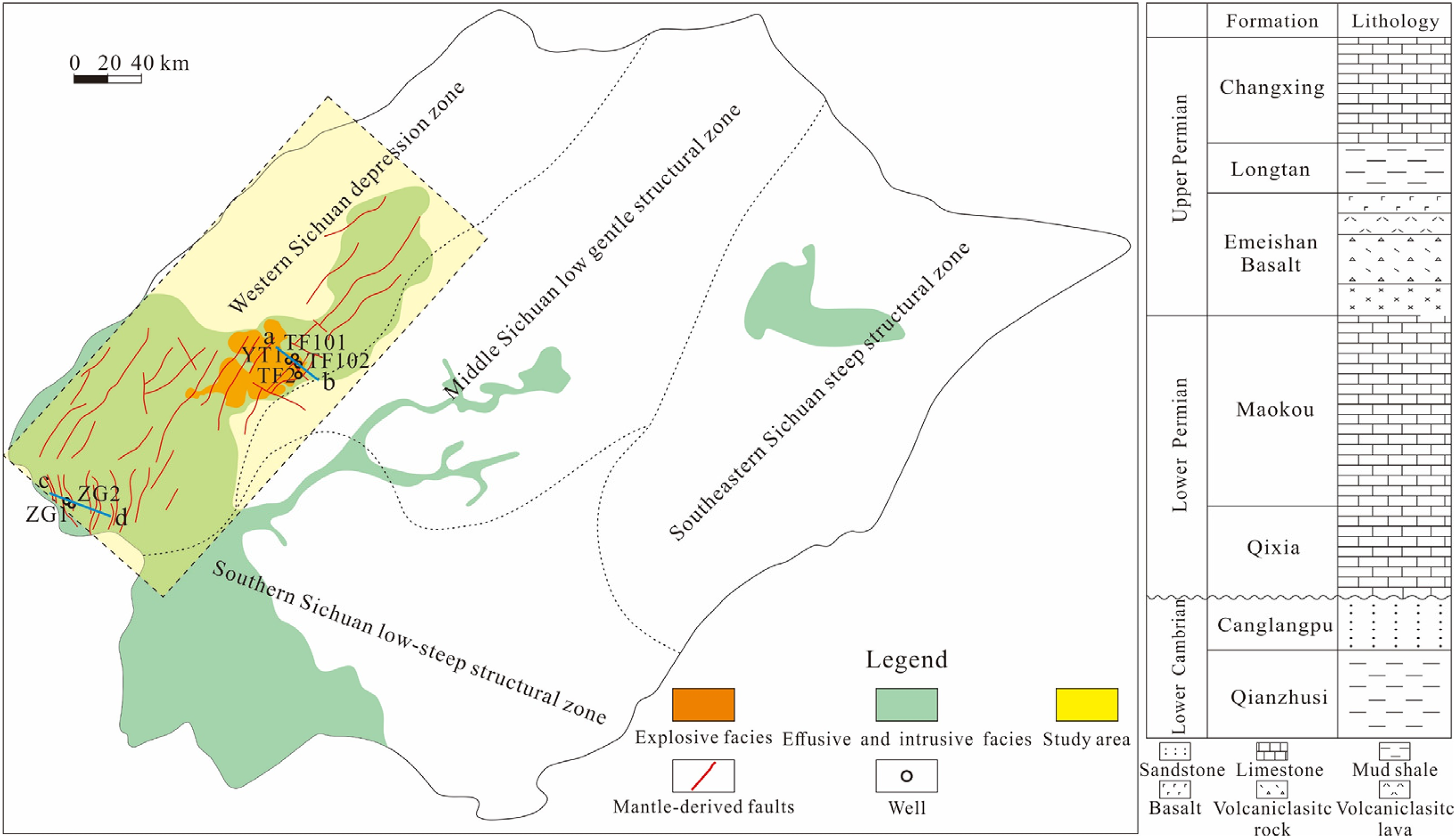
Planar distribution of Permian volcanic rocks, Sichuan Basin (Yang et al., 2016).
Geological conditions to form volcanic gas reservoirs
Characteristics of volcanic reservoirs
Permian Emeishan Basalt Formation in Jianyang is majorly composed of five lithologies from the bottom in turn, such as diabase porphyrite and dolerite of intrusive facies, volcaniclastic rock and lava of explosive facies as well as cryptocrystalline basalt of effusive facies, with the explosive-facies as the soul. The volcaniclastic lava not only has root in fusion (welding) of volcanic substances among which the content of volcanic clasts exceeds 90%, but is dominated by plastic clasts (Figures 2A and 2B). Generated through compaction or coalescence of volcanic clasts accounting for above 90%, volcaniclastics are dominated by rigid clasts like limy and basaltic breccias derived from a rapid pile-up after crushing surrounding rocks during a volcanic eruption (Figures 2C and 2D).
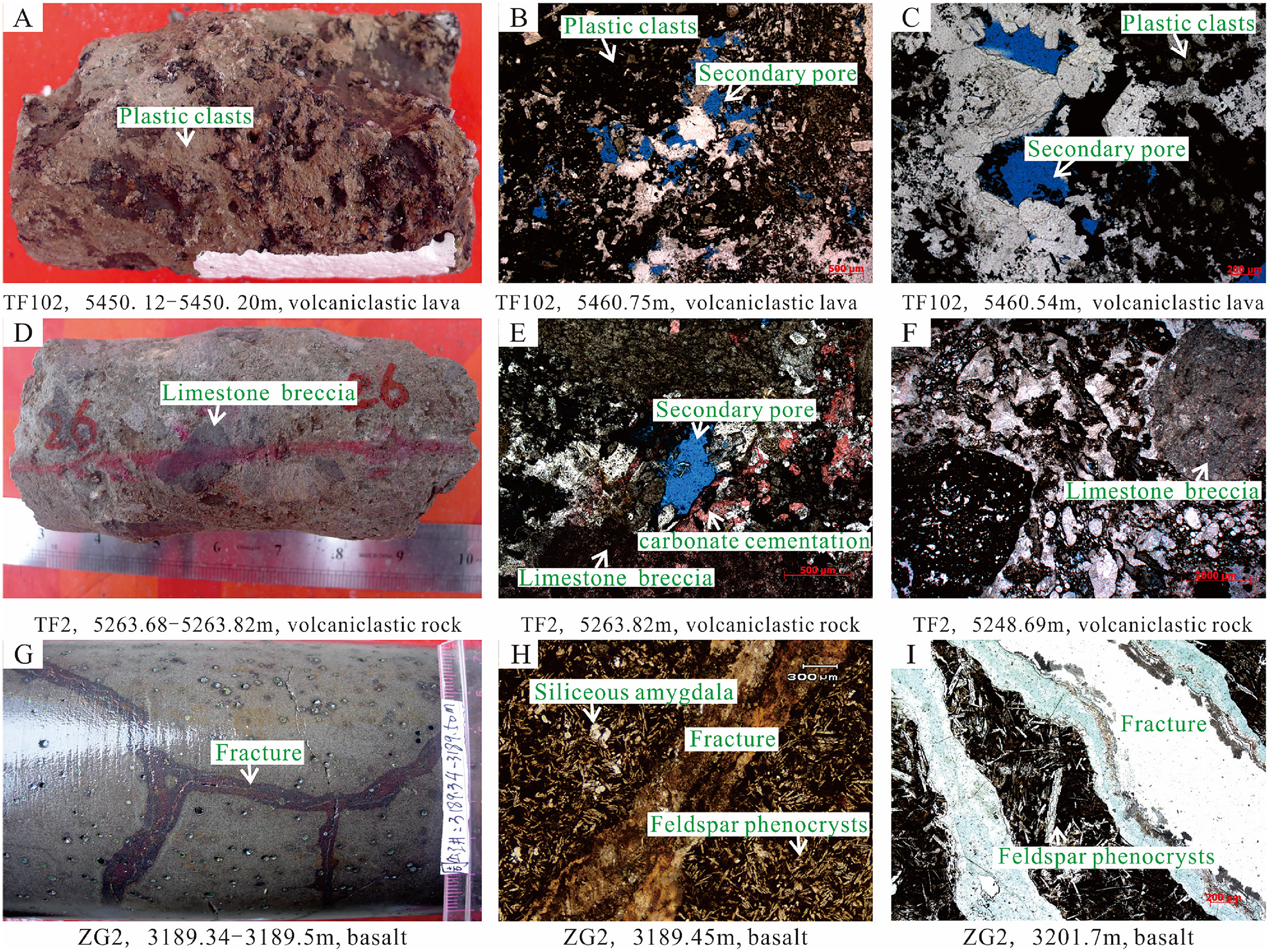
Characteristics of the Permian volcanic rocks, Sichuan Basin.
Microscopical identification indicated that reservoir spaces of both volcaniclastic rock and lava are all secondary pores resulted from massive dissolution of plastic clasts. Some of them are semi-filled with silicalite, calcite and chlorite. And intercrystalline micropores are generally developed within authigenic chlorite cements (Figures 2B and 2D). Cryptocrystalline basalt of effusive facies is always extended in Permian Basalt Formation, Zhougongshan (Figure 2E). Large amount of feldspar phenocryst and siliceous amygdala can be found in terms of this identification. Moreover, numerous high-angle fractures are also semi-filled by late silicate and carbonate cements (Figure 2F).
Explosive-facies reservoirs in Jianyang feature the porosity of 2.56% to 28.08% (13.38% on average) and the permeability of 0.00005 mD to 1.04 mD (0.074 mD on average), respectively. Figure 3A displays a better linear relation of porosity to permeability. Linked to micro natures of reservoir spaces, it is considered that volcanic reservoirs here are vitally porous ones. Effusive-facies reservoirs in Zhougongshan character the porosity from 0.13% to 5.23% (0.92% on average) and the permeability between 0.0106 mD and 12,000 mD (231.68 mD on average), individually. Figure 3B presents a rather poor relevance in between. Besides that, most samples reveal low porosity but high permeability. Distinct sorts of reservoir spaces are developed in not only effusive-facies reservoirs of Zhougongshan but explosive-facies ones in Jianyang. Combined with core analysis and microscopic identification, it is believed fractured volcanic reservoirs primarily developed in Zhougongshan.
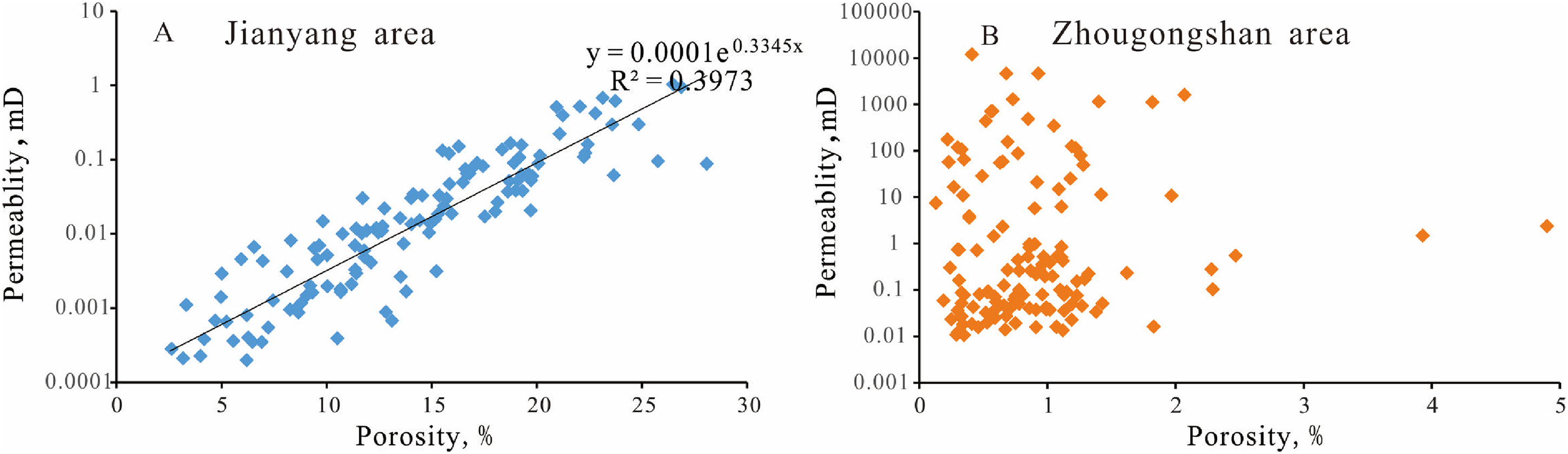
Relationship between porosity and permeability in Emeishan Basalt reservoirs.
Gas source
There exist two sets of source rocks in Sichuan Basin, namely Lower Permian Maokou 1 Member and Cambrian Qiongzhusi Formation, underlying the Permian volcanic gas reservoirs. In this study, the carbon isotope of natural gas, the solid asphalt in reservoirs, and the kerogen isotope of source rocks were compared to discuss distribution characteristics of source rocks. As shown in Figure 4, the carbon isotope is commonly smaller in volcanic gas reservoirs in Jianyang, with δ13C value of both methane and ethane between −34.44‰ and −29.73‰, and that of solid asphalt ranging from −35.2‰ to −35.1‰. This value is pretty low for the carbon isotope, and the isotope distribution is similar to that in the source rock of Qiongzhusi Formation. Natural gas is fundamentally oil-cracked gas (Figure 5). Underlying the volcanic gas reservoirs of explosive facies, the source rock of Qiongzhusi Formation exceeds 300 m thick, while that of Maokou 1 Member solely 40 m to 60 m. The former broads a rather larger extension than the latter's (Figures 6A and 6B). The Permian volcanic gas reservoirs in Jianyang are usually stretched over the upper Deyang-Anyue Rift Trough. Influenced by the erosion of Caledonian paleo-uplift, a few strata are missing from Longwangmiao Formation at the top Lower Cambrian to Carboniferous, bringing about the Permian in a direct contact with the Lower Cambrian Canglangpu and Qiongzhusi formations. Therefore, it is believed volcanic gas in Jianyang derived from Qiongzhusi Formation.
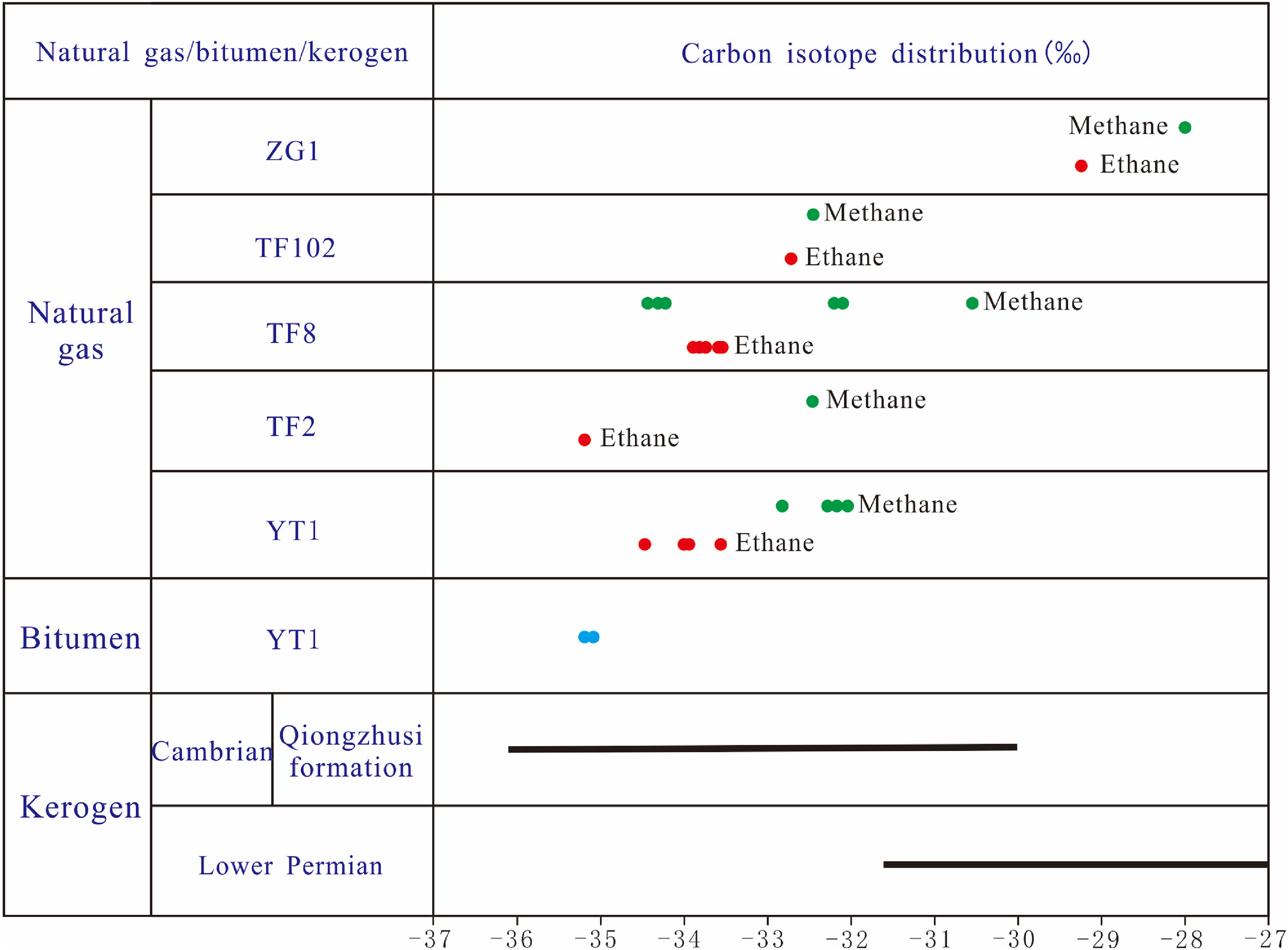
Carbon isotopes in natural gas, bitumen and kerogen.
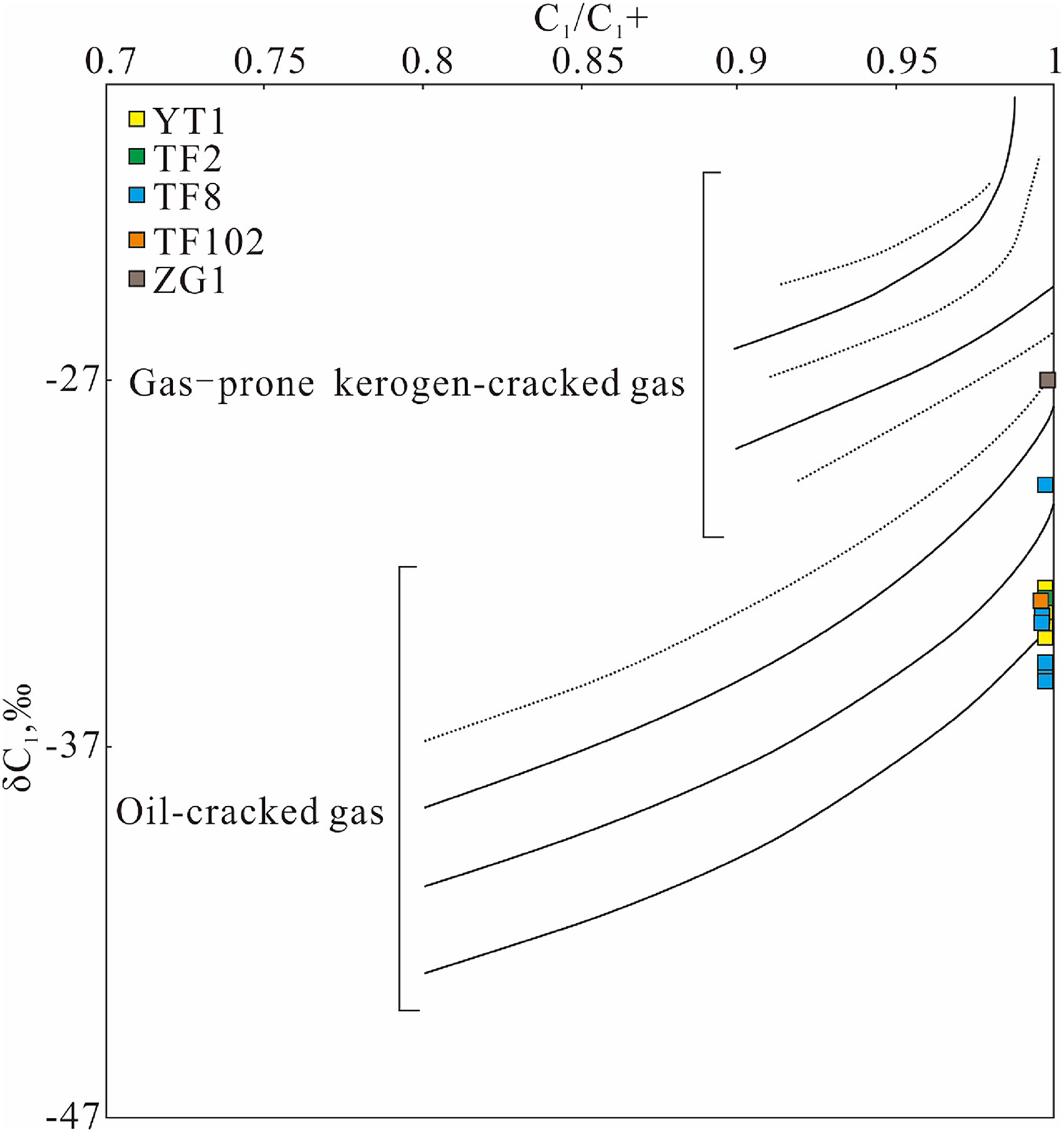
Carbon isotope identified by gas types.
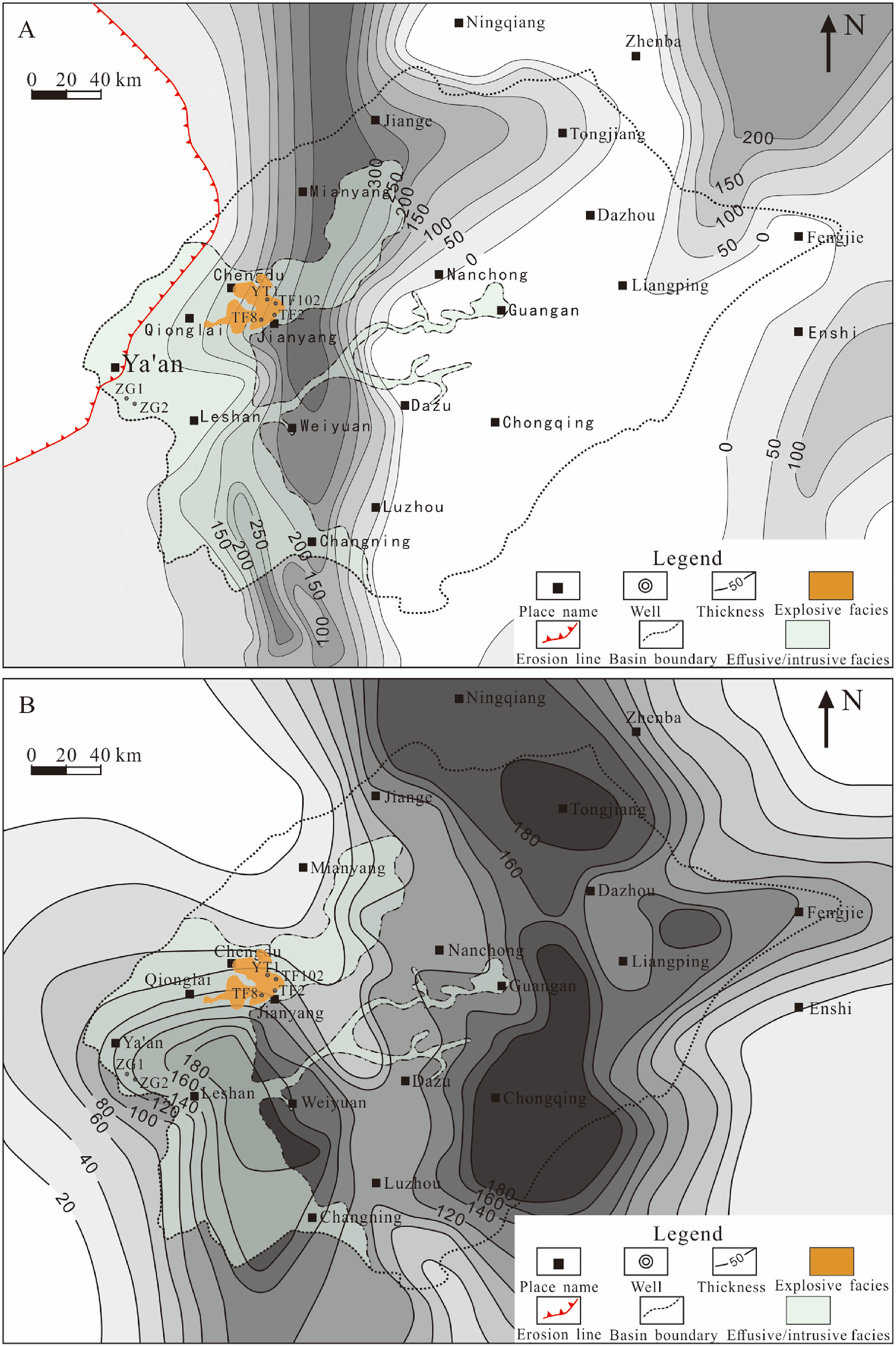
Thickness of source rocks in both Qiongzhusi formation and Maokou 1 member.
For volcanic gas reservoirs in Zhougongshan, the carbon isotope is bigger, and δ13C values of methane and ethane change from −28.00‰ to −29.27‰. And this value of carbon isotope is large or similar to isotope distribution in the source rock of Lower Permian (Figure 4). Most natural gas is kerogen-cracked gas (Figure 5). The source rock of Qiongzhusi Formation is mostly less than 50 m while that of Maokou 1 Member above 100 m (Figures 6A and 6B). Exactly next to Permian Emeishan Basalt Formation, the source rock of Maokou 1 Member extends more broadly. Therefore, it is deemed that, obviously, this member gave much more contributions to volcanic gas in Zhougongshan than that in Jianyang.
Previous studies suggested that source rocks of Qiongzhusi Formation and Makou 1 Member started their extensive hydrocarbon expulsion at a vitrinite reflectance exceeding 0.9. According to one relationship among burial history, vitrinite reflectance and burial depth in TF2 and ZG2 wells individually surrounding thicker source rocks of both Qiongzhusi Formation in Jianyang and Maokou 1 Member in Zhougongshan, it is deemed that the source rock of Qiongzhusi Formation in Well TF2 commenced its expulsion from early Triassic at a burial depth up to 2600 m. Before the end of late Cretaceous, the depth continued to enlarge, and the reflectance rose to 4.0%. As a result, the source rock got geologically ready for sustainable hydrocarbon generation and expulsion from early Triassic to late Cretaceous. While the other source rock of Maokou 1 Member in Well ZG2 initiated its expulsion from middle Jurassic at a buried depth of 3000 m. Then the depth went on improving together with the reflectance also mounting little by little. Consequently, the source prepared for continuous hydrocarbon generation and expulsion from middle Jurassic to late Cretaceous.
In the Permian volcanic reservoirs, Jianyang, the associated brine inclusion exhibits bimodal homogenisation temperature, 80–110°C and 140–160°C, respectively. In accordance with a burial history of Well TF2, it is deduced oil and gas reservoirs were approximately formed in early Triassic and middle Jurassic (Figure 7A). For those in Zhougongshan, the related inclusion temperature also functions as dual peaks, 110–130°C and 170–190°C. A burial history of Well ZG2 reveals the reservoirs formed virtually in late Jurassic and middle Cretaceous (Figure 7B).
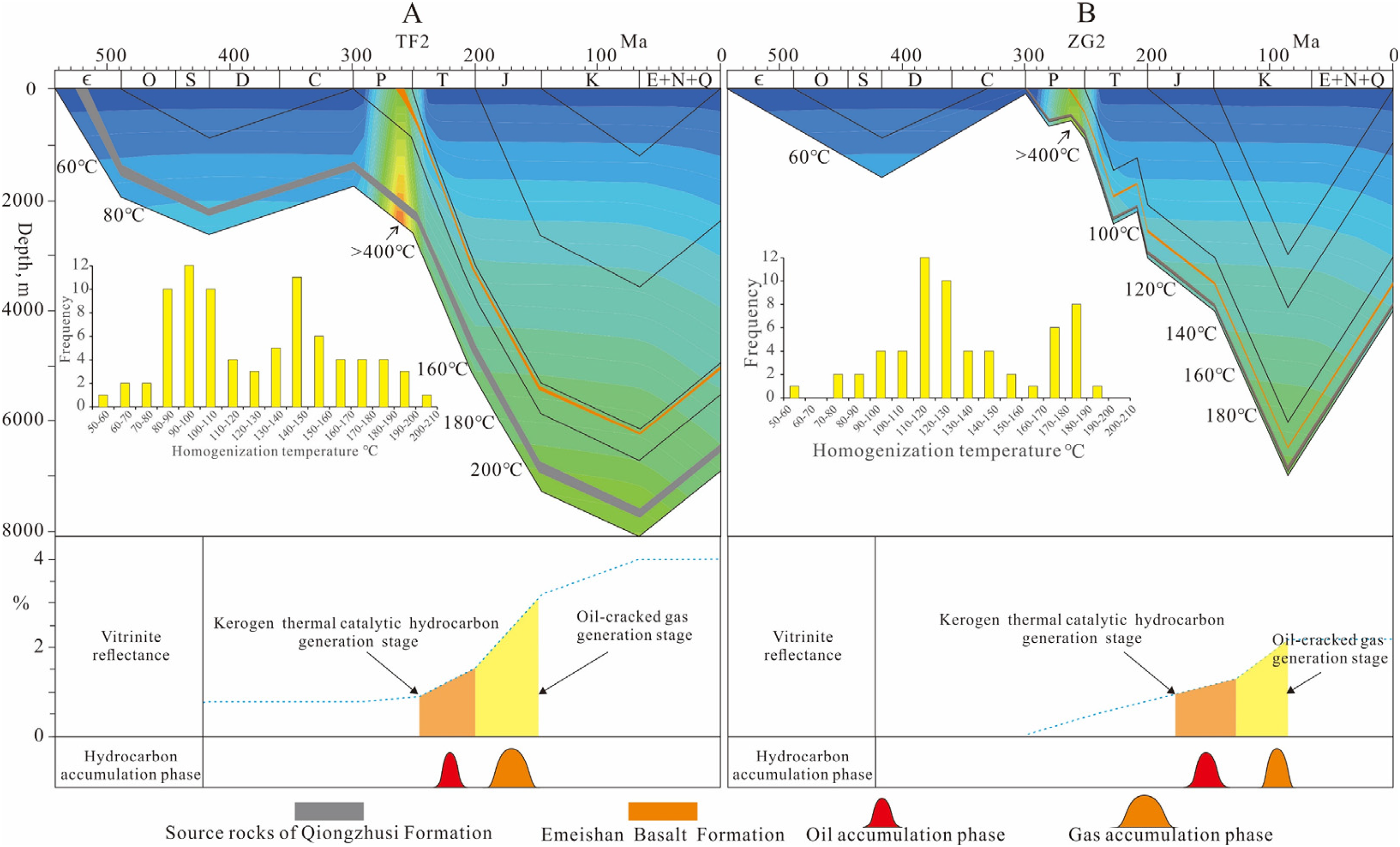
Burial history and thermal history of Permian in Sichuan Basin.
On the whole, a certain time when oil and gas were enriched in volcanic reservoirs of Jianyang and Zhougongshan is comparatively consistent with the other era at a broad expulsion of source rocks. In addition, all the reservoirs underwent the extensive enrichment twice. So, it is essential to further make clear the reservoir-forming process.
Fault extension
With the dip between 80° and 90° and an extensional length amounting to 60 km, multiple NW-trending strike-slip faults elongated in Jianyang often represent a linear relation in profile (Figure 8A). They expand from the basement upward to the top of Lower Triassic Feixianguan Formation, implying an evident weakness of faulting during early Triassic.
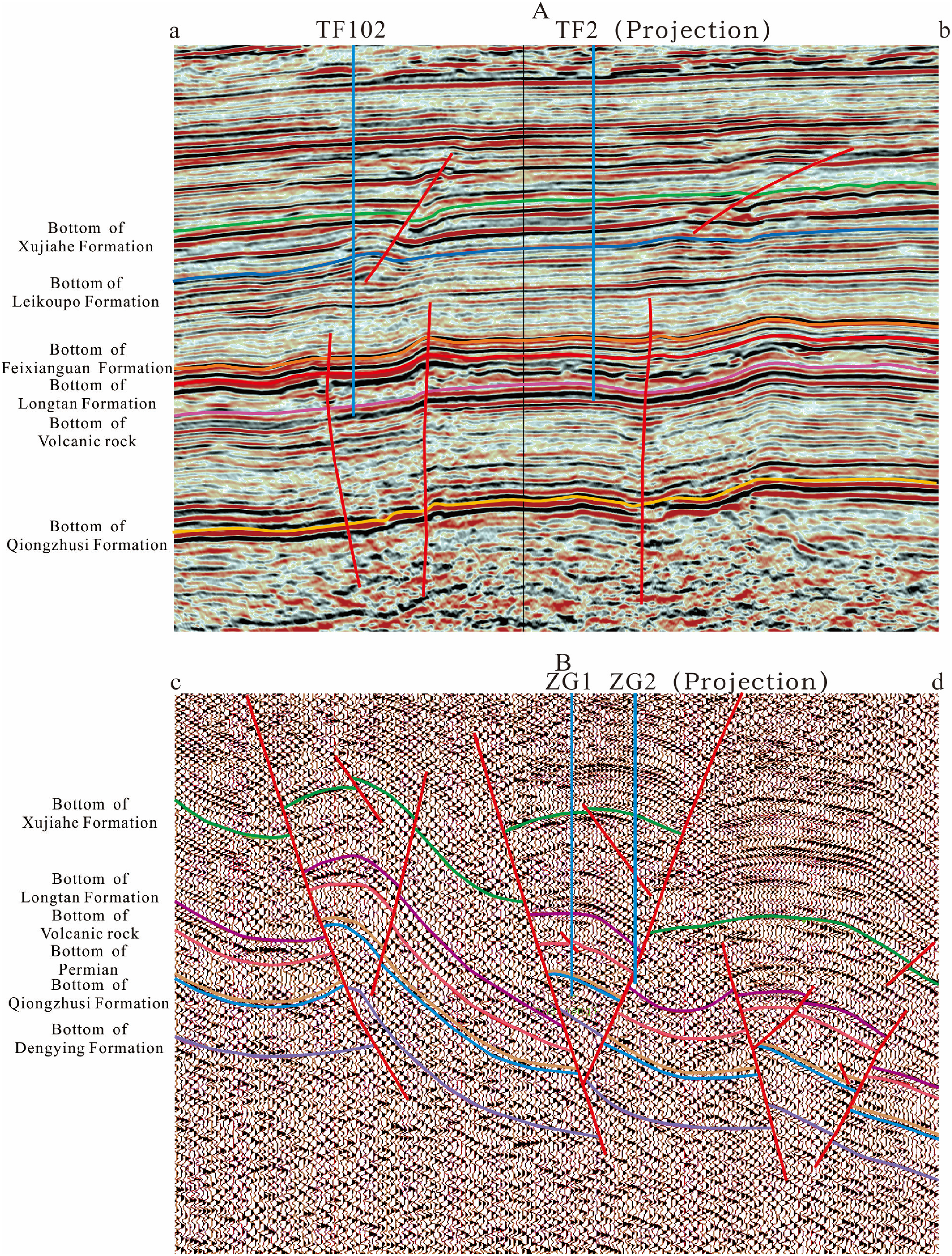
Profile features of faults in the study area (Profile position shown in Figure 1).
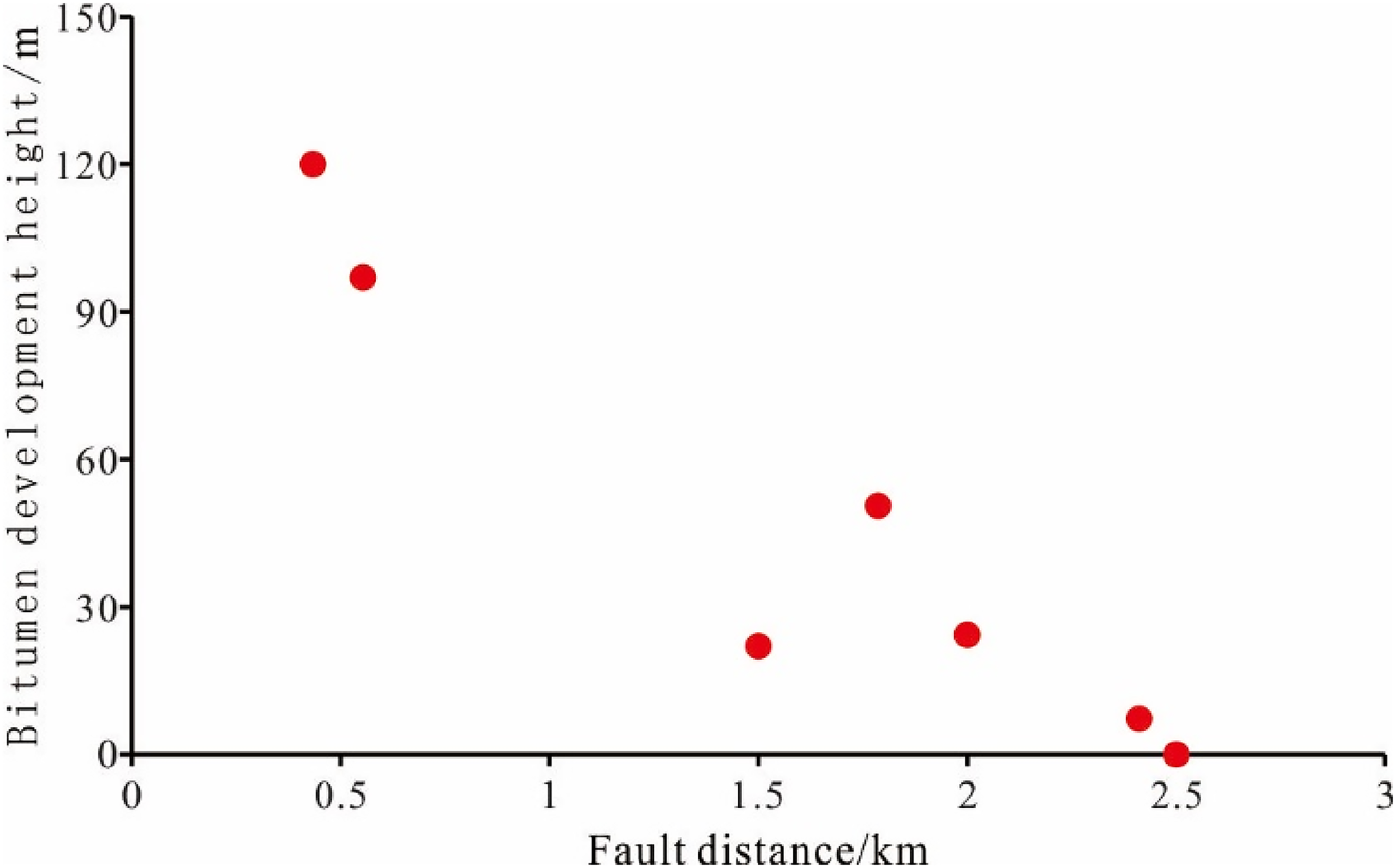
Scatter plot of bitumen development in volcanic gas reservoirs.
In conformity to bitumen distribution in single well and one range between this well to faults, it is indicated a wider distribution near the faults (Figure 9). Past studies argued that solid bitumen in the Permian reservoirs of western Sichuan Basin commonly came into being through oil cracking (Liu et al., 2008; Lin et al., 1998; Xiao et al., 2020b, 2021). Therefore, a paleo oil column height was predicted on the basis of bitumen distribution, reflecting the scale of early paleo oil reservoirs. Early faults in Jianyang provided migration pathways for the first large-scale oil and gas accumulation. At the second massive enrichment, faulting tended to suspend. And fault capacity for migrating kerogen-cracking gas went weaker at the later stage when a geotemperature exceeded 150°C or up to one temperature that oil could be cracked far and wide. Considering that the current natural gas in the Permian volcanic gas reservoirs in Jianyang is mainly oil-cracked gas boasting thermal metamorphic asphalt, it is believed that the cracking of early accumulated oil might provide material requirements for extensive gas enrichment in the later stage. Volcanic gas reservoirs contain CaCl2-type formation water with high salinity, and an existing formation pressure coefficient outstrips 2.2, indicating that reservoir preservation has not been affected by fault growth.
Even though several high-angle faults stretched in Zhougongshan just like those in Jianyang, they run through the surface longitudinally, meaning active till now (Figure 8B).
Drilling practices prove most gas gathered at structural highs far away from great faults. In Zhougongshan close to basin margin, progressively active faults not only gave pathways for hydrocarbon migration and accumulation in the early stage, but controlled reservoir preservation. Nowadays, no large-scale bitumen and oil-cracked gas can be found in volcanic reservoirs, indicating that sustainable faulting might act on early oil accumulation and also provided migration channels for late kerogen-cracked gas, furthermore to permit cracked gas to be assembled at one structural portion with better preservation conditions. Various fault activities in Zhougongshan and Jianyang led to a great disparity among gas types in volcanic reservoirs. The current volcanic gas in Zhougongshan is mainly kerogen-cracked gas. Volcanic gas reservoirs feature formation water of NaHCO3 type with low salinity, and the formation pressure coefficient between 1.0 and 1.2. In accordance with one character of gas usually far away from big faults, it is concluded that fault growth may affect preservation conditions.
Association of reservoir-forming elements and forming modes in volcanic gas reservoirs
Being the main source rock for volcanic gas reservoirs in Jianyang, Qiongzhusi Formation mostly spreads in the Deyang-Anyue Rift Trough where volcaniclastic rock and lava reservoirs of explosive facies are nearby. Influenced by Caledonian paleouplift, the Permian is adjacent to the Lower Cambrian (Figure 10A). A strong hydrocarbon expulsion occurred during early Triassic when a vitrinite reflectance amounted to 0.9. High-angle strike-slip faults joining source rocks to reservoirs might provide pathways for early large-scale oil accumulation. Paleo volcanic oil reservoirs fundamentally stretched along faults (Figure 10B). The faults’ activity became weaker during early Triassic, bringing about a gradual reduction in their capacity to migrate oil and gas. So, kerogen-cracked gas derived from source rocks at their high-mature and over-mature stages could not migrate to volcanic reservoirs through the faults. With an increase of burial depth, oil in paleo oil reservoirs started cracking extensively to turn into oil-cracked gas enriched in volcanic reservoirs in situ (Figure 10C).
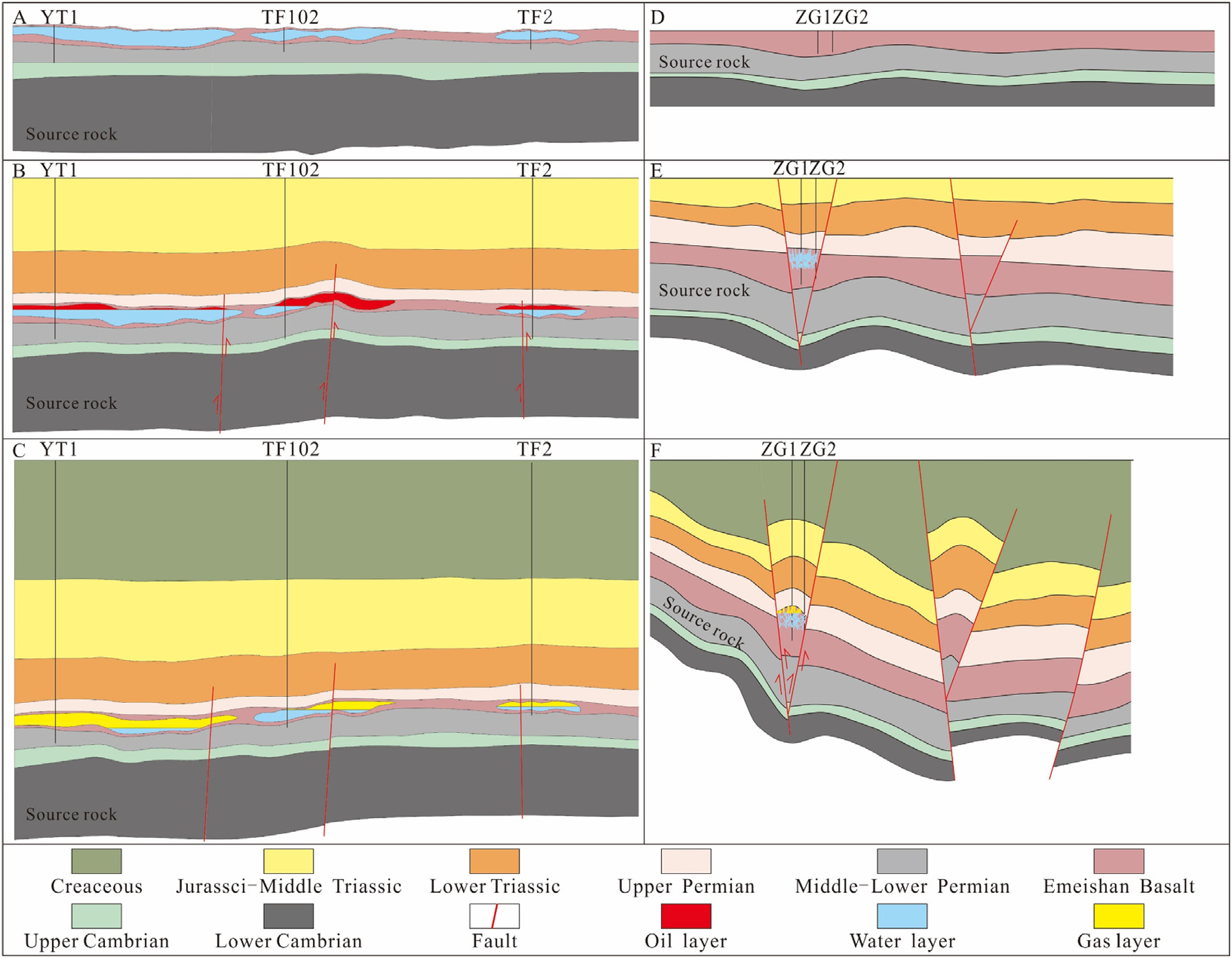
Reservoir-forming modes of volcanic rocks in the study area.
For this reason, whether or not to form early paleo volcanic oil reservoirs could be influenced by fault development, and in-situ cracking in these reservoirs rendered material base to gas enrichment. In summary, the Permian volcanic gas in Jianyang functions as one reservoir-forming mode of Cambrian hydrocarbon supply–fault transporting–in-situ cracking.
In Zhougongshan, Maokou 1 Member is the key source rock for volcanic gas reservoirs. Its thickness is obviously bigger than that of Qiongzhusi Formation. This member is covered by basalt of effusive facies (Figure 10D). Owing to intense tectonic events along basin margin, quantities of fractures were extended to perfect reservoirs’ physical property. The vitrinite reflectance in the source rock of Maokou 1 Member evolved to 0.9 during middle Jurassic. Thus, the rock commenced its capacious expulsion until tectonic uplifting inferred from the Himalayan movement in late Cretaceous. These faults kept active in the hydrocarbon-generating and expulsion processes. Big faults’ growth was bad for trap preservation (Figure 10E), resulting in an absence of oil-cracked gas in the present-day gas reservoirs, and late kerogen-cracked gas alone on structural highs isolated from these faults (Figure 10F). Thus, the Permian volcanic gas in Zhougongshan follows the other forming mode of Permian hydrocarbon supply–fault adjustment–effective trap accumulation.
Exploration prospects of volcanic gas
The above results show disparities among gas enrichment conditions in the Permian volcanic rocks of Zhougongshan and Jianyang. And gas in Jianyang was mostly enriched in volcanic rock reservoirs of explosive facies neighbouring a hydrocarbon-generating centre or faults.
The Permian basic volcanic rock reservoirs of explosive facies represent an extensional coverage of 1750 km2. For the moment, commercial gas flow has been obtained from two wells in the north of Jianyang, with an output exceeding 4 × 10⁴ m3/d. In Zhougongshan, volcanic gas is mainly gathered in structural highs beyond big faults. Multiple tectonic events around basin margin caused numerous fractures stretched within basalt, making reservoir conditions in volcanic rocks better. Being a significant factor, big faults’ distribution affected gas enrichment. Anticlinal regions boasts 1000 km2 away from the faults in this area. For Well ZG1, also too far away from big faults, the daily and cumulative production surpassed 25.6 × 10⁴ m3 and 2400 × 104 m3, individually. General speaking, there exist various sorts of basic volcanic rocks in Sichuan Basin. Following high fluidity and vast distribution, basic magma happened to overlap multiple sets of source rocks. A diversity of faults offered migration pathways to gather hydrocarbon, and late faulting around basin margin also acted on gas distribution. Because of progressive hydrocarbon supply from source rocks, natural gas was concentrated in different volcanic rocks to form many types of volcanic gas reservoirs. Gas flow successfully from a few wells also exhibits better exploration prospects. Therefore, the Permian volcanic rocks are expected to become a replaceable target for the next reserve and production increment in Sichuan Basin.
Conclusions
There mainly developed porous volcanic rock reservoirs in the Permian, Jianyang area, whose space is dominated by secondary pores formed after an extensive dissolution of plastic clasts in volcaniclastic rock and lava of explosive facies. In addition, fractured reservoirs are usually extended in the Permian, Zhougongshan, where high-angle fractures stretched in basalt of effusive facies serve as the main reservoir space.
Lower Cambrian Qiongzhusi Formation functions as the main source rock in Jianyang. Faults provided pathways for oil and gas accumulation in early Triassic. As faulting suspended and burial depth deepened, broadly cracking emerged in paleo volcanic oil reservoirs during middle Jurassic, and oil-cracked gas accumulation commenced on a large scale to be kept better until today. Therefore, the Permian volcanic rocks in Jianyang functions as one reservoir-forming mode of Cambrian hydrocarbon supply–fault transporting–in-situ cracking.
In Zhougongshan, the main source rock is Lower Permian Maokou 1 Member. Faults continued to be active in the processes of hydrocarbon generation and expulsion. Big faults destroyed trap conservation, and late kerogen-cracked gas mostly concentrated in structural highs far away from the faults. Therefore, the other forming mode here can be expressed as Permian hydrocarbon supply–fault adjustment–effective trap accumulation.
Many sorts of basic volcanic rocks are widely developed in Sichuan Basin. Rich in gas, multiple types of volcanic gas reservoirs have been formed since reservoir-forming conditions of volcanic gas are quite different among various tectonic settings. They are expected to turn into an alternative domain for coming reserve and production increase.
Footnotes
Declaration of conflicting interests
The author(s) declared no potential conflicts of interest with respect to the research, authorship, and/or publication of this article.
Funding
The author(s) received no financial support for the research, authorship, and/or publication of this article
