




Abstract
The prevention and control of stress relief gas have crucial influence on safety of coal mine, it is not only the inevitable requirement of safe production, but also an effective way to realize reasonable utilization of gas. Taking the 1103 working face of the Weijiadi coal mine as the background, the mining stress field was analysed by means of numerical simulation, theoretical analysis and field practice, and the control technology of stress relief gas was studied. The results showed that scope of stress relief zone drops gradually associated with an increase of distance from the roof (or floor) to the working face. Additionally, the shape of the stress relief body exhibited a ring-shaped distribution, while four corners of the goaf roof and floor underwent high permeability zones due to a deep stress relief body, where the permeability of two corners near the transportation roadway of the floor was higher. The results provided good information for W-shaped ventilation mode with two inlets and one return which was adopted in the working face. More importantly, the optimized layout of boreholes was put forward, which eventually were useful for solving the gas overrun of the working face. The technology used in 1103 working face has an attractive and practical background with other extensive applications for the prevention and control of relief gas.
Introduction
In China, the coal resources are gradually mined to the deep, and the coal seams are under high gas and in situ stress(Wang et al., 2016). Once the protective seam is mined, the mining stress field will lead to the stress redistribution of the roof and floor. Due to the compaction of gangue, the stress relief degree in different ranges of goaf is different, and the permeability of the roof and floor is zoned. The gas from the coal seams migrates into the working face through the high permeability zone. It is easy to cause air leakage and the high pressure of air drainage gas by using U-shaped ventilation mode. Finally, it leads to gas overrun in the working face or upper and lower corners. Hence, it is essential to explore the law of mining stress field in close distance coal seam and put forward gas prevention and control technology to maintain safety mining production.
For mining stress relief and gas control technology, many experts have made a lot of profound researches. Zhao et al. (2019, 2020a, 2021) explored the influence of mining height, dip angle and advancing speed on the distribution of gas migration channels in overlying strata via laboratory similar simulation, and then proposed the evolution model of gas migration channel based on fractal dimension. Liu et al. (2018b) explored the stress relief range and degree of surrounding rock in the steeply-inclined thick coal seam and put forward a design scheme of gas drainage borehole. Kong et al. (2014) studied the mining sequence of close distance coal seam by simulation analysis and determined the first mining layer according to the degree of stress relief. Chen et al. (2014) used numerical simulation to get the three-dimensional stress characteristics of the protective seam in Huainan coalfield. At the same time, according to the stress variation of the rock, the stress path was proposed, and the pseudo triaxial loading and unloading mechanical test of rock was carried out, which obtained the curve between rock permeability and axial strain. Yang et al. (2010) divided the coal floor into total de-stressed belt, vertical de-stressed belt and original stress belt along the vertical direction, and original zone, compression zone, expansion zone, recovering zone and recompressed zone along the horizontal direction. Zhang et al. (2018) explored area change of overburden permeability, and found that the realistic permeability-increasing area of the protective seam was more than that of goaf. In addition, the optimized cross-drilling was proposed for an on-site gas drainage test, which solved the danger of coal seam outburst Xu et al. (2021) obtained the uneven distribution characteristics of stress and permeability of disturbed coal seam. Liu et al. (2011) probed into the deformation and stress relief characteristics of the high gas coal seam in Wulan Coal Mine, which revealed that the goaf under the coal seam had a buffer effect on protecting the coal seam, and its stress relief effect was obviously weakened. Lu et al. (2019) established a new permeability damage model based on the test of rock, and found that there were areas with high permeability around the borehole. Finally, the layout scheme of the gas drainage borehole under the combination of soft and hard coal was proposed. Zhang et al. (2020) determined the permeability model of working face surrounding rock by laboratory test, and proposed the permeability evolution law related to mining stress path. The corresponding algorithm was designed and embedded into FLAC3D code, and the process of coal seam stress relief, anti-reflection and gas flow was simulated. Zhao et al. (2020b) analysed the stress field and permeability evolution process of the coal seam in front of the working face, and found that under the condition of stress concentration, the permeability of the coal seam decreased, and the gas pressure gradient between the stress concentration area and the stress relief area increased, which increased the possibility of coal and gas outburst
Previous research achievements provided the theoretical support for gas prevention and utilization in the coal mine, but the compaction effect of goaf which has an important impact on the roof, floor stress and permeability distribution of coal seam, is often ignored by people(He et al., 2020, 2021; Li et al., 2018; Shi et al., 2019; Wang et al., 2021). Consequently, it is essential to continue a systematic research on the evolution of mining stress field and the stress relief gas prevention and control technology.
Research background
The weijiadi coal mine is located in Baiyin City, Gansu Province, China. At present, Weijiadi coal mine mined No.1 coal seam that has a thickness of 8.1 m and a buried depth of 600 m. The No.2 coal seam with a thickness of 7.84 m is located underlying the No.1 coal seam. The average distance between No.1 coal seam and No.2 coal seam is 21 m, which belongs to the category of the close distance coal seam. Under No.2 coal seam, there is No.3 coal seam, with an average thickness of 12 m, and the average distance between No.2 coal seam is 19 m. Figure 1 shows the location and borehole histogram of the Weijiadi coal mine.
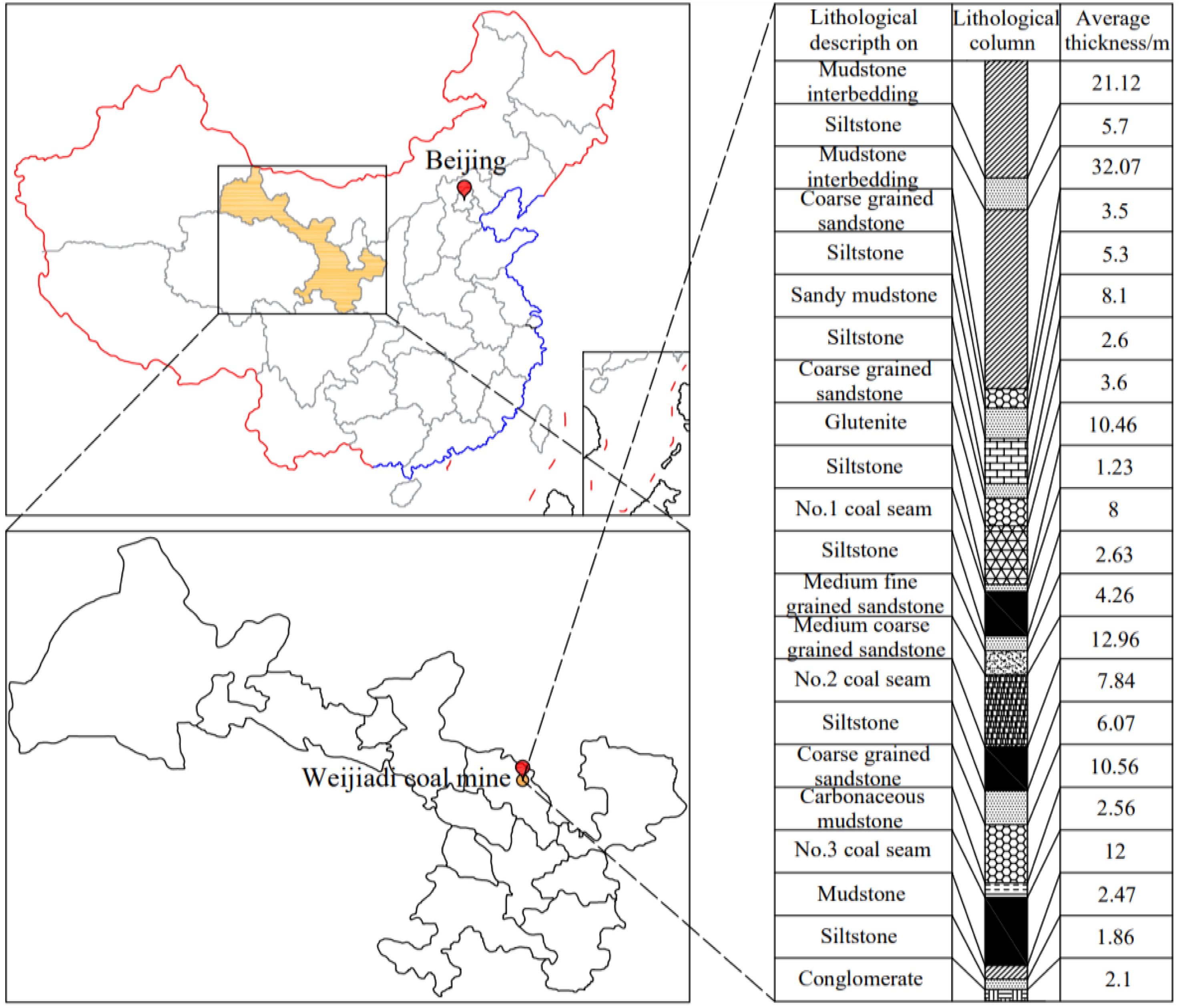
Location and geologic column of the Weijiadi coal mine.
The gas content of the coal seams is 9.22∼10.17m3/t. The mining response characteristics of the working face will affect the gas migration and distribution, resulting in the danger of gas overrun. Therefore, Taking the 1103 working face of the Weijiadi coal mine as the research background to pursue research in the characteristic law of the mining stress field. The average inclination of the working face is 10°, and the oblique length of the working face is 200 m. The transportation roadway and ventilation roadway was driven along the coal seam floor, and the working face adopted U-shaped ventilation. After 1103 working face started mining, gas overrun often appeared in the upper and lower corners and the mining space, which affected the normal production seriously. An in-depth study on the mining stress field and gas migration law of working face is meaningful.
Methods
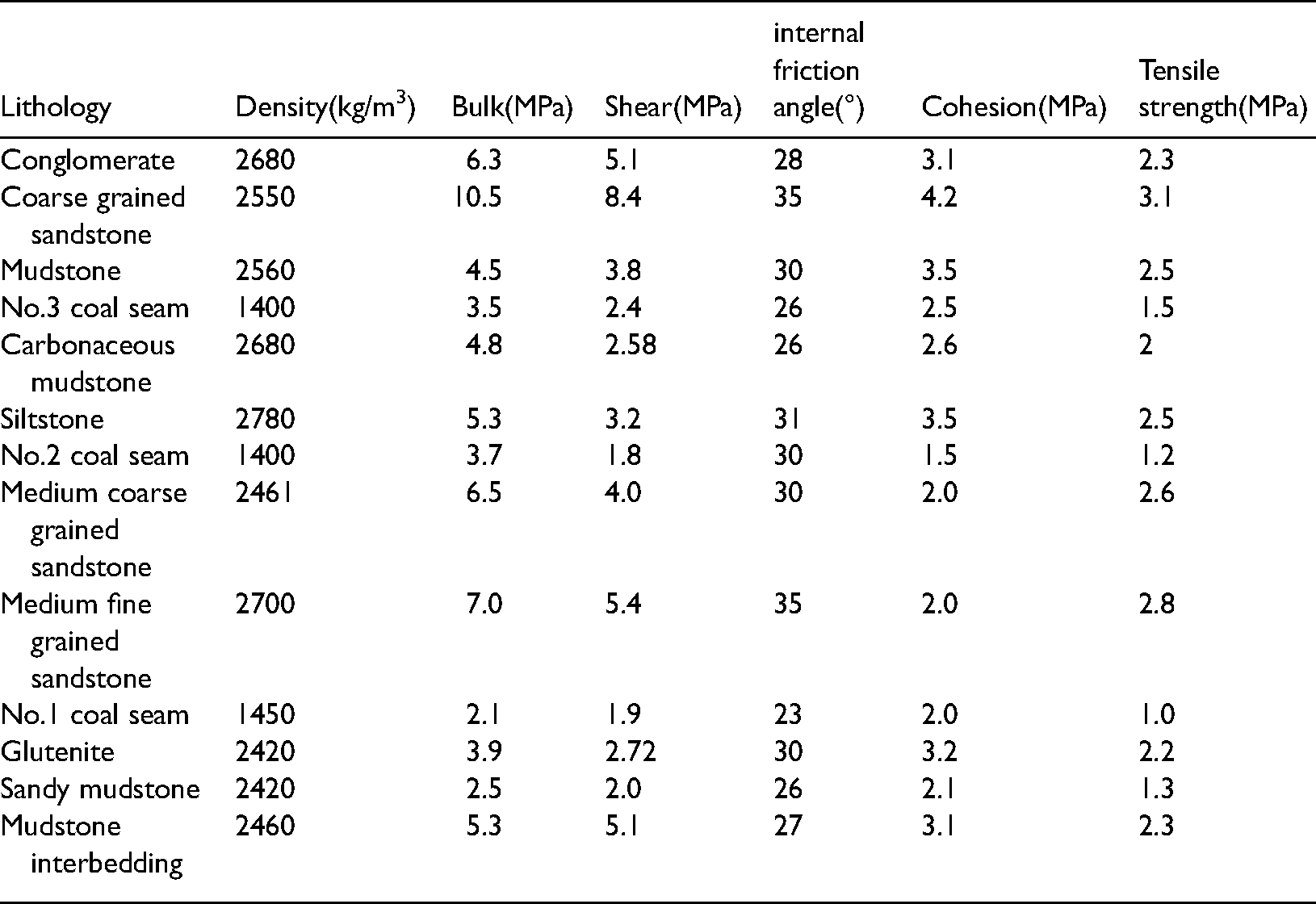
The mining stress field in 1103 working face is studied by FLAC3D software. The mechanical parameters of the strata are shown in Table 1. The model size is designed to be 300 m × 500 m × 235.5 m(X × Y × Z) that contains 888000 zones and 952084 grids. The dip angle of stratum is set to 10°. Displacement constraints are set at the bottom and around the model, and 12 MPa compressive stress is applied on the top of model. The M-C criterion was applied to calculate the model which is shown in Figure 2.
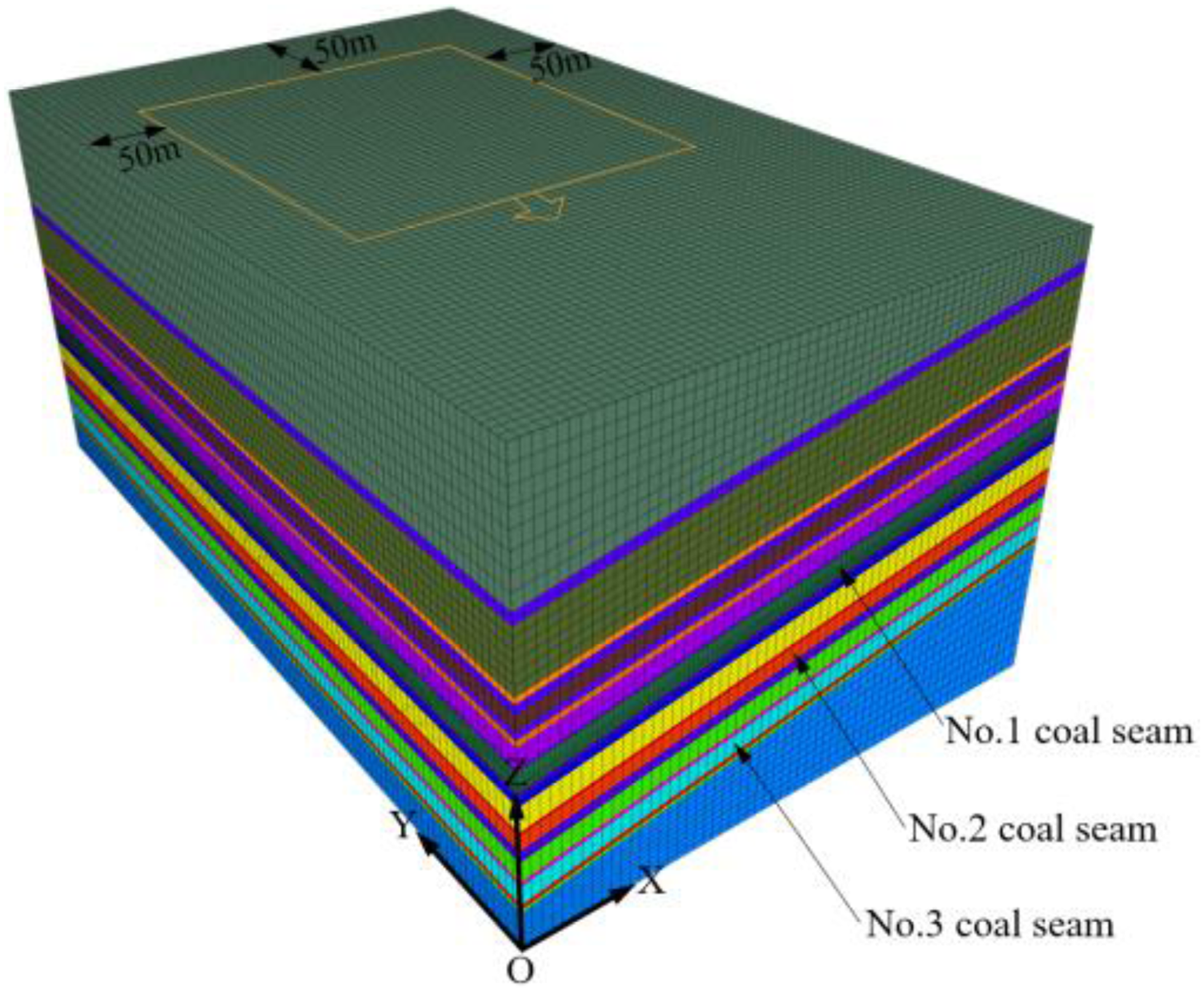
Numerical calculation model.
Mechanical parameters of the strata.
Results and discussion
Stress field distribution law of roof and floor
The vertical stress can reflect the mining stress field of the roof and floor. The diagrams of the vertical stress are extracted when the mining distance is 300 m, as shown in Figure 3.
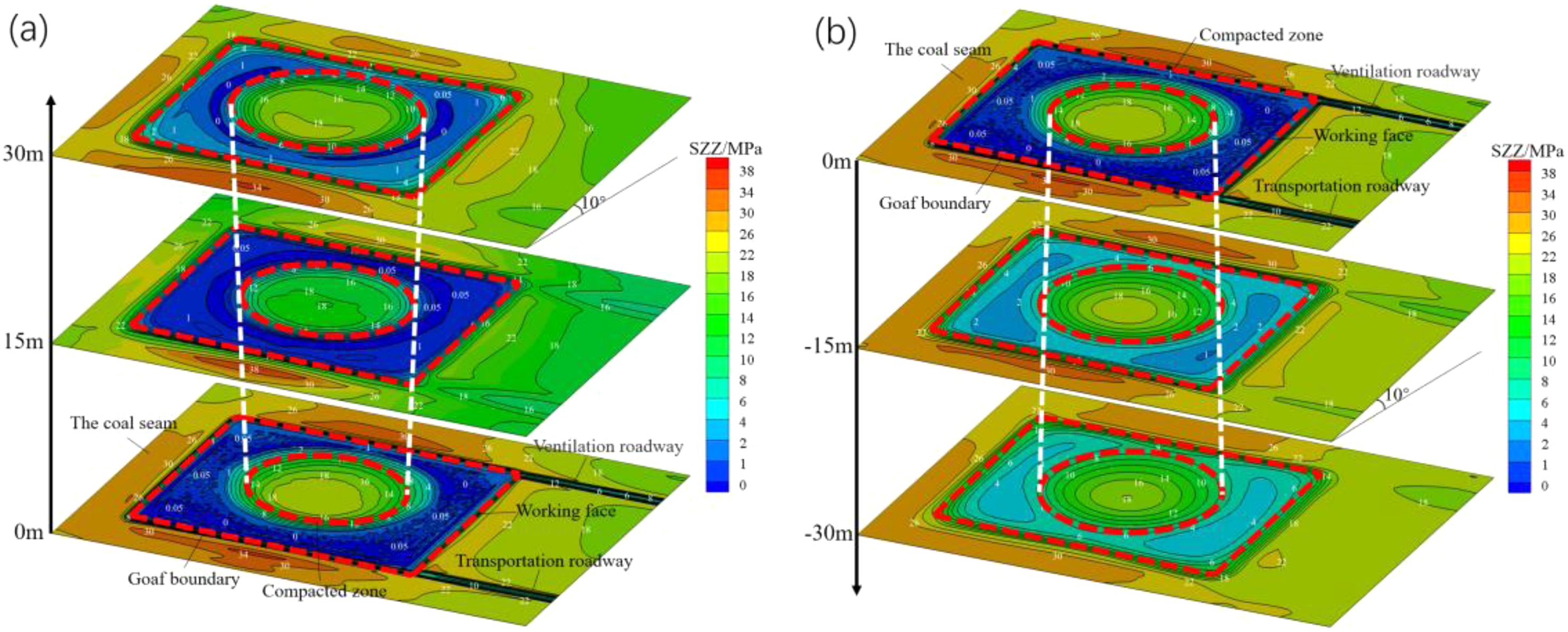
Vertical stress of roof and floor of working face: (a) vertical stress distribution law of roof and (b) vertical stress distribution law of floor.
As shown in Figure 3, after the mining of the working face, the vertical stress of the strata at different horizons has changed obviously. For mining coal seam, the higher abutment stress is formed inside the solid coal around the goaf. Due to a dip angle of the strata, the abutment stress near the side of the transportation roadway is higher. For the interior of goaf, according to the vertical stress, it can be divided into the compacted zone and stress relief zone. The compacted zone presents a flat oval distribution, and the stress decreases from the centre to the outside gradually. The stress of the stress relief zone is obviously less than that of in-situ stress. The stress relief zone has a corresponding relationship with the surrounding rock fracture zone, which is the key area of gas migration. As the stress release, the internal stress of coal body is released, the cracks are developed, the gas is desorbed and diffused, and the seepage and migration occur under the pressure gradient. The stress relief coal is the effective zone of gas drainage(Karacan et al., 2006a; Min, 2004; Liu and Rutqvist, 2010; Liu and Cheng, 2014; Qi et al., 2014; Yuan et al., 2011). The stress relief coefficient is used to characterize the stress relief degree of coal seam, its equation is as follows:
Here, the zones with stress relief degree more than 50% are classified as stress relief zone, and the zones with relief degree less than 50% are classified as compacted zone. In Figure 3, the outline line of the unit with stress relief degree of 50% is marked with red circle, and the inner part is compacted zone and the outer part is stress relief zone. As the distance between the roof (or floor) and working face increases, the range of compaction zone increases, the range and degree of stress relief zone decrease. When the distance between roof, floor and the working face are the same, the stress relief degree of the roof relief zone is higher than that of the floor, which indicates that the roof is conducive to gas seepage and migration after mining.
Evolution law of compacted body and stress relief body
In order to explore the size evolution law of the compacted zone and the stress relief zone in goaf, the vertical stress distribution of the coal seam under different mining distances is obtained, and the results are shown in Figure 4. When the mining distance of working face is less than 100 m, there is no obvious compacted zone in the goaf. At this time, the goaf is a rectangular stress relief zone. When the working face is advanced 150 m, compacted zone appears in goaf, but the scope of the compacted zone is small. Along the strike direction, the shape of compacted zone is thin and high oval, and the stress relief zone evolves from the rectangle to the ring distribution of outer square and inner circle. When the mining distance is 200 m, the compacted zone evolves into a circular distribution, and the scope of stress relief zone decreases gradually. The circular distribution of stress relief zone is easy to cause gas accumulation in the upper and lower corners of the working face. When the mining distance is 300 m, the compacted zone evolves from circular to flat ellipse. Because of the dip angle of coal seam, compacted zone presents asymmetric distribution in the goaf. The width of the stress relief zone near transportation roadway is larger, and the width of stress relief zone near the ventilation roadway is smaller. When the mining distance is 350 m, the width of compacted zone along dip direction is no longer changed, the length of the compacted zone along strike direction is increasing, and the stress relief zone is still in a circular distribution.
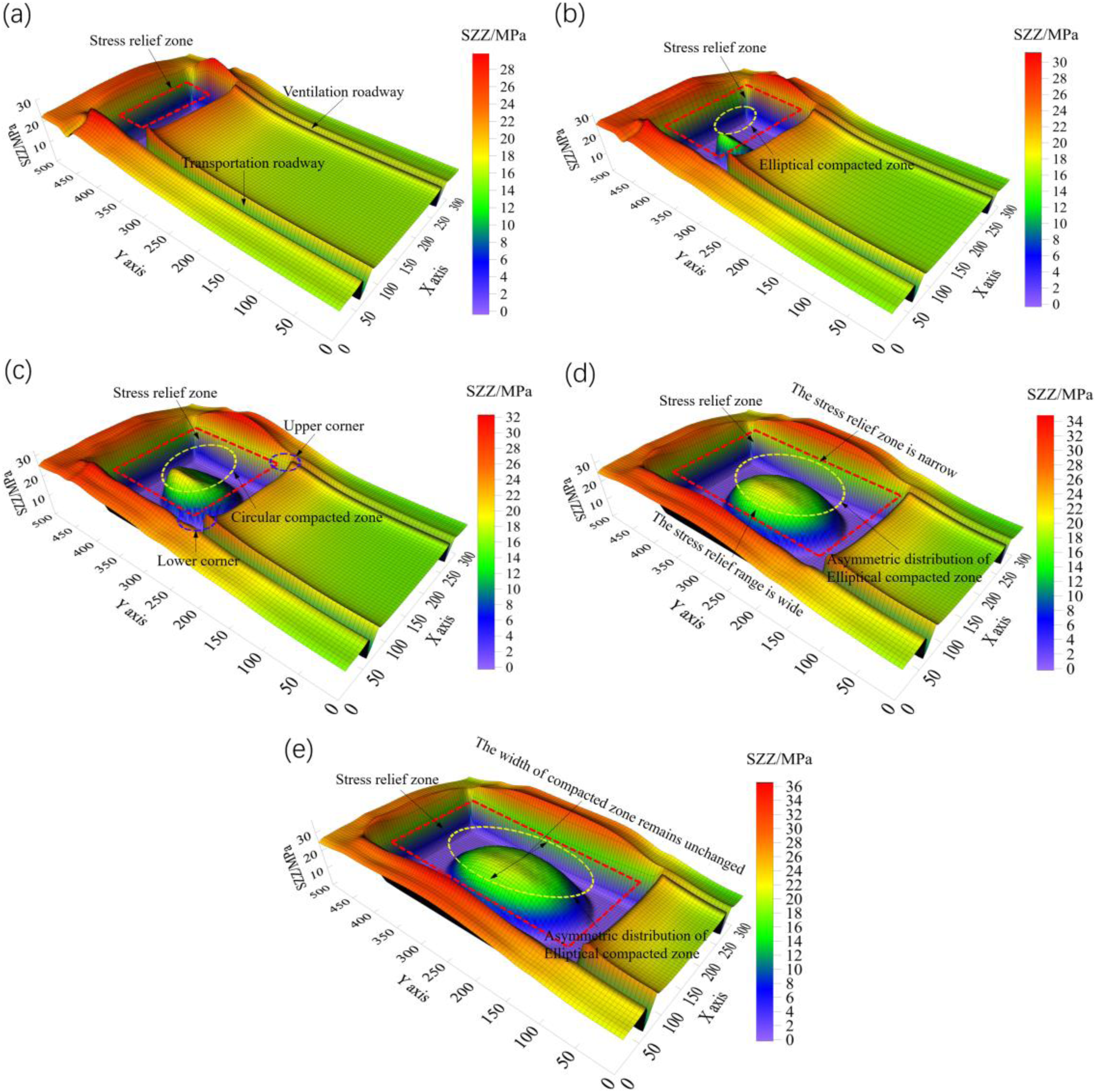
Evolution law of compacted zone and stress relief zone under different mining distances of working face: (a) mining 100 m; (b) mining 150 m; (c) mining 200 m; (d) mining 250 m; (e) mining 300 m.
The dimensions of the key parts of the compacted zone and the stress relief zone are marked, as shown in Figure 5. The evolution law of each dimension under different mining distances are explored. The results are shown in Figure 6.
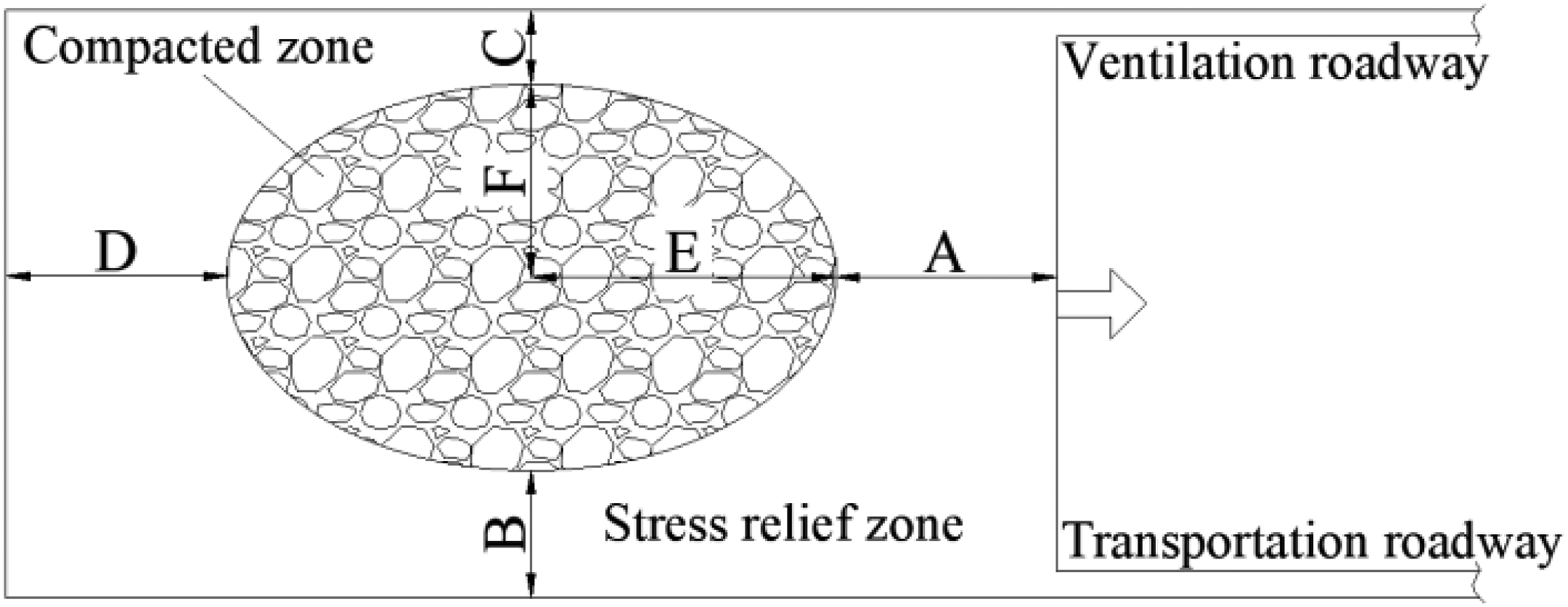
Dimensioning of compacted zone and stress relief zone.
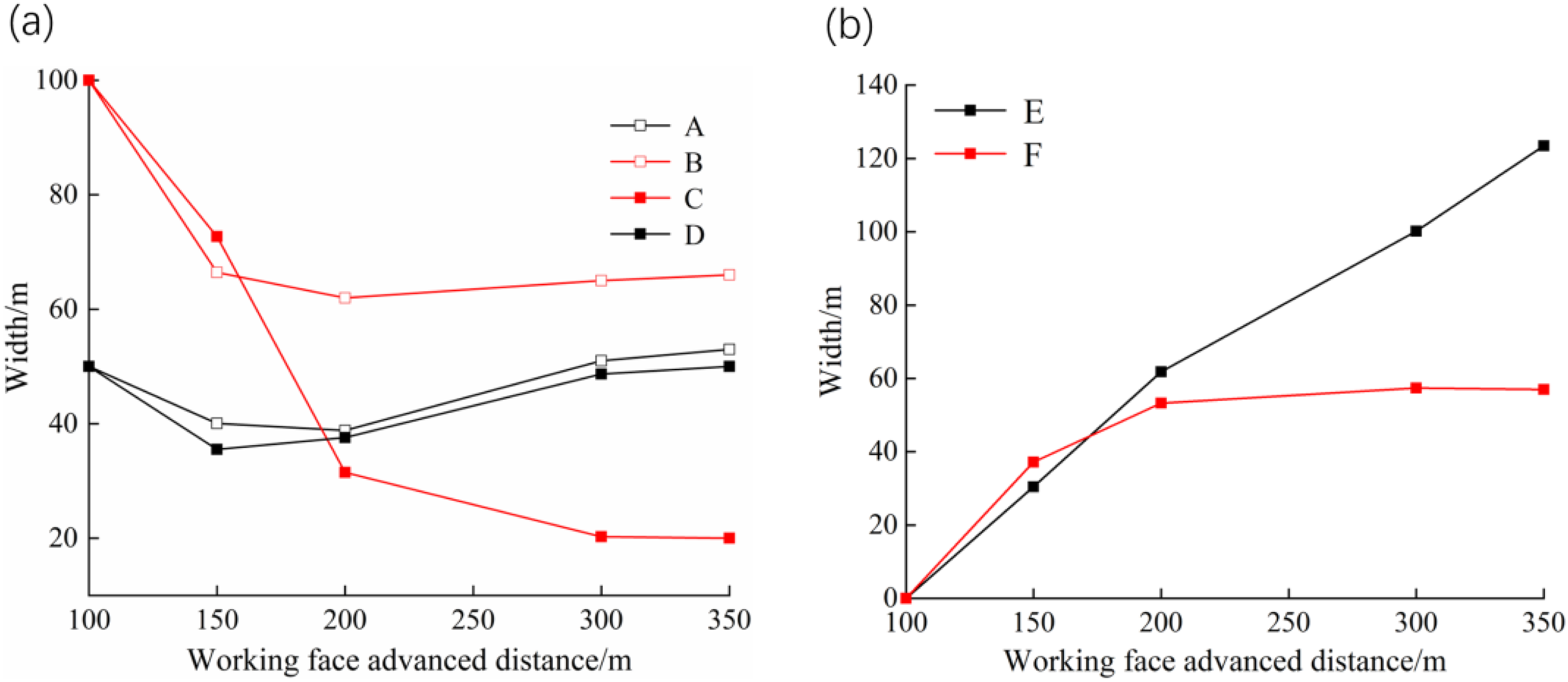
Dimensional evolution law of compacted zone and stress relief zone of coal seam: (a) dimensional evolution of the stress relief zone and (b) dimensional evolution of compacted zone.
For dimensions A and D of the stress relief zone, both of them decrease first and then increase with the mining distance, and the curve presents an inverted “S” shape distribution. When the mining distance reaches 300 m, the dimensional changes of A and D tend to be stable, and there is little difference between size A and size D. The value of dimension B is significantly larger than that of C, that is, the stress relief range of the side near the transportation roadway is larger. When the mining distance is less than 150 m, there is little difference between dimensions B and C of the stress relief zone. As the mining process continues, the value of dimension B is significantly larger than that of C, that is, the stress relief range of the side near the transportation roadway is larger. When the mining distance is more than 300 m, the dimensions B and C of stress relief zone tend to be stable gradually. For the compacted zone, the dimension E increases linearly with the increase of the mining distance. The dimension F increases gradually with the increase of the mining distance, when the mining distance reaches 200 m, the value of F tends to be stable.
It is beneficial to the accurate extraction of gas from the roof and floor by exploring the shape and size evolution law of the stress relief body and compacted body. Based on the analysis results in Chapters 2 and 3, the stress relief body and compacted body model of roof and floor are constructed, as shown in Figure 7(b).
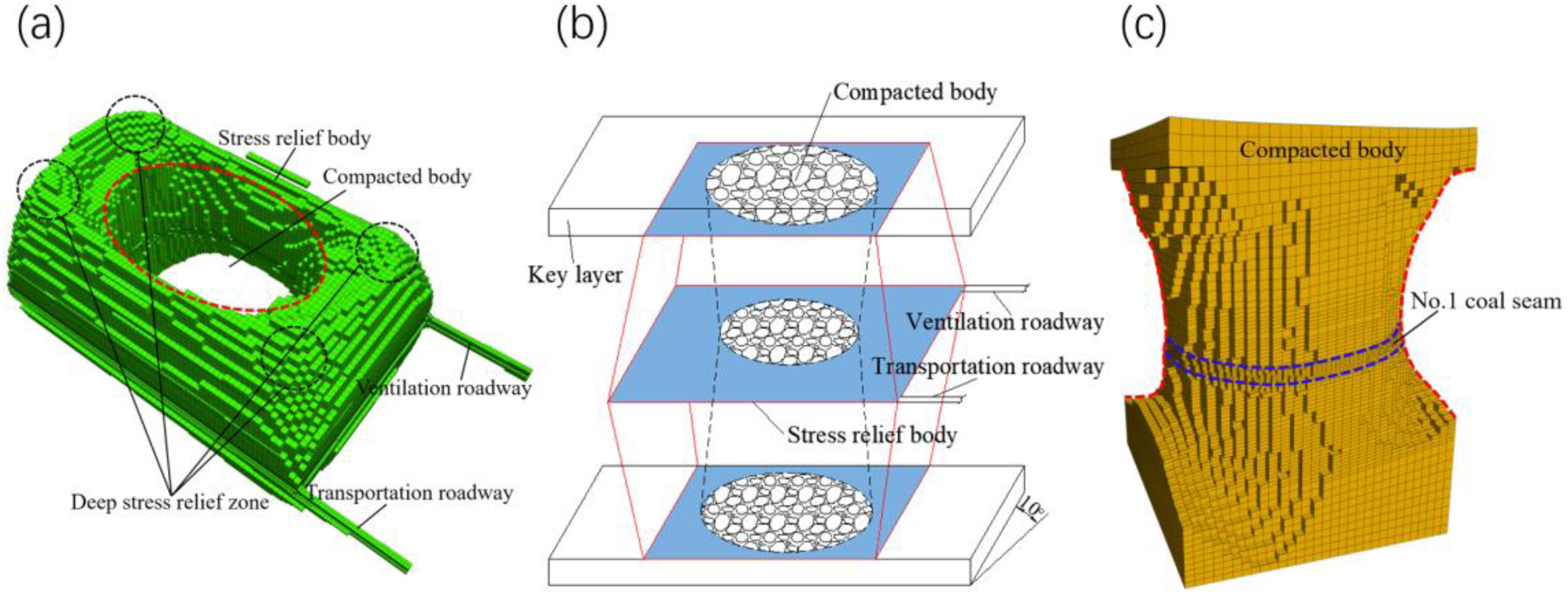
Model and shape of stress relief body and compacted body in working face: (a) stress relief body; (b) compacted body and stress relief body model; (c) compacted body.
The shape of compacted body presents a funnel shape, and the range of compacted body at No.1 coal seam is the smallest With the increase of the distance between the roof (or floor) and the coal seam, the range of compacted zone gradually increases. In the FLAC3D numerical model, when the working face is mining at 350 m, the stress relief body and the compacted body are called out by FISH programme. Their shapes are shown in Figure 7(a) and Figure 7(b), which are consistent with the constructed model. The shape of stress relief body is shown in Figure 8. The stress relief body of roof is distributed as a hollow trapezoid body, and it forms deep stress relief body at four right angles, where the height of the stress relief body reaches 104.8 m. The stress relief body of floor is also distributed as hollow trapezoid body. But due to certain dip angle of coal seam, from strike direction, the stress relief body near transportation roadway and the ventilation roadway is saddle-shaped, and the body forms a deep stress relief body at four right angles of the goaf. The maximum depth of the stress relief body near the transportation roadway is 87.5 m, which has exceeded the position of No.3 coal seam. The depth of stress relief body near the ventilation roadway is 30.2 m, which has reached the position of No.2 coal seam. The gas of No.2 coal seam is migrated to No.1 coal seam through the stress relief body, and the gas of No.3 coal seam near transportation roadway is migrated to No.1 coal seam through the conical stress relief body. Gas migration of No. 2 and No. 3 coal seams lead to gas overrun in 1103 working face, which affects normal production.
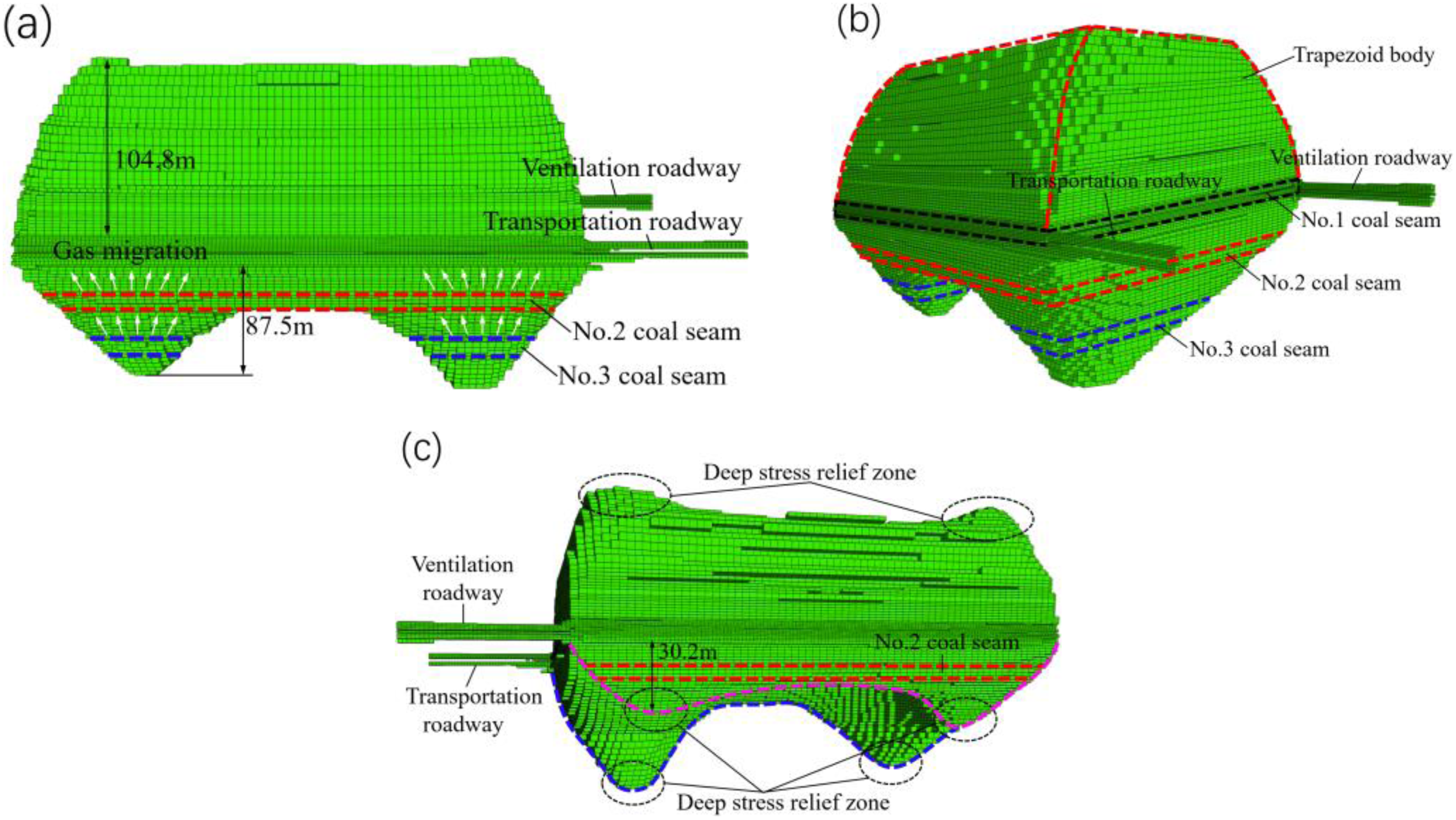
Shape of stress relief body when the working face is mined 350m: (a) perspective 1; (b) perspective 2; (c) perspective 3.
Evolution law of roof and floor permeability
The stress relief body in goaf is conducive to stress relief gas flow, but the stress relief degree is not the same in different parts of the stress relief body. For gas drainage, it is necessary to arrange the boreholes in the stress relief body with high permeability to realize efficient gas drainage. It is far-reaching to explore the permeability of the roof and floor strata for gas precise extraction(Karacan, 2006b; Li et al., 2014, 2018; Liu et al., 2018a; Lu et al., 2016; Xu et al., 2018).
There is a corresponding relationship between abutment stress and rock permeability. The corresponding expression between rock permeability coefficient K and abutment stress is as follow (Li et al., 2004; Xu et al., 2021):
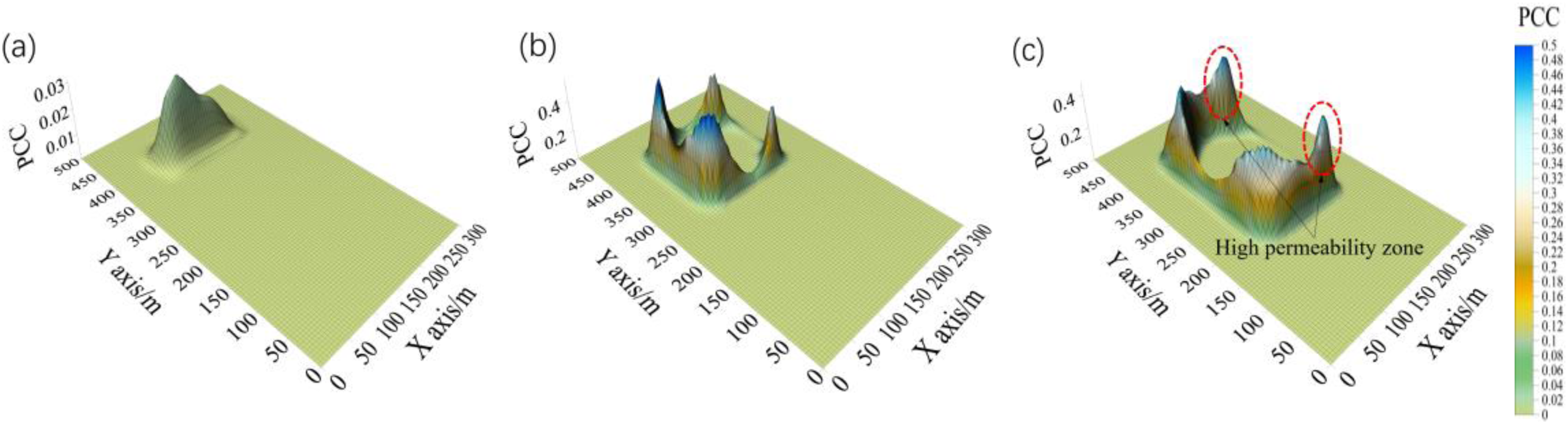
Permeability evolution at 50 m from the working face roof: (a) 100 m; (b) 200 m; (c) 300 m.
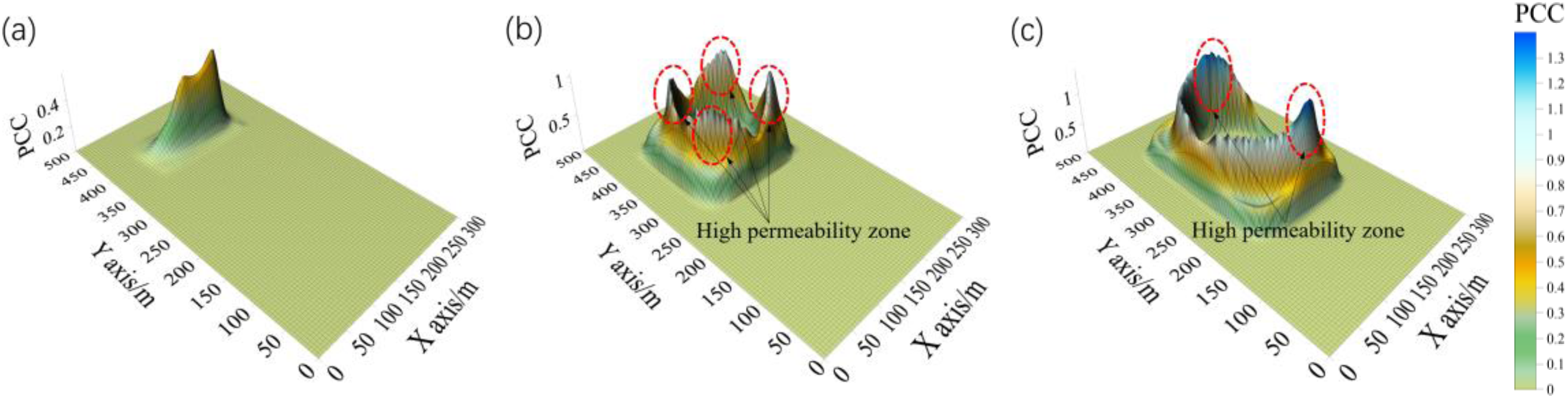
Permeability evolution at 30 m from the working face roof: (a)100 m; (b) 200 m; (c)300 m.
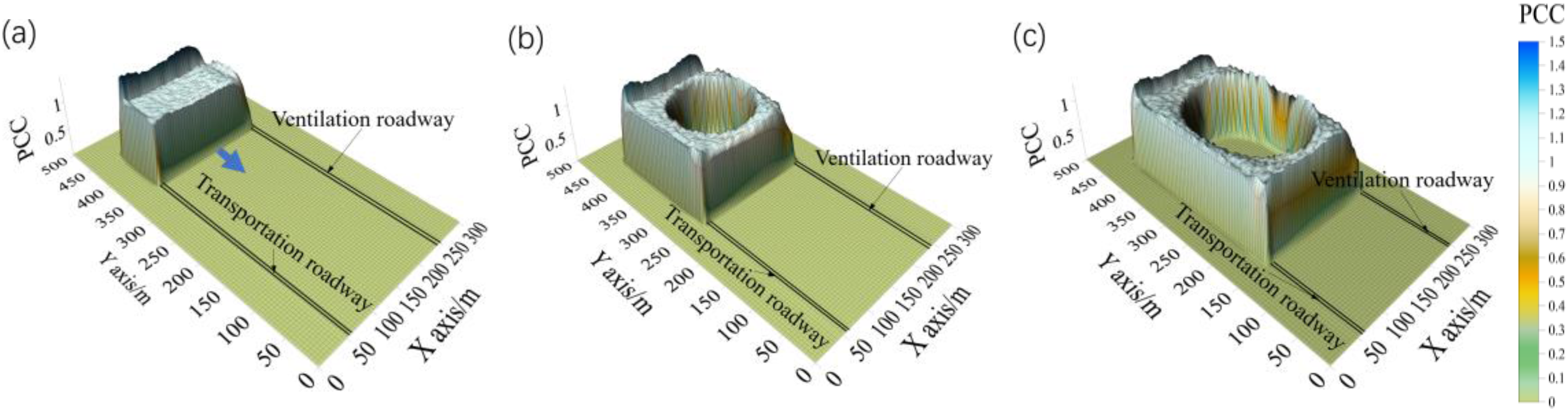
Permeability evolution of No.1 coal seam: (a)100 m; (b) 200 m; (c)300 m.
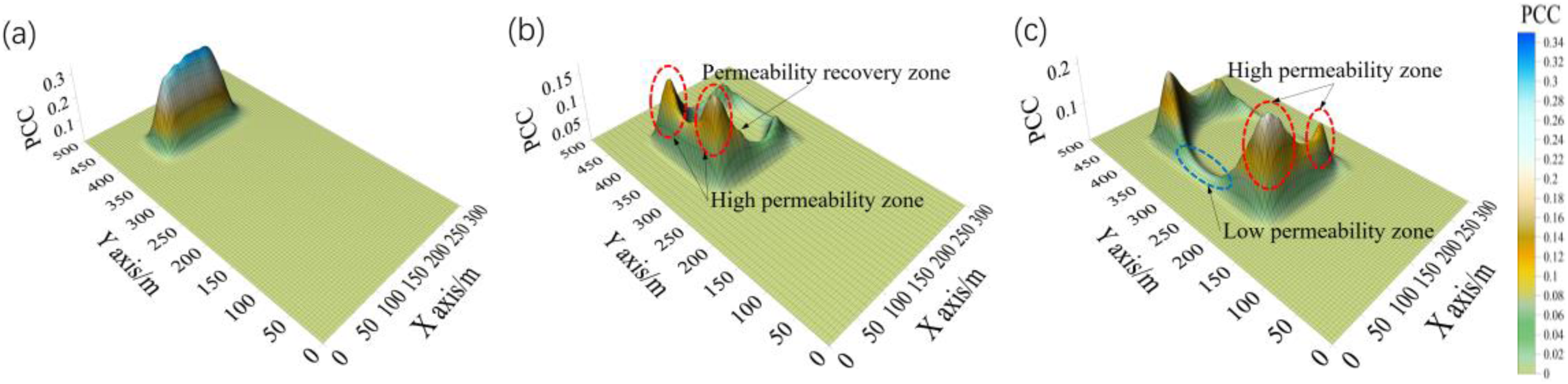
Permeability evolution at No.2 coal seam (23 m away from floor): (a)100 m; (b) 200 m; (c)300 m.
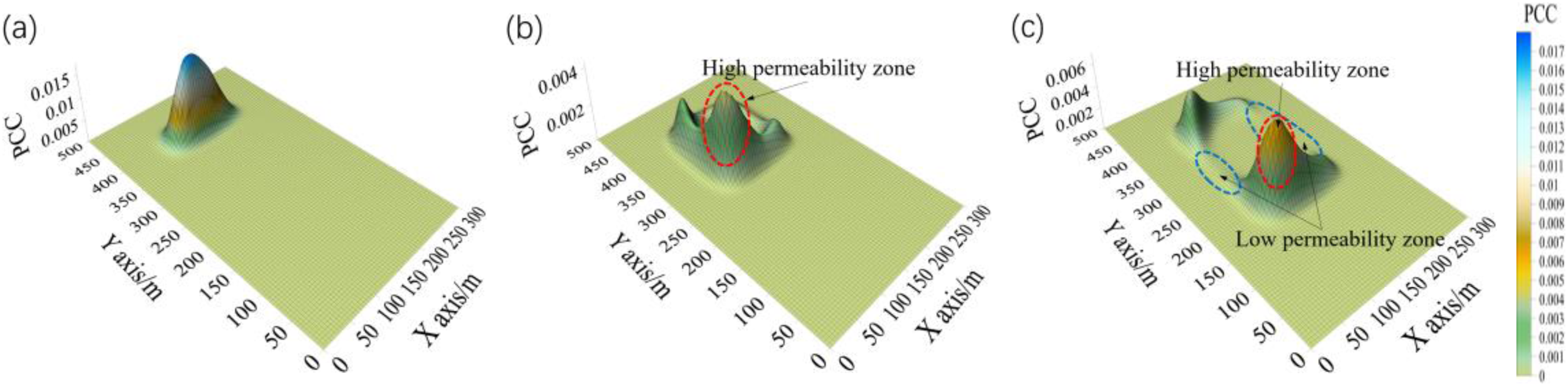
Permeability evolution at No.3 coal seam (52 m away from floor): (a)100 m; (b) 200 m; (c)300 m.
As shown in Figure 9 to Figure 13, the permeability distributions of goaf are different when the mining distances are different. In the coal seam, when the working face is mining 100 m, the permeability of the whole goaf is high. When the mining distance is 200 m, due to the compaction effect, the permeability recovery zone appears in the middle of goaf, where the permeability is low. As the working face advancing, the permeability recovery zone increases, and the high permeability zone forms around the goaf. When the distance between the roof (or floor) and the working face increases, the permeability of the roof and floor decreases due to the decreased influence of the mining, and the permeability of the roof is higher than that of the floor. For the roof, when the mining distance is 100 m, the roof forms a high permeability zone in the goaf. When the mining distance is 200 m, a high permeability zone is formed around the goaf, especially at the four right angles of the goaf. The permeability recovery zone is formed in the middle of goaf due to compaction. When the mining distance is 300 m, the highest permeability of strata is distributed at two right angles of goaf near the ventilation roadway. The range of permeability recovery zone increases with the mining of working face, and the permeability changes along the strike direction in a U-shape distribution.
In addition, the permeability of the goaf is low before the appearance of the compacted zone on the roof. After working face forms the compacted zone, the permeability around goaf increases significantly. When the working face continues to advance, the maximum permeability around goaf tends to be stable. For the floor, when the working face advances 100 m, the permeability of the goaf is high. When the compacted zone appears with the working face mines 200 m, the maximum permeability of the goaf position decreases compared with that without the compacted zone, and the permeability is the highest at two right angles near the side of the transportation roadway. When the working face mines 300 m, the permeability in the middle of the goaf is low, and only the high permeability zone is formed at four right angles of the goaf, and the maximum permeability is located at the lower corner.
To sum up, when the gas is extracted from the roof, the end of the borehole can be arranged in the zone with high permeability near the side of the ventilation roadway or the transportation roadway. For the floor, the borehole can be arranged in the zone with high permeability near the side of the transportation roadway to achieve efficient gas extraction.
Field experiments
To solve the hard nut to crack of gas overrun in 1103 working face and make rational use of gas resources, the engineering practice of stress relief gas prevention and control was carried out. The prevention and control measures of gas in working face included the following two aspects.
Ventilation optimization of working face
The 1103 working face used to adopt U-shaped ventilation mode, and gas overrun often occurred in the working face, especially the upper and lower corners. To solve the gas overrun problem, an auxiliary ventilation roadway was added. The distance between the auxiliary ventilation roadway and the ventilation roadway was 77 m, and the ventilation adjustment of the working face was a partial W-shaped ventilation mode of two inlets and one return. The ventilation system is shown in Figure 14.
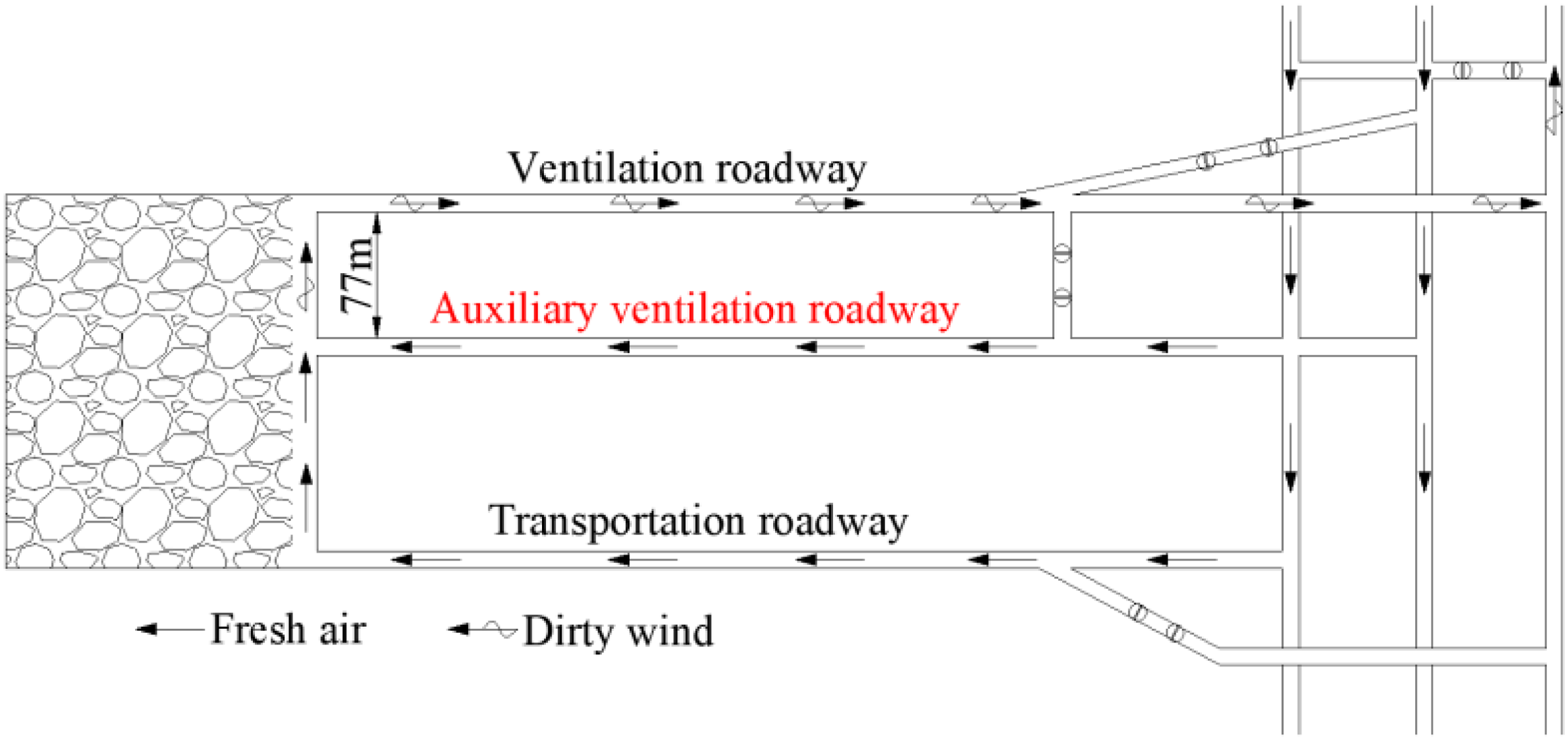
Ventilation system of working face.
When U-shaped ventilation was adopted, the air supply of working face was 926m3/min. After adding auxiliary ventilation roadway, the air supply of working face was adjusted to 1500m3/min, in which the supply volume of transportation roadway was 800 m3/min and that of auxiliary ventilation roadway was 700m3/min. Due to the close distance between the auxiliary ventilation roadway and the ventilation roadway, the distance of fresh air flow through the goaf was short, the air leakage was small, and the gas concentration in the upper corner was reduced due to the increase of air volume. For the lower corner gas, the gas came from No.1 and No.2 coal seam after mining stress relief. In Chapter 3, it is known that the relief gas of No.2 coal seam migrates to No.1 coal seam through the stress relief body, which leads to the gas overrun in working face. To solve gas overrun problem in the lower corner, it is integral to extract the gas of No.2 coal seam.
Optimal arrangement of gas extraction boreholes
In order to carry out stress relief gas drainage in 1103 working face, combined with the results of theoretical research, the engineering test was carried out. The drilling field was arranged in transportation roadway and ventilation roadway. The drilling field was 6.5 m width, 2.8 m deep and 2.8 m high. Three rows of boreholes were arranged in the drilling field of transportation roadway, and each row were arranged with five boreholes, all of which were fanning layouts with 94 mm aperture. The lower row of boreholes was 0.7 m away from the floor of the drilling field, the middle row of boreholes was 1.4 m away and the upper row was 2.1 m away. The upper and middle drainage boreholes were located in the high permeability zone of the goaf. The upper drainage boreholes were 30 m away from the coal seam floor with a dip angle of 30°. The final hole position of the middle row boreholes was 15 m away from the coal seam roof with a dip angle of 15°. The lower drainage boreholes were used to extract the gas from No.2 coal seam. The final hole was located in the high permeability zone of the goaf, 23 m away from coal seam floor, with an a dip angle of 25°. Only two rows of boreholes were arranged for the ventilation roadway drilling field, which was used to extract the gas of roof. The design parameters of boreholes were the same as those of the transportation roadway drilling field. The layout parameters of boreholes were shown in Figure 15.
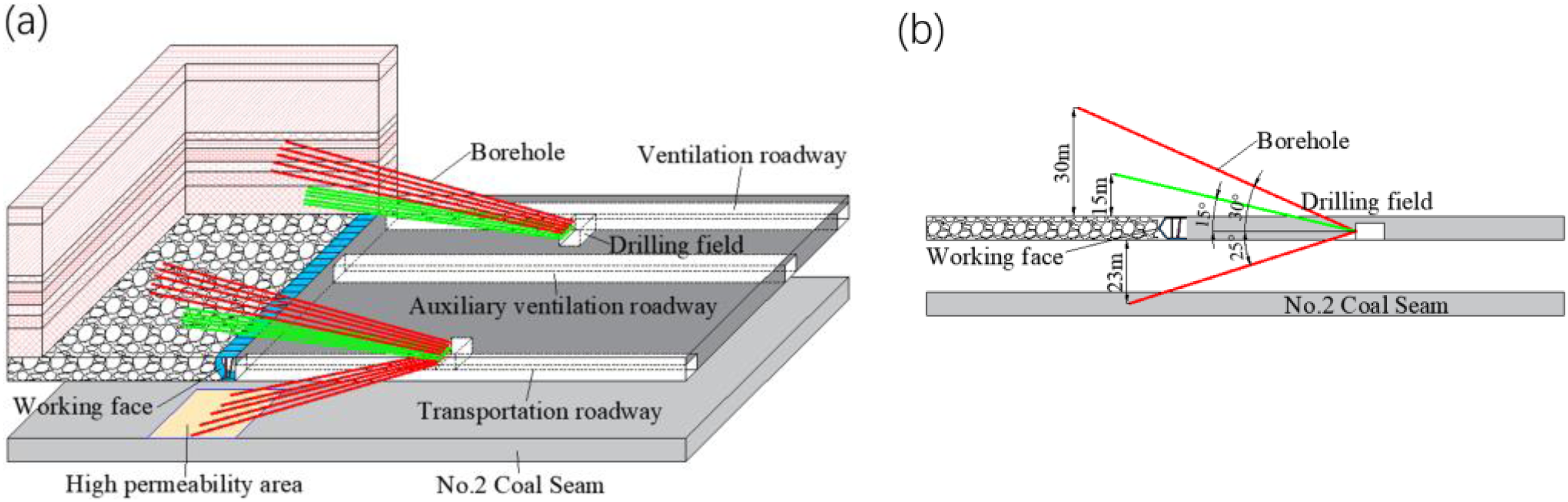
Arrangement of gas extraction borehole: (a) stereoscopic view of borehole layout and (b) borehole layout section.
After the above-mentioned stress relief gas prevention and control technical measures were taken in 1103 working face, the gas drainage pure quantity of boreholes in the drilling field was monitored, and the ratio of air exhaust gas to absolute gas emission was obtained. The monitoring results are shown in Figure 16(a). The gas extraction scheme had a good implementation effect. The maximum pure gas extraction volume of drilling field reached 16.8m3/min, and the air exhaust gas volume accounts for 10%–42% of the absolute gas emission volume of the coal seam. On the other hand, the gas volume fraction at the upper and lower corners was observed, which is shown in Figure 16(b). The change of gas volume fraction in the upper and lower corners verified the effectiveness of the optimization measures of gas drainage and ventilation. The maximum gas volume fraction in the upper and lower corners was not more than 0.47%, and the average gas volume fraction were 0.33% and 0.36%.
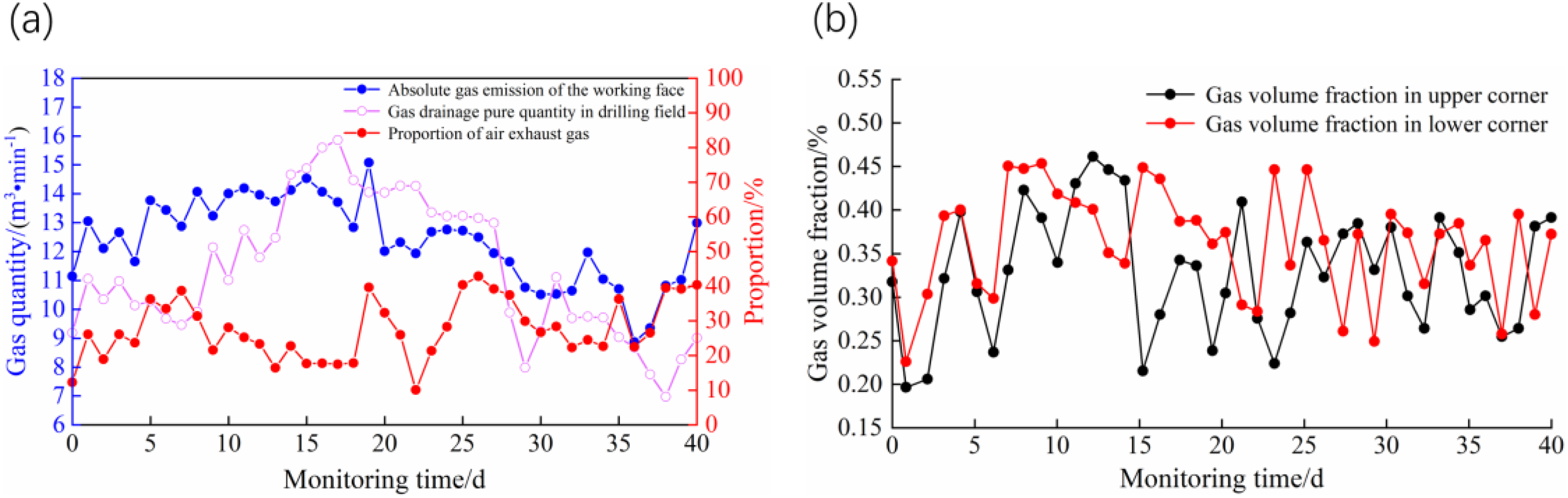
Monitoring results: (a) effect of gas drainage in drilling field and (b) change of gas volume fraction in upper and lower corner.
The technology in 1103 working face has a crucial reference function for prevention and control of stress relief gas in the working faces of Weijiadi coal mine.
Conclusions
The goaf forms compacted zone and stress relief zone after mining. As the distance between the roof (or floor) and the working face increases, the scope of compacted zone increases. The stress relief degree of roof is higher than that of floor.
The shape of the compacted body is funnel-shaped. The shape of the stress relief body is ring distribution, and the roof and floor stress relief bodies form deep stress relief bodies at four right angles. The maximum depth of high stress relief body of roof is 104.8 m; The maximum depth of the stress relief body near the transportation roadway is 87.5 m, and the depth of the stress relief body near the ventilation roadway is 30.2 m.
When the working face is mined, a high permeability zone is formed around the goaf, and a permeability recovery zone appears in the middle of the goaf. The highest permeability of roof strata is distributed in two right angles on the side of goaf near ventilation roadway. The maximum permeability of floor is located at the lower corner position.
The ventilation of 1103 working face was adjusted to a W-shaped ventilation mode with two inlets and one return, and the drilling field was set up. The boreholes were arranged in high permeability zone. After the implementation of stress relief gas prevention technology, the field application effect is good.
Footnotes
Declaration of conflicting interests
The author(s) declared no potential conflicts of interest with respect to the research, authorship, and/or publication of this article.
Funding
The author(s) disclosed receipt of the following financial support for the research, authorship, and/or publication of this article: This research was financially supported by Distinguished Scholars Project of Yueqi (grant number 800015Z1179), Hebei Province Ecological Wisdom Mine Joint Fund Project (E2020402036), Fundamental Research Funds for the Central University's Graduate Students Research and Innovation Ability Improvement Project (grant number 2020YJSNY07).
